







Abstract
The world is a turbulent space for leaders and organisations. Leadership scandals and failures have changed views on leadership behaviour in the West. There is increased demand for more ethical leadership, inspired by ideas of humanness, and care of the well-being of all stakeholders. This article offers our conceptualisation of two emerging domains in leadership – servant leadership and Indigenous Māori leadership. Both not only have strong resonance with each other but also reflect a common concern with individual and collective morality that draws us to the significance of human relationships and, context-specificity specifically as derived from worldview. We suggest these two leadership domains offer transformative realisation of leadership development that accepts alternative ontologies, epistemologies and worldviews, providing for richer and more meaningful understanding of leadership for the 21st century.
Introduction
Scholarship and practice of 21st-century leadership is faced with a host of systemic challenges in the contemporary business world. Researchers are increasingly paying attention to a variety of forms of leadership characterised as destructive, which includes injustice, aggression, bullying and unethical behaviours (Ghoshal, 2005; Krasikova et al., 2013; Schyns and Schilling, 2013). Challenges including climate change, environmental degradation, social justice and the well-publicised failures of leadership in organisations such as Enron, Tyco Ltd and, most recently, FIFA have drawn critical attention (Knights and O’Leary, 2006; Senge et al., 2015; Tomlinson, 2014). Consequently, leadership in practice is under much more intense scrutiny. Particularly, the deeper consideration of the morality and motivations of our business leaders (Knights and O’Leary, 2006), which draws us into a space where personal integrity, moral ethics and care for others are critical variables included in the process of leadership. Therefore, this article draws broadly from the convergence of servant and Māori leadership literatures, respectively, each of which shares a common concern with individual and collective morality that draws us to the significance of human relationships and, context-specificity specifically as derived from worldview. In doing so, we seek to demonstrate the transformative realisation of leadership development that accepts alternative ontologies, epistemologies and worldviews, providing for richer and more meaningful understanding of leadership for the 21st century.
Over the years, leadership scholars have called for different perspectives and ‘new frameworks of interpretation which yield new or deeper understanding of processes to which the term “leadership” is usually attributed’ (Knights and Willmott, 1992: 761). Thus, prompting innovative ways of understanding and researching the notion of the leader and leadership that accounts for the complex needs of organisations today (Lichtenstein et al., 2006). Consequently, there are several emerging areas of ‘new leadership theory’ (Foldy et al., 2008) that advocate alternative approaches and interpretations of leadership practice that engender an ethic of responsibility and care for others (Avolio et al., 2009; Brown and Treviño, 2006; Spiller and Stockdale, 2013). Therefore, we offer insight into leadership theory development that recognises the importance of people, and the way they conceptualise themselves in relation to others, and context, as influenced by beliefs and values (Avolio et al., 2009; Hamilton and Bean, 2005; McElhatton and Jackson, 2012; Ruwhiu and Cone, 2013; Spiller and Stockdale, 2013).
To begin, we offer a brief review of the literature associated with servant and Māori leadership, respectively, to identify key characteristics. We do so not to reflect a deep accounting of these concepts, but rather offer it to provide our understanding of these two leadership concepts. Servant leadership is a form of leadership that accentuates leadership style as people-oriented, stressing personal integrity and service to others (Greenleaf, 2002; Liden et al., 2008; Stone et al., 2004; van Dierendonck, 2011). Other attributes include stewardship, empowerment, building community, trust, honesty and appreciation of others (Russell and Stone, 2002), reflecting an altruistic ethic of care when servant leaders serve those whom they are leading.
Leadership from an indigenous perspective is not a new phenomenon. As with Indigenous peoples worldwide, Māori have always led and recognised leadership qualities in their people; at the centre of which has always been the cultural values that embody Te Ao Māori, the Māori world. Te Ao Māori, locates Māori philosophy, ethics and knowledge (wisdom) in a central role, and is therefore foundational to Māori thinking and practice (Marsden, 2003). 1 Spiller and Stockdale (2013) provide a succinct summary of Indigenous Māori conceptualisations of ‘life energies’ and their influence over leadership and organisation practice. They present five ‘energies’ connected to Te Ao Māori, as whakapapa (genealogies), wairua (spirituality), mana (inherited and endowed authority), mauri (life force) and hau (reciprocity). These practices are people-oriented and constructed primarily for the care and well-being of the people in the organisation.
We then continue on to reflect on critical ‘touch-points’ between the two perspectives of leadership and offer a ‘first glance’ discussion on the implications for leadership theory development for the 21st Century. It is not our aim to provide a unilateral definition of either leadership theory as they are bound to socially specific contexts. Rather, we see it as a platform on which we base our initial thoughts regarding the potential convergence of Indigenous Māori and servant leadership and outline specific implications for practitioners and scholarship of leadership. This article concludes by proposing a broader series of questions related to the philosophical and practical consequences of understanding the nature of leadership as more dynamic and context dependent in an increasingly turbulent and diverse world.
Servant leadership
Servant leaders are defined by their character and demonstration of commitment to serve others (Parris and Peachy, 2013; Stone et al., 2004). Therefore, the desire to serve combined with the motivation to lead is the basis of servant leadership (van Dierendonck, 2011). Greenleaf, the progenitor of servant leadership, writes: It begins with the natural feeling that one wants to serve, to serve first. Then conscious choice brings one to aspire to lead. That person is sharply different from one who is leader first… the difference manifests itself in the care taken by the servant – first to make sure that other people’s highest priority needs are served. The best test is: Do those served grow as persons; do they, while being served, become healthier, wiser, freer, more autonomous, more likely themselves to become servants. And what is the effect on the least privileged in society? Will they benefit or at least not be further deprived? (1970: 4) One which is based on teamwork and community; one which seeks to involve others in decision making; one which is strongly based in ethical and caring behaviour; and one which is enhancing the growth of people, while at the same time improving the caring and quality of our many institutions.
Values attributed to servant leadership.
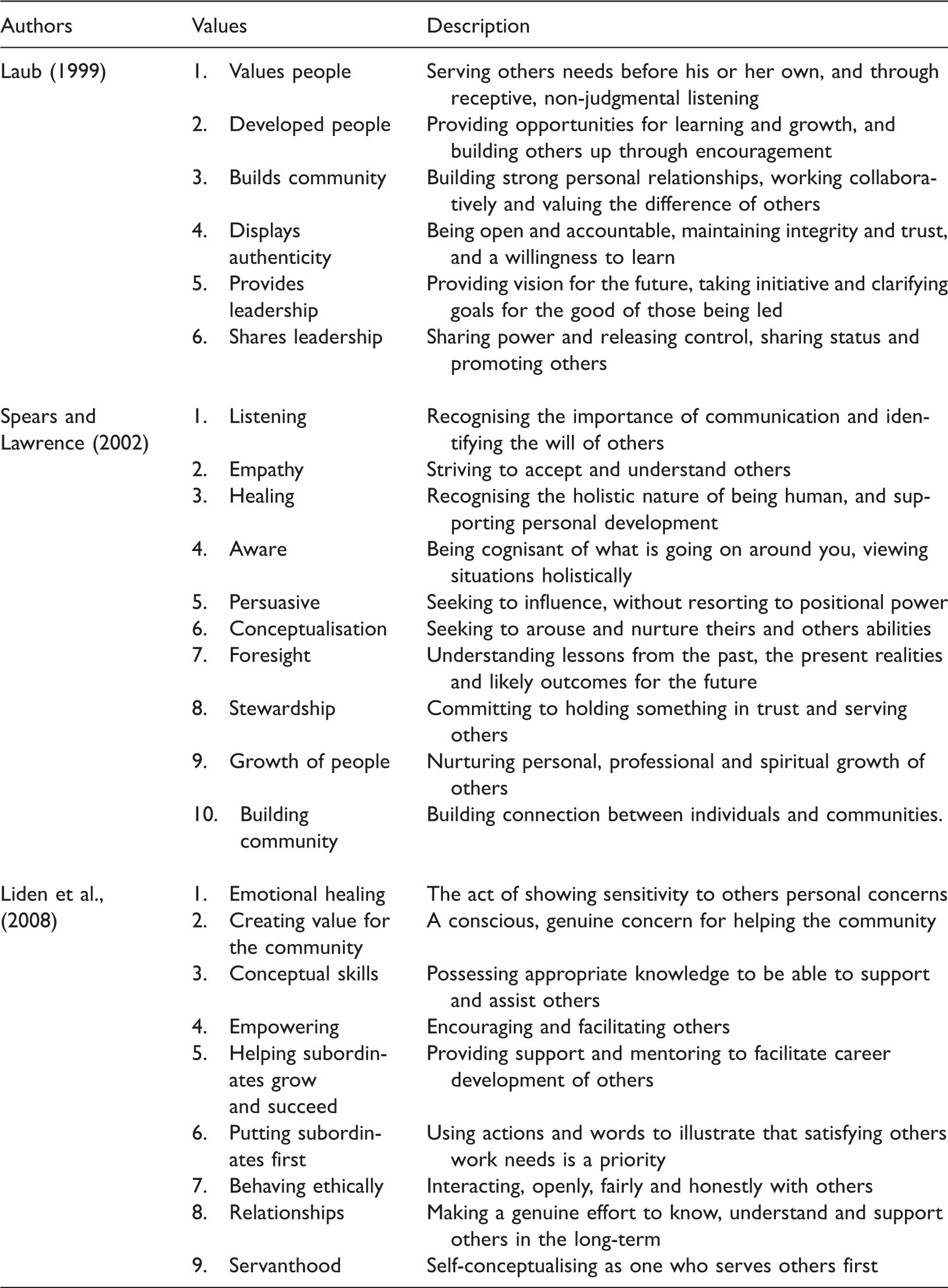
Highlighting these values as foundational, Van Dierendonck (2011: 1232) identifies characteristics of servant leader as those who ‘empower and develop people; they show humility, are authentic, accept people for who they are, provide direction, and are stewards who work for the good of the whole’. Servant leadership is anchored in the human drive to bond with others and imbues a strong ethic of contributing to the betterment of society, and motivated by empowering and developing people with empathy and humility (Mittel and Dorfman, 2012). Understandably, much of the earlier work on servant leadership was dedicated on how to define the concept (for example, see Parris and Peachy, 2013). The first empirical work undertaken was conducted by Laub (1999), developing a model and survey to measure six dimensions of servant leadership: developing people, shared leadership, displaying authenticity, valuing people, providing leadership and building community. More recently, there has been a plethora of theoretical and empirical works dedicated to developing the field further. For example, there is a burgeoning body of work that focuses on the relationship between servant leadership and cross-cultural contexts (Hale and Fields, 2007; Hirschy et al., 2012; Mittel and Dorfman, 2012); comparative analysis between servant and transformative leadership (Stone et al., 2004; van Dierendonck et al., 2014); and, the role of servant leadership in satisfying followers needs and achieving improved form performance (Liden et al., 2014; Peterson et al., 2012).
Indigenous Māori leadership
We draw from a system of Māori leadership that embodies Te Ao Māori, the Māori world, which is interconnected, both physically, spiritually and philosophically (Marsden, 2003). In relation to Māori leadership, rangatira is a Māori term used to denote chiefly status and is associated with the notion of leadership. Manuhuia Bennett, a Māori elder reflected on the notion of leadership when he stated te kai a te rangatira he kōrero, the food of the rangatira is talk; te tohu o te rangatira, he manaaki, the sign of a rangatira is being able to look after others, generosity; te mahi a te rangatira he whakatira i te iwi, the work of the rangatira is binding the iwi. (Manuhuia Bennett – Te Pīhopa Kaumātua (the Bishop, Kaumātua) as cited in Diamond, 2003: 67)
Māori values.
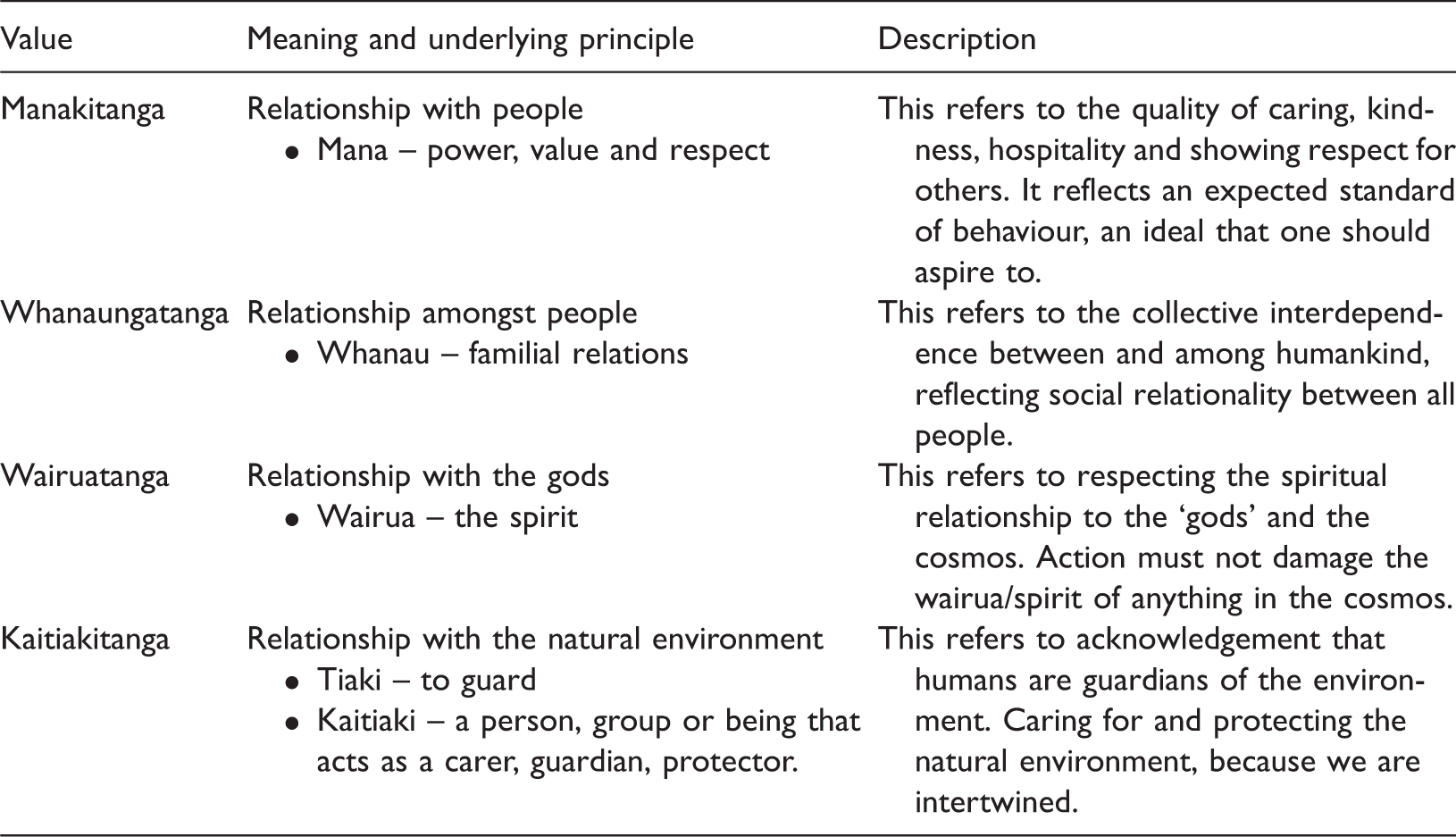
Taken together, these values inform traditional Māori ontology and assumptions about human nature; that is, ‘what is real’ for Māori (Henry and Pene, 2001). This provides the basis for recognising relationships between individuals and provides insight into a Māori worldview that represents the sacredness of all things and the significance of reciprocity in human relations (Henare, 2001). Ruwhiu and Cone (2013) explored the notion of Māori leadership as a form of pragmatic leadership and highlighted in their study how Māori leadership practice is relational and value rational, embedded within the innate connectedness of human beings and spirit. In this context, Māori leaders are accountable to their collective in less hierarchical authoritarian and more open, honest and caring ways. It is recognising that it is the mana, or power and authority vested in a leader gives it a communal aspect (Winiata, 1967). Thus, it can be ascertained that Māori leadership incorporates an element of ‘responsibility to’ the staff and broader community (Ruwhiu and Cone, 2013).
Māori leadership can be described as a process of socialised experiences which instils an innate sense of a special approach to leadership and embedded relations (within iwi/tribal affiliation and whānau/familial relations) (Ruwhiu and Cone, 2013). Spiller et al. (2011a, 2013) also provide deeper insight into the spiritual, cultural and social processes that flourish within the domains of Māori leadership and organisation. There is increasing scholarly attention in the literature shaping deeper understanding of leadership and organisation from within the context of Te Ao Māori, the Māori world (for example, see Haar and Delaney, 2009; Haar, 2013; Katene, 2010; Ruwhiu and Cone, 2010; Spiller et al., 2011b). This is a testament to its importance as an alternative perspective to leadership and organisation, but also the increasing strength of Indigenous Māori leadership and organisation in practice and research.
Leadership theory development for the 21st century
Bass and Steidlmeier (1999: 181) describe leadership as a ‘many-headed hydra’ that allows us to appreciate alternate perspectives of leadership. Therefore, the aim is not to subsume servant leadership into Indigenous forms, or vice versa. Rather, our aim has been to place them side-by-side on the landscape of leadership scholarship to develop richer understanding of these two ‘new’ perspectives of leadership theory and perhaps enhance the discussion around the contribution of such approaches. It is important to note that approaches to leadership that advocate selfless service is not a novel concept. The notion of service through leadership has been acknowledged for thousands of years, as a major theme in Judeo-Christian, Islamic, Hindu and Buddhist thinking (Kriger and Seng, 2005; Sendjaya and Sarros, 2002; Trompenaars and Voerman, 2009; Wallace, 2007). For Indigenous peoples, whose worldviews embody ancient wisdoms, leadership is determined by the cultural, social, exchange and political traditions passed down through generations (Verbos and Humphries, 2014; Winiata, 1967) and have already emerged in modern organisation and leadership approaches. For example, the Māori wisdom tradition (Ruwhiu and Cone, 2013; Spiller et al., 2011a), native American Indian (Warner and Grint, 2006) and indigenous Australian (Foley, 2008).
Connecting Māori and servant leadership.
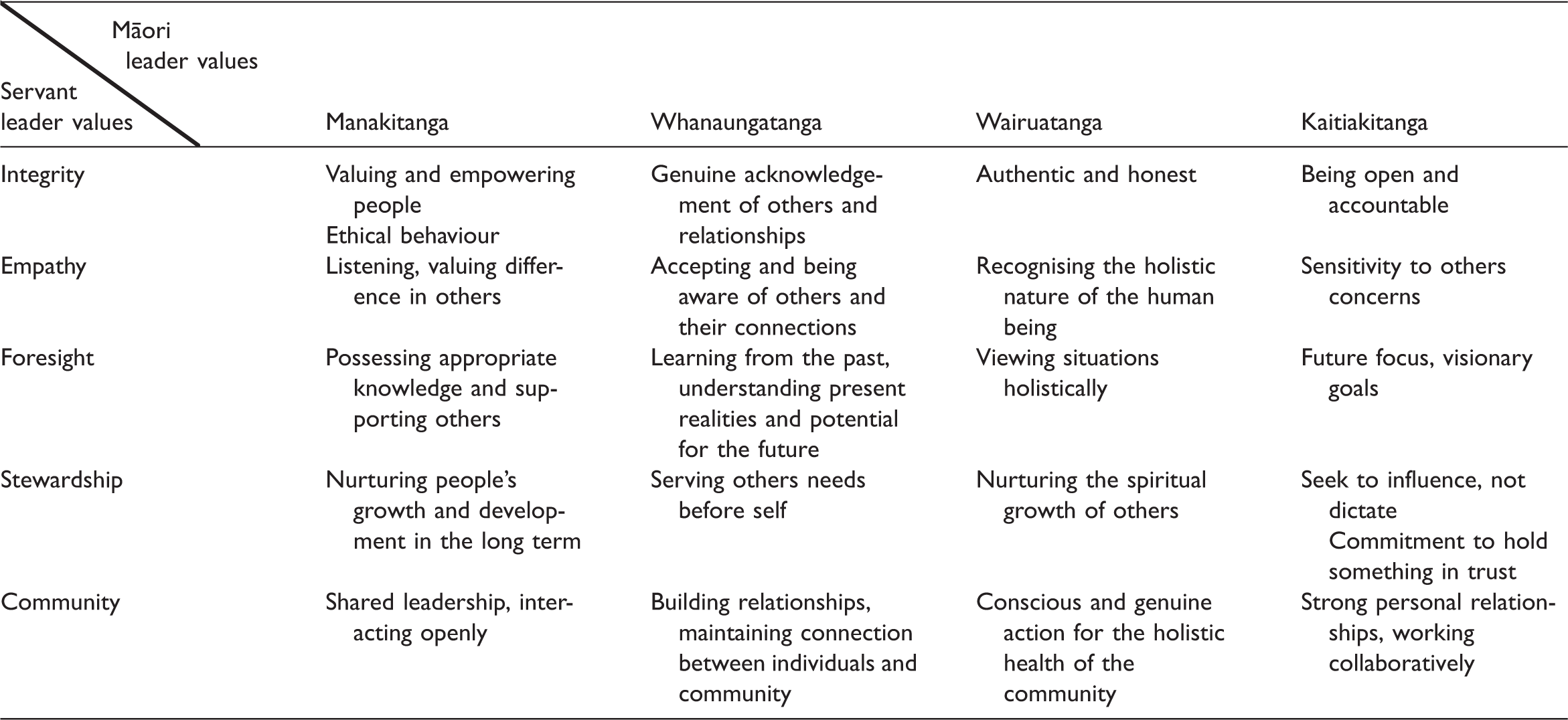
Both servant and Māori leadership literatures, respectively, share a common concern with the significance of human relationships and context-specificity. Subsequently, for both servant and Māori leadership, a vital distinction is in leader focus, specifically the construction of the leader-self in relation to others and the act of leading. This ‘other’ focus has implications for the processes through which leadership relationships form and evolve (Bradbury and Lichtenstein, 2000; Ruwhiu and Cone, 2013; Uhl-Bien, 2006). Through initial exploration, within and across the intersections of the matrix show similar ideas in regards to the philosophical orientation, which embody both servant and Indigenous leadership. The intersections reflect themes of leadership where notions of common humanity, meaning and value for humans in mind, body, emotion and spirit, truth and wisdom are evident. Of significance and relatively untouched in leadership scholarship to date are themes that recognise the temporality of relationships where past, present and future are connected (Marsden, 2003; Spiller and Stockdale, 2013). A convergence between the two perspectives of leadership suggests a much more holistic perspective to understanding leadership practice and research (Avolio et al., 2009; Ruwhiu and Cone, 2013; Zhang et al., 2011). Further research would be needed not only to explore the philosophical relationship at each intersection but also to understand the practical considerations for leadership and organisation studies.
Implications for the way we view leadership theory and practice
The way leadership is understood and practiced is a space of constant negotiation and evolution. Throughout the mid- to late 19th century, there have been several dominant themes that have shaped the way leadership is understood. From traditional depictions of leadership that stem from Carlyle’s ‘Great Man’ theory, which viewed leadership as being primarily focused on specific traits, such as charisma, confidence and intelligence that differentiate effective from ineffective leaders (Avolio, 2007). To perspectives of leadership that study leader behaviour in terms of leader–follower exchange relationships, and reinforcement behaviours that transform and inspire followers to perform beyond expectations while transcending self-interest for the good of the organization (Avolio et al., 2009; Bass and Steidlmeier, 1999). In their review of leadership theory and research, Avolio et al. (2009) identified several new leadership models that included servant leadership. Although they do not specifically name Māori leadership, they acknowledge the various forms of cross-cultural and spiritually based forms of leadership that have emerged.
Servant and Indigenous leadership contribute to the continuing evolution of leadership literature by reflecting a more holistic and positive form of leadership. Importantly, they both enable different philosophic lenses, or worldviews to be used when exploring ‘what constitutes leadership’. As Morgan (1980) argues to understand the orthodoxy in organisation theory, we must understand the ‘relationship between different modes of theorising and research, and the worldviews they reflect’ (p. 606). We do not use the term worldview in any hegemonic capacity, but rather view this space as a useful starting point to articulate a conceptualisation of alternative ‘views’ and ‘realities’ (Deetz, 1996; Morgan, 1980). To accept the existence of worldviews with their own philosophical orientation, logics, discourse and practices, means we argue that understanding requires a philosophic framework that is culturally informed and sensitive to the history and needs of different cultural communities (Ruwhiu and Cone, 2010).
The acceptance of alternative worldviews suggests that the representation and application of leadership theory and practice must be constructed in the contextualised/localised needs of the communities, and their worldview in which it is practiced (Ruwhiu and Cone, 2013; Zhang et al., 2011). In this point, we share the view that leadership is determined by context and ‘is still something that means different things to different people’ (McElhatton and Jackson, 2012: 441). Grint (2005) suggests that one of the field’s key failings is the underestimation of the extent to which context or situation is actively constructed by leaders. Leadership involves ‘the social construction of the context that both legitimates a particular form of action and constitutes the world in the process’ (Grint, 2005: 1471). Therefore, the study of servant and Indigenous leadership has broad implications for the development of context and value-rational understandings of leadership, more generally, and helps to give meaning to the characteristics and processes of leadership that can respond to the challenges of the 21st century.
Implications for research
Research in organisation and leadership studies are well implicated in the [re]production of economic, social and symbolic inequalities (Jack et al., 2011; McElhatton and Jackson, 2012; Ruwhiu and Cone, 2013). Much of the debate centres on the notion of ‘context’ and how it is conceived of and empirically explored in accounting for organisational, collective or individual cultural distinctiveness (Jack et al., 2013; Ruwhiu and Cone, 2010). This concern with context is, in part, a response to the increasing dissatisfaction with the overwhelming dominance of Anglo-American values, interests and theoretical frameworks that have cast the ‘non-Western’, ‘alternative’ or ‘Indigenous’ to the margins (Jack et al., 2011, 2013). Developing an appreciation of the convergence between servant and Māori leadership is particularly relevant to the study of leadership in an international and increasingly multi-cultural context. Both approaches to leadership offer a conceptualisation of and research into leadership forms and processes attributable to communities and their respective worldviews (Ruwhiu and Cone, 2013; Spiller and Stockdale, 2013; Warner and Grint, 2006).
For both servant and Māori leadership, there is the potential to develop critical appraisal tools that are capable of engaging multiple worldviews with integrity to provide more robust analysis of leadership processes in diverse forms of organisation and geographic locations. For example, in New Zealand, an Indigenous paradigm in the form of kaupapa Māori research is a research that gives full recognition to Māori cultural values and systems (Walker et al., 2006). Kaupapa Māori research is implicitly founded on collective consciousness, and historical and cultural concepts that are not necessarily reflected in mainstream Western perspectives of research. As a culturally constituted research tradition, kaupapa Māori research comprises values, which accept and embrace complexity through a relational orientation within a community of interests. It ensures that Māori maintain conceptual, methodological and interpretive control over research that is of relevance to Māori (Henry and Pene, 2001; Smith, 2012).
Several intriguing directions for future research arise across cultures, contexts and a diversity of research foci. First, this review highlights the need for further conceptualisation of the intersecting ‘touch-points’ between the characteristics of servant leadership and values that ground Māori approaches to leadership. More profound understanding of the nexus between the two would lend strength to each in regards to conceptual modelling and empirical investigation. Researchers could explore the notion and characteristics of a servant led Māori enterprise, or conversely, analysis of Māori entrepreneurial behaviour might provide deeper insight into the cross-cultural applicability of servant leadership.
The construct of culture within society is rich with complexity. Its connection to leadership is inherently difficult, mainly because the relationship tends to be more subtle. Yet, the study of the intersect between leadership and a particular culture offers deep and rich avenues of inquiry for leadership scholars and practitioners (McElhatton and Jackson, 2012). There is increasing interest in the connection between servant leadership and the cross-cultural context (Hale and Fields, 2007; Hirschy et al., 2012; Mittel and Dorfman, 2012; van Dierendonck, 2011), which draws us to the importance of cultural value systems. By focusing attention onto the cultural context offered by Māori worldview, we are drawn naturally to the potential commonalities with other non-Western worldviews that provoke us to seek evidence for servant leadership in a whole range of Indigenous societies. For example, Richardson et al. (2013) discuss the commonalities between Hindus and Islamic people and their understanding of work, spirituality and leadership. Leadership has also been explored among New Zealand Māori, Pacific Island, Native American Indian and Indigenous Australians, which we argue will locate Indigenous leadership as distinctly different from the dominant styles of Western leadership (Foley, 2008; Ruwhiu and Cone, 2013; Warner and Grint, 2006). Regardless of the research avenues, more theoretical work and research on both servant and Indigenous leadership will only provide deeper and more insightful contexts and analysis opportunities of leadership for the 21st century.
Conclusion
In this article, we have explored the convergence of indigenous Māori and servant leadership literature as an alternative to dominant views of leadership so deeply embedded in Western ethics, providing insight into leadership processes and practice across diverse contexts and cultures. Servant leadership and Indigenous Māori leadership each offer valid and exciting perspectives for leadership within a wide range of organisations and contexts. A key feature of both servant and Indigenous leadership is that they are never morally neutral nor socially disconnected, providing insight into leadership based on universal human values of respect, integrity and care for others. These values are not new. They are deeply embedded in ancient and Indigenous wisdoms that are [re]emerging in our leadership literature (Spiller et al., 2011a; Verbos and Humphries, 2014).
Both servant and Māori leadership extend our thinking about leadership theory development. Not only do these two approaches offer an important challenge to the narrow visions of universalism, in which Western views of leadership and management are located, but they contribute to the emerging conversation from Chinese, Latino and Islamic contexts (Jack et al., 2013; Zhang et al., 2011). Surely, as we enter the second decade of our new millennium facing financial crises and environmental degradation founded on corporate greed, these are values worth reclaiming and nurturing in our business leaders (Krasikova et al., 2013). This has implications, not only for how we expect our leaders to behave but also, as scholars, the type of research we support and what we teach in our business schools. In doing so, our intention is to generate new ways of thinking about and researching leadership, using the characteristics of both servant and Māori leadership to inform our understanding of leadership in a context specific – value-oriented way.
Broader questions then arise, such as, what is the philosophy and practice of servant and/or Indigenous leadership? What are the social processes by which servant and/or Indigenous leadership are constructed? What does quality servant and/or Indigenous leadership look like? Do servant and Māori provide more humane and ethical approaches to leadership? Can they provide the ‘answer’ for those seeking a viable leadership approach to resolve the challenges of the 21st century? Further research is needed to explore, not only the philosophical underpinnings of each concept but also to understand the practical considerations for leadership thinking now and as it evolves in the future. We conclude with a whakatauki, or proverb – Ka mura, Ka muri (walking backwards into the future), which means that as we forge new paths, we must learn from those who have gone before us. That is, to follow in the footsteps of Maori and servant leadership enables us to consider the phenomenon of leadership and leaders in a more holistic way, and with a stronger connection to the complex realities of the modern world.
The author(s) declared no potential conflicts of interest with respect to the research, authorship, and/or publication of this article.
The author(s) received no financial support for the research, authorship, and/or publication of this article.
Glossary
English Vitality of human life, essence land, breath of life, reciprocity Tribe Talk, speech Food Work Inherited and endowed authority Generosity, to look after others, Life force, life principle Leader, person of authority Potency of those things held to be sacred The Māori world Sign The spirit Genealogy Proverb To unite, bind together Family