






Abstract
In this paper, we extend research on implicit leadership theories by exploring and clarifying the content and structure of effective leader prototypes. We invited 78 Chinese and 50 American business practitioners to describe effective and ineffective leaders. Drawing on grounded theory approaches, we coded 671 statements of participants and found 41 leader attributes. After grouping these attributes into eight themes, we found that the structure and content of effective and ineffective leader prototypes indicate a departure from existing implicit leadership theories. In particular, we discovered a paradoxical theme regarding leader power, whereby this attribute could be simultaneously viewed as both effective and ineffective. This finding also emerged in a follow-up qualitative study that used archival data to explore the attributes of four exemplar powerful business leaders in the United States and China. Our studies probe the differences between effective leaders and typical leaders in implicit leadership theories and evoke scholars’ attention to the paradoxical evaluation of power in effective leaders. We discuss the implications for future research and managerial practice stemming from the ambiguity surrounding certain aspects of leadership effectiveness.
Introduction
I’ve looked at life from both sides now
From up and down, and still somehow
It’s life’s illusions I recall
I really don’t know life at all.
“Both Sides, Now” (Joni Mitchell, 1969)
Distinguishing leaders from non-leaders has been a central issue for leadership researchers and practitioners since implicit leadership theories (ILTs) gained scholarly attention 40 years ago (Epitropaki et al., 2013; Humphreys et al., 2015; Junker and van Dick, 2014). Traditionally, ILT researchers have focused on investigating the structure of prototypes, which refer to the “abstract conception of the most representative member or most widely shared features of a given cognitive category” (Phillips, 1984: 126), to capture the characteristics that individuals use to endorse someone as a leader (Junker and van Dick, 2014). In particular, using individual perceptions as a basis, researchers have organized leader attributes into categorization-based models, which were usually arranged as high or low in the level of prototypicality using terms such as positive/prototypic and negative/antiprototypic traits (e.g., Epitropaki and Martin, 2004; Lord et al., 1984; Offermann et al., 1994). Researchers also have continuously assessed the generalizability of this dichotomous structure of ILTs across contexts such as gender, employees’ work groups, and cultures (for a review, see Epitropaki et al., 2013). In addition to the ILTs research at the individual level of analysis, the Global Leadership and Organizational Behavior Effectiveness Research Program (GLOBE) has closely investigated how societal cultures can shape leadership expectations. GLOBE scholars have also compared people’s perceptions of outstanding leaders across cultures and searched for leader attributes relating to leadership effectiveness in different cultures (Chhokar et al., 2007; House et al., 2002, 2004, 2014).
Despite the prevalence of dichotomous “either/or” taxonomies of ILTs advanced in previous studies, quite a few researchers have identified ambiguous leader attributes (e.g., attractiveness, bold) that could fall into both the prototypical and antiprototypical categories (Epitropaki and Martin, 2004; Lord et al., 1984; Offermann et al., 1994). Meanwhile, the GLOBE project has revealed the fuzzy nature of some culturally contingent leadership dimensions that relate to effective leaders in some cultures and ineffective leaders in others (e.g., Castaño et al., 2015; Den Hartog et al., 1999; House et al., 2004).
Two recent lines of research may shed light into the ambiguity surrounding certain leader attributes. First, an increasing number of ILT researchers (e.g., Foti et al., 2017; Junker and van Dick, 2014; Van Quaquebeke et al., 2014) have identified the variance between “typical” and “ideal” leader prototypes and enquired into what it means to be perceived as an effective leader. While typical leader prototypes refer to the most common, or “average” or “central tendency” leader attributes (e.g., Epitropaki and Martin, 2004; Lord et al., 1984; Offermann et al., 1994), ideal leader prototypes refer to “effective” or “goal-oriented” leader attributes (e.g., Chhokar et al., 2007; House et al., 2004, 2014), relating to the attainment of desired or intended organizational outcomes (Junker and van Dick, 2014; Schyns and Schilling, 2011). It is important to note that although typical leader prototypes may be contrasted with ideal/effective leader prototypes, this does not imply that typical is equivalent with ineffective leader perceptions. Rather, typical simply reflects “average” leader attributes. In short, the ambiguous nature of some leader attributes may stem from a disconnection between leadership as viewed in the mind and leadership as viewed in practice. Thus, the “think typical vs. think effective” distinction requires researchers to differentiate effective leaders from typical leaders.
Second, within the larger spectrum of critical leadership studies (e.g., Alvesson and Spicer, 2012; Collinson, 2017; Collinson and Tourish, 2015) a growing body of research has focused on power in leadership (e.g., Collinson, 2014; Salovaara and Bathurst, 2018; Tourish, 2014) and paradox/contradiction in leadership (e.g., Collinson, 2014; Ford, 2006; Kodish, 2006; Zhang et al., 2015). These researchers note that mainstream leadership research has tended to dichotomize leadership, especially when it comes to the leadership attribute of power (e.g., Collinson, 2014). Throughout the twentieth century, an earlier analytical focus on ambiguities, contradictions, tensions, and paradoxes was abandoned in favor of new theories and perspectives consumed with creating conceptual neatness and order (Storey and Salaman, 2009). More recently, however, attention has shifted toward dialectical analysis in the context of leadership (e.g., Collinson, 2005, 2011; Fairhurst, 2001). As Collinson (2014: 41) explains, “a small number of leadership writers have begun to deconstruct dichotomies by arguing that such either/or binaries are better understood as dialectically inter-related.” Accordingly, we believe that the fuzzy nature of some leader attributes could be associated with complex and paradoxical leadership dialectics that may shape the ILTs of perceivers and that thinking beyond the assumption of either/or binary categorizations in existing ILT frameworks is needed.
The purpose of this research is to investigate further the characteristics of effective business leaders and to explore perceived differences between effective leaders and typical leaders. These important issues have not been fully clarified by previous ILT researchers. By conducting two qualitative studies, we aim to explore the content and structure of implicit effective leadership in two of the world’s largest economic entities: China and the United States. We believe that our qualitative methods could possibly facilitate the identification and interpretation of leader attributes that may not have been fully examined in earlier ILT studies.
Our findings make three theoretical contributions. First, we take an important step toward clarifying the content and structure of implicit effective leadership, responding to recent calls for ILT studies focusing on what attributes constitute ideal/effective leaders in follower ILTs (e.g., Foti et al., 2017; Junker and van Dick, 2014; Van Quaquebeke et al., 2014). Also, we extend the GLOBE project (Chhokar et al., 2007; House et al., 2004, 2014) by further exploring the characteristics of effective leaders across two distinctive cultures. Second, we respond to calls suggesting that leadership researchers move beyond dichotomized perspectives toward more contradictory and paradoxical leadership dialectics (e.g., Collinson, 2014: 28) as we attempt to raise scholars’ attention to possible alternatives for classifying leader attributes other than within binary patterns. More precisely, in the current study, we propose a trichotomy model of categorization that reflects the multifaceted nature of individual cognitive schemes used to evaluate effective business leaders. In particular, our findings regarding the paradoxical and contradictory nature of leader power attributes provide insights for better understanding employee perceptions and reactions to the use of power by leaders in managerial practice (Collison, 2005, 2014; Nicholson and Carroll, 2013; Tourish, 2014).
Theoretical development of ILTs
Implicit leadership research in general focuses on followers’ subjective views of leaders, particularly, their cognitive structures containing the traits and behaviors of leaders (Junker and van Dick, 2014; Schyns and Schilling, 2011). Early ILT studies conceptualized and verified prototype activation processes in which leadership is judged by its perceivers (Junker and van Dick, 2014). Applying theories of cognitive categorization (Rosch, 1978; Rosch and Mervis, 1975), Lord and his associates (Lord et al., 1982, 1984) used the term “leadership prototype” to represent leadership-related cognitive categories. They suggested that individuals follow their underlying cognitive patterns to evaluate how well a perceived leader fits these prototypes.
Since then, ILT theorists have continuously explored the structure and content of leadership prototypes. For example, Lord et al. (1984) identified 59 leader attributes and 26 non-leader attributes. Offermann et al. (1994) substantially updated Lord et al.’s (1984) model, identifying 41 leader characteristics structured in eight distinct ILT factors (sensitivity, dedication, tyranny, charisma, attractiveness, masculinity, intelligence, and strength). Epitropaki and Martin (2004) further refined Offermann et al.’s (1994) framework of leader attributes, developing a shorter 21-item scale with a six-factor structure of business leaders and showing its adequate generalizability over time. They labeled sensitivity, intelligence, dedication, and dynamism as positively evaluated leadership prototypes, with tyranny and masculinity as negatively evaluated leadership anti-prototypes.
Though ILT researchers have attempted to differentiate between leader attributes and non-leader attributes, this research has focused mainly on typical leaders and has been less clear regarding the extent to which ideal or effective leaders should be considered in ILTs (for a brief review, see Van Quaquebeke et al., 2014). For example, Offermann et al. (1994) used undergraduate samples to generate items, examine content validity and compare the content and structure of ILTs across three stimuli. They found that although both leaders and effective leaders were viewed similarly in four of the eight leadership prototypes (Sensitivity, Dedication, Charisma, and Intelligence), leaders were more tyrannical and stronger in strength than effective leaders. Due to the lack of a follow-up comparison between prototypes of leaders and prototypes of effective leaders, Offermann et al. (1994) concluded no variation in people’s perceptions of leaders and effective leaders.
Schyns and Schilling (2011) reinvestigated effective and ineffective leader attributes within the ILTs framework. As an extension of Offermann et al.’s (1994) study, Schyns and Schilling (2011) conceptualized effective leaders as ideal leaders and defined effectiveness as “being successful with regard to the achievement of goals” (142). Their study indicated that the “leader” category is not “as static and fixed as formerly believed” (2011: 147). In addition, Schyns and Schilling (2011) suggested that followers/perceivers might hold different perceptions of effectiveness for leaders perceived in terms of objective organizational performance as compared with their own subjective job satisfaction. Schyns and Schilling (2011) asked participants to name six attributes of a typical leader and then to rate the extent to which these typical leader attributes influence leadership effectiveness. Thus, these authors explored the extent to which typical leader attributes are automatically perceived as effective, whereas the current paper focuses on the attributes of effective leaders.
GLOBE researchers (Chhokar et al., 2007; House et al., 2004, 2014; Javidan et al., 2006) have made similar attempts to explore the content and structure of leader prototypes, extending ILTs research to the societal and cultural level and proposing culturally endorsed implicit theories of leadership culturally endorsed implicit theories of leadership (CLTs). The GLOBE project has taken a principal goal of determining how cultural values predict societal leadership expectations (i.e. CLTs) and further influence leader participation, acceptance and effectiveness (Bullough and de Luque, 2015; Dorfman et al., 2012; House et al., 2014). However, much like Schyns and Schilling (2011), GLOBE researchers have focused on the extent to which leader attributes “are contributors to or inhibitors of outstanding leadership” (Javidan et al., 2006: 73), while the present study seeks to identify more clearly the content and structure of implicit ideal/effective leader prototypes.
In sum, neither ILT nor CLT researchers have fully explicated the concept of effective leaders and possible related prototypes. Although recent ILTs research has provided some initial clarification of effective leaders as ideal leaders rather than typical leaders (e.g., Solansky et al., 2017; Van Quaquebeke et al., 2014), we only found a single study (Schyns and Schilling, 2011) that directly examines effective vs. ineffective leaders in the context of ILTs. In response to the call from recent ILT researchers, we believe the time is right for extensive investigation of effective vs. ineffective leaders as a means for providing more evidence to help further develop the concept of ideal leader prototypes (Foti et al., 2017; Junker and van Dick, 2014; Van Quaquebeke et al., 2014). Theoretically, a detailed inquiry into effective and ineffective leaders could help not only to explicate the “clearly defined center but fuzzy boundaries” of ILTs (Foti et al., 2017: 264) but also to clarify the underlying distinctions between ideal and typical leaders. From a practical standpoint, an accurate and comprehensive characterization of effective leaders could also aid organizations in selecting and developing qualified managerial personnel to achieve organizational effectiveness as well as other important goals relating to the welfare of stakeholders.
Study 1 – Method
We used a grounded theory approach (Corbin and Strauss, 2015; Locke, 2001) to explore possible leader attributes associated with effective leaders. Grounded theory is a qualitative research method used “to construct theory grounded in data” (Corbin and Strauss, 2015: 3). It is viewed as an especially appropriate methodology to elaborate on prior theory “by extending and refining its existing theoretical categories and relationships” (Locke, 2001: 103). In Study 1, we aimed to explore the structure and content of implicit effective leader attributes.
Data collection
Because our basic strategy of sampling involved finding appropriate contexts that allow us to capture and examine prototypes of effective leaders, we used theoretical sampling strategies to collect data. Building upon grounded theory, theoretical sampling is “open and flexible” because “it enables analysts to follow the lead of the research and to direct data collection to those areas that will best serve the developing theory” (Corbin and Strauss, 2015: 177).
We explored how business practitioners perceive effective leaders in two countries: China and the United States. We chose U.S. and Chinese participants because these countries are representatives of the GLOBE project Anglo and Confucian Asian cultural clusters, respectively (Chhokar et al., 2007; House et al., 2004). According to GLOBE analysis of cultural clusters (Chhokar et al., 2007), the mainstream U.S. society is generally high in the levels of individualism, gender egalitarianism, and assertiveness and low to moderate in the levels of power distance and uncertainty avoidance (Hoppe and Bhagat, 2007). As a complete contrast to the U.S society, the mainstream Chinese society is high in the levels of collectivism, power distance and uncertainty avoidance and relatively low in the levels of gender egalitarianism, and assertiveness (Fu et al., 2007). Also, GLOBE researchers have found that some leader attributes are ambiguous in these two countries due to the influence of national cultural values. For instance, Chinese leaders are good at balancing two seemly contradictory values: conservative and aggressive (Fu et al., 2007). Likewise, though “decisive” and “just” are universally desirable leader attributes, they have unique meanings in the United States (Hoppe and Bhagat, 2007). Therefore, these two countries serve good comparative contexts that enable us to investigate the consistency of effective leader attributes across cultures.
We undertook our study as part of a larger research project on leadership development and leadership effectiveness. We first invited participants to complete open-ended questionnaires. The participants were asked first to briefly describe their career history and then to think of one or more effective leaders that they personally knew or had heard about and to describe why they choose the person(s). Ultimately, we surveyed 47 participants in China and 26 participants in the United States. Since data collection completion requires that “each category is well defined and developed in terms of its properties and dimensions and includes sufficient variation to show the range to which the categories apply” (Corbin and Strauss, 2015: 251), we further interviewed 31 Chinese participants and 24 American participants to supplement our survey data. These interviewees responded to the same questions on their individual career histories and their effective/ineffective leader as those completing the open-ended surveys. However, the interviewees could take more time to recall effective business leaders that they have witnessed in their careers and could take more initiatives to analyze the characteristics of these leaders. Both the surveys and the interviews were conducted in the native languages of participants.
Our participants came from multiple sources. Some of the Chinese participants were invited through the alumni association of a prestigious research university in Shanghai, while others were approached through the researchers’ personal social networks including both business and social contacts. The American participants were invited through the alumni networks of a public university in New England. Altogether, 78 Chinese business practitioners (39 males and 39 females) and 50 American participants (28 males and 22 females) voluntarily participated. They worked in a wide range of industries, including engineering, financial services, insurance, health care, consulting, manufacturing, telecommunication, entertainment, advertisement, information technology, construction, hospitality, food services and other fields. The medians of working experience and managerial experience of our Chinese participants were nine years and six years, and those of American participants were 10 years and 8 years, respectively. The majority of the participants were between 25 and 45 years in age. The business leaders to whom the participants referred were mostly the middle managers within their own organizations.
Data analysis
We analyzed the survey responses and interview transcripts, searching for statements related to leader attributes. NVivo 10 (QSR, 2013) was used to organize the survey answers and interview transcripts. In total, we identified 671 statements, 356 from subjects in China and 317 statements from subjects in the United States. Statements contained the participants’ expressions regarding the characteristics of their leaders ranging from one to five sentences. We used the back-translation technique (Brislin et al., 1973) to ensure the linguistic accuracy between the Chinese and English versions of the statements collected in China. All the statements collected in the two countries constituted our data for further analysis. We followed a three-stage procedure in data analysis (Gioia et al., 2013).
Stage 1: Identifying first-order categories
We began with concept identification or open coding (Corbin and Strauss, 2015; Locke, 2001) to identify respondents’ views on the attributes of effective and ineffective leaders. At this stage, we attempted to explore and exhaust the potential attributes from the subjects’ statements. We first fractured the statements and worked independently to identify every word or phrase related to leader attributes in each statement. For example, we found several statements indicating that effective leaders are very smart, have high levels of work experience, and are highly capable of managing their emotions. These statements were made in response to an initial question, “what are the characteristics of an effective/ineffective leader?” Following Locke’s (2001) guidance, we used a category card form to record data fragments adapted from the statements. We kept track of the source and location of the fragments, the assigned meaning of the category name, and any possible relations between each card. This approach led us to develop provisional categories or first-order codes for our data. Using the constant comparative method (Locke, 2001), we checked back and forth as we named data fragments and compared these data fragments until no new codes emerged. Once the independent analysis was finished, we compared the tentative individual provisional categories of the two primary researchers and checked for similarities and differences. Based on Campbell et al.’s (2013) approach, we divided the number of coding agreements by the total number of coding agreements and coding disagreement to calculate the level of intercoder reliability, which was preliminarily 87.6%. We compared and assessed different coding over several rounds until we reached a mutual agreement on each category.
Stage 2: Generating second-order categories
At this stage, we used concept elaboration or axial coding to integrate first-order codes into theoretical or second-order categories (Corbin and Strauss, 2015; Locke, 2001). We again used the constant comparative method (Locke, 2001) to formulate theoretical categories by identifying similarity and variation in properties within and between first-order categories. For instance, we labelled statements about “being smart” and “having high levels of capabilities to manage emotions” as intelligent and emotionally intelligent respectively. Once we developed theoretical categories, we moved to the final stage of our analysis.
Stage 3: Aggregating theoretical themes
At this stage, we followed the procedure of “delimiting the theory” (Locke, 2001: 52) to make theoretical categories cohesive. We first aggregated second-order categories into themes based on their commonalities. For example, we integrated intelligent, emotionally intelligent and knowledgeable into a theme of competent. Then, we refined our evolving theory by dropping any extraneous fragments and statements, (e.g., “the leader likes sports”), which could not be placed into any of our emerging theoretical themes. There were four fragments and statements dropped at this stage. All were descriptions of leaders’ physical characteristics such as “elegant” or “athletic.” Next, we made efforts to integrate themes in terms of whether they are effective or ineffective and whether they share similarities and differences between the two cultures. In constantly comparing these themes, we were also open to tentatively identifying themes beyond the existing structure of ILTs. Once we identified all possible theoretical themes, our data analysis was completed.
Study 1 – Findings
We found eight themes with a total of 41 leader attributes. A “theme” represents a broad characteristic of business leaders, while an “attribute” is a more specific leader descriptor that falls within a given theme. The themes and attributes are organized within three large “categories” of effective, ineffective and paradoxical. There are six themes indicating characteristics of effective business leaders including individual capabilities, professional mindsets, work engagement, managerial practices, employment relationships and their moral principles. There was one effective leader attribute found only for the Chinese sample and one found only for the American sample. There was also one theme addressing characteristics of ineffective leaders. In addition, one theme included contradictory comments from the Chinese and American participants. This paradoxical theme relates to participants’ conceptualization of leader power and could not be categorized unequivocally as either an effective or ineffective leader attribute. The three categories with their respective themes and attributes are summarized in Tables 1 and 2.
Themes, attributes and illustrative quotes across countries.

Note: The frequency of each theme or attribute is marked in their respective parentheses.
Attribute comparisons.
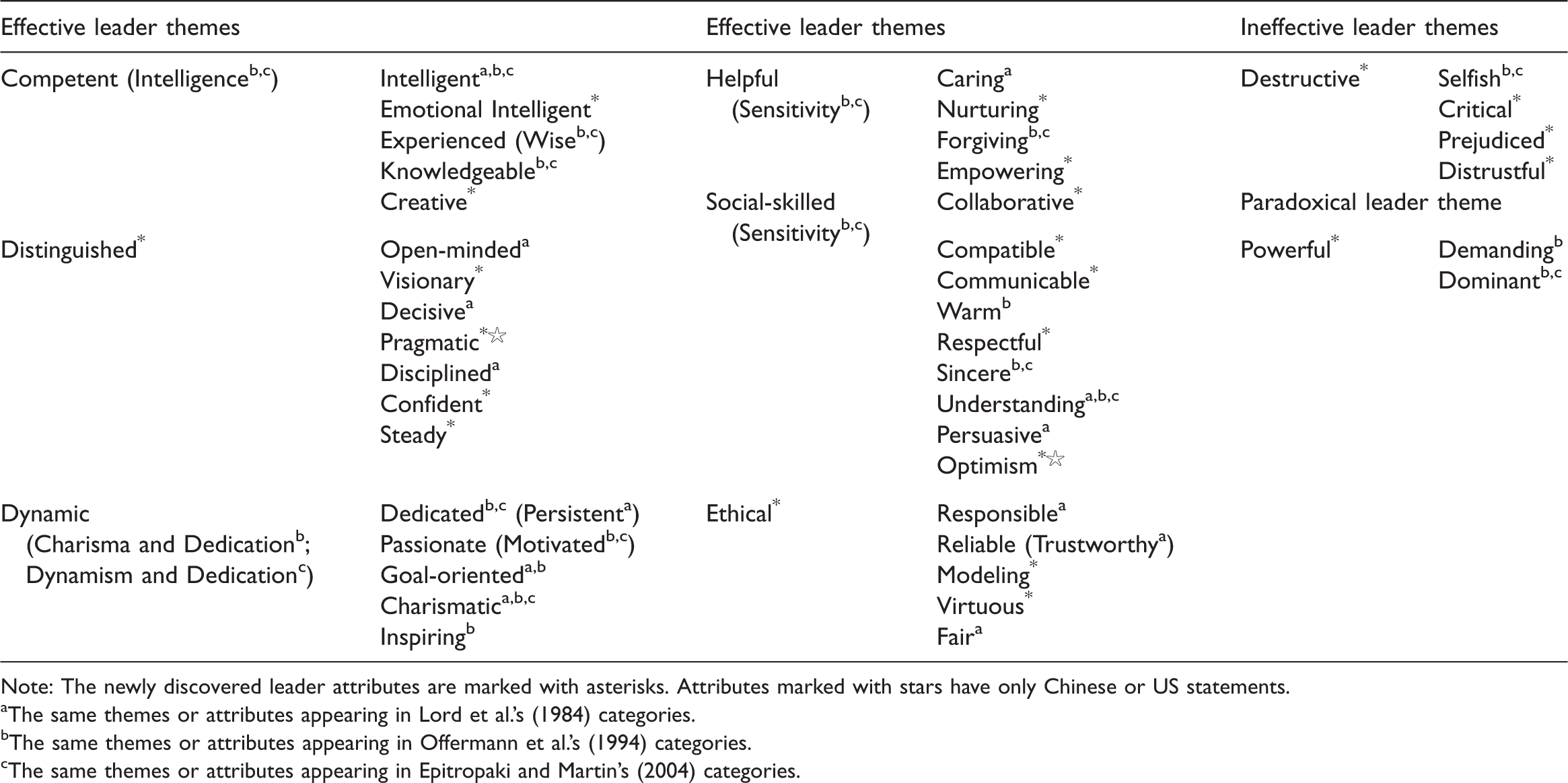
Note: The newly discovered leader attributes are marked with asterisks. Attributes marked with stars have only Chinese or US statements.
aThe same themes or attributes appearing in Lord et al.’s (1984) categories.
bThe same themes or attributes appearing in Offermann et al.’s (1994) categories.
cThe same themes or attributes appearing in Epitropaki and Martin’s (2004) categories.
One analysis suggested that 39 leader attributes are shared across the two countries. Many of these are essentially in line with previous ILT scales (Epitropaki and Martin, 2004; Lord et al., 1984; Offermann et al., 1994). Our competent theme captures the previously identified intelligent dimension (Epitropaki and Martin, 2004), which characterizes leaders’ fundamental abilities, such as intelligence, experience, knowledge and creativity. The distinguished theme has three attributes (open-minded, decisive and disciplined) initially identified in Lord et al.’s (1984) scale. Dynamic underlines the importance of enthusiasm for business leaders and is basically a combination of Offermann et al.’s (1994) dimensions of charisma and dedication. This conceptual combination is validated by Epitropaki and Martin’s (2004) empirical evidence that enthusiastic cross-loaded on the Offermann et al.’s (1994) dimensions of charisma and dedication. Helpful includes one attribute (caring) that was identified in Lord et al.’s (1984) scale and another attribute (forgiving) that is similar to Epitropaki and Martin’s (2004) and Offermann et al.’s (1994) sensitivity dimension. Socially-skilled has four attributes, sincere, understanding, warm and persuasive, that were previously encompassed in Offermann et al.’s (1994) and Epitropaki and Martin’s (2004) sensitivity dimension. Ethical has three attributes (responsible, trustworthy, and fair) that were previously proposed in Lord et al.’s (1984) scale and which connect with the ethical leadership literature (Brown et al., 2005) suggesting that employees are inclined to appraise leaders on moral grounds. As to the ineffective theme, destructive has one attribute (selfish) that is included in the tyranny dimension of both Epitropaki and Martin’s (2004) and Offermann et al.’s (1994) scales. Three other negative leader attributes (critical, prejudiced and distrustful) characterize baleful impacts on followers and show that leaders lacking courtesy and integrity were not viewed favorably in the workplace.
We found one leader attribute, pragmatic, only from the statements of Chinese respondents and one attribute, optimistic, only from American respondents. In an earlier study of Chinese ILTs, Ling, Chia and Fang (2000) categorized pragmatic in the Chinese factor of personal morality, which is congruent with traditional Confucian ethics that balance normative and ethical principles for appropriate leadership behaviors according to situational contexts (Zhang et al., 2011). Although the Charismatic, Ideological, and Pragmatic (CIP) model of leadership (e.g., Lovelace et al., 2018) was developed in the U.S. and features pragmatism as a prominent feature of effective leadership, it is possible that the U.S. respondents in our sample may have viewed pragmatic more in terms of a “nonidealistic ethical orientation…fundamental to Machiavellianism” (e.g., Leary et al., 1986: 75). Indeed, we are not convinced that pragmatic is an effective leader attribute perceived exclusively in China in part because criticism has a long philosophical tradition in the U.S. as embodied in such notable American pragmatists as Charles Sanders Peirce, William James and John Dewey (Hookway, 2016). The emphasis on positive, optimistic leaders, found only in the statements of U.S. respondents, may in part reflect the less assertive culture of China in which people prefer indirect, nuanced and context rich communication and where optimistic leaders with “a great positive energy” could be viewed as too direct and assertive. This distinction may also reflect the growing emphasis on positive organizational scholarship (Cameron et al., 2003) and optimism (Seligman, 1991) among U.S. scholars and practitioners coupled with the ways in which optimism and positivity are elevated and celebrated in U.S. culture (e.g., Ehrenreich, 2010) in a manner very different from dominant Chinese cultural values. Nevertheless, we believe that optimistic leaders should be generally appreciated because people normally expect their leaders to show great hope, care and compassion to help them survive or develop in the face of hardships (e.g., global financial crises, natural disasters, radical organizational change, and personal suffering).
Results concerning the powerful theme are the unexpected findings of Study 1. Powerful has two attributes (demanding and dominant) resembling concepts within the tyranny dimension of Epitropaki and Martin’s (2004) and Offermann et al.’s (1994) scales. However, the theme of powerful was viewed in a strikingly different way by the subjects in Study 1, with neither demanding nor dominant being interpreted in an entirely negative way but rather receiving a mixture of both positive and negative reactions. This may implicitly confirm Offermann et al.’s (1994) findings that effective leaders are perceived as less tyrannical than typical leaders. It is also interesting that these two leader attributes were associated with controversial leadership perceptions by both Chinese and American respondents, implying that the contradiction in the powerful theme was not likely based in differences in cultural values such as individualism-collectivism or power distance. As March and Weil have noted regarding the ambiguity of power in leadership, “We recognize a tension between hierarchy and participation, between power and equality, and between control and autonomy” (2005: 4). Therefore, we speculate that this powerful theme might reflect a fuzzy “shade of grey” beyond the traditional dichotomous ILTs taxonomy.
Regardless of the variety in existing ILT frameworks, most researchers have followed a dialectical structure in conceptualizing the dimensionality of leader attributes (Epitropaki and Martin, 2004; Lord et al., 1984; Offermann et al., 1994). However, there was some sporadic evidence on the ambiguous nature of some leader attributes in early studies. For instance, Lord et al. (1984) proposed three categories of leader attributes: positive, negative, and neutral. They found that a few neutral/non-leader attributes were moderately prototypical. Offermann et al. (1994) found that attractiveness could be both prototypical and antiprototypical. Likewise, Epitropaki and Martin (2004) found that bold is another contradictory item that does not categorize easily as either leadership prototype or anti-prototype because it can connote a person who is courageous and confident, as well as a person who is impetuous and willing to do whatever it takes to achieve desired outcomes. Some cross-cultural ILT researchers (e.g., Brodbeck et al., 2000; Gerstner and Day, 1994) also have pointed out the fuzziness of certain leader attributes. Despite growing evidence along these lines, possible alternative structures of ILTs have not been fully explored as a supplement to the prevalent dichotomous ILT models. Therefore, we conducted Study 2 to investigate how effective leader attributes may be perceived contradictorily. Our purpose is to validate whether paradox/contradiction is a part of the nature of effective leadership.
Study 2 – Method
Although our findings from Study 1 did reveal quite a number of effective leader attributes consistent with positive vs. negative dimensionality, the powerful theme provides us with an opportunity to explore whether certain attributes may involve paradox and contradiction for effective leaders. Given the initial evidence shown in Study 1 and the ILT literature, we decided to explore in more depth the paradoxical perceptions of powerful leaders existing in more heterogeneous samples by examining how people comment on influential business leaders on the internet. Because we are focused theory building in this research, we conducted a follow-up study of exemplar business leaders based on the principles of “holistic triangulation” that allow for a “more complete understandings of a given phenomenon” (Turner et al., 2017: 244). We used archival records to capture the paradox of power from a large population of perceivers in an effort to strengthen the generalizability of our findings from Study 1 (Turner et al., 2017).
We searched mainstream social media for business leaders who could potentially represent an exemplar powerful leader in both China and the U.S. Our prime targets were leaders frequently referenced in articles appearing in major newspapers or magazines such as the Wall Street Journal, Forbes, Bloomberg, Fortune, China Business News and the Economic Observer. We attempted to balance male and female business leaders in our search to accommodate the influence of possible gender biases on leadership perceptions (e.g., Carnes et al., 2015; Epitropaki and Martin, 2004; Offermann et al., 1994). Gender bias in the context of ILTs suggests that when people think about leaders, they often think about male attributes—the think-leader-think-male phenomenon (Schein, 1973, 1975; Sczesny, 2003). However, more recently, research suggests that women and men may conceptualize effective leaders differently, with women seeing them as more understanding and sincere, and less domineering and manipulative as compared with the conceptualizations of their male counterparts (Epitropaki and Martin, 2004).
After we completed a short list of business leaders with a public reputation who have had profound impacts on their industries, we searched the YouTube and TED websites for their recent speeches or interviews, which had been viewed and commented upon by a wide audience. We screened out leaders whose video clips had few comments, comments filled with derogatory criticism, or comments biased towards political reflections. Finally, we focused on two American and two Chinese business leaders and selected one of their recently posted speech or interview videos for analysis. The two American leaders were Steve Jobs and Sheryl Sandberg. Wang Jianlin and Dong Mingzhu were the two Chinese leaders. Steve Jobs was known as a pioneer of the personal computer revolution and named the most powerful business person by Fortune. Sheryl Sandberg is the COO of Facebook and the founder of the Lean In Foundation. She was listed as one of the 50 “Most Powerful Women in Business” by Fortune. Wang Jianlin is the Founder and Chairman of Dalian Wanda Group, the largest real estate developer in China. Known as the wealthiest person in China since 2015, he is now building a kingdom focused on entertainment and sports around the world. Dong Mingzhu, the Chairwoman of Gree Electric, has been called “one of the toughest businesswomen in China” by the New York Times. We selected Steve Jobs’ last interview at the D8 Conference in 2010, Sheryl Sandberg’s TED talks in 2010 and 2014, Wang Jianlin’s talk show on Phoenix television in 2016, and Dong Mingzhu’s talk show on Phoenix television in 2016. We focused our analysis on the comments and discussions posted by the audience for each of the videos.
We followed similar analytical procedures as applied in Study 1. First, the two primary researchers read each comment independently and identified statements related to the powerful leader attribute of the four business leaders. Although our priority was to validate the paradox of the powerful leader attributes rather than looking for new attributes, we did keep our eyes open but found no new attributes beyond the thematic domains derived in Study 1. We then jointly compared the selected statements for consensus and ensured that our selection represented the variety reflected in the opinions of the video audience. Finally, the two primary researchers worked jointly to discuss their differences in labelling and classifying the statements on each leader until all discrepancies were resolved. After carefully screening 4002 posts manually, we ended with 93 comments on the powerful leader attributes of Steve Jobs, 85 comments on Sheryl Sandberg, 123 comments on Wang Jianlin and 84 comments on Dong Mingzhu respectively.
Study 2 – Findings
As shown in Study 1, we found co-occurrence of opposing opinions on each business leader when they exhibited powerfulness in their managerial practices. For instance, Steve Jobs was widely appreciated for his robust efforts to remove “bureaucracy” and “hierarchy” in Apple and for his ongoing efforts to foster innovation during the company’s nascent stage. His powerful leadership was also salient relative to his turnaround strategy that saved Apple from decline and restored its business success between 1997 and 2007. His leadership was bitterly denounced as “Machiavellian” because of his “monitoring,” “controlling” and “commanding” behaviors, while he was simultaneously appraised as a “saint” or “a school of constructiveness” because of his “clean” motivation and “amazing mentality.” Similarly, Wang Jianlin’s success in real estate was strongly criticized because of his military background and his intensive involvement in politics. Commenters widely debated the extent to which Wang was a “red capitalist” bound to “both political and commercial interests,” while claiming that Wang “benefited financially from his networks in government” to hold a monopolistic position in the domestic real estate market. His perceived tyrannical style towards subordinates and business partners made him particularly unpopular with many commenters of the younger generations (e.g., Gen Xers). However, there were quite a few audience members who were supportive of his straightforward “arrogance” and “undisguised predominance,” which merited Wang a great deal of respect and public acknowledgement. These commenters believed that Wang had no option other than using “the power of the monarch in his empire” to retain “prestige” in such a big business.
We found that the powerful attributes of our two female business leaders also drew mixed public reactions. For instance, Dong Mingzhu, in her recent television talk show appearance, used strong language to blame an employee for a serious mistake. Many commenters were extremely annoyed by her confrontational and forceful style, showing deep intolerance for such aggressive traits, despite her legitimate authority to correct subordinates in the workplace. Dong was perceived as a “mean” queen bee with “a cynical tongue.” However, other online audience members defended Dong against the claims of discourtesy or malevolence, arguing that her lordly characteristics were a requisite for the prosperity of her business in such a competitive industry: “Only being bad to the bone could succeed.” Some audience members pointed out that being assertive and authoritative was particularly essential to the survival of business women in large-scale enterprises that have been traditionally dominated by men in administrative roles. By the same token, heated arguments either for or against “bossy” female leaders were salient among Sheryl Sandberg’s audience members, who focused their comments on the “masculine” or “feminine” aspects of leadership and the implicit sexism toward the mindset of “powerfulness.” Many audience members agreed that women leaders are disliked because of being “perceived as pushy” or “too ambitious” in a still “patriarchal society.”
Our Study 2 findings replicated the contradictory nature of powerful leader as revealed in Study 1. The mixed perceptions for the powerful leader provide greater insight into the possibility of “fuzzy sets” of leader attributes (Den Hartog et al., 1999; Gerstner and Day, 1994) and reflects the fact that some leader attributes may be perceived as relating to effective or ineffective leadership concurrently rather than conditionally (Schyns and Schilling, 2011). The data collected in study 2 also provide some clues as to what causes such contradictory judgements.
For instance, the coexistence of opposing perceptions towards powerful leaders may be associated with the dynamic power differentials between leaders and followers. Although followers are mostly subject to the power of their leaders and dependent on the leaders for resources at work, the degree of dependence characterizing the relationship between leaders and followers may vary in each dyad (Keltner et al., 2003; Magee and Galinsky, 2008). In some cases, followers might also possess valuable resources and use their resulting power to exert considerable influence upon leaders (French and Raven, 1959; Kotter, 1977; Pfeffer and Salancik, 1978). Given that power is a relative state of dependence between individuals or groups (Emerson, 1962; Pfeffer and Salancik, 1978), less dependent followers may be less likely to acknowledge the power from dominant and demanding leaders than those who are more dependent on their leaders. Accordingly, powerful leaders may be perceived as more effective when they are leading more obedient, dependent followers but less effective when leading more resistant, independent followers.
Another explanation for the paradoxical views on powerful leader attributes may relate to the context in which a leader is executing leadership. For example, leaders sometimes have to demonstrate complete authority and responsibility when launching and monitoring a nascent business. Powerful leaders might also choose to retain their centralized control in other critical development stages of their organizations (Vera and Crossan, 2004). To some extent, powerful leaders could be highly effective innovators and social networkers who form or reform business models (such as Steve Jobs or Sheryl Sandberg) and overcome resource starvation for business development (such as Wang Jianlin and Dong Mingzhu). Employees may appreciate such dominant and demanding powerfulness if it leads to immediate success and short-term stability. Meanwhile, the “one man show” type of top-down centralized control might interfere with the functions of middle managers and other employees in managerial positions during the formalization and institutionalization of the organizations. Such powerful leaders may also restrict autonomy and delegation, frustrating employees’ work attitudes and motivations, and inhibiting their creativity and job involvement. By the same token, powerful leaders may be vulnerable to biases and limitations in knowledge and information when they overly rely on individual decision making rather than collective decision-making in business administration.
General discussion
Our studies make three notable theoretical contributions to the leadership literature. First, we attempted to further clarify the content and structure of follower perceptions of effective leader attributes. Our analysis revealed 41 leader attributes in an eight-theme structure: competent, distinguished, dynamic, helpful, social-skilled, ethical, destructive, and powerful. Twenty-three attributes are congruent with existing ILT attributes and 18 are newly discovered. Our findings draw a distinction between effective and typical leaders and suggest the need for further examination. Second, we found controversial leadership perceptions on two leader attributes, demanding and dominant, which were previously marked as negative or anti-prototype by early ILT researchers. We categorized these two controversial leader attributes in a new powerful theme and provided some preliminary interpretations on their paradoxical nature. Essentially, this finding suggests that effectiveness could be both performance-based and humanity-based (e.g., wellbeing, work atmosphere) (Junk and van Dick, 2014). Since ILT studies traditionally have also found some ambiguous typical leader attributes (Epitropaki and Martin, 2004; Lord et al., 1984; Offermann et al., 1994), we believe that ILT scholars should shift their attention from situationally contingent “either-or” leader attributes to exploring the possible existence of “both-and” leader attributes combining praise and criticism simultaneously. This might partially resolve the misfit of certain ambiguous leadership perceptions in the current dichotomous ILT frameworks (positive versus negative or prototypical versus anti-prototypical). Third, our research extends our current understanding of contradictory and paradoxical leadership dialectics (Collinson, 2014; McElhatton and Jackson, 2012; Nyberg and Sveningsson, 2014; Zhang et al., 2015).
The paradoxical nature of the powerful theme could reflect Quinn’s (1984) competing leadership role model, which suggests that leadership functions encompass tradeoffs among the simultaneous and conflicting needs of both internal and external environments. The contradictory perceptions of demanding and dominant leaders reflect two pairs of leadership tensions: control versus flexibility as well as empowerment versus direction (Denison et al., 1995; Putnam et al., 2016; Zhang et al., 2015). Demanding leaders might have a positive impact on follower perceptions when leaders focus on the enforcement of necessary discipline and the development of desired performance standards (Denison et al., 1995). On the other hand, such leaders might run the business like a tightly controlled military unit, placing too much pressure and stress upon subordinates, resulting in negative perceptions. Similarly, dominant leaders could be perceived as beneficial by employees in early developmental stages who are relatively weak in competence or experience. Such employees are usually in need of clear direction in order to maintain high levels of performance (Hersey and Blanchard, 1977). However, dominant leaders may suppress initiative and creativity resulting in negative employee perceptions when they concentrate on mandating every detail in the workplace. In short, we believe that our findings extend our scholarly knowledge of leadership paradoxes, with the paradoxical nature of both the demanding and dominant leader attributes reflecting the contradictory views surrounding the intensity and scope of leaders’ power (Collison, 2005, 2014; Fairhurst, 2001).
Managerial implications
The results of our studies also suggest possible ways to improve managerial practice. First, our findings suggest that personal characteristics are not the only determinants of effective leadership. Many individual traits such as professional mindsets, work engagement, managerial practices, relationship with subordinates and moral principles should be taken into account when organizations recruit and train managerial staff. Because followers’ leadership perceptions are of prime importance in determining leadership effectiveness, organizations should be aware of variations in the way that business leaders are perceived. In addition, the process of achieving organizational effectiveness should also be taken into account. For example, the welfare of employees (e.g., job satisfaction) as well as other stakeholders (e.g., CSR) could be incorporated into the assessment of organizational performance. Because some powerful leader attributes could result in conflicting interpretations among the followers, organizations could coach management trainees to identify certain leadership behaviors and execute them with considerable caution. In particular, when leaders use their authority to implement strategies and plans, they should be aware of potential negative impacts on employees’ wellbeing that may result in difficult leader-member relationships and hostile work climates. It may be helpful to collect feedback from co-workers regarding their perceptions of effective leaders so as to improve leadership development programs by bringing more attention to leadership paradox and tension.
Second, our results suggest that organizations need to keep reasonable bounds when correcting and modifying managers’ performance. March and Weil (2005) noted the importance of appreciating leadership as a reality and an idea. On the one hand, leaders fulfill instrumental roles in the organizational hierarchy. On the other hand, leaders represent the symbolic tales of history and experience. Given differences in social norms and legal systems across cultures, managers should be trained to recognize that their attributes might lead to divergent interpretations from followers with varying expectations, especially when managers work in different societies or work with people from different cultural backgrounds, and should be provided with practical insights into improving the ways in which they are perceived by their followers.
Finally, organizations could benefit from granting leaders adequate power to foster organizational effectiveness while at the same time discouraging leaders from using supreme authority in decision-making. Contemporary employees expect more autonomy in their jobs and more delegation from their organizations. Leaders need to understand the nuances of power in work contexts and learn how to balance various kinds of influence that reflect various relational norms from “parenting” to “partnering” in management.
Limitations and future research
Our exploratory studies suggest some promising directions for future ILTs research along with some notable limitations. First, we suggest revising the binary classification of leadership perceptions and propose a more flexible categorization to accommodate the paradoxical nature of certain effective leader attributes. Compared to early ILTs research, our research shows that individuals’ perceptions about effective leaders may not always be crystal clear and cast in shades of black and white. Further research is needed to assess the possible controversy in perceptions of certain leader attributes and researchers might consider delving more deeply into how effective leaders are perceived and how leadership perceptions could reach consensus. Although the CLT theorists have assessed outstanding leader attributes and behaviors in certain social and cultural contexts, we propose that perceptions of effective/ineffective leaders rely heavily on the individual characteristics of the perceivers as well as the relationship between the perceivers and the perceived. Further investigations should examine whether and to what extent demographic characteristics of followers, such as race, gender and age, may influence the perception and judgment of certain leader attributes (Festekjian et al., 2014). Additional studies are needed to examine how followers make sense of effective or ineffective leader attributes and manage the interactions with their leaders.
A notable limitation of Study 2 is that we focused only on exemplar powerful leaders, leaving some doubt as to whether the dual-themed reactions are a specific finding for leaders representing the powerful-theme or a typical finding for a variety of leaders. Future studies should be designed to entail direct comparisons between leaders having and others lacking the powerful attribute. Future researchers should also be mindful that the variances among contextual factors may influence the degree of ambiguity in certain leadership attributes. Our theoretical sampling strategies do not allow for our research to achieve statistical generalizability. Future research might test these leader attributes in studies using a broader scope. It would be interesting to compare controversial leader attributes across industries (manufacturing and service) and among multiple types of enterprises (small business, domestic companies, and international organizations). Also, researchers might assess whether contradictions in leadership perceptions appears similarly across different generations. More extensive explorations of paradox in leadership perceptions pairing the traditional contextual-sensitive aspects of ILTs could promote significant theoretical development in this critical area of research (Epitropaki et al., 2013).
Finally, we should pay particular attention to the potential influence of national cultures on contradiction in leadership perceptions. We identified two paradoxical leader attributes from China and the United States and we encourage further investigation in other cultural contexts. As CLTs researchers have addressed the cultural sensitivity of leadership effectiveness (Dorfman et al., 2012), we believe that cultural values may account for the outcomes of perceptions of leader attributes. In particular, researchers could examine whether certain paradoxical leader attributes produce more positive or negative effects upon employee turnover or organizational performance in some cultures than they do in other cultures (Junker and van Dick, 2014). We expect future researchers will continue studying these interesting leader attributes across societies.
Conclusion
In closing, our findings help to extend our understanding of leadership perception beyond the classic positive-negative categorization of leader attributes to reveal greater complexity in the labeling of effective or ineffective leader attributes. Using two qualitative methodological approaches, we found empirical evidence in support of extending the traditional contingent-based implicit leadership studies reflected in existing ILTs and CLTs research (Epitropaki and Martin, 2004; House et al., 2004; Lord et al., 1984; Offermann et al., 1994). Our study helps to highlight the importance of “think effective” and provides new insights for a growing interest in ideal leaders (e.g., Foti et al., 2017; Junker and van Dick, 2014; Solansky et al., 2017; Van Quaquebeke et al., 2014). Our paper responds to calls for investigating leadership tensions (Putnam et al., 2016; Schad et al., 2016; Zhang et al., 2015) while providing new insights into the behavioral complexity and flexibility of leader effectiveness. We hope that this research will inspire future studies that may further enrich our understanding of the multifaceted nature of business leaders in increasingly global, dynamic, and competitive organizational environments.
Footnotes
Authors’ contribution
The first two authors contributed equally to this project, and thus the order of authorship is alphabetical.
Acknowledgements
We extend our appreciation to Chao C. Chen, Martha Feldman, Roy Suddaby, Leigh Anne Liu, and Shaowei Wu for helpful comments on earlier versions of this article. We also thank Steve J. Kulich and David Henry for assistance with data collection.
Declaration of Conflicting Interests
The author(s) declared no potential conflicts of interest with respect to the research, authorship, and/or publication of this article.
Funding
The author(s) disclosed receipt of the following financial support for the research, authorship and/or publication of this article: Sen Xu was funded by a grant from The Social Science Fund of Jiangsu Pronvince, China (No. 18GLD007).