







Abstract
Communities need inclusive leadership that embraces adaptive change to address complex social problems. Implementing such a leadership has proven elusive, calling into question how people understand community leadership. Through interpretive analysis of autobiographical narratives, we identified three orientations toward community leadership, which we label traditional, liberal, and hybrid. Each suggests a different logic of community, power, and the will to leadership. We argue the hybrid perspective is most in keeping with inclusive and adaptive approaches and suggest ways community leadership educators might promote it.
In many societies and especially Western ones, cultural knowledge tacitly assigns leadership to certain endeavors (e.g., solving other’s problems; making decisions) and people (white men, those with institutional authority). To seed change, leadership development must surface unspoken rules and teach new ones. For example, grassroots organizer Community Change asks women of color to “unlearn and discern,” a process in which “participants’ old assumptions are analyzed and challenged, while new ones are experimented with as new possibilities for one’s day-to-day work and life.” 1 Similarly, the Kansas Leadership Center asks clients to “rent” rather than “buy” inclusive and adaptive leadership in their community work, giving participants permission to try practices they might otherwise reject.
As these trainers illustrate, social-change organizations must reckon with existing cultural knowledge, meaning facts, information, skills, and familiarity with social processes (Lareau, 2015). Ignoring what participants take for granted about leadership risks reproducing hierarchies of headship rather than preparing communities for full inclusion and shared responsiveness to complex problems. Certainly, a new way of thinking about leadership has taken hold. To our point, an internet search of “anyone can lead” yields hundreds of results, suggesting how people without obvious social power can enact leadership in their everyday lives. But surely leadership educators also have heard the wise crack, “If everyone is a leader, then no one is a leader.” This dictum reveals a misunderstanding or rejection of inclusive approaches, but it makes sense thanks to dominant cultural presumptions about what leadership is and who can exercise it.
To advance, scholars and educators need clear and current maps of how people understand community leadership, which we argue is a consequential cultural resource. We address this need through interpretive analysis of autobiographical narratives authored by 488 people enrolling in community-leadership training. We found three culturally resonant understandings of community leadership, often contradictory but sometimes overlapping. The significance of our contribution lies in its potential to aid community-leadership developers in realigning and strengthening this cultural asset.
In this essay we review literatures of social inclusion, complexity, and adaptive leadership relevant to the community context. We then explain the rationale, goals, and method of analysis. We next detail the findings, explicating three orientations and how each understands community and, consequently, how leadership ought to be enacted. We close by reflecting on how each orientation could be inhibiting practices built on current leadership theories and demonstrate how the orientations can strengthen and sustain new community leadership.
Review of literature: Community leadership
By community leadership, we mean collaborative member efforts toward an inclusively determined common good through experimentation and adaption. While some point to the civic-minded people who participate in local leadership activities in a wide variety of ways, we see community leadership not as persons but process. Likewise, we concur with Ricketts and Ladewig (2008: 138) in that “community leadership is not so much a situation or style of leadership, as it is a context under which leadership operates. Consequently, this context does not lend itself to just one leadership tradition” or theory. Rather, two broad principles—inclusion and adaptation—are particularly relevant to its unique demands. In what follows, we explain the relevance of inclusion and adaptation to community leadership and demonstrate that such approaches have been resisted in practice.
Communities need inclusive leadership
According to Ricketts and Ladewig (2008), the wide variety of community-leadership definitions are bound by consistent concern for the common good and community-wide action for addressing shared problems. Schweigert (2007: 329) posits this aspect as what distinguishes community leadership from commercial relations: Through pursuit of the common good, community leadership seeks mutuality based on “values that transcend individual self-interest alone. Leaders are thus distinct from vendors, as followers are distinct from buyers.”
Concern for the common good makes full inclusion of all persons a requirement of ethical and effective community leadership. As Majee et al. (2018: 94) state, as community leaders “encounter each other and key community actors…, they build community identity, establish a common understanding of what their individual and community assets are, and commit to utilizing those assets for the common good.” In other words, engagement irrespective of social status allows the community to determine and enact what is beneficial to all.
Alternately, when members are denied participation in decisions that directly affect them, they are stripped of a core aspect of humanity (Peattie, 1987). Consequently, inclusive organizing and decision-making is essential (Hardina, 2006). Arnstein (2019) and Choguill (1996) explain participation as a function of citizen control or an outcome of negotiated control. Prins (2005) and Chandrasekhar (2012) assert that citizen involvement must be understood in the context of local and regional patterns of power, influence, privilege, and inclusion/exclusion. According to Gaventa (1980), participation and non-participation reflect dynamics among community groups holding different levels of power. It is not enough to be concerned about member contributions; additionally, it is imperative that we consider who is participating. Historically, the affluent and powerful have engaged in community action to maintain the status quo, thereby excluding others. Powerful citizens may strive to increase their influence and defend exclusionary practices rather than advance equality (Easterbrook, 1996).
Hence, even when adopting participatory methods, the power dynamics embedded in community structures can significantly impact the process and outcomes of citizen engagement (McCullum et al., 2016; Schafft and Greenwood, 2003). To our point, Collinson et al. (2018) argue that theories replacing individual leaders with collaborative efforts fall victim to romantic visions of harmonious dialogue and consensus. Consequently, post-heroic approaches potentially underestimate negative influences of collective leadership practices (Schweiger et al., 2020). Particularly in the context of community leadership, failure to account for power asymmetries will likely only reproduce social inequities.
While these critiques must be heeded, the emerging framework of collective leadership seeks to foster a genuinely inclusive structure (Ospina et al., 2020). Its foundational assumption is that change occurs when leaders who value equity engage in practices that build collective power, which in turn creates joint impact for common good (Ospina et al., 2012; Ospina and Foldy, 2005). Accordingly, leadership for common good is driven by individuals’ ability to identify systemic inequalities and envision a future where these inequalities do not exist. Collective leadership represents a departure from the dominant discourse of leadership as a function of the individual. It is rooted in the interpretive discourse that views leadership as shaped by context and requires the performance of a collective over a period (Carroll et al., 2015; Ospina, 2017).
Via a historical analysis of inclusive community organizing in Grand Rapids, MI, Quick (2017) found that what started as individual leadership efforts transformed into joint action and meaning-making. Quick (2017) locates collective leadership in collaborative planning, prioritizing, and action. Additionally, “it proved to be very important that the participants co-produced an idea of what ‘green’ meant, thereby creating space to incorporate diverse interests, knowledge, and resources in a collective effort” (Quick, 2017: 455). Rather than a singular leader or a group persuading others to accept a compelling vision, the community co-constructed a public imaginary of what Grand Rapids could be. “Ultimately, intentional efforts to organize green efforts inclusively enabled collective leadership to be co-constructed through a shared, emergent platform” (Quick, 2017: 446).
Notwithstanding the Grand Rapids case, scholars conclude that “too often, [community] collaboration is restricted to a few interests or a small subset of community fields—just enough to get the specific job done” (Pigg et al., 2015: 175). In their analysis of a program designed to empower low-SES persons to community leadership, Majee et al. (2018) demonstrate that its curricula led to authentic participation from the newly trained. However, several factors limited some from moving into community action. Most relevant here, low-SES participants encountered barriers in their communities, with some reporting that no leadership opportunities were available to them. Similarly, Etuk et al. (2013: 416) found that the effectiveness of a leadership-development program was “tempered by the prevailing leadership structure, the environment for public involvement in decision-making, or community divisions.”
Turning from leadership trainees to trainers, Keating and Gasteyer (2012: 155) found that community-leadership development (CLD) staff wanted to diversify their enrollments, but they “lacked resources and tools for how to identify promising leaders from non-traditional groups.” Notably, barriers within community also limited the recruitment of non-traditional leaders. Interviewees detailed cases in which those normally excluded were invited to CLD programs but their supervisors refused to support their participation. Overall, Keating and Gasteyer (2012: 158) concluded that the “challenge of organizing diverse leadership training programs amounts to changing the … shared beliefs regarding who gets to practice leadership. These beliefs are not only held by the traditional establishment, but by the non-traditional leaders themselves.” Thus, if the benefits of CLD are to be fully realized, then the “community’s pre-existing level of capacity” must also be addressed (Etuk et al., 2013: 416).
Communities need adaptive leadership
Additionally, community leadership cannot rely solely on power and formal authority to address increasingly complex social dilemmas. As an intermediary between formal organizations such as governments and more informal civic or social groups, community leadership rarely can draw on titles or institutional rules for clarity. Vivier and Sanchez-Betancourt (2020) establish that “community leadership is situated between the structures and policy directives of formal organizations (e.g., government), and communities’ more informal ways of organizing.” While navigating such space, “they must do so without the clear direction, authority or legitimacy provided to leaders within organizations.” Therefore, community leadership must develop and draw on networks of relationships. Ultimately, in community settings “power and authority flow horizontally to leaders who can articulate and coordinate the common will, increasing the autonomy of citizens, rather than flowing downward from a position of dominance and limiting the autonomy of subordinates” (Schweigert, 2007: 328).
The informal nature of social power in community leadership demands creative flexibility. Pigg et al. (2015) connect this facet of community leadership to its transformational nature, contrasting it with the governor of a state, for example, who might order the National Guard to assist with natural-disaster response. As the example illustrates, the elected official’s authority is clear, as is the solution to the problem. However, a “different sort of leadership is required when the problem people face has no ready solution and requires significant reframing and innovative thinking” (Pigg et al., 2015: 155).
Uhl-Bien et al. (2007) introduced complexity leadership theory to address the preponderance of such problems endemic to the Knowledge Era, which is characterized by its fast-past, volatility, and uncertainty thanks to uncontrollable outcomes. The complexity approach demands nonlinearity, struggle over differences in opinions and interests, and creativity in addressing problems. Similarly, relational leadership points to the messiness of human interaction and the uncertainties of highly complex systems (Uhl-Bien, 2006). If leadership emerges in networks of human interaction, then solving problems and reducing uncertainty are no longer germane. Instead, the dynamics by which leadership emerges and is exercised become key (Uhl-Bien, 2006). This view “moves leadership beyond a focus on simply getting alignment (and productivity) or a manager’s view of what is productive” (Uhl-Bien, 2006: 672).
Likewise, adaptive challenges rather than technical ones are indicative of the Knowledge Era. Drawing on Heifetz’s concept of adaptive challenges, Pigg et al. (2015) argue that contemporary social problems require different ways of thinking about leadership. Rather than advancing linear or singular solutions, community leadership must be circumspect and open to pursuing multiple, experimental avenues. Similarly, processual leadership advocates for a humble and iterative approach that embraces complexity, uncertainty, and shared responsibility for systemic drivers of organizational experience (Schweiger et al., 2020).
Understanding leadership through the lens of complexity is particularly applicable in communities. As Vivier and Sanchez-Betancourt (2020) detail, without clear titles or organizational authority, community leaders must operate in a liminal space between social groups. Additionally, because community leadership resides in the inclusive collaboration of people with divergent interests and ideas, it cannot possibly solve problems. In the context of national politics, Fintan O’Toole (2020: para. 8) puts it thusly: “Autocracy (as it imagines itself) is forever; democracy’s outcomes are always temporary.” In essence, community leadership has always operated within a context that organizational leaders increasingly must navigate: namely, leadership as “inherently complex, contradictory, iterative, adaptive” (Tourish, 2014: 93).
But in practice, the view of leadership as decisively solving others’ discrete problems remains entrenched. To learn why managers cling to heroic conceptions of leadership, Schweiger et al. (2020) studied a processual-leadership curriculum and assessed student outcomes. Immediately after training, managers correctly articulated and demonstrated appreciation for post-heroic leadership. However, they mostly failed to apply processual principles to their organizational interactions, instead describing their activities as driven to reduce uncertainty, provide clarity and direction, and solve problems for team members. Over time, Schweiger et al. (2020) found that managers reverted to heroic definitions of leadership. Additionally, some reported anxiousness over their inability to live up to demands made by the heroic ideal but nevertheless did not adopt the processual frame when explaining their organizational interactions (Schweiger et al., 2020).
In the context of community leadership, Pigg et al. (2015) concluded that those trained only through experience served a necessary role in communities but could not be relied upon to meet adaptive challenges. Apparently, they conclude, formal training is needed to overcome the inclination favoring decisive and unilateral action. As Pigg et al. (2015: 168) acknowledge, “this [adaptive] view will create some uncertainty among program participants who view leadership as more like management or a leader-follower relationship. We would all like the world to be predictable.”
Community leadership as cultural capital
From this review we note a fundamental challenge: Those advancing community leadership as inclusive and adaptive often contradict dominant cultural understandings of what leadership is. As Keating and Gasteyer (2012: 163) found, programs that sought to “identify, to cultivate, and to train people as a cross-section of the community” called into question “beliefs about who gets to practice leadership and how far can they go in doing so.” A CLD program that fails to address unstated beliefs about the nature of leadership will likely encounter resistance. Therefore, as consequential as what or who one knows are those things that community members know so well that they are taken for granted.
Keating and Gasteyer (2012) identify these taken-for-granted assumptions about leadership as cultural capital. Consisting of accepted “approaches to life,” a community’s cultural capital shapes how members understand the world and what is possible (Flora and Flora, 2008: 62). Regarding leadership, communities that appreciate it as inclusive and adaptive hold a resource that can be leveraged to support economic and noneconomic development. Alternatively, a shared understanding of leadership as exclusionary or a lack of definitional consensus can impede progress. To encourage new, shared visions of community leadership, scholars and practitioners need to consider what those in the community already know to be true.
Toward this end, we conducted an empirical assessment of this cultural capital. Specifically, we studied how a collection of new CLD participants explained themselves, their communities, and their work. Specifically, our research addresses the following question: What are latent understandings of community and leadership, and how do these understandings condition what is deemed necessary and acceptable in community leadership?
Cases and method: First-person accounts of community leadership
To address this question, we conducted secondary, interpretive analysis of autobiographical narratives collected by the Kansas Leadership Center (KLC) from all program enrollees in 2017. The narratives, written in preparation for training meant to strengthen community leadership, offered a unique opportunity to consider what cultural truths persons draw on as they explain their successes and challenges in community work. In what follows, we detail KLC’s mission, further explain who wrote the narratives and why, and review our analytical methods and assumptions.
As a non-profit that seeks to develop leadership “for stronger, healthier and more prosperous Kansas communities,” 2 KLC exists to advance community leadership. The KLC framework was built by first asking a wide swath of Kansans, “When you think about the future of your community, what concerns you the most?” Today, KLC espouses that “more leadership creates healthier Kansas communities” and trains people across sectors to approach leadership as an adaptive activity that anyone can exercise.
On enrollment forms used in 2017, KLC asked clients four questions about a leadership challenge recently faced. KLC developed the prompts for its training purposes with no input from the authors. Enrollees answered the questions in writing as they completed the form. While business executives make up a portion of their students, KLC approaches all trainees as community leaders, consistent with our definition of community leadership. To our point, KLC enrollees in 2017 self-identified as board members, business owners, baristas, and many other social roles. The term “executive” appeared 69 times across all job titles provided by KLC enrollees in 2017, with 33 instances of “vice president” or “VP.” In contrast, 88 trainees called themselves some kind of “assistant,” 99 said they were teachers, and 102 included “coordinator” in their job titles. Thus, studying the narratives allowed us to consider how a group of people, diverse in their social roles but unified by their desire to make a positive difference in their communities, explained community leadership.
Relative to the general population of the United States, those contributing narratives disproportionately identified as female and white and held very high levels of educational attainment. 3 However, in our analysis we sought not representativeness but understanding of a phenomenon. The value of our findings is in the descriptive depth of the categories we discovered, their relative emphasis, and the generative possibilities within and between various approaches to leadership. As Small (2009) argues, the logic of the case study is appropriate when asking questions of how or why about a previously unexamined process. 4
KLC provided the authors with narratives written by 1310 people, ranging in length from 21 to 1076 words. To limit our close readings to only the responses most likely to concern community leadership, we ignored those that did not include the word “community” at least once, resulting in a pool of 488 responses. The KLC prompts were as follows: (1) What is the background of the problem/opportunity/challenge? (major key players, key events, critical past decisions, etc.) (2) Why is this important to you? (3) What actions have you taken so far? What do you intend to do in the future? (4) In what way(s) are you stuck or confused?
Notably, none of the prompts directly ask what leadership is or how it ought to be achieved in communities. This nearly eliminated the possibility that enrollees meant to reflect socially desirable responses per our phenomena of interest. At the same time, because they were not asked to directly address community leadership, we needed interpretation to reveal underlying meanings.
Toward this end, we adopted a textual hermeneutic (Michrina and Richards, 1996). We concur with Jensen and Jankowski (1991: 43) in that through “a contemplative understanding of text, the humanities can provide a concrete, language-based understanding of communication and culture.” In the tradition of Heidegger and Gadamer, our hermeneutic was guided by theories of language and narrativity as forms of meaning-making and self-understanding, since “language is the medium through which the lifeworld discloses itself” (Alvesson and Skjolberg, 2017: 150). In an applied sense, “stories describe interactions with others within this symbolic social environment and reveal rules, routines, and territorial conceptions” (Pitre et al., 2013). Thus, understanding “can only be achieved by undertaking a dialogue with the text, which we approach neither as it master, nor by passively surrendering ourselves to it, but on equal footing” (Alvesson and Skjolberg, 2017: 151).
To promote such a dialogue, of each narrative we repeatedly asked the following: (1) What is community and where do leaders position themselves in relation to it? (2) Where does social power reside and how is it distributed according to the narratives? (3) What motivates leaders to get and stay involved in community? (4) What is leadership?
With these probes in mind, we approached the texts iteratively, enacting the various phases of the hermeneutic circle as adapted by Michrina and Richards (1996: 12). Stages in the cycle include description, interpretation, challenge, self-analysis, and reformulation of understanding.
In this first stage of open readings, we concentrated on describing the content of the narratives. Our initial review produced long lists of seemingly anachronist observations. After several consultations to compare notes, we read the narratives again, this time interpreting how the content, directly or implicitly, answered our four probes. Next, we considered challenges to the understandings we brought to the analysis. We use “challenge” as defined by Michrina and Richards (1996: 9), meaning a discrepancy between our biased assumptions, or “preunderstanding” in a hermeneutic sense, and a new piece of information gleaned from our interpretation. Through self-analysis and discussion, we reformulated our “big picture” understanding in light of textual information that contradicted our existing impressions of community leadership and those who engage in it (Michrina and Richards, 1996: 10).
After further reflection and conversation, we noticed divergent worldviews, or logics, of how community leadership operates. We then returned to the narratives a third time, independently, to challenge our categorizations and adjust understanding per negative examples. In this stage of analysis, we sought an increasingly holistic understanding of the worldviews, seeking to clarify how leaders orient toward community leadership and why within each domain. In this way, we sought to “‘fuse horizons’ between the familiar and unfamiliar” (Alvesson and Skjolberg, 2017: 151).
Findings: Orientations toward community leadership
Community leadership orientations.
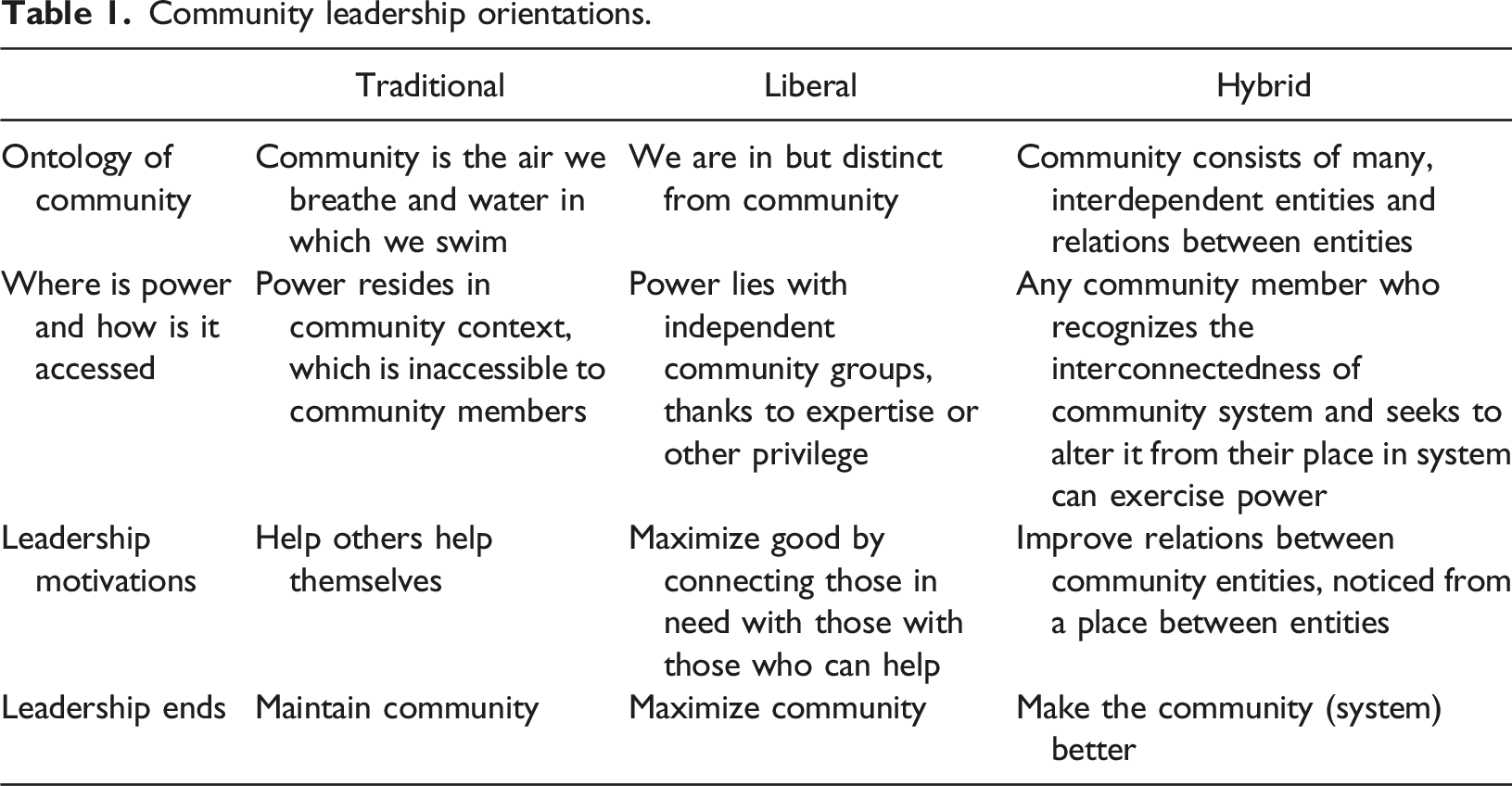
Traditional orientation
The traditional orientation depicts community as a container, holding and shaping those within it. In this view communities prevail through their unique dynamics, and leaders deal with life as determined by the community in which they live. Narrative 14424, for example, starts by explaining what makes her community unique, directly connecting these dynamics to her leadership challenge: “Education is not a priority in most minority homes here in my community. Families in my community are just thinking of putting bread on the table.” Both sentences limit the scope to “my community,” indicating that its uniqueness drives how the community ought to be understood and what happens there.
Because the traditional orientation understands community to be the influential monolith of social life, it implicitly grants it a great deal of social power. Indeed, the community structure determines what challenges need to be faced and how. Narrative 13618, written by the founder of a non-profit supporting cancer tests, first indicates that community factors led to the problem, explaining that “getting screening to a small [Kansas] community is a big challenge.” She then admits that her association finds it difficult to persist because “in a small community keeping an event going is very tough; we can get the volunteers to help with the [fundraising] but to take on a role of [board] officer is very hard.”
Notably, neither narrative directly discusses other community groups. In 14424, families and the school play a part but are more akin to setting than active characters in the community drama. Narrative 13618 identities several specific towns, but these municipalities are then said to be a part of one “small [Kansas] community,” bound by poor access to medical care. No other collectives, such as doctors, clinics, wellness centers, women’s clubs, or hospitals, receive mention.
While the traditional orientation rarely considers other organizational entities, it frequently pleas for more leadership help. As narrative 13618 laments, “I need to … get more involvement from the younger women in our communities. … I need to be able to delegate the job.” Like this author, those voicing a traditional orientation often seem at odds with themselves, saying that they cannot do it all while also indicating that they ought to be powerful enough to draw others into the work. Narrative 14170 also conveys that the author takes too much upon himself: “I have to admit that my leadership involves ‘If you can’t get the job done, then get out of the way and I’ll do it’ and ‘It’s just easier to do it myself.’ I NEED TO CHANGE.” And yet, the author also claims responsibility for and presumably the ability to “motivate others to step up into intermediate positions.” Similarly, Narrative 12598 envisions the power of people engaged in community. And as the last line of this excerpt indicates, the author assumes that she ought to be able to influence others to join despite mistrust. Trust, accountability, and reliability are big issues … It is hard to get persons involved/committed without incentives or them being able to see immediate progress. … They need to understand we must be actively working to address issues/problems in our community not just when there is racially charged incidents like with police brutality, hate crimes, etc. HOW CAN I GET THEM TO OVERCOME AND MOVE ON FROM THIS?????? HELP!
In sum, the traditional orientation allows for the possibility of collective leadership exercised through cooperation. But more commonly, traditional orientation speaks to the lack of commitment from others and leadership failures to recruit participants into the cause. When it comes to other community members, the traditional orientation struggles with the dilemma posed in Narrative 13957: “Is it possible to get them to care as much as I do?”
Such poignant appeals leave the reader wondering why these devoted community servants stick with their Sisyphean challenges: What is their leadership motivation? The traditional orientation answers with direct experience (Narrative 14587: “My family went through very difficult times while I was growing up. I know what it’s like to be in our patient’s shoes.”) or personal witness (Narrative 14336: “Working with children/families for 27 years, I know and understand the importance of parent involvement.”). The traditional orientation finds inspiration in others persevering through adversity as have they. According to Narrative 14424, the author “was in the same boat as my students. I never did well in school, I was always taken out of my English/language arts classes throughout elementary so the teachers could try and advance me in reading. I slept through classes and had bad grades. … I was a dropout.” Now, the author wants her students “to be the exception and not the rule.”
Likewise, Narrative 13168 recounts that the author “lost my mother and grandmother to cancer besides a lot of good friends and their children.” Of course, many people lose beloveds to cancer but do not start volunteer organizations to fight the disease. Hence, the author must address the question presumably in the audience’s mind: Why does she persist? As she testifies, “I had a lady tell me to not ever give up and keep [the non-profit] alive to help other women.”
In these ways, traditional orientation justifies leadership through the difference made in others’ lives. According to Narrative 14424, the leader has tasked herself with changing individual attitudes, actions, and opportunities. That the author sees “a lot of students that are missing homework or don’t even try on tests” does not necessarily indicate that personal effort is the solution. But every angle tried so far, including college visits, bolstering self-esteem, and challenging student beliefs, implies that individuals must develop themselves in the face of difficulties presented by the community context. That she wants her pupils to see her as a “a life-long…resource” also indicates that individuals need to change, with the leader’s help. Likewise, a firefighter writes in narrative 14170 that he wants to change not the department but its people, instilling more “pride and dedication” in service. And the cancer-screening advocate speaks to saving lives but says nothing about the conditions that created unequal access to preventative health care. Suffering people made whole are the leadership ends of the traditional orientation.
Liberal orientation
In contrast, the liberal orientation understands community as a collection of independent units that can benefit each other but that ultimately rise or fall on their own. The nature of these connections varies in the liberal orientation, with some suggesting frequent and profound relationships between the leader’s group and other community units, while other narratives show only weak ties between organizations. Universally, however, the liberal orientation starts from the premise that community is an entity distinct from the leader’s own group.
Narrative 13930, authored by an advocate for the homeless, represents one extreme, with the author providing copious details on alliance building. I have reached out to many other organizations and entities focusing on this cause and am working to create a proficient and innovative alliance designed to craft adaptive solutions to this complex issue. One future goal that is currently in motion is partnering with [the city] to create a page on our site to educate the community on homelessness … I intend to rally businesses and church organization for this cause.
For-profit leaders, too, describe their leadership as a process of putting the right people together. For example, Narrative 14464 is less centrally focused on relationship-building but still makes clear that community is a Rolodex. When describing how the author’s firm helped a crisis shelter, every sentence speaks to a shared contact or connection made. [We] assembled a team for the project. We brought in the general contractor, the architect, and the commercial realtor. After a series of conversations and meeting the team was able to put together a plan for the Board of Directors at The Shelter. The Board of Directors approved the plan, and we began to move forward. The general contractor put The Shelter into contact with another non-profit that had just been through the same process.
At the other extreme, Narrative 14474 pays little attention to external groups, mentioning only that the leader has “briefly practiced elsewhere,” which gives “some perspective to say [this Kansas] community has benefited uniquely by the existence of this law firm.” I believe the firm and its approach to serving clients is too good to let fade away. Having briefly practiced elsewhere, I have some perspective to say [this Kansas] community has benefited uniquely by the existence of this law firm.
All three examples indicate that the respective authors are part of an organization that is also part of a larger community network. In this way, the liberal orientation places leaders inside community as does the traditional orientation. But while our analysis finds no evidence of liberal orientation presuming competition between community groups neither does it allow for true collaboration.
Nor does the liberal orientation understand community to be the centripetal force of social life. Rather, envisioning community as a collection of distinct organizations allows the leader to exist outside of community and, if they choose, the agency to operate independently of it. For instance, a professional seeking to teach financial literacy in area schools projects sincerity in wanting to “help my firm become a business that gives back to the community in a way that is meaningful and uses our specialties and talents to improve the lives of the next generation.” But that the author must write that the firm ought to “become a business that gives back” logically implies that giving back is a choice, with another option being that the firm remain in the community but largely disconnected from it.
Independence is also implied by the lack of reciprocity between community groups. In the case of Narrative 14464, the author testifies her business had much to offer: “We knew immediately that we could help [The Shelter] get into contact with the right general contractor, architect, and commercial realtor.” But later, “we began to feel overwhelmed by the amount of time and money that the new facility would require. … What things can we do to ensure the new facility, once built, can maintain itself?” Beyond board approval the narrative indicates no collaboration on the building plan, a subject on which shelter employees and clients could speak with experiential authority. Regarding management and fundraising, would not the employees and shelter board be the logical place to begin this search? From its first sentence, “Every year, my company adopts a [service project],” the narrative indicates that community consists of connections but unequal ones, with some groups giving and others getting, some needing and others needing to give. Ultimately, social power remains with certain groups and persons.
Even narratives that claim community service as fundamental to the group’s mission imply that the leader’s organization will not have to work with others if determined otherwise. Reflecting on his proposal to offer financial-literacy courses in schools, the investment specialist writes that he is at a crossroads: I am also stuck with whether this is worth the time it will take to get it all set up and running. It will not just be a project I can turn on and let it go, it will take oversight and the ability to add people who can help foster and grow it in the long term.
Such pragmatic questions would be uncomfortable for the traditionalist, who understands self-sacrifice as a necessary part of community leadership. The liberal orientation, too, allows for selflessness but also weighs how to do it best. Such freedom permits liberal leaders emotional space and a sense of personal control and social power, allowing them to choose the best avenues for maximizing effort for community development.
Through our readings, we found that the liberal orientation’s leadership goal is fostering of social connections to maximize benefit for one’s own group and, to various extents, the improvement of others. As the one author writes, We have access to the connections that can contribute to an educational curriculum that can change our community through the lives of young people. I want our partners to see the value in this kind of community involvement in making us better people and the growth we could see in our business through helping to increase the wealth of the future through better habits.
Put succinctly by the author of Narrative 12541, her church’s strategic initiative “has morphed into trying to decide which church ministry is responsible for making connections within the church” since connections are what allow parishioners to grow the congregation and thereby better support the community.
Hybrid orientation
Community reigns paramount in the hybrid orientation but not as the faceless, unchanging structure experienced within the traditional perspective. For example, Narrative 13867 speaks to the community context that created the challenge that the author seeks to redress: In the past, School Board meetings were very contentious. . . The current Board is a reaction to that, in that they are afraid of negative feedback to the plans and procedures they are creating. So, they work to keep discussions on their decisions, money spending and policy changes to a minimum. … This has eroded public and institutional trust with the Board and Superintendent, it is one of the issues that has caused staff to leave the District and perpetuates poor decisions from year to year…
When comparing this with Narrative 14424, the traditional-orientation exemplar on educational attainment, we note that both authors write of community dynamics as origins and personal problems as outcomes. The traditional narrative presents a causal chain, with the mechanism moving linearly from community (“families in my community are just thinking of putting bread on the table,”) to its members (her students “do not value education”). In contrast, the school-board candidate describes a mutually influential spiral, with an erosion of trust causing staff to leave, perpetuating poor decisions, and creating more mistrust.
Additionally, the hybrid orientation imagines community as a product of interaction between groups that might be changed. We note that Narrative 13867 gives extended consideration as to why community groups react as they do, leaving the impression that stimuli and reactions could be altered. Meanwhile, the educator writing from the traditional orientation summarily declares that “families in my community are just thinking of putting bread on the table,” then moves on. Consequently, the narrative suggests that community dynamics are preordained and unmalleable.
Hybrid orientation credits the community with influencing its members but does so with an awareness of allegiances, conflicts, and differences within community—a discursive element mostly missing from the traditional narratives. Returning to Narrative 13867, the author writes of the school board as one faction while the general public is another. Together, they make up the community. Likewise, Narrative 13947, authored by a police officer seeking to improve engagement with Latinx neighborhoods, considers the interplay of the “Hispanic community with our police department.”
Like the liberal orientation, hybrids are attuned to distinct units within community but understand them to be interdependent. For instance, when envisioning the outcome of her leadership the school-board candidate writes of improved participation from staff, board members, and the public: “I think this openness, and honesty will help us define the major issues the District faces and build trust within our community in schools and in the Public to understand and contribute to solutions.” Implicitly, community is not so much a collection of groups as an inter-reliant system.
Regarding leadership motivations, hybrid narratives again emulate characteristics of traditional and liberal perspectives. Unlike the other orientations, hybrids explicitly write of the long game. Narrative 13947 well illustrates the many ways hybrid orientation explains motivations toward leadership. The author begins by writing that improving policing in Hispanic neighborhoods “is important to me for many reasons.” The author then turns to lived experience, stating, “I have lived in high crime areas for most of childhood life,” indicating that he knows the problem in a way that others in his unit may not. In the end, however, improving relations matters to him “mainly because this can make the difference in quality of life for people in the community.”
Narrative 13867 also starts with immediacy, much like traditional narratives: “I am running to be on this School Board, and I want to work with my fellow Board Members to create more transparency.” But she concludes, “ultimately I care about the education our children receive and I see the procedures and work structures of the Board are negatively impacting children’s education—hence it’s importance to me.” In this way, hybrid narratives acknowledge that the ends of leadership labor may not be realized for a long time. While traditional orientation points to making meaningful differences in individual lives even if at great personal cost, and the liberal orientation foregrounds smartly maximizing group good, the hybrid orientation indicates that leaders are driven to attain more distant and transcendent goals.
Admittedly, hybrid leadership speaks of improving life for individuals and community groups. But the hybrid orientation does not refer to these individual or group benefits as the raison d'être of leadership. Returning to the police-officer narrative, the author writes that he is trying to change the level of trust as well as the quality and quantity of communication between the Hispanic community and police. Surely the author also wants community members to call the police when they need help, but that would be the logical outcome of the systemic change that he is trying to make. More explicitly, the school-board candidate connects the “procedures and work structures of the Board” with “negatively impacting children’s education.” Overall, hybrid orientation holds community change as the telos of leadership.
To achieve these leadership ends, hybrid orientation leverages the social power of positionality within the community network. The school-board candidate writes from a perspective that indicates an understanding of various community factions. The police officer, too, undeniably has a role and authority in his department but comments such as “the lack of support from other… officers” indicate some distance between the author and his social group. Likewise, writing that “I run into people who refuse to report crime through the 911 system and often only call once the situation reaches an extreme” demonstrates seeing the issue from both sides, putting the leader in-between the groups that make up community.
Both narratives indicate that the authors envision using the social power afforded by location in the system as much as any formal authority to leverage change. The hybrid view is possible because its leader observes from places of in-betweenness. To our point, the school-board candidate seeks an office that will give her a measure of social power, but the narrative also indicates that she wants to effect change by altering how the board interacts with the public. We also note the confidence expressed in the hybrid orientation, not in oneself but in the ability to influence from where they stand. As Narrative 13947 puts it, “I know I am in a position to make a difference, a positive difference. I am in a position in which was specifically created for this purpose and have the freedom to create my own strategies and plan of action.”
Discussion: power of perspective
Our readings reveal dissonance between orientations, with traditional, liberal, and hybrid offering qualitatively different assessments of what community is, where power lies, what justifies leadership, and what leadership seeks to achieve. We argue that the traditional and liberal orientations likely invite heroic, solitary, and decisive leadership activities, contrary to current scholarship and training. Below, we draw on literatures of inclusive and adaptive approaches as we reflect on what each orientation says about community leadership, suggesting what needs further study. We also describe ways educators might use the orientations to promote the leadership communities need.
Implications for theory and research
According to extant literature of CLD, those seeking to advance inclusive and adaptive approaches could be stymied by persistent cultural presumptions. Our readings comport with this explanation. Specifically, the orientations invite images of who is called to leadership and what they are to achieve that, to varying degrees, undermine inclusion and adaption.
While the traditional orientation likely provides a useful interpretive structure in some contexts, it promotes a view of leadership incompatible with full community inclusion and adaption. Consistent with conventional approaches, the traditional perspective falls victim to what Alvesson (2017) calls the Hollywood ideology, which holds leaders to be all-knowing, strong individuals whom community members look up to solve their problems. Such a way of thinking could explain why leaders might find themselves taking the work back from followers instead of empowering others to join in despite expressed intention (Heifetz et al., 2009). Such an orientation also lends itself to a conception of leadership as grounded in individuals.
Meanwhile, a liberal orientation surely helps maximize community assets, but the framework misses the potential of egalitarian collaboration between social groups, making fully inclusive leadership impossible. Leadership for the common good demands an appreciation of communities as complex systems sustained by mutually supporting actors (Uhl-Bien et al., 2007). With no single individual or organization holding the power to solve today’s complex social problems, collective action is essential in creating sustainable change (Crosby and Bryson, 2010). However, those voicing the liberal orientation allude to group independence, and, therefore, are less likely to promote meaningful community change.
Of the three views that emerged from our readings, hybrid orientation best comports with inclusion and adaption. In the narratives, hybrid orientation is distinguished by explicit recognition that community is comprised of agential stakeholders who must participate to change systems. Therefore, hybrid orientation invites leadership to work with others to facilitate direction, alignment, and commitment (Drath et al., 2008). It also potentially facilitates boundary-spanning leadership, a necessary skill (Yip et al., 2016).
Beyond the who and what of leadership, the narratives also testify to problematic visions of how leadership is achieved. From a traditional perspective, leadership consists mostly of persuading others to join in the work. Liberal orientation emphasizes connecting people who hold necessary skills or knowledge but without appreciation for uneven social power, dampening emancipatory potential. Hybrid orientation seeks change by altering systemic relations within communities.
Notably, none of the community leadership orientations obviously include co-production as a central activity of leadership. Within leadership studies, the concept of co-production is mostly marshaled in the context of interaction, as in “demonstrating how actors utilize objects and verbal resources in the co-production of leadership” (Arvedsen and Hassert, 2020: 546). Here, we refer to an allied but slightly different sense of co-production, found in the scholarship of public administration and environmental governance, as a way of conceptualizing citizen involvement. It connotes that persons are not just consulted or even engaged but are partners in the design and delivery of public services (Pestoff, 2019).
Per Quick’s (2017) historical case study of collective community leadership, the co-production of shared priorities, agendas, and the very meaning of “green” marked the transition from individual to inclusive leadership. While the hybrid and, potentially, liberal orientations could allow for co-production, in the narratives we saw no consistent conception of leadership as a joint effort to determine what the community needs, how to get there, or what constitutes success. This is likely due in part to the nature of the texts, produced by individuals asked to describe their leadership work. Nevertheless, the absence at least indicates that without specific direction, authors did not reflect on negotiating, discovering, or building community vision with others. Future research will need to explicitly engage texts and employ methods that elicit these latent understandings, if they exist, as well as their resonance.
Additionally, our analysis is limited by other characteristics of our study design. Most notably, as interpretations of non-representative cases, our findings cannot indicate the relative strength or presence of the orientations in any cultural group. Some people and community contexts probably favor one orientation over the others. Further analysis is needed to determine which orientations might be documented in various cultures and contexts and to what extent, as well as the relationships between the orientations and outcomes. Also, while the persons writing the narratives come from a variety of cultural subgroups, all were prompted to write their stories upon enrollment in KLC programing. KLC, as any other organization, privileges a certain understanding of leadership. Therefore, a similar analysis of narratives written for a different center, in a place other than Wichita, Kansas, would likely yield a different mix of orientations toward community leadership.
Implications for community leadership developers
Even considering these caveats and need for further study, the orientations can be productive tools for practitioners to encourage “self-reflection and questions about right and wrong, and explore and imagine other possible ways of seeing the world” (English, 2016: 170; see also Pina e Cunha et al., 2017). Indeed, any leader, no matter their cultural or personal dispositions, might imagine these ways of thinking. If approached as a leadership-development tool, the orientations can provide mentors and coaches with instructional languages that will challenge participants to think about leadership differently (Ospina, 2017).
Considering leaders voicing a traditional stance, the greatest threat to consistent involvement is the disconnect between what they understand they are to do (persuade other people to sacrifice so the system can be maintained for the better) and what they actually accomplish (piloting solo, sacrificing self, failing to steer inevitable social change for the greater good). Because dissonance is so disabling, a first needed step is for a mentor to help the traditionally oriented recognize their existing power to enact change. The firefighter’s narrative hints at this strategy. His long tenure gives him a measure of social authority in the department. The author must recognize this potential since he testifies to “working with our chief to mentor and develop several younger firefighters to be chief officers.”
In contrast, the educator seeking to motivate her disadvantaged students hesitates to use her unique position in the community system. As she writes, “I do not know what else I can do to be more impactful. I was told that I need to share my story with my students, but … I don’t want to just lecture them.” If this leader understood her position as distinguished by her dual membership in the disadvantaged and achieving groups, sharing her story would seem less like lecturing and more like the revelations of one who has gone before.
In contrast, the liberal orientation allows the leader a greater sense of power and autonomy—perhaps too much. Fortunately, the liberal orientation starts from what Drath et al. (2010: 407) refer to as a culture of independence, which presumes that leadership is enacted through “discussion, compromise, and enlightened self-interest.” From an in-depth analysis of six organizations, McCauley et al. (2008) conclude that the confidence promoted by a culture of independence is a necessary foundation for accepting interdependent control. Also, key was “a leveling of hierarchical status differences and a sense of equality in the organization” (McCauley et al., 2008: 43). To promote a similar sense of equality across community, leadership educators might encourage liberal leaders to act it out. Indeed, Forenza and Tredinnick (2020) found community theater to be an effective means of fostering a sense of reciprocity.
All other things equal, the psychologic distance encouraged by the hybrid orientation ought to be advantageous but risks encouraging a sense of superiority, impatience, or even callousness. A lack of empathy for those with a more limited view could alienate the hybrid leader from others, and certainly the leader must account for others’ understandings when building cooperation between community groups. Leadership educators might invite hybrids into perspective-taking exercises that allow the leader to see a problem from the traditional and liberal view—not to critique these perspectives but to appreciate why many in the community cannot imagine something different that the current system.
Social perspective taking, the “ability to take another person’s point of view and accurately infer the thoughts and feelings of others,” has been found to be key to developing effective leadership (e.g., Dugan et al., 2014). Based on our readings, leaders also might be sustained through a mindful practice of seeing the world through different orientations. Not only could it keep in check negative judgments of others, but it also could promote creative invention of new strategies. To be resilient and effective at addressing adaptive challenges, hybrid leaders need a deep well of compassion and innovation to continually generate new ideas for catalyzing change.
Conclusion
This analysis was motivated by the observation that inclusive, adaptive leadership in communities is hard because it frequently asks practitioners to occupy a counter-cultural space. Hence, some organizations ask community members to unlearn what they know about leadership. As we reflect on the frameworks of meaning revealed in this analysis, we wonder if “unlearning” is what is needed. While we applaud the liberating potential of questioning and appreciate that disorientation can produce new insights, we advocate for learning more ways of understanding community and leadership. To our point, recognizing that community leadership can be many things allows persons to reflect on their assumptions, invent new possibilities, understand if not embrace others’ perspectives, and act for community improvement.
This analysis has provided a pedagogical tool—community leadership orientations—to achieve this end. For scholars, the analysis also raises many unanswered questions. For example, if hybrid orientation must widely resonate for inclusive and adaptive approaches to flourish, how broadly and deeply must it be accepted for new practices to take root? Does hybrid orientation encourage a psychological distance between members that undercuts co-production of community vision? In what contexts might traditional or liberal orientations be productive? Inexorably, community leadership needs more learning.
Footnotes
Declaration of conflicting interests
The author(s) declared no potential conflicts of interest with respect to the research, authorship, and/or publication of this article.
Funding
The author(s) received no financial support for the research, authorship, and/or publication of this article.
