






Abstract
Firms struggle to translate sustainability ambitions into innovation practices, especially in crisis contexts where leaders must navigate ambiguity, competing demands, and rapid change. This study examines how top managers use sense-related practices to cultivate an adaptive space for sustainability-oriented innovation (SOI) under crisis-induced conditions. Drawing on an in-depth, process-oriented case study of Plast, a Scandinavian plastic packaging firm responding to a business crisis amid the EU plastic ban, we investigate how such practices enable the emergence of an adaptive space as a socio-cognitive arena where novel ideas, practices, and solutions can take shape. Our findings show that leadership for crisis-induced SOI is enacted through situated interpretive and communicative practices that generate an adaptive space between formal organizational structures and emergent change dynamics. Top managers cultivate this space by framing urgency, using narratives and metaphors to reorient shared understandings, and sustaining collective engagement across the formulation, initiation, and implementation of SOI strategies. These practices enable novel ideas to be generated, negotiated, and integrated into organizational action. The study contributes to leadership research by offering an in-situ empirical account of how leaders enact sense-related practices in SOI contexts. It adds to complexity leadership theory by showing how an adaptive space is created through an intersubjective process of sense-related episodes, offering a processual and context-sensitive understanding of leadership in sustainability transitions. It also provides empirical insight into how language, framing, narratives, and collaborative meaning-making can support strategic change in response to sustainability challenges.
Keywords
Introduction
Although sustainability is increasingly recognized as a strategic imperative for organizational renewal, many firms continue to struggle to translate this commitment into action. One response to this challenge is Sustainability-Oriented Innovation (SOI), a strategic approach through which firms integrate sustainability considerations into their innovation activities (Adams et al., 2016; Rauter et al., 2023). SOI involves the development of novel product-service combinations and new business models that often challenge established assumptions and ways of working, requiring firms to engage diverse internal and external stakeholders across functions and organizational boundaries (Ackermann and Eden, 2011; Chari et al., 2021).
Advancing SOI places distinctive demands on leadership. Leaders must foster creativity and innovation while simultaneously acting responsibly and pursuing social and environmental outcomes (Waite, 2014). These dual demands require an ability to accommodate paradox, navigate ambiguity, and demonstrate considerable cognitive complexities, including an openness to multiple interpretations and experiences (Waldman et al., 2019). Leadership is further complicated when addressing unpredictable and highly context-dependent challenges such as sustainability and innovation (Domınguez-Escrig and Mallen-Broch, 2023). Leaders must continuously interpret emerging conditions, connect disparate issues, and respond to shifts within a broader organizational and societal system (Metcalf and Benn, 2013), while also acting as ethical stewards who reconcile short-term action with long-term sustainability ambitions (Rodríguez-Fernandez et al., 2020). As Metcalf and Benn (2013) note, sustainability challenges are embedded in complex adaptive systems and therefore call for exceptional leadership capacities.
To examine leadership in this context, we conducted a process-oriented single case study (Langley, 1999; Langley et al., 2013; Yin, 2014) of Plast (pseudonym), a Scandinavian plastic packaging firm. The study follows the company’s implementation of a SOI strategy developed in response to a business crisis triggered by the EU plastic ban. Our analysis integrates Complexity Leadership Theory (CLT) (Uhl-Bien et al., 2007) with a sense-making perspective (Maitlis and Sonenshein, 2010; Rouleau, 2005; Weick, 1995).
CLT conceptualizes leadership not as a top-down hierarchy, but as an emergent phenomenon arising through interactions within complex adaptive systems. Central to this perspective is the notion of adaptive space: a relational arena that connects formal organizational structures with entrepreneurial dynamics and thereby enables novelty, learning, and change (Uhl-Bien and Arena, 2017). An adaptive space is not a physical location but a socio-cognitive environment where novel ideas, practices, and solutions intertwine. The idea of such a space is especially relevant to SOI, as firms pursuing sustainability-oriented innovation (SOI) frequently encounter knowledge gaps, organizational resistance, and challenges of technological integration (Beusch et al., 2021; Edirisinghe et al., 2024). An adaptive space enables actors to bridge competing logics, relax formal constraints, and cultivate new organizational capabilities (Schoemaker et al., 2018; Uhl-Bien and Arena, 2017). An adaptive space is therefore critical since it provides the conditions through which emergent ideas can be generated, negotiated, and integrated into formal organizational systems. In this respect, CLT offers a valuable framework for understanding the leadership dynamics that support adaptability in the pursuit of SOI.
At the same time, sense-making theory helps explain how leaders interpret, frame, and communicate complexity, particularly in times of disruption and crisis (Hahn et al., 2015; Weick, 1995). Whereas CLT illuminates the structural and relational conditions of leadership, sense-making directs attention to the interpretive and communicative practices through which leadership is enacted in everyday organizational life (Pye, 2005). An integrated CLT sense- making lens therefore allows us to examine not only what enables an adaptive space, but also how leaders cultivate it through situated sense-related practices. In particular, this perspective sheds light on how leaders articulate urgency, frame change, and mobilize collective action in ways that foster adaptive responses. Accordingly, using CLT as an overarching framework and sense-making theory as a lens for everyday practices, we ask the following research question: How do leaders use sense-making practices to nurture adaptive spaces for SOIs in a crisis- induced change context?
Our analysis traces how leaders at Plast cultivated an adaptive space through narratives, metaphors, and shared meanings that enabled crisis-induced SOI to emerge and gain traction. This study makes both empirical and theoretical contributions. Empirically, it provides an account of how leadership is practiced in situ in the context of crisis-induced SOI. By closely examining leadership as it unfolds in context, the study offers insights into how adaptive responses are generated and sustained under conditions of uncertainty. Theoretically, the study extends CLT by complementing its broad conceptual contours with a processual and contextual sense-making account of leadership enactment. Specifically, it shows how top managers create and sustain an adaptive space during the formulation, initiation, and implementation of crisis-induced SOI strategies.
The remainder of the paper proceeds as follows. First, we review pluralistic perspectives on leadership, with particular emphasis on complexity leadership theory, and then discuss sense-making theory and selected sense-related concepts relevant to leadership practice. Next, we outline the methodological approach and introduce the Plast case. We then present the findings in chronological form, tracing the evolving complexity pressures and the leadership practices that enabled adaptive responses in support of SOI. Finally, we propose a conceptual model and discuss the study’s theoretical contributions and practical implications.
Theoretical framework
Complexity leadership theory: Pluralism and practice
The traditional leadership paradigm, characterized by actor-centric, heroic, and hierarchical characteristics, may be effective in relatively stable environments that permit directive, top- down approaches to leadership. However, this paradigm is less well suited to dynamic and complex contexts, where sustainability challenges unfold in fluid, emergent, often unpredictable ways (Schweiger et al., 2020). In this setting, static conceptions of leadership offer limited explanatory power.
Complexity Leadership Theory (CLT) provides a systems-oriented alternative by conceptualizing organizations as complex adaptive systems operating in volatile environments (Uhl-Bien and Arena, 2017). Whereas traditional leadership theories emphasize who the leader is, CLT shifts attention to how leadership emerges through interactions among actors, relationships, and contextual dynamics. Leadership is thus understood not as a set of traits or positional authority, but as an emergent property, arising from the interplay among leaders, followers, other organizational actors, and the environments (Lichtenstein et al., 2006; Marion and Uhl-Bien, 2001; Uhl-Bien et al., 2007; Uhl-Bien and Marion, 2009). In this sense, CLT advances a pluralistic understanding of leadership as something constituted and enacted through processes that enable adaptability, learning, and innovation in complex systems (Uhl- Bien et al., 2007).
A central contribution of CLT is its delineation of three interdependent leadership functions. Operational leadership refers to formal managerial functions such as planning, coordinating, and allocating resources. Entrepreneurial leadership arises more informally through experimentation, interaction, and the generation of novel responses to environmental challenges. Enabling leadership connects these two domains by creating the conditions under which entrepreneurial dynamics can emerge and be integrated into formal organizational arrangements. Together, these functions give rise to adaptive space: an informal, relational arena in which the tensions between bureaucratic control and entrepreneurial emergence can be productively negotiated (Uhl-Bien and Arena, 2018).
Enabling leadership in an adaptive space is particularly critical in this process because it reduces structural constraints and fosters the cross-boundary connectivity needed to link emergent initiatives to established systems. Sustainability-oriented Innovation (SOI) makes CLT especially relevant for understanding leadership in crisis situations where firms must innovate to advance sustainability goals while experiencing environmental turbulence. This pluralistic view resonates with broader developments in leadership studies, particularly relational, processual, and post-heroic perspectives (Denis et al., 2012). These approaches similarly conceptualize leadership as socially constructed, relationally accomplished, and contextually embedded. They foreground dialogue, negotiation, and collective sensemaking as central to leadership practice. Yet these dimensions remain comparatively underdeveloped within CLT itself, despite their relevance for explaining how adaptive space is actually created and sustained in practice (for a critical commentary on the collectiveness of leadership, see Edwards and Bolden, 2023).
As a meta-framework, CLT brings together insights from diverse leadership traditions to explain emergent and pluralistic leadership in periods of disruption and crisis (Riggio and Newstead, 2023), particularly in the “fast-paced, volatile context of the Knowledge Era” (Uhl- Bien et al., 2007: 299). Uhl-Bien and Arena (2018) further underscore that a defining leadership challenge today is to enable adaptability in the face of shifting external demands. CLT is particularly valuable in this regard because it shows how creativity, learning, and adaptability can co-exist with formal hierarchies rather than stand in opposition to it. This makes it a useful lens for examining crisis-induced SOI, where firms must adapt to rapidly changing business environments, while integrating sustainability imperatives into innovation processes.
To further specify how leadership operates in complex systems, Lichtenstein and Plowman (2009) identified four conditions associated with emergent change: disequilibrium, amplifying actions, recombination or self-organization, and stabilizing feedback. These conditions are enacted through a set of leadership behaviors, including: disrupting established patterns; embracing uncertainty; creating productive tension; encouraging experimentation, supporting collective action; and stabilizing emergent changes by integrating constraints and using language and symbols to shape meaning. These conditions support how organizations enact and interpret sustainability: disturbances trigger scanning and open interpretive space; amplification renders green alternatives plausible; cross-boundary recombination co-authors a shared narrative for novel business models; and stabilizing feedback institutionalizes that narrative in rules and routines. This approach aligns with sustainability transition research emphasizing multi-actor, multi-level reconfiguration and with paradox perspectives that treat economic, environmental, and social goals as persistent tensions to be navigated, not solved. Of particular importance here is the recognition that sense-related activities are central to enabling adaptive responses. However, these activities remain insufficiently theorized within leadership research. To address this gap, the next section turns to sense-making theory to examine how leaders cultivate adaptive space in crisis-induced change contexts.
Sense-related constructs of leadership practices
Sense-making, initially defined by Weick (1969) and later refined by Maitlis and Christianson (2014), is a recursive process triggered by violated expectations, where individuals and groups attend to environmental cues, co-create meaning, and restore an ordered context through interpretation and action. Sense-making plays a critical role in translating micro-level enactments into macro-level outcomes, as seen in strategic change (Nag et al., 2007), organizational learning (Christianson et al., 2009), or innovation (Jay, 2013). From a leadership perspective, the use of various sense-related constructs has been acknowledged as a core leadership capability (Ancona et al., 2020), but also seen as a suitable process-based, empirical, and interpretative lens for studying leadership (Pye, 2005).
In crisis contexts, sense-making becomes particularly salient to leadership, involving reflexive and embodied actions that precede, accompany, and follow decisions (Maitlis, 2005; Weick, 1988; Weick, 1995). Such actions unfold “between the cracks” of cognition, emotion, action, and context across multiple levels of analysis, rendering sense-making a process with individual points of entry that produces a collective outcome.
Yet critics argue that sense-making theory leans too heavily on deliberative and overly rationalistic, cognitive approaches, overlooking the more intuitive, emotional, and non-linear dimensions of how individuals interpret ambiguity (Sandberg and Tsoukas, 2015). Its emphasis on episodes and disruption may obscure the continuous enactment of sense-making in everyday contexts (Colville et al., 2016; Sandberg and Tsoukas, 2015). The reliance of sense-making on retrospective interpretation has been questioned for not adequately capturing how the process unfolds in the present moment, through embodied, affective, and context-sensitive mechanisms (Colville et al., 2016; Cunliffe and Coupland, 2012; Maitlis et al., 2013).
Despite these critiques, sense-making literature manifests as an umbrella for a range of cognition-action related processes connected to specific contexts (Balogun et al., 2014). For instance, in strategic change, Gioia and Chittipeddi (1991) outlined sense-making as a process through which the CEO develops a revised conception of the organization by interpreting the internal and external environment. In comparison, sense-giving refers to a process of attempting to influence the construction of meaning by others toward a preferred redefinition of organizational reality (Gioia and Chittipeddi, 1991). Sense-giving is often studied in the context of how organizational leaders or managers strategically shape the sense-making of organizational members through the use of symbols, images, and other influence techniques (Gioia and Chittipeddi, 1991; Maitlis and Lawrence, 2007; Rouleau, 2005) and a communicative effort by managers to shape how organizational members understand and engage with change (Logemann et al., 2019). Moreover, sense-giving is not simply a top-down process since those in receipt of the meaning offered have their own interpretations and can actively resist efforts from leaders to influence strategic change.
Building on these constructs, Maitlis and Christianson (2014) introduce related variants. For instance, sense-demanding captures strenuous efforts to acquire and process information to reduce equivocality (Vlaar et al., 2008). Sense-breaking refers to disrupting existing meaning structures, often by challenging identities and creating a temporary void that must be refilled (Pratt, 2000). Sense-exchanging denotes the negotiation of competing conceptions of organizational identity (Ran and Golden, 2011). Sense-hiding involves discursive practices that obscure or marginalize alternative interpretations, thereby privileging specific perspectives (Monin et al., 2013; Vaara and Monin, 2010). Finally, sense-specification refers to the articulation of explicit or implicit norms through principles, exemplary actions, or symbolic codifications (Monin et al., 2013). Thus, the constructs outlined above refer to different aspects of a larger sense-related process, aiming to bring order to ambiguous conditions by (re)interpreting contextual conditions. While these constructs enrich our vocabulary, they are rarely examined in combination. Therefore, we propose a combined analytical framework that foreground the practice of sense-related constructs as integral to leadership in complexity.
Analytical framework: Sense-making practices for leading in complexity
Although the sense-making literature has expanded substantially in recent decades, much of it remains centered on individual cognition and group-level conversation (Balogun et al., 2014). Comparatively less attention has been paid to how different sense-related constructs interact, reinforce one another, or unfold sequentially in organizational practice. Prior studies have identified a plurality of “sense-practices”. For instance, Gioia and Chittipeddi (1991) examined sense-making and sense-giving in executive leadership during strategic change; Mantere et al. (2012) explored sense-making and sense-giving in the responses of middle managers to strategic reversals; and Rouleau (2005) analyzed the micro-practices of sense-making and sense-giving among this group. These studies primarily focus on paired practices, offering limited insight into the broader repertoire of sense-practices through which organizational actors navigate complexity.
Existing research has also strongly emphasized the cognitive and discursive dimensions of sense-making (Vaara and Whittle, 2022), particularly narratives, accounts, and storytelling (Berthod and Müller-Seitz, 2018; Cornelissen et al., 2014). Language-based devices such as slogans, metaphors, catchphrases, and frames are often presented as central mechanisms for mobilizing action (Apostol et al., 2021). Such devices help actors conceptualize strategic change and support employees’ efforts to construct meaning (Gioia and Chittipeddi, 1991). Likewise, framing and narratives shape organizational interpretations by emphasizing the urgency and necessity of change (Logemann et al., 2019). Narratives (defined by Maitlis and Sonenshein, 2010: 480) as “grammatically structured constructions that actors use to shape their own and to impact others’ understandings”, not only guide interpretation but also have pragmatic effects in driving strategy execution. While prior research has examined how framing influences sustainability-related decisions and outcomes (e.g., Hahn et al., 2015), we still know relatively little about how such rhetorical strategies evolve during crisis-induced strategic transformation.
This gap becomes especially salient in contexts where crises and strategic change generate divergent interpretations and internal tensions (Haffar and Searcy, 2019; Knight and Paroutis, 2017). In such situations, the meanings passed down by top managers are particularly consequential. They interpret environmental signals (Thomas and McDaniel Jr, 1990), articulate transformative visions (Gioia and Chittipeddi, 1991), and shape strategic direction (Simsek et al., 2015). However, beyond the dyads of sense-practices, few studies investigate how top managers enact sequences of multiple sense-related constructs as part of a broader leadership practice repertoire.
The intended outcome of these practices is to develop shared meaning that is socially constructed and emerges through interaction among organizational actors (Weick, 1995; Weick et al., 2005). Such intersubjectivity is not merely the alignment of individual cognitive frames; it is the co-creation of shared meaning that makes coordinated action, collective orientation, and organizational adaptation possible. Building on this premise, our analysis identifies and labels a broader set of sense-practices reflected in the narrative accounts of top managers in the SOI-context of Plast. These include sense-making, sense-giving, sense-demanding, sense-breaking, sense-exchanging, sense-hiding, and sense- specification.
We use this sense-making lens to examine how leadership practices create adaptive spaces during crisis-induced SOI implementation. More specifically, we analyze how sense-practices generate intersubjective meaning that enable leaders to navigate complexity, foster pluralistic engagement, and leverage organizational learning and innovation. By focusing on the micro- level enactment of these practices, our framework responds to central critiques of CLT, including that it lacks empirical specificity and that it remains underdeveloped. The underdevelopment of CLT is particularly evident with regard to the everyday practices through which adaptability is accomplished under complex conditions characterized by uncertainty and “messiness”.
Method
Case setting
This study is based on a longitudinal study of Plast (pseudonym) a Scandinavian plastic packaging company. We selected Plast for three reasons. First, it illustrates how leaders’ sense-practices shape strategic responses to crisis-induced change, making it particularly relevant for understanding leadership in complex situations. Secondly, as a plastic packaging producer, Plast operates in a sector with profound environmental implications, where organizational practices influence both industry peers and broader societal debates. Thirdly, the company successfully navigated the crisis and reoriented its operation within a relatively short timeframe, providing an empirically rich setting for examining how leaders implement sustainability strategies under institutional, societal, and market pressures.
When the European Union introduced a ban on certain single-use plastics in March 2018 (European Commission, 2021; United Nations Environment Programme, 2018), it marked the turning point for Plast. The ban immediately disrupted Plast’s main product line, fossil-fuel based polyethylene grocery bags. Simultaneously, the company underwent an ownership transition from family to investor control. The change prompted engagement of top management in repositioning the company towards sustainability. Plast’s contextual richness made it a compelling setting for examining our research question.
Although the first proposal for a sustainability-oriented innovation (SOI) strategy was suggested in May 2018, concerns about internal and external readiness compelled the leadership team to reconsider. By the second half of 2018, pressures from regulators, markets, and civil society converged, forcing Plast to seek alternative materials and accelerate its strategic transformation.
A pivotal step in initiating and executing Plast’s SOI strategy was the establishment of a new leadership position: the Sustainability Innovation Director (SID). This role operated as a broker, facilitating information flows, mobilizing adaptive tensions, and bridging internal and external divides. Reporting directly to both the CEO and the Chief Purchasing Officer, the SID functioned as an internal change agent and an external sustainability ambassador. Externally, she represented Plast in standard-setting arenas such as the Swedish Institute of Standardization (SIS), the ISO committee, and the European Committee for Standardization (CEN), where she gained valuable insights from policymakers and environmental agencies and channeled this knowledge back into the organization. By positioning herself as the company’s “eyes and ears,” the SID closely monitored regulatory developments in the plastics industry and ensured that emerging policies were rapidly communicated to Plast. She also forged alliances with external stakeholders—including a multinational company in the hygiene product sector, one of the biggest grocery stores in Sweden, a Swedish research institute, and an industrial association in the plastic industry—thereby closing communication gaps between the company and its institutional environment. One outcome of these collaborations was Plast’s first major sustainable product: plastic packaging for toilet paper, produced using a mix of fossil-fuel free materials (based on the Green recipe) and recycled plastics. As the Sustainability Innovation Director (SID) reflected: I choose to use my power to pick out the projects that I consider essential. The first one, you have seen it, is a crossover with our customers and research institutes. We get a lot of publicity from this project. This project is super important for the whole Group because the way of securing product safety, like what we are doing here, is essential. (Sustainability Innovation Director)
At its core, the SID’s role was to coach and guide each division toward developing a sustainable portfolio. In the autumn of 2018, several pilot projects were launched to test the market, including an internal initiative to design sustainable breathable bags used in baby diapers. Traditionally, Plast’s innovation had centered on cost-efficiency, primarily through downgauging—reducing film thickness while maintaining product performance. Sustainability had not previously been a primary driver of innovation, a point underscored by the SID herself: “It will have to be forced through.” To institutionalize this shift, she spearheaded Plast’s five- year SOI strategy (2018–2023), aimed at achieving Plast’s goal of becoming the natural first choice for customers, suppliers, research institutions and related associations. The product measures for guiding the changes needed were identified as: • Timely – Effective time management will be the key competitive factor for Plast products being quick to market. • Sustainable – Plast will offer sustainable solutions for all market requirements. • Differentiated – Plast will add value through tailor-made, market-oriented differentiation.
Data collection
In 2018, we gained full access to the firm’s strategic planning activities through a learning collaboration agreement. This agreement, which maintained the anonymity of the firm’s identity, allowed us to provide feedback while documenting key strategic processes. We reported our case description, findings, and analysis to the top management team in 2019 and 2020 to check whether our observations and analysis matched their experience and to allow adjustment of potential biases. No objections and few comments were raised regarding the content of the report.
Our field observation officially started in October 2018 through formal and informal meetings, mainly with the newly appointed Sustainability Innovation Director. December 2018, January 2019, and March/April 2019, we visited the global headquarters and the manufacturing companies of Plast to conduct onsite non-participant observations. Multiple in- person meetings were held during this period, including a sustainability management meeting, strategy initiation meeting, and an R&D team meeting. We also followed and closely observed the Sustainability Innovation Director’s work for 8 days. In March 2019 a full-day meeting was held between the research team and the CEO. Several other full-day meetings were held between the research team and the informants, including a newly appointed marketing manager.
Data collected from interviews and field observation.
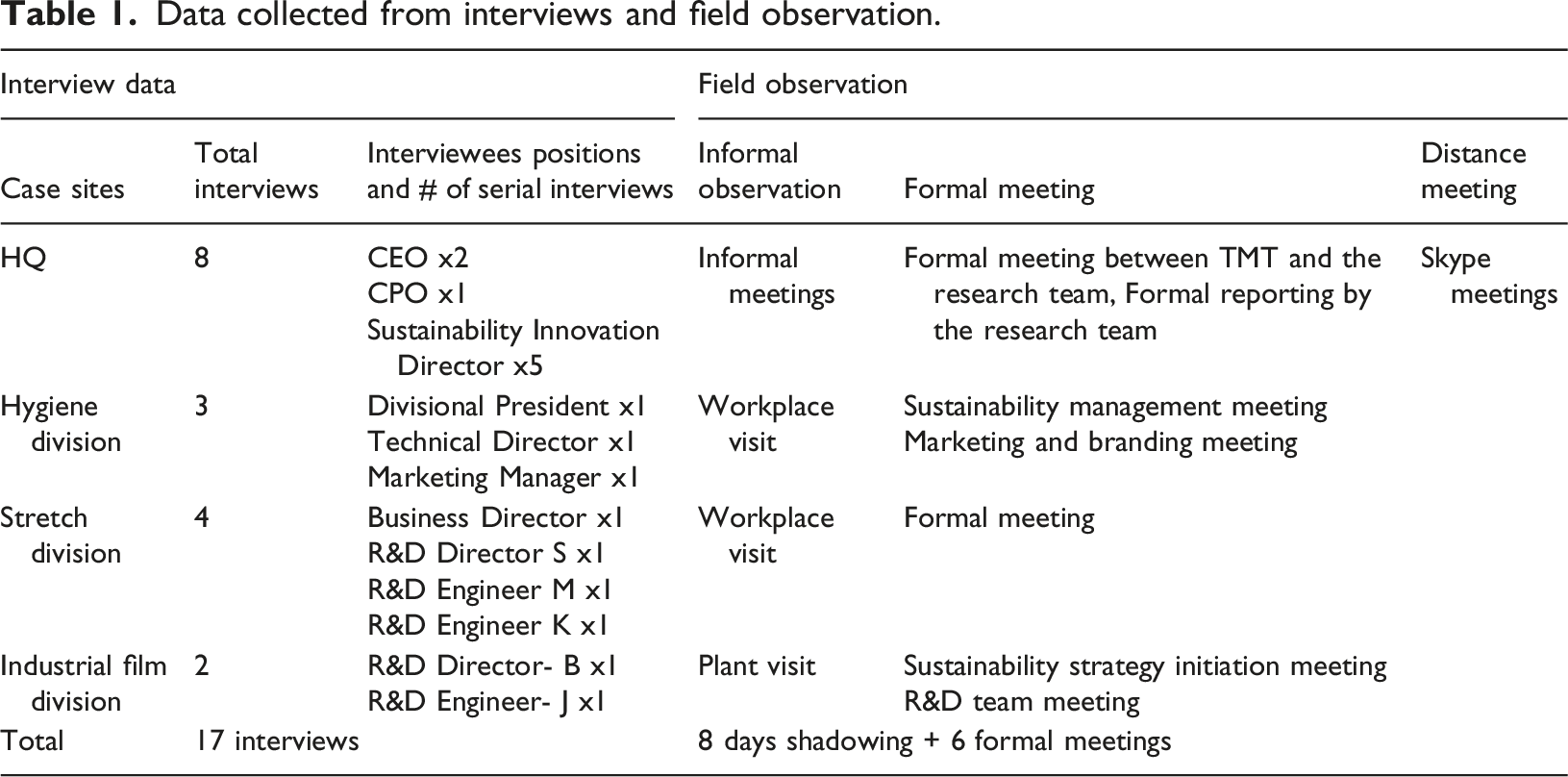
To trace the circumstances that could shape future developments, we collected firm- generated documents from 2017 to 2020. These include presentations by the Sustainability Innovation Director (SID) on the planning and implementation of the sustainability innovation strategy; a market research report on the business potential of recycled plastic; internal reports on various innovation projects; and publicly available documents on the company’s earlier history and strategic direction. To further understand the organizational context, we also reviewed 4 years of annual reports, sustainability reports, and internal magazines, as well as a marketing research report on recycled plastics, press release, marketing material for new products, and product brochures for the Green, Loop, and Lean offerings. In addition, several video presentations made by the CEO and the R&D director were analyzed to track the development of SOI over time.
Data analysis
We followed an “abductive” approach (Sætre and Van de Ven, 2021) to analyze the data, cycling back and forth between our empirical data and the theoretical frameworks (e.g., Mantere and Vaara, 2008).
The process of data analysis unfolded in several steps. First, we organized our data and composed a detailed chronological case narrative of the entire strategy process (Langley, 1999), which enabled us to identify key actors and key events. This analysis revealed that those involved referred to their strategy work as a sustainability innovation strategy, encapsulated in a metaphor derived from the Swedish word “produktifiera” and used in English “productify”. The metaphor suggests making sustainability offerings visible in the firm’s products. Our analysis also identified a distinct interpretative context for the strategic change, which was not universally perceived as positive. Differing understandings of sustainability and innovation led to tensions, including resistance to using recycled material in product development and production.
Following our abductive approach, we revisited the literature and identified these tensions as part of the broader sustainability imperatives and change context. By mid-2019, the firm had implemented a comprehensive organization-wide sustainability governance system and presented four types of sustainability-oriented innovation, marking the completion of their SOI strategy implementation. Combining these chronologically ordered data with our interviews and field notes, we categorized the empirical material into three phases: strategy formulation, initiation, and implementation. These phases are illustrated in the event map in Figure 1. Key event map.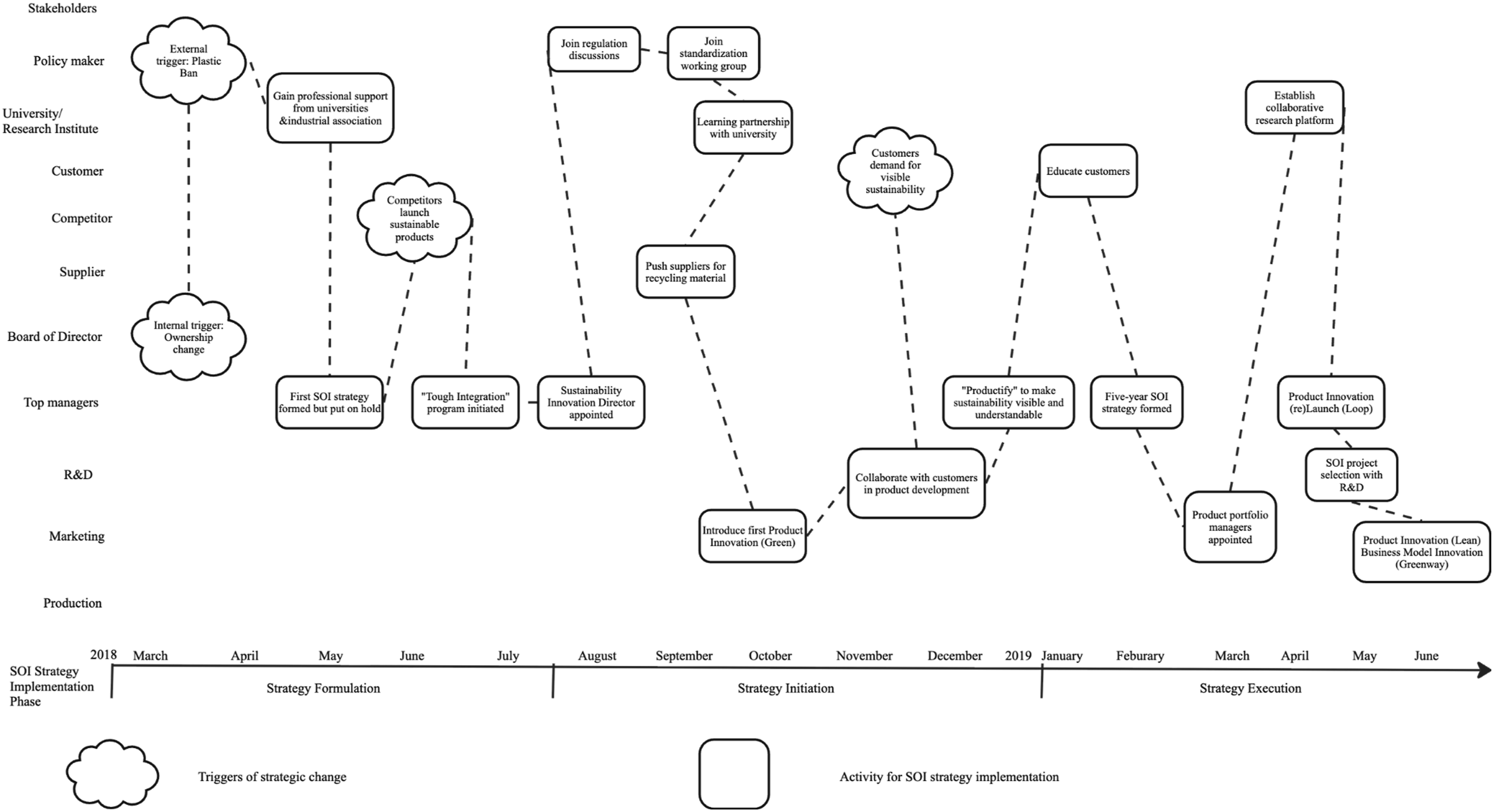
As it shows in Figure 1, although the Plastic Ban provided an external trigger for change and the ownership change created an internal trigger, top managers at Plast drove the strategic change process forward. They interacted with external stakeholders, such as policymakers, universities and research institutes, competitors, suppliers, and customers, shifting attention from market competition towards customer education in sustainability benefits. At the same time, the internal focus was on promoting the collaboration across R&D, marketing, and production. The event map also shows the innovation outcomes, including product innovations such as Green, Loop, and Lean, and the business model innovation Greenway.
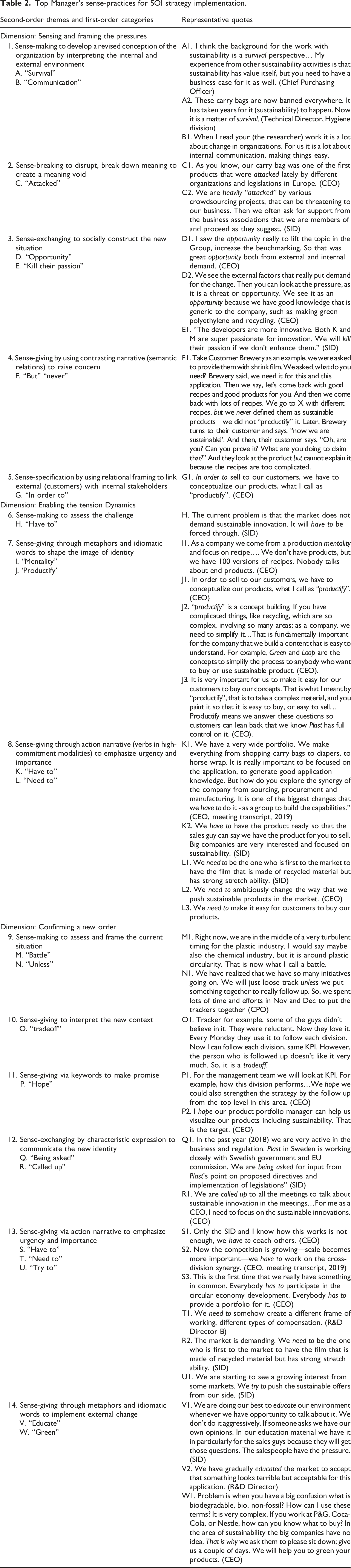
Top Manager’s sense-practices for SOI strategy implementation.
Findings
Opening an internal adaptive space: The making, breaking, giving, exchanging and specification of sense when framing the pressures
At the outset of Plast’s Sustainability-Oriented Innovation (SOI) strategy, the company confronted mounting external and internal pressures that together created a state of disequilibrium. Externally, these pressures stemmed from regulatory developments such as the EU plastics ban; intensifying competition; limited customer willingness to pay for sustainable alternatives; and broader societal demands for industrial transformation. Internally, competing interpretations of sustainability generated inertia and resistance to change. As one R&D manager observed: “Everyone has sustainability on the agenda, but they seldom do anything about it”. This gap between sustainability rhetoric and concrete action triggered the opening of an adaptive space for new interpretations and responses.
A key source of tension was Plast’s established way of working. The company had long relied on technically complex material recipes, which made it difficult to communicate the value of sustainability innovation to customers. This problem became especially salient when the early version of Plast’s Green product was presented through the composition of its recipe, leaving a key customer unable to identify what made the packaging sustainable. As one R&D engineer explained: I have the recipe for the new waste bag. It is difficult to say all the names in the “ingredients”. We have short names for the materials. This is how we describe them; it is a bit difficult to follow (if you are not in material development). (M. R&D engineer)
Although Plast had worked with recycling plastics for more than a decade, this capability had primarily been used as a cost-saving measure through the limited internal reuse of plastic waste rather than as an offering related to commercial sustainability. In short, the technology existed, but its market value had not yet been realized.
The growing attention to plastic bans increased customer interest in sustainable products, but this interest did not translate easily into sales. Recycled-content products struggled to meet customer expectations because recycled materials affected appearances and smell, making them unsuitable for sensitive applications such as food and medical packaging. At the same time, these products remained more expensive, as production had not yet reached economies of scale. Customers were therefore reluctant to absorb the additional cost despite the environmental benefits.
To better understand market demand, Plast collaborated with a Swedish technical university to assess the business potential of recycled plastics. The report indicated that customers expressed positive views of sustainability and that there was growing long-term interest in packaging made from recycled material. In response, Plast launched two SOI initiatives by the end of 2018: Green and Loop. Green products relied on fossil-free polyethylene derived from sugarcane, while Loop incorporated recycled material to reduce waste and support circularity. Both product lines aimed to reduce carbon footprints but also encountered commercial barriers. Green had originally been developed years earlier but remained commercially constrained by its premium price. Loop, despite building on existing recycling capabilities, struggled to secure orders because customers hesitated to accept the visual and sensory limitations of products with recycled content.
Within this context of technological promise and commercial uncertainty, top managers engaged in sense-practices that transformed pressure into strategic urgency. Rather than framing the situation as merely threatening, they interpreted it as a critical moment that required organizational adaptation. The CEO explained: First of all, there is ongoing discussion regarding sustainability and circularity in Europe and in the world, the circular strategy for plastics. It has resulted in very focused and intensive work in the committee. This has of course drawn attention to us. We need to do something with our positioning. (CEO)
This repositioning was strongly tied to collective survival. As the Chief Purchasing Officer noted: It is quite important for a company in the business we are in to work with the problem of sustainability and adopt changes for the future for our customers…it is a matter of survival. (Chief Purchasing Officer)
Similarly, the Technical Director stressed: These carry bags are now banned everywhere. It has taken years for it to happen. Now sustainability is a matter of survival. (Technical Director, Hygiene division)
These statements show how top managers framed sustainability not as a peripheral initiative but as central to Plast’s future viability. In doing so, they created disequilibrium by destabilizing existing assumptions while also opening internal adaptive space for new strategic interpretations and actions.
This opening of adaptive space was further reinforced through sense-breaking and sense- giving practices. Leadership deliberately disrupted prevailing understandings by emphasizing the intensity of external pressures; notably, both the CEO and the Sustainability Innovation Director (SID) describe the company as being “attacked” by sustainability-related demands. At the same time, they avoided allowing this pressure narrative to become paralyzing. Instead, they reframed sustainability as an opportunity to leverage Plast’s technical capabilities and differentiate its market position (see detailed quotes in Table 2).
The SID played an especially important role in sustaining this adaptive space within the organization. Working closely with R&D, the SID used sense-exchanging practices to protect engineers’ motivation. The developers are more innovative. Both K and M are super passionate about innovation. We will kill their passion if we don’t support them. (SID)
In parallel, the CEO’s sense-giving efforts linked sustainability to external stakeholder expectations, particularly those of key customers such as Brewery (pseudonym) and Hygiene (pseudonym). In discussions with Brewery, the CEO emphasized that recycled products needed to be simplified so that customers could communicate them more effectively to retailers. This captured the essence of Plast’s SOI strategy: away from presenting sustainability through technical recipes and toward translating sustainability into clear, marketable product solutions. In this way, disequilibrium did not simply expose problems; it opened an internal adaptive space in which new meanings, priorities, and strategic responses could begin to take shape.
Amplification and adaptive space for ideation: The making and giving of sense that enable the tension dynamics
As Plast moved forward with its sustainability-oriented innovation (SOI) strategy, tensions around the use of recycled materials became more visible and more consequential. These tensions were not merely technical; they also reflected competing assumptions about quality, safety, efficiency, and the very meaning of innovation. In this phase, adaptive space was not simply opened by external pressure but amplified internally as leadership worked to surface, hold, and channel these tensions into ideation and experimentation.
A central source of tension stemmed from the nature of recycled materials themselves. Unlike more predictable chemistry-based production processes, recycling introduced greater variation in material composition. This variability required new analytical tools and generated uncertainty among R&D teams, particularly regarding product safety. In response, the Sustainability Innovation Director (SID) used sense-giving to reframe reluctance not as a reason to retreat, but as a problem to be investigated and worked through: What we see is the reluctance to accept the Loop concept due to product safety. Our approach here is to challenge the reluctance and define the exact cause (SID).
In doing so, leadership helped create adaptive space by legitimizing concerns while preventing it from closing down experimentation.
Safety concerns were further intensified by questions of traceability, especially in Plast’s main product categories of hygiene and agriculture. The use of recycled plastics also disrupted established production routines, since operators needed to stop machinery, adjust settings, and manage additional scrap. Resistance was therefore strongest in production, where the shift was experienced as a direct threat to efficiency and performance. One production manager expressed this bluntly: “Don’t take my bonus away”. Among some R&D engineers, resistance took the form of attachment to long-standing routines: “It has been like this for 20 years, why change now?”
Yet this view was not universal. Technicians often approached the challenge more pragmatically: Working with recycled material is just a variation of our projects. We need to have repeated trials so that it is more difficult than a usual project. And you always need to have a reference when working with the recycled material (J, Technician).
These contrasting responses illustrate that adaptive space was unevenly distributed across the organization: for some, recycled materials represented disruption and loss; for others, they represented a manageable extension of existing problem-solving work.
Leadership responded by deliberately structuring the adaptive space rather than leaving these tensions unresolved. To bridge divergent interpretations, top managers introduced clear and simplified principles for SOI. In July 2018, they launched the Tough Integration program, which pushed product design toward single-material compositions. This initiative reduced technical complexity, aligned product development with recycling principles, and made sustainability easier to communicate internally and externally. Paradoxically, by narrowing the design space, leadership expanded the adaptive space for ideation: employees no longer had to navigate ambiguity; they could experiment within clearer sustainability parameters. Over time, this enabled visible progress. As one technician noted: Previously we worked with recycled material with about 5–10%, and now it is about 25%. This is a big change. We have seen lots of change happening (J. Technician).
Through the use of metaphor and linguistic framing leadership further amplified the adaptive space. The CEO introduced the term “productify” to shift attention away from technically complex recipes and toward tangible products that customers could more easily understand and buy. This was more than a communication device; it was a cognitive intervention that made sustainability innovation more actionable across functions. By translating abstract sustainability ambitions into product-oriented thinking, the metaphor reduced interpretive ambiguity and enabled ideation around commercially viable solutions. In this sense, adaptive space emerged not only through freedom to explore, but through the provision of shared language that made exploration collective and purposeful.
This cognitive shift was closely tied to a broader call for cultural change. The CEO repeatedly emphasized the need for a new mentality, and this language was echoed by R&D engineers themselves. As one engineer explained: We need to change the whole mindset of product development, that is the biggest challenge (M, R&D engineer).
Another added: Each month we have an improvement meeting with the top management team. We speak about our projects and what is ongoing. Everybody hears about it. But people have a different mindset. It is difficult to incorporate change (K, R&D engineer).
The reflections by the CEO and the R&D engineers show that leadership practices were not simply about intentional ways of directing action; they were about keeping adaptive space open long enough for new understandings to emerge, circulate, and gain legitimacy.
By late 2018, small customer orders for Plast’s Green products began to reinforce this shift. These early market signals gave employees greater confidence that the SOI strategy could work in practice. Leadership amplified this momentum through repeated and consistent sense-giving. The CEO, CPO, and SID used action-oriented language such as “have to” and “need to” to communicate urgency, emphasize the importance of measuring sustainability inputs, and identify viable business cases. A tracking system was also introduced to monitor SOI projects across R&D, Production, Sales, and divisional management. This extended adaptive space beyond isolated innovation efforts and embedded it in cross-functional routines and visibility structures. Importantly, the system was not experienced purely as control; rather, it was interpreted by R&D as a sign of managerial commitment. As one manager observed: The management team checks on the progress of SOI once a week. It is good! It shows their support (M, Material development manager).
Taken together, these leadership practices amplified internal tensions without allowing them to become immobilizing. By reframing resistance as a source of inquiry, simplifying complexity through shared principles and metaphors, creating recurring forums for dialogue, and establishing visible targets and metrics, top managers enabled adaptive space for ideation to expand and stabilize. In this way, tensions around safety, routines, incentives, and customer acceptance did not simply hinder SOI. Rather, when actively navigated through leadership sense-practices, they became generative conditions for experimentation, alignment, and the gradual embedding of sustainability into everyday operations.
Recombination and stabilizing feedback for scaling adaptive space: The making, giving and exchanging sense when confirming a new order
As market competition intensified, Plast’s SOI strategy entered an execution phase in spring 2019. At this point, leadership practices shifted again. Rather than primarily surfacing tensions or opening initial room for experimentation, top managers focused on recombining emerging ideas, actors, and routines, while generating stabilizing feedback that could scale adaptive space across the organization. Adaptive space thus became less episodic and more organized, preparing for the new order.
The CEO’s framing of the industry context remained central to this process. Referring to the turbulence surrounding the need for plastic circularity as a “battle”, he maintained a sense of urgency while redirecting attention toward collective adaptation. Right now, we are in the middle of a very turbulent time for the plastic industry … That is what I call a battle. (CEO)
Moreover, this framing was no longer used only to unsettle existing assumptions. It also served to hold adaptive space open long enough for emerging practices to consolidate. The CEO combined urgency with reassurance, frequently using supportive and forward-looking language such as “hope”, while also acknowledging likely setbacks: We will start it now, but honestly, I expect lots of friction before we make things work. (CEO)
This kind of calibrated sense-giving was less emergent in nature, but rather directive and served to provide a shared understanding and baseline among employees. The sense-giving efforts helped normalize friction as part of the transition, thereby preventing early resistance from closing down change.
Leadership also stabilized adaptive space by altering how performance expectations were communicated. Metrics were framed as trade-offs rather than as rigid constraints, which redirected attention from monitoring to identifying possible gains. At the same time, a more collaborative process was introduced around SOI project selection. R&D teams were actively involved in evaluating projects, increasing transparency and strengthening information flows to assess their impact on sustainability, this participatory approach broadened adaptive space by bringing technical expertise more directly into strategic decision-making. In parallel, top managers addressed production-side concerns by introducing a bonus program to compensate operators for the added difficulties associated with recycled materials. This was an important stabilizing mechanism: leadership did not merely ask actors to support the new order, but adjusted incentives to make participation in adaptive space more viable across functions.
By 2019, Plast also began to reposition itself externally in ways that fed back into internal confidence. Rather than reacting defensively to regulation, the company increasingly sought out knowledge and became recognized for its expertise. Through sense-exchanging, the CEO described Plast as a company that was now “being asked” and “called up” for its competence. This change in external recognition generated positive feedback internally and helped reinforce the legitimacy of the SOI trajectory. As one technician noted: New materials give new opportunities (J, Technician).
Such feedback mattered because adaptive space expands when internal experimentation is validated by external attention, thereby confirming that new ideas are not only technically feasible but strategically meaningful.
A key enabler in this scaling process was the SID, who played a mediating and integrative role across functions and stakeholder groups, including sales, R&D, communication, and divisional management. Her work was critical to recombining fragmented perspectives into a more coherent organizational direction. By “linking up” actors, translating between legislative demands and internal capabilities, and building shared understanding across divisions, she helped transform adaptive space from a local innovation arena into a broader cross-functional field of coordination. As one material development manager observed: Lately when the SID has come in, sustainability has become the goal and infused innovation.
The re-launch of the Loop product line further confirmed this emerging new order, focusing on SOI. The launch event of Loop became Plast’s first group-wide product launch and involved around 35 employees across headquarters, divisions, and the sales function. This initiative served as a recombination mechanism that brought together previously separated organizational elements around a shared sustainability agenda. Reflecting on this, the CEO stated: This is the first time that we really have something in common. (CEO)
Backed by tailored sales materials for 20 products, the launch helped materialize a shared innovation identity and translated adaptive space into concrete organizational outputs. R&D responded positively to this development. As one engineer put it: We are always open-minded, looking for new opportunities when developing new products (K, R&D engineer).
Through such experiences, adaptive space became increasingly institutionalized, as SOI gained visible form, broader participation, and reinforcing feedback.
By this point, Plast had developed three distinct SOI categories: an upgraded Green, a revamped Loop, and a new Lean line focused on material reduction through thinner product design and lower carbon footprint. These offerings reflected a recombination of technological capabilities, sustainability principles, and market demands. The CEO’s statement “We now have a solid setup to make our offerings sustainable”, captures this shift well. Adaptive space had moved beyond isolated projects toward a more stable configuration in which new practices, categories, and priorities were becoming normalized.
This maturation was also evident in leadership enactments. Sense-giving evolved from imperative formulations such as “have to” and “need to” toward more collaborative and externally oriented expressions such as “try to” and “working with”. This shift signaled that Plast was no longer only enforcing internal adaptation but also engaging in broader ecosystem work. Top managers initiated and supported collaborative projects with industrial associations and Swedish university partners to develop new products and materials. This engagement extended adaptive space beyond the firm’s boundaries: it became interorganizational, shaped through partnerships that brought in new knowledge, legitimacy, and opportunities for further innovation.
Educational work was central to this external scaling of adaptive space. Top managers used terms such as “educate” and “green” as sense-giving devices to frame sustainability not simply as a technical issue but as a shared learning process. Educational efforts targeted internal and external stakeholders alike, including sales teams, customers, suppliers, and industry partners. Sales staff received materials to prepare for customer questions about biodegradable materials, recycled content, and fossil-free polyethylene. R&D also participated in these efforts, particularly in relation to customer acceptance of recycled product features. As the SID explained: We are doing our best to educate our environment whenever we have the opportunity to talk about it. We don’t do it aggressively. If someone asks, we have our own opinions (SID).
Thus, these practices functioned as stabilizing feedback loops by diffusing the new logic of sustainability, reducing ambiguity among stakeholders, and strengthening the social infrastructure needed for the new order to hold.
Plast’s internal progress ultimately enabled a further expansion of its SOI agenda through Greenway, a business model innovation that bundled services such as life cycle analysis, sustainability education, new product development, and support with regulation and standards. Greenway shows that adaptive space, once stabilized, can generate not only new products but also new service logics and market relationships. By this stage, Plast had shifted from experiencing sustainability as a source of crisis to using it as a platform for strategic influence. The successful launch of four SOI categories confirmed a broader transformation. Plast had moved from a firm under pressure to an active participant in industrial change, with leadership practices helping to scale and stabilize adaptive space as a new organizational order.
Discussion
The EU ban on single-use plastics triggered a business crisis for Plast. Such crises often invite traditional directive leadership responses. Yet rather than relying primarily on top-down initiatives, top managers enacted a more pluralistic form of leadership to address complexity. Returning to our research question—how do top managers use sense-practices to nurture an adaptive space for SOIs in a crisis-induced change context? —we find that their practices intertwined interpretation, communication, and action across interactions with both internal and external stakeholders. Through these interactions, leaders fostered intersubjective meaning-making and enabled adaptive space for sustainable innovation and strategic change.
To illustrate these dynamics, we present our conceptual model in Figure 2. The conceptual model.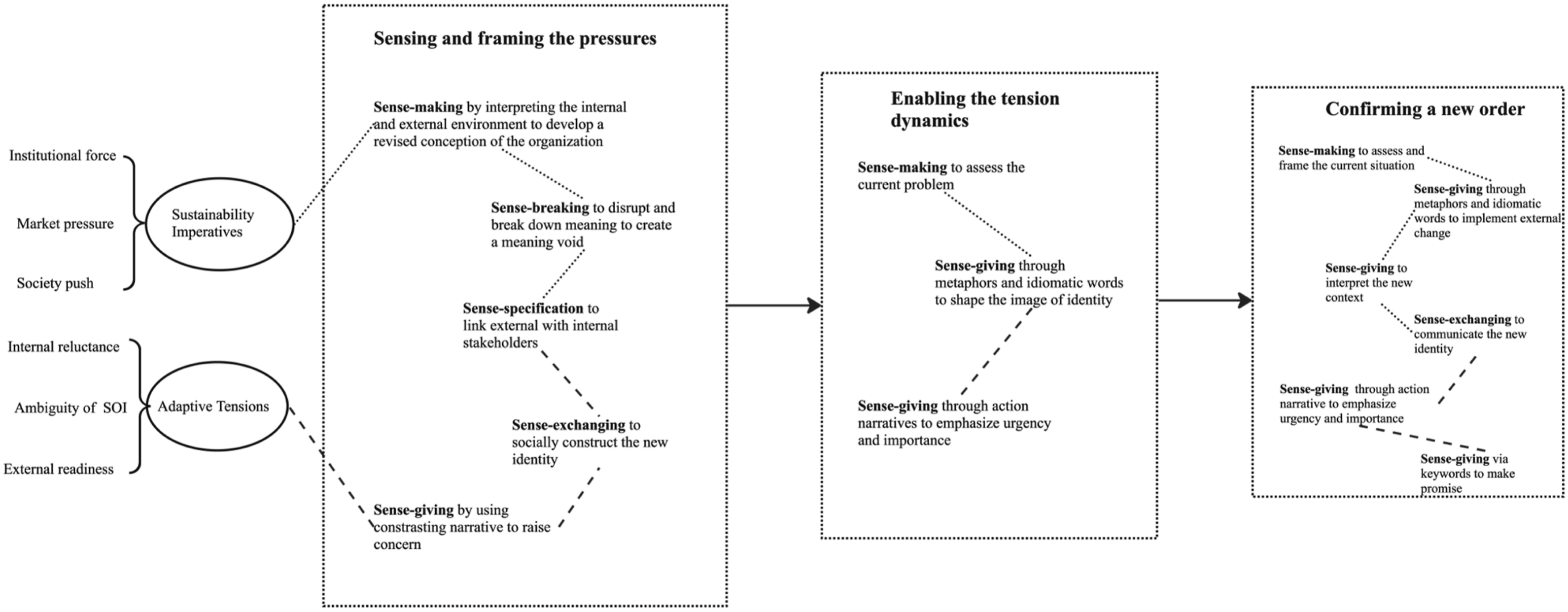
The model conceptualizes leadership for sustainability transformation as a sequential, yet overlapping, process of sense-practices through which organizations move from external pressures and internal tensions toward the stabilization of a new organizational order. As shown in Figure 2, Plast’s pre-change environment was shaped by external sustainability imperatives, including institutional, market, and societal pressures, as well as internal tensions associated with reluctance to change and limited understanding of sustainability-oriented innovation (SOI). Together, these conditions created both motivation for and resistance to change.
Organized around three phases -
The second phase,
The final phase,
In summary, Plast’s top managers drew on a repertoire of sense-practices that varied across phases of change. These practices functioned as attention-directing devices that guided employees toward specific areas of focus while simultaneously connecting internal actors with external stakeholders. In doing so, they created and sustained an adaptive space in which the sustainability-oriented innovation strategy could be legitimized and embedded in business operations. The model further demonstrates that these practices were both sequential and overlapping, depending on the stakeholder context and the tensions involved. The process was therefore neither linear nor uniform. Rather, it involved a shifting repertoire of sense-practices through which leadership shaped the interpretation, legitimation, and implementation of sustainability transformation as well as a contraction of meaning.
Theoretical implications
The process-oriented and practice-focused nature of this study offers several theoretical implications. First, we extend Complexity Leadership Theory (CLT) by refining the contours of the framework through contextualizing and identifying leadership practices that enable the creation of adaptive space. By incorporating a set of sense-practices, we make CLT more inclusive, combining both individual and group perspectives on leadership. Integrating these practices into CLT’s framework also helps contextualize leadership functions and roles, thereby adding analytical subtlety and safeguarding against oversimplification.
On a comparative note, CLT emphasizes the interplay between operational, entrepreneurial, and enabling leadership functions within complex adaptive systems (Uhl-Bien and Arena, 2018). The fundament of CLT aligns closely with sense-making as a distributed and retrospective process through which actors interpret ambiguity and enact their environments in crisis-induced change (Weick, 1995). Morover, leaders engage in sense-giving by framing issues, shaping narratives, and directing attention, thereby orienting collective interpretation without fully determining it. Sense-giving thus enables guiding and directing emergent meaning structures within complex systems.
Similarly, sense-exchanging emphasizes mutual influence and the co-construction of understanding through dialogue. Thus, sense-giving is more intentional and influence-oriented, whereas sense-exchanging is more reciprocal and emergent. CLT accommodates both: sense-giving resonates with enabling and operational leadership roles that help coordinate and align meaning, while sense-exchanging reflects the decentralized, network-based interactions that drive adaptive emergence.
Entrepreneurial leadership requires destabilization of entrenched assumptions in order to generate variation and innovation. Sense-breaking practices create the necessary disequilibrium in interpretive systems, increasing the potential for novel patterns to emerge. In this way, it serves as a catalyst for adaptive processes by loosening rigid structures and enabling new sensemaking trajectories. This aligns closely with CLT’s emphasis on disequilibrium, instability, learning and innovation.
Sense-specification, which involves the refinement, clarification, and stabilization of meaning (Maitlis and Christianson, 2014), corresponds to the integration phase in CLT, where emergent outcomes are selectively retained and embedded into organizational routines. Overall, our practice perspective nuances sense-making research by highlighting the role of multiple, diverse, and sequenced sense-practices in shaping strategic action. In doing so, we move beyond the field’s predominant focus on cognition and discourse by showing how sensemaking is enacted through concrete leadership practices, an issue we elaborate further below.
The pluralism paradigm in leadership
As well as extending beyond individual and collective perspectives, pluralism in leadership also requires openness to multiple theoretical vantage points. As Denis et al. (2012) emphasize, leadership in complex organizational settings should be enacted through collective, distributed, and interactive processes rather than through heroic individuals. However, other authors challenge collective accounts of leadership as an ‘empty signifier’ for holding incompatible and inconsistent conceptions and ideologies (Edwards and Bolden, 2023).
We suggest a paradoxical, “both-and” view of pluralism. Individuals may engage in sense- making to reinterpret a situation, while practicing sense-giving to influence other interpretations. Practices such as sense-specification (directing attention to particular cues), sense-exchanging (negotiating interpretations), and sense-breaking (punctuating or disrupting meaning), can be initiated by individuals, even though they are directed towards influencing the collective. These practices operate at the individual, dyadic, and collective levels. This illustrates that pluralism in leadership is not simply about levels of analysis but also manifests in coexistence and sequencing of multiple practices.
CLT already resonates with the collective account of leadership by acknowledging the emergent roles of multiple actors (Uhl-Bien et al., 2007). The CLT framework further accommodates plurality by integrating functions, styles, and roles, such as operational, enabling, and entrepreneurial leadership, decentralizing and downplaying the need for formal authority. However, as Tourish (2019) argues, it is overly restrictive to adhere rigidly to a single theoretical framework. Leadership theorists should instead strive to develop insights by drawing from multiple paradigms in pursuit of a more unitary approach (Tourish, 2019). In this case, adopting a practice-based sense-making perspective elevates the criticism of CLT’s decontextualization, while also connecting individual behaviors with collective processes and preserving its pluralistic character.
Classifying leaders at Plast solely within CLT categories would obscure the nuance of their behaviors and not accurately depict their deeds, just as attributing leadership to conventional heroic styles would do. For instance, engaging with external stakeholders of SOI could be seen as enabling leadership and also as behavior that connects individual and collective actions. However, these connecting behaviors can be deconstructed into specific practices, including re-interpretation of a situation (sense-making), refining it through an exchange of this new understanding (sense-exchanging); at other times, punctuating or substituting a current understanding (sense-breaking), specifying, highlighting certain elements (sense- specification), and influencing (sense-giving) others’ interpretations of the setting. When the latter three practices (sense-breaking, sense-specification, and sense-giving) are viewed either through the lens of CLT, or as a heroic perspective, they might be misinterpreted as top-down, formal, and directive approaches (e.g., Plast’s introduction of a 5-year strategy, key performance indicators, trackers, and a governance system). Indeed, behaviors exercised by top managers may have either a conventional and heroic taint or be viewed as a matter of operational leadership in CLT. In fact, in the context of business crisis and strategic re-orientation, they represented attempts to re-consider, re-claim, and re-configure order.
When analyzing Plast’s practices, we also found that although leaders initially may have regressed to using “old” recycling technologies and products in the innovation process—an action that might be seen as rigidity—the overall process, was characterized by the retrospective nature of sense-making, cognitive flexibility and the construction of multiple guiding narratives. Thus, under pressures, leaders shifted from traditional top-down approaches to more complex leadership practices. This shift helped them to make sense of the situation (cognitively re-assessing it), to re-construct and re-frame it, as well as to enact and make sense of it for internal and external stakeholders. As Maitlis (2005) notes, the recurring process of sense-making and sense-giving is reflexive and embodied, bridging cognition to action both before and after decision-making. Thus, infusing a practice perspective into CLT helps to explain not only the “who” and “what” in leadership, but also the “how”.
Implications of sense-practices
Adopting a sense-making perspective within CLT also has implications for sense-making theory. We argue that sense-making should be nuanced beyond its use as an umbrella concept and understood instead as a constellation of specific sense-practices. When examined from the perspective of leading a strategic change, these practices do not stand in contrast to, or contradict, one another. Rather, they complement each other by performing different but interconnected functions in shaping collective interpretations, mobilizing action, and supporting organizational transformation.
Compared with prior work, sense-making is widely used as a lens in strategic leadership studies, but existing research often isolates specific practices rather than examining how they interact. For instance, Gioia and Chittipeddi (1991), Rouleau (2005), and Mantere et al.’s. (2012) studies sense-making and sense-giving may appear selective, focusing on particular comparisons of sense-related concepts. Overlooking other practices, their analysis risks under-analyzing the influence of them. By adopting a sequential and interconnected view, our study helps bring to light the often-missed interconnectedness between the different sense-practices, which occasionally seem to contradict and oppose each other, at other times, complement each other. Thus, in contrast to Rouleau’s (2005) identification of micro-enactments within sense-making and sense-giving activities, we map the interactions among a broader set of sense-practices, offering a processual and contextual conceptualization of an otherwise overly inclusive concept.
Our processual perspective also challenges the canonical, iterative, and retrospective nature of sense-making literature (see Colville et al., 2016; Cunliffe and Coupland, 2012; Maitlis et al., 2013). As depicted in Figure 2, the SOI implementation process unfolds through sequenced phases of sensing and framing the pressures, enabling the tension dynamics, and confirming a new order. Yet, the process is not directly linear but operates almost in an overlapping fashion, with sense-making, sense-breaking, sense-giving, sense-specification and sense-exchanging activities recurring across the timeline. The top managers also display reasoning that makes use of past circumstances to understand the current situation, but they also make projections into the future. For instance, when leaders made sense of the changes necessary to “productify” to further legitimize the SOI strategy, the leaders evaluated the past to project these assumptions into the future with the purpose of dealing with the challenges ahead of them. Thus, the retrospective aspect of sense-making is also used as a basis for projections made into the future, suggesting sense-making activities that are prospective (see Wright, 2005).
This insight challenges Gioia and Chittipeddi’s (1991) oscillating and “linear” model of strategic change. While we similarly trace episodes of convergence and divergence in actors’ interpretation, our findings reveal a greater variety of sense-practices. Some, such as sense- giving, seemed to cluster and become relatively more common in the final phase, where the overall process gravitated toward shared understanding. Thus, shared understandings emerged gradually and became clearer through successive and alternating sense-making practices, after the shaping of different sense-practices.
Practical implications
The Plast case shows that implementing a sustainability-oriented innovation strategy is not simply a matter of setting goals or issuing directives. It requires leaders to actively create, expand, and stabilize adaptive space in which new meanings, practices, and collaborations can emerge. In practice, this means that leaders can deliberately bring tensions and paradoxes to the surface rather than suppress them. Using scenario-based discussions, external pressures, or early market signals, for example, would unsettle established assumptions and stimulate reflection. At Plast, such perturbations helped make visible the tensions between efficiency and sustainability; technical complexity and market simplicity; existing routines and new strategic demands.
Leaders can also strengthen adaptive space by building reinforcing feedback around early progress. Storytelling, visible managerial attention, peer recognition, and small but measurable market wins can help transform fragile experiments into shared organizational momentum. In Plast, early customer orders, regular senior management follow-up, and cross-functional visibility around SOI projects gave legitimacy to new ways of working. They also encouraged broader participation.
A further implication is that leaders need to enable recombination across functions and organizational boundaries. This involves creating forums, shared concepts, and boundary objects that help actors from R&D, production, sales, and external partners work together around ecosystem-level value propositions. In the Plast case, ideas such as “productify,” common sales materials, and collaborative projects with universities and industry actors helped translate sustainability from a technical issue into a shared commercial and organizational agenda.
Finally, for adaptive space to scale rather than fade, leaders need to embed the emerging logic into structures and routines, such as KPIs, procurement criteria, project evaluation systems, incentive schemes, and design principles. At Plast, this occurred through project tracking, revised bonus systems, simplified design rules, and the development of new product and service categories. At the same time, formalization should not close down learning. Leaders therefore need to maintain reflective dialogue so that experimentation, reinterpretation, and adjustment remain possible as sustainability challenges evolve.
More broadly, our findings suggest that sustainability-oriented innovation advances through collective sense-making that leaders enable, rather than through top-down initiatives alone. Leaders do not need to provide all the answers. Their real role is to curate the interactions, interpretations, and feedback processes through which more viable answers can emerge, gain legitimacy, and endure. By engaging in multiple sense-practices, top managers can align rhetoric with action, foster shared understanding, alleviate tensions, and connect mental representations with operational change. In this way, leadership can reduce the risk of talk about sustainability being purely symbolic, strengthen organizational credibility, and support trust internally and externally. A leadership perspective that is informed by the complexity of sense-making therefore helps explain how leaders can make sustainability efforts appear both credible and actionable, while reducing the risk of hypocrisy and accusations of greenwashing (Vollero et al., 2016).
Limitations and future research
This study has several limitations which open pathways for future research. First, as noted in the method section, ours are primarily based on observations and interviews with top managers. This focus does not fully represent the perspectives of other stakeholders, suggesting a potential direction for future research on stakeholder engagement in sustainability transitions in an SOI-context.
Secondly, while this study is process-oriented and focuses on the most critical transitional period, we did not capture activities beyond the transition to follow up on Plast’s SOI development. Future research could examine the post-transition change process in more detail. Giving additional attention to outcomes after the transitional period, for example, could provide further insights such as which initiatives of the strategy are maintained over time.
Thirdly, while the perspectives used in this study allow points of comparison and offer a chance of descriptive accuracy, their reliance on narratives as being indicative of sense- practices is another limitation. The methods used in this study do not take account of the fact that some individuals may purposely create a divide between what they think and what they do. In other words, individuals may intentionally hide what they know for personal strategic benefit. A more balanced triangulation of methods may serve as a remedy in future studies. A final limitation concerns the potential lack of generalizability to other firms. For example, our case company is a Scandinavian firm with a long history of decentralization and autonomy. The process and dynamics identified here may not apply to other types of organizations. Future research should explore cases with varying conditions to determine the broader applicability of these findings.
Additionally, the emergence and sequencing of sense-practices is highly context- dependent. The same set of sense-practices identified in this study does not necessarily emerge in the same order; some practices may be omitted in other settings. For instance, crisis-induced strategic change is more likely to connect to matters of urgency than if the change were triggered by incremental innovation initiatives. Thus, the same set of narratives indicates practices that are not likely to emerge across settings.
In conclusion, while the leadership of Plast’s strategic change towards sustainability proved successful, it prompts reflections on the suitability and scalability of the shaping of sense-practice. However, in this study, we let empirics inform theory, instead of making empirical generalizations. Rather than offering universal prescriptions, we provide a conceptual lens for understanding how leaders can navigate sustainability transitions through situated, practice-based leadership.
Footnotes
Acknowledgments
The fieldwork for this research was conducted while the corresponding author was funded by the Japanese Society for Promotion of Science (JSPS) Postdoctoral Fellowship, hosted by Hitotsubashi University, Tokyo, Japan. The authors extend their sincere gratitude to Professor Minoru Shimamoto for his active involvement in the fieldwork and invaluable support during the 8-month fieldwork period.

Ethical considerations
The research was conducted as part of a learning partnership between Hitotsubashi University under the guidance of Professor Minoru Shimamoto, and the case company.
Funding
The authors received no financial support for the research, authorship, and/or publication of this article.
Declaration of conflicting interests
The authors declared no potential conflicts of interest with respect to the research, authorship, and/or publication of this article.
Data Availability Statement
The case company provided data exclusively for research purposes, with all informants remaining anonymous.