







Abstract
The current debate in intergovernmental organizations about the object of freedom of the media has its origins in recent history. Conventions and other international legal and political documents provide, in retrospect, an insight into the relevant ideas shared by many, while accord on their meaning is usually reached by agreement that results from intense negotiations by both experts and diplomats. I argue that notions and concepts of what exactly should be protected under the umbrella of media freedom have been transformed during three distinct periods in post-war history. The related definitions are placed in the hierarchy of universal human rights. The contemporary international debate is illustrated with an example of the latest challenges to the scope of freedom of the media. The document analysis leads to a possible solution to the current intergovernmental argument.
Introduction
The concept of ‘freedom of the media’ can be considered the key to any theory of mass communication (McQuail, 1994: 140). While we leave it for philosophers to debate the meaning of freedom itself, let us look at the definition of the second part of the notion: freedom of what? *
The starting point of this article is that freedom of the media is a systemic concept, which implies that with the technical facilities to do so, individuals can circulate their thoughts and opinions among a number of people that is sufficiently large to satisfy their desire to take part in public dialogue and have a say in politics and decisions on matters of public interest. It also means that individuals can circulate and obtain information on current affairs without hindrance.
Hallin and Mancini (2004) claim that at the current stage of world history, ‘national differentiation of media systems is clearly diminishing’ (p. 13). They provide examples of the European Union (EU) countries where this trend is particularly evident. Such convergence of media systems’ differences is apparently based on growing uniformity of regulation. Key regulatory parameters of media activity, such as limits of governmental interference, protection of privacy as well as right of reply, protection of children and support of European content in broadcasting, are uniform in the EU.
While Hallin and Mancini – in their observation on diminishing differentiation – speak of the European Community of 28 states, this harmonization trend is also true for other regional and global international communities.
In Europe alone, there are two other intergovernmental players that have contributed to harmonization of media systems and their regulation: the Council of Europe (CoE) and the Organization for Security and Co-operation in Europe (OSCE). The CoE in its resolutions and recommendations addresses issues of balancing freedom of expression and other human rights. 1 Problems in media legislation and jurisprudence are settled by the European Court on Human Rights, the guiding force for the CoE. The CoE makes explicit demands to the candidate countries regarding specific changes of media regulation and the media system (Richter, 2009).
The OSCE of 57 participating States views human rights issues and, in particular, media freedom as essential components of international security. In its decisions, the OSCE advocates and promotes full compliance with its numerous principles and commitments in respect of freedom of expression and media freedom (OSCE, 2013a: 32).
This phenomenon of harmonization of media systems gives rise to the particular role of international agreements.
Indeed, modern principles and concepts of media regulation are typically implemented in international conventions on human rights. These agreements reflect the current scholarly debate as much as political compromise that can be achieved in relation to the scope of civil and political rights, their importance, aim and implementation.
Thus, this article’s methodology is to base the global understanding of the media element of the ‘freedom of the media’ concept on key international legal documents. Such normative texts serve as a source of study and present a valid reflection of the ideas, beliefs and concepts shared by many, while accord on their meaning is usually reached by agreement that results from extensive debates of both experts and diplomats. The research relied on adopted intergovernmental acts and largely excluded document analysis of policy papers and declarations of conferences, which instead serve as background material useful to understand various political ambitions and interpretations.
A systematic study of all key relevant international agreements adopted by the United Nations (UN) (including the UN Educational, Scientific and Cultural Organization, or UNESCO) and regional intergovernmental organizations, such as the OSCE, the CoE, the EU, the Organization of American States (OAS) and the African Union, reveals a documented process which makes it possible to identify three distinct periods in post-war history when the object of freedom of the media was labelled, defined and treated in clearly different ways. 2
Developing periods as an analytical tool leads to a hypothetical suggestion on a further stage in defining media freedom, which allows harmonizing currently opposing conceptual views on the scope of this freedom.
Freedom of information period
In the first period (1945 to the 1960s), the intergovernmental debate was centred on more general freedoms and human rights, which the press served. That was the time when post-war aspirations of eternal world peace and cooperation were replaced by the Cold War. The period was also marked by the growing influence of communist ideology and later the Non-Aligned Movement, which internationally heralded stronger emphasis on socio-economic rights and interpretation of political rights with a focus on the interests of the working classes.
The first intergovernmental document that touched upon the post-war meaning of media freedom was probably the 1945 Constitution of UNESCO. Specifically, Article 1.2(a) states that to contribute to peace and security by promoting collaboration among the nations through education, science and culture in order to further universal respect for justice, for the rule of law and for the human rights and fundamental freedoms … the Organization will … recommend such international agreements as may be necessary to promote the free flow of ideas by word and image …. (UNESCO, 2012: 6)
The UNESCO itself commonly interpreted this constitutional provision of the ‘free flow of ideas by word and image’ as an objective when facilitating the import of educational, scientific and cultural books, objects of art, films and audio materials (UNESCO, 1997). For this matter, the provision indeed served as the basis for the Beirut Agreement (UNESCO, 1948) and the Florence Agreement (UNESCO, 1950). Furthermore, it was instrumental in the new international agreement on copyright: the 1945 Universal Copyright Convention (Fortner, 1993: 158).
By the 1990s, however, the governing body of the UNESCO had developed a supplementary concept of what lay behind ‘word and image’ by linking it with freedom of expression and freedom of the media and implementing practical steps to ‘encourage the freedom of the press, and the independence, pluralism and diversity of public, private or other media’ (UNESCO, 1989).
Nordenstreng (2013) lists the UNESCO Constitution as one of the three ‘landmark documents of the international community’ that codify ‘the media-related freedom as a universal concept’ (p. 45). Nordenstreng’s (2013) assertion that the Constitution’s provision of ‘the free flow of ideas by word and image’ equals an introduction to ‘an idea of media freedom’ (p. 45) is probably an overstatement, even in retrospect. More relevant, however, is that the purpose of UNESCO (2012) was described in its Constitution as ‘to further universal respect … for the human rights and fundamental freedoms which are affirmed for the peoples of the world, without distinction of race, sex, language or religion, by the Charter of the United Nations’ (p. 6). The 1945 Charter, however, does not enumerate or elaborate on the definite protected human rights.
Ideas of media freedom were explained a year later, in 1946 Resolution of the UN General Assembly 59 (I), in the notion of freedom of information (Goldberg, 2014). At the time, the latter implied the ‘right to gather, transmit and publish news anywhere and everywhere without fetters’. Thus, freedom of information as ‘a fundamental human right and … the touchstone of all the freedoms to which the UN is consecrated’ probably meant freedom of ‘the press, radio, motion pictures and other media’ (UN, 1946), and not the right to access information as this notion was viewed soon thereafter.
The first significant international human rights agreement on common standards of the post-war world was the Universal Declaration of Human Rights (UDHR), adopted by the UN in 1948. Article 19 of the UDHR refers to freedom of information as an integral part of freedom of expression: ‘[e]veryone has the right to freedom of opinion and expression; this right includes freedom to hold opinions without interference and to seek, receive and impart information and ideas through any media and regardless of frontiers’ (UN, 1948).
Another milestone of the international human rights agreement, the International Covenant on Civil and Political Rights (ICCPR), was adopted in 1966 by the UN General Assembly. The ICCPR also holds the right to freedom of expression (Article 19), which includes ‘freedom to seek, receive and impart information and ideas of all kinds, regardless of frontiers, either orally, in writing or in print, in the form of art, or through any other media of his choice’ (UN, 1966). Here, again, freedom of the media is reiterated under the name of freedom of information and as an integral part of freedom of expression.
Tarlach McGonagle (2011) emphasizes that the adoption of these UN acts on freedom of expression was accompanied by a Cold War discussion on the media foundations of this right. During the debate, diplomats from the socialist countries daringly proposed the following formula to reinforce the freedom of information element of the right to freedom of expression: In order to ensure the right to free expression of opinion for large sections of the peoples and their organizations, State assistance and co-operation shall be given in providing the material resources (premises, printing presses, paper, and the like) necessary for the publication of democratic organs of the press. (McGonagle, 2011: 530)
Similar to the provisions of the then-national constitutions of the Union of Soviet Socialist Republics (USSR) and its satellite countries, this formula, if adopted, would protect a ban on private ownership of the press, which existed in the Soviet bloc, from accusations of violations of freedom of information. Moreover, this norm would provide a platform for wide interpretations of what were ‘democratic’ media.
Definition of freedom of expression in the American Convention on Human Rights, or ACHR (OAS, 1969) is similar to the language of the ICCPR. Article 13 (‘Freedom of Thought and Expression’) of the ACHR stipulates that the right to freedom of thought and expression includes ‘freedom to seek, receive, and impart information and ideas of all kinds, regardless of frontiers, either orally, in writing, in print, in the form of art, or through any other medium of one’s choice’. The ACHR also explicitly points to the integrity of freedom of information and freedom of the media as it continues to speak of the ban on indirect methods or means, such as the abuse of government or private controls over newsprint, radio broadcasting frequencies, or equipment used in the dissemination of information, or by any other means tending to impede the communication and circulation of ideas and opinions. (OAS, 1969)
Another regional agreement of that period, the European Convention for the Protection of Human Rights and Fundamental Freedoms (ECHR), calls for the right of everyone to have freedom of expression (Article 10). This right includes the freedom to receive and impart information and ideas without interference by public authority and regardless of frontiers (CoE, 1950). Again, freedom of the media is hidden in the freedom of information formula; hence, the same Article prescribes that this right shall not prevent States from requiring the licensing of broadcasting, television or cinema enterprises. No wonder the European Court of Human Rights (ECtHR), guided in its jurisprudence by the ECHR, has developed extensive case law providing a body of principles and rules granting the media and journalists special status in the enjoyment of the freedoms contained in Article 10. This status includes, for example, their durable protection from court trials and protection of confidential sources of information of journalists (Myjer, 2012: 121).
As a consequence, the essence of the first period was the promulgation of freedom of information, as mostly, if not solely, freedom of the press, television and radio. Freedom of information was considered an essential tool to serve and ensure the right to freedom of expression (Figure 1). It was endorsed as an internationally recognized human right due to the post–world war syndrome that lack of free expression and information, as well as other political and civil rights, endangers peace and security. Another contributing factor for promoting freedom of information at that time was the global drive for gaining knowledge. Press, television, radio and movies were expected by the intergovernmental organizations to make the public educated and thus respectful of the universal values.
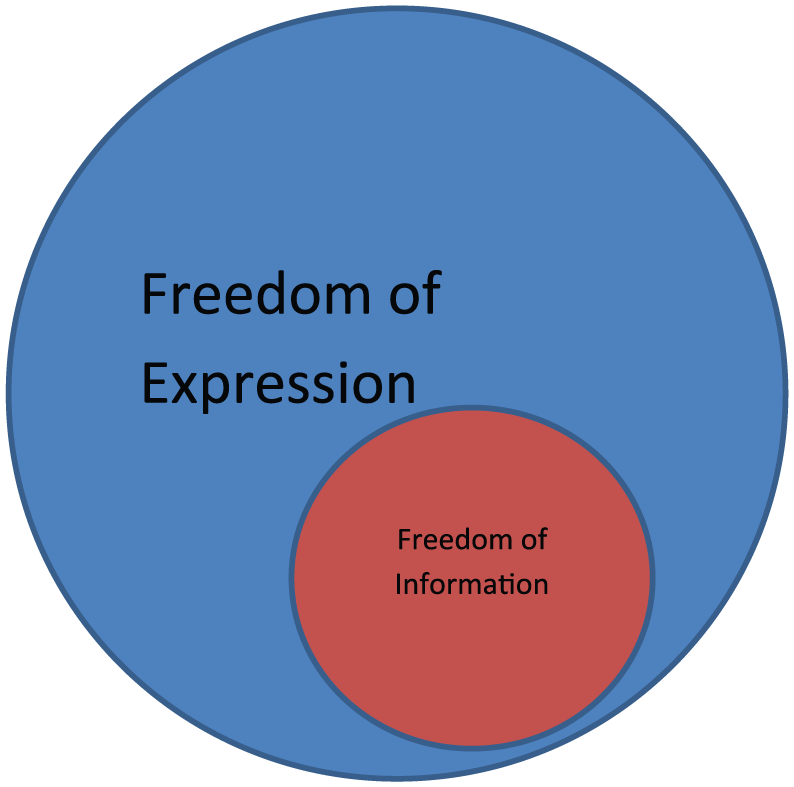
The first period.
Freedom of the mass media period
The intergovernmental discussion further developed in the second period (1970 to the mid-1990s). From an international relations perspective, this was the time of détente, followed by the collapse of the Soviet ideology and the end of the Cold War. The Helsinki Accords (1975) paved the way for a global recognition of the importance of political human rights – such as freedom of expression – for world security and cooperation (OSCE, 2013a).
The intergovernmental discussion on media freedom was boosted not just by the growth of television but, more importantly, by a growing debate and grass-roots activism demanding the right to access and gather governmental information, which was called the Freedom of Information (FoI) movement (Dennis and Merrill, 2006: 70; Schudson, 2014: 4). Access to information was then developed as a human right of its own, and its supporters have largely claimed ownership to the notion of ‘freedom of information’. This new right was later formally recognized in numerous regional intergovernmental acts, national law and jurisprudence, a dramatic growth of their adoption taking place in the 1990s (Mendel, 2003: v–vi). It was during this period that an international group of experts concluded, Freedom of information should be guaranteed as a legal and enforceable right permitting every individual to obtain records and information held by the executive, the legislative and the judicial arms of the state, as well as any government owned corporation and any other body carrying out public functions. (Mendel, 2008: 13)
Clearly, this new right was to be delineated from what was understood as freedom of information in the past.
In parallel, an analysis of the documents adopted by the Parliamentary Assembly and the Committee of Ministers of the CoE and case law of the ECtHR reveals that since the late 1960s, there was an urgent need and desire to articulate and safeguard an autonomous human right, usually called freedom of the press and other mass media. (It should be recalled that at that time and until the 1990s, the CoE was exclusively a club of Western European states.)
This international new right was based on the view that ‘the press and the other mass media’ perform an essential function for the general public to be discharged ‘with a sense of responsibility towards the community and towards the individual citizens’ (Parliamentary Assembly of the Council of Europe (PACE), 1970). Möwes (2000) observes that as early as 1976, the Committee of Ministers of the CoE introduced mass media as a human rights policy field in its own right.
The New World Information and Communication Order (NWICO), a project initiated by the UNESCO and the Non-Aligned Movement over media representations of the developing world in the 1970s, resulted in the adoption in 1978 of UNESCO’s flagship document (Nordenstreng and Hannikainen, 1984), ‘Declaration on fundamental principles concerning the contribution of the mass media to strengthening peace and international understanding, to the promotion of human rights and to countering racialism, apartheid and incitement to war’, or the Mass Media Declaration. The Declaration formulated its own principles for protecting the rights of journalists and other ‘agents of the mass media’ for decades to come (UNESCO, 1978).
The terminology of that period, although already influenced by changes in technology, was far from being clear-cut; alongside freedom of the press and other mass media, there was also a notion of freedom of mass communication media as well as calls for freedom of the press and television (e.g. in PACE, 1978), freedom of reception and retransmission (e.g. in CoE, 1989), freedom of the media, freedom of the mass media, freedom of opinion and information in the mass media, media independence and so on.
In the early 1990s, ‘mass media’ and ‘media’ were established as synonymic terms in international agreements and texts. An additional convenience of the notion was found in the function of the media as that of the mediator – an intermediary that provides information service (PACE, 1993).
The right to information reinterpreted as freedom of the mass media still remained one of the fundamental human rights. It belonged to the citizen in the sense that he had the right to demand that the information supplied by journalists be conveyed truthfully, in the case of news, and honestly, in the case of opinions, without outside interference by either public authorities or the private sector. At the same time, the media was part of business activity, where players were the publishers, owners and journalists. To that end, the PACE proclaimed that in addition to safeguarding freedom of the media, freedom within the media should also be protected and there should be safeguards against internal pressures (PACE, 1993). Only then, apparently, would freedom of the mass media serve its purpose.
This concept is based on a belief that individuals have the sovereign right to express themselves without reservation and that, therefore, similar rights are granted to media outlets – institutions that facilitate this communication of individuals (e.g. Freedman, 2008: 55; Nordenstreng, 2013: 47). There is no doubt among researchers and diplomats that media freedom implies a legal environment facilitating operations of the news outlets and media moguls inasmuch as they facilitate this communication and dialogue of individuals. To a large extent, such a legal environment was being driven and evolved by international documents during this period.
Thus, a consolidation of the right to freedom of the mass media, a notion derived from freedom of information, became the essence of the second period (Figure 2). Journalists and media outlets were recognized as subjects of this freedom, as mediators that provide the citizens and the public at large an essential information service to enable them as democratic participants in public life. Freedom of the mass media was viewed as having origins in the right to freedom of information, but still subservient to freedom of expression. Its raison d’être was that only a free mass media could function as an essential public good.
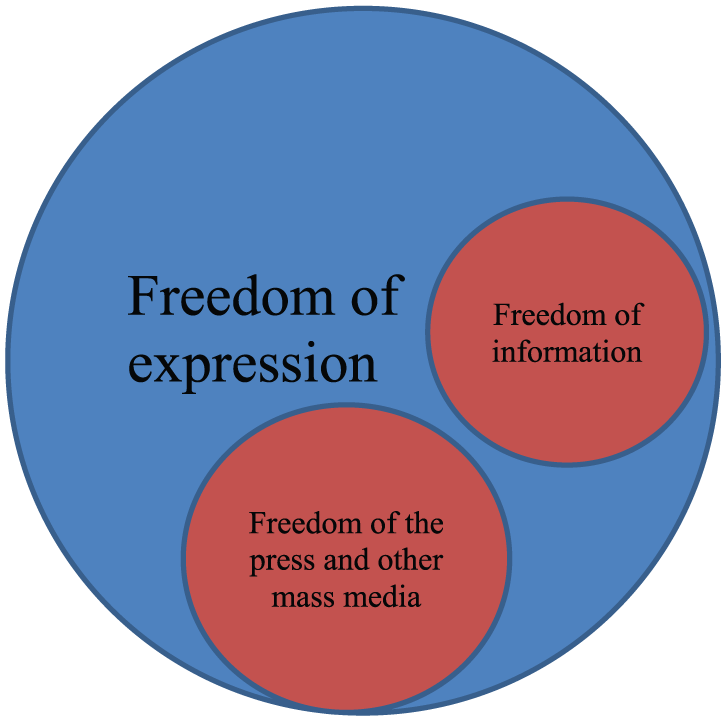
The second period.
Freedom of the media period
Finally, there is the current third period of the media freedom intergovernmental debate, which started in the mid-1990s. East–West ideological differences have largely disappeared, and the growing tension between the North and the South or between the West and the Arab world does not necessarily focus on media freedom issues.
This period can be distinguished by discussions centred on the rapid developments of information communication technologies (ICTs). It is characterized by the use, in documents of international organizations, of new terms relating to freedom of the media, such as ‘new media’, ‘social media’ and ‘ICT-based media’. A benchmark of the discussions has become the CoE Recommendation on a new notion of media (CoE, 2011).
This period brings about a tendency to replace, in intergovernmental documents, the duality of the terms ‘mass media’ and ‘media’ with the singularity of the ‘media’ as the latter reflects the more individualized and less ‘mass’ nature of the Internet and other ICT platforms.
In particular, the World Summit on the Information Society (WSIS), initiated by the UN’s International Telecommunications Union, which took place in 2003 in Geneva and in 2005 in Tunis, put under the chapter titled ‘Media’ commitments to freedom of the press, freedom of information as well as those of the independence, pluralism and diversity of media, although making a distinction between ICTs and traditional media (WSIS, 2003).
This trend was reflected in the changing labels of the relevant intergovernmental institutions. Just note the succession of names of the advisory body of the CoE: created in 1981 as the Steering Committee on Mass Media, it changed to the Steering Committee on Media and New Communication Services in 2005 and then to the Steering Committee on Media and Information Society in 2012.
The new post–Cold War spirit has allowed the OSCE to expand its political commitments to freedom of expression and freedom of the media. In 1997, the OSCE established the post of the Representative on Freedom of the Media (RFoM). The title reflects the concern with freedom of the media and not necessarily just mass media, thus allowing for a broad interpretation of the mandate of the Representative (see below). In most other official languages of the OSCE, the title of the RFoM speaks ‘on Freedom of the Media’, not ‘Freedom of the Mass Media’: ‘la liberte des medias’ (French), ‘Medienfreiheit’ (German), ‘la Libertad de los Medios de Comunicacion’ (Spanish) and ‘la liberta dei mezzi d’informazione’ (Italian). The only exception is Russian, where it is translated as ‘svoboda sredstv massovoi informatsii’ (freedom of the means of mass information).
Moreover, we note that this OSCE mandate speaks of freedom of expression as a right parallel to the freedom of the media, thus making the latter related, but no more subservient to the former.
The UN Millennium Declaration adopted by heads of State and Government in 2000 proclaimed the commitment to ensure ‘freedom of the media to perform their essential role and the right of the public to have access to information’ (UN, 2000), thus once again underlining a separation between the two rights.
In the same year, the Charter of Fundamental Rights of the EU proclaimed the freedom of expression (Article 11 of Part 1) in terms similar to the ICCPR. But it also went further and put forward the organization’s respect for the freedom and pluralism of the media (EU, 2000).
The category of media pluralism proclaimed in an international document of such magnitude becomes very much relevant to contemporary understanding of media freedom.
3
The essence of the requirement for media pluralism is revealed in a number of documents of other international organizations. In particular, the UN Human Rights Council, commenting in one of its resolutions on the provisions of Article 19 (3 para) of the ICCPR, called on all Member States: to promote a pluralistic approach to information and multiple points of view by encouraging a diversity of ownership of media and of sources of information, including mass media, through, inter alia, transparent licensing systems and effective regulations on undue concentration of ownership of the media in the private sector. (UN, 2009)
Thus, the basic outcomes of the third period appear to focus on guaranteeing media pluralism, raising the profile of freedom of the media in respect to freedom of expression and right to information (Figure 3). In fact, some researchers believe that ‘freedom of the media’ is already an alternative term to ‘freedom of expression’ (Calderado and Dobreva, 2013: 11). In the words of others, ‘press freedom is … the most visible manifestation of the functioning of the general right to freedom of expression, irrespective of media platform’ (Berger, 2013: 137).
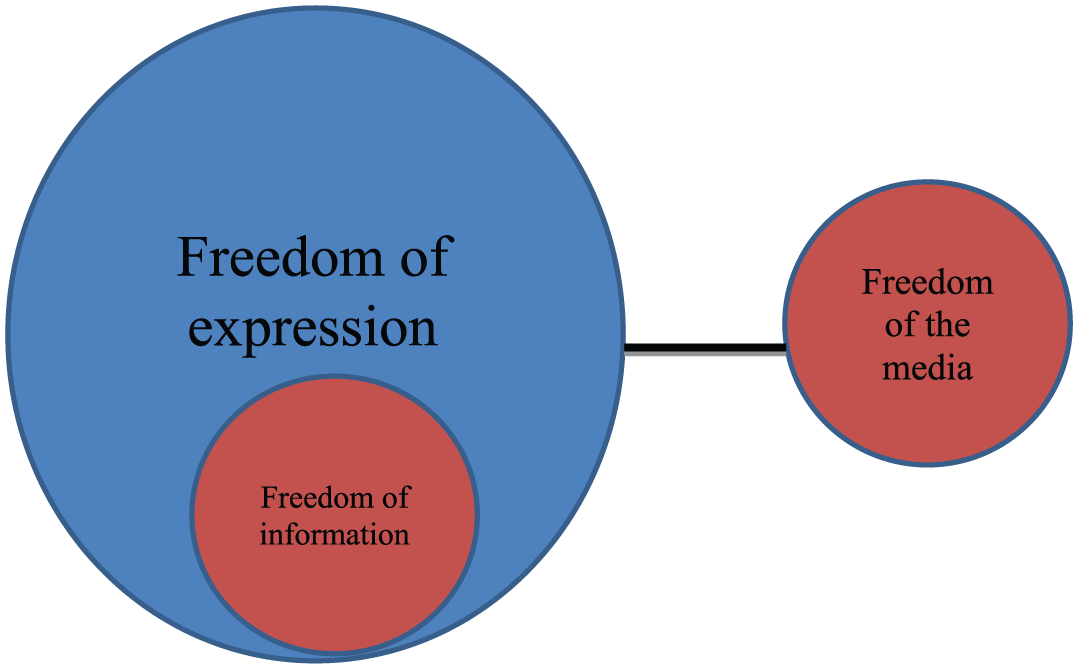
The third period.
Language games
Theories of mass communications, unlike natural sciences, lack clarity and distinctness of their basic notions that would otherwise help explain principles and trends in journalism and media studies. The vocabulary of these theories remains extremely broad. There is a ‘terminological mess’ (Dunas, 2013: 89) regarding what is considered communications, mass communications, media communication, media, mass media, means of mass communication and so on.
International politics is also about language games. Use of vague terms – sometimes intentionally to reach a compromise – and nuances in translation may result in variances of interpretations by different parties of both the ‘agreed language’ and the assumptions that underlie policies and regulation.
This trend to replace the category of ‘freedom of the mass media’ with ‘freedom of the media’ and to expand the scope of that freedom to the Internet and other technologies is meeting some diplomatic resistance. Illustrative of it is the position of the Russian Federation introduced in 2013, in particular, at the meeting of foreign ministers of the OSCE, which approved the extension of the mandate of its RFoM, Dunja Mijatović, for another 3 years. At that time, the Russian Federation, consistent with the Russian translation of the title of the Representative (see above), made an Interpretative Statement pointing out that the term ‘media’ used in the OSCE documents means ‘mass media’ [sredstva massovoy informatsii], which includes forms such as printed periodicals (press), television and radio broadcasting and electronic media, including those disseminated via the Internet. Other definitions of the media connected with a change in the ways of producing, sharing and disseminating mass information and the appearance of new types and means of communication require additional agreement and approval by all participating States. (OSCE, 2013b)
This would mean that with every new information technology, there is a need to renegotiate international commitments as to its use, free of governmental control. The Statement used this observation to call on the OSCE chairmanship and participating States to begin work on updating the mandate of the RFoM so as to bring it ‘into line with the present-day realities and tasks in this area’. 4
In a scene reminiscent of the Cold War rhetoric, the United States immediately rebuffed the Russian statement by declaring its disagreement: We wish to express our strongest support for the efforts of the OSCE Representative on Freedom of the Media to defend and promote freedom of expression through all media, including the Internet and other new technologies … We reject any call to parse or restrict this broad mandate, or indeed any effort to qualify established OSCE Human Dimension commitments that protect and promote the fundamental freedoms of citizens …. (OSCE, 2013c)
In a way, this seems to be a rear-guard battle. In 2007, Russia agreed to a CoE recommendation that in particular noted, The term ‘media’ refers to those responsible for the periodic creation of information and content and its dissemination over which there is editorial responsibility, irrespective of the means and technology used for delivery, which are intended for reception by, and which could have a clear impact on, a significant proportion of the general public. This could, inter alia, include print media (newspapers, periodicals) and media disseminated over electronic communication networks, such as broadcast media (radio, television and other linear audiovisual media services), online news-services (such as online editions of newspapers and newsletters) and non-linear audiovisual media services (such as on-demand television). (CoE, 2007)
The CoE reference that the media is defined irrespective of the means and technology used for delivery makes it clear that no change in the ways of producing, sharing and disseminating information should limit the scope of its freedom.
If the Russian statement points out that ‘freedom of the means of mass information’, or freedom of mass media, should be treated differently from freedom of the media, this would also contradict its national law. The Russian Constitution declares in Article 29, ‘The freedom of mass information shall be guaranteed’ (Constitution of the Russian Federation, 1993). This law, rightfully considered by all authors as the cornerstone of the mass media freedom in Russian law, proffers the right of everyone to freely seek, obtain, transmit, produce and disseminate mass information by any lawful means. Apparently, this term is the closest to the international understanding of freedom of the mass media. If so, what is the closest to the ‘freedom of the media’ challenged by the Russian diplomats? A deconstruction of the definition discovers the right of everyone to freely seek, obtain, transmit, produce and disseminate information by any lawful means. Incidentally, this right is part of the same Article and is called ‘freedom of information’ (Constitution of the Russian Federation, 1993).
Thus, the current intergovernmental debate on defining the media as part of the freedom of the media notion is characterized by the drive of Russia and its allies to renegotiate the applicability of established international standards of regulating free speech in the traditional press and broadcasting to the new technological platforms of disseminating information. Apparently, it is desired to exclude such platforms from existing universal human rights instruments on freedom of the media and let them stay as much as possible, if not exclusively, under national jurisdictions with their innovative means of government surveillance and control.
Conclusion
If the current diplomatic discussion on whether the freedom of ICT-based media is part of the media freedom notion succumbs to the rhetoric characteristic of the OSCE, then it may herald the beginning of the next stage of the intergovernmental debate on the object of the freedom of the media.
Limitation of its scope to just the traditional mass media and the ongoing evolutional decline of print press and broadcasting would eventually limit the scope of internationally protected free speech.
In order to prevent this negative trend, there is a need to step back from the argument about the notion and the scope of freedom of the (mass) media and recall the universal principle of freedom ‘to seek, receive and impart information and ideas through any media and regardless of frontiers’ (UN, 1948). This original international principle of freedom of information is hard to challenge and misinterpret.
The documented path of changing media freedom definitions makes it plausible to suggest that in a way, ‘freedom of the media’ today is the closest in its meaning to ‘freedom of information’ as it was promulgated internationally in the first post–World War II decades.
Moreover, while the concept of ‘freedom of information’ became the domain of the activists for the right to access and gather government information since the 1960s, the most recent trend for FoI activists and researchers is to consider it a ‘historical’ notion. The essence of the movement lies now in the aspiration for ‘right to information’, rather than ‘freedom of information’. This new notion is already reflected in the titles of the relevant recently adopted laws and academic rhetoric (Mendel, 2008: 3; UN, 2009). Thus, the concept of ‘freedom of information’ is vacated and can be refilled with the ‘old’ new meaning.
Thus, there is an opportunity for a full historic terminology loop from ‘freedom of information’ to ‘freedom of the mass media’, to ‘freedom of the media’ and, essentially, back to ‘freedom of information’. If this takes place, the protected freedom would keep its meaning and not depend on challenges brought up due to progress in technology.
Footnotes
Funding
The author(s) received no financial support for the research, authorship and/or publication of this article.
*
The analysis and opinions expressed are the author’s own and do not necessarily reflect those of the Organization for Security and Co-operation in Europe (OSCE).