







Abstract
This research analyses Safaricom, one of the most established mobile operators in Kenya. Alongside the provision of mobile services, Safaricom has closely engaged with the government of Kenya, even getting involved in the nation’s politics. This study examines Safaricom’s advertisements from 2010-2014 to explore its use of national sentiment in its marketing. We argue that the ads reflect a commitment to promoting the country and its products through discourses of ‘commercial nationalism’, which present Safaricom as a driver of economic growth and development in Kenya. These discourses link Kenyan identity and distinctiveness to consumerism, commercial and economic success, profit and upward social mobility.
Once a part of the government-owned Kenya Posts and Telecommunications Corporation, Safaricom has become the leading mobile operator in Kenya (Jack and Suri, 2011). The profitability of Safaricom has been beneficial to the country’s economy and earned the company numerous government and industry accolades (Wahome, 2012). Alongside its core business, the provision of mobile telephony and related services, ‘the company is also associated with people’s concept of a modern Kenya, and it has made efforts to negatively portray nepotism, inefficiency, and corruption’ in Kenya (Mas and Morawczynski, 2009: 78–79). For instance, following the government’s intention to phase out cash payments for public transportation, Safaricom introduced Lipa na M-PESA (Pay with M-PESA), a mobile-based electronic payment system that can be used on public transport. The new system is expected to usher in many benefits, including improving tax collection, raising accountability of public transport crews, making the sector more attractive to investors, reducing corruption in the traffic department, shielding commuters from erratic fares and establishing formal salaries and benefits for drivers and touts (Mwaniki, 2014; Okuttah, 2015). As this example shows, Safaricom’s relationship with government, politics and the nation is, at times, explicit. However, more commonly, Safaricom’s business and marketing practices closely reflect a commitment to promoting Kenya through a more ‘banal’ form of nationalism, ‘commercial nationalism’, tying Kenyan identity and distinctiveness to consumerism, commercial success, profit, upward mobility and economic development (Billig, 1995; Quail, 2015; Volčič and Andrejevic, 2011b). The practice of emphasizing distinct national sentiments through products and marketing – ‘nationalizing the commercial’ – is a strategy Safaricom employs to showcase its dominance in Kenya to appeal to both Kenyan consumers and to attract outside attention in an ever-competitive global market (Kania-Lundholm, 2014).
To explore Safaricom’s promotion of ‘Kenyanness’, we analyse Safaricom’s advertisements for mobile phone services and products. We argue that Safaricom’s marketing engages with discourses of commercial nationalism, creating a marketable Kenyan identity and culture tied to consumerism, national economic development and individual success articulated in ways that resonate with global neo-liberal logic (Kania-Lundholm, 2014; Quail, 2015; Volčič and Andrejevic, 2011a, 2011b). The strategies adopted by Safaricom were not only used to promote the consumption of its services but also to reinforce Kenyan solidarity and nationalism in an ethnically diverse and sometimes divided country. Constructing citizens as consumers serves to align diverse groups along a common axis, in which a singular, simplified national identity is presented as the ‘right’ choice for Kenyans, who can show their loyalty to their country by buying Safaricom goods and services. This version of ‘Kenyanness’ serves Safaricom’s financial interests and works to promote individual consumption as the means to personal and national economic success.
The subsequent analysis explores the discourses of commercial nationalism that Safaricom uses in its advertisements. This research not only contributes to the growing body of work on ‘commercial nationalism’ (see Kania-Lundholm, 2014) but also heeds the call to move beyond simply ‘information and communication technology for development’ (ICTD) research in developing countries like Kenya (Arora and Rangaswamy, 2013; Gajjala and Tetteh, 2014). The focus on ICTD often ignores the commercial side of information technology (IT) and rarely examines commercial entities as they operate as just that – corporations concerned with financial growth and economic success.
Our findings show that in Safaricom’s Kenya, Kenyans are consumers who achieve individual and collective success by using Safaricom products, and the country is a technological powerhouse with unending potential thanks to Safaricom’s investment and forward thinking. This message reflects global trends of creating distinct national brands to stand out in a competitive global marketplace with the goal of increased economic growth. Examining Safaricom as a potential co-creator of Kenya’s global image offers an opportunity to explore the complex interactions between the commercial and the national.
The next section offers an overview of commercial nationalism. We then provide a brief discussion of Safaricom’s history and relationship to mobile telephony in Kenya, with particular attention to M-PESA, its well-known mobile money service. Next, we describe the methods used for analysing Safaricom advertisements before addressing the findings and analysis. The conclusion examines how Safaricom’s strategies resonate with the government’s nation-branding efforts and how these strategies are driven by profit and commercial motives.
Commercial nationalism
Nations, national identities and nationalisms do not simply exist, but rather are social constructions, ‘cultural artefacts of a particular kind’, whose meanings and salience change over time (Anderson, 1991: 4). A nation involves specific territory, a homeland; national identity is a collective identity that reflects a commitment to that territory; and nationalism is the belief system, which creates a sense of belonging, attached to the nation (Anderson, 1991; Lueck et al., 2015; Oommen, 1997). Nationalism ‘functions in an attempt to create a homogeneous identity (the “nation”) for the political unit, or the state’ as a means of binding diverse groups under a common, shared identity (Lueck et al., 2015: 610). Various actors – for example, governments, citizens and corporations – have different stakes in moulding national identity and constructing nationalism to serve their needs and goals. No singular version of nationalism exists, but rather ‘the ways in which different forms of nationalist rhetoric are produced, reproduced, and consented to suggest a complex system of political and cultural negotiations’ in which diverse actors vie for power and legitimacy (Quail, 2015: 476). National identity and feelings of nationalism can be powerful forces that influence how people act and understand their place in a globalized world (Baruh and Popescu, 2008; Oommen, 1997). Nationalism and nation-building efforts have evolved over time as global relations and the status of nation-states have changed.
Constructing and maintaining nationalism has traditionally been viewed as a project of the state working through government institutions and elites to create lasting loyalty to the nation, often in service of state goals (Smith, 1998). As Anderson (1991) now famously theorized, the rise of capitalism and spread of printing created ‘imagined communities’ through the formation of national consciousness or a sense of belonging. However, as Billig (1995) argues, commonplace representations of the nation, such as flags, phrases and colours, that we experience in our everyday lives, often through the media, are pervasive and powerful in creating a sense of national identity. These forms of ‘banal nationalism’ serve to reinforce nationalism ‘at the level of everyday life in countless subtle and unremarkable ways’ (Baruh and Popescu, 2008: 84).
Taking the constructed and contested nature of nationalism as a starting point, this article builds on the work of scholars who have examined the role of symbols and media in constructing and reproducing nationalism (Anderson, 1991; Billig, 1995; Schlesinger, 1991; Tufte, 2000; Volčič, 2008; Volčič and Andrejevic, 2009). For the purposes of our analysis, we differentiate between official, state-sponsored nationalism, promulgated by governments and state actors, from discourses produced, reproduced and spread by businesses and other commercial entities (Kania-Lundholm, 2014; Volčič and Andrejevic, 2011a, 2011b). However, there are similarities between an increasing popular form of nationalist discourse known as ‘nation branding’ – government-sponsored marketing of a country aimed at creating a certain image to attract ‘the right kinds’ of investment and tourism – and the use of national appeals by non-state actors to serve similar commercial goals (Aronczyk, 2008; Volčič and Andrejevic, 2011b). The nation-branding work of governments and the use of national appeals by commercial entities are two sides of the same coin working together to create an image of a country that is attractive to outsiders (e.g. tourists and investors) and insiders, citizens who need to ‘buy in’ and ‘live the brand’ (Aronczyk, 2008; Kania-Lundholm, 2014). These contemporary forms of commercially motivated nationalism are driven by neo-liberal, global capitalism that places economic growth and development at the fore of national agendas (Lueck et al., 2015).
Commercial nationalism refers to ‘the phenomenon whereby commercial institutions take on an increasingly important role in framing issues of national identity and promulgating branded forms of nationalisms and nationalist brand identities’ (Volčič and Andrejevic, 2011b: 612). Commercial nationalism branding strategies make use of symbols, colours, phrases, styles and entertainment, especially the country’s national music and sports, to connect products to nations (Quail, 2015; Turner and Tay, 2009). Employing commercial nationalism involves the ‘deliberate use of national appeals by commercial entities to differentiate their products in a competitive and increasingly interdependent global market’ (Volčič and Andrejevic, 2011b: 613). Quail (2015) argues that the reality show, So You Think You Can Dance Canada, engages with commercial nationalism producing ‘a recognizable and marketable version of Canadianness’ that is at times stereotypical and contradictory (p. 473). The version of Canada promoted on the show serves to localize an international television format to build Canadian viewership in service of a transnational corporation’s profit. As Kania-Lundholm (2014) succinctly notes, ‘commercial entities capitalize on the idea of ordinary people getting their sense of national identity through everyday practices and experiences’ (p. 605). As such, corporations use and create national sentiments that tie consumption – particularly consumption of their products – to national identity creating citizens as consumers (Kania-Lundholm, 2014).
Governments also participate in promoting national identities that are expressed in commercial and economic terms in an attempt to compete with other countries for positive attention, tourism and potential investment (Aronczyk, 2008, 2013; Kania-Lundholm, 2014). Occasioned by this global competition, ‘nation branding’ is marketing undertaken by governments, often tourism departments, to improve or change a country’s image to attract tourists and investors and to promote exports (Aronczyk, 2008, 2013; Volčič, 2008; Volčič and Andrejevic, 2011b). In her analysis of new former Yugoslav states’ government websites, Volčič (2008) suggests that these new states represent themselves through their websites as modern, forward looking and committed to neo-liberal ideals. She argues that these websites are simultaneously nation-branding and development projects in service of creating idealized images of states with complicated histories. The nation brand is constructed as ‘the unique, multi-dimensional blend of elements that provide the nation with culturally grounded differentiation and relevance for all its target audiences’ (Johnston, 2008: 15).
Because the image of a place can affect how people perceive it and the people associated with it, nation-branding and commercial nationalism discourses often focus on ‘place branding’ techniques (Papadopoulos and Hamzaoui-Essoussi, 2015). Governments and corporations utilize ‘place branding’ as part of their broader marketing to influence perceptions of specific locales or features with the goal of boosting tourism and trade, attracting investment and increasing sales (Papadopoulos and Hamzaoui-Essoussi, 2015). What travellers and investors can experience in such destinations is positioned over the physical attributes of the locations, often seen as old campaigns of ‘brick and mortar’ (Hudson and Ritchie, 2009: 218). For example, ‘Brand Canada’ idealizes the visual beauty of the country, focusing on the tourists’ experiences to tap into the emotions of potential travellers and offering them the opportunity to see themselves in Canada (Hudson and Ritchie, 2009; Quail, 2015).
Place-branding is even more important for developing countries and countries recovering from war, natural disaster or other unappealing conditions (Papadopoulos and Hamzaoui-Essoussi, 2015; Volčič, 2008). Papadopoulos and Hamzaoui-Essoussi (2015) note that place-branding is particularly relevant for countries in Africa that are often misunderstood, misrepresented and generally not considered in a positive light. Despite the diversity of the 54 countries on the vast continent, Africa is often portrayed and thought of as a singular place without its own history and culture, ravished by poverty, corruption and conflict (Ibelema, 2014; Papadopoulos and Hamzaoui-Essoussi, 2015). Osei and Gbadamosi (2011) assert that African countries need to differentiate themselves from each other to create ‘a unique competitive identity’ to ‘communicate to investors that the benefits to be derived from investment in Africa far outweigh the perceived risks’ (p. 293).
Kenya has undergone a branding transformation in the last decade thanks to the work of government, private companies and media representations that focus on the country as a potential economic power in the region. Nairobi, the country’s capital, has a booming technology sector that is slated for continued growth and is a major contributor to economic development and the country’s gross domestic product (GDP) (Mutegi, 2015). The mobile sector is a major part of the information and communication technology (ICT) landscape and has been touted as Kenya’s biggest technological achievement. With government investment to build Konza, a ‘techno city’, dubbed ‘Silicon Savannah’, the country is working to brand itself as an innovative and safe place for domestic and international investment (Steadman, 2013). Safaricom has been a stalwart in the mobile and business sector, an example of technological and commercial success in the country.
Efforts by private companies to ‘sell’ nationalism (and their products) and promote a branded version of their home countries work in tandem with government-directed nation-branding efforts. As Volčič and Andrejevic (2011b) note, ‘On the one hand, commercial entities sell nationalism as a means of winning ratings and profits, while on the other, the state markets itself as brand. Such is the double logic of commercial nationalism’ (p. 613). The strategies and tactics used in nation-branding campaigns and by private companies reflect similar commitments to national identity tied to economic development conditioned by neo-liberal ideals that promote free trade and market-driven growth (Lueck et al., 2015). As such, efforts by governments and companies can look and feel similar, each having the goal of creating a nation that appeals to both citizens and investors, tourists and other outside stakeholders (Quail, 2015; Volčič and Andrejevic, 2011b).
Safaricom
Safaricom started its operations in April 1997 as a government department (Jack and Suri, 2011). Currently, Safaricom is owned in part by the Kenyan government, British Vodafone and members of the public who own shares in the company (Allen, 2013; Camner and Sjoblom, 2009; Doya and Cohen, 2014). Despite its partial foreign ownership and the fact that its only two chief executive officers (CEOs) have been foreign, the company has for the most part been viewed as a Kenyan company (Allen, 2013; Camner and Sjoblom, 2009). 1
At the time of this study, there were 32 million mobile subscriptions in Kenya (Communications Authority of Kenya, 2014). With 21.9 million subscriptions or 68 per cent of the mobile market share (Communications Authority of Kenya, 2014), Safaricom is the largest mobile operator in Kenya (Jack and Suri, 2011). Safaricom leads its competitors in the mobile money market as well as the short message service (SMS) market (Communications Authority of Kenya, 2014). It is also East Africa’s largest publicly traded company (Doya and Cohen, 2014). Safaricom’s commercial success has given the company flexibility to introduce new products into the market with ease and without the apprehension that its customers will shift to other mobile operators (Ngugi et al., 2010). Safaricom’s most successful product is its mobile money service, M-PESA.
Since its launch in 2007, M-PESA has been hailed as a mobile banking success and held up as an example of ‘best practice’ in the field and as a driver of individual and economic development (Aker and Mbiti, 2010; Mas and Morawczynski, 2009). Although M-PESA has been touted for enabling financial inclusion for people without bank accounts, the average M-PESA user is likely to be wealthier, younger, educated, urban and holding a bank account (Aker and Mbiti, 2010). In fact, people with bank accounts are three times as likely to use M-PESA than those without bank accounts (Mbiti and Weil, 2011). Additionally, men use M-PESA 35 per cent more than women (Mbiti and Weil, 2011). Therefore, while M-PESA is used throughout the country and has penetrated rural communities, with 80 per cent of rural households using the service in 2013 (McKay and Kaffenberger, 2013), Safaricom’s advertising for M-PESA portrays the product as fun and empowering and used by both ‘cool’ young Kenyans to support their lifestyles and hard-working rural Kenyans to improve efficiency (Gajjala and Tetteh, 2014).
The M-PESA product and brand have been critical to Safaricom’s subsequent product development and marketing strategy. Mas and Ng’weno (2010) argue that the ‘M-PESA brand is seen as stronger than Safaricom’s corporate brand – itself a powerful brand in Kenya with a dominant share of the mobile phone market’ (p. 5). Additionally, Donovan (2012) argues that because other mobile money service operators are comparatively weaker than M-PESA, Safaricom is now the standard, essentially eliminating alternatives and ‘voluntary choice’.
In much of its branding, Safaricom portrays itself as being essentially Kenyan. Safaricom has established a strong brand presence in Kenya, often relying on nationalistic sentiments in its messaging. In both small and big ways, Safaricom has participated in the creation and maintenance of the nation. During the 2007–2008 post-election crisis, Safaricom not only sent peace messages and promoted national reconciliation (Goldstein and Rotich, 2008; Morawczynski, 2011) but its M-PESA service was used to send money between families when travel was particularly unsafe and became a savings account for many who felt vulnerable during and after the violence (The Economist, 2013). Drawing lessons from the post-election violence, Safaricom supported a mobile-based peace promotion programme, donating 50 million free text messages to ‘peace ambassadors’ in the run-up to the 2013 elections (Mbuvi, 2013; Mutai, 2013). Although these large political and nationalist efforts are critical to Safaricom’s position in Kenyan society, its typical branding efforts, which serve to produce and reproduce a Kenyan identity and culture that connects Kenyanness with consumerism and capitalism, permeate Kenyan society and are consistent with Billig’s (1995) notion of banal nationalism.
In short, Safaricom has long been involved in politics and nation-building in both profound and banal ways. It is these less overt forms of creating discourses of commercial nationalism through embedding national images, values and ideals in its marketing to create citizen-consumers that are of interest here (Kania-Lundholm, 2014). Additionally, Safaricom urges consumers to participate in co-creating and spreading its content as a means of solidifying its brand and continued financial success and its connection to Kenyan consumers (Volčič and Andrejevic, 2011b).
Methods
The data in this study consist of Safaricom advertisements posted on YouTube. The videos were retrieved from the official Safaricom YouTube channel, 2 starting with the first available video posted in 2010 and ending with the last advertisement posted in 2014. In total, we collected and analysed all 15 advertisements posted between 2010 and 2014 through a critical reading of the videos (Appendix 1). The videos are in English and Swahili. One of the researchers, a native Swahili speaker, translated all the Swahili segments for inclusion in the analysis. When relevant, original Swahili texts and English translations are included in the findings below.
To interpret the relationship between Safaricom, its products and the Kenyan nation, we used textual analysis and performed a close reading of the videos focusing on the visual imagery, words, song lyrics and music that accompanied the advertisements. Textual analysis involves identifying textual elements as well as analysing the said and unsaid meanings inherent in the texts (Stern, 1996). Textual analysis offers the opportunity to conduct a careful examination of socially constructed products to explore how ‘social meanings are created and reproduced, and social identities are formed’ (Tonkiss, 1998: 246). The videos were analysed separately by the researchers for topics and themes. This in-depth analysis of the videos revealed three central themes of commercial nationalism: Kenya as an evolving multi-ethnic and inclusive society, upward mobility and progress tied to individual success, and reliance on place-branding to leverage the richness of Kenya’s geography. This final set of themes emerged from a comparison of the researchers’ original analysis and refinement based on our shared understanding of the key themes.
In addition, comments posted with the videos are included in the findings to provide insight into how viewers perceived these advertisements and to better understand viewers’ relationship with Safaricom and its products. The comments are included to exemplify the type of comments related to commercial nationalism and are not exhaustive. We did not engage in a formal analysis of all comments, but rather focused on the comments that addressed Safaricom’s portrayal of Kenya, Kenyans and Kenyanness. All comments appear how they were written with no corrections to spelling or grammar. This limited glimpse into viewer engagement with the content provides insights into how Safaricom’s messages were received and understood by Kenyan consumers.
Reframing Kenya
Kenya is a diverse country with numerous large and small ethnic groups and a large foreign population, including British and Indian immigrants and a growing Chinese population. Ethnic and racial tensions persist in the country, although in most areas, interethnic relationships are common. However, the country does have a history of politically motivated ethnic violence, often occurring around presidential elections (Ajulu, 2002; Bratton and Kimenyi, 2008). A discussion of the complexity of contemporary Kenyan history and ethnic politics is beyond the scope of this analysis, but it is imperative to note that the nation has a complicated past and present that is unsurprisingly glossed over in Safaricom’s representations of the diversity of the nation. Safaricom re-imagines an inclusive Kenyan identity, emphasizing the aspirational goals of many citizens for national cohesion. Invariably, Safaricom ads focus on ethnic and racial diversity and coexistence to show that its products and services are for everyone, an image that serves Safaricom’s goals of attracting and maintaining customers and appealing to potential outside investors and users. Safaricom’s representation of a diverse Kenya attempts to situate its products as central to the connections being made across different ethnic, racial and class groups. Kenyans are shown working side by side with Indians and telecommuting with Asian business people via Safaricom’s mobile phones and Internet products (Safaricom Business, 2014). In these scenarios, Safaricom facilitates both business and economic growth as well as diverse connections across the country and world.
In an advertisement for M-PESA, a floating sheet of red paper symbolizes mobile money being transferred from one person to the next in the Kenyan countryside and in the skyscrapers of Nairobi (Nchi na Safaricom M-PESA, 2013). Ultimately, the sheets of red paper come together to form the shape of Kenya as seen on the map, symbolically representing one nation. As this ad shows, the company’s vision of national unity is embedded in commercial terms with money at its centre – money is the unifier that brings all Kenyans together. Alongside the gliding red ‘money’ is the repetition of the country’s name in the advertisement’s lyrics. Both visual and audio cues suggest that using M-PESA brings the country together. It’s a product for everyone, everywhere. In the world of ‘Nchi na Safaricom M-PESA’ (2013), no one is left out of using M-PESA – the money travels across the entire country – and everyone is brought together unified by the service, reflected in the closing visual of the red map of Kenya.
Similarly, in the ‘Niko na Safaricom’ videos (‘I am with or I have Safaricom’), the individual and collective identity coincide (Niko na Safaricom, 2010; Niko na Safaricom Naweza, 2013). For instance, the country is ‘mine’ and ‘ours’ is sung in Swahili, Kenya’s national language, to signify that every Kenyan has a right to claim the country and to symbolize that the country belongs to all ethnic communities. ‘Yetu’ or ‘ours’ is repeated to suggest unity and promote visions of togetherness. Some commenters were impressed by the lyrics, ‘Niyangu … niyetu … [it’s mine, it’s ours] ♪♪♪ i love it’ (Joshua Kariuki, YouTube, 2013), suggesting that desires for national unity resonate with some users. In an explicit political statement, one commenter asked whether Safaricom’s commercial could be shown before the next election: ‘Can this commercial be shown every 20 minutes next election year?! to remind us how beautiful we are as a people?! i dream of a united & prosperous Kenya, hope it happens in my generation’ (Moz Love, YouTube, 2010). Without discussing the underlying causes of disunity, this commenter wants Kenyans to unite and recognize the beauty and value of the country’s diversity. Another commenter reminded Kenyans of their tumultuous past and the need for national unity while praising Safaricom for promoting unity: it will be a while before you ever see an ad on Kenyan TV that sells a brand and unifies a nation at the same time. Try and listen to the lyrics people – the words. The lyrics are powerful, extremely powerful. If you abhorred what happened in 2008, you’ll love this ad for one thing. it brings us together. (The Adman, YouTube, 2010)
Similar to the approach taken in many nation-branding campaigns, Safaricom eliminates the negative aspects of Kenyan history and interethnic conflict because these do not align with its aspirational and future-oriented rhetoric (Jansen, 2008; Kaneva and Popescu, 2011). Some video commenters buy into Safaricom’s re-imagining of national identity and serve to extend its vision and propagate the brand’s message, engaging in behaviour that exemplifies ‘living the brand’ (Aronczyk, 2008).
Although most ads focus on Kenyan people and landscapes (discussed below), some ads portray non-Kenyans creating a portrait of Kenya as not only a multi-ethnic country but also an inclusive, multi-racial country. For example, ads such as ‘Relax, You’ve Got M-PESA’, ‘Safaricom Karibu Tusherekee’ (‘Welcome, Let’s Celebrate’) and ‘Safaricom Business’ show White and Indian consumers happily using Safaricom products. In ‘Relax, You’ve Got M-PESA’ (2012), an Indian contractor is overwhelmed by having to pay his workers in cash and is relieved to use the mobile payment system. A white family is shown in ‘Safaricom Karibu Tusherekee’ (2011) enjoying a camping trip. This ad also uses the word ‘welcome’ (karibu) in the title to suggest openness and inclusiveness. In all cases, Safaricom’s messages emphasize that difference and diversity make the country beautiful and attractive for domestic and foreign investment. Consistent with commercial nationalism and nation-branding trends (Quail, 2015; Volčič, 2008), Safaricom’s ads create a Kenya in which native Kenyans and foreigners can see themselves and their money being put to good use. Creating an image of an inclusive, globalized Kenya serves to reinforce the neo-liberal ideals of open markets and borders, suggesting that Kenya is ready and able to be a global economic player (Lueck et al., 2015). These messages invite ‘the right kinds’ of investment, the kinds that contribute to the potential continued growth and success of Safaricom.
Safaricom’s discourse of commercial nationalism operates, in part, by positioning itself as a Kenyan product created for and by Kenyans, regardless of ethnic group, job or social status, designed to economically uplift users and, in turn, grow and support the economy. Kenyans are shown as the builders and benefactors of Safaricom’s services and products. These diverse users then contribute to the potential economic success of the country by creating jobs, buying products and paying school fees to educate their children, Kenya’s future citizen-consumers.
Upward mobility and progress
Individual success, achievement and spending are also showcased in Safaricom’s advertisements, creating a Kenyan identity that reflects neo-liberal ideals of individualism, progress and economic development. National development is linked with technological progress, individual success and upward mobility through depictions of infrastructure development and consumption that leverage Safaricom services. Progress, typically portrayed in economic and technological terms, of the individual and the country is foregrounded in the ads. The country is painted as a place of endless possibilities and economic development, thanks, in large part, to Safaricom’s commitment to building a world-class technological infrastructure that supports individual and business growth. Kenya is characterized as a country that values hard work through advertisement lyrics, such as ‘nchi ya bidii na ustadi’ (country of hard work and perfection) (Nchi na Safaricom M-PESA, 2013), thus connecting the values of Kenyans with Safaricom products. The word ‘naweza’ (‘I can’) is repeated to emphasize that an individual can get ahead through hard work and determination, particularly if they use Safaricom products and services.
The potential of Safaricom services, M-PESA in particular, to improve livelihoods is presented as a given and is reflected through images of success and leisure. As discussed, Safaricom has been credited with expanding financial services, improving business operations and creating opportunities for entrepreneurs throughout Kenya (Aker and Mbiti, 2010). M-PESA is recognized globally as a mobile money success, portrayed as a service that has improved individual and national economic growth. Safaricom plays off this idea in its messaging by interspersing images of individual success with images of national economic success.
In the ads, Safaricom’s technological infrastructure and M-PESA are shown as purveyors of economic development. In ‘Connect with Everyone’ (2014), ‘Get the Support You Need’ (2014) and ‘M-PESA: Send Money When You Need To’ (2014), Safaricom employees are shown building telecom towers, laying fibre-optic lines, working in modern business centres and servicing the entire country from remote rural areas to Nairobi. The ads tout Safaricom’s success in building business and infrastructure throughout the country, portraying the company as the driver of the Kenyan economy. While these three ads focus on large-scale development and Safaricom’s contribution to improving Kenya’s telecommunication infrastructure, in the end, they return to the individual with the closing line, ‘the reason is you’, and images of satisfied customers using Safaricom products. The message is simple: not only does Safaricom serve national development and economic growth, it serves every individual consumer’s needs.
M-PESA is consistently portrayed as instrumental in transforming the nation through supporting individual action and success. For example, M-PESA improves the farming activities of rural farmers, helps students achieve high grades because their school fees were paid via M-PESA and enables tech-savvy youth to engage in fun with friends. The initial M-PESA pitch, ‘send money home’, which targeted employed urban Kenyans who remit money to support their kin in rural areas (Morawczynski, 2011; Omwansa and Sullivan, 2012), has been replaced by a frame showing rural dwellers not as passive recipients of support but as empowered by the product (Gajjala and Tetteh, 2014). Safaricom’s current marketing speaks to users’ aspirations focusing on possibilities and positivity. Not only can every Kenyan achieve success with the help of Safaricom, every Kenyan can and should be a consumer. This message situates even the poorest users as consumers, not as passive recipients of technology or services (Kuriyan et al., 2012).
M-PESA’s position as a springboard for personal success is evident in the video comments section, where Safaricom engages with viewers to drive home the message of personal empowerment and achievement. A Safaricom representative is dedicated to responding to consumer comments: Our goal is to empower you so you can attain your own goals! Naweza is about adopting an optimistic attitude in whatever you pursue. You have the big ideas and we have the platform to drive them forward. Together, we can take Kenya to the next level! (Niko na Safaricom, Naweza, 2013)
Safaricom uses this interactive feature to engage with viewers, to promote its key messages and to acknowledge and thank them for using Safaricom services. These ‘empowerment’ and individual achievement messages are consistent across the ads and in posts from Safaricom representatives.
Consumers also use the comments to share their views about the products, services and brand. Showing pride in Kenya, commenters praised Safaricom for making the country a powerhouse in mobile banking. For instance, one commenter noted, ‘Kenya has become a global leader in mobile banking, thanks to Safaricom M-PESA service. M-PESA has redefined retail banking by making mobile phones all-in-one credit cards, ATMs, money transfer offices, and branches. We love M-PESA’ (Peter Gakure-Mwangi, YouTube, 2013).
For many commenters, mobile money epitomizes progress for the country, and because of M-PESA, Kenya has etched its place in the global technology sector. Another consumer who uses Airtel (Safaricom’s rival operator) commented, ‘I am on Airtel but I love their [Safaricom’s] theme songs always makes me shed a patriotic tear’ (Inyakinyua, YouTube, 2013). The affordances of the comments section and the encouragement from the Safaricom representatives enable consumers to become producers and participants of the brand, thus co-creating and spreading the company’s message and promoting its products (Volčič and Andrejevic, 2011b). However, not all comments are positive or supportive of the brand. Amidst Safaricom’s promoted images of individual success and portrayal of its services as accessible to all Kenyans exists the reality that many struggle to afford its services or access mobile telephony more broadly. For example, one consumer decried the high cost of Safaricom’s services saying, ‘land of my birth!! proudly kenyan … lakini safaricom lower charges … your ripping us off massive!’ (Sijuinisemeje, YouTube, 2010). Another commenter suggested that Safaricom was not genuine in its depictions of Kenya and was solely profit seeking: ‘Am sure those sand dunes are not in Kenya. Everyone beware, Safaricom is out to get your hard earned cash’ (Fundimangungu, YouTube, 2010). These types of messages attempt to shed light on the fact that Safaricom is a commercial entity attempting to sell goods and services, not simply an organization with the country’s or Kenyans’ best interests in mind.
In Safaricom’s vision of Kenya, the success of an individual consumer, supported by Safaricom, contributes to the economic success of the country. In its ads, Safaricom focuses on its position as a driver of economic and technological development, a contributor to the growing middle class and an enabler of individual and national achievement.
Commodifying geographies of the nation
Showcasing Kenya’s diverse and beautiful geography is one of Safaricom’s most prominent advertising tactics. The company utilizes picturesque images of destinations within Kenya to connect its products with the nation. Safaricom embraces the whole nation by featuring destinations from seven of eight provinces and showcasing the country’s diverse people and places. Most of the geographical locations are tourist attractions that have been used to market the country to potential tourists from all over the world. ‘Niko na Safaricom’ (2010), for example, showcases various geographical locations and features a singing cast of 800 members of the Safaricom choir clad in green – a Safaricom and Kenyan national colour. Consistent with other advertisements, the singers are in various well-known places, including Mt Kenya, Lake Victoria and Tsavo National Park. In this instance, Safaricom uses place-branding techniques for a dual purpose: to tap into local viewers’ feelings of attachment to these familiar locations and to attract tourists from outside the country (Papadopoulos and Hamzaoui-Essoussi, 2015; Quail, 2015). This dual intention reflects the double purpose of commercial nationalism discourses to appeal to citizens so they will ‘buy in’ to the brand and to attract the much-desired external attention that could lead to increased tourism or commercial investment (Aronczyk, 2008; Kaneva and Popescu, 2011).
Commenters who often identified as Kenyans were proud of Safaricom for featuring such diverse locations in the ‘Niko na Safaricom’ (2010) ad. For instance, reacting to this tactic, a commenter congratulated the company and the CEO for portraying a positive image of the country and for making Kenyans proud: ‘My love for Kenya is elevated every time Safaricom does things like this. What other product makes an ad from 7 provinces and 800 people from different cultures? Only Safaricom’ (Brian Karagu, YouTube, 2010). In addition to admiration, ‘Niko na Safaricom’ (2010) elicited feelings of pride because of how it beautifully portrayed locations within the country (Quail, 2015). For example, a commenter wrote, ‘Kenya is one amazing country. Najivunia kuwa Mkenya!’ (‘I am proud to be Kenyan’) (Fasadique1, YouTube, 2010). Another commenter acknowledged the distinctive beauty of the country, writing, ‘Its such a showcase of this amazingly diverse endowed country. Truly Proud to be Kenyan!’ (Irene Dames, YouTube, 2010). Viewers also liked the ‘Niko na Safaricom, Naweza’ (2013) ad because it portrayed a positive image of Kenya and carried a ‘true Kenyan spirit’ (Clement Ombette, YouTube, 2013). Another viewer hoped the tourism department would mimic Safaricom’s techniques: ‘I always said our Ministry of Tourism should poach the whole of #Safaricom marketing – totally awesome’ (Jeipeasmile, YouTube, 2013). Many commenters recognized and praised Safaricom for its marketing and portrayal of the country, contributing to the creation and spread of Safaricom’s brand and reproducing commercial nationalist discourses (Volčič and Andrejevic, 2011b). These place-based images in Safaricom ads offer a view of Kenya that is positive and welcoming, an image that counters popular perceptions of African countries (Papadopoulos and Hamzaoui-Essoussi, 2015). These images can potentially create a distinct Kenyan brand that separates it from other countries and stereotypical images of the African continent (Osei and Gbadamosi, 2011).
Safaricom also uses certain places, such as the skyscrapers of Nairobi or the new Thika superhighway, to represent a modern Kenya, ready for domestic and international investment. Foregrounded in the commercials is a country on the path to modernization, supported by Safaricom’s infrastructure and investment. Safaricom is always portrayed as a driver of technological and economic development. Safaricom showcases modern telecom infrastructure, roads, malls and other commercial buildings in its advertisements to symbolize progress and development for the nation, creating an image of Kenya as a place where nature and industry, tradition and modernity can and do co-exist.
Safaricom’s use of geography and reliance on distinct features is consistent with place-branding techniques that attempt to tap into viewers’ emotions to get them to connect to the locations and to see themselves there (Hudson and Ritchie, 2009; Papadopoulos and Hamzaoui-Essoussi, 2015). In the video comments, some Kenyans show loyalty and emotional attachment to how Safaricom portrays their country. For example, what stood out for some was how Safaricom represented the nation, not the actual products being sold. Safaricom uses representations of the country’s provinces, cities, landmarks and geographies to attract customers, keep them loyal to the brand and present Safaricom as truly Kenyan.
Conclusion
This study analysed how Safaricom – a leading mobile operator in Kenya – utilized discourses of commercial nationalism to market its services to connect to Kenyan consumers and potential desirable outsiders (i.e. investors). In particular, Safaricom connects its products with Kenyan identity and culture and to the country’s economic development, technological success and potential as a global IT leader. The company’s promotion of a certain ‘modern’ Kenya benefits Safaricom by showing that it is contributing to the technological and economic growth of Kenya and that it has a stable consumer base to attract international investors. The World Bank forecasted in 2014 that the Kenyan economy could become one of the leading economies in sub-Saharan Africa in the near future. This economic development relies, in part, on continued technological development, including in the mobile sector, foreign investment in Kenyan products and services, and continued infrastructure development. Safaricom positions itself as a key player in this modernization project and needs loyal customers and investors to maintain its foothold.
Although Africa has historically been associated with dire problems, which have earned the continent the negative brand, ‘the hopeless continent’, one contemporary discourse about the continent is that of Africa on the rise (Papadopoulos and Hamzaoui-Essoussi, 2015: 12). In addition to an improved economy and projections for future economic growth, Kenya experienced a peaceful presidential election in 2013 and has a growing middle class (World Bank, 2015). As one of the largest and most successful companies in East Africa, Safaricom’s promotion of Kenya as a vibrant and safe business hub in the region resonates with the ‘rising Africa’ discourse and invites Kenyans and foreign investors to see themselves in Kenya. In its advertising, the company shows a changing Kenya that is peaceful, productive and conducive to investment. In portraying the country in this way, Safaricom’s advertising tactics are similar to government-sponsored branding campaigns intended to attract foreign investment and tourists. Safaricom’s strategies resonate with those of Brand Kenya, a government project with the mission ‘to build a strong country brand that fosters national pride, patriotism and earns global recognition and preference’ (Brand Kenya, n.d.). For instance, like Safaricom’s ads, Brand Kenya’s website showcases ‘good news Kenya’, which promotes the country’s image and reputation as a thriving business and tourism destination (Brand Kenya, n.d.). Safaricom’s and the government’s digital ‘selling’ of the country aligns with globalization’s neo-liberal logic, in which nations create national brands to attract external investments. Nations subscribe to the tenets of neo-liberalism to maintain a competitive edge in a globalized economy (Jansen, 2008). Safaricom and the Kenya government have both defined Kenya’s identity as if it were a commodity with a market value in order to attract business, tourists and investments. Safaricom and the government promote a neo-liberal perspective by constructing images of the country directly tied to global markets and competition. Colours, images and stories resonate across Safaricom and Brand Kenya. The symbiotic relationship between government-sponsored branding and commercial marketing tactics serve a similar end: increase the bottom line.
Safaricom presents itself as synonymous with Kenya and Kenya’s success. As Gabriel Omondi, the composer of the Niko na Safaricom (2010) song, said, the song is as much about Kenya as it is about Safaricom, ‘Kenya and Safaricom being one and the same thing. It’s [the song] about the values of Kenyans – pulling together, working together, brotherhood, being proud of our heritage’. According to Omondi, the intention of the song is to ‘make Kenyans feel more Kenyan and to feel that they are part of this great country’. Similarly, a member of the wardrobe team responsible for Niko na Safaricom (2010) added, ‘It’s not just a company now, it’s actually like promoting brand Kenya’. Safaricom uses its national reputation and power to conjure national sentiment for the purpose of cementing national solidarity in service of building its brand and its customers.
M-PESA’s mobile money service has been critical to Safaricom’s success and position in Kenya. Although M-PESA is the brainchild of British creators who worked for Vodafone (Hughes and Lonie, 2007), it is portrayed and seen as Kenyan because the idea ‘was tested, honed and commercialized in Kenya and has succeeded there like nowhere else’ (Omwansa and Sullivan, 2012: 13). The framing of M-PESA as uniquely Kenyan has been instrumental in its widespread adoption in the country and to Safaricom’s continued success and additional product development. Safaricom has worked to promote M-PESA as a Kenyan product serving everyone in Kenya from the farms to the cities, eliminating its actual product history in favour of a more pro-Kenyan past and future.
Past research on commercial nationalism discourses in the media has focused primarily on fictional television (Quail, 2015; Volčič and Andrejevic, 2009, 2011a, 2011b) and nation-branding projects created and supported by governments (Volčič, 2008). Less is known about how commercial nationalism operates in other media domains. This study adds to the development of the concept of commercial nationalism by considering how a mobile phone corporation uses advertising for the purpose of creating an identity and nation around an image that supports its brand and bottom line. We offer a detailed examination of how a successful multinational corporation operating in Africa portrays itself as a partner in promoting the image of Kenya, and capitalizes on its national and global recognition to market its product and country.
Additionally, most research on mobile technology in Africa and other developing countries focuses on ‘mobile for development’, ignoring the fact that mobile service providers are commercial entities driven by profits and that consumers use the products for a variety of purposes (Arora and Rangaswamy, 2013; Gajjala and Tetteh, 2014). The mobile for development discourse typically focuses on the use of mobile telephony to improve education, health, income and governance (Donner, 2008; Gajjala and Tetteh, 2014). Most research on M-PESA and mobile money in Africa more broadly has focused on the use of these services for individual and economic development (Omwansa and Sullivan, 2012). Although the mobile-for-development strand of research is critically important, it does not engage with the marketing, motives and use of mobiles for non-development purposes and often ignores the fact that even the poorest mobile phone users are also consumers or potential consumers (Kuriyan et al., 2012). Analysing mobile operators’ marketing strategies provides insights into how these large, oftentimes transnational corporations appropriate national identity to connect with consumers, to build loyal customers, to make profits and to extend their global reach. By connecting its products and services with Kenya, Safaricom has positioned itself as uniquely Kenyan, and in turn, its users are portrayed as patriotic, loyal Kenyans committed to the development and growth of the country’s economy. As developing countries in Africa and around the world attempt to re-brand themselves as modern, safe places for investment in terms that often reflect neo-liberal ideals (Osei and Gbadamosi, 2011), successful commercial companies, such as Safaricom, will inevitably play a role in creating messages and images that portray their countries as places where investors can see themselves and where citizens are proud to ‘live the brand’.
Footnotes
Appendix
Videos included in analysis.
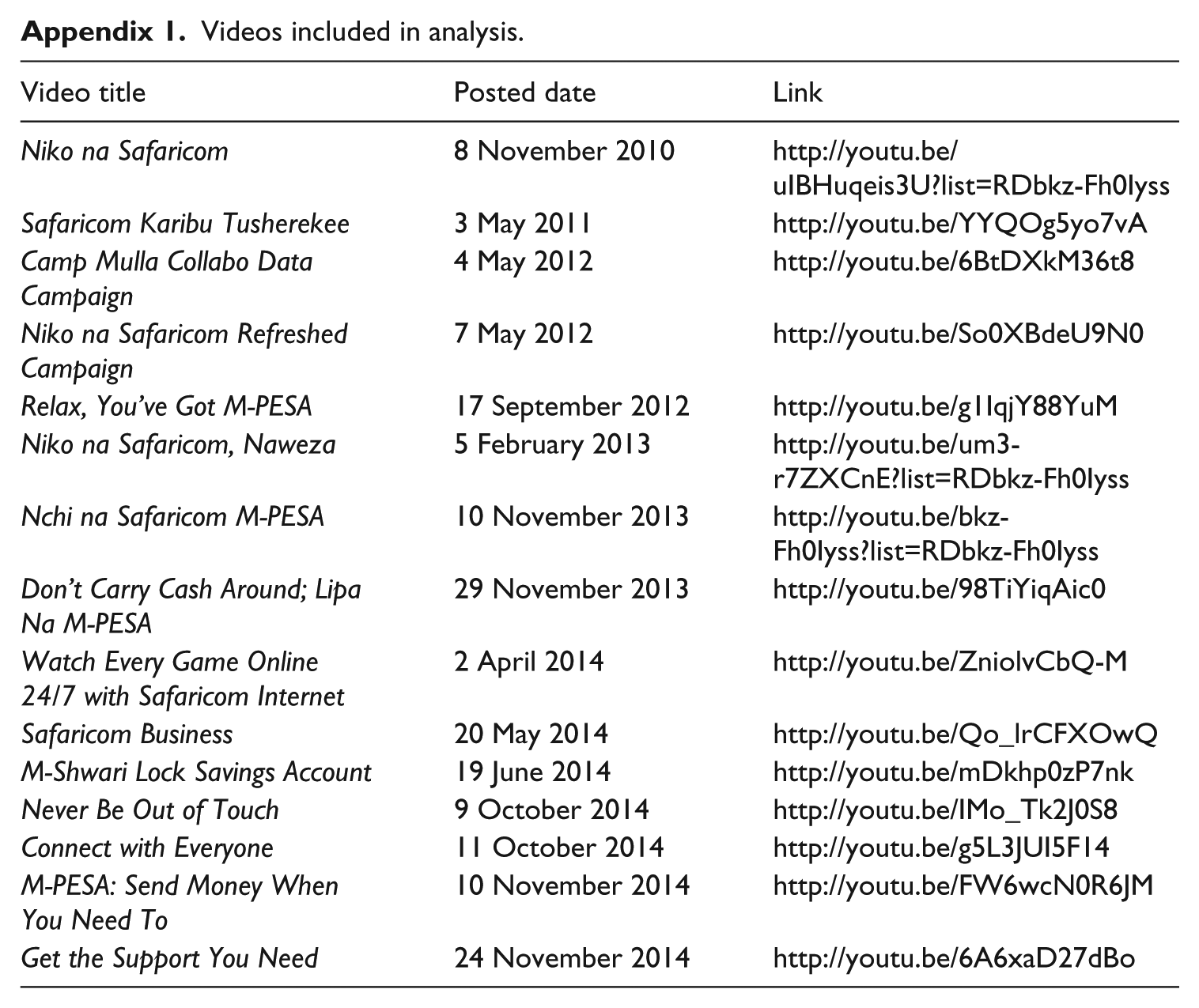
| Video title | Posted date | Link |
|---|---|---|
| Niko na Safaricom | 8 November 2010 | http://youtu.be/uIBHuqeis3U?list=RDbkz-Fh0Iyss |
| Safaricom Karibu Tusherekee | 3 May 2011 | http://youtu.be/YYQOg5yo7vA |
| Camp Mulla Collabo Data Campaign | 4 May 2012 | http://youtu.be/6BtDXkM36t8 |
| Niko na Safaricom Refreshed Campaign | 7 May 2012 | http://youtu.be/So0XBdeU9N0 |
| Relax, You’ve Got M-PESA | 17 September 2012 | http://youtu.be/g1IqjY88YuM |
| Niko na Safaricom, Naweza | 5 February 2013 | http://youtu.be/um3-r7ZXCnE?list=RDbkz-Fh0Iyss |
| Nchi na Safaricom M-PESA | 10 November 2013 | http://youtu.be/bkz-Fh0Iyss?list=RDbkz-Fh0Iyss |
| Don’t Carry Cash Around; Lipa Na M-PESA | 29 November 2013 | http://youtu.be/98TiYiqAic0 |
| Watch Every Game Online 24/7 with Safaricom Internet | 2 April 2014 | http://youtu.be/ZniolvCbQ-M |
| Safaricom Business | 20 May 2014 | http://youtu.be/Qo_lrCFXOwQ |
| M-Shwari Lock Savings Account | 19 June 2014 | http://youtu.be/mDkhp0zP7nk |
| Never Be Out of Touch | 9 October 2014 | http://youtu.be/IMo_Tk2J0S8 |
| Connect with Everyone | 11 October 2014 | http://youtu.be/g5L3JUI5F14 |
| M-PESA: Send Money When You Need To | 10 November 2014 | http://youtu.be/FW6wcN0R6JM |
| Get the Support You Need | 24 November 2014 | http://youtu.be/6A6xaD27dBo |
Funding
The author(s) received no financial support for the research, authorship, and/or publication of this article.