







Abstract
The free daily papers, Metro and 20 Minutes, originally from Scandinavia, have conquered many national markets with a single recipe: short, illustrated and easily consumed content distributed in large urban areas during the morning or evening peak hours. However, could one say that the urban news mediatized by this press is structured according to the standardized infotainment and sensationalism objectives that are often associated with the commercial media? The research based on three case studies shows that these publications, which have a single logo and format worldwide, develop a specific, place-bound editorial line of exposing the most important risks perceived within late-modern cities by its reporters and their audiences. Interactionism and, more precisely, the ‘social world’ approach to a profession can help understand these differentiated representations of metropolitan dangers by offering a more place-bound and socio-anthropological perspective of journalism.
Introduction
Large cities have been an environment favourable for the development of print capitalism due to the high density of potential readers and consumers. Free dailies coming from Scandinavia (20 Minutes and Metro) distributed in metropolitan regions have been one of the strategic adaptations of paid-press publishers to get access to advertising resources. They symbolize the debordering of the state markets in the European Union (EU; Bakker, 2013: 35) at a time when state borders are becoming more linear (Shield, 2014: 6). Free newspapers as the most advanced level of commercial journalism participate in the rebirth of the popular penny press distributed in the 19th-century metropolises (Conboy, 2002: 43; Moore, 2005: 339; Thussu, 2007: 16) with two noticeable differences: the public of the free dailies is not necessarily marketed as popular and this successful press offers the same format and infotainment columns everywhere. Schibsted (20 Minutes) and Kinnevik (Metro) together account for 15 million copies distributed daily in Europe (Bakker, 2013: 39). The number of copies has decreased since the late 2000s, but companies publishing these newspapers are still able to attract a mass readership. Metro International SA (2016) had, for instance, totted up nearly 7.2 million daily European readers in 2015. The question is whether these newspapers produce only a single, sensationalist representation of the city.
It is hypothesized in this article that this press is a ‘glocal’ newspaper, that is to say, a medium whose know-how and brand have been standardized at the global level, but whose urban news is structured by specific place-bound and localized ‘social worlds’ (Becker, 1988: 371; Strauss, 1978: 119), that is to say, communities that include professional reporters, sources, commercial advertisers and readers all interacting in the city. As free dailies have emerged in late-modern metropolises that are experiencing radical economic transformations, such as increasing income inequality, cultural challenges due to less homogenous communities and media fragmentation associated with a growing segmentation of audiences (Massey, 2005: 213), we would expect the primary activity of this social world to be the reproduction of a sense of control in urban regions perceived as in transition. The research is based on the analysis of a single newspaper, distributed in the three following city-regions: the small metropolitan state of Luxembourg, the Swiss Lemanic urban area centred on Geneva and the Greater Lille region in France. Following an introduction to the literature on the significance of the free daily press in the late-modern city from the viewpoint of the sociology of professions, the hypothesis and the methodology are outlined. Second, the results are discussed in two interrelated parts: a comparative news and advertising content analysis and the exploration of daily routines and interactions of reporters in the city which can account for this content.
Free dailies in the city: Commercialism, professionalism and late modernity
The economic situation of the newspaper industry has become more and more problematic over the past few decades, whereas it had proven to be one of the most profitable businesses of the 20th century (Picard, 2004: 114). The increasing number of free media, such as radio and television stations, the free access to news offered on the Internet, the growing share of the public unwilling to pay to be informed and the decreasing interest in reading long texts have put pressure on the economic model of the traditional printed and paid newspapers. The role of ads in securing the economic model of the newspaper has also become increasingly important, even if some differences exist between countries (OECD, 2010: 35; Papathanassopoulos and Negrine, 2011: 53; Vogel, 2011: 369). As advertisers are paying for the attention of the public, it could have a negative impact on the quality of news. Commercialism, that is to say, the search for profit maximization can be considered as a threat for the democratic role of the press; infotainment and sensationalism associated with commercial television stations have progressively become the norm of the newspaper industry (McManus, 1994: 7) and, as suggested by Picard (2007: 225), ‘Private media companies, like all corporations, exist primarily to serve the economic self-interest of their owners’. The late-modern free daily press, invented by Schibsted (Metro) and Kinnevik (20 Minutes) in the mid-1990s to stabilize the economic model of their respective publishing companies, can be considered as the ultimate level of commercialism in the printed press industry, as its objective is to sell readers/consumers to advertisers.
However, is it simply a standardized commercial tool that shows the increasing value of global economic capital in the definition of the journalistic field as considered from a neo-Weberian/Bourdieusian perspective of the profession (Benson and Neveu, 2005: 5)? It is fair to say that the free press has been used by the publishing companies of the dominant quality broadsheets in their national journalistic fields to secure their dominant position or to contest the domination of other media. It is the case, for instance, of Le Monde in France which had, successively, a deal with 20 Minutes to use its printing facilities and an agreement with Metro to promote some of its content, whereas this free tabloid was, at the same time, accused of destroying the core values of journalism by some renowned French newspapers like Libération (Soubrouillard, 2006: 95). Furthermore, some national media entrepreneurs have decided to take over, wholly or in part, the capital of this press for their national market. For instance, the well-known Swiss Tamedia publishing company is the sole owner of 20 Minutes for the Swiss Confederation. The same situation can also be found in Luxembourg. The free daily press is thus often mixed up with the previously nationalized competition for the control of advertising resources (Lamour, 2016a: 821). It can be compared with some transnational television channels as media located in multiple nation-sovereign territories (Chalaby, 2005: 155). However, the neo-Weberian/Bourdieusian approach considers a profession as an entity searching for a certain autonomy, which can be quite limiting for understanding the daily perpetuation of the journalistic community. It is fair to say that though the first audience for reporters are other reporters, their professional legitimacy is above all based on their capacity to interest their wider audience of readers based on a shared linguistic heritage, an encyclopaedic knowledge and a series of routinized news production mechanisms involving a variety of sources. The interactionist theory, which puts the interactions between professionals and non-professionals as the central process for founding the values of specific segments of the profession (Dubar and Tripier, 1998: 104), is potentially a more suitable framework for grasping the journalistic scope of the free daily press in the metropolitan regions of today, and which face the key transformations of late-modern times, from economic restructuring and social inequalities to cultural and societal challenges (Bridge, 2005: 8; Massey, 2005: 213) – a late-modern time which can favour ‘a media-based culture centred on immediate consumption and sensationalized impact but with little depth analysis or contextualization’ (Jewkes, 2011: 29). More precisely, the ‘social world’ notion developed by Strauss (1978: 119) and Becker (1988: 371) that presents human communities structured by shared beliefs and organized cooperation can offer a key insight for characterizing the objectives of the free daily press in the large urban territories in transition.
Hypothesis, case studies and methodology
The free daily newspapers are distributed in late-modern metropolises characterized by major economic and cultural transformations which can impart to large sections of the urban population a sense of insecurity. Consequently, it is hypothesized that their urban news is structured by a series of risks as perceived by specific metropolitan ‘social worlds’ (Strauss, 1978: 119; Becker, 1988: 371), including reporters, sources, advertisers and readers; the social use of risks – meaning events which may happen – being interpreted as ‘a means of achieving a semblance of control – or more accurately (following Featherstone, 1994) “a controlled sense of loss of control” – in the face of the changes and upheavals associated with late modernity’ (Hayward, 2004: 163). The free press can have a standardized format and a single logo at the international level. It can also serve the economic interests of publishing companies competing against each other in closed national markets. However, its representation of the urban news, which can be sensationalist, is shaped by context-based interactions around a series of risks and their controls. Good news from a commercial point of view is often bad news and bad news is on the increase in the global media sphere (Jeffries, 2012: 39). We can expect that the bad news of the free press is shaped by specific social worlds in the city.
The hypothesis will be tested by doing a comparative research on a single newspaper, 20 Minutes, 1 circulated in three different metropolises: Luxembourg, Geneva (Switzerland) and Lille (France). As the objective is to find out whether the representation of their city by the three newspapers is similar or not, and in what way, a social world approach to the journalistic profession is better suited to explaining these similarities/differences and the methodology is therefore based on the following two points:
(1) The collection and analysis of a minimum of 600 articles for each newspaper between September 2012 and June 2013. These articles were extracted from recomposed weeks (Monday of the first week, Tuesday of the second one, etc.). The contents were classed into eight themes: economy (economic growth, job issues, etc.), society (health, family issues, schools, religious affairs, etc.), politics (elections, etc.), mobility (public regulation, public transport strikes, etc.), sundries (crimes, accidents, stories about animals, etc.), sport (competitions, etc.), culture (cultural events, tourism, etc.) and other (environmental issues, etc.). For each article, the following information was collected: presence on front page, signature, size of the article according to two categories and illustration. Ads located near these articles were also encoded into 11 different groups: cars, grocery retailers, anomalous shops and products (clothing, etc.), high tech (computers, etc.), communication (mobile phone packages, etc.), banks, institutional information (public health campaigns, political campaigns, etc.), individual services (craftsmen services, etc.), luxury goods (jewellery, etc.) and other (TV ads, etc.).
(2) A total of 17 interviews with journalists from free dailies and participant observation of their work for between 3 days and 10 days in each newsroom in 2012 and/or 2013 in order to analyse the ‘primary activity’ 2 of their work that they share with their sources, advertisers and audience and, also, the urban ‘sites’ 3 (Strauss, 1978: 122) that they practise with the other members of their social world. As suggested by Watson and Till (2010: 126), it is not possible to grasp an objective reality by means of participant observation. However, the interviews and the analysis of routines completed with a quantitative analysis of content over many months can reveal some aspects of the main social world of this daily press. As mentioned by Strauss (1978: 122), social worlds intersect and there can consequently be many different groups associated with this press. However, the purpose is to figure out which one tends to be the most prominent.
Free dailies: The mirror of the non-standardized risky cities
The analysis of the news content and the ads sharing the same pages in three newspapers associated with 20 Minutes show that this publication put a lot of emphasis on deregulation which impacts some specific segments of the urban population. There is no global standardization of serious urban news. Furthermore, advertised products and services can be considered potentially as a paid-for and partial answer to the ‘loss of control’ (Hayward, 2004: 163) perceived in the city by some groups of urbanites. Free dailies exist because of the dense flows of ideas, capital, goods and people in large city-regions, but paradoxically their news is structured around a context-based series of risks associated with mobility and the reorganization of the urban space occupied by a static or a nomadic society.
The multi-faceted urban representation: Threatening flows and threatened within flows
A detailed analysis of this press content, focused on the living area of its readers, shows the importance of the latest information on leisure. Culture and sport are always key subjects, whatever the newspaper under consideration. However, the city of leisure can be relatively peripheral sometimes. Its articles are put in the second part of the newspapers. They are not necessarily mentioned on the front page and reporters will not sign them automatically. The main mediated issues about city life are serious ones and they often concern specific threats related to the fluidity of movements in the city. Each context tends to produce specific bad news related to the intensification/reduction of mobility that puts at risk urban territories. There is a metropolis of criminal flows in Switzerland and a city-region of economic unstable flux in Luxembourg and Lille. The Swiss and Luxembourgish newspapers belong partly to the same Swiss company (Tamedia), but they offer divergent content when we pay attention to the distribution of the major articles over 1 year. A quarter of top news in Geneva concerns sundries focused on crimes, whereas only 4 per cent of major events describe social deviances in Luxembourg (Figure 1).
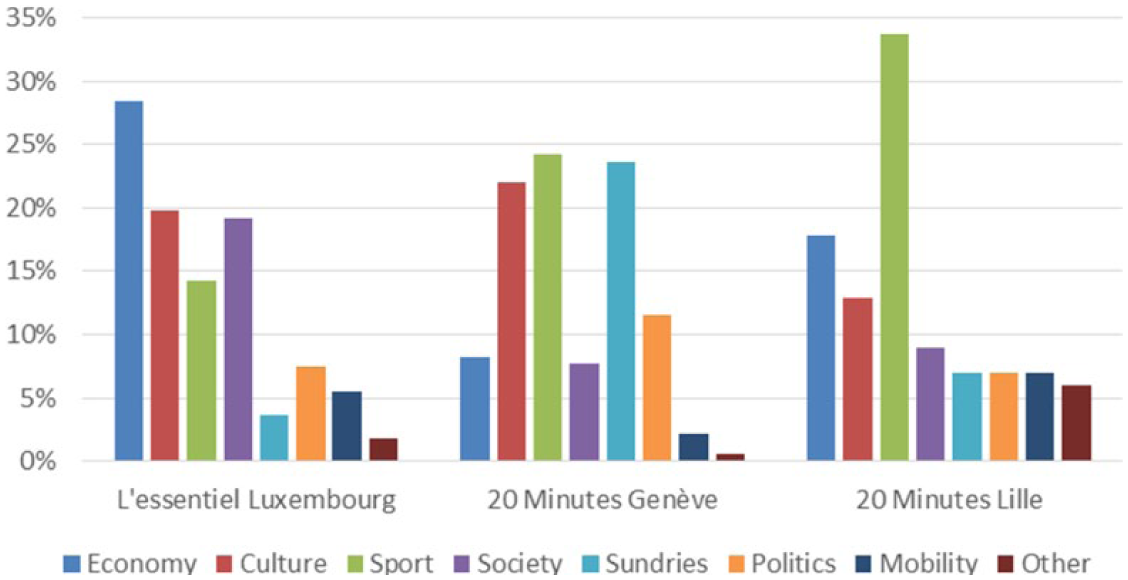
The distribution of major metropolitan articles per topic.
20 Minutes Geneva tends to depict a metropolitan region in which the traditional discipline and authority that secures the cohesion of the long-lasting cantonal communities is endangered by disordering flows of criminals. The newspaper is not interested in economic issues even if the unemployment rate in the metropolis is relatively high compared to the rest of the country. It insists on social deviance and features civil officers such as policemen and judges whose role is to promote a sense of control in this perceivedly unstable late modernity (Hayward, 2004: 163). These representatives of the state’s disciplinary power are not only central in the miscellaneous section but also in social, economic and political debates. For instance, the strike by prison officers who asked for better working conditions was mentioned by the newspaper (27 March 2013). The enemies depicted in Geneva are often some nomads who have crossed the boundaries of the confederated cantons to commit their crimes. The newspaper insists on the national/cantonal provenance of the delinquents. It is not rare to find articles mentioning, for example, that the thieves were ‘all from the Ivory Coast’ (27 May 2013) or that a young female thief caught by the police swore on the Koran that she would get her revenge (4 April 2013). In parallel with this portrayal of foreign danger, it is interesting to see that the Swiss newspaper regularly provides information about forms of nature and wildlife coming back into the city. As in a Grimm Brothers’ fairy tale, the lynx, the beaver and mice have recolonized the urban world. The only dangerous animal found in the sample was a deadly adder expecting babies, which had come from Africa and was owned by a man with an Arabic name; the headline of the article read, ‘A cantankerous and very dangerous snake at the vet’ (11 March 2013). 20 Minutes Geneva is not necessarily the newspaper of a global, young, cosmopolitan and liberal social class. It tends to replicate the place-bound, popular, right-wing and sensationalist basis of paid tabloids (Conboy, 2006: 9) in the specific context of a territorially fragmented Switzerland. Although these mediated reports of violence and danger can have an entertaining function (Presdee, 2000: 75), they will always reveal shared beliefs about the societal norms and the perceived enemy threatening these norms.
20 Minutes Lille also tends to define news that locate the city within a permanent, cohesive and bounded space which is threatened by the globalization of economic flows; the fluidity of economic capital held responsible for the collapse of the Fordist working class employed in large factories and a collapse that entails a local search for social solidarity processes associated with the Keynesian state. The free daily in Lille spotlights the agents of a brotherly discipline. The social worker, the Catholic Church fighting against poverty, the young handicapped woman who has created her small business thanks to public funds are all the symbols of a sense of control in a capitalist environment which is unpredictable (Bridge, 2005: 8). In tandem, the Lille newspaper keeps some distance from the politics of the ‘competition state’ (Fraser, 2003: 166), searching for alliances with global economic forces. For instance, the arrival of IBM in the city is not mediatized as a good piece of news; on the same day and on the same page, a negative article is written about Amazon under the headline ‘Amazonia: Infiltrated into a “Brave New World”’ (25 June 2013). These negative articles express the shared values of reporters and readers concerning the global and partly invisible economic forces perceived as a risk by some segments in society (Katz, 1987: 68–69). The economy favoured by the newspaper is the endogenous one such as a farmer making whisky (23 October 2012) or a local billiard table maker exporting his wares (18 April 2013).
L’essentiel in Luxembourg, contrary to the other two newspapers, does not promote the metropolis as a bounded place which is at risk by external flows, but as a reticular space defined by the risks in the necessary economic mobility. It represents what Castells (1991, in Paasi, 1996: 8) has phrased as ‘a space of flows […] which may generate local and regional mobilization among people who are trying to preserve their identities’. The two main subjects addressed in the newspaper are the neo-liberal economy and transportation issues. The economy is the most important topic covered by the newspaper. It regroups 19 per cent of all articles, that is to say, as much as sport and cultural news, but also 22 per cent of articles accompanied by a photo, 27 per cent of signed articles and 38 per cent of front page news items. The journal represents the capitalist cycles of the small national and urban economy as totally dependent on international markets. Consequently, it promotes the city as an open place with economic opportunities and destabilizing changes which put the reader into a flexible and mobile world where successes are short-lived and renewed business confidence can suddenly collapse. In parallel with this economic information, the newspaper gives information on motorized mobility issues in the city. Transportation is the transversal topic found in all sections: politics, economics, social issues and sundries. Political parties debate it, the smallest changes in petrol prices are advertised, the police check on winter tyres, youngsters still in school compete for the best driver of the year contests and the bulk of the miscellaneous news is about bottlenecks hindering the fluidity of commuter flows in the city and, thus, preventing workers from reaching work on time. It is a city inhabited by the nomads of the service industry, always under pressure and threatened within the risky flows they may suddenly leave behind, for instance, after a fatal car crash or a suicide due to psychological tensions at work; 10 per cent of the active population of the prosperous Grand-Duchy has had some suicidal thoughts according to an article titled ‘One suicide every four days’ (19 February 2013). The free daily newspaper regularly lists the statistics for burn-out and the suicide rates in the country, a type of news that can seriously annoy the editor-in-chief as he can only postpone its publication:
Find some other topics! The labour market is not limited to stress and burnout. I would even like to say to those who believe so that they should visit a mine or a steel factory! They would see that to work in an office is slightly less stressing […] Be careful! Last week, we already had an article on suicide at work! […] Come back with it in 3, 5, 6 weeks. (Differdange, 26 November 2012)
Mass consumption in the city of perceived risks: To regain a sense of control
The ads can be interpreted as complementary to the urban news. The consumption of mass goods and services in rich countries is related to functional needs, but it is also linked to a series of values, enabling individuals to conform to the codes of the social group they want to be associated with. Mass consumption, and consequently the value of advertised items, has been going through phases. It is a marker of an evolving industrial and post-industrial modern time. It has been associated with the immaterial reassurance of consumers during a period of collective doubt since the late 1980s (Rochefort, 2001: 36). A statistical analysis of the type of ads facing the articles about the three metropolitan areas shows that each context produces an advertising tendency that is in line with a negative aspect of urban life. The publicized products and services can thus help to give a sense of control to some dysphoric urbanites perceiving specific metropolitan risks.
20 Minutes Geneva, whose news is strongly structured around social deviance and violence, advertises products and services that can potentially have a function as a material and ideational protection of the localized and intimate space of people ensconced in their tiny, bordered cantons. Contrary to the two other newspapers, 20 Minutes Geneva proposes individual services for improving the most secure place the readers possess, that is to say, their homes (e.g. Internet sites promoting craftsmen, publicity for furniture removers, training for redecorating the house interior) as well as the individual corporality, as with the female body (e.g. nail varnish publicity, slimming courses focusing on women). The ads offer another potential system of reassurance in the bordered place of Lille. A lot of publicity can enable individuals to reorganize their traditional community by letting them know about local amateur sports events or, for instance, by offering them new mobile telecommunication deals to connect themselves at a lower price and/or for a longer period of time with the people they know. Readers are also given the promises of a brighter future through the services of astrologists or Internet sites that help them to find the perfect companion for the rest of their lives. In Luxembourg, the free daily proposes an advertising coverage quite different from the other two case studies. It places its readers in a safer reticular and mobile metropolitan space. Car manufacturers fill the ads found most often next to the articles. They propose new models supposed to reduce the risks of death for commuters. Nearly as important as the cars, the newspaper promotes standardized shopping centres that are mainly accessible by car (Figure 2). L’essentiel offers to its car-owning and commuting readers stable spaces of community-building in an unstable, fluid economic environment in which colleagues commit suicide and offices can disappear from one day to the next; the road and the supermarket have become two spaces of late modernity where a sense of belonging is structured (Amin and Thrift, 2002: 44; Lévy, 2000: 168). This specific representation of news and advertised items can be interpreted as the co-production of marginal social worlds, which is partly revealed by the daily routines of reporters in the city.
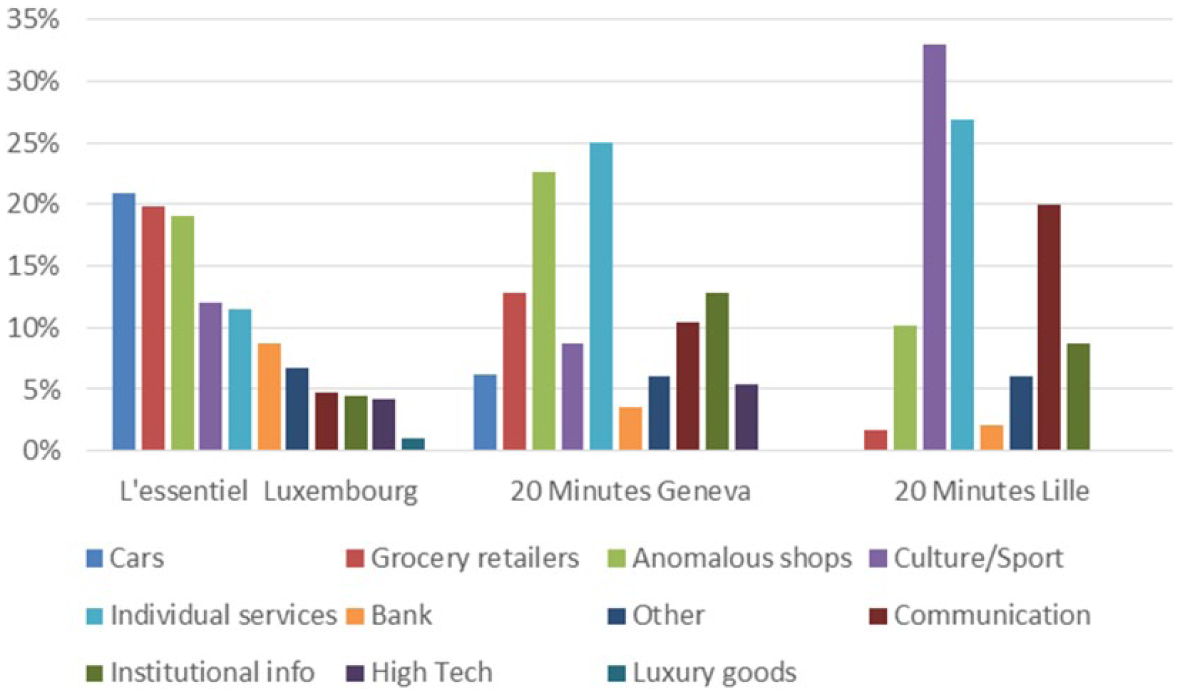
Articles positioned near an ad.
The metropolitan social world of free dailies: A sense of control for the peripheries
The reporters of the free press are part of a professional segment which has to find its legitimacy in a social world consisting of sources, readers and even, indirectly, advertisers. The ‘primary goal’ and the ‘sites’ (Strauss, 1978: 122) of journalists thinking and interacting with a series of news sources and communities in the city are sources of information for explaining the different representations of the metropolises.
The primary goal: The management of the urban world by the margins
The key primary goal of the free dailies’ social world is to regain a sense of control over the changes besetting late-modern cities. What matters for the reporters is to portray a city perceived as full of risks by the most marginal segments of the urban population in terms of location and/or social status, this urban group being totally different from one place to the next and requiring different sources of information to secure effective communication flows. The primary goal of L’essentiel in Luxembourg is to inform a public of workers and especially the most spatially marginal of them, that is to say, cross-border commuters and resident diasporas whose presence in the Grand-Duchy is business-related – a public that is not mobilized by the other media in the country. Consequently, reporters connect some sources of the ‘Competition State’ (Fraser, 2003: 166), such as the Economy and Transportation Ministries with these flexible economic migrants, the reporters themselves being non-Luxembourgers and often non-resident workers. It turns out that the head of the metropolitan ‘Luxembourg’ unit of L’essentiel is a cross-border worker who covers economic issues and covers more than 1000 km by car on a weekly basis to connect his home, the newsroom and the different places where press conferences are held. Furthermore, the three most senior reporters in the newsroom (the editor-in-chief, the head of the Luxembourg unit and the reporter intensively covering political issues) write and sign articles on the latest cars after testing them. They are part of an interaction between car manufacturers, a public administration encouraging the adaptability of employees and the diasporas of readers–workers commuting by car in order to maximize their flexibility. The Geneva-Lemanic region is embedded in a different peripheral social world. 20 Minutes in Switzerland is a metropolitan newspaper for a cohesive, locally based and bordered social world as suggested by the following Swiss reporter who uses metaphors indicating the issue of proximity for a reader imagined in an intimate space (home and local pubs):
The objective (of the newspaper) was rather to pick the Genevan at the bottom of his bed […] not to go and search for him […] All we do from an editorial point of view concerning the nearby French region […] It is always from that angle: ‘Dear Genevan reader, here is what’s happening at your door’ […] Sometimes I am obliged to say to reporters: ‘Listen, they (the events to be mediatized) are serious topics, so serious’ […] but tell them […] I don’t know if you go for a drink with some colleagues, with some friends, in a pub […] I tell them often when I read the texts: ‘But, listen, would you tell it like that, you, personally, to a friend you share a beer with?’ (Lausanne, 12 March 2013)
The public is not only an imagined one. It can be real and interact with sources and reporters based on the news published. It can also influence the reporters as a source of information. Readers can send photos by mobile phone to the newspapers and are then given the status of ‘MMS Reporters’. The free dailies will select the most valuable photos. Not surprisingly, MMS Reporters of L’essentiel are often car drivers who witness accidents on the road. During the participant observation of the daily routines of 20 Minutes Geneva (14 March 2013), reporters received a photo and xenophobic comments from a Genevan reader about a gypsy settlement under a bridge located in the canton. The reporters were disgusted by the comment, but they searched for the exact location of the bridge and they used the photo to illustrate an article about the legal expulsion of some migrants. In Lille, it is the interaction between the inner-city youngsters and the political representatives which reveal the social world of 20 Minutes as suggested by the following reporter:
Mrs. X. [powerful elected politician in Lille] became aware that the only youngsters who asked her questions in public meetings in the inner-city of Lille started often their questions by saying: ‘I have read in 20 Minutes that […] is it true?’ Then, she said to herself: ‘They [20 Minutes] reach a readership not mobilized by the traditional press’ (Lille, 24 June 2013)
The city of practices: The sites of the social worlds’ risks and control
The journalists interviewed and the observant participation in their daily life was a source of information for understanding the specific ‘sites’ (Strauss, 1978: 122) in which each free daily’s social world is structured. On one hand, L’essentiel is located into a mobile social world structured by economic networks, while, on the other hand, 20 Minutes in Lille and Geneva are characterized by two different types of places.
The journalists of L’essentiel are long-distance commuters using their cars to be flexible in the city. Their low income takes them away from the centre of the metropolis where their most important sources of information – the central state agencies – are located. Their place of work is also distant from the city centre where most events take place. Participation in their professional routines implies driving in their cars and taking some risks on the road in order to reach the press conference on time or to be back as soon as possible in the newsroom to write the article before 6 p.m. The road is not simply an infrastructure to go from one place to another. It is a site per se that they share with their readers on their way to work, an increasing number of people being on the move in the global urban space (Urry, 2007: 3). Transport issues by car are the routinized topic shared by most journalists of L’essentiel in the newsroom. They will automatically react to the sirens of the fire brigades located near their office. It is a potential source of information about a car crash they or their readers could have been involved in, a car crash requiring a future interaction with public emergency forces to explain the causes of the accident. In parallel, the first journalist who will learn about the decrease or increase of oil price in the Grand-Duchy will announce it aloud to his colleagues in the open space. He will also mention the information in the next edition of the free daily for his readers who experience the metropolis as drivers like him. Reporters who never switch on the TV sets put above their desks during the week, watch on Sundays the Formula 1 Grand Prix, especially its start and its potential crashes, which they can experience every day on the motorway – an ensemble of routines not found in the newsroom of Lille and Geneva. In the road-centred environment of L’essentiel, it becomes rather natural to put a lot of information on car issues from new legislation to car accidents. There is no ‘car industry’ conspiracy to incite people to go buy brand new and safer cars. The journal is simply located in a rather ‘mechanical/automobile’ social world in which car safety is not perceived as a luxury. The second most central site of L’essentiel’s social world is the Luxembourgish business plant. Like their readers, journalists tend to be in the country above all as workers expecting the latest news about the risks in terms of growth which can impact their professional security in a Luxembourg imagined as a factory or an office. The journalists of L’essentiel share with their public the same undifferentiated, neo-liberal job market. They are not protected by any journalistic collective labour agreement, unlike the reporters of the paid press, and any salary increase is contingent on the economic success of the journal. These journalists are part of what Lemieux (2011: 91) calls a supply and demand ‘space of services’, which tends to disqualify progressively the neo-Weberian/Bourdieusian approach to journalism that considers the profession as an autonomous entity.
The central sites of the two other free dailies’ social worlds are not the mobile space of the roads or the places of the performant economy. Reporters in Lille and Geneva are not simply economic agents, but professionals, culturally rooted in the place of their work; they are included in a community of national citizens who elect state representatives to rule the city. They are also rather static compared to the reporters in Luxembourg. They live and work in the centre of the city. One of them in Geneva does not even possess a driving licence. They walk, take public transport or use their bicycles when they leave their office to attend press conferences or to interview someone like the reporters of the penny press in the late 19th century. In Lille, the journalists must walk 15 minutes before they reach the car park in which their vehicles are located, which they hardly use, except the reporter following sport news who must travel to the distant football pitches of Lille, Lens and Valenciennes. The sites investigated by the 20 Minutes journalists, which are also practised by their public and controlled by state agencies, are closed by the cultural and political borders of cantons in Switzerland, whereas they are bordered by the economic difficulties of the free press and its inner-city public in France. One of the main sites of information in Geneva is the Tour Baudet, the small fortress where the state-elected power has been located since the 16th century and the Calvinist Reformation. Free daily journalists with other reporters working for the paid press or radio/television stations located in the canton go there on a weekly basis and face the executive government of the Genevan Republic in a solemn press conference to get a series of information bulletins, which are then delivered to the citizens.
The other key Swiss sites are places of discipline and surveillance for immobilizing deviants, such as the courts of justice or the street, seen not as a space of economic activity, but as a space of criminal flows that are to be transformed into controlled places; such was the case, for instance, for one cross-border street which had been closed at night by a local Swiss mayor to prevent the influx of illegal potential thieves from France, an issue discussed among reporters (14 March 2013). Furthermore, the male reporters in Geneva are not only journalists but also members of a disciplinary order since they are citizen-soldiers, called up regularly to serve in the army and who keep their military weapons at home; one of the reporters in Geneva was indeed absent during the participant observation because of his military obligations. The localized social world explored by 20 Minutes Lille is instead constituted of positive sites of discipline, in which the Keynesian state is instrumental in producing moral citizens who respect both the group and the most fragile in the community. These sites can be, for example, a hospital in which inner-city youngsters enact their civic service duties and support lonely elderly people; an example of this reinsertion of socially deprived and potentially deviant people into the brotherly French Republic is portrayed in an article whose headline is quite clear: ‘When youngsters know how to become adults’ (25 June 2013).
Conclusion
Free metropolitan newspapers can be analysed from different research perspectives. They belong to the commercial media which have been considered for their negative or positive impacts on democracies (Gripsrud, 2008: 34;Lamour, 2017: 17; McManus, 1994: 2; Thussu, 2007: 5). At the same time, from a neo-Weberian/Bourdieusian perspective, their creation and success can symbolize the increasing role of economic capital in the redefinition of domination processes in the journalistic field (Benson and Neveu, 2005: 5). The objective of this article has been to take into consideration this global media from a spatial and interactionist perspective in the city. Media are structured by a series of routinized spatial and social practices (Couldry and McCarthy, 2004: 4). The interactionist approach of free dailies shows that this press is part of a ‘glocal’ media sphere. The three journals share the same logo/format/lifestyle content associated with the global city, but they dedicate the larger part of their professional resources to mediatize a different ‘every day city’ for their readers. Reporters interacting with their sources and determining free news thinking of their public belong to specific social worlds whose primary activity is to regain a sense of control lost through living in late-modern cities that are characterized by economic or physical clashes which occur in a series of places or networks (the factory, the jail, the street, etc.). The paid-for products and services advertised next to these free news items can also have a potentially protective value for these specific urban communities.
Reception studies will be needed to find out what readers–consumers do with this information. However, it is already possible to say that free dailies mirror a series of urban troubles which are mobilized in the mediated public sphere (Lamour, 2016b: 9). 20 Minutes in Lille and Geneva, which portray a time of economic and cultural change, is circulated in urban regions characterized by an increasing popularity of those parties rejecting globalization. The suburban peripheries of Lille are the stronghold of Marine Le Pen, the head of the National Front, which has developed a socially oriented and economically protectionist rhetoric in the region. A third of the MPs of the Genevan Canton are members of right-wing populist parties such as the Union Démocratique du Centre (UDC) and the Mouvement Citoyens Genevois (MCG), asking for a greater regulation of the Swiss border and of migrants entering the country. L’essentiel in Luxembourg is distributed, on the contrary, in an area ruled by centre-left and centre-right coalitions that promote the cultural and economic diversity of a small country whose foreign population is as large as its native one. It does not mean that free daily reporters are in favour of far-right movements in Lille and Geneva or cosmopolitan forces in Luxembourg. These journalists are simply located in urban regions confronted with a series of late-modern economic and/or cultural changes which they decide to mediatize based on the news expectations of their static or mobile core audiences, mediatized changes which are reprocessed by political parties promising a semblance of metropolitan control as structured by nationalism and the rebordering of space (Geneva/Lille) or by cosmopolitanism and the promotion of debordering networks (Luxembourg).
Footnotes
Funding
The author(s) received no financial support for the research, authorship and/or publication of this article.