






Abstract
This study examines the key factors driving ChatGPT’s diffusion on X through the media effects and innovation diffusion theories. The findings reveal perceived usefulness was discussed more than topics like government regulations, with positive and neutral sentiments dominating. Theoretically, this study advances understanding of innovation diffusion via the media effects perspective. Practically, it offers guidance to AI developers and stakeholders for improving AI applications and decision-making.
Introduction
ChatGPT is a large language model developed by OpenAI that has garnered significant attention in recent years. This model uses machine learning algorithms to generate human-like text, allowing it to be used for a wide range of applications, including customer service, language translation and content creation. As an emerging technology that has the potential to revolutionize the internet, ChatGPT had totted up more than 100 million users within the first 2 months of its launch in November 2022. As of March 2024, ChatGPT has around 180.5 million users, with 1.6 billion visits (Duarte, 2024). It has overtaken all previous user applications in terms of diffusion rate within such a short period. Research firm Gartner predicts that by 2026, the market for AI software will reach US$453 billion, and market growth is expected to accelerate from 14.4 per cent in 2021 to 47 percent in 2026, far outpacing overall growth in the software market. With the fastest diffusion speed, ChatGPT will play an essential role in this huge market.
ChatGPT is a type of AI-based chatbot that has rapidly gained global diffusion. The AI-based chatbots are automated conversational agents designed with user interfaces that facilitate natural language interactions (Adamopoulou and Moussiades, 2020). Since their inception, AI-based chatbots have attracted significant attention from researchers, who have explored the driving forces behind their rapid adoption and diffusion (e.g. Dobrinićč et al., 2021; Hari et al., 2022; Hwang and Kim, 2021; Kushwaha et al., 2021; Kwangsawad and Jattamart, 2022). Two well-established theoretical frameworks – the Diffusion of Innovations Theory (DOI) and the Technology Acceptance Model (TAM) – have been widely applied by these researchers to investigate how individuals across various industries adopt AI-based chatbots.
ChatGPT has rapidly emerged as a focal point in public discourse, sparking extensive discussions across traditional and social media platforms. Drawing on media effects theories such as agenda-setting and framing (Entman, 1993; McCombs and Shaw, 1972), this study explores how media agendas and frames shape public perceptions and attitudes toward emerging technologies. While these theories have been widely applied in domains like political communication, health communication and public opinion research, their application to the adoption and diffusion of innovations remains underexplored. This research bridges this gap by examining the interplay between major themes in public discourse and key constructs from the Diffusion of Innovations (DOI) and Technology Acceptance Model (TAM). By integrating these frameworks, the study offers novel theoretical insights into how media narratives influence the acceptance and diffusion of technological innovations, thereby advancing media effects research and contributing to a deeper understanding of innovation adoption processes. To achieve this, we categorize discourse into micro-level themes, which focus on ChatGPT’s characteristics, and macro-level themes, which address its broader societal impacts. By applying second-level agenda-setting theory to micro-level themes and framing theory to macro-level themes, this conceptual framework offers a comprehensive understanding of ChatGPT’s representation and societal implications.
Literature review
Diffusion of innovations theory, technology acceptance model and chatbot adoption
The Diffusion of Innovations (DOI) theory defines the rate of innovation adoption as the speed at which members of a social system adopt an innovation, typically measured over a given time period (Rogers, 1962). The theory suggests that adoption follows an S-shaped curve, with the slope representing the adoption rate. Rogers (2003) noted variations in the slope across innovations, indicating that some diffuse faster than others, and even the same innovation can exhibit different adoption rates across social systems. DOI also outlines five key characteristics of innovations: relative advantage (the perceived superiority over what it replaces), compatibility (consistency with adopters’ values and needs), complexity (ease of understanding and use), trialability (opportunity to test the innovation), and observability (visibility of tangible results; Rogers, 2003).
The Technology Acceptance Model (TAM) is a key framework for studying the factors driving technology adoption. TAM identifies two critical attributes – perceived ease of use (PEOU) and perceived usefulness (PU) – as key influences on individuals’ intentions to adopt innovations (Davis et al., 1989). PEOU refers to the effort required to use the innovation, while PU reflects the perceived utility of the innovation. Unlike the societal-level focus of the Diffusion of Innovations (DOI) theory, TAM emphasizes adopters’ psychological factors, particularly subjective attitudes and intentions.
To address the original TAM’s neglect of social systems, scholars proposed extensions like the Unified Theory of Acceptance and Use of Technology (UTAUT). UTAUT identifies four factors influencing adoption: performance expectancy (belief that the innovation enhances job performance), effort expectancy (ease of use), social influence (perceptions of others’ expectations), and facilitating conditions (availability of organizational and technical support; Venkatesh et al., 2003).
Researchers have extended the DOI and TAM/UTAUT theories by incorporating new variables, such as perceived risk, to better understand innovation diffusion and adoption. Perceived risk refers to consumers’ perceptions of risks associated with adopting an innovation and encompasses six dimensions: performance, financial, social, psychological, time and privacy (safety) risks (Faroughian et al., 2012). Many studies have built on DOI and TAM/UTAUT by integrating perceived risk. For instance, Chang et al. (2016) modified the UTAUT model by adding perceived risk to examine consumers’ online shopping intentions, while Farzin et al. (2023) extended DOI and UTAUT with perceived risk to study the acceptance of autonomous vehicles.
DOI and TAM are well-established theories widely applied to study the diffusion and adoption of digital innovations, including the internet, broadband and mobile media. Both frameworks have also been used to examine chatbot adoption. For instance, Kushwaha et al. (2021) analyzed AI-based chatbots’ impacts on B2B customer experience, finding that adoption is influenced by system design, users’ technological proficiency, and trust in the brand and system. Similarly, Dobrinićč et al. (2021) studied Croatian consumers’ attitudes toward mobile messenger chatbots, revealing that perceived usefulness, ease of use, compatibility, and attitudes toward mobile ads significantly impact chatbot adoption.
Communication, media effects and innovation diffusion/adoption
DOI emphasizes the critical role of communication in influencing the rate and extent of innovation diffusion. Communication factors such as channels, styles, source credibility, social context and opinion leaders shape perceptions and adoption of innovations (Rogers, 2003). Building on this idea, scholars have incorporated communication variables into diffusion models. Barnett (2011), for example, integrated communication variables into mathematical models to capture the complexity of innovation diffusion. Similarly, Bunea et al. (2022) distinguished between mediated and interpersonal communication, noting that the former affects adoption rates, while the latter influences imitation rates.
As social media emerge as a key communication channel with interpersonal characteristics, their role in innovation diffusion and adoption has drawn scholarly attention. Zhu et al. (2020) developed a media-based perceptions and adoption model, revealing that mass media and social media have opposite effects on perceived risks for fully autonomous vehicles—mass media increases perceived risks, while social media reduce them. Similarly, Purwiyati et al. (2020) found that platforms such as Facebook, WhatsApp and YouTube significantly influence farmers’ innovation adoption. Hu et al. (2019) demonstrated that endorsements by social media influencers boost adoption intentions for computer applications by directly enhancing trust in the applications.
While DOI theory emphasizes the role of communication in innovation diffusion, and numerous studies have shown that mass media and social media significantly shape perceptions of various innovation aspects, major media effects theories have not yet been integrated into DOI theory or these prior studies. This gap highlights a valuable new research opportunity to explore how media effects theories can deepen our understanding of the influence of media on the diffusion and adoption of innovations.
Media effects is a major research area in communication studies, encompassing the ways in which media influences individuals’ perceptions, behaviors and decision-making processes. Communication theorists have developed numerous theories to explain these effects, with agenda-setting theory and framing theory standing out as two of the most well-established and widely-applied frameworks. Agenda-setting theory, first introduced by McCombs and Shaw (1972), posits that media influences what issues the public considers important by emphasizing certain topics over others. Framing theory, as articulated by Entman (1993), explains how media shapes the way issues are presented, influencing how audiences interpret and respond to them. Both theories have been extensively tested and applied across various contexts, from political communication to health campaigns, demonstrating their enduring relevance in understanding media’s role in shaping public opinion and behavior (Scheufele and Tewksbury, 2007; Valkenburg et al., 2016).
The foundational concept of agenda setting emphasizes how the prominence of issues in media translates to public opinion (Severin and Tankard, 2001). Building on this, the second level of agenda-setting theory examines how media attributes and tones affect audience perceptions. It encompasses two dimensions: the cognitive dimension, which addresses the characteristics of an issue, and the affective dimension, which considers the valence (positive, negative or neutral) of those attributes (McCombs and Reynolds, 2009). This theory suggests that by emphasizing specific attributes with varying tones, media can shape both the perceived importance of these attributes and the public’s emotional response to them (McCombs, 2005). Additionally, agenda-setting theorists have investigated the psychological factors driving information-seeking behaviors and proposed the need for orientation hypothesis, which suggests that individuals seek media information to navigate their environment, influenced by relevance and uncertainty (Weaver, 1977; McCombs and Reynolds, 2009).
Since Entman (1993) introduced the concept of framing to communication research, framing theory has become a key framework in media research, aiding in the analysis of how news media cover various issues (e.g. de Vreese, 2005; Famulari, 2020; Pan and Kosicki, 2010) and how framing operates in social media contexts (e.g. Muralidharan et al., 2011; Russell Neuman et al., 2014; Yang et al., 2019). Research has shown that framing can significantly influence public attitudes and behaviors across different domains, including political perceptions (Lecheler et al., 2015), health-care opinions (Chong and Druckman, 2007) and environmental attitudes (Dunaway et al., 2018). Overall, framing theory provides a vital lens for understanding the complexities of communication in contemporary media landscapes (Scheufele, 1999).
Although agenda-setting theory and framing theory originate from distinct theoretical backgrounds, their relationship is complex and can be understood through three main perspectives. The first perspective equates framing with attribute agenda-setting, suggesting they are essentially the same concept (McCombs, 2005). The second perspective posits that the two theories complement each other and align in their functions (Entman, 1993). The third perspective argues that agenda-setting and framing are fundamentally different and cannot be integrated (Scheufele and Tewksbury, 2007).
An attempt to integrate innovation diffusion/adoption theories and media effects theories in the case of ChatGPT
A new theoretical framework
Although these media effect theories have been widely used in political communication, health communication and public opinion research, they have seldom been applied in the study of the diffusion and adoption of innovative technologies. The literature on innovation diffusion/adoption suggests communication plays a crucial role in the process of innovation diffusion/adoption. And there are many studies that demonstrate news media and social media have significant influence on innovation diffusion/adoption regardless of the fact that there is no strong connection between innovation diffusion/adoption theories and media effects theories in the literature. There is a potential that these two types of theories could be combined to better interpret the role of media in innovation diffusion/adoption.
This study attempts to fill this gap in the literature and build the connection between innovation diffusion/adoption theories and media effects theories. It identifies the attributes and frames in the public discourse of ChatGPT in social media and investigates the possible connections between the two types of theories. The constructs in DOI theory and those in TAM/ TUAUT have some overlaps. For example, relative advantage in DOI has an overlap with performance expectancy in TUAUT; the perceived usefulness in TAM has an overlap with compatibility in DOI, as well as performance expectancy in TUAUT. To combine these theories to study the diffusion of ChatGPT, we select the constructs that have no overlap with one another in these theories. On the other hand, the relationship between agenda-setting theory and framing theory is complex. To combine these theories, we adopt the view of Entman (1993) that agenda-setting theory and framing theory are complementary. We differentiate between two types of themes in the discourse. The first type focuses on the micro-level characteristics or aspects of ChatGPT, while the second type addresses the macro-level social influences or impacts of ChatGPT. Drawing on second-level agenda-setting theory, we examine micro-level themes and public sentiment, defining these themes as attributes of ChatGPT in the discourse. Simultaneously, we employ framing theory to analyze macro-level themes, which we define as frames within the discourse. This dual approach allows for a comprehensive understanding of ChatGPT’s representation and societal implications (see Figure 1).
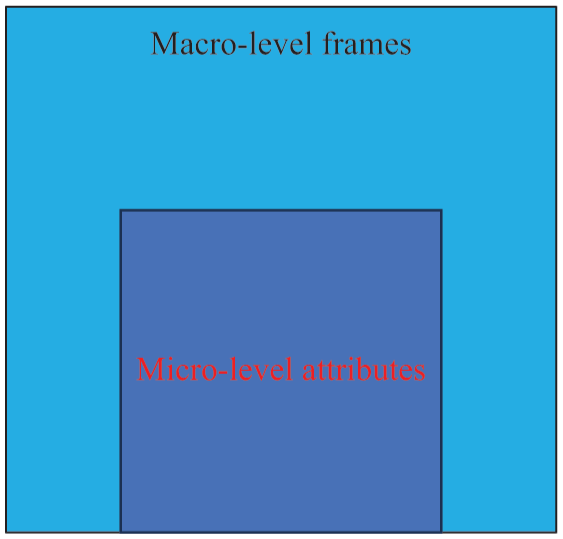
The conceptualization of frames and attributes of the social media discourse on ChatGPT.
Definitions of attributes and frames in the social media discourse of ChatGPT
Particularly, we define the following four micro-level attributes in the social media discourse of ChatGPT:
Perceived usefulness: how ChatGPT can help people do things more effectively or efficiently;
Relative advantage: how ChatGPT does a better job than other applications/technologies;
Observability: the extent to which ChatGPT provides tangible results; and
Peer influence: the degree to which an individual perceives that other people believe they should use ChatGPT.
We define the following four macro-level frames in the social media discourse of ChatGPT:
Facilitating conditions: the organizational and technical infrastructure, as well as the institutional policies and other forces that support or prohibit the use of ChatGPT;
Social impacts: a variety of social impacts that ChatGPT brings about. These impacts might be positive, such as promoting production at a societal level, creating new industries and job opportunities, facilitating further innovation, etc. They might be negative such as job replacement, salary and benefit reduction, bargain, protest, etc.;
Ethical issues: the concerns that people have about ChatGPT in terms of ethics such as cheating, phishing, cybercrime, etc.; and
Government regulations: how the government should regulate ChatGPT, as well as legal issues such as copyright and intellectual property.
We exclude trialability, defined as the degree to which an innovation can be tested or experimented with prior to adoption, as ChatGPT offers a free app account, making it readily accessible for experimentation. Similarly, we omit constructs such as complexity, perceived ease of use, and effort expectancy, given that ChatGPT is designed for ease of use, requiring only basic typing and search skills to operate its core functionalities. Additionally, performance expectancy is excluded due to its conceptual overlap with perceived usefulness and relative advantage.
To address the unique societal implications of ChatGPT as a disruptive technology, we introduce three new constructs: social impacts, ethical issues and government regulations. These constructs reflect the transformative potential of ChatGPT across various societal domains, its associated ethical challenges, and the need for regulatory oversight. Recent studies have extensively explored these issues (e.g. Agathokleous et al., 2023; Cao and Zhai, 2023; Chavanayarn, 2023; Chung, 2023; Delellis et al., 2023; Gursoy et al., 2023; Hung and Chen, 2023; Jeyaraman et al., 2023; Yan et al., 2023; Yang, 2023). These new constructs align with compatibility in DOI, as well as performance expectancy and perceived risk in UTAUT. Furthermore, we use peer influence instead of social influence to avoid conceptual overlap with the newly introduced construct of social impacts, which pertains to broader societal consequences rather than interpersonal influence.
Based on the literature review, the new theoretical framework, and the conceptual division of attributes and frames in the social media discourse on ChatGPT, the following research questions are proposed:
Methods
We used X (formerly Twitter) as the representative of social media because X has increased its dominance in public discourse (Jones-Jang et al., 2020). The X data on ChatGPT was downloaded from Kaggle Datasets (Bhattacharjee, 2023) on 29 September 2023. The dataset contains the information of 307,219 posts in English. To reduce the noise in the dataset, we filtered this dataset by searching for the keyword ‘ChatGPT’ in the posts’ texts. Our final data sample contains the information of 49,317 posts. The time range of these posts is between 5 December 2022 to 3 April 2023, which was the period when ChatGPT started to diffuse rapidly across the world.
We applied the aspect-based sentiment analysis (ABSA) approach to conduct data analysis. ABSA is a natural language processing (NLP) technique that goes beyond traditional sentiment analysis by not only determining the overall sentiment of a piece of text but also identifying and analyzing the sentiment associated with specific aspects mentioned in the text. In this study, the specific aspects are the micro-level attributes and macro-level frames defined previously. The ABSA process typically involves two steps: (1) Aspect extraction through which the specific aspects are identified and extracted from data; and (2) Sentiment classification through which the sentiment polarity (positive, negative or neutral) associated with each identified aspect is labeled.
As the dataset we analyzed is large, it is not possible to conduct ABSA analysis using the traditional human coding approach. The cutting-edge NLP technologies, the large language models (LLMs), enable us to do such content analysis efficiently. These LLMs have been created based on the Transformer model, which was originally developed by Google Research and Google Brain in 2017 (Vaswani et al., 2017). Earlier LLMs, such as the BERT models, were fine-tuning models that require task-specific datasets to fine-tune the pre-trained models. Recently developed LLMs, such as GPT models and Llama models, are Zero-Shot models that do not need to be fine-tuned and possess the capacities of cognition and reasoning like human intelligence.
The use of Large Language Models (LLMs) in analyzing social media content has garnered significant attention in recent research. For instance, Garg et al. (2023) employed the GPT-4 model to analyze public sentiment on COVID-19 vaccines, demonstrating its effectiveness in extracting insights from large-scale social media data. Similarly, Lyu et al. (2023) explored GPT-4′s application in social media analysis, highlighting its efficacy in tasks such as sentiment analysis, hate speech detection, fake news identification and political ideology detection. Additionally, Pendyala and Hall (2024) examined the capabilities of LLMs, including Llama, Orca, Falcon and Mistral, in identifying misinformation across diverse datasets. Their findings indicate that LLMs can effectively detect misinformation by leveraging their extensive knowledge bases. Collectively, these studies underscore the transformative potential of LLMs in advancing social media content research.
We used the Llama 2 (70 billion parameters) model, a Zero-Shot LLM, to identify the aspects (i.e. micro-level attributes and macro-level frames) in the X data sample. We provide the definitions of micro-level attributes and macro-level frames as well as examples of these concepts to the model. Then, we used the following query for the model to perform this task: Here is a tweet
1
: The tweet text. . . Does this tweet talk about the [perceived usefulness], [relative advantage], [observability], [peer influence], [facilitating conditions], [social impacts], [ethical issues], or [government regulations] of ChatGPT? Reply with only one topic label.
We also used the Llama 2 (70 billion parameters) model to conduct sentiment analysis on each post and associated these sentiment polarities with micro-level attributes and macro-level frames. To test the validity of the model, we randomly selected 1000 posts for human annotation and reliability tests. This validation consists of two steps. The first step is to test the inter-coder reliability, in which the two coders identify the micro-level attributes and macro-level frames, as well as the sentiment polarities from post texts, and answer the question of whether they agree with the model’s predictions (1 = agree, 0 = disagree). The two coders conducted this coding process independently and their coding results were used to calculate the inter-coder reliability index. After three rounds of inter-coder reliability tests, we achieved acceptable results between the two coders (percentage of agreement = 92%) for the aspect identification and (percentage of agreement = 86%) for the sentiment polarity. We also used the agreed coding results between the two codes to test the inter-coder reliability between the coders and the model and achieved acceptable results (percentage of agreement = 86%) for aspects identification and (percentage of agreement = 96%) for the sentiment polarity.
Results
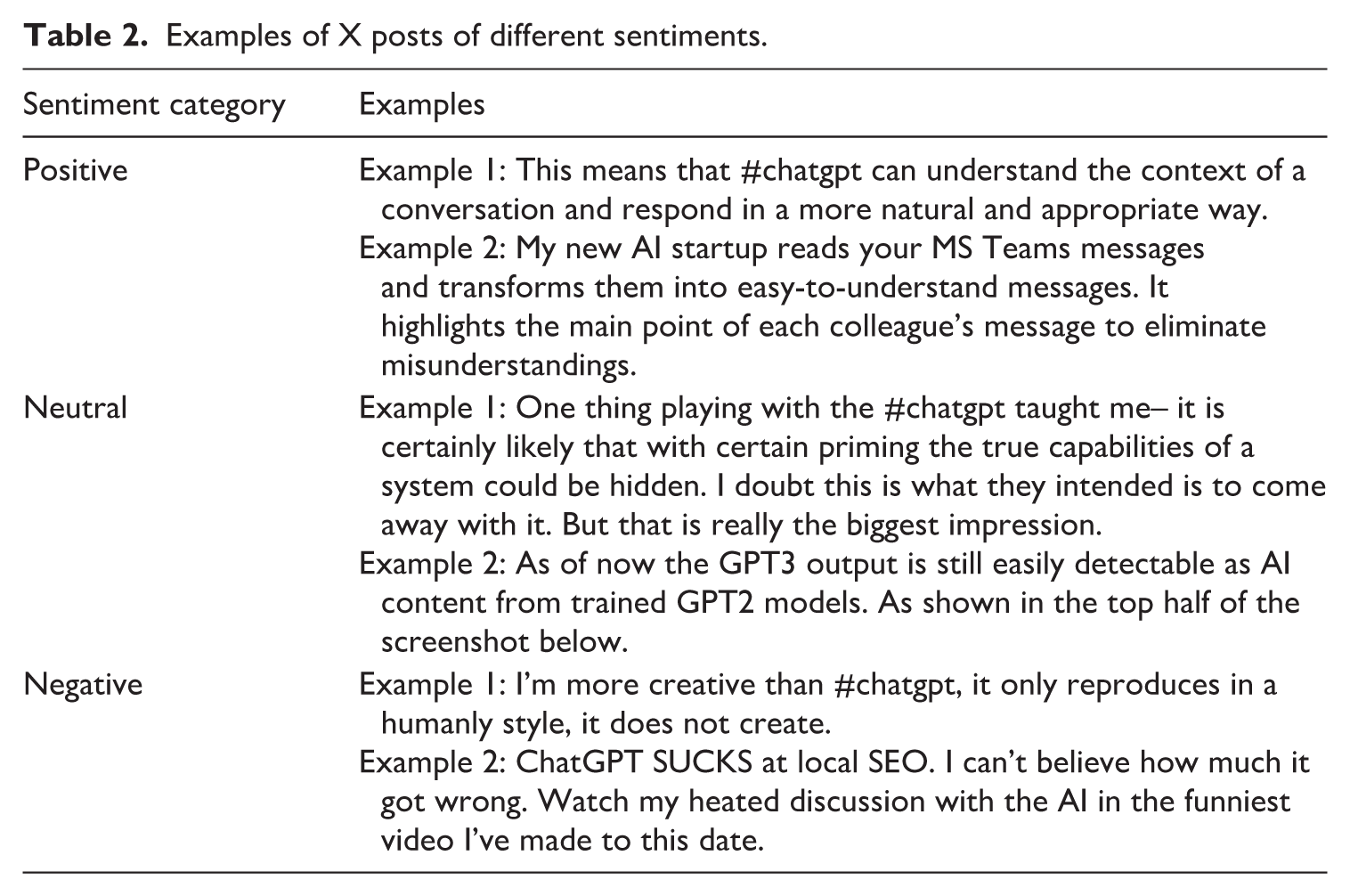
Llama 2 assigned labels of micro-level attributes and macro-level frames to 38,092 (77.24%) posts. For the other 11,225 posts, the model only repeated the question and did not provide answers. The examples of the posts for each of the micro-level attributes and macro-level frames are reported in Table 1. Based on the prediction of the Llama 2 model, the majority of the posts (77.24%) are related to the micro-level attributes and macro-level frames defined in this study. The model also classified these posts into one of the three sentiment categories: positive, neutral and negative. The examples of the posts for each sentiment category are reported in Table 2. The number of positive posts is 25,325, consisting of 66.48 per cent of the total posts in the data sample. The number of neutral posts is 12,585, consisting of 33.04 per cent of the total posts in the data sample. The number of negative posts is 182, consisting of 0.48 per cent of the total posts in the data sample.
Examples of X posts on micro-level attributes and macro-level frames.
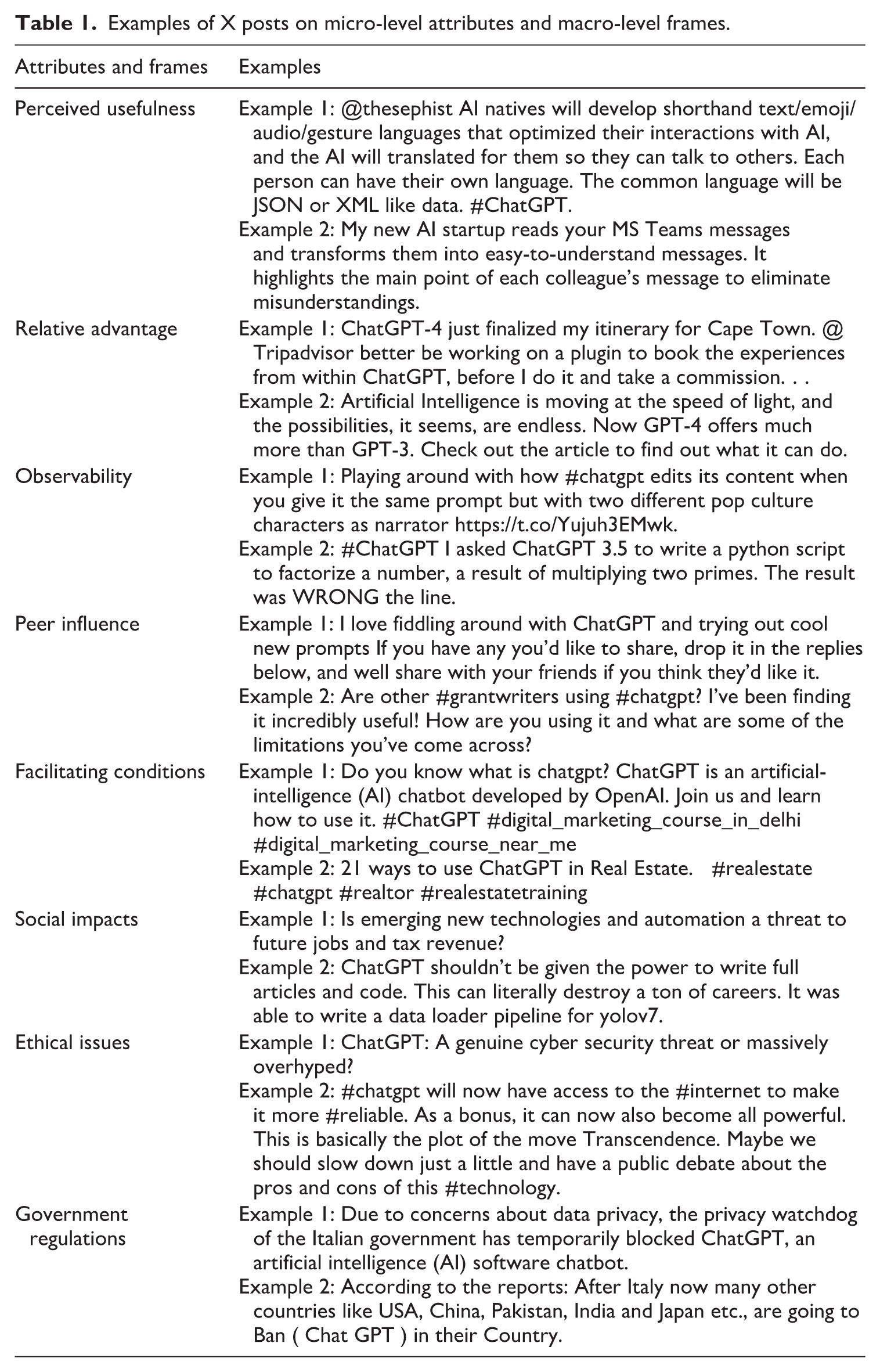
Examples of X posts of different sentiments.
Perceived usefulness was the most frequently discussed micro-level attribute, with 21,263 posts (55.82% of the sample), followed by relative advantage (4188 posts, 10.99%). Observability (146 posts, 0.38%) and peer influence (86 posts, 0.23%) were discussed far less frequently. Among the macro-level frames, facilitating conditions was the most prominent, with 9895 posts (25.98%), while ethical issues (1467 posts, 3.85%), social impacts (815 posts, 2.14%) and government regulations (232 posts, 0.61%) were less frequently discussed. Overall, perceived usefulness, facilitating conditions and relative advantage accounted for 92.79 per cent of all the posts.
Regarding sentiment polarities, perceived usefulness had the highest number of positive (14,249 posts, 56.26%), negative (111 posts, 60.99%) and neutral posts (6903 posts, 54.85%). Facilitating conditions ranked second in positive (6164 posts, 24.34%) and neutral posts (3715 posts, 29.52%), while ethical issues had the second-highest number of negative posts (43 posts, 23.63%). For positive sentiment, relative advantage had the highest percentage (77.22%), followed by ethical issues (75.26%) and perceived usefulness (67.01%). Ethical issues also had the highest percentage of negative posts (2.93%), followed by social impacts (1.10%). For neutral sentiment, government regulations had the highest percentage (79.74%), followed by observability (55.48%) and social impacts (48.47%). Detailed percentages are provided in Table 3.
Number of X posts on different attributes/frames and sentiment categories.
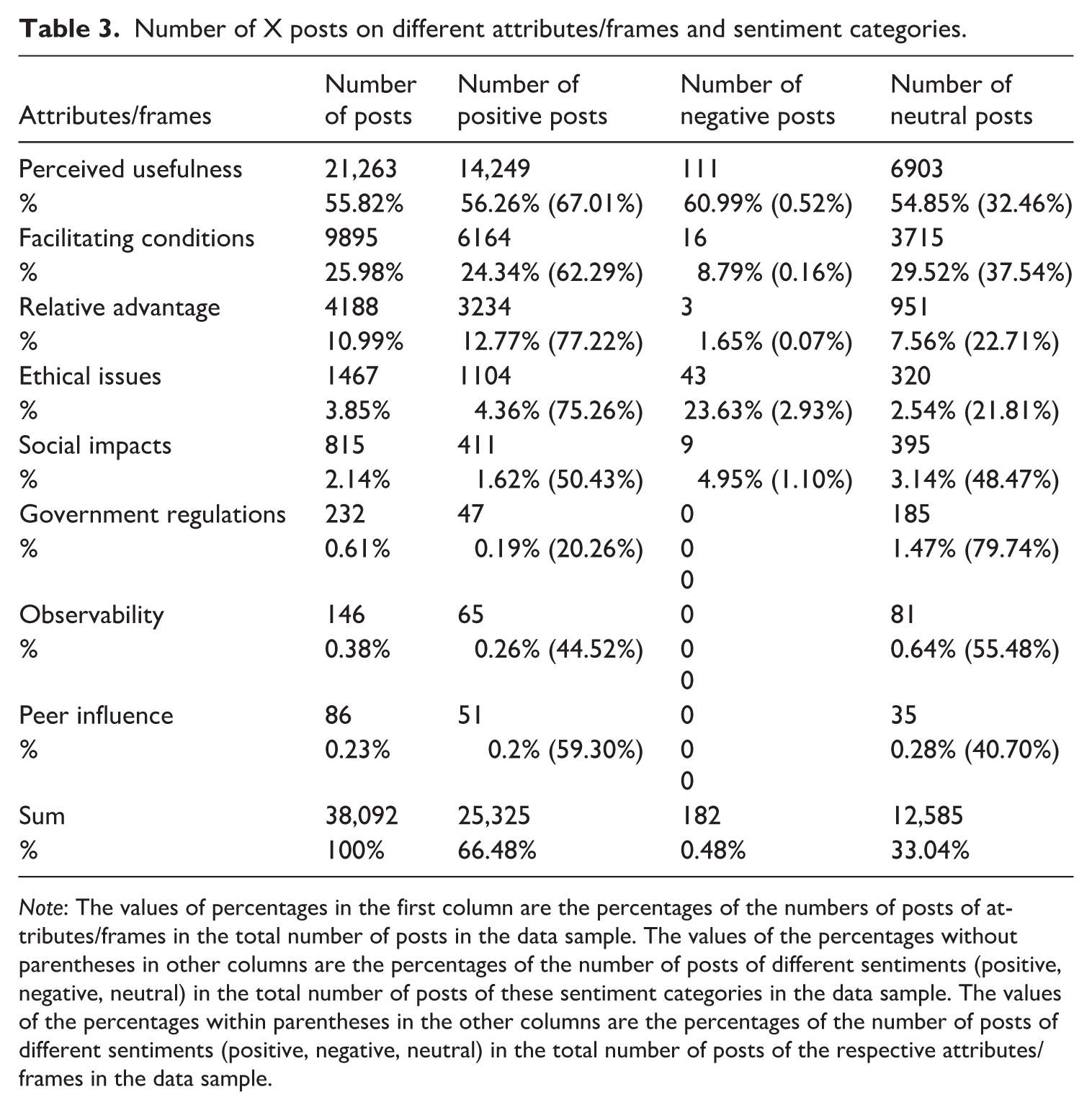
Note: The values of percentages in the first column are the percentages of the numbers of posts of attributes/frames in the total number of posts in the data sample. The values of the percentages without parentheses in other columns are the percentages of the number of posts of different sentiments (positive, negative, neutral) in the total number of posts of these sentiment categories in the data sample. The values of the percentages within parentheses in the other columns are the percentages of the number of posts of different sentiments (positive, negative, neutral) in the total number of posts of the respective attributes/frames in the data sample.
Discussion
As a cutting-edge and rapidly diffused innovation, ChatGPT has garnered significant attention in public discourse. This study employs Llama 2 to identify four micro-level themes – perceived usefulness, relative advantage, observability and peer influence – and four macro-level themes – facilitating conditions, social impacts, ethical issues and government regulations – in the public discourse surrounding ChatGPT on X. These themes are derived from the literature of two major innovation diffusion theories (DOI and TAM/UTAUT) and the most recent research on ChatGPT’s diffusion. Drawing on second-level agenda-setting theory, the micro-level themes are conceptualized as attributes, while the macro-level themes are defined as frames based on framing theory. This conceptual division allows for a nuanced analysis of how ChatGPT is represented in social media discourse.
The prediction of the Llama 2 model demonstrates that most of the posts in the data sample are related to these attributes and frames. The top three most frequently discussed attributes and frames include two attributes (perceived usefulness and relative advantage) and one frame (facilitating conditions). The attributes of observability and peer influence received the least attention in the social media discourse. The results of the sentiment analysis demonstrate that most posts are either positive or neutral, and only a small proportion of posts are negative.
In terms of sentiment polarities, perceived usefulness has the highest number of positive and neutral posts, as well as the most negative posts among all attributes and frames. These negative posts discussed the flaws or shortcomings of ChapGPT and other AI applications such as inaccuracy, incompetence and inconvenience. An example of these posts is: ‘I’m more creative than #chatgpt, it only reproduces in a human style, it does not create’. Another negative area in the discourse revolves around the ethical issues frame. These posts discussed the privacy, bias, conflict with ethical norms, and threats to humanity issues brought about by ChatGPT and other AI applications. An example of these posts is: ‘#chatgpt is a fine example of mankind’s failures when its programmers are biased and put in their own bullshit views. AI will always be what man wants it to be and with it. It will inherit mankind’s failures and will never have true thought’.
The attribute of relative advantage, on its own, has the highest percentage of positive posts among all attributes. The positive posts on relative advantage revolved around the advantages of ChatGPT and other AI applications in terms of enhancing, replacing or superseding other technologies or tools. Here is an example: ‘Transform your website into a user engagement powerhouse with our AI SuperApp Builder’s custom mini apps and monetization options powered by OpenAI API’.
It is somewhat surprising that most posts about ethical issues are positive. These posts discuss the potential of ChatGPT and other AI in addressing ethical issues, and advocate developing ChatGPT and AI in ethical ways, etc. Here are two examples: ‘Before #EinsteinGPT was announced I was already playing with integration with #ChatGPT API and was building a bunch of Salesforce features. What about a chatter moderator to control violence and sexual posts using the moderation api? What if chatgpt was a chatter free user?’ ‘New AI tools are emerging daily. It’s so hard to keep up! That’s why examining AI ethics/responsible use in education is important. Our multi-disciplinary panel promises lively debate and fresh perspectives ahead!’
The frame of social impacts, on its own, has the second largest percentage of negative posts. These negative posts discuss the negative impacts of ChatGPT and AI on our lives and societies. Here is one example: ‘#chatgpt takes over your job and you have to resort to eating your moms dog turd for a living’. Another frame – government regulations – has no negative posts and has the largest percentage of neutral posts on its own. This suggests that most X users are not against government regulations on ChatGPT.
It is worth noting that while the macro-level frames – ethical issues, social impacts and government regulations – have garnered significant attention from researchers (e.g. Agathokleous et al., 2023; Cao and Zhai, 2023; Chavanayarn, 2023; Chung, 2023; Delellis et al., 2023; Gursoy et al., 2023; Hung and Chen, 2023; Jeyaraman et al., 2023; Yan et al., 2023), X users discussed these topics less frequently during the initial months of ChatGPT’s global diffusion. As ChatGPT becomes more widely adopted and applied across various settings, it is reasonable to expect increased public discourse on these frames.
This study offers several theoretical contributions. While major innovation diffusion/adoption theories (DOI and TAM/UTAUT) examine how perceptions influence innovation diffusion, they do not address the origins or formation of these perceptions. Media effects theories can provide insights into these critical questions. Additionally, although innovation diffusion theories highlight the role of communication in the diffusion process, they do not explore the impact of media messages. This study bridges these gaps by integrating innovation diffusion/adoption theories with media effects theories. The proposed conceptual framework establishes a foundation for analyzing media messages related to innovation diffusion. Although the analysis of this study focuses on ChatGPT, this framework has the potential to be applied to other innovations.
The key finding that various attributes and frames have differing levels of prominence in public discourse suggests that people do not perceive all factors as equally significant. While major innovation diffusion/adoption theories propose that factors related to these attributes and frames drive diffusion, they do not account for variations in their significance. Media effects theories, however, argue that the prominence of attributes and frames in public discourse shapes perceptions, with differing levels of prominence leading to varying degrees of attention and potentially influencing perceptions or intentions. This study’s findings highlight the need to advance innovation diffusion/adoption theories by integrating media effects theories and exploring the varying significance of their key factors.
The predominance of positive sentiment reflects the general attitudes of X users toward ChatGPT, as X serves as a platform for expressing opinions. According to second-level agenda-setting theory, these sentiments shape users’ affective or emotional perceptions of ChatGPT. The overall positive attitudes align with the rapid diffusion of this innovation. The sentiment patterns revealed in this study – such as perceived usefulness having more positive posts than other attributes and frames – suggest that certain attributes elicit more favorable emotional perceptions, influencing adoption intentions and behaviors. While individuals naturally have varying emotional responses to innovations, DOI and TAM/UTAUT do not address these differences or their impact on adoption. The second-level agenda-setting theory fills this gap by explaining how media message sentiments influence affective perceptions. The findings of sentiment patterns underscore the need to integrate the second-level agenda-setting theory with DOI and TAM/UTAUT to explore the role of media effects in innovation diffusion.
This study has practical implications for OpenAI and other AI developers to improve their AI applications. Users’ feelings and experiences are especially important for them to develop their products. The discussions on X as well as other social media would reflect the users’ feelings and experiences. They should pay attention to these discussions and utilize the valuable information in the discussions to improve their current applications or guide new application development. They should focus more on the negative discussions on social media, which might reflect users’ concerns or the flaws in their applications. Other organizations, such as governments and AI investors, should also investigate the public discourse of ChatGPT and AI in social media. The attributes/frame and sentiment analysis would help them make wise policies and strategies based on the understanding of public opinion reflected in the public discourse.
As the first attempt that applies the Llama 2 model to analyze social media content, this study has several limitations. The data used in this study is from the second-hand dataset. It does not contain all the posts during the time frame of investigation. As X changed its Application Programming Interface drastically, it is very hard to extract historical data from this platform. Although many studies used the second dataset, the authors note this is the major limitation of this study. Another limitation may come from the machine learning model approach. Although large language models (LLMs), such as Llama 2, are powerful tools to analyze large datasets, they may be not as accurate as human brains in recognizing the patterns in textual data. The posts on X are usually short and sometimes messy, which add more risks to semantic analysis. Moreover, this study only identifies the attributes/frames and sentiments in the X discourse but does not investigate the influence of these factors on the adoption intentions and behaviors of ChatGPT. This limitation suggests a direction for future research.
Notwithstanding these limitations, this study suggests the potentials of the theoretical integration between media effects theories and innovation diffusion/adoption theories, as well as the utilization of LLMs in analyzing big data in social media. Future research would benefit from further exploring these potentials.
Footnotes

Funding
The authors received no financial support for the research, authorship, and/or publication of this article.
Declaration of conflicting interests
The authors declared no potential conflicts of interest with respect to the research, authorship, and/or publication of this article.