







Abstract
In 1959, Hannah Arendt published an essay in Dissent criticizing the school integration movement. Ever since, the essay has been understood as an anomaly in her work and an affront to the school integration movement that followed Brown v. Board of Education (1954). Rather than being dismissed, this article suggests that Arendt’s “Reflections on Little Rock” should be read alongside her contemporaneous works and appreciated for bringing up a topic that was central to Brown. It argues that Arendt’s “Reflections,” like the Brown opinion, was largely concerned with improving black children’s childhoods and that this point brought to light a broader concern for children’s childhoods that preoccupied Arendt deeply in the late 1950s.
Keywords
In the fall of 1957, Hannah Arendt saw a photograph of a fifteen-year-old black student, Elizabeth Eckford, on her first day of school in Little Rock, Arkansas. That morning of September 4th, the young Eckford had put on a starched white dress and had taken the public bus alone to Central High School. There, she had been met by a hostile white mob of segregationists who opposed her attendance in the traditionally white school. When she walked across the street to the school’s entrance, she found that the National Guardsmen were not there to protect her from the mob; instead, the men had been ordered by the Governor to prevent her entrance. She had nowhere to go. A young photographer from an Arkansas newspaper took a photograph of the teenager as she walked back to the bus stop with a crowd of jeering white students and adults trailing behind her. Almost instantly, this photograph graced the pages of newspapers across the globe. 1
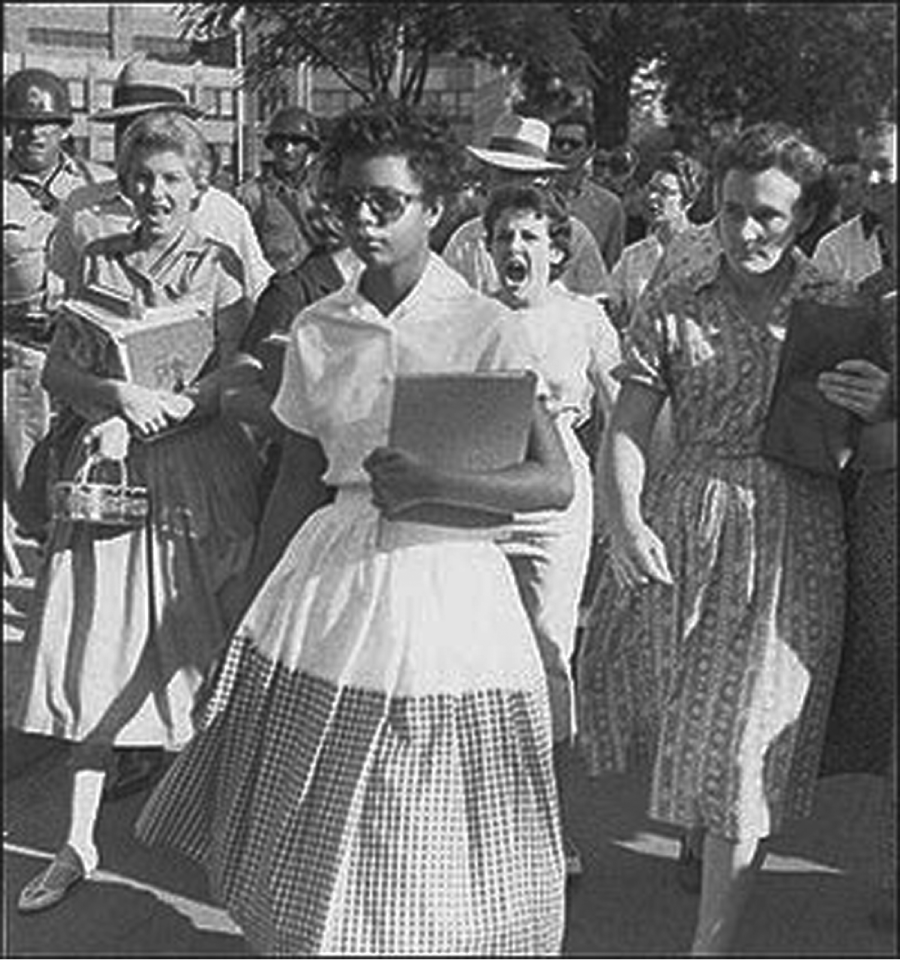
Elizabeth Eckford [permission to reproduce image received from Indiana University Archives.]
Like many other people in the United States and abroad, this image shocked Arendt, but her response was unique. Instead of believing that this photograph proved the righteousness of civil rights activists’ efforts to enforce black Americans’ constitutional rights to an integrated education, she thought that the photo proved that these activists’ attempts were unjustified. Commentary refused to publish an essay by Arendt making these controversial observations. The following year, when the Governor of Arkansas closed all public schools in Little Rock as a further effort to defy integration, Arendt observed that the school crisis was as heated as ever and believed that it was important to publish her essay, which had been sitting on her desk for over a year. Her “Reflections on Little Rock” were published in Dissent in the early months of 1959. Directly criticizing a movement that was close to the hearts and minds of many Americans (including Dissent readers), Arendt’s essay found few fans. 2
In the same edition of Dissent, two contemporary scholars responded to her essay and suggested that Arendt was simply an aloof Northern academic disconnected from the actual lives of black Americans in the South. In an interview with Robert Penn Warren a few years later, Ralph Ellison argued that Arendt simply did not understand why black parents sent their children to integrated schools. 3
Since then, scholars have continued to analyze this 1959 essay. Two scholars have argued that Arendt incorrectly analogized the experience of Jewish children like herself in Germany with black schoolchildren in the Southern United States. 4 Another has posited that “Reflections” reflected Arendt’s prejudice against black Americans; 5 and a fourth has suggested that Arendt was too preoccupied with defining her theoretical terms to realize the moral consequences of her analysis. 6 It is not difficult to sympathize with these scholars’ efforts to understand why Arendt criticized the school integration movement and their ultimate conclusions finding fault with her essay. However, this article explains that the critics have misread Arendt’s main point in “Reflections”; and in the process, have convinced themselves that, at best, Arendt misapplied her own political concepts in the essay.
By contrast, this article suggests that in “Reflections” Arendt correctly applied a political concept that she was working on in the late 1950s, and that the main purpose of her 1959 essay was to mobilize this theory. Specifically, Arendt’s leitmotif in “Reflections on Little Rock” was that black schoolchildren (indeed, all children) belonged in the private realm of the family. This concern for schoolchildren’s childhoods is evident in two other contemporary works by Arendt: The Human Condition (1958) and “Crisis in Education” published in the fall 1958 edition of The Partisan Review. Side-by-side readings of these three works should make it evident to Arendtian scholars (who so far have missed Arendt’s overarching concern for children in “Reflections” and in her politics more broadly) that Arendt in the late 1950s was concerned with defining a private realm and keeping children within it. 7 In other words, far from being an outlier of Arendtian thought, “Reflections on Little Rock” is one example where Arendt applied her concept of childhood and explained to her readers the importance of preserving and protecting this stage in human development.
To late 1950s’ Dissent readers who assumed that the school integration movement required black schoolchildren to become stoic, heroic, and sacrificial civil rights actors for the benefit of future generations, a concern with children’s childhoods seemed immaterial. 8 However, the Supreme Court’s opinion in Brown v. Board of Education (1954) reveals that even for the nine justices of the Brown Court (who, presumably, represented the antithesis of Arendt’s position in “Reflections”), the entire point of integrating public schools was to improve black children’s lives. Taking the Brown opinion at face value, one of the main reasons for integrating schools was to correct black schoolchildren’s “feeling of inferiority as to their status in the community that may affect their hearts and minds in a way unlikely ever to be undone.” 9 When in 1959 Arendt prescribed keeping black schoolchildren like Elizabeth Eckford far away from political and public concerns as a means of improving their childhoods, she clearly differed from Brown’s position, but both Arendt and the Brown Court were concerned with the same question.
Put simply, this article argues that Arendt’s “Reflections,” like the Supreme Court’s Brown opinion, was largely concerned with improving black children’s childhoods and that this point brought to light a broader concern for children’s childhoods that preoccupied Arendt deeply in the late 1950s. Rather than being dismissed by Arendtian and civil rights scholars alike, “Reflections” should be read alongside Arendt’s two other contemporary works and appreciated for bringing up a topic that was central to Brown.
I. Brown v. Board of Education (1954)
In its 1896 ruling in Plessy v. Ferguson, 10 the Supreme Court held that segregated transportation on the basis of race was constitutional, so long as each race was afforded “separate but equal” treatment. 11 Then, in 1950, a black law student in Texas argued that his segregated law school was unequal and inferior to the comparable white one. The Court in Sweatt v. Painter held that the Texas law schools failed to meet the “separate but equal” doctrine because of “quantitative differences in facilities and intangible factors” such as the quality of the faculty, of the library, and of law reviews, moot court, and order of the coif affiliation. 12 In 1954, the Supreme Court once again confronted the application of the “separate but equal” doctrine in the context of public education; this time, in the context of segregated public grade and high schools.
The Supreme Court in Brown v. Board of Education (1954) noted that in this case, unlike in Sweatt, the segregated schools had been equalized “with respect to buildings, curricula, qualifications and salaries of teachers, and other ‘tangible’ factors.” 13 In other words, these public grade and high schools had equalized all tangible and intangible requirements to meet Sweatt’s standards for the “separate but equal” doctrine. Nevertheless, the Court found that segregated education violated the “separate but equal” doctrine with respect to other intangible factors not yet mentioned or discussed in Sweatt, such as how black and white school children experienced segregated education in grade and high schools.
The Brown Court noted that segregated education made black schoolchildren feel inferior to white schoolchildren. The Supreme Court explained: “To separate [black students] from others of similar age and qualifications solely because of their race generates a feeling of inferiority as to their status in the community that may affect their hearts and minds in a way unlikely ever to be undone.” Not only did black schoolchildren feel inferior by attending segregated schools, but such schools offered “educational opportunities which [were] substantially inferior to those available to white children otherwise similarly situated.” Seeing that white and black schoolchildren experienced segregated public education differently and unequally, the Court reasoned that “[s]eparate educational facilities [were] inherently unequal” and held that such separate and unequal treatment was a violation of the federal constitution’s equal protection clause. The purpose of integrating schools, the Brown Court explained, was to remedy the sense of inferiority that the practice of segregating schools had placed upon black schoolchildren, and to equalize the benefits black and white children received in school. The Court hoped that, by attending integrated schools, black schoolchildren’s childhood development would improve. 14
In the concluding remarks, the Court restored the case to the docket for further arguments on methods for desegregating schools in states “requiring or permitting segregation in public education” 15 ; and for the following year, the Court heard arguments from school boards and administrators on the implementation of its desegregation plan.
II. The School Integration Movement in Little Rock, Arkansas
The State of Arkansas, like other southern states, permitted segregation in public grade and high schools and was thus implicated by the Brown ruling: Ten days after the Supreme Court decided Brown, the Little Rock School Board of Arkansas announced a plan for desegregating the schools, to be carried out in three voluntary, gradual phases. 16 Little Rock’s elected superintendent of schools, Virgil Blossom, proposed desegregating Little Rock’s high schools first, but stated that such desegregation would begin three years from then, in 1957. 17 This plan became known as the Blossom Plan.
Orval Faubus, later becoming infamous for his role in school desegregation battles, was elected Governor of Arkansas the same year of the Brown ruling and the announcement of the Blossom Plan. He assumed office as Governor of Arkansas in January of 1955. 18 Three months later, the Supreme Court published Brown II. 19 After spending a year hearing arguments from school boards and authorities across the South, the Court acknowledged the difficulties local school authorities faced in desegregating schools. The Brown II Court delegated to the district courts the task of policing school boards’ compliance with the Court’s holding in Brown, and ambiguously ordered desegregation “with all deliberate speed.” 20
In the wake of Brown II on May 31, 1955, Virgil Blossom modified his original school desegregation proposal. Author of Massive Resistance and Minimum Compliance, John Kirk explained that Blossom, who had advocated a policy of minimum compliance all along, saw the court implementation order as a mandate for further measures to limit the impact of Brown. 21 The new Blossom Plan “specified that even though the entire process might take as many as six years, ‘To move faster than the ‘deliberate time schedule’ outlined could easily result in placing our system of Free Public Education in danger.”’ 22 As his original start date for desegregation in Little Rock neared, Blossom tried to replace it with an undefined future date; however, the National Association for the Advancement of Colored People (NAACP) responded by taking the school board to court and demanding immediate integration. 23
Little Rock historian, Elizabeth Jacoway, wrote that “[m]any members of the Little Rock chapter of the NAACP understood that Blossom and his board ‘now intended to integrate the public schools only on a token basis, if at all.’” 24 Convinced that the Little Rock School Board would integrate its schools only if the federal district court got involved, the Little Rock chapter of the NAACP searched for parents who would be willing to attempt to register their children in white schools. When school officials refused to allow these black students to attend white schools, the Arkansas State Conference of the NAACP filed suit in district court in the spring of 1956 on behalf of these thirty-three black parents.
The national chapter of the NAACP decided to represent the parents in this case; and along the lines of national leadership, the NAACP lawyer “declared immediate and systematic desegregation as the goal of the suit.” 25 The district court decided in favor of Little Rock’s School Board, which had explained to the court that it was planning to integrate its high school in the fall of 1957. The court reasoned that the board “had acted in good faith in scheduling its integration plan to start the following year, in September, 1957.” 26 The NAACP then appealed the decision to the Eighth Circuit, which affirmed the district court’s ruling. 27 The NAACP lost its primary goal of integrating all schools in Little Rock immediately, but per the Eighth Circuit and the district court, the School Board no longer could indefinitely postpone the integration of at least one of its schools: Central High School. If the Little Rock School Board did not allow black students into the white high school in September of 1957, it would be in contempt of court. 28
By this point, school desegregation in Little Rock had become a politically divisive issue. By early 1957, segregationist organizations were being formed and becoming vocal in the community, and by the later half of 1957, “the issue of school desegregation swiftly reached its denouement at Little Rock.” 29 In the spring of 1957, just months before the desegregation of Little Rock public schools was scheduled to take place, the Arkansas legislature introduced four pro-segregationist bills with the support of Governor Faubus. 30
As the beginning of the 1957–58 school year approached, two segregationist organizations tried their last attempts to stall integration. Little Rock mothers who opposed the desegregation of the Little Rock schools formed the Mothers’ League of Central High, “claim[ing] to be a ‘group of Christian mothers opposed to violence.”’ 31 On August 27, 1957, this group filed suit; arguing that the pro-segregation laws passed by the legislature conflicted with federal laws and requesting temporary injunction against school integration in Little Rock. The Mothers’ League warned that if the school board continued on with its desegregation plans under such uncertainty of the law, “civil commotion” would ensue. 32 The local court granted the injunction, and the next day, on August 28, 1957, the NAACP went before a federal judge with a petition. The federal judge overruled the injunction, “ordering the school board to proceed with immediate integration.” 33
That same month, another segregationist group, the Capital Citizens’ Council of Little Rock filed several lawsuits petitioning the state to uphold its segregationist statutes. While the Mothers’ League argued that they stood against integration in order to protect their children, the Citizens’ Council argued that segregated schools were part of the Southern way of life. Both groups “claimed the mantel of ‘respectable resistance’ by posing as exponents of non-violent opposition to a coercive federal government.” 34 They ultimately failed to convince the courts, but both groups remained influential segregationist forces in the Little Rock community for the next two years.
On September 2, 1957, the night before the first day of school at Central High, Governor Faubus said that he, too, feared violence at the school. He announced that he would call out the Arkansas National Guardsmen for the beginning of school the next day. 35 “Faubus’ alleged reason for calling out the troops was that he had received information that caravans of automobiles filled with white supremacists were heading toward Little Rock from all over the state. He therefore declared Central High School off limits to [black students].” 36 Faubus warned that “blood would run in the streets of Little Rock” if black students attempted to attend Central High the next day. 37 Like the Mothers’ League and the Citizens’ Council, Faubus did not say that he was trying to defy federal authority in the name of segregation; instead, he said he sought to preserve peace and avoid violence. 38
By then, only nine children who had requested to attend Central High remained interested. That first day of school, these nine students “stayed home while the Little Rock School Board went into federal court to ask for a temporary delay of its integration plan”; 39 and by that afternoon, the district court judge ordered the school board to proceed immediately with its federally mandated plan the very next day, on September 4th. Late that night, Daisy Bates, president of the Arkansas State Conference of NAACP branches, called the children’s parents and told them to bring their children to her home the next morning in order to drive them as a group to meet with city policemen two blocks from the school. 40 However, there was one child whom she could not contact, Elizabeth Eckford, whose family did not have a telephone at home. Before going to bed that night, Bates told herself that she would find Eckford in the morning. 41 Meanwhile, sometime after midnight, Faubus changed the orders of the National Guard, “instructing soldiers explicitly to prohibit the black children from entering Central High School.” 42
On the morning of September 4, 1957, eight students met at Bates’ house and, in light of Faubus’ orders, did not make their way to Central High. Unbeknownst to these changes in the plan, however, Eckford prepared herself for her first day of school. With a notebook in hand and dressed in a starched white dress, Eckford stepped off the public bus alone to find an army of National Guardsmen blocking her entrance to the school and an angry white mob across the street. 43 It is against this backdrop in the fall of 1957 that the political theorist, Hannah Arendt, wrote her “Reflections on Little Rock.”
***
Born in Hanover, Germany in 1906, Arendt grew up in a secular middle-class Jewish family in Königsberg, East Prussia. 44 She went on to study philosophy at the University of Marburg and completed her doctorate at Heidelberg in 1929. Four years later, Arendt was detained by the Gestapo; and after her release, she fled to France and then immigrated to the United States in 1941. 45 When she wrote her “Reflections on Little Rock” in 1957, Arendt had been in the United States for 16 years, and was teaching at the University of California-Berkeley and at the University of Chicago. 46
Whether in Berkeley or in Chicago that fall, Arendt wrote her “Reflections on Little Rock” and sent it along to Commentary, but withdrew her piece from publication in a letter dated November 23, 1957. Explaining her withdrawal, Arendt wrote that it was partly due to “the controversial nature of [her] reflections which, obviously, were at variance with [Commentary’s] stand on matters of discrimination and segregation.” 47 She later published the article – unchanged – in the winter 1959 volume of Dissent. Between the writing and the publication of “Reflections,” the Little Rock school crisis intensified.
***
Twenty days after the photograph of Elizabeth Eckford had become front-page news, on Tuesday September 24th, President Eisenhower dispatched units of the 101st Airborne Division to Little Rock from Kentucky and federalized the Arkansas National Guard units. 48 On Wednesday morning, the nine children met at Bates’ home again in an effort to attend school: 49 “When the Army station wagons arrived at the Bates home to pick up the nine children and deliver them to Central High,” one of the nine students said somberly, “‘For the first time in my life, I feel like an American citizen.’” 50 With the protection of federal troops, this time the nine children made it safely into the school building, almost three weeks after the official start of school at Central High. According to Bates, “[s]ome of the citizens watching the arrival of the troops cried with relief. Others cursed the Federal Government for ‘invading our city.’” Through this cacophony of reactions, Daisy Bates “got the impression that the ‘Solid South’ was no longer solid.” 51 The South was split between those who found relief in the federal government’s presence in Little Rock and those who did not.
Racial tensions escalated in the school and among the community. In the school, black students “faced daily intimidation and harassment.” 52 In the community, “[a]nyone actively promoting integration of schools was subject to a torrent of physical violence, public insults, and economic pressure from local white segregationists.” 53 All of these forms of harassment and intimidation largely remained unpunished in Little Rock, 54 and although some white residents in the community attempted to speak out against the segregationists, they were clearly outnumbered by those who remained silent, or who actually supported them. 55
Segregationists in Little Rock continued fighting their cause in court. At the end of the school year, the Little Rock School Board petitioned the federal district court to delay integration of Central High. The School Board explained that integration had caused increased violence in Little Rock, and that the community could use a cooling-off period. The Board “asked that the Negro pupils currently enrolled be removed and that integration be postponed until the January mid-term of 1961.” 56 In June 1958, the School Board’s request to delay integration was granted by the district court. The NAACP appealed and by August 18th, the delay was overruled. In its written opinion, the Eighth Circuit did not underscore the federal protection of civil rights, but rather, the supremacy of the federal government. 57 The segregationists appealed this decision to the Supreme Court, which on September 11, 1958, held that, no matter how violent the opposition, integration at Central High must continue. 58 That same day, Governor Faubus “signed the ‘package of segregation bills passed at the Extraordinary Legislative Session and ordered Little Rock’s three white and one Negro high school closed.”’ 59 For the following academic year, from September 1958 to August 1959, all public schools in Little Rock were closed.
In September of 1958, Faubus promised a seamless transition from public to private education, and he enjoyed support from Little Rock voters to close down the public schools. However, “the white private school quickly proved unsatisfactory, especially after a federal court blocked its use of public money and public school buildings.” 60 By December, Little Rock became divided between those segregationists who continued to support Faubus’ decision to close schools, and those Little Rock residents who saw little reason in fighting federal sovereignty if it meant sacrificing the education of their children and the economic well-being of the city. 61 It is under this political climate, in January of 1959, that Hannah Arendt finally published her “Reflections on Little Rock.”
In the fall of 1958, when Little Rock schools had closed, Arendt had realized that the issue of school integration in Little Rock was as critical as ever. In the winter 1959 edition of Dissent, Arendt explained that recent developments in Little Rock convinced her to publish the piece, and she “agreed to let Dissent publish the article as it was written” in the fall of 1957. 62
III. Hannah Arendt’s “Reflections on Little Rock” (1959)
In her twelve-page “Reflections,” Arendt argued that the Supreme Court and civil rights activists were misguided in their attempts to forcefully integrate schools in the South, and she mobilized four arguments in favor of this claim. Central to these four arguments were her notions of the political, social, and private realms. 63
Arendt argued that each realm was governed by a different principle. She explained that the political realm was governed by the principle of equality; the social realm by the principle of discrimination; and the private realm by the principle of exclusivity. Arendt stated that the government should enforce equality in the political realm, and nowhere else: “Strictly speaking, the franchise and eligibility for office are the only political rights, and they constitute in a modern democracy the very quintessence of citizenship.” 64 As such, black and white Americans alike should have the right to vote in the same elections, and the right to hold the same public offices.
In the essay, Arendt then argued that certain things – like buses, trains, restaurants and hotels – lay just between the political and social realms. “Though not strictly in the political realm, such services are clearly in the public domain where all men are equal; and discrimination in Southern railroads and buses is as scandalous as discrimination in hotels and restaurants throughout the country.” 65 She suggested that the principle of equality should govern suffrage, public office, and access to buses, trains, restaurants, and hotels. In other words, the government should not tolerate discrimination on the basis of race in these areas of American life.
Then, Arendt moved on to explain the social realm, which was governed – not by the principle of equality, but – by the principle of discrimination. She wrote: “[D]iscrimination is as indispensable a social right as equality is a political right. The question is not how to abolish discrimination, but how to keep it confined within the social sphere where it is legitimate, and prevent its trespassing on the political and the personal sphere, where it is destructive.” 66 Arendt found value in this social sphere, where people had the right to freely associate. She argued that discrimination was the very principle that guided people as they chose with whom they wanted to associate in the social realm, and concluded that “without discrimination of some sort, society would simply cease to exist and very important possibilities of free association and group formation would disappear.” 67 She argued that people had a right to attend vacation resorts, for example, that were restricted to their own ethnic groups. Arendt suggested that as a Jew she did not see how anybody could prevent her from spending her vacations only in the company of Jews; just as she did not see why other vacation resorts should not cater to clients who wished to exclude Jews. For Arendt, in “the realm of the purely social … the right to free association, and therefore to discriminate, ha[d] greater validity than the principle of equality.” 68 She noted that vacation resorts, children’s schools, and adults’ places of employment existed in the social realm, 69 and people were free to limit access to these venues.
She did, however, create some exceptions to the right to discriminate in the social realm. She noted that this principle should not apply to theaters and museums “where people obviously do not congregate for the purpose of associating with each other.” 70 By deductive reasoning then, Arendt deemed that vacation resorts, children’s schools, and adults’ places of employment – unlike theaters and museums – were areas where people gathered to associate freely with each other.
Children, Arendt argued, existed in the private realm of the family and home. “Children are first of all part of family and home, and this means that they are, or should be, brought up in that atmosphere of idiosyncratic exclusiveness which alone makes a home a home, strong and secure enough to shield its young against the demands of the social and the responsibilities of the political realm.” 71 This private realm, Arendt argued, was governed by the principle – not of equality nor of discrimination, but – of exclusiveness. “Here we choose those with whom we wish to spend our lives, personal friends and those we love.” 72 In this realm, the individual chose his spouse, and raised his children. Arendt argued that neither government in the political realm nor society in the social realm had any roles to play in limiting the individual’s right to organize his personal life as he wished in the private realm. For this reason, the individual should have the right to marry whomever he wished 73 and the right to raise his children as he deemed fit.
With these three realms and their governing principles in mind, Arendt moved on to present her four main arguments against the school integration movement. First, she explained that the “only reason that the Supreme Court was able to address itself to the matter of desegregation in the first place was that segregation has been a legal, and not just a social, issue in the South for many generations.” In other words, laws that enforced segregation were illegitimate because they curtailed equality in the political realm and people’s ability to freely associate in the social realm. However, laws that enforced integration in the social realm were equally illegitimate because they limited people’s rights to freely associate in the social realm. She wrote, “For the crucial point to remember is that it is not the social custom of segregation that is unconstitutional, but its legal enforcement.” 74 Placing public schools in the social realm, Arendt argued that the Court’s role in enforcing school integration was an illegitimate infringement on people’s rights to freely associate.
Moving on to her second point, Arendt explained that the enforcement of school integration was, more specifically, an infringement on parents’ rights to select with whom their children associated in the social realm. She wrote: “To force parents to send their children to an integrated school against their will means to deprive them of rights which clearly belong to them in all free societies – the private right over their children and the social right to free association.” 75 Arendt explained that the child belonged in the private realm of the home, and that the state could only obligate the parent to take the child outside of the home to attend school in the social realm. However, the state could not infringe upon the parent’s right to decide with whom his child would freely associate in this realm. The school integration movement, she explained, blatantly infringed upon the parent’s right to decide with whom his child associated in the social realm.
Arendt mobilized yet a third reason why the Supreme Court’s decision to integrate schools in the South was illegitimate. She explained: “In contradistinction to the classical principle of the European nation-state that power, like sovereignty, is indivisible, the power structure of this country rests on the principle of division of power and on the conviction that the body politic as a whole is strengthened by the division of power.” She continued, “If it is true (and I am convinced it is) that unlike force, power generates more power when it is divided, then it follows that every attempt of the Federal government to deprive the states of some of their legislative sovereignty can be justified only on grounds of legal argument and constitutional history.” 76 She concluded this analysis by stating that the United States Constitution was “silent on education and that legally as well as traditionally, public education lies in the domain of state legislation.” 77 Once again, and for a third reason based on the separation of powers, the Supreme Court’s efforts to integrate public schools were illegitimate.
Lastly, Arendt explained that the Supreme Court was misguided in its efforts to “start integration in, of all places, the public schools.” She wrote that it “certainly did not require too much imagination to see that this was to burden children, black and white, with the working out of a problem which adults for generations have confessed themselves unable to solve.” 78 Before the Supreme Court went into the business of integrating public schools and involving children in the messy issue of race relations, Arendt argued that it should have considered invalidating other (and more important) violations of inalienable human rights among adults. She wrote: “Even political rights, like the right to vote, and nearly all other rights enumerated in the Constitution, are secondary to the inalienable human rights to ‘life, liberty and the pursuit of happiness’ proclaimed in the Declaration of Independence; and to this category the right to home and marriage unquestionably belongs.” 79 Among the most important violations of human rights, Arendt explained, were the anti-miscegenation laws that prohibited marriage between white and black adults.
To say the least, these arguments against school integration were provocative, and critics quickly reacted.
IV. Critics and Hannah Arendt’s “Reply to Critics”
In the very same Dissent issue in which Arendt’s “Reflections on Little Rock” were published, the Columbia political scientist David Spitz and the Princeton sociologist Melvin Tumin responded. 80 To Tumin and Spitz, Arendt came off as an aloof academic in the North overly concerned with irrelevant philosophical definitions. In their critiques of “Reflections,” they seemed to be telling Arendt that theirs was not a time to sit down and debate the proper definitions of federalism or of the social, private, and political realms. Instead, it was time to mobilize all possible national resources to help black Americans in the South exercise their constitutional rights to be treated equally as white Americans. In the next edition of Dissent, Hannah Arendt attempted to defend her essay.
She published her three-page “Reply to Critics” in the spring 1959 edition of Dissent, just three months after the publication of her “Reflections.” 81 Arendt quickly dismissed both of her critics, whom she thought misunderstood her essay. She then explained what got her to write her critique of the school integration movement in the first place: “The point of departure of my reflections was a picture in the newspapers, showing a Negro girl on her way home from a newly integrated school; she was persecuted by a mob of white children, protected by a white friend of her father, and her face bore eloquent witness to the obvious fact that she was not precisely happy.” 82 The point of departure for Arendt’s “Reflections” was the picture of fifteen-year-old Elizabeth Eckford getting attacked by a white mob on her first day of school in Little Rock’s Central High School.
In her “Reply to Critics,” Arendt explained that the young girl in the picture bore witness to the fact that school integration was making black schoolchildren’s psychological development more vulnerable to feelings of inferiority than they would have been in segregated schools. In a segregated school, this young girl would have suffered by knowing that her race barred her from attending the white school; however, she would have been spared the experience of feeling unwanted. Arendt elaborated: “Psychologically, the situation of being unwanted (a typically social predicament) is more difficult to bear than outright persecution (a political predicament) because personal pride is involved.” 83 Essentially, Arendt argued that it was more psychologically damaging for Eckford to hear the mob’s jeers and fellow students’ and teachers’ insults than to have known that she could not have attended the school because she was black.
Arendt continued, “By pride, I do not mean anything like being ‘proud of being a Negro,’ or a Jew, or a white Anglo-Saxon Protestant, etc., but that untaught and natural feeling of identity with whatever we happen to be by the accident of birth.” By pride, Arendt meant the ego, the sense of self that makes the individual stand up straight. “Pride, which does not compare and knows neither inferiority nor superiority complexes, is indispensable for personal integrity, and it is lost not so much by persecution as by pushing, or rather being pushed into pushing, one’s way out of one group and into another.” 84 Arendt suggested that Eckford was sacrificing her personal pride and integrity by pushing herself into an environment where she was unwelcomed. If she had simply attended her segregated school, Arendt seemed to suggest, this young girl would have had a chance to develop into a happy teenager with a strong sense of self (albeit in a segregated bubble). As discussed below, Arendt’s reading of Elizabeth Eckford’s photograph revealed her main purpose for writing the essay: Her central purpose was to explain that children should not be actors in the public realm; but rather, that they should be protected from public scrutiny within the private family home.
Arendt concluded her “Reply to Critics” by analyzing what she would have done had she been a mother of these children in Little Rock. As a black mother trying to improve her child’s education, she wrote that she would have pursued instead the improvement of schools for black children. Arendt wrote that she would have felt that the “Supreme Court ruling, unwillingly but unavoidably, ha[d] put my child into a more humiliating position than it had been in before.” Moreover, she would have challenged the legal enforcement of segregation and she would have pursued the legal enforcement of her indisputable rights – “my right to vote and be protected in it, to marry whom I please and be protected in my marriage (though, of course, not in attempts to become anybody’s brother-in-law), or my right to equal opportunity.” As a black parent, Arendt would have avoided pushing herself into white Americans’ social realm, which she deemed to be a humiliating effort and an “affair of social climbing.” Such pushing and elbowing into white Americans’ social realm was only excusable, Arendt wrote, if it was necessary to make a decent living or to raise one’s family’s standard of life. 85
The second question she raised was: “What would I do if I were a white mother in the South?” If she were a parent who preferred to have her child attend a segregated school, Arendt said that she would have “agree[d] that the government ha[d] a stake in the education of my child insofar as this child [was] supposed to grow up into a citizen, but I would [have] den[ied] that the government had any right to tell me in whose company my child received its instructions.” By contrast, if she were a white parent who supported integrated schools, she would have run a pilot program with black parents and would have tried to persuade other white parents to join. “To be sure, there, too, I would [have] use[d] the children in what [was] essentially a political battle, but at least I would have made sure that the children in school [were] all there with the consent and the help of their parents; there would [have been] no conflict between home and school, though there might [have arisen] a conflict between home and school, on one side, and the street on the other.” 86
With these final words, Arendt ended her public conversation on the Little Rock School Crisis. Since then, critics have struggled to understand how she could have possibly found fault with the school integration movement.
V. More Critics respond to “Reflections on Little Rock”
A few years after the publication of her “Reply to Critics,” the poet and literary critic Robert Penn Warren interviewed the novelist Ralph Ellison for his 1965 book Who Speaks for the Negro?; and during the interview, Ellison mentioned Arendt’s “Reflections.” Ellison explained that in her essay, Arendt had failed to take into account the “ideal of sacrifice” in the lives of black parents. He said that “in the outlook of many of these parents (who wish[ed] that the problem didn’t exist), the child is expected to face the terror and contain his fear and anger precisely because he is a Negro American.” 87 Ellison noted that black parents did not send their kids to integrated schools in order to push themselves into white American society, but rather, to introduce their children to what it meant to be a black American in the United States.
Of all of her critics, Ellison made a significant impression on Arendt. Soon after his interview, Arendt wrote to him and apologized for her critique of black parents, acknowledging that: “It [was] precisely this ideal of sacrifice which I didn’t understand.” 88 Arendt conceded to Ellison that she had not considered this ideal of sacrifice when she had brainstormed reasons why black parents would have exposed their children to the kinds of criticism and hate speech that they were experiencing in the school integration movement, but she held steadfast to the belief that schoolchildren had no place in the political realm of politics. Irrespective of parents’ motivations, Arendt believed that a movement that sent schoolchildren into the throes of a political battle was illegitimate. 89
Since then, scholars have tried to understand why Arendt remained critical of school integration. They have largely concluded that she was either prejudiced against black Americans; aloof to the moral consequences of her arguments; or, just misguided in her analysis of the situation. Some, like Anne Norton, have suggested that Arendt was prejudiced against black Americans. Norton argued that Arendt’s “constructions of Africans and African Americans … do not subvert or depart from what she called ‘the common prejudices of Americans in this area.’” 90 Norton explained that Arendt’s critique of school integration, for example, exposed her deep indifference and prejudice against black Americans. 91
James Bohman went on to argue that Arendt critiqued school integration – not because she was a segregationist, but – because she was primarily interested in defining the social realm and in defending plurality within it, irrespective of the moral consequences of this analysis. 92 Still more scholars, such as Seyla Benhabib and Elisabeth Young-Bruel, 93 tried to excuse the conclusions in Arendt’s “Reflections” by noting that Arendt was just not sensitive to the significance of school integration in the United States. They suggested that Arendt wrongly analogized the experience of European Jews like herself with black Americans in the Southern United States. 94
Young-Bruel wrote that Arendt’s “Reflections” “reflected her Jewishness more than her conservatism. Her ‘pariah’ and ‘parvenue’ categories, though never mentioned, governed her approach.” 95 Benhabib explained that, when analyzing Jews in Europe, Arendt supported the “self-conscious pariahs” who mobilized to abolish segregation, but pitied the “social parvenu[s] who care[d] about social acceptance and conformism.” When she saw a schoolgirl pushing her way into a school where she was unwanted, the entire episode – and the civil rights movement more broadly – seemed to her to be like the Jewish “social parvenus” who cared too much about social acceptance. Benhabib concluded by writing that the “distinction between the pariah and the parvenu, which was so illuminating in her analysis of patterns of European anti-Semitism and Jewish responses to them, now fail[ed] her.” 96 Even though Arendt had conceded this argument about black parents’ motivations to Ellison long ago, Young-Bruel and Benhabib were convinced that this argument revealed why Arendt continued to argue against school integration.
***
It is understandable why these scholars would fish for clues as to why Arendt would stand against school integration. “Reflections” argued against federally enforced school integration and mobilized a seemingly endless list of rationales for it. Arendt not only mentioned the U.S. Constitution, parental rights, federalism, the private, public, and social spheres, but also went into an analysis of schoolchildren’s psychological well-being and black parents’ reasons for sending their children into hostile white schools. This has led scholars to ask: What did she really mean? Why would she cede her critique of black parents but remain convinced that federally enforced school integration was unjustified? Was she categorically against school integration? Was she a segregationist? Did she not understand what black Americans had to go through in the South and in the rest of the United States? Did she not understand how important the civil rights movement (and school integration in particular) was?
I suggest that scholars have missed Arendt’s main point in “Reflections,” and that correcting this oversight is important if we want to understand what worried Arendt in the late 1950s. That is, Arendt was neither a segregationist nor an aloof academic who was unaware of what she was writing when she argued against school integration. Instead, Arendt’s “Reflections” and two other contemporary works (The Human Condition (1958) and “The Crisis in Education” (1958)) suggest that she was particularly interested in protecting children’s childhoods and thought that this was only possible if children were kept out of the public realm. I suggest that the other arguments she mobilized in the essay should be understood as vehicles for this main argument. Further analysis of The Human Condition, “The Crisis in Education,” and Arendt’s reading of Elizabeth Eckford’s photograph helps unearth this main point.
VI. Arendt and Protecting Children’s Childhoods in “Reflections on Little Rock,” The Human Condition,and “The Crisis in Education”
Once prompted by critics, Hannah Arendt explained what had inspired her to write her “Reflections on Little Rock.” It was, as she confessed, a somber-faced photograph of the black schoolgirl Elizabeth Eckford. While the rest of the world looked at the photograph and admired the young girl for being a “Joan of Arc” who was willing to defy a howling mob with grace and dignity, Arendt saw a child whose childhood was being compromised. She thought that children such as Eckford should not play such heroic roles in the public realm; but rather, that they should be protected and sheltered in the private realm of the home. Such a political battle, Arendt argued, should have been fought by adults among adults in the public realm.
Arendt articulated this division between what adults and children should be expected to do by elaborating on the public, private, and social realms that she was constructing for her book manuscript, The Human Condition. 97 In “Reflections on Little Rock,” she explained that children belonged in the private realm of the home where individuals engaged in exclusive and intimate relationships, and that only adults were welcomed into the public realm where they could engage as equals in political debates. Children’s schools, she explained, were located in the social realm of discrimination, where parents could choose with whom their children socialized and where children were slowly and cautiously introduced to the world of adults.
In The Human Condition and in “Reflections on Little Rock,” Arendt presented similar pictures of the private and public realms. In both manuscripts, she explained that the private realm was the realm of the family (which included children) and that the public realm was the realm of adults. 98 Her presentation of the social realm, however, was slightly different in the two manuscripts.
In The Human Condition, Arendt criticized how the social realm in the modern world was largely governed by a principle of conformity to a socially accepted norm. 99 She wrote that this was an unfortunate development because mass society “not only destroys the public realm but the private as well, deprives men not only of their place in the world but of their private home, where they once felt sheltered against the world and where, at any rate, even those excluded from the world could find a substitute in the warmth of the hearth and the limited reality of family life.” 100 She explained that the social realm, instead, should be a transitional realm between the private and public realms, and in no way should consume the latter two, which were necessary components of modern society.
In “Reflections,” however, she took her critique of the social realm one step further and offered an alternative. The social realm, she explained, should be governed by a principle of discrimination (instead of conformity) whereby people could freely associate and form groups of their own liking. In offering this new guiding principle within her critique of the Little Rock School Crisis, Arendt could have been trying to sketch an alternative to the social realm she observed and critiqued in The Human Condition. Or, perhaps she simply wanted to round out her argument that parents had a right to choose with whom their children attended school. Regardless, in both manuscripts, Arendt argued that children unequivocally belonged in the private realm.
In a second manuscript, “The Crisis in Education,” 101 Arendt went on to explain the importance of keeping children in the private realm of the home and outside of the public realm of adults. Arendt wrote this essay for The Partisan Review at the same time that she was drafting “Reflections on Little Rock”: “Crisis” was published just a few months before “Reflections” in the fall of 1958. In this Partisan Review essay, Arendt explained that Americans were in the midst of a crisis in education and that she was particularly worried that they were trying to educate adults in the public realm and using children’s education to build a new political utopia. 102 In other words, she feared that Americans were politicizing education.
Arendt argued that education had no place in the public realm of politics among adults, and that education should simply be a vehicle by which adults gradually taught children about the world they were born into. In “Crisis,” Arendt wrote: “Education can play no part in politics, because in politics we always have to deal with those who are already educated. Whoever wants to educate adults really wants to act as their guardian and prevent them from political activity. Since one cannot educate adults, the word education has an evil sound in politics; there is a pretense of education when the real purpose is coercion without the use of force.” 103 Education was only appropriate for children, Arendt explained, who needed to be introduced into the world adults had created and into which they were born. 104
Moreover, Arendt explained that Americans were using children’s education (not simply to teach children about the world adults had created) but to create a new world, and thought that this was inappropriate largely because the work of creating a new world was the work of adults. She wrote: “[I]nstead of joining with one’s equals in assuming the effort of persuasion and running the risk of failure, there is dictatorial intervention, based upon the absolute superiority of the adult, and the attempt to produce the new as a fait accompli, that is, as though the new already existed.” 105 Children’s education should be left out of political projects, she wrote, because such projects should be created solely by adults in the public realm.
In this Partisan Review essay, Arendt discussed the Little Rock school crisis and made the link between her theoretical concepts and her critique of school integration quite explicit. In “Crisis,” she noted that the federal government’s efforts to integrate schools in the South politicized children’s education. Children’s education was no longer a haven where children slowly learned about the public realm of adults, and instead had become a forum for public indoctrination. 106 Arendt then explained why children themselves needed to be left out of the public realm of politics and in the private realm. Aside from the fact that the public realm needed to be populated by adults alone, she explained that children needed the security and protection of the private realm. The child, Arendt wrote, needed special protection so that nothing destructive may happen to him from the world; and because the child must be protected, his traditional place is in the family “which daily welcomes him back from the outside world into the security of private life within four walls.” 107 She continued: “These four walls, within which people’s private family life is lived, constitute a shield against the world and specifically against the public aspect of the world. They enclose a secure place, without which no living thing can thrive. This holds good not only for the life of childhood but for human life in general.” 108 Arendt’s relegation of children to the private realm arose not only out of a perceived need to maintain a public realm exclusively populated by adults who could engage with each other as equals, but also because it was in a child’s best interest to exist in the private realm.
Children, Arendt explained, were still developing into adults and needed the security of the home and the guidance of a school to help them mature into adults who could one day participate in the public realm. 109 This was exactly Arendt’s point in “Reflections.” She explained that black schoolchildren were not yet prepared to deal with the political battles of the school integration movement. When she saw the photograph of Elizabeth Eckford, she saw the dangers of politicizing children’s education and of asking children to enter the adult world of politics. These children, Arendt noted, were not yet ready to engage in the public realm of politics and their proper development was being compromised in the process.
After considering Arendt’s point of departure for the essay alongside her two other contemporary works, it becomes clear that her main point in “Reflections” was that all children (including black schoolchildren) belonged in the private realm where they could enjoy their childhoods, then mature, and one day join the public realm of adults. She was working on The Human Condition and “The Crisis in Education” when she saw the picture of Elizabeth Eckford that inspired her to write “Reflections”; and in the picture, she saw the failures of asking children to jettison their childhoods and become stoic and heroic adults overnight. This concern for black children’s childhoods, it turns out, was also a driving force for the Supreme Court; though the Court reached the opposite conclusion in Brown v. Board of Education.
VII. Brown v. Board of Education and“Reflections on Little Rock”
The Supreme Court’s opinion in Brown v. Board of Education makes clear that the Court’s intention in integrating public schools was (not to make black children into heroic civil rights actors, but rather) to improve their childhoods. In Brown, the Court noted that segregated education made black schoolchildren feel inferior to white schoolchildren. The Court explained: “To separate [black students] from others of similar age and qualifications solely because of their race generates a feeling of inferiority as to their status in the community that may affect their hearts and minds in a way unlikely ever to be undone.” Not only did black schoolchildren feel inferior by attending segregated schools, but such schools offered “educational opportunities which [were] substantially inferior to those available to white children otherwise similarly situated.” 110
The point of integrating schools, the Brown Court explained, was to remedy the sense of inferiority that the practice of segregating schools had placed upon black schoolchildren, and to equalize the benefits black and white children received in school. When they attended integrated schools, the Court reasoned, black schoolchildren would no longer feel inferior and would henceforth experience a better childhood. The Court’s mandate to integrate public schools in the South was an effort to improve the childhood experiences of black schoolchildren no matter how violent the opposition. 111
Upon reflection, the Supreme Court and Hannah Arendt did not see eye-to-eye on how to improve black schoolchildren’s lives and these discrepancies between their conclusions largely reflected their differing visions for an ideal society. In The Human Condition, “Crisis in Education” and “Reflection on Little Rock,” Arendt explained that a proper modern society should distinguish sharply between its private realm of home and family and its public realm of equal adults. In this vein, she explained that children belonged in the private realm and that their development could only be improved by protecting them from the public realm of adults. By contrast, the Supreme Court suggested that an ideal society did not condone segregated public spaces and that children would have to play their part in integrating public schools no matter how violent the opposition. Both were invested in improving the lives of children, but the Court and Arendt dreamt of different utopias and disagreed as to children’s proper roles in realizing them.
VIII. Conclusion
Hannah Arendt’s “Reflections on Little Rock” is a jarring text. Not only did Arendt criticize the school integration movement, but she also appropriated some arguments that echoed segregationists’ own (like federalism and parental rights). At the same time, the point of departure for her essay was the photograph of Elizabeth Eckford, and throughout her essay, she expressed sympathy with black schoolchildren like Eckford who confronted hostile white mobs of parents, teachers, and classmates.
In this article, I have tried to make sense of Arendt’s “Reflections” by placing it in context with two other contemporaneous works by Arendt, The Human Condition and “The Crisis in Education.” Far from excusing the segregationist-like arguments that she made, my reading of “Reflections” has tried to unearth Arendt’s main point. I have explained that Arendt’s primary claim in “Reflections” was that black schoolchildren (indeed, all children) needed to be sheltered within the private realm of the home and that their education should be an introduction to the public world of adults (but not the public realm itself). Once children matured into adults, Arendt explained, then they could participate in the public realm where adults dealt with each other as equals. She argued that this separation and distinction between adults and children (and consequently between the private and public realms) was necessary for the proper development of children and (more broadly) for a viable human community. Far from being an anomaly, “Reflections on Little Rock” is one example where a late 1950s’ Arendt exposed her concern for children’s childhoods and explained the importance of preserving this stage in human development.
Even more, her concern for black schoolchildren’s childhoods, while seemingly anachronistic to Dissent readers in 1959, had also been a concern of the Supreme Court in Brown. The Court had held in favor of enforcing school integration precisely because it had thought that this would help black schoolchildren enjoy better childhoods. And so, even though Arendt mobilized several arguments against federally enforced school integration in “Reflections” that could make the modern-day reader shudder (and made 1950s readers do the same), it should neither be dismissed nor forgotten. She, like the Supreme Court, was largely concerned in the 1950s with improving the lives of children: They simply disagreed as to the means of achieving this goal.
Footnotes
Acknowledgements
I would like to thank Hendrik Hartog, Stanley N. Katz, James Martel, Anson Rabinbach, Vanessa Barker and Jason Sanjana for commenting on several drafts of this essay. Also, I would like to thank the reviewers at Law, Culture, and the Humanities whose insightful comments greatly improved the quality of this piece. Of course, all errors and omissions are my own.
1.
Will Counts was the young photographer who took the photograph of Eckford. For a discussion of the photograph’s circulation around the world, see Elizabeth Jacoway, Turn Away Thy Son: Little Rock, the Crisis that Shocked the Nation (New York: Free Press, 2007) and Karen Anderson, Little Rock: Race and Resistance at Central High School (Princeton, NJ: Princeton University Press, 2010).
2.
Hannah Arendt, “Reflections on Little Rock,” Dissent 6 (1959). Hannah Arendt’s “Reflections on Little Rock” was attacked by many people (largely leftist Americans, like those who read Dissent), but it was also celebrated. For “Reflections,” Arendt received the 1959 Longview Foundation award for the year’s outstanding little-magazine article. Elisabeth Young-Bruel, Hannah Arendt: For the Love of the World (New Haven, CT: Yale University Press, 1982), p. 315.
3.
Robert Penn Warren, Who Speaks for the Negro? (New York: Random House, 1965), p. 344.
4.
Seyla Benhabib, Situating the Self (New York: Routledge,1992), and Elisabeth Young-Bruel, Hannah Arendt: For the Love of the World (New Haven, CT: Yale University Press, 1982).
5.
Anne Norton, “Heart of Darkness: Africa and African Americans in the Writings of Hannah Arendt,” in Bonnie Honig, ed., Feminist Interpretations of Hannah Arendt (University Park, PA: Pennsylvania State University Press, 1995).
6.
James Bohman, “The Moral Costs of Political Pluralism: The Dilemmas of Difference and Equality in Arendt’s Reflections on Little Rock,” in Larry May and Jerome Kohn, eds., Hannah Arendt: Twenty Years Later (Cambridge, MA: MIT Press, 1996), p. 54. See also, Phillip Hansen, “Hannah Arendt and Bearing with Strangers,” Contemporary Political Theory 3 (2004), pp. 3–22 and Margaret Canovan, Hannah Arendt: A Reinterpretation of Her Political Thought (New York: Cambridge University Press, 1992).
7.
One exception is Jean Bethke Elshtain’s “Political Children,” Feminist Interpretations of Hannah Arendt, ed. Bonnie Honig (University Park, PA: Pennsylvania State University Press, 1995). The present author became aware of Elshtain’s chapter during the final stages of editing this article and well after completing all of the interpretation and analysis. It was too late to incorporate it into this piece. However, the present author suggests reading Elshtain’s chapter alongside this article.
8.
The constitutional scholar, Derrick Bell, made this observation two decades later. In “Serving Two Masters,” Bell explained that school integration in racially isolated neighborhoods had required the transportation of students, often black students over long distances to white schools. He argued: “The busing issue has served to make concrete what many parents long have sensed and what new research has suggested: court orders mandating racial balance may be (depending on the circumstances) educationally advantageous, irrelevant, or even disadvantageous. Nevertheless, civil rights lawyers continue to argue that black children are entitled to integrated schools without regard to the educational effect of such assignments.” Derrick Bell, “Serving Two Masters: Integration Ideals and Client Interests in School Desegregation Litigation,” Yale Law Journal 85 (1976), p. 480.
9.
Brown v. Board of Education, 347 U.S. 483 (1954).
10.
163 U.S. 537 (1896).
11.
Op. cit.
12.
Sweatt v. Painter, 399 U.S. 629 (1950).
13.
Brown v. Board of Education, 347 U.S. 483 (1954).
14.
Op. cit.
15.
Op. cit.
16.
David L. Chappell, Inside Agitators: White Southerners in the Civil Rights Movement (Baltimore, MD: Johns Hopkins University Press, 1994), p. 98.
17.
Op. cit.
18.
“Following the precedent of his mentor Sid McMath, under whom Faubus served as administrative assistant and then as state highway director, Faubus appointed black men to state boards and commissions; Faubus appointed more black officials than any previous governor.” Op. cit.
19.
349 U.S. 294 (1955).
20.
Op. cit.
21.
John A. Kirk, “Massive Resistance and Minimum Compliance: The Origins of the 1957 Little Rock School Crisis and the Failure of School Desegregation in the South,” in Clive Webb, ed., Massive Resistance: Southern Opposition to the Second Reconstruction (New York: Oxford University Press, 2005), p. 76 and p. 81.
22.
Jacoway, Turn Away Thy Son, p. 53.
23.
Op. cit.
24.
Op. cit., pp. 52–3.
25.
Anderson, Little Rock, p. 40.
26.
Daisy Bates, The Long Shadow of Little Rock: a Memoir (Fayetteville, AR: University of Arkansas Press, 1987), p. 35.
27.
Op. cit.
28.
Anderson, Little Rock, p. 42.
29.
John A. Kirk, Redefining the Color Line: Black Activism in Little Rock, Arkansas, 1940–1970 (Gainesville, FL: University Press of Florida, 2002), p. 106.
30.
Bates, Long Shadow, p. 53.
31.
Karen S. Anderson, “Massive Resistance, Violence, and Southern Social Relations: The Little Rock, Arkansas, School Integration Crisis, 1954–1960,” in Clive Webb, ed., Massive Resistance: Southern Opposition to the Second Reconstruction (New York: Oxford University Press, 2005), pp. 203–204.
32.
Kirk, The Color Line, p. 113.
33.
Bates, Long Shadow, p. 57.
34.
Anderson, Little Rock, p. 204.
35.
Chappell, Inside Agitators, p. 106.
36.
Bates, Long Shadow, p. 61.
37.
Op. cit.
38.
Chappell, Inside Agitators, p. 104.
39.
Jacoway, Turn Away Thy Son, p. 3.
40.
Op. cit.
41.
Op. cit.
42.
Op. cit., p. 127.
43.
Op. cit., p. 5.
44.
Op. cit.
45.
Peter Baehr, “Introduction,” in Peter Baehr, ed., The Portable Hannah Arendt (New York: Penguin Books, 2003), p. xiii.
46.

47.
Arendt, “Reflections,” p. 45.
48.
Jacoway, Turn Away Thy Son, p. 178.
49.
Op. cit., p. 181.
50.
Bates, Long Shadow, p. 104.
51.
Op. cit., pp. 100–101.
52.
Karen Anderson, “The Little Rock School Desegregation Crisis: Moderation and Social Conflict,” Journal of Southern History, 70 (2004), pp. 603 and 627; Kirk, The Color Line, p. 123.
53.
Kirk, The Color Line, p. 123.
54.
Anderson, Little Rock, p. 627.
55.
Kirk, The Color Line, pp. 129–30.
56.
Bates, Long Shadow, p. 151.
57.
Kirk, The Color Line, p. 132; Bates, Long Shadow, p. 152.
58.
Cooper v. Aaron, 358 U.S. 1 (1958).
59.
Bates, Long Shadow, p. 155.
60.
Michael J. Klarman, “Why Massive Resistance?,” in Clive Webb, ed., Massive Resistance: Southern Opposition to the Second Reconstruction (New York: Oxford University Press, 2005), pp. 21 and 31.
61.
Kirk, The Color Line, p. 135.
62.
Hannah Arendt, “Reflections on Little Rock,” Dissent 6 (1959).
63.
See, Elisabeth Young-Bruel, Hannah Arendt, pp. 308–18.
64.
Hannah Arendt, “Reflections,” pp. 45–56.
65.
Op. cit.
66.
Op. cit., p. 51.
67.
Op. cit.
68.
Op. cit., p. 52.
69.
Op. cit.
70.
Op. cit.
71.
Op. cit., p. 55.
72.
Op. cit., p. 52.
73.
Arendt elaborated that the “marriage laws in 29 of the 49 states constitute a much more flagrant breach of letter and spirit of the Constitution than segregation of schools.” Op. cit., p. 45. She explained that people had the right to marry whom they wished. These individuals would not be able to control other people’s discriminatory behavior towards them in the social realm; but, they did reserve the right to marry whomever they wished in the private realm. Op. cit., pp. 52–3.
74.
Op. cit., p. 49.
75.
Op. cit., p. 55.
76.
Op. cit., p. 54.
77.
Op. cit.
78.
Op. cit., p. 50.
79.
Op. cit., p. 49.
80.
David Spitz, “Politics and the Realms of Being” and Melvin Tumin, “Pie in the Sky,” Dissent 6 (1959), pp. 56–71.
81.
Hannah Arendt, “Reply to Critics,” Dissent 7 (1959), pp. 179–81.
82.
Op. cit.
83.
Op. cit., p. 179.
84.
Op. cit.
85.
Op. cit.
86.
Op. cit., p. 180.
87.
Robert Penn Warren, Who Speaks, p. 344.
88.
Young-Bruehl, Hannah Arendt, p. 316.
89.
Op. cit., p. 317 “Even though Ellison argued in terms she could appreciate and moved her to amend her views, Hannah Arendt remained convinced that education should not be the sole or even the most important source of social or political change.”
90.
Norton, “Heart of Darkness,” p. 248.
91.
Op. cit.
92.
James Bohman, “Moral Costs,” p. 54.
93.
Benhabib, Situating the Self, and Young-Bruel, Hannah Arendt.
94.
Op. cit.
95.
Young-Bruel, Hannah Arendt, p. 311.
96.
Seyla Benhabib, The Reluctant Modernism of Hannah Arendt (Thousand Oaks, CA: Sage, 1976), p. 149.
97.
Hannah Arendt, The Human Condition (Chicago, IL: University of Chicago Press, 1958).
98.
Op. cit., Section II. The Public and the Private Realm, pp. 22–78.
99.
Op. cit., pp. 40–41. “The rise of mass society, on the contrary, only indicates that the various social groups have suffered the same absorption into one society that the family units had suffered earlier; with the emergence of mass society, the realm of the social has finally, after several centuries of development, reached the point where it embraces and controls all members of a given community equally and with equal strength.” Op. cit., p. 41.
100.
Op. cit., p. 59.
101.
Hannah Arendt, “The Crisis in Education,” Partisan Review (Fall 1958), pp. 493–513.
102.
Op. cit., pp. 495–6.
103.
Op. cit., p. 496.
104.
Op. cit., p. 507. “Normally the child is first introduced to the world in school. Now school is by no means the world and must not pretend to be; it is rather the institution that we interpose between the private domain of home and the world in order to make the transition from the family to the world possible at all.” Op. cit.
105.
Op. cit., p. 495.
106.
Op. cit., pp. 496–7.
107.
Op. cit., p. 504.
108.
Op. cit.
109.
Op. cit., pp. 504–505.
110.
Brown v. Board of Education, 347 U.S. 483 (1954).
111.
Cooper v. Aaron, 358 U.S. 1 (1958).