







Abstract
Brett Kavanaugh’s confirmation hearing occurred in the context of an increasingly partisan court deciding mega political questions. Kavanaugh’s private virtues, particularly his mentoring relationships with women and girls, were celebrated in a performance I call “the ladies’ man” to avoid rather than answer questions about a factional court. After Christine Blasey Ford’s allegations, Kavanaugh performed the aggrieved victim/hero, a performance of masculinity that paradoxically claimed to be within the law and justify vengeance outside the law. That the public performance of private gendered virtues was offered to foreclose questions about an attempt to govern through faction raises larger questions about the ostensible universality and neutrality of courts.
Keywords
1. Introduction
Confirmation hearings for Supreme Court justices are often derided as theatrical or performative. I argue instead that the theatrical elements of confirmation hearings can be as significant as the discussions of constitutional law. The confirmation hearing of Brett Kavanaugh, precisely because of its theatrical nature, is an opportunity to reconsider the relationship among law, courts, judging and gender, and faction. Kavanaugh was a controversial nominee even before the allegations of sexual assault. The controversies surrounding his nomination were related to his expected role on an increasingly factional court but also his history as a partisan operative. 1 Moreover, he was nominated to join a Court that is the product of factional organizing and decides “mega” political questions—questions about the structure of government and the conduct of elections. I argue that a gendered performance, the ladies’ man, 2 was offered to avoid, not answer, these objections. That a public performance of private gendered virtues was offered to foreclose questions about partisanship, legitimacy, and democratic erosion raises larger questions about law, courts, and judges in democracies. 3
I examine Brett Kavanaugh’s confirmation hearing as a two-act play. In the first act, serious questions about the role of courts in American democracy, the partisan stacking of courts, and a partisan political operative as a “justice” are avoided by presenting Kavanaugh through the performance of gendered roles as a particular kind of patriarch that I call “the ladies’ man.” The ladies’ man exercises tutelary authority over girls and women. The line between protecting and coercing imperceptibly merges in the figure of the ladies’ man. In the first act of the confirmation, this performance of gender, the ladies’ man, is offered as a response to a serious inquiry into the candidate’s impartiality and to forestall questions about factionalism, legitimacy, and democratic erosion in the courts.
In the second act of the confirmation hearing, Kavanaugh performed the victim/hero 4 of a melodrama 5 and engaged in the “speculative frenzy” of the white patriarch. 6 In so doing, he performed the grief, rage, and desire for partisan vengeance that law is supposed to quarantine and yet still ascended to the Supreme Court. The melodramatic victim/hero’s victimization and injury authorize their own transgressions. In both liberal and ancient traditions, law, courts, and judges replace revenge and contain grief and mourning to limit the possibility of factional conflict (stasis). Kavanaugh’s performance of the melodramatic victim/hero challenged both ancient and liberal myths about the origins and purpose of courts and the role of judges in mitigating stasis. 7
Confirmation hearings perform the role of theater in the ancient polis, they hold up the city (nation) as an object for citizens to watch and debate, initiating a process that threatens to slip out of elite control. However, they also function (or elites want them to function) as tightly controlled theatrical legitimation rituals. Elites offer confirmation hearings as rites of ascent. Bercovitch defines rites of ascent as any “coherent system of symbols, values, and beliefs and a series of rituals designed to keep the system going.” 8 The Supreme Court, in particular, and federal courts, in general, have been and continue to be important vehicles in the United States for de-democratization, partisan minority entrenchment, and oligarchic formation. The nomination process and confirmation hearings are an opportunity to construct partisan courts while engaging in a legitimation ritual 9 that obfuscates the factional and mega-political role of courts in the United States.
This article proceeds in three parts. In the first part, contemporary scholarship and popular accounts of the US Supreme Court are embedded in Oresteia and Locke’s narrative on the founding of the state and the significance of the delegation of punishment to neutral judges in that narrative. Rather than dismissing confirmations as mere theater, I propose to take their theatrical elements seriously by reading the Kavanaugh confirmation as a legitimation ritual that is meant to build partisan courts while performing gendered roles that are ostensibly “neutral.” I argue that a gendered performance was offered to buttress the felt legitimacy of courts, justices, and a particularly partisan nominee. Both the Ancient Greek and Lockean liberal mythohistory offer the founding of the rule of law, judges, and courts as replacements for cycles of intra and interfamilial revenge. Their broader narrative offers community governance and citizenship among equals as a replacement for domestic governance among unequal. However, Kavanaugh centered his domestic governance capacities or tutelary authority over women as a demonstration of his capacity for neutral judgment in a democracy where governance takes place among equals. 10 Part two focuses on the first act of the nomination and confirmation hearing where viewers were introduced to Brett Kavanaugh, the ladies’ man, who defined himself through tutelary relationships with women. The performance of the ladies’ man not only attested to Kavanaugh’s neutrality and judicial temperament, it also implicitly answered the question: What kind of authority will women and girls be subjected to as the state withdraws rights? Part three considers the second act of Kavanaugh’s confirmation hearing. Confronted with an unanticipated challenge to his performance as the ladies’ man Kavanaugh became the melodramatic victim/hero who promises law and revenge for partisans as justice. 11
II. Prologue: Stasis—Courts, Faction, and Gender
Until recently, the post-WWII US Supreme Court has enjoyed more insulation from open criticism by elites and more popular support than have other branches of government. 12 That insulation appears to be eroding. 13 Criticism comes from expected sources, 14 but the nature and scope of these critiques are unusual in the modern era. 15 Moreover, these broad critiques also emanate from unexpected sources. 16 These popular critiques join decades of scholarship on the Court as an institution. 17 Over the past several decades, scholars of courts and law and society have chronicled the increasingly partisan (even factional) nature of the Court. 18 While some scholars have continued to argue that the Court is largely constrained by internal norms 19 or by its institutional position, 20 others have taken a more critical view of courts. Still other scholars take a longer view arguing that the Court, or at least judicial review, has always been incompatible with democracy. 21
These accounts of the Supreme Court are joined by critical scholarship on American democracy. Recent critics of American politics have argued that the United States, never as democratized as many imagined, is de-democratizing. Scholars have called de-democratization with the maintenance of democratic forms “managed democracy,” 22 “competitive authoritarianism,” 23 and the “new despotism.” 24 Some scholars have linked de-democratization specifically to the radicalism of the Republican Party 25 and others with emergent oligarchy or class domination. 26 Historians, political scientists, and even a judge have pointed to the role of American federal courts in all three developments (i.e., de-democratization, oligarchic consolidation, and GOP minority power). 27 Moreover, the US Supreme Court has been called on to decide (or insert itself into) questions of “mega politics,” questions about the structure of the political system itself. 28 Hirschl argues that “some groups are more likely to support the judicialization of formative nation building and collective identity questions when their hegemony, worldviews, and entitlement to disproportional perks and benefits are being increasingly challenged in majoritarian decision-making arenas.” 29 In the United States, the judicialization of politics, 30 oligarchic class formation, de-democratization, and minority governance are linked by the Republican Party, in particular by the Conservative Legal Movement (CLM) and Christian Conservative Legal Movement (CCLM).
Scholars of the CLM and the CCLM have developed a comprehensive account of the building of the conservative “support structure.” 31 The support structure 32 includes legal mobilization, the training of lawyers, and, finally, the placement of judges, which the CLM considers the apex 33 of their movement. 34 Tsai and Ziegler have argued that some Supreme Courts justices are “movement jurists” rather than merely partisan. Movement jurists are embedded in influential networks and seek to advance the interests of these networks. 35
Confirmation hearings have also been the subject of serious scholarly attention as well as popular writing. While many scholarly and popular accounts focus on particularly contentious hearings, 36 others have linked the increasing contentiousness of the process to the partisan takeover of courts. 37 Scholars argue that the contentiousness is increasing, 38 and that it is driven by partisan elites and elite rhetoric. 39 The nominees themselves are more partisan 40 and reflect the increasing role of organized advocacy groups and extreme elite rhetoric. 41 Against the backdrop of increasingly contentious hearings Boyd, Collins, and Ringhand find the presences of ubiquitous familiar tropes about race and gender in the questioning by senators and the responses of nominees. 42
Despite the partisan nature of the process around nominations and confirmations Collins and Ringhand 43 and Comiskey, 44 for example, each argue that these contentious hearings are democratic, but for very different reasons. Collins and Ringhand argue that elites signal consensus on issues through questioning. Comiskey, however, argues they are democratic precisely because they stage open dialogue about the most contentious issues in American life. Both agree, however, that the focus on “qualifications” is de-politicizing and de-democratizing. The narrow focus on qualifications, which seems objective and non-partisan, robs Americans of the opportunity to understand the views of nominees. In a polarized era, in which partisan nominees are evaluated though party cues, the nominees and the parties involved attempt to de-politicize confirmation by framing them as inquiries into objective or neutral criteria such as “qualifications” or “temperament.” Rogowski and Stone, for example, find that partisan “contestation generates divergent partisan responses by shaping impressions of nominee’s impartiality.” 45 Elites frame the other side as “partisan” and their side as “neutral” or “impartial” while also signaling to their base that their favored candidate is a reliable partisan or faction member. 46
Kavanaugh was presented as “impartial” or “legitimate” not only through a narrow focus on his qualifications but through a set of gendered performances. In the first act of the hearing, Kavanaugh’s private gendered virtues were publicized precisely to avoid questions about his public role, the role of a factional court in American politics, and American courts and democracy. Kavanaugh, a product of a factional process to produce judges, nominated to a Court engaged in mega politics, was presented as neutral and legitimate because of the institutions he reproduced through his tutelary relations with women. After Christine Blasey Ford’s sexual assault allegations were made public, this performance was no longer plausible and Kavanaugh transformed into the injured melodramatic victim/hero whose victimization authorized him to perform all the emotions courts and judges are meant to quarantine from law and organized state violence.
As theatrical legitimation rituals confirmations engage in legal storytelling. Legal storytelling “can help a group construct a shared reality” and a “communal sense of outrage.” 47 To enquire after the theatrical and performative elements of confirmation hearings is not to diminish their significance. All congressional hearings are quasi-judicial and confirmation hearings in particular have trial-like features. 48 Trials are vehicles for ethical norms, a game with rules for how to win, and a rhetorical and visual performance. 49 As the American legal system becomes increasingly bureaucratic trials have become unusual but exceptional performances that “allows for a simultaneous grasp or facts norms, and possibilities for judgment.” 50 Indeed, trials link abstract ethical and moral concerns, with “common sense,” judgments, and powerful feelings about fairness and justice.
The triple function of trials (real and fictional) for the adjudication of individual cases, the training of citizens for democratic judgment through theatrical performance, and the management of factional disputes that threatened stasis emerged in Ancient Athens. 51 Athenians watched tragedies that staged the most fraught issues and divisions that divided the polis to better administer the polis and guard against stasis. 52 Stasis begins with perceived victimization that requires redress outside the law or the current political order but transforms from a desire for redress of grievances into a demand for unlimited gain and honor. 53 In the Ancient Greek tradition as in the liberal tradition, the founding of courts brings cycles of inter and intrafamilial revenge that threatened with stasis to an end.
The Oresteia is perhaps the most prominent Greek tragedy for thinking about this relationship between law and theater. The Oresteia stages the founding of courts to end an intergenerational, interfamilial, and intrafamilial blood vendetta. 54 Luban argues the Oresteia offers a “fascinatingly contemporary motif: an ‘activist’ right-wing court stripped of its powers by opponents and a writer recalling or retelling the tale of its origins to restore its legitimacy in a ‘reasonable spirit of accommodation.’” 55 At the play’s conclusion, “Ancient right is overthrown in order to end factional slaughter and to restore civil peace. And, in the name of prosperity and peace, an unjust verdict converts women into a permanent underclass in society.” 56 In critical readings of the Oresteia, law, courts, and judges put an end to revenge and offer justice only if women are excluded not only from the administration of justice but from making demands on the law. In these origins, stories law, judges, and courts replace older modes of familial governance that locate judging and enforcement power in women. The Areopagus is founded to put an end to cycles of revenge that result in stasis, but for that to happen women must be silenced. Njoya, in her reading of the Oresteia, argues that for the law to serve as “universal,” “the House and the polis have been effectively emptied of women” 57 at the end of the Oresteia. The law then is not universal, but a “racket” of class, gender, caste, and other forms of domination. The winners get law, and the losers get criminalized. 58 For both Luban and Njoya, the Oresteia stages the ancient association between the subjugation of women; the establishment of courts; and the management of stasis by and through law, courts, and judges.
The significance of courts in the Ancient (as well as liberal) mythology is not only the promise to resolve individual disputes but the promise to manage factional conflicts, stasis. Courts and law are organized state violence that takes the place of revenge by imposing limits on the appropriate targets, tools, and scope of conflict, which are rejected during periods of stasis. Courts limit parties and issues, delay resolution over time, constrain kinds of evidence, etc. to manage factional conflict through individual suits. Courts are thus placed in the paradoxical position of being the site where factional conflict is taken to mitigate stasis. 59 They are the alternative to, and conduits of, factional disputes because they are used to both conduct and limit partisan conflict. Accordingly, partisan conflict in courts during stasis is more than the resolution of individual suits; it is an attempt to use courts to alter the constitutional order and to conduct factional, constitution-altering conflict.
Locke’s Second Treatise is one of the most important texts in the liberal tradition to make the argument that neutral judging replaces revenge for individuals and families but also constitutes the legitimacy of the state. John Kang writes that “[T]he image of the impartial judge is one that consoles and inspires the liberal imagination. Indeed, while liberalism’s worth might not be logically reduced to its insistence on impartial judges, it seems safe to say that liberalism would look downright incoherent without their presence.” 60
Locke writes that “Men living together according to reason, without a common superior on earth, with authority to judge between them, is properly the state of nature.” 61 In the state of nature (and civil society), each man remains judged in his case and self-love causes him to over-punish, which threatens to escalate into cycles of revenge and civil conflict. In the Lockean narrative, the liberal state promises to limit the violence of revenge and retribution that threatens stasis. The state, through the establishment of neutral judges, reluctantly takes violence, particularly the power to punish, from a citizenry that enjoys it too much and so solves the problem of over-punishment and the cycles of revenge to which it leads and that threaten stasis.
Liebell argues that while “Locke emphatically rejects individual policing and punishment in favor of collective written standing laws administered by the state. Yet he violates his own principles by embracing a radical form of justifiable homicide that leaves his liberalism vulnerable to biased vigilantism.” 62 Locke undermines liberal community governance among equals when he imagines that we can kill a thief because anyone who would rob us would also try to enslave us. Liebell argues that Locke’s countenance of justifiable homicide in this instance quickly erodes his promise of placing the power to punish in the state and impartial judging according to community standards. “Locke establishes political authority linked to the rule of law only to quickly retract it and revert to individual policing in the name of self-defense.” 63 While these two modes of judging are in tension and vigilantism threatens the rule of law in Locke’s work for Liebell, Lester goes further, arguing that the availability of individual policing fully undermines neutral judging and the rule of law in Locke’s account.
Lester argues that courts, judges, and the state do not operate as neutral but rather stand in place of the injured patriarch. Lester calls the leaps in logic that Locke makes to find the state “speculative frenzy.” 64 Locke’s speculative frenzy begins when he imagines that a thief is trying to enslave the patriarch. A crime against an individual patriarch, theft, is imagined as a threat to raced, classed, and gendered social and economic order. 65 Lester thus locates the origins of the Lockean state police power in white patriarchal household governance. Indeed, Locke’s patriarch, according to Lester, stands in a relation of “absolute difference from his social inferiors often imagined as women, children, and slaves.” 66 In Lester’s reinterpretation, the state is founded not to limit “over punishment” and frenzied revenge and retaliation but is instead based on the “speculative frenzy” of the patriarch where all injuries threaten enslavement and the destruction of the social, economic, and political order. As Mary Ann Franks has argued, the American state has never tried to get a monopoly on violence; it has tried to prevent male injury. 67
The liberal state, in this reading, does not take the power to punish in response to crime and the problem of over-punishment. It makes the paradoxical promise to stand in place of patriarchal speculative frenzy to found the state and to limit state violence by making state violence rational, nonarbitrary, and proportionate. 68 The liberal state disavows partisan violence, the enjoyment of domination, and promises not to subject people to barbaric outbursts of unreason and loss of control and promises to perform as a vehicle for white male speculative frenzy. 69 Crime and stasis are indistinguishable in Locke’s speculative frenzy because all threats to the self are threats to the social order and threats to the social order are injurious to the self. The founding of courts and the delegation of judgment to judges eschew the possibility of judges who enjoy factional violence and domination even as the state in the liberal narrative and courts in the Ancient narrative delegate judgment to them. Critical readings of the mythohistory of the founding of courts place the judiciary and judges in a paradoxical position: They are the substitute for factional conflict but also the site of factional conflict, and they are constituted to displace the injured patriarch and to stand in place of the injured patriarch.
As the Kavanaugh confirmation began the paradoxical promises of courts and law were more apparent as a partisan and factional court continued to decide mega-political questions. However, it was Kavanaugh’s personal record, marked by procedural anomalies and aggressive partisanship, that made these paradoxes impossible to avoid. Substantively, the proponents of Kavanaugh’s confirmation wanted to focus on his qualifications 70 while concealing large parts of his record. In addition to the focus on supposedly objective qualifications, a gendered performance, the ladies’ man, was offered to make Kavanaugh appear to be a neutral nominee, one willing to publicize his private virtues but not his public record, and to disavow the factional campaign to create a partisan Supreme Court. In particular, Kavanaugh, the ladies’ man, was constructed to present factional domination as a benign kind of tutelary authority, to legitimate minority rule, and to foreclose questions about the power of the state and the courts, factional conflict conducted through courts, and judicial neutrality. When this performance was no longer plausible, after the accusation of sexual assault, Kavanaugh engaged in “speculative frenzy” and transformed into a melodramatic victim/hero who attempted to link his fate to the fate of the nation and whose victimization authorized the rejection of legal and judicial norms and the embrace of partisan vengeance, which courts are supposed to be the alternative to.
Kavanaugh was an unusual postwar nominee 71 nominated to an unusual Court. He was involved in highly controversial Bush-era decision-making (e.g., the decision of the Bush Administration to use torture), 72 a member of Ken Starr’s Clinton investigation team whose actions were influenced by Vince Foster-related conspiracy theories, 73 a participant in the Florida 2000 recount on behalf of the Bush team, 74 a recipient of emails hacked from Patrick Lahey’s Senate office, 75 and a member of former judge Alex Kozinski’s “Easy Rider” email list. 76 Moreover, the circumstances in which he was nominated to the Supreme Court and the way his nomination was handled were unusual in the postwar context. He was nominated by a president who lost the popular vote and was confirmed by senators who represent 41 percent of the population. 77 He was the second nomination for then-President Trump because then-Senate Majority Leader Mitch McConnell held open the first seat for eight months. Among the many procedural irregularities of Kavanaugh’s hearing was the fact that a private lawyer, Bill Burck, rather than the National Archives, vetted the documents that the senators would have access to. 78 At the time it was feared that he would be the fifth vote for a dramatic revision of precedent around abortion, the nondelegation doctrine, gun rights, and voting rights. 79
The nomination and confirmation of Brett Kavanaugh were unusual from the moment the nomination was announced. Kavanaugh thanked Trump by telling an ingratiating lie. 80 Trump’s first nominee Neil Gorsuch declined to say anything similar at the announcement of his nomination. When the hearing opened on September 4, there were further “unprecedented” developments. Democrats’ objections to these anomalies fell under five not-quite-distinct categories: speed, secrecy, partisanship, denial of minority rights, and transgression of Senate norms. 81
While Democrats focused explicitly on these procedural anomalies, they intimated that only a deeply flawed candidate needed an expedited partisan process to get on the Court. Democrats implied that Kavanaugh was not part of a conservative takeover of courts but of a narrower factional takeover of courts. 82 Senator Leahy, who was on the Judiciary Committee for nineteen Supreme Court confirmations, said you “shouldn’t be sitting in front of us today.” 83 This remark was not only about Kavanaugh as a nominee but about the speed and opacity of the process. Other senators suggested that the Kavanaugh team was reluctant to turn over thirty-five months of his time in White House because something was being concealed. Documents available for the 2018 hearing raised the possibility that Kavanaugh misled the Senate in his 2006 confirmation hearings about the level of his involvement in the judicial nomination of William Pryor and his involvement in discussions about Iraq and Guantanamo as associate counsel and staff secretary in the Bush Administration. Moreover, he appeared to have altered his views of executive power. Kavanaugh, a harsh critic of executive power when a Ken Starr deputy investigating then-President Bill Clinton, became a zealous defender of executive power when he worked for President George W. Bush. Senator Richard Durbin wondered aloud why this staunch defender of executive privilege was now being nominated by a president, Trump, who was so seriously legally compromised. 84
III. Act One: The Ladies’ Man
Even before Christine Blasey Ford’s allegations of sexual assault women, especially young girls, were front and center in Brett Kavanaugh’s nomination. Kavanaugh walked in holding the hand of his youngest daughter, who walked in front of him while his oldest daughter walked directly behind him followed by her mother. While Chief Justice John Roberts’s young children stayed long enough to be introduced and Justice Neil Gorsuch’s daughters attended neither the announcement nor the confirmation, Kavanaugh’s young daughters were present periodically over the first three days of his hearings.
On day three, Kavanaugh was joined by over a dozen girls ranging from nine to fifteen years of age. While Gorsuch introduced his law clerks on day one of his confirmation, on day three Kavanaugh chose to introduce the girls he had coached. It was an odd spectacle—a Supreme Court nominee with a row almost entirely of women (three adults and the rest fifteen-year-old to nine-year-old girls) behind him. 85 The girls—all white, private school students (many in plaid Catholic school skirts), the daughters of Washington elites; along with his wife, and his former female clerks—sat silently behind him. A nominee with an unusual pedigree, who was seen at the time as a possible fifth vote to overturn Roe v. Wade, 86 was surrounded by women and girls for three days and was studiously defined by his relationships to women and girls.
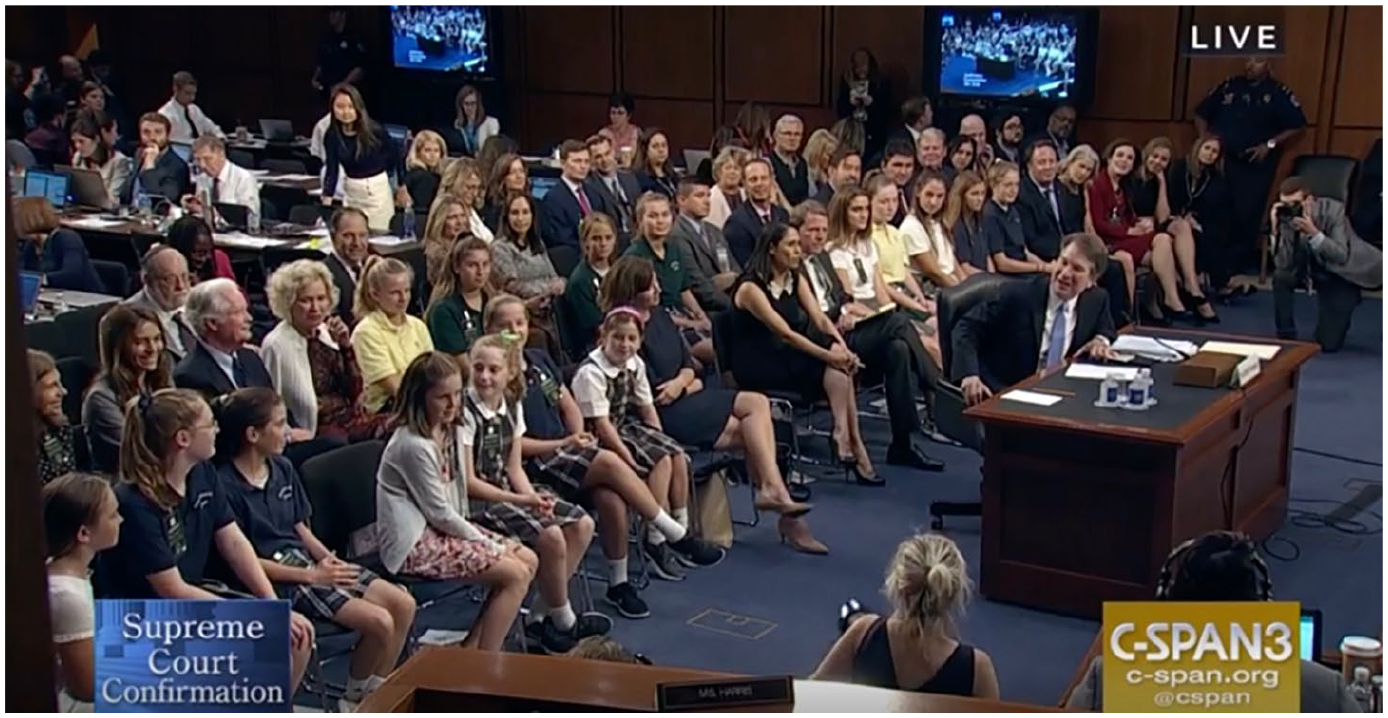
The “Kavanaugh” introduced at the confirmation hearing was defined to a great extent by his relationships with women and girls. 87 He was the husband of his wife, the father of daughters, the coach of girls, a mentor to female law clerks, and the son of a woman “trailblazer” in law many of whom surrounded him silently at his hearing. Kavanaugh, the ladies’ man, was presented as the proper party to control little girls’ and women’s bodies. Kavanaugh, Coach K, trained them in the rules of the game and how to play, compete, and win under his tutelage. Kavanaugh, a mentor of law clerks, explained to Senator Kennedy the importance of recruiting female law clerks and boasted that more than half of his clerks had been women and that one of his clerks had just confirmed to the Eleventh Circuit. Kavanaugh, the son, learned from his mother, who became a judge. Kavanaugh also served as a kind of patriarch at the ready. One of Kavanaugh’s character witnesses testified that he coached a girls’ team when he did not have a daughter on it. He even gave her daughter a performance review. He also took a girl without a dad to a father–daughter dance. Because Kavanaugh will exercise so much power over women’s bodies through the long sought-after withdrawal of rights and state protection from women his image as a “coach” and “mentor” offers a comforting vision of what the withdrawal of rights and state protections will look like for women.
In this gendered performance, Kavanaugh is defined by his sentimental attachments to women and girls and not by his relationship to an organized factional takeover of US courts. Kavanaugh, the ladies’ man, is unproblematically presented as neutral or non-partisan because he reproduces so many institutions through his (tutelary) relationships with (white) women: family, sport, and the legal profession by mentoring junior women. This Kavanaugh, as the ladies’ man, is neither partisan nor revolutionary and he is certainly not a partisan operative who is a product of a generational effort for the partisan weaponization of courts, the consolidation of oligarchic power, and de-democratization. 88 A product of elite networking ready to extend the political and economic power of elites was presented as “the ladies’ man” a son, husband, father, basketball coach, and mentor.
This substitution of a display of private virtues for an inquiry into public power did not only serve as an implicit answer to the question of what kind of authority women and girls will be subjected to as the state withdraws. It also served as an answer to the question: What kind of authority will any group having rights and law withdrawn be subject to? For example, there still has not been a full account of Kavanaugh’s role in authorizing torture in George W. Bush Administration where he worked in the Office of White House Counsel and Assistant to the President and White House Staff Secretary. Conversely, Kavanaugh’s record as a lower court judge is public and it indicates his willingness to withdraw rights and the ability to make legal claims from workers, consumers, and others. 89
Justice Kavanaugh will preside in a Court that is poised to withdraw rights, power, and state protection from women. 90 The private and professional practices of Kavanaugh, the ladies’ man, testify that women who are surrounded by the tutelary authority of the ladies’ man need not worry about the withdrawal of the state. Several of his former clerks testified to his mentorship and support of them even through motherhood. As Senator Flake says about Kavanaugh, “[he] provided the girls the opportunity to learn about teamwork, honesty integrity, humility, respect, discipline, hard work, and competitiveness.” 91 Senator Cornyn remarked that he once asked his law clerks why he hires women and one replied: “We are smarter, and we work harder.” 92 In this exchange women, their opportunities, and their work are defined in terms of their attachments to elite men and elite institutions and how well women serve them rather than how well those institutions serve women.
There was, however, an awkward juxtaposition between the spoken words and the events of the hearing room. As Senator Grassley spoke about “free speech,” “democracy,” and “legitimacy” and protecting the ladies, protestors (overwhelmingly women) were removed and arrested. 93 As Senator Hatch advocated for “civility,” 94 overwhelmingly female protesters were forcibly removed. The performance of a gendered legitimating spectacle that offered tutelary authority as the model of governance was interrupted by mostly women protestors who were then forcibly removed and arrested by the Capital police. 95 In one revealing exchange, a protestor says she resented the suggestion that Democrats “brought them.” She responded: “We brought ourselves.” 96
Several GOP senators (e.g., Senators Graham and Cruz) commented (often more than once) on how hard the hearings must be for Kavanaugh’s female family members. Ted Cruz apologized to Kavanaugh, “I’m sorry your daughters had to endure the political circus of the morning.” 97 Senator Graham later favorably contrasted circuses to confirmations: “And I want to defend circuses. Circuses are entertaining, and you can take your children to them. This hearing is neither entertaining, nor appropriate for young people,” 98 yet Kavanaugh continued to bring his young daughters to the confirmation hearings.
Teen and pre-teen girls were brought to the hearing while GOP elites lamented that the hearings were not appropriate for them because the questioning for a life-tenured judge was too aggressive for pre-teen and teen girls. Kavanaugh’s performance of his private virtues in public demanded that young girls be brought to the public to “describe how little they belong there” 99 while GOP senators implied all questions to a nominee for a life-tenured court should be appropriate for young girls. Women and girls (daughters, moms, and wives) were made to appear in public to demand a limit to politics and protect the ladies’ man from public scrutiny appropriate to the power for which he was auditioning. For GOP senators, the confirmation hearings should be safe for Kavanaugh’s daughter, Liza, who he testified referred to them as “my television debut.” 100 Melissa Murray, a witness invited by Democrats, framed the paradox of this tutelary authority explicitly when she commented that for Kavanaugh: “the common element in all of that is that there is no burden that is too great for the woman.” 101 There was no burden too large for women (and girls) even as the ladies’ men invoked women’s welfare to shield themselves from questioning. 102
Court watchers observed 103 that Kavanaugh was auditioning for a Supreme Court nomination with his dissent in Garza v. Hargan as a judge on the DC Court of Appeals. 104 Garza represented a minor, Jane Doe, who fled an extremely abusive family and arrived in Texas pregnant. Doe was placed in the Office of Refugee Resettlement (ORR) where she began the process of seeking an abortion. As a minor Doe had to go through Texas’s judicial bypass system. ORR director Scott Lloyd then forbids ORR from allowing detainees to leave to get an abortion without his express permission. 105 Doe’s lawyer, Garza, sued arguing that Doe had complied with all the legal requirements. Eventually, courts agreed with Doe and Garza, but Doe’s first-trimester medical abortion would now be a second-trimester surgical abortion. Several senators implied that Kavanaugh used a vulnerable pregnant teen fleeing abuse to audition for the Supreme Court shortlist. 106 His audition for power that imposed substantial costs on her was recast as “supervision,” “help,” and “support.” She, he said, was alone, surrounded by people who don’t speak her language, and he was just trying to give ORR a chance to find a “sponsor” to “support” her. Her lawyer, Garza, described a very different person. Garza described a seventeen-year-old, who undertook a dangerous journey to escape her abusive family, 107 and who “never wavered” in her desire to have an abortion, and who withstood every obstacle and punishment Texas and ORR placed in her way. 108 Kavanaugh increased the medical risk for a vulnerable teen girl to demonstrate simultaneously his “neutrality” (he just follows precedent) and his “partisanship” (he is helping the state run out the clock), but it is the performance of the ladies’ man that allowed him to recast this intervention, which caused her emotional distress, further restricted her already minimal personal freedom, and increased her medical risk, as “help” or “support.”
The experience of Jane Doe, the underaged immigrant woman, of Garza v. Hargan was invoked by witnesses to represent what it would feel like to have no rights; to be fully dominated by an ambitious judge, representing a faction; in courts weaponized against democracy. The asymmetries of power, age, and gender made it possible for Kavanaugh to frame his thwarting of her will as “help.” But it was Christine Blasey Ford who became the more captivating rejoinder to Kavanaugh’s self-presentation as the ladies’ man because Ford is one of the women the ladies’ man promises to train to compete for elite positions but who will find it harder to compete because of his decision-making.
The testimony of a woman making a sexual assault allegation was offered to revisit the procedural irregularities of the Kavanaugh confirmation, the concealment of Kavanaugh’s record, and the revolutionary aims of the factional court. Democrats and Republicans agreed that “hearing from the lady” would be necessary to legitimate the process, the Senate, and, eventually, the Court, in the context of a process that Democrats had already argued was too irregular. Her testimony would stand in for an inquiry into the concealment of Kavanaugh’s record, the looming withdrawal of rights from women, and the construction of a factional court. Ironically, even as he performed his intimate life in public, Kavanaugh often spoke of himself in terms of concealment and factional bonding through shared secrets: “What happened at Georgetown Prep stays at Georgetown Prep.” 109 “What happens on the bus stays on the bus.” Tonight, you can modify that to: “What happened at the Federalist Society after-party stays at the Federalist Society after-party.” 110 Kavanaugh himself implied that the truth is the connections he has made at exclusively (Georgetown Prep) or overwhelmingly (Federalist Society) male elite private institutions.
IV. Act Two: The Speculative Frenzy of the Melodramatic Victim/Hero
Kavanaugh’s confirmation hearing appeared to be over on September 7th, but by mid-September, a rumored sexual assault allegation was made public. Trump reiterated his support for his nominee but also indicated that he wanted to hear from the accuser. On September 27th, both the accuser, Christine Blasey Ford, and the nominee, Brett Kavanaugh, were brought in to answer questions in front of the Senate Judiciary Committee. The Republican members of the Senate Judiciary Committee were all men and so a female prosecutor from Arizona, Rachel Mitchell, was brought in to question Ford and Kavanaugh to avoid the spectacle of Ford being questioned by an all-male GOP panel 111 as was the case when Anita Hill testified during Clarence Thomas’s 1991 confirmation hearings.
With the allegations of sexual assault, the carefully stage-managed performance of the ladies’ man went awry, and it was replaced not with candor 112 but with the speculative frenzy of the melodramatic victim/hero who linked his fate with the fate of the nation. Kavanaugh performed the powerless victim/hero who harbors persecutory fantasies and whose victimization, powerlessness, and persecution authorize his transgressions. 113 The melodramatic partisan hero/victim can use violence to engage in revenge, but Kavanaugh performed the victim/hero as a Supreme Court nominee and current federal court judge who was supposedly bound by law and serving “justice.” Kavanaugh centered not the loss of a seat on the Supreme Court but the loss of his tutelary relationships as the primary injury: “I love teaching law. But thanks to what some of you on this side of the Committee have unleashed, I may never be able to teach again” 114 ; “I love coaching more than anything I’ve ever done in my whole life. But thanks to what some of you on this side of the Committee have unleashed, I may never be able to coach again” 115 ; “A majority of my 48 clerks have been women I’m one of the strongest advocates for women in the profession.” 116
In the second act of his confirmation hearing Kavanaugh, the former ladies’ man and now melodramatic victim/hero, linked his fate with the fate of the nation and its institutions in his opening statement on the allegations: “The 10-day delay has been harmful to me and my family, to the Supreme Court, and to the country.” 117 He claimed the allegations have “Destroyed my family and my good name” 118 and “My family and my name have been totally and permanently destroyed.” 119 He continued, “This confirmation process has become a national disgrace. The Constitution gives the Senate an important role in the confirmation process. But you have replaced advice and consent with search and destroy.” 120 As he linked his injuries to the nation, the Court, and his family any retribution would also be on their behalf. He predicted (or threatened): “You sowed the wind for decades to come,” “What goes around, comes around,” and “I fear for the future.” 121 As the victim/hero, Kavanaugh performed all the emotions that drive stasis and that law, courts, and judging are supposed to quarantine: anger, grief, and the desire for revenge.
Kavanaugh’s “victimization” made open contempt for the Senate Judiciary Committee and particularly Democrats on the Committee possible. Now the aggrieved victim/hero Kavanaugh no longer communicated with senators to persuade them or the public but adopted a hostile posture to mobilize partisans. “The behavior of several of the Democratic Members of this Committee in this hearing a few weeks ago was an embarrassment.” 122 When Senator Klobuchar asked him if he has ever blacked out, he refused to answer and instead asked her if she has. In interrogating her, he reversed the understood relationship between nominees and senators. 123 Kavanaugh’s strategy was to suggest that he was a victim of partisanship, the process was a sham, and the Senate’s role (of advice and consent) was illegitimate, and he no longer had to pretend to respect the Senate, the conventions of the Senate, or the (Democratic) senators.
Kavanaugh continued to invoke relationships with women in a failed attempt to reprise the role of the ladies’ man. He repeated that there are letters from “65 women who knew me in high school,” 124 “84 women who worked with me at the Bush White House from 2001 to 2006,” 125 and a “majority of my 48 law clerks have been women.” 126 Women’s names cascaded in an attempt to reprise the ladies’ man: “Amy or Julie or Kristin or Karen or Maura or Megan or Nikki.” 127 He claimed, “One of these women friends from college, a self-described liberal and feminist” texted him: “you’re a good man, a good man, a good man.” 128 The husband of Ashley, father of daughters, son of a female trailblazer, mentor of female clerks, and coach of female grade school basketball players was now the friend of women as he incorporated friendships into his litany of tutelary and familial relationships with women. Intimate details of his friendships, familial relationships, and communication with women were publicized to insulate himself from accusations. He claimed female friends confided their abuse to him and that his mother was sexually harassed. Even his daughters’ prayers (“Little Liza, all of 10 years old, said to Ashley, ‘We should pray for the woman’” 129 ) were now offered for public consumption.
Kavanaugh as victim/hero articulated well-worn GOP persecutory fantasies 130 but also fantasies of personal persecution. He claimed that the allegations were held in “secret” and Democrats were “lying in wait” with an “orchestrated political hit” driven by “pent up anger about President Trump and the 2016 election” 131 and “revenge on behalf of the Clintons.” 132 Other Republicans repeated and elaborated on Kavanaugh’s persecutory and conspiratorial fantasies. When Lindsey Graham said, “This has been a drive-by shooting when it comes to Kavanaugh. . .I’ll listen to the lady, but we’re going to bring this to a close” 133 he analogized Democrats to a criminal gang and Kavanaugh to a victim of a violent life-threatening crime as his hopes of becoming a Supreme Court justice were threatened and he faced remaining merely a judge on the DC Court of Appeals. Graham’s rhetoric here casts Kavanaugh as an innocent racialized victim of random urban gun violence as Thomas once referred to himself as the victim of “a high-tech lynching.” Moreover, one of the witnesses who testifies at the invitation of Democrats is Aalayah Eastmond a victim of a school shooting who hid under her classmate’s body. This rhetoric transforms Kavanaugh into the metaphorical victim of American gun violence even as school children testify about victims of actual gun violence.
Conversely, having been compelled to speak, Ford also performed conduct that has been framed as private in public. But she could not play either the ladies’ man or the melodramatic victim/hero and link her fate to the fate of the nation. Her public performance of the private transformed her from victim to transgressor to madwoman. She, or her sponsors, was criminally out of place. Those unwilling to criminalize (or make partisan) Ford attempted to privatize her motivations and medicalize her. Senator Collins, for example, portrayed Ford as damaged and delusional when she said: “I believe that she believes what she testified to.” “I do not believe that Brett Kavanaugh was her assailant.” “I do believe she was assaulted. I don’t know by whom. And I’m not certain when.” 134 Senator Kennedy used a similar framing when he said: “I do believe that something very, very, very bad happened to Dr. Ford and I am very sorry. . .But I do not believe that Judge Brett Kavanaugh was involved.” 135 While Anita Hill was portrayed as simultaneously hypersexual, undesirable, and lesbian, Ford got “empathy” as confused, traumatized, and unreliable. While Senator Arlen Specter accused Hill of perjury, Ford was portrayed as merely confused and traumatized (but not because of Kavanaugh).
While the justices were supposedly quietly appalled by Kavanaugh’s “outburst,” they quickly closed ranks. Justice Sonia Sotomayor later said, “[t]he nine of us are now a family and we’re a family with each of our own burdens and our own obligation to others, but this is our work family, and it’s just as important as our personal family” [italics added]. 136 His new metaphorical family served to protect Kavanaugh but also to limit more inquiry into his behavior as a now inappropriate intrusion on the private. The Court, in Sotomayor’s formulation, is a family, not an institution of public servants. Once again Kavanaugh’s relationships to women protected his relationships with men from scrutiny. Kavanaugh later wrote an op-ed for the Wall Street Journal where he conceded that his performance was “very emotional” but “I hope everyone can understand that I was there as a son, husband, and dad. I testified with five people foremost in my mind: my mom, my dad, my wife, and most of all my daughters.” 137 During his confirmation, his private virtues were publicly performed to reassure viewers about his neutrality and to offer tutelary gendered governance as an attractive mode of governance. Now on the Court, a public institution, any inquiry into his performance is framed as an intrusion into an institution governed by familial norms. Moreover, the threatened loss of his private relationships justified promising to use the courts to enact partisan revenge.
Kavanaugh became a justice on a Supreme Court that employs the myth that it is consistent with a democratic society because the judges self-limit though interpretive discipline and informal norms. After he was accused, Kavanaugh performed the speculative frenzy of the victim/hero. Having made in onto the Supreme Court through a process, he derided as illegitimate, the institution itself is now more vulnerable and other justices argued that they must protect themselves from a threatening citizenry because the institutions they have weakened no longer can. As Justice Kagan wrote, “part of the Court’s strength and part of the Court’s legitimacy depends on people not seeing the court in the way the people see the rest of the governing structures of this country now. . .It’s an incredibly important thing for the court to guard—this reputation of being fair, of being neutral, and not being some extension of the terribly polarized political process and environment that we live in” [italics added]. 138
As the justices worry about the decline in perceived legitimacy some also claim melodramatic victimhood. In response to increasing criticism of the Court, retiring SC Justice Breyer wrote a pamphlet, The Authority of the Court in Peril, arguing that the Court is, in fact, the victim of the American people, who misunderstand how it operates and why it comes to the decisions that it does. Justice Alito elaborated: “It goes without saying that everyone is free to express disagreement with our decisions and to criticize our reasoning as they see fit, but saying or implying that the Court is becoming an illegitimate institution or questioning our integrity crosses an important line.” 139
V. Conclusion
Courts and judging are mired in constitutive paradoxes. They are meant to replace interfamilial and intrafamilial cycles of violence and the desire for revenge without limit that threaten to degenerate into stasis, but they also serve as forums to conduct those disputes. The limits on the judicial power and neutrality of judges serve as the primary guarantors of the promise that courts will serve as forums of factional conflict but not engage in factional conflict. That courts and judges might be participants in, rather than the alternatives to, partisan conflict is anathema to liberal accounts of judges, courts, and state formation. Particularly judges might enjoy domination is disavowed in the liberal account of courts and judges. Scholars critically engaged in both the liberal and Ancient Greek traditions have asked: How can courts stage stasis but not be of it? In particular, scholars of law and Ancient Greek tragedy have asked: Is not the instantiation of courts of law the consolidation of male rule over women under the guise of the rule of reason, law, and citizenship over lawlessness, vengeance, and family or partisan vendettas? Placing Kavanaugh’s performance in the context of the Ancient Greek and the Lockean liberal mythohistory about the origins of courts I ask: Is the promise of disciplining women so intrinsic to the promise of law that the spectacle of well-disciplined girls and women can serve as a legitimating spectacle and as example of impartial judging?
As factional courts consolidate viewers might expect to see women driven off stage and underground, as in the Oresteia. 140 What if instead audiences see gendered performances that link women’s fates not to public rights and political power but to their tutelary relationships with men? Kavanaugh was cast as an appropriate figure for the withdrawal of rights and citizenship particularly from women but also from other groups. Kavanaugh’s former students and clerks testified as women, especially as mothers, that Kavanaugh “helped” or mentored them even as he was part of a legal movement to withdraw rights from women and workers.
After Christine Blasey-Ford’s allegations, Kavanaugh accepted the partisan role that he had sought to disavow, particularly that he might enjoy factionalism, revenge, and violence—which are the very things judges in liberal orders must most disavow. Kavanaugh could threaten partisan retribution and ascend to the Supreme Court because he was able to link his fate to that of the nation as the victim/hero. His “speculative frenzy” of injury as the melodramatic victim/hero authorized fantasies of vengeance as justice. However, this performance raised fundamental questions about the distance between the liberal umpire state and the state of factional conflict. Does Locke’s speculative frenzy threaten law and judging or is it law and judging? Kavanaugh’s hero/victim was a form of injured masculinity that paradoxically claimed to be within the law and justify vengeance outside the law. It was his victimization that made his threatened retaliation “justice.”
At least one other justice has embraced the role of the victim/hero. Like Kavanaugh, Justice Alito has offered himself up as the victim/hero. In a Wall Street Journal interview, he moved seamlessly from threats of assassination to mere criticism of the Court. He claimed that the Dobbs leak made them “targets of assassination,” but continues: “‘this type of concerted attack on the court and on individual justices’ is ‘new during my lifetime. . .We are being hammered daily, and I think quite unfairly in a lot of instances. And nobody, practically nobody, is defending us. The idea has always been that judges are not supposed to respond to criticisms, but if the courts are being unfairly attacked, the organized bar will come to their defense’. Instead, ‘if anything, they’ve participated to some degree in these attacks’.” 141 Alito collapsed criticism of the court with threats of violence and framed the current criticism of the Court as exceptional and the current Court as uniquely isolated, defenseless, and powerless.
Trump has risen to the defense of his judges and argued that criticizing the Court should be a jailable offense. “These people should be put in jail the way they talk about our judges and our justices, trying to get them to sway their vote, sway their decision.” 142 In Trump’s formulation, Republican judges and American courts are not powerful institutional actors but are instead defenseless victims/heroes whose protection requires him to violate the law so that they can make the law.
Footnotes
1.
Kavanaugh’s hearings were delayed three years when he was nominated to DC Court of Appeals because he was considered too partisan (Michael Kranish, “Democrats’ View of Kavanaugh Shaped by Bitter 2004 Hearing,” Washington Post, September 3, 2018).
2.
The “ladies’ man” is a reference to James Stewart’s character, the lawyer Ransom Stoddard, in The Man Who Shot Liberty Valance. John Wayne’s character, Tom Doniphon, ironically refers to Rance as “the ladies’ man.” Stoddard sees himself as a protector of the ladies, but Wayne sees him (and the law) as effeminate and effeminizing. In our era, “ladies’ man” takes on a third signification because of pick-up artists and manopshere influencers. I use the term for this triple signification.
3.
H. Howell Williams argues that the staging of Amy Coney Barrett with her family and frequent references to her as a mother staged white republican motherhood (H. Howell Williams, “Just Mothering: Amy Coney Barrett and the Racial Politics of American Motherhood,” Laws 10 (2021): 36).
4.
In the ancient Greek tradition, the hero is imbued with the supernatural but is also a sacrificial victim for his people (Gregory Nagy, The Ancient Greek Hero in 24 Hours (Cambridge: Belknap, 2013)). The ancient hero is always tragic. Anker’s victim/hero performs in the genre of melodrama not tragedy and so the sacrifice earns not glory, but the entitlements created by weaponized victimization.
5.
Elizabeth Anker argues that melodrama is the most popular American genre, it is a political genre, and it “convey[s] stories about the suffering of virtuous people overcome by nefarious forces” (Elizabeth Anker, Orgies of Feeling: Melodrama and the Politics of Freedom (Durham, NC: Duke University Press, 2014), 2).
6.
Quinn Lester, “Bound to Preserve the White Self: Speculative Frenzy and the Patriarchal Right to Self-Defense in John Locke and Ida B. Wells,” New Political Science 44 (2022): 210–26.
7.
Stasis is a notoriously difficult word to translate. It gets translated as civil war, faction, sedition, revolution, strife, and civil discord. I use it interchangeably with faction but to refer to a particular kind of factional organizing. Factional organizing that aims to substitute the faction for the whole and relies on the perception of injury or grievance to justify the pursuit of unlimited gain or honors.
8.
Sacvan Bercovitch, The Rites of Assent: Transformations in the Symbolic Construction of America (New York, NY: Routledge, 1993), 30.
9.
For example, president and nominee do not need to appear together. The president can merely forward a name and hearings themselves become routine only in the twentieth century (Congressional Research Service, “Supreme Court Nominations, 1789 to 2020: Actions by the Senate, the Judiciary Committee, and the President,” prepared by B. J. McMillion (Washington, DC, 2021).
10.
Roberts’s formulation of the “judge as umpire” has come to mean “impartial” or “non-partisan” but it also means “non-equal.” To the extent the United States is governed by umpires, it governed by impartial judges or people of unequal status?
11.
“To my friends, everything; to my enemies, the law” origins disputed.
13.
Ibid.
14.
Liberal organizations such as Take Back the Court, Alliance for Justice, and the Brennan Center.
15.
A sitting US senator, Sheldon Whitehouse, has been vocal in his criticism of the Court as a captured institution (see e.g., Sheldon Whitehouse, The Scheme: How the Right Wing Used Dark Money to Capture the Supreme Court (New York, NY: The New Press, 2023)).
16.
Lynn Adelman a US district judge published “The Roberts Court’s Assault on Democracy,” Harvard Law & Policy Review 14 (2020): 131 and Charles Fried Reagan’s solicitor general wrote “Not Conservative” for the Harvard Law Review (July 3, 2018),  where he argued that the Roberts Court is radical in rulings and procedures.
17.
Terri Peretti, In Defense of a Political Court (Princeton, NJ: Princeton University Press, 2001); Justin Crowe, Building the Judiciary: Law, Courts, and the Politics of Institutional Development (Princeton, NJ: Princeton University Press, 2012); Jack Jackson, Law Without Future: Anti-Constitutional Politics and the American Right (Philadelphia, PA: University of Pennsylvania Press, 2019); Robert G. McCloskey and Sanford Levinson, The American Supreme Court, 6th ed. (Chicago, IL: University of Chicago Press, 2016).
18.
James Zirin and Kermit Roosevelt, Supremely Partisan: How Raw Politics Tips the Scales in the United States Supreme Court (Lanham, MD: Rowman & Littlefield Publishers, 2016); Richard Hasen, Plutocrats United: Campaign Money, the Supreme Court, and the Distortion of American Elections (New Haven, CT: Yale University Press, 2016); Neal Devins and Lawrence Baum, “Split Definitive: How Party Polarization Turned the Supreme Court into a Partisan Court,” The Supreme Court Review 2016 (2017): 301; Terri Peretti, Partisan Supremacy: How the GOP Enlisted Courts to Rig America’s Election Rules (Lawrence, KS: University Press of Kansas, 2020); Michael Klarman, “Foreword: The Degradation of American Democracy—and the Court,” 2020, ; Adam Cohen, Supreme Inequality: The Supreme Court’s Fifty-Year Battle for a More Unjust America (New York, NY: Penguin Books, 2021).
19.
Thomas Keck, Judicial Politics in Polarized Times (Chicago, IL: University of Chicago Press, 2014).
20.
Brandon Bartels and Christopher Johnston, Curbing the Court: Why the Public Constrains Judicial Independence (Cambridge, UK; New York, NY: Cambridge University Press, 2009); Michael Bailey and Forrest Maltzman, The Constrained Court: Law, Politics, and the Decisions Justices Make (Princeton, NJ: Princeton University Press, 2011).
21.
James Burns, Packing the Court: The Rise of Judicial Power and the Coming Crisis of the Supreme Court (New York, NY: Penguin Pres, 2009); Erwin Chemerinsky, The Case Against the Supreme Court (New York, NY: Viking 2014); Mark Tushnet, Taking Back the Constitution: Activist Judges and the Next Age of American Law (New Haven, CT: Yale University Press, 2020).
22.
Sheldon Wolin, Democracy Incorporated (Princeton, NJ: Princeton University Press, 2017).
23.
Steven Levitsky and Lucan Way, “The Rise of Competitive Authoritarianism,” Journal of Democracy 13 (2002): 51–65.
24.
John Keane, The New Despotism (Cambridge, MA: Harvard University Press, 2020).
25.
Steven Levitsky and Daniel Ziblatt, How Democracies Die (New York, NY: Crown, 2018); Murat Somer, Jennifer McCoy and Russell Luke, “Pernicious Polarization, Autocratization and Opposition Strategies,” Democratization 28 (2021): 929–48; Liliana Mason, Julie Wronski and John Kane, “Activating Animus: The Uniquely Social Roots of Trump Support,” American Political Science Review 115, no. 4 (2021): 1508–16.
26.
Hasen, Plutocrats United; Camila Vergara, Systemic Corruption: Constitutional Ideas for an Anti-Oligarchic Republic (Princeton, NJ: Princeton University Press, 2020).
27.
Micheal Klarman, “The Degradation of American Democracy—And the Court,” Harvard Law Review 134, no. 1 (2020), pp. 1–264; Peretti, Partisan Supremacy; Adelman, “The Roberts Court’s Assault on Democracy.”
28.
Ran Hirschl, “The Judicialization of Mega-Politics and the Rise of Political Courts,” Annual Review of Political Science 11, no. 1 (2008): 93–118.
29.
Ibid., 26.
30.
The judicialization of politics refers to courts deciding political questions also called mega politics or juristocracy.
31.
Amanda Hollis-Brusky and Josh Wilson, Separate but Faithful: The Christian Right’s Radical Struggle to Transform Law & Legal Culture (New York, NY: Oxford University Press, 2020).
32.
Charles Epp, Making Rights Real: Activists, Bureaucrats, and the Creation of the Legalistic State (Chicago, IL: University of Chicago Press, 1998).
33.
Hollis-Brusky and Wilson, Separate but Faithful.
34.
Ann Southworth, Lawyers of the Right: Professionalizing the Conservative Coalition (Chicago, IL: University of Chicago Press, 2008); Steven Teles, The Rise of the Conservative Legal Movement: The Battle for Control of the Law (Princeton, NJ: Princeton University Press, 2010); Micheal Avery and Danielle McLaughlin, The Federalist Society: How Conservatives Took the Law Back from Liberals (Nashville, TN: Vanderbilt University Press, 2013); Jefferson Decker, The Other Rights Revolution: Conservative Lawyers and the Remaking of American Government (New York, NY: Oxford University Press, 2016); Amanda Hollis-Brusky, Ideas with Consequences: The Federalist Society and the Conservative Counterrevolution (New York, NY: Oxford University Press, 2019); Christine Bird and Zachary McGee, “Going Nuclear: Federalist Society Affiliated Judicial Nominees’ Prospects and a New Era of Confirmation Politics,” American Politics Research 51 (2023): 37–56.
35.
Robert Tsai and Mary Ziegler, “Abortion Politics and the Rise of Movement Jurists,” 57 U.C. Davis Law Review 2149 (2024): 2169–73.
36.
Ethan Bronner, Battle for Justice (New York, NY: Anchor, 1990); Paul Simon, Advice and Consent: Clarence Thomas, Robert Bork and the Intriguing History of the Supreme Court’s Nomination Battles (Washington, DC: Natl Pr Books, 1992); Jane Mayer and Jill Abramson, Strange Justice: The Selling of Clarence Thomas (Boston, MA: Houghton Mifflin Harcourt, 1994); Ruth Marcus, Supreme Ambition: Brett Kavanaugh and the Conservative Takeover (New York, NY: Simon & Schuster, 2019); Robin Pogrebin and Kate Kelly, The Education of Brett Kavanaugh: An Investigation (New York, NY: Portfolio, 2019); Carl Hulse, Confirmation Bias: Inside Washington’s War Over the Supreme Court, from Scalia’s Death to Justice Kavanaugh (New York, NY: Harper, 2019).
37.
Jan Crawford Greenburg, Confirmation Bias: Inside Washington’s War Over the Supreme Court, from Scalia’s Death to Justice Kavanaugh (New York, NY: Penguin Press, 2007); Jackie Calmes, Dissent: The Radicalization of the Republican Party and Its Capture of the Court (New York, NY: Twelve, 2021); Linda Greenhouse, Justice on the Brink: A Requiem for the Supreme Court (New York, NY: Random House, 2021).
38.
Charles Cameron, Jonathan Kastellec, and Jee-Kwang Park, “Voting for Justices: Change and Continuity in Confirmation Voting 1937–2010,” The Journal of Politics 75 (2013): 283–99.
39.
John Rogowski and Andrew Stone, “How Political Contestation Over Judicial Nominations Polarizes Americans’ Attitudes Toward the Supreme Court,” British Journal of Political Science 51, no. 3 (2021): 1251–69.
40.
Devins and Baum, “Split Definitive,” 2017.
41.
Charles Cameron et al., “From Textbook Pluralism to Modern Hyperpluralism: Interest Groups and Supreme Court Nominations, 1930–2017,” Journal of Law and Courts 8, no. 2 (2020): 301–32.
42.
Christian Boyd, Paul Collins, and Lori Ringhand, Supreme Bias: Gender and Race in U.S. Supreme Court Confirmation Hearings (Stanford, CA: Stanford University Press, 2023).
43.
Paul Collins and Lori Ringhand, Supreme Court Confirmation Hearings and Constitutional Change (New York, NY: Cambridge University Press, 2013).
44.
Michael Comiskey, Seeking Justices: The Judging of Supreme Court Nominees (Lawrence, KN: University Press of Kansas, 2004).
45.
Rogowski and Stone, “How Political Contestation,” 2.
46.
I distinguish between partisan conflict between the parties and factional conflict which can include inter and well as intra-party conflict. The contemporary Grand Old Party (GOP) is defined by extreme intra-party factional conflict. In short, a faction can be smaller than a political party.
47.
Susan Waysdorf, “Popular Tribunals, Legal Storytelling, and the Pursuit of a Just Law,” Yale Journal of Law and Liberation 2 (1991): 75.
48.
The Kavanaugh hearing saw the introduction of a prosecutor to question the witness/victim/perpetrator, Christine Blasey Ford.
49.
Robert Burns, A Theory of the Trial (Princeton, NJ: Princeton University Press, 2001).
50.
Robert Burns, “Is Our Legal Order Just Another Bureaucracy?” Loyola University Chicago Law Journal 44 (2016): 413–38.
51.
See Geoffrey W. Bakewell, “Tragedy as Democratic Education: The Case of Classical Athens,” Administrative Theory & Praxis 33, no. 2 (2011): 258–67, for tragedy as political education in ancient Athens.
52.
Stasis is often translated as civil war, but it can refer to any sustained factional conflict. Stasis can include going to court, in fact sta of stasis is also the root of “standing” as in standing at court. Moreover, stasis is sometimes used so broadly it can include democratic contestation itself and the line between ordinary democratic contest and “stasis” can be difficult to draw clearly.
53.
Aristotle: “The objects about which it [stasis] is waged are gain and honor, and their opposites, for men carry on party faction in states in order to avoid dishonor and loss, either on their own behalf or on behalf of their friends” (Aristotle, The Politics (New York, NY: Oxford University Press, 2009), 1302a).
54.
The Oresteia is a trilogy of tragic plays performed at the Festival of Dionysus in ancient Athens. Agamemnon the king sacrifices his daughter, Iphigenia, so that he can set sail for the Trojan War. When he returns Clytemnestra, his wife and mother of Iphigenia, kills him. Orestes, their son, then kills Clytemnestra. This story takes place in the context of an ongoing cycle of violence and revenge in the House of Atreus, Agamemnon’s family. The trial of Orestes for the murder of his mother, which substitutes court judgments for the law of revenge, is said to have brought the cycle of revenge to an end.
55.
David Luban, “Some Greek Trials: Order and Justice in Homer, Hesiod, Aeschylus and Plato the Many Futures of Jurisprudence: A Symposium,” Tennessee Law Review 54 (1986): 299.
56.
Luban, “Some Greek Trials,” 312–3.
57.
Catherine Holland, “After Antigone: Women, the Past, and the Future of Feminist Political Thought,” American Journal of Political Science 42, no. 4 (1998): 1108–32 at 1118–9 quoted in Wairimu Njoya, “The Progress of Law: Aeschylus’s Oresteia in Feminist and Critical Theory,” Political Theory 48 (2020): 147.
58.
“Those who belong to the racket are protected by the law, and those who find themselves on the outside are almost permanently in breach of law” (Njoya, “The Progress of Law,” 155). Njoya goes on to argue there is emancipatory potential in law and the interaction of law and social movements.
59.
Thucydides’s description of stasis in Corcyra ends in extreme violence but stasis is also conducted through courts as the parties to stasis paradoxically use courts to simultaneously define, limit, and exacerbate the emerging conflict. This attempt fails in Corcyra but raises the possibility that courts are not the alternative to extreme factional dispute but rather part of factional disputes (Peloponnesian War (Chicago, IL: University of Chicago Press, 1989), Book 3, Chapter 10). Twice in this very short interlude the factions go to court to simultaneously conduct and limit their conflict.
60.
John Kang, “John Locke’s Political Plan, or, There’s No Such Thing as Judicial Impartiality (and It’s a Good Thing, Too),” Vermont Law Review 29 (2004): 7.
61.
John Locke, Second Treatise of Government (Indianapolis, IN: Hackett Publishing Company, Inc.), Chapter 3, Section 19.
62.
Susan Liebell, “Retreat from the Rule of Law: Locke and the Perils of Stand Your Ground,” The Journal of Politics 82 (2020): 958.
63.
Ibid., 962.
64.
Lester, “Bound to Preserve the White Self.”
65.
Locke here has placed his reader is the position of Anker’s melodramatic victim/hero.
66.
Lester, “Bound to Preserve the White Self,” 212.
67.
Mary Ann Franks, “Men, Women, and Optimal Violence,” University of Illinois Law Review 2016 (2016): 929.
68.
Bruce Buchan, “Liberalism and Fear of Violence,” Critical Review of International Social and Political Philosophy 4, no. 3 (2001): 27–48.
69.
In “Violence and the Word,” Robert Cover argues that the criminal justice system is bureaucratic precisely to enable judges to overcome their inhibition to use violence. That judges might enjoy violence is not even considered as possibility. Robert Cover, “Violence and the Word,” The Yale Law Journal 95, no. 8 (1995): 1601–29.
70.
See Collins and Ringhand, Supreme Court Confirmation Hearings and Constitutional Change; Comiskey, Seeking Justices.
71.
Kavanaugh’s was first nominated to US Circuit Court District of Columbia by George W. Bush in 2003 but was not confirmed until 2006 because of opposition by Democrats because of his history as an extremely partisan operative. In his first confirmation hearing, he was not presented a ladies’ man (he mentions his mother once, there are no letters from female classmates or co-workers, etc.). Strangely, Senator Hatch refers to Kavanaugh’s mother, a federal court judge, as “Ed’s wife, the mother of Brett, who is renowned judge.” “We all know Ed” Hatch announces (“Confirmation Hearing on the Nomination Brett Kavanaugh to be Circuit Court Judge for the Distinct of Columbia Transcript,” 2004, 1).
72.
He testified in 2006 that he had no knowledge of these events until he read about them in the newspaper. However, subsequent two accounts by other Bush staff indicate that: “Kavanaugh was involved in at least one contentious meeting at the Office of White House Counsel in 2002, and two former White House officials detailed his role in interviews this week with The Washington Post” (Michael Kranish, “Kavanaugh’s Role in Bush-Era Detainee Debate Now an Issue in His Supreme Court Nomination,” The Washington Post, July 18, 2018).
73.
Ruth Marcus and Sean Wilentz document Kavanaugh’s willingness to indulge right-wing conspiracy theories about Vincent Foster’s death. Marcus does so through interviews and Wilentz by reviewing Kavanaugh’s own notes. Kavanaugh spent months investing right-wing conspiracy theories and went so far as to consider subpoenaing Foster’s entire family (Marcus, Supreme Ambition and Sean Wilentz, “Why Was Kavanaugh Obsessed with Vince Foster?,” The New York Times, September 5, 2018).
74.
Kavanaugh worked on the litigation related to the 2000 recounts as a private practice attorney.
75.
Manuel Miranda, Republican counsel on the Senate Judiciary Committee, accessed confidential information regarding Democratic strategy for questioning Bush judicial nominees. Miranda has admitted to sharing this information with Kavanaugh, then a Bush staffer working on judicial appointments, but claims he did not tell Kavanaugh where the information came from. However, “In a July 28, 2002, email, Miranda wrote Kavanaugh that Leahy’s staff has distributed a confidential letter to Democratic staffers, and then described the contents of the letter.” Moreover, the subject line of one email was “spying” (Michael Kranish, “Leahy Says Kavanaugh Was ‘Not Truthful’ About Democratic Documents,” The Washington Post, September 7, 2018).
76.
When Kavanaugh was asked about US Court of Appeals for the Ninth Circuit judge Kozinski’s infamously sexually explicit talk to clerks and his Easy Rider email list that Kozinski used to send obscene and misogynist “jokes” to former clerks he claimed to not remember. Heidi Bond, also a former Kozinski clerk who accused Kozinski of misconduct, argues that this is not a credible answer (Heidi Bond, “I Received Some of Kozinski’s Infamous Gag List Emails. I’m Baffled by Kavanaugh’s Responses to Questions About Them,” Slate, September 14, 2018).
77.
Kevin McMahon, “Will the Supreme Court Still ‘Seldom Stray Very Far’?: Regime Politics in a Polarized America,” Chicago-Kent Law Review 93, no. 2 (2018): 343–71.
78.
Bill Burck was a former special counsel and deputy counsel to President George W. Bush and served in the Bush Administration at the same time as Kavanaugh.
79.
With the addition of Coney Barrett, he will most likely be sixth vote for a constitutional revolution.
80.
“Throughout this process I’ve witnessed first-hand your appreciation for the vital role of the American judiciary. No president has ever consulted more widely or talked with more people from more backgrounds to seek input about a Supreme Court nomination.” “Remarks by President Trump Announcing Judge Brett M. Kavanaugh as the Nominee for Associate Justice of the Supreme Court of the United States—The White House,” Brett Kavanaugh, July 9, 2018.
81.
All five concerns were raised in the discussion of document production. GOP lawyer, Bill Burck, vetted the documents from Kavanaugh’s time at the White House, and submitted only 7% of their request to the committee, and designated more than half of those “committee confidential,” which means the committee could review them, but they could not be the basis of questioning since they were confidential. What is more, Burck is the individual who determined the scope of executive privilege, which had never been invoked by presidents, let alone by GOP lawyers. The National Archives could have done document clearing by mid-October (six weeks), but the GOP declined. That Kavanaugh’s nomination was marked by extraordinary speed, secrecy, partisanship, and trampling of minority rights and the norms of Senate were all on display in the document production.
82.
Charles Fried, Ronald Reagan’s former solicitor general, argued that these are not “conservative” justices because they are rejecting political compromises that have lasted decades and using novel judicial arguments and tools to do so (“Not Conservative,” 2022).
83.
“Confirmation Hearing on the Nomination of Hon. Brett M. Kavanaugh to Be an Associate Justice of the Supreme Court of the United States,” 2018, 33.
84.
Ibid., 40–3.
85.
“Confirmation Hearing on the Nomination of Hon. Brett M. Kavanaugh to be an Associate Justice of the Supreme Court of the United States,” 2018, 415 he says they are in fifth to tenth grade. That would be ages 9–15.
86.
Kavanaugh voted to overturn Roe v. Wade in Dobbs v. Jackson Women’s Health Organization, 2022.
87.
This is not the case at his first confirmation where he mentions his mother once. There are no letters from female classmates and co-workers, etc.
88.
Hollis-Brusky and Wilson argue that members of the Christian conservative legal movement consider producing judges the primary goal of their movement. Hollis-Brusky and Wilson, Separate but Faithful.
89.
Public Citizen analyzed 101 cases that were split decisions and concluded that Kavanaugh overwhelmingly sided with business, against workers, for police and against human rights, and against environmental interests in split decisions (Robert Weissman, “An Analysis of Judge Kavanaugh’s Opinions in Split Decision Cases,” 2022, ). SCOTUS blog also considered his record: “Kavanaugh tends to interpret narrowly the limits that work law places on employers” (Charlotte Garden, “Judge Kavanaugh on Work Law,” SCOTUSblog, August 16, 2018).
90.
Dobbs hints at the retreat of law from women. Alito writes that there are two kinds of rights: those that are explicit in Constitution and those that are part of historical tradition of ordered liberty in United States. Women’s rights are neither.
91.
“Confirmation Hearing on the Nomination of Hon. Brett M. Kavanaugh to be an Associate Justice of the Supreme Court of the United States,” 71.
92.
Ibid., 445.
93.
The phrase “disturbance in the hearing room” appears 246 times in the transcript. The slogans protestors used are never reproduced in the transcript. Even though many can be made out quite clearly, they do not become part of official transcript. Many of them shouted “be a hero” asking senators to not vote for Kavanaugh, others mentioned abortion and disability rights frequently.
94.
“Confirmation Hearing on the Nomination of Hon. Brett M. Kavanaugh to be an Associate Justice of the Supreme Court of the United States,” 31.
95.
The Capitol Police do not have numbers arrested available but began making those public after January 6, 2021.
96.
Anita Hill wrote that what most outraged senators was that: “I dared to come to the body on my own” without a sponsor or patron unlike Supreme Court nominees who are carefully cultivated products of patronage systems. Anita Faye Hill, “Marriage and Patronage in the Empowerment and Disempowerment of African American Women,” in Race, Gender, and Power in America: The Legacy of the Hill-Thomas Hearings, eds. Anita Faye Hill and Emma Jordan Johnson (New York, NY: Oxford University Press, 1995), 280.
97.
“Confirmation Hearing on the Nomination of Hon. Brett M. Kavanaugh to be an Associate Justice of the Supreme Court of the United States,” 51.
98.
Ibid., 359.
99.
Kristina Milnor, Gender, Domesticity, and the Age of Augustus: Inventing Private Life (New York, NY: Oxford University Press, 2006), 4.
100.
“Confirmation Hearing on the Nomination of Hon. Brett M. Kavanaugh to be an Associate Justice of the Supreme Court of the United States,” 109.
101.
Ibid., 567.
102.
When Ketanji Brown Jackson was accused of being sympathetic to pedophiles because of her sentencing departures for people convicted of the possession of child sex abuse material Brown Jackson first made mention of her role as a mother but then quickly pivoted to an explanation as to why her sentencing departures were not unusual or unreasonable as a judge. No suggested that this line of questioning was inappropriate for Ketanji Brown Jackson’s daughter.
103.
Senator Blumenthal pursued this line of questioning when he examined the timeline of Kavanaugh’s nomination. “Confirmation Hearing on the Nomination of Hon. Brett M. Kavanaugh to be an Associate Justice of the Supreme Court of the United States,” 243.
104.
Elliott Ash and Daniel Chen find Kavanaugh was an exceptionally partisan circuit court judge. He dissented more often close to elections, wrote more partisan dissents, and used conservative doctrine in opinions. “What Kind of Judge is Brett Kavanaugh?,” Cardozo Law Review (2018): 70–100.
105.
Scott Lloyd Trump’s Director of Office of Refugee and Resettlement kept an Excel spreadsheet tracking the “mentsral” (sic) cycles of refugees ages 12–17. Carter Sherman, “The Trump Administration Has a Spreadsheet of Migrant Teens Who Want Abortions,” Vice, May 6, 2019.
106.
This may or may not be case, I am interested in how he casts his intervention in her case (and his dissent) which manifestly imposed harm on her.
107.
Garza testified that Office of Refugee Resettlement (ORR) disclosed to Doe’s parents that she was pregnant even though Doe told them her parents had beaten an older sister who became pregnant until she miscarried (“Confirmation Hearing on the Nomination of Hon. Brett M. Kavanaugh to be an Associate Justice of the Supreme Court of the United States,” 528).
108.
“Confirmation Hearing on the Nomination of Hon. Brett M. Kavanaugh to be an Associate Justice of the Supreme Court of the United States,” 528.
109.
Kavanaugh’s 2015 Speech at Columbus Law School, cited in Pogrebin and Kelly, The Education of Brett Kavanaugh, 27
110.
Kavanaugh’s 2014 Federalist Society Speech, cited in Pogrebin and Kelly, The Education of Brett Kavanaugh, 87.
111.
Although Mitchell was supposed to question both Ford and Kavanaugh only three GOP senators ceded their time to her to question Kavanaugh. Once Senator Graham took his time back the rest follow suit and she sat silently at a small desk in front of the all-male GOP senators for the rest of Kavanaugh’s time.
112.
Jeffrey Green, The Eyes of the People: Democracy in an Age of Spectatorship (Oxford: Oxford University Press, 2011); Boris Litvin, “ ‘This Hearing Should Be Flipped’: Democratic Spectatorship, Social Media, and the Problem of Demagogic Candor,” American Political Science Review 117, no. 1 (2022): 1–15.
113.
Anker, Orgies of Feeling.
114.
“Confirmation Hearing on the Nomination of Hon. Brett M. Kavanaugh to be an Associate Justice of the Supreme Court of the United States,” 690.
115.
Ibid.
116.
Ibid., 689
117.
Ibid., 682.
118.
Ibid., 683
119.
Ibid., 682.
120.
Ibid.
121.
Ibid., 683
122.
Ibid., 682.
123.
He was so hostile to Senator Klobuchar that he had to apologize. “Confirmation Hearing on the Nomination of Hon. Brett M. Kavanaugh to be an Associate Justice of the Supreme Court of the United States,” 709.
124.
“Confirmation Hearing on the Nomination of Hon. Brett M. Kavanaugh to be an Associate Justice of the Supreme Court of the United States,” 688.
125.
Ibid., 689.
126.
Ibid.
127.
Ibid., 687.
128.
Ibid., 688.
129.
Ibid., 684
130.
Kavanaugh speculated that this was another “Borking,” repeating the well-worn belief on the right that rejecting a Supreme Court nominee for their beliefs is illegitimate even as Bork himself was instrumental in the opposition to Harriet Miers who was not seen as conservative enough.
131.
“Confirmation Hearing on the Nomination of Hon. Brett M. Kavanaugh to be an Associate Justice of the Supreme Court of the United States,” 683
132.
Ibid.
133.
Marcus, Supreme Ambition, 259.
134.
“Collins: ‘I do not believe that Brett Kavanaugh was’ Ford’s assailant,” CNN Interview, October 7, 2018
135.
Quoted in Marcus, Supreme Ambition, 321–2.
136.
Italics added, quoted in Marcus, Supreme Ambition, 372.
137.
Brett Kavanaugh, “I am an Independent, Impartial Judge,” The Wall Street Journal, October 4, 2018.
138.
Quoted in Marcus, Supreme Ambition, 373
139.
Brad Dress, “Alito: Questioning Supreme Court Legitimacy ‘Crosses an Important Line’,” The Hill, September 29, 2022.
140.
The protestors at both acts of Kavanaugh’s confirmation hearing perform this role. They are ejected from the room and their words stricken from the final transcript and replaced with “disturbance in the hearing room.”
141.
James Taranto and David B. Rivkin, “Justice Samuel Alito: ‘This Made Us Targets of Assassination’,” The Wall Street Journal, April 23, 2023.
142.
Aaron Blake, “Trump Keeps Talking about Criminalizing Dissent,” The Washington Post, September 24, 2024.