







Abstract
One of the main functions of the exterior walls and façades is to protect the indoor and the sensitive parts of construction from the outdoor climate. Exposure of driving rain is the most prominent moisture source a wall has to resist. Despite this, there is a lack of information on rain resistance. Field measurements on real-life external walls show that recurrent water leakage under driving rain conditions is observed in five out of seven new-built houses in Sweden, including those with ventilated façades. About a 100 commercial laboratory façade tests, mounted by façade suppliers, and targeted laboratory experiments showed that it is almost impossible to achieve fully tight façade solutions, and keep them sealed. Nearly, all test walls with façade details leaked, almost regardless of façade type and sealing efforts. The results from field and laboratory measurements of rain resistance in new buildings in Sweden show that façades are usually not water-tight and also that very small deficiencies can cause substantial amount of water leakage.
Keywords
Introduction
One of the intended functions of the exterior walls and façades is to protect the indoor and the sensitive parts of construction from the outdoor climate. The way in which façades are exposed to driving rain, at different rain intensities, frequencies, and degree of water absorption in the façade surface, has been studied extensively (Beijer and Johansson, 1976; Blocken et al., 2013; Högberg, 2002; Künzel, 2015; Sandin, 1987; Straube, 1998; Zhu et al., 1995). Fewer studies have investigated rain resistance and inward leakage where the façade constitutes one of the number of layers of the external wall, especially with façade details (Teasdale-St-Hilaire and Derome, 2005; TenWolde, 2011).
It has been shown that masonry walls can be easily penetrated by driving rain due to the fact that they have small invisible cracks, often hairline thick (Sandin, 1993; Straube, 1998; Van Den Bossche et al., 2011). However, there are many other types of façade materials, such as board cladding, render, concrete, metal panel, and painted wood paneling, that can be water-tight, more or less water-repellent, and free of cracks, and for this reason, may be considered to be in principle impervious to rain. In these cases, it is not the material in the wall’s cross-section at the center of an external wall, that is, the critical section: joints in façade materials must also be borne in mind (Lacasse et al., 2009; Straube, 1998; Waltz and Nelson, 1999), as well as joints at façade details, in particular around windows, doors, ducts, or penetrations (Beaulieu et al., 2002; Carll, 2000; Kudder and Erdly, 1998; Lacasse et al., 2003; Scott, 1984; Teasdale-St-Hilaire and Derome, 2005; TenWolde, 2011; Tsongas et al., 1998). The risk of rain intrusion is greater in the presence of these façade details than in an unimpaired wall, since inward leakage tends to occur in correspondence with flaws in the joints around façade details.
Joints around window–wall interfaces are one of the most common façade details, and windows often make up a relatively large proportion of the façade area. According to ASHRAE standard 160, façades with details are normally not completely rain proof and there is a lack of rain resistance and rain intrusion data of various façades (ASHRAE Standard 160-2016, 2016; TenWolde, 2011). One aim of this investigation is to find out whether this finding is representative for Sweden as well. Regarding External Thermal Insulation Composite System (ETICS), there is proof of extensive damage when these rendered, well-insulated systems are used in combination with unventilated wooden stud walls in Sweden (Jansson, 2014; Samuelson et al., 2008). Similar results are found in North America and New Zealand (Building-Industry-Authority, 2003; Canada Mortgage and Housing Corporation (CMHC), 1996, 2000; Lawton, 1999; Williams and Williams, 1998; Woodbury, 2009). These studies show that damage to such walls is common, and that the damage is caused predominantly by flaws in the joints around façade details where water penetrates as deep as to the load-bearing structure. Relatively often, the flaws were actually found to be invisible, making it difficult to detect them and the associated damage during a normal visual inspection of a building (Jansson, 2014; Olsson, 2014a). Additionally, to get a European Technical Approval of ETICS, driving rain resistance is not a requirement in ETAG 004 (European Technical Approval Guidelines of ETICS), which means that the driving rain resistance is not proved (EOTA, 2013).
Usually, façades with façade details are designed and mounted without previous testing of rain resistance. Therefore, there is a lack of knowledge about rain resistance and the exact performance of details, for example, sealings. Nevertheless, the interest in sealing materials of details has increased in Sweden since 2007, when a large number of damages in ETICS façades were discovered. The aim of this work is to determine whether leakages occur in façades with façade details built after 2007, how common it is, and how important workmanship is. In order to investigate this, measurements have been made on different setups:
Field measurements of rain penetration in seven buildings, detecting moisture content, relative humidity, and temperature in the wooden structure behind the façade cladding, in combination with weather data;
Laboratory measurements of more than 100 façades including details, with measurements of rain resistance and estimated amount of rain penetration;
Laboratory measurements of rain resistance and amount of rain penetration on four walls with several windows and varying degree of workmanship.
Buildings, test wall setup, and measurement methods
Field measurements of rain resistance were made in seven buildings (one-, two-, and seven-story height), with wood frame structure, located at different places in Sweden. Most of them were studied for nearly 7 years, together with climate data of rain, wind speed, and wind direction from nearby national weather stations (SMHI, 2016). The walls in these buildings consisted of ETICS (two buildings), ventilated façades with façade layer of render on fiber cement board (one), fiber cement board (one), and wood paneling (three). The field measurements were distributed over all four façades, and more sensors on south-, west-, and east-facing façades that were expected to be more exposed to driving rain. It has not been possible to detect inward leakage over the entire wall surfaces; instead, wireless moisture-content measurements have been carried out in a number of locations (10–20 locations) on each buildings. These have usually been placed beneath selected façade details (such as windows, doors, and balconies) and have covered an approximated area of 5 mm × 40 mm (electrodes of two stainless steel screws) in each location on the outer part of the wooden frame (behind the façade, air gap, and wind/weather barrier). Details of the field measurements can be found in the study by Olsson (2015).
In order to further understand the results from the field measurements, data from a large number of laboratory driving rain tests were investigated (>100 tests). The size of the test walls were 3 m × 3 m, and the wall designs included common façade details such as windows, balcony, ventilation pipe, tube for electrical cable, fastenings, and screen roof joints. The tested systems were ventilated façades with façade layer of render on fiber cement board, fiber cement board, composite board and wood panel. Furthermore, sandwich element of metal sheets or concrete with cellular plastic insulation, ETICS, and ETICS with a drainage possibility on the outside between the second line of defense and substrate were tested. The test walls were mainly mounted by the façade supplier themselves. Additional information about the measurements can be found in the study by Olsson (2014b).
In order to study the impact or workmanship on rain penetration, additional tests were performed on one detail: window–wall connection. Consequently, 29 windows were mounted in four test walls (3 m × 3 m), having three different façades or wall constructions: one with ventilated composite board as façade, one with concrete façade with cellular plastic, and two with ETICS with a drainage possibility on the outside between the second line of defense and substrate (see Figure 1). Additional information about the measurements can be found in the study of Olsson (2016).
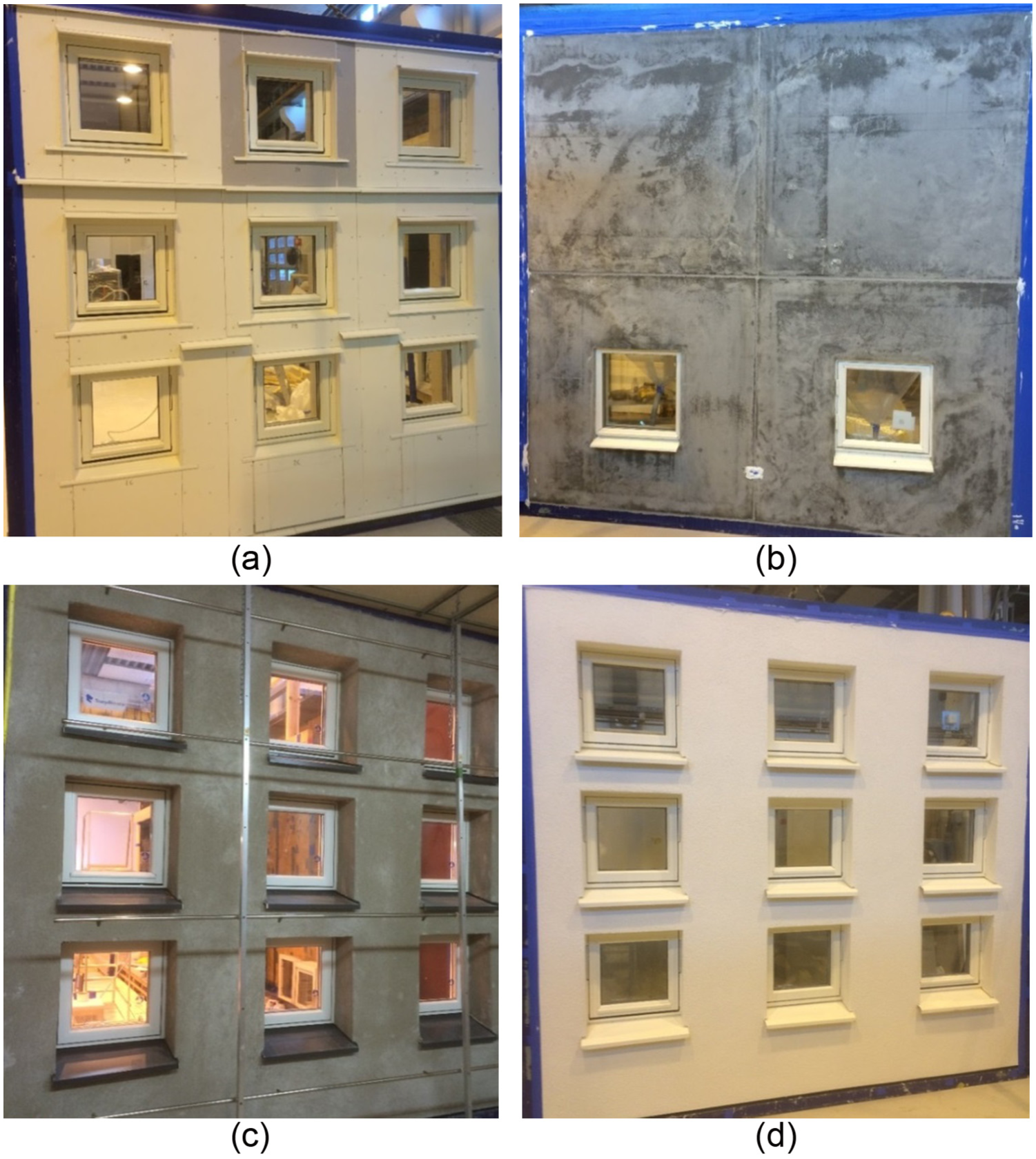
Photos of the (a) front façade of a ventilated façade with composite boards as cladding, (b) façade of concrete elements, (c) façade of rendering (installed in the rain chamber), and (d) façade of rendering.
Prior to assembly or configuration, the façade suppliers were given the following information. Each façade system (experimental wall) should be built up in three vertical sections (see Figure 1). Section 1 was constructed to best industry practice by specially trained installers. This would form the base level for driving rain resistance or leakage. In sections 2 and 3, a number of possible and verified working procedure defects (5–10 defects) were introduced, based on interviews with, for example, system developers and trained installers, as well as findings gained from testing and investigative activities. The defects are, for example, improperly mounted or lacking sealings. Section 3 allow installation by a joiner without any specialized knowledge of specific systems, but with access to the installation instructions. The horizontal rows of windows simulate each floor level for a three-storey building.
The laboratory tests were carried out partly using the standardized test method of EN 12865, “Determination of the resistance of external wall systems to driving rain under pulsating air pressure,” and was extended to include additional load combinations and repetitions (SS-EN 12865:2001, 2001). Simulation of driving rain was obtained using specified water spray nozzles (1.5 L/min·m2 and run-off of 1.2 L/min·m) and dynamic pressure loading with compressed air at successive pressure steps, such as 0, 0–75, 0–150, 0–300, 0–450, and 0–600 Pa.
Beneth each façade detail, collection funnels made of plastic foil were fitted. These were taped up and sealed against the rear of the façade. Each funnel was emptied into a glass bowl or plastic container which made it possible to collect the water and weigh it. However, the actual leakage rate was not measured in the study of 100 commercial tests. Instead, the leakage rate was estimated (classified to a five-point scale: 1 = one or few drops, 2 = continuously dripping, 3 = low flow, 4 = modest flow, and 5 = heavy flow) during and after each test.
Note that several of the systems are designed with rain seals in multiple steps, which means water may leak through the outer façade layer, but not reach the structure. Therefore, some of the systems work adequately even when measuring leakage through the outer façade layer, provided that it does not reach the load-bearing structure. Instead, the leakage amount could be applied for walls without flashing under the window frame and second line of defense, or in cases with risk of water accumulation into the wall.
Results and comments
The field measurements on seven buildings showed that rain leakage is a recurrent problem. In five out of a total of seven houses, there are moisture indications in the load-bearing structure derived from driving rain leakage during the measurement period of 2009–2015. No difference was noted in the number of leakage occasions when comparing ventilated and unventilated façades. The leakage in field measurements occurred at relatively low wind speed, minimum 5 m/s (the range of wind velocity at rain leakage was 5–12 m/s), with a rain intensity on a horizontal surface of typically 2–3 mm/h (the range was 1–8 mm/h), together with wind direction toward the leaking façades.
In periods of heavy rain, there is often no sign of leakage. However, if analyzed together with the weather data, it becomes evident that the wind speed, on these occasions, is often lower than 2–5 m/s, or that the wind direction is not straight toward the measured façade. As an example, this occurs on 21 December and 10 January for a building in Helsingborg (see Figure 2; the cumulative rain). The moisture content in the load-bearing wooden frame is shown during winter time in Helsingborg (coastal area, south-west Sweden; see Figure 2).
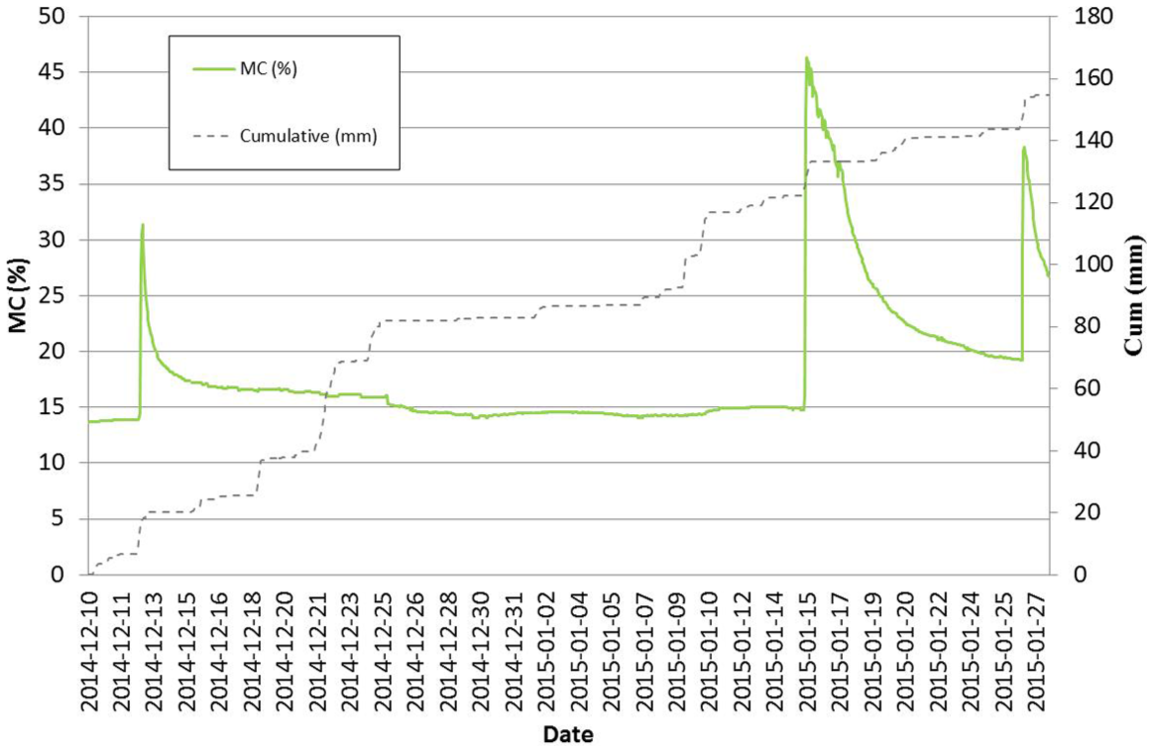
Moisture-content (MC) measurements, in one of the houses, representing one measurement each hour. Cumulative (mm) represents accumulated rain on horizontal surface at the weather station from the start date in the diagram (10 December 2014).
However, large amount of water leakage is detected during heavy rain and simultaneous light or moderate wind toward the façade. The water leakage is detected by sudden increase in moisture content. Using Helsingborg (Figure 2) as a representative example, this occurs on 12 December 2014, and 15 and 26 January 2015, and the increase in moisture content is over 30%. The increase starts approximately 4 h after the rain starts.
After the rain stops, the general indication is that the moisture dries out and that there is no accumulation of moisture in the measurement points. However, from the moisture-content measurements, it is not possible to detect whether the water has run further down in the construction, underneath sills, or trapped and accumulated in other locations where it might cause moisture damage.
From the field measurements, it became evident that rain penetration is a recurring event. This was confirmed in the laboratory measurements on walls, where 90% of the walls failed and 50% of the details failed. The term “failed” is defined as water penetrating all the way to the load-bearing structure and also if water leaked through the rain-exposed surface into the air gap, drainage gap, and thermal insulation as plaster substrate.
The following results are based on 110 tested walls with 471 details in total. The type of details and percentage failed are shown in Figure 3.
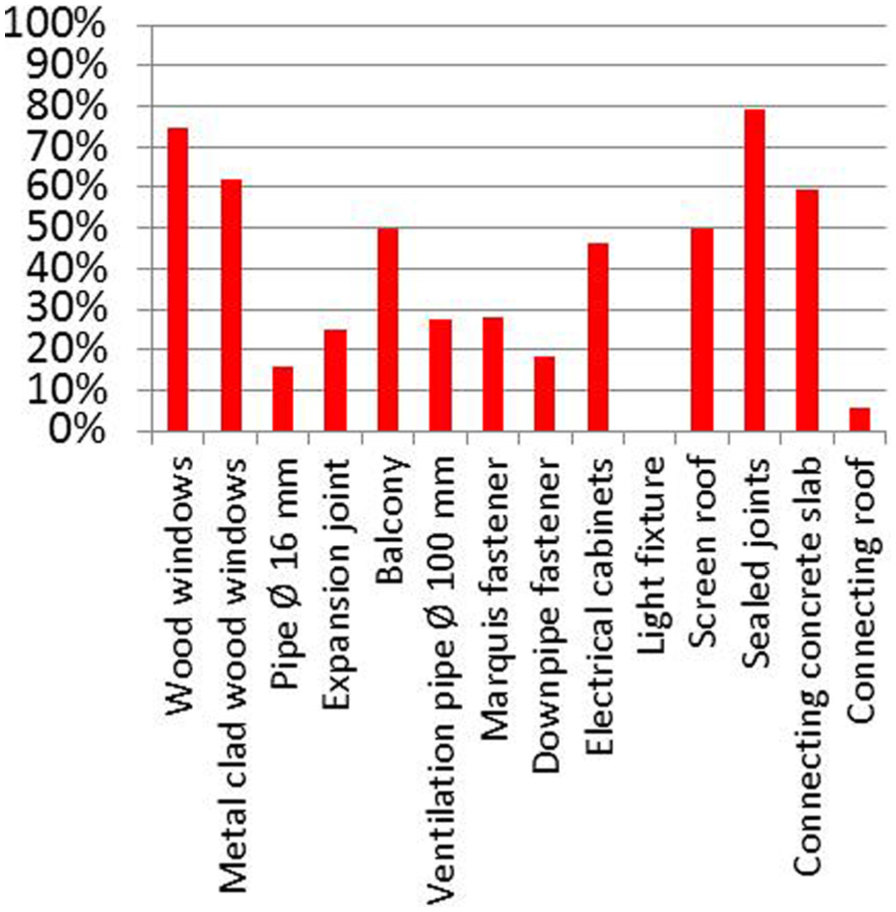
Percentage of specific details that failed.
Windows, balconies, connections to the concrete slab, and sealed joints are some of the details that leaked the most, and despite windows being such a common detail in façades, it had one of the highest “fail ratios” (see Figure 3). A comparison between all different types of façades showed that the fail ratio for windows (60%–75%) was relatively independent of wall type. In these tests, there were almost no pressure differences over the ventilated façades since there was pressure equalization, but still the fail ratio was high for façade details with wooden windows.
A general experience from these tests is that if water leakage increases, it often already starts when testing at low air pressures, probably due to gravity, capillary suction, kinetic force, and surface tension, which is confirmed by previous literature (Straube, 1998). It is interesting to compare these laboratory results with the field measurements, where there had to be wind toward the façade to obtain leakage. Most likely, the wind just helps in making the rain hit the façade, but does not necessarily cause a large pressure over the rain-exposed surface. The building details, such as eaves, will protect low building from vertical rain during light winds.
Furthermore, three quarters of all test walls had significant rain intrusion, that is, continuously dripping and low flow, which is in the range of roughly 0.01–0.05 L/min, thus a significant amount. Additionally, very few details had modest leakage flow and none of them had large leakage flow.
The problematic window connection was then studied more in detail, with respect to workmanship, as previously described (see Figure 1). In this case, all four façade systems experienced water leakage. Around 60% of all tested window–wall interfaces had measured water leakage. The amount and number of water leakage were in average not less for section 1 than for sections 2 and 3, which had deliberate defects in two walls. The largest leakage flow was 0.028 L/min, which is a significant amount. Many of the leakages started already at 0 Pa, that is, without any wind loads. In general, the defects were small and imperceptible, probably difficult to avoid when installing, which may be one reason why no clear distinction could be seen between sections 1, 2, and 3. The leakage appears to have increased in a random manner. Based on these results, we can confirm that commercial, well-performed sealed joints around the windows in façades are, despite all, usually not rain resistant, which should be considered when designing the inner part of the wall.
Discussion
Based on field studies, leakages seem to appear when four factors are present at the same time: deficiencies at joints in the façade, wind direction toward the façade, significant amounts of rain (2 mm/h), and a wind speeds of 5–12 m/s. However, these wind speeds do not cause any major average pressure differences over the façade. Also, several of the façades are well ventilated and therefore most likely pressure-equalizing. On the basis of this reasoning, the wind speed contributes, above all, to the water drops hitting the façade rather than it being crucial for leakage, due to pressure difference, in those cases of measurement. Something that has been shown in other references (Lacasse et al., 2003; Straube, 1998). The two laboratory studies confirm this statement as well.
The general site inspection and checking before the tests in the laboratory have usually not shown any obvious flaws or unusual deviation from construction practice. In almost all the laboratory tests, the clients were hopeful of the façade system being rain resistance before the tests took place. Usually, the façade system providers used sealing material in a brave attempt to make the joints in the façade rain resistant, but the joints usually failed at the first attempt. This shows that it is difficult in practice to achieve fully sealed solutions, particularly without a secure and proven sealing and installation method.
Conclusion
Field measurements during driving rain show that in five out of seven new buildings, water leaks all the way into the load-bearing structure, even if the façade has a ventilated air gap, and regardless of façade type (such as fiber cement boards, render on fiber cement boards, or wooden panels). The leakages occurred at relatively low wind speed of 5 m/s with a horizontal rain of at least 2 mm/h, and together with wind direction toward the façades. Since several of the façades are well ventilated, and by this most likely pressure-equalized, the conclusion is that leakage can occur without pressure difference over the façades, which confirms previous literature (Lacasse, 2003; Straube, 1998).
The results of 100 laboratory tests on rain resistance show that more than 90% of all tested walls failed and 50% of all details failed. Based on this, fully sealed façade solutions for joints around window details cannot be achieved (75% of façade details with wooden windows failed), unless with great difficulty, and this is the case regardless of façade type, and even for pressure-equalized façades.
The study comparing best possible installation with man-made flaws did not show any obvious difference regarding rain resistance, despite the difference in mounting performance. Around 60% of all tested window–wall interfaces had measured water leakage. Many of the leakages started already at 0 Pa. In general, the defects were small and imperceptible, probably difficult to avoid when installing, which may be one reason why no clear distinction could be seen between well-executed and not well-executed joints.
These three studies imply that leaks around façade details, at windows, doors, balconies, and so on, are actually the rule rather than the exception in Sweden, even in new façades (built after 2007). These studies confirm the statements in ASHRAE standard 160, which describe that façades normally are not completely rain proof (ASHRAE Standard 160-2016, 2016; TenWolde, 2011).
Because façades with façade details are not usually rain proof, we should consider the leakage quantities when predicting risk of moisture intrusion and high moisture level in walls. To estimate the amount of leakage, more and correct data is required, which is lacking. In order to describe how water is spreading in the wall, drainage ability and moisture retention behind façades is another area of interest where there is lack of data. Consequently, information is needed to carry out reliable moisture-risk assessments.
Footnotes
Declaration of conflicting interests
The author declared no potential conflicts of interest with respect to the research, authorship, and/or publication of this article.
Funding
The author(s) disclosed receipt of the following financial support for the research, authorship, and/or publication of this article: This study was supported by the Swedish Energy Agency and the SBUF (the Swedish construction industry’s organization for research and development).