







Abstract
We longitudinally investigated the development of deictic and general accompanying gestures in one 5-year-old boy with autism spectrum condition (ASC) and intellectual disability. The investigation was performed during an intervention focusing on phonological segments. The purpose was to see whether gestures developed in conjunction with language. We found that deictic and general accompanying gestures increased during the study, despite not being trained. There was also a positive temporal correlation between deictic gestures and speech. Contrary to the expectations in this case, declarative gestures were frequent and increased, while imperative decreased during the period of intervention. Furthermore, we detected a specific kind of general accompanying non-context-sensitive gestures that may be involved in the retrieval of phonemes and syllables. Speech prosody was also analysed in relation to these gestures.
Introduction
Autism spectrum conditions (ASCs) are a group of neurodevelopmental conditions (DSM - 5, 2013), which occasionally co-occur with intellectual disability (Levy et al., 2010). ASCs are characterized by impairment in social communication, interaction and restricted behaviour. These conditions are related to a deficiency in sensory integration (Ayres, 1972) of various modalities, such as vision and audition, which often affect both speech and gestures. Gestures are important for linguistic–cognitive development as they are used in interaction and joint attention, a core deficit in ASCs. There is a lack of longitudinal studies on gestures in production by this group, although gestural impairment is now one of the criteria for ASCs (DSM - 5, 2013). In addition, most studies in this field focus on how children with ASC perceive gestures. It has been suggested that the developmental trajectories for gestures are similar in typically developing (TD) children and children with ASC (Sowden et al., 2008). This leads us to believe that children with ASC can also develop in their production of gesture.
Gestures
Gestures are motions, preferably of hands or arms, used for expressions (Kendon, 2000). The present article studies gestures in one child with ASC and limited speech output over 1½ year. The gestures are classified into different categories, such as deictic (pointing) gestures and general accompanying gestures. General accompanying gestures always accompany speech, while this is not necessarily the case for deictic gestures. Notably our study does not claim to cover all aspects of non-verbal communication in ASCs, such as body posture, facial expression or eye movements.
Deictic gestures (imperative and declarative) in typical development
Deictic gestures are intentional, goal-directed pointing, in order to share attention, reference or request an object. They display a communicative intent and social-cognitive function, where joint attention is involved. In typical human development, deictic gestures occur at around 9–14 months of age, with the production of the first words. Camaioni et al. (2004) suggest 10 months in TD children as the age when deictic gestures develop.
Classically, an important distinction is made between imperative and declarative gestures (Bates, 1976; Brinck, 2004; 1989; Camaioni et al., 2004; Carpenter et al., 2002; Liszkowski, 2005). Imperative gestures are used in requests or when the child gets other individuals to act, while declarative gestures are used in order to obtain other individuals’ attention on an inter-subjective way. Once gesturing, TD children first produce imperative gestures at an early age and then develop declarative gestures about 3 months later (Camaioni et al., 1997; Camaioni et al., 2004). Declarative gestures are important because they are linked to an understanding of the intentions of others.
Deictic (imperative and declarative) gestures in ASCs
According to a few recent studies, children with ASC show impairments in production of deictic gestures at an early age (Carpenter et al., 2002; Charman et al., 2003; Mitchell et al., 2006; Wetherby et al., 2007). More specifically, children with ASC display a complete absence of or delay in the development of declarative (sharing focus of an object) gestures (Camaioni et al., 1997; Camaioni et al., 2004; Charman et al., 2003). Imperative gestures (request gestures), on the other hand, may not be impaired in children with ASC, apart from very young children with ASC or children at a lower developmental level (Charman, 1998). Camaioni et al. (1997) studied imperative and declarative gestures in young children exhibiting ASC. As with TD children, they showed that imperative functions occurred prior to declarative functions in ASC children. In addition, they managed to show that there was a strong relationship between the development of declarative gestures and high skills in understanding other’s intentions. Results obtained by Carpenter et al. (2002) showed that compared to children with developmental delay, 4-year-old children with ASC had impaired declarative gestures. Of 4-year-old children with ASC, just 25% exhibited declarative gestures skills, compared to 82% in the developmental delay (DD) group of the same age. Fifty-eight percent of the 4-year-old children with ASC managed imperative gestures compared to 64% in the DD group. Subsequent research on children with ASC concludes that the two types of deictic gestures (imperative and declarative) may develop over time (Charman, 1998).
General accompanying gestures in typical development and in ASCs
Studies on general accompanying gestures in children with ASC are not very frequent in the literature. Nevertheless, general accompanying gestures are important because they are part of the speech utterance and are among the gestures tightly connected to speech. In this way, they may be compared to other supra-segmental phenomena, such as prosody. In studying these gestures, we may receive information about the close relationship between speech and gestures (see Wagner et al., 2014, for a review). General accompanying gestures, or co-gestures, are visible motor actions, produced while an individual is speaking. They may occur in the same time frame as speech, precede it, or they may appear shortly afterwards. Similar to prosodic properties, they may even be regarded as a part of the utterance (Wagner et al., 2014). General accompanying gestures include different hand shapes and movements by the fingers, hands or arms. They do not exhibit any of the properties of being deictic, ritualistic, interactional or iconic, but their presence in human communication is considered important (Iverson and Thelen, 1999, Wagner et al., 2014). Children with ASC produce fewer general accompanying gestures than TD peers do (Marchena and Eigsti, 2010). The facts mentioned make gestures important aspects of communication to be studied.
Relations between speech and gestures in typical development and in ASCs
There is some evidence for an interrelationship between speech and gestures in children’s language (see Bates and Dick, 2002 or Wagner et al., 2014 for discussion). Canonical babbling has been linked temporally to the development of hand banging or clapping and also with the development of deictic gestures. Iverson and Goldin-Meadow (2005) studied two-word acquisition in 10 TD English-speaking children and found a temporal interrelationship between gestural and linguistic development. At the sentence level, the development of combinations of gestures and words predicted the beginning of verbal two-word phrases. In their study of TD English-speaking children, Özcaliskan and Goldin-Meadow (2005) noted an increasing amount of gesture and speech combinations as the children expanded their repertoire of two-word utterances.
An anatomical link between gestures and speech has been suggested to exist in Broca’s area (Iverson and Thelen, 1999). In addition, Broca’s area (in the frontal lobe) is linked to gesture production, while there is an involvement in the temporal lobe regarding gaze and directional cues. In ASCs, deficiencies in motor programming of speech are often seen (Code, 1998; Page and Boucher, 1998). These deficiencies may also apply to gestures. In ASCs, there is also evidence for impaired speech and gesture integration concerning perception (Silverman et al., 2010), but the present study focuses on production, which is why perception is not further described.
Relations between gestures and phonetic prosody in typical development and in ASCs
Studies on the relationship between gestures and phonetic prosody in ASCs are rare, as well as longitudinal studies on prosody and gestures (Nordgren, 2016). There are however examples of studies on typical development. One example is the work obtained by Guaitella et al. (2009). They studied eyebrow movements in relation to changes in fundamental frequency (F0) and the results of their work showed that the eyebrow movements are intentional and not automatic.
Bilingualism in ASCs
Despite the fact that bilingualism is frequent in the population worldwide, there is very limited literature on this phenomenon and how to relate to it in ASCs (Nordgren, 2015). In fact, recent studies on bilingualism in ASCs suggest a multilingual environment is positive for a child with ASC. According to a study by Valicenti-McDermott et al. (2013) there were no differences in the development of spoken language between a monolingual and a bilingual group of children with ASC. Rather, the bilingual children in the study vocalized and used more gestures than the monolinguals. Similar results have been shown in other studies (Ohashi et al., 2012). In addition, it may be problematic for a child with ASC to be made monolingual in a bilingual home, that is, to be excluded from parts of conversation (Kremer-Sadlik, 2005). However, it is often the case that parents are advised to speak only one language with their child.
Another underresearched area is gesture and several languages in relation to ASCs. In addition to spoken language, gestural communication differ across languages, particularly in relation to verb-framed versus satellite-framed languages.
The present study
It is suggested that language develops in context of auditory and visual input. Due to the possible interrelationship between speech and gestures (Iverson and Thelen, 1999), we predicted that auditory and visual input would also affect the development of gesture. In addition, we predicted declarative gestures to be less common than imperative in a boy with ASC at this level of development.
The results of two previous case studies (Nordgren, 2015, 2016) showed that the subject child showed increase in his production of speech sounds and his use of prosody. This increase was possibly due to an intervention with speech stimuli. For the present study, the questions concern whether gestures also develop in conjunction with language.
Research questions
The following questions guided the study: How are the deictic and general accompanying gestures distributed across 1½ year? Are imperative gestures more frequent than declarative? Is there a temporal agreement between development of deictic gestures and first-word acquisition? Is there a temporal correlation between speech production and gesture? What function do the general accompanying gestures exhibit? Are the general accompanying gestures synchronous with syllables or prosodic structure? Can any changes in the interaction between adult and boy be seen?
Method
We conducted a longitudinal single-subject study of a boy with ASC, who we called Ted. Video recordings were made and data collected during three sequential intervals over the study period of 1½ year. The current study presents predominantly gesture data, while Ted’s phonological and prosodic development has been presented in previous papers (Nordgren, 2015, 2016). The intervention focused on phonological segments and included a puppet game. The order of child language acquisition (Jakobson, 1968) formed a basis for the construction of the methodology (Nordgren, 2015).
Participant
Ted was 5.9 years old at the beginning of the study and 7.2 years old at the end of the intervention period (the second year). He had normal vision and hearing (Nordgren, 2015, 2016).
Ted 2.9–2.11 years of age
The boy in the study, Ted, was diagnosed with ASC (DSM - IV, DSM 1994; ICD 10, WHO 1992) and intellectual disability by a neuropsychiatrist at 2.9 years of age. Ted had limited skills regarding mutual interaction and communication as well as restricted interests.
A neuropsychological investigation with the Autism Diagnostic Observation Schedule, ADOS (Lord et al., 1989), also at age 2.9 (performed by a psychologist), showed that the boy was above the limit for ASC in language, communication, social interaction and play. The observation showed a shortened attention span and stereotyped behaviours. Ted was only able to focus on an activity for a short period of time. In addition, he was mainly oriented towards objects and did not notice intentions from others or gave eye contact. No words were used, but some sounds existed, with the purpose of expressing dissatisfaction. Ted was able to use a request gesture, in order to show that he wanted something.
Ted’s development at age 2.11 years was clearly delayed according to the Griffiths Mental Developmental Scales (Griffith, 1954), Griffith scale I (0–2 years). However, he performed better within the areas of gross and fine motor skills and ADLs (run, jump, eat, drink), that is, activities of daily living. He was able to say no by shaking his head and shout in order to attract attention but did not respond to others’ call for attention. He was able to attend to pictures for a short period of time.
The Vineland Adaptive Behaviour Scales (Sparrow and Cicchetti, 1985), at age 2.11, confirmed the results from the Griffith testing. The interview showed large difficulties within language (receptive/expressive), social interaction and play, but good performance within motor skills (gross and fine motor). Ted exhibited behaviour that was consistent with ASC and a delayed development, with the largest difficulties within the language domain. Non-linguistic skills, such as manipulation of toys and other objects, were also delayed.
An evaluation by a speech and language pathologist (SLP) at age 2.9 revealed impairment in the use of non-verbal communication, language comprehension, speech production, play, interaction, imitation and attention. Ted had an expressive language, consisting of few (4–5) one-syllable utterances but was able to point out a few objects and follow a simple instruction.
Ted 5.6 years of age
At 5.6 years of age, 3 months before the onset of the present study, SLP testing with Reynell Language Developmental Scales (Reynell, 1977) revealed that the boy could point out 8 out of 15 nouns (Nordgren, 2015) and was able to follow simple instructions, such as ‘put the teddy on the bed’, ‘put the keys in the box’ and ‘give me the apple and the teddy’. Ted was also able to point out his mother and a lamp. Bilabials, dentals and velars were established in some positions, since some objects were named with these sounds. A majority of utterances consisted of one syllable. Reduplicated babbling was rare but occurred.
Ted 5.9 years of age
Shortly, before the beginning of study, Ted exhibited extremely limited interactional communicative skills and oral production (Nordgren, 2015). Speech was constituted by one-syllable utterances (Nordgren, 2015), such as [pε] for ‘apple’ äpple (Swedish), [tɔ:] for ‘train’ tåg (Swedish), [ɡʊ] for ‘cookie’ kaka (Swedish) and [bi:] for ‘car’ bil (Swedish). At home and at school, picture boards were used to some extent. The family also used pictures in order to increase the boy’s language comprehension. The boy was able to point at a picture to indicate he was thirsty, needed to go to the bathroom, and so on. He was also able to point out his family members: mother, father and brother and request various objects by pointing. The parents estimated the boy’s lexicon to about 5–10 words. Between 3.0 and 5.9, the parents had received some guidance and courses concerning augmentative and alternative communication from an SLP (Nordgren, 2015).
Family and education
Ted’s family consisted of both parents and a younger brother (Nordgren, 2015, 2016). L1 was a non-Germanic language. 1 Both L1 and L2 (Swedish) were spoken at home, together with some English, until Ted reached the age of 1.6 years. The parents noticed Ted’s delay in language development (at 1.6 years) and were then given the advice to change languages at home to only L1, which they did. When an investigation of psychomotor development started (at the age of 2.5 years), the parents switched to using L2, as the only language. At school, Swedish was used as language (also in the present study). Ted attended a special class for children with ASC, integrated in a regular school in Sweden. He had constantly attended the same school since the age of 3. The TEACCH methodology (Schopler et al., 1995), which uses structured settings, was employed (Nordgren, 2015).
Stimuli
Puppets (Nordgren, 2015, 2016) made of different colours and materials were used as stimuli. The idea was that these would be stimulating for different modalities like vision and audition (IAKM, Johansson, 1988 [The International Association for the Karlstad Model]). Different names, that is, CVCV syllables, for the puppets were decided upon beforehand. All the puppets’ names exhibited the accent of Swedish (accent 2). The puppets were then introduced according to a specific order, for example, [pʊpʊ] – [tʊtʊ], [pʊpʊ] – [kʊkʊ], etc. (Nordgren, 2015).
Procedure
The context was declarative and the situation triadic: two subjects, that is, the boy and the teacher or the SLP, shared attention to an object (a puppet). The sessions were designed to be interactive, playful and fun. Ted was encouraged to listen and had the possibility to produce the given names of the puppets. The adults’ prompts included the puppets’ names or phrases, such as ‘where is….?’ or ‘who is that?’. Each occasion a few puppets were present.
The single-subject methodology
The single-subject strategy (Nordgren, 2015, 2016; Hegde, 1994) was a preferred starting point for the present study. Repeated measurements before the onset of each treatment period served as baselines, and measurements were also made during treatments. An ABAABAB design was employed in this study (Table 1) 2 : baseline period 1 (BL 1) = week 1–3, treatment period 1 (TM 1) = week 4–16, baseline period 2 (BL 2) = week 17–18, baseline period 3 (BL 3) = week 19–22, treatment period 2 (TM 2) = week 23–31, baseline period 4 (BL 4) = week 32–34 and finally treatment period 3 (TM 3) = week 1–9, which was a period (conducted by the SLP) containing treatment sessions only.
The single-subject ABAABAB design with baselines and treatment periods.

Interval 1 (February to June, age 5.9–6.1 years)
During interval 1, February to June, there were in total 18 video recordings (Nordgren, 2015) recorded once a week by the researcher. The weekly recordings in interval 1 could be considered probe sessions. During week 1–3 we had a pre-training baseline (baseline sessions), whereas in week 4, the study started involving daily puppet play sessions (treatment sessions) for 5–20 min (or as long as Ted participated). Training during this first interval was undertaken by Ted’s teachers and the remainder intervals by the SLP. Likewise, in interval 1, the researcher made the video recordings and in intervals 2 and 3 this task was performed by the SLP. In interval 1, eight puppets (+ pictures of the puppets) were used during baseline sessions and probe sessions, while only two puppets at a time were used during the treatment sessions.
Interval 2 (August to December, age 6.3–6.7 years)
There were a total of 16 video-recorded weekly sessions during interval 2. In interval 2, in total 13 puppets (+ pictures of the puppets) were used as stimuli. During every treatment session in interval 2, 4–5 puppets were used.
Interval 3 (February to June the second year, age 6.8–7.1)
A total of 9 sessions were video recorded (interval 3). Interval 3 included treatment sessions only and 6–8 puppets per week. Interval 3 was a treatment period performed by the SLP. However, data were analysed for the whole period.
Recordings and transcriptions
Once a week, the sessions were video recorded with a Panasonic HDC SD-700 (Nordgren, 2015, 2016). Recordings began when the child and the teacher or SLP entered the room. The length of the recordings varied between 5 and 20 min, with consideration taken for Ted’s participation and attention span. The mean session length for interval 1 was ≈5 min (SD 2.65) and for interval 2 ≈12 min (SD = 5.7) and for interval 3 ≈20 min (SD = 2.44). The mean session length for the intervals and the corresponding mean session length for the baseline and treatment sessions are shown in Table 2.
Recorded mean session length (and standard deviation).
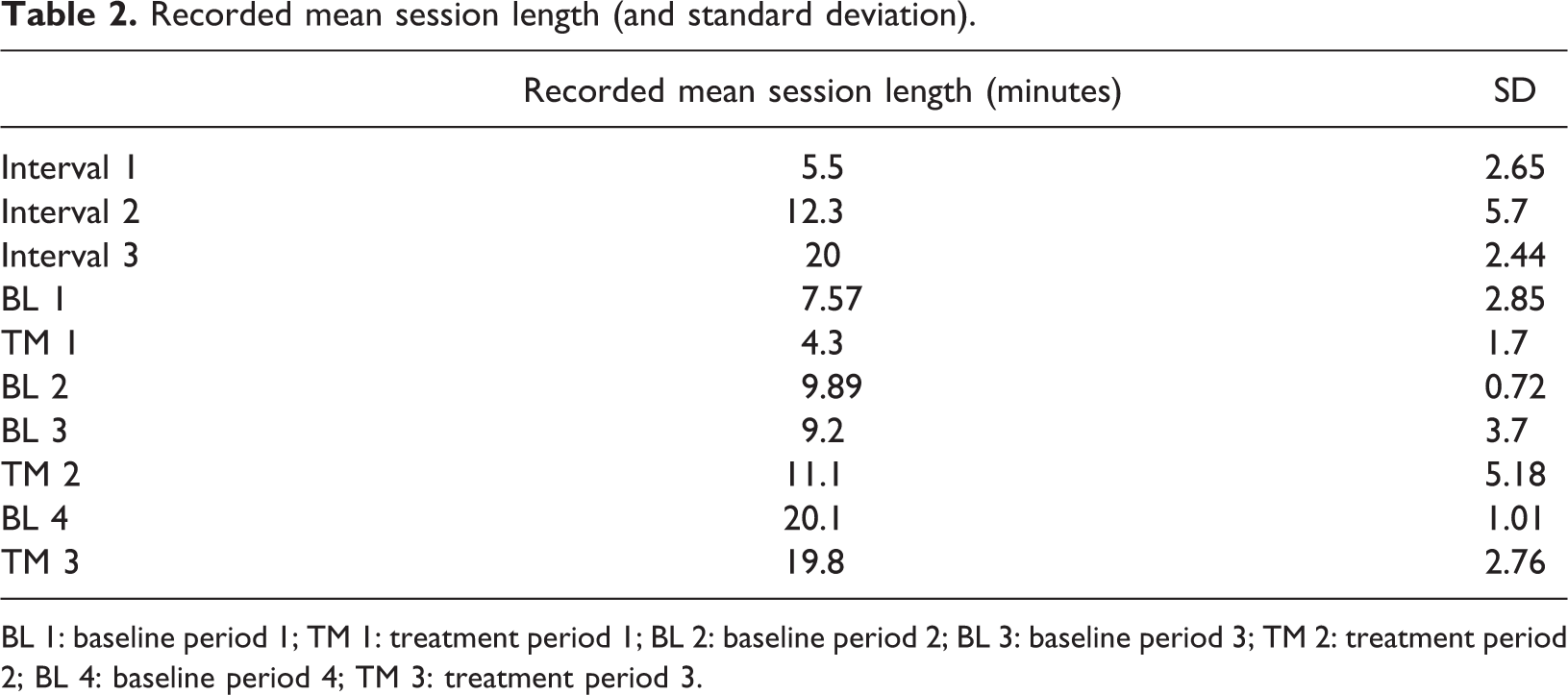
BL 1: baseline period 1; TM 1: treatment period 1; BL 2: baseline period 2; BL 3: baseline period 3; TM 2: treatment period 2; BL 4: baseline period 4; TM 3: treatment period 3.
All data were transcribed and annotated. Orthographic transcriptions of the data were made for the teacher’s and the SLP’s speech, while phonetic transcriptions (according to IPA) were made for the child’s speech. 3
Analyses of data
The outcomes of the present study are measured in the number of speech (vocalizations) and gesture productions annotated in the video annotation program ELAN 4.5.0, which allows detailed visual analyses.
Deictic goal-directed pointing was labelled ‘deictic’. The boy, for the most part, pointed towards the puppet (or puppets) which were the object(s) of attention or pointed at a box, or a bag, containing the remaining puppets. When Ted pointed towards the box or the bag, these gestures were interpreted as a request for new material, that is, imperative gestures. When he pointed towards the puppets or pictures that were present in a joint attention situation, these gestures were interpreted as declarative gestures.
In the present article, general accompanying gestures were gestures that occurred in the same time frame as speech and did not exhibit the property of being deictic. In addition to descriptions of these gestures, spectrograms with acoustic properties are presented. An acoustic analysis program, PRAAT (Boersma and Weenink, 2015), was used for the acoustic analyses.
Not all movements were annotated, that is, movements such as standing, sitting down, fetching an object from the floor and pure imitation were excluded. However, some examples of ritualistic (giving, putting), interactional (clapping on hands) and iconic (pretend) gestures were presented. As shown, the sessions varied in length, and that is why we divided the total number of speech productions and gestures based on the number of minutes for the various periods during the course of the intervention. T tests were used to some extent, concerning the number of gestures per session during the year. In addition, percentage exceeding mean (PEM) was calculated for every session during the year.
Regarding Ted’s speech, we included all the vocalizations as well as syllables and words, due to Ted’s very limited speech production. Pearson’s correlation quantified the interrelationship (correlation) between speech and gestures as well as between imperative and declarative gestures.
Inter-observer agreement
Inter-observer agreement (Nordgren, 2015) was calculated for speech sounds (i.e. sounds containing at least one syllable, excluding vocalizations). Then K = 0.77 and accuracy was 81% (0.81–0.22/1–0.22 = 0.77).
We were also able to use the teachers’ and SLP’s actions or comments as inter-observer agreement. In 11 sample sessions (out of 19 sessions containing imperative gestures) distributed over 1½ years, 28 cases of 40, that is, in 70% of the cases, the teachers’ or SLP’s actions confirmed the researcher’s annotations and were interpreted as imperative. One possible reason for this agreement not reaching 100% is that Ted sometimes produced two imperative gestures in a row and that the teachers and the SLP responded after the second gesture. Another possible reason is that the teachers and the SLP conducted the sessions themselves and occasionally wanted to lead the boy in another direction. On a few occasions the imperative gestures were unnoticed by the teachers/SLP.
Results
Speech, deictic (imperative and declarative) and general accompanying gestures
We noted 669 speech utterances during 1½ year. Vocalizations were included but shouting excluded. In total, there were 422 deictic and general accompanying gestures observed in all of the video data collected over the course of 1½ year. Two hundred seventy-six of these gestures were performed in combination with speech (36 in interval 1, 102 in interval 2 and 138 in interval 3). Apart from these gestures, some ritualistic, iconic and interactional gestures occurred, which along with imitation were not included.
Of the 433 gestures, a total of 364 deictic gestures were observed. Deictic gestures increased in number during the course of the study. Interval 1 4 yielded 57 deictic gestures (mean = 3 per session) whereas there were 119 deictic gestures (mean = 7 per session) in interval 2, an increase of 48%. 5 Deictic gesture frequency continued to increase during interval 3, with 188 deictic gestures 6 (mean: 21 per session), an 86% increase.
Contrary to the expectations, declarative gestures (n = 273) were more common than imperative gestures (n = 60) throughout the study period. Declarative gestures developed between interval 1 (n = 37, ≈2 per session) and interval 2 (n = 59, ≈4 per session). Interval 3 had the largest proportion of declarative gestures (n = 177, ≈20 per session). Besides imperative and declarative gestures, there were some deictic gestures (n = 30), which could not be categorized as either of the two groups.
Imperative gestures were fewer (n = 60). There were 12 imperative gestures during interval 1 (≈ 1 per session), 42 imperative gestures during interval 2 (≈ 3 per session) and 6 imperative gestures during interval 3 (≈ 1 per session). In total, there were 58 general accompanying gestures during the study. They were seen to a limited extent during interval 1 but became more frequent at the beginning of interval 2.
There were 14 general accompanying gestures during interval 2 (an increase of 81% compared to interval 1) and 44 during interval 3 (an increase of 92% compared to interval 1).
Due to the varying durations of the sessions, we also divided the total number of gestures in each phase (BL 1, TM 1 etc.) by the total number of minutes in these sessions. Comparing all sessions, the increase between interval 1 and interval 3 of declarative gestures per minute was significant, t(8) = −2.674, < 0.028. PEM was ≈0.88 = 88%, which is very strong.
The decrease in imperative gestures per minute was also significant between intervals 2 and 3, t(8) = 3.494, p < 0.008. PEM was ≈0.88 = 88%, very strong. Comparisons of the number of general accompanying gestures per minute, in each session of intervals 1 and 3, showed a significant increase, t(8) = −2.536, p < 0.035. The PEM values were ≈0.66, which was interpreted as a moderate increase. Table 3 shows the mean number of deictic (imperative and declarative) and general accompanying gestures per minute during the three intervals of study.
Declarative, imperative and general accompanying gestures per minute during the period of intervention in relation to speech utterances (Figure 1).
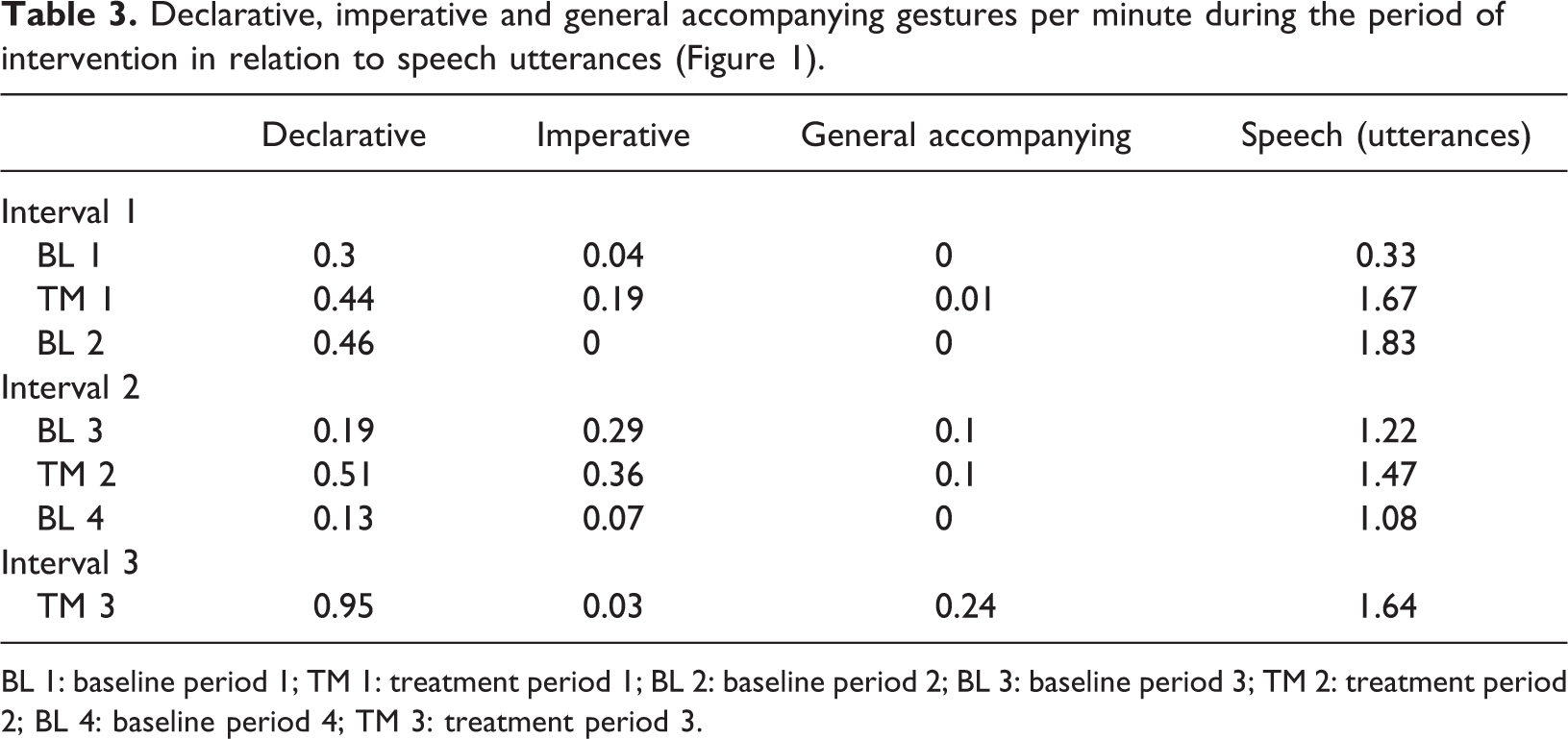
BL 1: baseline period 1; TM 1: treatment period 1; BL 2: baseline period 2; BL 3: baseline period 3; TM 2: treatment period 2; BL 4: baseline period 4; TM 3: treatment period 3.
Figure 1 presents the total number of imperative and declarative deictic gestures per minute during the three treatment periods. Imperative gestures increased at first from 0.19 per minute in interval 1 to 0.36 per minute in interval 2 but then decreased significantly in interval 3 to 0.03 gestures per minute. The number of declarative gestures per minute in interval 1 was 0.44, in interval 2 was 0.51 and in interval 3 was 0.95.
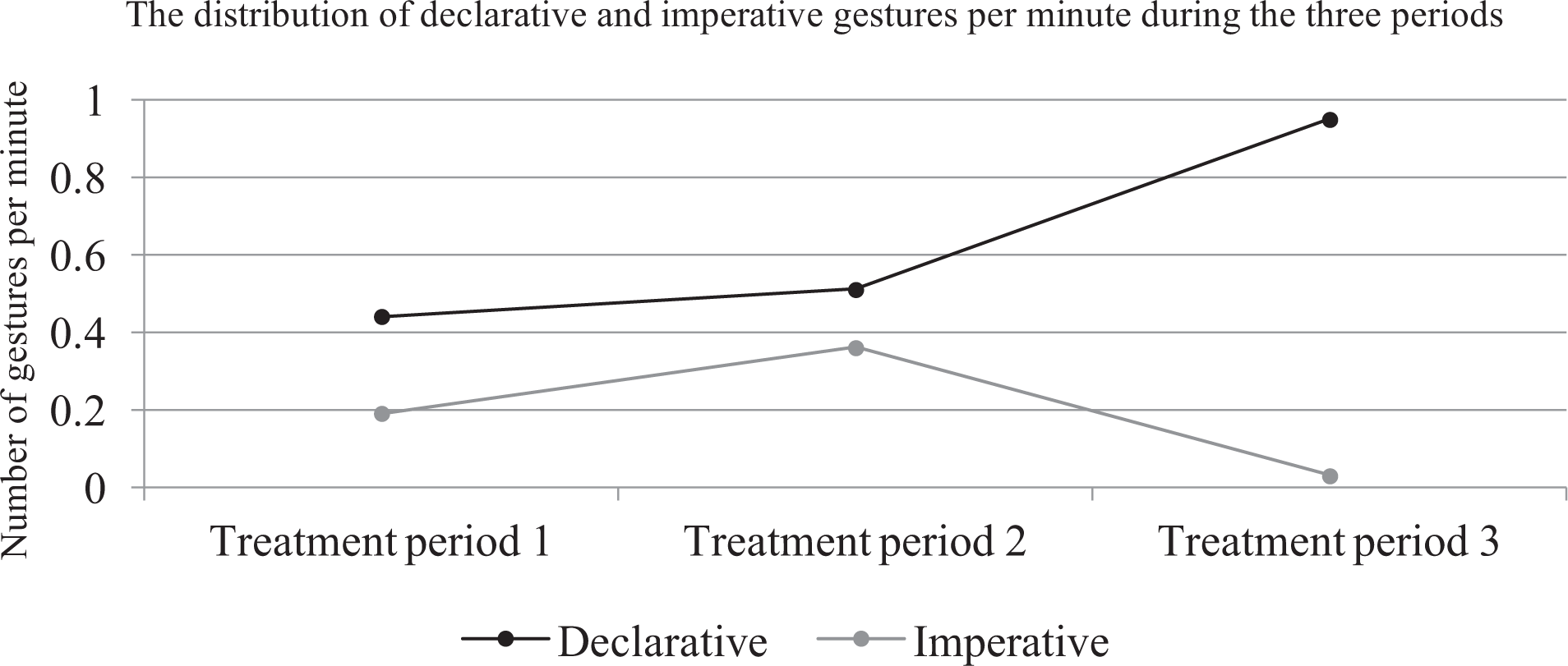
The distribution of declarative and imperative gestures per minute during the three periods.
There were some examples of ritualistic gestures in the video data, such as giving a puppet to or taking it from the SLP, putting the puppet on a picture, putting it in a box or showing it to the SLP. Examples of interactional gestures in the video data were taking the hand of the SLP, clapping on the SLP’s hands or grasping the hands of the SLP in order to perform a movement with them. An iconic gesture noted was Ted’s deictic gesture towards the corners of his mouth to show that the puppet was happy (or alternatively that the puppet had whiskers). Another example of an iconic gesture was Ted himself pretending to eat. Before interval 2, Ted used his whole hand to make deictic gestures and the later use of his index finger (interval 2 and 3) is an important qualitative difference. This transition coincided with the appearance of general accompanying gestures and the development of Ted’s first words (Nordgren, 2015) as well as an increased number of deictic gestures.
The relationship between deictic gestures and speech
We compared the development of deictic gestures per minute with the number of speech productions (vocalizations, syllables, words) per minute (Figure 2). The results showed that the number of speech productions per minute increased during the first treatment period (interval 1) and then remained high during the second baseline (interval 1). During the third baseline, the number of speech productions decreased but increased again during the second treatment period. Ted’s deictic gestures, on the other hand, displayed the greatest increase during the second treatment period, when he was given phonological training. During TM 3, we notice an increased number of deictic gestures per minute, while during BL 4, the number of deictic gestures per minute decreased remarkably. Both deictic gestures and speech productions increased during treatment periods and decreased during baseline periods. Pearson’s correlation was significant at the 0.05 level, r(43) = 0.385, thus demonstrating an interrelationship between speech and gestures.
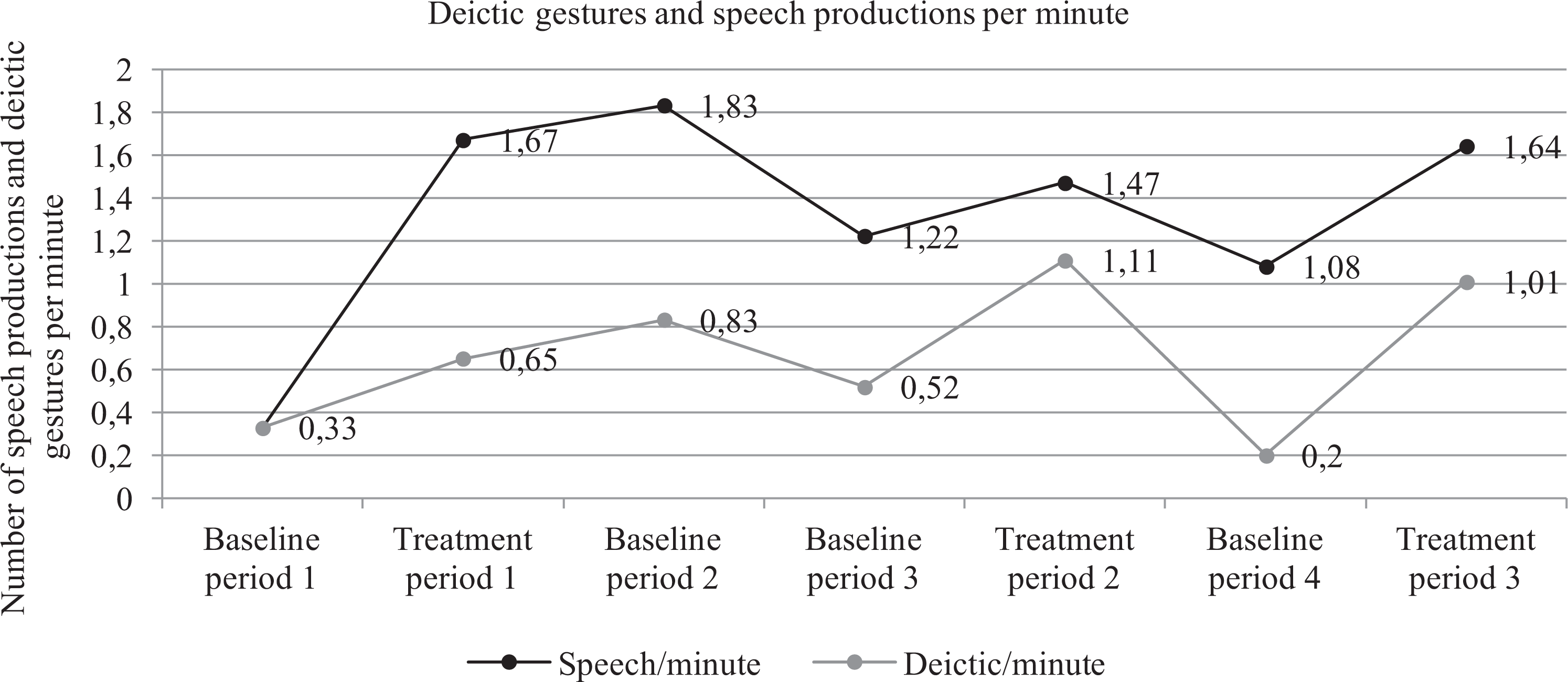
Deictic gestures and speech productions per minute.
General accompanying gestures
In one session specifically, we noted a development of general accompanying gestures over the period of study, which warranted a more detailed investigation. All Ted’s general accompanying gestures co-occurred with a single syllable. They were in temporal synchrony with the whole utterance. Below we will present the examples that stood out best among these general accompanying gestures.
Example 1: We noted one example of this kind of gesture in particular, namely, the formation of a specific hand shape to accompany each performed syllable, shown in Figure 3. Ted interacted with his SLP and produced a series of syllables, that is, vocalizations, and two different hand shapes to match the utterances. In picture A (Figure 3), when Ted made the syllable [a], he simultaneously used an extended arm hand with an arching hand shape. In picture B (Figure 3), the continuation of the gesture, to match the second part of the syllable [œ], is shown. The hand (arm) has retracted and Ted gestures with the index finger. The whole sequence was performed in 1 second and 14 milliseconds and as an integrated, ongoing sequence, in which Ted matched the two uttered vowels with his hand movements. The prompt uttered by the SLP before the sequence was Yes, Tatta. These data suggest that gestures are used in order to retrieve phonemes and syllables, rather than to retrieve whole lexical units.
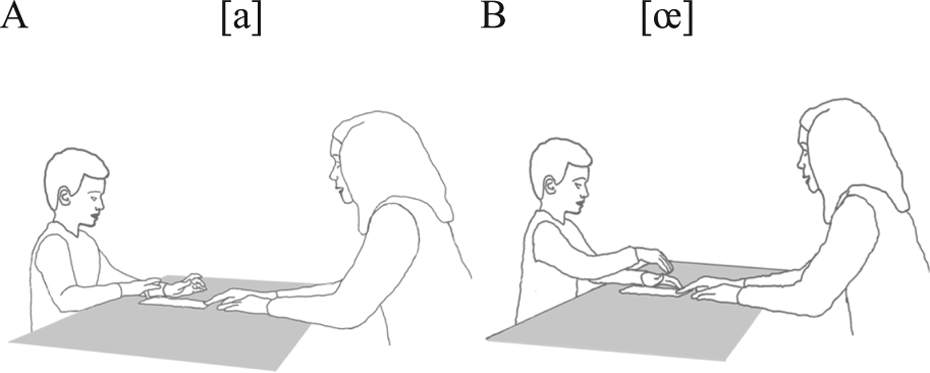
A, The speech sound [a], the first part of the word [aœ] is combined with an extended arm with an arching hand shape (right hand). B, The gesture for the second syllable, [œ], the right hand now is retracted with one finger gesturing downwards (right hand) while the left hand remains.
In the utterance (Figures 3 and 5), [a]-[œ], Ted did not use his prosody to a great extent. The first syllable had a mean pitch of 482 (434–499) Hz and the second syllable a mean pitch of 455 (356–481) Hz. The whole utterance had a mean pitch of 468 (353–499) Hz and a range of 146 Hz, which was below the mean range for the session (227 Hz). The mean pitch for this utterance (468 Hz) was however much higher than average for the session (322 Hz), which suggests the general accompanying gestures were used in conjunction with syllables and thus may exhibit a function in establishing prosodic features.
Example 2: Ted gestured several times in relation to three syllables, that is, [tI ta ʊ], for a period of 1 second and 18 milliseconds. During that sequence (Figure 4), Ted pointed twice at the picture (the first two syllables). The third time he pointed at the picture, he looked up and made eye contact after finishing the word. The prompt before that sequence was Here comes Tatta.
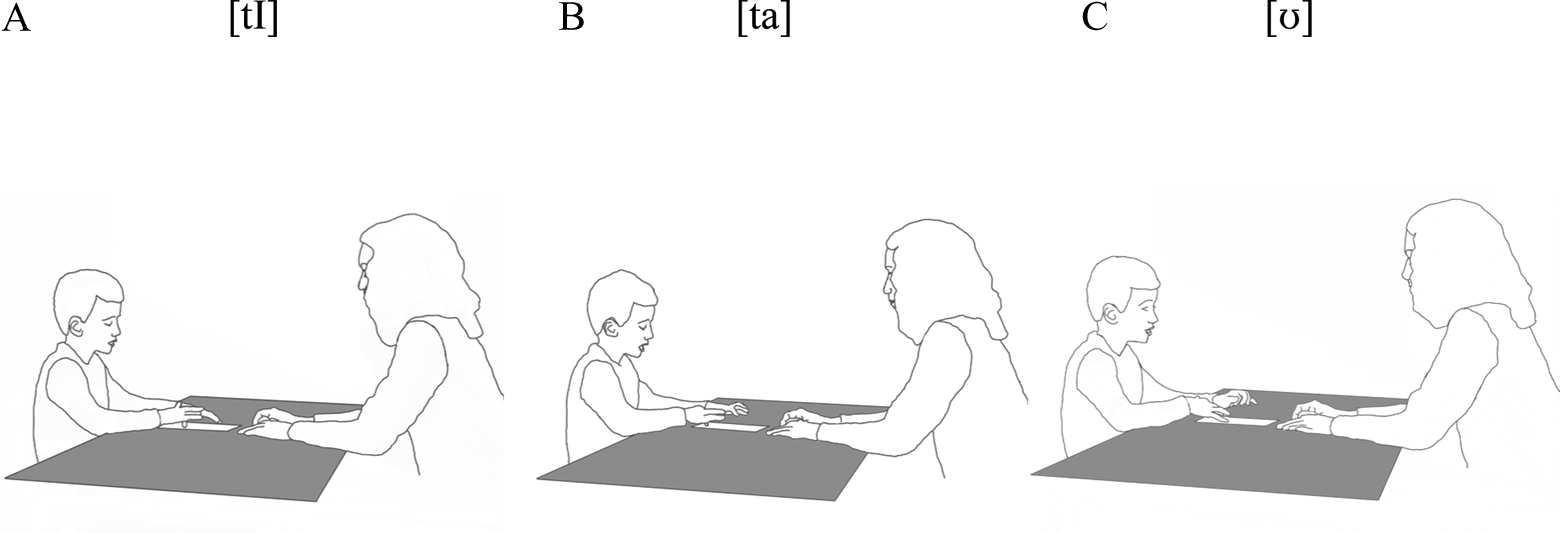
A, [tI] B, [ta]: The boy points twice at the picture, while uttering two syllables. C, [ʊ]: Ted gives eye contact during the last syllable, as he points at the card and says.
In the example [tI ta ʊ], Ted also used prosody in conjunction with the syllables (Figure 5). The first syllable [tI] exhibits a mean pitch of 130 (102–165) Hz, the second syllable a mean pitch of 435 (370–467) Hz and the last syllable a mean pitch of 300 (253–316) Hz. The whole utterance exhibited a mean pitch of 318 (101–467) Hz, about the same as the mean for the session and thus a range of 366 Hz. This was 139 Hz above the mean range for this specific session, which was 227 Hz (Nordgren, 2015).
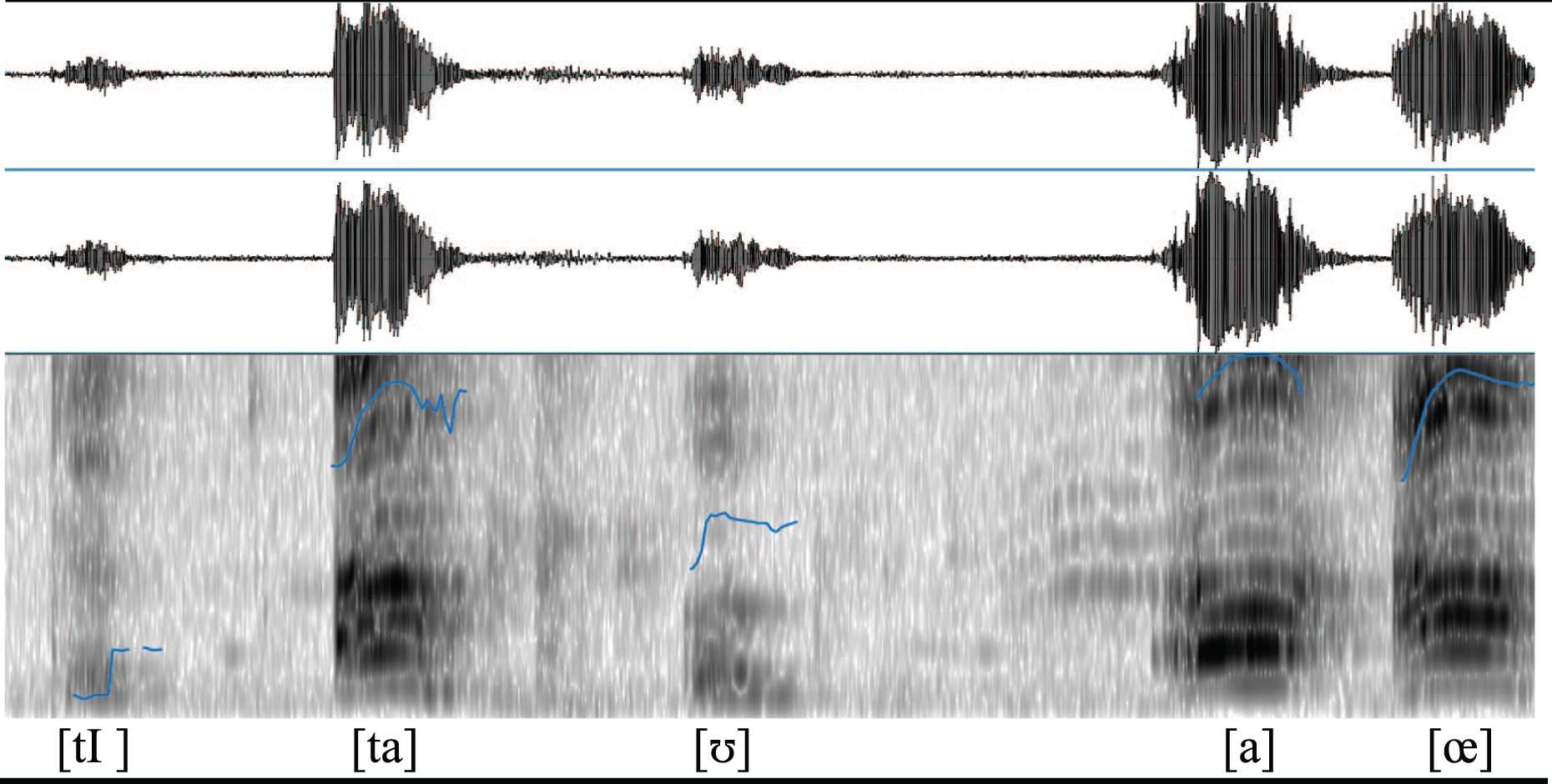
Spectrogram of the phrases [tI] [ta] [ʊ] [a] and [œ].
Example 3: In the third example (Figure 6) the SLP prompts, ‘Here comes Ninni’ and Ted responds [ni: mi: pi:], during a period of 1 second and 14 milliseconds. In picture A (Figure 6), we notice how Ted stretches his right arm forward and simultaneously utteres [ni:]. In the second part of the word, he says the syllable [mi:] and simultaneously makes a deictic gesture (points) with his index finger at the photo (see picture B). In the last part of the word, Ted retracted his hand, smiled and made eye contact. Finally, he said the syllable [pi:] (picture C).
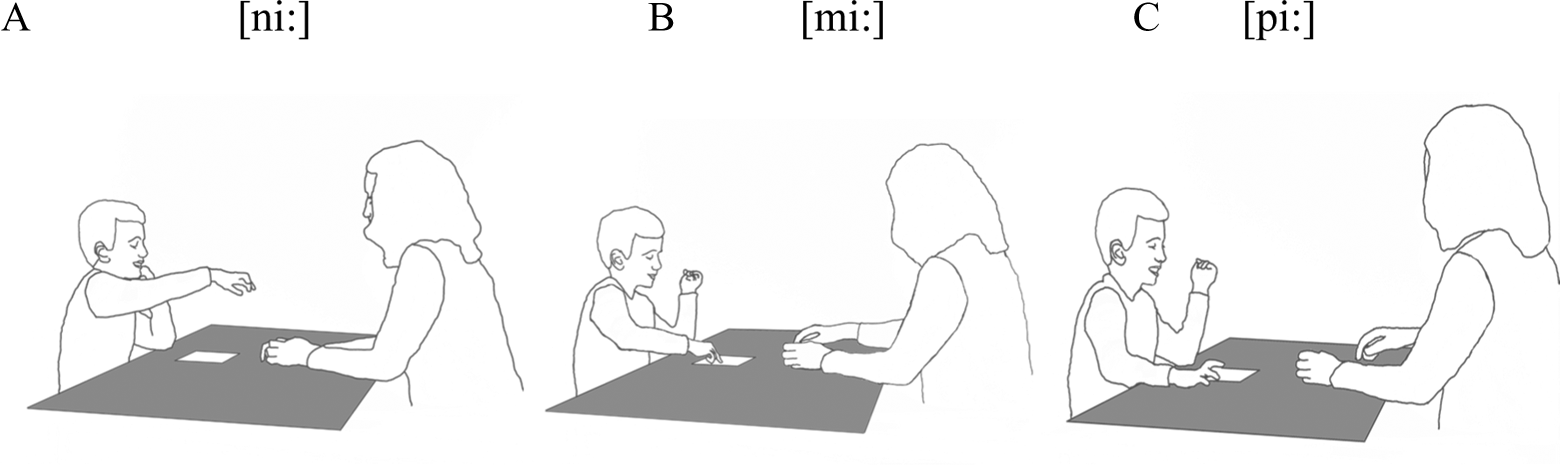
A. Ted’s stretches his right arm forward and says [ni:]. B. Ted utters the syllable [mi:] and points with his index finger on the picture. C. Retraction of the hand + he says the syllable [pi:].
Also in the example [ni mi pi], prosody was used for the various syllables (Figure 7). For the first syllable, [ni], the mean pitch was 409 (324–449) Hz, for the second syllable [mi] the mean pitch was 249 (139–350) Hz and for the last syllable the mean pitch was also 249 (245–251) Hz. For the whole utterance, the mean pitch was 321 (140–449) Hz, about the same as the mean pitch for this session (322 Hz). This happened when the range was 309 Hz, that is, 82 Hz higher than that typical for the session. The general accompanying gestures were infrequent, with only a few examples found. They nevertheless provide instances of movements, which are synchronized with Ted’s speech. We could not find whether any context changed, other than Ted’s behaviour.
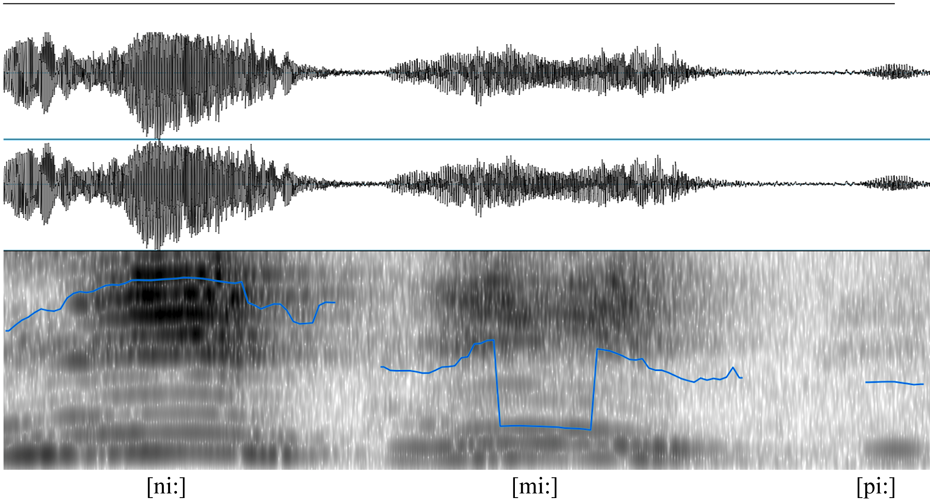
Spectrogram of the phrase [ni:], [mi:] and [pi:].
There appears to be a relationship between Ted’s general accompanying gestures and oral motor function. Of specific interest are Ted’s gestures, which corresponded with the number of syllables in a word. Characteristics of these gestures were: An extension or retraction of the arm. Synchrony with a specific single syllable. Persistence through the speech utterance. That the mean pitch (during gesturing) was about the same level as the mean pitch for the other utterances during the sessions, apart from the utterances with a narrow range, which exhibited a higher mean pitch than usual (146 Hz higher). That they either had a lower (about 80 Hz lower) or higher (about 80–140 Hz higher) range than the mean range for the utterances during the specific sessions. That they exhibited the property of 2–3 syllables.
Summary of the results
In general: According to our predictions, gestures developed in conjunction with language. There was a general increase in the number of deictic and general accompanying gestures in the study period. General accompanying gestures, which were absent during interval 1, were first seen at the beginning of interval 2 and continued to develop during interval 3, despite not being trained in any way. In contrast to what was predicted, declarative gestures were more common than imperative. However, declarative gestures were impaired in relation to TD development but increased (interval 3). This happened when imperative gestures increased in interval 2 but then decreased in interval 3, a difference thath was significant. There was a temporal relationship between the appearance of indexical deictic gestures and the first words (Nordgren, 2015). A temporal interrelationship between speech production and deictic gestures was found (Nordgren, 2015). General accompanying gestures and oral motor function appear to be interrelated. Of specific interest are the gestures that corresponded with the number of syllables in a word, which also appears to be interrelated with prosody. The general accompanying gestures were produced in conjunction with syllables and prosody and may help in retrieving speech and prosodic features. There were some changes in the interaction between the adult and the boy, for example, using communicative utterances instead of actions (the adults) and better cooperation (Ted). A qualitative difference is that Ted did not use his index finger in deictic gestures during interval 1 but did so during intervals 2–3.
Discussion
Deictic gestures (imperative/declarative)
We found that the use of deictic gestures increased during the course of the study, that is, 86% between the intervals 1 and 3, which is a large increase. Imperative gestures increased at first, but then decreased, in favour of declarative gestures, which increased. Declarative gestures are often described in the literature as being totally absent, impaired or delayed in ASC (Camaioni et al., 1997; Carpenter et al., 2002). However, this 5-year-old boy’s use of declarative gestures (≈2 per session) was more frequent than his use of imperative gestures (≈1 per session), despite declarative gestures being impaired in relation to TD development. In this case, use of picture boards before the onset of treatment may have given a platform for the development seen in the present intervention study.
Contrary to expectations given by previous research (for children at this developmental level), Ted’s use of declarative gestures also increased significantly, while that of imperative gestures decreased. This is a striking result as declarative gestures in general are suggested to be less frequent as well as more complex and advanced than imperative gestures. TD children learn their first words at about 9–14 months of age (Camaioni et al., 1997), and declarative gestures are seen as a basis for this acquisition. Ted already had declarative gestures already during interval 1, even if they were infrequent compared to later intervals. The significance of the increase alongside syllable structure development indicates that this is a developmental advancement for the child. Ted reached a stage of development enabling the use of declarative gestures. An explanation for the development may be the use of triadic interactional training with the child, the SLP and the puppet, which, in fact, could have contributed to the improvement, as this develops joint attention. Thus, we noted positive results on speech (which was trained) and also on gestures.
General accompanying gestures (phonetic prosody)
General accompanying gestures also displayed development during the present study. Compared with TD children, children with ASC tend to have fewer general accompanying gestures (Marchena and Eigsti, 2010). Any increase in the use of general accompanying gestures is therefore positive and occurred despite the focus being on phonological segments. During interval 1, a period of very limited speech production (Nordgren, 2015), there were very few general accompanying gestures. This changed in interval 2, when they became more frequent. The general accompanying gestures then coincided with the development of CVCV syllables and improved phonological competence (Nordgren, 2015). The general accompanying gestures continued to increase during interval 3. The overall increase between intervals 1 and 3 was statistically significant.
We found examples of general accompanying gestures, such as hand shapes, finger placements, and extensions or retractions of hand and arm that accompanied speech (or various speech sounds or syllables). Ted’s simultaneous use of these general accompanying gestures and speech sounds and syllables suggests that he used gestures as an aid to retrieve phonemes and syllables, rather than whole lexical units. This is an argument for an interrelationship between speech and gestures (Wagner et al., 2014). An additional fact is that the pitch was higher when general accompanying gestures were used, which also suggests an interrelationship with prosody. The use of these gestures may have been intentional (Guaitella et al., 2009) and used for improving prosodic features also. However, the causality between general accompanying gestures and phonetic prosody is not quite clear from the present study.
Relations between speech and gestures
We also wanted to investigate a possible temporal agreement between the development of deictic gestures and speech production. Such an agreement was found in that gestures developed as speech production increased (Nordgren, 2015). This occurred particularly during the second treatment phase.
During BL 4, the number of deictic gestures per minute decreased remarkably, which may be related to the withdrawal of treatment. An additional explanation could be the increase in the number of minutes per session (Nordgren, 2016), ≈20 min, compared to previous sessions ≈10 min. It is possible that the longer sessions were tiresome for the boy and that he could not participate fully during the whole session.
Ted’s use of his index finger in deictic gestures was a development that occurred between intervals 1 and 2. Before period 2, he used his whole hand for the execution of deictic gestures. This is further support for gestural development. In addition, this development coincided temporally with first word acquisition.
Development of interaction
Ted presented instances of ritualistic and interactional gestures during the study. In addition, he used some iconic gestures, which could resemble sign language (e.g pretending to eat). All these examples show important aspects of Ted being active and specifically interactive. He was involved in playful games during the sessions with the SLP, in particular activities that included interaction. Some major changes in the interaction between adult and boy were noticed. The adults started using communicative utterances instead of using pure actions in communication.
Concluding discussion
We cannot claim to have identified the causal factors but just that speech and gestures are correlated. Nevertheless, speech productions per minute started to increase rapidly between the first baseline and the first treatment period (see Figure 1), while gestures increased only after a period of training. Gestures increased along with speech, but not to the same extent as speech did, which indicates that speech development was primary in this case. It could be that an extent of linguistic development took place during interval 2, which led to an increase in gestures. A certain level of phonological competence might be necessary in order to acquire the facility of gesturing. This would mean that certain precursors interact and possibly take turns in driving the development forward. With regard to gestures as precursors, we notice an increase in general accompanying gestures and their use in the retrieval of sounds and syllables. In addition, prosody developed during the same period of time (Nordgren, 2015). In the present study, it was seen that prosody used together with general accompanying gestures differed from the mean range for that session, which may be explained by increased cognitive load. Uttering these syllables together with prosody seemed very demanding for the boy and the general accompanying gestures may have been used for facilitation. Nevertheless, the prosodic pattern during these specific utterances was at a lower developmental level (Nordgren, 2016), in respect to deviant prosodic features. The close neuro-anatomical relationship between speech production and gestures (Iverson and Thelen, 1999) can explain the co-development in both functions, as seen in the present study. As expected from the theoretical framework, if there is development within one language-related module, we can expect development within the others. Both speech and gestures use auditory and visual perception in interaction. Nevertheless, it may also be that these various areas sometimes compete and development within one area leads to increased cognitive load in another area.
Clinical implications
Gestures and sounds may exhibit a two-way relationship and it can help the child to find the rhythm for speech, using gestures in order to retrieve syllabic units and phonological/prosodic features. Finger-tapping is suggested as a way to improve speech and gesture development.
Limitations and future research
The issue of general development is important to take into account when you perform intervention studies. However, the use of the single-subject design, with the presence of baselines, reduces maturation as a factor involved in the outcome of the present study.
The results of the article are based on just one participant with ASC and intellectual disability, living in a bilingual home, which is why we need to be careful about making any generalizations of other children with similar problems. The group of children with ASC is very heterogeneous and we cannot expect the exact same result with another child. In the future, it is important to include more participants in extended studies. However, the study gives several ideas for future research. Studies concerning precursors of language delay in ASC are needed in order to establish the exact mechanisms of the delay. More specific areas for future studies of precursors in ASC are the development of declarative versus imperative gestures and the study of deictic gestures using the index finger in relation to first word acquisition. The relationship between gestures and phonological/prosodic features versus lexical units is a study of future interest as well as how interaction between adult and child may change due to longitudinal daily focus on speech sounds.
The boy in the present study did not only have the opportunity to listen to auditory stimuli, but he also viewed the teacher’s (and SLP’s) productions of speech sounds visually. This means both auditory and visual input may have been involved in the development of speech and gestures.
Conclusions
An important observation is that the frequency of gestures increased during the course of the study more than expected. This happened temporally as the syllable structure and the first words occurred (Nordgren, 2015). In addition, the boy’s use of declarative gestures increased, while his use of imperative gestures decreased. In ASCs, there appears to be an interrelationship between speech and gestures in the development of communicative skills. This was seen in the use of gestures for retrieval of phonemes and syllables, the correlation between the production of speech and deictic gestures per minute, and the prosodic structure used in conjunction with gestures. Notably, the interventions in the study did not train gestures, but nevertheless the frequency of gestures increased during the year. This development suggests a link between verbal and non-verbal language in communicative development in ASCs and that a further investigation of gestures may help to guide clinical practice.
Footnotes
Acknowledgements
I would like to express my sincerest gratitude to the family, the teachers and the SLP involved in this study. I am grateful to Professor Åsa Abelin and Professor Sally Boyd at the Department of Philosophy, Linguistics and Theory of Science, University of Gothenburg, Sweden, for giving me ongoing support and thoughtful comments on the manuscript.
Declaration of conflicting interests
The author(s) declared no potential conflicts of interest with respect to the research, authorship and/or publication of this article.
Ethical issues
This work was approved by the Regional Ethical Review Board in Gothenburg, Sweden on the 13th of December 2010. Parents have given their informed consent to the study.
Funding
The author(s) disclosed receipt of the following financial support for the research, authorship and/or publication of this article: The Region Västra Götaland, Sweden, the University of Gothenburg, Sweden, the Kempe-Carlgrenska foundation, Sweden, and the Royal Hvitfeldska foundation, Sweden, funded this work.