







Abstract
Background:
Students with intellectual disabilities may lack sufficiently developed skills to initiate qualitatively good social interactions; thus, they might be in need of assistance. This study examined special education teachers’ role in facilitating peer relationships among students with mild intellectual disabilities in a mainstream school context.
Materials and Methods:
The study was based on qualitative semi-structured interviews with nine special education teachers who belong to special education groups in lower secondary schools. A thematic structural analysis was used to identify themes.
Results:
The teachers made substantial efforts to promote social competence and ensure optimal conditions to foster peer interactions. An “academic-oriented” education, divergent attitudes, challenges in teacher collaboration, and organizational constraints may be barriers.
Conclusions:
In a mainstream school, the role of special education teachers appears to be dependent on the basic values of the school management in terms of real opportunities to foster peer relationships among students with mild intellectual disabilities.
Keywords
Introduction
Close relationships appear to be a prerequisite for gaining experiences of belonging, community, and social support (Bukowski et al., 1996; Newcomb and Bagwell, 1996). However, the essential preconditions for succeeding in social interactions presuppose the presence of age-appropriate social skills (Frostad and Pijl, 2007), the rapid interpretation of social information, and a capacity to choose the most useful strategies (Guralnick, 2006, 2010). For a large number of people with cognitive difficulties, information processing is challenging and may cause difficulties in terms of understanding the necessary information to manage social interactions in a satisfactory manner. Students with intellectual disabilities may lack sufficiently developed skills to initiate qualitatively good social interactions; thus, they may be vulnerable to the difficulties that are associated with this form of peer competence (Carter and Hughes, 2005; Pijl et al., 2008), and they appear to be at greater risk of being excluded (Estell et al., 2009). Learning of formal and informal rules that regulate social interactions and relationships is more difficult for people with intellectual disabilities because learning and internalizing these rules depends to a certain extent on the capacity to recognize, regulate, or respond to the emotions of one’s self and others, and this ability is somewhat impaired in students with intellectual disabilities (Carr and O’Reilly, 2016). Challenges in recognizing, regulating, and responding to emotions of others and difficulties in following social rules thus make the process of establishing and maintaining long-term relationships more difficult for these students. Fewer relationships may also provide fewer positive experiences, which could further weaken these students’ social competence (Pijl et al., 2008).
The present article examined special education teachers’ role in facilitating peer relationships among students with mild intellectual disabilities. Mild intellectual disabilities are defined according to the International Statistical Classification of Diseases and Related Health Problems, 10th revision (ICD-10) (World Health Organization, Version 2016, 2016). The diagnosis of an intellectual disability is based both on a reduced level of intellectual functioning and limitations in adaptive behavior expressed in conceptual, practical, and social competences, before the age of 18 (Schalock et al., 2010). Although the focus of the present article is targeted to special education teachers of students with intellectual disabilities in a mainstream Norwegian school context, an overview of this field on an international level is still relevant. This overview has particular interest for the description of this group of students in a social domain and in considering how special education teachers can facilitate optimal conditions to foster peer interactions within such a form of organization.
During adolescence, certain developmental factors may play a role in peer interaction. For students in lower secondary school, the experiences of the teenage years may be challenging (Brown and Clute, 2003). Throughout adolescence, major changes occur in relation to peers: belonging becomes increasingly important, social interactions become more complex (Parker and Gottman, 1989), and the challenges may further influence students’ attitudes and social acceptance of peers with special needs (Estell et al., 2008). Moreover, at a higher level of education, general education entails ever-increasing demands on individuals (Carter and Hughes, 2005), which may affect students’ engagement and opportunities for social interaction (Wagner et al., 2003).
For the majority of adolescents, peer relationships develop naturally with no particular facilitation. However, adolescents with intellectual disabilities often require assistance to improve their social participation and peer interactions (Carter and Pesko, 2008; Reed et al., 2011). Additional support from people in close relationships with the adolescent seems to be an essential condition for social interactions to work. Previous studies have demonstrated that some close caregivers or professionals may play a crucial role in assisting people with intellectual disabilities in their capacity to address social relationships (Mason et al., 2013; McVilly et al., 2006). Social support, good adult role models, and social skill training appear to be of significant importance (Bramston et al., 2005; Matheson et al., 2007). In a school context, research findings have particularly emphasized the need for teacher-initiated interventions (Carter et al., 2005, 2008; Moore and Carey, 2005; Rossetti, 2012). Contextual factors have been found to have a major impact on students’ participation, which suggests that social interventions should be based on a careful identification of the particular factors that contribute to promoting students’ social participation.
The role of teachers has been emphasized in terms of the quality and frequency of social interactions (Carter et al., 2005). Nevertheless, teachers’ impact is not unambiguously positive (Rossetti, 2012; Wendelborg and Tøssebro, 2011). In some cases, the close proximity of special education teachers appears to suppress students’ social interaction (Carter et al., 2008; de Boer et al., 2012). Thus, the role of special education teachers may be critical depending on the way that teachers design their roles as supporters of these students.
To make the teacher’s role less prominent, peer interventions have been found to be effective. Typically, developing peers can be given a particular task, such as mentoring, to provide social and academic peer support and friendship to students with moderate and severe disabilities (Carter and Hughes, 2005; Carter et al., 2005; Moore and Carey, 2005; Rossetti, 2012). Although it does not replace teachers’ efforts, this practice has been shown to contribute positively to strengthening social interaction (Carter and Kennedy, 2006).
As supervisors and facilitators, special education teachers’ role is not negligible. Because of challenging difficulties in the social competence area, special education teachers of students with intellectual disabilities have responsibility especially in social facilitation. However, special education teachers’ role in facilitating peer interactions does not exist in isolation. The special education teacher is a part of a teaching community, and it is important to identify what the teacher’s role entails within a specific context. In particular, it is important to determine to what extent extraneous contextual factors, such as the school’s overriding focus, the school’s leadership, the locality, or teacher collaboration, affect special education teachers’ opportunities to facilitate increased social interaction among their students.
These issues appear to be insufficiently examined regarding special education teachers who are responsible for students with mild intellectual disabilities in special education groups in mainstream schools. In-depth qualitative research is needed to better understand the opportunities that special education teachers have in a mainstream school to facilitate the development of peer relationships in adolescents with mild intellectual disabilities.
The present article takes the perspective of special education teachers in a mainstream school context. The purpose is to examine what opportunities and constraints characterize special education teachers’ efforts in facilitating peer relationships among adolescent students in lower secondary schools who have mild intellectual disabilities. The results of this examination form the background for an overall discussion of the significance of these opportunities and constraints with respect to special education teachers’ role in facilitating peer relationships in this type of school context.
Materials and methods
This study focused on students in lower secondary schools in Norway who have mild intellectual disabilities and was designed in the form of qualitative in-depth interviews with nine teachers of these students. In the present study, the researcher completed all parts of the research process, namely, planning and developing the interview guide, implementing the interviews, interpreting the data, and discussing the results. The planning of the interview guide and interpretation of the data were also discussed with colleagues in this field.
The sample and the selection process
Norway has a full inclusion policy. To improve education for students with special needs, special education groups are occasionally organized for older students. In several cases, students receive their education partly within these groups and partly within their regular classes.
The special education teachers of students with mild intellectual disabilities/general learning disabilities who belong to special education groups in four mainstream Norwegian schools were invited to participate. Eight of their 11 students had a clear diagnosis (Sigstad, 2017) from specialist health-care services.
The responsibility for the students who belong to a special education group in a mainstream school was used as a selection criterion to elicit teachers’ perspectives on students’ peer relationships, including friends both with and without intellectual disabilities.
The researcher made initial contact with the heads of special education at each school. Then, informational meetings were held for the special education group teachers. The schools provided feedback on 13 potential teacher interviewees. Teachers, students, and the parents of these students were asked to provide permission for the teacher interviews by sending one reply form directly to the researcher.
Three ordinary schools were involved. One of the schools recruited students from regular classes to the special education group and the other schools recruited students from a broader region. One of the groups had a central location in the school. In the other cases, the special education groups were slightly less centrally located within the school campus. The actual sample included nine teachers (seven women and two men) whose ages ranged from 25 to 65 years. In the case of two of the schools, the teachers taught partly in special education groups and partly in regular classes. In the third school, the teachers performed all their instruction in special groups. With the exception of one teacher, all participants were qualified as special education teachers or general teachers. In this study, all the participants are called special education teachers.
Ethical considerations
This study was conducted according to the World Medical Association Declaration of Helsinki (2017) and was approved by the Norwegian Centre for Research Data (NSD, 2017). The participants were guaranteed anonymity and the right to withdraw from the project at any time. In addition, the participants’ statements were anonymous in terms of names, dialects, positional information, and other recognizable characteristics.
The interviews
The study involved nine interviews, one interview per teacher. The interviews were conducted using a semi-structured guide with predetermined issues but with openness to new topics that may emerge. Examples of predetermined themes were as follows: the students’ social participation and well-being at school (in the special education group, in teaching, in the break, at school in general), what the teachers did to facilitate social interaction among the students, the teachers’ opportunities to influence the facilitation of peer interactions, and current barriers in relation to the facilitation of peer relationships in the school context. Some of the questions were as follows: In what ways do the students describe their enjoyment of school (in the special education group, on breaks and at school in general)? Do you think that friendship has meaning for your students? In what situations do you facilitate the development of peer relationships at school (in the special education group, on breaks, and at school in general)? In what ways do you facilitate the development of peer relationships at school (in the special education group, on breaks, and at school in general)? What opportunities do you have to facilitate peer relationships among your students at school? What characterizes the possible constraints on facilitating peer relationships among your students at school?
The face-to-face interviews were conducted at the schools, and each interview lasted approximately one-and-a-half hours. The interviews were taped on a digital recorder and transcribed word for word as soon as possible after the interviews were completed. Field notes were also taken immediately after the interviews.
Data analyses
The analysis was conducted by a data-driven process. The primary material consisted of interview dialogues with the teachers. A thematic structural analysis was used to identify themes (Lindseth and Norberg, 2004). Using condensed descriptions, attempts were made to capture the essential meaning of lived experiences. The meaning units were further condensed into subthemes, which were assembled into themes (see Table 1).
Examples of a thematic structural analysis (Lindseth and Norberg, 2004): Interviews with the teachers.
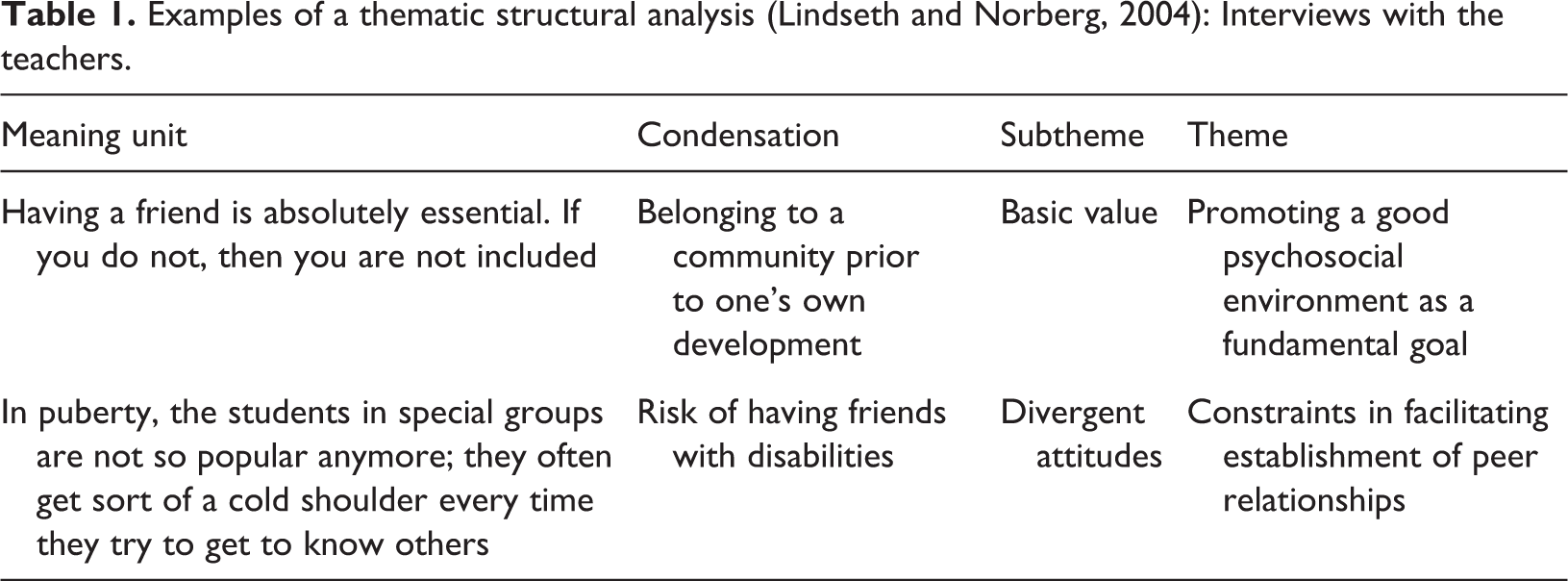
A thematic analysis of the level of self-understanding that is based on the respondents’ own thematizing is used to present the qualitative empirical data, as described in the “Results” section (Brinkmann and Kvale, 2014). The empirical findings are further discussed on an overarching theoretical level in the “Discussion” section. The thematic analysis was used to identify implicit and explicit ideas in the data (with meaning units; see Table 1). Themes were seen as the similarities in patterns across the data that were important to describe the phenomenon and that were associated with specific research questions. The process was conducted by generating initial codes (by condensing the meaning units), searching for themes among these codes (subthemes), reviewing the subthemes and defining and naming the main themes (themes). NVivo 10 was used as technical assistance in the coding process to develop free nodes and to further structure the nodes into three nodes.
To improve the trustworthiness of the study, all interpretations were presented in subthemes and themes that were consistent with the transcriptions of the interviews. These interpretations were also presented with the help of clarifying discussions with colleagues and were discussed from several perspectives throughout the analysis. On the basis of examples of interpretations, the relationships between the different levels in the data analysis were reviewed and discussed. The remaining data collected from the interviews with students and parents (Sigstad, 2016, 2017) were also used to strengthen the credibility of the teachers’ interpretations.
Results
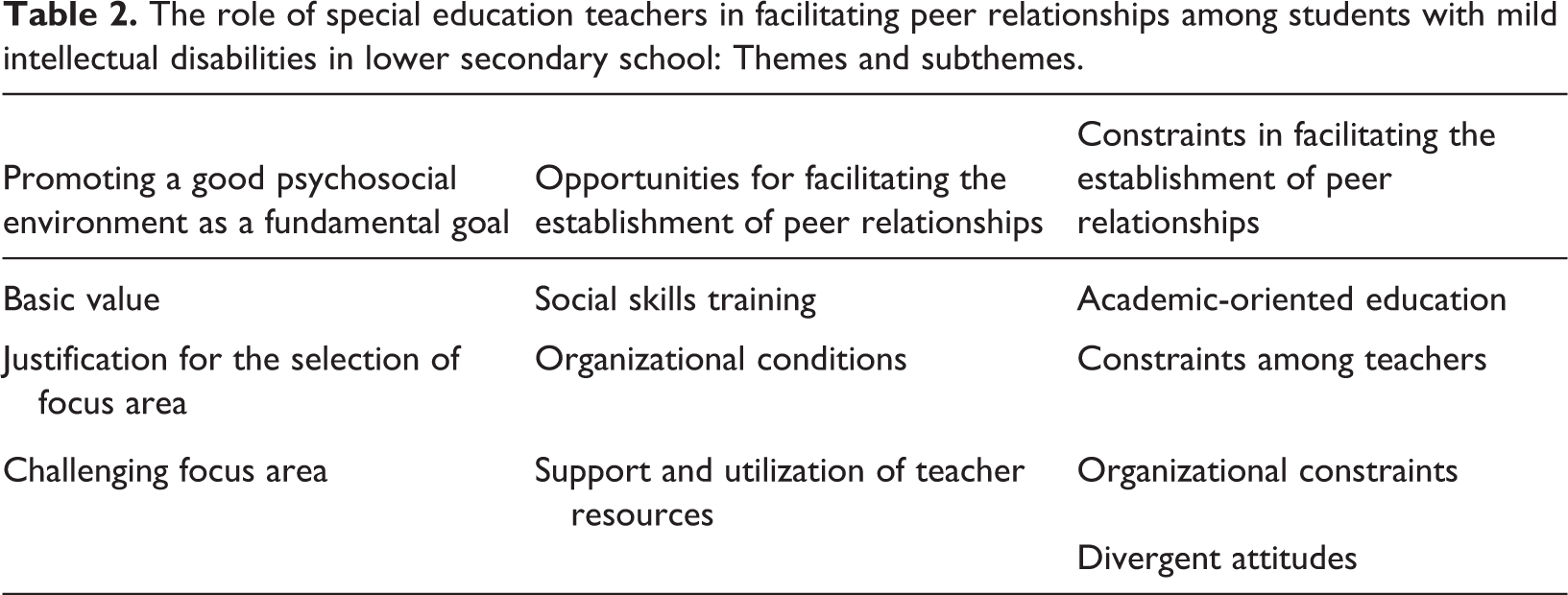
In the present study, the special education teachers’ efforts to facilitate peer relationships were categorized into three themes: promoting a good psychosocial environment as a fundamental goal, opportunities for facilitating the establishment of peer relationships, and constraints in facilitating the establishment of peer relationships. The findings that are presented below are divided according to these three main themes (see Table 2). Quotes are used to exemplify the themes.
The role of special education teachers in facilitating peer relationships among students with mild intellectual disabilities in lower secondary school: Themes and subthemes.
Promoting a good psychosocial environment as a fundamental goal
Promoting a good psychosocial environment was emphasized as an overarching goal. The establishment of peer relationships was crucial. A clear value base appears to be overriding to what they actually did to get social interaction to work. The theme included three subthemes: basic value, justifications for the selection of the focus area, and a challenging focus area.
The subtheme basic value demonstrated the extent to which the teachers’ attention to the facilitation of peer relationships was of supreme importance. Focusing on a good psychosocial environment was highlighted as more essential for adolescents with intellectual disabilities than working with academic tasks: The most important success factor is about having one or more relationships. Perhaps the effort to contribute to relationships is our most important task in school. Although you are unable to master the multiplication tables, with a close relationship, you may be happy for the rest of your life.
In various ways, the special education teachers described the background for their focus area in school. This subtheme illustrated justifications for the selection of the focus area. The teachers rationalized their social focus with the students’ lack of opportunities to succeed in society. To develop lasting relationships, the experience of belonging and community within a small special education group at school was considered of crucial importance: In the long term, our students lose many opportunities for employment because the labour market has been made more efficient. Later, it will be increasingly harder for these students to succeed in their adult life. This makes venues like this special education group absolutely crucial, in which you can establish lasting friendships.
However, facilitating good peer relationships and creating an adequate psychosocial environment at school may involve several challenges, particularly regarding students with intellectual disabilities in a mainstream school context. As such, promoting a good psychosocial environment was a challenging focus area and objective in practice: I miss recognition of this focus area in school in general. In a special education group, we have opportunities to do work on the social environment. We need to do fundamental work in this area, but the work may be challenging due to the increasing focus on goals and achievements in school in general.
Opportunities for facilitating the establishment of peer relationships
Despite various challenges, the special education teachers experienced numerous opportunities to facilitate the establishment of relationships. This theme was categorized into three subthemes: social skills training, organizational conditions, and support and utilization of teacher resources.
To enhance the students’ abilities to establish peer relationships, the special education teachers focused on social skills training. This training involved exercises in positive self-promotion, assistance in avoiding dominating behavior, and training in tolerance. Furthermore, considerable time was allocated for conversations that are related to the topic of friendship: Friendship is the greatest challenge. It’s extremely hard to work with social competence in this group. They are simply so weak, but they will gladly work. We must continually discuss the theme of friendship and social training.
Facilitating the establishment of peer relationships at school involves organizational conditions. Because the students belonged to mainstream schools, facilitating the establishment of peer relationships across various groups was a relevant theme. However, the inclusion of these adolescents in regular classes depended on the students’ individual conditions and presupposed proper planning. Individual conditions among the students with intellectual disabilities could be about cognitive and linguistic capabilities, sense of security, and confidence as well. Among certain teachers, a so-called reverse integration was experienced as a more suitable alternative: Instead of including students in regular classes, some general teachers choose to send students from the mainstream classes into our special education groups. Working with the establishment of relationships in that manner is a more functional solution for us.
From the perspective of the special education teachers, real opportunities to facilitate the establishment of peer relationships also depended on the available support and utilization of teacher resources. In this respect, support from the school management was substantial: The current principal experiences our students as a source of enrichment. Such support from the school management is of immense significance.
Social support from other teachers was invaluable as well. Initiatives from the other general teachers were considered particularly supportive. Enhancing teacher collaboration across all groups and classes was considered a good opportunity to strengthen the psychosocial environment at school. However, the special education teachers called for better teacher cooperation. The inclusion of students with special needs was often dependent on their own facilitation and to a limited degree only.
Constraints in facilitating the establishment of peer relationships
Certain limitations may present obstacles to the facilitation of peer relationships. The constraints were categorized as follows: academic-oriented education, constraints among teachers, organizational constraints, and divergent attitudes.
An academic-oriented education in lower secondary school may present a barrier. The special education teachers experienced the academic orientation as a challenge. Attention to social competence seemed to be missing: I observe the students in the regular classes; they do have many subjects, and they may not lose anything. Social competence could be a kind of elective. All the teachers over there—it’s curriculum, grades and exams. It is a completely different focus. Sometimes it can be challenging with so much attention to achievement and performance in school.
A lack of facilitation of peer interaction was also due to certain constraints among the teachers themselves. Some special education teachers noted challenges that were associated with teacher collaboration: We cooperate with the regular teachers, but it is not permanent. A lack of collaboration may be an obstacle. The other teachers are not so focused on all the other students with special needs.
Another challenge was the lack of stability, involvement, and awareness of special education teachers among the staff. According to some of the teachers, working with social competence may be given a lower priority, even in the special education group. One of the special education teachers emphasized that this prioritization depended on additional commitment; however, he lacked this engagement at his current school.
In addition to limitations among the teachers, organizational constraints may present barriers to the facilitation of peer interactions. These barriers may involve localities, technical challenges in the schedule, or a lack of public venues. In two cases, the facilities of the special education groups were physically separated from the other facilities. Thus, physical conditions may be a contributing factor to the lack of contact between the students: To some extent, we are isolated at school. There is not close contact. Active meeting points with the others are mainly non-existent.
For students in lower secondary school who have intellectual disabilities, friendships were commonly restricted to peers within the special education group. The most common reason for the lack of interaction with peers in mainstream classes was divergent attitudes among typically developing peers. Their attitudes were influenced by egocentricity and the risk of having friends with a disability. Thus, there were constraints in the establishment of peer interactions: The youngsters are entering a period of time in which they are very egocentric. It is risky to have friends who are different. They do have a great deal of care; they enter into a caring role, but the relationships cannot be described as friendships.
The special education teachers experienced an increasing gap between the students’ developmental levels in the mainstream school. Despite the care demonstrated by many of the students in the regular classes, it was difficult to achieve equal friendships.
Discussion
Regarding the opportunities that special education teachers have to facilitate the development of peer relationships among students in lower secondary school who have mild intellectual disabilities, two themes seem to be particularly relevant: the high significance of enhancing peer interaction in education and special education teachers’ role in facilitating these peer interactions within a mainstream school context.
In the current study, the special education teachers had the overarching goal of facilitating the establishment of peer relationships. Focusing on a good psychosocial environment was considered more essential than presenting academic tasks to adolescents with intellectual disabilities. This understanding appeared to be particularly motivated by a long-term perspective. The special education teachers considered belonging and peer relations to be the most important success factors for a good life. Providing help in establishing relationships in adolescence was thus deemed to be the main task of the special education teachers. Previous studies have suggested that social interaction is frequently a separate learning objective for adolescents with intellectual disabilities (Carter et al., 2005). Peer interaction is considered an advantage in mainstream schools (Carter and Hughes, 2005). However, students with intellectual disabilities rarely interact with their typically developing peers. This was also the case in the present study.
The teachers’ substantial weighting of psychosocial conditions in school may be explained on the basis of external organizational issues. General attention to academic skills and goal achievement in school may have contributed to this emphasis on psychosocial conditions in teaching students with intellectual disabilities. Thus, psychosocial competence objectives appear to be of greater importance for these special education teachers, possibly because of the significant academic shortcomings and increasing social challenges they observed in the special education group. The students’ peers in the mainstream school seemed to be at a different developmental stage, both academically and in terms of social development (Brown and Clute, 2003). Students with inadequate skills in coping with relationships thus appeared to be at risk of being excluded (Estell et al., 2008).
Given these students’ lack of social skills, an instructive skill training is recommended to promote peer interactions (Carter and Hughes, 2005). In the present study, the students needed to develop adequate skills and to receive training in establishing and maintaining friendships. For various reasons, the development of prosocial skills is significant in terms of students’ learning. Teaching students with intellectual disabilities in a mainstream school context appeared to reinforce the value-based foundations of education. However, increasing focus on the students’ psychosocial development was experienced as challenging in this academic context. The teachers missed a similar focus in the schools in general, and they emphasized that it was difficult to maintain these values within a mainstream school.
Given their responsibility for students with mild intellectual disabilities within the mainstream school context, these teachers suggest numerous opportunities as well as several limitations with regard to the facilitation of peer relationships. An increased emphasis on the inclusion of students with intellectual disabilities appeared to be a motive to examine organizational options and choices. The special education teachers attempted to find opportunities for their students to attend mainstream classes. This overarching objective was linked to the social aspect and the belief that students should have genuine possibilities for social participation within regular classes. Some teachers preferred the so-called reverse inclusion. This practice is well known in previous research. Schoolmates are frequently used as positive role models to support their peers with intellectual disabilities (Carter et al., 2005; Dolva et al., 2010; Rossetti, 2012). In this case, the purpose is to strengthen social interaction using peer-mediated strategies.
An awareness of the development of social competence as an overarching goal of all teaching was considered crucial in strengthening students’ capacities to interact with others. The results of the present study indicate various obstacles. Within a mainstream school context, some of these constraints are of particular relevance. An increasingly academic-oriented education, the limitations among special education teachers and in teacher collaboration, the organizational constraints in schools, and divergent attitudes regarding students with intellectual disabilities are examples of challenges. A focus on the psychosocial environment at school and an awareness of the need to facilitate peer relationships were conditional upon support at school and good utilization of the school’s teaching resources. The special education teachers noted that they depended on support from the schools’ management and increased teacher collaboration to make this happen.
In this context, the role of special education teachers appears to be essential. From a developmental ecological approach (Bø, 2012), opportunities and constraints may indicate room for special education teachers to maneuver in this arena and cause special education teachers to be actors in this context. Considering the current data, the possibilities and limitations in the school context appear to be guided by the five conditions of the special education teacher’s personal preferences, the individual characteristics of the students, support from other colleagues, organizational conditions at the school, and the school management or management philosophy. In this case, the student group included all students, the teacher colleagues included both special education teachers and general teachers, and the organizational conditions included physical rooms and public venues. The teacher’s role appears to be designed in light of the various arenas in which the teacher practices his profession and in light of the various individuals who are located within these arenas. In addition, the role is affected by the interaction between the various arenas. Thus, the role of the special education teacher is complex but may be interpreted through a developmental ecological approach.
The present study examined lower secondary school students with mild intellectual disabilities. Students with mild intellectual disabilities typically have learning difficulties in school (World Health Organization, 2016). However, in adulthood, many of these students should be able to manage jobs and to contribute to society. The students in the current study were aged 13–16 years and belonged to a mainstream school with an overall academic focus. Students’ goal achievement is central, and the performance of the typically developing students is assessed with grades. Both the school’s management and the teachers are committed to fulfilling the school’s intentions. In turn, the students are committed to achieving their goals. In this context, the current study has demonstrated how academic-oriented teaching in lower secondary schools may present a general challenge, especially in terms of prioritizing other types of values in education. These findings are in accordance with previous research. An academic-oriented focus has been found to be one of the key causal factors that prevents opportunities for social interaction in school (Carter and Hughes, 2005) and thus increases the risk of loneliness in students (Rossetti, 2012). The structure and focus of secondary school are far more academically oriented than those of primary school. For many students, it may also be risky to develop friendships with students with special needs (Parker and Gottman, 1989). In this stage of development, adolescent students work diligently to maintain their position among peers, which may affect the opportunities for students with intellectual disabilities to establish relationships.
In this context, the role of special education teachers is crucial. The special education teachers in the present study were responsible for following up with the students in the special education groups and were committed to following the school’s governing curriculum. Thus, they had both academic and social ambitions on behalf of their students. Compared with the general teachers in the school, the role of the special education teachers in a mainstream school is different. The number of special education teachers in special education groups may be larger than in other classes. A smaller number of students may provide closer proximity of the teachers to both students and parents. Due to their responsibility for a smaller group of students with intellectual disabilities, the teachers may also have stronger loyalty toward their students. Moreover, several of the participants in the present study explained that the special education groups functioned as separate divisions in the mainstream school. Thus, it appears that the teaching of students with intellectual disabilities occurred within a context independent of the whole, as did the professional conduct of the special education teachers. However, previous studies have shown that students with disabilities who do not physically attend classes with students without disabilities miss numerous opportunities for social interaction with their peers (Feldman et al., 2016). Social participation presupposes physical proximity. Moving students into regular schools does not always lead to inclusion (Siperstein and Parker, 2008). In this case, the distance between the special education groups and the mainstream classes was unfavorable.
The special education teachers in the current study were employed within special education groups and were simultaneously employed as teachers in a larger collegium with the same principal. They were close to the general teachers, and they experienced commitment to the school’s overall goals and ambitions. A special education teacher employed in a mainstream school is aware of opportunities to facilitate the development of peer interactions in the environment. Special education teachers may also have greater freedom in their role than general teachers, especially in terms of their choice of focus in teaching. This freedom may be an advantage that may provide opportunities to enhance the social competence of the students.
Research based on a social network perspective has observed teachers’ network position with respect to teacher collaboration within school (Moolenaar, 2012). Teachers may benefit from resources in the social network only if they have access through their social relationships. The network structure in schools appears to be fragmented, resulting in subgroups. The more similar individuals are, the more rapidly resources will flow between them. However, if teachers are disconnected from the flow of resources in the network, the school’s ability to achieve its goals may be hindered.
Thus, the present study has demonstrated how the role of the special education teacher appears to be challenged within a mainstream school context. The special education teachers seemed to be bound to a kind of “outsidership” within their subgroups. The close follow-up of students with special needs, which, in principle, is a strength, may be an obstacle to their work and may present a barrier to facilitating peer relationships. As supporters of their students with intellectual disabilities, the special education teachers seemed to be at the same risk of being marginalized as their own students; more precisely, they may be excluded by their general colleagues. Paradoxically, their closeness to students with intellectual disabilities appeared to be an obstacle for the special education teachers to achieve their own significant objectives, including focusing on developing social competence and facilitating their students’ interactions with their peers. However, friendship and social training without context is ineffective. The onus of relationship building and social skill development should not be on the individual special education teacher only. Social network research has explored how a teacher’s position within the school impacts his or her job self-efficacy and ability to implement certain policies and practice (Daly et al., 2014; Moolenaar, 2012; Spillane et al., 2015). Teachers’ human capital does not occur in a vacuum. The human capital of teachers is developed, strengthened, and shared through social interaction and collaboration in a social network, resulting in new knowledge that improves students’ achievement (Moolenaar, 2012). The results indicate that the human capital of special education teachers is not utilized (Daly et al., 2014). Their education is qualitatively different from that used in general education. One benefit of having special education groups within a regular school seems to be the opportunities that exist for students in this context in terms of both academic and social development. The question is to what extent the lack of connections to the larger network seems to impede the flow of resources to students with special needs and prevent goals from being met.
Methodological limitations
The study is limited by the sample size. However, the sample included nine in-depth interviews with rich descriptions, in which the participants highlighted the contemporary problems in this field. One strength of the study is that the researcher contributed to all parts of the project. A closer research collaboration throughout the process and the use of respondents in reviewing the interpretations could have further supported the reliability and validity of the results. However, the quality of this study was ensured by the collaboration with colleagues on the interview guide and clarifying discussions concerning the interpretations of the data. In order to examine in what extent the subthemes and the main themes were representative categories of the respondents’ own thematizing from the interviews, connections between the different levels in the data analysis were reviewed, and examples of interpretations discussed. The remaining data that were collected from the interviews with students and parents (Sigstad, 2016, 2017) were also used to strengthen the credibility of the teachers’ interpretations.
In light of the results of this study, a natural question may be whether these findings would have differed with the selection of a different sample. The interpretations of special education teachers’ role in facilitating peer relationships may have been different with samples of teachers in schools with another approach. The results of the present study may also have differed with the inclusion of the schools’ management and/or the general teachers. The question is whether the descriptions of the role of special education teachers in facilitating peer relationships within a mainstream school context were determined by the actual participants in this study, who had an apparently isolated role in their efforts within these special education groups. Nevertheless, the current study presents rich descriptions of how these special education teachers perceive their role in facilitating relationships among students with mild intellectual disabilities within the school context in which they work. Further research is needed. These findings provide examples of some key issues that may form the basis for new questions within research studies in this area.
Conclusions
Based on a discussion of what special education teachers do to facilitate peer relationships among adolescent students with mild intellectual disabilities, the present study identifies two topics of particular interest: the strong weight assigned to the facilitation of peer relationships in education and the design of special education teachers’ role in facilitating peer interactions within a mainstream school context.
The issue is what opportunities exist for the best possible facilitation of peer relationships for students with intellectual disabilities within a mainstream school context. Teachers have shown that they perform an essential role in contributing to the development of necessary skills and ensuring an optimal environment to foster peer interactions. Nevertheless, this study identifies several obstacles that prevent special education teachers from succeeding in this area. The present study has demonstrated how the role of special education teachers seems to be particularly challenged in such a mainstream school context.
Teachers appear to face certain dilemmas. Special education teachers have responsibility for students in separate groups within mainstream secondary schools. Based on overall social objectives, special education teachers attempt to facilitate peer relationships among their students with mild intellectual disabilities in the best possible manner. Moreover, the school maintains academic ambitions that are also the overarching goals for the general teachers. Typically developing students appear to have a different focus in school; they have clear academic expectations for their schoolwork, and they are involved in a challenging process of self-development.
The question is what is needed to expand the opportunities for special education teachers to facilitate good peer relationships among students with mild intellectual disabilities in this school context. Change seems to depend upon the school’s management philosophy. The school’s core values may govern the teaching staff’s attitudes, the teachers’ choices and priorities, and possibly the teachers’ motivation for working together. With an overarching philosophy in which students with intellectual disabilities are genuinely included in school, general teachers also have a responsibility to promote psychosocial competence among students with intellectual disabilities. The basic values are primarily associated with attitudes toward students with special needs. Secondarily, this effort involves identifying suitable meeting areas for students and for teachers. In this context, physical location, common schedules, and time for teacher collaboration may be relevant topics. In addition to an awareness of these issues in education, organizational adaptations may be required.
Footnotes
Acknowledgements
The author thanks Heidi Mjelve at University of Oslo for her helpful support in planning this study.
Declaration of conflicting interests
The author(s) declared no potential conflicts of interest with respect to the research, authorship, and/or publication of this article.
Funding
The author(s) received no financial support for the research, authorship, and/or publication of this article.