






Abstract
Parents raising children with autism have distinct experiences that influence their well-being, relationships, engagement with the public, and interaction with education and healthcare systems. However, experiences of fathers of children with autism have been largely overlooked by researchers. This meta-synthesis is our synthesis of qualitative accounts of fathers’ experiences and we included peer reviewed and gray literature articles that: (1) reported primary qualitative research, (2) included fathers of children with autism as participants, and (3) reported qualitative findings on the first-hand experiences of fathers of children with autism. Studies were appraised for quality and many theoretical and methodological deficiencies identified. Six studies met quality appraisal criteria and three main themes of findings from these studies were generated: (1) adaptation and concern with the future, (2) the importance of cultural context, and (3) reverence for one’s child and new opportunities. Fathers’ experiences illuminate a need for father-oriented resources that recognize fathers’ value in children’s lives.
Introduction
Autism spectrum disorder (ASD) is a neurological developmental disorder that presents parents with distinct challenges and opportunities that impact their individual well-being, spousal and family relationships, engagement with the public sphere, and interaction with education and healthcare systems (Braunstein et al., 2013; Corcoran et al., 2015; DePape and Sally, 2015; Meadan et al., 2010). These challenges and opportunities are synthesized in systematic reviews and meta-syntheses by DePape and Lindsay (2015), about experiences of parents raising children with ASD, and Corcoran et al. (2015), about lived experiences of US parents of children with ASD. DePape and Lindsay (2015) included 31 studies published between 1980 and 2013, while Corcoran et al. (2015) included 14 US studies published between 2001 and 2012 in their synthesis.
These reviews report parent descriptions of joys of raising their children with ASD and appreciation for “small moments” of progress and connection, which would likely go unnoticed or uncelebrated by parents of typically developing children (Corcoran et al., 2015; DePape and Sally, 2015). Parents share experiences about how raising their child with ASD made them better people, increased their awareness and empathy for other people’s experiences, and strengthened their family bonds. Many parents reminisce about positive memories, such that they celebrate who their children with ASD are as people rather than focus on fixing them.
Despite positive experiences, parents face significant difficulties, beginning with obtaining a diagnosis for their child after first identifying ASD symptoms (Corcoran et al., 2015; DePape and Sally, 2015). Parents experience long referral processes, incorrect diagnoses, disagreement among family members, and primary care physicians who do not take their concerns seriously. Following diagnosis, parents not only experience guilt and grief but also push forward to empower themselves with knowledge, and their children with resources and support. In the years following their child’s diagnosis, one parent, most often mothers, feel compelled to stay home to focus on their child’s development. An at-home parent is valuable in navigating education and health systems, gathering information pertaining to intervention and treatment, and managing ongoing interventions and appointments. Parents often rely on one another’s support as they attend to demands that can accompany managing their child’s difficult behaviors and irregular diets and sleep patterns. As a result, parenting children with ASD can simultaneously provoke marital closeness and marital strain. Parents also feel guilt and worry about the impact of their child with ASD on the well-being of their typically developing children. Furthermore, feelings of shame and stigmatization are common to parents of children with ASD who experience judgment from friends and family, as well as from strangers, regarding their child’s unconventional behavior. Parents point out that because their child’s disability is “invisible,” others may attribute their child’s behavior to poor parenting.
Although these two reviews offer important insights, we note that the majority of participants in studies included in these reviews were mothers. The DePape and Lindsay (2015) synthesis included 160 fathers compared to 425 mothers. This lower representation of fathers is of concern in light of research reports of differences between mothers and fathers in responding to an ASD diagnosis, identifying sources of stress and anxiety, and coping with challenges (DePape and Sally, 2015; Meadan et al., 2010). Of further concern, both of these previous reviews include findings presented as “parent” experiences raising children with ASD, when in fact, findings reflect primarily mothers’ experiences. Given the prominence of meta-syntheses in shaping evidence-informed practice decisions and research directions, the ease at which the distinct voices and experiences of underrepresented subgroups, such as fathers, are overshadowed and absorbed into broader samples, is of great concern to us.
Braunstein et al. (2013) investigated underrepresentation of fathers in empirical research on children with ASD and pointed out that in 404 empirical research article reports of studies of families raising a child with ASD, a total of 47,076 mothers and 8714 fathers participated. An additional 26,063 participants in these studies were indistinguishable as mothers or fathers. Of the 404 articles, a mere 1.5% investigated only fathers as compared to 21.5% of articles written about studies that included only mothers. Braunstein et al. (2013) concluded further that between 2001 and 2010, there was little change in the inclusion of fathers in research on children with ASD.
Braunstein et al. (2013) went on to discuss potential reasons for fathers’ limited inclusion in research as tied to researcher assumptions of traditional gendered caregiving roles, perceptions that fathers are less available to take part in studies, and more generally, researcher tendency to overlook the father–child relationship. This pervasive underrepresentation is detrimental for fathers, and by extensions their partners, children and communities, because research recommendations and corresponding developments in support services cannot thoroughly account for, and address, fathers’ experiences and needs. Propelled by reports of fathers of children with ASD as underrepresented in research, we systematically review and synthesize qualitative studies in order to report a collective state of evidence drawn from accounts of fathers describing their experiences raising children with ASD. Although meta-syntheses have been criticized as removing the specific context and meanings of primary research, we contend that synthesizing qualitative evidence is vital for informing policymakers and service providers (Walsh and Doone, 2005). We define meta-synthesis as the “intentional and coherent approach to analyzing data across qualitative studies” (Erwin et al., 2011: 186), and concur with Zimmer (2006) that meta-syntheses aim to interpret the findings of selected primary qualitative studies rather than solely aggregate and summarize the data. These aggregates and summaries are tantamount to erasure of fathers’ unique experiences, and we argue the need to carefully consider the limits of qualitative meta-syntheses in fully capturing and presenting the scope of participant experiences. Not unlike Corcoran et al. (2015) decision to include only studies in the US context, our meta-synthesis focuses on the experiences of fathers as a subgroup belonging to the “parents of children with ASD” research topic. In light of these two previous meta-syntheses, we considered conducting a subgroup analysis of studies included in Corcoran et al. (2015) or DePape and Lindsay (2015) reviews. However, of the 42 studies in total reviewed by Concoron et al. and DePape and Lindsay, only 1 included fathers only as the sample. Indeed, the majority representation of mothers, and our inability to conduct a subgroup analysis of these meta-syntheses, reaffirms our commitment to taking steps to address the absence of fathers’ experiences in the research literature.
Methods
Search strategy and selection
We developed our review protocol, including search strategy, in consultation with an expert in scientific librarianship and systematic reviews. The search strategy was created first in PubMed and then adapted to four additional databases: CINAHL, PsycINFO, SocINDEX, and Embase. The MeSH Terms and Subject Headings were identified for each database based on four search concepts: fathers, child, Autism, and experience. MeSH Terms for PubMed included “fathers,” “men,” “parents,” “family”; “child,” “adult children”; “Autistic disorder,” “Autism spectrum disorder,” “Asperger syndrome”; “Qualitative research,” and “Narration.” In combination with MeSH Terms and Subject Headings, the search phrases included a range of terms to search titles and abstracts. A sample of the terms included for each of the search concepts are (1) “father,” “stepfather,” “families”; (2) “son,” “daughter,” “child”; (3) “autistic,” “autism,” “ASD,” “Asperger”; (4) “qualitative,” “experience,” “cope”; and also, given of our interest in in-depth, qualitative accounts, (5) “stories,” “interview,” and “narrative.” The searches were limited to human participants and to articles published between 1980, when “infantile autism” was listed in the Diagnostic and Statistical Manual of Mental Disorders-Third Edition (DSM-III) as distinct from “childhood schizophrenia” (Volkmar et al, 1986), and 2016. Searches were conducted in March 2016, and results were exported to EndNote X7 (reference management software) to organize and remove duplicates. All citations were then exported to Microsoft Excel for the screening and selection process.
The study selection process entailed three phases. In phases 1 and 2, records were included, if they (1) reported primary qualitative or mixed-methods research studies, (2) included fathers of children with autism as participants, and (3) reported qualitative findings on the first-hand experiences of fathers of children with autism. In phase 1, the second and third authors independently screened the titles and abstracts of retrieved records for relevance to the study topic and excluded records with titles and abstracts that did not meet our inclusion criteria. In phase 2, the same authors independently assessed full texts of selected records according to inclusion criteria. After each phase, the authors met to compare and discuss disagreements. If necessary, the first author was consulted to make a decision on the inclusion or exclusion of a record.
As the focus of this review was first-hand experiences of only fathers of children with ASD, phase 3 of the selection process entailed assessing and including studies according to the representation of father’s voices. Through this step, we aimed to ensure findings of included studies clearly and distinctly reflected the experiences of fathers of children with ASD, rather than the experiences of other family members or professionals. In this phase, we filtered studies according to two criteria. First, studies were excluded if the quotes of fathers in the sample could not be distinguished from those of other participants (e.g. mothers). Under this criterion, studies were excluded if quotes were not assigned a pseudonym or an identifier to indicate perspectives of father versus mother. Second, studies were excluded if fathers were not well represented, which we defined as samples that did not include and/or quote enough (i.e. four or more) fathers of children with ASD. This process was completed independently by the same two authors and then finalized through comparison and discussion of disagreements. The reference lists of included studies, as well as reviews that provide background to our review, were searched to find additional studies relevant to the review topic. Finally, studies recommended by an expert in the field were included. After applying these criteria and steps, we concluded that remaining qualitative studies that focused exclusively on fathers of children with ASD were likely to offer a fulsome illumination of fathers’ experiences; thus, we excluded studies that used mixed methods and/or had a mixed sample of participants.
Data extraction and quality appraisal
We developed a data extraction form that included extracting details of study objectives, design, sample characteristics, data collection and analysis processes, thematic findings, quotes, key conclusions, author-stated limitations, and recommendations. The form was piloted on one study and adjusted before it was used to extract data from all included studies. The second author conducted data extraction; these data were reviewed independently by the first author. We followed this with an appraisal of the studies individually, and collectively, in terms of the coherence of theoretical anchoring, methodological soundness, and importance of findings.
Thematic synthesis
We used Thomas and Harden (2008) to guide our thematic synthesis of included qualitative studies. The first and second authors familiarized with the data extracted from included studies then met to discuss emerging themes and data quality. The second author then used Microsoft OneNote (digital notetaking application) to code the findings data of each included study. This process was iterative, meaning that as new codes were identified, the second author reviewed the findings of each previous study and recoded as appropriate. In this way, the second author was able to build connections and translate concepts between studies. After completion, the second author reviewed the coded data line by line for consistency. These codes were grouped into themes developed through discussion with the first author. The authors summarized these themes and then reframed them in terms of how themes addressed our review topic.
Findings
Figure 1 illustrates our screening and selection process. After removing duplicates, a total of 9870 records were identified in the database search and screened for inclusion. Of these, 300 were eligible for full-text assessment, after which 94 were selected. Once these 94 were assessed for father participant representation, 9 were included and 2 were added on expert recommendation. These 11 studies were appraised for theoretical and methodological quality, and our appraisal findings and decisions are detailed in our “Quality appraisal findings” section. Six studies met our quality appraisal criteria for inclusion, and findings from these six studies are presented in “Thematic synthesis findings” section.

Consort diagram of search and selection process.
Quality appraisal findings
Assessment of theoretical framing
Published articles
Compared with their predominantly theory-testing quantitative counterparts, qualitative studies tend to entail elements of theory building and we contend that coherent theoretical framing of qualitative studies is essential to study credibility and ultimate usefulness. From our appraisal of the coherence of theoretical framing of our included sources, we report many deficiencies. The studies published by Vacca (2013) and O’Halloran et al. (2013) included no consideration of theory whatsoever. For her study, Frye (2015) claimed to have applied the Resiliency Model of Family Stress, Adaptation and Adjustment, which she defined in terms of how families manage stress using skills and resources. However, Frye proceeded to use Kubler-Ross’ “stages of grief” as categories under which to present her findings. Indeed, using “grief” stages to organize data in some ways contrasts with her proclaimed resiliency model anchoring. Meaden et al. (2015) seemed to use systems theory, yet did not present this theory until their discussion section, and did not describe how the theory was used to guide their study. Only Cheuk and Lashewicz (2015) delineated, and applied, a theoretical framework throughout their study; they used social comparison to guide the research and interview questions and to categorize their findings.
Dissertation studies
Most of the dissertation studies included in our review, despite the fairly detailed theoretical framing typically required for research at this stage, fell short on a coherent application of theory. In her Doctor of Psychology dissertation, Long (2005: 8–9) provided only passing mention of theory as part of her literature review where she included reference to early psychological theories of parenthood and theories of fathers’ roles; Long offered no follow-up use of these theories in her methods, findings, or discussion chapters. Other authors described, but did not apply, theoretical concepts and propositions to the conduct of their dissertation studies. Specifically, Schrader (2014) raised theories of systems and social support which she defined, yet did not integrate or apply, to her presentation of study design and implementation. Similarly, Hahn (2008: 18) moved between referring to intergenerational, cultural and gender theories and, at one point, spoke of the importance of an “eco-cultural frame of reference,” but did not follow through with discussion of how these theoretical perspectives guided her in conducting her study. For her dissertation study, Collins (2008) delineated and illustrated symbolic interactionist principles, yet failed to follow through with evidence of how she applied these principles in designing and/or implementing her study. Further, Collins misleadingly claimed that theory “specifies parameters in which behavior occurs” (p. 11), rather than more accurately and fully describing theory as an abstract tool used by researchers to think about parameters in which behavior occurs.
The two remaining dissertations included stronger evidence of having applied theory. Hannon (2013) declared a systems theory orientation in his introduction and then, in his literature review, elaborated on the systems concept of life cycle. Yet systems concepts were not explicit in Hannon’s presentation and discussion of findings. Of the dissertations included in our review, only Hunt-Jackson (2007) offered a coherent application of social construction and participatory action theoretical principles which she clearly articulated in her introduction and methods sections; correspondingly, Hunt-Jackson organized her presentation and discussion of findings consistent with her social constructionist and participatory action attention to fathers’ meanings and priorities.
Appraisal of methodology
Published articles
In this section, we appraise the sources included in our review in terms of the thoroughness and coherence of the use of methodological principles, and follow through with appropriate application of methods. Consistent with deficiencies we identified in the theoretical framing of studies, we found many deficiencies in methodological thoroughness and coherence. Frye (2015) claimed to use a single-case, multiple participant, phenomenological case study approach to studying 10 fathers of children with ASD. Frye provided brief definitions of principles of both phenomenology and case study (p. 3), yet did not bring these principles together to justify her distinct study approach. Furthermore, Frye categorized her findings according to preexisting grief stages delineated by Kubler-Ross which runs counter to the inductiveness inherent to phenomenology. Moreover, Frye presented her “findings” in the form of lists of “sample comments” not identified by numbers or pseudonyms under each of her thematic categories, thus the reader is unable to (1) “track” particularities of each participant’s experiences and views and (2) achieve a sense for the dimensions and relative weight of particular participants’ voices amidst Frye’s so-called “case” of 10. Relatedly, Vacca (2013) proclaimed an ethnographic research approach which he did not justify in terms of principles of participant-observation inherent to ethnographic studies; indeed, his data collection was limited to single interviews of approximately 1-h duration with each of his eight participants. Further, like Frye, Vacca presented findings from his sample as compilations of quotes, or identified simply as the words of “one father” or “a father.” Stated differently, qualitative research is predicated on goals of achieving contextualized and deep understandings of participant experiences, and decisions by Frye and Vacca to detach participants from their stories renders such understandings impossible and violates the methodological richness essential to case study, phenomenology, ethnography, and indeed, all qualitative research approaches.
Meaden et al. (2015) claimed a grounded theory approach to their study of experiences of seven fathers raising children with ASD. Yet data collection as described by these authors was confined to single, 45-min interviews with each participant and having participants complete a 25-item Family Quality of Life Scale prior to interviews. No evidence was offered about iterative, cyclical processes of participant engagement expected of grounded theory researchers and specifically, author evidence of having included multiple forms of data typical in grounded theory, is restricted to the relatively brief interviews and a Family Quality of Life Scale. Further, the scale is described in a single sentence, and no data from participants who completed this scale were integrated into the presentation of findings derived from interview data. Finally, no evidence, or discussion, was offered for having built new theory through their grounded theory study.
While Cheuk and Lashewicz (2015) apply a social comparison theoretical framework in their study purpose, interview guide design, and presentation of findings from interviews with 28 fathers of children with ASD, these authors refer to their methods only in terms of semi-structured interviews and thematic analysis and omit delineation of their broader methodological approach. Of the studies included in our review, O’Halloran et al. (2013) provided a relatively coherent application of methodology as they described using a Husserlian phenomenological approach predicated on the assumption that only those with a particular experience can fully communicate that experience, and these authors described their sampling and interviewing of and findings from nine fathers of children with ASD accordingly.
Dissertation studies
Hunt-Jackson (2007) continued her coherent application of social constructionist and participatory action principles by having asked her participants what they want from the research project, and interrogating the socially constructed perspectives of researchers who must “pick and choose” which data to present. True to principles of intense and sustained engagement of participatory action research, Hunt-Jackson did member checks, with 7 of 14 participants responding.
Hahn (2008) declared a hermeneutic phenomenological approach to her study which entailed conducting one-on-one interviews, lasting approximately 75 min each, with five Mexican American fathers of children with ASD. Hahn argued employing this approach to support research that is open, exposed, and driven by participant meanings and this aligns with her presentation of study procedures. Yet Hahn portrays hermeneutic phenomenology as distinct for entailing focus on participant meanings when indeed, virtually all qualitative approaches entail this focus.
Schrader (2014) also declared a hermeneutic phenomenological methodological approach in her study of seven fathers of children with ASD and she drew upon interviews with fathers along with 1-week diaries kept by fathers. Schrader indicated having had an initial contact with fathers, and spoke of conducting interviews she “anticipated” taking 1–3 h to conduct. Yet Schrader did not delineate details of the actual data collection interviews. Further, Schrader’s methods section is plagued by conflation of methodology (e.g. phenomenology) and components of methods (e.g. diaries). Also conflated by Schrader were methodological concepts of validation, verification, trustworthiness, and triangulation. Schrader incorrectly engaged with an “external psychologist” to conduct member checking when in fact, member checking requires engagement with participants toward testing and refining findings. Further, Schrader’s presentation of findings was not consistent with hermeneutic phenomenological principles of following participant language choices/meanings and collective essence of experience, but rather she presented her findings using headings in the form of her own predetermined interview questions.
Hannon (2013) presented and supported his use of a collective case study approach to understanding experiences of six African American fathers of children with ASD, including by presenting his use of “within-case” and “between-case” comparison practices. His claims of applying phenomenological interviewing principles were followed through in his descriptions of practices of sustained, in-depth participant engagement as he conducted three interviews with each participant, spaced approximately 3–10 days apart, and ranging in duration from 40 to 75 min.
Collins (2008) did an adequate job of delineating grounded theory principles and, to an extent, illustrating the workings of these principles by referencing works of others. However, she fell short in integrating the principles by illustrating their workings within her own study. Some practices of grounded theory, such as sustained engagement with participants, were evident in Collins’ description; however, confusingly, in her methods chapter on page 52, Collins indicated having conducted three interviews with each participant, yet in her findings chapter on page 83, she claimed to have conducted two interviews with each participant. At a data analysis level, Collins referred to developing emerging themes as “establishing grounded theory” (p. 49) when in fact, virtually all qualitative approaches entail developing emerging themes. Collins’ reader is left asking what theory was generated through this work and whether her inconsistent descriptions of steps undertaken to conduct the study can be trusted. Perhaps the most egregious deficiency of this dissertation is Collins’ decision, which she argued on grounds of protecting participant anonymity, to refer to her participants only as one father or a father. As with studies published by Frye (2015) and Vacca (2013), Collins’ method of de-identification constitutes a detaching of participants from their stories and nullifies many principles of grounded theory, making it impossible for her reader to trace the significance and development of interaction-generated meanings for participants, including in terms of how these may be used to constitute new theoretical claims.
In her dissertation, Long (2005) did not declare a methodological approach. She merely made passing reference to “stories” and offered undeveloped reference to phenomenology. Additional methodological weaknesses include Long’s failure to justify neither the age restriction of her participants’ children (2–5 years) nor the requirement that her participants have sons rather than daughters. Long claimed having taken steps in her analysis to avoid being personally biased even though earlier in the dissertation, she used her personal experience as part of the justification for her study. Overall, Long inspires little methodological trust in her scant, three-page methods chapter. Correspondingly, Long’s findings read more as broad categories (e.g. “experience of stress”) and do not offer an integrated sense for the significance of the experiences shared by her participants.
Quality appraisal decisions
We excluded five reviewed sources because they have deficiencies which, combined with lacking theoretical coherence and being methodologically flawed per our descriptions above, cannot lead to credible findings. Specifically, we exclude Long’s dissertation in view of the deficiency embedded in Long’s reliance on literature published mainly in the 1980s in spite of a body of more recent published literature. We exclude Collin (2008) dissertation study given Collins’ use of deficit-oriented language of grief and loss and speaks in terms of what children with ASD “fail to” achieve and ways in which children with ASD are “restricted.” Correspondingly, Collins uses the concept of “normal” as an unproblematic and universal standard. We exclude Schrader’s dissertation study in light of the conceptual crudeness of Schrader’s interchangeable use of “fathering,” a process, and “fatherhood,” a status. Errors in Schrader’s table of contents leave us additionally skeptical about her study credibility. Finally, we exclude published studies by Frye (2015) and Vacca (2013) as our faith in their findings is shattered (as it is with Collins’ dissertation study) given that these authors’ de-identification of their participants leaves us unable to discern the overall nature of their participant responses and specifically, whose perspectives are presented and to what extent particular perspectives are represented.
Thematic synthesis of findings from studies meeting quality appraisal criteria
For the 6 of 11 reviewed sources that met our quality appraisal inclusion criteria, we offer our synthesis of novel, important findings and we define novel and important findings as pertaining to non-deficit–oriented approaches to fathering and to disability. Our synthesis is intended to provide a summary informed by our relatively extensive familiarity with literature pertaining to fathers raising children with ASD. We present findings from four of our six included studies, consistent with our theoretical and methodological appraisals, with little reservation (Cheuk and Lashewicz, 2015; Hunt-Jackson, 2007; Hannon, 2013; O’ Halloran M, Sweeney and Doody, 2013). We synthesize findings from our remaining two included studies, that is, Meaden et al. (2015) and Hahn (2008), with reservations. For the Meaden et al.’s (2015) study, we have reservations about the background section, as we believe the authors make claims that are unsupported by context and citation information. And for the Hahn (2008) dissertation, we are troubled by Hahn’s disjointed presentation of background, including her lack of coherence in her argument about the need for better understandings of families of children with ASD, versus Mexican American families of children with ASD. Further, Hahn often says “interestingly” and “unfortunately” without explaining this opinion-based and value-laden language in terms of the goals of her study. At the same time, we concluded that these two studies have “adequate” credibility and we leave it to our reader to consult the original sources to more fully decide to what extent our decisions to include findings from these sources in our synthesis are sound.
Study descriptions
Table 1 summarizes our 6 sources, completed between 2007 and 2016, that represent the voices of 69 fathers of 74 children with ASD between the ages of 2 and 23.
Study and participant characteristics.
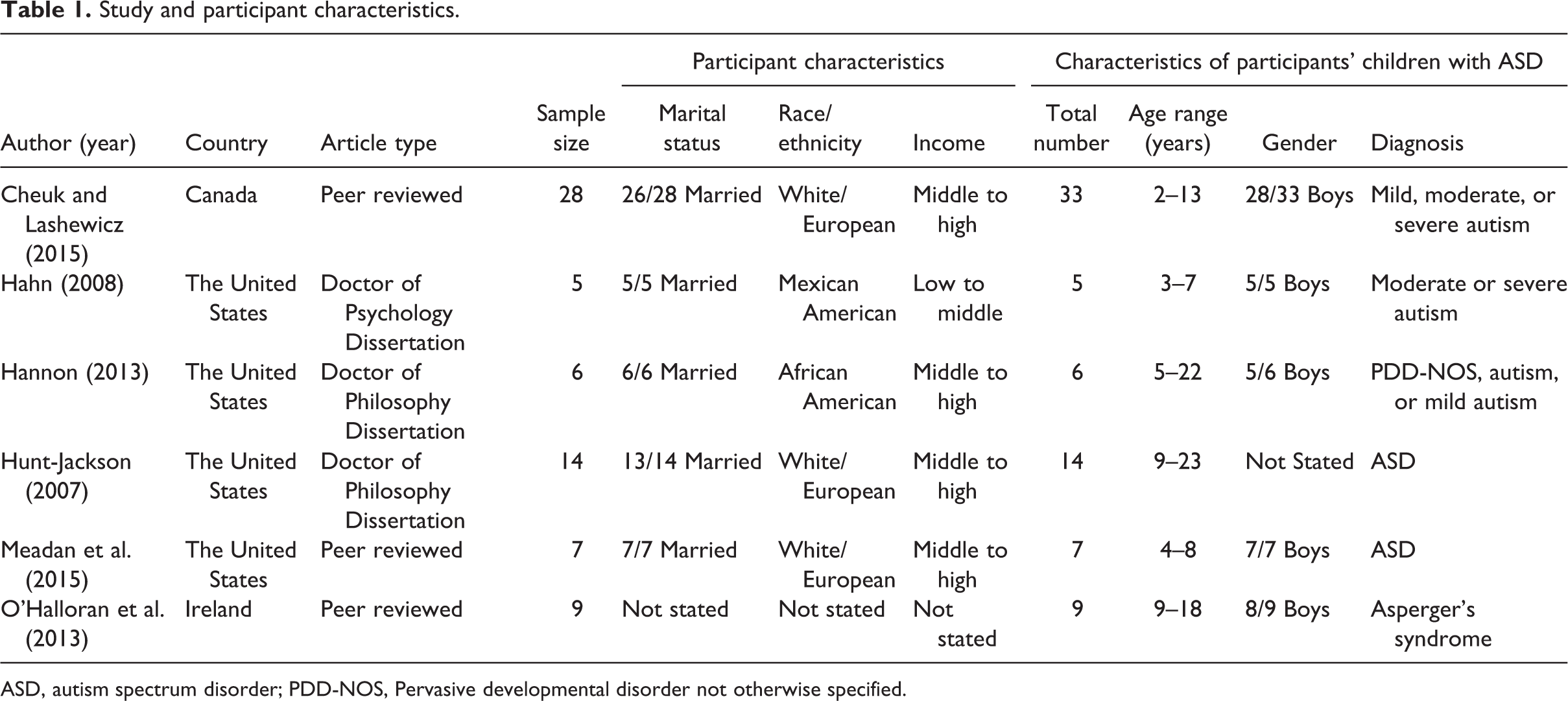
ASD, autism spectrum disorder; PDD-NOS, Pervasive developmental disorder not otherwise specified.
Thematic synthesis findings
Fathers have long been underrepresented in research about families of children with disabilities (Braunstein et al., 2013; Cassano et al., 2006) and authors of the 11 sources we reviewed have pursued timely and important topics of study. Through our synthesis of findings from the six sources we consider credible, we generated three broad themes, including (1) adaptation and concern with the future, (2) the importance of cultural context, and (3) reverence for one’s child and new opportunities.
Adaptation and concern with the future
Authors of the six sources presented findings pertaining to adaptations fathers face in identifying and understanding their child’s diagnosis. Meaden et al. (2015) findings encompass adaptations to how parent roles are delineated and shared as well as barriers and challenges faced by parents in securing services and special education for their child. Hahn (2008) sample spoke of the impact of their child’s diagnosis on their marriages and described their own struggles to understand and manage their child’s challenging behavior. O’Halloran et al. (2013) participants raise the experience of “relief” that accompanies a child’s diagnosis following months, and sometimes years, of misgivings over their child’s development. At the same time, worry over their child’s future was a theme among O’Halloran’s sample. The adaptation theme for Hannon’s (2013) sample was stated in terms of the overall family, as participants articulated expectations that siblings assume some responsibility for the well-being of the child with ASD. Cheuk and Lashewicz (2015) identify a theme of jealousy expressed by participants who compare their parenting demands with those of parents of typically developing children. Hunt-Jackson (2007) sample offered a range of descriptions of adaptations including the stamina required, along with the eventual development of their parenting frame of reference, as they come to feel like a “fish in water” managing needs associated with ASD. Hunt-Jackson’s themes include frustration over how poorly the general public understand ASD, and a lack of workplace support for fathers raising children with ASD, despite pervasive expectations that fathers financially support their families. On the balance, these findings reinforce earlier research about families/fathers of children with disabilities in general, and ASD in particular, as themes of discovering and coming to terms with a child’s diagnosis, and corresponding needs, are prominent in this literature.
The impact of culture
Cassano et al. (2006) completed a review of father participation in 702 studies on child psychopathology and reported that studies are skewed not only toward perspectives of mothers but, more specifically, to mothers from middle-class, Caucasian samples. To date, Jegatheesan et al. (2010) provide one of few published qualitative studies targeting immigrant fathers of children with autism as these authors examined experiences of three South Asian immigrant and low-middle socioeconomic status families, raising a child with autism in the American Midwest. We submit that Hahn’s (2008) study of Mexican American fathers of children with ASD, and Hannon’s (2013) study of African American fathers of children with ASD, offer much needed cultural perspectives to the fathering children with ASD literature. Hahn taps into expected themes about the ways culture, and language, can add a layer to the isolation fathers may feel as parents, and as parents of a child with a disability diagnosis. Hahn also captures nuanced themes of fathers striving to be “more than” cultural stereotypes of fathers as drinking and/or violent versions of “machismo” in light of their child’s ASD-related needs. Relatedly, fathers in Hannon’s African American sample depict their parenting approaches as part of their values of being strong father figures who are actively involved with their children. We hope these studies are part of a trend toward fuller understandings of, and culturally responsive practices for, fathers from diverse cultural backgrounds.
Reverence for the child and new opportunities
Arguably, the most innovative findings we synthesize pertain to father’s non-deficit focused reverence for their child with ASD and, relatedly, fathers embracing opportunities arising as part of raising a child with ASD. Hunt-Jackson (2007) reports fathers’ descriptions of having gained appreciation for diversity and enjoying “little things” about their child’s abilities to show affection, while Cheuk and Lashewicz (2015) report fathers expressing gratitude for their child’s capabilities and accomplishments, and exercising care to notice their child’s progress. Hannon (2013) presents fathers appreciating the intrinsic value of their child including by citing a father who views his child as a “perfect gift” and likens himself to a “kid on Christmas morning.” Hannon’s findings include fathers’ views of their child with ASD as a second chance and source of motivation to be “a better man.” O’Halloran et al. (2013) reports fathers describing how the presence of ASD in their family gave rise to meaningful conversations between family members. Finally, Cheuk and Lashewicz (2015) provide evidence from a father who considers himself “lucky” in his access to resources that support his child’s ASD-related needs, as he views these resources as parenting support which parents of typically developing children do not have.
Discussion
In this meta-synthesis, the relatively small number of studies, and the equal proportion of dissertation studies among these, indicate that qualitative investigations into experiences of fathers of children with ASD is an emerging realm of inquiry. We are encouraged by this gathering research interest as incorporation of fathers’ experiences is part of attending to a fuller range of parenting skill and energy brought to bear on raising a child with ASD. Further, we see the qualitative studies in our review as evidence of ongoing endeavors to appreciate the richness and theoretical significance of qualitative approaches.
However, while we are encouraged by trends of growing endeavors to (1) understand experiences of fathers of children with ASD and (2) use qualitative approaches to this end, we underline our concerns with shortcomings in the quality of the qualitative studies we reviewed. Several studies were not coherently framed by theory, thus much power for shared conceptual level understandings, which in turn feed knowledge creation, is lost. We are equally, if not more, troubled by methodological inadequacies. Taken together, the five studies we excluded, and to a lesser extent, the two studies we include with reservations, suggest a piece meal approach to qualitative research such that approaches (i.e. phenomenology and ethnography), are claimed, yet only loosely tied to epistemological assumptions such as the importance of participant meanings. Moreover, proclaimed methodological approaches are not situated relative to qualitative approaches more broadly, and, as such, important distinctions between approaches are neither discussed, nor implemented. Further, these studies are riddled with application deficiencies in methods and findings such as presentation of de-identified, thus decontextualized data (Collins, 2008; Frye, 2015; Vacca, 2013), collection of data that were not reported (Meadan et al., 2010), presentation of contradictory details of data collection (Collins, 2008) and a misuse of principles and practices of trustworthiness (Schrader, 2014).
Overall, the quality deficiencies evident through our review leave us reflecting on Janice Morse’s claim that “in recent decades, qualitative researchers have not earned a significant role in knowledge development” (Morse, 2015), and we conclude with our goal that our review serve as a call to action for disability researchers to set, and adhere to, higher standards of quality in qualitative research. Higher methodological standards will elevate the scholarship and practice of qualitative research within its own right, and correspondingly, the scholarship and practice surrounding populations and issues studied through qualitative approaches. Our review leaves us troubled that overlooked views of fathers raising children with ASD are gradually being included, but too often, in ways that lack credibility. More than a half century ago, Goffman (1963) coined the term “courtesy stigma” to characterize what he described as a “spoiled” social identity owing to one’s ties to a stigmatized individual. Accordingly, people with “disability,” including ASD, have long been stigmatized and supported by undervalued paid caregivers. Relatedly, family members of people with disability are part of a legion of undervalued unpaid caregivers. We entreat disability researchers to dedicate themselves to pushing back against (potential) courtesy stigma given their researcher association with a devalued target population and we argue that this pushing back entails setting and adhering to high standards of methodological and theoretical quality.
Implications for practice
We build on earlier review studies by Corcoran et al. (2015) and DePape and Lindsay (2015) to raise new implications for practice targeted at children with ASD and their families. Unlike Corcoran et al. (2015) and DePape and Lindsay (2015), we offer a synthesis of experiences exclusive to fathers of children with ASD and we incorporate unpublished dissertation/thesis work in this newly emerging area. As such, we underline the importance how fathers influence, and are influenced by, raising children with ASD and attendant needs to target practices that incorporate fathers’ distinct perspectives and needs, for examples, through practices of providing forums within which fathers may share how they’ve adapted their parenting and strategize about plans for their child’s future. Further distinguishing our work from that of Corcoran et al. (2015) and DePape and Lindsay (2015), is our incorporation of studies of fathers from specific cultural backgrounds; as such, we draw out the importance of culture in shaping fathers’ experiences in ways that reinforce the need for practices that support fathers to navigate child raising in relation to culturally specific needs—such as isolation related to language barriers—and opportunities—such as inspiration to be more than cultural stereotypes. Yet we present these practice implications with caution as we return to our key conclusion from our meta-synthesis which is about the pressing overall need for higher quality qualitative studies of fathers’ experiences to more definitively advance understandings and corresponding practice.
Limitations
Our decision to narrow the eligibility criteria in phase 3 of our selection may have imposed more subjectivity than typical of a review selection process. However, as two authors independently reviewed studies with these criteria, and discussed discrepancies with a third author, we are confident that eligibility criteria were applied appropriately and consistently. Although additional studies that included father’s experiences were available in our data set, we opted to only include studies that had only fathers in their sample because systematic reviews have already synthesized experiences of mothers and fathers.
Footnotes
Acknowledgements
The authors thank Diane Lorenzetti for her assistance in developing the systematic review protocol.
Authors’ note
LS designed the review protocol and conducted search. LS and KL conducted study selection. BL led quality appraisal. LS and BL conducted synthesis and analysis. BL and LS wrote manuscript. All authors approved the manuscript.
Declaration of conflicting interests
The author(s) declared no potential conflicts of interest with respect to the research, authorship, and/or publication of this article.
Funding
The author(s) received no financial support for the research, authorship, and/or publication of this article.