







Abstract
There is limited research into parents’ experiences of Intensive Interaction. Despite this, there are parents who use it and may hold unique experiences. Exploring this could provide insight into how to support parents using Intensive Interaction. Six mothers, who used Intensive Interaction with their children with intellectual disabilities and/or autism, were interviewed. Results were analysed using interpretative phenomenological analysis. The analysis yielded 10 subordinate themes which were organised into 4 superordinate themes: ‘The Connection’, ‘Bittersweet’, ‘Fighting for Support’ and ‘Challenging Underlying Low Expectations & Stigma’. Intensive Interaction was found to help some mothers feel connected with their child; they appeared to indicate that accessing timely support with Intensive Interaction was beneficial. Intensive Interaction was also perceived to challenge assumptions and stigma, but these factors were also perceived to be potential barriers to using the approach.
Background
Individuals with intellectual disabilities can face communication and inclusion barriers (Health Service Executive, 2011; Taggart, 2011). Intensive Interaction is a social communication approach which may help people to overcome these barriers (Nind and Hewett, 2005). Intensive Interaction has been found to increase communicative behaviours in people with profound intellectual and multiple disabilities (Leaning and Watson, 2006; Nind, 1996) and is officially recommended as beneficial for people with profound intellectual and multiple disabilities (Department of Health, 2009). A key aspect of the approach is that it is led by the person with communication needs; a common misunderstanding is that Intensive Interaction is a form of ‘imitation,’ however, the interaction partner is more of an active participant and can enhance the interaction (Barber, 2007). Some techniques used in the approach are mirroring body language and vocalisations, responding to behaviours ‘as if they have significance’ and engagement in joint activities (Leaning and Watson, 2006; Nind, 1996). The proximity involved allows display of congruency between facial expression and underlying feeling, which can enhance the individual’s skills in social communication (Nind and Powell, 2000).
Intensive Interaction is derived from Augmented Mothering (Ephraim, 1986), which suggests that an individual who is preverbal could benefit from the social communication style that takes place between an infant and caregiver. The approach also links to Attachment Theory (Bowlby, 1969); the secure base is created by the mother attending to the infant’s communication in a synchronous fashion, for example, by imitating the infant’s vocalisations (Pawlby, 1977). A less synchronous interaction may be if the mother persists with an interaction while the infant diverts their gaze away (Brazelton et al., 1974). Ephraim (1982) described that successful communication can increase the field of security and that unsuccessful attempts may recede them; Augmented Mothering was designed to increase the success of interaction.
Some practitioners view Intensive Interaction primarily as a tool to develop communication skills (Nind and Hewett, 2005), while others view it primarily as a route to social inclusion (Caldwell, 2007). This variation, therefore, means that Intensive Interaction lends itself to implementation within a variety of settings. For example, development of communication may be a preferable aim of using Intensive Interaction in educational settings whereas increased social inclusion may be the prioritised aim in residential settings (Firth, 2009).
Much of the research into Intensive Interaction has explored the experiences of paid staff/practitioners (Clegg et al., 2018; Jones and Howley, 2010; Nagra et al., 2017; Rayner et al., 2016). These studies suggest that staff perceived that Intensive Interaction enabled them to build relationships with the individuals they worked with. However, this research also highlighted barriers when using the approach, such as a lack of opportunity for naturally spontaneous interactions, due to the corporate need to evidence and schedule interactions into the day.
Despite there being previous research exploring parental involvement in other social communicative interventions (Shire et al., 2015), there has been minimal research into parental involvement in Intensive Interaction. Nind and Powell (2000) suggest that practitioners learn to read the person’s unique signals via the approach in a neutral manner, as opposed to making personal assumptions about them which, theoretically, may be more of a challenge in the caregiver/infant dyad (Ephraim, 1982). However, as there are parents who have learned about/use Intensive Interaction, and as their experiences may be unique, it seems imperative to explore their experiences. For many people with communication needs, their parents may be their largest support system so would play an important role in their social and communicative development. Lack of research regarding parents’ experiences may deny this group acknowledgement or support in being involved with Intensive Interaction; therefore, this research was designed to explore parental experience of Intensive Interaction.
Method
Design
A qualitative design was employed to capture experiences. Data were gathered via semi-structured interviews which included open questions to allow exploration around structured points (Smith et al., 2009). The primary researcher met with an expert by experience, a mother who used Intensive Interaction with their child who was not included in the study, to attempt to ensure that the interview schedule was accessible to the intended group and to strive to incorporate credibility within the findings. The researcher adopted a constructivist epistemological standpoint, which suggests that truth and meaning are subjectively constructed by experience (Crotty, 1998).
Participants
A purposive sampling strategy was adopted to recruit a homogenous sample to assist with accessing particular experiences (Smith et al., 2009). Participants were included if they had parental responsibility for a child who had intellectual disabilities and/or autism and had been involved with Intensive Interaction. In addition, participants must have had some knowledge of Intensive Interaction acquired through attendance at a training course, information provided by a healthcare/educational professional or observation of others using Intensive Interaction with their child. There were no set minimal criteria required for the length of time participants had used Intensive Interaction, as research has shown that effects can occur within minutes of using Intensive Interaction (Zeedyk et al., 2009).
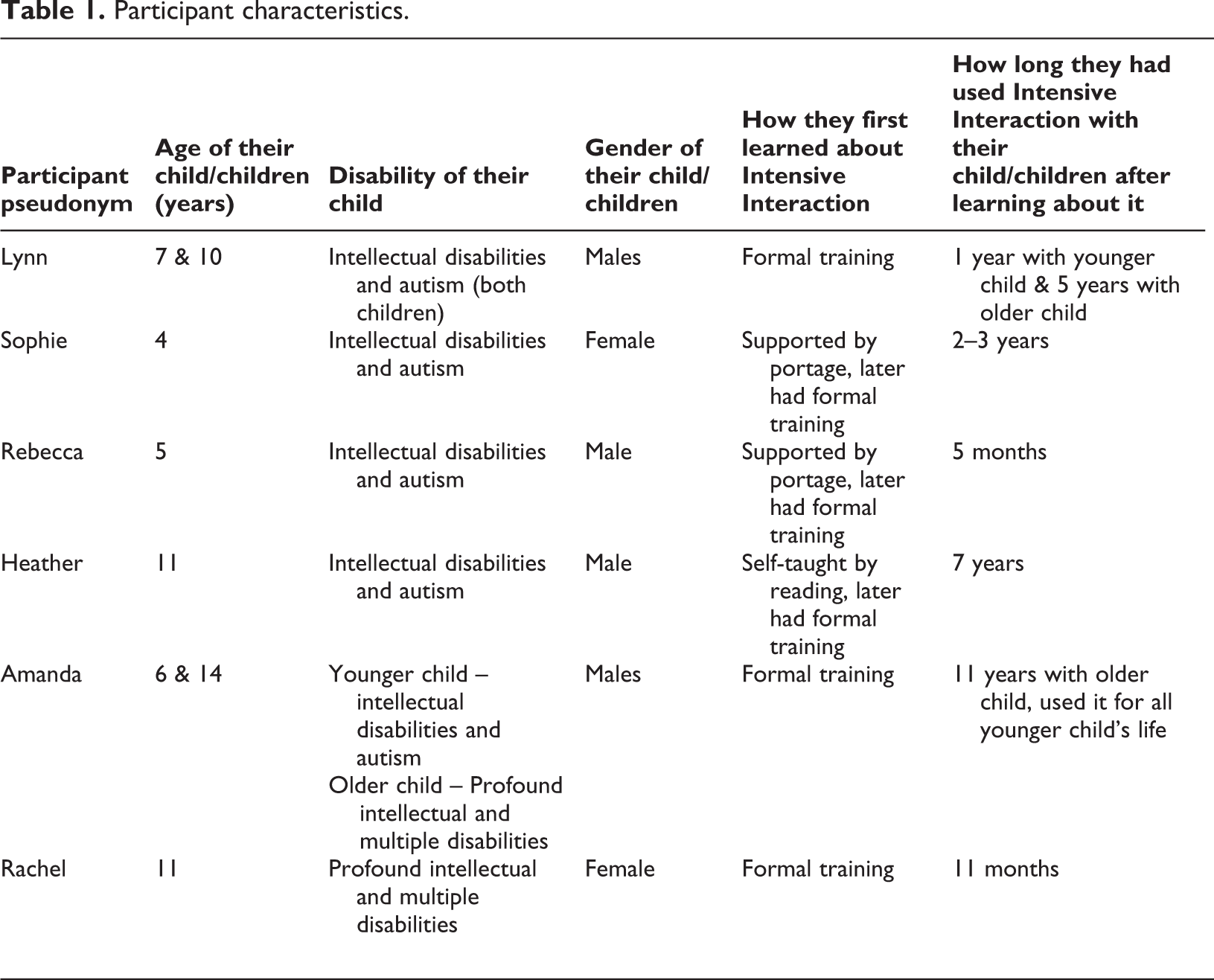
Six participants took part in the study; Table 1 provides details of the participants, including the pseudonym they were allocated, the age(s) of their child(ren) with intellectual disabilities, the nature of their disabilities, information relating to the Intensive Interaction training and length of time it had been used with their children. Despite intention to recruit parents of any gender, only those who identified themselves as their child’s mother were recruited, therefore, this study specifically explored mothers’ experiences. In total, participants talked about their experiences of supporting eight children (six boys and two girls), who were aged 4 to 14 years. Participants had learned about Intensive Interaction through different means and all had attended some form of training. The length of time they had used Intensive Interaction with their children ranged from 5 months to 11 years.
Participant characteristics.
Procedure
This research was approved by a University Research Ethics Committee. Participants were recruited through two routes. Firstly, staff in special educational needs schools in the Yorkshire and Humber region of the United Kingdom were asked to circulate information about the study to parents; interested parents then contacted the researcher. Three participants were recruited via this method. Secondly, a Speech and Language Therapist who ran Intensive Interaction workshops for parents, distributed information to attendees. Three participants were recruited through these workshops.
Participants took part in semi-structured interviews with the first researcher. All participants read the study information sheet and signed a consent form before interviews commenced. The interviews took place in the homes of the participants (n = 5) and at a University site (n = 1) and lasted between 45 and 90 minutes. Interviews were audio recorded onto an encrypted laptop and transcribed for data analysis. Once the paper had been written up, the participants were provided with the opportunity to read the paper to assess if the interpretations made were congruent with their experience; this was to ensure that the interpretations derived from the data were credible (Sandelowski, 1986).
Data analysis
Data were analysed using Interpretative Phenomenological Analysis (IPA) based on the guidelines of Smith et al. (2009). This method was chosen to allow insight into the participants’ experiences and the double hermeneutic process meant that the researcher could interpret and present the complexity of experiences. Exploration of the mother’s experiences was imperative as Interaction Intensive Interaction is based upon the experience of the dyad. As Intensive Interaction can be such a personalised experience between those who partake in it, the idiographic approach of IPA was preferred over approaches which aim to generalise data.
Data analysis ran alongside data collection. Transcripts were read and re-read line by line and were developed into codes (key words or phrases that attempted to capture the cruxes of the data). A total of 11 codes were generated and merged, or discarded, to create more abstract themes. During the process of data analysis, the primary researcher collaborated with the secondary researcher and participated in reflective practice groups, whereby transcripts, codes and emerging themes were discussed and critiqued; this assisted with the researcher's development of subordinate and superordinate themes and ensured that their interpretations stayed grounded to the data. Ongoing supervision was utilised, and the primary researcher kept a reflexive journal to attempt to recognise their own assumptions to ensure that the interpretations remained true to the data and did not reflect the researcher's biases.
Reflexive statement
This section attempts to create transparency for the reader, which is to be considered in light of the interpretations made from the data within this paper. Researchers need to be aware of their personal, social and cultural contexts, and understand how this impacts the way in which they interpret their world (Etherington, 2004). The first author had the personal experience of having a sibling who appeared to thrive from Intensive Interaction; this experience undoubtedly shaped the researcher’s preconceptions. IPA was chosen in this study, as opposed to an analysis method whereby the imposition of the researcher’s role is minimised, because the researcher’s preconceptions are worked with rather than eradicated (Schleiermacher, 1998). The researcher developed awareness of their own preconceptions throughout the research process and measures were taken to ensure rigour in analysis and credibility of findings, as previously mentioned.
Results
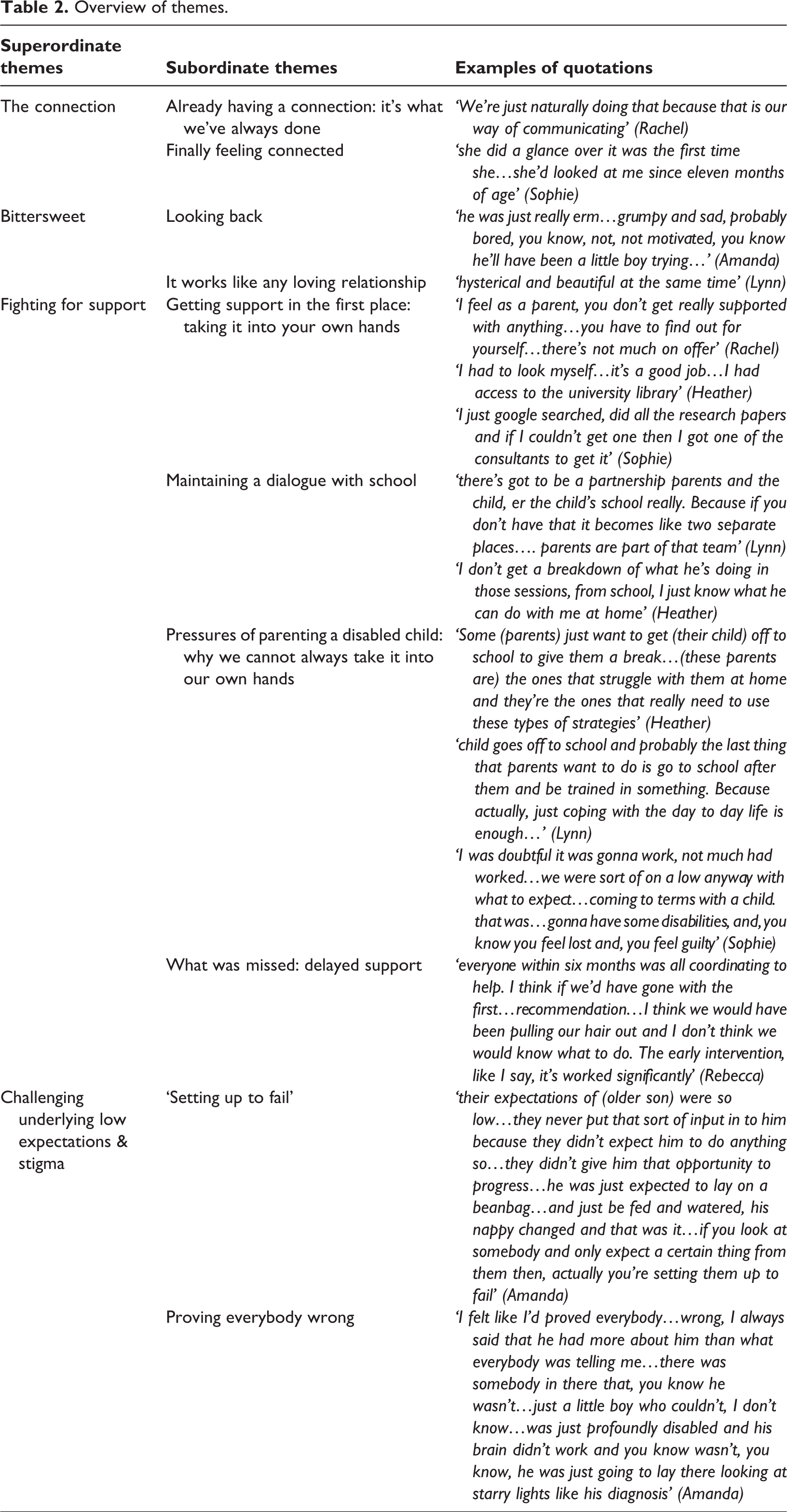
The analysis yielded 4 superordinate themes, which consisted of 10 subordinate themes; see Table 2 for an overview of the themes.
Overview of themes.
Superordinate theme 1: The connection
Participants differed in the extent to which they experienced that Intensive Interaction affected the connection they felt with their child. For some, it seemed that Intensive Interaction did not have a large impact as it was felt that connection and reciprocity were already present. Others experienced Intensive Interaction as having a powerful impact.
Already having the connection: It’s what we’ve always done
Rachel described that Intensive Interaction seemed to be already naturally part of their relationship: 'We’ve always, done a lot of turn taking and waiting for her to respond…we’ve always been, you know, very close up'.
Rebecca suggested that they were not seeking to change their child and were accepting of them: ‘We’ve got the mother-son bond, and you know so it’s unconditional love anyway. I’d be proud of him no matter what'.
Rachel experienced that her child characteristically reciprocated love: ‘ she is very responsive and very, you know she loves us'.
Finally feeling connected
Heather was actively seeking to develop her relationship with her son: ‘I was hoping that it would be a way to build up a relationship with him cos we didn’t have that'. Learning about Intensive Interaction and using it had a more profound impact and was described as a way to connect with her child: ‘we couldn’t reach him'.
Lynn and Sophie used language which suggested that Intensive Interaction helped them to pass a barrier in between them and their children: we can see little chinks in his armour". (Lynn) "she’s just in this massive bubble…but there was, just that glimpse of her". (Sophie) Intensive Interaction, brought her, into the world". (Sophie) "just give us that time to be sort of…bit on the same planet for a little while…it’s the only time where you feel that you’ve actually made that like connection". (Amanda)
Superordinate theme 2: Bittersweet
When describing the experience, connotations of love were used. Yet there was a sadness accompanying this, when mothers thought about their relationship, and what their child’s experiences could have been, prior to the introduction of Intensive Interaction. The latter seemed apparent in those who felt that Intensive Interaction brought connection.
Looking back
Sophie’s perception of her competence as a mother seemed influenced by lack of responsiveness from her daughter. she just wasn’t responding at all so I did feel like a bit of a failure as a mother". (Sophie)
She empathised with how life could have been without Intensive Interaction: ‘he’d still be…locked in his own world’. This suggests that she felt responsibility to ‘unlock’.
It works like any loving relationship
Participants talked about Intensive Interaction in ways that could be used to describe any loving relationship. Lynn emphasised the ‘warmth’ involved. Sophie and Rebecca described it as ‘lovely’ and Rebecca emphasised the ‘affection’ which accompanied the experience. Amanda described how she would ‘catch him glancing at me’, something which may take place in a loving relationship. Lynn described it as ‘absolutely thrilling’ and ‘sort of magic’.
Rachel described Intensive Interaction as ‘kind of natural’, which could indicate that she found it was already part of their relationship.
For Rebecca it seemed to develop into a way of being and had a sense of ease, ‘it’s just. automatic’. Amanda reiterated this: ‘you don’t think about it’.
However, like any loving relationship, Lynn described that ‘you really have to work at it’ as it needed to be ‘Totally on their terms…’. Otherwise, it was ‘not necessarily meaningful’.
Superordinate theme 3: Fighting for support
Finding information and support relating to Intensive Interaction was often perceived to be challenging. Gaining support for their child’s needs had to take place before the introduction of Intensive Interaction; this could also be a challenge. Proactivity seemed essential, as delay could result in difficult consequences.
Getting support in the first place: Taking it into your own hands
The fight for support started prior to introduction to Intensive Interaction; Sophie described an encounter with a health visitor after she identified that she needed help to communicate with her child: ‘well she ignored me to begin with then she called me an erratic parent…in the early, years assessment I put…please help me, to play with my child’. Sophie appeared to persist despite the resistance she faced. When Rebecca requested support, she also experienced a response of resistance, yet still persisted which enabled support. She described having to ‘push an awful lot’.
In relation to Intensive Interaction, Heather emphasised the sparsity of information: ‘there wasn’t a lot…’. Rachel commented ‘it’s not as accessible as you would hope’. Amanda described training courses as being infrequent with no opportunity for a review: ‘I’ve had…nobody mention it since I’ve been on the training really’. The regular use of the word, ‘nobody’ may suggest that participants felt alone in the process. Heather and Sophie used their resources independently to gain information (see Table 2).
Maintaining a dialogue with school
Schools that use Intensive Interaction sometimes provide information and support. Rebecca had a positive experience: ‘communication is a lot better than. we could have ever have imagined’. This appeared to contrast the experience she had when trying to gain initial support. Amanda also had a positive experience with the school her younger son attended: ‘they use Intensive Interaction and they do get a lot of support’. Lynn emphasised the need to be proactive to maintain dialogue and the consistency of Intensive Interaction (see Table 2).
Others did not have a sense of strong dialogue with school: I don’t know what they do at school…. (Sophie) I think they kind of do it (Intensive Interaction)…I don’t know"…. (Rachel)
Pressures of parenting a disabled child: Why we cannot always take it into own hands
It had previously been suggested that taking action into their own hands had been necessary for these mothers. Lynn and Heather (see Table 2) consider reasons why parents may not take action to seek support and dialogue with school.
Amanda’s experience exemplified some challenges: ‘I was a single mother…I got a really small package of care…I still have three children to then find individual time with them, and it’s, you know difficult…'’. This difficulty appears to be ongoing, as her language changes from past to present tense. Rachel uses the words ‘draining’ and ‘tiring’ when describing caregiving duties, which compromised her ability to invest in Intensive Interaction.
Sophie recalled her experience of initially hearing about Intensive Interaction (see Table 2). The language used in this account suggests grief, confusion and self-blame which may contribute to them feeling challenged to seek support externally.
What was missed: Delayed support
Mothers described the actual, or potential, impact of delayed support with Intensive Interaction: ‘there’s big, big gaps where I could have been doing something’ (Sophie). The use of first person suggested that this may transfer to self-blame and the word ‘big’ is repeated, suggesting the perceived enormity of this. Heather emphasised the importance of early intervention: ‘if you get told as a parent that, to have a look at Intensive Interaction and what it can do, I think…the earlier that you can do that the more sane you’ll stay’. Use of the word ‘sane’ suggests that Heather’s mental well-being may have been affected due to the amount of time it had taken for her to find out about Intensive Interaction. Rebecca’s contradictory experience also highlights the importance of quick support (see Table 2).
Superordinate theme 4: Challenging underlying low expectations and stigma
Participants experienced other people having low expectations of their child. There was a sense that Intensive Interaction challenged this.
‘Setting them up to fail’
Amanda described that low expectations and stigma of people with disabilities were a ‘mind-set’ and she compared it with ‘racism’. Sophie explained how her child was not expected to progress with her communication: ‘I got told she’d never do PECs (Picture Exchange Communication) until she’d learned sign language and she probably wouldn’t be doing sign language…it was all negative’. Rachel talked about her perception of a school staff member towards her daughter: ‘it kept saying in her book. (daughter) was not very cooperative today. And I thought well that just shows how much you don’t know her’. It appeared that the opportunity for assumptions of the staff member to be proven otherwise were diminished as they had not taken time to understand her child, so the child seemed unresponsive, demonstrating a detrimental cycle of self-fulfilling prophecy.
Amanda seemed to talk about a self-fulfilling prophecy which resulted from low expectations (see Table 2) which transferred to Intensive Interaction: ‘they don’t think he’s capable of engaging in Intensive Interaction’. Amanda also discusses how she may have initially succumbed to having low expectations herself prior to using Intensive Interaction: ‘…people had sort of dismissed and tried to make me dismiss…I must have been to a certain degree cos I was quite shocked how it worked’. It appears that she developed an awareness of her own expectations after using Intensive Interaction.
Proving everybody wrong
There appeared to be a sense of ‘us against them’, as indicated by the word ‘they’, which conflicted ‘we’ and ‘us’.
‘She’s on stage four PECs now and they told us she would wouldn’t get…up, the stages’. Sophie explained how Intensive Interaction had made her child more aware of others and so was more easily able to learn.
Rachel demonstrated the contradiction between her perceived reality of her child and how perception of her child could be shaped by assumptions, which she emphasises by listing her disabilities: ‘if you said on paper…well she can’t really see very well, she can’t hear, she can’t walk, she can’t talk. it sounds like she’s just sat in a corner…But actually she is very responsive and very, you know she loves us and she loves people and you get a lot from her’.
Amanda describes how Intensive Interaction had challenged misconceptions of her child’s ability, which she felt had empowered her son: ‘Intensive Interaction, that showed them that he could progress…it’s give him that opportunity to show that actually, he understand what’s being said to him, so then that’s given him a voice’. Amanda also felt that she had proved others wrong and was given confidence regarding her opinions (see Table 2).
Heather explained that Intensive Interaction challenged the stigma relating to her child as her experience of Intensive Interaction was normalising: ‘if it’s a shared experience between the two of us, we don’t tend to get that. response of he’s a bit strange…they just accept that that’s the way we communicate’.
Rebecca narrates the progression of social inclusion and emphasises the need for awareness of Intensive Interaction to further the progression: ‘they used to be institutionalised didn’t they…It needs to be out in the public more…everybody needs to understand. the benefits of it (Intensive Interaction) will help these children be part of society…and not, you know considered weird and disruptive’.
Overall, mothers in the study appeared to experience Intensive Interaction as a phenomenon including, but beyond, their direct relationship with their child.
Discussion
This research investigated mothers’ experiences of Intensive Interaction, which appeared to be experienced as natural and normalising. The natural aspect of the approach may reflect that the interaction is based on the caregiver-child relationship. For example, as illustrated by the ‘early attentional system’ (Ephraim, 1982), the mother attends to the effects of her behaviour upon the infant via their signals, which provides the mother with a basis for evaluating her own behaviour. The normalising aspect likens to Positive Psychology due to emphasis of positive subjective experience, as opposed to a focus on pathology (Seligman and Csikszentmihalyi, 2014).
It was interpreted that mothers within the study experienced Intensive Interaction as effective when on their child’s terms. Typically, an element of power imbalance in these dyads is possible due to the child having additional needs, hence why benefits may have been emphasised when the interaction was on their child's terms. Like practitioners (Nind and Powell, 2000), it appeared that the mothers were able to learn, or reinterpret, and, therefore, respond to their child’s signals through the approach. Arguably, a healthy relationship is reciprocal in nature, potentially explaining why Intensive Interaction was described in a way that any loving relationship could be, which is in line with the literature suggesting that Intensive Interaction is an approach that is ‘done with’ the person (Irvine et al., 2010: 21). Otherwise, the interaction pattern can fall into action-response, whereby the response is focused upon rather than the interaction itself (Barber, 2007). The observable effects of the approach, as opposed to the process, have often been the focus of research (Hutchinson and Bodicoat, 2015); in this study, further light was shed on the versatility and joy derived from the process.
For some mothers, Intensive Interaction appeared to be a way of feeling connected to their child. Some ways in which connection was described, such as increased eye contact and proximity, appeared to relate to the process necessary for a secure attachment (Perry, 2001). For these mothers, learning about the approach seemed to link to reflecting retrospectively, which appeared to be challenging for them to do, possibly due to them feeling responsibility for their child’ previous responsiveness which, at times, impacted their perception of their competence as a mother. Other mothers in the study seemed to experience a connection prior to the introduction to Intensive Interaction, which was largely related to them perceiving that their child was already reciprocatively affectionate; therefore, the approach did not appear to have such an affect. The contrast seems to reflect previous literature regarding mothers’ interactions with their children with additional needs; Field (1979) suggested that breakdown in the interactive feedback (which Intensive Interaction addresses) can result in mothers experiencing challenges in their interaction with their child. This style of interaction contributed to the mother feeling helpless (Goldberg, 1977). However, other research suggests that mothers of developmentally disabled infants are particularly able to read their infant’s cues and their actions are synchronous with their infant’s actions (Oliver and Davies, 1980; Yoder and Feagans, 1988). Regardless, it appeared that Intensive Interaction was most helpful for the mothers within this study who had initially struggled to gain a connection.
Some of the mothers appeared to view the gaining of support and information prior to the introduction to the approach as an integral part of the Intensive Interaction experience, hence the prominence of this topic within the interviews. This research showed that there was a need for, but lack of, external support and information about Intensive Interaction for these mothers. Prior to learning about Intensive Interaction, participants described that they needed support for their child’s additional needs generally, which required the mothers to be persistent. This research suggests that when the mothers faced challenges in other areas of their life, persistence was challenging, which is supported by Catherall and Iphofen (2006), who found that caregivers were left feeling tired and stressed from the amount of energy needed to access support. This finding was concerning, especially in consideration of the consequences the mothers identified following not being supported or provided with information quickly.
School seemed to be the main other setting where Intensive Interaction was used. The study uncovered the importance of parents having a good dialogue with school, which was supported by teachers’ perspectives in the study of Sri-Amnuay (2012: 229); they suggested that consistency of the approach between home and school is important.
The themes within the study demonstrated that Intensive Interaction appeared to go beyond that of the experience of the dyad and included macro-processes relating to the approach. The mothers seemed to experience Intensive Interaction as a way of challenging assumptions and societal stigma. Research involving staff experience had also suggested that Intensive Interaction challenged their assumptions of the individual’s communicative ability (Bodicoat, 2013; Clegg et al., 2018; Firth et al., 2008). The mothers were interpreted to experience their own assumptions being challenged to some extent, but it was interpreted that they usually perceive that Intensive Interaction challenged those outside of the dyad.
On one hand, mothers in this study seemed to perceive that low expectations and stigma towards their children were challenged by Intensive Interaction, but also that these factors were barriers to successful interaction. In the latter case, these factors seemed to contribute towards others expecting little of the individual, potentially reducing opportunities for social inclusion and communication. This was suggested in, ‘Setting Up to Fail’. Low expectations and stigma reflect the Triad of Impairments (Caldwell and Horwood, 2008), which sums up negative assumptions of those with autism: a failure to relate, a failure to think flexibly and a failure to understand speech. This narrative within the data suggests further that experiences of Intensive Interaction partially relate to macro-level processes.
Limitations
As participants had different experiences of learning about Intensive Interaction, this may have meant that they had varying concepts of what it is, potentially reflecting the lack of universality of the approach (Firth, 2009). Therefore, the findings may not relate to a shared understanding of the concept. Nonetheless, one of the interview questions was, ‘In your own words, how would you describe Intensive Interaction?’ The descriptions and definitions offered by participants appeared to be in line with those covered in the literature (Irvine et al., 2010), as were the answers throughout.
Participants in the study appeared to describe experiences that were not always related directly to Intensive Interaction, namely, the challenges relating to support prior to the introduction to Intensive Interaction. Arguably, this provided greater richness of the context of their experiences. Gaining support for their child’s needs generally was an important issue for the participants within the study; this appeared to be experienced as a necessary means to progress to the introduction to Intensive Interaction, and, therefore, may be considered as part of the whole experience of Intensive Interaction.
All participants were female; therefore, it is unclear if those with different gender identities would have different perceptions. Even though age was not part of the exclusion criteria, only mothers of young children were recruited, therefore, experiences may have resulted from factors relating to a cohort. This may have been due to the recruitment process, despite attempts having been made to recruit parents of children in adulthood by recruiting via social media and seeking advice from those who worked in the field. Most of the participants had worked in education or healthcare sectors, which may have affected their experiences and ability to access support. However, as a result of these factors, the final participant group was, to an extent, homogenous, which is recommended when exploring perceptions and understandings of phenomena within IPA (Smith et al., 2009). Despite this, there are limitations in relation to achieving such homogeneity; for example, in terms of the method of learning about/gaining experience in Intensive Interaction, as there is no standardised way to achieve this. Therefore, dependability may be challenging to achieve (Koch, 2006).
While the overall aim of this study is to shed light on this unexplored topic, it also seeks to be of benefit by providing recommendations. However, recommendations from this paper may be considered tentatively, as the data is not intended to be generalisable. The author invites further research to enhance or challenge the recommendations made.
Implications and further research
It was apparent that the process of learning about Intensive Interaction brought up some difficult feelings for the participants; this could be considered in training courses. As this research only recruited mothers, further research could consider the experiences of those with other gender identities.
The study demonstrated that the mothers were not always capable of fighting for support due to life stressors; therefore, it is important that Intensive Interaction, and opportunities to learn about it, is accessible. Greater education about Intensive Interaction may be beneficial for those who provide external support and advice to families with children with special educational needs, such as those bodies who ‘have regard to’ the SEND Code of Practice (Department for Education and Department of Health, 2015). This may be especially important within early year’s settings and schools, which were found to be significant providers and informers of Intensive Interaction. A good dialogue between home and school was found to be important for these mothers; this may contribute towards the reduction of hardship felt by parents when attempting to access support. Participants in the study experienced challenges relating to delayed support, which may suggest that prior to gaining support related to Intensive Interaction, it is important that families are supported in getting recognition and support for their child’s disabilities. Further understanding of parental experience of collaboration with other contexts in relation to Intensive Interaction may be beneficial, so future research may consider the experiences of parents with children in adulthood to broaden this understanding.
This study suggests that these mothers perceived that Intensive Interaction challenged underlying attitudes and stigma towards people with intellectual disabilities but that these factors also caused barriers to Intensive Interaction. Further research could explore the impact of low expectations and stigma towards people with diagnoses of intellectual disabilities and/or autism, including ways to address this.
Conclusions
This research explored experiences of six mothers who use Intensive Interaction with their children. For some of the mothers, Intensive Interaction was found to be a way to connect with their child through developing reciprocity, suggesting that it was a beneficial approach in a relational and emotional sense for the participants, and possibly their children. The participants appeared to convey that benefits were, or would be, maximised if they were supported quickly with their child’s needs and provided with opportunities to learn about Intensive Interaction, or its principles. For those mothers who already perceived that their child reciprocated affection, learning about Intensive Interaction was perceived to have less of an impact on their relationship. Despite this, the mothers appeared to experience Intensive Interaction as a way of challenging negative discourses, relating to people with diagnoses of learning disabilities and/or autism, that they had experienced.
Footnotes
Acknowledgements
We would like to express our deepest gratitude to the mothers who took part in this study, doing so despite facing other commitments and demands. Thank you to the staff from the special needs schools who went above and beyond to assist with the process.
Declaration of conflicting interests
The author(s) declared no potential conflicts of interest with respect to the research, authorship, and/or publication of this article.
Ethical considerations
This research was approved by a University Research Ethics Committee. Identifiable information was kept in the supervising researcher’s locked cabinet at the university. Recorded interviews were destroyed after transcription. Participants were reminded that they could withdraw from taking part at any point up until data analysis and were given a time period of when this would be. The primary researcher met with an expert by experience (a mother who used Intensive Interaction who was not recruited as a participant in the study) who helped to develop the interview schedule and information sheets.
Funding
The author(s) received no financial support for the research, authorship, and/or publication of this article.
