






Abstract
Individuals with intellectual disabilities need an affective and sexual education adapted to their characteristics. There are few interventions that meet these objectives and offer empirical evidence of their efficacy. To respond to the limitations of existing interventions, an evidence-based affective-sexual educational intervention for adults with a mild degree of intellectual disability is proposed: SALUDIVERSEX. Participants will be randomly assigned to an intervention group that will receive the SALUDIVERSEX program or to a waiting list group. The intervention will be implemented by educators of occupational centers after a thorough training phase. Our main hypothesis is that the SALUDIVERSEX program will improve the sexual health and quality of life, through the joint action built into three components: the acquisition of basic information, the development of skills and strategies and the achievement of healthy attitudes towards the experience and expression of sexuality. The results of this approach could have important implications for optimizing the quality of life and self-determination of individuals with Intellectual disability by contributing to the development of healthy sexuality.
Introduction
In order to improve self-determination and quality of life of people with intellectual disabilities, and once it was found that sexual health is a key element for this (Neuman & Reiter, 2017), a series of educational proposals have emerged in recent years, mostly informal. The affective-sexual education required by this group should be accommodated to their level of intellectual functioning and adaptive capacity and should aim to enable positive self-exploration of their sexuality while teaching them how to manage potential risk situations (Brown & McCann, 2018; Löfgren-Mårtenson, 2012; Schwartz & Robertson, 2019).
People with Intellectual Disability are a very heterogeneous group characterized by the presence of some limitations in perceiving social cues accurately, regulating their emotions and behavior, and understanding the risk involved in some social situations. These limitations have had an enormous influence on the attitude of their guardians regarding the experience of sexuality, who in many cases do not consider them capable of assuming a responsible sexual behavior and do not think that education can solve these deficits (Santinele Martino, 2021). The education that people with a higher degree of autonomy should receive should be substantially different from that received by people who, either because of their adaptive or intellectual limitations or because of the high degree of overprotection by their parents or guardians, have a lower degree of autonomy to initiate relationships and explore their sexuality as they see fit (American Psychiatric Association, 2013).
Affective and sexual education for individuals with Intellectual Disability has started from a risk reduction perspective, focusing only on the negative aspects of sexual health (e.g. prevention of unwanted pregnancies, STIs, etc.), without attending to the positive aspects (e.g. experience of pleasure, intimacy, development of communication skills, etc.). In addition, Gil-Llario et al. (2018) conclude that the information provided is not always the aspects shought or desired, as 85.6% of women and 93.3% of men report wanting to discuss more about sexuality-related topics. Therefore, it would be important to make additional changes in the traditional methodology to ensure that these individuals can express their sexual interests in a positive and peaceful context, where the issues that really concern them are discussed and their questions are answered (Brown et al, 2020; Coulter et al., 2023). Consequently, the risky behaviors and low level of sexual satisfaction experienced by these individuals are not only attributable to the degree of disability, but also to a lack of adequate information (Brown & McCann, 2018). Educational actions are needed with an updated conception of sexuality directing them away from the paternalistic and/or heterosexist myths that have traditionally determined the sexuality of these people (McCann et al., 2019), conceiving them as asexual children who do not experience needs of a sexual nature (Alexander & Gomez, 2017).
In the design of sexual health interventions for people with intellectual disabilities, there are mainly two approaches: informal educational programs designed ad hoc, and formal educational programs based on empirical evidence.
The first approach is based on a non-standardized methodology. Thus, they are informal strategies designed for very small groups that lack empirical and methodological rigor. This type of intervention has the following characteristics: (1) they are adaptations of programs aimed at the general population, with a methodology and structure similar to the original content (Sala et al., 2019); (2) they are implemented in small and heterogeneous groups belonging to the same educational or occupational center (McCann et al., 2019); and (3) they usually focus on the supply of “bio-type” information related to the prevention of sexually transmitted infections and unwanted pregnancies (Sala et al., 2019). Although these strategies constitute a first attempt to improve the self-determination and quality of life of this group through improving sexual health, they have many limitations that affect the degree of reliability and replicability: lack of an exhaustive assessment prior to the design of the program to know their conceptual skills, such as oral language level or literacy level, as well as their interests, motivations and demands (Brown et al., 2020; McCann et al., 2019); use of tools and materials that, while proven effective in the general public, may not be appropriate for individuals with adaptive and intellectual limitations; and lack of pre- and post-treatment assessment to determine whether changes in knowledge, attitudes and skills are due to the intervention or not (Schaafsma et al., 2013).
In response to the limitations of these programs, formal interventions have been developed based on a thorough review of the existing scientific information and employing more appropriate evaluation methodologies. In these programs, the focus is on their specific characteristics to enhance the results of the intervention (Chrastina & Večeřová, 2020). However, despite formal improvements being introduced, many programs still have some methodological limitations that prevent reaching conclusions about the degree of effectiveness: (a) the programs do not have a sufficient theory or scientific evidence (Schaafsma et al., 2015); (b) they do not transmit the necessary information and skills for both genders to either men or women exclusively (Wells et al., 2012); (c) the existing programs focus only on very specific aspects of sexuality, such as sexual abuse or STI prevention (Wells et al., 2012); (d) they do not offer a sufficiently large and representative sample (Hayashi et al., 2011); (e) these programs do not use questionnaires adapted and validated in this population with adequate psychometric properties (Gutiérrez-Bermejo et al., 2021; Navarro et al., 2010; Schwartz & Robertson, 2019); and (f) they do not employ experimental or quasi-experimental research designs (Gutiérrez-Bermejo et al., 2021; Schaafsma et al., 2015).
Methods
Program Content Design
The choice of content has traditionally been based more on false and stereotypical beliefs than on empirical studies. Thus, based on the belief that people with intellectual disabilities are infantilized/sexualized beings who have no interest in sexual relations or autoeroticism, affective-sexual education programs did not include content aimed at improving their abilities to initiate relationships, to maintain relationships based on mutual respect or even to learn how to masturbate. However, empirical evidence shows a different reality. Programs based on empirical evidence and grounded in theory are more effective (Davis et al., 2016; Schalock et al., 2017). Therefore, it is necessary to know in depth their motivations, sexual practices, sexual health, use of contraceptive methods, knowledge of social norms, partner relationships and experiences of victimization and abuse (Brown et al., 2020; Chrastina & Večeřová, 2020; Schwartz & Robertson, 2019).
The review found that a high proportion of individuals with mild intellectual disability have had a steady partner (Brkić-Jovanović et al., 2021) at some point in time and are sexually active (Baines et al., 2018). Romantic heterosexual and homosexual relationships and sexual socialisation are considered as very important aspects for them (Crehan et al., 2023; de Wit et al., 2023). The average age of first sexual intercourse is 17.5 years for men and 19 years for women (Kijak, 2013). In this group, autoeroticism constitutes the most common sexual practice and begins around the age of 15 (Gil-Llario et al., 2018; Morales et al., 2016). Regarding sexual practices, Gil-Llario et al. (2018) found that 84.4% have practiced vaginal intercourse and 80.3% oral sex. In addition, people with mild intellectual disability who have sex within a relationship as a couple report regular use of contraceptive methods (Retznik et al., 2021), but everal current studies evince that only 22% to 24% of women report consistent condom use (Gil-Llario et al., 2018; Gil-Llario, Morell-Mengual et al., 2022). In addition, the data reported by them regarding such use may not be reliable. A study performed with 133 people with intellectual disability found that only 10% actually understand what a contraceptive method is (Kijak, 2013). In this regard, Gil-Llario, Castro-Calvo et al. (2021) found that 21.9% think that keeping the mouth and intimate areas clean is sufficient /adequate to prevent STIs.
Rates of sexual abuse and violence committed against people with intellectual disability are higher than among individuals without disabilities (Byrne, 2018). These behaviors of abuse include any activity that a person engages in unwittingly, without giving explicit consent (Gil-Llario et al., 2019). The combined prevalence of sexual abuse in adults with intellectual disability is 32.9% (Tomsa et al., 2021). However, only a very small proportion of all sexual abuse that occurs is officially acknowledged (Åker & Johnson, 2020; Willott et al., 2020) because many victims are not able to recognize the abuse and the concept of privacy (Gil-Llario et al., 2019). A high percentage of individuals with intellectual disability are accustomed to having their privacy violated by others, making it difficult to recognize contexts that may involve sexual abuse (Black & Kammes, 2019; Chrastina & Večeřová, 2020, Gil-Llario, Ballester-Arnal et al., 2020).
The information obtained in these valid and reliable studies justifies the inclusion of modules aimed at developing in depth the areas in which important gaps and/or vulnerabilities have been identified. Thus, our intervention includes the following contents: • Intimacy (public vs. private). • Self-care (STI prevention and contraception). • Autoeroticism (how, where, and when). • Healthy couple relationships (respect and assertiveness skills). • Self-protection (identification of indicators of abuse and reporting skills).
Methodology and Materials Design
The correct selection of the methods used, the materials, the type of activities and the timing as key elements for the success of the interventions (Schaafsma et al., 2015; Schwartz & Robertson, 2019).
Instructional Strategies
Modeling, role-playing and skills practice are the most useful strategies for improving the skills of people with intellectual disability (Löfgren-Mårtenson, 2012; Schaafsma et al., 2015). However, each area requires a differential type of instruction. To accommodate the conceptual limitations of people with ID, reading the questions aloud and using outlines and/or reminders are strategies that substantially enhance learning (Sala et al., 2019). Social stories have also proven to be effective approaches because they provide information and shape appropriate social behaviors (Chrastina & Večeřová, 2020). Moreover, the use of role-playing activities are specifically effective methodological strategies for the prevention of sexual abuse because they put the person in the position of facilitating the transfer to the real context (Farlina, 2019). But this strategy must be framed, as Bruder & Kroese (2005) point out, within a broader strategy that includes three elements: (1) provide instructions and information; (2) rehearsing skills through role-plays; and (3) test and rehearse skills in real-life situations. A recent systematic review analyzing different strategies to address inappropriate masturbation in people with developmental disabilities concludes the effectiveness of behavior modification techniques, antecedent strategies and instructional training (Mann & Travers, 2020). Therefore, the development of masturbatory behavior within normative standards requires the substitution of public masturbation for private masturbation (Davis et al., 2016). The person's bedroom can be arranged to be the most appropriate place for private and rewarding masturbation (Mann & Travers, 2020). In conclusion, our intervention, according to the objectives to be achieved in each session, uses different strategies that will be specified below, but, as a whole, it includes the following strategies: • To eliminate stereotypes and false beliefs; and to increase knowledge: ➢ Braimstorming to know their previous ideas and identify misconceptions. ➢ Brief explanations with visual support. ➢ Social stories with errors to identify. • To develop skills: ➢ Modeling. ➢ Role-playing. ➢ Rehearsal/practice. • To develop healthy attitudes: ➢ Group discussion after viewing of audiovisual materials. ➢ Group games of choice of response to different situations. • To consolidate learning: ➢ Periodic reminders of what has already been learned in previous sessions. ➢ Quiz games.
Materials
Several studies indicate that the use of visual stimuli, slides, dolls with anatomical details and small fragments of videos or films constitute materials that promote significant learning (Colarossi et al., 2023; Löfgren-Mårtenson, 2012; Sala et al., 2019; Schwartz & Robertson, 2019). Written materials should be the essential ones, brief, with simple vocabulary based on the easy reading method (Sala et al., 2019). Based on these recommendations and indications, the following materials are used in our interventions: • To improve the knowledge: ➢ Slides with many images and little text. ➢ Banner in hand with true or false sign. ➢ Models of anatomical parts. • To model skills: ➢ Short video clips. ➢ Models of anatomical parts to learn, for example, how to masturbate or how to put on a condom or latex barrier. ➢ Avatars of them on laminated paper to be placed in appropriate places to ask for something intimate, to have sex, etc. • To improve healthy attitudes ➢ Short stories projected on slides and read by the educator. ➢ Short video clips. ➢ Banner in hand with sign of agreement or disagreement. • To consolidate learning ➢ Summary posters of previous sessions. ➢ Questions projected on slides and read out by the educator.
The Figure of the Educator
The degree of trust that the users have with the professional is a fundamental element to ensure the existence of a climate of trust among the members of the group, a necessary condition for them to feel comfortable and open up to express their concerns, doubts, questions, etc. (Löfgren-Mårtenson, 2012). But, while the degree of confidence is important, so is the degree of mastery of appropriate knowledge and instructional skills (McCann et al., 2019). Unfortunately, both qualities are not always present in the same professional, so many professionals need training actions that allow them to acquire and develop the knowledge and skills necessary to provide sex education programs (Brown et al., 2020). These skills include the ability to to identify and question those attitudes, assumptions and stereotypes that may interfere with the correct development of the program (McCann et al., 2019).
In response to this important issue, our intervention is implemented by educators of occupational centers, where people with intellectual disability attend daily, who have been working in the center for more than 2 years and who are committed to attending a training course for trainers where they are provided with the necessary knowledge and skills to deliver the program. Our team performs weekly monitoring of the implementation of the intervention to identify weaknesses in the educators and complete their training by helping them to make the necessary adjustments for their own users.
Recruitment Methods and Participant Eligibility
Participants will be adults between the ages of 18 and 65 with a diagnosis of mild intellectual disability. The inclusion criteria established for participation are as follows: (1) have an official diagnosis of intellectual disability (DSM-5); (2) be 18 years of age or older; and (3) have sufficient communication and autonomy skills to participate in the program.
Participants will be recruited through two support service networks for individuals with intellectual disbilities in Spain: the “Instituto Valenciano de Servicios Sociales (IVASS)” and the “Asociación Coordinadora de Recursos de atención a personas con Diversidad Funcional Intelectual (COPAVA)”. We aim to recruit at least 250 people through stratified random sampling. In the occupational center, two professionals will be assigned to lead each group, ensuring a ratio of 6-8 individuals per group. However, intervention programs for people with intellectual disabilities in urban and rural areas are not comparable in terms of integration and socialization into the community (Nicholson & Cooper, 2012) and the provision of community care services (Wark et al., 2014). Thus, priority will be given to centers located in urban areas of medium population density and, secondly, centers located in areas of high and low population density will be recruited. So, a representative sample of urban and rural areas will be obtained. Ethical approval for this study was obtained from the Ethics Committee of Research in Humans of the Ethics Commission in Experimental Research of the University of Valencia.
Randomization
Those individuals who meet the above criteria, as assessed by the directors of the occupational centers that have agreed to participate in the program, and who agree to participate will be randomized to an experimental group that will receive an affective-sexual educational intervention (SALUDIVERSEX) and be added to a waiting list control group that will receive the intervention at a later time. The randomization process will be stratified equally according to area of residence, gender and age.
Contents of the Intervention
The SALUDIVERSEX intervention consists of 16 sessions lasting approximately 2 hours, grouped into 4 thematic modules (see Figure 1). SALUDIVERSEX program modules and sessions.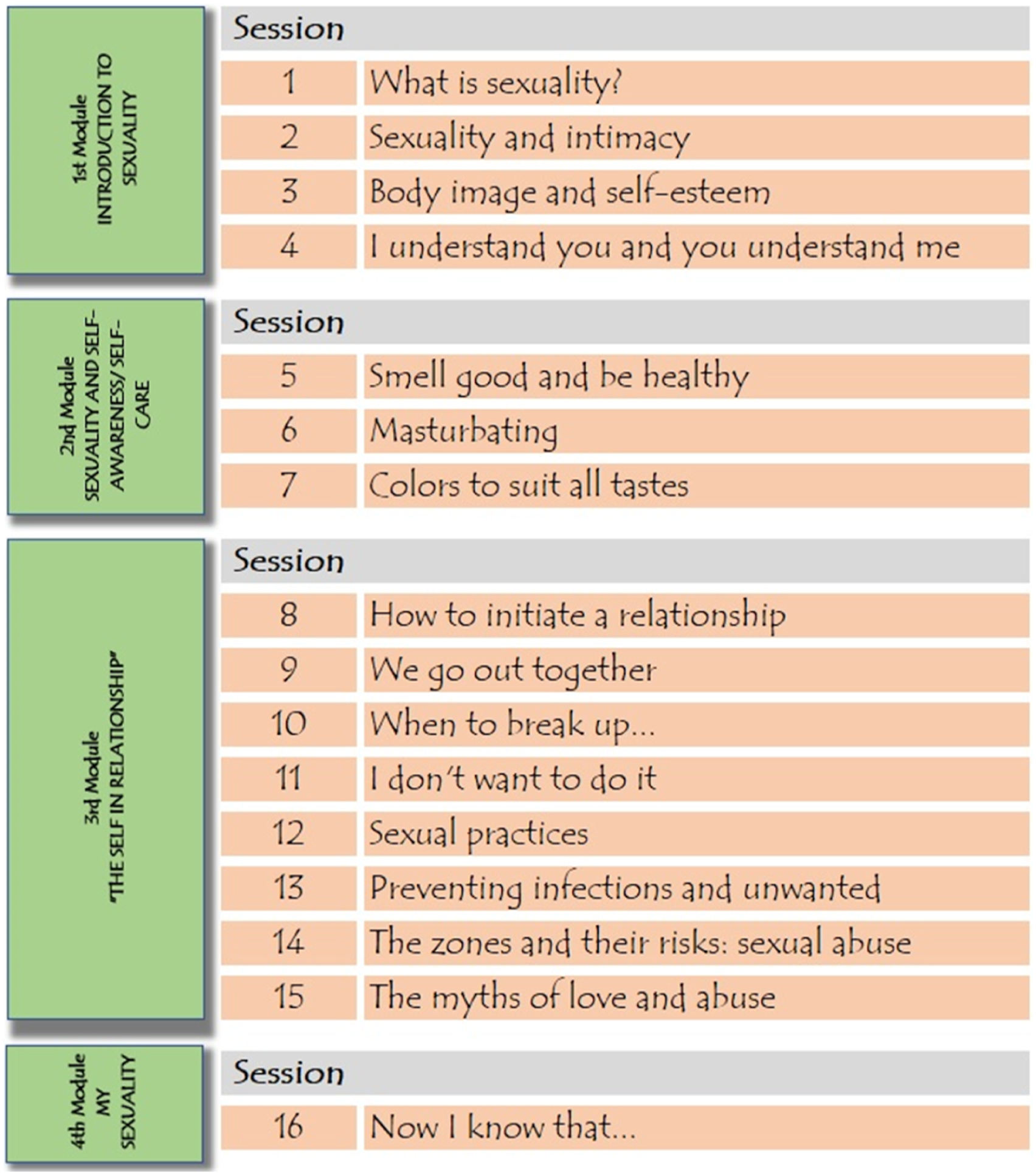
The first module “INTRODUCTION TO SEXUALITY” begins with the presentation of the program: work methodology, basic rules of behavior, and encouraging participation in the proposed activities. It includes 4 sessions, In the first session “what is sexuality”, the concept of sexuality as a personal experience and a point of union between people is analysed. The second session “sexuality and intimacy” aims to learn about behaviors that can be carried out in public or private spaces. The third session “body image and self-esteem” highlights how a good and correct self-assessment are fundamental aspects for the development of a healthy sexuality. The fourth session “I understand you and you understand me” involves understanding that knowing how to communicate correctly is an essential element in sexual relations. The three components of language are introduced: verbal (words), paraverbal (tone) and non-verbal (gestures). These four sessions lay the conceptual and attitudinal foundations, as well as the skills that will be used transversally in the remaining modules.
The module “SEXUALITY AND SELF-AWARENESS/SELF-CARE” is composed of 3 sessions. The fifth session “smell good and be healthy” raises awareness of the importance of maintaining hygiene in intimate areas. Some guidelines adapted to men and women are given and practised. The sixth session “masturbating” involves knowing what masturbation is and at what times and intimate places it can be performed. The seventh session “colors to suit all tastes” aims to develop tolerance towards sexual diversity and to reflect on one's own orientation.
The module “THE SELF IN RELATIONSHIP” is composed of 8 sessions focused on couple relationships. The eighth session “how to initiate a relationship” aims to learn how to initiate a romantic relationship and acquire skills to accept or reject requests from a partner. Thus, the steps to follow to start a relationship in an optimal way are presented step by step and in a simple way. The possible risks associated with meeting people through websites or apps are also discussed. The ninth session “we go out together” involves learning the rules governing relationships. Assertive communication guidelines and strategies for dealing with possible jealousy are also provided. The tenth session “when to break up...” is to educate as to the proper attitudes and steps to follow in order to end a relationship in a correct and respectful manner.
The eleventh session “I don't want to do it” allows the participant to identify when a sexual request is acceptable and when it is not, especially over the Internet. The concepts of sexting, grooming and sextortion are introduced and explained. The twelfth session “sexual practices” aims to teach participants about different sexual practices. It is explained that there are non-coital practices (caressing, kissing, mutual masturbation, oral sex, etc.) and coital practices involving the introduction of the penis through the vagina or anus. The thirteenth session “preventing infections and unwanted pregnancies” focuses on the description of the most frequent symptoms of Sexually Transmitted Infections (STI) and the benefit of consulting a professional when they appear. The importance of using methods, such as condoms or latex barriers, to prevent STIs is also emphasized. In the fourteenth session “the zones and their risks: sexual abuse” the concept of sexual abuse is introduced and explained with emphasis on who can commit sexual abuse, who can be the victim, where it can occur, who is to blame when it happens and what to do when someone is a victim of sexual abuse. The fifteenth session “the myths of love and abuse” involves learning about the different forms of violence and abuse and becoming aware of when it is occurring in order to stop and report it.
The fourth module “MY SEXUALITY” is composed of a single session “now I know that...”, which integrates and consolidates the lessons learned throughout all the modules.
Each session (except session 1, which begins with a general presentation of the program) begins with a brief reminder of the previous session and the resolution of possible doubts. This review is done with the help of a graphic poster that summarizes the key information. Next, some questions are asked in order to activate previous knowledge and to gauge the starting level of each participant with respect to the topics that constitute the core of the session. It then begins with a brief presentation and explanation of the content followed by a hands-on activity that promotes meaningful learning. It should be noted that in some sessions this order is reversed. It begins with an activity to encourage the users themselves, through discovery, to reflect and construct the desired concepts.
Immediately afterwards, the professional provides a comprehensive explanation. Following the completion of the activities, an integration and conclusion of the content worked on is carried out, including the distribution of a questionnaire whose purpose is to check the correct acquisition of the fundamental contents. At the end of the session, the summary poster is presented, which in turn will be reintroduced at the beginning of the next session and periodically at the end of each block, to promote the consolidation of the contents learned.
All activities are supported by slides with clarifying images, little text and following easy reading guidelines. In all sessions there is some activity and in several there is more than one. The average duration of the activities is 20 minutes, of which there are the following types: error identification activities based on short narratives or cases, role-paying and games. The games sometimes consist of sorting cards with different contents into 2/3 boxes with different labels, sometimes placing avatars of the participants in different places in a house according to the degree of privacy of the action indicated, and sometimes in contests aimed at consolidating knowledge, skills and attitudes.
Conditions of Training
The program designers will summon the two professionals chosen for program implementation at the University of Valencia's premises. The first phase of training will entail a 30-hour introductory program, focusing on essential knowledge (dimensions and functions of sexuality) and attitudinal aspects (e.g., sexual rights, professional ethics, and positive behavioral psychology) regarding sexuality in individuals with intellectual disabilities. The second phase of the training will encompass the provision of guidelines and essential materials for implementing the program. This training will span 8 sessions, each lasting 3 hours, and occurring every two weeks. Within each session, the content of two program sessions will be covered. Apart from the initial session, which will provide an overview of the program and introduce the professionals, the structure of the second training phase will consist of the following: 1) feedback from previously conducted sessions by professionals; 2) presentation and explanation of new sessions by program designers; 3) distribution of the necessary materials.
Conditions of Application
To obtain maximum effectiveness it is advisable that it be applied by two professionals from the occupational center who work regularly with the participants. The first professional carries the main weight by exposing and explaining the contents. The second professional provides individualized supervision and support. The sessions should take place in a spacious and private room that allows the realization of the different activities, the correct visualization of the materials presented, and the formulation of doubts and personal questions without fear of being judged by other people.
Measures for Process Evaluation
At the end of each session, the professionals make an evaluation of the degree of benefit (involvement, pertinent questions, etc.) that the users obtain from each of the sessions. They also assess to what extent they think that the activities carried out in the session are appropriate for the users in terms of complexity, duration, etc. To do so, they fill out a registration form developed ad hoc. Users also answer two questions at the end of each session: whether they found the activities interesting and whether they think they learned something (indicating what).
There are also four questions that are asked before and after each session. The first ones are aimed at activating prior knowledge and identifyihig erroneous knowledge. The second ones are to check the degree of difficulty of the session for each user. These questions cover knowledge, skills and attitudes.
Measures for Results Evaluation
Before applying the intervention, it is advisable that users complete a series of instruments that are administered again at the end of the intervention. The objective is to know the starting level and to check the extent of improvement:
ISK-ID. Inventory of Sexual Knowledge of People with Intellectual Disability
This instrument, validated in the Spanish context, has been elaborated by Gil-Llario, Castro-Calvo et al. (2021). The ISK-ID is a 34-item self-reported instrument designed to asses six dimensions related to sexual knowledge: (1) sexual practices (e.g. «only men can masturbate»); (2) dating, intimacy, and sexual assertiveness (e.g. «If my boyfriend/girlfriend asks me to send a sexual picture by WhatsApp, I should say no. I don't know who will see it»); (3) body image and sexual communication (e.g. «I have a positive body image when I like my body as it is»); (4) concept of sexuality (e.g. «walking or dancing are sexual activities»); (5) homosexuality (e. g. «If a friend tells me that he/she is homosexual, I support him/her»); and (6) sexual health (e.g. «To prevent a Sexual Transmitted Infection (STI), I should clean my mouth and privates»). All items are dichotomous (Yes or No).
ABSKID. Assessment of Sexual Behaviour and Knowledge of People with Intellectual Disability
The ABSKID was developed and validated in the Spanish population by Gil-Llario, Morell-Mengual et al. (2020). It is an other-reported scale to identify various aspects related to sexuality in people with ID: uninhibited sexual behaviour (e.g. «Do you think s/he is aware of his/her body changes in response to stimuli that excite him/her?»); privacy and social norms (e.g. «Do you think s/he is aware of social norms about knocking on closed doors?»); knowledge about sexuality (e.g. «Do you think s/he has knowledge about sexual hygiene?»); and concerns (e.g. «Are you concerned that his/her sexual behaviour might be misinterpreted?»). Responses are recorded using a dichotomous format (yes or no).
SEBECOMID-S. Assessment of Sexual Behaviour and Concerns of People with Intellectual Disability
The SEBECOMID-S was developed and validated in a Spanish sample by Gil-Llario, Flores-Buils, et al. (2022). This instrument contains 14 statements designed to assess sexual behavior and concerns: (a) STI prevention (e.g. «Are you sure to tell your partner that you want to use condoms even though he/she could reject you?»); (b) concerns (e.g. «Do you think other people look at you funny because they think you do things with a sexual intent when you don't?»); and (c) sexual practices (e.g. «Have you ever masturbated each other?»).
DSARss. Detection of Sexual Abuse Risk Screening Scale
The DSARss has been elaborated and validated in a Spanish sample by Gil-Llario, Ballester-Arnal et al., (2020). This is a 19-item questionnaire to assess diferents aspects of sexual abuse risk: (a) risk factors and self-protection skills (e.g. «I should be suspicious of a stranger who offers me a gift»); (b) acceptance of the abuse due to affection (e.g. «My uncle takes care of me, so it is okay to have sexual relationships with him»); (c) denial of the risk associated with places (e.g. «It is impossible to be sexually abused in a public place»); and (d) lack of awareness of intimacy rules (e.g. «If I like someone, I can allow him or her to touch my privates»).
Statistics
Sample characteristics will be examined with percentages for categorical variables and means for numerical variables. Means and SDs for each of the relevant outcomes will also be presented by groups. In addition, characteristics will be compared between groups using independent sample t-tests for numerical variables and chi-squares for categorical variables. The assumptions of normality were previously tested.
To test the main objective, to explore the efficacy of the intervention, effect sizes (ES) will be obtained, and a multilevel model will be run. The standardized mean difference (d) between the control and experimental groups is calculated by controlling for differences in the basis of belonging to different centers (Becker, 1988; Hedges, 1981). The Huedo-Medina & Johnson effect size coding calculator was used to calculate SEs (2011). The significance of efficacy will be further examined by controlling for dependence on participants belonging to the same center using multilevel models controlling for pretest differences and cluster dependence. The goodness of fit of the models will be investigated using a number of goodness-of-fit indices (i.e. Schwarz's Bayesian Criterion (BIC), Akaike's Information Criterion (AIC), and -2 Restricted Log Likelihood). To test the secondary objectives, that is to say if the number of sessions in the program and the characteristics of the participants and of the professionals who implement it influence the effectiveness of the intervention, several multilevel models will be undertaken controlling for pretest differences and cluster dependence.
Data Quality and Missing Data
Data quality procedures include the treatment of missing data, fixed responses, etc. as soon as they occur. All items in the questionnaire battery will be reviewed to avoid unanswered items. Although it is believed that the response rate will be ∼80% of the items, when we encounter missing data a systematic analysis of the data will be performed to determine if the probability of response varies by item type (Liao et al., 2015). If necessary, multilevel data imputation will be performed, assessing the type of absence and imputing the values with complete information or restricted maximum likelihood estimation (Little, 2002). The statistical package SPSS version 25.0 will be used.
Discussion
The development of rigorously designed affective-sexual educational interventions is one of the most important challenges in the field of developmental disabilities. The SALUDIVERSEX intervention program is based on a non-systematic review of the scientific literature and an exhaustive analysis of the needs referred to by the professionals (Brown et al, 2020; Crehan et al., 2023) and the users themselves (Coulter et al., 2023; Gil-Llario et al., 2018). This approach is especially relevant given that there are many informal interventions that do not take into account information from people with intellectual disability themselves (McCann et al., 2019). In addition, they constitute intervention strategies that only provide information focused on the prevention of unwanted pregnancies and sexually transmitted infections (Sala et al., 2019), but do not focus their interest on the development of skills and attitudes that allow a self-exploration of their sexuality (Brown & McCann, 2018; Schwartz & Robertson, 2019). In its favor, the SALUDIVERSEX program includes modules focused on self-acceptance of sexual orientation, the explanation of sexuality through autoeroticism, the beginning of healthy relationships, and other relevant positive aspects. However, given the adaptive and intellectual functioning limitations of people with ID, our intervention also provides information and skills to cope with possible risks: sexual abuse, intimate partner violence, homophobic attitudes or sexting. The correct identification of the variables involved in the acquisition of healthy behaviors and attitudes can lead to the design of new and more efficient programs that improve self-dermination through the improvement of sexual health.
Another distinctive element of the SALUDIVERSEX intervention program is the use of an experimental methodology, which overcomes the limitations of other existing interventions (Gutiérrez-Bermejo et al., 2021; Schaafsma et al., 2015). This aspect is especially relevant given that there are currently few interventions focused on affective-sexual aspects for people with intellectual disability that have been empirically demonstrated with rigorous evaluation of their effectiveness (Schaafsma et al., 2013). In general, the interventions implemented in this group do not usually have sufficiently representative samples (Hayashi et al., 2011), nor do they use evaluation instruments that are correctly adapted to the needs of this group (Gutiérrez-Bermejo et al., 2021; Schwartz & Robertson, 2019). Thus, the evaluation of the different variables of the SALUDIVERSEX program is performed using four psychometric instruments specifically designed and validated in this population that assess: the level of knowledge related to sexuality (Gil-Llario, Castro-Calvo et al., 2021; Gil-Llario, Morell-Mengual et al., 2020), sexual behavior (Gil-Llario, Flores-Buils, et al., 2022) and the ability to detect the risk of sexual abuse and their defense mechanisms (Gil-Llario, Ballester-Arnal et al., 2020).
The SALUDIVERSEX intervention program establishes a work methodology and structure based on some findings from the scientific literature. Thus, elements such as role-playing, modeling and guided practice are used to enhance and promote meaningful learning (Brown & McCann, 2018; Löfgren-Mårtenson, 2012; Schwartz & Robertson, 2019). This aspect is fundamental given that many interventions do not describe the methods and procedures used in detail, limiting their replicability or adaptation to other groups with similar characteristics (Schwartz & Robertson, 2019).
This study has some limitations. The literature review conducted was not systematic. Only a small albeit significant proportion of information focused on recent years is included. In future program revisions, it would be advisable to conduct a comprehensive systematic review that encompasses all the information generated regarding sexual health and quality of life in people with intellectual disabilities.
In summary, the SALUDIVERSEX intervention program can generate important contributions to the improvement of self-determination and autonomy of people with intellectual disabilities. Until now, many studies that have analyzed the effectiveness of similar intervention programs have had a series of methodological limitations that prevented the correct analysis of the effectiveness and replicability of the results. Therefore, our study may improve the current evidence regarding the importance of several attitudinal, behavioral and informational variables in the experience of free but socially adapted sexuality.
Footnotes
Declaration of conflicting interests
The author(s) declared no potential conflicts of interest with respect to the research, authorship, and/or publication of this article.
Funding
The author(s) disclosed receipt of the following financial support for the research, authorship, and/or publication of this article: This work is part of the R+D+i project RTI2018-095538-B-I00, funded by MCIN/AEI/10.13039/501100011033 and by “ERDF A way of making Europe.
Author contributions
Study conception, design and material preparation were performed by Maria Dolores Gil-Llario and Rafael Ballester-Arnal. The first draft of the manuscript was written by Vicente Morell-Mengual, Olga Fernández-García and Verónica Estruch-García, and revised by María Dolores Gil-Llario and Rafael Ballester-Arnal, and all authors commented on previous versions of the manuscript. All authors read and approved the final manuscript.
Ethics approval
The study was approved by the Ethics Committee of University of Valencia and was performed in accordance with the ethical standards as laid down in the 1964 Declaration of Helsinki and its later amendments.
Consent to participate
Participants were informed about the objectives of the survey, completion times, benefits, and risks, as well as about the anonymity of the responses and the right to stop the survey in any point and for any reasons.
