







Abstract
The present research investigated the lived experiences of mothers of children with mild intellectual disabilities in a central city in Iran. The research method was qualitative and phenomenological type. Eleven families were selected from males with intellectual disabilities who were graduated from secondary vocational centers through purposeful sampling and participated in in-depth semi-structured interviews. The data was analyzed by Colaizzi method. The main themes extracted from the interviews with mothers were: employment and financial independence; physical and mental health; sexual and marriage issues; and life after the death of parents. The results showed the lived experiences of mothers and their concerns regarding employment, marriage, sexual issues, physical and mental health, and the future of their children. The results recommended that the government should take steps to remove life obstacles for adults with intellectual disabilities by modifying the methods of education and rehabilitation of people with intellectual disabilities in the country.
Introduction
People with intellectual disabilities have been existing throughout human history and all over the world, constituting part of all cultures. They form a small part of the very vast diversity of human societies. It has been reported that these people constitute one percent of the population. The main diagnostic criteria are significant limitations in intellectual functioning and adaptive behaviors that appear during the growth period (before the age of 18) (Byrne, 2022). In the fifth edition of the Diagnostic and Statistical Manual of Mental Disorders (2013), it has been stated that different levels of intellectual disability are determined based on the adaptive behaviors; while, in the past, only intelligence scores were considered as the basis for making decisions in this regard. This change in classification has been made to emphasize the amount of support required for each person (Byrne, 2022). Determining the severity of intellectual disability requires evaluating a person’s functioning in three areas: conceptual skills (academic skills), social skills, and practical skills. Based on the required support levels, people with intellectual disabilities are classified into four categories: mild, moderate, severe, and profound (Williamson et al., 2017). About 85% of these people fall into the mild category (IQ 50 to 70 with mild deficits in adaptive behavior) and need limited support throughout their lives. Receiving the necessary support, the individuals in this group can, to a large extent, achieve independence in their lives. (Bjelland and Bruyère, 2022) The main goal of educating and training people with mild intellectual disabilities is to prepare them to enter the world of work and acquire the necessary skills for living in the society.
In Iran, people with mild intellectual disabilities are identified through intelligence evaluation before entering the elementary school. After being separated, they are educated in special schools. After passing the elementary and pre-professional courses, this group enters secondary vocational centers. The goals of secondary vocational centers are to increase life skills, achieve personal, social, and economic self-sufficiency, improve work and activity motivation, and acquire job skills with an emphasis on professional rehabilitation (National Exceptional Education Organization, 2010). After being educated from special schools, the important stage of transition to adulthood must take place. The transition to adulthood involves a major life change. Moving from the safe and supportive school environment to the wider community and environment is associated with a change in the person’s roles. During the transition, many changes occur in the person’s roles such as employment, independent life, friendship, and leisure time. (Norouzi, 2014) Although the transition to adulthood is natural and happens automatically, it can be very challenging for adolescents with intellectual disabilities. Transition is often associated with movement from a protected environment to a self-directed environment. This feature is characterized by the ability to make decisions and take care of oneself (Rosner et al., 2020).
Raising children suffering from intellectual disabilities can cause great psychological problems for their parents often manifested as depression, anxiety, and physical illnesses (Cramm and Nieboer, 2011; Norlin and Broberg, 2013). Several studies have shown that having a child with an intellectual disability is clearly associated with personal and financial difficulties, adjustment to a new role, and satisfaction of the child’s unique requirements (Olsson and Hwang, 2008; Pisula, 2007).
Taking care of children with intellectual disabilities by their families is considered as the main way of looking after these people. The family is considered to be the most lasting source of support for the majority of people with intellectual disabilities (Boehm and Carter, 2019). In research conducted by Minnes and Steiner (2009) in Canada, the researchers described that families are concerned about the amount of care and support services provided for their children with intellectual disabilities (Naqdi et al., 2018). Families have to deal with daily caregiving needs, including feeding, bathing, dressing, toilet training, and behavioral problems of the child (Plant and Sanders, 2007; Tomanik et al., 2004). Most parents also express concern about whether their children can function independently or not or who will take care of the child after their death. Finally, these fears and anxieties can lead to the stigma, isolation, and shame of having a child with intellectual disabilities (Taylor et al., 2019).
Compared to other mothers, mothers who take care of children with disabilities, experience more anxiety and tension (Kenis-Coskun et al., 2020). Planning for people with intellectual disabilities should be done in such a way that the anxieties and concerns of their families for taking care of them are reduced. This aim is not achieved unless people with intellectual disabilities move towards independence in their personal and social life, their dependence on their parents is reduced, and they can play a useful role in the society.
The lived experiences of Japanese mothers who took care of several children with intellectual disabilities showed that these mothers had no hope of having a normal family and experienced more physical and mental fatigue. However, although these mothers faced severe difficulties in raising several disabled children, they had tried to change negative perceptions and find an optimistic way for life (Kimura and Yamazaki, 2013). The lived experiences of parents of children with intellectual disabilities in South Africa showed that parents face challenges such as emotional stress, inability to cope with children’s disabilities, and financial challenges at the workplace, home, school, and society. The study also showed that parents are not sure about making educational decisions on behalf of their children and they were not trained on how to cope with their children’s disabilities and how to work and cooperate with the educators (Slungil et al., 2015). Budak et al. (2018) concluded that not all mothers consider having a child with intellectual disabilities to be negative. Some mothers may have no problem taking care of their children. However, almost all mothers worry about the future and experience significant changes in their family relationships. Analyzing the experiences of mothers who took care of a disabled child in Rudbar helped to classify the experiences of mothers into four main themes: negative emotions, social stigma, dissatisfaction and concern of mothers due to the lack of specialized financial support and weak support received from the supporting organizations (Khodabakhshi-koolaee et al., 2019).
A limited number of research studies have been conducted on the living conditions of people with intellectual disabilities in adulthood in Iran. Parents of these people are considered as a valuable source of information and examining their lived experiences about teenagers who have been graduated from special schools will help us to gain information about the conditions of these people in the family and society and to be able to take steps to solve their problems. The present study examines the lived experiences of mothers of children with intellectual disabilities after being graduated from the special schools.
Method
The present research study was conducted in a central city in Iran in 2024. The research was qualitative and the phenomenological research method has been used. Qualitative research studies are appropriate and useful in the fields where the existing knowledge is not complete and sufficient (Adib Haj Bagheri et al., 2016). Considering that no study has evaluated the life situation of people with mild intellectual disabilities after leaving school in the country, qualitative research on the experiences of their mothers will help to clarify the dimensions of the issue.
Participants
The statistical population of the study consisted of all mothers whose sons were graduated from secondary vocational centers in a central city of Iran. Eleven families were selected from males with intellectual disabilities who were graduated from secondary vocational centers through purposeful sampling and participated in in-depth semi-structured interviews. The criteria for entering the research included the consent of mothers of males with intellectual disabilities whose children have been graduated from secondary vocational centers since 1998 and before to share their experiences about their child’s life condition. In this research, saturation (when interviews do not contain new information different from previous interviews) was done after interviewing eleven mothers.
Data collection
Semi-structured in-depth interviews (Ruslin et al., 2022; Norouzi, 2006; Francis et al., 2018; Galletta, 2013) were used to gather the required data. At the beginning of each interview, the ethical principles of the research, including honesty and confidentiality, were discussed and an agreement to conduct the research was reached verbally. Ethical approval for the study was granted by the Research Ethics Committee (REC) of the host University (No: 79433277, date 13/03/2023). Permission to record the interviews was also obtained from the mothers. At the beginning of the interview session, general questions were asked as an introduction and, then, additional and differentiating questions were asked based on the parents’ answers. Given the authors’ research and practice background in working with people with intellectual disabilities, general interview questions were agreed upon in a joint meeting. Some of the questions raised include: 1- What actions has your child taken after being graduated? 2- Does your child suffer from any special physical illness? 3- Does your child take psychoactive drugs? 4- How does your child spend a full day? 5- How does your child spend his free time? 6- What are the most important needs of your child? 7- Does your child have the ability to attend in the society? 8- What is your most important concern for your child? 9- Have you made any decisions about your child’s marriage? 10- If you can go back to the past, how will you plan for your child? 11- How do you predict the future of your child?
All interviews were conducted by a PhD student in the field of psychology and education of people with special needs who had 15 years experiences of working with male’s students with intellectual disabilities in vocational secondary schools. All interviews were recorded and the recorded sessions were reviewed and analyzed individually and in a joint session by two associate professor researchers in the field of psychology and education of people with intellectual disabilities. The process of identifying eligible mothers and conducting interviews took 60 days, and the duration of each interview session was an average of 70 minutes. The data obtained from the interviews with the mothers were fully recorded and listened to many times and were, then, transcribed. The main and sub-themes were identified through coding and using Colaizzi method.
Data analysis
Colaizzi method was used to analyze the data. The steps of Colaizzi method are: 1- First, the description of the participants in the study is read to gain an understanding of the whole. 2- Important statements/phrases are extracted. 3- Meanings are compiled from important statements/phrases. 4- The compiled meanings are organized as themes. 5- A detailed description is written for each theme. 6- The basic structure of the phenomenon is developed (Adib et al., 2016). The process of obtaining validity and reliability in the implementation stage of the research was carried out as follows:
The validity and verifiability of the study
Achieving the validity and verifiability of the data was done with several different steps. In the first step, and in order to prevent data bias, an attempt was made to select research participants from different areas of central city of Iran and with different social and economic statuses. Interviewers also participated in a short-term retraining course to become more familiar with the principles of semi-structured interviews in qualitative methods. In the next step, coding and extracting themes from the interviews were done by two coders, and the level of agreement between them was considered using the Kappa agreement coefficient (Rau and Shih, 2021). The Kappa agreement coefficient (K = 0.85) indicated that there was good agreement between the two coders. In the third step, in order to achieve a common meaning, the extracted themes were presented again to the participants and they were asked to express the degree of harmony of the themes with their life experiences; and all themes were approved by the participants in the study. In the last step, the interview documents were archived while maintaining the confidentiality of the information to be re-examined by other researchers if needed.
Results
Demographic characteristics of the research participants.
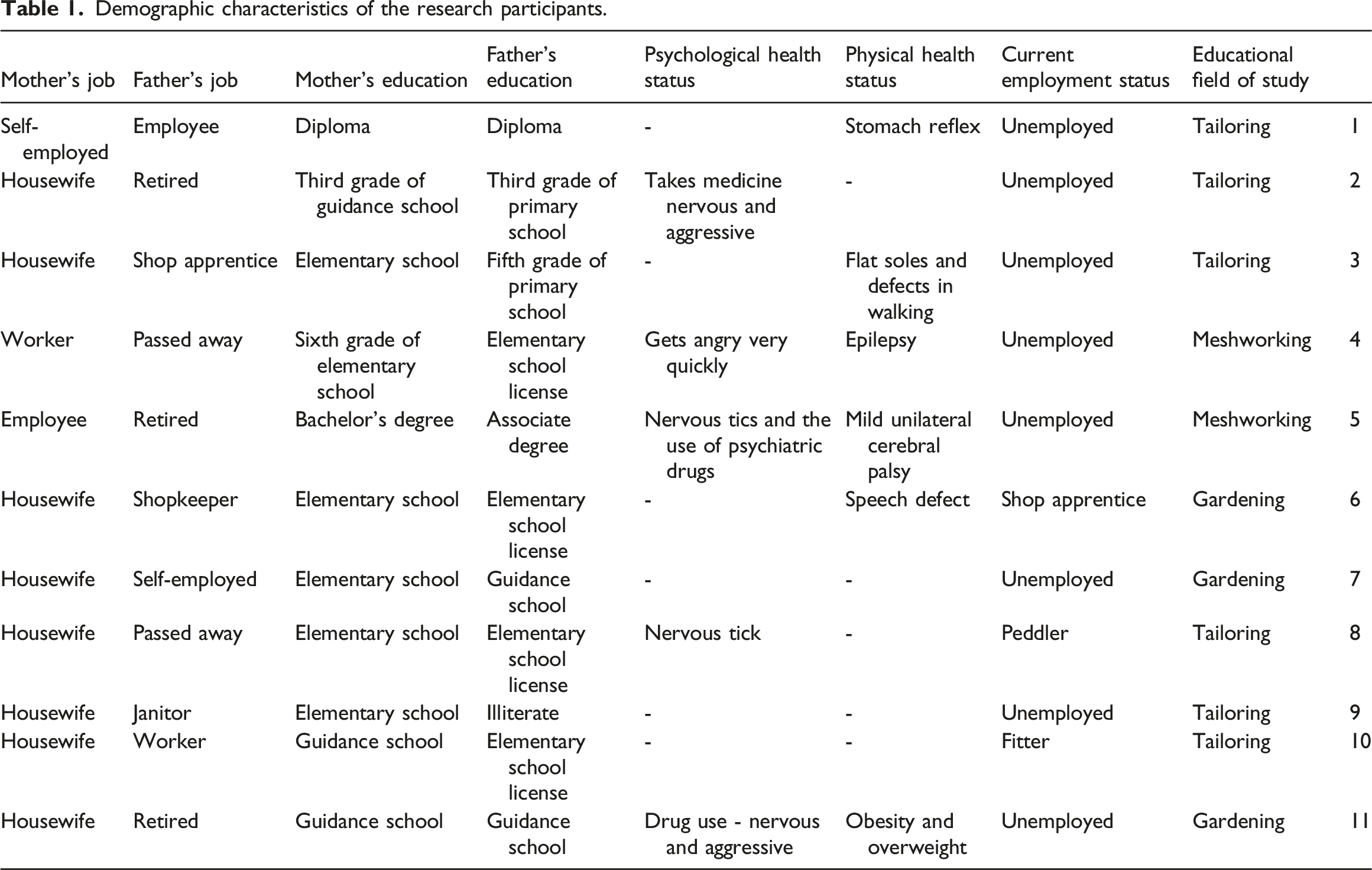
The study of demographic information showed that 73% of young people with intellectual disabilities were unemployed and the rest were working in low-level jobs and were deprived of receiving minimum wages and insurance from the labor department. The amount of physical and mental illnesses reported by the parents was high. The parents did not have a high social and economic status.
The main and sub-themes were identified through coding and using Colaizzi method.
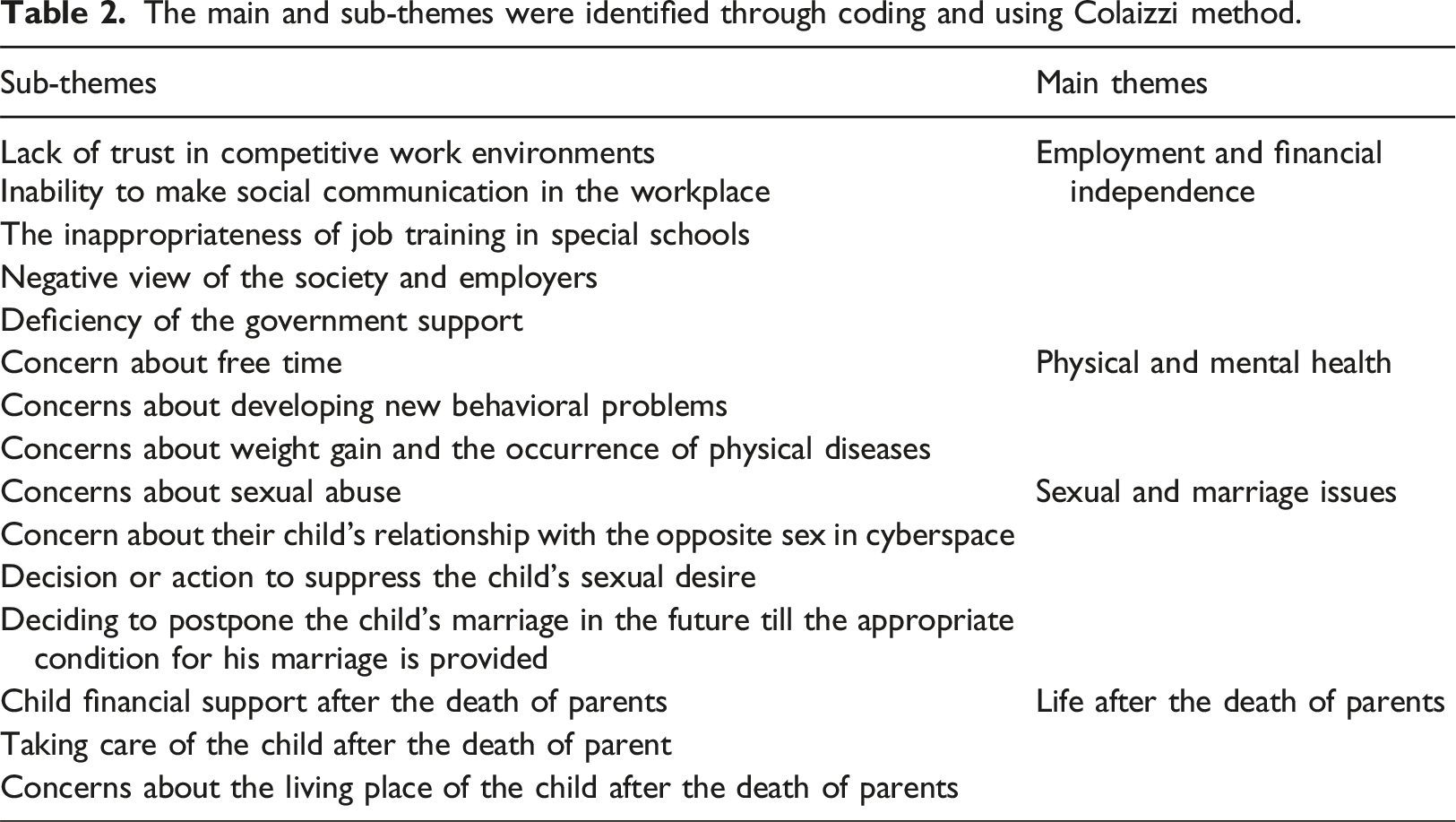
Based on the in-depth interviews and conducted investigations, the lived experiences of mothers of children with mild intellectual disabilities were classified into four main themes. Each of these main themes is divided into several sub-themes, the description of which can be seen in Table 2. The main themes include: 1- Employment and financial independence 2- Physical and mental health 3- Sexual and marriage issues 4- Life after the death of parents
In the following, each theme will be explained separately.
Employment and financial independence
One of the most important goals for the rehabilitation of people with intellectual disabilities is to help them get a job and achieve economic self-sufficiency. Rehabilitation in the field of intellectual disability will be effective and efficient when its output is the employment of these people based to their talent and ability. People with intellectual disabilities face a difficult and serious situation looking for a job and this has become one of the biggest challenges and concerns of their families. During the interviews with mothers and analysis of their lived experiences, the issue of trying to get a job for their children with intellectual disabilities and the failures they had experienced in this path was mentioned repeatedly. Families had tried different ways to find a job for their children, but most of these efforts were unsuccessful, and their children are currently unemployed.
According to the lived experiences of parents, the most important concerns and challenges in the field of employment of people with intellectual disabilities were: 1-1- Lack of trust in competitive work environment 1-2- inability to make social communication in the workplace 1-3- The inappropriateness of job training in special schools 1-4- negative view of the society and employers 1-5- Deficiency of the government support
Lack of trust in competitive work environment
In the competitive work environment, after learning professional and social skills, the person enters the free labor market and works besides other ordinary people in the society. On the other hand, in the protected models, after learning job and social skills in supported workshops, the person works besides other mentally disabled people under supervision. Interviews with mothers showed that almost the majority of mothers wanted to create protected work environments for their children. The most important reason for insisting on this issue was lack of trust in competitive work environments and fear of abuse, especially sexual abuse.
Inability to make social communication in the workplace
Lived experiences of mothers showed that one of the most important reasons why people with mild intellectual disabilities constantly lose their jobs is their inability to establish proper social communication with their employer and other colleagues.
The inappropriateness of job training in special schools
The analysis of mothers’ lived experiences revealed that mothers were not very satisfied with the job training provided in the schools and believed that these trainings did not result in their children’s job self-sufficiency.
Negative view of the society and employers
One of the important issues mentioned by many mothers was the negative view of the society and employers towards hiring individuals graduated from exceptional schools. Talking about their experience, mothers stated that if their child had not studied in the exceptional schools and had not received the so-called exceptional label, he would have been able to live in better conditions and would have been more easily accepted in the society.
Deficiency of the government support
The majority of parents had common experiences in referring to the government organizations to receive services for their children. Almost all of them had referred to the welfare organization, but they were not satisfied with the amount of service received.
Physical and mental health
One of the major issues that preoccupied mothers’ mind and was repeatedly referred to in the interviews was the concern about the consequences of unemployment and inactivity of children. Due to unemployment and the constant presence of the person at home, the possibility of physical and mental diseases will increase and the lived experiences of mothers showed that mothers are worried about this issue. Some of them mentioned the increase of violence and aggression in their children after being graduated from school. Some parents referred to their children’s isolation and reluctance to do daily tasks and some tried to use strategies such as walking, cycling, etc. to prevent weight gain and psychological problems. Two of the mothers mentioned that their children started cigarette and hookah smoking, and this matter worried them a lot.
Sexual and marriage issues
It was found that all mothers believed in the existence of sexual desire in their children and their need for marriage, but in response to the question of whether their child had the ability to make a family or not, they all believed that it was not the case. The lived experiences of mothers showed that one of the basic issues and challenges in the families of people with intellectual disabilities was the issue of sexual instinct and marriage. Almost the majority of boys with mild intellectual disabilities expressed their desire to get married. These people were generally treated in two ways by their family members:
One: postponing the issue of marriage to the future when the conditions can be met
Two: decision and attempt to suppress sexual desire
The issue of marriage of the people with intellectual disabilities is a very important and neglected issue in Iran. Most of these people openly express their sexual desire and their need for marriage, but this need is ridiculed or suppressed by the society and this issue has become one of the most important concerns of their families.
Life after the death of parents
The last issue that was common in the lived experiences of all mothers and can be, in some way, considered as the conclusion of the child’s current condition was the concern of the parents about the future of the child with intellectual disabilities. They were mainly concerned about who will take care of and support the child after the death of parents, what financial resources will be available to support the child, and how will be the housing situation of the child.
Discussion
In line with research findings (Minnes and Steiner, 2009; Naghdi et al., 2018) examining the lived experiences of mothers showed that people with intellectual disabilities did not have the required social skills to enter the society and mothers did not evaluate the education provided in the special schools as appropriate and sufficient. In addition, according to the mothers, the view of society and employers was negative towards the employment of their children and the parents were not satisfied with the support provided by the government in the field of employment.
People with intellectual disabilities face serious challenges in physical and mental health in adulthood (Perera et al., 2020). The issue of physical and mental health of the child was mentioned as one of the most important concerns of mothers. As stated by mothers, unemployment and constant presence of children at home will be the root of their mental and psychological problems. Mothers believe that due to unemployment and tensions created between children and their family members, children suffer from behavioral disorders and depression. Mothers also reported their concerns about the physical problems and obesity of their children due to their lack of activity and excessive use of smart phones.
In terms of sexual and marriage issues of people with intellectual disabilities, practical and specific strategies have not been proposed in the country. The existence of sexual desire in children was an undeniable fact that was referred to by mothers. However, all the mothers believed that their children were not ready to get married and make a family. In response to the question of how the sexual needs of young people with intellectual disabilities should be met, mothers answered with doubt and hesitation. A group of mothers believed that the issue of marriage should be postponed to the future and another group thought that the sexual desire should be suppressed. The findings of this section are consistent with the research of (Perez-Curiel et al., 2023; Taghizadeh et al., 2020; Zewude and Habtegiorgis, 2021).
Concerns about the child’s employment, marriage and health forms a bigger concern called fear of the future. Parents are worried about what will happen to their children with intellectual disabilities after the parents’ death. They are also worried about how their dependent child can continue his life without the emotional and financial support of the parents. Almost all mothers worry about the future, and without planning for the future, families will be exposed to greater psychological problems (Bodak et al., 2018; Lee and Brook, 2020; Yoosefi Lebni et al., 2021).
Conclusion
Nowadays, families of children with intellectual disabilities are faced with many concerns throughout their lives. Parents’ concerns begin from the moment when they become aware of the diagnosis of intellectual disability for their child. Proportionate to the severity of intellectual disability, the type and amount of concerns will also change.
Facing the fact that their child will not be able to grow and develop like normal peers and needs special social, academic, and practical support will cause anxiety in the family (Cramm and Nieboer, 2011; Kimura and Yamazaki, 2013; Norlin and Broberg, 2013 and Keniş-Coşkun et al., 2020). The majority of individuals with intellectual disabilities are categorized in the mild class and enter special schools after receiving the diagnosis. With the presence of the child in the special schools, his parents’ hope for his growth and change will increase. Moreover, as the child’s free time is filled up by attending school, his parent’s concerns will decrease. However, the problems are intensified from the time when the person intellectual disabilities are graduated from school. This will usually occur between the ages of 18 and 22. At this time, the transition to adulthood is required to occur. Based on the training received during education, the person should be able to enter the labor market, be socially compatible, and have a clear future. However, the problem is that the majority of people with intellectual disabilities will become consumers and a burden on the family after leaving school in the country. These people have not acquired the necessary skills and readiness to enter the world of adulthood and this issue will become the biggest concern of their parents.
Considering the determination of the basic concerns of mothers of young people with intellectual disabilities, the need to modify the educational and rehabilitation methods used for this group is an undeniable necessity. The government, associations and all related educational and rehabilitation institutions should take steps to address the basic concerns of these parents. Rehabilitation in childhood has not reached its final goal if it does not lead to self-sufficiency and independence in adulthood.
The strengths and limitations of the study
This research has been conducted for the first time in Iran and has revealed significant results regarding the living conditions of people with intellectual disabilities in adulthood. The results of this research can provide rich content for educational and rehabilitation planning for people with mild intellectual disabilities and their families to the organizations responsible for education and rehabilitation in Iran. Organizations responsible for education and rehabilitation in Iran can prepare and implement useful programs and training courses for people with intellectual disabilities and their families in order to improve their quality of life. This research was accompanied by limitations such as limited financial resources and lack of support from organizations responsible for education and rehabilitation in Iran. Also, given that this research was conducted only in the context of families with lived experiences of mothers of young people with mild intellectual disabilities, caution should be exercised in generalizing the results of this research to mothers of children and adolescents with mild intellectual disabilities or people with profound, severe, and moderate intellectual disabilities. Therefore, the results of this study suggest that, with appropriate financial resources, similar research should be conducted on families with lived experiences of mothers of children and adolescents with mild intellectual disabilities or other groups with intellectual disabilities. In addition, using the qualitative research method will lead to the collection of in-depth data about the topic, but the obtained results in this method are not generalizable. Therefore, the results of this study suggested to use quantitative research methods to achieve a comprehensive view, using the variables discovered by the qualitative (phenomenological) method.
Footnotes
Acknowledgments
Authors would like to appreciate the administration for exceptional children education in Isfahan Province. Also, we respectfully appreciate all the mothers of children participated in the research and all the dears that assisted us in the research administration.
Author contributions
Study design: HS, GN, MA. Data collection and analysis: HS, GN, Manuscript preparation: HS, GN, MA.
Declaration of conflicting interests
The authors declared no potential conflicts of interest with respect to the research, authorship, and/or publication of this article.
Funding
The authors received no financial support for the research, authorship, and/or publication of this article.
