







Abstract
This study examines the moderating role of family stress in the relationship between psychological well-being and resilience among children with intellectual disabilities. It also explores differences in psychological well-being, resilience, and family stress levels based on the severity of the child’s disability. The sample included 200 fathers from Türkiye, with a mean age of 42.5 years, and children aged 3–10 years. The results show that psychological well-being positively predicts resilience, and family stress moderates this relationship, with higher family stress levels associated with reduced resilience. Fathers of children with mild intellectual disabilities reported higher psychological well-being and resilience compared to those with moderate or severe disabilities. These findings highlight the importance of family stress management and resilience-building strategies in supporting fathers of children with intellectual disabilities. Future research should use diverse samples and longitudinal designs to further explore these dynamics.
Introduction
Challenges faced by families with children with intellectual disabilities
Families of children diagnosed with intellectual disabilities (ID) face substantial challenges that affect their daily lives, routines, and overall family dynamics. According to the Diagnostic and Statistical Manual of Mental Disorders (DSM-5), ID is characterized by significant limitations in both intellectual functioning (such as reasoning, learning, and problem-solving) and adaptive behavior, which covers a range of everyday social and practical skills. These limitations originate before the age of 18 and often require long-term support (American Psychiatric Association, 2013). Compared to parents of typically developing children, parents of children with ID frequently report increased physical, emotional, and financial burdens, as they must adapt to ongoing care demands and specialized educational and therapeutic interventions (Boyraz and Sayger, 2010; Darling et al., 2011; Tien et al., 2022). Emotional responses such as confusion, guilt, denial, shock, anger, anxiety, and depression are also common in the initial and ongoing stages of caregiving (Soni and Jain, 2016; Tripathi, 2015).
Historically, caregiving responsibilities in families, including those with typically developing children, have fallen primarily on mothers (Parke et al., 2005). Mothers have traditionally been regarded as the main caregivers, while fathers’ roles have been relatively underrepresented in both practice and research (Kózka and Przybyła-Basista, 2017; Peer and Hillman, 2014). However, research indicates that fathers’ involvement plays an equally critical role in child development, parental well-being, and the stability of the family system (Dhungel et al., 2021; Flouri and Buchanan, 2003). In families of children with ID, paternal psychological resilience, family stress management skills, and emotional well-being are particularly important for maintaining a stable and supportive home environment.
Resilience and its relevance in fathers of children with intellectual disabilities
Resilience, defined as the ability to adapt to and recover from adversity, is a crucial skill for individuals facing significant life challenges (Muir and Strnadová, 2014). Resilience is not an innate characteristic but a skill that develops over time, influenced by the balance between risk and protective factors in one’s environment (Shang et al., 2022). Fathers of children with intellectual disabilities often experience disruptions in their dreams, expectations, and future plans for their children, leading to emotional strain and decreased resilience (Coşkun and Akkaş, 2009).
Research shows that resilience enables individuals to better manage family stress, regulate negative emotions, and maintain positive relationships, all of which are essential for effective caregiving (Chen et al., 2022; Langley et al., 2020; Musi, 2020). While resilience can help parents cope with challenges, the present study follows the Family Stress Theory and the Stress-Buffering Model, which posit that high levels of family stress can weaken the extent to which psychological well-being fosters resilience (Cohen and Wills, 1985; Havnen et al., 2020; Patterson, 2002). In other words, when family stress is elevated, the benefits of psychological well-being on fathers’ adaptive capacity may be reduced, whereas under lower family stress conditions, this relationship may be stronger (Aivalioti and Pezirkianidis, 2020; Havnen et al., 2020; Kaner and Bayraklı, 2010). For fathers of children with intellectual disabilities, sustaining resilience under such circumstances is vital for meeting caregiving demands, managing emotional strain, and maintaining a supportive family environment.
Psychological well-being and its role in fathers of children with ID
Psychological well-being is a multidimensional construct encompassing emotional balance, life satisfaction, and overall happiness (Bernard et al., 2020). It is critical for fathers’ ability to accept their child’s disability, manage caregiving responsibilities, and cope with concerns about their child’s future (Abdelfattah et al., 2021; Harvey, 2020). High levels of psychological well-being enable fathers to maintain a sense of purpose, foster healthy relationships, and support their children’s development.
Despite its importance, research shows that fathers of children with special needs often experience lower levels of psychological well-being compared to fathers of typically developing children (Langley et al., 2020). The increased caregiving demands and emotional burden of raising a child with special needs can significantly impact fathers’ mental health. These challenges underscore the need for a better understanding of the factors that influence fathers’ psychological well-being and how it can be enhanced.
Family stress refers to the psychological strain experienced by parents in response to the demands of raising a child. In families raising children with intellectual disabilities in Türkiye, empirical work shows elevated burden and strain, underscoring the salience of family stress in this context (Kuscul and Adamsons, 2022; Meral and Cavkaytar, 2012; Muslu and Coskun Cenk, 2018). For parents, this is often exacerbated due to the additional challenges associated with caregiving. The type and severity of a child’s disability play a significant role in determining the level of family stress experienced by parents. For instance, families of children with autism spectrum disorder (ASD) report higher levels of family stress than parents of children with other disabilities (Dabrowska and Pisula, 2010; Estes et al., 2009).
High levels of family stress can reduce parents’ ability to translate their psychological well-being into resilient coping strategies, making it harder for them to adapt to their child’s condition and manage related challenges (Kuntz et al., 2017). In line with the Family Stress Theory (Patterson, 2002) and the Stress-Buffering Model (Cohen and Wills, 1985), this study assumes that family stress does not simply coexist with resilience but actively moderates the psychological well-being–resilience link. In this framework, fathers with high psychological well-being may still experience diminished resilience if family stress is elevated, whereas under lower family stress conditions, psychological well-being is more likely to foster resilience (Havnen et al., 2020; Kaner and Bayraklı, 2010; Pan et al., 2025). This conceptualization provides the foundation for the current research model and underlines the importance of addressing family stress in interventions aimed at strengthening resilience among fathers. Therefore, adopting family-centered approaches, as highlighted by Hoxha and Ristovska (2024), which strengthen collaboration between professionals and families, improve service accessibility, and enhance advocacy efforts, can indirectly contribute to reducing family-wide stress. These benefits, however, do not occur in a cultural vacuum, as societal norms and values play a crucial role in shaping how fatherhood is experienced and enacted.
Cultural norms and expectations significantly shape family roles and dynamics. In Turkish society, fathers have traditionally been viewed as financial providers, with limited involvement in caregiving or emotional support. Observational and survey research in Türkiye indicates that mothers still perform most direct caregiving, with fathers’ hands-on involvement comparatively lower, especially in families of children with intellectual disabilities (Meral and Cavkaytar, 2012; Tutkun, 2022). However, raising a child with special needs often requires fathers to take on more active roles within the family. This shift in responsibilities can challenge traditional gender roles and require fathers to develop new skills and coping strategies.
Understanding how Turkish fathers navigate these challenges is essential for developing culturally appropriate interventions. Exploring the psychological well-being and resilience of Turkish fathers provides valuable insights into the unique cultural factors that influence their experiences and the specific support they may require (Langley et al., 2020; Musi, 2020). Within this cultural framework, it is also important to consider the family-level stressors that can shape, and sometimes constrain, the link between fathers’ psychological well-being and their capacity for resilience.
The relationship between psychological well-being and resilience is complex, with various factors influencing this dynamic. Family stress has been identified as a critical moderator, affecting how psychological well-being translates into resilience. High levels of family stress can weaken the positive effects of psychological well-being on resilience, highlighting the need to address family stress in interventions aimed at enhancing resilience (Aivalioti and Pezirkianidis, 2020; Havnen et al., 2020; Pan et al., 2025).
For fathers of children with special needs, family stress often stems from the caregiving demands, financial pressures, and emotional challenges associated with their child’s condition. Addressing these family stressors is crucial for fostering resilience and improving psychological well-being.
The current study
Although previous research has examined the psychological well-being and resilience of parents of children with disabilities, the majority of studies have focused on mothers, leaving fathers’ unique experiences underexplored (Etzold-Frometa, 2014; Seymour et al., 2017). Moreover, empirical evidence on these relationships in the context of intellectual disabilities (ID)—particularly in underrepresented cultural settings such as Türkiye—is scarce. Guided by the Family Stress Theory (Patterson, 2002) and the Stress-Buffering Model (Cohen and Wills, 1985), the present study conceptualizes family stress as a moderating factor that can weaken the positive influence of psychological well-being on resilience among fathers of children with ID. This approach reflects the idea that when family stress levels are high, fathers’ psychological well-being may be less effective in fostering resilience, whereas under low family stress conditions, well-being is more strongly associated with resilience (Havnen et al., 2020; Pan et al., 2025). In addition to examining this moderating effect, the study also investigates differences in psychological well-being, resilience, and family stress according to the severity of the child’s intellectual disability (mild, moderate, or severe), addressing another gap in the literature. By integrating these aims, the research provides a culturally grounded understanding of the psychological processes that support fathers in their caregiving role, offering evidence-based directions for interventions aimed at strengthening resilience in families raising children with ID. Moreover, by situating this investigation within the Turkish cultural context—where traditional gender norms and caregiving expectations may uniquely shape fathers’ experiences—the study offers a valuable contribution to cross-cultural research on fatherhood and resilience
Study objectives
This study has three primary objectives: (1) To examine the relationship between psychological well-being and resilience in fathers of children with intellectual disabilities (ID). (2) To investigate the moderating role of family stress in this relationship, specifically how family stress influences the strength and direction of the link between psychological well-being and resilience. (3) Comparing psychological well-being, resilience, and family stress levels across fathers of children with mild, moderate, and severe ID
Hypotheses
Based on the study objectives, the following hypotheses were formulated: (1) Psychological well-being is positively associated with resilience in fathers of children with intellectual disabilities. (2) Family stress moderates the relationship between psychological well-being and resilience, such that higher family stress weakens the positive association between the two variables. (3) Psychological well-being, resilience, and family stress differ significantly across fathers of children with mild, moderate, and severe intellectual disabilities.
Method
Research model
This study investigated whether family stress (W) moderates the association between fathers’ psychological well-being (X) and resilience (Y) in families of children with intellectual disabilities (ID). In a moderation framework, a third variable changes the strength or direction of the X–Y relation (Frazier et al., 2004). We estimated the main effect of psychological well-being on resilience and the interaction between psychological well-being and family stress (X×W) using Hayes’ PROCESS (moderation analysis). • Independent variable (X): Psychological well-being • Dependent variable (Y): Resilience • Moderator (W): Family stress • Interaction term: X×W (Psychological well-being × Family stress)
Participants
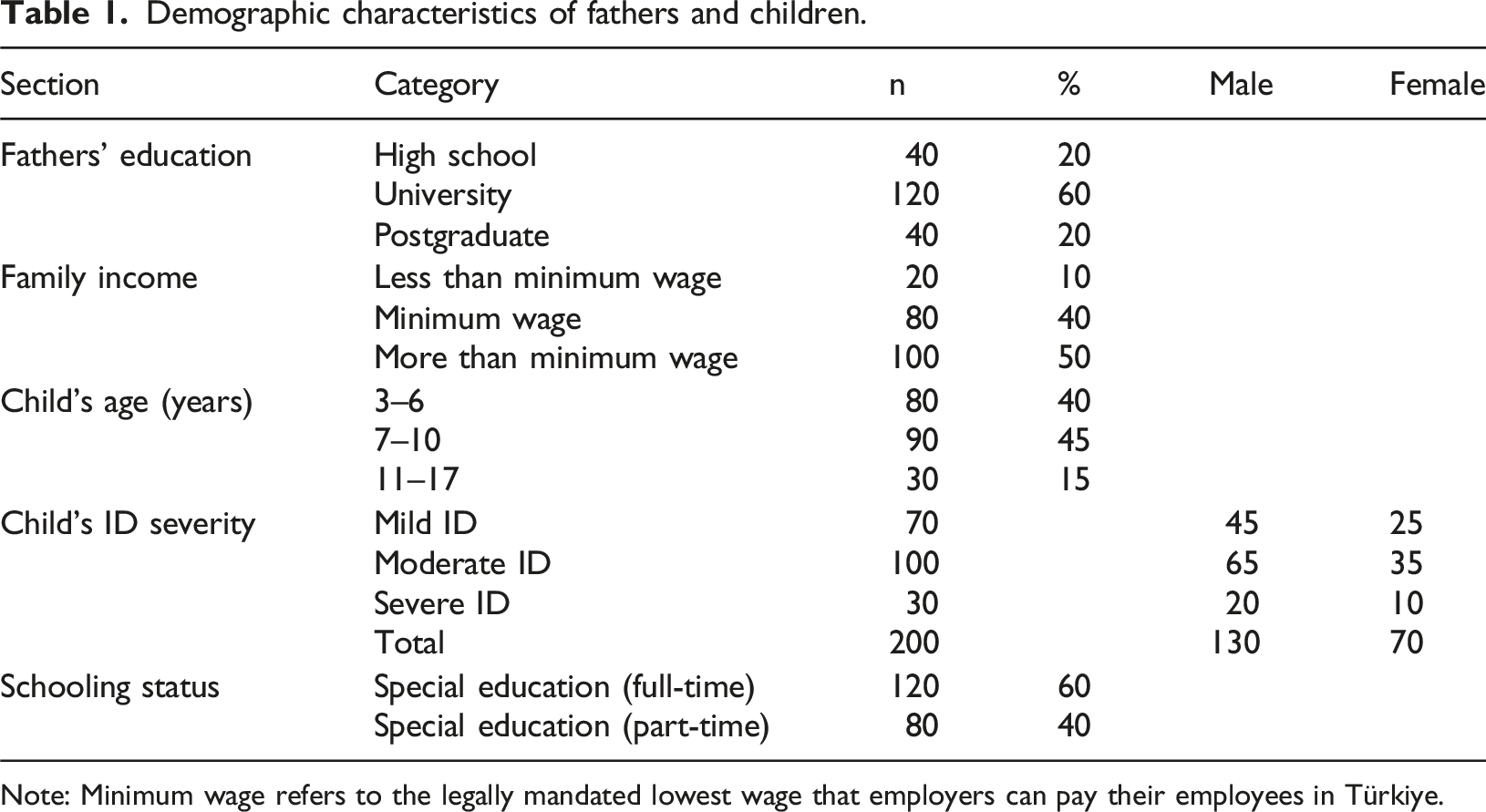
Demographic characteristics of fathers and children.
Note: Minimum wage refers to the legally mandated lowest wage that employers can pay their employees in Türkiye.
As shown in Table 1, 40 (20%) fathers were high school graduates, 120 (60%) university graduates, and 40 (20%) held postgraduate degrees. Regarding household income, 20 (10%) earned less than the minimum wage, 80 (40%) at the minimum, and 100 (50%) above the minimum. Among the children with intellectual disabilities (ID), 70 (35%) had mild ID, 100 (50%) moderate ID, and 30 (15%) severe ID; 130 (65%) were male and 70 (35%) female.
Measures
Measurement of intellectual disability severity
Children’s intellectual disability (ID) status was determined based on existing clinical diagnoses documented in official records. Severity levels (mild, moderate, severe) were primarily based on classifications maintained by the child’s rehabilitation or special education center, as recorded by qualified clinicians and reported by fathers from their most recent documentation.
In addition, the parent-report form of the Vineland Adaptive Behavior Scales–Second Edition (VABS-II; Sparrow et al., 2005) was administered online via a secure link shared with participating fathers. This version indexed adaptive functioning domains (e.g., communication, daily living skills, socialization) and served to corroborate the center-reported severity categories for research purposes. Participants whose VABS-II scores did not align with the severity classification reported by the centers were excluded from the analyses. No new diagnostic assessments were conducted by the authors, and IQ scores were not collected due to feasibility and privacy constraints; thus, the study relied on center records for categorical severity while using VABS-II scores as a standardized measure of adaptive functioning.
Information form
An Information Form was developed by researchers to gather data on the demographic and child-related characteristics of the participants. The form included questions about the father’s age, education level, occupation, and family income, as well as the number of children in the family. It also collected information about the child with an intellectual disability, including the child’s age, gender, diagnosis, the type of institution they attend (e.g., special education center or inclusive school), and the duration of their institutional enrollment. These variables provided the basis for describing the sample and exploring potential group differences.
Family stress assessment scale (QRS-F)
The Turkish validity and reliability of the Questionnaire on Resources and Family stress (QRS-F), the original form of which was developed by Friedrich et al. (1983), was re-tested by Kaner (2001) with data obtained from parents with children in a wide age range and various disability groups. There are three subscales of the QRS-F; Functional Impairment (16 items), pessimism (16 items), and Parental and Family Problems (7 items). The KR-20, Cronbach’s alpha coefficients, and Spearman Brown two-half reliability coefficients calculated to determine the internal consistency of the scale were 0.92, 0.91, and 0.89, respectively (Kaner, 2001). These values are 0.87, 0.89 and 0.89 for the Functional Impairment subscale, 0.86, 0.86 and 0.86 for the Pessimism subscale, 0.66, 0.55 and 0.27 for the Parental and Family Problems subscale (Kaner, 2001). Scale items were responded to by choosing one of the True or False response options. In this study, the Cronbach’s alpha reliability coefficient for the total QRS-F scale score was found to be 0.85.
Family Resilience Scale-FRS
The Family Resilience Scale (FRS) was developed by Kaner and Bayraklı (2010) to assess parents’ perception of resilience. Exploratory factor analysis, confirmatory factor analysis, item-total correlation, and correlation between subscales were applied for the validity study of the scale. In addition, correlations of the FRS with Beck Depression Inventory, Learned Resilience Scale and Parenting Competence Scale were examined. Cronbach’s alpha, Spearman-Brown two-half reliability, and test-retest reliability coefficients were examined. The scale consists of 34 items and three subscales: Struggle (17 items), Commitment to Life (8 items), and Self-efficacy (9 items). The items on the five-point Likert-type scale are scored as follows: (1) does not define me at all, (2) defines me a little, (3) defines me moderately, (4) defines me well, and (5) defines me very well. A high score on the subscales of the scale means that the level of resilience is high, whereas a low score is interpreted as low resilience. The Cronbach’s alpha coefficients of the FRS ranged between 0.54-0.91 and the test-retest reliability values ranged between 0.33-0.80, and all of these values were significant. The Cronbach Alpha coefficient of this study was found to be 0.86.
Psychological well-being scale
Psychological well-being was measured using the Psychological Well-Being Scale, developed by Diener et al. (2010) The scale is unidimensional and consists of eight items rated on an 8-point Likert-type scale ranging from 1 (strongly disagree) to 8 (strongly agree). The scores range from 8 to 56, with higher scores indicating higher levels of flourishing or psychological well-being. The scale was adapted in Turkish by Telef (2013) and provided good evidence of reliability and validity. The Cronbach’s alpha internal consistency coefficient obtained in the reliability study of the scale was .80. According to the test-retest results, there was a high, positive, and significant relationship between the first and second administrations of the scale (r= 0.86, p<.001). As a result of the reliability analysis conducted in this study, the Cronbach’s alpha internal consistency coefficient was .89.
Procedure
All instruments were administered online via Google Forms. The information sheet detailed the study purpose and confidentiality; no personally identifying data (e.g., name or national ID) were collected. Participation was voluntary, and respondents could withdraw from the study at any point. The survey remained open for four weeks and all items were mandatory; consequently, there were no missing data. Recruitment and eligibility criteria. Participants were recruited via special education and rehabilitation centers and nationwide parent associations that distributed the survey link to fathers of children with intellectual disabilities (ID). The inclusion criteria were as follows: (a) being the father of a child with an existing clinical ID diagnosis, (b) child aged 3–17 years, and (c) residence in Türkiye.
Ethics
The study protocol was approved by the university. All procedures were performed in accordance with the Declaration of Helsinki.
Analysis of data
Analyses were conducted in SPSS 26 using Hayes’ PROCESS macro (Model 1) to test moderation (IBM, 2023). IBM SPSS Statistics for Windows, Version 29.0. IBM. Predictors were mean centered prior to creating the interaction term to reduce multicollinearity. The moderation model used 10,000 bootstrap resamples with 95% bias-corrected confidence intervals. We report unstandardized coefficients (B), standard errors, standardized coefficients (β), and p-values. Distributional assumptions were screened via skewness–kurtosis target within ±1; (Finney and DiStefano, 2006) and visual diagnostics.
Between-group differences by ID severity (mild, moderate, severe) were examined with one-way ANOVA. Simple slopes for the interaction were probed at ±1 SD of family stress and graphed accordingly. In addition to examining the overall relationships between variables, we analyzed intergroup differences across fathers of children with mild, moderate, and severe intellectual disabilities. This analysis was conducted to address Study Objective 3 and to explore whether the severity of a child’s disability is associated with variations in fathers’ psychological well-being, resilience, and family stress levels.
Result
Differences in fathers’ psychological well-being, resilience, and family stress according to the severity of their child’s intellectual disability (mild, moderate, severe) were examined using one-way ANOVA.
Fathers’ psychological well-being, resilience and family stress levels according to children’s disability status.

MID =Mild intellectual disability, MOID= Moderate Intellectual disability, SID =Severe intellectual disability, ns = non-significant.
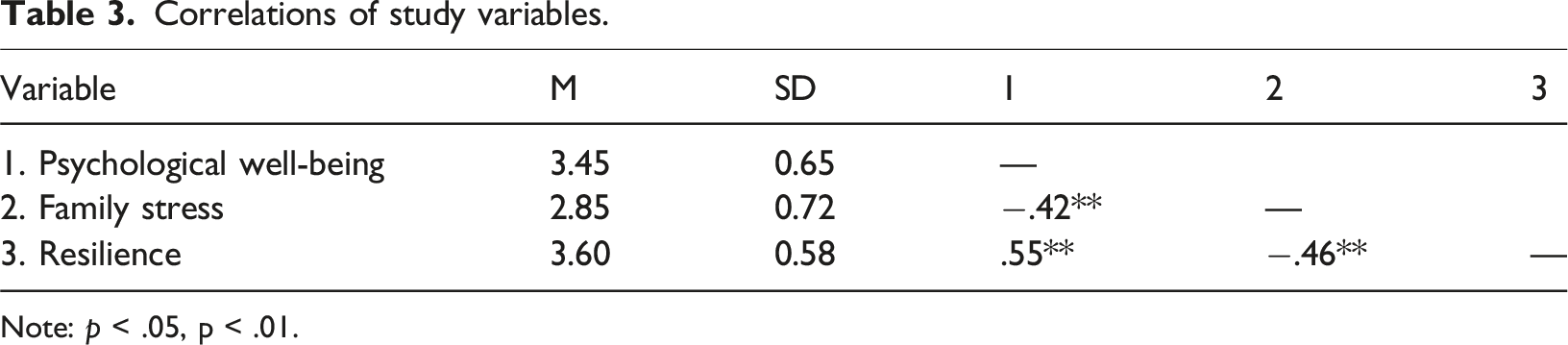
Given these group-level findings, a preliminary correlation analysis was conducted to further examine the bivariate relationships among psychological well-being, family stress, and resilience.
Correlations of study variables.
Note: p < .05, p < .01.
Testing the proposed model
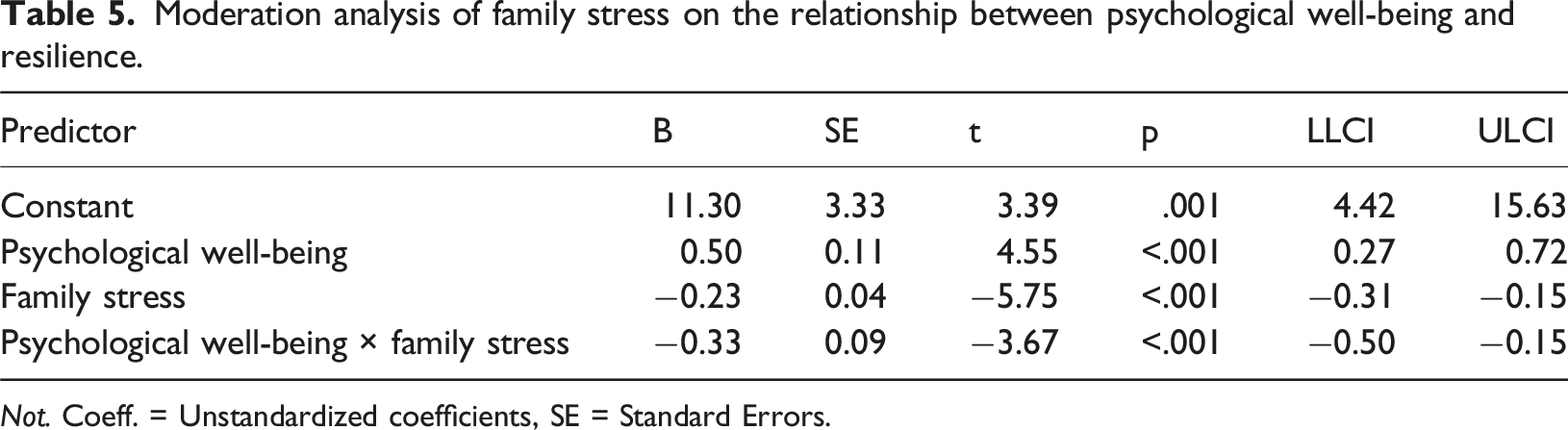
Hayes’ PROCESS Macro (Model 1) was used to examine the moderating role of family stress in the relationship between psychological well-being and resilience. A bootstrapping procedure with 10,000 resamples was employed, and 95% bias-corrected confidence intervals were calculated. The results indicated that psychological well-being significantly and positively predicted resilience (B = 0.50, p < .001). Family stress significantly and negatively predicted resilience (B = −0.23, p < .001). Moreover, the interaction term between psychological well-being and family stress was significant (B = −0.33, p < .001), indicating that higher family stress levels weakened the positive association between psychological well-being and resilience.
Model summary.

Moderation analysis of family stress on the relationship between psychological well-being and resilience.
Not. Coeff. = Unstandardized coefficients, SE = Standard Errors.
The analysis of Figure 1 shows that the positive effect of psychological well-being on resilience is stronger at low family stress levels, whereas this positive effect weakens at high family stress levels. This indicates that family stress moderates the relationship between psychological well-being and paternal resilience. The moderating effect of family stress.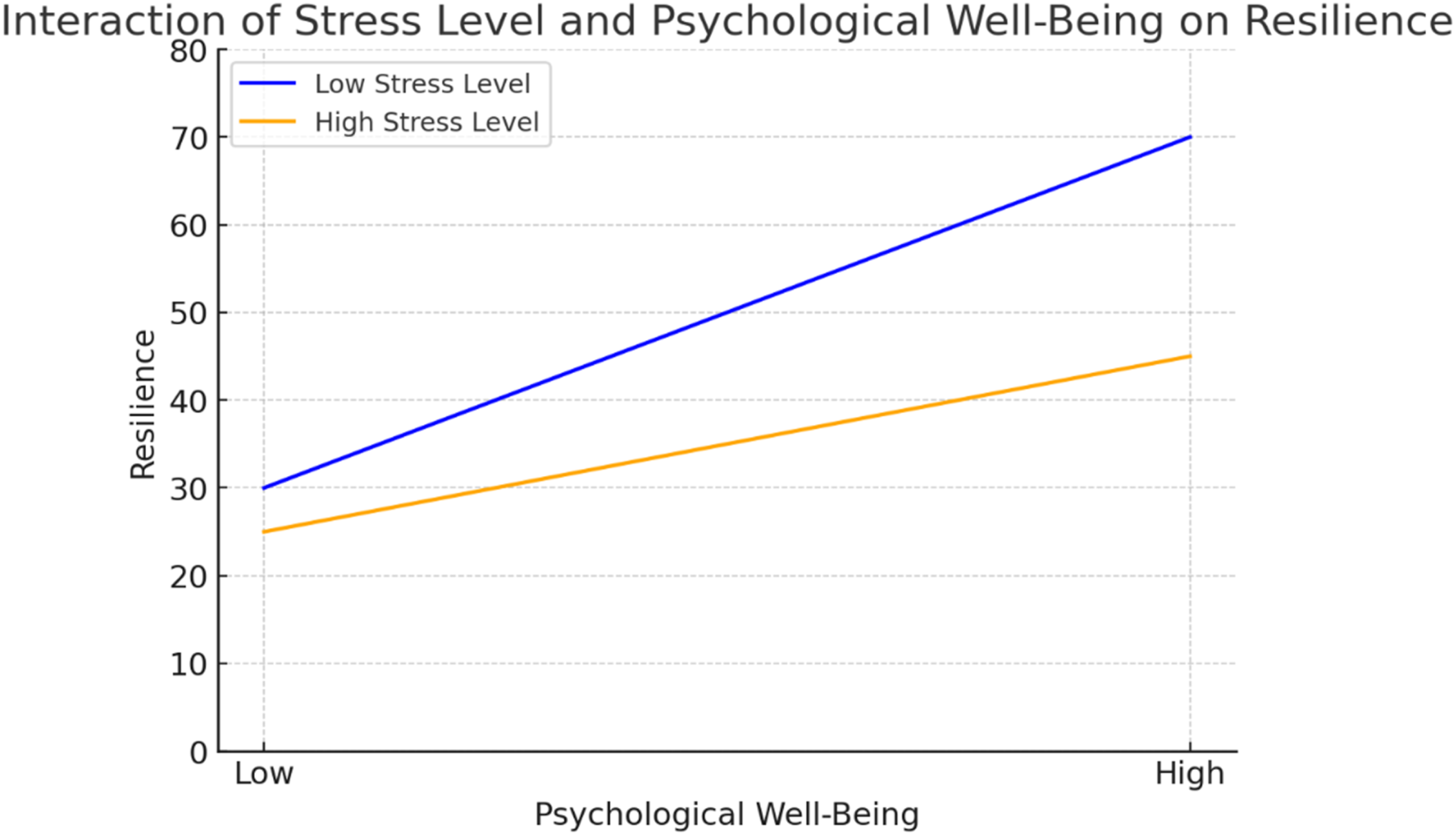
Discussion
This study explored the relationship between psychological well-being and resilience levels in children’s fathers with special needs, focusing on the moderating role of family stress. Additionally, differences in psychological well-being, resilience, and family stress levels across disability groups were analyzed. The findings provide significant insights into the unique challenges and coping mechanisms of fathers raising children with special needs, contributing to a deeper understanding of their psychological experiences and well-being.
Relationship between psychological well-being, resilience, and family stress
The results demonstrate a complex interplay between psychological well-being, resilience, and family stress. Consistent with prior research, a negative relationship was observed between psychological well-being and family stress, indicating that higher family stress levels are associated with reduced psychological well-being (Abdelfattah et al., 2021; Harvey, 2020). Fathers of children with special needs often encounter heightened caregiving demands, financial pressures, and social stigma, which can exacerbate family stress and diminish their psychological well-being (Potter et al., 2022; Silver et al., 1998). These findings align with the family systems theory, which suggests that the well-being of individual family members is interconnected and influenced by stressors within the family system (Cabrera et al., 2000).
In this study, psychological well-being positively predicted resilience, and this association was influenced by the level of family stress. Specifically, when family stress was lower, the positive relationship between psychological well-being and resilience was stronger, whereas at higher stress levels, the relationship was weakened. This pattern indicates that family stress acts as a moderating variable in the relationship between psychological well-being and resilience, rather than resilience serving as a buffer between stress and well-being. This finding provides empirical support for the Stress-Buffering Model (Cohen and Wills, 1985), emphasizing that well-being does not operate in isolation but is shaped by the stress context within which individuals function.
Intergroup differences based on disability severity
In addition to the main analyses, this study explored differences in psychological well-being, resilience, and family stress among fathers based on the severity of their children’s intellectual disabilities. Fathers of children with mild intellectual disabilities (MID) reported significantly higher levels of psychological well-being than those of children with moderate (MOID) and severe (SID) intellectual disabilities. This finding may be attributed to the relatively fewer behavioral and caregiving challenges associated with children with mild intellectual disabilities compared to those with more severe disabilities (Baker-Ericzén et al., 2005; Chen et al., 2020). Conversely, fathers of children with severe intellectual disabilities (SID) exhibited significantly lower resilience levels than those of children with MID, consistent with prior findings showing that parents of children with greater disability severity face higher caregiving demands, heightened family stress, and fewer opportunities for respite (Dabrowska and Pisula, 2010; Estes et al., 2009).
Interestingly, the study found that family stress did not significantly differ by disability severity, which is an unexpected but theoretically meaningful finding. One possible explanation is that although the sources of stress differ across groups, behavioral management for severe disabilities versus educational and social concerns for mild cases, the overall stress burden remains high. Another explanation may involve fathers’ cognitive appraisal of stress: regardless of the objective severity of their child’s condition, Turkish fathers may perceive caregiving as a uniformly demanding and socially pressured role. This could be due to societal expectations that position fathers primarily as financial providers rather than emotional caregivers, leading to a generalized experience of stress, independent of disability severity. This interpretation aligns with the findings of Kuşçul and Adamsons (2022), who noted that traditional paternal identity in Türkiye often centers on responsibility and provision rather than active caregiving. Thus, even as caregiving roles diversify, the psychological burden associated with fatherhood may remain consistently high across disability types.
Cultural context and the role of Turkish fatherhood
The cultural context of Türkiye offers an essential lens through which these findings can be interpreted. In Turkish families, fathers have historically been viewed as the economic backbone and authority figures, whereas mothers assume many direct caregiving responsibilities (Tutkun, 2022). This traditional role distribution can influence both the sources and expressions of stress in women. For example, financial strain, linked to the provider role, can become a dominant component of “family stress,” even when caregiving is primarily managed by mothers. Additionally, cultural norms that discourage men from expressing emotional vulnerability may prevent fathers from seeking social or psychological support, thereby weakening their resilience under stress. The moderating effect of family stress found in this study might therefore reflect not only situational strain but also deeper cultural expectations that shape how Turkish fathers experience and manage caregiving-related challenges.
Kuşçul and Adamsons (2022) further emphasized that fathers’ modernity beliefs and caregiving attitudes interact to influence their involvement and emotional adjustment. In this sense, psychological well-being and resilience among Turkish fathers may be affected as much by cultural identity and social norms as by their child’s disability characteristics. The current study thus contributes to a culturally grounded understanding of fatherhood in Türkiye, highlighting how sociocultural expectations may amplify or attenuate the relationship between psychological well-being, resilience, and stress.
Family stress as a moderator
The interaction between family stress, psychological well-being, and resilience is crucial for understanding mental health outcomes in caregiving contexts. This study demonstrated that family stress significantly moderates the relationship between psychological well-being and resilience. Specifically, the beneficial effects of psychological well-being on resilience become more pronounced when family stress levels are low; however, at elevated stress levels, this positive influence diminishes (Havnen et al., 2020). This suggests that excessive family stress may destabilize fathers’ psychological resources and impede their resilience development. While prior studies often positioned resilience as a protective factor (Gao et al., 2022; Hasudungan and Mustika, 2024), these findings point to a more dynamic process in which stress itself constrains the functioning of psychological well-being in fostering resilience.
Practical implications and intervention strategies
These results underscore the need for interventions aimed at reducing family stress and promoting paternal well-being. Empirical evidence supports the efficacy of targeted interventions, such as mindfulness-based practices, structured stress management programs, and community-based peer support groups, in enhancing caregivers’ resilience (Poojari et al., 2024; Saif et al., 2023; Thongthammarat and Yamarat, 2022; Zhu et al., 2024). For instance, online resilience interventions, such as the SMART-3RP program, have been shown to improve coping and emotional balance in parents of children with chronic conditions (Park et al., 2020). In the Turkish context, developing father-specific support groups could be particularly valuable, offering safe spaces for fathers to share their experiences, build coping skills, and challenge cultural norms that inhibit emotional expression. Additionally, psychoeducation initiatives for clinicians and educators should explicitly include fathers in service delivery, acknowledging their unique stressors and fostering inclusion in family centered care practices (Kokorelias et al., 2019). Multicomponent family interventions that address both parents’ psychological and relational dynamics may further reduce cumulative family stress and promote adaptive resilience (Breiner et al., 2016; Erbiçer et al., 2024).
Limitations and future directions
This study provides valuable insights into the moderating role of family stress in the relationship between psychological well-being and resilience among fathers of children with special needs. However, this study has several limitations. First, the use of self-report measures may introduce bias due to social desirability and inaccurate self-perception. Future research could adopt mixed method approaches that integrate interviews, observations, and professional assessments. Second, cross-sectional design prevents causal inference; longitudinal studies are recommended to explore how these variables evolve over time. Third, although the sample of 200 Turkish fathers provides a meaningful starting point, it may not fully represent the diverse cultural, socioeconomic, and regional characteristics of the broader population. Including mothers, siblings, and extended family members in future studies could provide a more holistic picture of family functioning.
From an applied perspective, interventions that target stress reduction and resilience enhancement through culturally sensitive, family centered approaches hold promise for improving psychological outcomes among fathers. Integrating evidence-based strategies into both preventive and therapeutic frameworks may substantially enhance fathers’ mental health, family well-being and caregiving capacity.
Footnotes

Consent to participate
Participation in the study was entirely voluntary, and every effort was made to create a comfortable and supportive environment for the participants.
Funding
The author received no financial support for the research, authorship, and/or publication of this article.
Declaration of conflicting interests
As the author, I declare that there is no financial support or other conflict of interest associated with the execution of this study.
Declarations
Originality of the work the author confirms that the work submitted here is not published or submitted for publication elsewhere.
Data Availability Statement
The author is willing to collaborate and provide the necessary information to support the results presented in the article.