







Abstract
Domestic abuse research can be emotionally challenging, particularly for qualitative researchers who are immersed in sensitive, and sometimes distressing, participant stories. Reflexivity is essential in sensitive research; however, researchers typically focus their reflexive efforts on how their own perspectives may have influenced the data, rather than how they may have been personally affected by the stories they analyse. In this paper, I reflect on how using poetry in domestic abuse research can help to increase researchers’ sensitivity to emotion, heighten their empathic responses to participants’ stories and promote reflexivity. The use of poetry has gained popularity and various poetic forms have been used to collect, analyse and present qualitative data. Using examples from a recently completed study on domestic abuse, I show how tanka poems can be developed from existing qualitative data to draw together researcher and participant perspectives within the same poem. Originating in 7th-century Japan, the tanka is a short, structured poem that conveys strong emotion and authentic voice. To date, tankas are underutilised in poetic inquiry research and, in sharing my own reflections, I advocate tanka poetry as a creative way of engaging with qualitative data and a useful means of reflexivity in domestic abuse research.
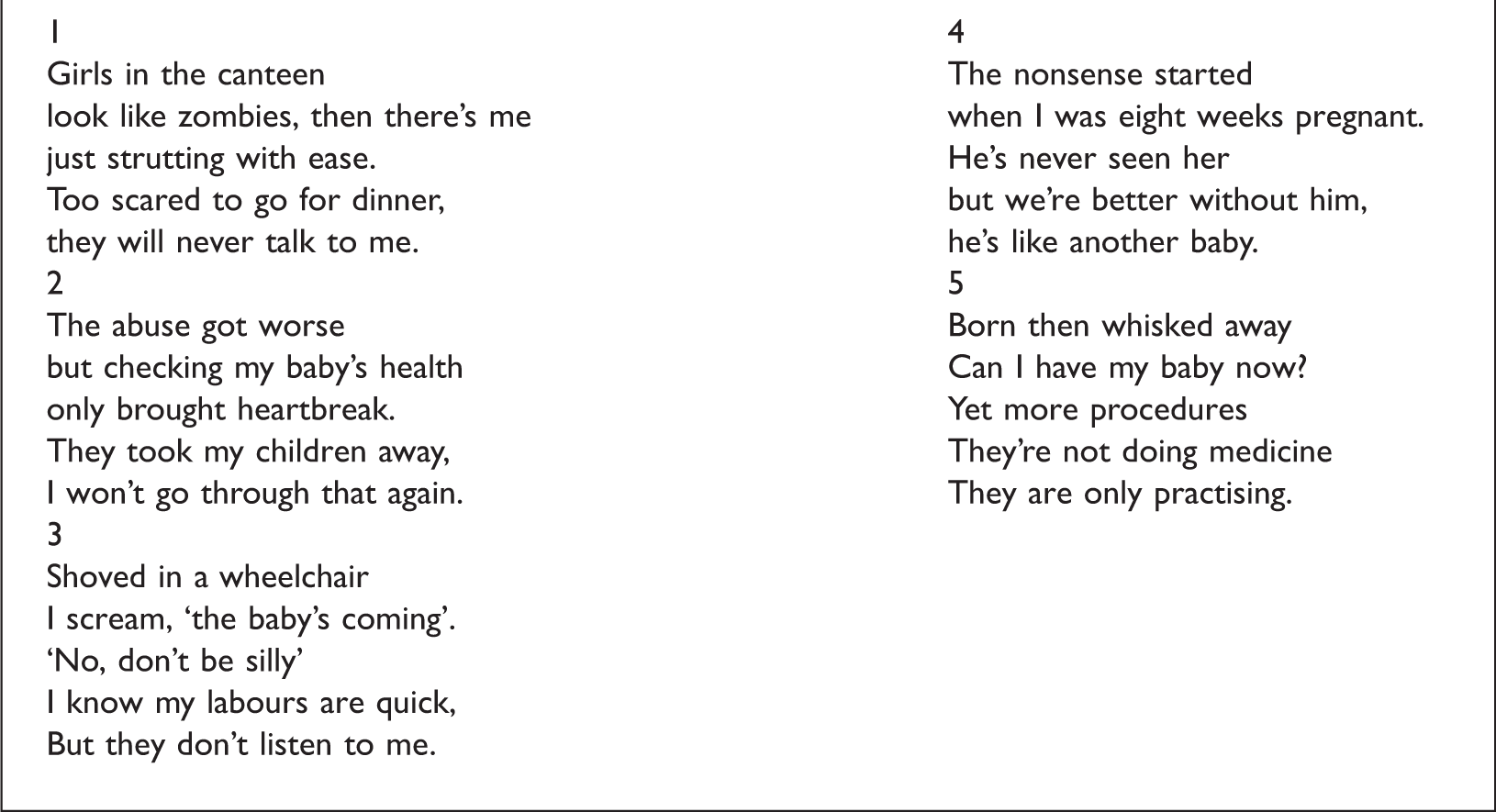
The abuse got worse
but checking my baby’s health
only brought heartbreak.
They took my children away,
I won’t go through that again.
Doing qualitative research is intellectually and emotionally challenging (Hubbard et al., 2001). Particularly within domestic abuse research, immersion in participants’ stories demands a great deal of emotional labour (Jackson et al., 2013). While it is common for researchers to report how they have biased or constructed their data, it is less common for researchers to acknowledge how they have been personally affected during the research process (Warr, 2004). There is convincing evidence, however, that researcher reflexivity and personal introspection can generate greater sensitivity between researcher and participant (Hill, 2004), help to anticipate and address ethical issues (Kidd and Finlayson, 2006) and mitigate researcher vulnerability (Ballamingie and Johnson, 2011).
In this paper, I reflect on my experience of conducting research with disabled women who experienced domestic abuse during pregnancy (Bradbury-Jones et al., 2015; Breckenridge et al., 2014). I was challenged to not only consider how my perspectives, choices and interpretations as a researcher impacted upon key findings, but also to recognise that participants’ data had transformed my own social, emotional and intellectual worldviews (Finlay, 2002). Poetic inquiry – the use of poetry in the research process – is one way of exploring reflexivity and emotion. Using the Japanese tanka, the aim of this paper is to demonstrate how poetry and research can be combined and to reflect critically on the benefits and challenges of this approach within qualitative domestic abuse research.
Poetic inquiry
Poetic inquiry refers to the use of poetry for research purposes, where poems can be used both ‘in’ and ‘as’ social research (Furman, 2006: 560). Researchers can use poetry as a data source, a data collection tool, a means of data analysis or a method for dissemination (Furman et al., 2007). The field of poetic inquiry is growing and many researchers have written about the use of poetry in qualitative research (see e.g. Furman, 2006, 2007; Furman et al., 2006, 2007; Gallardo et al., 2009; Hordyk et al., 2014; Hunter et al., 2002; Lahman et al., 2010; Taiwo, 2011; Witkin, 2007). While a disproportionate amount of literature on using poetry in qualitative research comes from North America, specifically the US (Furman, 2006, 2007; Furman et al., 2006, 2007; Gallardo et al., 2009; Lahman et al., 2010) and Canada (Hordyk et al., 2014; Taiwo, 2011), this paper comes from a UK perspective.
Poetic inquiry is not an homogenous field and a variety of methods have been used, including researcher-voiced autobiographical poems (Furman, 2006; Furman et al., 2007; Gallardo et al., 2009), reflexive, circular emails amongst the research team (Lahman et al., 2010) and combining poetry with other arts-based approaches, such as photography (Szto et al., 2005). Witkin (2007) developed the use of relational poems to create constructivist conversational poems; one person writes a free-standing poem, and another responds by writing a new poem. When the lines of both poems are interwoven, a new poem is created that captures how new realities can be formed through interaction (Witkin, 2007). Arts-based methods have been found to be particularly suited to discussing sensitive or taboo subjects, and as a means of social activism to highlight important social and political issues (Finley, 2011). Poetry in particular has been used to address topics such as adolescent identity and development (Furman et al., 2007), emergency room experiences (Furman, 2006), bereavement (Barak and Leichtentritt, 2014), depression (Gallardo et al., 2009) and homelessness (Hordyk et al., 2014).
Reflecting on the field of poetic inquiry, Prendergast (2009) has identified three main approaches: 1) literature-voiced poems (where poems are written by the researcher in response to theory or literature in the field); 2) researcher-voiced poems (where poems are written about the researcher’s own experience); and 3) participant-voiced poems (where participants’ voices are used to create poetry). Participant-voiced poems are written with or by participants or – as in this paper – written by the researcher based upon raw data from interview transcripts. Sometimes referred to as found poetry or data poems, this approach to qualitative data analysis was pioneered by Richardson (1994), who suggested that restructuring existing data into poetic form could spark novel analytic insights. This approach has been used within feminist research on domestic abuse, for example, creating ‘I poems’ in which poems are formed from each line of a transcript beginning with the personal pronoun (Koelsch and Knudson, 2009).
There is some debate within the methodological literature about whether researchers should use free verse or select a formal poetic structure when writing poems from data (Prendergast, 2009). Proponents of free verse suggest that applying extant structures such as sonnet or haiku may be too restrictive and could detract from the original voice of the participant. Whilst I recognise the benefits of free verse, I also agree with Furman (2006, 2007), who has written extensively about the benefits of applying different poetic forms to data. He suggests that imposing formal poetic structures can encourage researchers to be economical and get to the very essence of an emotion, experience or story. This is why I opted for the Japanese tanka. Within the growing field of poetic inquiry, the Japanese tanka is relatively under-used by researchers in comparison to other forms. There are very few examples of the use of the tanka in poetic inquiry, with the exception of authors such as Furman (2006) and Furman et al. (2007).
Tanka poetry
The tanka is a short Japanese poem, similar to the haiku. Tanka poems date back to the 7th century where they were traditionally used as a means of clandestine communication between lovers in the Japanese Imperial Court. Tanka poetry was a matter of social necessity within the Court and an eloquent poem sent to a person of superior social rank could gain the author recognition as a fellow human being (Tyler, 2001). When the tanka moved into the formal realms of Japanese literature, it was primarily geared towards a female readership. Many of the great tanka poets were women, most notably Lady Murasaki Shikibu who wrote The Tale of Genji in the 11th century. Considered to be the world’s first novel, it is recognised as a masterpiece in Japan, much akin to the acclaim given to Shakespeare or Homer in other parts of the world. The Tale of Genji tells the story of an Emperor’s son as he tries to restore his prominent position in the Court after being exiled from the Imperial Family. The story is told through seamlessly woven poetry and prose, incorporating a total of 795 tanka poems. Despite being told from Genji’s perspective, literary critics suggest that the novel is actually more of a detailed portrait of the experiences and emotions of the women he encounters along the way, as demonstrated in the tanka below (Tyler, 2001: 60). Your haste to be off Before morning mists are gone Makes it all too plain So I should say that your heart Cares little for your flower
From its clandestine roots, the tanka has since evolved in contemporary literature as a form of social activism, bringing taboo subjects into the public domain. For example, McCotter’s (2012) modern tankas deal with issues such as breast cancer, learning disability and dementia. Beginning in the early 1960s, Kizer wrote tankas from a position of female oppression (Salvaggio, 1990). Her tankas advocated for political issues such as abortion, claiming that ‘to keep these issues out of poetry is to keep the world of politics safely distracted from the lives of the very women affected by politics’ (Salvaggio, 1990: 69). Rexroth (1964) had a similar concern with bringing poetry into ‘closer proximity to the main concerns and currents of society’ and he used tankas to speak directly to his readers – what he called ‘talking poetry’ (Guttierrez, 1996: 40). Reflecting on the historical and literary context of tanka poetry, then, it is easy to see synergies with social research. As a poetic form steeped in women’s history it is aptly suited to domestic abuse research and there are interesting parallels between the history of tanka poetry and the aim of sensitive research to address difficult or hidden social issues.
Composing tanka poems within domestic abuse research: An example
I was inspired to use tanka poetry within the data analysis phase of a study about how disability and domestic abuse affect women’s access to maternity care (for a full description of the study and its findings see Bradbury-Jones et al., 2015; Breckenridge et al., 2014). The study took place in the UK during 2012–2014 using a Critical Incident Technique (CIT) methodology (Flanagan, 1954). CIT is focused on identifying discrete incidents in the data and closely examining their context, antecedents and consequences (Butterfield et al., 2005). Theoretically, the study was underpinned by Andersen’s (1995) model of healthcare use, which conceptualises healthcare use as a combination of three factors: individuals’ predisposition to use services; the perceived necessity of care; and the enabling and disabling factors influencing service access. We interviewed five disabled women affected by domestic abuse and asked them to describe, in detail, the barriers and facilitators they faced when using maternity services. We identified all of the incidents in each transcript where women had come into contact with maternity services and mapped these onto the theoretical framework (Bradbury-Jones et al., 2015). This provided a valuable overview of the barriers preventing women’s access to services as well as potential strategies for making maternity care more accessible and acceptable to disabled women affected by domestic abuse.
Five tankas: five maternity experiences from disabled women affected by domestic abuse.
A personal reflexive writing story
To optimise the reflexive potential of poetic inquiry, Richardson (2000: 965) has encouraged researchers to create ‘writing stories’ that reflect the motivations behind their poetry. She provides three prompt questions to guide reflexion:
Where am I in the poem? What do I know now about the interviewee and myself that I did not know before I wrote the poem? What poetic devices have I sacrificed in the name of science?
Whilst tanka poems in themselves are a powerful means of data representation, by integrating Richardson’s (2000) writing story process within my poetic inquiry I was able to explore more deeply and reflect on my personal response to participants’ stories. Using these prompt questions, I reflected on how and why I had constructed the five tanka poems. My writing story is shared here.
Where am I in the poem?
Richardson (1997) describes the process of transforming interview data into poetry as the coming together of two voices. She explains that participants themselves are the ‘speaker in the poem’, but the researcher is the one who has actively ‘crafted it using both scientific and poetic criteria’ (Richardson, 1997: 154). As I arranged participants’ words into the tanka form, I thought carefully about word choice, emphasis and line breaks. I wanted each poem to possess a rhythm and sound that reflected the voice and character of each woman. As Prendergast (2009: xxvii) suggests: Data poems … are not just transcriptions of interviews or observations with random line breaks – they must be sparse, economical, rich and resonant. An elixir. Potent. An effective data poem is no different from an effective poem – each word, right down to the or and, matters. Each line break matters; each space matters.
What do I know now about the interviewee and myself that I did not know before I wrote the poem?
Poetic inquiry is about listening deeply to participants so that, by putting ourselves in their context, we can ‘feel, taste, hear what someone is saying’ (Prendergast, 2009: xxvi). In each tanka, therefore, I am not writing about participants, I am writing as participants. Taking on their narrative persona enabled me to explore my emotional connection with their experiences. Reflecting on all five tankas, I realised that none of them began with personal pronouns; the words ‘I’, ‘my’ and ‘me’ appear consistently in the second, rather than the first, line of each poem. In tanka 1, for example, I adapted the participant’s original words: ‘I was even scared to go and get my dinner sometimes, because of all the other girls’. Similarly, tanka 3 is based upon the phrase ‘I was shoved in a wheelchair’ and the data supporting tanka 5 begins with the phrase ‘I looked over at them and I’m like, can I have my baby?’. Relegating women’s voices to the second line captured and reinforced the full extent of their disempowerment. Collectively, the tankas portray women’s loss of control; as disabled women, they had experienced social exclusion and limited participation, and as victims of domestic abuse they had all been controlled by an oppressive partner. Our initial CIT data analysis had identified loss of control as a particular issue for our participants but, in writing the poems, I began to appreciate more greatly the gravity of their disempowerment.
The five tanka poems capture something of the unique pregnancy journey of each woman, providing insight not only into specific maternity experiences but also her nature, character and personality. This reflects Wakoski’s (1980) suggestion that a certain image, anecdote or phrase can be so meaningful that it comes to mean something more than itself. For example, tanka 1 recounts one woman’s experience of being ignored by other pregnant women on the labour ward. She had been classed as a ‘high-risk pregnancy’ because of health complications and was admitted to hospital much earlier than the other women. During our interview she had been confident, funny, loud, talkative and vibrant. In the poem, however, her voice is timid, dejected and lonely. The poem was able to capture this side of her effectively; the enjambment on line 2 makes the word ‘me’ stick out visually on the end of the line, and the comma in line 2 emphasises the separation between the participant and the other women on the ward. This encouraged me to return to our original analysis to consider more deeply the social experience of accessing care.
The tanka poems also expose some of my own nature. Participant 1, for example, with her outgoing personality and desire to socialise with other women, did not conform to any of the stereotypes I mistakenly held about ‘victims’ of domestic abuse. Writing the poems also called me to reflect on my identity as a health professional and I felt uncomfortable knowing that the women’s experiences of health services had left them feeling excluded (tanka 1), unsupported (tanka 2) and frustrated (tanka 5). The women recounted incidents where they had not been listened to or had their wishes belittled and I was encouraged by the examples in tankas 3 and 5 where women challenged health professionals’ authority. In tanka 3 the juxtaposition of the frightening chaos of labour (‘shoved’ and ‘scream’ in lines 1–3) with the calm, experienced voice of the participant response in lines 4–5 reinforces that it is the woman herself who is the expert in her own birthing experience. Similarly, tanka 5 conveys a cynical and humorous disdain for the perceived incompetency of medical practitioners (‘they are only practising’), something I chose to reinforce with the insertion of the negative conjunction ‘yet’ at the start of line 3. As I wrote and reflected on the tankas, I considered my own identity as a health professional and was reminded of the fundamental importance of valuing service users as experts in their own lives.
What poetic devices have I sacrificed in the name of science?
By converting participants’ words directly into poetic form, data poems juxtapose the language of everyday speech with the ornate, metaphorical language typically associated with poetic writing (Richardson, 2000). Using an image to embody an attribute or experience, rather than simply offering a comparison, is considered to have a more powerful impact on the reader (Hunter et al., 2002). Interestingly, everyday language is littered with metaphor and simile, meaning that figurative and symbolic language is often already present within interview transcripts. Typically, however, everyday speech employs dead metaphors which poets would seek to avoid because they make writing stiff and clichéd (Richardson, 2000). In tanka 2, therefore, I hesitated at using the ‘heartbreak’ cliché. However, as I reflected on the deeply emotive nature of her narrative – her account of prolonged physical and emotional abuse, her severe level of impairment and the loss of her children – I decided resolutely to not only use the cliché, but emphasise it. Clichés provide a safe way to talk about difficult subjects and while, as a researcher, I valued the rich data afforded by this woman’s personal experiences, I was also reminded of the need to respect participants’ need for self-preservation, particularly when discussing sensitive or distressing topics. The poetic clumsiness of the word ‘heartbreak’ somehow encapsulated the failures of language alone to convey emotion, and the crude bluntness of this tanka makes it perhaps the most emotionally poignant of them all.
Thinking poetically enabled me to listen more intently to participants’ narratives, recognising that the simplicity of participants’ words often veils the true complexities in their narrative content. Like metaphor, the use of litotes (under-exaggeration) creates safety and distance when talking about a difficult personal experience. In tanka 4, the word ‘nonsense’ to describe the violent physical and emotional abuse directed at a pregnant woman and her young children is effective purely because it is mundane and inadequate. While, poetically, the language of the everyday life may not imbue the same emotive power as other poetic devices, I was struck profoundly by the vast under-exaggeration. I found the word ‘nonsense’ simultaneously intriguing and disgusting, perhaps evidenced by me giving it priority in the first line of the poem. I wanted to stay true to my participant’s own words, but I was also reluctant about reinforcing prevailing discourses about ‘boys being boys’ that diminish or excuse abusive behaviour.
In tanka 4, I tussled with the use of symbolism. I experimented constantly with the final line as I tried to turn the participant’s exact words (‘he’s like another baby’) into a metaphor (‘he is a baby’). The image depicted him as immature, requiring constant attention and demanding loudly that his needs were met. But something about the directness of the metaphor made me feel uneasy and, in the end, I opted to keep the simile (‘he’s like …’). I was still able to convey the sentiment behind the comparison without defiling my memory of interviewing this woman in whispered voices as she held a sleeping baby in her arms. The participant’s own personal response (‘we’re better without him’) created distance, a turning point between the past and the future, and perhaps I too wanted to create as much distance as I could between the image of an innocent child and the stories I had heard – from all of the women – about the perpetrators of their abuse. Indeed, it is interesting to note that the perpetrator is only directly referenced in one poem (‘him’ in tanka 4) and I have been challenged to reflect on whether I chose consciously or subconsciously to silence the voice of the perpetrator in the poems. Thinking emotionally about participants’ lives removed me from the distant safety I had as a researcher, demanding that I was simultaneously a poet and a scientist.
Discussion: Reflexivity, emotion and voice
Reflexivity is concerned with how researchers’ lived experiences and social positions interact with the research process (Finlay, 2002). As participants in the research process, researchers are expected to think critically about how their own experiences, opinions and values influence, and are influenced by, participants’ data (Mauthner and Doucet, 2003). Reflexivity is an important concern in all research, but manifests differently according to different philosophical paradigms. Whereas from a positivist/post-positivist position reflexivity may be used to acknowledge and counterbalance bias, from an anti-positivist position reflexivity is a means of co-creating a shared interpretation of phenomena (Finlay, 2002). Feminist researchers in particular have advanced the theoretical understanding of reflexivity by challenging the power imbalance between researcher and participant voices (Maynard, 2013) and recognising the emotion work involved in the research process (Hochschild, 1983).
Poetic inquiry provides a vehicle for researcher reflexivity. Particularly during the data analysis phase, the use of poetry helps to engage researchers in a process of reflexion-in-action. Whilst the methodological literature on poetic inquiry acknowledges the reflective and reflexive aspects of writing poetry, it is curious that little is written about how poetry actually operationalises researcher reflexivity. By bringing together researcher and participant voices in one poem, the use of tanka poetry is inherently reflexive. However, the reflexive power of the use of tanka poetry in domestic abuse can be furthered by extending the traditional poetic inquiry approach to include Richardson’s (2000) reflexive writing story. The reflexive writing story compliments the already reflexive process of poetry writing by helping to operationalise a more explicit reflexive process, consolidate the researcher’s affective experience and increase their sensitivity to the participant’s voice as discussed below.
Emotional connectivity through the reflexive use of tankas
Coffey (1999) has argued that researchers cannot and should not try to understand their participants’ lives from an intellectual standpoint alone, but should participate imaginatively and passionately in their participants’ data. Lahman et al. (2010: 43) suggest that poetic inquiry fulfils this aim because it permits researchers to briefly ‘live the circumstances and experiences of others’. Indeed, situating oneself within participants’ contexts, worldview, feelings and interpretations can facilitate some empathic insight into their lived experience. Furman (2007: 1) has referred to data poems as an ‘emotional microchip’ because they serve as a compact repository for emotionally charged experiences and, in writing lines 4–5 of each tanka (the personal response), I was challenged to imagine research participants’ emotions. It is important to note, however, that empathy is a complex social and neurological phenomena and the extent to which researchers can know or understand participants’ experiences and emotions is highly contentious. Emotional connectivity through poetry should be considered carefully, ensuring that the researcher’s attempts at empathy do not undermine the personal significance and uniqueness of participants’ individual experiences (Watson, 2009).
From a researcher’s perspective, connecting so deeply with others’ emotions can also carry personal risks, particularly within sensitive and emotive research like domestic abuse (Blakely, 2007; Jackson et al., 2013). Watts (2008) has recommended that researchers involved in difficult topics should engage in emotional capacity building; an active process of building resilience through reflection on the emotional consequences of becoming immersed in others’ – often difficult – lived experiences. Poetry is one means of doing this, but should occur in a supportive context where research teams and ethics committees give as much attention to the emotional well-being of researchers as they do participants (Jackson et al., 2013). For example, as part of an ethical review, committees could consider the extent to which research teams have anticipated and prepared to address issues of vicarious trauma. In my experience, using poems as a basis for reflective discussion and supervision within the research team provides a safe space in which to explore researchers’ affective responses and emotional growth.
Exploring the concept of ‘voice’ through reflexive use of tankas
In writing the tanka poems and preparing them for publication, I was challenged by the question: Whose voice is it? Criticisms of data poems have typically centred on this issue, with Morse et al. (2009) exemplifying a particularly strong stance against poetic inquiry. They argue that changing data into poems risks changing participants’ original meaning. It is easy to see that this could be the case, particularly when conforming to a specific poetic form. My use of tanka poetry condenses data whilst still retaining the actual words of participants, but it is possible that this degree of parsimony, where context is less important, could diminish participants’ words and experiences rather than illuminate them. However, Cahnmann-Taylor (2009) suggests it is this brevity that actually invokes participants’ voices more powerfully than traditional methods of research dissemination. Expressing emotive content through rhythms that mimic the spoken word speak directly to the reader, giving findings stark, immediate and more lasting impact.
Once poems are shared in the public domain, they not only incorporate the voice of participant and researcher, but also the active voice of the reader. Poetry is an inter-subjective experience that ‘does not allow for passive recipients’ (Hordyk et al., 2014: 217). Data poems ask researchers and readers alike to try on and experience the words and emotions of the other (Witkin, 2007). Poems contain existential themes to which many people can relate: fear, betrayal, love, despair and so on, are all elements of the shared human condition (Stein, 2004). So, although poems may relate to the experience of just one person, readers can connect with familiar emotions (Furman et al., 2007; Gilgun, 2008). This is particularly true for tanka poetry; as Rexroth (1964) explains, the first three lines are simply a metaphorical preface to set the scene for the emotional truth in the last two lines. Tanka poems have a conceptual and metaphorical generalisability, where one individual’s experience provides a context for understanding a deeper social issue. In this way, tanka poems make the private public and the invisible visible (Burawoy, 2005), as they are transformed by readers into something bigger than their original meaning (Taiwo, 2011; Witkin, 2007). This three-way poetic conversation has the potential to challenge the reader’s viewpoint, raise their awareness about issues that may not have otherwise have captured their imagination and break down stereotypes and otherness (Hordyk et al., 2014).
Future developments in the reflexive use of tanka poetry
My use of poetic inquiry in this paper was very much a means of reflexivity; an attempt at empathising with participants, addressing my own feelings towards the women and understanding how I both affected, and was affected by, the research process. However, one limitation of the use of tanka – or, indeed, any poetry – to facilitate reflexivity is that the written word is static. Reflexivity is a dynamic process where the researcher’s position changes over time and therefore the extent to which the researcher’s embodied emotional experience can be captured by the written word alone is questionable. In thinking about the future directions for using tanka poems in the reflexive process, it would be interesting to revisit the tankas at different time points, to reflect on how the personal response in lines 4–5 may change over time. This could be enhanced by also revisiting the reflexive writing story: Where am I now in the poem? How have my perceptions of self and other changed over time? Do I now interpret the symbolism in the poem differently? Moreover, relying on the written word assumes that human experience can be consciously articulated (Van der Riet, 2008), and it would be interesting to reflect on what is not said within the poems to address additional meanings and perspectives.
Although the focus of this study has been on researcher reflexivity, it has also highlighted the compatibility between tanka poetry and qualitative domestic abuse research. Beyond the scope of this paper there is potential to embrace tanka poetry as a means of dialogic participatory domestic abuse research. A novel approach would be to explicitly bring different voices into the tanka structure. The researcher could write the upper poem (lines 1–3) based on the data and then ask participants to write the lower poem (lines 4–5) in response. Alternatively, the participant could write the upper poem and the researcher could write the lower poem based on their own personal reactions to the participant’s experience. Co-creating the poems in this way would bring in a relational aspect to poetic inquiry that is compatible with the principles of participatory research, whereby participants are active agents in the research process who have co-ownership over the research product (Van der Riet, 2008). Future research avenues should explore the theoretical, practical and ethical considerations involved in co-creating domestic abuse poetry, paying particular attention to the researcher–participant dynamic and the representation of ‘voice’.
Finally, as this paper forms part of a focus issue of the Journal of Research in Nursing, I am compelled to reflect on how tanka poetry can make a specific contribution to nursing practice and policy. The World Health Organization (2013: 10) is committed to increasing the capacity and capability of nurses and other healthcare providers to identify and provide support to women affected by domestic abuse, suggesting that ‘it is necessary to sensitize them towards the issue and provide them with the information and tools necessary to respond sensitively and effectively to survivors’. Whilst I have written this paper from a researcher perspective, I am struck by the clinical potential of tanka poetry in facilitating this personal and professional sensitisation. As demonstrated here, tanka poetry challenges stereotyped views, familiarises the ‘other’ and generates empathic connectivity. Within the context of reflective practice (Nursing and Midwifery Council, 2015), nurses (or indeed other healthcare practitioners) could write tanka poems themselves or in collaboration with colleagues and service users to support reflection and reflexion in action. Research findings presented in poetic form could be used in clinical supervision; for example, practitioners (or students) could re-write the final two lines of the tankas in this paper from their own perspective and use the reflexive writing story questions to guide an exploration of their own personal responses, prejudices and attitudes towards women experiencing domestic abuse.
Conclusion
This study has presented a methodological innovation in which tanka poetry has been used to convey participants’ own words and facilitate researcher reflexivity within domestic abuse research. Alone or in combination with a reflexive writing story, tanka poetry can explore researcher emotion, generate new understandings of participant and researcher experiences and advocate for important social issues. Importantly, the conceptual and metaphorical generalisability of tanka poetry ensures that reflexivity is not simply an exercise in researcher introspection, but a means to a more generalised understanding of the research processes and the topic under study. Finally, by combining multiple voices in one poem, tanka poetry has the potential to be an effective method for co-creation and participatory research in the domestic abuse field, where dealing with empathy, emotion and advocating for silenced voices is not only crucial but an ethical imperative.
Key points for policy, practice and research
Reflexivity in domestic abuse research should extend beyond how the researcher has influenced the research process, to how the researcher has been affected emotionally, socially and intellectually by participants’ data. Creating tankas from participant data in domestic abuse research extends the clandestine, metaphorical origins of the tanka and builds upon the historical role of the tanka in social activism. Writing tanka poetry in combination with Richardson’s (2000) reflexive writing story operationalises the reflexive process and challenges researchers to make their reflexive efforts more explicit. The use of tanka poetry is a methodological innovation that has the potential to facilitate participation and co-creation within domestic abuse research. Future research should further explore the theoretical, practical and ethical implications of the reflexive use of tanka poetry in domestic abuse research.
Footnotes
Declaration of conflicting interest
The author(s) declared no potential conflicts of interest with respect to the research, authorship and/or publication of this article.
Ethics
Ethical approval was granted by University of Dundee Research Ethics Committee.
Funding
The author(s) received no financial support for the research, authorship and/or publication of this article: this article is based on data analysis from a study funded by Wellbeing of Women.