






Abstract
The present study explores how increased managerial tasks affect nursing leadership in Norwegian nursing homes. Responding to New Public Management reforms, increased managerial tasks have been implemented by Norwegian central government into public nursing homes. Even though nursing leadership plays a key role in implementing managerial tasks, it is still unclear how nurses describe the influence of increased managerial tasks in nursing leadership. This was a qualitative study, including 100 hours of observations and 18 semi-structured interviews of nurses holding various positions in three public nursing homes. Thematic analysis was used in analysing data. Three changes were identified in the exercise of nursing leadership: (1) leading daily care from a distance; (2) lack of support in problem-solving; and (3) difficulties in adopting new managerial language. The study demonstrates that managers take on a more administrative role that, in turn, weakens their ability to supervise and motivate nurses in daily care. Lack of a reciprocal relationship between managers and nurses in goal achievement has significantly weakened nursing leadership in nursing homes. The study contributes knowledge on how nursing leadership weakens as a response to changes in nurses’ roles with increased managerial tasks.
Introduction
Nursing leadership has been cited as one of the main factors that can improve the quality of care (Castle and Decker, 2011; Harvath et al., 2008; Kjøs et al., 2010; Stanley, 2006a). In addition, nursing leadership plays a critical role in maintaining and improving staff performance (Germain and Cummings, 2010). Thus, it is of interest to investigate how nursing leadership is affected by increased managerial tasks associated with New Public Management (NPM) reforms in the health sector.
Norwegian nursing homes provide accommodation and medical care to elderly individuals who can no longer receive suitable care in their homes (Jacobsen, 2005). Over the last few decades, elderly care in Norwegian nursing homes has undergone extensive changes, as also observed in other European countries (Kamp and Hvid, 2012; Næss et al., 2013). Health reforms inspired by NPM have caused nursing homes to increase their focus on efficiency. This includes a greater emphasis on competition and performance management to be effective, improving the quality of services and making the operations more efficient (Pollitt and Bouckaert, 2011). In Norway, where the majority of nursing homes are public, this change is seen through a comprehensive decentralisation in the public sector, in which new managerial tasks have been delegated further down the organisational structure toward leaders in nursing homes (Jacobsen and Mekki, 2012; Lægreid et al., 2006).
NPM-inspired changes stand in many ways in contrast to nurses’ traditional professional leadership practices that place emphasis on a high degree of self-leadership through professional autonomy (Evetts, 2009). Therefore, based on NPM reforms’ rather weak emphasis on professional values, professional values in Norwegian nursing homes are challenged, resulting in an element of uncertainty about nursing leadership (Kristiansen et al., 2015). Of particular interest is to explore how nurses holding various positions in nursing homes describe the influence of new managerial tasks on nursing leadership.
Nursing leadership
Nursing leadership is a vague concept that has been defined and interpreted in various ways, and is often used interchangeably with ‘clinical leadership’ and ‘nursing management’ (Kelly, 2012; Kitson, 2001; Stanley, 2006a). In this paper, the term nursing leadership is understood as the process of influencing people to accomplish goals (Kelly, 2012). Influencing others is an instrumental part of nursing leadership and means that nurses in managerial positions affect others by inspiring and engaging others to participate. Kelly (2012) argues that nursing leadership must be seen as a reciprocal relationship that can occur between a leader and a group. This is in line with Johnsen’s understanding of leadership, which defines leadership as a goal-setting, problem-solving and language-creating interaction between relevant persons (Johnsen, 2006). In other words, Johnsen argues that leadership is the process of developing goals through negotiations and interpretation, solving problems that hinder the achievement of goals, and developing a language to work with goal-setting and problem-solving.
Bush and Murdock (2014) claim that this process-oriented view of leadership is of particular relevance within professional-based organisations, since professionals largely practise self-leadership with fewer restrictions on their work performance. This does not mean that leaders in professional-based organisations are in a position to avoid adjusting to NPM-inspired changes. Numerous studies have focused on NPM and the characteristics of formal leaders, concentrating on the need for change in leadership skills (Harvath et al., 2008; Siegel et al., 2010) and leadership styles (Castle and Decker, 2011; Sellgren et al., 2006). However, focusing on the individual characteristics of formal leaders, these studies have only limited ability to account for the nursing leadership processes. In an attempt to address this research gap, this paper aims to explore how nurses holding various positions in nursing homes describe the influence of new managerial tasks in nursing leadership. By taking a process-oriented view of nursing leadership, we go beyond the traditional view of leadership as someone in a formal position at the top of an organisation. Instead, nursing leadership is seen as relational processes involving many more than those who are in a position of authority.
Leadership and management
Referring to nursing leadership, the terms leadership and management are often used interchangeably, but they are not synonymous (Stanley, 2006b). According to Kotter (1990), leadership is relationship-oriented, focusing on the ability to create change and work toward a common vision, whereas management is about controlling complexity in an effort to bring order and consistency. Although both terms serve different functions and are grounded in different values, both are essential to accomplishing goals such as high-quality care, better productivity, higher clinical governance score, and fewer patient complaints. Therefore, nursing leadership involves striving to strike a balance between doing the right thing and doing things right. Or, as Ladegård and Vabo (2010) explain, ‘… management without leadership doesn’t know where to go and leadership without management doesn’t get anywhere’ (p. 177) (authors’ translation).
This quote draws attention to the tension nurses face due to trying to remain clinically focused while also following stricter management restrictions of their clinical area. According to Stanley (2006a), nurses who were tied up with administrative, managerial and financial duties, and further removed from clinical care and nursing core values, were much less likely to be seen as clinical leaders guided by their passion of care. Stanley (2006a) argues that the result can be conflict, confusion, challenges to the clinicians’ values and beliefs, or ineffective leadership and management, leading to diminished clinical effectiveness with a negative influence on the quality of care. Similar tensions between nurses’ traditional values and managerial tasks were found by Venturato et al. (2007), who demonstrated how nurses struggled to renegotiate their roles, values and responsibilities along with the implementation of NPM reforms within Australian long-term aged care.
Methods
Setting
The study includes three public nursing homes located in three different municipalities of various sizes (1000–23,000 inhabitants) in the northern part of Norway. The nursing homes were strategically selected to ensure variation in size, new and old buildings and work tasks (Creswell, 2007). Nursing homes A and B had 39 and 27 beds, respectively, both divided into three wards. Nursing home C had 90 beds divided into nine wards. The nursing homes functioned as separate entities and were controlled by the municipalities’ central administration from ‘arm’s length’ through use of managerial tasks, such as incentives and contracts, auditing, standards, staff regulations, reporting systems and different clinical guidelines. Strong public regulations ensured that the nursing homes had a structural and organisational similarity, although the content in work varied in line with residents’ changes in needs. The workforce was dominated by nurses with 3 years of higher education.
Participants
Study participants, interviews and observations.
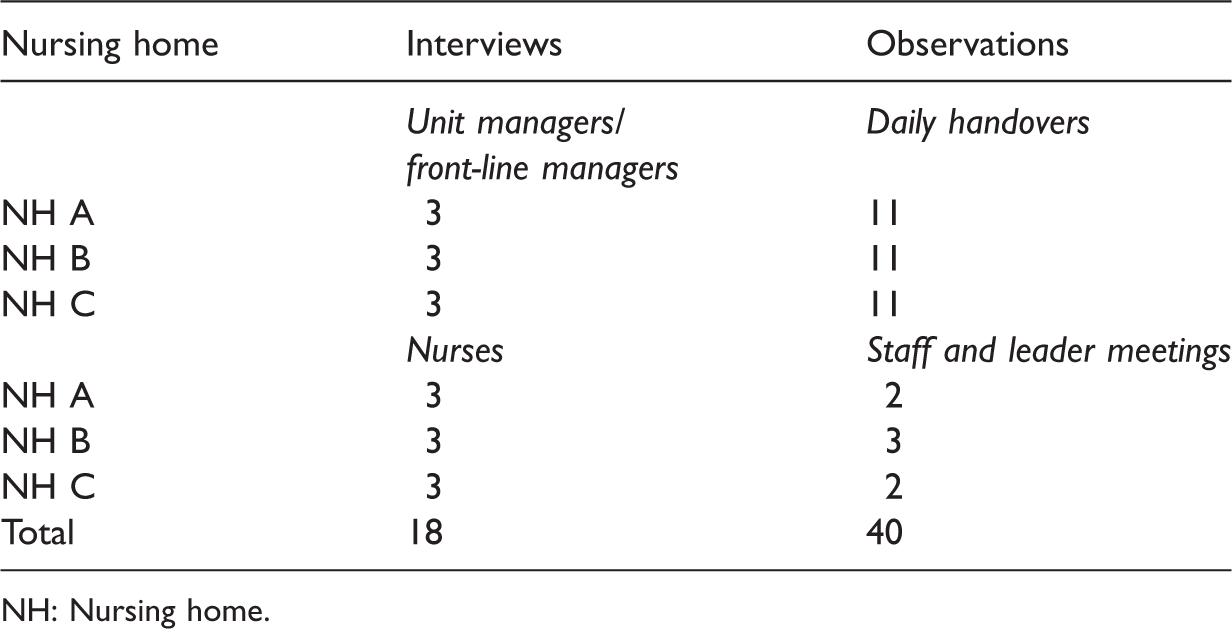
NH: Nursing home.
Data collection
Data were collected from January to February 2012. We interviewed staff and observed daily shift handovers and meetings to collect rich data about the organisation of daily work and contradictory management requirements. During a 1-week stay at each nursing home, we alternated between conducting observation and performing individual semi-structured interviews (Kvale and Brinkmann, 2009). To the greatest extent possible, we attempted to combine observations with follow-up interviews with the participants observed.
The interviews were based on an interview guide, which focused on the aims, responsibilities and decision-making in how daily work was organised. The same interview guide was used regardless of the participants’ position. Each interview was conducted by the first author during the participant’s working hours and lasted approximately 60 minutes. The interviews were recorded and transcribed.
Everyday, three handovers occurred in each ward at the nursing homes (morning, afternoon and night). These were arenas with access to typical situations in which daily work was organised and performed. During daily handovers, staff at work met to receive updated information about the residents and make decisions for each shift. In addition, we chose to observe planned staff and leader meetings that took place during the week. These were arenas where unit managers, front-line managers and nurses met to evaluate and discuss the work on a more strategic level. In each nursing home we observed 11 daily handovers and three meetings, totalling 100 hours of observation (see Table 1). Field notes were taken continuously and later transcribed into written text.
Analysis
In analysing the data we used template analysis, which, according to King (1998), refers to a group of techniques for thematically organising and analysing qualitative data. As such, template analysis is a form of thematic analysis and it overlaps with qualitative content analysis (Schreier, 2012).
First, we reread the interviews and observational data and started to identify patterns. To organise the data we used the main questions from the interview guide as predefined themes. Second, we started to analyse the organised text within each theme. It became apparent early in the process that nursing leadership was central, although nursing leadership was not asked about as a separate theme in the interview guide. Third, we searched for units of meaning containing various aspects of nursing leadership performance in daily work. By going back and forth between the interviews and observation texts the units of meanings were organised into 50 categories. Fourth, we further organised the categories, searching for thematic similarities. As a result of this process, we ended up with three main themes, these being leading daily care from a distance, lack of support in problem-solving and difficulties in adopting new managerial language. The Results section is presented according to these themes. The software program Nvivo was used to support the analysis process.
Ethical consideration
The study was approved by the Norwegian Social Science Data Service. Informed consent was collected from all participants with the information that they could withdraw from the study at any time. Anonymity and confidentiality were assured according to the guidelines for research ethics in social sciences, law and humanities.
Results
Leading daily care from a distance
As a response to increased managerial tasks, the participants expressed increased responsibilities. In nursing home A, the unit manager had been delegated responsibility for running home care services in addition to the nursing home. Similarly, the unit manager at nursing home C was responsible for running two nursing homes. In the same nursing home, the front-line managers explained that they used to be responsible for one ward with 10 beds, whereas now they were responsible for three wards, with 30 beds in total. The nurses on the wards experienced a similar situation across the nursing homes. We were told that in addition to patient care, they were delegated responsibility for laundry, preparing food and documenting quality of care.
The participants spoke of these expansions in responsibilities as tensions, resulting from both trying to safeguard professional values and at the same time carry out managerial tasks. In particular, front-line managers expressed that there was no longer enough time to engage in patient care, and instead they ended up doing administrative work. Although many of the administrative tasks were not new, they had increased in number and scope, leaving less time to participate in guiding patient care. Front-line managers spent more time performing administrative tasks such as hiring temporary staff, attending administrative meetings, and following up on and ensuring regular reports on economy, sick leave and quality indicators, as expressed in the following quote: I’m sure 80% of my time is spent doing administrative work. I think front-line managers have become expensive secretaries. I would like to spend more time in the clinical environment, but I no longer have time for it. (Beate, front-line manager, nursing home C)
Lack of front-line managers in daily care was similar in all the nursing homes. During the handovers we observed that front-line managers were not present, which triggered a need to delegate responsibility for care tasks further down to the nurses on the wards, as expressed here by Siri, a front-line manager in nursing home A: ‘I have to delegate many care tasks to the nurses on the wards because I get overloaded with administrative tasks, delegated from my leader.’
Further, unit managers at nursing home A told us that there were no financial resources available to hire extra personnel to carry out administrative tasks. Therefore, increased tasks had to be solved through delegation. Similarly, in nursing home B we found that increased delegations were solved by taking nurses out of daily care duties every second week to take responsibility for administrative tasks, which used to be done by front-line managers. During these so-called ‘administration days’ the nurses said that they now had more time to update patient care plans, complete necessary documentation, make checklists and forms to control the quality and efficiency of care, conduct meetings with relatives, and so on. Due to this shift in task responsibilities, nurses were also seen as the new front-line managers: ‘My experience is that nurses on the wards function as front-line managers. They are the ones controlling daily care tasks, whereby I only check in randomly’ (Oda, front-line manager, nursing home B). As shown in this quote, front-line managers saw themselves more as inspectors leading daily work from a distance. This lack of ‘hands-on’ leadership in patient care became even clearer when we looked at our observational data. In all of the nursing homes, neither the unit managers nor front-line managers wore uniforms like the rest of the staff did. Their offices were located in separate areas, far from the wards, which meant it was difficult for them to be aware of what was happening on the wards themselves. In addition, at the handovers we were told several times by nurses that there was no longer any expectation that front-line managers would be involved in patient care.
Lack of support in problem-solving
Many of the participants expressed that daily tasks were increasingly regulated by standards. All the municipalities operated with a service declaration that the nursing homes had to fulfil. This involved reporting on performance indicators for economy, quality and personnel administration. All three unit managers told us that in contrast to earlier years when they were supported by central administration, they now had to do all the reports by themselves. When interacting more closely with new administrative systems, they experienced that many of the reports had become so pervasive that other important tasks, such as creating a good working environment, had to be set aside. For instance, we were told that there was no longer time to prioritise yearly appraisal interviews with the staff, as expressed here by Siv, a unit manager at nursing home B: ‘I have personal responsibility for almost 100 people. I know we are measured on completion of performance appraisal but I haven’t had time to do that in years.’
In addition, many front-line managers across the nursing homes said they found it inefficient to spend so much time on following up reports with staff on sick leave instead of working directly with the staff who were at work. This made personnel seem like a cost in the budget instead of a resource in daily care. Instead of being motivators and good role models, front-line managers lacked time to follow up nurses in daily care. For instance, one front-line manager at nursing home C said that even though she knew it was important for the quality of care, she did not have time to supervise nurses in the care of individuals with dementia, which was one of her areas of expertise.
Lack of support in leadership not only created a feeling of inadequacy in safeguarding professional challenges, but also contributed to increased confusion among nurses in problem-solving. Many nurses across the nursing homes expressed that they saw front-line managers’ participation in daily work as pivotal to ensure delivery of high-quality care. During many of the handovers we observed that challenges in patient care were postponed in anticipation of discussing the cases with a front-line manager. This often related to patient treatment, the ordering of new medical equipment and evaluating needs for hiring extra staff. One nurse in nursing home C pointed out that due to a lack of leadership, she found it hard to reach decisions on how to handle irregularities in care, which in turn left room for subcultures to develop: Earlier we saw the front-line manager much more. Now she keeps saying that I must take more responsibility in guiding the staff in dementia care. I do this often, however I don’t like to be the one making tough decisions. After all, they are my colleagues. So many times I just report adverse situations to the front-line manager, but often she will not have time to follow it up. (Bodil, nurse at nursing home C)
As the quote illustrates, nurses felt they had neither the means nor the formal authority to solve important issues in care. Such lack of clarity in problem-solving caused nursing leadership to be seen in a critical light.
Difficulties in adopting new managerial language
There were participants who expressed a willingness to accept new managerial tasks. They said that increased reporting requirements gave them an opportunity to advocate for more resources to improve quality of care. However, in order to influence decision-making, unit managers expressed they had to be armed with information from the nurses on the wards to support their position when negotiating with central administration. During the handovers at nursing home C, we observed that nurses used both standard documentation and self-made registration lists to demonstrate the scope of services they provided and the need for more resources to ensure quality of care. The documentation was then given to the unit managers who would plead their case. A similar use of documentation was expressed by Siva, unit manager at nursing home B: In situations where employees do not get time to do everything they should do, I need them to document it and why they don’t have the time to do it. I need to have this specific documentation to support further arguments about the need for more resources.
This translation of professional work to a managerial language was seen as problematic. Nurses in particular expressed concern that increased managerial language might put less emphasis on professional values and quality of care. During the handovers we observed several occasions where nurses expressed frustration about the situation, telling their colleagues that they were willing to call in sick in response to demands for increased efficiency. Similarly, a unit manager in nursing home C told us that the ambiguity she experienced when talking about professional values together with efficiency demands was so pervasive that it was reason enough to quit her job. Thus, adopting a new managerial language at the sacrifice of professional values contributed to increased confusion regarding how to perform daily care.
Discussion
This study shows that nursing leadership changes with increased managerial tasks in Norwegian nursing homes. Expansions in responsibilities with the increased use of standards to improve efficiency goals involved more administrative tasks at the expense of professional values. However, this does not mean that earlier ‘core functions’ in daily care no longer applied, but rather that they continued to exist in addition to increased managerial tasks. In line with Stanley (2006a), both managers and nurses in the study encountered conflict when they were drawn into areas of management and removed from their professional values concerning patient care. To handle this tension, managers and nurses took on new roles which influenced how they related to each other in organising daily care. According to their new role, front-line managers took on a more administrative role in an effort to control daily care, giving less room for leading according to their professional values. Nurses, on the other hand, were seen as the new clinical leaders ensuring patient care. Change in roles increases the distance between front-line managers and nurses. This in turn weakens their reciprocal relationship, which, according to Kelly (2012), is a prerequisite for nursing leadership. Based on our findings we argue that nursing leadership in nursing homes is weakened due to increased managerial tasks.
First, leading daily work from a distance made it hard for front-line managers to take part in the goal-setting of daily care and diminished their ability to influence nurses and guide them towards professional values. This in turn led to confusion regarding what goals to follow in daily care. Conflicting goals increases the risk that managerial goals will overshadow professional goals, which might prove unfortunate for daily care, as reported by Johnsen (2006).
Second, the increased delegation of responsibility creates uncertainty and blurry boundaries between nurses and managers regarding who decides what, and hinders problem-solving in daily care. Nurses did not feel they had the necessary tools or the authority to take on a leadership role. This in turn made room for subcultures to develop and divergent practices to exist without coming to light. This finding is in line with Stanley (2006a), who found that nurses are unrecognisable as clinical leaders while they do not fit the formal management criteria.
Third, new and increased documentation routines entailed codifying care tasks and trusting standardised information over less measurable professional values. This led to a reorientation in how managers and nurses communicated about work. This finding is in line with Johnsen (2006), who found that the modification of existing language helps to create new meanings and construct a new reality of patient care. On the one hand, using a new managerial language provided an opportunity to advocate for professional values in care; on the other, it was seen to suppress nurses’ professional values and create an insufficient basis for communication in daily care.
Conclusion
The study contributes knowledge on how nursing leadership is weakened in response to increasing numbers of managerial tasks. Managers took a more administrative role rather than one of professional leadership, resulting in nurses being seen as the new front-line managers. Such reorientation in roles increased managers’ distance from daily care and gave them less time to supervise and motivate nurses in daily care tasks. Increased distance and lack of reciprocal relationships between managers and nurses to achieve common goals led to unclear goal-setting, hindered problem-solving and created an imprecise basis for good communication. This, we argue, has significantly weakened nursing leadership in the nursing homes studied.
A limitation of this study was the small number of nursing homes involved. In addition, further studies could highlight how weakened nursing leadership processes affect the quality of care in nursing homes.
Key points for policy, practice and/or research
Nursing leadership is the process of influencing people to accomplish goals, and plays a key role in implementing managerial tasks. Taking a process-oriented view of nursing leadership, the study demonstrates that nursing leadership alters in response to increasing numbers of managerial tasks. Unclear goal-setting, problem-solving and an imprecise basis for good communication in daily care has significantly weakened nursing leadership in the Norwegian nursing homes studied.
Footnotes
Acknowledgement
The authors thank the participants at the nursing homes for taking part in this study.
Declaration of conflicting interest
The author(s) declared no potential conflicts of interest with respect to the research, authorship and/or publication of this article.
Funding
The author(s) received no financial support for the research, authorship and/or publication of this article.