







Abstract
Background/aims
To review the literature on college students’ healthcare-seeking behaviours to uncover the current evidence and promote better healthcare-seeking behaviours and essentially better health outcomes in young adults.
Methods
The researchers conducted an extensive literature review using CINAHL, Cochrane, PubMed, EBSCOhost and Google Scholar in the years 2018 and 2019. The search was limited to the past 18 years (2000–2018) and to studies reported in the English language focused on the general healthcare-seeking behaviour of college students. The search was also extended to young adults (aged 18–39 years).
Results
A total of 56 articles were identified for abstract review and only 28 articles met the inclusion criteria for the final review. The following themes emerged to organise our findings: healthcare-seeking behaviour among college students, health information resource utilisation and its influence on healthcare-seeking behaviours and barriers to accessing care among college students.
Conclusions
This review summarises the current body of knowledge related to healthcare-seeking behaviour among college students, health information resource utilisation and its influence on healthcare-seeking behaviour and barriers to accessing care among this population. Important measures further to address the health needs and interventions for addressing these needs among the college student population are discussed.
Introduction
According to the US Department of Education (2018), 19.9 million young adults were enrolled in colleges and universities across the US. This constitutes 17% of the general population (US Census Bureau, 2018). College students attend postsecondary institutions at the undergraduate and post-baccalaureate levels and have the option of attending 4-year public, private non-profit and private for-profit institutions. College student age varies depending on the type and level. As an example, at the undergraduate level, younger students aged 25 years and under constitute the majority (90%) for public and private non-profit institutions; meanwhile, at private for-profit institutions, student ages are more evenly distributed among the various age groups (33% for under 25 years; 39% for 25–34 years; and 28% for 35 years and over). This trend is relatively consistent for 2-year undergraduate institutions and post-baccalaureate institutions (US Department of Education, 2018). College student enrolment in postsecondary education programmes is expected to increase to 20.5 million by the year 2027 (US Department of Education, 2018). College students represent a population with heightened health needs due to lifestyle factors, and so this is an important time for providers to educate on the prevention of chronic disease relating to lifestyle (Turner and Keller, 2015).
Despite the presence of health centres in most colleges, healthcare utilisation is low among this population. The College Health Surveillance Network studied healthcare utilisation at 23 universities across the US and found that only 32% of enrolled students utilised the student health services in a year (Turner and Keller, 2015). Of the 32%, only 15.6% were preventive services. It would seem unlikely that the utilisation rate is an indication that college students are healthy, and therefore have no need to seek healthcare. College students have significant health risks related to stress, poor sleep habits, sexual activity, poor diet, lack of physical activity and tobacco, alcohol and drug use (Deasy et al., 2014; Kenney et al., 2013). Changing their behaviour and mitigating the impact early will be likely to keep college students healthy and reduce future health risks as adults. Therefore, healthcare-seeking behaviours and service utilisation among college students is a topic deserving of attention from an early intervention and public health perspective.
For many students, the college years represent a challenging transition developmentally to adulthood (Hunt and Eisenberg, 2010). What happens during these years has profound and long-lasting implications for their future career, economic security and physical, psychological and emotional wellbeing (Stroud et al., 2015). Student health centres are convenient and accessible and exist to address healthcare needs for students (Hunt and Eisenberg, 2010; Turner and Keller, 2015). However, student health centre services and resources are underutilised (Lemly et al., 2014). This underutilisation of healthcare services may contribute to students’ failure to transition developmentally to adulthood or to make meaningful healthcare decisions, and when to seek healthcare (Lemly et al., 2014).
Green et al. (2003) interviewed 470 students and found that two-thirds of them did not accurately perceive their risk of developing heart disease. In another study, 92.1% of students who were identified as having at least one risk factor for chronic disease stated that they had never been told they were at risk of chronic disease (Romero et al., 2005). Of special note, almost half (45.4%) of the students interviewed reported that they would most likely change their lifestyle if their healthcare provider informed them that they were at risk of cardiovascular disease (Romero et al., 2005). Chronic health problems can be prevented if college students engage in healthy behaviours and are screened for health risks and early signs of health problems (Bonnie et al., 2014). Considering that college students are generally unaware of their health risks (Arts et al., 2014; Lynch et al., 2006), they are not inclined to seek healthcare services to alleviate those risks. It has been observed that college students are more likely to utilise the internet for health information instead of student health centres (Basch et al., 2018). Students usually seek treatment for acute symptoms including upper respiratory infections and for mandated services such as physical examination and immunisations (Keeton et al., 2012). In addition, many college students require mental health and preventive care services (screening and intervention); however, they do not seek such services (Champlin and Nisbett, 2018). If not detected and managed early, these health concerns can negatively impact students’ wellbeing and academic success (Champlin and Nisbett, 2018).
The Centers for Disease Control and Prevention (CDC) has proposed a college health safety initiative that includes strategies to prevent and stop smoking and alcohol consumption, increase daily exercise, adopt healthy food choices and improve sleep patterns in student populations. Considering that approximately 33% of college students visit their student health centre for different reasons multiple times a year (Keeton et al., 2012), this can be a point of access to implement the CDC’s college health safety initiative by conducting risk assessment and teaching management and prevention strategies for chronic diseases. There are additional benefits to focusing on improving the healthcare delivery and capacity to serve students. College years provide an opportunity for students to transition into accessing and navigating the healthcare system without the assistance of their parents or guardians and to participate in health and wellness practices (Bonnie et al., 2014; Lau et al., 2013). As well as providing treatments to health issues when contacted directly, student health centres have the potential to meet the demands of providing health promotion and disease prevention services to college students. For that potential to be fulfilled, there is a need to understand the needs of the target population and the gaps in supply. Therefore, the purpose of this study was to review the literature on college students’ healthcare-seeking behaviours and service utilisation, with the specific aim to uncover the current evidence and promote better healthcare-seeking behaviours and service utilisation and essentially better health outcomes in this population.
Methods
We conducted an extensive literature review that included the following search terms: health seeking, health promotion, healthcare, college students, young adults, health risk, student health and health behaviour. Our focus for this literature review was aimed at healthcare-seeking behaviour among college students. The electronic search databases we used were CINAHL, Cochrane, PubMed, EBSCOhost and Google Scholar. The search was limited to the past 18 years (2000–2018) and to studies reported in the English language. An extensive timeframe would allow us to find additional important information related to the topic. The inclusion criteria were studies that focused on the general healthcare-seeking behaviour of college students and extended to young adults (aged 18–39 years) and studies conducted in the US and other countries. We conducted the initial literature search by reading the abstracts, and we identified 56 articles for abstract review to be completed by two independent reviewers. Additional studies were identified from the reference list. A total of 28 articles met the inclusion criteria for the final review focusing on healthcare-seeking behaviour among college students.
There were three qualitative studies while the remaining were quantitative studies. The studies were conducted mainly using questionnaires, online surveys and focus groups. Two independent reviewers read the articles that met the inclusion criteria for the review and independently determined common themes. Each reviewer developed a list of themes and compared to one another, discussed discrepancies until consensus and finalised the themes and associated subthemes. Among the review articles related to college student healthcare-seeking behaviour, the following themes emerged to organise our findings: healthcare-seeking behaviour among college students, health information resource utilisation and its influence on healthcare-seeking behaviours and barriers to accessing care among college students.
Results
Approximately 50% of the studies included in this review were conducted in the US, whereas the remaining studies were from Asia, Africa, and the Middle East. There were 15 studies conducted in the US, three studies in India, two in Nigeria, one in Ghana, one in Taiwan, one in Saudi Arabia, one in Lebanon, one in Pakistan, one in the United Arab Emirates, one in Oman and one in Canada. The studies in the US focused on healthcare-seeking behaviours related to general and mental health; perceived stigma related to seeking healthcare; expenditures associated with healthcare; the association between medical mistrust and the use of health services; the use of online tools to seek healthcare; and the staffing for and scope of services offered in student health centres (Basch et al., 2018; Burlaka et al., 2014; Davies et al., 2000; Dennis and Hicks, 2006; Eisenberg et al., 2009; Fortuna et al., 2009; Gavgani et al., 2013; Han and Pong, 2015; Lau et al., 2014; McBride et al., 2013; Mesidor and Sly, 2014; Nicoteri and Arnold, 2005; Price et al., 2013; Turner and Keller; Zhang, 2013). Similarly, the studies in India, Nigeria, Lebanon, Canada, Oman, Pakistan, Taiwan and Ghana focused on general healthcare-seeking behaviours among college students and the use of online tools in seeking healthcare (Afolabi et al., 2013; Ahmad et al., 2017; Ajaegbu and Ubochi, 2016; El Kahi et al., 2012; Kuuire et al., 2015; Luo et al., 2018; Menon et al., 2017; Moazzam et al., 2018; Osei Asibey, et al., 2017; Sultan et al., 2017; Vaz et al., 2012). Other studies outside of the US conducted in Saudi Arabia and the United Arab Emirates focused on whether being in a health sciences profession affected healthcare-seeking behaviour and the prevalence of self-diagnosis and self-treatment (Asraj et al., 2013; Sawalha et al., 2017).
We were able to identify the following themes: healthcare-seeking behaviour among college students; health information resource utilisation and its influence on healthcare-seeking behaviour; and barriers to accessing care among college students.
Healthcare-seeking behaviour among college students and young adults
Healthcare-seeking behaviour among college students and young adults.

Barriers to accessing care among college students.
Health information resource utilisation and its influence on healthcare-seeking behaviour.
Healthcare-seeking behaviours among young adults.
Among the 28 articles, three of the reviewed articles examined healthcare-seeking behaviour in young adults with a large sample size (Fortuna et al., 2009; Kuuire et al., 2015; Lau et al., 2013). These three articles were included in this review because college students are often in this age range. Fortuna et al. (2009) conducted a national cross-sectional survey in the US, which examined 13,897 young adults aged 20–29 years and found that young adults who have insurance had more annual visits compared to those without insurance. In terms of gender, young men accessed healthcare less and nearly half the rate of preventive care visits than any other age group in addition to lower rates of utilisation of ambulatory care. Young black and Hispanic men had considerably lower annual visits compared to white young men. Kuuire et al. (2015) also conducted a cross-sectional study on adults aged 18 years and older on 1137 subjects (18–34 years, n = 672 vs. 35+ years, n = 465) examining the factors that influence healthcare service utilisation in a poor setting. They found that subjects who lived 0.5 km or more from a health facility, had secondary education and traditionalists (those who are resistant to change and an advocate of maintaining tradition) were less likely to seek treatment in a health facility; and especially poor subjects were less likely to seek treatment in health facilities even when they have health insurance. Likewise, Lau et al. (2013) conducted a retrospective study examining young adults’ healthcare utilisation and expenditures prior to the Affordable Care Act on 3768 young adults aged 18–25 years old. The results were similar to those of Fortuna et al. (2009) and Kuuire et al. (2015), who also added that young adults without a usual source of care were less likely to use health services compared to those with a usual source of care. Also, young adults with low income had the highest number of emergency room visits (Lau et al., 2013).
Dennis and Hicks (2006) conducted a baseline investigation of self-rated health behaviour and quality of life among college students. A total of 514 college students were included and data were collected using a survey. More first-year students failed to seek healthcare for physical and psychological problems during the academic year, compared to students in more advanced years of study.
In general, research has shown that being in a health-related discipline affects healthcare-seeking behaviours of college students. Vaz et al. (2012) studied the healthcare-seeking behaviour of medical students and found that self-investigation and self-treatment is prevalent among students, and interestingly students saw this behaviour as acceptable. Students consulted informally with doctors or intern friends, and there was a preference for private doctors compared to consultants. Al-Asraj et al. (2013) and Sawalha et al. (2017) had similar findings to Vaz et al. (2012). Al-Asraj and colleagues (2013) assessed healthcare-seeking behaviour of Saudi senior nursing students and evaluated whether their behaviour was influenced by their studies in a health-related area. Results indicated that the majority of students only visited the doctor when they felt ill, students used medications without prescriptions and students believed that nursing and other medical courses influenced their health behaviours. Sawalha et al. (2017) found factors affecting healthcare-seeking behaviours were medical education, excessive waiting times, cost and inaccessible medical services. Self-prescription was a common healthcare-seeking behaviour and the majority of students had a tendency to ignore a health problem. Overall, medical education impacted healthcare-seeking behaviour.
Burlaka et al. (2014) examined healthcare-seeking behaviours associated with the mental health problems of college students. These researchers found the least utilised mental health services are those provided by psychiatrists, the use of psychological services is a less popular choice among students, and students with mental health problems need both continued emotional commitment as well as economic support. Mesidor and Sly (2014) investigated the extent to which social-cognitive factors and psychological distress predicted helpcare-seeking intentions for international and African American college students, and they found that perceived behavioural control was a significant predictor of intentions to seek mental health services. This and psychological distress were positively correlated with help-seeking intentions; students reporting high psychological distress and perceived they had some control over the situation were more likely to seek mental health services.
Han and Pong (2015) also focused on mental healthcare-seeking behaviours, and explored the relationship between cultural contextual variables, demographic characteristics and willingness to seek mental health services. The results indicated that these students conceptualised mental illness as controllable and personal, and preferred self-help and self-control methods to manage life challenges. Also noted was that Asians were unlikely to seek help from mental health professionals due to stigma. Interestingly, participants identifying as American were more willing to seek mental health services compared to those identifying as Asian; women were also more likely to seek mental health services compared to their male counterparts. Menon et al. (2017) compared self-reported barriers to healthcare-seeking for both mental health and physical health services between first-year and final-year medical students. There were differences between the two groups in terms of perceptions and barriers to healthcare. Among first-year students, lack of time, unawareness about where to seek help, cost and fear of academic jeopardy were common barriers to mental healthcare. Issues surrounding stigma were reported by final-year medical students as it pertained to seeking mental health services. El Kahi et al. (2012) also examined healthcare-seeking behaviours related to mental health. Of the 57.2% that reported psychological issues, only 3.3% consulted a healthcare provider or facility. Confidentiality and accessibility were reported barriers to healthcare-seeking behaviours.
Health information resource utilisation and its influence on healthcare-seeking behaviour
Health information resource utilisation and its influence on healthcare-seeking behaviour.
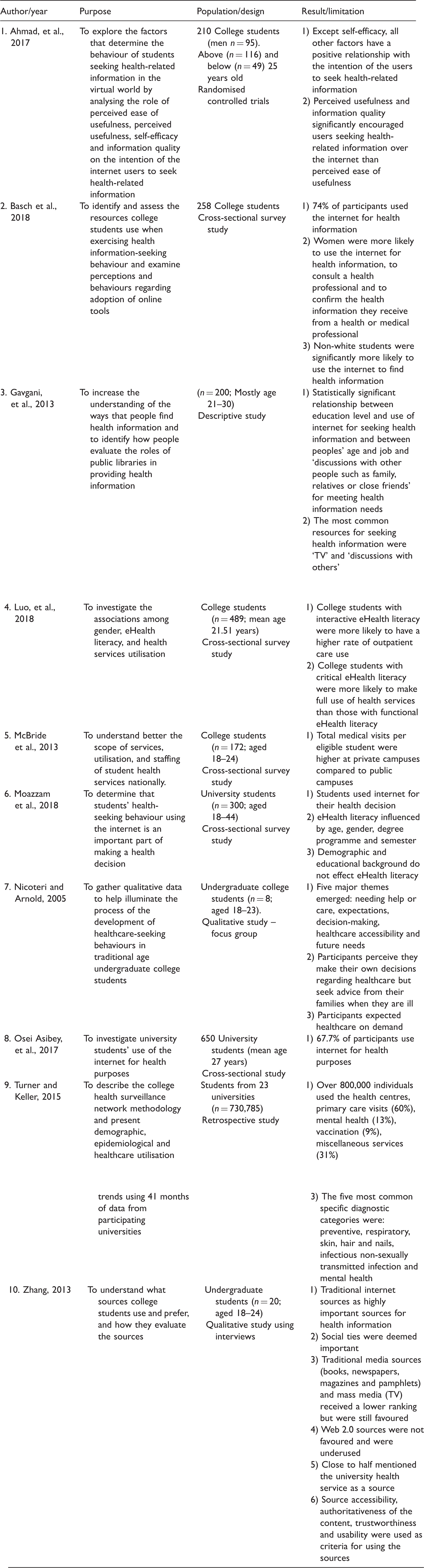
Three of the 12 articles found that the student health centre was a source for their health information (McBride et al., 2013; Turner and Keller, 2015; Zhang, 2013). In particular, McBride and colleagues (2013) found that the student health centre visits were higher at private campuses compared to public campuses. Besides the health information resource utilisation, other influences on healthcare-seeking behaviour included eHealth literacy or the ability to search, find and use health information using electronic resources, source accessibility, authoritativeness of the content, trustworthiness, usability, perceived usefulness, information quality and self-efficacy (Ahmad et al., 2017; Luo et al., 2018; Moazzam et al., 2018; Zhang, 2013).
Barriers to accessing care among college students
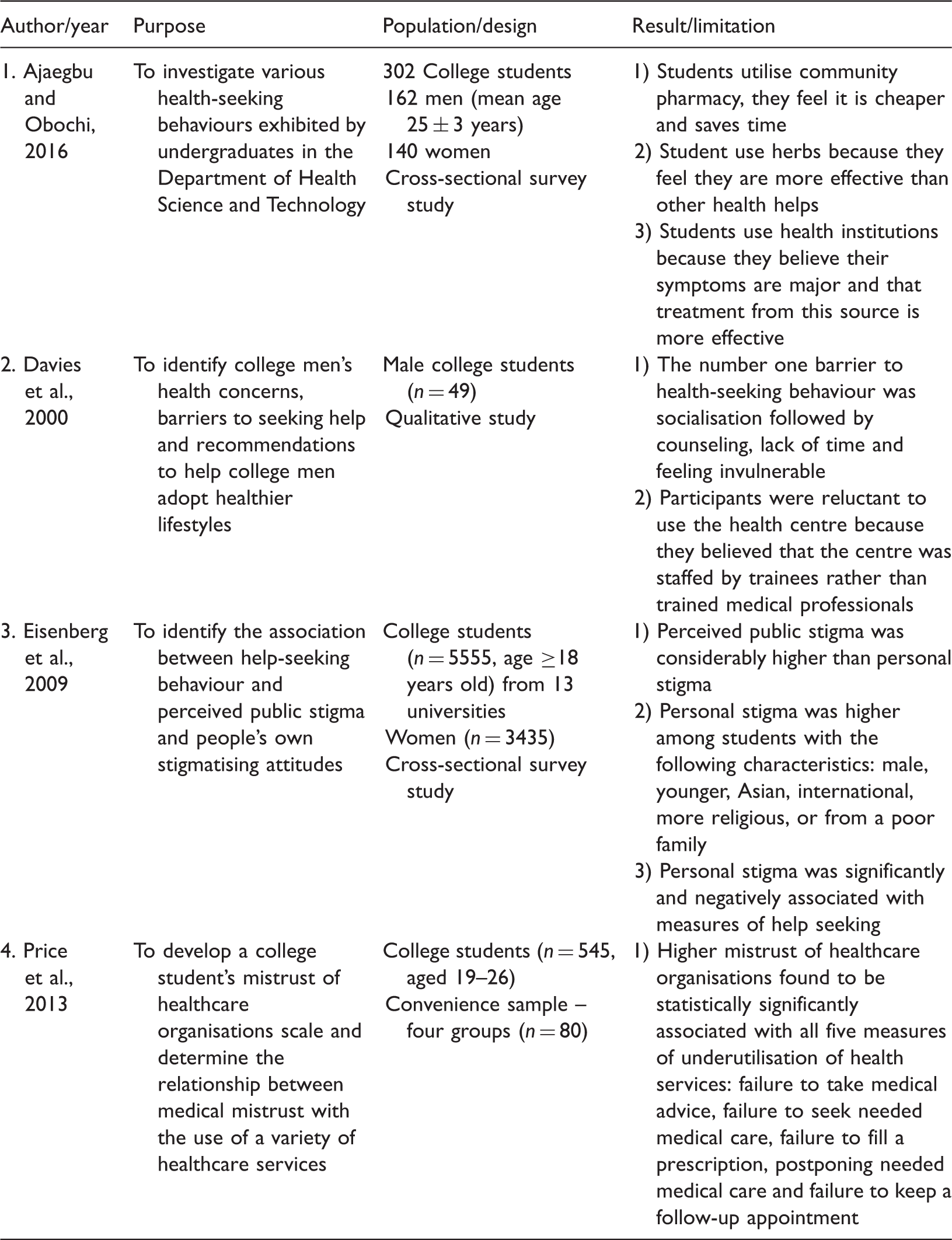
Barriers to accessing care among college students.
Discussion
Articles included in this review were from studies conducted both in the US and in other countries. Of the 28 review articles on college students’ healthcare-seeking behaviour, the common themes were the consideration of the healthcare-seeking behaviour among college students, health information resource utilisation and its influence on healthcare-seeking behaviours and barriers to accessing care among college students. This review asserts that there are different demographics and characteristics that contribute to the differences in healthcare-seeking behaviours in college students and young adults. This contributed to the underutilisation of healthcare by college students and young adults, resulting in the implication that healthcare providers should be approaching this population proactively with a focus on preventive care services.
Major themes noted included general behaviours, the influence of studying in a health-related discipline and behaviour specific to mental health. Demographic variations emerged in the review, and young men are noted to access healthcare significantly less frequently than any other age group. In addition, young black and Hispanic men had considerably lower annual visits compared to young white men. These findings are in line with the older adult population as well in that African Americans were less likely to seek care, pertaining only to using health technology (Bhuyan et al., 2016). Targeted efforts towards young men for preventive screenings will help to address this disparity. Another common barrier was distance from a healthcare facility. Those who lived more than 0.5 km from a facility were less likely to seek care; therefore, efforts should be made to reach this population closer to where they frequently visit, such as at home, at school, or in commonly visited places such as the grocery store or mall by using outreach efforts and mobile health clinics. Another finding was that those who were traditionalists were less likely to seek care. Healthcare delivery efforts need to be creative in their approach to target this population.
First-year college students are less likely to seek care. Including healthcare access information in programme orientation may be helpful. Underutilisation and using alternatives to formal care could be addressed by healthcare administrators by increasing the ease of filling prescriptions, instituting a process for follow-up communication, decreasing wait times and offering student health insurance or subsidised expenses. Strategies such as health fairs and community outreach events could help to increase engagement in preventive services among this population, while addressing personal stigmas and alternative preferences.
Students studying in a medical-related discipline have both advantages and disadvantages as it relates to healthcare-seeking behaviours. In particular, seeking care informally may lead to medical issues being inadequately addressed and may leave the student without needed treatments and referrals. Including this as an aspect of their education may also be beneficial. Understanding the experience of a college student shines a light on the idea that mental health issues are likely to surface while in college. Taking a proactive approach in mitigating these issues may be helpful, perhaps by offering support services early on to students who are notably struggling academically or in any other way. It is important to note as well that Asians and women are less likely to seek mental healthcare when needed, so these students should be monitored closely for signs of struggles with mental health. Of note, no literature was located addressing older adults’ healthcare-seeking behaviour patterns pertaining to mental health. Having a department within the college that focuses on the mental health needs of students would likely be a heavily utilised resource. All of the described recommendations have the potential to promote success among young adults and college students, which will contribute to their success in higher education overall.
Unfortunately, despite the availability of a student health centre; very few articles identified college students’ utilising the student health centre as a source for their health information. It was more prevalent among the studies that the internet, family members or friends and other media resources were utilised more for their health information. This may be problematic due to the reliability of these resources that the students tend to seek for their health information and health decision compared to the student health centre or their healthcare provider. Interestingly, we found that one reason a sample of college students did not utilise the student health centre is because they believed that the health centre was staffed by trainees rather than trained medical professionals. This misconception dramatically affected their healthcare-seeking behaviours and correcting this would greatly benefit this population, which should be done sooner than later. In addition, contrary to the older adult population, a sample of college students identified healthcare providers as their main resources for their health information and health decisions whereas social media such as the internet is the last on their list for health information (Chaudhuri et al., 2013).
This review emphasised the importance of lack of time, feeling invulnerable to health concerns, access to care, cost, confidentiality, fear and most importantly the stigma to show vulnerability in young men as barriers to seeking healthcare. The majority of these barriers are not new or unique in college students and were also found in other populations (Thompson et al., 2016). The unique barriers to college students are fear and showing vulnerability. The good news is that if these are truly based on misconceptions from the college student population, the most basic intervention would be delivering knowledge education as the initial step which should also include debunking the student health centre staffing. This can be done creatively during one of the events that are hosted for incoming students, such as orientation or welcome-back events.
Recommendations for future research
The current state of the research on healthcare-seeking behaviours for college students reveals some identifiable patterns which can guide future research efforts. Learning more about the determinants specific to the male population, especially black and Hispanic men, would be helpful in encouraging healthy behaviours. Researching interventions aimed at bringing healthcare to those who are not able to travel is needed. Learning more about the perceived barriers for those who have secondary education, traditionalists and first-year students would be helpful in addressing their needs. Gearing research towards targeted interventions that are unique to addressing the needs of the college student population with regards to mental health is important at this time. Finally, researching interventions addressing lack of time, invulnerability, access to care, cost, confidentially and fear will prove useful based on this review.
Conclusions
College students are prone to certain health risks due to some of the experiences they have that are inherent to life circumstances as a student. They are known for significant health risks related to stress, poor sleep habits, sexual activity, poor diet, lack of activities and tobacco, alcohol and drug use. The findings of this review summarise the current body of knowledge related to healthcare-seeking behaviour among college students, health information resource utilisation and its influence on healthcare-seeking behaviour and barriers to accessing care among this population. Taking important measures to address further the health needs and to research interventions for addressing these needs among the college student population is imperative.
Key points for policy, practice and/or research
College students have identifiable patterns associated with healthcare-seeking behaviour. Health information resource utilisation has an influence on healthcare-seeking behaviours among college students and young adults. Barriers to care are evident among college students and young adults as a population. Targeted efforts to increase healthcare utilisation can be employed based on healthcare-seeking behaviours especially nurses during the assessment encounter.
Footnotes
Declaration of conflict of interests
The author(s) declared no potential conflict of interest with respect to the research, authorship and/or publication of this article.
Ethics
Not applicable due to the review nature of this paper.
Funding
The author(s) received no financial support for the research, authorship, and/or publication of this article.
