







Abstract
Background:
Environmental changes are drastically influencing way of life and healthcare, and are considered a global health emergency. Nursing professionals stand as a great opportunity to positively influence this situation.
Aims:
To understand the role of nursing and its importance within the health field for sustainability in global healthcare.
Methods:
An integrative review was carried out searching for the PubMed, Web of Science, CINAHL and SCOPUS databases in the last 5 years of research. Keywords and synonyms relating to sustainable development and nursing were used. Papers published in the last 5 years in English and Spanish were included. Exclusion criteria were studies showing data before 2019 and, studies on non-health-related sustainability. The Preferred Reporting Items for Systematic Reviews and Meta-analysis (PRISMA) was followed.
Results:
From a total of 2909 references, 17 were included. Our findings revealed that nursing can be considered a key agent for the incorporation of sustainability into the health system. The role of nurses is highly influenced by the context, political decisions and research. The current nursing education system was analysed together with the new visions that are emerging and provide a conception of nursing that is more resilient with the world.
Conclusions:
The incorporation of sustainability into the health system is taking time, despite nurses being positioned as a key factor in this change. There is need for changes in politics, education and research to facilitates nurses’ agency in this domain.
Keywords
Background
The globalisation of health implies the integration of disease, phenomena such as global warming, and widespread care for equity and social justice, making healthcare more complex and demanding at the global level today (Beck, 2021). In the face of this, the health system must be competent to address the health consequences, and employ the necessary measures to ensure mitigation and sustainability in service delivery.
The International Code of Nursing (ICN) addresses global health in relation to nursing.The code emphasises how nurses should collaborate and practice to conserve, support and protect the natural environment and should beaware of the health consequences of environmental degradation, such as climate change (Consejo Internacional de Enfermeras, 2021). Figure 1 outlines the relationship between nursing and sustainability.
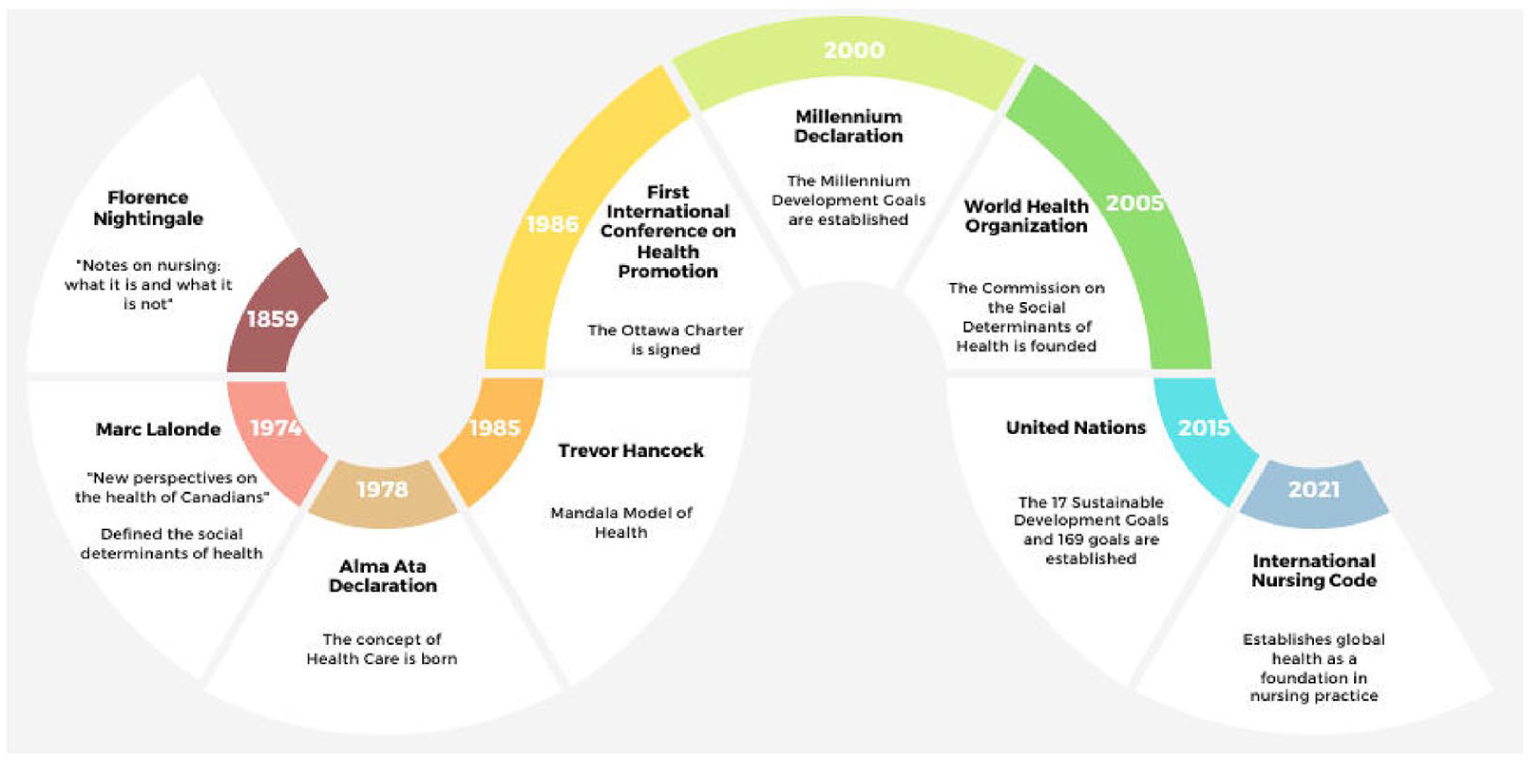
Timeline of the relationship between nursing and sustainability.
The nursing profession has potential to beone of the main agents of change as it has the capacity to promote health, avoid resource use, and influence the use of healthcare resources in health care delivery (Ramírez and Müggenburg, 2015). Improvements made in the level of knowledge and skills in sustainability will lead to an improvement in the way nurses work with users, which, in turn, will also benefit their health. Nurses are in a good position to lead on awareness of health inequities, as it fits with the philosophy of nursing; nursing includes advocacy for vulnerable populations, educating communities, and influencing policy to promote equitable access to healthcare; as well as being part of the ICN ethical framework- treating equity as an aspect of social justice, being part of nursing action to eradicate systemic disadvantage (Stewart, 2022).
Nursing takes a holistic approach, where care transcends the individual, family and community; and promotes community health through advocating for contextual change – whether this be at a community, local policy, or legal level. In this way nursing professionals are contributors to population health within the Sustainable Development Goals (SDGs) set out by the United Nations (UN) (De Diego Rocío et al., 2023).
Consistent and increasing scientific evidence speaks to the importance of the environment on health. The actions of society can have a negative impact on the environment, the effects of which are directly reflected in the health of the global population. This relationship becomes more than evident when estimating the impact that environmental factors have had in recent years; 24% of the global burden of disease and 23% of mortality are attributable to such factors. This clearly affects health systems and requires a proportionate response from society (Ribera Rodríguez, 2022). The healthcare system has been found to be a major contributor to environmental pollution. This is reflected in a report published by Health Care Without Harm and Arup, which states that healthcare produces equivalent to the annual production of greenhouse gases (GHGs) generated by 514 coal-fired power plants (2019). This is through its energy-intensive facilities, carbon-heavy supply chains, transport, and medical waste, making it a major global source of greenhouse gases. It has been said that if the global healthcare sectors were a country, it would be the fifth largest GHG emitter (Karliner, 2019).
Numerous initiatives have been carried out within different health sectors to mitigate this impact. Within these initiativesnursing professionals have an important role, however this is not clearly defined, . Therefore, the following research question is posed: How can nursing contribute to sustainability in global healthcare?
Aim
To understand the role of nursing and its importance within the health field for sustainability in global healthcare.
Methods
This is an integrative review, which is ‘a specific review method that summarises past empirical or theoretical literature to provide a more comprehensive understanding of a particular phenomenon or healthcare problem’ (Whittemore and Knafl, 2005). An integrative review is ideal for exploring nurses’ influence on sustainability because it systematically synthesizes diverse types of evidence—quantitative, qualitative, and theoretical—providing a comprehensive understanding of how nursing practice, decision-making, and advocacy impact environmental and organizational sustainability in healthcare.
A search was carried between out using the databases PubMed, Scopus, Web of Science and the Cumulative Index to Nursing and Allied Health Literature (CINHAL). We also searched for expert reports, documents and official reports of websites of the Ministries of Health, the World Health Organization (WHO), the United Nations (UN), the Network of Autonomous Region Councils and the International Council of Nurses (ICN) relating to sustainability in healthcare, seeking reference to nursing within. The Preferred Reporting Items for Systematic Reviews and Meta-analysis (PRISMA) guide was followed to structure and write this review (Haddaway, 2022).
This work is linked to project ‘Development of a Model ethical and with a gender perspective’ for the implementation of sustainability measures in healthcare centres and institutions. Department of Nursing, financed by the Vice-Rector for Research of the University of Seville.
Definitions used in the present study
For this review, we have taken the UN definition of sustainability as meeting the needs of the present without compromising the ability of future generations to meet their own needs, as set out in the Report of the World Commission on Environment and Development: Our Common Future (UN 1987) and global health as medical and health issues with global impact, in which its main task is to seek for global solutions to the issues with global health impact as set out in the Editorial Board Meeting of Global Health Research and Policy (Chen et al., 2020).
Search strategy and selection criteria
Databases were searched using keywords chosen according to the thesaurus Descriptors in Health Sciences (DeCS) and the thesaurus Medical Subject Headings. The pages of Associations and Official Bodies were searched for expert reports, documents and official reports of recommendations. The keywords chosen according to the terminology ‘Mesh’ and ‘Desh’, combined with Boolean operators, to search the databases were: ‘Sustainable development’, ‘Millenium Development Goals’ and ‘nurs*’. Although the term ‘Millenium Development Goals’ refers to an agenda that has ended in 2015, there are still papers addressing the achievements and challenges in the implementation of these goals. Therefore, we decided that the inclusion of this term would be appropriate. The search strategy was thus defined: (((‘sustainable development’ [All Fields] OR ‘millennium development goals’ [All Fields])) AND ‘nurs*’ [All Fields])) AND (y_5[Filter]). Papers published in the last 5 years in English and Spanish were included. Exclusion criteria were studies showing data before 2019 and, studies on non-health-related sustainability. A summary table of the search strategy is set out in Table 1.
Search strategy.
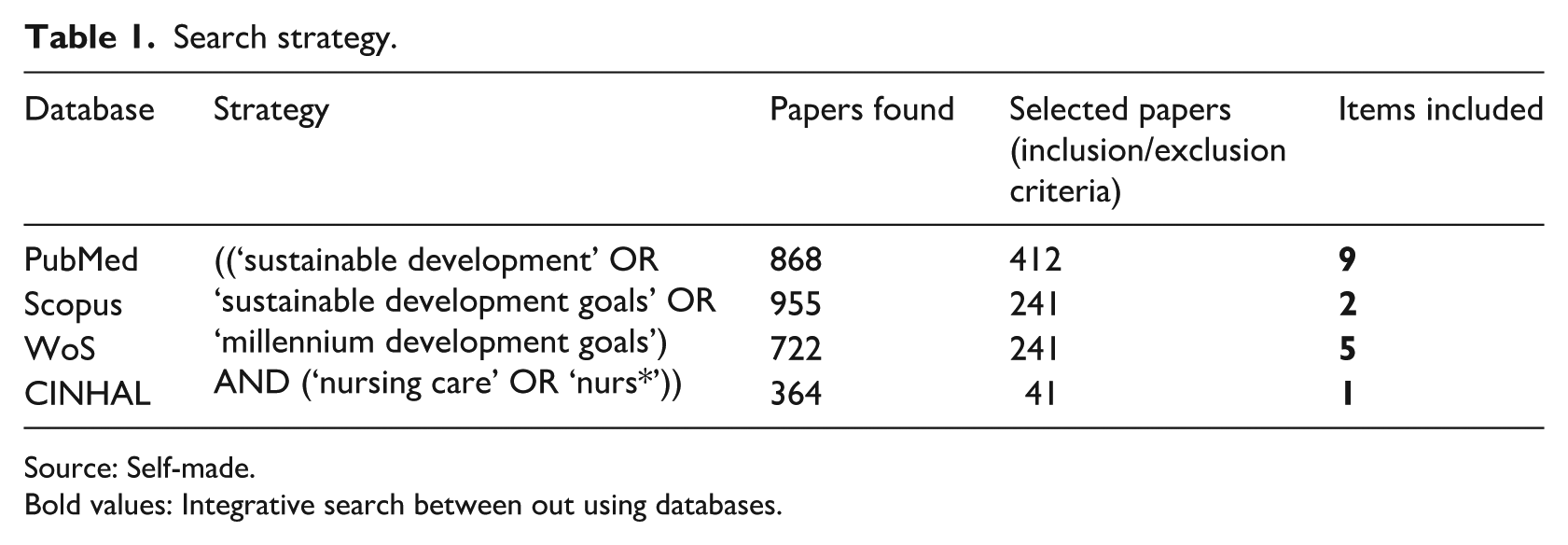
Source: Self-made.
Bold values: Integrative search between out using databases.
Study selection
The screening procedure was carried out in order to identify relevant studies based on the selection criteria. Firstly, duplicate publications were removed and then reviewers screened the references by title and abstract. Finally, texts were read in full, and those meeting eligibility criteria were included. All procedures were carried out by two reviewers independently and, if there was a disagreement, another reviewer was consulted. Zotero and Mendeley were used to process the bibliographic records.From a total of 2909 references, according to the inclusion and exclusion criteria 143 documents were selected based on title review. Abstracts were reviewed and 84 studies were identified for full text review by two reviewers. Seventeen papers were included in the study Figure 2. Flowchart for the inclusion of papers in the review.
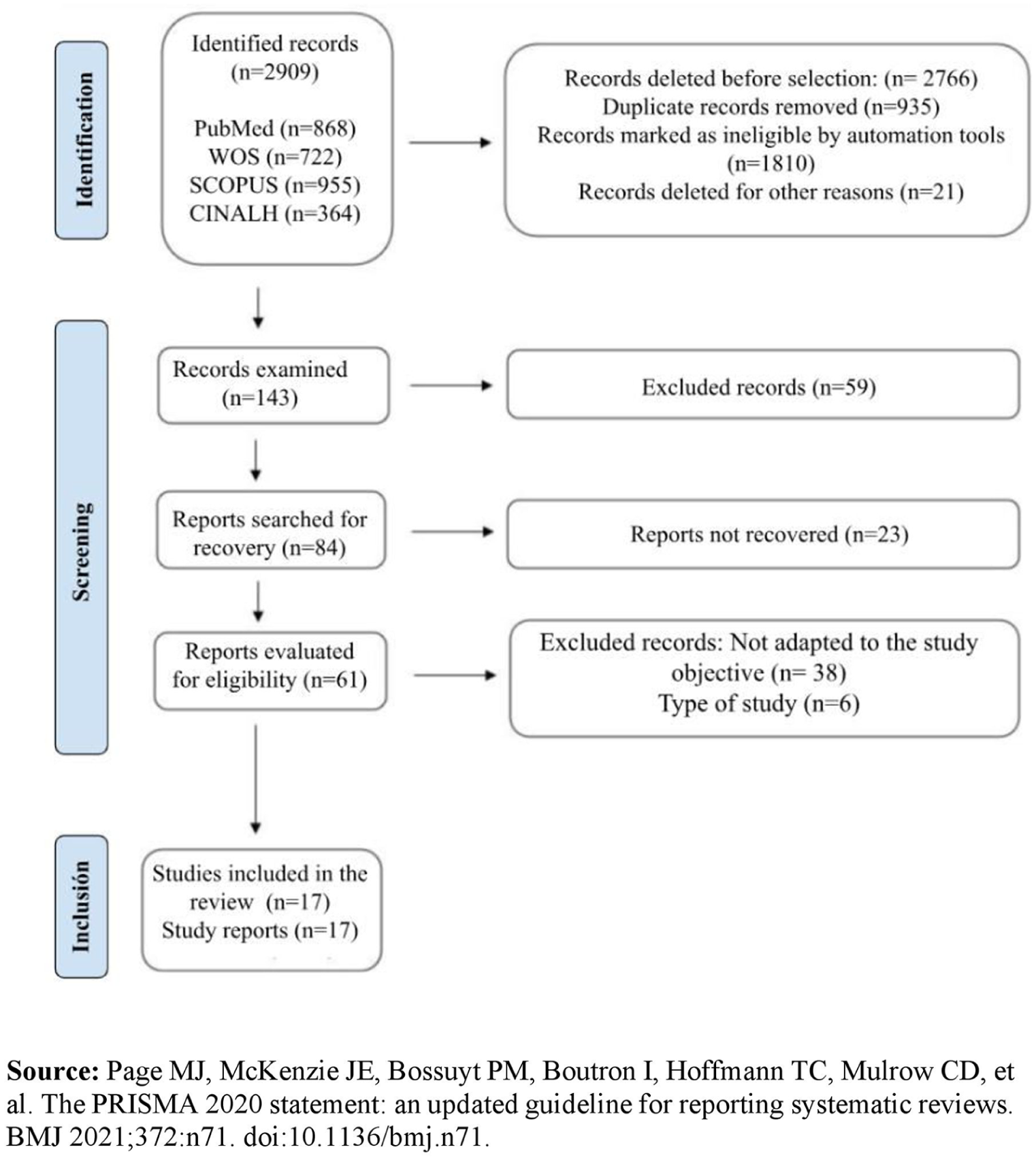
Flowchart for the inclusion of papers in the review.
Data extraction
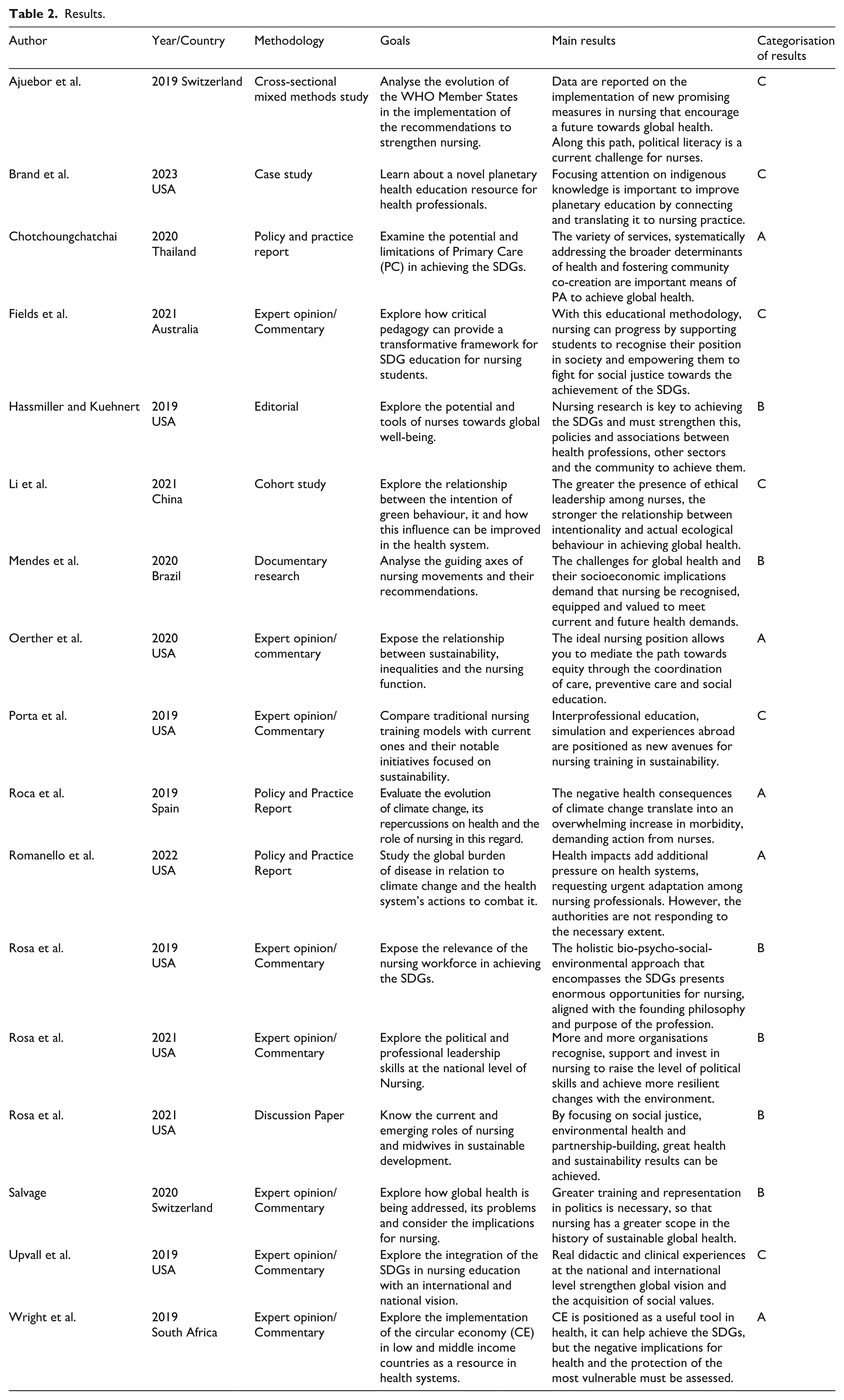
One reviewer was in charge of extracting and analysed the data from the papers, which was subsequently verified by another reviewer. Once the data had been extracted, a table was drawn up including authors, year, country, purpose of the study, methods and a summary of the major findings. The summary tables were thoroughly reviewed by all the reviewers independently, with critical discussions of the extracted data. This information is set out in Table 2 below.
Results.
Results and discussion
From these 17 papers included, 8 were experts’ opinions/commentaries, 3 policy and practice reports, 1 editorial, 1 discussion paper, 1 documentary study, 1 cohort study, 1 case study, and 1 mixed method cross-sectional study.
More than half of the selected documents originated in the United States (52.3%). Regarding the sample, 82% of the documents focused on nurses, and 12% on nurses and midwives.
The main findings identified during the analysis were: Category A: Sustainability in the healthcare system and its influence on nursing professionals; Category B: Main difficulties to incorporate sustainability into nursing practice and actions to overcome them and Category C: Nursing education in sustainability.
Category A: Sustainability in the health system and its influence on nursing professionals
Sustainability has become both a call to action and a form of progress; seeking to improve quality of life, promote intergenerational equity, and preserve the health of the environment. Within this context, the need to develop both technical solutions and to bring about changes in lifestyle and social practices is recognised.
To realise such a transformation, both individuals and communities must engage in a process that requires both learning and significant ‘unlearning’. Health systems, as both recipients and contributors to the effects of climate change, must incorporate certain concepts and processes into their practice to reduce these detrimental impacts, while fulfilling their role in educating society. Given that the mission of the health sector is to protect and promote health, it has a responsibility to fulfil the Hippocratic oath to ‘do no harm’ in relation to its own climate footprint. It must also influence other sectors to take similar actions (Romanello et al., 2022).
The effects of climate change on health exacerbate other existing crises, which may be perceived as more immediate and divert attention and resources needed to address climate change. Among the major changes taking place that directly affect health are alterations in the distribution and transmission of vector-borne, food-borne, and waterborne infectious diseases. There is also an increase in temperatures and, as a result, heat waves, which are associated with an increased risk of acute kidney injury, worsening cardiovascular and respiratory diseases, increased non-accidental deaths, heat stroke, pregnancy complications, mental health problems, and sleep disorders. Another group of diseases that may increase with global warming are mental health disorders, as they are influenced by geographical, social, environmental, financial, and political factors and any climate impact on physical health also becomes a risk factor for mental health (Hassmiller and Kuehnert, 2020).
According to the results of the WHO Global Health and Climate Change Survey 2021, only about half of the countries (49 out of 95) report having a national plan focused on health and climate change. Within this group, 62 countries (65%) report a moderate or lower level of implementation, while 67 countries (70%) cite insufficient funding as the main barrier to progress. The lack of adequate adaptation to climate change has exposed the vulnerability of health systems to climate-related health risks. Currently, only 48 out of 95 countries have assessed their requirements for adapting to climate change, and only 63% reported a high or very high level of implementation in health emergency management at 2021 (Oerther and Rosa., 2020).
Health as an SDG aims to ensure healthy lives and promote well-being for all at all ages, so it is clear that nursing has a responsibility in relation to this goal, as well as other goals relating to education and poverty. The rationale for nurses’ contribution to achieving the SDGs is based on four main reasons. The first is that nurses inherently care for others; the second that the SDGs present the opportunity to apply knowledge as nurses to create a healthier and better world; the third reason is that change is possible - improvements in life expectancy, lower child mortality rates, higher rates of child schooling, reduction of extreme poverty or improved access to safe water and sanitation are all achievable with such action; the fourth reason is that it is about everyone’s health, achieving these goals will improve the lives of people in the communities and families closest to them and even one’s own health. There are a variety of ways to enhance and improve the health and well-being of individuals and populations, whether in clinical practice, working with individuals and their families, through community support and development programmes, national health initiatives and policies or international commitments, and agreements to improve access and quality of healthcare. Nurses can play an important role at all levels, whether providing care, conducting accurate needs assessment, designing the clinical or policy response or evaluating outcomes and effectiveness (Oerther and Rosa, 2020; Romanello et al., 2022).
On the other hand, the healthcare sector, as a consumer of a large amount of primary resources such as water, energy, metals, and chemicals; and a producer of significant volumes of waste, must implement measures to gain efficiency and reduce negative effects. The circular economy (CE) is the antithesis of the linear scheme that is prevalent in the current health sector and is a great ally on the road to sustainability. However, the very connotations that surround healthcare practice, such as hygiene or safety, make it difficult to implement, and it is mostly used in those cases where the availability of material goods is scarce, requiring this ‘circularity’ in these countries. But it is because of this need that CE is not carried out safely because of poverty and unemployment, with no regulation to protect workers from the risks that arise in the process. If a cross-sectoral approach is adopted, CE aligns with other SDGs such as: Responsible Production and Consumption (SDG 12), Sustainable Cities and Communities (SDG 11), as well as SDG 6 (Clean Water and Sanitation), SDG 7 (Clean and Affordable Energy), and SDG 15 (Life of Terrestrial Ecosystems). Similarly, with the necessary research, it can generate indirect synergies and accelerate the achievement of important targets, such as fostering economic development and employment (SDG 8), eradicating poverty (SDG 1) and combating hunger (SDG 2). Thus, some of the measures could include extending the useful life of medical equipment, valuing its repair instead of its replacement, another measure could be to change the concept of ‘ownership’ to ‘use’ in health services, which would allow the acquisition of certain equipment only when necessary and would save the cost of maintaining, preserving and updating equipment, saving and using fewer resources (Wright et al., 2019).
Previous studies agree that climate change affects global health through multiple direct and indirect pathways, and each year, weather- and climate-related disasters cause thousands of deaths worldwide and contribute to the global burden of disease. Di Napoli et al. (2022) and Karliner et al. (2019) agreed with our findings that as understanding and awareness of the health dimension of climate change grows, there is greater demand for feasible and efficient tools that can inform climate change mitigation and adaptation strategies to deliver human health benefits at all levels.
Along the same lines, Gascóns (2011) showed how primary care is still far from achieving this central role in the system in order to guide towards a more sustainable process. This slow process is marked by the decrease in public spending on primary care and the parallel increase in specialised care, the lack of a global vision, and the conflicts in incorporating new demanding criteria of productivity and efficiency. In addition to the structure of management, functional organisation and financing of public provision, rather than the achievement of high results through optimal use of resources.
One of the aspects on which our review focuses is the influence that sustainability has on nursing practice and how this performance mediates within the system. In two previous meta-analyses, Lambrinou et al. (2012) in reference to heart failure and Tshiananga et al. (2012) in diabetes, coincidentally reflected how the performance of nurses in these pathologies that generate high costs in the health system, allowed favourable results regarding the impact of nurses leading care scenarios and efficiency.
Another of the issues addressed by our study is sustainability within the healthcare system itself. In this regard, De Diego et al. (2023) concluded that the CE is a great opportunity to bring healthcare systems closer to this goal of resilience.
However, Espaliaut (2018) refuted our results, arguing that in a sector where technical advances and being at the forefront of technology are privileged advantages, the consideration of this circular resource is difficult, coupled with the low economic attractiveness it generates and the impediments of the pharmaceutical industry.
Category B: Main difficulties to incorporate sustainability into nursing practice and actions to overcome them
Nursing, which represents 59% of the global healthcare workforce, with approximately 27.9 million professionals, is rooted in a concern for social well-being, and the ability to provide holistic care is a quality of these professionals, positioning them as key players on the path to achieving the 2030 Agenda for Sustainable Development. This agenda is the United Nations’ global action plan, adopted in 2015 by all UN member states, to guide progress towards sustainability. The SDGs provide an overarching global framework for health practice and policy, driving the activity of numerous global bodies, thus placing them in a politically contested and exponentially expanding terrain of complexity. At the interface between the community and the health system itself are nurses, who see first hand how policy affects people and who have crucial information to inform change. However, the data are not received with the enthusiasm that one might expect among policymakers, and competencies in this area are not consistently developed (Salvage and White, 2020However, the need to address acute problems, ongoing and future staff shortages, and rising demands is making the vital contribution of nursing more evident than ever. (Mendes et al. 2020; Rosa et al., 2021; Salvage and White, 2020).
Indeed, one of the expected competencies of the nursing profession is such advocacy to address instability and human rights abuses. Hassmiller and Kuehnert (2020) emphasised that if nurses are to be aware of their value in achieving this ambitious agenda, education must provide tools for knowledge and understanding of the interconnectedness of all levels for global well-being. Rosa et al. (2019) proposed that such education should be based on skills such as: civic and political skills to participate in decision-making, fostering self-awareness to prevent the emergence of exclusionary nationalism, critical thinking to question unfounded assertions, and media and information literacy to critically evaluate information sources and participate responsibly in digital citizenship. Thus, there is a need to include in nursing education curricula the concepts of social justice and global citizenship, as well as clinical experiences that increase community engagement (Venkatasubramanian 2022). Integrating such academic dialogue and practice rooted in global society avoids ‘privileging’ the Western lens and empowers nursing advocacy defined by the ethic of social equity and inclusion (Rosa et al., 2019). The promotion of a culture of health must be based on reliable evidence, which must be the product of increased research, centred on communities and patients (Hassmiller and Kuehnert, 2020). To this end, the creation of a ‘policy track’ could be positioned as an innovative way to promote leadership among nursing professionals, so that they become better trained in research in schools and eligible for participation at policy-making tables, where they can implement such evidence to improve lives. Within this it must be recognised that often the policies that most affect health are not always health policies (Salvage et al. 2020).
Despite the role that nurses have as the largest group of health professionals, daily personal or professional actions alone will not be enough, but policy change is needed at all levels, from local to global, and forceful action is required (Hassmiller and Kuehnert, 2020). Global policies are mostly set by large organisations and agencies. These are then policies that then guide local, regional and global levels, and it is in these spaces that nursing knowledge is excluded from the comprehensive framework and planning despite having the most substantial scope. ithout preparing groups of nurses with the capacity to take on leadership roles in aspects of clinical practice as well as in the social justice arena immersed in politics and away from medical care, the achievement of the SDGs will be unfeasible. Thus, new ways of ensuring the contribution of the profession can be explored, for example, by integrating the workings of politics and how to work in those spheres involved, as a curricular requirement at all levels of education, or by offering opportunities to experience policy forums and interact with Non-Government Organisations. Partnerships with leaders in other sectors, such as education, community development, transport or the environment, will be necessary. Health promotion, and therefore primary care, will be more in demand and will require more roles and cooperation, including with patients and concerned citizens. Contributions that nurses and midwives can make in their localities include encouraging change through health promotion and demonstrating its realisation in reality, ranging from the growth of nurse-led Non-Communicable Diseases clinics to ‘reverse innovation’ (the process where an innovation is first developed and implemented in a low- or middle-income country, often out of necessity and resource constraints, and is later adapted and applied in high-income countries between staff in different countries (Rosa et al., 2019).
Another way to engage with global health may be through disseminating ideas and achievements at conferences or debates, after conducting research, or within your own work circle, forming groups that enable knowledge sharing with each other and with external peers, or learning what we have within our regional, national or local organisation so that we can take action (Salvage and White, 2020). The Global Nursing Leadership Institute, which identifies and advocates for the role of nursing according to health priorities, has carried out several projects to achieve the SDG targets, including the initiative to supply and accommodate exponential vaccination that took place during COVID-19, which focused on mitigating epidemics and pandemics caused by communicable diseases (targets 3.3 and 3.8). It lobbied state-level governors to implement emergency measures to reduce inequalities in vaccinating people. Another contribution was based on policy coherence by mediating to make policies more congruent with reality, a need reflected in SDG 17- Partnerships for the Goals, aiming to strengthen global conversations that integrate nursing practice (Rosa et al., 2021).
The promotion of palliative care advocacy articulated in target 3.8 of the SDGs (Achieve universal health coverage, including financial risk protection, access to quality essential health-care services, and access to safe, effective, quality and affordable essential medicines and vaccines for all) has also been a priority due to the increase in the universal burden of suffering in recent years, which has proposed palliative nursing experts as agents to address the growing inequalities in access and establish it as a component of universal health coverage (Rosa et al., 2021). In addition, various actions have been carried out by multiple organisations such as the ICN, which developed core competencies in disaster management to guide nurses before climatic emergencies, or the Alliance of Nurses for Healthy Environments (ANHE) and Healthcare Without Harm, which seeks to educate nurses about the importance of palliative care for the health and well-being of patients. About 50,000 nurses in the United States with the Nurses Climate Challenge, as well as ANHE and Project Drawdown (a nonprofit organization and research initiative that identifies, evaluates, and promotes the most effective solutions to stop climate change and achieve “drawdown” — the point at which levels of greenhouse gases in the atmosphere stop climbing and begin to decline) partnered to launch Nurses Drawdown (2020), an initiative that primarily seeks to decrease GHG emissions. Nursing Now (2018–2021) aims to improve the quality of healthcare globally (Mendes et al., 2020). This campaign was based on a series of documents showing the relevance of nursing in global health, positioning it as an investment and not as a cost for institutions, knowing the opposite priority of the administration based on minimising costs without modifying the quality of care (Mendes et al., 2020).
Among the challenges facing nursing in the application of sustainability in daily practice, Aguirre Raya (2020) pointed to training, working conditions and health policies, which aligns with our results. In the current global fabric, these axes limit the participation of nursing in the integration of these changes, despite its key position in the health system.
Similarly, Álvarez et al. (2017) agreed that in order to achieve nursing leadership in the field of sustainability and health systems, environmental health research must be consolidated, management plans or policy changes that support these results must be promoted, and training in this area must be improved, given that there are major shortcomings in teaching practice and the incorporation of environmental knowledge. Other studies point to further current problems facing the profession, including lack of staff and resources, limited potential for contribution and difficulties in recruitment, retention and re-entry into the profession (All-Party Parliamentary Group on Global Health, 2016).
Finally, the actions carried out to overcome these difficulties are also analysed in our study, in accordance with the Spanish Nursing Code of Ethics, nurses must form part of the councils in which health policies are established (Organización Colegial de Enfermería, 1973). Thus, and in favour of what is indicated in our results, there are numerous actions initiated and with promising results in this line, both carried out by nurses, as well as others in which their participation has been fundamental (for example the United Kingdom All-Party Parliamentary Group (APPG) on Global Health, 2016).
Category C: Nursing education in sustainability
Nursing students must be knowledgeable about global issues and interconnectedness at the local level, redefining the personal and professional self, then expanding with critical education, so that despite not knowing the context of others they possess the ability to question their own assumptions and invite ethical action through reflection.
Studies agree that students are currently not trained and skilled to think critically and solve complex real-life situations, which is why Venkatasubramanian (2022) addressed new concepts focused on encouraging students to engage with the well-being and sustainability issues identified in their own settings, reflecting on these in search of practical solutions. This supports the position of Daza de Caballero et al. (2005), explored the need to provide personalised education to nursing professionals given the little attention given to the acquisition of knowledge and competencies in response to global challenges within traditional education, with regard to not harming the environment so that it does not harm current and future generations as a goal of the profession.In view of the need for improvements in universities given their link with the generation and dissemination of knowledge about sustainability and their critical and constructive contribution to sustainable development, the Conference of Rectors of Spanish Universities (CRUE, 2020), in accordance with the Action Plan for the Implementation of the 2030 Agenda, presents a series of actions that incorporate participatory teaching methods and new skills in the curricula, which increase awareness and debate on the SDGs in the classroom, incorporating them as a university quality criterion. In line with the new methods that are emerging, we find scenario-based learning as a great ally in this curricular innovation. Richardson et al. (2019) demonstrated how this methodology brings students closer to reality and the possible challenges of their work. Through pedagogical approaches, systemic thinking is created that integrates climatic events and threats to resources used in daily practice into nursing education, leading to significant changes in the attitudes of these future professionals and the relevance of these issues.
Clinical implications
This study has potential clinical implications and unique contributions that should be highlighted. Firstly, the literature consulted and the experts’ opinions align to the importance of nurses to mediate the sustainability-health dyad, acting as the main agents in the contact with the population and to the importance of nursing practice to incorporate consideration of the environment into healthcare. This is in accordance with a broader and expanded model of health that needs to be cultivated by nursing science.
Nevertheless, our study has highlighted several barriers that impede assimilation of these sustainability goals by nurses, such as lack of training and knowledge, inappropriate working conditions, and difficulties in incorporating health policies by institutions. These findings highlight the need for the promotion of more discussion by government bodies, more healthcare compliance regulations and more training for nurse professionals.
Our findings were also promising since they revealed that the introduction of sustainability into the healthcare system is progressing. Although this progress is affected by a multitude of factors, it seems that primary care is a detrimental place for implementing environmental changes and to educate the general population to be sustainable. Finally, training should be increased and provided all over the world to guarantee that nurses are prepared for the current and future agenda for this topic.
Conclusions
This study has provided further information on the relationship between nursing and sustainability, showing that new sustainable opportunities are being created to bring the healthcare system closer to a future that is more adapted to the new environmental requirements. In this context, training nurses to be able to act in a more environmentally resilient healthcare is fundamental. Current nursing education must be updated, integrating new methods and concepts in line with environmental nursing. Ultimately, incorporating sustainable practices in nursing can improve the health and well-being of patients, while protecting the environment and promoting a more sustainable healthcare system.
Key points for policy, practice and/or research
The integration of sustainability into the healthcare system is slow, therefore the involvement of nurses in achieving a more environmentally resilient healthcare environment is essential.
The training of nurses needs to be updated in line with environmental needs withing the health caresystem and the needs of the population.
Nursing plays a key role in the sustainability-health dyad; incorporating sustainable nursing practices can improve the health and well-being of patients, while protecting the environment and promoting a more sustainable healthcare system.
Footnotes
Author contributions
Conceptualization, B.B.; R.d.D.-C; Methodology, B.B.; Formal analysis, B.B.; R.d.D.-C; J.M.P.-J; Investigation, B.B.; R.d.D.-C; J.M.P.-J.; GL.; SRM; Resources, B.B.; R.d.D.-C; J.M.P.-J; SRM;GL; Data curation, B.B. and R.d.D.-C.; Writing – original draft preparation, B.B.; R.d.D.-C.; J.M.P.-J; GL;SRM; Writing – review and editing, B.B.; R.d.D.-C; J.M.P.-J; GL;SRM; supervision, B.B. and R.d.D.-C. All authors have read and agreed to the published version of the manuscript.
Declaration of conflicting interests
The author(s) declared no potential conflicts of interest with respect to the research, authorship, and/or publication of this article.
Funding
The author(s) disclosed receipt of the following financial support for the research, authorship, and/or publication of this article: This work is linked to the project ‘Development of a Model with an ethical and gender perspective for the implementation of sustainability measures in healthcare centres and institutions (SUSTAinsHealth)’. It was funding in 2024 by the VII Plan Propio de Investigación – V.1C Program to stimulate areas with research needs and emerging research activity (Vice-Rectorate for Research of the University of Seville).
Ethical approval
Not necessary as it is a systematic review of the scientific literature.
