






Abstract
Background
Research impact has been described as occurring when research generates benefits (health, economic and cultural) and builds on existing academic knowledge (Glover et al., 2025). Many countries have adopted processes for assessment and evaluation of research impact (Adams and Szomszor, 2024). One such system in the United Kingdom (UK) is known as the Research Excellence Framework (REF), which has long since been established within Higher Education Institutions (HEIs) for measuring the excellence of research and associated impact. However, although REF is designed to assess the excellence of all types of research including measurable impact, its primary focus is to provide accountability for public investment and inform allocation of block-grant funding based on research quality (Research Excellence Framework 2029 [REF], 2025). Arguably, the REF framework does not represent the full story in terms of potential and actual clinical impact; moreover, it is not widely understood amongst the UK health and care system leaders. Clinical impact has been described as the extent to which research findings impact on clinical practice, care and treatments (Spencer, 2022). Consequently, the REF on its own could fail to fully describe the impact of research on clinical practice (van Eck, 2013).
Newington et al. (2021) described the cultural changes that clinical researchers can bring to patient care and research culture; however, this is difficult to capture and articulate. Over the last 10 years, there has been significant investment in building capacity and capability for healthcare professionals to lead research, especially nurses, midwives and allied health professionals. This has led to organisations working on establishing careers and job roles and presenting business cases to enable this. This, alongside a clear endorsement and future promised investment in research as part of the National Health Service (NHS) 10-year plan (Department of Health and Social Care, NHS England 2025), means that it has never been more important for a clinical healthcare researcher to capture and record their research in terms of clinical impact. However, to do this requires agreed solid metrics within a user-friendly tool. This paper reports on the development and implementation of a digital user-friendly tool, which aims to capture and measure clinical impact of research.
Methods
Recognising the challenges around demonstrating and articulating impact outside of a HEI setting, a team, including a postdoctoral researcher undertaking a funded fellowship working across two NHS organisations developed and piloted a real-time clinical impact tool. This is called the Research and Clinical Impact Tracker for Excellence (ReCITE™) tool.
Guidance was sought from an impact expert, about how to ensure that the tool remained faithful to the principles of impact whilst facilitating translation to the clinical academic landscape (Bayley, 2023). In addition to this, the team also reviewed the seven pillars of clinical governance in the NHS to enhance the metrics through a clinical lens. These pillars, Clinical Effectiveness, Risk Management, Patient and Public Involvement, Audit, Education and Training, Information Management and Staff Management, work together to ensure high-quality, safe and effective care for patients (Halligan and Donaldson, 2001) and were a useful stating point to understand impact in the context of health and care.
The novel approach of using a scoring system to help describe the impact within clinical areas was carefully considered by the team and debated with key stakeholders at a national nursing conference. It was agreed that, as scoring systems are commonly used in NHS organisations when articulating improvement, this could work well with a clinical research impact tool.
The key to the project was that the two Trusts supported leadership and partnership across both their large regional NHS organisations. This included a series of four consensus meetings being undertaken to develop and pilot the tool. A digital user-friendly tool was consequently developed in 2023, which aims to capture and measure clinical impact of research. We believe this will be one of only a few pragmatic tools in the UK to capture the real world of clinical research undertaken.
The ReCITE™ tool
The ReCITE™ tool is a working live document to self-identify metrics of researchers individual studies which in turn captures project impact. The tool collects information in four main sections:
Project details
Objectives and rationale
People
Impacts
These include the type of project, objectives and rationale locally and nationally, stakeholders and key people involved including patient–public involvement and experience, and the activities undertaken which have generated the impact. Prompts are included to support the user in completing the tool, and these were generated from the feedback received from the pilot of the tool. Ideally, the tool should be used prospectively, collecting data as the project develops; however, it can be used retrospectively for completed projects. For ease of use, a QR code is used to access the tool.

The tool provides a user guide to support individual organisations to collect and manager their own data. This can be accessed throught the user guide link within the tool. It is important that the researcher using the tool duplicates the form before completion to ensure their data is stored and managed within their organisation.

Project details
Project details are collected, including the people leading the project, the organisations involved, the type of project (service evaluation/research/quality improvement), the title and a short summary of the project including start and anticipated completion dates.
Objectives and rationale
Up to four objectives can be entered into the tool, along with a rational for why this project is important locally and nationally. There is also an opportunity to include whether this project is related to any other project – creating a record of the development and growth of projects.
People
The people sections include individuals who will be, or have been, involved in the project including any stakeholder involvement. Information about patient–public involvement and experience representatives is also required.
Impact
The impact section recaps on the importance of the study locally and/or nationally and enables the individual to record the activities undertaken to create impact and the outcome this relates to. A drop box of different types of impact enables the individual to identify the impact type for each activity, along with recording evidence of the change and impact.
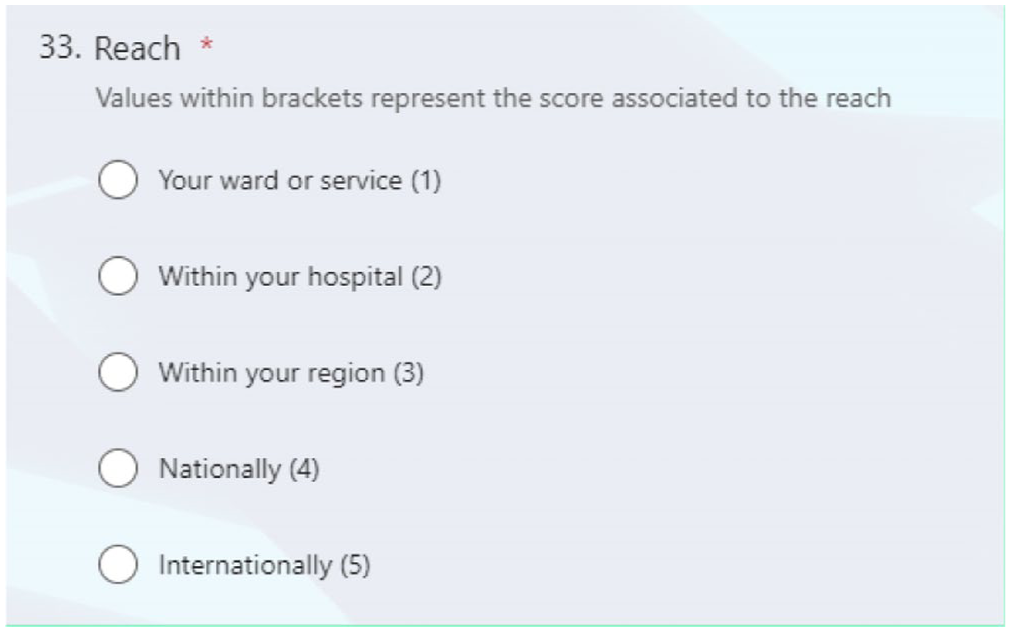
The tool also asks about the reach of the project. This section is required as it is important for calculating the overall impact score.
Results
An evaluation pilot was undertaken, involving 11 nurses, midwives and allied health professionals working at either of the NHS Organisations involved in the project. Individuals were asked to complete the ReCITE™ tool for projects they had led on, which included:
PhD studies
Quality improvement projects
Feedback from the pilot found that the digital tool provided all clinical researchers working in the NHS organisations with a prospective working document to self-identify metrics of their studies, which in turn captures project impact. Metrics within the NHS are often presenting as a score, and the ReCITE™ tool enables professionals to self-capture and articulate the impact of their project or study, both with narrative and with a score, whilst also providing guidance about how to increase their impact such as enhancing reach or populations.
The pilot results also showed that the ReCITE™ tool enabled individuals to collect information both retrospectively and prospectively and translate impact in a meaningful way to their audiences, whether that be healthcare practitioners or impact required by HEIs.
Feedback from the pilot enabled the tool to be fine-tuned to ensure it was easy to use, and the questions elicited the expected information, particularly around the impact sections. Prompts were also added to some questions to provide clarity for the individual completing the tool. Hinrichs and Grant (2015) identified that the information used to compile REF case studies were not consistent or standardised, and the purpose of the case studies was for assessment and did not include any analysis. More robust and sophisticated approaches to capturing and demonstrating impact have been labour-intensive and often not feasible within a clinical environment. The ReCITE™ tool has been developed to address these limitations of existing impact measurement mechanisms, being analytical, standardised and feasible to complete for clinical academics.
Recommendations for practice
It is recommended that all NHS organisations with clinical academic researchers consider utilising this tool to enable the impact of clinical academic research activities to be demonstrated and articulated to a wide audience. The tool also provides insights into how to increase the impact which could inform future developments and clinical academic activity.
Discussion and conclusion
This novel tool had been designed and piloted to facilitate clinical academic healthcare professionals to demonstrate and articulate the impact their work has and enables them to describe this in a meaningful way within the context of NHS organisations and HEIs. This is an important step forward in developing meaningful impact data to support the national imperative to increase research activity across health and care. The ReCITE tool can support healthcare professionals to articulate the success and for senior leaders to understand the impact of their work across health and care services.
