







Abstract
The current study examines how teachers’ professional wellbeing is affected by teacher-level and school-level factors using the TALIS 2018 data. Teacher-level factors consist of teachers’ instructional practices and teachers’ professional practices and school-level factors include school climate, school leadership styles and workload. The Hierarchical Linear Modeling (HLM) was used to examine whether the principals’ leadership, school climate and workload and teachers’ instructional practices and teachers’ professional practices explain the variation in teacher self-efficacy, teacher job satisfaction, and motivation and perceptions net of several important teacher-level and school-level control variables. The results revealed that both the teacher- and school-level factors were significantly related to teachers’ professional wellbeing. These findings were discussed concerning five countries of Canada, China, Finland, Japan and Singapore. The implications of the findings for improving teachers’ professional wellbeing are discussed.
Introduction
The globalized economy has become the driving force fuelling urgent and rapid educational changes, and schools should provide students with the skills and knowledge they will need to succeed in this highly competitive global economic market (Sun and Xia, 2018). Accordingly, effective teaching is a central goal of the educational systems. Although seeking to achieve this goal involves many complexities, certain factors have been shown to support them, one of which is teacher well-being (Collie et al., 2012; Day and Qing, 2009). In an empirical study, Zaki (2018) found that teacher professional well-being is a key factor to enhance effective teaching and promote the quality of teachers. Teacher professional wellbeing is now receiving more research attention as it is an important predictor of employee and organizational productivity (Wright and Cropanzano, 2004; Yu et al., 2022). Given this function, it is not surprising that professional wellbeing is attracting the attention of policy developers, principals and political role players in the field of education administration (OECD, 2018). Teachers' professional well-being can be conceptualized as a positive sense of feelings of respect, motivation, efficacy and job satisfaction as a teacher (Butt and Lance, 2005).
Up to now, people have understood the phenomenon of professional well-being through an individual’s psychological and social well-being, integratively manifested as a process and state, fixing the nature and content of human life activity in the profession, the conditions of its implementation, the main results of professional activities and an individual’s attitude towards their results (Fedorov et al., 2020). On the whole, professional well-being is defined as part of psychological well-being, reflecting a positive assessment of oneself and one’s own results in the profession (Fedorov et al., 2020). Teachers’ professional well-being as an indicator provides information about the statements of teachers in terms of the teaching profession, and the importance of an indicator comes from the reasons that generate it (Yildirim, 2014). If we know these reasons, the right intervention would be carried out when the problem arises (Yildirim, 2014). Teacher professional well-being is a critical and often overlooked part of school health (Viac and Fraser, 2020). Professional well-being is accepted as a dimension of the general well-being of an employee. Although, there are lots of studies on ‘general well-being’ there is a scarcity in numbers of research focused directly on professional well-being and especially on teachers’ professional well-being (Yildirim, 2014).
A few scientific studies are devoted to the problems of teachers’ professional well-being (Fedorov et al., 2020). The problem of the low level of social prestige of the profession in societies remains relevant, considering the constant increase in the importance of tasks, complexity of functions, and growth of expectations and requirements from the societies (Fedorov et al., 2020). Teacher education and in-service training that include aspects of teachers’ self-regulatory skills and coping behaviour might enhance teachers’ professional well-being (Klusmann et al., 2004). Teachers who feel supported by their colleagues and principals usually have a higher sense of general professional well-being, they experience greater self-efficacy, less pressure at work and have a more pupil-centred orientation (Viac and Fraser, 2020). There is an obvious need to develop conditions for the growth of teachers' professional well-being, which creates a basis for improving the quality of education and its competitiveness, consolidation in the profession of young professionals (Fedorov et al., 2020).
There are a few academic papers propose analytical frameworks to measure teacher professional well-being (Viac and Fraser, 2020). Modern education systems evolve in a context of growing teacher shortages, frequent turnover and a low attractiveness of the profession (Viac and Fraser, 2020). In such a context where these challenges interrelate, there is an urgent need to better understand the well-being of teachers and its influential factors (Viac and Fraser, 2020). Identification of factors influencing the concept of professional well-being might enable administrators, political decision-makers and supervisors to undertake actions accordingly to enhance it (Yildirim, 2014). Hence, it will be interesting to investigate the effects of teachers and school-levels factors on teachers’ professional well-being. This study provided scientific bases for the development of all possible interventions that will improve teacher professional well-being.
According to the literature review, teachers’ professional well-being is mainly shaped by organizational and individual characteristics. The most effective factors are school climate, leadership styles, school resources, workload, cooperation among staff, teaching practices and professional development activities (Aelterman et al., 2007; Yildirim, 2014). Very few studies have linked teacher- and school-level factors to teachers’ professional well-being while they are important constructs for school effectiveness. The present study aimed to examine teachers’ professional well-being using the data from the 2018 Teaching and Learning International Survey (TALIS) cycle. TALIS 2018 is the third cycle of the TALIS project, which is an ongoing large-scale survey of teachers, school leaders, and their learning environments within the Organization for Economic Cooperation and Development (OECD) programme (Liu et al., 2021).
One of the approaches to the search for differentiated environmental solutions for organizing work at the institutional and regional levels to improve professional well-being is to determine the factors affecting teachers' professional well-being (Fedorov et al., 2020). TALIS 2018 provides available data about teaching conditions and learning environments, which makes it possible to explore how teachers' professional well-being is affected by factors at the teacher-level (e.g. teachers’ instructional practices and teachers’ professional practices) and school-level (e.g. school climate, school leadership styles and workload). We investigated the effects of these two levels on teachers’ professional well-being in five countries of Canada, China, Finland, Japan and Singapore that mostly have good educational performance. These countries were among the top ranks of the world’s best education system. All of these five countries have a high-quality teacher workforce, student achievement is higher and traditionally score high on international tests of student performance in which their policymakers support effective teaching (Stewart, 2011). It seems that teacher well-being levels from these counties may be higher than other countries (Collie et al., 2015; Katsantonis, 2020). Moreover, some influential factors such as workload seem to have significant effects on teacher professional well-being in all countries of Canada, China, Finland, Japan and Singapore (Jayaratne and Chess, 1986; Butt and Lance, 2005). In this study, we selected countries that have centralized education system (i.e. Singapore, China and Japan) and decentralized education system (i.e. Canada and Finland); countries that are collectivistic societies (i.e. Singapore, China and Japan), and individualistic societies (i.e. Canada and Finland) (Cornito, 2021; Noordin et al., 2002). However, Japan has started a process of decentralization of its centralized educational system (Muta, 2000).
Literature review
Teachers’ professional well-being
General well-being can be defined as being psychologically, physically and emotionally healthy (Yildirim, 2015). As McLellan and Steward (2015) explain, initial attempts to measure well-being theorized it in hedonic terms: as the absence of negative states/emotions such as excessive stress or depression, and the presence of positive feelings such as life or job satisfaction (Brady and Wilson, 2021). This component of teacher well-being is called hedonic well-being, which originated with the Greek philosopher Aristippus and can be measured by the positive-negative affect balance (Diener et al., 2010). Another component of teacher well-being is called eudaimonic well-being, which originated with Aristotle and includes a wide variety of factors such as autonomy, personal growth and engagement (Diener et al., 2010; Waterman, 1993). In a modern context, eudaimonia well-being can be interpreted as the achievement of self-realization (McLellan and Steward, 2015). Professional well-being is the feeling which provides individuals with the confidence they need to assume new roles, adapt to their career changes and accept challenges they might face as part of their professional development (Yildirim, 2015). Warr’s model (1990) proposed dimensions of affective, work-related wellbeing including enthusiasm–depression (measured by burnout and engagement), pleasure–displeasure (measured by job satisfaction) and anxiety–comfort (measured by occupational stress).
Based on positive psychology Ryff and Keyes (1995) described a six-dimensional model of well-being. They used environmental mastery, autonomy, self-acceptance, positive relations with others, personal growth and purpose in life. Van Horn et al. (2004) focused on work-related well-being and combined Warr’s and Ryff’s models. They described five dimensions and three of which (social, affective and professional well-being) are taken from Ryff and Warr’s models. They specifically underlined professional competence, autonomy and aspiration as measures of professional well-being. These measures also include aspects of job-related motivation, self-efficacy, ambition and achievement (Yildirim, 2014).
Literature review produced very few studies that are involved in teachers’ professional well-being. Among the rare studies, the study was carried out by Aelterman et al. (2007) revealed the components of teacher professional wellbeing as job satisfaction, self-efficacy, perceptions and autonomy. Professional well-being is also fuelled by a self-determined motivation involving the satisfaction of the three basic psychological needs (autonomy, competency, relationship) (Cece et al., 2020).
The most recently used conceptual framework for teacher professional well-being was developed by Yildirim (2014). This framework proposes some dimensions in this construct like job satisfaction, self-efficacy, aspiration and motivation which are influenced by relevant factors (e.g. school climate, classroom environment, workload, cooperation among staff, school management (supportive), teaching practices, teaching beliefs and professional development activity).
Accordingly, teachers’ self-efficacy, job satisfaction, motivation and perceptions were employed as components of teacher professional well-being in this study.
Teacher-level factors and teachers’ professional well-Being
In this study, teacher-level encompassed factors such as teachers’ instructional practices and teachers’ professional practices that can predict teachers’ professional well-being OECD, 2018; Yildirim, 2014.
The quality of teaching practices in the classroom affects teachers’ professional well-being (Yildirim, 2014). Based on years of research, TALIS describes teachers’ instructional practices as a multidimensional framework. These dimensions explored by TALIS are cognitive activation, clarity of instruction and classroom management (OECD, 2018; Wiens et al., 2021). Cognitive activation represents a set of various instructional strategies that give students opportunities to engage with content on a high level, whether through complex problem-solving, evaluation, or critical thinking, and is commonly associated with group collaboration (Wiens et al., 2021).
On the other hand, clarity of instruction represents a collection of different instructional strategies that focus on ensuring the learning of students through relating content meaningfully, goal setting, re-teaching, and summarizing content (Kouhsari et al., 2022; Wiens et al., 2021). Classroom management also represents the practices a teacher utilizes to achieve an orderly and safe environment where classroom instructional time is used effectively and student learning is possible (OECD, 2018).
Additionally, teachers’ professional practices consider different kinds of interactions among teachers and as early as the 1990s, scholars recognized the importance of the interaction among teachers, exchange of instructional materials, cooperation and collaboration, meeting to discuss student progress, collective learning activities and developing curricula (Jokic Zorkic and Jovanovic, 2020). TALIS 2018 recognizes professional collaboration and, the coordination and exchange for teaching and also instructional practices, as effective practices related to components of teachers’ professional well-being such as teachers’ self-efficacy, job satisfaction, and motivation and perception (Newton, 2009; OECD, 2018). Recently, Bardach et al. (2021) have revealed that teachers’ instructional practices have a positive effect on teacher well-being. However, the effect of teachers’ instructional practices and teachers’ professional practices on teachers’ professional well-being remained unknown.
2-level factors and teachers’ professional well-Being
In addition to teacher-level factors, several researchers have proposed that attributes of the work environment and school-level factors such as school climate, school leadership styles and workload also play a primary role in affecting teachers’ professional well-being (Munn et al., 1996; Yildirim, 2014). Yildirim (2015) maintains that school climate promotes teachers’ professional well-being. A climate of this kind is created by interactions with students and colleagues and positive feedback (Yildirim, 2015). Furthermore, the previous studies indicated that school climate predicts all of the components of teachers’ professional well-being such as teachers’ self-efficacy (Aldridge and Fraser, 2016; Hu et al., 2019; Katsantonis, 2020), job satisfaction (Aldridge and Fraser, 2016; Collie et al., 2012; Taylor and Tashakkori, 1995; Treputtharat and Tayiam, 2014), and motivation and perception (Utomo, 2018; Reaves and Cozzens, 2018).
Another contributing factor is school leadership styles that encourage teachers’ professional well-being (Kok, 2018). The principal’s leadership style has a significant influence on the professional well-being of teachers. Although a lot of research has focused on principals’ leadership styles and some research has been done on teachers' general wellbeing, there remains a scarcity of studies researching teachers' professional wellbeing (Kok, 2018; Yildirim, 2014). Few empirical studies have reported an association between leadership styles and professional wellbeing (Kok, 2018).
In this study, school leadership styles included instructional leadership, supportive leadership and distributed leadership. There are reasons why we focused on these leadership models. A recent systematic review study suggests that distributed and instructional leadership models are the first and second most frequently studied leadership models in educational research, respectively (Liu et al., 2021). Further, it has been revealed that these three leadership models have direct relationships with teacher work attitudes (Liu and Werblow, 2019; Hallinger et al., 2018; Kouhsari et al., 2016; Zeinabadi et al., 2020), but less is known regarding how these leadership practices are related to teachers' professional well-being (Liu et al., 2021). Specifically, the available research has provided evidence indicative of associations between the principal’s instructional, supportive and distributed leadership and either or both teacher job satisfaction and self-efficacy and also teacher motivation and perception (Liu and Werblow, 2019; Liu et al., 2021). The workload was another attribute of the work environment that play a role in affecting professional well-being (Perlman and Hartman, 1982; Burke and Greenglass, 1996; Babic et al., 2020).
Numerous research studies have found the heavy workload to be predictive of lower job satisfaction, lower self-efficacy and motivation (Jayaratne and Chess, 1986; Kouhsari and Bush, 2020; Kouhsari et al., 2022). Although the previous studies have directly explored the effect of two kinds of school-level factors (school climate and workload) on teachers’ professional well-being, we know less about the impact of school leadership styles on teachers’ professional well-being. Specifically, notable knowledge gaps remain for the antecedents of teachers’ professional well-being for the comparative international education studies like the TALIS dataset (Zhang et al., 2021).
Conceptual framework
Although a good number of studies have examined teachers’ well-being, most often fewer studies have sought teachers’ professional well-being at both teacher and school levels. In this study, we conceptualized that teachers’ professional well-being is affected by factors at the teacher-level (e.g. teachers’ instructional practices and teachers’ professional practices) and school-level (e.g. school climate, school leadership styles and workload) in five countries of Canada, China, Finland, Japan and Singapore.
The conceptual framework is illustrated in the Figure 1. We used ecological systems theory (Bronfenbrenner, 1992) to support a multilevel understanding of lower-level educational variables. Ecological systems theory explains how human development is influenced by different types of environmental systems (Ettekal and Mahoney, 2017). The conceptual framework of the study.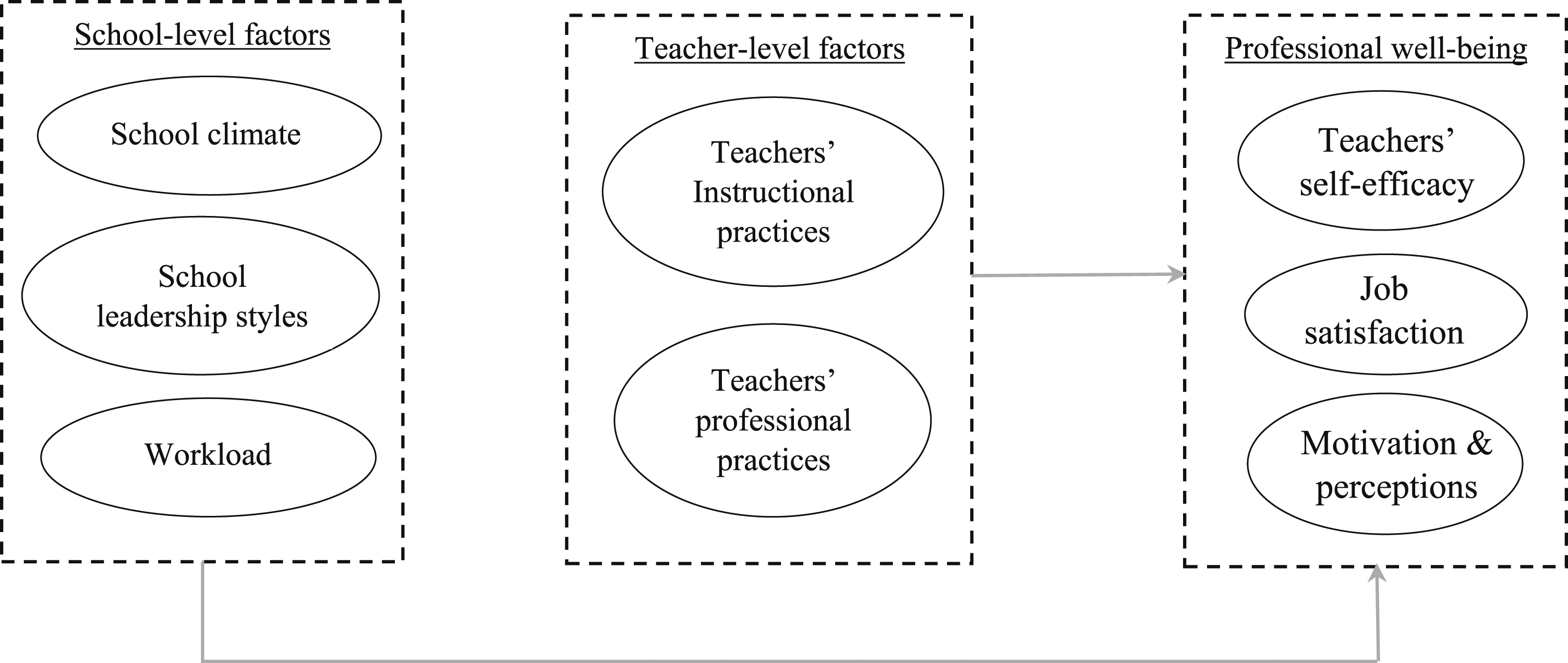
Method
Data
The data source was the Teaching and Learning International Survey (TALIS), which was conducted by the OECD in 2018. The TALIS was developed as a part of the Indicators of Education Systems (INES) project, which aims to provide reliable indicators for OECD and partner countries about their educational systems (OECD, 2018).
The TALIS data set differs from other well-known international data sets (e.g. PISA, TIMMS) because it focuses on the work conditions of teachers and the learning environment in schools. The main research areas targeted by TALIS include school leadership, professional development, teacher appraisal, feedback, teaching practices, and the beliefs and attitudes of teachers. The data set also contains rich information about the infrastructure and climate of schools as well as the demographic characteristics of the teachers and principals of the participating countries. A total of 24 countries around the world have participated in TALIS. In this study, we focused on five countries of Canada, China, Finland, Japan and Singapore. To allow multilevel analyses, TALIS includes two data sets, one for teacher-level variables and another one school-level variables.
Measures
Dependent variable
The dataset consists of teachers from different schools. The dependent variable is ‘Teacher Professional Well-being’ that consisted of: Teachers’ Self-Efficacy (SELF); Job Satisfaction (JOBSA); and Motivation and Perceptions (MOPER). Teachers’ self-efficacy variable contained a total of 12 items (e.g. control disruptive behaviour in the classroom; craft good questions for students; get students to believe they can do well in schoolwork) on a 4-point Likert-type response with 1 for ‘not at all’ and 4 for ‘a lot’ (OECD, TALIS 2018 database).
Teacher job satisfaction was measured using 13 questions that included teachers’ job satisfaction with the work environment, profession and target class autonomy. All 13 items were measured on a 4-point Likert response with 1 for ‘strongly disagree’ and 4 for strongly agree’ (OECD, TALIS 2018 database). Finally, teachers’ motivation and perceptions were measured using 10 questions that targeted teachers’ personal and social utility motivation to teach, and perceptions of value and policy influence. These 10 items were on a 4-point Likert-type response with 1 for ‘not important at all’ and 4 for ‘of high importance’ (OECD, TALIS 2018 database).
Independent variables involved two data sets, one for teacher-level variables and another one for school-level variables.
Teacher-level variables
The teacher-level variables consisted of teacher’s instructional practices (TIPRA) and teacher’s professional practices (TPPRA). The teacher’s instructional practices were measured using 12 questions that targeted clarity of instruction, cognitive activation and classroom management. These 12 items were measured on a 4-point Likert response with 1 for ‘never or almost never’ and 4 for ‘always’ (OECD, TALIS 2018 database). The teacher’s professional practices variable contained a total of eight items (e.g. discuss the learning development of specific students; participate in collaborative professional learning) that targeted exchange and coordination among teachers and professional collaboration in lessons among teachers (OECD, TALIS 2018 database).
School-level variables
School climate (SLMT), school leadership styles (LEAD) and workload (WLOAD) were variables at the school level. The school climate included 13 items (e.g. this school has a culture of shared responsibility for school issues; there is a collaborative school culture which is characterized by mutual support) on a 4-point Likert response with 1 for ‘strongly disagree’ and 4 for ‘strongly agree’ (OECD, TALIS 2018 database).
In this study, leadership styles were measured through instructional leadership, supportive leadership and distributed leadership styles using eight questions. Three items measured instructional leadership (e.g. to ensure that teachers take responsibility for improving their teaching skills), these items were on a 4-point Likert response with 1 for ‘never or rarely’ and 4 for ‘very often’. And the other five items measured supportive and distributed leadership style (e.g. to provide staff with opportunities to actively participate in school decisions). These items were on a 4-point Likert response with 1 for ‘strongly disagree’ and 4 for ‘strongly agree’ (OECD, TALIS 2018 database). Additionally, the workload variable contained a total of five items (e.g. having too much lesson preparation) on a 4-point Likert-type response with 1 for ‘not at all’ and 4 for ‘a lot’ (OECD, TALIS 2018 database).
Model specification
The Hierarchical Linear Modeling (HLM) was used to examine whether the principals’ leadership, school climate and workload and Teachers’ Instructional practices and Teachers’ professional practices explain the variation in teacher self-efficacy, teacher job satisfaction, and Motivation and perceptions net of several important teacher-level and school-level control variables. The HLM is used in cases where individuals are nested within groups and the data has a hierarchical structure (Raudenbush and Bryk, 2002). Since the data collecting method has produced a nested design (i.e. teachers nested within principals/schools), and the TALIS data retained a multilevel data structure (school level and teacher level), HLM was an appropriate method for the study. R 4.1.1 was used for the analyses of the multilevel TALIS data. For fitting the models, lme4 and lmerTest packages were used. Also, we used ggplot2, tidyverse and misty packages for advanced plotting, data manipulating and grand and group mean cantering, respectively. The first step in the data analysis is to develop an unconditional model for each dependent variable. Therefore, we define a two-level hierarchical linear model for job satisfaction as follows

It should be noted that a two-level hierarchical linear model can be transformed into a single regression equation as follows

For the two remaining dependent variables, we can define the model in the same way




In this paper, we will use the second form of models to examine the effects of predictors on dependent variables. All level-1 (teacher level) predictor variables and all level-2 (school level) predictors were centred around the grand mean.
Results
Descriptive analysis
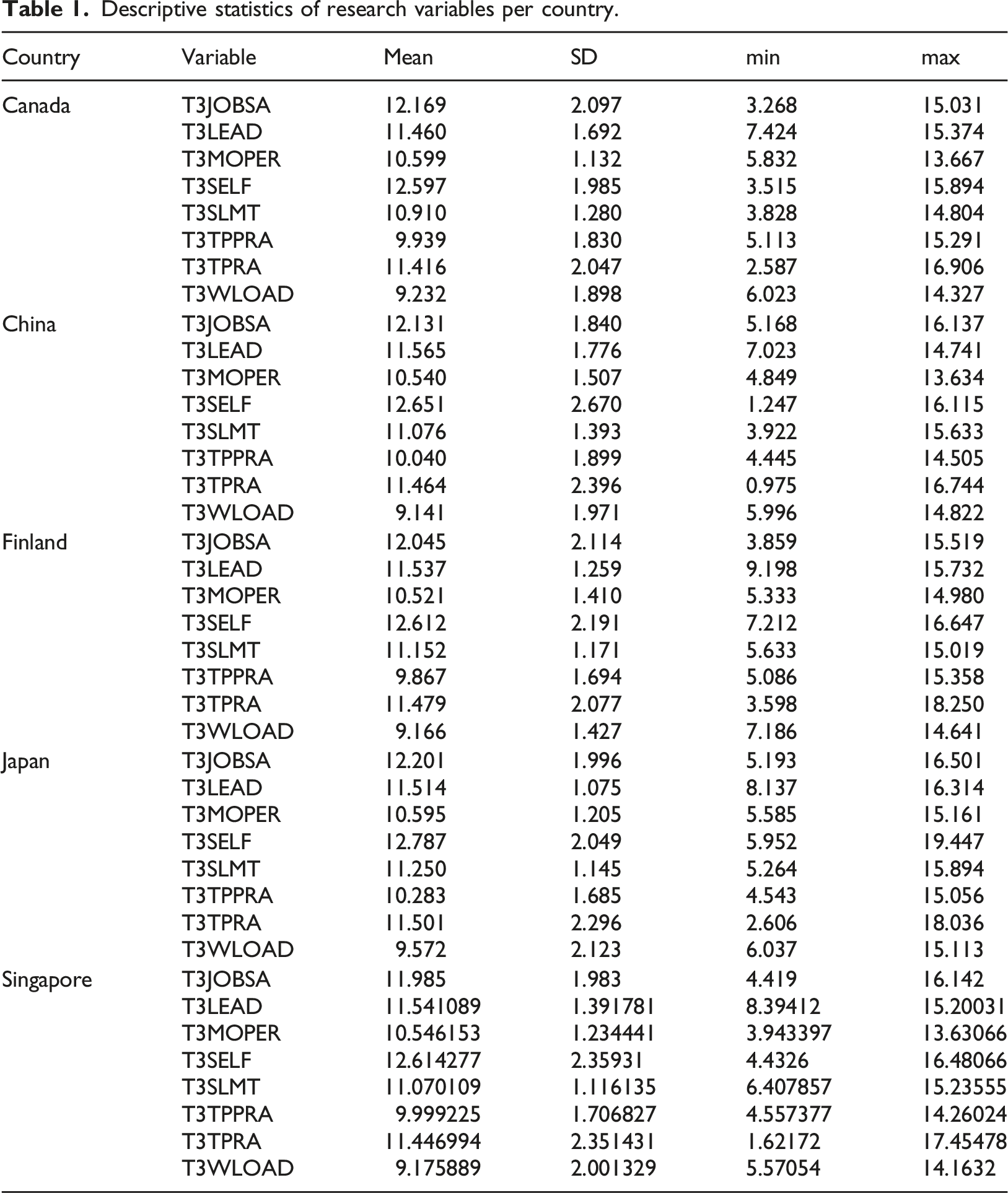
Descriptive statistics of research variables per country.
The Pearson correlation coefficients for all variables per country.
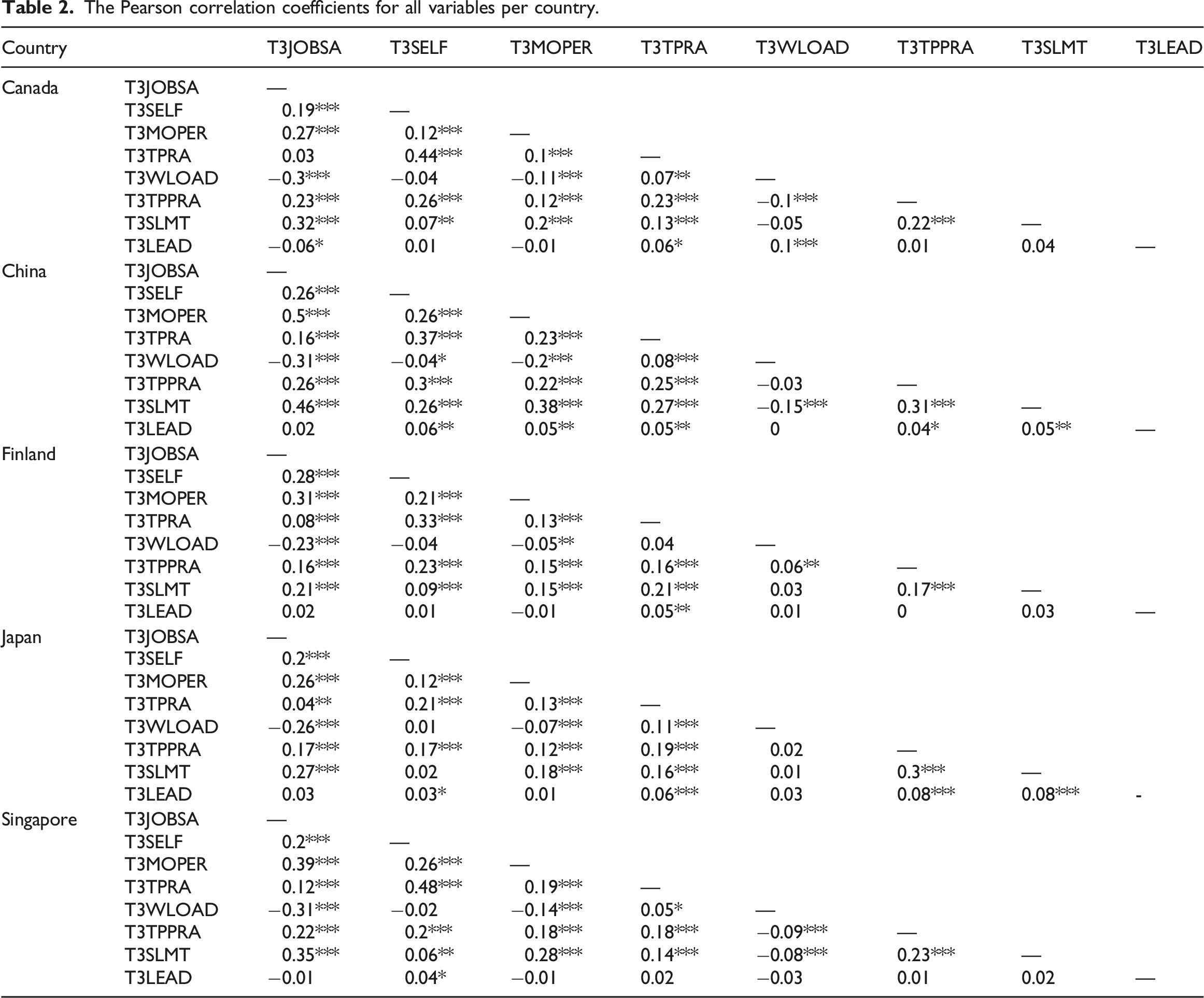
The results of Table 2 for the China dataset indicate that teacher job satisfaction was significantly correlated with all dependents variables except T3LEAD (school leadership styles).
Teacher self-efficacy had significant relationships with all variables but two school-level variables, workload and school leadership styles which is similar to the result from the Canada dataset. Analogously, teacher motivation and perceptions were significantly correlated with all independent variables. For the Finland dataset, Table 2 shows that there was a significant correlation between teacher job satisfaction and all independent variables except school leadership styles. Similarly, teacher self-efficacy was significantly correlated with all independent variables. Finally, teacher motivation and perceptions were significantly correlated with all independent variables but school leadership styles. Table 2 shows the bivariate correlation between all variables for the Japan dataset. It can be seen that teacher job satisfaction had a significant relationship with all independent variables except school leadership styles. Also, teacher self-efficacy was significantly correlated with all independent variables but school workload and school climate. The correlations between teacher motivation and perceptions and other variables reveal that there is a significant relationship between this variable and all variables but one, school leadership styles.
Finally, from Table 2, we can conclude that teacher job satisfaction was significantly correlated with all dependents variables except T3LEAD (school leadership styles). Teacher self-efficacy had significant relationships with all variables but one school-level variable, workload. Similarly, teacher motivation and perceptions were significantly correlated with all independent variables but school leadership styles. Next, we examine the normality assumption of dependent variables using QQ-plots. This graph is presented in Figure 2. It can be seen that as almost all points fall approximately along the reference line; we can conclude that all dependent variables follow a normal distribution. From Figure, we can assume that the distribution of variables is normal. QQ-plots of dependent variables for different countries.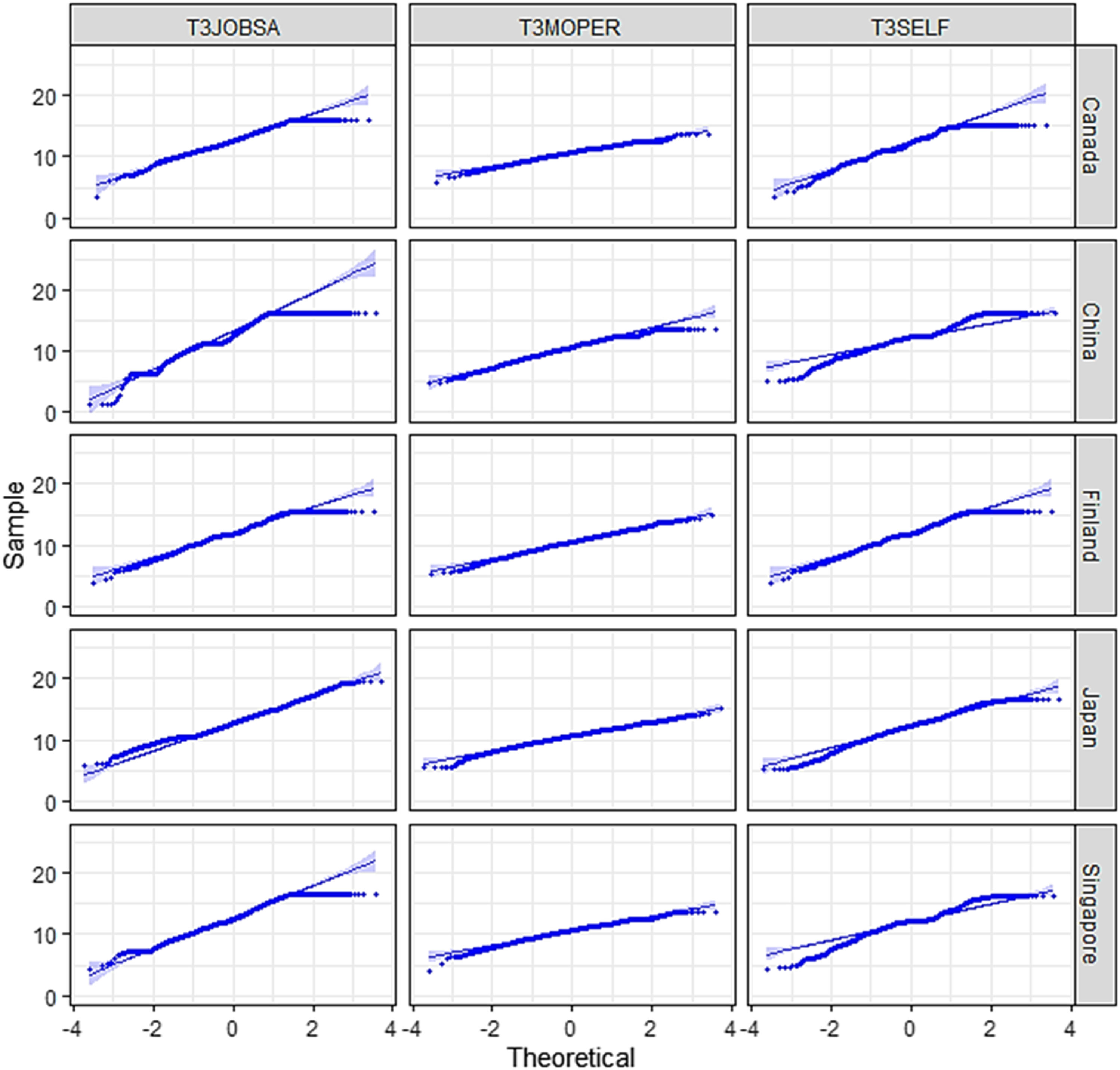
Multi-level analysis
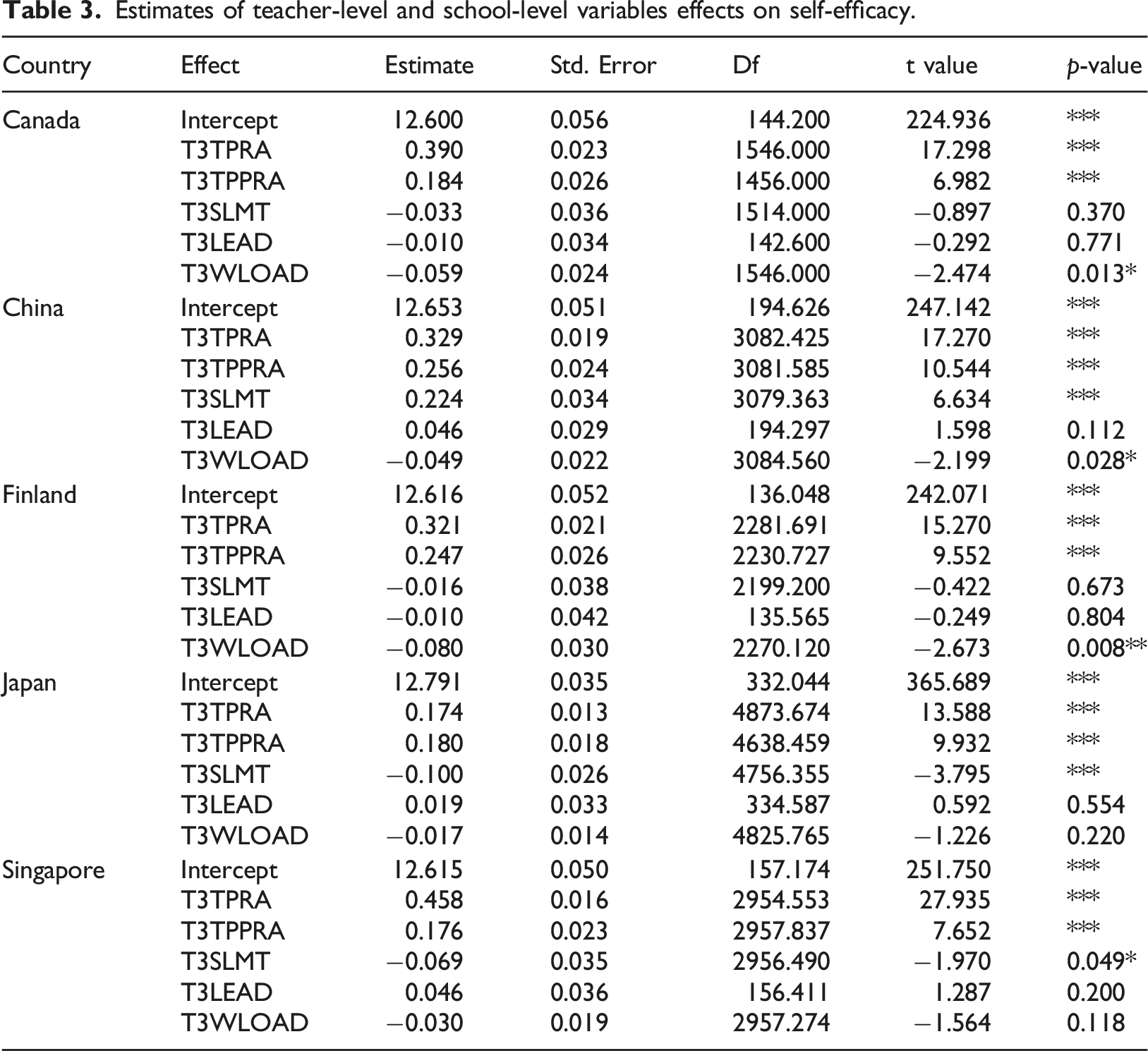
Estimates of teacher-level and school-level variables effects on self-efficacy.
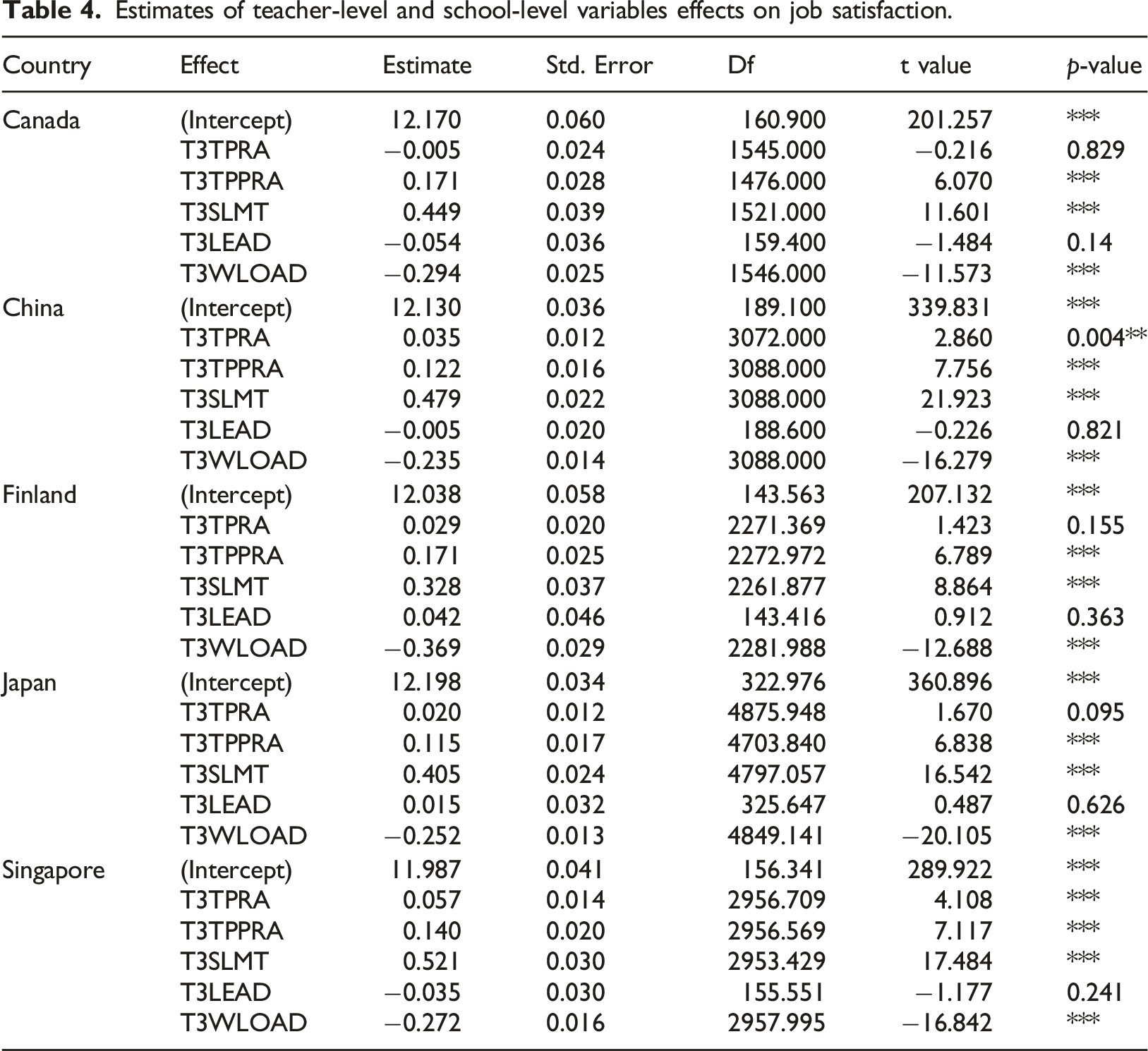
Estimates of teacher-level and school-level variables effects on job satisfaction.
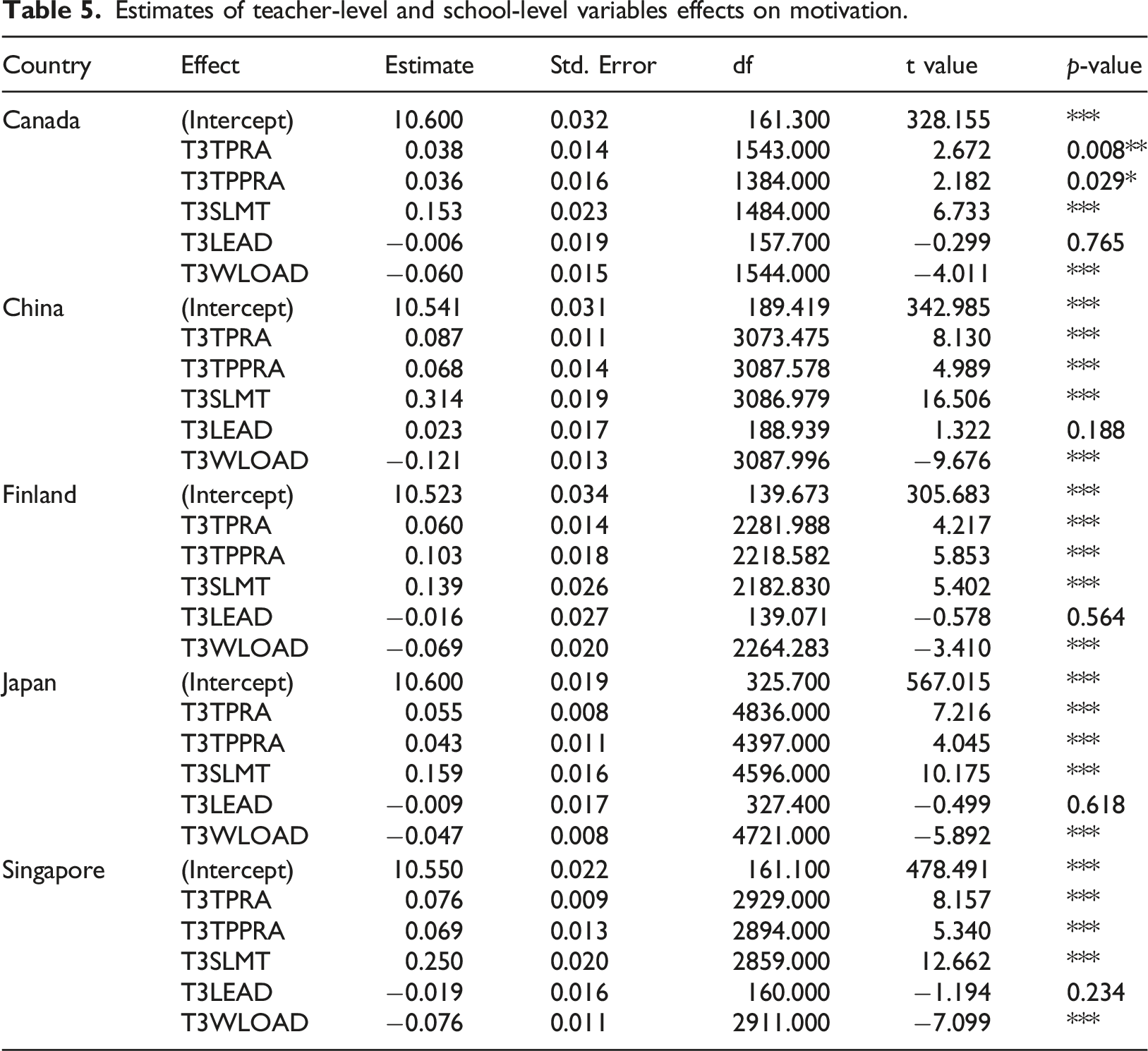
Estimates of teacher-level and school-level variables effects on motivation.
Canada
The results of Table 3, Table 4 and Table 5 show that the predictor variable T3TPRA has a significant effect on the dependent variables SELF (
China
It can be seen that the predictor variables T3TPRA, T3TPPRA, T3SLMT and T3WLOAD have a significant effect on all three dependent variables (p-value < 0.05). On the other hand, the T3LEAD predictor variable has no significant effect on any of dependent variables.
Finland
The results of fitting the hierarchical linear model to the Finland dataset for fixed effects are presented in Tables 3, 4 and 5. According to the results of these tables, it can be said that the predictor variables T3TPPRA and T3WLOAD have a significant effect on all three dependent variables (p-values < 0.05). On the other hand, the predictor variable T3TPRA has a significant effect on dependent variables SELF (
Japan
The next country to be examined is Japan. The results indicate that there is a significant association between T3TPRA, T3TPPRA and T3SLMT and three dependent variables. Furthermore, the predictor variable T3WLOAD has a negative effect on three dependent variables but only on JOBSA (
Teachers with higher T3WLOAD tended to experience higher Job satisfaction, Motivations and perceptions, which is statistically significantly different from zero. The independent variable T3LEAD does not affect any of the dependent variables.
Singapore
Finally, we present the results of the hierarchical linear model for the Singapore Database. Table 3, Table 4 and Table 5 show the effect estimations with standard errors and significance test of each effect.
According to the results of Table 3, Table 4 and Table 5, it can be said that the variables T3TPRA and T3TPPRA have significant positive effects on all three dependent variables (p-value < 0.05). The predictor variable T3SLMT has an insignificant negative effect on the dependent variable SELF (
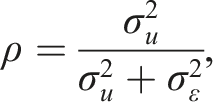
The standard deviation of variance components for the Canada dataset.
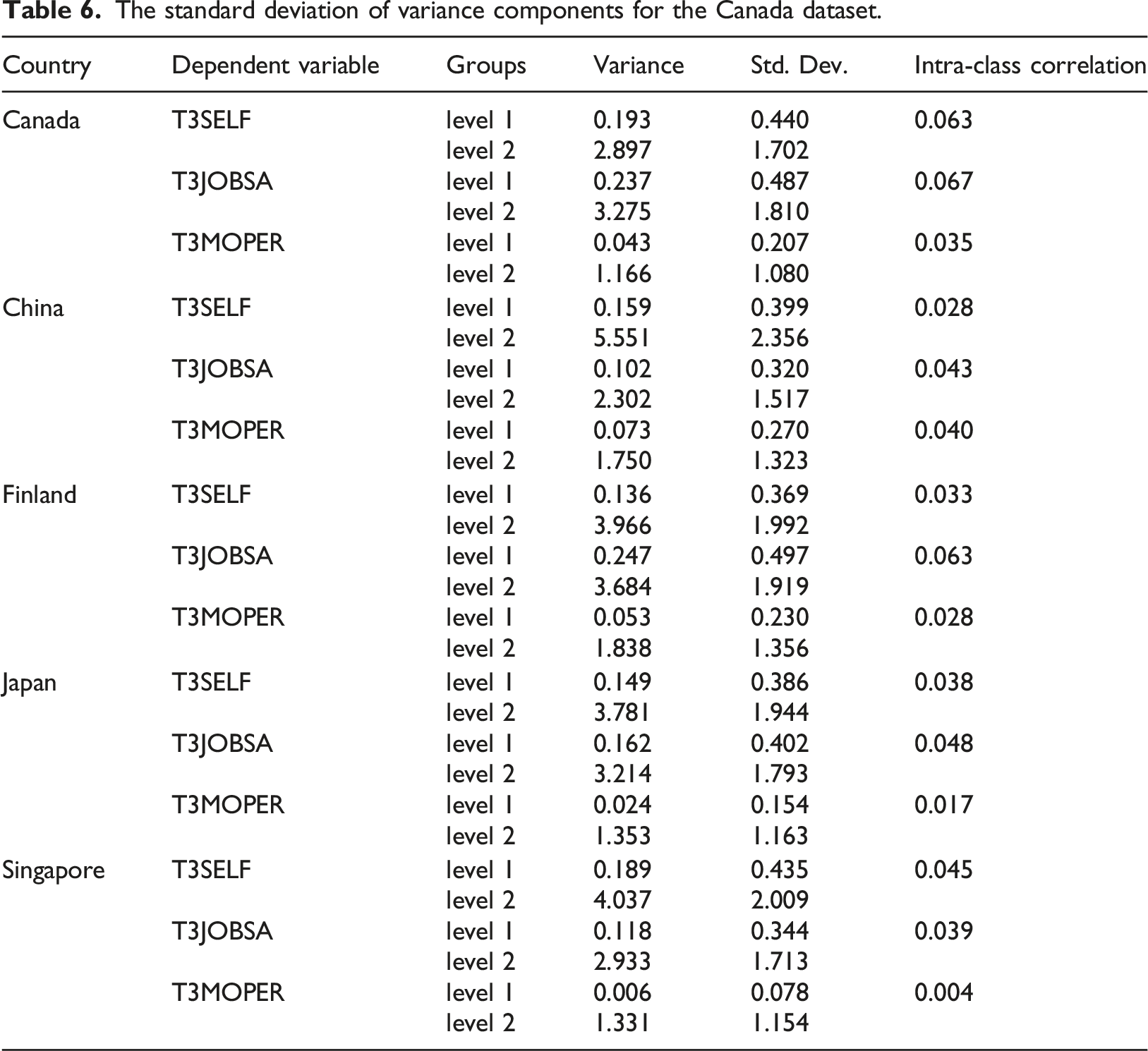
According to the results of Table 6, we can say that about 6% of the overall variance self-efficacy, 7% of job satisfaction and 3.5% of motivation can be attributed to differences between Canada schools. As for China datasets, it can be concluded that about 2% of the overall variance self-efficacy, 4% of job satisfaction and 4% of motivation can be attributed to differences between schools.
The results of HLM for Finland datasets showed that about 3% of the overall variance self-efficacy, 6% of job satisfaction and 3% of motivation can be attributed to differences between schools. For Japan dataset, it can be seen that about 4% of the overall variance self-efficacy, 5% of job satisfaction and 2% of motivation can be attributed to differences between schools. Finally, for Singapore dataset about 4.5% of the overall variance self-efficacy, 4% of job satisfaction and 0.4% of motivation can be attributed to differences between schools.
Finally, we use Q-Q plots of residuals to examine whether the residuals are normally distributed. The normal probability plot of residuals should approximately follow a straight line. The Q-Q plots of residuals for each dependent variable are demonstrated in Figure 3. It can be seen that almost all the points fall approximately along this reference line, so we can assume normality of residuals. QQ-plots of residuals of fitted models for different countries.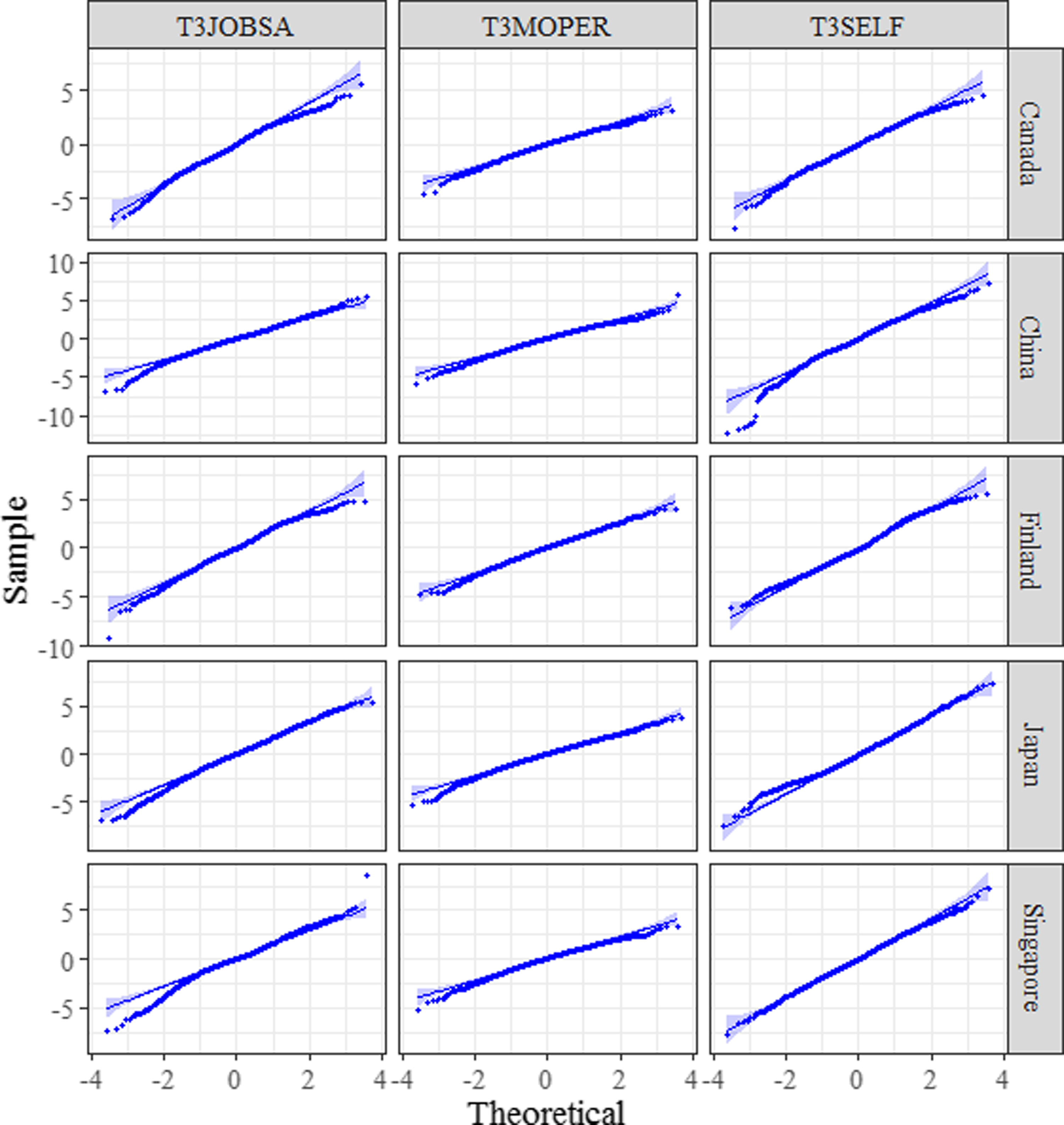
Discussions and conclusion
In the context of educational quality and student learning, teachers’ professional wellbeing deserves attention (Kok, 2018). To the best of our knowledge, there are very few studies exploring factors influencing teachers’ professional well-being from the teacher and school levels. Based on the literature review, teachers’ self-efficacy, job satisfaction, and motivation and perceptions were employed as components of teachers’ professional well-being in this investigation to explore how this construct is affected by factors at the teacher-level (e.g. teachers’ instructional practices and teachers’ professional practices) and school-level (e.g. school climate, school leadership styles and workload) in five countries of Canada, China, Finland, Japan and Singapore. Our study, using the TALIS 2018 database and linear mixed model analyses, revealed that both teacher- and school-level factors predict teachers’ professional well-being.
At the teacher level, teachers’ professional well-being was significantly predicted by both teachers’ instructional practices and teachers’ professional practices in nearly all five countries. For instance, teachers’ professional practices were significantly and positively related to teachers’ self-efficacy, job satisfaction, motivation and perceptions in all countries of Canada, China, Finland, Japan and Singapore. Teachers’ professional practices consider different kinds of interactions among teachers (Jokic Zorkic and Jovanovic, 2020). The job resource model (Bakker and Demerouti, 2007) serves as a useful framework for studying the positive relationships between teachers’ professional practices and well-being (Liang et al., 2022). This model emphasizes that working conditions like job resources have been indicated effectively in stimulating personal engagement and development (Bakker and Demerouti, 2007) that are typical components of well-being (Liang et al., 2022).
In teachers’ professional practices, cooperation and collaboration among teachers can eliminate conflicts at work and therefore help teachers experience positive emotions in schools (Owen, 2016). Moreover, based on self-determination theory, this kind of teacher relatedness and cooperation meet the critical psychological need of teachers to perform self-initiated behaviour in the workplace and increase their professional well-being (Ryan and Deci, 2000).
Moreover, teachers’ instructional practices significantly and positively were associated with job satisfaction in the countries of China, Japan and Singapore except for the countries of Canada and Finland. The findings support the general idea that there is a relationship between teachers’ practices and teachers’ professional well-being (Newton, 2009; Wiens et al., 2021; Yildirim, 2014). Based on school-level variables, school climate is significantly and positively related to both job satisfaction and motivation and perceptions in all countries of Canada, China, Finland, Japan and Singapore. The finding is following the previous studies (Treputtharat and Tayiam, 2014; Aldridge and Fraser, 2016; Utomo, 2018).
Further, it was found that school climate is significantly associated with teachers’ self-efficacy only in countries of China and Japan. This finding affirms previous results (e.g. Katsantonis, 2020) that indicated a positive effect of school culture on teachers’ self-efficacy. As one facet of Bandura’s social cognitive theory (1977), self-efficacy shapes a person’s goals, behaviours and actions and is influenced by conditions within the environment (Aldridge and Fraser, 2016). Both China and Japan are still generally considered to be collectivist countries (Michailova and Hutchings, 2006). It seems that in the collectivist cultures, teachers are interdependent, rather than independent and one protects oneself by considering the needs and feelings of others, hence, teachers’ professional wellbeing will increase (Rudy et al., 2007).
The results of the statistical analysis indicated that school leadership styles didn’t predict either job satisfaction or motivation and perceptions in all countries of Canada, China, Finland, Japan and Singapore. Additionally, school leadership styles significantly and positively predicted teachers’ self-efficacy only in China, not in other countries of this study. Among very few empirical studies have reported an association between school leadership styles and teachers' professional wellbeing. Finally, consistent with previous studies (e.g. Jayaratne and Chess, 1986; Butt and Lance, 2005) it was found that workload significantly and negatively influenced teacher professional we-being in all countries of Canada, China, Finland, Japan and Singapore. Given the fact that most teachers tend to work part time and to cooperatively teach a class, extra workload might be a specific burden during their career and decrease their professional well-being (Hascher et al., 2021).
To the best of our knowledge, there are very few studies exploring antecedents of teachers’ professional well-being from both the teacher and school levels. This study added knowledge on teachers’ professional well-being based on comparisons of the results in five countries that have good educational performance.
Implications, limitations and future directions
This investigation provides two main important implications for future practice. First, as teachers’ instructional and professional practices are significantly and positively associated with teachers’ professional well-being in all of these countries, administrators should promote instructional and professional practices by knowing how to address a lack of teachers' pedagogical content knowledge and classroom practices to promote teacher professional well-being. Second, this study highlights the role of school culture for improving teachers’ professional well-being, especially in the collectivist cultures such as China and Japan. Administrators and educators can seek effective interventions and in-service training programs to create strong collective cultures in schools.
A potential limitation of this study was the reliance on the self-report TALIS 2018 data and its cross-sectional research design. As Berkovich and Eyal (2017) have mentioned, a cross-sectional design in field study is known to limit the ability to infer causality and therefore a cause-effect chain cannot be deduced in future occasions. Hence, longitudinal research to track the possible changes of levels of teachers’ professional well-being and the corresponding influencing factors could be considered in the future.
Additionally, this study involves factors at the teacher and school levels, lacking student-level constructs. Future studies could regard student-level factors to further investigate how levels of teachers’ professional well-being influence students’ well-being and achievement. Finally, as Collie et al. (2020) have emphasized the use of international datasets like TALIS comes with significant strengths (e.g. large-scale, multination), there are limitations around the types of variables available and the countries involved. All the countries included in this study had mostly good educational performance, future research is needed to examine with other countries to see if the results hold in various cultural contexts.
Footnotes
Declaration of conflicting interests
The author(s) declared no potential conflicts of interest with respect to the research, authorship, and/or publication of this article.
Funding
The author(s) received no financial support for the research, authorship, and/or publication of this article.
