







Abstract
This study was an attempt to compare the distinctive features in current Early Childhood Teacher Education (ECTE) curricula conducted at two universities, one in China, and one in the US. Document reviews, interviews, and questionnaires shed light on the two different approaches to curriculum design. Two program directors and 25 participants, viewed as “cultural outsiders,” were recruited. Results showed that the US model could be viewed as “deep” learning while the Chinese model was seen as “broad” learning. The US ECTE curriculum focused on a robust connection between general education and professional courses, strong standards, content-centered professional courses, multiple cultures, and more credit for field experience. The ECTE curriculum at the Chinese university provided a wide variety of general education and professional courses, arts-related professional courses, national cultures, and more modalities for field experience. This study also examined the impact of culture and society on the ECTE curriculum design.
Introduction
Both the US and China have been experiencing a growing demand for well-qualified early childhood educators, especially those with bachelor degrees (Peng and Liu, 2012; The Institute of Medicine and the National Research Council, 2015; U.S. Department of Health and Human Services & U.S. Department of Education, 2016). To enhance teacher quality, both countries are taking steps to reform the curricula for bachelor-level teacher preparation programs. In the United States, the National Association for the Education of Young Children released Professional Preparation Standards (2010) and Professional Standards and Competencies (2020) as frameworks for teacher preparation programs. In China, universities and colleges are encouraged to align their curriculum with the Teacher Education Curriculum Standards issued by the Ministry of Education (MOE, 2011). Each country has its own culture and societal needs that influence early childhood teacher education (ECTE). Therefore, a cross-cultural comparison between the two countries may offer valuable insights into the field of early childhood education (ECE), particularly by examining ECTE curricula to improve educators’ cultural perspectives on ECE.
Previous studies on ECTE curriculum were chiefly concerned with the structure of curriculum relative to the general education courses and professional education courses. The curriculum structure of ECTE programs has been criticized in recent studies. For example, Chinese ECTE programs faced criticism for the insufficient course offerings in child development and field experience, while overemphasizing the extrinsic value of general education courses over nurturing students’ personal knowledge (Lee, 2011; Liu and Hai, 2016; Wang, 2007). Similar criticisms were presented in the US which included the lack of widespread application of acknowledged standards for high-quality ECTE programs (Institute of Medicine and National Research Council, 2015), a paucity of coursework in the latest science of child development and family engagement, inadequate training for teaching dual language learners and children with special needs, and a disconnection between field-based learning and coursework (Phillips et al., 2016). Nonetheless, some scholars have been striving to develop a better curriculum structure. According to Isenberg (2000), ECTE curriculum should consist of two essential components: subject matter content and professional content. Furthermore, it is suggested curriculum include (a) foundational courses in child development, learning theory, and curriculum; (b) pedagogy for domain-specific content courses; and (c) topics related to the assessment and adaptation of instruction for individual children from diverse backgrounds in inclusive settings (Allen, 2008; Hyson, 2003).
In 1996, Stott and Bowman called for reform in undergraduate general education for teacher preparation programs. In the US, ECTE programs have generally given little attention to the quality of the general education courses, hindering students’ ability to take advantage of those courses thinking clearly about pedagogy or planning curricula. Similarly, the general education component in Chinese ECTE, taking up 30% of teacher training programs, was also under scrutiny for its lack of logical connections to the ECE curriculum (Lee, 2011; Zhang et al., 2015). Thus, teacher preparation programs should involve faculty from various disciplines who can apply their knowledge to address the practical problems that confront early teachers (Isenberg, 2000; Stott and Bowman, 1996).
The literature highlights three primary topics in ECTE professional education courses: diversity, standards, and practice. First, the need for diversity has become a central trend in the field of ECE. Djonko-Moore’s (2022) research showed that early childhood teachers who had more undergraduate coursework focused on diversity felt better prepared by their teacher education programs and were more motivated to remain in teaching. To increase preservice teacher’s intercultural competence (Lash et al., 2022; Wee et al., 2023), ECTE programs have implemented various strategies, including culturally responsive pedagogy (Bransford et al., 2005; Warren, 2018), cultural immersion experiences (Zygmunt-Fillwalk and Clark, 2007), multicultural apprenticeships (Seidl et al., 2015), and cultural humility (Brown et al., 2016). Second, articulating standards in higher education programs has been considered a critical strategy in curricular design to improve teaching quality (Darling-Hammond, 2017, 2020). The standards call for higher education programs to prepare future early teachers with a higher level of skills, insights, and professional dispositions; therefore, institutions need to find ways to make it accessible (Hyson and Biggar, 2006). However, the extent to which the standards were incorporated into teacher education programs has not been well established. The research indicated that bachelor programs appeared to prioritize academic instruction, curricula, observation and assessment, and formal student teaching experience, while areas such as professionalism and the promotion of children’s social and emotional development were less frequently covered in required courses (Buettner et al., 2016). Third, the disparity between today’s school reality and traditional teacher preparation paradigms has led to a great realization of the more collaborative approach to teacher training (Hardman, 2009; Wang, 2007). A group of researchers explored varied practice to help teacher candidates develop teaching skills, such as the practice-based approach (Hollins, 2011; Vartuli et al., 2016), service-learning (Lake et al., 2015), developmentally appropriate practice (Cunningham, 2014), research-oriented teaching and learning (Brew and Saunders, 2020; Dunn et al., 2008), whole practice (Qin, 2006), research-informed practice (Elton-Chalcraft et al., 2018), a field-based program (Waddell and Vartuli, 2015), course-embedded supervised practice (Cowan and Berlinghoff, 2008), and “core practices” of teaching (Grossman, 2018). Additionally, Zhu (2010) advocated for the establishment of a support system to enable context-sensitive practice in Chinese ECTE.
The literature revealed that the majority of studies focused on ECTE curricula either in the US or China, with limited research dedicated to comparing and discussing ECTE curricula in both countries. Thus, the aim of this study is to explore and compare ECTE curricula in the selected two countries. Hence, the following research questions were addressed: (1) In what ways are the two bachelor ECET curricula different or similar to one another? (2) How do the cultural outsiders perceive the existing ECTE curriculum design in two universities, one in China and one in the United States?
To ensure multiple perspectives in the analysis, an approach was adopted from a previous study using “Cultural outsiders” (He et al., 2021, p. 69) to assess the differences in the curricula. A participant is considered a “cultural outsider” if they lack familiarity with the cultures where certain educational actions are commonly practiced. In the current study, cultural outsiders referred to participants from the US who have limited knowledge or understanding of the Chinese cultures in which the curricula are framed; and vice versa, referring to Chinese participants who are not familiar with aspects of the US educational system or its curriculum design, which are different from those known to them (He et al., 2021). Using the perspective of cultural outsiders has its advantages. First, we believe cultural outsiders have different values, beliefs, and knowledge from their counterparts (Suwankhong and Liamputtong, 2015). They could “make the familiar strange by making the strange familiar” (Alexander, 2000, p. 27). As a result, they may provide different perspectives due to cultural de-familiarization instead of taken-for-granted beliefs (Tobin et al., 1989). Second, it was assumed that incorporating the perspective of cultural outsiders would strengthen the research rigor. The authors believe cultural outsiders’ viewpoint is a valuable and significant addition when examining curricula through a cultural lens.
Methodology
Case study design
This study adopted coursework offerings from the two ECTE bachelor programs as source materials to examine the specific components of the ECTE curricula in China and the US. In this study, coursework served as a texture clue for the researchers and cultural participants to be engaged in an unfolding conversation between the text and their pre-understandings (Gadamer et al., 1989; Robinson and Kerr, 2015). This means that both researchers and participants were involved in an ongoing dialogue with the curriculum text, allowing its truths to emerge (Gadamer et al., 1989).
The coursework was requested from the participating universities offering bachelor degree in ECTE programs, one from China and another from the US. This study employed a simple multiple-case replication design to investigate parallel cases (Yin, 2014). Despite the fact that the two cases were from different countries, they were considered parallel cases due to their selection with purposeful sampling criteria, including (1) the information-rich capacity to inform the research questions; (2) bachelor programs in ECE established after the start of the 21st century; (3) bachelor programs accredited by a national organization (NAEYC in the US and MOE in China); and (4) stand-alone baccalaureate degrees in ECTE programs. Following the four criteria, two cases were selected from China and the US. The first case was a regional public university located in the southern region of China, referred to by the pseudonym, “Southern Normal University,” and the second case was a regional public university located in the eastern United States, referred to by the pseudonym, “Eastern State University.” Parallel cases allowed the researchers and participants to focus on their interpretations of the curriculum documents based on their cultural backgrounds. The researchers contacted the directors of the ECTE program at both universities via email to describe the purpose of this study and request access to the coursework list. Once the coursework documents were collected, they were standardized into the same format, arranging the courses from freshman year to senior year. The courses were color-coded, with required courses marked in red, optional courses in yellow, general education courses denoted by an asterisk, and non-asterisk for the professional courses and field experience courses.
Participants
This study adopted a procedure from a previous study (He et al., 2021), categorizing the participants into four groups: (1) Two program directors; one from each of the two participating universities; (2) Ten novice teachers; five graduated from Southern Normal University and five from Eastern State University. Each teacher held a teaching certificate and had 1 to 3 years of teaching experience in ECE settings in their respective countries during the data collection; (3) Ten senior students; five studying at Southern Normal University and five at Eastern State University majoring in ECE; (4) Five teacher educators; three working in the Department of Early Childhood Education at universities in China and two in the US. Each of the five faculty members was teaching at least one course in ECTE programs during the data collection.
Apart from two program directors, 25 participants, who were cultural outsiders from the US and China, were assigned numbers as follows: A1-A12 represented US participants, and C1-C13 represented Chinese Participants. This study received Institutional Review Board approval. Participation was voluntary, and participants signed and returned the consent forms. They had the option to leave the study at any time.
Data collection procedures
Data collection was conducted using a mixed method to broaden the study’s scope and depth (Creswell, 1994), and strengthen the triangulation of the research results.
Document review
In this study, the coursework was central to the framework and served as the primary data source, with which both researchers and participants needed to explore and engage (Robinson and Kerr, 2015). The coursework from both universities comprised all of the required and optional courses offered to students over a four-year period, including general education courses, professional courses, and field experience courses. The researchers individually looked through two sets of coursework documents. Subsequently, they convened over Zoom to discuss each coursework based on the document review protocols as follows: A. credit allocations to general education courses, professional courses, and field experience courses, B. credits for both required and optional courses, C. content of general education courses, professional courses, and field experience courses, D. course sequences.
Interview
Document review was insufficient in elucidating the process and rationale behind curriculum development and the incorporation of cultural backgrounds. In other words, document review primarily revealed “what” information rather than explaining “how” and “why.” Therefore, this study relied on interviews with the two directors to gain insights into the development of the ECTE curriculum. All interviews in this study were conducted face-to-face by the first author using a semi-structured interview format. The interviews were audio-recorded with the interviewees’ consent and subsequently transcribed. The following interview protocols were developed to guide the data collection and analysis: A. How were the courses selected and organized? B. What decisions were made regarding course sequence and why? C. What changes did your department make recently? D. Were there any difficulties you encountered during the curriculum design? If so, how did you deal with it? E. What are the strengths of the current curriculum? F. What are the challenges in the current curriculum?
Questionnaire
Data regarding the perceptions of cultural outsiders (i.e., novice teachers, senior students, and teacher educators) about the coursework were collected through a text-based questionnaire. The questionnaires, along with the coursework sheets, were distributed to 25 participants referred to as cultural outsiders in this study. The text-based questionnaire comprised a series of open-ended questions designed by all researchers after productive discussion. Before sending the questionnaires to participants, the coursework from the US university was translated into Chinese, and the coursework from the Chinese university was translated into English. To ensure the accuracy and validity of the translations of the coursework, three colleagues who were educators and proficient in both English and Chinese were invited to review the translations (He et al., 2021). Consequently, the questionnaire was prepared in both languages. Subsequently, the US coursework and questionnaire were emailed to the Chinese participants, while the Chinese coursework and questionnaire were emailed to the US participants. All participants were politely asked to review the coursework carefully prior to completing the questionnaire. The questionnaire included the following questions: A. What is your first impression of the coursework? (please describe) B. What are your comments on the general courses? C. What are your comments on the professional courses? D. What are your comments on the course sequences? E. Please describe the image (or abilities) of an early teacher who graduates from the program with this coursework.
Data analysis and interpretation
This study utilized content analysis to structure the dataset systematically (Drisko and Maschi, 2016). The data from the document review, interviews, and questionnaires were organized into similar content categories: general education courses, professional courses, and field experience courses. These three sections were the main units of analysis. More specifically, basic content analysis (Drisko and Maschi, 2016) was used to showcase the statistical differences between the two sets of coursework. Qualitative content analysis was adopted to systematically summarize and interpret the qualitative meanings within the data (Drisko and Maschi, 2016; Flick, 2013). With these connections, thematic analysis was used to generate meanings. The following steps were adopted from He et al. (2021) to investigate themes in general education courses, professional courses, and field experience courses. 1. All researchers looked through two coursework documents, interview transcripts, and the responses from 25 cultural outsiders to the questionnaire and discussed the process of color-coding the data. 2. Each researcher individually color-coded the information on similarities and differences in each of the sections: general education courses, professional courses, and field experience courses. 3. Each researcher thoroughly read all of the color-coded data in the sections and collated the codes for potential themes. 4. The researchers convened to discuss and organize the color-coded information into categories under general education courses, professional courses, and field experience courses for comparison and contrast. 5. The researchers then discussed similarities and differences in categories to refine and define themes. 6. The final themes were extracted with an in-depth interpretation aiming to develop a comprehensive understanding of the ECET curricula in both countries.
Results
The results of this study were derived from the analysis of two sets of ECET coursework, transcripts from interviews with two program directors, and responses from 25 cultural outsiders. The themes were organized into three sections: general education courses, professional courses, and field experience courses, followed by an overview of the ECET curriculum design in both universities.
Comparison chart with coursework of Southern Normal University and Eastern State University (credit hours and percentages).
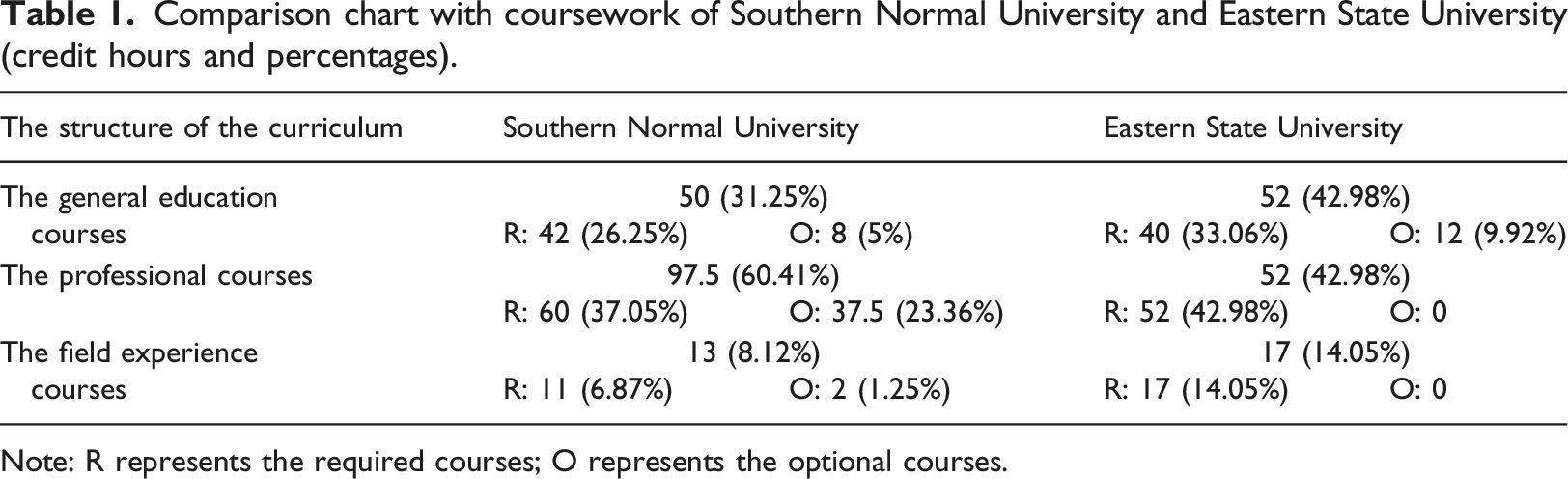
Note: R represents the required courses; O represents the optional courses.
General education courses: Foundations for future teachers versus foundations for future citizens
According to the director’s interview, Eastern State University’s general education courses were selected by the department to ensure that students would become successful future teachers. Three specific science courses in biology, chemistry, and earth science were the foundations for future teachers because some of the standards for national accreditation specify that students must have science courses covered in biology, earth science and chemistry. Three math courses were very specific to what teachers needed because they must pass a praxis test for math in order to be accepted into the professional program (Eastern State University program director interview).
Therefore, the department selected those courses (1) to ensure the prospective teachers receive a well-rounded education, (2) to address the standards, and (3) to prepare students for the entrance test into the ECTE program. In a word, general education courses served as the foundation for professional course learning. Chinese participants held the same points. One senior student said, “These courses are very interesting to me and could equip me with knowledge from other fields” (C5). Another participant said, “These courses don’t seem to connect with early childhood education, but I have to say that they can definitely strengthen a future teacher’s knowledge base” (C8). They appreciated the various courses for providing scientific knowledge. Specifically, some Chinese professionals highly valued the Biology course as a foundation for the Child Development course. However, concerns existed regarding more science and math courses over fewer humanities and art courses.
In contrast, at Southern Normal University, the university selected general education courses with a focus on political-related content, such as Military Training, Mao Zedong Thoughts & Socialist Theory, Fundamentals of Marxism, Introduction to Modern and Contemporary History of China, Ideology, Morality & Law Basis, plus Trend & Policy Education. Taken together, the 18-credit courses (36%) aimed at educating college students to become informed Chinese citizens who advocate for core socialist values. The US participants were surprised by the inclusion of political courses. They doubted that the general education courses such as political courses plus Physical Education I, II, III, IV and Innovation and Entrepreneurship wouldsignificantly benefit future teachers’ careers. One participant from the US noted that “These required courses are unnecessary and daunting” (A5). However, American participants saw value in certain courses, including Career Guidance, Computer Application, Career Planning, Social Services, Educational Trends, and English, as they could hone teacher candidates’ skills applicable to the educational field. Additionally, another participant found the P.E. classes personally valuable.
Professional courses I: The content-centered versus the arts-related
At Eastern State University, the content courses accounted for 20 credits (38%) out of 52, including Reading and Language Arts, Mathematics, Science, and Social Studies. Chinese participants highly valued Children’s Literacy course, but noticed the absence of the Health and Safety course which was an important course in China.
American participants were surprised that over half of the professional courses were art-related at Southern Normal University, including those such as Dance, Fine Arts, Piano, Keyboard Music, Vocal Music, Children’s Theater, Animation, Children’s Chorus, and Toy Making. These art-related courses constituted 53 credits (54%) in professional courses, with 21 credits (35%) out of 60 credits as required, and 32 credits (85%) out of 37.5 credits as optional. Most American participants highly valued these courses making statements such as, “Our program is much more content-focused; I think ours should have more arts” (A9). “It is different, but I do understand why it is necessary, like piano and dance teachers do need that” (A4). However, some felt these courses might not benefit new teachers in the classroom. Although many believed that graduates from this coursework would be very well versed, some participants were doubtful, “Some of the skills may never be utilized in the classroom and a new teacher would be good at engaging lesson plans but may not be able to differentiate and meet the needs of all of her students” (A6).
Professional courses II: Multiple cultures versus national cultures
Eastern State University’s coursework featured five courses (i.e., Learning and Assessment for Diverse Classrooms, Teaching Diverse Learners, Diversity and the Self, Diversity and the Family, Diversity and the Community) with 11 credits relevant to multicultural education. The program director emphasized that they integrated diversity into almost every course, because “we want them (teacher candidates) always to be thinking about it” (Eastern State University program director interview). In contrast, Southern Normal University placed more emphasis on national culture in its teacher education curriculum. “Though only one course titled Preschool Indigenous Education (optional) appeared on the coursework list, national and local cultures were infused into some other professional courses” (Southern Normal University program director interview).
Professional courses III: Strong standards versus strong collaboration
As the director stressed, Eastern State University coursework was strong with standards. They revamped each course to align with both the Associate for Child Education International (ACEI) standards and the National Association for the Education of Young Children (NAEYC) standards. “We worked diligently to make sure that our courses cover everything indicated in standards” (Eastern State University program director interview).
Southern Normal University maintained a strong partnership with local government and early childhood education facilities. They sponsored training programs for local early teachers and directors commissioned by the local government. They invited exceptional educators to share their experiences with students and provide field experience opportunities. Additionally, the university also involved experts outside the university, such as local artists and scholars, in co-teaching with the department faculty. “It is a popular approach because they are complementary with professors’ expertise” (Southern Normal University program director interview).
Field experience courses: More credits versus more modalities
Eastern State University required 17 credits (14.05%) for field experience courses, along with a mandatory 12-hour field experience embedded in each professional course. Southern Normal University, in contrast, had 13 credits (8.12%) for field experience courses, with 11 required and 2 optional. The director mentioned that the course-embedded field experience was encouraged, but not mandatory. Interestingly, Eastern State University required 14 credits for the 100-day internship and the internship seminar while Southern Normal University had four credits for the 10-week internship. Chinese participants found “14 credits for internship and the internship seminar beneficial for preservice teachers to reflect and discuss what was happening during the internship” (C8). However, Southern Normal University offered a broader range of field experience options. They required a research paper, along with social service and Innovation and Entrepreneurship (optional), in addition to the internship and course-embedded field experience (also optional). Eastern State University had one course titled Collaboration and Cooperation, which needed to be completed in the field, apart from the internship and the course-embedded field experience.
Course sequence
When it came to the course sequence, Chinese participants appreciated the fact that general education courses were completed before delving into professional ones at Eastern State University. They deemed this sequence beneficial for students to adapt themselves to college life because the general education courses were foundations for learning professional courses. However, some were concerned about the timing of professional courses starting in the junior year. They believed that some professional courses should be introduced in the freshman year to help prospective teachers develop their identity as future early childhood educators. Conversely, some American participants questioned the courses at Southern Normal University, where ECE topics began in the freshman year, implying that students would need to be certain of their teaching career choice from the beginning. However, other participants highly valued the early exposure to courses specific to the ECE major. In addition, both Chinese and American participants recognized the logical organization of the professional courses that started from theories and moved to content areas and then clinical practice.
Discussion
Overall, our findings in this study showed distinct features among general education courses, professional courses, and field experience courses at the two universities. Eastern State University’s ECTE curriculum could be categorized as encouraging “deep” learning, stressing the interconnectedness among courses to develop a deep understanding of the core knowledge and skills the program requires. This was evident in the robust connection between general education courses and professional courses, with more (four) credits allocated for each strongly standard-aligned professional course. In contrast, Southern Normal University’s ECTE curriculum appeared to encourage “broad” learning, offering a variety of courses, resources, and opportunities for teacher candidates to choose from. They provided numerous professional courses but assigned fewer (1-2.5) credits to each course, offering diverse modalities in field experience courses and more opportunities for teacher candidates to learn with experts beyond program professors. This finding showcased that the two universities had distinct expectations for future early teachers. The US university aimed to produce specialized ECE educators and they designed the curriculum based on established standards, while the Chinese university aimed at producing well-rounded early teachers by maximizing the accessible resources. This finding was opposite from prior comparative research conducted by He et al. (2021), which considered US universities as “broad” learning and Chinese universities as “deep” learning based on an examination of the child development syllabi from both countries. Given the definitions of “deep” learning and “broad” learning, further exploration through interviews with faculty and teacher candidates and/or classroom observations might shed light on this topic.
Cultural outsiders from the US side were surprised that general education courses were dominated by political courses at Southern Normal University. Even though the faculty members did not think those courses were necessary for ECE majors, the department could not remove those courses from the program. According to Huang (2020), a majority of Chinese universities have offered ideological and political education for college students since the commencement of the People’s Republic of China in 1949, which continues to thrive nowadays. Ideological and political education has been set up as part of the required general education courses for all majors since 1952 (Bie and Qi, 2018; Huang, 2020). The goal of ideological and political education is to produce future Chinese citizens in alignment with the goal of the Chinese Communist Party and the nation (Huang, 2020).
Though the cultural outsiders did not think the course Innovation and Entrepreneurship would be beneficial to teacher candidates’ future careers, the researchers (D’lntino et al., 2010) explained that the Entrepreneurship and Innovation course was inherently multidisciplinary to add new capacity to the general education by emphasizing opportunity recognition, creativity, knowledge and skills, and integrative learning and thus fill an educational gap. It might be interesting to investigate how Innovation and Entrepreneurship, as a general education course, would benefit ECE majors in China.
As the US participants were surprised, there were heavily art-related courses in the Chinese university. Unlike the early teachers in the US, Chinese early educators are in charge of everything in classrooms including teaching music, arts, dancing, and crafts in addition to teaching math, science, social studies, language arts, and health. Further, those teacher candidates who were well-equipped with art-related skills had more chances to be hired as early teachers (Fei et al., 2008).
Obviously, Eastern State University placed a strong emphasis on preparing teachers for culturally diverse classrooms (Lash et al., 2022) while Southern Normal University highly valued national cultures inside China, including local cultures. Though China consists of 55 minorities, the majority Han culture and Western cultures have been predominant in all education settings and textbooks, leaving little room for minority cultures. However, in recent years, the Chinese government has proposed the idea of a “Great China Renaissance,” which has led to increased attention towards national cultures, including local and minority cultures. This is why ECTE programs at Southern Normal University are featured with indigenous cultures as the director mentioned. This is consistent with Chinese early childhood settings where the local culture is powerful in shaping early childhood curriculum innovations (Yang and Li, 2022).
Though the two universities have different cultural orientations (i.e., multiple cultures vs national cultures) for their curricula, they have the same focus on being student-centered. In the US, the minority groups in the overall student population is expected to grow from 50.2% in 2020 to 63.6% of all children (population under age 18) in 2060 (U.S. Census Bureau, 2020). Since diversity has been a challenging trend in the field of ECE, more information on content and experiences is needed in order to best prepare early teachers for the complexities and diversity of the field (Couse and Recchia, 2016). In China, the majority of the student population is Chinese, particularly in universities located in minority areas where teacher candidates will teach local children. As a result, local cultures hold importance for both future teachers and local children. Obviously, both universities have taken action to address cultures for the curriculum to ensure that future teachers are very familiar with and able to understand children’s varied cultural backgrounds which best supports a student-centered approach.
US universities firmly believed that aligning courses with professional standards was very important to ensure the best education for prospective teachers, so they consistently implemented it across all professional courses (Darling-Hammond, 2017, 2020; Hyson and Biggar, 2006). The United States has been a leader in the articulation of standards for the curriculum as a strategy for profession-building (Darling-Hammond, 2017) because it is believed professional standards can leverage greater quality in teacher education (Darling-Hammond, 2020). Many studies showed that standards were dominant in educational programs from the US institutes (Fanoos and He, 2021). In contrast, the ECTE program in China benefits from the collaborations to break up traditional teacher preparation paradigms (Hardman, 2009; Potter et al., 2020). Building school-university partnerships (Darling-Hammond, 2020) is a noncontroversial strategy to open up connections so that university faculty members and experienced practitioners can collaborate on teacher preparation (Holmes Group, 1986).
Though many differences were found to exist in the curricula, both universities highly valued the field experience in teacher education (Canrinus et al., 2017; Daza et al., 2021). It is in agreement with international teacher educators and policy makers who call for teacher preparation to be more deeply linked to practice (Jenset et al., 2018) because the research shows that teacher candidates had a positive impact on student learning outcomes and school culture (Hartman et al., 2021). Hence, it is crucial to further explore how educators better bridge coursework and fieldwork more explicitly (Peltier et al., 2021). For example, Ohio University’s early childhood program has been nationally recognized for its Clinical Model of teacher education (see Hartman, et al., 2020).
Limitation
It is worth highlighting that this study is unique in adopting cultural outsiders’ perspectives to investigate diverse features in ECTE curricula both in the US and China. But like all research, this study inevitably has its limitations. The first limitation is that this study only used coursework lists for document review, interviews, and questionnaires. Though the triangulations did strengthen the research rigor, the broader scope and depth of the study could be accessed by interviewing faculty and preservice teachers about their perspectives of ECTE curricula from both countries. The second limitation is associated with the sample. Obviously, one coursework from each university might not represent all ECTE curricula in the country. This study has given us a small glimpse of the picture in ECTE curriculum from the two countries. In order to obtain a more compelling examination of the significant cross-culture differences in ECTE curricula, future studies should minimally consider a larger sample of curricula from both countries.
Conclusions
This research compared the distinctive features of current bachelor ECTE curricula at two culturally different universities, one in China, and one in the United States. Obviously, each university had its own unique features aligned with its culture and societal needs. As an American participant mentioned, “Some of the courses make me wonder the cultures are so different” (A2). Identifying differences did not translate into rating the two bachelor programs or stating any preference. Instead, this cross-cultural case study aimed to explain the values embedded in each ECTE curriculum document and how they were perceived by cultural outsiders. A lens through the cultural outsiders offered different perspectives as “mirrors and windows” for educators, policymakers, reformers, and leaders of both countries. This perspective encouraged all to delve deeper into improving the quality and excellence of would-be teachers for youngsters through exploring the integration of curriculum design with policy, theory, and practice.
Footnotes
Declaration of conflicting interests
The author(s) declared no potential conflicts of interest with respect to the research, authorship, and/or publication of this article.
Funding
The author(s) received no financial support for the research, authorship, and/or publication of this article.