







Abstract
The growing importance of third-party funding, excellence policies, and organisational differentiation are eroding the Humboldtian idea of a unity of research and teaching. Though studies show a perceived preference for research over teaching amongst academics, there remains a dearth of research into the association between the research-teaching nexus and job satisfaction. We know little about whether, and if so how, national higher education contexts moderate job satisfaction. This study examines what effect, if any, the perceived preference for research, the compatibility of research and teaching, and workload have on job satisfaction and whether effects are moderated by country – selecting Canada, Germany, and Austria for comparison. Findings indicate that while high teaching and administrative workloads decrease job satisfaction, those who subjectively prefer teaching over research are more satisfied than their research-oriented colleagues. The results also show that national higher education systems are a significant moderating factor for job satisfaction, highlighting the importance of country-comparative research.
Keywords
Introduction
Academic work environments have changed drastically over recent decades (Aichinger et al., 2017). New public management (NPM) reforms have increased the demand for accountability of academic work, which has led to widespread commodification and metrification of the academy (Mau, 2019; Tomlinson and Watermeyer, 2022). In addition, excellence policies and competitive funding arrangements (Gläser and Velarde, 2018) have strengthened universities’ competition and differentiation (Bégin-Caouette et al., 2024; Mergele and Winkelmayer, 2021). This has led to a growing ‘publish or perish culture’ (Aprile et al., 2021; Macfarlane, 2021), a prevalence of fixed-term contracts (Pasma and Shaker, 2018), and a growing importance of the acquisition of third-party research funding for career advancement (Acker and McGinn, 2021; Müller and Schneijderberg, 2020).
Consequently, these developments are dissolving the Humboldtian idea of the research-teaching nexus, leading to a post-Humboldtian pattern of differentiating teaching and research (Schimank and Winnes, 2000). In general, the research-teaching nexus is based on the conviction that research, as a process of expanding scientific knowledge, and teaching, as the transmission of scientific knowledge, are functionally interdependent or produce synergy (Tight, 2016) and therefore the role of academics and the organisational context of the university should be to unite both. The underlying assumption is that active researchers provide a high-quality learning experience, with research-informed teaching at its core. This idea of a nexus spread from Germany throughout the world in the nineteenth and twentieth centuries and influenced the organisation and culture of universities and academics (Schwinges, 2001; Stephenson et al., 2020). A systematic review by Uaciquete and Valcke (2022) presents evidence of a strong belief among university stakeholders that teaching and research are positively related. This is true not only for university systems characterised by the Humboldtian idea of the university (e.g. Austria and Germany; see Meier and Schimank, 2009), but also for countries that had once incorporated the Humboldtian model but now have moved towards a post-Humboldtian pattern of a separation of research and teaching (e.g. Canada) (Leisyte et al., 2009). The post-Humboldtian separation of research and teaching driven by the above-outlined developments creates an increasing tension between the ideal of a close link between research and teaching and reality, which is often characterised by a decoupling of both tasks (Arimoto et al., 2014; Geschwind and Broström, 2015).
To examine this tension, we use the concept of job satisfaction as one indicator for where these changes may manifest themselves on the micro-level (Aichinger et al., 2017; Bedenlier and Zawacki-Richter, 2015). Job satisfaction has proved to be fruitful for reflecting academics’ perceptions of their work and the changing work environment of academia (Bentley et al., 2013; Castellacci and Viñas-Bardolet, 2021). Given that research and teaching are the core academic tasks and that the idea of a nexus is at the same time deeply institutionalised and highly questioned inside and outside the academy (Clark, 1997), determinants that reflect on the relation between research and teaching appear to be particularly salient for the analysis of job satisfaction. Furthermore, the current changes in academia have led to a growing interest in the central role of job satisfaction, particularly in the context of academic career decisions (Blaese et al., 2021). Knowing the determinants of job satisfaction, especially those associated with the core tasks of academic life – research and teaching – is important because they provide us with a strong indicator for the attractiveness of a career in the academic profession (Bentley et al., 2013). Gaining a deeper understanding of academics’ job satisfaction is paramount for not only identifying barriers affecting academic careers but also for retaining highly motivated scholars within the academy. Additionally, there is evidence that satisfaction is positively related to academics’ performance and engagement (Albert et al., 2016; Derbis and Jasiński, 2018). Thus, shedding light on the influence of the research-teaching nexus on academics’ satisfaction forms a critical case both for researching the implications of current developments in academia and for assisting policymakers and senior higher education leaders in developing targeted institutional support structures that consider different roles and career paths, thus making an important contribution to current research in this field.
Although there are some studies connecting teaching and research to academic job satisfaction (Shin and Jung, 2014; Viñas-Bardolet et al., 2020), there appears to be a dearth of country-comparative perspectives paying attention to the different national paths regarding the research-teaching nexus and varying national career structures. Therefore, whether – and if so how – academics’ perception of the research-teaching nexus affects their job satisfaction, and whether country differences moderate these effects, remain notable research gaps that we intend to narrow by investigating the following research question: What effect does the relationship between research and teaching (measured by academics’ perceived compatibility of research and teaching, their preferences for research and teaching, and their workload for different academic duties) have on job satisfaction of postdocs (including assistant professors) and full professors?
Country-comparative research on this topic is needed because the relationship between the research-teaching nexus and job satisfaction is expected to be filtered by traditions and cultures of national higher education (HE) systems. Both the move from the Humboldtian to the post-Humboldtian pattern of teaching and research as well as job satisfaction vary according to HE traditions and culture, the degree of implementation of NPM reforms, and the extent of marketisation (Schimank and Winnes, 2000; Shin and Jung, 2014). Additionally, scholars argue that career systems are designed differently, which has a strong influence on academic life and job satisfaction (Goldan et al., 2022) and potentially also moderate the relationship between the research-teaching nexus and job satisfaction. Therefore, this study presents a new contribution to research in comparative education by linking a macro-perspective (i.e. influence of national HE traditions and culture regarding the integration of research and teaching) to micro-perspectives (i.e. job satisfaction of individual actors).
Taking these system differences into account, we developed a theoretically driven sampling strategy for a systematic country comparison by drawing on the following theoretical considerations: (1) The degree of differentiation of the research-teaching nexus (Schimank and Winnes, 2000); and (2) the diverse career structures, especially the paths to professorship. Based on the latest international survey on the academic profession, we purposefully selected three countries for a secondary data analysis: Canada, Germany, and Austria. These countries were chosen in a two-step process: First, only those systems that historically had followed a Humboldtian tradition were included (13 of 22). Second, out of the remaining 13 countries, three were selected that showed maximum differentiation of the research-teaching nexus with Canada being considered the most advanced in decoupling research and teaching, Austria the least advanced, and Germany ranging between those two (see also the section ‘Rationale for country comparison’). By applying regression analyses to the data and using a country-comparative lens we illuminate the different degrees of the ongoing dissolution of the research-teaching nexus as well as the diverse structures of the national career systems and estimate how these factors contribute to academics’ job satisfaction.
Literature review: Job satisfaction and the research-teaching nexus
There is an extensive body of literature analysing factors influencing academics’ job satisfaction which shows that academic rank (Acker and Webber, 2020; Van Helden et al., 2024), working-time (Frei and Grund, 2022), contract type and working conditions (Castellacci and Viñas-Bardolet, 2021; Lee, 2023), academic discipline (Yesufu, 2020), and gender (Cidlinská and Zilincikova, 2024) have significant effects on how satisfied scholars are with their work.
Studies focussing on satisfaction in the context of the research-teaching nexus show that higher teaching loads are often associated with lower job satisfaction (Bozeman and Gaughan, 2011; Flander et al., 2020), while time spent on research is more often positively related to satisfaction, or at least considered neutral (Bozeman and Gaughan, 2011; Feld et al., 2014). A study situated in Germany also found that academics with a research preference who spend a substantial amount of time on research were more satisfied than those with a teaching emphasis (Frei and Grund, 2022). Academic job satisfaction also varies based on the type of institution (universities, universities of applied sciences, or research institutes) (Höhle and Teichler, 2013), which is another indicator for a correlation between job satisfaction and teaching (vs research activities), as academics in these different types of institutions have different teaching and research obligations.
To explain such findings, a closer look into psychological literature reveals two main arguments for how academics’ job satisfaction is influenced by research and teaching activities: Their perception of self-determination as well as their sense of coherence. Regarding self-determination, it is argued that in contemporary academia both teaching and research are shaped by a mix of intrinsic motives and extrinsic rewards and demands (Wandycz-Mejias et al., 2025; Zhang and Gandham, 2025). Yet the alignment between intrinsic engagement and institutional reward structures differs between research and teaching. In research, intrinsically motivated effort is often reinforced by career-relevant incentives and evaluation criteria, which helps explain why research performance is frequently linked to job satisfaction (Albert et al., 2016). In teaching, by contrast, intrinsically meaningful engagement may be supported less by formal reward structures and more by a socialisation-based professional self-understanding that continues to reference a balance and an assumed synergy between research and teaching (Darabi et al., 2017; Li et al., 2025). Under such conditions, the teaching workload can become satisfaction-relevant not simply because it is ‘more work’, but because high teaching demands may threaten the manageability of balancing teaching and research and limit opportunities to pursue career-relevant and reputation-relevant goals, particularly where recognition patterns strongly prioritise research (Esdar et al., 2015; Leisyte et al., 2009).
Regarding academics’ sense of coherence, it is argued that satisfaction is shaped by whether the work environment is perceived as comprehensible, manageable, and meaningful (Antonovsky, 1993; Zhang and Gandham, 2025). Empirical evidence from academic work contexts shows that a lower sense of coherence is associated with higher stress, poorer psychological health, and lower satisfaction in environments characterised by heavy workload, time pressure, role ambiguity, and competing demands across multiple tasks (Daumiller and Dresel, 2020; Derbis and Jasiński, 2018; Kinman, 2008). Importantly, this literature suggests that stressors related to time constraints, role conflict, and insufficient recognition are especially detrimental when academics experience their work as fragmented or internally inconsistent (Kinman, 2008). In line with this, recent work indicates that academics who perceive greater congruence between their teaching-related and research-related goals experience lower stress and higher job satisfaction (Daumiller and Dresel, 2020; Kangleon, 2026), pointing to the relevance of perceived compatibility and integration of both domains for satisfaction.
To summarise, the reviewed literature suggests that job satisfaction depends not only on the intensity of demands and time allocation across tasks, but also on whether teaching and research can be experienced as compatible and integrated within a coherent overall work profile. This also implies that the relevance to satisfaction of teaching workload, perceived compatibility, and teaching/research orientation is likely to vary across national higher education contexts if they differ in how they structure and reward research and teaching. However, to our knowledge, previous studies have not considered such potential moderating effects by country as they have largely focused on a single institution, one type of institution, or one country (Blaese et al., 2021; Lee, 2023; Weinrib et al., 2013). This leaves a considerable gap in research in comparative education that calls for further investigation.
Rationale for country comparison and hypotheses
To be able to systematically investigate whether and how academics’ perception of the research-teaching nexus affects their job satisfaction and whether country differences moderate these effects we developed a sampling strategy to select the countries for comparison. In the next two sections, we describe two key aspects of the rationale for investigating the public university sector in Canada, Germany, and Austria: (1) The differentiation of the research-teaching nexus, and (2) the career structures, especially the paths to professorship.
The differentiation of research and teaching in Canadian, German, and Austrian academia
Many HE systems are still imprinted by a Humboldtian tradition centring the research-teaching nexus (Schimank and Winnes, 2000). HE systems following this tradition are characterised by a unity of teaching and research that is strongly institutionalised in the organisational context of the university and in the role of academics. Examples here are Germany and Austria in which the Humboldtian university tradition is probably the most culturally anchored in international comparison (Meier and Schimank, 2009). Canada’s HE tradition also institutionalised Humboldt’s idea of the nexus, but is also strong influenced by the organisationally diversified and marketised organisation of HE in the U.S.
Massification of higher education combined with increasing competition and marketisation, as well as New Public Management led to a parallel research and teaching drift in HE, weakening the research-teaching nexus (Clark, 1997). This created a post-Humboldtian pattern that refers to a strong separation of teaching and research on the micro-level of academic roles and on the meso-level of HE organisations (Meier and Schimank, 2009). Previous research on this post-Humboldtian HE context found that a decoupling of teaching and research on the individual level occurs through funding mechanisms and accountability policies compartmentalising teaching and research (Leisyte et al., 2009). A related mechanism is the vertical stratification of universities driven by a research imperative in the organisational race for reputation and resources (Schimank and Winnes, 2000). According to these trends, national and organisational policies enable formal role specialisation on one of these tasks for academics. Furthermore, informal differences have emerged in how individuals manage teaching and research (Leisyte et al., 2009).
We therefore use knowledge of these mechanisms on the macro-level to shed light on the relationship between decoupling tendencies and subjective perceptions of these tendencies in different contexts. We focus on Humboldtian systems that have moved towards a post-Humboldtian pattern to varying degrees and offer different career paths because we expect that the subjective reactions to dissolution tendencies become most visible in cases in which this development is ‘in-the-making’ and thus creates an ambivalence between culturally anchored convictions and the transformation of practices. We purposely select Canada, Germany, and Austria because they contrast systematically in their development to a post-Humboldtian pattern.
Canada represents an HE system in which the move towards a post-Humboldtian model is based on vertical organisational differentiation (Lacroix and Maheu, 2015) as well as stratifying competitive pressures primarily constructed through university rankings (Adam, 2024). Despite many Canadian universities retaining the ‘core’ tenure-track positions that maintain a balance between teaching and research, fragmentation has occurred with an increase in primarily teaching-only positions in response to increasing teaching needs (Rawn and Fox, 2018; Stephenson et al., 2022). In Germany, there is still a strong cultural influence of a Humboldtian unity of research and teaching (Meier and Schimank, 2009). However, policy emphasis on vertical organisational stratification through excellence initiatives has accelerated ongoing differentiation in academic roles, which is mainly driven by an unequal distribution of third-party funding (Mergele and Winkelmayer, 2021). Here, primarily the creation of research-oriented universities and the specialisation of academic positions, for example, internal differentiation of the professorship (Deger and Sembritzki, 2020), are driving the dissolution of teaching and research in the university sector (Götze and Schneijderberg, 2022). In Austria, such developments are less pronounced since excellence initiatives only started in 2023. Austria, therefore, represents a country more slowly moving towards a post-Humboldtian pattern with a low specialisation in academic roles.
Combining the psychological accounts presented in the previous section with knowledge of (post-)Humboldtian HE systems provides a useful lens through which to interpret why certain configurations of workload, perceived compatibility, and task preferences are more likely to result in higher or lower levels of job satisfaction. Based on the highlighted cross-national differences in the organisation of the research-teaching nexus, we hypothesise that the negative correlation between job satisfaction and teaching workload, as identified in prior studies, will be moderated by national context. In Germany and, even more so in Canada, individual competition is intensified by organisational competition for reputation and resources. Where competitive pressures foster a stronger research imperative (Schneijderberg et al., 2021) and research performance functions more strongly as a positional good for individuals and HEIs alike, the opportunity costs of teaching and the likelihood of perceived goal conflicts between teaching and research can be expected to increase. Consequently, we propose the following hypothesis 1:
The negative correlation between time spent on teaching and academics’ job satisfaction is strongest in Canada, weaker in Germany, and weakest in Austria.
Furthermore, in systems moving towards post-Humboldtian differentiation, the compatibility and congruence of teaching and research tasks can be considered an increasingly contested aspect of academic work (Götze and Schneijderberg, 2022). Stronger institutional incongruence between the enduring professional ideal of Humboldtian unity and reform-induced decoupling tendencies may influence how compatibility perceptions translate into satisfaction. In such contexts, perceived compatibility is likely to become a more important subjective resource for maintaining a coherent work profile and coping with goal conflicts intensified by research-related competition, which leads us to the following hypothesis 2:
The positive correlation between the perceived compatibility of research and teaching and job satisfaction is strongest in Canada, weaker in Germany, and weakest in Austria.
Self-determination theory emphasises that the motivational quality of work depends on whether task engagement aligns with individual preferences (Deci and Ryan, 2008). While high teaching workloads may reduce job satisfaction by intensifying goal conflicts, teaching can also be a source of satisfaction when it reflects a self-determined role orientation and is experienced as legitimate and valued (Skaalvik and Skaalvik, 2023). In systems with stronger post-Humboldtian differentiation, increasing role differentiation can provide clearer and more legitimate teaching-focused trajectories (e.g. teaching-stream positions), which may strengthen the positive relationship between a teaching orientation and job satisfaction. Therefore, we expect teaching-oriented academics to experience greater satisfaction where teaching-focused roles are more institutionalised (notably in Canada), and a weaker advantage where such roles remain less formalised (in Germany and Austria), leading us to hypothesis 3:
The positive correlation between a teaching orientation and job satisfaction is stronger in Canada than in Germany and Austria.
Career structures in Canadian, German, and Austrian academia
The importance of career structures in different national HE systems and the impact of their employment types on academics’ job satisfaction have been well illustrated (Goldan et al., 2022; Lee, 2023; Waaijer et al., 2017). Therefore, we take this dimension into account by including Canada, which is characterised by a highly selective but clearer career path, and Germany and Austria with more heterogeneous career paths to the professorship and more precarious positions during the postdoc phase.
In the contemporary academic landscape of Canadian universities, faculty appointments fall into one of four categories: ‘sessional’ part-time or contract-based lecturers, assistant professors, associate professors, and full professors. Postdoctoral fellows are usually not considered full-time ‘faculty’. The entry-level faculty role is typically the assistant professor, who usually undergoes a review process for tenure after a probationary contract period. In the tenure review at most universities, research production tends to carry more weight than teaching or service accomplishments (Gravestock et al., 2011).
Countries such as Germany or Austria, in contrast, are characterised by a more heterogeneous path to professorship – the so-called ‘survivor model’ (Enders and Musselin, 2008). Given the absence of a clear career structure and the high proportion of academics with temporary contracts (lecturers, junior professors without tenure track, junior research group leaders, postdocs in third-party funded research projects, etc.), the competition for full professorships at public universities is particularly high (Rogge, 2015). In international comparison, the high job insecurity, and a high proportion of academic staff without the prospect of a permanent job in academia are a noted feature of these HE systems (Kreckel and Zimmermann, 2014).
From a psychological perspective, the comprehensibility of academic careers and the meaningfulness of investments in career development (as key components of a sense of coherence) are more threatened in contexts where career paths are largely unpredictable (Antonovsky, 1993; Varela and Premeaux, 2023). Therefore, we posit that, in countries with a ‘survivor model’ such as Germany and Austria, satisfaction is more strongly correlated with contract conditions than in Canada where there is a relatively clear career pathway. This leads us to the following hypothesis 4:
The negative correlation between non-tenured employment conditions and job satisfaction is stronger in Germany and Austria than in Canada.
Methodology
Data and sample
To analyse the relationship between job satisfaction and the research-teaching nexus comparatively, we conduct a secondary analysis of survey data that was collected as part of the latest international project on the academic profession ‘The Academic Profession in Knowledge Societies (APIKS). The APIKS-survey examines the working conditions and tasks of academics employed at HE institutions including academics’ careers and professional situations, their teaching and research, as well as external activities, governance and management, and demographic characteristics.
For comparative reasons, we focus our analysis on postdoctoral academics, including mostly tenured full-professors and non-tenured or tenure-track non-full professors above the PhD level. Non-full professors encompass various employment categories across our analysed cases. This category includes non-professorial postdoctoral researchers, the most prevalent postdoctoral position in Germany and Austria, as well as junior professorships. In Canada, this category includes assistant professors, who make up the majority of non-tenured or tenure-track, full-time postdoctoral appointments below the level of full professorship. These appointments can be considered as functional equivalents to non-full professorial positions in Germany and Austria.
We focus solely on the public university sector in the selected three countries (research- and teaching-oriented institutions) as the inclusion of teaching-focused organisations (such as colleges and universities of applied sciences) would add another layer of heterogeneity to the study. Including only academics employed full-time, we focus on the ‘typical’ role of postdoctoral academics and professors. Multiple confirmatory factor analyses (introduced methodologically in the following methods section) revealed that including part-time postdoctoral academics would jeopardise the cross-country comparability of our satisfaction measurement model. Academic staff without a PhD were excluded due to the heterogeneous organisation of the doctoral phase in the national higher education (HE) systems analysed.
The data was collected between 2017 and 2021. We would like to mention here that while we are aware that significant changes have occurred in HE since 2017 (e.g. COVID-19 pandemic, shift to online teaching), the process of decoupling research and teaching can be considered a long-term, incremental process and findings can therefore be expected to be relevant in light of the ongoing debates on the research-teaching nexus. Table A3 (in Supplementary Material) shows the representativeness of the country samples based on selected core descriptive statistics. The Canadian sample includes 2968 academics (64 publicly funded universities), including tenured full-professors as well as mostly non-tenured or tenure-track non-full professors (assistant professors). The surveys were sent out to publicly funded universities in all ten Canadian provinces and were directly distributed to academics via their email address (31,728 valid email addresses in total). Four demographic comparators were used to conduct chi-square goodness of fit tests: age, rank, discipline, and gender. In three areas (age, rank, discipline) the difference was not significant (0.3–0.7), confirming that the sample population was representative of the larger population. However, Table A3 shows that full-professors are slightly oversampled in the Canadian sample (78% vs 72% in the population). The final factor, gender, revealed that the proportion of female (51%) respondents was greater than the proportion of women in the population as a whole (41%).
The German sample includes 7143 academics (12 universities and 12 Universities of Applied Sciences (UAS)). Based on a stratified random sample, 24 HE institutions were selected. All academics at these HEIs were invited to participate (Schneijderberg et al., 2021). This sample represents the population of academic staff well. The proportion of women (38% women in the sample, 35% women in total) as well as the ratio of professorial to non-professorial staff are close to the distributions in the population (ibid.). After excluding academics from the UAS, as well as predoctoral researchers and part-time academics, the sample size for this study is 2979.
The Austrian sample is based on a quota sample, which was drawn according to institutional type and discipline. The sample covered four types of HE institutions (public and private universities, universities of applied sciences, and universities of education). In Austria, the proportion of females (41% in the sample and in total), and discipline (maximum variation of five percentage points between sample and total population in Humanities and Engineering) also correspond to the distribution in the population (see Table A3 in the Supplementary Material). After excluding academics from private universities, UAS, universities of education, as well as doctoral students and part-time academics, the sample size for this study is 1012.
Methods
To analyse the relationship between the research-teaching nexus and job satisfaction, we applied structural equation modelling (SEM) using Mplus (version 7.4). The main advantages of this approach for country-comparative research are that we can assess the context invariance of a job satisfaction measurement model and develop an integrated structural model that evaluates the relationship of this measurement model to independent explanatory variables in one step (Kline, 2016). Additionally, we can check whether the differences in relationships between job satisfaction and the research-teaching nexus are moderated by the country context via multiple-group moderation (Svetina et al., 2019). The model applies a weighted least squares estimation (WLSMV), which is the most accurate method for estimating models with ordered categorical dependent variables, available in Mplus (DiStefano and Morgan, 2014; Li, 2016). We applied multiple imputation of missing data based on a Bayesian estimation method to manage missing data in the sample (Asparouhov and Muthén, 2022).
We used multi-group confirmatory factor analysis (MG-CFA) (Svetina et al., 2019) to mitigate the problem of context invariance (also known as measurement equivalence) that could occur with country-comparative research. Thus MG-CFA allows us to assess whether our measurement model of job satisfaction showed equivalence in Austria, Canada, and Germany and to include the measurement model on satisfaction into a structural model for regression analysis. This method is more accurate for cross-country comparative analyses than exploratory factor analysis, which cannot test for cross-country equivalence nor incorporate the complete measurement model with latent and manifest variables into the regression model. Metric and scalar invariance (Kline, 2016) were investigated by a chi-square-based comparison of the model in which factor loadings and intercepts were estimated freely in the different countries (baseline model) with a model in which the factor loadings (metric invariance testing) and intercepts (scalar invariance testing) were set equal across countries (constrained model).
The moderating effects of the respective national HE system on the main independent variables were tested for significance using the chi-square difference test (Kline, 2016). Significant chi-square differences reveal that the correlation between the measurement model on job satisfaction and the respective independent variable is moderated by the country context.
Variables
We use a measurement model that operationalises job satisfaction based on three variables, which has also been applied in other studies (e.g. see Bentley et al., 2013; Flander et al., 2020; Lee, 2023). This measurement model serves as the dependent variable in the structural model (e.g. the regression analysis). The respondents were asked to rate their satisfaction with their ‘current employment situation (e.g. contract status, salary)’, their ‘current work situation (e.g. workload, work environment)’, and their ‘current overall professional environment’ based on a five-point Likert scale ranging from 1 ‘very low’ to 5 ‘very high’.
The MG-CFA including these three variables shows partial metric invariance between the Austrian, German, and Canadian samples. Comparing the unrestricted baseline model with the partial metric model shows that the chi-square difference between models is not significant (ΔChi-square = 7.569; p = 0.108). The differences in CFI, TLI and SRMR, and RSMEA between the baseline model and the restricted model are all below the suggested cut-off value (Rutkowski and Svetina, 2014; Svetina et al., 2019) (ΔCFI = 0.000, ΔTLI = 0.001, ΔRMSEA = 0.021). Robustness checks were carried out to evaluate whether the results were substantially affected by the different measurement model specifications (freely estimated factor loadings in Tables A11 and A13 and factor loadings set completely equal in Tables A12 and A14 in the Supplementary Material).
As the main independent variables depicting the construct of the research-teaching nexus we included three indicators in the structural model: (1) workload associated with different academic duties, (2) teaching or research preference, and (3) the perceived compatibility of teaching and research. The workload variables were based on self-reports of weekly working hours in the questionnaire. We use the workload for teaching, research, academic self-governance, and knowledge and technology transfer (e.g. service provision for external partners). The respondents were asked for their weekly workload for different academic duties (teaching, research, externally oriented activities/knowledge and technology transfer, administration and services, other academic activities) when classes are in session (measured in hours; see Table A4 in the Supplementary Material). Research preference was operationalised through the following question measured on a four-point scale: ‘Regarding your own preferences, do your interests lie primarily in teaching or research?’ To account for non-linear effects of teaching preference, we included these variables in the structural model by transforming them into dummy variables. The perceived compatibility of teaching and research was operationalised using the answers to the statement ‘Teaching and research are hardly compatible with each other’ measured on a five-point Likert scale ranging from 1 (‘strongly disagree’) to 5 (‘strongly agree’). Again, we recoded these values into dummy variables.
In addition to the main independent variables regarding the research-teaching nexus (workload, preference, and compatibility), we also included career structure (paths to professorship) as an independent variable, operationalised via contract conditions, which has been proved to have a strong influence on academics’ job satisfaction (Goldan et al., 2022; Möller, 2018). Academics’ contract conditions were included in the model through four binary variables operationalising different contractual settings for postdoctoral academics: (1) postdoctoral academics (including assistant professors) in tenured positions, (2) postdoctoral academics (including assistant professors and junior professors) in tenure-track positions, (3) non-tenured positions (positions with fixed-term contracts without prospect of a permanent position), while (4) full professorial status (including university professors, associate professors, and extraordinary professors (i.e. without a chair) in Austria; C2, W2/C3, and W3/C4 professorships in Germany and associate professors as well as professors in Canada) serves as the reference category.
In the models, we controlled for several factors that were shown to be relevant in previous studies on job satisfaction in academia. To control for stages of an academic career we included indicators in the structural model which account for the number of years since the respondent’s dissertation: 0–6 years, 7–12 years, 13–18 years, 19–24 years, and 25+ years since the doctoral degree. Categorisations follow six-year steps because these periods are crucial landmarks in the Austrian and German academic systems (e.g. after finishing the dissertation, academics have around six years for the habilitation, regulated by the UG-Novelle and the Wissenschaftszeitvertragsgesetz. We also controlled for the educational background of the respondent’s parents, a factor influencing career choices and familiarity with academia, and therefore a factor that could affect job satisfaction (cf. Ciftci et al., 2023; Helin et al., 2023). Gender is another important control variable, since research shows that female professors experience greater dissatisfaction in their academic roles than their male counterparts (Elliott and Blithe, 2021; Weinrib et al., 2013). In addition to satisfaction, gender also affects the research-teaching balance, productivity, and career paths, especially for mid-career academics (Leisyte and Hosch-Daiycan, 2014). The number of dependent children is operationalised by two binary coded variables: ‘One_child’ and ‘Two_and_more_children’. Since job satisfaction may also vary according to disciplinary affiliation (Kim and Baek, 2020; Lee et al., 2020), we distinguished between four disciplinary fields: (1) natural sciences, (2) engineering, (3) social sciences, and (4) humanities.
Results
Descriptive statistics
The survey asked participants to report how many working hours they dedicated to teaching, research, external engagement, and administrative activities. The level of teaching activities for non-full professors in Canada (24.7hrs; SD = 12.286) is higher than in Germany (12.8hrs; SD = 10.494) and Austria (11.9hrs; SD = 9.711). In contrast, more time is dedicated to research activities in Austria (21.2hrs; SD = 13.119) and Germany (17.6hrs; SD = 13.749) than in Canada (12.6hrs; SD = 9.755). For full professors, the descriptive findings indicate that in Germany almost half their working time is spent on teaching-related activities (21.5hrs; SD = 9.761), while only a quarter of their working time is dedicated to research activities (10.8hrs; SD = 8.783). For full professors in Canada, the teaching (19.7hrs; SD = 11.020) and research workload (13.9hrs; SD = 9.757) is more balanced (see Table A4 in the Supplementary Material).
Findings on the teaching or research preference show that 16.9% of non-full professors and 20.4% of full professors in Austria indicated that they prefer teaching or at least lean towards teaching. In Germany, 25.3% of non-full professors and 28.1% of full professors indicated a preference for teaching activities. For the Canadian context, 22.3% of non-full professors and 37.7% of full professors indicated a preference for teaching activities (see Table A5 in the Supplementary Material).
Regarding the compatibility of teaching and research, 40.9% of non-full professors in Austria, 41.0% in Canada, and 44.3% in Germany agreed or strongly agreed that teaching and research are compatible activities. While only 39.6% of full professors in Canada (strongly) found the two activities to be compatible, almost half their peers in Austria (49.2%) and 62.4% in Germany showed a strong or moderate agreement with research and teaching being compatible (see Table A6 in the Supplementary Material).
Multivariate results
Structural model with job satisfaction as dependent variable (using partially constrained measurement model).
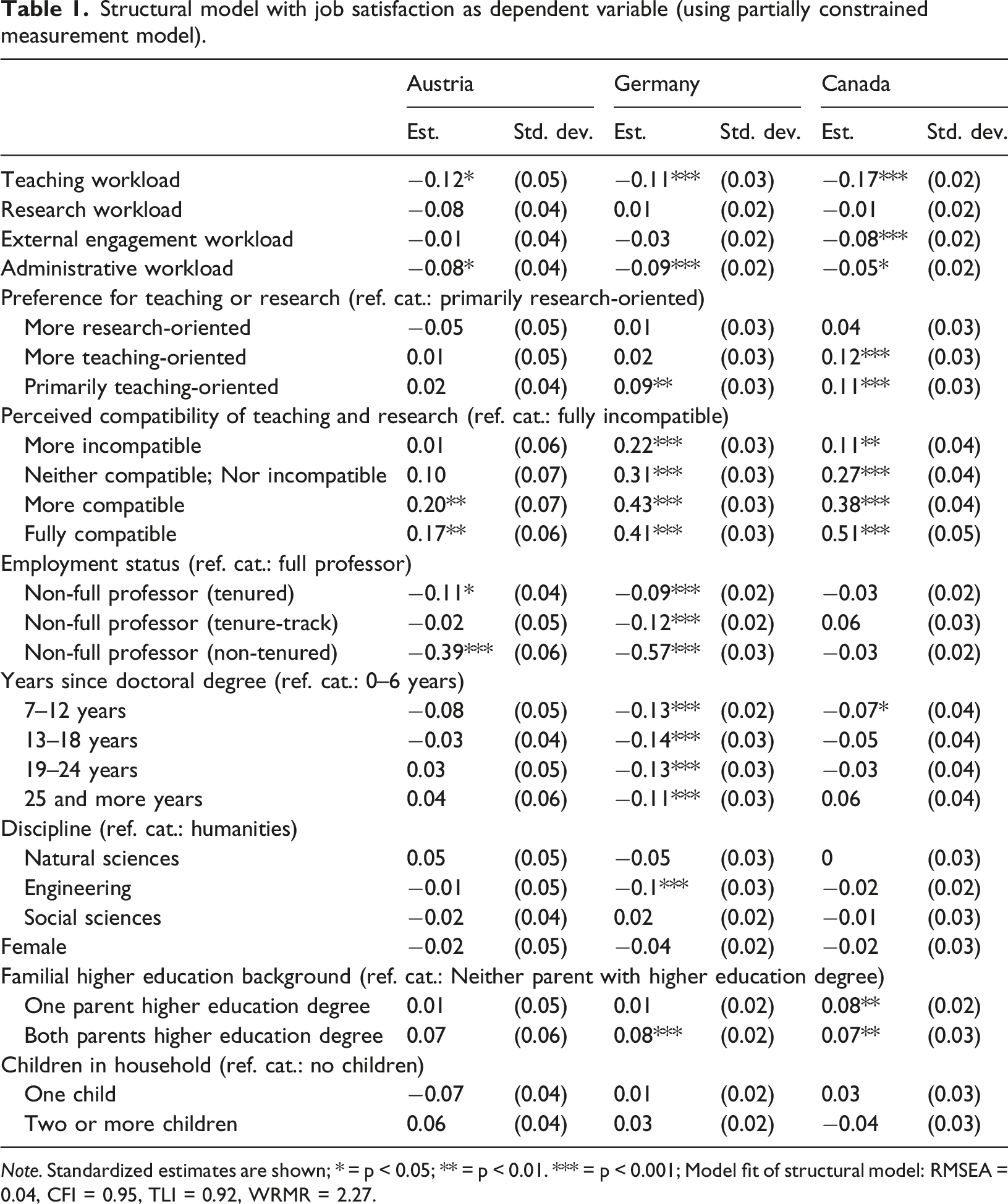
Note. Standardized estimates are shown; * = p < 0.05; ** = p < 0.01. *** = p < 0.001; Model fit of structural model: RMSEA = 0.04, CFI = 0.95, TLI = 0.92, WRMR = 2.27.
Chi-square difference tests investigating the moderation of independent variables by country differences.
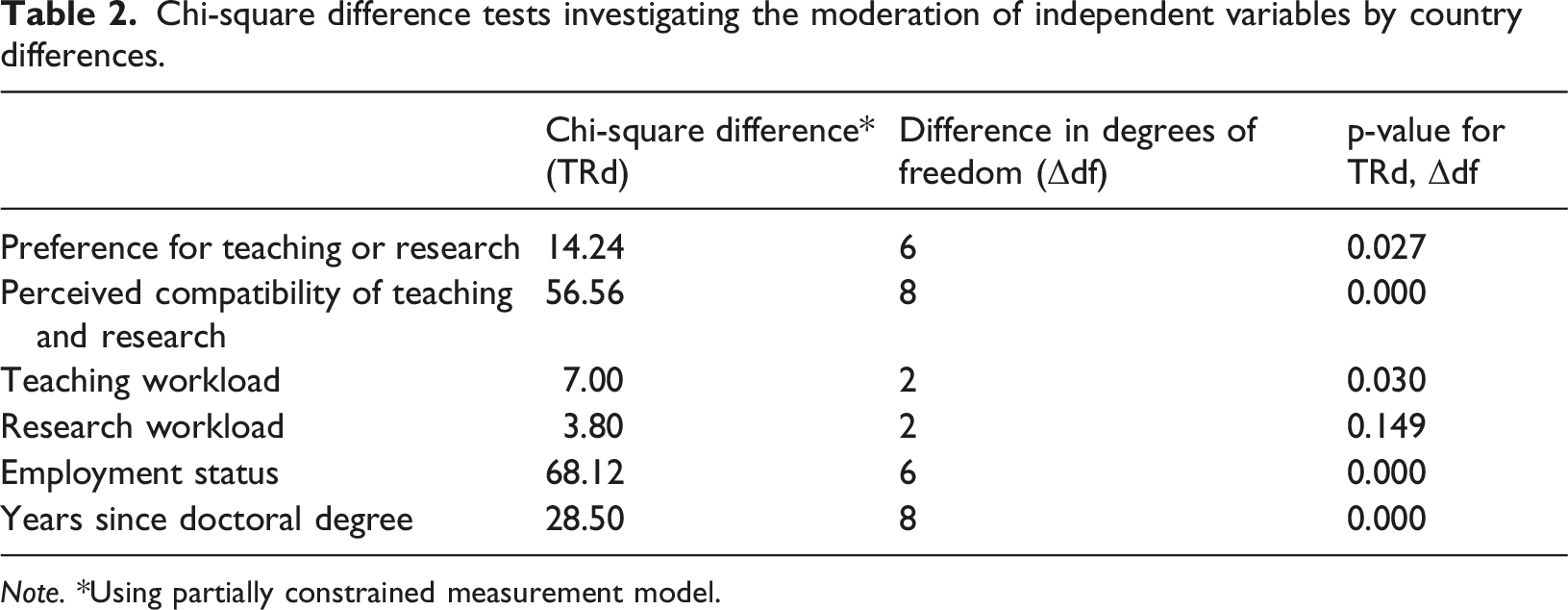
Note. *Using partially constrained measurement model.
Results for the three indicators on the research-teaching nexus reveal the following: Regarding compatibility, the correlation between compatibility of research and teaching and job satisfaction is lowest in Austria and strongest in Canada. Thus, our analysis fully supports hypothesis 2. A similar pattern of country moderation is evident with respect to the preference for teaching and/or research. In Austria, the correlation between a research and/or teaching preference and job satisfaction is lowest and not significant. In contrast, we find that teaching-oriented academics as well as academics with a preference leaning towards teaching are both more satisfied than research-oriented academics in Canada. Unexpectedly, we also find a significant correlation between teaching/research preference and satisfaction in Germany. Here, academics who are strongly teaching-oriented are more satisfied than those who are strongly research-oriented. Consequently, hypothesis 3 is partly supported by the analysis.
The teaching workload is negatively correlated with job satisfaction in all three country contexts. However, as stated in hypothesis 1, the results are significantly moderated by the country context. The negative effect of teaching workload on job satisfaction is substantially stronger in Canadian than in German and Austrian public universities. Nevertheless, the moderating effect of the country is not as pronounced as in the case of the compatibility variable, and hypothesis 1 is only partially supported as the effects do not differ substantially between Germany and Austria.
Results regarding career structure also underline major differences and support the patterns proposed in hypothesis 4. In the Canadian HE system, which is characterised by a clearer career structure compared to Germany and Austria, postdoctoral status (i.e. assistant professor) is not associated with lower satisfaction. In fact, assistant professors are slightly, but not significantly (p = 0.056) more satisfied than full professors in Canada. This is in sharp contrast to Austria and even more so to Germany. Here, postdocs, and especially non-tenured postdocs, are significantly less satisfied than full professors.
Discussion
The reported results show that in those countries where the ongoing dissolution of the research-teaching nexus is more advanced (most notably in Canada, but also in Germany), the perceived compatibility of research and teaching more strongly influences academics’ job satisfaction than in the country with a lower level of separation between research and teaching (Austria). This suggests that in countries where research-teaching connections are increasingly questioned by funding regimes attempting to separate them (Deem and Lucas, 2007), task congruence between teaching and research is an increasingly contested but at the same time relevant aspect of academics’ job satisfaction. Here, satisfaction is strongly connected to the perceived ability to achieve synergies between both tasks.
The results also underline that, particularly in Germany and Canada, where the development towards a post-Humboldtian model is more pronounced, there is also a satisfaction-related ambivalence between the workload and the preference for research and/or teaching. We find a significantly negative correlation between time spent on teaching and satisfaction. This negative correlation is also observed in other country contexts (Feld et al., 2014; Flander et al., 2020) and thus could be seen as a global trend accompanying the global research imperative in the struggle for reputation and positions. Previous studies have found evidence for a trade-off between research and teaching time leading to time allocation conflicts (Leisyte et al., 2009). Thus, the teaching workload reduces the time available for research, which conflicts with the research-focused strategic positioning aims of academics and applies additional pressure on top of organisational expectations to acquire external funding and to achieve a consistent research output (Weenink et al., 2024).
Although this negative correlation can be seen as a globally widespread phenomenon, our study found interesting variations between national HE systems: In Canada, the negative correlation between teaching workload and satisfaction is stronger than in Germany and Austria. We consider this to be a result of the stronger marketisation of Canadian HE. The historical development path of HE in Canada, in which the Humboldtian university tradition is mixed with influences from the U.S. marketised and more organisationally differentiated HE tradition, forms a breeding ground in which neoliberal policies can flourish better. At the individual level, this seems to translate into stronger competitive pressure for strategic positioning through research accomplishments both for academics and for universities. This – at least partly – can explain the stronger negative influence of teaching workload on satisfaction. In addition, there is widespread public debate in Canada about the creation of a teaching stream in faculty roles, which could fuel fears of research-oriented or research and teaching-oriented academics getting locked into teaching positions through high teaching loads. Meier and Schimank (2009) or Leisyte et al. (2009) have found such a perception of lock-in effects in post-Humboldtian systems, such as the UK, Australia, and the Netherlands.
However, this negative correlation between workload and satisfaction contrasts with the positive correlation we found between teaching preference and satisfaction in national HE systems where research and teaching are more separated (i.e. Canada and Germany). In those countries, purely teaching-oriented academics are more satisfied than their research-oriented colleagues. In the Canadian case, this might be explained by the fact that stronger compartmentalisation of roles decreases the stress and competitive pressures for teaching-focused academics by legitimising roles with lower or no research expectations. For Germany, the unexpectedly higher satisfaction among strongly teaching-oriented academics may be less driven by legitimisation of teaching roles, but more strongly by the fact that stress due to competitive performance pressures in research are less pronounced in this group. In the reward for compliance scheme of German research governance centred on third-party funding (Schneijderberg et al., 2022), purely teaching-oriented academics may experience fewer competitive pressures than their colleagues.
The contrasting effects of workload and personal preference on satisfaction in the different HE systems observed in our study highlight the importance of acknowledging the difference between academics who choose teaching roles out of intrinsic motivation and personal alignment, and those who feel compelled to take on teaching duties (Esdar et al., 2015; Skaalvik and Skaalvik, 2023; Zhang and Gandham, 2025). Our findings reveal significant ambivalence in job satisfaction, situated between intrinsic teaching motivation and the actual teaching workload. Interestingly, these tensions are particularly pronounced in national contexts where policies are aimed at dissolving the traditional link between research and teaching.
In addition to the differentiation of the research-teaching nexus, differences in career structures are also echoed by significant country differences regarding the influence of contract conditions on satisfaction. Job satisfaction is highly influenced by working conditions and it has been repeatedly reported that those who have not secured full professorial positions are less satisfied (Goldan et al., 2022; Möller, 2018). Academics in the postdoctoral phase are likely to feel higher pressure to focus on their research and publishing to secure a professorial position. In Germany and Austria, postdoctoral status is – as expected – negatively associated with satisfaction. In those systems that in international comparison have less clear career paths in academia, a broad diversity of academics with non-tenured positions is created who compete for tenured full professorships and experience increasing insecurity and stress, which negatively influence satisfaction (Castellacci and Viñas-Bardolet, 2021; Urbina-Garcia, 2020; Van der Weijden et al., 2016; Waaijer et al., 2017).
Surprisingly, we found that Canadian tenure-track assistant professors in this study report higher levels of satisfaction than full professors. We could argue that this is due to their relatively ‘recent’ success in competing for tenure-track status in a field where full-time positions are in decline and precarious employment is becoming the normal business model (Jungić et al., 2023). With many universities in Canada no longer enforcing mandatory retirement (CAUT, 2019; Worswick, 2005), do we infer that this means responsibilities and expectations are also unchanged? Perhaps the mismatch in satisfaction between mid-late-career professors is due to the unmet expectation of a lighter workload and less competition given the absence of a formal ‘end date’ to their position.
This study has important implications for policy and practice. Generally, the results highlight the satisfaction-relevant, ambivalent individual valence of different governance regimes, which structure national higher education, career systems, and the research-teaching nexus differently. First, the ambivalence driven by the policy-induced dissolution of teaching and research and their strong relationship with satisfaction should not only be reflected in organisational governance design but also in the design of national policies for reorganising the relationship between teaching and research. A step towards such a reflection could be an investment in monitoring capacities looking at the influence of national policies on (the subjective perception of) academic work. While staff satisfaction surveys are often anchored at an organisational level, they fail to grasp broader developments, such as increasing managerialism, dissolution of research and teaching, or rising precarity, which also heavily contribute to academics’ satisfaction. Therefore, policymakers should invest in cross-national surveys, similarly to student social surveys (e.g. EUROSTUDENT or EUROGRADUATE), which are able to grasp academics’ satisfaction beyond institutional views and logics.
Second, to inform policy, surveys of academic staff should not only include the dominant measurements related to satisfaction (e.g. working conditions, salary, workload) but also whether respondents perceive their overall work as meaningful and coherent and what meaning they attach to working as an academic. Complementary to our results, current research in the UK has shown that this needs to be explored further when analysing outcomes such as satisfaction (Nathwani, 2023). When doing so, it is important to acknowledge that motivational, time and goal synergies, and conflicts between the different working tasks are present simultaneously and affect an academic’s behaviour and professional identity.
However, this study also comes with some limitations. The survey does not include any psychological measurement inventories, such as the Sense of Coherence Scale (Antonovsky, 1993) or the Intrinsic Motivation Inventory (Deci and Ryan, 2008). Using these inventories in country-comparative studies on academic work in future research could provide a more nuanced understanding of the micro-macro mechanisms of the interdependencies of the research-teaching nexus and academics’ satisfaction. Further, we focused the analysis solely on countries with some degree of a Humboldtian tradition. While our results suggest that national cultures and configurations of the research-teaching nexus are relevant to satisfaction, a promising area for future research would be to compare (post-)Humboldtian university systems with those influenced by other traditions, such as the Newman ideal or the Napoleonic model, in which the decoupling of teaching and research by means of university stratification and role differentiation is more profoundly entrenched in the culture of HE than in Humboldtian models. This highlights the need for more comparative studies on higher education investigating the interface between the research-teaching nexus and perceptions of academics’ satisfaction within different national contexts.
Conclusion
In this paper, we investigated the influence of the research-teaching nexus on academics’ job satisfaction. We aimed for a country-comparison according to (1) the differentiation of the research-teaching nexus (measured by perceived compatibility, preferences, and workload), and (2) the career structures, especially the paths to professorship, and therefore selected Canada, Germany, and Austria. Our results show that national HE systems are a significant moderating factor for job satisfaction, thus highlighting the importance of country-comparative research. In light of the theoretical considerations of this study, our results emphasise that the institutionalisation of the decoupling of research and teaching does not proceed without friction but rather unfolds in an increasing tension between a reform-induced transformation of funding arrangements and recognition patterns and culturally-anchored ideals. Decoupling in Humboldtian systems, mainly driven by policies intensifying research competition and marketisation, may not manifest in a transformation of academic ideals, but in a growing ambivalence between the historically grown academic conviction of a synergistic research-teaching nexus and current trends towards a fragmentation of the overall academic work profile through intensification of multiple competitions and role specialisation in one of these tasks. This ambivalence is also found in studies on post-Humboldtian systems with far-reaching funding-induced decoupling (Leisyte et al., 2009; Meier and Schimank, 2009), but these studies do not show the impact of this ambivalence on job satisfaction. We add to this research by showing that job satisfaction is folded into the ambivalences of the research-teaching nexus under different national HE configurations.
Supplemental material
Supplemental material – The unity of research and teaching under threat: Does it matter for academics’ job satisfaction?
Supplemental material for The unity of research and teaching under threat: Does it matter for academics’ job satisfaction? by Nicolai Götze, Franziska Lessky, Corinna Geppert, Alison Elizabeth Jefferson in Research in Comparative and International Education
Footnotes

Ethical considerations
This study was approved by the respective universities in each country (University of Toronto, University of Kassel, University for Continuing Education Krems).
Consent for publication
Respondents gave written consent for publication before filling out the survey. Further information on ethical approval can be found in the methodological report accompanied with the scientific use file.
Funding
This work was supported by the German Federal Ministry of Education and Research (BMBF) under Grant number M522200; and the German Research Foundation (DFG) under Grant number DFG FOR 5234.
Declaration of conflicting interests
The authors declared no potential conflicts of interest with respect to the research, authorship, and/or publication of this article.
Data Availability Statement
Supplemental material
Supplemental material for this article is available online.
Author biographies
References
Supplementary Material
Please find the following supplemental material available below.
For Open Access articles published under a Creative Commons License, all supplemental material carries the same license as the article it is associated with.
For non-Open Access articles published, all supplemental material carries a non-exclusive license, and permission requests for re-use of supplemental material or any part of supplemental material shall be sent directly to the copyright owner as specified in the copyright notice associated with the article.
