






Abstract
Background
Period product insecurity is an emerging form of material hardship with significant implications for mental health. Previous research has shown that financial challenges related to accessing material basic needs hygiene products can increase stress and anxiety.
Objectives
This study aims to examine the relationship between frequencies of period product insecurity, parenting stress, and mental health outcomes in caregivers with young children.
Design
The study uses cross-sectional survey data from participants (N=541) who menstruated in the past year and were caregivers of children under age four. Data were collected during completion of an online survey from March – April 2024.
Method
Participants reported experiences with period product insecurity and completed standardized measures of anxiety and depression (GAD-2 and PHQ-2). Logistic regression models, adjusting for sociodemographic factors, estimated the association between period product insecurity frequency, parenting stress, and mental health outcomes.
Results
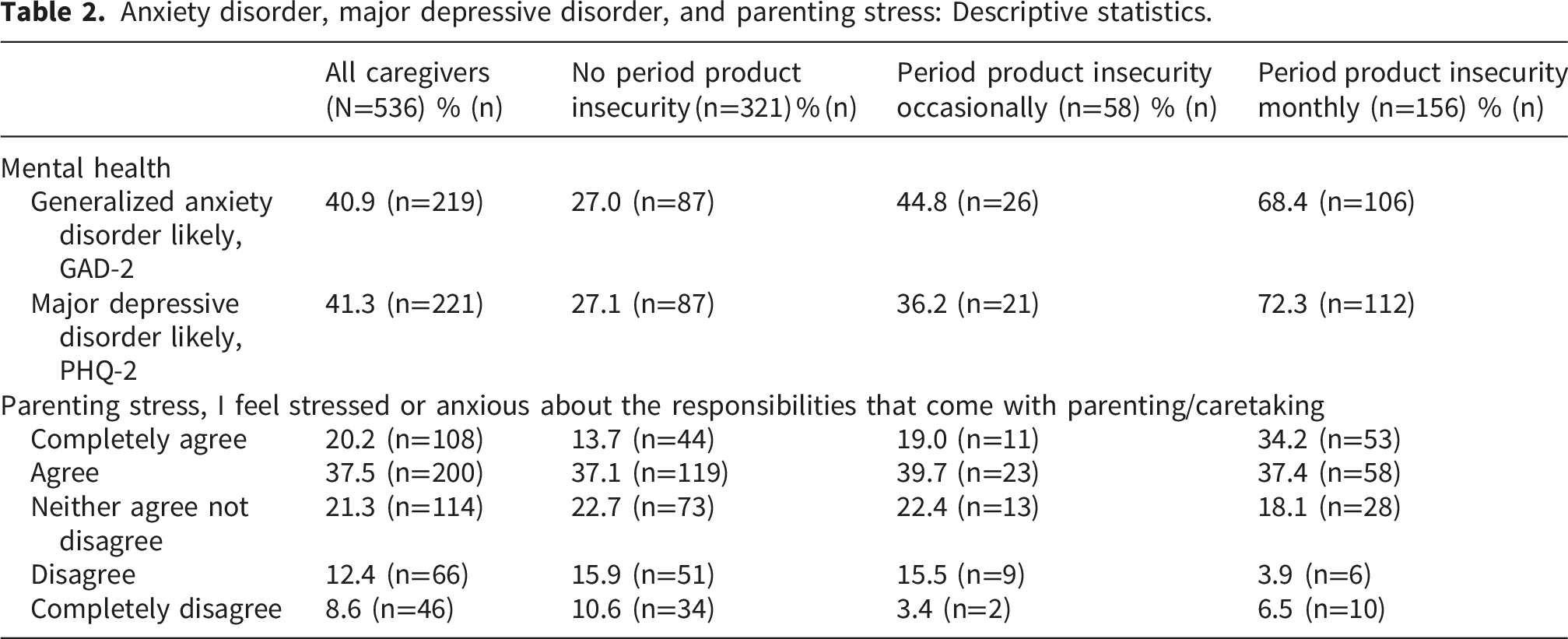
Among participants, 39.5% (n=214) endorsed period product insecurity at least once in the past year. The majority of caregivers with young children who experienced period product insecurity monthly reported symptoms of Generalized Anxiety Disorder (68.4%, n=156) or major depressive disorder (72.3%, n=112). Fewer caregivers who did not experience period product insecurity reported symptoms (Generalized Anxiety Disorder 27.0%, n=87; major depressive disorder 27.1%, n=87). More than half of all caregivers “completely agree” or “agree” that they felt stressed or anxious about the responsibilities that come with parenting/caretaking (57.7%, n=308). Monthly experiences of period product insecurity, and stress about parenting responsibilities, increased risk of symptoms of anxiety and depression compared with no period product insecurity (p<.001).
Conclusion
Future research is needed to strengthen the evidence base to better understand the causal pathways between period product insecurity and caregiver mental health. In the meantime, interventions and policy measures could be explored to integrate both period product distribution and parenting supports within broader caregiver support systems.
Plain language summary
Why we did this study: Being a parent can be very stressful, so can worrying about how to pay for basic essentials like period products (including pads and tampons). Not being able to afford period products is called period product insecurity or period poverty. Parents’ mental health can impact how they parent their children. What we wanted to learn: We wanted to understand if there is a connection between not being able to afford period products, feeling stressed about parenting responsibilities, and the mental health of caregivers with young children. What we did: From March 2024 to April 2024, 541 caregivers who had menstruated in the past year and lived with a child under age four completed an online survey. Survey questions asked whether participants had trouble affording period products like pads or tampons, how often that happened, whether they felt stressed about caregiving responsibilities, and whether they experienced symptoms of anxiety or depression. What we learned: 40% of caregivers said they had struggled to afford period products in the past year, and 29% said it happened every month. Caregivers who experienced period product insecurity monthly were much more likely to report parenting stress and symptoms of anxiety and depression, even after considering other factors like income and employment. Why is this important: Struggling to afford period products can contribute to serious mental health challenges for caregivers of young children. This can make it hard for caregivers to be the parents they want to be for their children. We need the people who make the laws for our states and country and decide how to spend the government’s money to use policies and funding to make free period products available to caregivers with young children. This could help reduce stress, improve mental health, and support families raising young children.
Keywords
Introduction
Period product insecurity, the repeated inability to afford period products when needed due to a lack of income, is an emerging public health issue with significant implications for mental health. Much like other forms of material hardship, period product insecurity is linked to stress, anxiety, and depression.1–6 Colloquially known as period poverty, period product insecurity disproportionately affects low-income individuals who face financial difficulties securing essential health products.1,2,4,7–12 Unlike more widely studied areas of material hardship, such as food, housing, energy, or transportation insecurity, the mental health impacts of period product insecurity have begun receiving attention only in recent years.2–6,12,13 The inability to access period products can have profound consequences for emotional well-being, contributing to increased worry, social stigma, and disruptions in daily life.1,2,5,7–9,14,15
Like economic instability and other material hardships, period product insecurity is likely exacerbated by broader financial conditions. Individuals facing period product insecurity often experience intersecting challenges, such as income instability due to missed days of work, housing insecurity, and food insecurity.1,4,8,11 Period product insecurity disproportionately affects low-income individuals and those from marginalized communities, as the cost of period products can constitute a significant financial burden for those living in poverty.1,8,11,16 This intersection of economic stressors may amplify the mental health consequences of not having access to period products when needed.
United States-based public benefit programs, such as the Supplemental Nutrition Assistance Program (SNAP) or Temporary Assistance for Needy Families (TANF), are critical for addressing some forms of material hardship.17–19 Yet, most do not cover the cost of period products. Previous research has demonstrated that period product insecurity can affect physical and emotional well-being.2,8,14,15 Studies suggest that ongoing financial struggles may lead to chronic stress, which is a known risk factor for mental health issues.20,21 Given that period product insecurity is a recurring, cyclical challenge for many individuals, those who experience this form of hardship every month are at greater likelihood of negative mental health outcomes than those who face it only occasionally.
The Family Stress Model provides a theoretical framework to understand how economic hardship contributes to caregiver psychological distress, which can subsequently affect parenting behaviors and child outcomes. 22 According to the Family Stress Model, economic instability often results in increased levels of caregiver anxiety and depression, which may lead to less supportive and more punitive parenting practices.22,23 In the model, these maladaptive parenting behaviors are linked to adverse outcomes for children, including emotional and behavioral problems.21,22,24 Material hardship, such as food insecurity and housing instability, exacerbates these challenges described in the model, creating a cycle of stress that further undermines caregivers’ mental health and parenting abilities. 25
Caregiving, particularly for those parenting young children, can be a source of immense joy but also significant stress. 25 Research consistently shows that the demands of parenting, especially when compounded by economic instability, can lead to heightened levels of anxiety and depression among parents and caregivers.21,24 The U.S. Surgeon General’s 2024 report on parental stress highlights parents’ unique pressures in balancing their children’s needs with financial strain, housing instability, and lack of access to necessary resources. 26 These stressors are particularly acute for parents with low-incomes, who often experience overlapping forms of material hardship—food insecurity, housing instability, and income volatility—that make it difficult to meet basic needs for themselves and their children.24,26,27
Our primary hypothesis is that period product insecurity is significantly associated with symptoms of both anxiety and depression among caregivers and that the effect will be more substantial for those experiencing monthly period product insecurity compared to those facing difficulty affording period products less frequently. This study contributes to the broader understanding of how period product access intersects with mental health and parenting stress.
Methods
Data collection
The data for this study were collected from March to April 2024 through a self-administered web survey fielded by YouGov targeting U.S. adults responsible for ≥25% of the at-home diaper changes for children in their household wearing diapers who were under the age of four. Potential study participants were recruited by YouGov from their pool of online survey panel members who consent to participate in research studies. Prior to survey completion, all participants provided written informed consent, captured electronically, to participate in the online survey. The study was approved following review by the Duke University Campus Institutional Review Board [IRB], Protocol #2024-0478. To derive a sample nationally representative of U.S. adults, respondents were matched to a sampling frame based on key demographic variables including gender, age, race, education, and income relative to family size. The sampling frame is a subset of adults with children under age five from a representative “modeled frame” of U.S. adults, constructed from sources including the American Community Survey (ACS) public use microdata, public voter file records, the 2020 Current Population Survey (CPS) Voting and Registration supplements, the 2020 National Election Pool (NEP) exit poll, and the 2020 Cooperative Election Study (CES) surveys. The final sample, stratified by household income, included N=1,000 adult caregivers with primary or shared responsibility for at-home diapering of the children in their household under age four. Further explanation of YouGov’s sampling methodology is publicly available. 28
The present study further subsets the data to include only individuals who had menstruated in the past year, determined by the screening question, “Have you experienced a period in the past 12 months?” Of these, 541 respondents reported having experienced a period within the last year and were included in our analyses. Study inclusion criteria included both the responsibility for at least 25% of diaper changes at-home for a child in their household under the age of 4 and menstruation in the past year. Caregivers of children under age 4 were excluded from the present analyses if they completed fewer than 25% of the at-home diaper changes and/or they did not report menstruation in the past year. Thus, the final sample includes N=541 caregivers. To address missing data in this study, we employed a complete-case analysis approach, excluding observations with missing values on any of the analytic variables. This decision was guided by both the relatively low proportion of missingness across the dataset and the primary goal of producing interpretable and robust estimates without introducing additional assumptions through imputation. While more complex imputation methods can be appropriate in certain contexts, particularly when missingness is more extensive or systematic, the limited scope of missing data here supported the use of listwise deletion. This approach ensured a consistent analytic sample across models and allowed for straightforward interpretation of results while maintaining the integrity of the predictor-outcome relationships under examination.
Measures
Survey questions were piloted by a group of n=22 participants, 2.2% of the final sample.
Period product insecurity
Two questions were asked about period product insecurity:
“In the past 12 months, have you found it challenging to afford period products (such as pads, tampons, menstrual cups, or sanitary napkins)?”
“Did you find it challenging to afford period products every month?”
The period product insecurity questions were answered either “Yes” or “No.” Respondents who answered “yes” to the first question about period product insecurity but “No” to the second question were coded as experiencing period product insecurity only occasionally, and those who answered “yes” to the second question were coded as experiencing period product insecurity monthly. These measures have not been validated.
Parenting stress
Parenting stress was measured by respondents’ agreement (i.e. “completely agree,” “agree,” “neither agree nor disagree,” “disagree,” or “completely disagree”) with the statement, “I feel stressed or anxious about the responsibilities that come with parenthood/caretaking.” This measure has not been validated.
Caregiver mental health
Generalized Anxiety Disorder 2-item [GAD-2] and Patient Health Questionnaire-2 [PHQ-2] screening tools served as the primary measures for mental health outcomes.29,30 Both tools have a cut-off score of 3 or higher for a positive screen (range 0-6). A Cochrane Review of several studies utilizing the GAD-2 found the tool, when assessing generalized anxiety disorder, to have a summary specificity of 0.86 and a summary sensitivity of 0.68.29,30 The internal cosistency of the PHQ-2, a measure of the tool’s reliability, is reported as Cronbach’s alpha = .83.29,31
Statistical analysis
Statistical calculations were computed with IBM SPSS version 31.0. 32 Descriptive statistics were calculated for categorical variables. The relationship between period product insecurity, parenting stress, and mental health outcomes, specifically anxiety and depression, was examined using logistic regression analysis. Separate models were estimated to assess the effects of period product insecurity frequency on the likelihood of reporting symptoms of anxiety or depression, as measured by the GAD-2 and PHQ-2 cutoff scores, respectively. The primary independent variables of interest were categorical measures of period product insecurity frequency (monthly, occasionally, or never), and a binary measure of parenting stress, indicating whether participants reported they “completely agree” or “agree” with the statement that they felt stressed by parenting responsibilities.
The models included several covariates to control for sociodemographic factors across participants, specifically: race (with white as the reference category), income level, educational attainment, employment status, and marital status. These covariates allowed for a more precise estimation of the unique effects of period product insecurity and parenting stress on mental health outcomes.
Robustness checks
We conducted several robustness checks to ensure the validity of our findings. First, we tested whether general financial hardship could confound the association between period product insecurity and mental health outcomes. To address this, we adjusted for a more detailed income variable beyond the standard categories initially included in our models. This additional control captured finer gradations of income, helping to distinguish whether the relationship between period product insecurity and mental health was independent of overall financial strain. The results remained consistent, confirming that the associations between period product insecurity and anxiety or depression were not driven solely by broader economic circumstances.
The Strengthening the Reporting of Observational Studies in Epidemiology (STROBE) checklist guided preparation of this manuscript. 33
Results
Descriptive statistics for demographic characteristics of sample of menstruating caregivers with young children.
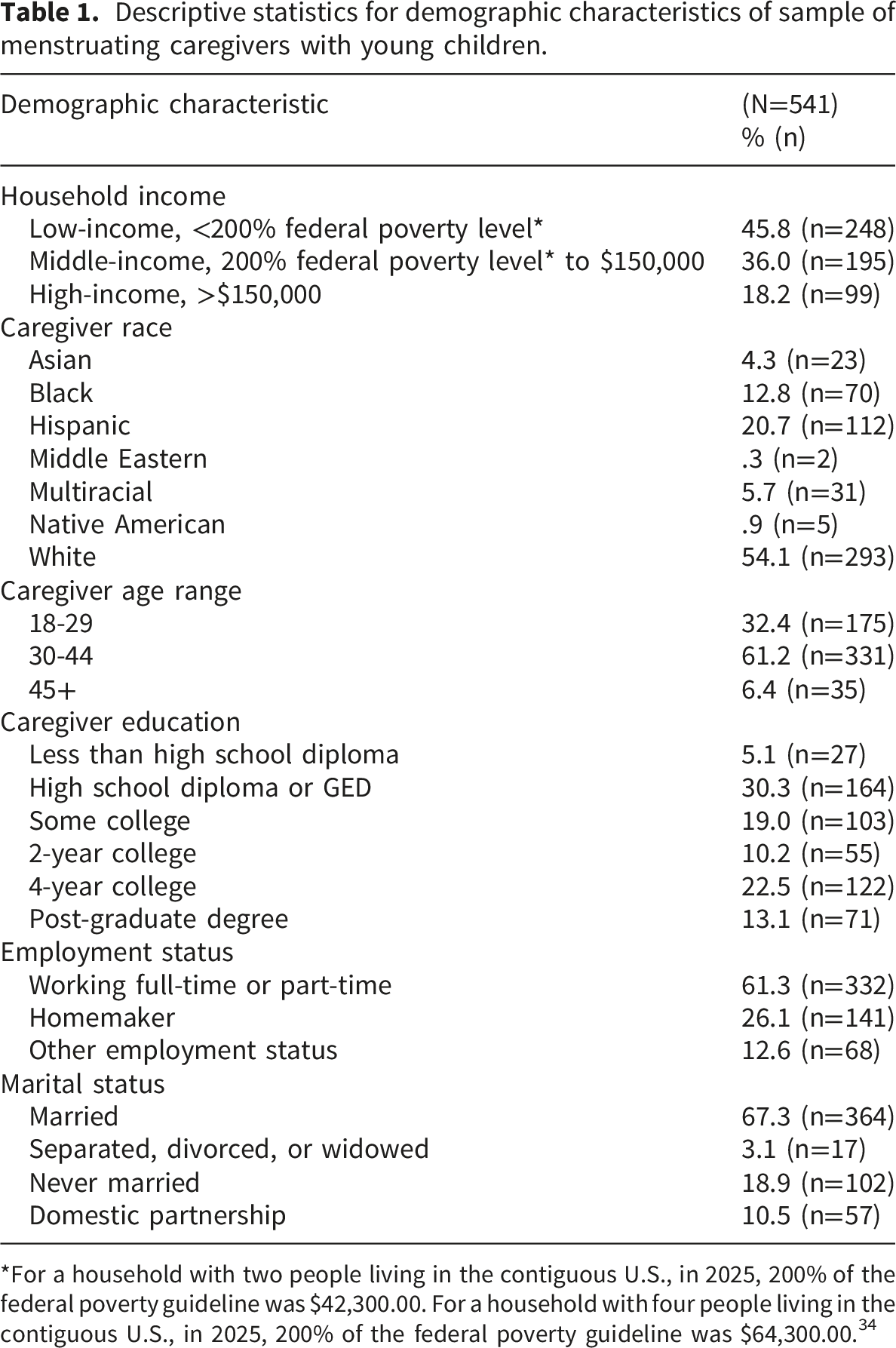
*For a household with two people living in the contiguous U.S., in 2025, 200% of the federal poverty guideline was $42,300.00. For a household with four people living in the contiguous U.S., in 2025, 200% of the federal poverty guideline was $64,300.00. 34
Period product insecurity
Survey respondents reported experiences of period product insecurity as determined by whether they had found it challenging to afford period products at any time in the past 12 months. Among the sample of menstruating caregivers with young children, 39.5% (n=214) endorsed period product insecurity at least once in the past year. Challenges affording period products monthly were reported by 28.8% (n=156) of respondents. Difficulty affording period products in the past year but less often than monthly was reported by 10.7% (n=58) of respondents.
Caregiver mental health
Anxiety disorder, major depressive disorder, and parenting stress: Descriptive statistics.
Predictors of caregiver mental health
Summary of logistic regression analysis for variables predicting generalized anxiety disorder (GAD-2) score among menstruating caregivers (n = 536), controlling for demographic variables.
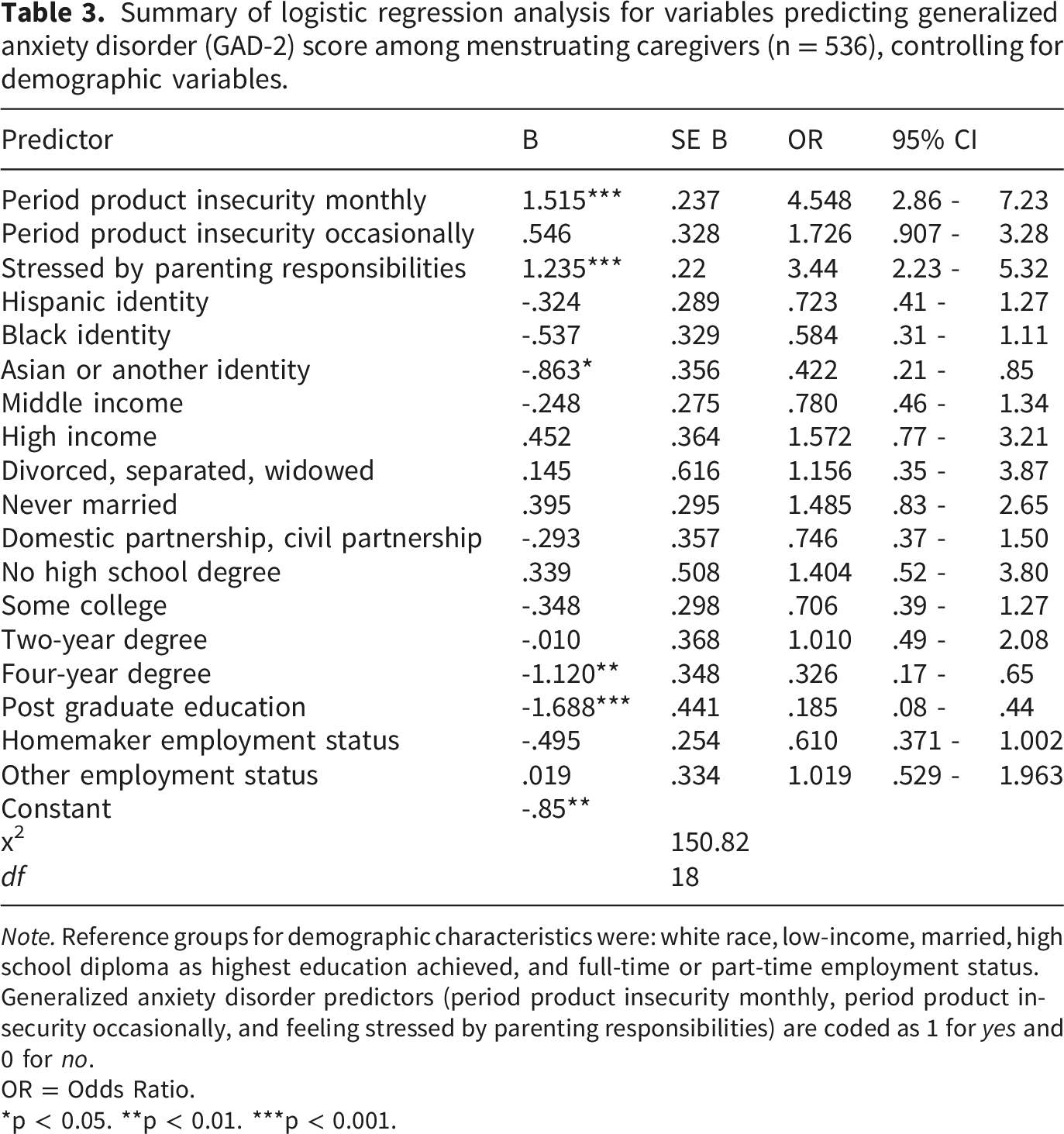
Note. Reference groups for demographic characteristics were: white race, low-income, married, high school diploma as highest education achieved, and full-time or part-time employment status.
Generalized anxiety disorder predictors (period product insecurity monthly, period product insecurity occasionally, and feeling stressed by parenting responsibilities) are coded as 1 for yes and 0 for no.
OR = Odds Ratio.
*p < 0.05. **p < 0.01. ***p < 0.001.
Summary of logistic regression analysis for variables predicting depressive disorder (PHQ2) score among menstruating caregivers (n = 536), controlling for background variables.

Note. Reference groups for demographic characteristics were: white race, low-income, married, high school diploma as highest education achieved, and full-time or part-time employment status.
Depressive disorder predictors (period product insecurity monthly, period product insecurity occasionally, and feeling stressed by parenting responsibilities) are coded as 1 for yes and 0 for no.
OR = Odds Ratio.
*p < 0.05. **p < 0.01. ***p < 0.001.
Discussion
Our study findings indicate that individuals who faced period product insecurity monthly were more likely to experience anxiety (68.4%) and depressive symptoms (72.3%) than individuals who did not experience period product insecurity or who experienced it less frequently. To contextualize the study findings with prevalence rates from the general U.S. adult population, 18.2% of adults experienced anxiety symptoms in 2022, and 21.4% experienced symptoms of depression. 35 Among adults living in poverty, the prevalence of anxiety symptoms was higher, with 28.4% reporting symptoms. 35 From 2021 – 2023, 26.0% of adult and adolescent females living in poverty in the United States experienced depression. 36 Our study of menstruating caregivers with young children reported higher rates of both anxiety and depression symptoms among participants than the general adult population and among adults with low-incomes specifically. Our findings suggest that not only is the experience of financial strain related to period products associated with risk of poorer mental health, but the frequency nature of these challenges may further intensify this relationship. The mental health burden appears more pronounced for those who experience ongoing, recurring difficulties in affording period products, highlighting the importance of understanding period product insecurity as a persistent, rather than intermittent, challenge.
Our findings align with broader research showing that material hardship, such as diaper insecurity and food insecurity, are associated with adverse mental health outcomes.37–41 The rate of monthly period product insecurity reported in our study was higher than rates of period product insecurity reported in previously published research, suggesting that our sample of caregivers of young children may have additional financial stressors, possibly related to the expenses of adding an additional household member.26,27 Additionally, at the time these data were collected, no validated screening question(s) for measuring period product insecurity were available.4,12 Comparisons of period product insecurity rates across studies should consider that utilizing different benchmarks may yield results that are not directly comparable. Our study adds to this body of work by demonstrating that period product insecurity—an often-overlooked aspect of material hardship—has a similarly significant impact on mental well-being. The higher odds of anxiety and depression associated with monthly period product insecurity suggest that individuals who face continuous financial challenges are subject to significant stress and worry, intensifying their mental health struggles.
Existing research suggests that regular experiences of material hardship, such as ongoing financial strain, exacerbate mental health risks.2,39,42–44 However, few studies have examined how the frequency of period product insecurity—whether faced on a monthly or less frequent basis—impacts mental health outcomes such as anxiety and depression. This study is among the first to empirically demonstrate the mental health risks for caregivers associated with period product insecurity frequency, providing critical insight into the broader consequences of period poverty.
The findings highlight a promising area for future research aimed at better understanding the role of period product insecurity in shaping caregiver mental health. Given the nascent state of the evidence base, additional studies are needed to clarify causal pathways and inform the development of targeted interventions. In the meantime, policymakers may consider exploring strategies to reduce period product insecurity, like increased access to affordable or accessible period products, as part of a broader effort to address material hardship. Addressing this form of material hardship may not only alleviate the immediate financial burden but also help mitigate its negative impact on caregiver mental health which has implications for parent-child attachments and reducing parenting stress. 45
Parents, more often than non-parents, report struggles with isolation and loneliness. 26 Isolation can be compounded by the lack of access to period products – if people do not have the hygiene products they need, they cannot leave home to access resources or engage with their support networks. 1 Parenting young children often involves heightened emotional and financial demands, and limited affordability of period products may add another layer of stress and instability to already strained households. Our analysis suggests a compounding mental health burden for caregivers navigating both material hardship and reporting stress from parenting responsibilities. The rates at which study participants reported symptoms of anxiety or depression were higher than the rates reported by individuals in the United States living in poverty, suggesting that income may be a confounding variable but may not be the sole contributor to these experiences.
Longitudinal research emphasizes the protective role of parental resilience in mitigating the negative effects of economic instability on mental health, underscoring the importance of supporting caregivers to foster positive parenting practices and improve outcomes for children. 21 Supporting caregivers of young children by increasing access to affordable period products addresses a material basic need with implications for physical and mental health. Potential strategies to increase access to affordable period products for caregivers via policy action include: the provision of period products via newborn supply bundles, the use of Temporary Assistance for Need Families [TANF] Non-Recurrent, Short-Term [NRST] funds to support basic needs banks, and the allocation of state or federal funds to basic needs banks. Caregivers who are supported in their own physical and mental health are better equipped for meeting the challenges of parenting and realizing their dreams for their own families.
Strengths and limitations
This study adds to the growing literature on period product insecurity by examining how monthly experiences of insecurity are associated with increased risk for anxiety and depression among caregivers of young children. Previous research highlights the challenges that period product access can pose for economically disadvantaged individuals, but few studies have focused on the mental health implications of these struggles and specific impacts for parents. Our study fills this gap by investigating how different frequencies of period product insecurity are linked to symptoms of anxiety and depression.
Despite this study’s contributions, several limitations should be noted. First, our cross-sectional data limits our ability to establish causality between period product insecurity, parenting stress, and risk for poorer mental health outcomes. Second, while we controlled for several key sociodemographic factors, we did not have detailed data on other potential sources of financial support, including wealth, that might mitigate the effects of period product insecurity. In the present study, 46% of caregivers with young children up to age 4 reported incomes <200% of the federal poverty guideline. Another source using U.S. census data reported the percentage of U.S. households with children up to age 18 with income in the same range to be 37% in the same year. 46 Third, the study focuses on a single population, menstruating caregivers of young children, which may limit generalizability to other groups with different demographic profiles. A power analysis was not conducted a priori for this sub-analysis of menstruating caregivers. Additionally, our screening question may have excluded individuals who do not menstruate themselves but could still experience stress related to period product insecurity if they are responsible for obtaining products for others in their household, such as children, partners, or other relatives. At the time these data were collected, no validated screening question(s) for measuring period product insecurity were available.4,12 Further, we measured parenting stress with a single question. Future research is needed to explore material hardship alongside more comprehensive measures of parenting stress.
Nonetheless, the results provide valuable evidence that monthly period product insecurity is a significant risk factor for anxiety and depression among caregivers of young children, providing evidence that could inform policy interventions including two-generational approaches to addressing poverty in families by mitigating the adverse outcomes associated with monthly period product insecurity. Two-generation approaches to poverty reduction address needs of both parent and child, nothing the interwoven lives of both generations such that interventions to intentionally support both generations may be more effective than siloed interventions to address either independently. 47 Our study findings suggest that public health efforts to address mental health disparities and support caregivers of young children should consider period product affordability as a critical dimension of material hardship, particularly for those facing ongoing financial challenges. The distribution of free period products by period supply banks is a two-generational approach to addressing poverty and reducing caregiver stress among households with young children by increasing access to material basic needs.1,48 Future research should explore longitudinal relationships between period product insecurity and mental health, as well as investigate the effectiveness of interventions aimed at reducing period product insecurity.
Conclusion
Period product insecurity is a significant and understudied dimension of material hardship with meaningful implications for caregiver mental health. Monthly experiences of period product insecurity were strongly associated with elevated symptoms of anxiety and depression among caregivers of young children, even after accounting for key sociodemographic factors and broader financial hardship. These findings underscore the importance of considering period product affordability as part of comprehensive efforts to support caregiver well-being and reduce stress in households with young children. Public health and social policies that expand access to affordable or free period products represent a feasible and impactful strategy to address unmet material needs, alleviate caregiver distress, and promote healthier family environments.
Supplemental material
Supplemental material - Period product insecurity, parenting stress, and mental health: A cross-sectional study examining anxiety and depressive symptoms among caregivers of young children
Supplemental material for Period product insecurity, parenting stress, and mental health: A cross-sectional study examining anxiety and depressive symptoms among caregivers of young children by Kels M. Bowman, Megan V. Smith and Kelley E. C. Massengale in Women's Health.
Footnotes
Acknowledgments
We appreciate the survey respondents for sharing their experiences so that we could learn from them.

Ethical considerations
The study was approved following review by the Duke University Campus Institutional Review Board [IRB], Protocol #2024-0478.
Consent to participate
Prior to survey completion, all participants provided written informed consent, captured electronically, to participate in the online survey.
Author contributions
Bowman, Kelsey M.: Conceptualization, Formal analysis, Writing – original draft. Smith, Megan V. Project administration, Writing – review & editing. Massengale, Kelley E. C. (Corresponding Author): Formal analysis, Project administration, Writing – review & editing
Funding
The authors disclosed receipt of the following financial support for the research, authorship, and/or publication of this article: Funding provided by The Seedlings Foundation.
Declaration of conflicting interests
Dr. Kelley Massengale and Dr. Megan Smith have received funding from the Seedlings Foundation and are employed by the Alliance for Period Supplies, an organization that receives funding from a period product manufacturer and engages in advocacy related to addressing both poverty experienced by families and period product insecurity. The authors declared no other potential conflicts of interest with respect to the research, authorship, and/or publication of this article.
Data Availability Statement
The raw data are available from the corresponding author upon reasonable request.
Supplemental material
Supplemental material for this article is available online.
References
Supplementary Material
Please find the following supplemental material available below.
For Open Access articles published under a Creative Commons License, all supplemental material carries the same license as the article it is associated with.
For non-Open Access articles published, all supplemental material carries a non-exclusive license, and permission requests for re-use of supplemental material or any part of supplemental material shall be sent directly to the copyright owner as specified in the copyright notice associated with the article.
