







Abstract
The psychological self may be construed as a reflexive arrangement of the subjective “I” and the constructed “Me,” evolving and expanding over the human life course. The psychological self begins life as a social actor, construed in terms of performance traits and social roles. By the end of childhood, the self has become a motivated agent, too, as personal goals, motives, values, and envisioned projects for the future become central features of how the I conceives of the Me. A third layer of selfhood begins to form in the adolescent and emerging adulthood years, when the self as autobiographical author aims to construct a story of the Me, to provide adult life with broad purpose and a dynamic sense of temporal continuity. An integrative theory that envisions the psychological self as a developing I–Me configuration of actor, agent, and author helps to synthesize a wide range of conceptions and findings on the self from social, personality, cognitive, cultural, and developmental psychology and from sociology and other social sciences. The actor–agent–author framework also sheds new light on studies of self-regulation, self-esteem, self-continuity, and the relationship between self and culture.
W. J. was an 18-year-old college freshman when, after a fall, she sustained a concussive brain injury that resulted in temporary retrograde amnesia. For a week or so after the accident, she was unable to recall any specific events in her life that had occurred in the preceding 9–12 months, even though her memory for general facts about herself as a freshman in college remained largely intact. In other words, W. J. experienced a near total loss of episodic memory for the recent past, while her semantic memory pertaining to the recent past appeared to be unaffected. In a well-known case study, Klein, Loftus, and Kihlstrom (1996) administered a series of personality tests to W. J. 5 days after her accident, asking her to describe what she was like during her first semester at college, and again 4 months later, at which time her episodic memory had returned. The researchers were struck by how highly correlated the young woman’s self-report trait scores from the first testing session were to both the self-report scores obtained 4 months later (when she had recovered her memories) and the trait ratings made of W. J. by her boyfriend. Even when W. J. had no access to autobiographical scenes that, one might assume, provide the concrete data from which trait judgments are derived, her trait knowledge about herself proved to be highly accurate. Unable to recall stories about her recent personal past, she still knew her traits.
Findings from the case of W. J. dovetail with a handful of other case studies in psychological science, as well as an experimental literature, attesting to the functional independence of semantic (abstract, trait-based) and episodic (concrete, event-based) knowledge about the self (Addis & Tippett, 2008; Klein & Lax, 2010). For example, Tulving (1993) found that K. C., a patient with amnesia for personal experiences, readily made trait judgments about himself that were highly consistent with how his mother rated him. Klein and Lax (2010) reported that D. B., a 79-year-old man who became profoundly amnesic after cardiac arrest, produced reliable and consistent trait ratings for himself that were highly correlated with those made by his daughter. Even as he accurately rated his own personality, D. B. reported that he was “unable to recollect a single thing he had ever done or experienced from any period in his life” (Klein & Lax, 2010, p. 927). In conceptual priming studies of people with normal memory abilities, moreover, researchers consistently have found that rating oneself on summary traits does not typically activate recall of behavioral episodes indicative of the trait (Klein & Loftus, 1993). Whereas people may initially derive information about themselves from concrete personal experiences, the information is ultimately summarized into general semantic categories, like trait labels. Retrieving the semantic, trait-based information, therefore, may not typically require accessing the episodic, autobiographical store. I may, therefore, know that I am an extravert, but I do not need to recall any particular episodes of extraverted behavior in my life to know that I am right.
If semantic and episodic features of self-understanding are functionally independent, then it follows that a person may lay claim to a “trait self” and a separate-but-equal “story self.” In terms made famous by William James (1892/1963), the “I” may reflexively construe the “Me” as both (a) a collection of abstract traits and (b) an anthology of personal episodes or stories about my life. Perhaps surprisingly, the traits and the stories may have little to do with each other. All told, what is the different psychological material contained in the self? Considering the self as a reflexive arrangement of the observing I and the to-be-observed Me (Harre, 1998; James, 1892/1963; Taylor, 1989), what does the I see when it looks on the Me? The case of W. J. and related research on semantic and episodic features of self suggest that the I sees and knows at least two very different psychological things about the Me: traits and stories. What else might the I see? And why?
This article asserts that the self contains at least three different kinds of psychological material or content, each kind specifying what the I may see and know when it reflexively encounters the Me. Building on a tripartite framework for the study of human personality (McAdams & Olson, 2010; McAdams & Pals, 2006), the theory contends that human selves understand themselves from three different psychological standpoints: as actors, agents, and authors. Each of the three, furthermore, corresponds to three developmental layers of psychological selfhood, emerging at different points in ontogeny and following their own respective developmental trajectories over the human life course.
The first layer corresponds to the self as social actor, encompassing semantic representations of traits, social roles, and other features of self that result in and from repeated performances on the social stage of life. Layered over the self as actor is the self as motivated agent, specifying personal goals, motives, values, hopes and fears, and other features that involve the important decisions and choices that a person makes regarding exploration and commitment to life projects. Selves first emerge as social actors, but by the time human beings reach middle or late childhood, motivated agents have also entered the scene. Layered over both the social actor and the motivated agent is the autobiographical author, the self-as-storyteller who ultimately aims to burnish and synthesize episodic information about the self into a coherent and integrative life story. Beginning in the emerging adulthood years (Arnett, 2000), the autobiographical author works to formulate a meaningful narrative for life, integrating the reconstructed episodic past and the imagined episodic future in such a way as to explain, for the self and for others, why the actor does what it does, why the agent wants what it wants, and who the self was, is, and will be as a developing person in time (McAdams & Cox, 2010).
Table 1 lays out the main ideas of the proposed theory and anticipates this article’s central argument. For each of the three layers of the psychological self, Table 1 spells out (a) the contents of the self (what the I sees when it encounters the Me), (b) mechanisms of self-definition, (c) temporal emphasis, (d) the self’s central psychosocial problem or challenge, (e) the point in development when the corresponding layer of selfhood begins to emerge, and (f) the resources and constraints that culture provides for self-development.
Features of the Psychological Self
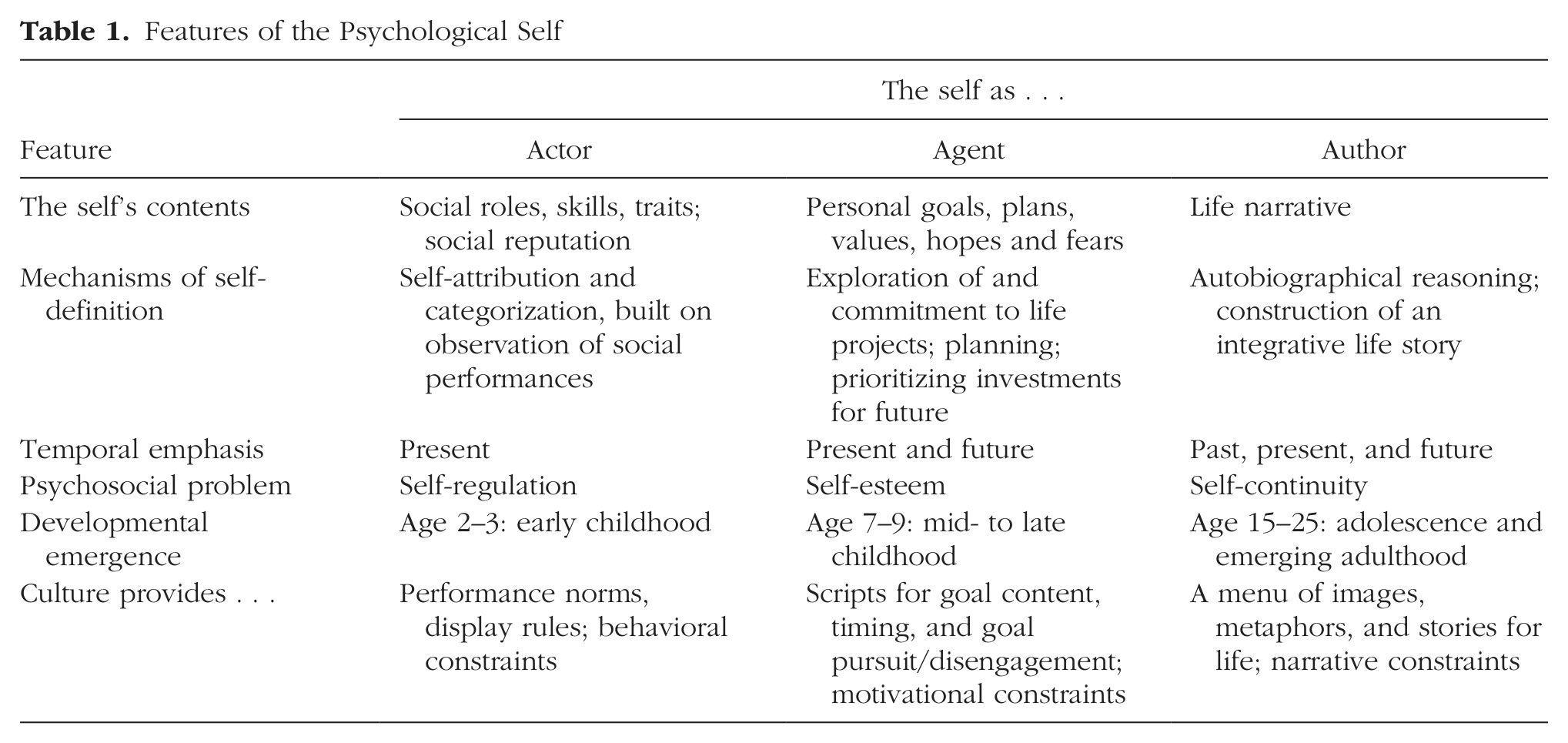
The self begins life as a social actor, struggling to regulate itself (Gailliot, Mead, & Baumeister, 2008) so as to enact effective performances in the here and now, on the social stage of human life (Goffman, 1959). The self never forgets that it is a social actor, but as the person moves into middle childhood, the I gradually perceives the Me to be a motivated agent, too, forward looking and future oriented, defined largely by personal goals, values, and other anticipated end states. Successful goal pursuit goes a long way in determining self-esteem, as James (1892/1963) originally argued. In late adolescence and adulthood, an autobiographical author joins the agent and actor, as the I now aims to create a story about the Me, in order to integrate the personal past, present, and future (Habermas & Bluck, 2000; McAdams, 1985). The central problem becomes self-continuity—how did the self of yesterday become the self of today, and how will that all lead to the anticipated self of tomorrow (Addis & Tippett, 2008)?
As much as anything else, it is the problem of self-continuity—how the I creates a dynamic sense of the Me as retaining its sameness or identity over time, even as the self and the world change—that renders certain forms of amnesia, like that described in Klein et al. (1996), so psychologically intriguing and disturbing. When 18-year-old W. J. lost much of her episodic memory after an accident, she experienced a profound decrement in self-continuity. As indicated by her scores on a self-report trait scale, she still knew what kind of a social actor she was. But she ceased to be an author of her life. For W. J., the I retained access to the semantic trait attributions that characterized, in broad terms, the record of her performances on the social stage of life. But W. J. temporarily lost access to the episodic material out of which the authorial I creates a story about and within the Me. A layer of selfhood—the self as author—was temporarily stripped away.
The three guises of selfhood described herein—the self as actor, agent, and author—are not reified and autonomous things. Nor are they distinct roles that a person might play at any given point in time. It is not the case, for example, that my social actor self is activated when I am having coffee with my friends in the afternoon and that my motivated agent self then supplants the actor later in the day, when I sit down to make plans for tomorrow. Contra certain contemporary trends in psychological science (e.g., McConnell, 2011), the theory described herein does not view selves to be autonomous mental structures that can be readily switched on and off—activated and deactivated—by environmental prompts and conditions. In the same sense that a person endowed with self-consciousness is always both I and Me, so, too, a psychologically fully formed adult exists at any given time and place as an actor, an agent, and an author. The theory specifies three different ways, then, that the I reflexively encounters the Me, whenever and however such reflexive activity occurs.
When I look on myself, when I think about myself, when I consider the possibility of psychologically working on my self, when I aim to control, regulate, evaluate, discover, fulfill, improve, or monitor my self, what do I focus on? I focus on my self as a social actor, a motivated agent, or an autobiographical author or perhaps some combination of the three. When the I self-consciously and reflexively apprehends and works on the Me, it does so from three different functional standpoints—as an actor who performs in the here and now on a social stage, as an agent who sets forth a motivated agenda for the future, and as an author who tries to make sense of it all—past, present, and future—through narrative.
The Social Actor: Self-Ascribed Traits and Social Roles
Dramaturgical and symbolic-interactionist theories in sociology (e.g., Mead, 1934) and social psychology have traditionally underscored the performative features of human social behavior, or what Goffman (1959) famously called “the presentation of self in everyday life.” Taking Shakespeare’s words more seriously, perhaps, than any other social scientist has ever taken them, Goffman (1959) asserted that all the world is, indeed, a stage and all the men and women are like actors and actresses upon it. Social actors present themselves to each other through performances, in which people play roles, follow scripts, enact routines, and manage the audience’s impressions. What matters for social actors is the effectiveness of the performance—how well do they play the role, how convincing is their enactment of the part, and how skillful are they at managing the impressions of others on stage?
Cognitively gifted and exquisitely social, human beings evolved to live as social actors in small tribes, bands, and other complex, hierarchical groups (Wilson, 2012). Continuously striving for social acceptance (to get along) and social status (to get ahead), actors form alliances and shifting coalitions with each other, jockey for position in different social arenas, and work the group through cooperation, competition, persuasion, guile, deception, reputation, and, when other strategies seem wanting, brute force (Hogan, 1982). Not only do human beings, therefore, feel strong needs to belong to groups, but they have evolved adaptive mechanisms and systems to enact, monitor, develop, and refine the behaviors they exhibit in groups, and (importantly) to process the feedback they receive from other group members regarding their social performances. For social animals, the self is initially defined through social behavior in the group, and it flourishes, or withers, as a function of the quality of social performance:
First we discover what society says we are; then we build our identity on performance in that part. If we uphold our part in the performance, we are rewarded with social affirmation of our identity. It is hardly an exaggeration, then, to say that we are created in the performance. If we bungle the performance, show that we do not merit the part, we are destroyed—not figuratively but literally (Becker, 1971, p. 99).
A couple of years before they become consciously aware of themselves as actors on the social stage of life, human newborns enter the world ready, in a rudimentary sense, for social performance. Even before the self emerges, characteristic styles of social performance begin to reveal themselves as infants express the inborn patterns of temperament that they (unwittingly) bring to the stage. Temperament refers to broad and basic differences in behavioral style, emotional tone, and emotion regulation that show up very early in life, assumed as they are to be largely a product of genetic endowment. The first glimmerings of basic differences in the ways human actors characteristically play their roles in social life, therefore, can be observed in the first few months of life. Parents, older siblings, doctors, researchers, and other members of the audience quickly observe how some actors seem generally cheerful and smiley; others, distressed, recurrently fearful, or slow to warm up. These observers readily note that whereas some social actors consistently approach opportunities for social reward, others show marked behavioral inhibition or extreme wariness in the presence of novelty (Caspi, Roberts, & Shiner, 2005). And infants, as social actors, respond to the audience’s feedback. Behaviors that are reinforced will be repeated down the road; those that are punished or ignored may decrease or even extinguish.
By the time children become aware of themselves as social actors, therefore, they have already launched an acting career, the contours of which are shaped by temperament and early social interactions. Numerous studies have shown that human infants begin to recognize themselves in mirrors and through recording devices (e.g., video) around 18 months of age (Rochat, 2003). They literally see themselves acting and recognize their actions as their own. It is also around this time that children typically begin to say self-referential words, such as “me” and “mine,” and begin to express certain kinds of self-referential emotions, such as pride and embarrassment (Tangney, Stuewig, & Mashek, 2007). To feel pride or shame in response to one’s own actions presupposes a sense of the self as an actor whose performances are viewed and evaluated by others in the environment. The I emerges as a self-conscious actor, therefore, shortly before or around the second birthday. Reflexively, an impression or image of the Me begins to take form as the child begins to take note of his or her own social actions and other actors’ reactions to those actions.
When asked to describe herself, 4-year-old Sara may tell you right off the bat that she lives in a white house, she has green eyes and brown hair, she runs real fast, she likes to eat macaroni and cheese, and she is a good girl and always “nice.” By the time she is 10, she may tell you that she is outgoing, spontaneous, a very good listener, terrible at math, and happy with her girlfriends but shy around boys (Harter, 2006). For younger children, the I defines the actor Me the way a radical behaviorist or demographer might describe social action—in terms of observable performance and concrete situational cues (Harter, 2006). Research shows that by age 10, the I has become more like a trait psychologist, attributing to the Me a range of broad dispositional tendencies that summarize general trends in social behavior, aggregated across social performances and over time (Harter, 2006).
Over the course of childhood and into adolescence, the I’s characteristic manner of describing the Me as a social actor comes to rely more and more on the discourse of dispositional traits. Trait labels capture general individual differences between social actors with respect to their characteristic thoughts, feelings, and actions. As Bem’s (1972) self-perception theory suggests, actors repeatedly observe their own particular performances and the performances of other actors, and they eventually come to define themselves in terms of these observations. Actors eventually categorize themselves in terms of general skills and trait tendencies that characterize their own performances as they have observed them over time and as they have monitored feedback obtained from other observers, such as peers, parents, and teachers. Even though these trait labels oversimplify social behavior, observers find them useful in summarizing broad differences between social actors. Accordingly, the I finds them useful, too, in depicting the basic contours of the Me as a social actor.
In early adolescence, self-report scores on personality scales become increasingly stable and begin to show the common five-factor structure that has been repeatedly observed among adults (Roberts, Wood, & Caspi, 2008). These data are usually interpreted to suggest that personality traits encompassed within the Big Five taxonomy are beginning to crystallize in the teenage years. Another way to interpret these findings, however, is to suggest that teenage actors are beginning to settle into a stable conception of their performative styles. To the extent that dispositional traits are assessed via self-report, personality trait scores are as reflective of the self as they are of personality structure (McAdams & Cox, 2010; Robins, Tracy, & Trzesniewski, 2008). When I respond affirmatively to extraversion-keyed items like “I enjoy myself at lively parties” and “Other people say that I am outgoing,” I am making an explicit and reflexive claim about myself as a social actor. Accordingly, the self-report personality ratings that W. J. made when she was experiencing amnesia (Klein et al., 1996) expressed clearly, albeit in broad semantic form, how she saw herself then as a social actor—what the I reflexively made of the Me—even though she was unable to recall episodic details from her recent social performances.
The self as social actor continues to develop in the adult years. Findings from research on the development of the self-concept (e.g., Diehl, 2006) dovetail with cross-sectional and longitudinal studies of personality traits in adulthood to show that as social actors move from adolescence and young adulthood through late midlife they see themselves as increasingly agreeable (warm, caring, altruistic) and conscientious (industrious, well-organized, disciplined) and decreasingly neurotic (less anxious, less depressive, less agitated) (Roberts, Walton, & Viechtbauer, 2006). These broad trait attributions combine with more situationally anchored understandings of the self as an actor. In adolescence and adulthood, research shows, the I tempers broad trait attributions with a dose of social psychology; it comes to know and respect the power of situations in the shaping of the Me (Harter, 2006). With greater insight, the I sees how it consistently performs in one characteristic manner in certain situations and in a very different manner in certain other situations, reflecting an understanding of contingency and context in social behavior.
Even children and adolescents understand themselves in terms of social roles. They realize that certain kinds of social performances are expected for certain roles: I should act this way around my parents, in the role of son or daughter, and quite another way around my peers, in the role of friend. Social roles seem to become more important features of the self as social actor, however, as people move through the adult years. Adults develop differentiated understandings of themselves as social actors playing such roles as parent, spouse, worker, citizen, and so on (Erikson, 1963; Serpe & Stryker, 2011). Social roles set forth conventional expectations and provide explicit scripts for social behavior, while leaving plenty of room for individual improvisation (Serpe & Stryker, 2011). Thus, all women who assume the role of “mother” confront common challenges and expectations, but each mother performs her role in her own unique way. Actors understand that different roles call for different sorts of performances. Even though I may not see myself as an especially conscientious person overall, I know that I must model discipline and constraint when performing the role of father with my obstreperous son. The fact that I see myself as a dutiful father, then, becomes part of the Me as a social actor, even as I retain my general self-attribution of “not especially conscientious.” But social roles can also change general trait attributions, as research on social investment in adulthood shows (Lodi-Smith & Roberts, 2007). As I invest more and more into the father role, I may eventually come to see myself as more conscientious overall than I used to think I was. Research has documented striking examples of how the assumption of certain social roles in adulthood can sometimes change the broad trait attributions that social actors make about themselves (e.g., Neyer & Lehnart, 2007).
Over the life course, then, the actor reflexively observes his or her own performances on the many social stages of human life and monitors carefully the reactions of other actors and audiences to those performances. The self-conscious and ever-observing actor is especially eager to read the reviews. What is my social reputation? How am I regarded by the audiences who are most important to me? What kinds of traits do they attribute to me as they watch me play my roles? The reviews convey social reputation (Hogan, 1982), which affects the identity that the I constructs to define the Me as an actor. As the person moves into and through adulthood, the social actor’s identity continues to be composed largely of self-attributed traits and salient social roles, as well as various representations of how traits are differentially and contingently expressed in and through particular situations and roles.
The Motivated Agent: Goals, Values, and Plans for the Future
To be an agent is to make choices and, as a result of those choices, to move forward in life in a self-determined and goal-directed manner (Deci & Ryan, 1991). Human agency suggests intention, volition, will, purpose, and some modicum of personal control in life. It is clear that a great deal of human behavior is goal-directed (Bandura, 1989). As they enact performances, actors make choices and act in accord with goals. Even human infants act in purposeful and goal-directed ways. But it is one thing to say that human beings are, in a rudimentary sense, motivated agents; it is quite another to say that individual selves explicitly and self-consciously see and know themselves as motivated agents. For the theory proposed herein, the self does not become a full-fledged motivated agent until the I, in a reflexive manner, comes to understand and define the Me in terms of personal goals, values, and other long-term desired ends, projected into the future. In other words, even though infants can be seen to express agency, human beings do not consciously and reflexively understand themselves as motivated agents in a full sense until much later—that is, until they set forth goals and plans for their daily lives and organize their behavior and self-understanding to be consistent with those goals and plans (McAdams & Cox, 2010; Walls & Kollat, 2006). How, then, does an understanding of self as a motivated agent develop over the human life course?
By the age of 1 year, human infants express a rudimentary appreciation for agency. Research has shown, for example, that 9-month-old infants can distinguish between intentional and accidental behavior on the part of their caregivers (Behne, Carpenter, Call, & Tomasello, 2005) and prefer to imitate intentional behavior over random acts (Woodward, 2009). By the age of 4 years, most children have internalized what developmental researchers call a theory of mind. Before they enter kindergarten, children have developed an implicit theory about how minds (their own and others) operate and why people do what they do. Their simple folk-psychological theory says that people have beliefs and desires in their minds that ultimately motivate their behavior. In other words, children now expressly conceive of people as motivated agents: People do things because they want to do them (desire) and on the basis of internal beliefs they have about things. Equipped now with theory of mind, children may promiscuously project agency onto many other beings and things in their environment, including inanimate objects, imaginary companions, and culturally mediated concepts, such as God (Kelemen, 2004). In a reflexive manner, furthermore, children are now able to appreciate agency in themselves. Applying theory of mind to the self, the I is now able to attribute recurrent desires, wants, and goals to the Me.
The magnification and refinement of individual agency within a broadening societal context is the central psychological theme in developmental theory and research on what has been called the 5- to 7-year shift (Sameroff & Haith, 1996). Cultural historians have traced back many centuries a common belief that children become markedly more rational, planful, and goal-oriented between the ages of 5 and 7 years. Research has clearly shown that, in most cultures, it is during this developmental period that children typically enter school and/or become responsible for such tasks as caring for younger children and assisting in hunting, gathering, tending animals, agricultural jobs, or household chores (Rogoff, Sellers, Pirrotta, Fox, & White, 1975; Sameroff & Haith, 1996).
A number of classic developmental theories from the middle of the 20th century elaborated on different features of, and identified different mechanisms for, the 5- to 7-year shift, yet they all converged on the broad conclusion that selves ideally begin to learn, in a reflexive sense, how to shape their inner desires and wants into socially acceptable goals and valued agendas during this time. According to Erikson (1963), for example, elementary-school children move through a period of industry versus inferiority, in which socializing forces like schools and religious institutions teach children how to use material and cultural tools and adopt social roles in order to meet their personal goals. In Piaget’s (1970) terms, childhood agency becomes contoured by concrete operational thought around age 7 or 8, enabling children to understand better the perspectives of other motivated agents and to compare themselves and their goals systematically with others. As such, children become autonomous moral agents at this time, Piaget (1965) contended, an idea variously reflected in Freud (1923/1961), Mead (1934), and Kohlberg (1969). Vygotsky (1986) argued that language originally derived from others is internalized to become a self-directing organ for reflection and planning in the elementary school years. McClelland (1961) argued that a planful, goal-directed, and future-oriented perspective on life is characteristic of people high in achievement motivation. Individual differences in achievement motivation, McClelland (1961) observed, begin to emerge around age 8.
By the time children are 8 or 9 years of age, then, they are defining and evaluating themselves through experiences in the family, among peers, on the playground, and in school in terms of culturally valued goals and their progress, or lack thereof, in accomplishing valued goals (Harter, 2006; Walls & Kollat, 2006). In the ever expanding Me, specific goals to be accomplished in the future (“I want to be a good baseball player”; “I plan to get Jennifer to like me”) join with attributions about traits (“I am an outgoing person”) and social roles (“I am a good sister”). In other words, features of the motivated agent now sit side by side in the Me with features of the social actor. It is important to note, however, that the self-attributed goals of the motivated agent are not the same things as the self-attributed traits and roles of the social actor, even though social behavior itself is typically goal-directed in nature.
For example, I may see myself as a friendly and outgoing person (traits: the self as social actor), but this semantic self-attribution suggests little regarding my particular goals and aspirations for the future (the self as motivated agent). A friendly person may set out to become a star athlete, a good student, a popular chum, the teacher’s pet, the class clown, a successful entrepreneur, a fashion model, an artist, a scientist, a revolutionary, a good provider, a loyal wife, or president of the United States. A less friendly person might pursue these same goals. The Me is a big house, and it can readily accommodate the new agential self-attributions who begin to move in and take up residence during the late-childhood and adolescent years, even when the new arrivals sometimes have little in common with the “older” inhabitants.
Through the articulation of and investment in personal goals, the motivated agent extends the Me into the future. What goals do I wish to achieve in the future? Where is my life going? What do I wish to become? Questions regarding personal goals link naturally to personal values and ideology (Schwartz & Bilsky, 1990), for values refer ultimately to those personal, social, and cultural goals that an individual most cherishes and deems to be of greatest worth. As Erikson (1963) suggested, questions regarding personal goals and values gather together around the big issues of identity in adolescence and emerging adulthood (see also Arnett, 2000). Among other things, identity development involves the young person’s broadening of consciousness to encompass a wide range of life goals and the eventual narrowing of consciousness to focus on those goals determined to be most worthy of pursuit. In Kroger and Marcia’s (2011) extension of Erikson’s identity theory, broadening entails an active exploration of ideological and vocational aspirations for the future, to be followed (ideally) by agential choice, by a narrowing of focus—a commitment—to value positions and occupational goals that reflect both the emerging adult’s agency and society’s prevailing opportunities and constraints.
In the terms of Markus and Nurius (1986), the motivated agent must ultimately commit to desired, valued, and more-or-less realistic possible selves in emerging adulthood. In the terms of related theoretical perspectives, emerging adults aim to invest in meaningful personal strivings (Emmons, 1986), personal projects (Little, 1999), and life longings (Schiebe, Freund, & Baltes, 2007). Investments, however, are fluid and dynamic, changing over time as the person comes to confront new challenges and developmental demands. The motivated agent must sometimes give up on an investment, cast aside a failing possible self (King & Hicks, 2007). Like a strategic investment banker, the agential I chooses to infuse capital into those strivings, projects, and life goals that promise, at any given moment in the life course, the best returns for the future.
Research on the development of the self in adulthood reveals both continuity and change. Central features of the self as social actor—especially self-attributions regarding dispositional performance traits—typically show considerable interindividual stability over time, and this becomes increasingly so as adults get older (Roberts & DelVecchio, 2000). However, changes in the self as a motivated agent are more forthcoming (Freund & Riediger, 2006; McAdams & Cox, 2010). As trait attributions remain relatively stable, people do change their goals, plans, programs, projects, and possible selves in the adult years, in response to on-time developmental challenges, such as marriage and retirement, and unpredictable off-time events (Elder, 1995). Research conducted in modern societies shows that among young adults, goals related to education, intimacy, friendships, and careers are likely to be especially salient. Middle-aged adults tend to focus their goals on the future of their children, securing what they have already established, and property-related concerns. Older adults show more goals related to health, retirement, leisure, and understanding current events in the world (Freund & Riediger, 2006). Research shows that goals indicative of prosocial societal engagement—generativity, civic involvement, improving one’s community—become more pronounced as people move into midlife and remain relatively strong for many adults in their retirement years (McAdams, de St. Aubin, & Logan, 1993; Peterson & Duncan, 2007). Goals in early adulthood often focus on expanding the self and gaining new information, whereas goals in late adulthood may focus more on the emotional quality of ongoing relationships (Carstensen, Pasupathi, Mayr, & Nesselroade, 2000).
Reflecting a sense of agency, people often feel that they choose or have chosen their goals in life. They may feel, however, that their performance traits have been thrust on them (Cantor, 1990). How many extraverts, after all, feel that they chose this trait for themselves? How many people who see themselves as relatively anxious believe that they sat down one day and decided to become an anxious person? This is not to say that people cannot or do not work on their traits, in a reflexive manner. But the phenomenology of selfhood still often suggests this: I choose my goals; I have my traits (Cantor, 1990; McAdams & Pals, 2006). Self-attributions, furthermore, regarding intentions and goals are, by their very nature, oriented to the future. They spell out what agents plan to accomplish in the time ahead, often in accord with familial and/or cultural expectations about the content and timing of goals over the life course (Elder, 1995). By contrast, self-attributions regarding how the actor plays his or her roles on the social stage of life do not generally require the I to look into the future. I can talk about myself as an extreme extravert or an anxious father without any discussion of what my wants and desires are or what valued goals I plan to pursue in the days and years ahead.
Finally, goals often specify clear and detailed episodes that the motivated agent expects or hopes to experience in the future (Markus & Nurius, 1986). Motivated agents frequently engage in what Szpunar (2010) calls episodic future thought. Anticipating the outcomes of their goals and projects, they imagine and simulate specific personal episodes that may potentially occur in the future. Recent research findings from neuroimaging, neuropsychology, and clinical psychology demonstrate a close relation between episodic future thought and the ability to remember specific personal episodes from the past (Szpunar, 2010). Impairments in episodic memory, therefore, may have significant implications for goal setting and future planning. Tulving (1993) reported that K. C., who experienced lifelong amnesia, had great difficulty also in answering the question “What will you do tomorrow?” Regarding this article’s opening case, W. J. may have found her intact semantic trait attributions regarding herself as a social actor to be of little use in directing her agency to the future (Klein et al., 1996). She may have needed access to concrete episodes from the past in order to plan for the future. In drawing, then, on episodic future thought, the self as a motivated agent foreshadows the self as autobiographical author. Motivated agents may draw loosely on specific past episodes to imagine what the future may be like. As will become clear in the next section, however, autobiographical authors dig more deeply into the past, to create a coherent story for the self about who I was, who I am, and who I aim to be.
The Autobiographical Author: The Stories We Live By
Over the past three decades, a growing number of philosophers, social scientists, and empirical psychologists have developed theories and research paradigms around the fundamental proposition that adults living in modern societies typically create meaning and purpose in their lives by constructing self-defining stories (McAdams, 1985; McLean, Pasupathi, & Pals, 2007; Ricoeur, 1984). As Dennett (1992) has put it, “the self is a center of narrative gravity” (p. 103). The I becomes an autobiographical author; the Me becomes the story it tells. The internalized and evolving amalgam of self stories—what is now typically referred to as a narrative identity (McAdams & Pals, 2006)—aims to integrate the reconstructed past, experienced present, and imagined future.
The developmental psychology of narrative identity begins with autobiographical memory. With the advent of language and the emergence of self-recognition behavior in the 2nd and 3rd years of life, children first begin to show evidence of basic autobiographical memory (Howe & Courage, 1997). By age 3 or 4 years, they are able to recall recent episodes within which they played a role and to tell brief stories about these events. Parents typically encourage children to talk about their personal experiences as soon as children are able to do so (Fivush, 2011). Early on, parents may take the lead in stimulating the child’s recollection and telling of the past by reminding the child of recent events, such as this morning’s breakfast or yesterday’s visit to the doctor, and encouraging the child to talk about these events. Taking advantage of this initial conversational scaffolding provided by adults (and older children), the young child soon learns to take more initiative in sharing personal events. Research shows that by the time children enter kindergarten, they are able to tell relatively coherent stories of their past experiences, independent of adult guidance (Fivush, 2011). Nonetheless, broad individual differences in self storytelling may also be observed, as a function of gender, parents’ conversational styles, social class, and culture. For example, girls talk more about their feelings and thoughts in personal experiences than do boys, and children whose parents show an elaborative conversational style tend to tell richer stories than do children of parents whose styles are more constricted (Fivush, 2011).
Full self-authorship, however, requires more than merely telling coherent stories about individual episodes in one’s life. Autobiographical authors also wish to articulate what their personal memories mean. To do so, authors use the skills of autobiographical reasoning (Habermas & Bluck, 2000). The term autobiographical reasoning refers to a wide set of interpretive operations through which people draw on autobiographical memories to make inferences about who they are and what their lives mean. For example, a person may trace a particular passion back to an early event in life “where it all began,” or may designate a specific episode from the past as a “turning point”—“I was never the same after that happened” (Pals, 2006). In another form of autobiographical reasoning, a person may tell how a particular episode conferred on the self a lesson learned or insight gained (McLean & Pratt, 2006). In this regard, research on narrative identity suggests that people are especially eager to derive lessons and insights from negative emotional scenes in life, searching for redemptive meanings in suffering and adversity (McAdams, 2006; McAdams, Reynolds, Lewis, Patten, & Bowman, 2001).
Autobiographical reasoning also encompasses the ways in which authors string together multiple events into causal sequences, in order to make a point or draw a conclusion about the self (Habermas & Bluck, 2000). On college admissions essays, candidates may arrange important episodes from their past into a narrative that explains how they came to hold a certain value or aspiration in life or why their admission to the particular college represents the logical, even inevitable, endpoint in a sequence of personal events defining who they were, are, and hope to become. Although they may not explicitly define their task as such, admissions officers may be judging not only the quality of an applicant’s autobiographical experiences but also the reasoning the applicant uses, as an author of self, to make narrative sense of those experiences. In a similar vein, research on psychotherapy patients who experience successful therapeutic outcomes shows that they tend to organize their memories of particular therapeutic sessions to tell a heroic story of individual triumph over an implacable foe (Adler, 2012; Adler, Skalina, & McAdams, 2008). In these instances, autobiographical reasoning serves to arrange the memories of individual therapy sessions into a recovery narrative that illustrates the protagonist’s steadily accelerating individual agency (Adler, 2012).
Developmental research shows that autobiographical reasoning skills begin to emerge in late childhood and continue to grow through the adolescent years. Older adolescents and young adults show more facility than their younger counterparts in (a) deriving organizing themes in their lives; (b) sequencing personal episodes into causal chains in order to explain their development; (c) illustrating personal growth over time; (d) identifying clear beginnings and endings in their life narrative accounts; and (e) incorporating foreshadowing, retrospective reflection, and other markers of mature self-authorship (Habermas & Bluck, 2000; Habermas & de Silveira, 2008; McLean & Breen, 2009). From late childhood through adolescence, furthermore, autobiographical authors develop a more detailed understanding of the typical or expected events and transitions that mark the human life course—when, for example, a person leaves home, how schooling and work are sequenced, the expected progression of marriage and family formation, what people do when they retire, when people typically die, and so on (Habermas & Bluck, 2000; Thomsen & Bernsten, 2008). These expectations provide an overall developmental script for the life story, within which the author can construct his or her own personalized narrative identity.
The construction of a coherent and purposeful narrative identity becomes a prime psychosocial challenge in the emerging adulthood years. It is in the late teens and 20s that many young men and women living in modern societies seek to create an integrative story for their lives (Hammack, 2008; McAdams, 1985). Drawing on a rich autobiographical store of episodic memories and applying formidable skills of autobiographical reasoning, emerging adults aim to reconstruct the past and imagine the future in such a way as to provide their lives in full with some semblance of meaning, unity, and purpose. It is at this time, therefore, that the self becomes fully engaged as an autobiographical author, even as the I continues to construe itself (the Me) as a social actor and motivated agent. In this sense, the self as author becomes layered over the self as agent, which is layered over the self as actor, as depicted in Figure 1. Once it enters the developmental picture, furthermore, the self as author continues to narrate, synthesize, and organize the life story, well beyond the emerging adulthood years. Into and through the midlife years, adults continue to refashion their narrative understandings of themselves, incorporating on-time and off-time events, expected and unexpected life transitions, gains and losses, and their changing perspectives on who they were, are, and may become into their ongoing, self-defining life stories.
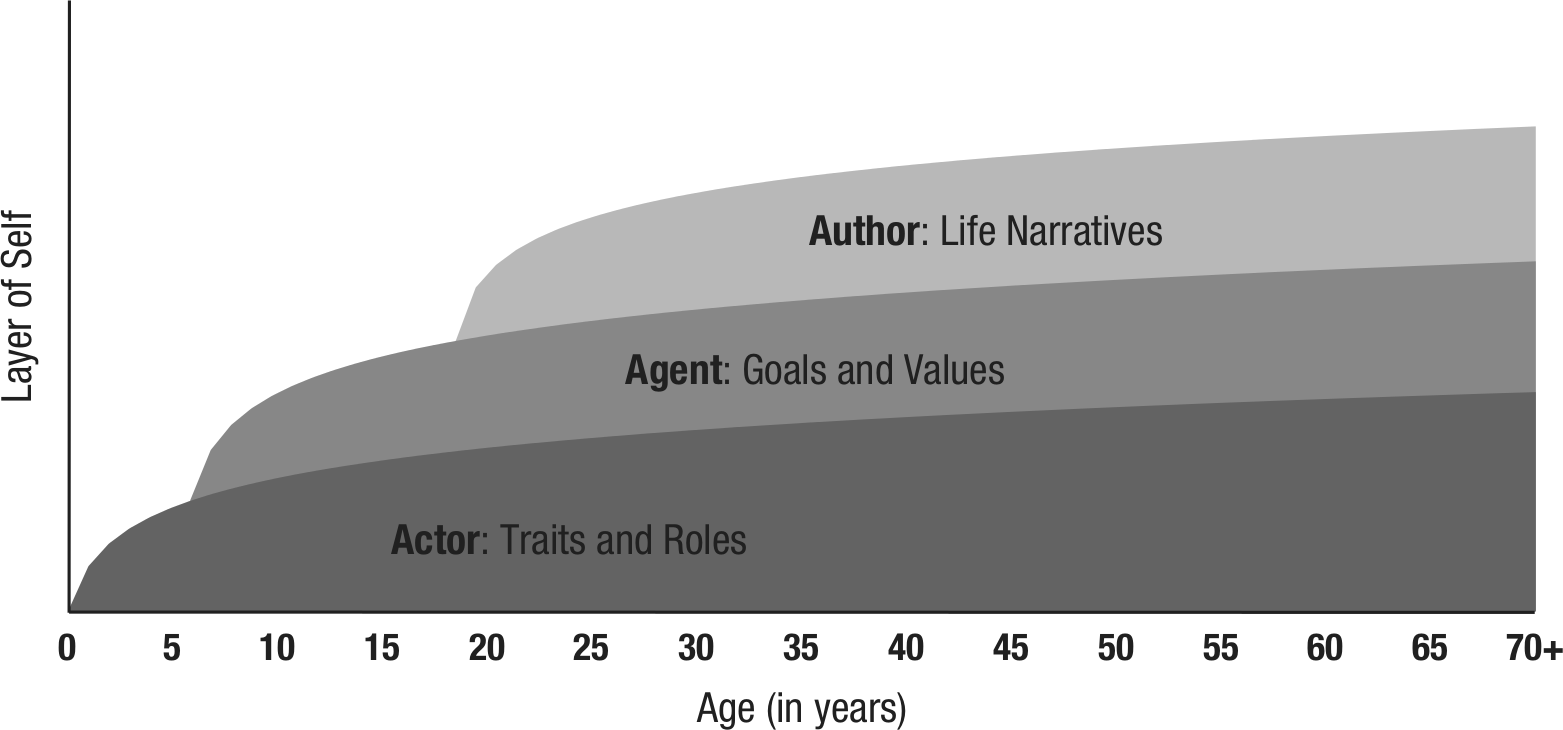
Three layers of self, developing over time.
Narrative identity continues to develop across the adult lifespan. Studies have shown that people’s life stories become more psychologically nuanced and integrative as they move from the emerging adult years through midlife (Baddeley & Singer, 2007). Pasupathi and Mansour (2006), for example, found that autobiographical reasoning in narrative accounts of life turning points increases with age up to midlife. Middle-aged adults showed a more interpretive and psychologically sophisticated approach to life storytelling, compared with younger people. Bluck and Gluck (2004) asked adolescents (ages 15–20), young adults (ages 30–40), and older adults (age 60 and over) to recount personal experiences in which they demonstrated wisdom. Young adults and older adults were more likely than the adolescents to narrate wisdom scenes in ways that connected the experiences to larger life themes or philosophies. Singer, Rexhaj, and Baddeley (2007) found that adults over the age of 50 narrated self-defining memories that expressed a more positive emotional tone and greater interpretive meaning compared with those of college students. Findings like these dovetail with Pennebaker and Stone’s (2003) demonstration, based on laboratory studies of language use and analyses of published fiction, that adults use more positive and fewer negative affect words and demonstrate greater levels of cognitive complexity as they age, at least up through midlife (the 40s and 50s). The findings are also consistent with a broader literature in lifespan developmental psychology showing that middle-aged adults tend to express the most complex, individuated, and integrated self-conceptions, and with research on episodic memory and aging, showing a positive memory bias among older adults (Kennedy, Mather, & Carstensen, 2004).
In sum, the self as author aims to construct a narrative identity within the Me, an autobiographical narrative, or integrated collection of related chapters and scenes, that explains how the self came to be and where it may be headed in the future. The developmental origins of the self as author lie in the emergence of autobiographical memory in early childhood and the development of autobiographical reasoning skills in late childhood through adolescence. Responding to the psychosocial demands of emerging adulthood, the authorial I makes its first full-fledged attempts to define and integrate the self through narrative. Self-authorship continues apace through the adult life course, even as the I continues to know and construe the Me in terms of its traits and roles as a social actor and the goals, plans, and values of the motivated agent. Social action and motivational agendas, furthermore, become grist for the authorial mill. The self as author continues to incorporate personal experiences into the narrative, revising and sometimes dramatically transforming the story to make sense of social action, personal motivation, developmental demands, gains and losses, and the full gamut of changes in the developing author’s world.
Three Perennial Problems for the Self
Among the many topics that empirical psychologists have repeatedly examined under the broad aegis of human selfhood, three stand out as perennial favorites: self-regulation, self-esteem, and self-continuity.
Under the topic of self-regulation, researchers have investigated how people reflexively control or monitor their feelings, thoughts, impulses, and behaviors in social settings (Gailliot et al., 2008). How does the self (the I) keep itself (the Me) in check? What does the I have to do to the Me in order to minimize the possibility of social punishment and maximize social reward? Studies of self-regulation often consider issues of social control, socialization, conscience, moral development, shame, guilt, and a wide range of fundamental issues regarding how people interact with each other. By contrast, research on self-esteem considers those evaluative attributions that the I makes regarding the Me’s worth (Crocker, 2002; Harter, 2006). To what extent does the self (the I) feel good about itself (the Me)? What does the I have to accomplish in order to make the Me into a worthwhile object? What are the contingencies of achievement, failure, and perseverance that the I must confront and endure in order to confer on the Me some sense of worth and well-being? Finally, research on self-continuity considers the extent to which the I apprehends the Me to be continuous in space and time (Sani, 2008). Am I the same person I was yesterday? How will I be different tomorrow? Given all the changes and transformations that the self experiences over time and across different situations, how can the I construe the Me to be a continuous and integrated thing? Or can it? The topic of self-continuity encompasses a wide range of celebrated problems in human selfhood—from dissociative states (Hacking, 1995) to identity crises (Erikson, 1963).
The three perennial problems of selfhood overlap and interact in many ways. For example, deficits in self-regulation are significantly associated with low self-esteem (Doerr & Baumeister, 2010). Each of the three problems, furthermore, may be understood from the perspective of a social actor, a motivated agent, or an autobiographical author. Take self-regulation, for instance. As a social actor, a person must control his or her impulses, monitor inner states, and shape behavior in order to meet situational and role demands. At the level of the motivated agent, self-regulation may involve making decisions to pursue new goals and summoning up the willpower to focus on those goals in the face of potential distractions. For the autobiographical author, self-regulation may be fostered by creating a story about one’s life that underscores the power of self-discipline, God’s will, or some other trope that is well designed to portray and celebrate the protagonist’s abilities to control the self.
Research and theory on self-regulation, self-esteem, and self-continuity, moreover, suggest a developmental logic for these three problems of selfhood that roughly parallels the development of the self as actor, agent, and author (McAdams & Cox, 2010). Over the course of relatively normal development in human selfhood, self-regulation typically emerges as the first and most pressing problem for the self. Preschool children, for example, struggle mightily with controlling their impulses and desires in social situations (as do many adults). But preschool children do not obsess over their self-esteem, and with the exception of autism and related disorders, they do not typically suffer from problems in self-continuity. Research suggests that meaningful individual differences in self-esteem do not appear until about age 7 or 8 (Harter, 2006). In other words, self-esteem does not even show up as a relevant psychological issue in the lives of most people until the school-age years. Self-continuity waits even longer, emerging as a new problem in selfhood for many adolescents and young adults who struggle to formulate an identity (Erikson, 1963; McAdams, 1985). In adulthood, of course, all three problems— self-regulation, self-esteem, and self-continuity—may prove to be psychologically salient.
In keeping with the developmental logic posed above, the current theory proposes that self-regulation first emerges as a problem for the self as a social actor, even as it later shows relevance for agency and authorship as well. Self-esteem’s entrance into the psychological picture corresponds to the emergence of the self as motivated agent in middle childhood; the correspondence is more than a coincidence and instead shows an integral relation between agency and esteem. And whereas self-continuity may prove to be a problem for some children with autism and related disorders, it does not typically pose a problem for most human beings until they reach adolescence (and even then mainly in modern societies; Giddens, 1991), at which time people first face the challenge of authoring a self-defining story for their lives. Creating an integrative story of the self provides a dynamic solution to the problem of self-continuity (McAdams, 1985; Sani, 2008). In sum, self-regulation first concerns the self as social actor, self-esteem first emerges as a problem for the self as motivated agent, and self-continuity typically emerges first as a problem for the self as autobiographical author. The self’s development, then, leaves a legacy of psychological associations, whereby self-regulation is most closely and deeply linked to the I’s understanding of itself as a social actor, self-esteem connects most closely and deeply to the I’s appraisal of its status as a motivated agent, and self-continuity comes to depend largely on the I’s ability to author an integrative autobiographical story of the Me.
Self-Regulation and the Social Actor
One of the prime challenges of being an actor is to learn to control one’s performance. As Goffman (1959) suggested, actors work hard to manage impressions by carefully monitoring and calibrating how they express themselves on life’s many social stages. Losing control can sometimes prove disastrous, for not only does the actor thereby ruin the scene, but he or she may also compromise well-being and reputation for the future. Going back to Plato’s conception of the Republic, the regulation of the self has proved to be one of the most vexing—if not the most vexing—challenges of self-presentation in everyday life. Indeed, five of the seven deadly sins of Christian medieval thought involved failures in self-regulation—greed, lust, gluttony, sloth, and wrath (Baumeister, 1998). It is not surprising, therefore, that many influential social theorists of the 20th century devoted considerable attention to the problem of self-regulation. Freud (1923/1961), for example, imagined the Oedipus complex as the grand solution to the problem of self-regulation. With the internalization of the threatening Oedipal authority and the establishment of the superego, the child gains an internal monitoring mechanism, Freud insisted, the lifelong functions of which are to observe the self and keep impulses in check. Mead (1934) put his money on the external social world. As the child becomes increasingly aware of how the social world sees him or her, the child will monitor behavior more closely and aim to act in ways that meet the approval of the generalized other. Like many theorists, Freud and Mead suggested that self-regulation depends on the observation of the self—the eagle-eyed I watches the Me, like a moralistic hawk. Social performances always have an audience—whether it is others or the self itself. When the audience monitors and critiques in effective ways, selves should become regulated.
The importance of observation for the regulation of the self highlights yet again the reflexive I–Me dynamic of human selfhood. Selves (the I) observe (and ideally regulate) themselves (the Me). In keeping with this theme, a number of contemporary theorists maintain that the prime function of self-awareness itself is indeed the regulation of social action (Higgins, 1996; Silvia, 2002). From this perspective, the great leap forward in self-regulation may be the developmental emergence of self-awareness—the acting I’s recognition of the Me as an actor—around age 2 (Rochat, 2003). Once the I is able to apprehend the Me as an object of reflection, the I can begin to control the presentation of the self on the social stage. Assisting its efforts are powerful social–moral emotions, such as pride and shame (Tangney et al., 2007). Beginning in the 2nd year of life, children feel pride when their actions bring the approval of others. By contrast, they may feel shame, regret, or guilt when their actions bring disapproval, when they fail to live up to a socially mandated standard. As they seek to maximize reward and the feel-good experience of pride and to minimize punishment and the feel-bad emotions of shame and guilt, children should gradually become something like the socialized and self-regulated actors that their ever-watchful audiences—parents and teachers, for example—want them to become.
Throughout the human life course, actors show broad individual differences in their ability to exhibit effective and consistent self-regulation in social performances. Children with strong temperamental inclinations toward effortful control exhibit an “active and voluntary capacity to withhold a dominant response in order to enact a subordinate response given situational demands” (Li-Grinning, 2007, p. 208). Compared with children low in effortful control, they are able to delay immediate gratification and focus their attention on longer-term goals to be achieved and rewards to be obtained. Effortful control appears to be an important factor in moral development and the consolidation of conscience. Being able to control one’s impulses at home and preschool may pave the way for rule compliance and a cooperative manner on a broader social stage. Through effortful control, actors manage to inhibit impulses and summon the strength needed to perform behaviors that will win social approval. Personality researchers have suggested that early differences in effortful control, furthermore, may represent developmental precursors to adult traits of conscientiousness and agreeableness (Caspi et al., 2005).
Self-Esteem and the Motivated Agent
If self-regulation refers to the many ways in which the I aims to monitor and control itself (the Me), self-esteem derives from the I’s reflexive activity of self-evaluation. Although a person’s self-esteem may derive from many different sources, the extent to which he or she is able to achieve goals and realize valued ends and expectations appears to be key. “To have high self-esteem implies both that we consider aspects of our life as important and that we have the confidence to fulfill our expectations,” wrote Hattie (1992, p. 54). Those important aspects of life where we consider achievement important provide us with what Crocker (2002) has termed contingencies of self-worth. “Contingencies of self-worth represent the domains in which success or failure leads to increases or decreases in self-esteem, respectively” (Crocker, 2002, p. 143). In other words, self-esteem is fundamentally about the self’s relative success or failure as a motivated agent who strives to achieve goals in strongly valued domains of life—goals upon which one’s very worth is at stake.
The idea that self-esteem may be intimately tied up with human agency goes back at least as far as William James. James (1892/1963) defined self-esteem with a famous ratio: self-esteem equals “success” divided by “pretensions” (p. 175). What James depicted as “pretensions” includes the goals, values, and expectations that we seek to achieve; success is what we feel when we achieve them, or at least make good progress toward achieving them. The implication in James’s simple conceptualization is that if people did not have pretensions—if they never held out goals to pursue—they would never have to worry about self-esteem. In other words, self-esteem is strongly (though not exclusively) linked to the self as a motivated agent, a goal-oriented striver, a decision maker who exerts his or her will in order to achieve desired ends in the future.
Self-esteem, then, is the logical outgrowth of the I’s tendency to set forth goals and then evaluate its own (the Me’s) progress with respect to goal attainment. As argued above, such a tendency becomes especially salient in the elementary school years, when agential self-attributions regarding purpose and long-term goals greatly enrich the content and structure of the Me. Research on the 5- to 7-year shift suggests that children make important strides in the development of agency between kindergarten and the 2nd or 3rd grade, driven by social interactions with teachers and peers, increasing demands from parents and schools, cognitive–developmental advances, and brain maturation (Sameroff & Haith, 1996). Children begin to see themselves and the world in more systematic and goal-oriented terms. They begin to articulate short-term goals for daily life, reinforced by school schedules and various socializing regimens in their lives. They begin to note just how well they are doing in achieving their most valued goals, and they begin to compare themselves with their peers with respect to goal achievement.
Linking self-esteem to the consolidation of the self as motivated agent in middle childhood fits nicely with Harter’s (2006) findings regarding the development of self-esteem in children. Preschool and kindergarten children show few individual differences in self-esteem, her data reveal. In general, very young children tend to see themselves in a bright positive light. They do not evaluate the self in a critical way. Beginning around age 7 or 8 years, however, children begin to show sharp and consistent differences in their self-evaluations. Some children express consistently high levels of self-esteem, and some reveal consistently low levels, and many, of course, fall between the two extremes. Self-esteem may also be domain-specific (Marsh & Hattie, 1996): A child may feel good about himself in sports but feel inferior in schoolwork. As children move through elementary school, moreover, self-esteem may fluctuate in response to how well things are going for them in the different areas of their lives where they (and others) have invested emotion and value.
Harter (2006) suggested that the emergence of individual differences in self-esteem around the age of 7 or 8 results in part from increasing expectations for achievement coming from parents and teachers and from cognitive–developmental changes that enable older children to compare their own goal-based achievements in various domains—from sports to academics to moral behavior—with the achievements of others. Of course, self-evaluations appear even in areas where it occasionally feels as if little can be done by way of goal attainment. For example, reflexive judgments of physical attractiveness play into self-esteem, especially for girls (Harter, 2006). Even in this domain, however, young people (and older people) may set forth goals for improvement—through dieting, exercise, better makeup and hairstyles, fashionable clothing, plastic surgery, and on and on. For some people, improving one’s physical appearance can become an overriding life goal and a key element in determining overall self-esteem.
Relationships between the self as actor and the self as agent in the development of self-esteem were tracked in a recent longitudinal study of 7,100 individuals, followed from age 14 to 30 years. Examining data from eight assessments of self-esteem over a 14-year period in the Young Adults section of the National Longitudinal Study of Youth, Erol and Orth (2011) showed gradual linear increases in self-esteem from age 14 to 30, for both males and females and for various ethnic groups. At all ages and for all groups, the self-reported social traits of high extraversion, high conscientiousness, and low neuroticism were significantly associated with self-esteem. Dimensions of the self as actor, therefore, relate to how the self as agent evaluates itself. Higher self-esteem was also related to lower risk-taking (suggesting more effective self-regulation) and better health. The researchers’ longitudinal analysis suggested, however, that the prime underlying variable accounting for the normative increase in self-esteem from age 14 to 30 was a sense of mastery, which they defined as “the extent to which individuals perceive having control over their lives” (Erol & Orth, 2011, p. 609). Sense of mastery was measured by self-report items such as “I can do just about anything I really set my mind to” (Erol & Orth, 2011, p. 609). As operationalized in this study, sense of mastery would appear to tap largely into the self’s efficacy as a motivated agent (Bandura, 1989). The findings, therefore, are highly consistent with the current article’s assertion that self-esteem is intimately tied to the self as motivated agent. As the I comes to see the Me as a more strong-willed and confident agent, capable of achieving the valued goals it sets out to achieve, the I comes to esteem the Me as ever more worthy and good.
Self-Continuity and the Autobiographical Author
When considering the problem of self-continuity, psychologists have traditionally invoked the term identity. Erikson (1963) wrote that identity “is the accrued confidence that the inner sameness and continuity prepared in the past are matched by the sameness and continuity of one’s meaning for others” (p. 261). Am I the same person when I am with my parents, with my friends, and with my coworkers? Or am I a different person in each case? Is there a continuity in who I am over time? In what sense am I the same person I was last year? Will I be the same person in 20 years?
Identity, then, concerns the extent to which the self (the I) see itself (the Me) as the same thing across different situations and continuous over time. Going back to Mead (1934), social psychologists have tended to focus their inquiries on the spatial continuities (and discontinuities) of identity: how the self is similar and different across various social situations, with respect to various social demands, and in the context of various social roles. A strong line of social psychological theory and research contends that the self is indeed multifaceted and that people may have many different selves in order to address the many different and competing social scenarios of modern life (e.g., Markus & Nurius, 1986; McConnell, 2011). By contrast, developmental psychologists have tended to focus on continuity (and discontinuity) in identity over time (e.g., Fivush, 2011; Kroger & Marcia, 2011). While acknowledging that the modern I may construct a different Me for each of many different situations, developmentalists have tended to underscore the extent to which the I experiences and aims to construct temporal continuity. Their message has been that amid all the change and flux of contemporary life, the self aims to maintain or discern some sense of continuity with respect to the reconstructed past, experienced present, and imagined future (Sani, 2008).
There are two different senses in which the I experiences itself (the Me) as continuous over time. The first is what Addis and Tippett (2008) called phenomenological continuity, and it refers to a basic, moment-by-moment feeling that I continue to exist as the same locus of feeling, thought, and consciousness. Most people take phenomenological continuity for granted. To invoke James’s (1892/1963) famous example, Peter goes to bed at night fully expecting that he will still be Peter when he wakes up in the morning. Should he, however, wake up to believe that he is now Paul, he would experience a startling disruption in phenomenological continuity. Nonetheless, serious disruptions may indeed occur in real life, as in dissociative states and severe psychosis. Less startling but nonetheless interesting are the disruptions in phenomenological continuity that people routinely experience in dreaming, reverie, and altered states of consciousness.
Addis and Tippett (2008) described a second form of self-continuity as narrative continuity, which refers to a constructed sense of the self as a character in the many different scenes that comprise a story, extending back to the past and forward to the future. In narrative continuity, the I authors an integrative life story that demonstrates continuity by explaining, in narrative form, how the self has changed and how it has remained the same over time. Disruptions in narrative continuity are common. They often go by the name of “identity crisis” or some other term that denotes a period in life wherein the I is struggling to develop a coherent and consistent narrative for the Me. Most commonly, such disruptions characterize the struggle to formulate identity in adolescence and the emerging adulthood years (Erikson, 1963; McAdams, 1985). In these cases, Peter may wake up every morning knowing that, in a basic phenomenological sense, he is still Peter. But he does not know who Peter really is, or who Peter wants to be, or how the Peter of the past (childhood as Peter recalls it) is meaningfully connected to the Peter of the future (adulthood as Peter anticipates it) through a story that makes sense to himself and to others.
Both phenomenological continuity and narrative continuity depend on the full functioning of autobiographical memory. Autobiographical memory encompasses both personal episodic memory (for specific events) and personal semantic memory (for general facts and semantic attributions about the self). Addis and Tippett (2008) argued that phenomenological continuity cannot be experienced without personal episodic memory (sometimes called autonoetic consciousness), which is that function of autobiographical memory that enables the person to engage in mental time travel to reexperience the past. Because the I can reexperience what has happened before, the I is able to feel that the past belongs to Me: I was there and now I am here; I experienced that event long ago, and I continue to experience events now. Episodic memory, Addis and Tippett (2008) argued, also provides the cognitive basis for the simulation of future events: I was there, I am now here, I will be somewhere else in the future. Therefore, the sense that I continue to exist as the same person from one moment to the next, and from the remembered past to the simulated future, appears to be grounded in personal episodic memory. The I needs to be able to travel back in time to remember and reexperience particular episodes in life, and to simulate episodes for the future, in order to feel the most basic sense of temporal continuity in selfhood.
Like phenomenological continuity, narrative continuity also depends on personal episodic memory. The I cannot author a story for the self if it has no access to the specific autobiographical recollections out of which a story is to be made. However, narrative continuity requires more. In constructing a narrative identity, the authorial I does more than merely assemble episodes from the past and juxtapose them with imagined or projected scenarios for the future. The I as autobiographical author must also interpret the meaning of specific episodes. The I must draw conclusions and make connections about the self, which is, as described in earlier sections of this article, what autobiographical reasoning is fundamentally about. In order to construct a life story and consolidate a sense of narrative continuity in time, therefore, the I must also have some reasonable access to personal semantic memory—to the facts about who I am and the semantic dispositions that I routinely attribute to the self as social actor (Klein & Lax, 2010). And the I must be able, through autobiographical reasoning, to form new facts, new conclusions about the self, deriving themes, motifs, causal connections, meaningful insights, and life lessons from the raw episodic data of life.
In this article’s opening case, the temporary amnesia W. J. experienced mainly affected her memory for specific episodes from the past. By contrast, she seemed to retain semantic knowledge about her life—general facts about the kind of person she was, as indicated in her self-report trait ratings. In terms of this article’s central distinctions, W. J. retained a good understanding of herself as a social actor, even as her sense of herself as an author of her life was temporarily compromised. Nonetheless, being an effective autobiographical author relies on both episodic and semantic memory for the self, which together comprise the full gamut of autobiographical memory. In W. J.’s case, any problems she experienced in what Addis and Tippett (2008) depicted as narrative continuity of the self derived from deficits in episodic memory. The same deficits seemed to have little, if any, bearing on her understanding of herself as a social actor. When her episodic memory returned 4 months after the original accident, W. J. likely regained the full complement of cognitive abilities needed for the forging of narrative continuity. It is important to note, however, that those abilities included not only the episodic, time-traveling memory skills she had temporarily lost but also the semantic memory facility that seemed to remain intact all along.
Research in cognitive (Conway & Pleydell-Pearce, 2000), developmental (Fivush, 2011), and personality (McLean et al., 2007) psychology has begun to document the role of autobiographical memory in the self’s construction of narrative continuity. For example, Landau, Greenberg, and Sullivan (2009) showed that maintaining a temporally coherent biography of the self reinforces self-continuity, imbues experience with order and meaning, and helps to insulate the individual from mortality concerns. McLean and Fournier (2008) demonstrated that deriving an organizing theme for one’s life story, especially around the idea of personal growth, helps to consolidate self-continuity and reflects higher levels of ego development.
Beyond the self’s power to author an integrative story for life, it is important to note that self-continuity may also receive psychological contributions from the self as social actor and as motivated agent. In providing self-report assessments about the actor’s extraversion or conscientiousness, the I attributes some degree of dispositional continuity to the Me, as expressed across situations and over time. Indeed, Klein and Lax (2010) showed that even in the wake of severe neural damage, basic dispositional ratings of the self show remarkable durability. Some case studies show that even after a person has lost not only episodic memory but also access to many of the basic semantic facts about one’s life, the person may still retain more-or-less accurate knowledge of what his or her basic personality traits are, or what they were before the onset of severe brain injury (Klein & Lax, 2010). Sources of self-continuity may also be found in the goals and values of the motivated agent. By setting forth long-term goals, the I projects a sense of self-continuity into the future. Still, self storytelling remains the most effective and encompassing mechanism at the I’s disposal for constructing a dynamic sense of continuity linking the reconstructed past and anticipated future. The authorial self is supremely well equipped to create the stories that show and explain how the self of yesterday became the self of today and how the self of today may become the self envisioned for tomorrow.
Culture and the Self
Behavioral and social scientists have long puzzled over how to characterize the complex relationship between individual selves on the one hand and the broader world of social collectives and culture on the other. Dividing psychological selfhood into the three realms of the social actor, motivated agent, and autobiographical author may help to clarify certain features of the relationship between self and culture. Accordingly, it would appear that culture relates to selfhood in correspondingly different ways for actors, for agents, and for authors. In a nutshell, culture may (a) set norms and constraints for the behavioral expression of the actor’s traits and roles; (b) provide timetables, scripts, and strong priorities for the agent’s articulation of goals and values; and (c) provide the psycho-literary menu off of which the author chooses the very images, metaphors, and narratives that can be used to make narrative identity. Cultural effects may be ubiquitous, but the most pronounced and dramatic cultural effects are to be expected for the self as an autobiographical author.
Actor
From the standpoint of the social actor, the I attributes traits and social roles to the Me. The tendency to understand the self and others in terms of broad dispositional categories, such as personality traits, appears to be a cross-cultural universal (Heine & Buchtel, 2009). Moreover, factor-analytic studies of self-report and peer-report trait ratings in a wide range of societies and language groups suggest that the Big Five taxonomy— popularly conceived as extraversion, neuroticism, conscientiousness, agreeableness, and openness—captures well the structure of self-attributed dispositional characteristics in many different cultures (Heine & Buchtel, 2009; McCrae et al., 2005). To say that social actors in many different cultures tend to attribute personality traits to themselves, and to say that the interindividual distribution of those labels tends to follow a five-factor structure, is not to suggest, however, that all people give trait ratings equal weight in their respective understandings of the self as social actor. Research using the Twenty Statements Test, for example, shows that East Asians tend to list fewer traits and more social roles than do North Americans (Heine & Buchtel, 2009). For East Asians, social roles may be more salient features of the self as social actor, compared with North Americans. The reason for this cultural difference may lie in the greater emphasis in certain East Asian societies on social “face.” In Japanese contexts, for example, people are said to attend chronically to society’s gaze (seken), an orientation internalized through socializing experiences that direct attention to how they appear to authority figures and society at large. Although society’s gaze is surely important for all social actors in all societies, the stronger emphasis in Japanese society may focus social actors more clearly on their social roles rather than their traits. As a prototypical actor in Japanese society, the logic goes, I may see myself as more or less “agreeable” or “depressive,” but I am likely to pay even more attention to my role-based social performances as, say, a mother, son, sister, student, or coworker.
The most obvious influence of culture and societal context on the self as social actor lies in the culturally contoured ways in which self-attributed traits and social roles are expressed in social behavior. As trait psychologists are quick to point out, extraversion is extraversion is extraversion, whether the extravert is walking through Manhattan, dining in an Indonesian village, or standing on the moon. People take their traits with them wherever they go; or, in the terms developed in the current argument, the actor I brings its Me—replete with trait attributions and internalized social roles—along to every social stage whereupon it performs. Nonetheless, the specific manner in which traits are enacted and social roles are performed in social contexts is strongly driven by the exigencies of the social contexts themselves. Extraverts who grow up and live in Manhattan do their extraversion thing in a very different way than do those equally extraverted Indonesians who sit down for an evening meal. Likewise, social roles like “son” and “wife” entail different behaviors, duties, and customs in different societies. Therefore, although different cultures may exert some effect on how traits and roles are weighted and arranged in the social Me, cultural influence is more readily apparent in how traits and social roles are actually performed.
Agent
In moving from the social actor to the motivated agent, cultural influence shifts from trait expression and role performance to the goals, values, and other desired ends that different cultures and social groups set forth. It is from the standpoint of the motivated agent that many of the claims regarding cultural differences in individualism and collectivism appear to be most relevant (Markus & Kitayama, 1991). Individualistic societies like the United States typically place a strong premium on goals that enhance the autonomy, achievement, and power of the individual person, over and against the group. What Markus and Kitayama (1991) originally described as the independent self-construal favors values, plans, and goals that make for the separation of the self from others. Each agent pursues its own goals, sets forth on its own journey of self-actualization. By contrast, collectivist societies, such as Japan and China, may encourage the development of interdependent self-construals. In a collectivist context, the self as motivated agent seeks social harmony and connection to the social context. Personal goals should promote broader group goals. Accordingly, self-esteem should rely more on individual achievement in individualistic societies, whereas it should rely more on successful accomplishment of group goals in a collectivist social environment (Heine & Buchtel, 2009; Robins et al., 2008).
Cultural differences in goal pursuit have been revealed in many different studies. For example, goals aimed at avoiding negative states seem to be more common among certain cultural groups than others. In one study, Asian Americans, Koreans, and Russians showed higher levels of avoidance goals, compared with European Americans (Elliot, Chirkov, Kim, & Sheldon, 2001). By contrast, European Americans showed more goals aimed at approaching positive states. Other studies have identified the relative prevalence of a prevention-focused strategy for motivation among members of collectivist societies and a more promotion-focused motivational strategy for members of individualistic societies (Higgins, 2008). Avoidance–prevention goals suggest social vigilance and caution; the I takes care to construct a Me that does and receives no harm, aimed at achieving security and social harmony. Approach–promotion goals, by contrast, may suggest personal entrepreneurship and the uninhibited pursuit of self-fulfillment. In the extreme, the individualist I construes the Me to be a high-stakes risk taker, a restless, intrepid, internally energized, autonomy-seeking, ever-striving agent on the run.
Beyond prioritizing content and salience for personal goals, values, and life plans, culture also sets norms for the timing of goal pursuit and goal disengagement. From a life course perspective, societal norms set expectations and constraints regarding not only what goals to pursue but when to pursue them and when not to (Elder, 1995). Religious traditions and ethnic heritage may set up expectations as to when in the life course one should pursue goals related to family formation, career development, leisure pursuits, and other aims and ends related to work, love, and play. Gender norms may be especially powerful in this regard. As motivated agents, men and women may confront substantially different culturally shaped agendas for goal pursuit over the life course. To take an example so common that it has become almost trite, many professional women in American society face especially daunting challenges, compared with their male counterparts, in balancing their goals for professional advancement and raising a family. Intensive longitudinal studies of women and men over the adult life course have demonstrated how gender, ethnicity, and class shape the complexities of self-development in the realm of goals, values, interests, and other motivational concerns (Peterson & Duncan, 2007).
Author
For the autobiographical author, culture provides the basic forms, metaphors, motifs, and plots out of which narrative identity is made. Life storytelling is not simply a matter of recalling those favorite or most significant episodic memories that stand out from the autobiographical past. How the memories are told, how they are linked together to make a coherent story, what meanings are drawn from them, what causal explanations are offered to document a narrative point about the self, what counts as a convincing or dramatic or compelling narration—all of this is determined by prevailing cultural standards regarding what a good story is and should be (Hammack, 2008; McAdams, 2006). “We are the plagiaristic authors of our own identities,” Tafarodi (2008, p. 38) writes. The autobiographical author borrows and appropriates a culture’s prevailing narrative forms, images, metaphors, and plots and fits his or her personal experience to them—taking great literary license, for sure, but always within culture’s narrative constraints.
Different narrative identities make sense within different kinds of cultural contexts. Depicted in Erikson’s (1958) classic study of Martin Luther’s identity, the stories Luther told about himself—replete with physical encounters with the devil and saints—made perfect cultural sense in 16th-century Christian Germany, but they strike the contemporary ear as strange. A member of a rural Indian village may account for his sanguine temperament by invoking a lifetime diet of cool and dispassionate foods (Shweder & Much, 1987). His story will make sense to his peers in the village, but it will not fit expectations for life-narrative accounts among Euro-American middle-class residents of Naperville, Illinois. Within modern societies, different groups are given different narrative opportunities and face different narrative obstacles. Especially relevant in this regard are gender, race, and class divisions in modern societies. Linking agency to authorship in the self, feminist author Carolyn Heilbrun (1988) remarked that many women have traditionally “been deprived of the narratives, or the texts, plots, or examples, by which they might assume power over—take control of—their own lives” (p. 17). The historical and contemporary life experiences of many African Americans do not always coalesce nicely into the kind of life-narrative forms most valued by the White majority in the United States (McAdams, 2006). Narrative identity, therefore, reflects gender and class divisions and the patterns of economic, political, and cultural hegemony that prevail at any given point in a society’s history.
Cultural norms provide moral legitimation for life stories (Taylor, 1989). In constructing a narrative identity, authors “subscribe and conform to culturally prescribed narrative structure in order to maintain the conviction that they are on a significant journey unfolding in a systematic and meaningful progression that the culture deems appropriate and worthy” (Landau, Greenberg, & Solomon, 2008, p. 93). According to Hammack (2008), a particular culture may offer a master narrative that captures the fundamental journeys and conflicts that its people have traditionally faced. In research on Israeli and Palestinian adolescents, Hammack (2008) showed how the form and content of individual stories often reflect cultural master narratives—morality stories of persecution and triumph for the Israeli youth, the tragedy of a lost land and stolen identity for young Palestinians. Cohler and Hammack (2007) identified master narratives of struggle and emancipation in the historical development of gay and lesbian culture in the United States.
McAdams (2006) argued that master narratives in American society typically exemplify the theme of redemption. In redemptive life stories, the protagonist endures suffering in order to attain enhancement later on. In a series of nomothetic and idiographic studies conducted over the past 15 years, McAdams and colleagues have consistently found that midlife American adults who enjoy high levels of psychological health and who score especially high on self-report measures of generativity—indicating a strong commitment to promoting the well-being of future generations and improving the world in which they live—tend to highlight redemptive episodes in autobiographical memory and tend to see their lives as following a redemptive arc (McAdams, 2006; McAdams, Diamond, de St. Aubin, & Mansfield, 1997; McAdams et al., 2001).
In the redemptive life stories told by highly generative American adults, the protagonist typically (a) enjoys a special advantage or blessing early in life, (b) expresses sensitivity to the suffering of others or societal injustice as a child, (c) establishes a clear and strong value system in adolescence that remains a source of unwavering conviction through the adult years, (d) repeatedly overcomes adversity, (e) tries to integrate experiences of power and love, and (f) looks to achieve goals to benefit society in the future (McAdams, 2006; McAdams et al., 1997; see also Walker & Frimer, 2007). Taken together, these themes articulate a master narrative prototype regarding a gifted hero who, equipped with clear moral values, journeys forth into a dangerous world, confronts and experiences suffering of various kinds (e.g., loss, failure, pain), and eventually gives back to society, while emerging better or wiser for the pain and suffering endured. For highly generative American adults, McAdams (2006) argued, this kind of narrative identity sustains hope and confidence that their hard work to benefit others and improve society today will pay off in the future. The redemptive life stories they author are psychological resources on which they draw as social actors who assume generative roles in society and as motivated agents who have made long-term commitments to improving the lives of others.
The redemptive life stories that highly generative American adults author for their own narrative identities say as much about American culture as they do about the individual authors themselves. McAdams (2006) argued that the life story themes expressed by highly generative American adults recapture and couch in a psychological language especially cherished, as well as hotly contested, ideas in American cultural history—ideas that appear prominently in spiritual accounts of the 17th-century Puritans, Benjamin Franklin’s 18th-century autobiography, slave narratives and Horatio Alger stories from the 19th century, and the literature of self-help and American entrepreneurship from more recent times. Evolving from the New England Puritans to Ralph Waldo Emerson to Oprah, the master narrative of redemption in American society has morphed into many storied forms in the past 300 years, as Americans have sought to narrate their own lives as tales of atonement, emancipation, recovery, self-fulfillment, and upward social mobility. The stories speak of heroic and specially blessed individual protagonists—the chosen people—whose manifest destiny is to make a positive difference in a dangerous world, even when the world does not wish to be redeemed. The stories translate a deep and abiding script of American exceptionalism into the many contemporary narratives of success, recovery, development, liberation, and self-actualization that so pervade American talk, talk shows, therapy sessions, reality TV, Sunday sermons, and college commencement speeches. It is as if especially generative American adults, whose lives are dedicated to making the world a better place for future generations, are, for better and sometimes for worse, the most ardent narrators of a general life story format as American as apple pie and the Super Bowl.
Beyond the study of master narratives, psychological researchers have noted strong differences in autobiographical recollection and life authorship between East Asian and North American societies. For example, North American adults typically report an earlier age of first memory and have longer and more detailed memories of childhood than do Chinese, Japanese, and Korean adults (Leichtman, Wang, & Pillemer, 2003).
Wang and Conway (2004) asked European American and Chinese midlife adults to recall 20 autobiographical memories. Americans provided more memories of individual experiences and one-time events, and they focused their attention on their own roles and emotions in the events. In contrast, Chinese adults were more inclined to recall memories of social and historical events, and they placed a greater emphasis on social interactions and significant others in their stories. Chinese also more frequently drew on past events to convey moral messages than did Americans. Wang and Conway (2004) suggested that personal narratives and life stories fulfill both self-expressive and self-directive functions. European Americans may prioritize self-expressive functions, viewing personal narratives as vehicles for articulating the breadth, depth, and uniqueness of the inner self. By contrast, Chinese may prioritize the self-direction functions, viewing personal narratives as guides for social conduct. Confucian traditions and values place a great deal of emphasis on history and respect for the past. Individuals are encouraged to learn from their own past experiences and from the experiences of others, including ancestors. From a Confucian perspective, the highest purpose in life is ren—a blending of benevolence, moral vitality, and sensitive concern for others. One method for promoting ren is to scrutinize one’s autobiographical past for mistakes in social conduct. Another method is to reflect on historical events to understand one’s appropriate position in the social world. It should not be surprising, then, that personal narratives imbued with a Confucian ethic should draw on both individual and historical events to derive directions for life.
Implications and Conclusion
In assuming the editorship of the journal Self and Identity, Alicke (2009) noted that psychological science has proceeded apace without the guidance of an overarching theory of selfhood: “After all, nobody ever sat down and systematically mapped out what the self was and how it was going to be studied—we just flailed away at what we thought were interesting problems, and eventually a field called ‘the self’ began to emerge” (p. 2). As studies continue to be conducted and empirical results accrue, scientists can certainly learn more and more about a particular phenomenon of interest. But sometimes it is helpful to have an overall theoretical framework within which to situate, articulate, and integrate empirical findings and for the purpose of stimulating new research. The goal of the current article was to sketch out just such a theoretical framework for self—a broad conceptual scheme that reorganizes many different strands of research and theory on the psychological self under the three rubrics of the self as actor, agent, and author. Researchers who study the self can continue to “flail away,” to use Alicke’s (2009) apt expression, but the flailing can be evaluated and interpreted in terms of an encompassing theory of what the psychological self is and how it develops over the human life course.
Future empirical and theoretical work should assess the extent to which various conceptions of human selfhood in the broad psychological literature—relational selves, collective selves, bicultural selves, and so on—may be clarified through the application of the actor–agent–author frame. For example, in delineating an organizing framework for collective identity, Ashmore, Deaux, and McLaughlin-Volpe (2004) identified three content components: (a) self-attributed characteristics, such as traits and dispositions, that are associated with a social category; (b) ideology and beliefs linked to a group’s history and position in society; and (c) narratives that a person develops regarding the self and the social category in question. These three correspond closely to the current article’s delineation of the actor’s self-attributed traits (and social roles), goals (and values), and life narratives. McAdams (2005) has argued that sexual identity, especially in the case of gay and lesbian individuals, may likewise break down into characteristic self-attributed traits, values and goals, and one’s narrative about his or her development as a sexual being. Syed (2010) has examined ethnic and academic identities among ethnically diverse college students in terms of their role-based self-attributions and self-defining life stories. In his program for career counseling, Savickas (2011) explicitly identified three psychological features—basic dispositions, occupational goals, and occupational stories— that together comprise a person’s specific occupational identity.
Future research should also examine relationships between specific self features that are identified with different layers of the self. How do the actor’s self-attributed dispositions and social roles connect to the agent’s goals and values and to the main themes that run through the author’s narrative identity? Personality psychologists have conducted some studies linking the Big Five dispositional traits to personal goals (Roberts & Robins, 2000) and to narrative themes in autobiographical recollections (McAdams et al., 2004). One short-term longitudinal study of traits and narratives in college students, for example, found that freshmen high in extraversion, conscientiousness, and openness to experience tended to construct stories of self-exploration and change as seniors (Lodi-Smith, Geise, Robins, & Roberts, 2009). McAdams and colleagues have examined relations between political and religious values on the one hand and the content of life narratives on the other (McAdams et al., 2008). In these studies, politically conservative Christian adults tended to construct life narratives that feature scenes of self-discipline and what Lakoff (2002) called a strict-father morality, expressing strong fears regarding personal turmoil and societal breakdown. By contrast, politically liberal Christian adults tended to feature life-story scenes of self-exploration and what Lakoff (2002) called a nurturant-caregiver morality, expressing strong fears regarding inner emptiness.
The delineation of self into actor, agent, and author suggests a new agenda for research on the development of self understanding. Features of the social actor, the motivated agent, and the autobiographical author may relate to each other in meaningful ways at any given point in developmental time, and they may also change over time in predictable ways. Research has yet to examine how features of the self as social actor at Time 1, for example, relate to features of the self as motivated agent at Time 2. How do self-attributed traits in childhood relate to goals and values that emerge later in life? Do certain features of the self as actor and as agent combine in predictable ways to herald the later emergence of particular kinds of narrative identities? How do narrative identities draw on trait-based and role-based experiences from the past? With respect to the last question, for example, researchers have examined how family stories (Fivush, Bohanek, & Marin, 2010) and tales told by grandparents (Pratt, Norris, Lawford, & Arnold, 2010) influence the development of narrative identity in adolescence and young adulthood. Research on episodic future thought (Szpunar, 2010) suggests that the ability to simulate scenes for the future is linked to the ability to recollect episodes from the autobiographical past. The agent’s long-term goal planning may shade into and draw from the author’s propensity for making narrative sense of the past. From late childhood through emerging adulthood, therefore, how do goal setting and life planning develop, and how is that development related to the emergence of the self as an autobiographical author?
In his controversial biography of former U.S. president Ronald Reagan, Edmund Morris (1999) created a fictional character who served as a perpetual audience for the book’s protagonist. Morris argued that Reagan’s identity was that of an actor, through and through. The only way to comprehend an actor, Morris insisted, is to observe how his action affects an audience. Are some selves structured like what Morris imagined for Ronald Reagan? Are some people mainly social actors, nearly devoid of long-term agentic goals and an integrative life narrative? Do people show individual differences in the extent to which their self understandings are dominated by either the perspective of the social actor, the motivated agent, or the autobiographical author? Do certain people, like Ronald Reagan perhaps, understand themselves mainly in terms of traits and social roles? Others mainly in terms of goals and values? Still others mainly in terms of the stories they recall about who they are and have been? If broadly different styles of selves can be identified—people who are mainly actor selves, or agent selves, or author selves—do these styles relate differentially to psychological health and well-being? And what might the developmental sources of these differences be? Mar and Oatley (2008) argued that reading novels and other forms of fiction simulates social experience and improves readers’ social interactions. Does such reading also help to build an authorial self?
Applications of the actor–agent–author perspective to social psychological investigations of self can be readily identified. For example, many social psychological experiments attempt to prime an identifiable quality of self in the laboratory, such as an independent or interdependent self, an individualistic or collectivist self, a self associated with a particular national or ethnic identity, or a self associated with a particular domain in the person’s life (e.g., Oyserman & Lee, 2008). Priming occurs through the introduction of a self-relevant stimulus. To date, researchers have not typically distinguished between priming stimuli that connect primarily to the self as social actor, the self as motivated agent, or the self as an autobiographical author. What are the implications of priming a particular quality of selfhood through stimuli suggestive of, say, trait attributions (actor), or particular values and goals (agent), or via narratives that speak in one way or another to the self as author? Might the combination of stimuli from all three self positions—actor, agent, and author—make for more robust priming effects?
Hundreds of studies in social psychology have shown that people are motivated by both self-enhancement and self-assessment (sometimes called self-verification or self-consistency) concerns (Gregg, Sedikides, & Gebauer, 2011). Put simply, the I seeks to enhance the Me—to make it bigger, better, stronger, and more excellent. The I also seeks to make the Me consistent, understandable, and predictable. For the most part, studies of self-enhancement and self-assessment have not distinguished between actor, agent, and author features of the self. Might different strategies for self-enhancement and self-assessment be correspondingly identified with the actor, agent, and author perspectives? Social actors may self-enhance in different ways than do motivated agents. And it would seem that the perspective of the autobiographical author—with the tremendous narrative license that comes with storytelling—might be especially germane for the I’s efforts to enhance the Me and to construct a Me that seems consistent and verifiable.
In conclusion, dividing the psychological self into actor, agent, and author helps to synthesize theories and research from many different fields in psychological science while suggesting a promising new agenda for future inquiry. The integrative framework provided herein also reprises many of the most basic questions about human selfhood, which themselves trace back to classic philosophical sources (Taylor, 1989). Who am I? What kind of a self does the I construct for, with, and out of the Me? How does the I regulate the Me, confer esteem on the Me, and forge a sense of the Me’s continuity over time? How does culture influence the I’s construction of the Me? Psychological science is still a long way from providing full answers to these compelling questions. But repositioning these questions within a broad and integrative conceptual framework may promote the search for answers. The new framework follows from this simple assertion: Human selves begin as social actors; eventually they become motivated agents and autobiographical authors, too.
Footnotes
Acknowledgements
The author would like to thank the following colleagues for their generous and critical comments on drafts of this article: Donna Rose Addis, Jonathan Adler, Charles Carver, Keith Cox, Jeremy Frimer, Simone Ispa-Landa, Shinobu Kitayama, Stan Klein, Jack Martin, Kate McLean, Monisha Pasupathi, Mark Savickas, Ken Sheldon, Dorthe Thomsen, Kali Trzesniewski, and Joshua Wilt.
Declaration of Conflicting Interests
The author declared no potential conflicts of interest with respect to the research, authorship, and/or publication of this article.
Funding
The composition of this article was supported by a grant from the Foley Family Foundation to establish the Foley Center for the Study of Lives at Northwestern University.