






Abstract
Why do people punish wrongdoers when they are not personally affected? Researchers on costly third-party punishment have long debated whether such behavior reflects strategic self-interest or a moral commitment to fairness and justice. Recent developmental evidence offers important insights into this question. We argue that the origins of costly third-party punishment in early childhood are best explained by nonstrategic moral concerns. Young children selectively punish norm violators, incur personal costs to do so, and intervene even when they stand to gain nothing—often without reputational incentives or expectations of future benefit. Empirical studies indicate that children’s punishment is driven by egalitarian norms, retributive motives, and efforts to alleviate victims’ distress. In contrast, strategic motivations, such as reputation management and self-protection, appear only later in development. These findings challenge the view that third-party punishment is grounded in self-interest and instead support the idea that a concern for justice underlies the earliest forms of human norm enforcement. We conclude that whereas strategic considerations may shape punishment in adolescence and adulthood, they build upon an early-emerging moral foundation centered on fairness and justice.
One major debate in the behavioral sciences concerns how cooperative norms take root in society and are maintained in the face of norm violations. How do people respond when they witness someone treating others unfairly or causing harm? Adults often intervene against such moral transgressions—even as uninvolved third parties who are not directly affected (Balafoutas et al., 2014b; Molho et al., 2020; Pedersen et al., 2019). Behavioral scientists have operationalized this as “costly third-party punishment” in anonymous experimental settings with real stakes of money, demonstrating that adult participants are willing to pay some of their own money to punish individuals who behave unfairly toward others (Fehr & Fischbacher, 2004a; Henrich et al., 2006; Nelissen & Zeelenberg, 2009; Yamagishi et al., 2017). This behavior is striking because it cannot be easily explained as a desire to maximize personal gain or as retribution for a personal affront. Consequently, it has sparked ongoing debate about the motivations underlying costly third-party punishment. In this article, we focus on proximate explanations for how third-party punishment is generated—that is, the mechanisms underpinning the behavior—rather than ultimate explanations of why the behavior is favored from an evolutionary perspective (Scott-Phillips et al., 2011).
One prominent perspective—referred to here as the strategic-selfishness account—holds that although third-party punishment is costly in the short term, it is driven by the promise of long-term personal benefits. For instance, individuals may punish wrongdoing to bolster their reputations as principled or trustworthy members of society (e.g., Barclay, 2006; Jordan et al., 2016; Kurzban et al., 2007) or to deter others from treating them unfairly in the future (e.g., Krasnow et al., 2016). According to this account, although costly punishment may seem altruistic in one-off encounters, it serves the punisher’s self-interest over time through these strategic pathways (Delton & Krasnow, 2017; Krasnow et al., 2016; Nowak & Sigmund, 2005; Raihani & Bshary, 2015, 2019). Therefore, individuals should be particularly motivated to intervene when they can anticipate some direct or indirect benefit to themselves in the future.
However, an alternative view—which we will refer to as the justice account—posits that people engage in costly third-party punishment out of a commitment to justice and fairness. Under this view, individuals punish norm violators not strategically, to gain a personal advantage, but to uphold cooperative norms within their community (Fehr & Fischbacher, 2004b; Fehr & Henrich, 2003) or as an act of deserved retribution for a moral violation (e.g., Carlsmith et al., 2002). Advocates of this account argue that people are willing to punish unfair behavior even without immediate benefits or future personal gain (Carlsmith et al., 2002; Darley et al., 2000; Fehr & Fischbacher, 2004b; Fehr & Henrich, 2003). Rather, a sincere concern for justice motivates their desire to intervene against transgressors.
Although this theoretical debate has been active for many years, it has focused almost exclusively on evidence from studies with adults. Here we argue that insights from work with children make an important contribution by focusing on the foundational processes of norm enforcement in development and providing a test case for the main claims about the underlying psychological processes of third-party punishment.
To show how these insights can contribute, we first outline how developmental research can inform this theoretical debate, then examine how empirical evidence supports or challenges each perspective, and finally advance our hypothesis that costly third-party punishment originates from a sense of justice and fairness.
How Do Developmental Studies Contribute to This Debate?
Developmental research with children can contribute to the debate about the motivations underlying costly third-party punishment in at least two important ways. First, studies involving children can help determine the degree to which self-serving concerns are fundamental to third-party punishment by examining whether young children’s punitive behaviors are motivated by such concerns.
Second, if strategic self-concerns are a primary driver—as proposed by the strategic-selfishness account—then the emergence of third-party punishment should depend on the development of relevant social-cognitive skills, such as perspective-taking, anticipating future social interactions, and managing one’s reputation and self-image. Unlike studies with adults, developmental research can examine the timing of these abilities in relation to the onset of third-party punishment. If children engage in such punishment before these cognitive skills have fully developed, this would challenge the notion that strategic self-interest is foundational to third-party punishment in humans.
In the following section, we review the development of costly third-party punishment and identify its key components.
When Do Children Punish?
Several important components of third-party punishment emerge early in development. Preverbal infants as young as 8 months have been shown to direct their gaze to punish computer-animated agents in a gaze-contingent paradigm (Kanakogi et al., 2022), suggesting that even at this young age, infants support the punishment of transgressors as unaffected third parties.
By age 3, children begin to verbally protest when someone fails to follow conventional rules during play. For example, children verbally intervene by saying “No! It doesn’t go like this!” or try to teach to others the correct way of playing, even for solitary and noncompetitive games (Köymen et al., 2014; Rakoczy et al., 2008, 2009). These findings indicate that 3-year-olds intervene against conventional rule violations through verbal protest, even when they are not directly affected. Similarly, in moral norm violations—such as when one individual destroys another’s belongings—3-year-olds protest verbally (e.g., “No, you’re not supposed to do that”) or tattle on the wrongdoer even if they are not directly affected by the transgression (Vaish et al., 2011; Yucel & Vaish, 2018).
Although these studies demonstrate key components of third-party punishment in young children—namely, interventions in third-party contexts—they do not capture fully developed, costly third-party punishment. In particular, infants and children in the above studies were not required to incur a personal cost to intervene (Kanakogi et al., 2022; Köymen et al., 2014; Rakoczy et al., 2008, 2009; Vaish et al., 2011; Yucel & Vaish, 2018), meaning the trade-off between self-interest and norm enforcement was not present. As a result, it remains unclear whether children are willing to intervene when doing so comes at a personal cost.
However, in real-world settings, third-party punishment is rarely cost-free. Individuals who intervene in transgressions often incur personal costs—whether material, physical, or social—to uphold social norms (Balafoutas et al., 2014a; Molho et al., 2020; Nikiforakis, 2008). For example, adults who are punished often retaliate against their punishers (Denant-Boemont et al., 2007; Fehl et al., 2012; Zheng & Nie, 2013). Beyond material costs, punishment can also involve significant social or emotional costs, such as disapproval from others (Adams et al., 2012). Therefore, to accurately model the trade-off between self-interest and norm enforcement in experimental settings, it is important to also test third-party punishment that involves costs.
For these reasons, studies have implemented experimental paradigms to test costly third-party punishment that meets at least three key criteria: (a) the punisher must be an unaffected third party, not a second party who is directly harmed by the transgression; (b) the punisher must incur a personal cost in order to punish; and (c) the punishment must impose a cost or harm on the transgressor. This article focuses primarily on costly third-party-punishment behavior in children.
Typical costly third-party punishment in childhood is measured using paradigms such as those developed by McAuliffe et al. (2015). In these tasks, children first observe a norm violation as uninvolved third parties. For example, they watch a divider allocate six windfall resources (e.g., candies or tokens exchangeable for prizes) either fairly (3–3) or selfishly (6–0) between themselves and a recipient. As third parties, children are then given the option to punish or not (see Fig. 1). If they choose to punish, all six resources are removed from both the divider and the recipient. If they choose not to punish, the divider’s allocation remains unchanged. Three key findings emerged from this and similar tasks designed to measure costly third-party punishment in children.
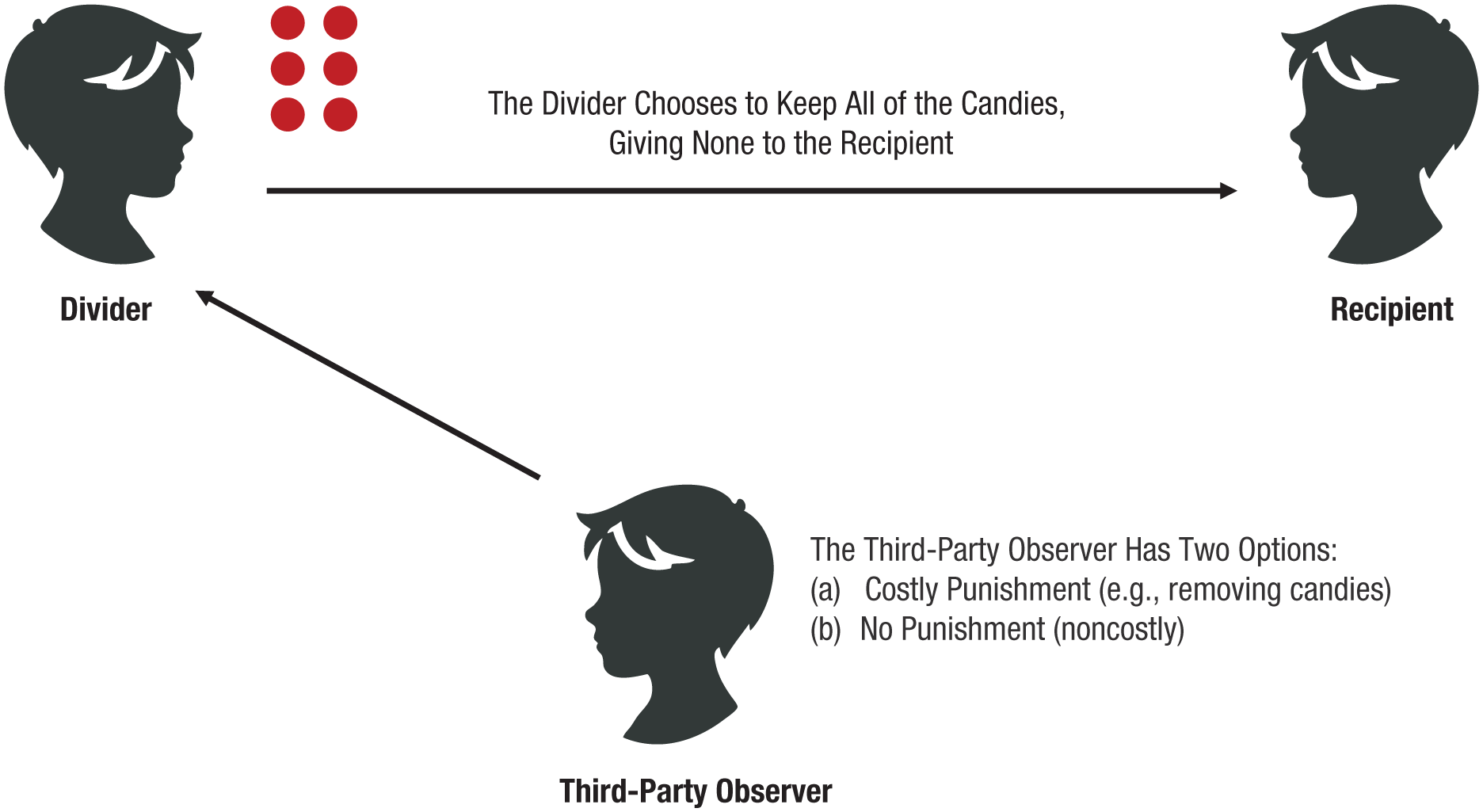
Schematic representation of a typical costly third-party-punishment task.
Children target norm violators for punishment
First, as children develop, they become increasingly likely to punish norm violations—such as unfairness or harm to others—while refraining from punishing nonviolations, indicating a selective response to moral transgressions (Arini et al., 2021; Gummerum & Chu, 2014; House et al., 2020; Jordan et al., 2014; Lee & Warneken, 2022a, 2022b; Marshall et al., 2021; McAuliffe et al., 2015, 2025; Yudkin et al., 2020). These findings suggest that children’s punishment is neither random nor driven by spite, but rather reflects a sensitivity to moral norms. This selective-punishment tendency has been found in diverse societies across the world, including both Western and non-Western children. Across societies, one robust finding is that, as children age, they increasingly punish selfish, unfair sharing over fair sharing; however, the magnitude of this preference for punishing unfairness varies cross-culturally (House et al., 2020; McAuliffe et al., 2025).
One cross-cultural study (House et al., 2020) examined how local adult models might shape children’s third-party-punishment behavior, which in this study involved taking tokens away. They found that in three of six societies, children responded more strongly to a prime showing that punishing unfair sharing is appropriate and punishing fair sharing is inappropriate (punish–unfairness prime) than to the reverse (punish–fairness prime). That is, the increase in punishment of unfairness after the punish–unfairness prime was greater than the decrease after the punish–fairness prime. Notably, in none of the six societies did children significantly reduce their punishment of unfair sharing when explicitly discouraged from doing so by an adult. These findings are consistent with the view that children conceptualize punishment as targeting unfair, selfish behaviors and resist punishing fair behaviors even when encouraged by an adult model to do so.
Children punish even when they are unaffected third parties
Second, children choose to punish transgressors even when they are not personally affected by the transgression, showing that their actions are not driven by personal revenge (Arini et al., 2021; Gummerum & Chu, 2014; House et al., 2020; Jordan et al., 2014; Lee & Warneken, 2022a, 2022b; Marshall et al., 2021; McAuliffe et al., 2015, 2025; Yudkin et al., 2020). One might question whether children truly understand the distinction between third-party and second-party contexts—that is, whether they mistakenly believe the transgression affects them directly. Although comprehension checks have addressed these concerns, a study by Bernhard et al. (2020) directly addressed this possibility by manipulating whether the child was the recipient of the divider’s allocation of candies (second-party condition) or an unaffected observer (third-party condition). The results showed that, although children removed candies from unfair dividers more often than fair ones across both conditions, they did so more frequently when they were directly affected by unfairness. This mirrors patterns seen in adults (e.g., Crockett et al., 2014; Fehr & Fischbacher, 2004a) and suggests that children, like adults, distinguish between second- and third-party contexts—yet still choose to intervene in the third-party context.
Children pay a cost to punish
Third, children are willing to incur personal costs to punish moral violations (e.g., Jordan et al., 2014; Lee & Warneken, 2022a, 2022b; Marshall et al., 2021; McAuliffe et al., 2015, 2025; Yudkin et al., 2020). But how do we know these costs are meaningful to children? In McAuliffe et al. (2015), children were randomly assigned to either a costly or nonncostly punishment condition. In the noncostly condition, children could punish (i.e., remove candies from others) without losing any of their own. In the costly condition, punishment required them to give up one of their own candies. The results indicated that children were more likely to engage in third-party punishment when it was cost-free, demonstrating that even the loss of a single piece of candy was meaningful to them. Yet, notably, 6-year-olds still chose to punish unfair sharing even in the costly condition, showing not only a sensitivity to cost but also a willingness to uphold fairness at personal expense.
Moreover, children’s willingness to punish extends beyond material costs. In other studies, children gave up enjoyable experiences to punish wrongdoers. For example, 3-year-olds willingly gave up a chance to go down a playground slide by placing a “Closed” sign on it, preventing a transgressor—who had destroyed another child’s drawing—from using it (Yudkin et al., 2020). Similarly, in another study (Marshall et al., 2021), 5- to 7-year-olds punished a wrongdoer by locking an iPad in a box, thereby denying access both to themselves and the transgressor.
In sum, the developmental studies reviewed above have operationalized children’s costly third-party punishment as a behavioral tendency to impose costs on norm violators at a personal expense, even when the punisher is an unaffected third party. The mechanisms underlying the development of costly third-party punishment remain understudied. Evidence from both adult and child research suggests that affective perspective-taking, compassion for victims (Y. Li et al., 2022; Pfattheicher et al., 2019), and the maturation of behavioral control (Steinbeis, 2018) are likely contributors. One clear finding does emerge: At least by middle childhood, children engage in behaviors that meet the criteria of costly third-party punishment. This raises the important question of the reasons for children to engage in these behaviors.
Why Do Children Punish?
Developmental research has tested a range of possible motivators for children’s costly third-party punishment. Here we begin by reviewing studies testing motivational processes proposed by the justice account—egalitarian norms, retributive motives, and the desire to alleviate victims’ distress—followed by studies addressing the strategic-selfishness account.
Egalitarian norms drive punishment
Punishment, as an act that harms another individual, can serve both prosocial goals (such as promoting fairness and justice) and antisocial ones (such as defeating others or acting out of spite; Raihani & Bshary, 2019). In typical costly third-party-punishment tasks, children may use punishment to assert dominance, outcompete peers, or act spitefully, especially given their powerful position: for example, by paying just one piece of candy, they can remove several candies from another child. To investigate children’s underlying motives, one can assess whether they use punishment to restore fairness, a core principle of justice (Wenar, 2008). If justice-based motives guide their actions, children will view and use punishment as a tool to establish fairness. In contrast, if their behavior reflects antisocial or competitive motives, they will not see or use punishment as a means of restoring fairness or justice.
A growing body of research indicates that children’s use of punishment is closely tied to their concerns about egalitarian norms. For example, in Lee and Warneken (2020), 5- to 9-year-olds learned about a divider who allocated more candies to the self than to another peer. Children aged 7 and older—but not younger children—evaluated a third-party character who took candies away from the unfair divider (thereby restoring equality) more positively than one who took candies away from the deprived recipient (thereby exacerbating inequality). Further, in this work, children overall liked third-party punishers who restored equality, and they increasingly preferred them, with age, over neutral characters. This finding suggests that by middle childhood, children begin to understand and endorse punishment as a means of rectifying existing inequality. Importantly, this developmental period also corresponds to the emergence of costly third-party punishment, in which children selectively target unfair individuals over fair ones (Jordan et al., 2014; Lee & Warneken, 2022a, 2022b; McAuliffe et al., 2015).
Additional evidence comes from Lee and Warneken (2022a), which moved beyond the binary choice of punishment versus no punishment by allowing children to determine the amount of punishment. They found that between ages 5 and 9, children increasingly used punishment to correct inequality between an unfair divider and a disadvantaged recipient. For instance, when the divider kept three coins and gave one to the recipient, older children were more likely to impose a punishment that restored equality—effectively turning the 3–1 split into a 1–1 outcome by taking coins away from the unfair divider. These findings suggest that children not only punish unfairness, but do so with the explicit goal of reestablishing equality between others.
Surprisingly, children seem so focused on equality that they even punish generous allocations. In McAuliffe et al. (2015), when a divider gave all six candies to the recipient (0–6 split), 6-year-olds punished this generous sharing (i.e., removed all six candies) more often than equal sharing, indicating that any deviation from equality, even in the recipient’s favor, may be seen as normatively problematic. Another piece of evidence for children’s focus on equality is that children and adolescents often disregard the intentions behind the distribution and instead focus solely on whether the outcome is equal (Bernhard et al., 2020; Gummerum & Chu, 2014). Together, these findings suggest that children conceptualize third-party punishment as a mechanism for restoring balance between people—even when the imbalance results from generosity. Therefore, children’s concerns about equal outcomes are likely to be a key driver of their punitive behavior.
Children punish transgressors because they deserve it
Second, other potential motivations underlying children’s punishment include retributive and consequentialist motives. From a retributive perspective, punishment is justified because transgressors deserve it in proportion to their wrongdoing (Cushman, 2015; Hoskins & Duff, 2024), making punishment an end in itself that requires no further justification (Carlsmith et al., 2002). In contrast, consequentialists justify punishment by its capacity to achieve valuable social outcomes, typically reducing future transgressions (Cushman, 2015; Hoskins & Duff, 2024). Research with adults has shown that punishment is driven by both retributive and consequentialist motives (Carlsmith et al., 2002; Crockett et al., 2014). For example, adults were more likely to punish transgressors when they knew the transgressors would learn about the punishment. Notably, however, adults were still willing to punish even when the transgressors would remain unaware of being punished (Crockett et al., 2014).
Although philosophers often argue that retribution-based punishment lacks moral justification from a normative perspective (Bentham, 1907; Caruso, 2021; Mills & Crisp, 1998), we maintain that evidence of a retributive motive in children could nevertheless provide support for the justice account in terms of punishers’ own motive as rectifying perceived injustice. In retributive conditions, punishment cannot be communicated to others, minimizing reputational concerns and future benefits. By contrast, consequentialist motives are less diagnostic: Children may punish to teach transgressors and promote fairness and justice, consistent with the justice account, but they may also do so to protect themselves from future exploitation (Krasnow et al., 2016), consistent with the strategic-selfishness account.
Empirical work shows that although children and adolescents punish more often when they are told that transgressors will learn about the punishment (e.g., punishing by limiting transgressors’ access to enjoyable activities or removing their resources), they are still willing to punish even when they are told that the transgressors will remain unaware (Marshall et al., 2021; Twardawski & Hilbig, 2020). This indicates that whereas they may seek to educate norm violators, they are also driven by retributive motives—that wrongdoers deserve punishment independent of future benefits. In such retributive conditions, neither transgressors nor bystanders are informed about the punishment, minimizing reputational or strategic concerns. Yet children still punish, and they do so more when transgressions occur than in control conditions without them, showing that they do not punish out of spite. These findings suggest that children’s punishment aligns more with justice-based concerns than with self-interest.
Children’s interventions focus on alleviating victims’ distress
Third, children’s third-party punishment is sensitive to the emotional responses of victims. This sensitivity may indicate that their punishment is justice-oriented, because justice concerns not only punishing wrongdoers but also addressing the harm suffered by victims (Lee & Warneken, 2020; Mott & Solomon, 2025; Van Camp & Wemmers, 2013).
Empirical research supports this view. For example, 6- to 10-year-olds were more likely to punish unfair dividers (i.e., remove stickers from them) when the victim expressed distress about the unfair sharing (e.g., “Oh, no! That’s terrible! I only got one candy!”) than when the victim responded neutrally or positively (Y. Li et al., 2022). This finding suggests that children’s punitive behavior may be driven not only by norm violations but also by concern for the victim’s emotional state.
Further, when given a choice between punishment and compensation, children often favor helping the victim. Children aged 5 to 9 preferred a third-party character who compensated the victim’s loss by giving candies rather than one who punished the unfair divider by taking candies away (Lee & Warneken, 2020; see also Liu et al., 2021, for similar results). This preference indicates that, when alternative options are available, children tend to support victim-focused responses rather than punishment aimed solely at the transgressor. However, existing findings are mixed regarding whether children prefer to punish or compensate (McAuliffe & Dunham, 2021; Yang et al., 2021), highlighting the need for more research to draw firm conclusions.
In sum, children’s third-party punishment appears to be motivated by egalitarian norms, retribution, and efforts to alleviate victims’ suffering. The developmental evidence reviewed thus far supports the justice account by highlighting children’s concern for fairness and justice. However, an open question remains: could the origins of this behavior also involve self-serving motivations? In the following section, we review empirical studies that have tested this possibility by examining whether children’s punitive actions may also be shaped by strategic self-interest.
Is There Empirical Evidence That Self-Serving Concerns Drive Children’s Punishment of Others?
Adults sometimes engage in third-party punishment in strategic, self-serving ways. For example, they might care about promoting their own reputations, being more likely to enact costly punishment when their decision is observable to others than when it is anonymous (Kurzban et al., 2007; see also Piazza & Bering, 2008). This evidence has been used to argue that adults punish to signal desirable traits—such as fairness or trustworthiness—to potential social partners (Barclay, 2006; Jordan et al., 2016; Kurzban et al., 2007; Nowak & Sigmund, 2005; Piazza & Bering, 2008). It has also been proposed that adults use third-party punishment as a means of self-protection, interpreting a divider’s mistreatment of a recipient as a signal of how the divider might treat them in the future and deter such future behaviors toward themselves (Krasnow et al., 2016). Supporting this view, adults are less likely to punish a divider who treats the recipient poorly if they believe the divider would treat them personally well, using third-party punishment as a personal deterrent (Krasnow et al., 2016; see also Delton & Krasnow, 2017; Petersen et al., 2010). Therefore, at least for adults, strategic considerations may operate alongside concerns for justice and fairness in motivating third-party punishment (see Fig. 2). Do these factors matter for children?
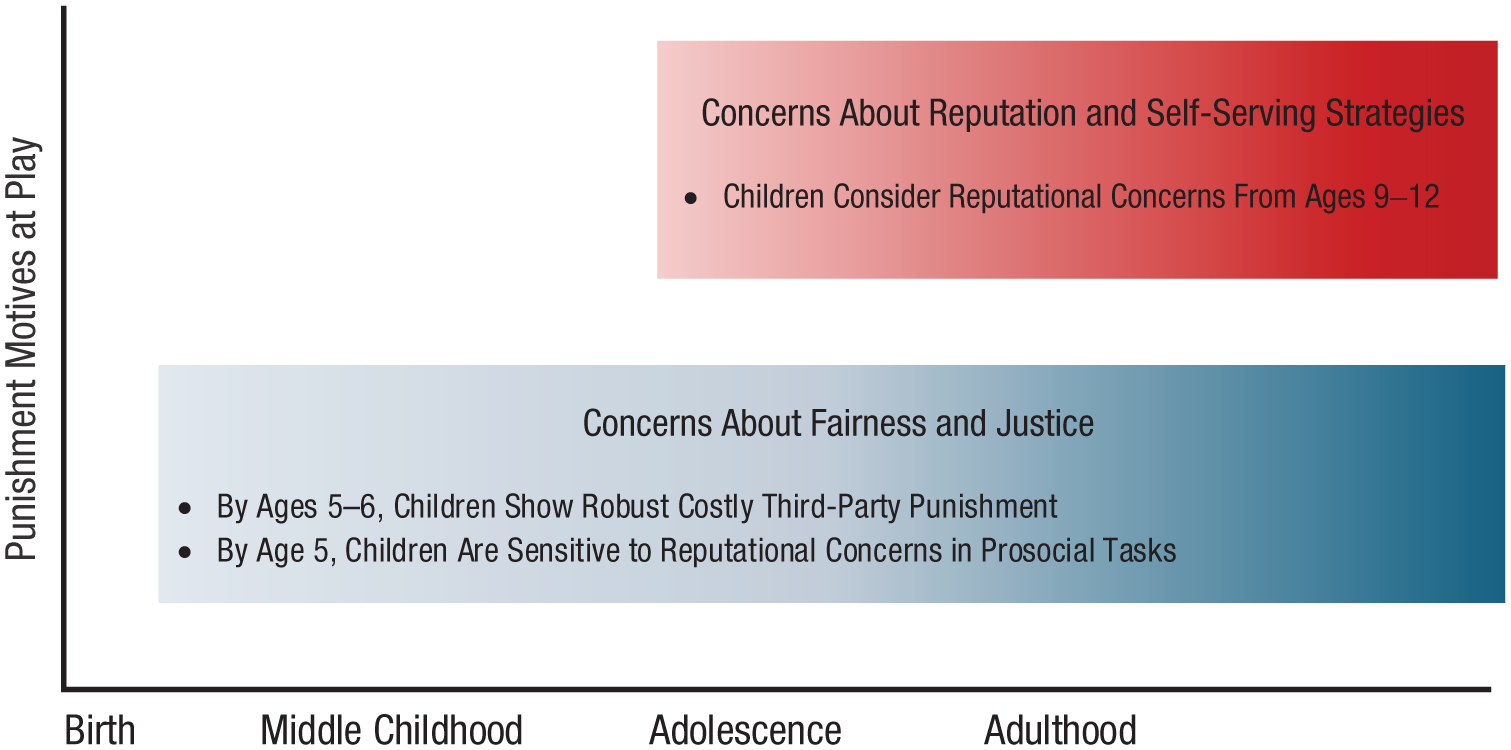
Emergence of difference motives for costly third-party punishment.
Do reputational concerns motivate children’s punishment?
If reputational motivations are foundational, one would expect third-party punishment to appear concurrently with—or after—the development of the social-cognitive skills required for managing one’s reputation. However, existing evidence suggests otherwise. Reputational concerns begin to influence prosocial behavior around age 5: For example, 5-year-olds share more generously when the recipient is aware of the allocation options (Leimgruber et al., 2012), demonstrating sensitivity to others’ perspectives and a capacity for strategic adjustment of prosocial behavior. Also, by 5 years of age, children share more and steal less when they are being observed by a peer compared with when they are alone (Engelmann et al., 2012). Further, explicit reasoning about one’s reputation becomes more evident around age 8 (see Engelmann & Rapp, 2018, for a review). As mentioned above, however, third-party punishment emerges earlier in development, with (e.g.) preverbal infants as young as 8 months directing their gaze to punish antisocial agents (Kanakogi et al., 2022) and 3-year-olds engaging in costly third-party punishment by preventing transgressors’ access to fun activities (Yudkin et al., 2020). These findings suggest that punitive tendencies are present well before children develop the cognitive capacities needed for deliberate reputation management. Taken together, this evidence casts doubt on the idea that reputational concerns are a primary driver of early third-party punishment, although they might boost children’s preexisting desire to punish wrongdoers.
Further support for the limited role of reputation for the emergence of third-party punishment comes from experimental studies that directly manipulate reputational concerns. In one study (Arini et al., 2021), children aged 5 to 11 years were either observed by an audience or remained unobserved during a costly third-party-punishment task. However, the presence of an audience had no significant effect on their punishment behavior. The earliest age at which reputation manipulations affected costly third-party punishment comes from Twardawski and Hilbig (2020) with 9- to 12-year-olds. They were more likely to engage in third-party punishment when they believed a bystander would learn about their actions, compared with when they believed their actions would remain private.
Overall, these findings suggest that although reputational concerns may influence third-party punishment later in development—particularly during adolescence and adulthood—they are unlikely to serve as the primary motivation in early childhood. Instead, the developmental origins of punishment appear to be rooted in children’s concerns about justice. Reputational motivations related to punishment seem to emerge later, building on earlier-developing moral senses (Fig. 2). What mechanism might make adolescents and adults, but not children, sensitive to reputational concerns? Understanding that third-party punishment can signal positive traits to others may underlie this developmental shift. Children as young as 5 can manage their reputations in prosocial tasks, such as sharing (Engelmann et al., 2012; Leimgruber et al., 2012), yet they appear insensitive to reputational concerns in costly third-party punishment until ages 9 to 12 (Twardawski & Hilbig, 2020). This suggests that younger children may not realize that punishing unfairness can convey prosocial qualities, like trustworthiness and fairness, to observers. Because punishment involves harming others, which appears outwardly aggressive, children may be uncertain how observers interpret their actions. Supporting this, 5- to 9-year-olds viewed a third-party punisher of an unfair divider as more aggressive than a helper who compensated a disadvantaged recipient (Lee & Warneken, 2020).
Does personal deterrence motivate children’s punishment?
Another way in which adults use third-party punishment to serve self-interested ends is by deterring potential mistreatment directed at themselves in the future. Do children consider such strategic effects? Lee et al. (2024) tested this possibility by examining whether children’s third-party-punishment decisions are influenced by expectations of future cooperative interactions. As in prior studies, 5- to 9-year-old children acted as third parties deciding whether to punish unfair dividers (i.e., remove coins from them) at a personal cost. The key manipulation involved future partner identity: In the same-divider condition, children knew that after the third-party-punishment task, the unfair divider would also be their future sharing partner, whereas in the different-divider condition, they knew that a new individual would serve as the future partner. If children used punishment strategically to deter unfair treatment directed at themselves, they should have been more likely to punish during the third-party-punishment task in the same-divider condition (vs. the different-divider condition). However, results showed that children punished unfair dividers more than fair ones regardless of the future partner’s identity. These results are inconsistent with the strategic-selfishness account and better align with the notion that children are concerned about themselves and others being treated fairly.
Do resource availability and prior experience shape children’s punishment?
Although there is little evidence that reputational concerns drive third-party punishment in children, other forms of self-serving motivations remain possible. One such possibility is that children’s willingness to punish others may be influenced by how many resources they have at their disposal. Because third-party punishment often involves a personal cost, it could be argued that children who experience fair allocations or were just lucky—and therefore possess more resources—might be more willing to incur that cost compared with those who experienced unfair allocations.
To test this possibility, Lee and Warneken (2022b) manipulated children’s prior experiences with resource allocation. Prior exposure to fair or unfair distributions could affect third-party punishment either by (a) reinforcing the belief that resources should be divided fairly or (b) changing the amount of resources children had available to spend on punishment. To disentangle social experience from resource availability, 5- to 9-year-olds participated in a 2 × 2 between-subjects design, manipulating the allocation type they received (always equal vs. always unequal) and allocator type (peer vs. computer). Children first played a series of second-party games as recipients, consistently receiving either equal or unequal allocations from a peer or a computer. They then completed a standard third-party-punishment task with a peer, similar to the task shown in Figure 1. If third-party punishment were shaped by self-interest—such as resource availability or prior (un)fair treatment from other people—punishment rates should differ across conditions. Instead, children punished unfair dividers at similar rates regardless of allocation type or allocator, suggesting that third-party punishment is not strongly driven by self-serving concerns but is robustly motivated by fairness concerns.
To summarize, although adolescents and adults may engage in third-party punishment for strategic reasons—such as enhancing reputation or deterring future mistreatment—there is currently no empirical evidence that young children’s punishment behavior is motivated by such concerns. Likewise, there is no evidence that children’s punitive actions are shaped by how many resources they possess or by their prior experiences as recipients of fair or unfair allocations.
Conclusions
Overall, developmental research suggests that children’s third-party punishment is less likely to be driven by self-serving motives. Instead, children’s behaviors align more closely with a concern for fairness and justice. At least early in development, children are motivated to engage in costly third-party punishment because of moral considerations rather than strategic or reputational ones. It is not until adolescence and adulthood that self-serving motivations—such as reputation management or personal deterrence—begin to play a more prominent role alongside justice concerns. In conclusion, justice concerns form the foundation for the emergence of third-party punishment in humans.
Future Research Directions
Although there has been a recent surge in developmental research on third-party punishment, relatively few studies have directly tested the role of justice concerns versus self-serving motives. We hope this article draws attention to this important question, which lies at the heart of understanding the origins of cooperation and morality in humans. Although no single study can definitively adjudicate between the justice and selfishness accounts, future work can directly test this question and further probe the robustness of the justice account.
One important direction for research is to examine individual differences in children’s responses to third-party-punishment tasks. To date, most developmental work has focused on average age-related trends, leaving individual variation relatively unexplored. For instance, how does a child’s tendency to punish unfairness relate to their behavior in other prosocial contexts, such as helping or sharing? Addressing this question may clarify whether third-party punishment reflects a broader moral orientation rooted in fairness and justice, or whether it can also emerge from self-serving motivations in certain children.
Additionally, future research should examine whether social desirability, experimenter demand, and cultural conformity partly influence these results (e.g., Dunham et al., 2008). Although the retributive conditions used in prior work (e.g., Marshall et al., 2021; Twardawski & Hilbig, 2020) may minimize such concerns, existing tasks focus primarily on explicit behaviors and thus remain susceptible to the social influences. Notably, these social concerns may not be mutually exclusive with the justice account. Children’s moral understanding does not arise in a vacuum independent of social influences (P. H. Li & Koenig, 2023; Mammen & Paulus, 2023). Rather, children may first learn which behavior is socially desirable and encouraged by other people, and later internalize these behaviors. However, more empirical work is needed to delineate the cognitive and motivational processes through which children develop punishment behavior.
Finally, most studies reviewed here tested children from Western, educated, industrialized, rich, and democratic (WEIRD) societies (Henrich et al., 2010). Recent cross-cultural work has shown that although children in diverse societies tend to punish unfairness, the extent of punishment (and potentially the underlying motives) varies across cultures (House et al., 2020; McAuliffe et al., 2025). Further, in some adult populations, even prosocial acts are punished under certain norms (Herrmann et al., 2008), suggesting that cultural context can shape the meaning and function of punishment. Thus, future studies should explore how cultural norms and socialization practices influence both the development and motivation of third-party punishment.
