







Abstract
This paper reports on the self-assessment of future teachers regarding their familiarity with the Convention on the Rights of the Child and their competency to teach about children’s rights and participation. A total of 561 future teachers were surveyed in Serbia, Croatia, and Slovenia. They all agreed that, during their studies, they did not acquire sufficient knowledge on children’s rights and participation and were not adequately prepared for teaching this content in schools. The authors further suggest an introduction of new study programs and a significant increase in the number of classes dealing with these topics in day-to-day school practice.
Keywords
Introduction
The Universal Declaration on Human Rights (United Nations, 1948) instituted—among other things—the right to education and determined that states should ensure the strengthening of respect for human rights and fundamental freedoms. Decades later, the United Nations Declaration on Human Rights Education and Training (2011) re-emphasized the importance of education, in terms of the right to education, the importance of education on human rights (encompassing all social strata and all forms of education—Article 3, par. 2), and indicated that it is necessary to ensure the professional training of staff, particularly teachers, for the achievement of this goal (Article 7, par. 4).
The 1989 United Nations Convention on the Rights of the Child (UNCRC) is founded on human rights, and in the most general sense its provisions guarantee the human dignity and harmonious development of every child (UNICEF, 2014). The rights from the CRC, that the authors used as their starting point, refer to the child as a rights-holder and adult as the duty-bearer (Jerome et al., 2015). One of the foundations of the Convention is the idea of democracy in education supported by the views of Dewey (1944), who believed that the most important task of the school is to educate future active, participating, and responsible citizens who will have a strong sense of justice. Education must be child-centered and empower for children through the curricula, teaching methods, teaching process, and environment in which it takes place while simultaneously enabling children to express their views in accordance with Article 12(1) and participate in school life (UN Committee on the Rights of the Child, 2001).
Countries that have ratified the CRC 1 have committed themselves to ensuring the welfare of children through respect for their rights. This goal is achieved by national governments, experts, and policymakers, especially in the field of education, by establishing and adopting various documents, but experts and recent relevant sources warn that this is not enough if the conditions for the practical implementation of children’s rights are not met (Rasmusson et al., 2016; Urinboyev et al., 2016).
The goal of integrating children’s rights into the school system is to have children learn about their rights and to design school situations initiated by adults (as well as children), in which students will participate and further develop their civic skills (Keating and Janmaat, 2016). The ones charged with these tasks are the teachers, and that is precisely why ‘the challenge is to educate future teachers to be committed to democratic participation and democracy at school’ (Zyngier et al., 2015: 278).
The starting point for the authors of this paper is the CRC, with participation as an individual right, viewed from the perspective of the school. The focus is on future teachers and their competency for teaching students about children’s rights and participation. The paper posits the following questions: How much do future teachers know about the CRC and children’s participation in school? How do they assess the role of teachers in children’s rights education and preparing students for participation? How do they assess their personal competencies for implementing content related to children’s rights in schools and for preparing students for participation? To answer these questions, the authors first reviewed what and how much is taught about children’s rights and participation in Serbia, Croatia, and Slovenia according to government curricula for primary school; after which they compared study programs which included these topics at faculties for the education of future teachers. The opinions of future teachers themselves on their knowledge of the CRC, individual children’s rights, and participation were examined next, and this was followed by the discussion of results and concluding remarks.
The country context
Even though education has long been identified as an arena in which children’s civil, political, and social human rights need to be met and respected, some authors warn that, in addition to including aspects of human rights and children’s rights in the school curricula, their implementation is often unsystematic and optional and rarely leads to significant education about rights (Robinson et al., 2020). Children learn about their rights through informal learning (i.e. through their experience of the world and the society in which they live), while in formal education they learn about their rights in schools with the help of their teachers (Lenz et al., 2018: 12). The priority task of the school is to prepare young people for different social roles and various aspects of their participation in society (Sargeant, 2018; Sargeant and Gillett-Swan, 2015), that is, it is necessary for schools—through their curriculum and school ethos—to contribute to the development of democracy and global citizenship (Howe and Covell, 2010). Schools should be able to do so under the assumption that teachers—currently active and future teachers—are adequately equipped with both theoretical knowledge and professional skills needed to prepare children for becoming active agents in promoting children’s rights and democratic principles (Guo, 2014). Thus, educational policies—that are reflected in school curricula, and well-educated teachers—who teach students about children’s civil, political, and social human rights, embody the foundations for their realization. Education policies of Serbia, Croatia, and Slovenia are normatively oriented toward the development of competencies for understanding and respecting children’s rights and preparing students for participation in the community. The key starting points are two international documents, that is, the UNCRC (especially articles related to participatory rights) and the Council of Europe Strategy for the Rights of the Child 2016–2021 (strategic goal related to the promotion of children’s participation).
Serbia
The Law on Primary Education in the Republic of Serbia (2019) affirms the school as an institution in which students acquire competencies for identifying and solving various social problems. It enables them ‘to make decisions by using critical and creative thinking, to be ready to accept challenges and changes, to be able to recognize and respect human and children’s rights, and to be able to actively participate in their implementation’ (The Law on Primary Education, 2019: 8). In the educational system of Serbia there is a school subject called Civic Education, and students of a younger school age in Serbia also learn about children’s rights explicitly through certain lessons of the school subjects World Around Us—in the first and second grade (e.g. lesson titled ‘Children’s Rights – Respecting Diversity and the Rights of Others’, first grade), and Nature and Society—in the third and fourth grade (‘Children’s Rights, Group Rules – Knowing, Respecting and Living in Accordance With Them’, third grade; ‘We Are the Children of One World – Convention on the Rights of the Child’, fourth grade). Children’s rights also implicitly appear in Serbian Language and Music Education and are covered by specific topics and lessons (Rulebook on the Curriculum for the First Cycle of Primary Education and the Curriculum for the First Grade of Primary Education, 2017).
Croatia
Education for children’s rights and democratic citizenship in the Republic of Croatia has been unified into curricula for grades 1–4 in the homeroom education curriculum. Students from grades 1–4 in Croatia encounter content on children’s rights explicitly in the subject Nature and Society. Of the four key topics, content on children’s rights can be identified in the topic The Individual and Society. In this topic, one of the outcomes for the first grade is to have ‘the student compare the role and impact of rights, rules and duties on an individual and the community, the consequences of disrespecting them and the importance of responsible behaviour’, and this is further elaborated by having the student learn and talk about children’s rights (Curriculum for the Subject Nature and Society for Primary Schools in the Republic of Croatia, 2019: 15). Within the same topic, in the second grade, this outcome is elaborated by having students discuss children’s rights, while, in the third grade, students discuss children’s rights but also explore the relationship and balance between rights and duties and the causes and consequences of their actions in respecting the rights of others. In the fourth grade, the learning outcome states: ‘The student is able to reach conclusions on the impact of rights and duties on an individual and the community and the importance of freedom for the individual and society’ (Curriculum for the Subject Nature and Society for Primary Schools in the Republic of Croatia, 2019: 24). At the end of the fourth grade, students should be able to act in accordance with children’s rights in everyday life, to actively stand up for children’s rights, promote the rules of a democratic community, and participate in decision-making within such a community.
Slovenia
The development of social and civic competencies concretizes the White Paper on Education in Slovenia (2011), emphasizing education for civic values, respect for children’s and human rights, and fundamental freedoms and the development of competencies for living in a democratic society, as the main focus of primary education (Kolar et al., 2011). The development of social and civic competencies in primary education is integrated in the following subjects: Slovenian Language (years 1–9), Environmental Education (years 1–3), Social and Environmental Science and Technical Education (years 4–5), and in numerous optional subjects (years 7–9). Further, one of the general objectives of the subject Getting to Know the Environment (first, second, and third grade) is ‘to lay the foundations for constructive thinking on the content of citizenship, ethics, local and international responsibility, democracy, justice, safety, human rights, cultural diversity’ (Kolar et al., 2011: 17). The contents are operationalized in the thematic units. The topic of Relationships is implemented by learning the rules that govern social life and learning about law in the first grade, and in the third grade, students are taught that people and countries are interconnected and that therefore there is a need for understanding the necessity of cooperation and mutual tolerance. The curriculum of the subject called Society (fourth and fifth grade) contains the topic People in Society in which basic human rights and children’s rights are taught in both grades. In the fourth grade, in lessons titled Children’s Rights, Human Rights and Duties, students are required to learn about and understand children’s rights, recognize their existence and ways to exercise them. At the end of fifth grade, students should be able to list some of the basic rights, duties and responsibilities of children, as well as the services and people who help children exercise these rights, duties, and responsibilities (Budnar et al., 2011: 11).
Preparation of future teachers—Faculty of Education
To compare the opinions of future teachers on the knowledge of children’s rights and their ability to implement these contents with children at school, teachers from three countries that became independent and separated from Yugoslavia in the 1990s were chosen. The similarities in language, cultural and educational contexts, as well as personal acquaintances, professional cooperation, and joint research of colleagues from the Faculty of Education in Sombor (Serbia), Maribor (Slovenia), and Osijek (Croatia), were decisive in this matter.
The education of teachers in Slovenia, Croatia, and Serbia has undergone various reforms for more than three decades, most notably the Bologna Process. All three countries are striving for the integration of the European educational space, that is, the harmonization of curricula for the initial education of teachers (although Slovenia and Croatia are members of the European Union, and Serbia is not). On the other hand, in the mentioned countries, higher education institutions have autonomy in creating their curricula.
Introduction to children’s rights and their implementation, as well as participation as one of the CRC’s four guiding principles in everyday work with children involves a thorough preparation of the key agents: students, adults (teachers), and institutions (schools). In order for future teachers to be able to implement the content related to children’s rights with students in schools and prepare them for participation, this content must be an indispensable part of their professional training (Percy-Smith et al., 2015), therefore, an analysis of study programs was performed. At the faculties of education in Sombor, Osijek, and Maribor, in undergraduate and master’s academic studies for teachers, children’s rights appear as explicit content (through stated objectives, outcomes, and topics) in several compulsory and optional courses. The segments related to children’s rights and the perspective of participation were extracted from the complete descriptions of these courses, that is, their syllabi, in the following table (Table 1).
Comparative overview of study programs of faculties of education in Sombor, Osijek, and Maribor, which include children’s rights and participation.
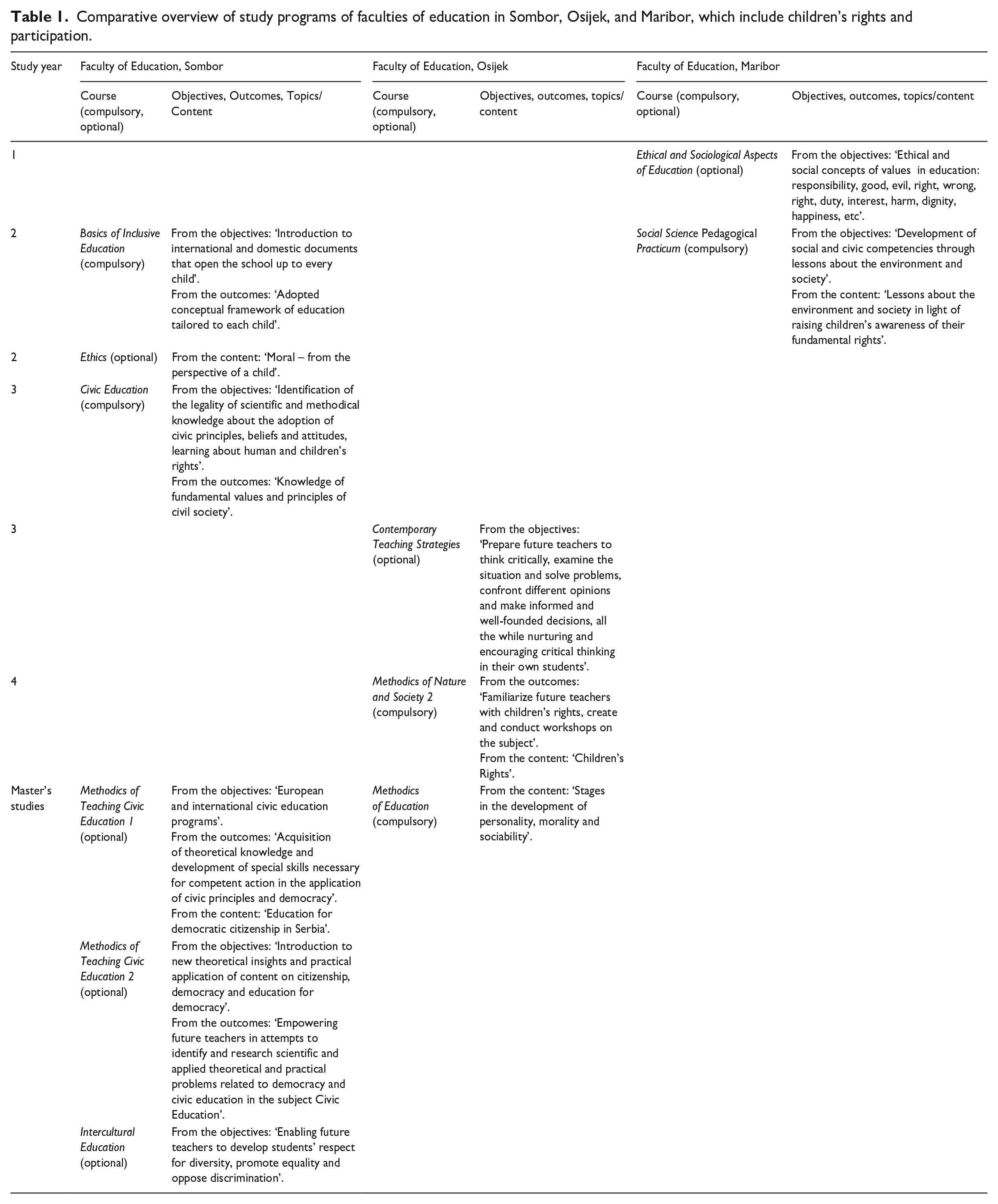
In the current study programs for the education of future teachers in Sombor, Osijek, and Maribor, there are no courses that deal exclusively with children’s rights and participation. One positive example is the Faculty of Education in Sombor, with a compulsory course in the sixth semester called Civic Education, the objectives of which include learning about human and children’s rights.
The implementation of children’s, and especially participatory rights, in school curricula, and their introduction into the daily practice of working with students in schools—implies an adequate preparation of future teachers. It is preceded by the preparation of higher education institutions (in the form of program accreditation), ensuring that future professionals first understand what children’s rights are, what children’s participation means and how it can be achieved. In evaluating the legislation, policies and practices related to children’s participation in the European Union, Percy-Smith et al. (2015) mention the relatively good awareness of children’s rights and participation of adults (experts), but also a lack of specific skills on how to practically implement these topics with students in schools. In that sense, the purpose of this study was to examine how future teachers from the faculties of education in Sombor, Osijek, and Maribor assess their knowledge of children’s rights and participation, and how they assess their competency to implement CRC-related content with students in their future schoolwork.
Method
The study was based on a descriptive and non-experimental method of empirical pedagogical research. The data collection tool was developed by the researchers and named ‘Children’s Rights and Participation – Can They Be Taught?’. The survey questions were partially taken from the study Teaching and Learning About Child Rights: A Study of Implementation in 26 Countries (Jerome et al., 2015). Some questions were modified in accordance with the aim of the study, and a final questionnaire was thus developed and used. The questionnaire was piloted in May 2019 with 30 future teachers from the Faculty of Education in Sombor who volunteered to participate. The feedback that they provided allowed the authors to eliminate ambiguities and identify gaps (Bryman, 2008). The final data collection tool included 30 items and was divided into four segments. The first segment collected demographic data on the respondents (age, gender, previously acquired educational profile, current year of study). The second segment collected data related to the respondents’ knowledge and understanding of the CRC and individual rights; their ability to identify children’s rights as educational objectives; their assessment of the role of schools and teachers in the realization of these objectives; and their attitudes about the inclusion of content related to children’s rights in study programs. The third segment determined whether the respondents knew that educating children about their rights was part of their future occupation, and then assessed how noticeable children’s rights were during school practice they attended, and in what ways. The respondents then expressed their attitudes toward the exercise of children’s right to voice opinions and participate in school, and assessed the role of teachers in this matter. The fourth segment consisted of the respondents’ self-assessment of their current competency for implementing content related to children’s rights and participation in school with the students, after which the respondents were asked to pinpoint the forms of scientific and professional support that would help them develop this competency during their studies. Apart from the first four items (which referred to data on the respondents), the following 23 items were measured with a five-point Likert scale (ranging from 1—strongly disagree to 5—strongly agree), while the last three items asked respondents to circle one of the offered options. The internal consistency for constructs was determined according to Cronbach’s alpha. The paper-and-pencil version was used and distributed to second-, third-, and fourth-year respondents from the faculties of education, in November and December of the academic year 2019/2020. A total of 561 valid questionnaires were collected (Sombor—102, Osijek—282, Maribor—177).
The data was statistically treated by using means, standard deviations, relative importance (P), the T-test, and One-Way ANOVA F-test. The data is shown in tables by presenting the absolute frequencies (f) and percentage frequencies (f%). The data were analyzed by using SPSS, a statistics program.
The interpretation of findings had its constraints. First, some of the survey questions were such that respondents may have given socially desirable answers. The absence of interviews with the respondents, the results of which would perhaps explain the problem more qualitatively and extensively and influence the conclusions of this research, is also considered a disadvantage.
Results and discussion
First, we examined how future teachers assess their knowledge of the Convention on the Rights of the Child (CRC) and children’s participation; and whether they understand and recognize these contents in the context of their future occupation (Table 2).
Differences in attitudes between groups of future teachers about being familiar with, understanding and recognizing the CRC and participation in practice.
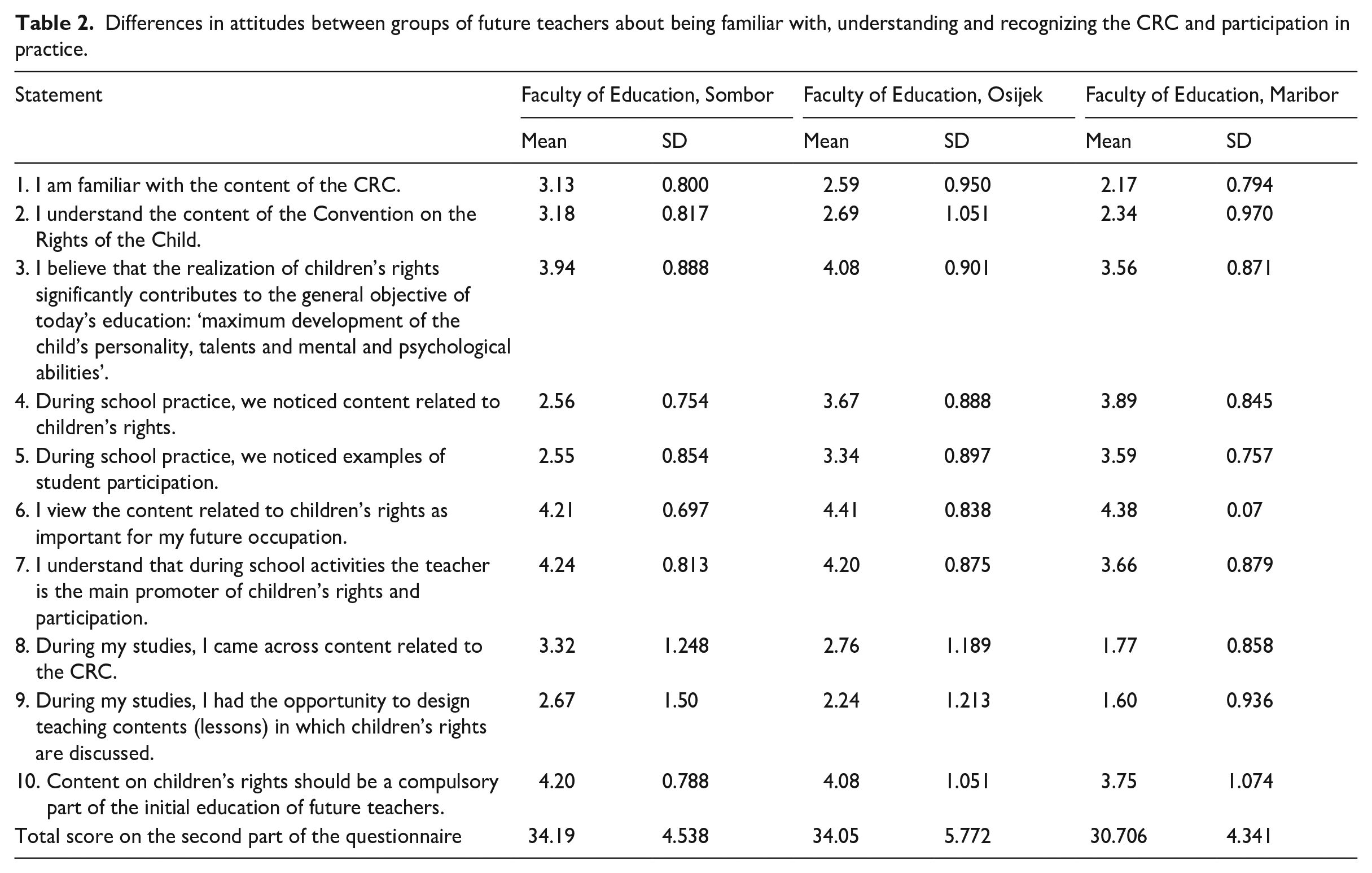
The analysis of variance showed that there is a statistically significant difference between future teachers from different faculties in the scores on the second part of the questionnaire (F(2.555) = 26.229; p < 0.01). The Scheffe test found a difference between future teachers from Sombor and Maribor and Osijek and Maribor; future teachers from Sombor and Osijek achieved statistically significantly higher results in this part of the questionnaire than future teachers from Maribor. Therefore, it can be concluded that the assessment of knowledge and understanding of children’s rights of future teachers from Sombor and Osijek is somewhat higher than that of future teachers from Maribor. However, the difference is only four points, so these results should be taken with caution. Future teachers from Maribor may only be more critical than their colleagues from the other two cities. With regard to gender and year of study, there was no statistically significant difference in responses to this part of the questionnaire. In general, it can be noticed that, out of a total of 50 maximum points (and a minimum of 10), future teachers averaged 34 or 30 points in this part of the questionnaire, that is, they assessed their knowledge, understanding, and recognition of children’s rights in practice as mediocre. Future teachers expressed a very positive attitude toward the importance of content related to children’s rights and participation (score above 4 at all three faculties). Future teachers from Sombor and Osijek assessed the role of teachers as promoters of children’s rights and participation very positively (4.24 and 4.20), while the assessment of future teachers from Maribor was somewhat lower but still positive (3.66). Similar findings are related to the assessment of the statement about the need to study children’s rights and participation during the initial education of future teachers (Sombor 4.2; Osijek 4.08; Maribor 3.75). Future teachers who participated in our study do not have a uniform view on the presence of content on children’s rights and the practice of student participation in school. Future teachers from Sombor expressed a negative attitude (2.56) toward the statement ‘During school practice, we noticed content about children’s rights’, while future teachers from Osijek (3.67) and Maribor (3.89) expressed a positive attitude. Also, future teachers from Sombor expressed a negative attitude toward the statement ‘During school practice, we noticed examples of student participation’ (2.55), while their colleagues from the other two centers expressed a positive attitude (Osijek 3.34; Maribor 3.59). Although future teachers from all three faculties attended continuous school practice, future teachers from Sombor did not notice children’s participation in school during these activities nor did they encounter content related to children’s rights. This was also the result of the Report on the Implementation of Child Rights in the Republic of Serbia from the Perspective of Children and Youth (2013): there is a gap between the CRC and its practical application in schools. Although our respondents from Osijek and Maribor noticed content on children’s rights and participation during their school practice, studies conducted in their countries nevertheless indicate an insufficient presence of children’s rights and participation in schools (Jeđud Borić, 2015; Mithans et al., 2017). This finding can also be interpreted from another aspect: children’s rights, their realization in school, as well as the practice of participation skills imply a democratic, and not an authoritarian school climate (Seashore Louis, 2003); and a certain amount of autonomy—of the teachers in relation to the official curricula (MacMath, 2008), and the students in relation to everyday school activities (Bickmore, 2014). In that sense, if future teachers perceived schools in which they attended school practice as democratic environments, it is possible that this factor decisively influenced their perception of the presence of children’s rights and participation (Osijek, Maribor). According to the statement ‘During my studies, I had the opportunity to design teaching contents (lessons) in which children’s rights are discussed’, future teachers from Sombor and Osijek expressed a negative attitude (2.67 and 2.24), and future teachers from Maribor expressed a very negative attitude (1.6). The authors of this study believe that this lack of practical opportunities to practice such content in teaching caused our respondents to assess the statement: ‘Content on children’s rights should be a compulsory part of the initial education of future teachers’, as significant (Sombor: very positive attitude—4.2; Osijek: very positive attitude—4.08; Maribor: positive attitude—3.759).
The third part examined how future teachers assess the role of teachers in the promotion of children’s rights and encouragement of student participation (10 items). The results are shown in Table 3.
Differences in attitudes between groups of future teachers on the role of teachers in promoting children’s rights and participation.
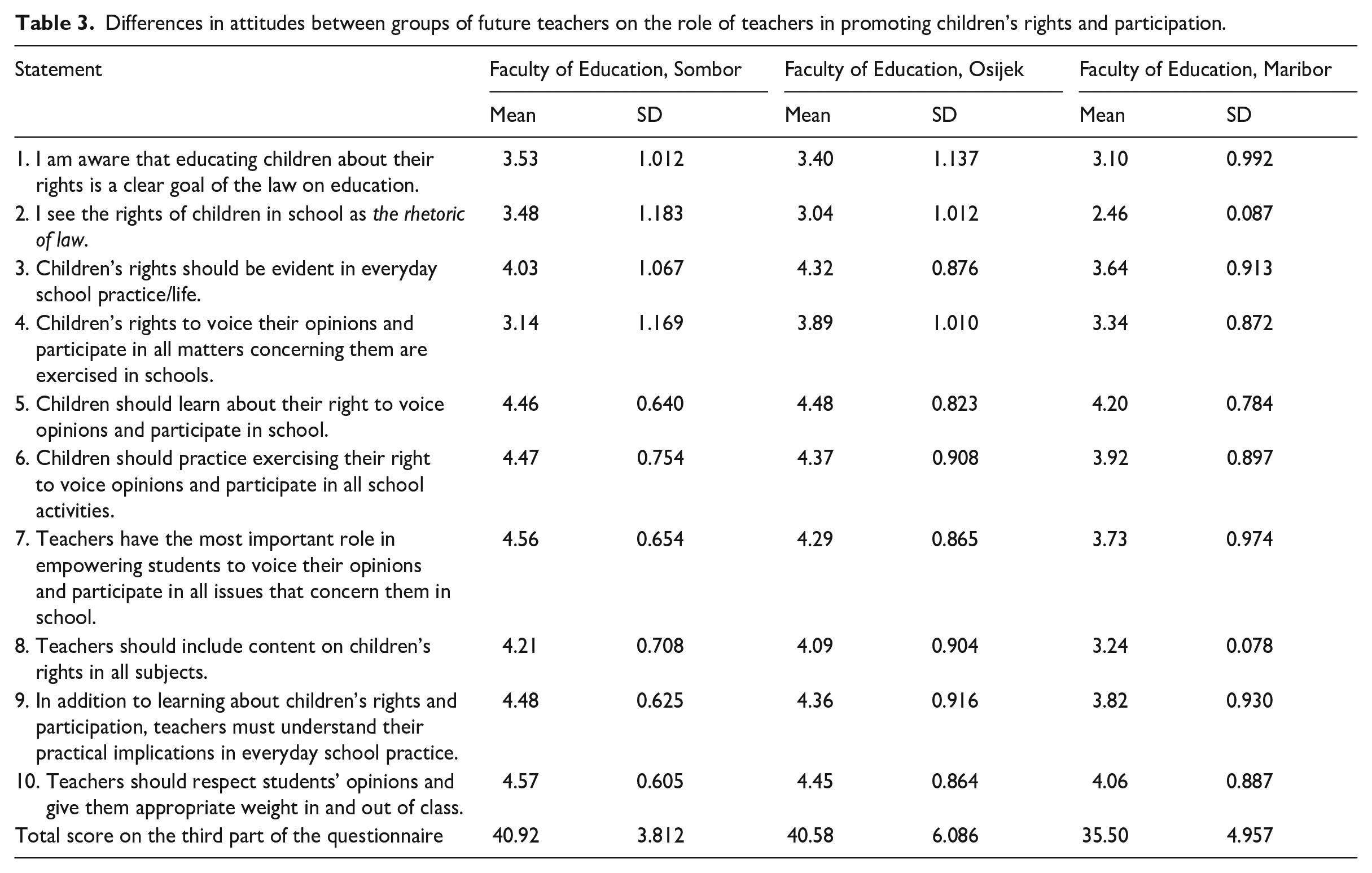
The analysis of variance showed that there is a statistically significant difference between future teachers from different faculties in the scores on the third part of the questionnaire (F(2.558) = 55.864; p < 0.01). The Scheffe test found a difference between future teachers from Sombor and Maribor and Osijek and Maribor; future teachers from Sombor and Osijek achieved statistically significantly higher scores on this part of the questionnaire than future teachers from Maribor. Therefore, it can be concluded that future teachers from Sombor and Osijek give somewhat more importance to the role of teachers in the promotion of children’s rights and participation in school, compared to future teachers from Maribor (though the difference is miniscale, only 5 points on the questionnaire). These results should also be taken with caution for the reasons stated earlier. With regard to gender there were no statistically significant differences in responses to this part of the questionnaire. Also, with regard to the year of study, there were no statistically significant differences in responses to this part of the questionnaire. In general, it is possible to notice that out of a total of 50 maximum points (and a minimum of 10), future teachers averaged 40, that is, 35 points on this part of the questionnaire.
When it comes to the statement ‘I am aware that educating children about their rights is a clear goal of the law on education’, future teachers from Sombor and Osijek expressed a positive attitude (3.53 and 3.40), while in Maribor the attitude was ambivalent (3.10). These results indicate that future teachers are not familiar enough with normative acts (educational objectives, the law on primary school, curricula/study programs), and it seems that when preparing for practical activities, they do not consult these documents enough (or at all). This could be the reason why future teachers in our study did not assess this claim more significantly, and it implies that content related to children’s rights is more a matter of choice than a clear objective. When it comes to the statement ‘I view the rights of children in school as the rhetoric of law’, respondents in Sombor expressed a positive attitude (3.48), in Osijek an ambivalent attitude (3.04), and in Maribor a negative attitude (2.46). When it comes to the statement that children’s rights should be evident in everyday practice, respondents expressed highly positive attitudes (Osijek, 4.32; Sombor, 4.03) and positive attitudes (Maribor, 3.64); and when it comes to the statement ‘Children’s rights to voice their opinions and participate in all matters concerning them are exercised in schools’, respondents in Osijek expressed a positive attitude (3.89), as did the respondents in Maribor (3.34), while in Sombor respondents expressed an ambivalent attitude (3.14). The respondents expressed very positive attitudes about statements that children should learn about their right to participate in school (Osijek, 4.48; Sombor, 4.46; Maribor, 4.20) and that participation should be practiced and exercised in all school activities (Sombor—4.47 and Osijek—4.37: very positive attitude; Maribor—3.92, positive attitude).
The following four items referred to the role of teachers in the process of education for children’s rights and participation. For each item, respondents from Sombor expressed a very positive attitude, as did respondents from Osijek, while respondents from Maribor had somewhat lower, albeit similar scores (see Table 4). In general, respondents strongly agree with the statements indicating that the role of teachers in empowering students to participate in school is the most important and that it depends on the teachers how often content related to children’s rights will be taught. The results show that future teachers understand that they have an important role to play in what happens in school and that they are the ones who determine whether students will learn about children’s rights and develop skills of applying that knowledge through participation. The authors of this study assume that this is more the result of their experience during school practice and overall observation of school activities, than the result of more intensive theoretical learning during their studies (the analysis of syllabi showed only a few courses that include content related to children’s rights and participation).
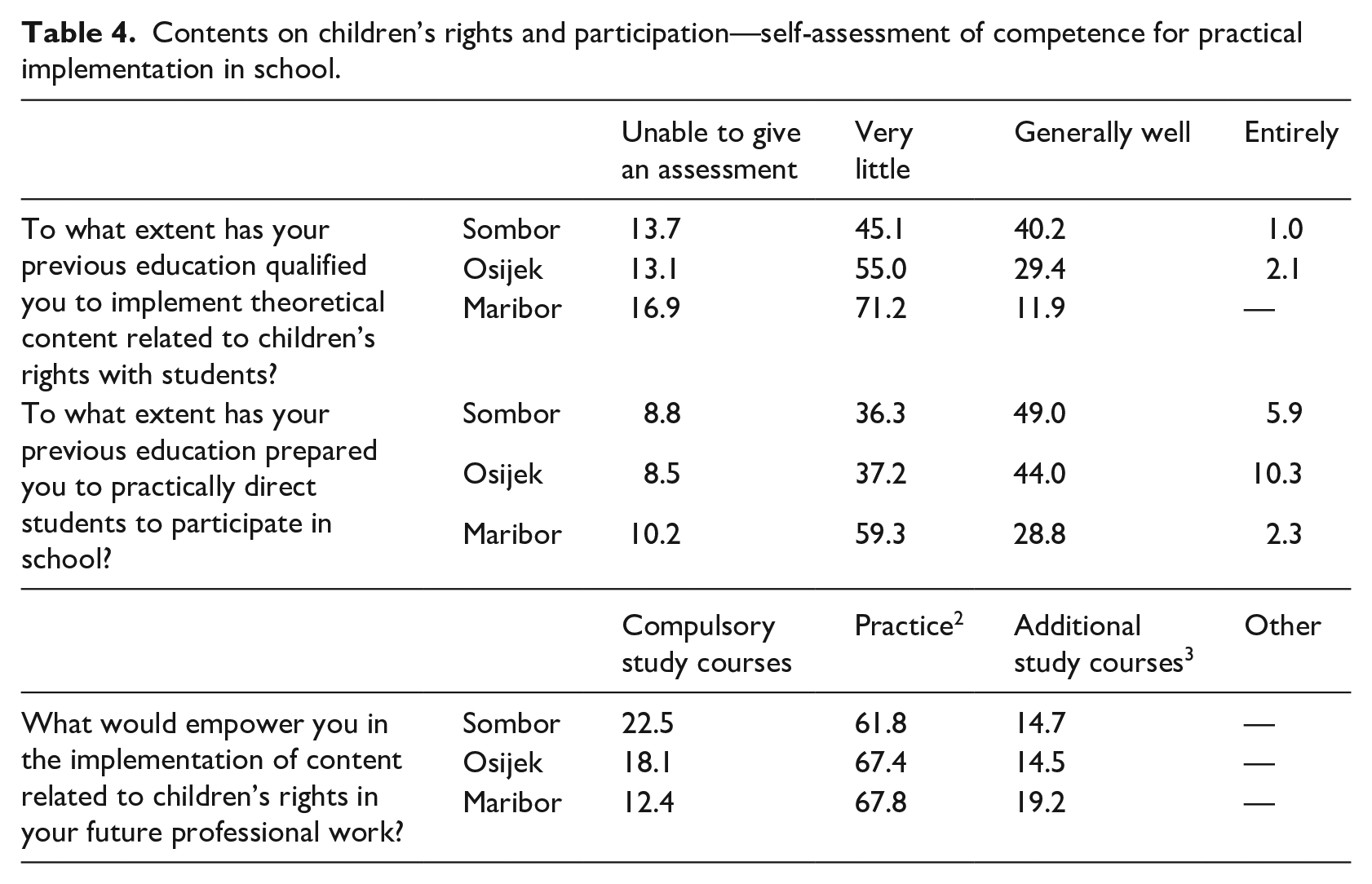
Contents on children’s rights and participation—self-assessment of competence for practical implementation in school.
Future teachers from Sombor, Osijek, and Maribor expressed very positive attitudes concerning the statement that teachers should respect student opinions and give them appropriate weight (4.57; 4.45; and 4.06). It is indisputable that student participation largely depends on the teacher, and this is also recognized by our respondents. Mithans et al. (2017) conclude that well-educated teachers will give the student the option to participate in decision-making and provide the conditions for the development of participation competences. The results of this study show that future teachers recognize the importance of their future engagement in the field of children’s rights and empowering children to participate, which is most likely related to their personal experiences during previous education (in all three countries, they encountered similar content: in Serbia in Civic Education, in Croatia through the content on Civic Education presented as a cross-curricular topic, much like in Slovenia). At the same time, future teachers do not feel that they are being sufficiently prepared for these tasks during their studies.
The fourth part referred to the self-assessment of future teachers regarding their competence to implement content related to children’s rights and participation in working with students (a total of six items). The first three items were measured by using a five-point Likert scale with the following options: I never considered this—1; Entirely unimportant—2; Of minor importance—3; Important—4; Extremely important—5. The next two questions contained the following response options: Unable to give an assessment; Very little; Generally well; Entirely; while the last question asked the respondents to state the type of assistance that would be necessary for strengthening their professional competencies when it comes to the contents on children’s rights. Three options were offered (introduction of new study courses, an increase in time spent attending professional practice, or additional training courses at higher education institutions), as well as the option to add the type of assistance themselves.
The role of the teachers in the promotion of children’s rights was assessed by future teachers in Sombor as extremely important (68.6%). The opinions of future teachers from Osijek were divided: 46.1%—important; 46.8%—extremely important, while in Maribor 65.5% of future teachers considered this role to be important. Furthermore, it was found that the majority of future teachers at all three faculties assessed their theoretical and practical knowledge of the CRC as extremely important (Sombor—58.8%; Osijek—55.3%; Maribor—42.9%), while, in Sombor, they assessed the need for a special preparation for the implementation of content related to children’s rights as extremely important (46.1%). At the other two faculties, the majority of future teachers assessed this need as important (Osijek—46.1%; Maribor—50.8%). Although they believe that they should be familiar with children’s rights, both from a theoretical and practical standpoint, future teachers are not satisfied with their own competencies in this field, and the majority of them believe that they need more practical experience—this option was chosen by more than 60% of future teachers at all three faculties (Table 4).
In neighboring countries, it was not possible to find many studies that focused on the theoretical and practical knowledge of teachers related to children’s rights, and even fewer studies examined the preparedness of future teachers to teach such content. In Serbia, students learn the most about children’s rights in Civic Education (which is part of the official curricula for both primary and secondary schools since 2001), therefore, we already have some evaluations of the effectiveness of this subject. The results of the comparison of the situation in the period 2009–2019, from the point of view of teachers, showed that there is still no support for the systematic implementation of specialized training that would serve to prepare teachers for teaching this subject (Baucal et al., 2019: 88). Mapping legislation, policy, and practice, in the 28 Member States of the EU, Percy-Smith et al. (2015) stressed the relatively good awareness of adults (educationalists) when it comes to children’s rights and participation, but also a lack of specific skills on how to practically implement this knowledge in working with students, whereby they raised special concerns concerning the finding that children’s participation is not given enough significance in professional development programs for educationalists, which is especially evident in initial teacher education (p. 10).
Conclusion
The comparison of opinions of future teachers in Serbia, Slovenia, and Croatia on their knowledge of the CRC and competencies for teaching students about children’s rights and participation was considered important for at least three reasons. The first was to identify commonalities in terms of knowledge and understanding of the rights of the child, despite specific national contexts. Second, it helps emphasize the common problems in initial education that future teachers see as the main obstacles to their ability to teach students about children’s rights, as well as to consider possible solutions. Third, the comparison could raise the awareness of higher education institutions in terms of children’s rights, prompting them to include this topic in their study syllabi.
Results indicate that the future teachers from the faculties of education in Sombor, Osijek, and Maribor, during their education, do not receive sufficient relevant theoretical knowledge, nor skills and practical experience needed for teaching about children’s rights and participation. Future teachers feel that it is very important that content related to the CRC and participation is studied at university, but at the same time, they indicate that they did not learn much about these topics and that they had even less opportunity to practice the implementation of these topics in schools. This is not surprising, given that the analysis of syllabi demonstrated that none of the three faculties of education offers courses that deal exclusively with children’s rights and participation, and the fact that children’s rights and participation are implicitly mentioned in six courses in Sombor, three in Osijek, and two in Maribor, is evidently not enough. An indicative finding is also the one according to which future teachers state that, during their school practice, they did not notice that children’s rights were taught at any of the classes, nor were examples of children’s participation evident (especially in Sombor, and then in Osijek and Maribor).
Relevant sources confirm that an obstacle to the successful teaching about human and children’s rights is the insufficient knowledge of teachers about these topics (Cassidy et al., 2014). Jerome (2016) points out that teachers must be seen as active agents of change themselves.
A particularly indicative finding is that future teachers at all three faculties did not even have the opportunity to didactically and methodically design the teaching content (lessons) in which children’s rights are discussed, which means that they did not practice the implementation of such lessons with students.
Another important finding is that future teachers are insufficiently familiar with the legislation and normative acts related to the introduction of children’s rights in education and especially with the obligation to include participation in everyday school practice. In order to empower future teachers for the implementation of content related to children’s rights and participation, it is necessary to innovate study programs and introduce more practical activities. Classes and lessons on children’s rights that they would design didactically and methodically during their studies, and participatory school situations that they would have the chance to practice in direct work with students—are seen as the best possible solutions.
The context in which this issue was researched is marked by an aspiration toward the compatibility of study programs for teacher education, on the one hand, and the autonomy of higher education institutions to conceptualize their programs independently, on the other. As the contents on children’s rights are not systematically integrated in the study programs of the Faculties of Education in Serbia, Slovenia, and Croatia, the respondents are rightly interested in their implementation and realization, both in theory and in practice. Given the importance of including children’s rights and empowering students to participate in schools, the authors of this paper are of the opinion that similar studies should be conducted in other countries as well, after which a final comparison of the results should be made.
Footnotes
Declaration of conflicting interests
The author(s) declared no potential conflicts of interest with respect to the research, authorship, and/or publication of this article.
Funding
The author(s) disclosed receipt of the following financial support for the research, authorship, and/or publication of this article: This paper is an output of the research project ‘Social Phenomena and the Contemporary School: The Role of Teaching Innovations in the Efficient Adoption of Content about Society’ 2020–2021, approved by the Faculty of Education in Sombor, University of Novi Sad, Serbia [06-4-2/20].
