






Abstract
In this article, the author discusses the animated documentary in relation to the use of staged reenactments in works that are generally understood as documentaries. His conceptual foundation draws especially on recent work by Bill Nichols on documentary reenactments, which he argues have specific ‘fantasmatic’ and reflexive qualities. These qualities clearly dovetail with key attributes of animation, with the animated documentary standing as a significant and interestingly hybrid creative form. Key ideas are applied to a case study of Chris Landreth’s Ryan (2004), in which Landreth deploys fantasmatic visual flourishes partly in order to destabilize the documentary’s conventional discourse of sobriety, pushing it in the direction of its mirroring discourse of delirium, and partly to explore the current status of animation (and animation tools) in the realm of visual simulation.
The animated documentary has become the subject of a small but increasingly sturdy and illuminating critical discourse in recent years, in part because of a proliferation of examples of the form, with some feature-length works attaining a broad cultural visibility and impact (e.g. Waltz with Bashir, dir. Ari Folman, 2009). In this article, I will discuss the animated documentary in relation to the use of reenacted scenes in films that are generally understood as documentaries, with a specific focus on Chris Landreth’s Ryan (2004).
The term ‘reenactment’ refers in this context to the practice of staging events for the camera that are important to the broader argument of the documentary filmmaker, but which are not coincident with the actual time (and often space) of the events portrayed. The decision on when to use reenactments is perhaps especially crucial to consider in relation to the animated documentary, as this form of discourse is based around a deliberate fracturing of the conventional indexical status of the photographic image, as well as an implied rejection of the idea that indexicality is a prerequisite for a work to be classified as ‘documentary’. That is, unlike other forms of documentary expression, the animated version inherently (though not universally) 1 relies on reenactment. For the non-specialist viewer of both animations and documentaries, in fact, this very category may appear to be ontologically vexed. However, thanks to the pioneering work of animation scholars such as Paul Wells (1997) and Paul Ward (2006, 2008), as well as writing on the hybrid media forms generated through the proliferation of digital production and distribution methods, 2 it is becoming increasingly clear that the theory and practice of the animated documentary help to illuminate several technical and conceptual issues that are central to contemporary visual culture, much less the craft and art of animation itself.
It is interesting that a majority of the direct critical engagement with the animated documentary thus far has come from self-identified animation scholars. The reasons for this probably have to do with the histories and dynamics of documentary and animation studies as areas of teaching and research; that is, because of the relative novelty of animation studies as an academic field, it is more likely that animation teachers and scholars have also taught, read, and/or written about documentary than the reverse. One of the consequences of this situation is that animation historians and theorists who wish to draw on documentary theory must do so largely through strategies of inference and analogy because documentary theorists themselves have rarely incorporated significant discussions of animation-based examples into their arguments.
Still, there are shared interests at work here, the most fundamental of which is a mutual awareness that both animators and documentary filmmakers frame their work in relation to particular understandings of the nature and expressive possibilities of visual illusionism. To elaborate on the brief discussion of photographic indexicality just introduced, one commonly understood difference between the forms has to do with documentary’s supposed ‘purity clause’, a requirement for such works to maintain an umbilical connection with a pre-existing material reality. Animated works, meanwhile, as Maureen Furniss (1998: 5–6) so usefully put it, may oscillate freely along a conceptual continuum from mimesis to abstraction. Also, most animations are understood to originate not in actual events that took place in front of a camera, but in the mind of the animator – who then visualizes the work without explicitly referencing aspects of material reality. 3 Consequently, a documentary film or video is often considered to have a privileged access to ‘the real’, while animation is widely perceived as entirely a work of the imagination and by definition ‘unreal’. 4 However, this apparent chasm between the forms was never entirely unbridgeable and, in the contemporary context, the ground is shifting noticeably.
There are at least two reasons for this vogue for this incremental erosion of boundaries. The first emerges from debates among documentary scholars over the past two decades or so, which cumulatively have eroded, among both practitioners and theorists, a belief in the holy grail of ‘objectivity’, coupled with a recognition that the truth value of documentary is contingent and contextual, and ultimately not significantly different from creative expressions that may be most easily recognized as fictions. The second reason has to do with the mimetic capabilities of computer imaging software. These capabilities are most apparent in blockbuster ‘live action’ feature films from Jurassic Park (dir. Steven Spielberg, 1993) to Avatar (dir. James Cameron, 2009), in which computer animators have become ever more adept at rendering convincingly realistic visual images of physical settings, and of integrating live actors (or their motion-captured avatars) with these partly or completely synthetic background environments. That is, Christian Metz’s (1982: 240–242)famous description of the cinema’s inherent semiotic status as a ‘short-circuit sign’ has been both amplified and complicated in the digital era as filmmakers regularly combine images recorded by a camera with images constructed entirely through a computer program, and usually with the goal of producing a composite image that viewers will find satisfactorily unified (i.e. ‘realistic’) from a perceptual perspective.
These contemporary practices of production and reception have obvious implications for documentary filmmakers and theorists, who find a certain urgency in making sense of both the practical opportunities and conceptual complications afforded by new imaging technologies. However, as Carl Plantinga (1997: 69) put it several years ago, before the seismic rumblings of the so-called digital revolution were entirely apparent, ‘the changes digital processing brings are matters of degree, not kind.’ That is, the central issues of documentary practice and theory, up to and including the ontological status of the visual images chosen to represent ‘something’ (whether people, material objects, ideas, or symbols) are no more or less present than they ever were. Meanwhile, the processes through which meaning is produced through the intersection of producer, text and audience are made more complex by new technologies, but this was also true, for instance, when the first video portapaks were introduced in the 1960s.
Bill Nichols has long been recognized as one of the most important theorists of the film and video documentary. In recent years, much of his work in this area has been directed towards expanding upon – and to an extent re-evaluating – the implications of his argument at the beginning of Representing Reality in 1991 that:
Documentary film has a kinship with those other nonfictional systems that together make up what we may call the discourses of sobriety. Science, economics, politics, foreign policy, education, religion, welfare – these systems assume they have instrumental power; they can and should alter the world itself, they can effect action and entail consequences. (p. 3)
Nichols’s proposed template for documentary as a ‘discourse of sobriety’ was subsequently critiqued by, among others, Michael Renov (2004), who contended that this model did not sufficiently account for the ways in which audiences make sense of the arguments constructed by documentary producers, or of the residual hermeneutical ambiguities of the cinematic image itself. Renov’s objection leads him to argue for the use of psychoanalytic theory as a means of more fully understanding the processes of reception, which do not necessarily occur at a conscious, rational level of engagement. He draws, in a strategic mirror image of Nichols’s concept of ‘sobriety’, on Julia Kristeva’s use of the term ‘delirium’ to propose that, while many documentary producers work to produce rationalist arguments, it may be observed that others do not, and that the structures of desire enacted by audiences when they watch a film may similarly range from the ‘sober’ to the ‘delirious’ (pp. 100–101).
How, then, do we draw animation theory and practice into this discussion? Let me begin to do so by quoting the sentence that immediately follows the passage from Representing Reality (1991) cited earlier, in which Nichols argues that documentary ‘has an air of sobriety since it is seldom receptive to “make-believe” characters, events, or entire worlds (unless they serve as pragmatically useful simulations of the “real” one)’ (pp. 3–4). In this early work, Nichols addresses such ‘simulations’ to an extent, especially through a discussion of the use of reenacted events by documentary producers, but his thoughts in this area are not greatly elaborated. In a recent essay, though, Nichols (2008) returns to the question of documentary reenactments in much more detail, developing a considerably more nuanced evaluation of the practice, and one that is considerably more open to more ‘delirious’ processes of encoding and decoding. After observing that reenactments were common to documentary form before they ‘were slain by the “verité boys” of the 1960s’ (p. 72), and that they have made a comeback in recent years in films like Little Dieter Needs to Fly (dir. Werner Herzog, 1997), he proposes that their renewed use raises relevant questions ‘about the experience of temporality and the presence of fantasy in documentary’ (p. 73).
First of all, says Nichols, in order for a reenactment to function in an ethically viable way in a documentary, it needs to have a reflexive element in order to avoid confusing the viewer concerning its ontological and temporal relationship with other scenes in the work:
Viewers must recognize a reenactment as a reenactment even if this recognition also dooms the reenactment to its status as a fictionalized repetition of something that has already occurred. Unlike the contemporaneous representation of an event … the reenactment forfeits its indexical bond to the original event. It draws its fantasmatic power from this very fact. (pp. 73–74)
Nichols’s understanding of the concept of fantasy is derived from the work of Laplanche and Pontalis, who hold that fantasy involves the transformation of a real object into an emotionally charged image that remains connected with a triggering thing or event but generates a separate, autonomous form of pleasure.
This enjoyment or pleasure is real. It derives from the corporeal activity of going through the necessary motions, but is also entirely psychic … it involves a pleasure associated with a past event that is transposed into a distinctly different, fantasmatic domain. (p. 76)
That is, the viewer of a documentary reenactment is normally alerted (through the strategic use of particular cinematic tropes) to the altered ontological status of this section of the work, which in turn shifts the viewer’s encounter with the work as a whole into a different mode, one in which he or she is invited not just to make sense of the reenactment on its own terms, but also in relation to the original events for which it is standing in. The viewer’s work, here, then, is self-consciously, reflexively interpretive of the filmmaker’s ‘fantastic’ portrayal of the events.
As Paul Wells (2002) has argued, this reflexive viewing position is entirely typical of the audience’s normal mode of engagement with animation. Viewers’ own eyes tell them that what they are seeing is different from both ‘live action’ film and the normal visual perception of material reality, a difference that registers as something artificial or fantastic.
The very artifice of animation requires that the characters, situations, narratives and designs ‘announce themselves’ as different kinds of ‘phenomena’. This challenges the viewer to … invest in engaging with animated phenomena as constructs which may relate directly to the terms and conditions of human experience, but equally may offer more complex meditations on socio-cultural and aesthetic epistemologies. (p. 11)
I have noted elsewhere (Fore, 2007b: 124) that the development of digital imaging tools capable of creating highly mimetic representations of many objects and spaces has diminished the inherent reflexivity of animation as a creative form. Still, I have also pointed out (Fore, 2007a: 319–320) that the current ‘imperfections’ of software designed to allow animators to create illusions of material reality, and especially those portraying human figures and movement, have resulted in a tendency for such attempts at a photorealistic effect to be poorly received by audiences. 5 This in turn has compelled a situation in which computer animators in particular are confronted with a range of new dilemmas and opportunities as they devise a visual aesthetic for a particular work. In the realm of feature-length, computer-generated commercial animation in Hollywood, Japan, and elsewhere, the strategy increasingly has been to create a hybrid style in which animated characters, while volumetrically enhanced, continue to be drawn so that their status as ‘cartoons’ is immediately evident to the viewer, while many aspects of the mise en scène inhabited by these characters is configured through an increasingly hyperrealistic mode of representation. 6
These technological and creative imperatives, then, have produced a situation in which the use of animated reenactments in documentary films are likely to generate precisely the kind of reflexive viewer engagement described by Nichols. 7 For the spectator, this viewing experience is characterized in part by a heightened awareness of the presence of the filmmaker’s sensibilities and beliefs in the fantasmatic images on display. It is a situation in which
the viewer, immersed in an experience in which he or she knows very well that the reenactment is not that which it represents and yet, all the same, allows it to function as if it were. Above all, however, the filmmaker is the one caught up in the sequence of images; it is his or her fantasy that these images embody. (Nichols, 2008: 77)
In a documentary reenactment, the filmmaker’s presence is made overt at least as an off-screen ‘ghost’, the authorial presence responsible for shaping the onscreen material. For Nichols, this is the most typical means of asserting, within the reenactment, the broader phenomenon of the ‘documentary voice’. It establishes a context in which this voice ‘is the embodied speech of a historical person – the filmmaker, caught up in the syntax of enacted or reenacted images through which the past rejoins the present’ (p. 79).
In rare instances, though, the filmmaker takes part in the reenactment as an onscreen character, and in the remainder of this article I would like to explore some of the opportunities and implications of this circumstance in relation to the animated documentary. As a case study, I will discuss Chris Landreth’s film Ryan (2004), which, among other honours, won three awards at Cannes and the 2005 Academy Award for best short animation. Landreth’s 14-minute work is on one level a biographical sketch and witty but dark-edged celebration of the Canadian animator Ryan Larkin. Larkin is well known in animation circles as a prodigiously tragic figure, having produced three very successful short experimental works through the National Film Board of Canada at the very start of his career, only to have his muse flame out almost completely amidst a sea of psychological problems and substance abuse. Larkin spent much of the latter years of his life as a panhandler on the streets of Montreal. 8
Landreth also has had an interesting, if less dramatic, career trajectory. Trained as an engineer at the University of Illinois in the field of fluid mechanics, he decided to leave that industry because of its emphasis on designing weapons technologies. He subsequently found himself working with people on the Illinois campus who were setting up a computer graphics lab, and eventually joined Alias Research just before that company was bought out by Silicon Graphics, along with Wavefront Technologies, to form Alias/Wavefront (now a part of Autodesk). Probably in part because of his engineering background, Landreth was charged with testing, troubleshooting and critiquing Alias/Wavefront’s Maya computer software, which was introduced in 1998 and which Landreth, although no longer employed by the company, continued to use in the production of his films Bingo (1998), Ryan (2004) and The Spine (2009).
Landreth and Larkin met as fellow selection committee members at the Ottawa International Animation Festival in 2000, where Larkin’s screening of some of his work from the late 1960s and early 1970s immensely impressed Landreth. Larkin literally had been plucked from the streets of Montreal by a long-time supporter to serve on the selection committee, and Landreth became intrigued by the obvious contrast between the dynamic energy of the young Larkin’s animations and the still vibrant but clearly troubled contemporary version of the man. After finalizing a co-production deal involving the National Film Board and the independent production company Copperheart Entertainment, 9 and supported by a grant from the Canada Council for the Arts, Landreth, plus a core team of nine people (including student animators from Toronto’s Seneca College) and several dozen volunteers, subsequently produced Ryan over a course of 18 months.
The film’s basic structure and setting is simple. Landreth and Larkin converse over a table in what is probably the dining room area of the homeless mission where Larkin resides, the discussion focusing on Larkin’s early successes and subsequent problems. As markers of the documentary premise, boom microphones are visible in several shots (Figure 1). Brief segments from Larkin’s animations are shown. At particular points in the story, flashback scenes are narrated partly by one of Larkin’s NFB producers and his girlfriend from the NFB days. The dialogue used in Ryan is edited directly from Landreth and Larkin’s actual conversations and Landreth’s interviews with other subjects. 10

The documentary premise in Ryan is suggested by the presence of boom microphones in the scene where Chris Landreth interviews Ryan Larkin. © Copperheart Entertainment and National Film Board of Canada.
So far, so documentary. The expressive power of the film, though, lies mainly in the visualization of this basic scenario, and those animated visual images take Ryan emphatically into the realm of Nichols’s fantasmatic expression. As a reenactment of the events portrayed, though, Landreth’s animation is an ‘impure’ example of the form: the soundtrack, after all, consists not of restagings but parts of the actual conversations and interviews as they happened. 11 That is, a tension is created between the immediacy and apparent authenticity of the soundtrack and the distinctively, vividly grotesque animated analogues of the characters as they ‘speak’ their lines. This creates an interesting variation on the breakdown of the conventionally indexical relationship between the cinematic image and its referent that other scholars have discussed in relation to the animated documentary. As Craig Hight (2008: 14) has noted, while the visual images in interview-based works tend to preserve animation’s usual reflexivity, the soundtrack maintains (in a term borrowed from Michael Renov) ‘acoustic indexicality in the form of interview sound-bites and especially expositional voice-over narration’, and as Paul Ward (2006: 122) writes, these animations ‘construct a “world” that will metaphorically emphasise (or dramatically undermine) what the viewer is hearing on the soundtrack.’
Landreth has described his approach to visualizing Ryan Larkin’s story as ‘psychorealism’ (as in ‘psychological realism’, but, for Landreth, apparently with an edge of subjectivized, subconscious emotional instability), influenced in part by a quotation attributed to Anais Nin: ‘We don’t see things as they are, we see things as we are’ 12 (Figures 2 and 3). On the one hand, this statement resonates in relation to longstanding discussions of the construction of point of view in documentary film and video by making the point that the filmmaker’s subjective experience is inevitably inscribed in the processes of conceptualizing, shooting and editing a work. More broadly, it references the conventional notion within the visual arts through which it is held that the artist’s interior, emotional life may exceed the surface of the work, and may indeed inhabit that surface. This technique is deployed in the visual arts of the West especially (though not only) in works that are composed within a tradition of visual realism or a descendant, but which place a new emphasis on the subjective expression and experience of the artist –think here of Turner, Van Gogh, Grosz, Magritte, or Bacon in the world of fine arts painting, or, obviously, German Expressionist cinema.
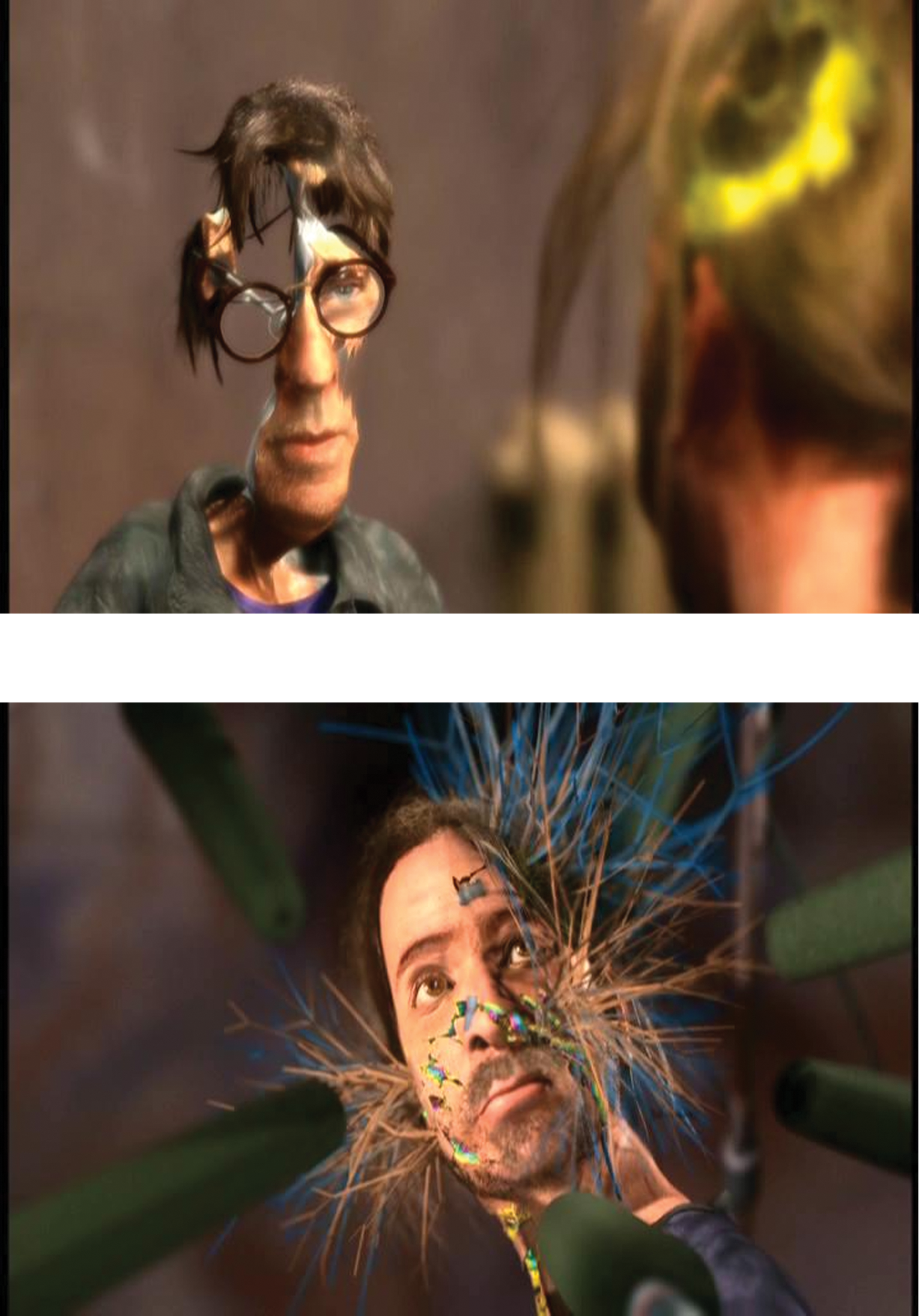
Fantasmatic expression and ‘psychorealism’ are communicated through the visualizations of both Landreth and Larkin. © Copperheart Entertainment and National Film Board of Canada.
This connection is relevant because European fine arts painting, beginning with the Italian Renaissance, worked within ever more refined conventions of visual illusionism for centuries, and the cinema’s visual and emotional affect was founded in part on the movie camera’s capacity for mimesis. That is, this foundation of technique and technology in traditions of pictorial realism provided the platform for subsequent expressionist experiments (some of which coalesced as ‘traditions’ or ‘movements’).
A partial analogy can be drawn here with the established conventions of computer animation production and technology. While certainly not a directly parallel set of historical circumstances (nor was the trend as seamlessly convergent as my description here may imply), it might be argued that, as the enshrinement of linear perspective and other realism-enhancing techniques in the context of the Renaissance pushed painters and sculptors to strive for maximal visual realism in their work (at least until the Impressionist breaking point in the mid-19th century), so too has research and development in computer graphics over the past four decades (itself influenced at least indirectly by the Renaissance’s illusionist legacy) taken as a given that ‘progress’ in software development is to be measured most fundamentally in terms of the quality of a particular package’s reality effect – the capacity to execute visual scenes and objects with an ever-increasing degree of verisimilitude. Consequently, the menu options available to the animation artist in a software program such as Maya encourage (sometimes subtly, sometimes blatantly) a realist visual design, and deviations from this realist template may involve creative and technically complex work-arounds.
Chris Landreth’s background as an animator of the digital era is significant in relation to the process through which he conceived a visualization strategy for Ryan (and his other films). That is, while he is certainly familiar with the history of animation, he learned the craft on a computer – he didn’t take classes in figure drawing, cel animation, or stop-motion techniques. Consequently, the creative platform he is most intimately familiar with is one with a congenital, ingrained tendency in the direction of realist expression, and Landreth’s desire to break that mould is nonetheless defined in relation to it. In describing his understanding of ‘psychorealism’, he says:
My animation work has used and continues to use photorealism … but what I’m most interested in is not achieving photorealism in CGI, but in co-opting elements of photorealism to serve a different purpose – to expose the realism of the incredibly complex, messy, chaotic, sometimes mundane, and always conflicted quality we call human nature. (Robertson, 2004)
Landreth’s strategy for visualizing this complexity, for externalizing interior states of mind, is to draw the characters in Ryan in relation to the medium of animation’s historical predisposition towards reflexivity – they look essentially ‘human’, but with significant, imaginatively exaggerated enhancements to their physical appearance. The animated versions of both Landreth and Larkin start from an essentially realistic portraiture, but Landreth then literally chips away at the characters’ physiognomies (especially Larkin’s) in order to expose their inner stresses. The animated Landreth appears in the first scene of the film, standing and facing the (simulated) camera in the communal rest room of Larkin’s mission. Instead of introducing Larkin, however, Landreth talks first about himself, and specifically about traumatic events in his own life. We initially see Landreth in a medium shot, framed from the knees up against a setting that includes three institutional porcelain sinks and mirrors to Landreth’s left, and well-worn toilet stall doors to his right. The scene’s décor and objects are portrayed with photorealistic touches characteristic of much contemporary computer animation (veins of rust on one toilet door, the other covered with blistered blue paint and a jumbled array of small adhesive stickers); Landreth’s CGI figure also appears to be a straightforward simulacrum of the ‘real’ Landreth. Then, as he begins to chronicle a personal history of self-doubt and disillusionment, Landreth turns to look into one of the mirrors on the wall, the shot framed as an over-the-shoulder medium close-up directed into the mirror, and we suddenly see that his cheeks and nose are slashed with jagged cuts that, instead of dripping red blood, are unsettling but curiously party-colored. He turns his head to the left, putting his face in profile, revealing that the entire right hemisphere of his cranium is a crater filled by what looks like an exploded, bright yellow smiley face (Figure 4).
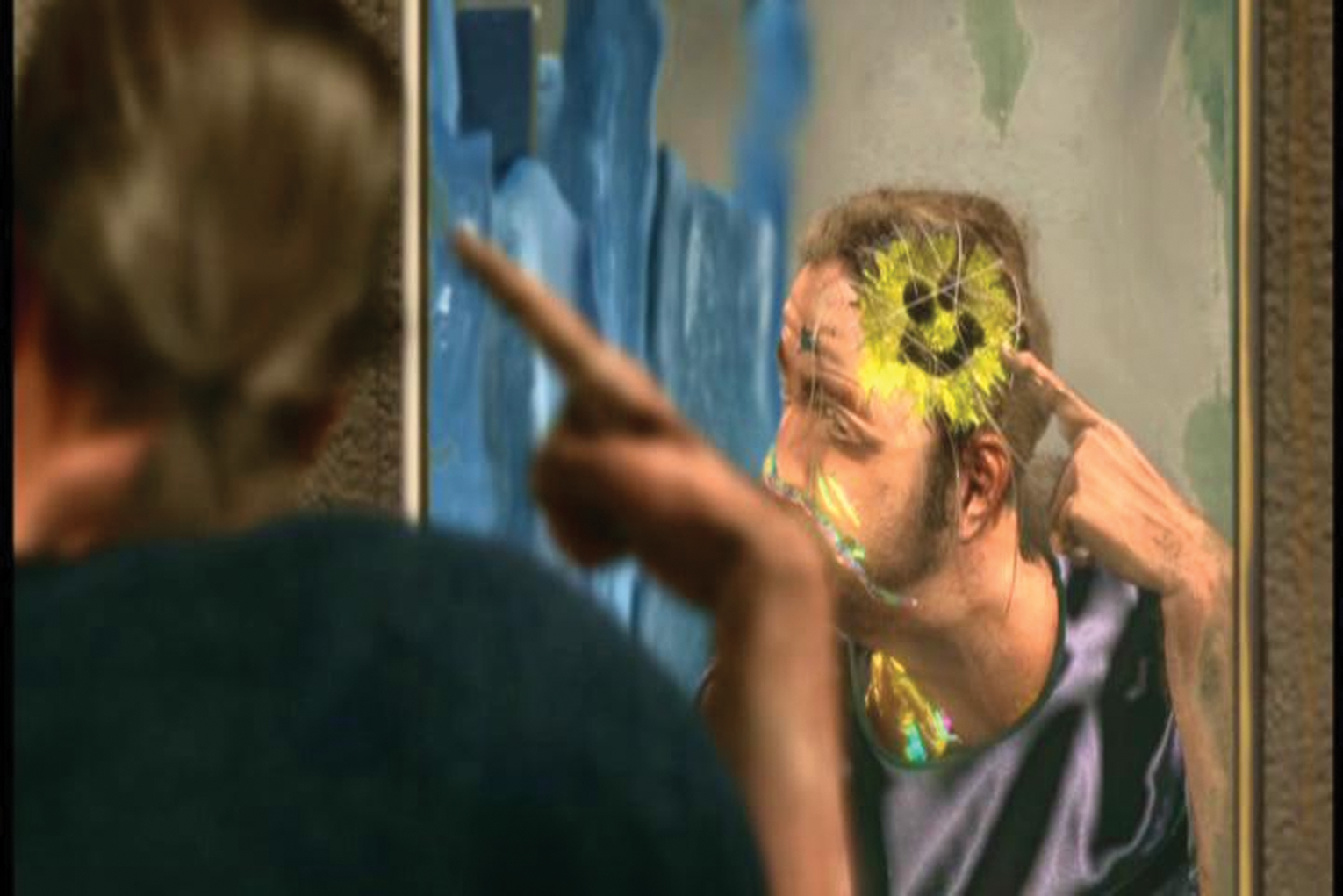
Landreth introduces the film by discussing his own inner demons, externalized through extreme distortions of his physical appearance. © Copperheart Entertainment and National Film Board of Canada.
This seems like a curious way to set up a mini-biography of Ryan Larkin, but the tactic begins to make sense as the film progresses, and we realize that its subject is as much Landreth’s very personalized understanding of and response to Larkin as it is a portrait of Larkin himself. In addition to being the story of Larkin, that is, Ryan is also a more general meditation on the fragility of the creative muse. Landreth sees (and is disturbed by) a hypothetical version of his own future in Larkin’s story, and his visualization of a physically mangled version of himself is an obvious but strikingly rendered metaphorical representation of his own interior demons. He uses the imaginative licence of animation (a licence granted by generations of animators and viewers who expect from animation something different from live action cinematography) elsewhere in the film to insert further commentary on his thoughts and feelings. For instance, in a scene in which Landreth is paternalistically declaring to Larkin the benefits of reducing his daily alcohol consumption, from the back of Landreth’s head sprouts a halo, which illuminates with the stutter start click of a fluorescent tube. When Larkin responds angrily to Landreth’s presumptuous appeal, the fluorescent halo ‘blows out’ with a pop and falls to the floor (Figure 5).

As Landreth lectures Larkin, his head sprouts a fluorescent halo. © Copperheart Entertainment and National Film Board of Canada.
This image of a visibly tarnished, impaired Landreth parallels that of an even more ravaged Larkin, whose animated body also starts from the real-world model, but is even more grotesquely (though poignantly) distorted. After Landreth’s self-introduction, he walks out of the bathroom and across the dilapidated, substantially photorealistic mission dining room (which nonetheless undulates uneasily but subtly throughout the film) to sit down with Larkin. The room is a large space sparsely populated by a handful of three-dimensional but explicitly cartoon-like characters, presumably other mission residents, with greatly exaggerated faces and bodies (one has a massive and unruly beard that almost entirely obscures the rest of his face; another is a ‘pinhead’ straight out of Freaks, dir. Tod Browning, 1932; a third has a literally deflated body that drapes over the edge of a table). These bystanders do not take part in the main narrative, but are cut away to from time to time, figuring as reminders of the socially marginal realm that Larkin inhabits (Figure 6).

Most of Ryan is set in the dining area of a homeless mission, populated by other residents, also with greatly exaggerated faces and bodies. © Copperheart Entertainment and National Film Board of Canada.
This juxtaposition of a documentary-like setting populated by fancifully bizarre, explicitly fantastic anatomies is jarring, and to a degree prepares the viewer for Landreth’s visual interpretation of Larkin, who appears as a thin, jaggedly attenuated physical presence. Most of his head is entirely missing except for the left side of his face; a large pair of owlish, dark-brown-framed glasses rests on the bridge of his nose, one lens framing a gray/blue eye, while the other is a window to the wall behind Larkin, as that side of his cranium has been erased. A shock of brown hair sits perilously above his forehead, supported by what remains of Larkin’s face and a narrow metallic central strut that juts back approximately along the outer edge of what would be his skull. Landreth visualizes Larkin, that is, as a starkly caricatured, literally hollowed-out shadow of himself, decades of psychological ordeals echoed in a whittling away of his physical presence. 13 But, as with Landreth’s envisioning of his own damaged self, the animator deflects connotations of pity (or horror) through the inclusion of playful, darkly comic details. For instance, throughout the conversation, Larkin periodically drinks from a blue thermos bottle full of a presumably alcoholic beverage; at one point, the thermos sprouts tiny arms that telescope like an accordion wall lamp towards Larkin in a gesture of invitation to take a drink, and during an emotional confrontation over Larkin’s alcohol consumption, one of the thermos hands extends towards Landreth, its middle finger raised. As the scene escalates in intensity, Larkin’s anger takes external form as an array of sharp red spikes that spring from his head (a fantasmatically organic variation on the convention of speed and motion lines in cartoons and animations), and he finally gestures so violently that the hair flies right off his head. The explosion is punctuated as the hair is retrieved in a conciliatory gesture by a contrite Landreth.
It might be said, then, that Landreth deploys fantasmatic visual flourishes throughout Ryan partly in order to destabilize the documentary’s conventional discourse of sobriety, and to push it in the direction of its mirroring discourse of delirium (Figure 7). On the one hand, viewers literally can’t believe what they see: the physical manifestations of the characters are bluntly impossible, not of our world. At the same time, though, the symbolic, metaphorical status of these images is established at the very beginning of the film, in which Landreth’s verbal description of himself is directly aligned with his mutilated physical expression – these, says the animator Landreth, are the rules of the game we are about to play. Landreth’s self-introduction also alerts the viewer to the animator’s status as a potentially unreliable narrator of the events that follow; as Nichols (2008: 80) puts it: ‘reenactments belong to a situated fantasmatic that nullifies the status of that other fantasmatic of objectivity, omniscience, and finality that haunts the documentary film and its kindred discourses of sobriety.’

Landreth uses fantasmatic visual flourishes partly to destabilize the documentary’s conventional discourse of sobriety, and to push it in the direction of its mirroring discourse of delirium. © Copperheart Entertainment and National Film Board of Canada.
It is in this way that the conventional reflexivity of animation harmonizes especially well with the use of reenactments in documentary film and video. Unlike animation, in documentary the trope of reflexivity is not a pre-requisite component of the form, but emerges either as a self-consciously deployed tactic on the part of the producer, or more prosaically as a section in the film that the viewer understands has been assembled with images of a different ontological status from those used in other sections of the work. In an animated documentary, though, the former situation seems to prevail inherently – the cards of reflexivity are on the table, and to quote Nichols (p. 78), the viewer’s ‘psychic pleasure seems to stem from the construction of ambiguity about what happened in the past, what these social actors have said and done, how they understand the actions, and how they wish others to understand them.’
In the closing pages of his essay, Nichols outlines a provisional taxonomy of documentary reenactments, grouped according to their relative transparency or reflexivity, and according to the degree to which an anticipated emotional response on the part of the viewer is foregrounded. 14 Ryan seems to fall most logically into the ‘stylization’ type, in which the distance between the reenactment and ‘realist dramatization’ is especially exaggerated. The implied spectator of Landreth’s animation, in Nichols’s Laplanche/Pontalis-inflected logic, experiences a temporal and psychological disruption as he or she realizes that the events witnessed have a genuine historical basis but do not visually reside in the original space and time of those events – ’the subject knows that this act stands for a prior act, or event, with which it is not one’ (p. 76) Landreth further emphasizes this rupture by foregoing the use of either motion capture of actors performing the roles of characters, or rotoscoped documentary footage of the characters’ interactions. 15 Instead, with the audio recording of his conversations with Larkin and the other characters as a guiding template (Renov’s ‘acoustic indexicality’), Landreth fabricated both the characters and the mise en scène from the combination of his own memory and imagination. 16 Thus, in a stylized reenactment ‘the viewer remains vividly suspended in that moment between before and after embodied in signifiers that possess an iconic rather than indexical relation to what has already happened’ (p. 86).
It should also be noted that Landreth’s creative motivation for the use of animation as the form through which to communicate Ryan Larkin’s story (and his) may differ in motivation from the strategic use of animation in other works that also have strong documentary elements. In Waltz with Bashir, for example, director Ari Folman used animation in part because a filmed record of the events chronicled in the film simply didn’t exist (to this extent, Folman’s rationale is not unlike that of Winsor McKay in the production of The Sinking of the Lusitania, 1918). By contrast, Landreth could have used live action images as the basis of his animation, or indeed produced Ryan entirely with conventional live action cinematography. In fact, there is an accompanying ‘making of’ documentary that in part does just this. 17 But Landreth used animation, of course, in part because he is an animator – the work is both a poetically appropriate homage to Ryan Larkin’s chosen mode of expression, and an assertion and exploration of Landreth’s own artistic identity. However, this does not at all mean that a more pragmatic user of animation like Folman did not also recognize that combining it with documentary heightened the affective and psychological impact of his work. He, too, could have recreated the events portrayed in his story through live action recreations, but decided that employing particular visual and rhetorical tropes associated with both forms would trigger a fantasmatic alchemy that captured the traumatic events, ideas and feelings Folman wanted to express more vividly and more precisely.
So the choice of combining animation with documentary adds up to more than a pragmatic and/or aesthetic matter. The rhetorical styles and production processes associated with each form have been regarded as mutually exclusive throughout most of their histories, but, as recent works such as Ryan, Waltz with Bashir, and Chicago 10 (dir. Brett Morgen, 2007) demonstrate, the calculated synchronization of animation and documentary also has the power to produce what Nichols describes (in relation to documentary reenactments) as a ‘fold in time’ that seems characteristic of contemporary visual culture more broadly. Our image-saturated, mediated experience of the world tends to be temporally asynchronous – although the supposed perpetually ‘flattened out’, present tense consciousness of the postmodern subject seems considerably more nuanced in the trenches of daily life, in which we continue to be aware of and interested in the temporal inflections (and significance) of representations. Documentary reenactments appear to mirror this process, in that
they take present time and fold it over onto what has already come to pass. They resurrect a sense of a previous moment that is now seen through a fold that incorporates the embodied perspective of the filmmaker and the emotional investment of the viewer. (Nichols, 2008: 88)
The fantasmatic qualities of such reenactments find a naturally sympathetic partner in animation, the moving image form most fundamentally invested in the reflexive qualities that Nichols also identifies in some kinds of documentary. In Ryan, and in other recent animated documentaries, this reflexivity is by no means a narrowly formal construction. Rather, it also has strongly expressive qualities, both announcing the ‘voice’ of the filmmakers through a pattern of strategic disruptions and exaggerations of the real, and articulating thoughts and ideas in vividly visual terms. The implications of this attribute are, of course, nothing new for theorists and practitioners of both documentary and animation. But while formal and perceptual reflexivity have been largely taken for granted throughout most of the history of animation, in documentary this tendency has required more substantial theoretical heavy lifting to accommodate (as indicated in the work of Nichols and Renov, among others). Ironically, as computer animation research continues to pursue an increasingly complete reality effect, thus raising the question of whether reflexivity is an essential characteristic of what we understand as ‘animation’, this form too finds itself in a crisis of definition.
Footnotes
Acknowledgements
I would like to thank the anonymous reviewers of this essay for their useful comments and suggestions, and the editors of this special issue for all the cat-herding that made it possible.
This research received no specific grant from any funding agency in the public, commercial, or not-for-profit sectors.