






Abstract
This article looks at two of the films of Japanese anime auteur Satoshi Kon – Millennium Actress (2001) and Paprika (2006) through the lens of magical realism. The authors argue that animation can be read as magical realist (which is applied to literature) as opposed to magic realist (which is applied to art), as animation is flowing art and hence has a narrative structure as in literature. While incorporating Wendy Faris’s five characteristics of magical realism in the analysis, the article also introduces additional concepts that are unique to Millennium Actress and Paprika. The authors engage with magical realist apparatuses in these anime, arguing that the two films use unconventional narratives and modes to reveal an Asian (Japanese) identity, uniqueness in form and sense of self. Kon’s films, although rooted in realism, explore the magical that embodies desire and longing in Millennium Actress and an exploration of the unconscious in Paprika.
Satoshi Kon, one of Japan’s most prolific anime (Japanese animation) directors, passed away in 2010, leaving a wealth of feature films, from his 1997 thriller Perfect Blue, to Millennium Actress (2001), Tokyo Godfathers (2003) and his last film Paprika (2006). His films, Andrew Osmond (2009: 8) argues, ‘present a fractured, multifaceted world’ where ‘everyone has their own different reality’. Kon’s cinematic space and his artistry are limitless due to dimensions provided by animation. His films have been seen as magic realist (Wells, 2011: 5–7). His recurring use of illusion within reality, the blurring lines between dreams and reality, and his play with the conscious and subconscious demand a deeper and closer analysis of his work through a film studies lens. We argue that animation can be read as magical realist (which is applied to literature) as opposed to magic realist (which is applied to art), as animation is flowing art and hence has a narrative structure as in literature.
This article examines two of Satoshi Kon’s films, Millennium Actress (2001) and Paprika (2006) through the lens of magical realism. While drawing from the five characteristics 1 of magical realism described by Wendy Faris (2004), we introduce concepts to examine Millennium Actress and Paprika in the light of broader magical realist theory. We argue that both Millennium Actress and Paprika incorporate characteristics of being rooted in ‘the phenomenal world’ as described by Faris (2004: 14), and that her concept of ‘the irreducible element of magic’ is present in various situations in both films, for instance, during the involvement of observers in action that directly impact the narrative, and where characters have multiple personalities and seamlessly ‘play’ different people at the same time. Furthermore, Faris’s concept of ‘unsettling doubts’ is echoed in Millennium Actress and Paprika, primarily in the use of sentences where the premise and conclusion are not logically linked. Another characteristic mentioned by Faris is ‘merging realms’ which is seen both in Millennium Actress and Paprika, in instances where the film world and the real world, the internet and the real world, and the dream world and the real world are so seamlessly woven together that it becomes difficult to tell them apart. This ambiguous merging of realms also extends to Faris’s concept of ‘disruptions of time, space and identity’.
Apart from incorporating Faris’s five characteristics in our analysis, we also introduce additional characteristics that are unique to Millennium Actress and Paprika, such as the involvement of observers in action (much like the audience of a play involved in affecting the world of the play), the use of non-sequiturs to create ‘unsettling doubts’, and the mingling of many realities. We use the following concepts to apply to Kon’s films:
Non-linearity of time and space: this is similar to Faris’s concept of ‘disruptions of time, space and identity’. Time, space and identity are blurred and may not follow accepted notions of these terms. Time may be non-linear, space may be ambiguous, and identity may be fractured. This concept can be extended to the blurring of spaces and time in Millennium Actress and Paprika. It relates to both phenomenal spaces as well as spaces in different realms. Linear time is also absent in particular instances in both films.
Non-sequiturs: these are used to distinguish between the real and the fantastical. Non-sequiturs, statements which do not logically follow what has preceded them, are also present in Millennium Actress and Paprika, and raise ‘unsettling doubts’ 2 as defined by Faris (2004: 17). Non-sequiturs are used in the films to distinguish between the real world and what is the unreal. Non-sequiturs are used in the two films to indicate that the characters are not in the ‘real’ world of the film.
Entangled identities: characters in Millennium Actress and Paprika have multiple identities, all of which are so interfused that they become difficult to distinguish. This concept is again similar to Faris’s characteristics of the ‘disruptions of time, space and identity’ and ‘merging realms’. This is best described as ‘the closeness or near-merging of two realms, two worlds’ (p. 21). In Hayao Miyazaki’s Porco Rosso, for instance, the protagonist is stuck between the merging realms of being an animal and being a human. This could be different worlds, such as the world of the living and the world of the dead, or even dreams and reality.
Observers as actors: in Millennium Actress and Paprika, secondary characters who do not seem to have any direct relevance to the plot play pivotal roles. In Millennium Actress, where Tachibana and his assistant come to Chiyoko to listen to the story of her life, they become involved in her flashbacks, at times changing events in the plot and thus becoming active actors. This is a clear example of Faris’s concept of heightening ‘the irreducible element of magic’, in which she refers to something unexplained ‘according to the laws of the universe’. This could be something seemingly impossible, such as butterflies constantly following Mauricio Babilonia in Gabriel Garcia Marquez’s One Hundred Years of Solitude or Gregor Samsa turning into a vermin in Kafka’s The Metamorphosis. However, considering the possibility that magical things do happen in reality, these instances are not met with alarm and shock (such as in surrealism), but are accepted without comment. In Paprika, Konakawa is able to enter Osanai’s dream through a film theatre screen to save Paprika.
Integration of alternative realities: this concept, although similar to Faris’s ‘merging realms’ and ‘the phenomenal world, 3 suggests that there is nothing ‘unreal’ as such in both Millennium Actress and Paprika and that the realms in these films are merely alternative. For instance, the merging of the film world and the real world in Millennium Actress does not mean that the film world is unreal. It is in fact an alternative reality. Similarly the dream world in Paprika is not unreal, but is an alternative reality.
As what constitutes magical realism is still debated, this article first looks at the problem of defining magical realism, and the use of the technique in animation, followed by a discussion of the two films within the concepts mentioned above.
Satoshi Kon’s worlds
Alexander Zahlten (2010: 29) observes that Satoshi Kon’s work refers to varied sources ranging from Akira Kurosawa, Dario Argento, Terry Gilliam and David Lynch, and Kon himself is ‘too easily subsumed under the label of a post-modern auteur’. Paul Wells (2011: 5), however, who sees Kon as an auteur, views his work not as post-modern, ‘but as a different model of “flow”’. He argues that Kon embodies a similar vision to Hayao Miyazaki which is ‘more socially grounded’, addressing ‘the themes that have their conditions rooted in the past, but which emerge problematically in the contemporary world’.
Millennium Actress, Kon’s second animated film, juggles with reality and alternative reality, reel life and real life, often blurring the lines between real events and fantasy or dreams. The film, which is about an iconic actress and her pursuit of a man she loves through time and generations, caught worldwide attention and is arguably Kon’s most famous anime. The film was Kon’s studio’s entry into the Oscars that year and apart from winning numerous awards in Japan and being hailed by critics, it concretized Kon’s reputation as a major anime director. Millennium Actress is a reflection of ‘Japan’s transformation in the twentieth century; from the war-torn ruin of 1945, through the hardships of the 1950s, to the stirrings of national revival in the 1960s’ (Osmond, 2009: 11). By using the symbol of the 1969 moon landing, Osmond suggests, the film shows ‘that it wasn’t just nations that were changing; our visions of the world, our place, our selves, were equally in flux’.
In Kon’s last film, Paprika (2006), Doctor Atsuko Chiba and her team are working on a device that allows people to see the dreams of others, helping in dream therapy. However, when the prototypes of the device are stolen, their imperfections create havoc in the real world. The dream machine thieves start targeting individuals by invading their dreams and merging their dreams and reality. The disruption created by the dream devices is so great that the real world and the dream worlds of many individuals converge, making the difference between the two impossible to perceive. Chiba’s alter-ego and dream self is the title character, Paprika, who unlike the serious Chiba’s is more in touch with her real feelings, is expressive and extroverted. Paprika ‘sees dreams, films and the Internet as part of the same continuum’ (Osmond, 2009: 8), and her identity, although constrained to the dream space, seeps into reality. The ‘dream-tapping device [in Paprika] most overtly poses the question of what identity might mean when disembodiment and the surfacing of subconscious alterity become a technological possibility’ (Zahlten, 2010: 29).
The idea that dreams are so realistic that they are inseparable from reality until we wake up is explored both in Millennium Actress and Paprika and often the viewer is trapped into believing that dreams (or fantasy) are real. Kon’s first film, Perfect Blue also shares a similar technique where ‘sceptical questions about illusion and reality’ (Murphy, 2006: 494) are raised. Paul Wells (2011), while drawing on Perfect Blue and Millennium Actress, argues that Satoshi Kon’s work can be seen through a ‘magic realist register’: [Fredric] Jameson’s refinement of the ‘magic realist’ principle could arguably be recognised in a great deal of cinema and certainly much animation, but it is clear that the historical preoccupation, conceptual colour use, and concentrated narrative vignettes in the service of heightening the ‘present of time’ is a clear feature of Kon’s work, especially in the ways he heightens both physical and emotional ‘violence’. (pp. 5–6).
The problem of magical realism
The term ‘magical realism’ is not a well-defined one, and critics have argued about its true meaning for years, making it what Karen Christian (1997: 122) calls one of the ‘unresolved issues of scholarly debate’. In spite of magical realism having been ‘established as a literary genre, its definition has remained vague’ (Aldea, 2011: 1).The term ‘magic realism’ was first applied to Post-Expressionist German art in the 1920s and the term itself was coined by Franz Roh in 1925. Although Roh’s definition of magic realism refers exclusively to art, the term found its usage in literary circles as well thanks to Italian writer Massimo Bontempelli, who uses it in his article written in 1927 to describe literature (Herman, 1996: 124). The term ‘magical realism’ was later used to refer to a genre in contemporary Latin American literature identified in the works of Gabriel García Márquez, Isabel Allende and Laura Esquivel among others (Pelayo, 2001: 21). Magical realism has now been extended to include other forms such as theatre and film (Al-Shamma, 2011: 50).
Magic realism, Jeffrey Wechsler (1985: 293) writes, ‘does not invent a new order of things; it simply reorders reality to make it seem alien.’ Wechsler further suggests that ‘magic realism is an art of the implausible, not the impossible; it is imaginative, not imaginary.’ Joyce Wexler (2002: 139) states: … in magic realist texts, time and space obey laws of desire rather than physics. Characters return from death, the logic of cause and effect is reversed, memory is hereditary and communal, and prophecy comes true. Magic realism retains the specific historical setting of realism but defies its underlying empiricism. (p. 139)
Magical realism has also been seen in the light of a postcolonial discourse (Slemon, 1995: 407–426). Wexler (2002: 139) states that ‘postcolonial novelists have discovered that magic realism promotes national identity because it represents the empirical reality of the historical past and present while also expressing longings that transcend the flux of events’. However, Strecher (1999) argues against magical realism’s ‘assertion of a national (cultural) identity’ and states that it is instead ‘used as a tool to seek a highly individualized, personal sense of identity in each person’ (p. 269).
Some critics have chosen to differentiate between magic realism and magical realism, with others choosing to view them as the same concept (Martin, 2011: 24). In her book Magic(al) Realism (2004), Maggie Ann Bowers attempts to explain the difference between magic realism as defined by Roh, and magical realism ‘that is understood, in Salman Rushdie’s words, as the “commingling of the improbable and the mundane”’ (p. 3). Bowers also attributes ‘much of the confusion concerning their meaning … to the conflation of criticism on “magic realist” art and literature and that of “magical realist” fiction’ (p. 3).
Bowers elucidates on the differences between the two, arguing that magic realism (defined in 1925) refers ‘to art that attempts to produce a clear depiction of reality that includes a presentation of the mysterious elements of everyday life’ (p. 131), whereas magical realism (introduced in the 1940s) refers ‘to narrative art that presents extraordinary occurrences as an ordinary part of everyday reality’. Bowers states that while magic realist art tries to ‘find a new way of expressing a deeper understanding of reality witnessed by the artist and writer through experimentation with painting and narrative techniques’, magic(al) realist writing ‘has become associated with the modernist techniques of the disruption of linear narrative time and the questioning of the notion of history’ (p. 8). Keeping in mind the difference between magic realism and magical realism laid out by Bowers, this article reads Satoshi Kon’s films as magical realist and not magic realist texts.
Towards a definition of magic(al) realism for film and animation
Film is generally not considered to be a medium for magical realism and ‘neither magic realism nor magical realism are recognized categories of film’ (Bowers, 2004: 109). However, the term has now slowly been seen as applicable to film (see Jameson, 1986), which ‘further attest[s] to its increasing dispersion throughout all contemporary culture’ (Faris, 2004: 29). A number of films have been put under a ‘magic(al) realist’ banner, such as Like Water for Chocolate (1991) and Pan’s Labyrinth (2006) (Fowkes, 2010: 28). Franz Roh, in his 1925 essay does not limit magic realism only to art, but asserts that ‘magical realist’ painters created a new kind of imagery whose ‘special way of intuiting the world … can apply to all the arts, including music’ (quoted in Zamora, 2002: 23). Therefore, one can assume that Roh’s definition would also extend to film.
Borge (2008: 139), suggests that the Cuban novelist Alejo Carpentier, 4 considered to be one of the early magic realist writers, had ‘introduced the marvelous as a concept intimately linked to the cinema’ in an article written in 1928 for the Cuban magazine Carteles. Borge proposes that ‘Carpentier views film as more than just a “mobilizer” of the marvellous’ (p. 139). As an audio-visual medium, feature film incorporates elements of art and sound, as well as literature (as narrative films are structured using scripts). This allows film to be viewed differently from a painting, for instance, which does not attempt to use movement to tell a story. This also separates film from books, as books leave visualization to the imagination of the readers. Film, however, is constructed carefully using narrative and visual techniques. Visualization is a key element, and the filmmaker chooses what to show, and what not to show. The viewer does not have to ‘imagine’ or ‘visualize’ from written words. Similarly, in film, the viewer does not have to create a story or a meaning after looking at a static image. In fact, art and literature are interspersed in film, making it a distinct category that draws from both forms. As a result, film merits inspection through the lenses of both magic realism and magical realism, as distinguished by Bowers (2004: 104). ‘Film … is artifice, constructed, contrived’ (DeVaney, 1994: 362); it is not real. It is not in the inherent nature of film to depict pure reality as the film crew constructs a world to show on the screen. In feature films, ‘the reality we see on the screen is neither inevitable nor somehow natural to the camera, but a vision creatively constructed out of bits and pieces of images taken from the surface of a world’ (Rosenstone, 1995: 54). Therefore, in its inherent form, the creation of film is the creation of the unreal – or even the creation of something fantastical that mirrors reality. Traditional animation has been described as ‘a film made by hand, frame-by-frame, providing an illusion of movement that has not been directly recorded in the conventional photographic sense’ (Wells, 2013: 10).
Animation, whose history parallels that of film, draws upon some similar principles as live action, in both its ability to capture (and recreate) the real world (though not like photographic reality), as well as the art form’s intrinsic potential to create entire new worlds, spaces and universes. Animation recreates both the human and natural world. For example, despite a few fantastical elements, Isao Takahata’s animes Grave of the Fireflies (1988) and Only Yesterday (1991) reconstruct both the human and natural world realistically. At the same time, animation also has the great potential to create entirely new worlds through its painted spaces (as in the magic-filled worlds of Hayao Miyazaki), worlds of cut-outs (as in the animated films of the Russian maestro Yuriy Norshteyn) and clay animation (the works of British animator Nick Park). These are worlds that are not restricted to the spaces inhabited by human beings. Indeed, animation has the potential to explore both the animate and inanimate, the real and fantastical.
The argument of the filmic space’s capacity for magical realism also encapsulates the space provided by animation. Crawford (2009: 58) argues that magical realism is applicable within animation as it ‘is just as much an entirely constructed reality as literature, the difference being that visual imagery in animation is constructed externally’. Due to the ‘illusory’ nature of animation, reality is represented in an artistic manner. Traditional 2D animation can be said to incorporate elements of art (as it is drawn or painted by hand), as well as literature (as it rests on a narrative structure and is constantly ‘moving’). Magical realism as a result fits well in animation as reality is drawn and not captured, and therefore reality itself is created and is ‘magical’. In animation, ‘infinite, magical possibilities and metamorphoses of animation’s unrealistic surface seem to predispose it intrinsically to magical narratives’ (Tiffin, 2008: 44). This unrealistic surface is ideal for magical realist narratives, where reality is sprinkled with elements of the fantastic.
We engage with these magical realist apparatuses in Asian (in this case, Japanese) cinema, particularly anime, arguing that the two anime Millennium Actress and Paprika use unconventional (non-Western, post-colonial) narratives and modes to reveal an Asian (Japanese) identity and uniqueness in form and sense of self. The next few sections look closely at Millennium Actress and Paprika, while using concepts introduced earlier, namely: (i) non-linearity of time and space; (ii) non-sequiturs; (iii) entangled identities; (iv) observers as actors; and (v) integration of alternative realities.
Non-linearity of time and space
One of Kon’s most defining techniques is the blurring of space and time. By using this method, which Osmond refers to as trompe l’oeil, Kon successfully creates the same illusion as ‘a painting that looks “real” to unsuspecting eyes’ (Osmond, 2009: 8). With the exception of Tokyo Godfathers (2003), all of Kon’s animated films play with space and time. In addition, though all his films, including Millennium Actress and Paprika, are ‘grounded’ in Tokyo, characters alternate between different spaces, drawing the fantastical into the realistic. Although apparently running in real time and ‘the phenomenal world’, Kon’s films alternate between accepted notions of time and space; this is a concept which can be linked to Faris’s (2004: 96) ideas of ‘partially detaching … from concrete reality, but always inserting … back in’. In Perfect Blue, Millennium Actress and Paprika, these ideas of time and space are continuously invaded by unbelievable events, throwing them out from the realm of reality for a moment, and then pulling them right back in.
In Millennium Actress, the technique of ‘disturb[ing] received ideas about time, space, and identity’ (Faris, 2004: 23), reaches its most frequent use. Chiyoko’s life is so completely intertwined with film that her flashbacks are like a film. Kon blurs the linearity of space by having Chiyoko literally ‘run’ from one place to another; from the Ginei Studios to Manchuria, to Hokkaido, and back. This is interfused with Chiyoko’s film personality moving from one era to another, and from one world to another in her movies. Thus the concept of space is completely blurred to the extent that the difference between Chiyoko’s real life and her onscreen life is indiscernible to the viewer.
Chiyoko is continuously running in the direction of the dissident artist she is in love with. This ‘space’ where her lover resides is never constant and, in her pursuit of him, she travels on ships, trains, trams, horses, hand-pulled rickshaws, bicycles, and even a spaceship. Surprisingly, Genya Tachibana and his assistant Kyōji Ida are also flung into all the spaces Chiyoko is recollecting, making them spectators to the ‘irreducible magic’. Chiyoko first joins the movies to go to Manchuria so that she can find the artist. She travels from town to town to search for him, and even lands in jail during the course of the film. Prison becomes her restricting space, but upon leaving it, she (supposedly) sees her lover handcuffed and being taken to the same restricting space from which she emerged.
The viewer is never told what the key to the ‘most important thing there is’ actually opens. However, the symbol of the key becomes important from a magical realist perspective. Having no real ‘door’ or ‘lock’ to open, the key acts as an access point to different spaces (both real and reel) and hence shifts ‘space’. Once Chiyoko discovers the key in the snow, her personal life is disturbed and she is pushed out of normal life (and space) of a teenager to that of an actor (within the film’s diegesis), and yet both realms merge within the real and reel world. Tachibana returning the key to Chiyoko at the beginning of the film opens up all the spaces in her mind, from memories to films. The key therefore really becomes the key to the most important thing – concealed and blurred spaces of memories. A point to note is that Chiyoko’s memories mix up real events as well as the films she was a part of, and therefore these spaces in her mind remain unclear throughout, blurring distinctions between real and unreal.
In one magical realist sequence (24:45–26:15), Chiyoko finds herself locked up in a train going to Manchuria, which is attacked and set alight by bandits (see Figure 1). She tries to fling the door open, but it does not move. However, as the key hangs out, the door magically opens, and the space of the burning train is completely transformed into a scene from historical fantasy. The bandits from the burning train are now mediaeval warriors and the train is now a palace under siege (see Figure 2).
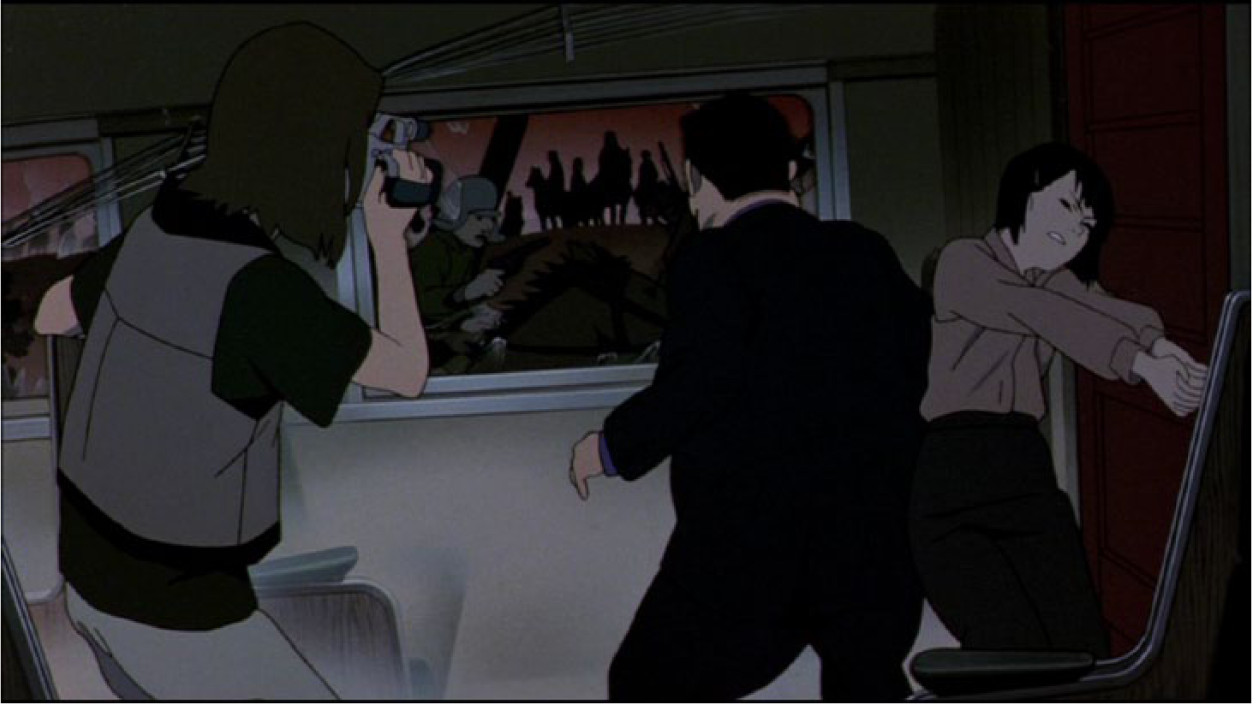
Chiyoko tries to open the door of the train set alight by bandits in Sennen joyû (Millennium Actress, 2001) (DVD). Directed by Satoshi Kon. Japan: Madhouse.
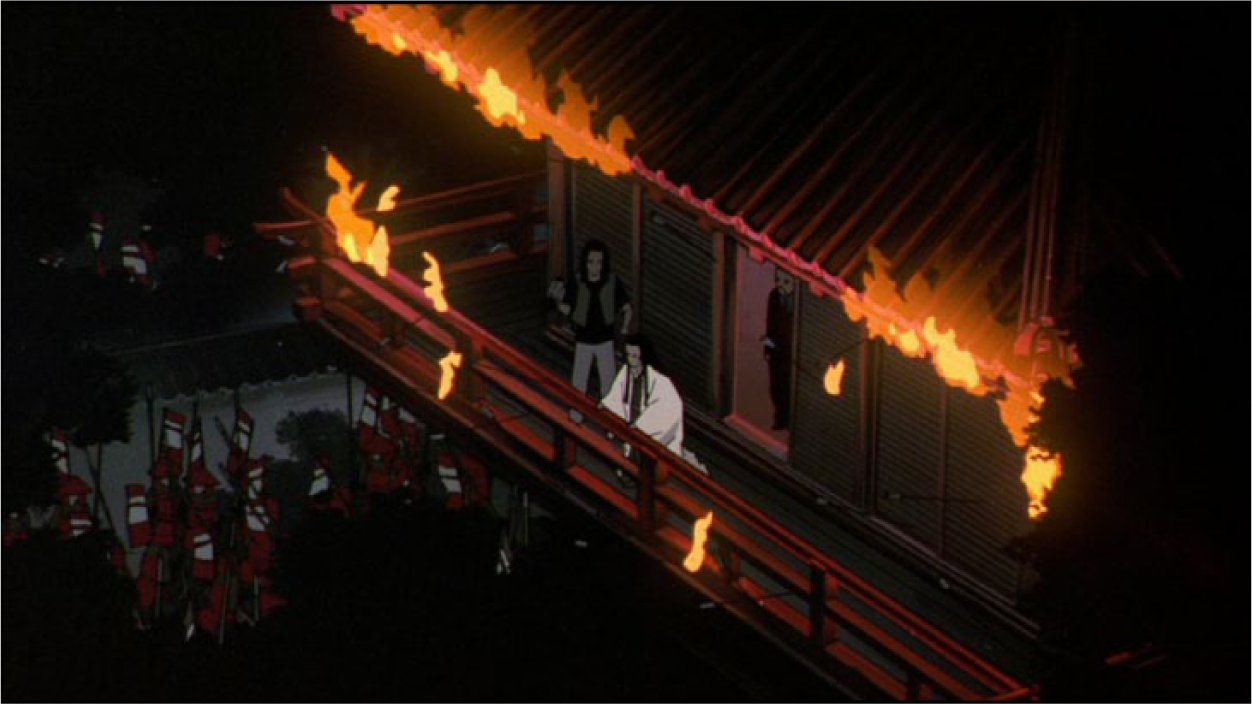
The door of the train opens onto a scene from historical fantasy in Sennen joyû (Millennium Actress, 2001) (DVD). Directed by Satoshi Kon. Japan: Madhouse.
Alarmed at the sudden change in space, Kyōji exclaims: ‘Where are the bandits? Where’s Manchuria?’ In the same sequence, Chiyoko (as a feudal princess in a film) finds her husband dead. Just before she is about to drink poison herself, a Spectre appears and tells her that Chiyoko can go to the ‘space’ where her husband is if she drinks magical tea. Chiyoko drinks it in the hope of being transported to the ‘space’ of her ‘Lord’, but the Spectre reveals that it is ‘1000-year tea’ that will make Chiyoko burn in the flames of eternal love. This becomes a metaphor for Chiyoko’s relentless pursuit of the artist from one space to another, which bears no fruit.
It is after the World War II air raid that Chiyoko finds her most intimate space destroyed. The storeroom, where she first housed the artist, lies in ruins. But this ‘space’ brings its own magic for Chiyoko, who discovers a painting of her on her broken-down wall, signed by her lover. This discovery opens many other spaces for Chiyoko, who eventually starts realizing that she is not young anymore. In her anguish, she finds that her conversation with her own mother completely blends in with a film-within-a-film conversation with her co-actress Eiko, and she cannot tell them apart (neither can we). After the shooting of this scene Chiyoko also loses the key, after which she agrees to get married and her film space converts to domestic space.
Chiyoko’s marriage acts as restrictive space, both for her memories and the ‘chase’ that she so loves. Once the key is rediscovered by her in the film and she confronts Ootaki in a private moment, realistic settings are invaded by unreal, magical elements: a rather theatrical entrance of Eiko and her admission of the theft of the key, followed by the scarred policeman’s appearance with the artist’s letter. After reading the letter, Chiyoko’s marital space is shaken, and she is on the run again, pursuing the artist. In the end, Chiyoko holds on to the key in hospital, telling Tachibana that she can find the man because she now ‘has the key’. Even on her deathbed, the key becomes her point of access from the space of the living, to the space of undying pursuit. When the film studio is torn down, it becomes a metaphor for Chiyoko’s personal space being shattered; with the destruction of the studio, Chiyoko passes away.
Time becomes a complex, indistinct element. As Chiyoko narrates her story, she re-lives her life, with all her memories and films becoming so real that Tachibana and Kyōji ‘watch’ it in real-time. Chiyoko also alternates between being an elderly woman and a young woman, and from a young woman to an old one. Once Tachibana hands old Chiyoko the key, she is magically transformed into a young woman through her memories. From real time to her flashback, time is non-linear. However, her flashbacks in themselves are linear, until they are interrupted by the old Chiyoko’s need to rest, or need to comment on some event. This illustrates the lack of fluidity of time through different times and eras. In the final scene, Chiyoko is propelled into space as a young woman; the spaceship and her ‘final journey’ become a metaphor and euphemism for death, suggesting that time is not fluid, flowing differently in space.
In Paprika, time and space is a void concept for Paprika, who shifts from space to space almost as if being teleported magically. During the opening credits, Paprika hops from place to place, slightly levitated. Paprika, who is a ‘dream’ personality, completely defies the notions of time and space. This is particularly clear when Chiba enters Himuro’s dream. Her alter ego Paprika travels by flying on a cloud, also appearing as a Sphinx and a butterfly. In these roles, she moves from space to space without any barriers. She also changes form and shape according to requirements.
The dream parade is one such element which completely works according to its whim, without taking in the notions of time and space (see Figure 3). It first appears after Dr Shima falls victim to the misuse of the DC Mini (the device that allows its user to see people’s dreams). In the parade, random inanimate objects such as dolls and refrigerators, take on a life force of their own and march to an unknown destination. The parade itself is one delusional patient’s dream and, throughout the film, it becomes a metaphor for the invasion of the fantastical within the dream world, and finally within the real world as well. The parade is first seen in a space indiscernible to the viewer, apparently a desert, at a time when dreams and reality have not yet merged. Eventually however, it assimilates all the dreams of individuals, making it one large, collective dream. By the end of the film, the dream world and the real world become so connected that the parade marches into Tokyo, pulling in people from the real world and turning them into objects. The very first scene in Paprika explores the space of a ‘dream within a dream’ and the character Paprika is introduced to us as a participant in Konakawa’s dream. Once Konakawa wakes up from his recurring nightmarish dream, Paprika is at his side in a hotel room, replaying his dream to him on his laptop. At this point the audience is unaware that Paprika is not a real character within the anime’s world (diegesis) but one that exists solely in the dream space. Therefore Paprika being with Konakawa in a hotel room is actually Konakawa’s dream as well (while using the DC Mini). With the introduction of Paprika, the concept of space is completely altered as the events take place not in real space, but in the dream world.
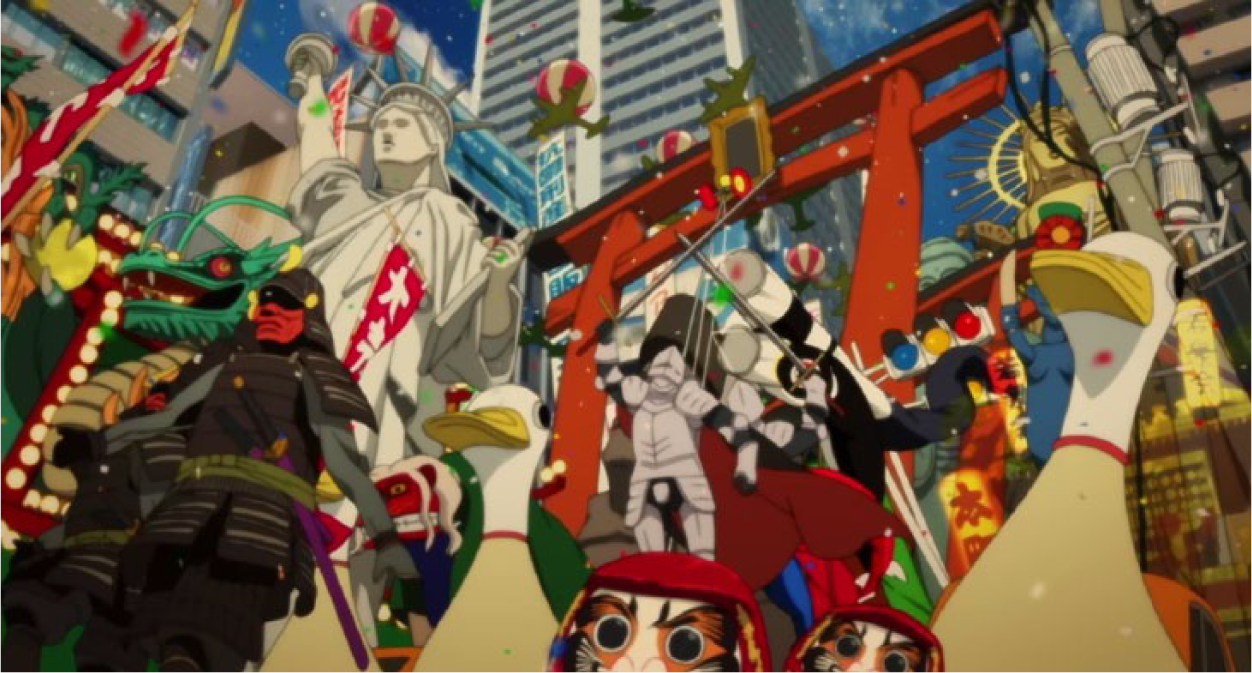
The dream parade in Paprika (2006) (DVD). Directed by Satoshi Kon. Japan: Madhouse.
Time and space are also constantly blurred for anyone in contact with the DC Mini. Dr Shima, the first victim of the DC Mini completely loses track of time and space once his dreams are invaded. He almost plunges to his death because he translates his actions in the dream world to the real world. Until he recovers, he has no concept of the real world. The same happens for all those who are affected by their dreams being invaded (including Tokita and Himuro). Due to the imperfections of the DC Mini, the dream worlds of many individuals merge even when they are not in a state of sleep, creating multiple spaces. An example of the merging of dreams is when Konakawa, who is caught up in his own recurring dream hears Paprika shout in Osanai’s dream and then proceeds to save her. To finish off his own dream, Konakawa has to kill a criminal. However, as a result of the dream worlds and real worlds merging, Konakawa shoots Osanai (the ‘criminal’ in this case), killing him even in the real world.
In another dream sequence, where Paprika is counselling Konakawa (43:47–44:30), she asks him why in his dream (within a dream) there were references to filmmaking such as ‘crossing the line of action’, or ‘panfocus’. Here Kon melts the boundaries distinguishing dreams and film. Konakawa’s dreams are like films because of his own association with them and his dream spaces are like scenes from films, where he appears in a circus, a jungle (as Tarzan), a train, a fight, and eventually in a hallway. This adds to the concept of ‘merging realms’ as well, because the spaces provided by the medium of film and the spaces provided by dreams seem similar, and in essence, indistinguishable. Just as films can be creatively imagined, dreams can also be imagined and constructed in similar ways.
Non-sequiturs: Distinguishing the real from the unreal
A non-sequitur is ‘a statement which does not follow logically from the premises which precede it’ (Warburton, 2000: 94). Kon inserts non-sequiturs in both Millennium Actress and Paprika: in Millennium Actress, the unexpected jump through time and space causes a premise to seem different from its conclusion; Paprika has many non-sequiturs, and the technique is used to make a distinction between the normal world and the ‘fantastical’. Millennium Actress has fewer non-sequiturs, and their use indicates a jump from one setting and time to another. Take for instance a scene where Chiyoko sees the dissident artist being taken into jail. She runs, but the doors are closed. She cries: ‘Let me in, let me in’ and is immediately flung into World War II raids. Here Eiko and some others call out to her saying ‘Come back’. The words from the previous scene have no connection with the words from the latter. Even visually, there is no connection between the prison scene and the air raids scene. This indicates a jump from reality into fantasy, thus extending the realm of magical realism in the film.
In Paprika, non-sequiturs become indicative of madness and create strange and fantastical situations. After the DC Mini is stolen, the culprit tries to take control of the minds of victims who had once used the device, or had come into close contact with it. The first victim we see is Dr Shima, who after speaking very normally, suddenly breaks into nonsensical non-sequiturs: Even the five court ladies danced in sync to the frog’s flutes and drums. The whirlwind of recycled paper was a sight to see. It was like computer graphics. That I don’t support Technicolor parfaits and snobby petit bourgeois is common knowledge in Oceania! Now is the time to return home to the blue sky!
Although Dr Shima’s words are grammatically correct and there is nothing wrong with them technically, they are completely nonsensical. Their basic premises do not have any bearing on their conclusions. These words cause ‘unsettling doubts’ in the minds of Chiba and Tokita. Following Dr Shima’s ‘possession’, non-sequiturs become connotative of mind control as a result of the misuse of the DC Mini. Those possessed in the real world also use non-sequiturs in the realm of dreams. Dr Shima for instance tells Paprika (in the dream world): ‘You’re the feisty country girl I saved some time ago. How are you? If he was not home when I passed by around 7:30, then he probably disappeared into the instant noodle soup.’
Non-sequiturs extend to other members of staff in Chiba’s office; two possessed scientists use them later. Even Tokita is assimilated into the dream later on in the story, and his non-sequiturs, very aptly, hint at his love of food: ‘The ecstasy that blooms in synapses is Paprika-brand milk fat! 5% is the norm. The safety net of the ocean is nonlinear, even with what crabs dream of! Let’s go!’ Detective Konakawa, who for the most part is looking into his own dreams, is never seen to be talking in non-sequiturs. This separates him from the other people whose minds have been invaded by the DC Mini. Paprika similarly does not use non-sequiturs in the dream world, but that is because it is her real world. The use of non-sequiturs in Paprika makes individuals take on a different identity altogether. As the dream invasion leads individuals to a loss of consciousness and in a way, a loss of self, non-sequiturs indicate a move from ‘normal’ behaviour to ‘unnatural’ behaviour, thus leading to a further blurring of a person’s real identity.
Entangled identities: Alter-egos, reflections and self
In Millennium Actress and Paprika, what constitutes the character’s ‘true self’ lies in constant disorientation, with characters possessing more than one identity. In an almost web-like sense of self, Chiyoko possesses a real, time-bound identity, and constantly assumes roles and identities of characters in the past, travelling through Japan’s history. Her reality and true self, however, absorb these multiple enacted selves. Her film self and her own self are different and yet their identities run parallel. In Paprika, Paprika inhabits both the animated ‘physical’ as well as non-physical world. In Millennium Actress, Chiyoko’s self is entangled between her non-film identity and her celebrity identity. Even when recollecting her memories, she fails to differentiate between the two, making her flashbacks more indistinct. She has many identities as a result of her appearance as different characters in films. Although the audience never discovers the names of her characters, Chiyoko takes on the forms of a young girl looking for a man in Manchuria (which ironically is as true as her real life story), a feudal princess, a ninja warrior, a geisha apprentice, a prisoner, a World War II survivor (reality again), a scientist, an astronaut, among others. Chiyoko’s real life mirrors her reel life perfectly, as in all of her roles she is in love with a man; all characters headed towards a distant dream of finding something or someone. All the characters become so much a part of her personality that she finds them impossible to separate from her memories.
Chiyoko forfeits her film identity later on because she realizes that she is no longer young, and even if the dissident artist sees her films, he will no longer recognize her. Chiyoko’s younger self is overshadowed by the older, and she notices it only much later on. Before that period in time, Chiyoko stays true to her young self and is fuelled by her desire to find her lover. The Spectre that appears in a fine example of intertextuality (inspired by Akira Kurosawa’s 1957 Throne of Blood) can be likened to Chiyoko herself. She hates this form of herself the most – the withered, old, wretched form – that stops her from gathering her strength and pursuing her love. While the key represents Chiyoko’s youth, the Spectre is a metaphor for old age. Before her death, the Spectre appears in the artist’s painting of the young Chiyoko, symbolizing the older Chiyoko and the end of the pursuit.
In contrast, Paprika is an actual (and not imagined) alter-ego of Dr Atsuko Chiba, and exists in a different realm. While Chiba is reserved and serious, Paprika is fun-loving and chirpy, almost making it seem like a personality clash, especially in the dream and reality merging sequences. Paprika comments during a session with Konakawa, that dreams and the internet allow one to vent repressed emotions. In this dream space, Chiba lets her repressed self free. In a similar manner, Chiba vents her repressed emotions in the form of Paprika, who is very expressive. Chiba accepts and reconciles with her real love for Tokita only when the real and the dream worlds merge, allowing her to embrace her emotions. Unlike in Millennium Actress where Chiyoko’s various onscreen roles are inseparable from her real self, Paprika and Chiba are sharply contrasted and easily distinguishable from each other. However, they are not two different people but two different sides of one person.
Reflections play a key role in revealing alternative selves. In Paprika, while Chiba is walking through a glass passageway (24:15), she watches her reflection in the glass, which suddenly transforms into Paprika herself (see Figure 4). This invasion of the reflection is also seen at several points in Millennium Actress, where Chiyoko’s reflection in glass is magically invaded by the Spectre; whenever this happens, it leads to a change within Chiyoko. For instance, when Eiko (somewhat resembling Chiyoko’s mother), in a staged (yet very realistic) setting, tells Chiyoko that she will not be everyone’s ‘Madonna’ forever, Chiyoko spots her reflection in the glass case transform into the image of the Spectre. The key is lost, and eventually, Chiyoko agrees to marry Ootaki. In another occasion, while an earthquake strikes during a sci-fi film shoot and Genya saves Chiyoko, she spots the Spectre’s image replacing her reflection on the helmet: this moment marks Chiyoko’s seclusion. At the end of the film, she is looking at the storeroom wall painting and sees the Spectre in it (see Figures 5 and 6). However, she does not react to it with fear, but instead accepts the end of life. The lotus that we see within the secluded space into which the old Chiyoko has retired is connotative of peace, serenity and simple purity and is a metaphor for Chiyoko’s personal tranquillity, brought to her by her old age. This is contrasted to the state in which the key had put her – constantly chasing a dream-like man. This use of multiple, entangled identities and magical invasions of space in the two films creates ‘unsettling doubts’ about the nature of the self, adding to magical realist narratives.
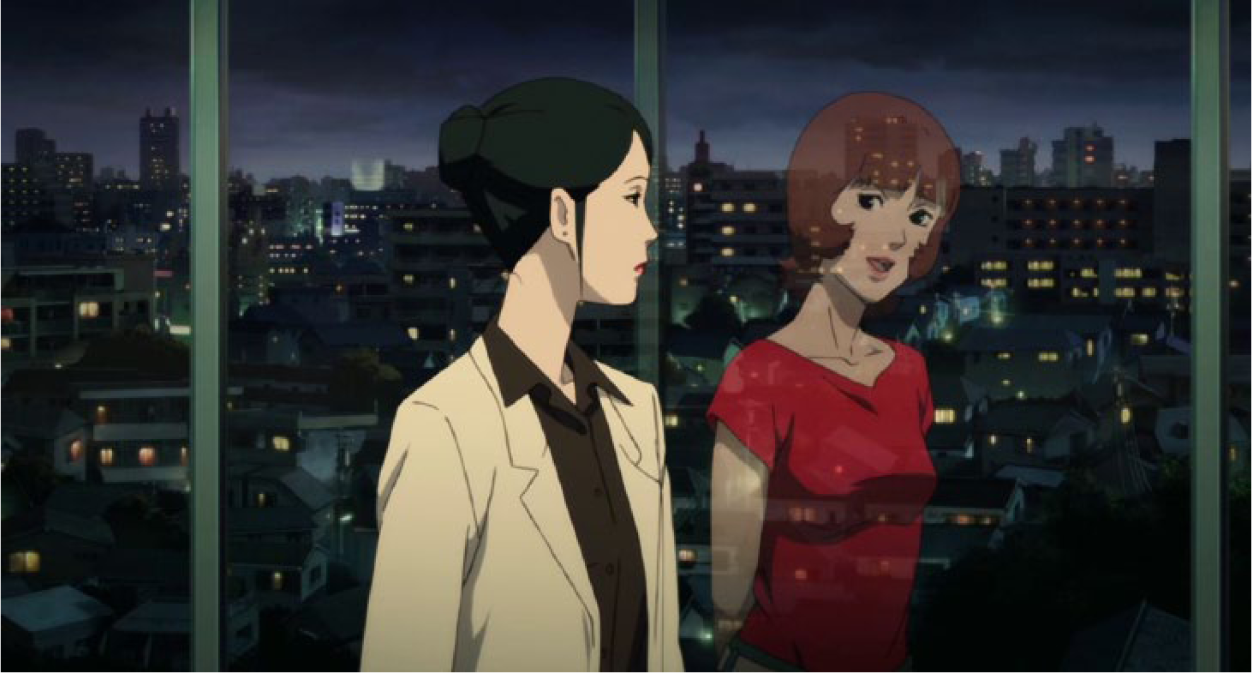
Chiba sees her reflection transform into Paprika in Paprika (2006) (DVD). Directed by Satoshi Kon. Japan: Madhouse.
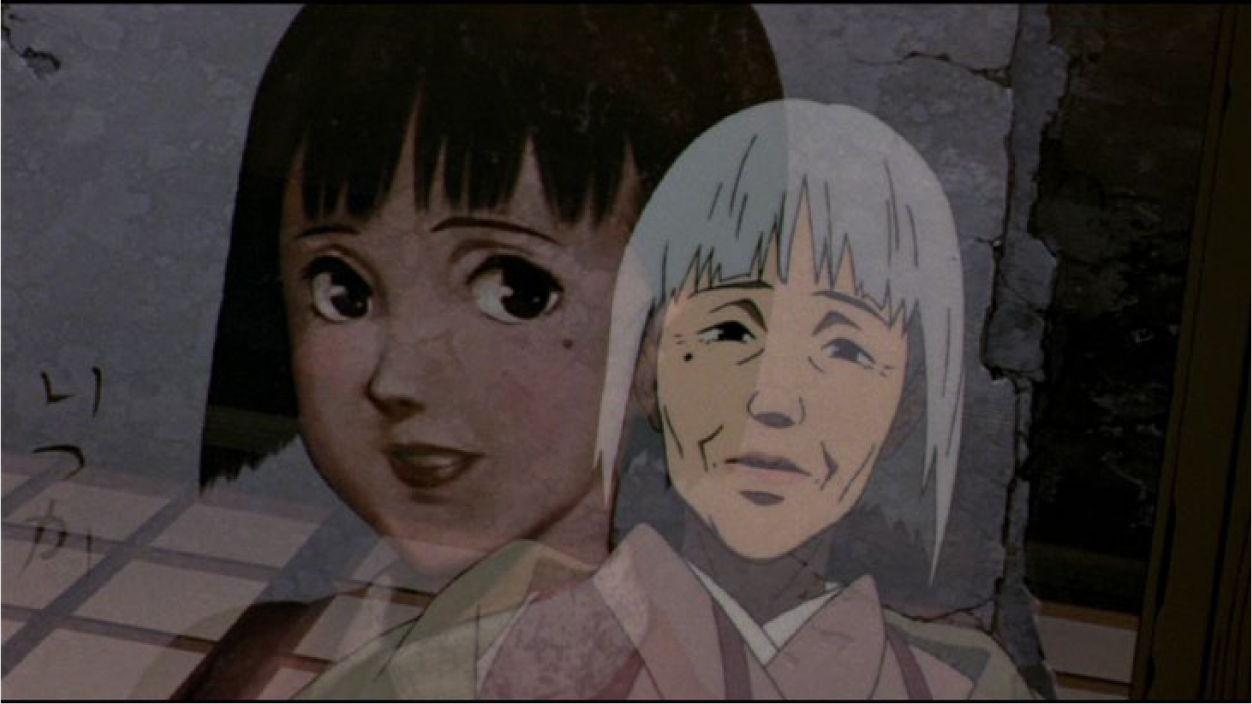
The old Chiyoko’s reflection in the glass case of the painting is transformed into Figure 6 in Sennen joyû (Millennium Actress, 2001) (DVD). Directed by Satoshi Kon. Japan: Madhouse.
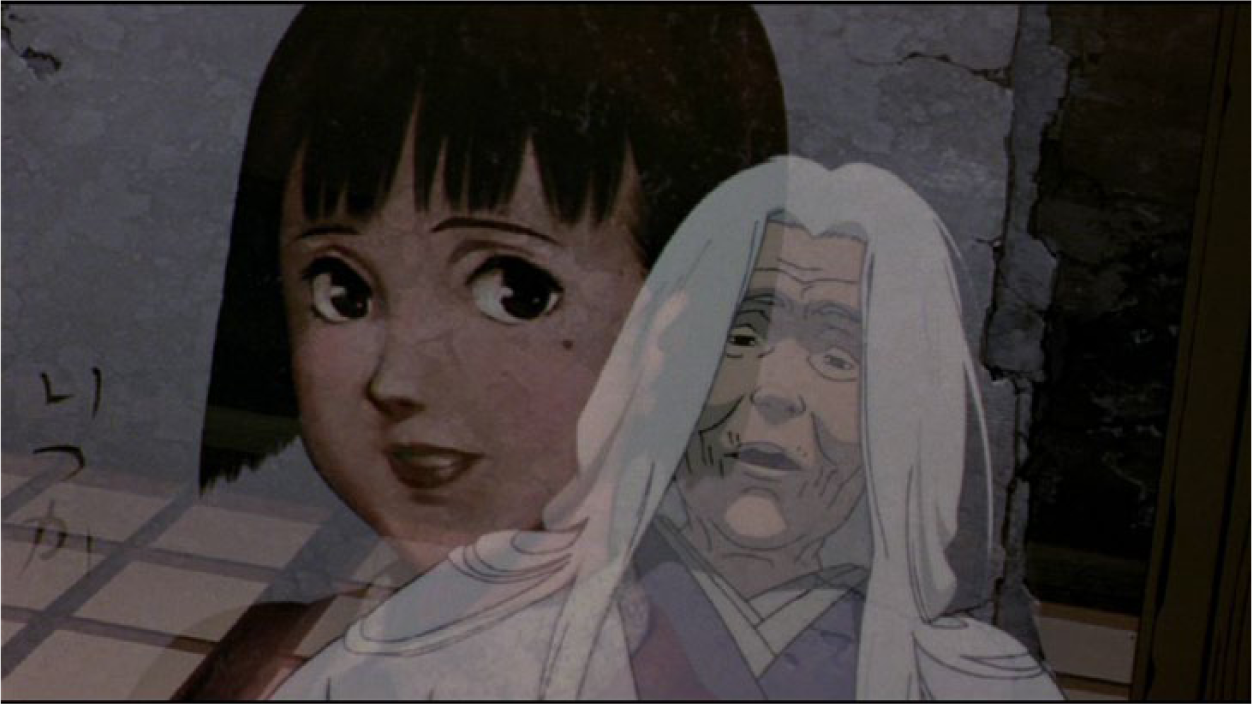
The old Chiyoko’s reflection in the glass case of the painting is transformed into the Spectre in Sennen joyû (Millennium Actress, 2001) (DVD). Directed by Satoshi Kon. Japan: Madhouse.
Observers as actors
Millennium Actress and Paprika extend the elements of magical realism by introducing observers as actors in sequences. Observers can be taken to mean listeners of a story (such as Tachibana and Kyōji in Millennium Actress) or even dream consultants or viewers of movies (in Paprika). The observer as an actor not only adds to the fantastical in the story, but also changes events in the narrative, thus disrupting notions of time, space and self.
In Millennium Actress, Tachibana and Kyōji listen to Chiyoko’s recollections. However, they are magically transported into her memories. Although the two initially act as observers to the action, Tachibana starts taking an active role in Chiyoko’s memories after the Throne of Blood inspired sequence, where he stops Chiyoko from taking her own life. He saves Chiyoko in many scenes, including her fight with Eiko in a ninja setting, as well as during an Edo period movie where the man with the scar almost kills her. Tachibana also frees Chiyoko with his money when she is thrown into jail. This makes him an active participant in her memories, and they both actually end up sharing a few memories. It is revealed that Tachibana was a former employee at Ginei studios, and that he had saved Chiyoko during an earthquake. Therefore, as Chiyoko unravels the mystery of her past, Tachibana’s participation hints at his real involvement in her life.
In Paprika, Paprika is a dream therapist in the alternative reality of dreams, who participates in the dreams of her patients. As the film begins, we are in Konakawa’s dream, where Paprika is dressed as a clown. She converses with Konakawa and sees everything he sees. It is this participant element that makes the DC Mini ‘revolutionary’. By being an actor in the dreams of other people, Paprika is able to treat them. Konakawa tells Paprika that if dreams are like movies, then she must be a dream movie star.
In the dream realm, Paprika alternates between being a participant and an observer. In one sequence, she is in a film theatre, watching Konakawa fall in his recurring dream. She then shouts ‘encore’ and the recurring dream takes place once again. This reveals Paprika’s ability to influence the dreamer. Once dreams and reality start merging, Paprika becomes prey to the Chairman and Osanai’s scheme to trap her. Osanai rips Paprika’s body, in a seemingly realistic moment, to reveal Chiba inside it. This notion is quite reminiscent of Noboru in Murakami’s Nejimakidori kuronikuru, who ‘reaches into the bodies of women and physically removes their “core identities,” leaving them bereft of an individual self’ (Strecher, 1999: 287). Konakawa, who is a victim of his own recurring dream, is somehow pulled into Chiba’s dream, where he sees Paprika’s molestation by Osanai being screened in a film theatre. He pushes through the screen and ends up inside the ‘film’, and then saves Chiba from the clutches of the Chairman and Osanai. When reality and dreams merge finally, all observers become actors. For instance, passers-by who watch the dream parade as observers get pulled in and become a part of the parade itself.
The integration of alternative realities
Kon’s films narrow down the distinction between what is real and what is not, but one can argue that the unreal in Millennium Actress and Paprika is simply an alternative reality rather than a figment of imagination. Unlike Perfect Blue, where Mima’s life is plagued by hallucinations, in Millennium Actress and Paprika, the protagonists do not hallucinate, but take the story forward through different realities. The earliest example of this technique in Kon’s films can be traced back to Perfect Blue, in which Mima finds a website called ‘Mima’s room’ where the creator of the website seems to know as much about her life as she does. The reality of this alternative ‘space’ disturbs Mima day by day, as it is a projection of her real life. The internet becomes an ‘alternative reality’ for Mima, where she finds her inner thoughts projected.
Similarly, in Millennium Actress, an alternative reality for Chiyoko is film. It is so embedded in her personality that her life acts out like a film, and her pursuit for the man she loves is both a film story and her real life story. Chiyoko relentlessly seeks the man she loves, through different films, and is shown to give her best performance when she transfers this reality onto the screen. Therefore her real life and her reel life merge perfectly, making the distinction between the two completely vague. This ‘film within a film’ concept completely integrates both realms of film and reality. Furthermore, there is no dividing line between memory, film and reality, and Tachibana and Kyōji take part in the action as if they are actual characters in the film-within-a-film.
When Chiyoko discovers that the dissident artist has escaped and is on a train to Manchuria, she runs to the station, only to miss him by seconds. She falls on the floor and cries, evoking a similar response from Tachibana, who is ‘watching’ this memory with Kyōji. The following dialogue between Tachibana and Kyōji best describes the merging of real life, memory and film:
Man, this is dramatic …
I cried fifty-three times during this scene!
When did this become a movie?
This is the first time Kyōji realizes that Chiyoko’s memories are also films. In subsequent sequences, Kyōji’s acceptance of this ‘irreducible magic’ is reflected in his nonchalant attitude, adding to the film’s magical realist narrative.
In Paprika, reality is naturally alternative. The film mixes dreams and reality so that both become inseparable from one another, adding to its magical realist characteristics. The beginning sequence is a seamless merging of the phenomenal world and an alternative reality of dreams. From very early on in the film, Paprika tells Konakawa that if some dreams are like trailers, then others are like fully-fledged movies. By doing so, she introduces the idea of dreams being similar to movies. This concept is extended with film theatres being central to the plot. Paprika tries to help Konakawa realize why he dislikes films, by taking him into a dream realm where there are movie posters all around. After a recurring dream sequence, Konakawa and Paprika sit in a movie theatre and discuss aspects of filmmaking.
Another alternative reality in Paprika is the internet. Earlier in the film, Paprika tells Konakawa that the internet and dreams are similar as they provide a platform for repressed feelings. This becomes true literally for Konakawa, who constantly visits the radioclub.jp site to undergo dream therapy with Paprika. Although Konakawa accesses the site from his laptop, he is literally pulled into it. The barrier between phenomenal reality and the alternative reality of the internet are completely blurred. Within a second, Konakawa ‘jumps’ from the real world into the realm of the internet, obscuring the dividing lines between different realities.
Merging realms of time, space and identity is strongest in Millennium Actress. Paul Wells (2011: 7) points out that Millennium Actress is ‘based on the motif of running, and moving through, the contours of Japanese social history since the 1930s’. We add that this moving through not only unveils many eras of Japanese history (effectively through memories of films that Chiyoko has acted in – quite incidentally, these are also recollections of and references to real Japanese films); at the same time, this moving through not only reveals Chiyoko’s own life history but, through the element of running, we watch Chiyoko growing up from a teenager to an adult to an old woman. Time and timelessness hence are experienced through these merging visuals of past and present. Here, we would also draw upon a visual experience of déjà vu, used in the film as recalling of past experiences through the repetition of visuals both same and identical, thus fulfilling a full circle. An example of this would be the repetition of the artist’s words (about the penultimate moon) as Chiyoko again is on the run, inside a train, after breaking the shackles of marital life: we again see the visuals of the moon (symbolizing a potent memory of the past), while instantaneously also seeing three friends talking about first love – a déjà vu of Chiyoko’s own experiences as a teenager earlier in the film. The film begins and ends with identical visuals – Chiyoko boarding a spaceship, and in the final scene she is seen vanishing into space. Each visual element becomes a reflection of the past, and although they are all disconnected in reality, they are connected in essence, constituting a collective, cyclic experience.
Conclusion
This article has argued that film and animation can be read as magical realist. If magical realism is an expression of the postcolonial, then Satoshi Kon’s magical realist anime play with and break down traditional narrative structures, embodying an Asian visual experience. In Millennium Actress, the ‘colonizer’ that Chiyoko battles with in the film world is the idea of social constraint – Kon’s narrative mode is thus a rebellion against such constraint and limiting societal structures; in Paprika it is repression that colonizes, and hence the film approaches this colonialization through breaking with traditional film structures. Kon once said: ‘If I dare to put into words the movies I have directed, it would be fantasy based on a world that has reality … then take off from there and fly into the domain called fantasy’ (Bergen, 2010). His magical realist apparatus includes the use of female protagonists, a going forward and backward technique that parallels the history of Japan with the memories of Chiyoko Fujiwara in Millennium Actress, the merging phenomenal world and an alternative reality of dreams, memories and film, as well as the blurring of dreams and exploration of the unconscious in Paprika. Kon’s films, although rooted in realism, explore the magical that embodies desire and longing in Millennium Actress and the unconscious in Paprika. Both films, examined using concepts developed earlier, play with the element of time, space and identity disruption. Each film, however, weighs differently with regard to these concepts. For instance, the non-linearity of time and space is more prevalent in Millennium Actress than in Paprika. Likewise, non-sequiturs are more common in Paprika than in Millennium Actress.
In both Millennium Actress and Paprika, truth is subjective, with no one single truth or way of knowing. Furthermore, reality itself is not absolute – through the introduction of the magical, the construct of the real (true) self is constantly disrupted. The disruption of space, time and identity is common to both films. Millennium Actress’s protagonist Chiyoko is seen as one and yet multiple personalities – the realms of her ‘true’ self are interspersed with the characters she embodies in her films (film within a film for the viewer) – each pursuing a chase. Chiyoko’s identity is inherently Japanese, while the characters in Paprika are more transnational. Indeed, we see Millennium Actress as an intensely personal film that is a deep exploration of the self. In Paprika, alternative realities (made clearer with the indistinguishable merging of dreams and reality) lead to disruptions in space, time and identities. The protagonist Dr Chiba does not have one, but two personalities, one of them being her alter ego (in the realm of dreams).
While both films use similar narrative structures, Paprika is set in a postmodern world and Millennium Actress follows a postmodern narrative structure. Both anime play with the idea of a collective experience and Japanese consciousness. In Paprika, despite the film’s exploration of the unconscious (an idea taken from the West), the film focuses on the collective (key to Asian cultural identity) – the dream space that binds together the film’s narrative, is a collective space, not individual. Lastly, we see the magical as constituting the soul of Millennium Actress and as the expression of the unexplored self in Paprika. These anime inherently provide counter narratives and historical, cultural and personal experiences, thus reflecting the plurality in Asian ways of knowing and in experiencing the world and ourselves in film.
Footnotes
Acknowledgements
We would like to thank Suzanne Buchan, the Editor, for her meticulous reading of our drafts and invaluable comments provided.
Funding
This research received no specific grant from any funding agency in the public, commercial, or not-for-profit sectors.
Notes
Author biographies
Emails: