







Abstract
In this article, the author proposes that both substance and process philosophy inadequately address the ‘plasmatic’ and metamorphic movement (PMM) of early animation since it subverts the logic of the ‘cinematographic illusion’. Cognition, which is apparently dependent on identity formation, is predicated on substance, which conforms to representational thought. PMM, which is predicated on the ‘fluid’ linkage of images, destabilizes substance, consequently problematizing representation by introducing conflict between speculative substance predicated on form and perceived materiality from movement. A different problem appears with process philosophy privileging continuing flux that cannot logically be based on identity formation as it resists predication. Yet, cognition is possible as process is speculative and substance is manifest. PMM, as a manifest process that dematerializes substance, ungrounds the basis of both philosophies, simultaneously highlighting their complementarity. By problematizing both, PMM is able to highlight the relational and dependently originated nature of thought.
Keywords
Introduction
The starting point of any conception concerns certain fundamental postulates that could be expanded into a broader perimeter of definitions. Thought comprehends movement in terms of the ‘cinematographic illusion’. Movement is either recorded and reproduced using the cinematographic apparatus, such as in live action, or constructed using a frame-by-frame process, as in animation. Consequently, two resultant image forms can be distinguished not only from their processes but also in their differing movements. While the plasmatic and metamorphic movement (PMM) of early animation was very distinct from live action movement, contemporary digital imagery blurs differences between the two. Mainstream animation following digital processes, in trying to emulate live action ‘realism’, has ended up representing ‘substance’. Apparently, metamorphosis can be theorized by process philosophy as against substance philosophy. However, I suggest that PMM ungrounds theory by highlighting that the relational nature of concepts fail to emerge without a sense of enduring structure, from which either philosophies ‘dependently originate’. Therefore, this article contests the application of both substance and process philosophy to animation, while highlighting there complementarity.
The cinematographic illusion and animated motion
In Creative Evolution, Henri Bergson (1944[1907]: 332) states that: The mechanism of our ordinary knowledge is of a cinematographical kind . . . We take snapshots, as it were, of the passing reality, and, as these are characteristic of the reality, we have only to string them on a becoming, abstract, uniform and invisible, situated at the back of the apparatus of knowledge . . . Perception, intellection, language so proceed in general.
Bergson calls this a false movement and gives it a name: ‘cinematographic illusion’ (see Deleuze et al., 1997: 1). Deleuze, in elaborating Bergson’s theses on movement states: . . . you cannot reconstitute movement with positions in space or instants in time: that is, with immobile sections [coupés]. You can only achieve this reconstitution by adding to the positions, or to the instants, the abstract idea of a succession, of a time which is mechanical, homogeneous, universal and copied from space, identical for all movements. And thus you miss the movement in two ways. On the one hand, you can bring two instants or two positions together to infinity; but movement will always occur in the interval between the two, in other words behind your back. On the other hand, however much you divide and subdivide time, movement will always occur in a concrete duration [durée]; thus each movement will have its own qualitative duration. Hence, we oppose two irreducible formulas: ‘real movement → concrete duration’, and ‘immobile sections + abstract time’. (Deleuze et al., 1997: 1)
Certain aspects of this conception may be highlighted. Firstly, the continuous and the discrete cannot be reconciled. Movement cannot occur without presuming continuity of the same identity. Movement is grounded within a ‘single, identical, homogeneous space’ (p. 1), and a time which is ‘mechanical, homogeneous, universal and copied from space, identical for all movements’. This is representational thought predicated on identity that subordinates difference. Secondly, and conversely, ‘becoming’, as continuing difference (dissolving identity), cannot occur in an instant; it is a movement possessing its own qualitative duration. Therefore, becoming cannot be conceived without imputing continuity to discrete ‘immobile sections’, an ‘abstract idea of succession’, which is time or in time. Hence, can there be becoming, difference or time without each conception grounding the others? Alternatively, can there be movement without identity? Again, if becoming is continuing difference, can there be any relation between different and different without movement or identity? Such questions problematize the cinematographic illusion.
Bergson distinguishes between the ancient and the modern illusion of constituting movement. ‘For antiquity, movement refers to intelligible elements, Forms or Ideas which are themselves eternal and immobile’ (Deleuze et al., 1997: 4). Movement is reconstituted from their ‘actualisation in a matter-flux’, ‘potentialities which can only be acted out by being embodied in matter’. Movement expresses an ‘ideal synthesis’ of a ‘dialectic’ of forms, or ‘an order of poses or privileged instants’ which is filled in between by regulated ‘transition, of no interest in itself’. The modern conception relates movement not to privileged instants, but to any-instant-whatever. ‘Although movement was still recomposed, it was no longer recomposed from formal transcendental elements (poses), but from immanent material elements (sections). Instead of producing an intelligible synthesis of movement, a sensible analysis was derived from it’ (p. 4).
Now, ‘cinema is the system which reproduces movement as a function of any-instant-whatever that is, as a function of equidistant instants, selected so as to create an impression of continuity’ (p. 4). Significantly, this conception takes time as an ‘independent variable’ (p. 4). The cinematographic apparatus records the given with ‘photogrammes – that is, with immobile sections’, yet ‘what it gives us is . . . an intermediate image, to which movement is not appended or added; the movement on the contrary belongs to the intermediate image as immediate given’, i.e. ‘it immediately gives us a movement-image. It does give us a section, but a section which is mobile, not an immobile section + abstract movement’ (p. 2). Movement-image as a mobile section, i.e. becoming, follows the modern illusion of constituting movement. However, can there be any mobile section (continuity) without immobile sections at its two ends?
The ancient dialectic is ‘the order of transcendental forms which are actualised in a movement’, while the modern dialectic is ‘the production and confrontation of the singular points which are immanent to movement’. It seems that ‘transcendental’ forms are perceived from movement for the ancient dialectic, while choosing points from transitioning ‘wholes’ inform the latter. ‘Eisenstein extracted from movements or developments certain moments of crisis’, or the ‘pathetic’, where ‘he picks out peaks and shouts, he pushes scenes to their climax and brings them into collision’ through the ‘cut’ passing through an ‘organised set of any-instant-whatevers’ (pp. 5, 6). Thus, for live-action, the ‘production of singularities (the qualitative leap) . . . achieved by the accumulation of banalities (quantitative process)’ is simply about picking ‘remarkable instants’ from the immanent analysis of movement (p. 6). This means that ultimately the mobile section, or a cinematic shot, is given meaning by identifying and relating ‘privileged instants’. Thus, Kubelka argues: It can be a collision, or it could be a very weak succession . . . Eisenstein, for example, said it’s the collision of two shots. But it’s very strange that nobody ever said that it’s not between shots but between frames . . . when one frame is very similar to the next frame . . . this would be a shot. (Beckman, 2014: 4)
For Norman McLaren (cited in Solomon, 1987: 11), ‘Animation is not the art of drawings-that-move, but rather the art of movements-that-are-drawn. What happens between each frame is more important than what happens on each frame.’ This is significant, as what happens ‘in between’ distinguishes animation from live-action. Animation therefore supposedly accepts the overarching mechanism of modern conception of movement materially manifest as the playback apparatus of any-instant-whatevers (frames-in-sequence), yet effectuates movement through the ancient dialectic. Therefore, Deleuze contrasts cartoon animation from the movement-image: ‘Any other system which reproduces movement through an order of exposures [poses] projected in such a way that they pass into one another, or are “transformed”, is foreign to the cinema’ (cited in Deleuze et al., 1997: 5). By ‘transformation’, Deleuze obviously refers to PMM, which renders any frame within the animation process into a privileged instant. However, Deleuze overlooks the fact that drawings are ideas, and hence ‘poses’ are not realized sans matter. Hence, PMM is not the result of a transition between poses, instead the movement resulting from a ‘fluid linkage of images through the process of animation itself’ (Wells, 1998: 69). Therefore, forms-in-sequence (not poses-in-sequence) result in ‘plasmaticness’, or a ‘rejection of once-and-forever allotted form, freedom from ossification, or the ability to dynamically assume any form’ (Eisenstein, 1986[1941]: 21). The essence of animation therefore resides in concatenation or ‘a flow of incoherent images’ (Bendazzi, 2016: 31) where ‘metamorphosis is an inborn possibility of . . . frame-by-frame shooting only’. Therefore, forms-in-sequence are distinct from the movement-image, both in terms of the process and its resultant image.
Deleuze’s movement-image creates an ‘indirect image of time’ where ‘the camera does not organise images from a fixed point but itself moves across movements’, so that ‘we no longer think of movement as the synthesis of points within a single line of time. We see movement itself, in all its diversity, from which single points of view are composed’ (Colebrook, 2002a: 32, 33). Nonetheless, can meanings emerge from a mobile section without itself being differentiated into identities? This movement of the whole may not produce meanings without generating identities predicated on ‘differing differences’ – editing structures becomings into becomings of beings, since cinema operates by privileging certain movements and viewpoints over others, rendering them into a meaningful sequence of events (narrative) that culminate in the (primarily psychological) transformation of beings. Instead, PMM already illustrates that beings are ‘manifest’ becomings.
Chandler (2017: 138–139) remarks, ‘if the basic unit is the shot, the analytical utility of this concept is highly restricted in the case of a film like Hitchcock’s Rope (1948), in which each shot (or take) lasts up to ten minutes’, or ‘shots-within-shots in a film like Buster Keaton’s Sherlock Jr. (1924), where we see a film within a film’. But how is PMM different from live-action sequences? An instantaneous frame does not amount to anything meaningful sans movement (either of perception or the perceived), nor does a shot, since a different kind of spatiotemporal conception emerges with PMM. Thus, Sobchack (2000: xix) distinguishes metamorphosis from the temporal sequencing of meaningful events prevalent in live action cinema: morphing is considered a novel form of figuration that accomplishes transformation and change in time in a structure that is quite different in temporality from such cinematic figurations as the cut, dissolve, or camera movement combined with long takes, all of which constitute temporal significance and eventful meaning in sequential terms.
Again, for Klein (1993: 66), metamorphosis is ‘similar to what Eisenstein meant by “intellectual montage,” but without separate shots, more like a linear version of lapse dissolves’, implying both identities and events in literal transformation.
Deleuze further adds: the drawing . . . is always in the process of being formed or dissolving through the movement of lines and points taken at any-instant-whatevers of their course . . . It does not give us a figure described in a unique moment, but the continuity of the movement which describes the figure. (cited in Deleuze et al., 1997: 5)
Thus, forms-in-sequence (not necessarily regulated transitions between poses) and PMM are dependently originated. Animated motion apparently results from ‘finding the nicest transition between two poses’ as ‘breakdowns or passing positions’ (Williams, 2012: 62). Such movement is manipulated using ‘spacing’, i.e. iterative differences between forms, and ‘timing’ or ‘the rhythm of where things happen’ (p. 36). Since every frame is privileged, transitions are not neutral and can be deregulated. Nonetheless, what do we mean by ‘regulated’ or ‘nice’ transitions? Animation relates variable forms-in-sequence (unregulated sans material constraints) input to fixed frames-in-sequence output. Therefore, perception synthesizes forms-in-sequence into supposedly ideal becomings (ideas in movement) within the overarching mechanism of uniform abstract time afforded by the playback device. And, although these contentions refer to drawn animation, frame-by-frame manipulation of forms-in-sequence is applicable across all animated mediums. However, is this synthesis of an idea in movement bereft of a material dimension?
Movement and materiality
Differences between forms-in-sequence result in apparent motion, which is different from real movement of entities. Wertheimer observed apparent motion as ‘a particular type of visual “illusion” in which the phenomenon of seen motion is generated by two stationary stimuli, as contrasted with real motion’ (cited in Wertheimer, 2012[1912]: 93–94). Optimal apparent movement or β (beta) movement
is always described as an apparent movement of a figure (object), whose physical properties . . . are identical to the properties of the objectively stationary targets. If the targets generating the apparent movement are different from one another, changes of some or all of these properties are always observed. (Steinman et al., 2000: 2263).
If the optical stimuli are presented in rapid alternation in certain combinations of spacing and timing with a relatively high frequency, a diffuse shadow seems to move between and temporarily ‘occlude’ the stimuli, also termed as φ (phi) phenomenon. ‘The psychological circumstances can . . . be designated aφb . . . where φ represents what is there in addition to the perceptions of a and b; what occurs in the space between a and b; what is added to a and b’ (Wertheimer, 1912: 186). While both are apparent movement, β is observed at lower frequencies, while ‘pure φ’, which is observed for higher frequencies, is ‘described as a shadow moving between and around the targets. β does not qualify as an objectless, pure movement’ (Steinman et al., 2000: 2263). Therefore, only φ is ‘pure, objectless, movement’, ‘φ does not have shape’, and is incapable of any further analysis. Therefore, perception connects formal differences into continuous movement of an entity with an associated materiality. Yet, this materiality is perceived from movement. So, is identity predicated on materiality, i.e. substance, or does substance follow from movement of identity? This apparent confusion illustrates that substance and identity are dependently originated. However, philosophers were already theorizing movement, the primary difference being their grounding concept.
According to Robinson (2020), substances are typified as ‘the things from which everything else is made’, being ‘subjects of predication and bearers of properties’, or being the ‘subjects of change’. Substance also signifies endurance, which is continuity in time. As enduring substances are also subjects of change, it may be inferred that substance is not bereft of process. By Aristotelian contention, the marks of primary substance are ‘being objects of predication but not being themselves predicable of anything else’. Again, Aristotle understands substance in terms of form and matter. ‘The form is what kind of thing the object is, and the matter is what it is made of. The term “matter” . . . is rather the name for . . . being that from which the object is constituted’. Again, ‘The individual substance is . . . the form individualised in the matter. The matter is . . . the catalyst by means of which the form becomes an individual substance’ (cited in Robinson, 2020). Therefore, for Aristotle, substance is form as individuated matter.
For Hume (1960[1739–1740]: 220): When we gradually follow an object in its successive changes, the smooth progress of the thought makes us ascribe an identity to the succession . . . the imagination is apt to feign something unknown and invisible, which it supposes to continue the same under all these variations; and this unintelligible something it calls a substance, or original and first matter.
Hume declares, ‘We have therefore no idea of substance, distinct from that of a collection of particular qualities’ (p. 16). He asserts that ‘a full knowledge of the object is not requisite, but only of those qualities of it, which we believe to exist’ (p. 172). He connects substance with identity in movement through time. It seems that form, identity, matter and substance are dependently originated alongside succession.
Bergson (2005[1907]: 22) similarly maintains, ‘I call matter the aggregate of images, and perception of matter these same images referred to the eventual action of one particular image, my body.’ Therefore, representational thought imputes fixed identities to aggregated becomings (i.e. images-in-sequence). Again, matter in becoming, and subordinated to identity, cannot necessarily be qualified without relating it to bodily movement, which becomes the basis of relational thought. Becoming is therefore qualified by differing movements of differentiated matter, i.e. substance, or as differing differences. Additionally, Bergson introduces implied causal connections between substances, alongside bodily action. Therefore, it seems that substance is dependently originated, not only with identity, but also its movement in time, which is difference.
Apparent motion, as experimentally demonstrated by Wertheimer, indeed follows from Bergson’s or Hume’s contention, and has a material dimension. Significantly, the Kantian tradition adds another mark of substance as ‘those enduring particulars that give unity to our spatio-temporal framework, and the individuation and reidentification of which enables us to locate ourselves in that framework’ (Robinson, 2020). For Kant (A144, 1998[1781]: 275): Time itself does not elapse, but the existence of that which is changeable elapses in it. To time, therefore, which is itself unchangeable and lasting, there corresponds in appearance that which is unchangeable in existence, i.e., substance, and in it alone can the succession and simultaneity of appearances be determined in regard to time.
Again, Kant states: Our apprehension of the manifold of appearance is always successive, and is therefore always changing. We can therefore never determine from this alone whether this manifold, as object of experience, is simultaneous or successive, if something does not ground it which always exists . . . Only in that which persists . . . is the substratum of the empirical representation of time itself, by which alone all time-determination is possible. (p. 300)
Kant, with his famous Copernican revolution drops Hume’s empiricism and makes substance a matter of a priori psychology. Moreover, substance becomes the grounding principle for succession. We can experience the physical world only by employing certain categories: It is only by understanding the world as possessing enduring spatio-temporal objects (substance), which enter into causal relations with each other . . . that we can have intelligible experience. Substances – that is, a framework of stable, enduring objects – are essential, but the source of this necessity lies not in how the world is in itself, but in the framework that we are obliged to impose. (cited in Robinson, 2020).
Kant formally posits an a priori framework of perception with the presupposition of the existence of substance and causal relations.
From Bergson, Hume and Kant, it follows that perception imputes a dependently originated framework of differentiated substance, space, time and causality to movement. For process philosophy, this grounding shifts from identity or substance to difference/time. Since form organizes matter, identities tend to become synonymous with substances and their material potential. External reality or its reproduction as live-action images follow this framework of consistent materiality predicated on regulated transitions between poses of the same entity, i.e. material potential. However, unregulated seamless linkage between different forms disjuncts identity speculated from form, from perceived matter interpreted from movement. PMM, which simply links images, is not concerned with consistent material potential, but with possibility, the only limit being the limits of human imagination. Forms-in-sequence can not only concatenate identities but their very transformational possibilities redefine material potential – an ontological inversion. Theory could thus identify a unique materiality in ‘objects made of the same all-purpose substance, a rubberised cartoon plasma’ (Klein, 1993: 120). Eisenstein (1986[1941]: 21) has coined this cartoon substance as the ‘primal protoplasm, not yet possessing a “stable” form, but capable of assuming any form’. Unregulated transition between identities not only delinks but also inverts the relationship between possibility and potential as PMM transgresses limits afforded by epistemological categories and causal connections. Fantasmagorie (1908) by Émile Cohl, an early example, showcases such non-sequitur acausal transformations when a bottle turns into a flower, or an elephant turns into a door (see Figure 1a–d). Potential predicated on form disjuncts from that predicated on movement, as manifest ‘omnipotence’ leading to a causal transformations of identities and/or events. So, with concatenated identities exhibiting inconsistent materiality, what happens to the causal framework of identity, space and time, grounded on substance? To answer these questions, PMM first needs to be comprehended in terms of process philosophy.
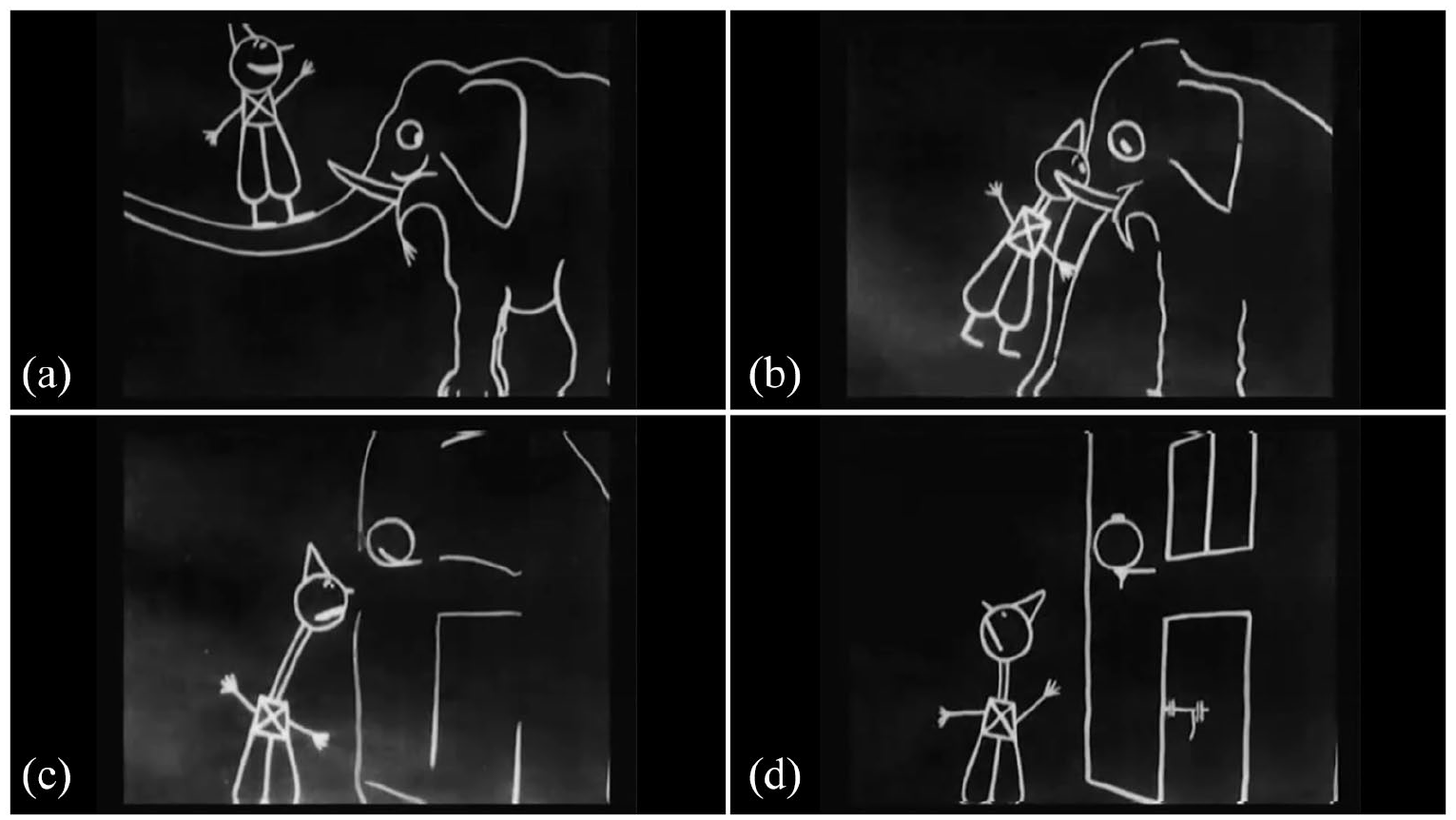
Fantasmagorie (Émile Cohl, 1908).
Identity and non-representation
Sobchack (2000: xii) highlights that fluid metamorphosis destabilizes dominant Western metaphysics focused on ‘essences, categories, and identities’, which instead dramatizes a ‘“process metaphysics” that is less about “being” than about “becoming”’. Sobchack states that morphing seemingly ‘collapses’ ‘boundary distinctions’ between ontological as well as epistemological categories (p. xvi). Therefore, theory should consider the complexity of the morph through both ‘formal and technical’ as well as ‘historical and cultural’ lenses (p. xxii). Yet, with the collapse of boundary distinctions, can there be concepts? Moreover, applying process philosophy on the ineffability of transformation showcased by PMM leads to another set of problems.
In Difference and Repetition, Deleuze (1994[1968]: xix) states that ‘the primacy of identity, however conceived, defines the world of representation.’ Representation restricts thought to fixed norms that do not acknowledge the flow of time (becoming), or ‘difference in itself’. Deleuze goes against the contention that identity produces difference, which is the basis of representational thought, and replaces it with difference-in-itself as ‘empirical and non-conceptual’ (Parr, 2005: 74). Thus, every aspect of reality is constitutive of difference and there is no grounding behind such difference. For Deleuze (1994[1968: 128), ‘There can be no identity without pure differences standing in the background as a condition for the illusory appearance of a pure, well-determined identity.’
Unidentifiable processes are always at work behind representation ‘because all things are connected to multiplicities, that is, to uncountable and unidentifiable processes of becoming, rather than existing as fixed beings with identifiable and limited predicates or essences’ (p. 127). ‘Every determinate thing is a combination of singularities, forming a multiplicity that is changing in multiple ways according to the syntheses of time and led by . . . the eternal return of difference, the eternal return of the new’ (Williams, 2011: 187). ‘If the primacy of identity is what defines a world of re-presentation . . . then becoming . . . defines a world of presentation anew’ (Parr, 2005: 21). ‘Time is what follows from difference (time is difference); difference cannot be located in time’ (p. 86). Therefore, either difference-in-itself grounds time, or it has to be grounded by time. Deleuze, by grounding concepts on ‘pure’ difference, also enters the confusion associated with synthesizing difference/time/movement, or succession. Therefore, time and difference (and movement) are dependently originated concepts. Nonetheless, can there be identity predicated on pure difference without ‘qualitative duration’ differentiating movements?
As Bergson already understands, process philosophy also falls within the trap of material perception even if it presumes cognition of becoming. And, although Deleuze grounds thinking on ‘the effect of forces that are not decided by thought itself’ (Colebrook, 2002b: xl), however, by his own contention, Deleuze (1997: 2) states, ‘whether we would think becoming, or express it, or even perceive it, we hardly do anything else than set going a kind of cinematograph inside us.’ Identities should be dissolved by difference-in-itself, but relating different to different as becomings having their own qualitative duration already indicates differing material perceptions associated with entities. Again, movement cannot take place without continuity of the same; yet, movement must exist for cognition of difference. Therefore, continuing pure difference should refute movement, for if identity dissolves continuously, then what is it that moves? Otherwise, if it is a series of disconnected flickers, there should be no movement. If (re)cognition is the process of knowing, then it is also predication upon differentiated becomings. Synthesizing a past and a future of identities from the present, which is notional endurance, is nothing but speculative becoming possessing its own qualitative duration, i.e. substance. Significantly, if we are to consider ‘the forces, differences, processes or (to use [Deleuze’s] term) ‘syntheses’ which produce recognisable entities’ (Colebrook, 2002b: xl), we should reconsider multiplicity as concepts dependently originating from a ‘collection or connection of parts’ (p. xxvi). The leading question would be: what are the boundary conditions of such a ‘collection’ for concepts to be synthesized from ‘the effect of forces’ beyond thought?
Bergson (2001[1889]) argues that, being hypothetical and speculative, ‘process-character of being is precisely out of our cognitive reach’, and as long as we conceptualize conscious experience in terms of subject–object relations, we theorize in terms of the metaphysics of substance. However, when we do not enforce a conceptualization of experiential content, ‘we find . . . an interactivity – an ongoing interfacing out of which world and self arise in our conceptualizations.’ The immediate, non-conceptualized experience tries to comprehend the ‘dynamicity of this interfacing as becoming or the flow of duration (‘durée’), but this felt dynamic content of our experience transcends what we can conceptually articulate’. For, as soon as we try to conceptualize it, we turn the continuous complex flow of experience into a sequence of discrete units, into pluralities of states of objects at locations that engender Zeno’s paradoxes of motion, and we transform our entangled being with the world into the ever puzzling opposition of a subject and an object. (Seibt, 2018)
Moreover, if our general perception of time is in terms of space, and that ‘time, conceived under the form of an unbounded and homogeneous medium, is nothing but the ghost of space haunting the reflective consciousness’ (Bergson, 2001[1889]: 99), the dynamics of isolating objects predicated on differentiated qualitative duration, should simultaneously speculate variegated qualitative movement in space. Yet, identities synthesized from manifest substance/speculative process are grounded on the modern scientific conception of movement (time as independent). Since the cinematic apparatus is the material manifestation of the modern conception of movement, a simple disjunction between the frame-rates of the recording and the playback device would show that universal homogeneous time contracts or dilates, and perceived in terms of fast-forward or slow-motion (e.g. a time lapse video), in relation to the external world. Concepts are synthesized without contradictions from such discrepancies as structural relations remain unchanged. A sensible analysis fails to account for this changed intelligible synthesis of movement, although universal mechanical homogeneous time is supposedly independent. In that case, perception from inside a given temporal reality would never be able to comprehend changed time as all relative movements change uniformly alongside the changing ‘whole’. In that case, is time irrelevant to perception? Moreover, can there be time without differentiated movement?
The primary factor differentiating PMM from live action is the destabilization of boundary conditions of ‘multiplicities’ from which concepts are synthesized. Since non-conceptual singulars can be concatenated in any way whatsoever, PMM, by ‘literally’ stretching the formal boundaries of entities, also transgresses the boundary conditions of conceptual frameworks, i.e. knowledge structures. Unpredictable transformation of formal structures leads to unpredicability as the transgression of boundary conditions destabilizes the conceptual grounding of knowledge structures. This ‘manifest process’ (not pure process), for lack of a better term, is also the ‘dilemma’ of synthesis, a liminal zone of action ‘in between’ undecidability and concept formation, occuring in the ‘present’. Therefore, manifest process ungrounds decidabililty of simultaneity/succession, perceiver/perceived, subject/object, actor/action, cause/effect into the zone of continuous indecision. Perception is the continuing collapse, the result of this formal undecidability into grounding concepts with associated structural relations. Undecidable entities with PMM are therefore ‘fixed’ by identities predicated on material perception, with interesting ramifications: ‘Cartoons earlier often had all objects made of the same all-purpose substance, a rubberised cartoon plasma. All air was rubber; all gags tried to show how many ways difference could look the same’ (Klein, 1993: 120). Perception can therefore accommodate apparently contradictory new formations to synthesize concepts, or accommodate contradictions within extant knowledge structures. It is when, the desire to order, isolate and justify pure concepts, the structural boundaries are made determinate and rigid, that conflict arises. With the eventual capture of the image by substance (structure + potential), ‘the table of elements has gotten much more complex. Some were harder, or softer, denser, fuller, even vaporous. Characters had to fight the elements more, be changed by the atmosphere’ (p. 120). The ‘flow of differing difference’ (Colebrook, 2002a: 45) is also the progressive differentiation and development of consistent materiality, i.e. substances. Yet, in the absence of matter, perceived identity is predicated on movement of form alone.
Structure and potential
Form organizes matter into individual substances, as differentiated endurance of structures. Potential is nothing but the inability of form to transgress its structural constraints predicated on matter. Identity predicated on form, especially representations of external reality, is speculative matter that anticipates material potential. Perceived matter is potential comprehended from movement. For live-action recordings, these two identities are usually conflated. This conflation is predicated on the synthetic endurance of structure, or differing qualitative duration of matter. With form and material perception being disjunct under PMM, speculated potential comes into direct conflict with perceived potential. For example, in Goofy Goat Antics (1931), Goofy Goat, unable to come out of his undersized car, stretches the limits of its speculated structural boundaries, stretches and pulls it out like an elastic garment and neatly folds it into a handkerchief, small enough to fit into his pocket (Figure 2a–f). This sequence not only breaks the structural limits of substance, which ‘becomes’ malleable as its ‘atomic structure seemingly comes unglued’ (Klein, 1993: 64), but also ungrounds processes as it disjuncts movement from speculated qualitative duration, i.e material perception.
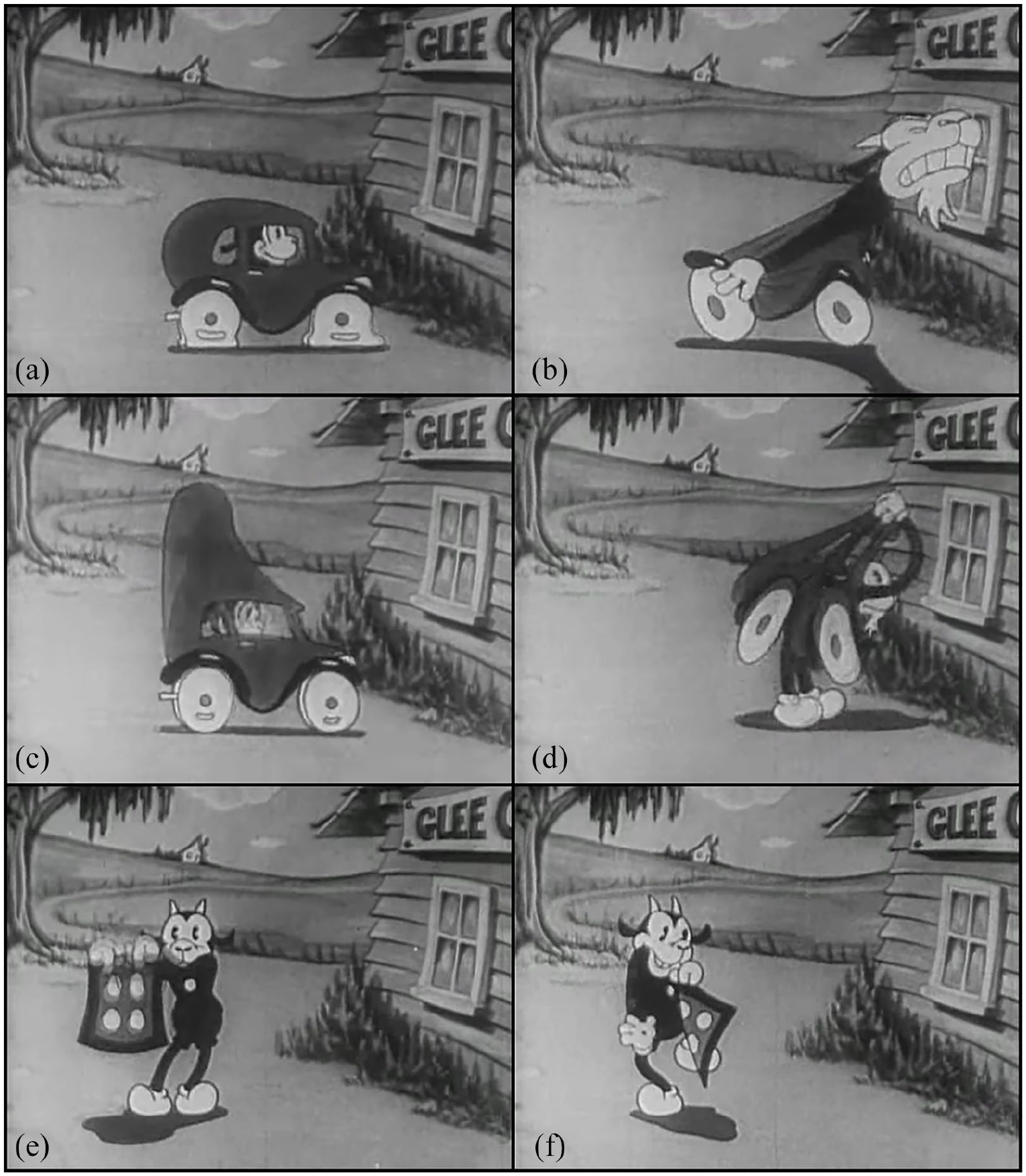
Goofy Goat Antics (Ted Eshbaugh, 1931).
PMM is therefore ‘manifest process’ as it connects differences into becomings, but not necessarily through representational thought. Identity is problematized as PMM transgresses the limits of substance potential, the combination of structure and matter. Since matter is absent, structure is all there is to cognition. And since regulated movement of structure is substance, while unregulated movement is perceived matter, representational thought predicated on determinacy of substance replaced by malleable structures results in non-representation. Although identities could be constructed from representative forms (icons), thus speculating matter, a corresponding synthesis of matter from PMM destabilizes representational movement, speculated endurance, and hence identity. Material perception from movement turns into possibility of the moving form not bound to material potential. For example, Felix the Cat in Felix Woos Whoopee (1928) is swallowed by a fish, which turns into a saxophone and subsequently morphs into a trumpet with legs and a tail (Figure 3a–d). All such concatenated identities defy ontological and epistemological categories predicated on substance potential. Speculated potential comes into direct conflict with perceived potential. Material perception, being an a priori category arriving from movement, affects identity which, conflated with substance for external reality or its reproduction, manifests as structureless non-representational movement in animated motion, of which PMM is one aspect.
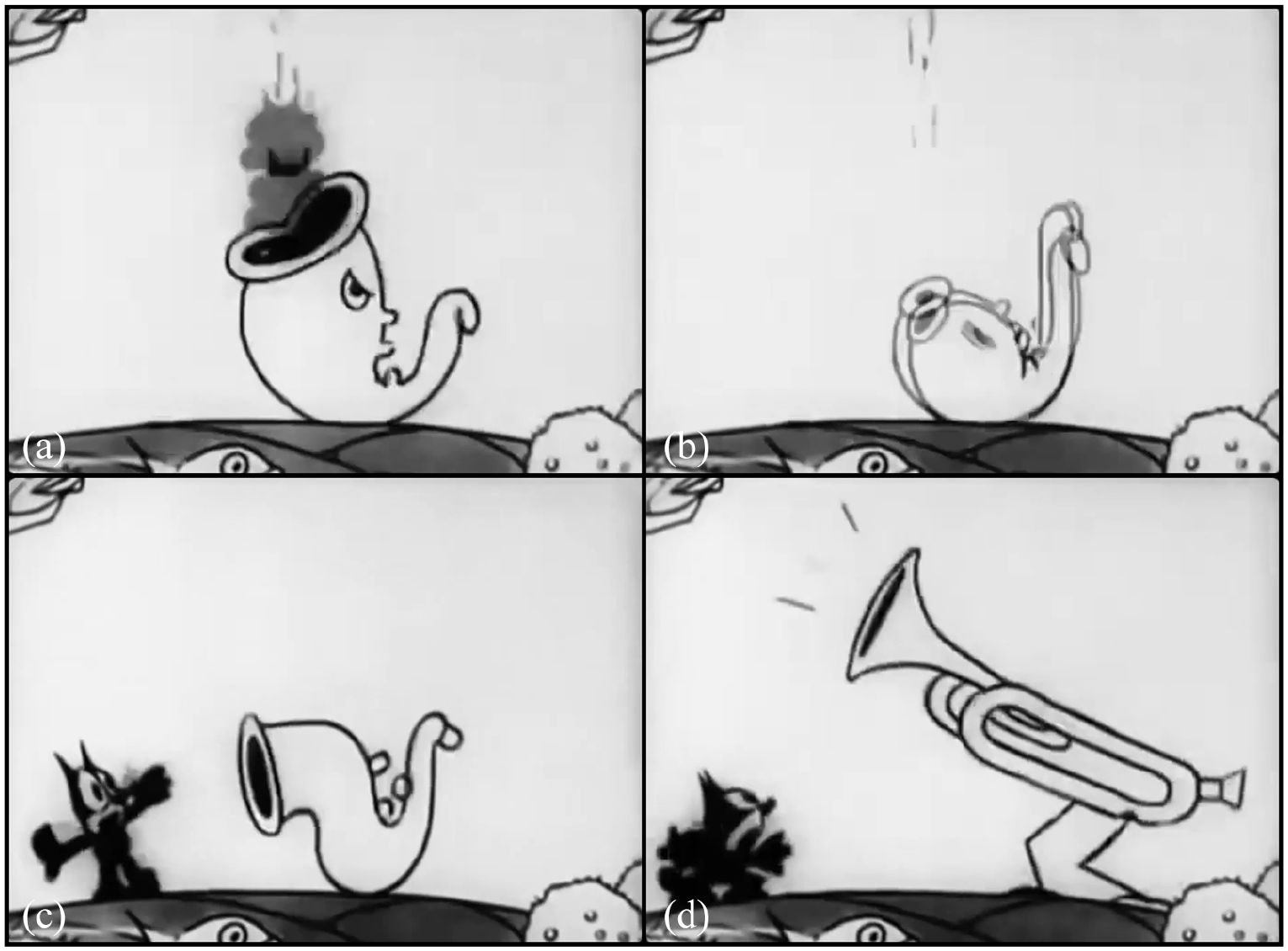
Felix Woos Whoopee (Otto Messmer, 1928).
Some distinct trajectories emerge with respect to image perception since PMM transgresses theoretical limits of substance metaphysics, rendering it non-discursive or prediscursive. Firstly, movement of abstract forms is accepted without much concern for their associated materiality. Torre (2014: 53) invokes Oskar Fischinger’s Allegretto (1936) where ‘movement can be seen to transform . . . purely abstract forms into easily definable representations, quite plausibly, schools of swimming fish.’ Here, non-representational form with representational movement invokes recognition, as identity enters discourse through material movement. This also means that the image comes into some relation with lived experience of external reality, i.e. substance perception. Generative and algorithmic art may similarly be recognized or simply cognized without imposing meanings to entities. It is only when speculated potential from form comes into conflict with perceived potential from movement that meanings and/or causality are destabilized. Therefore, secondly, (re)cognition of iconic representations comes into direct conflict with non-representational movement. For example, in Bosko the Doughboy (1931), the supposed metallic ‘non-living’ (speculated potential) cannon turns flaccid and ‘dies’ upon being hit by a shell, a curious case of anomalous identity (from perceived potential) demonstrated through volition, agency, or actions associated with organic life (see Figure 4a–d).
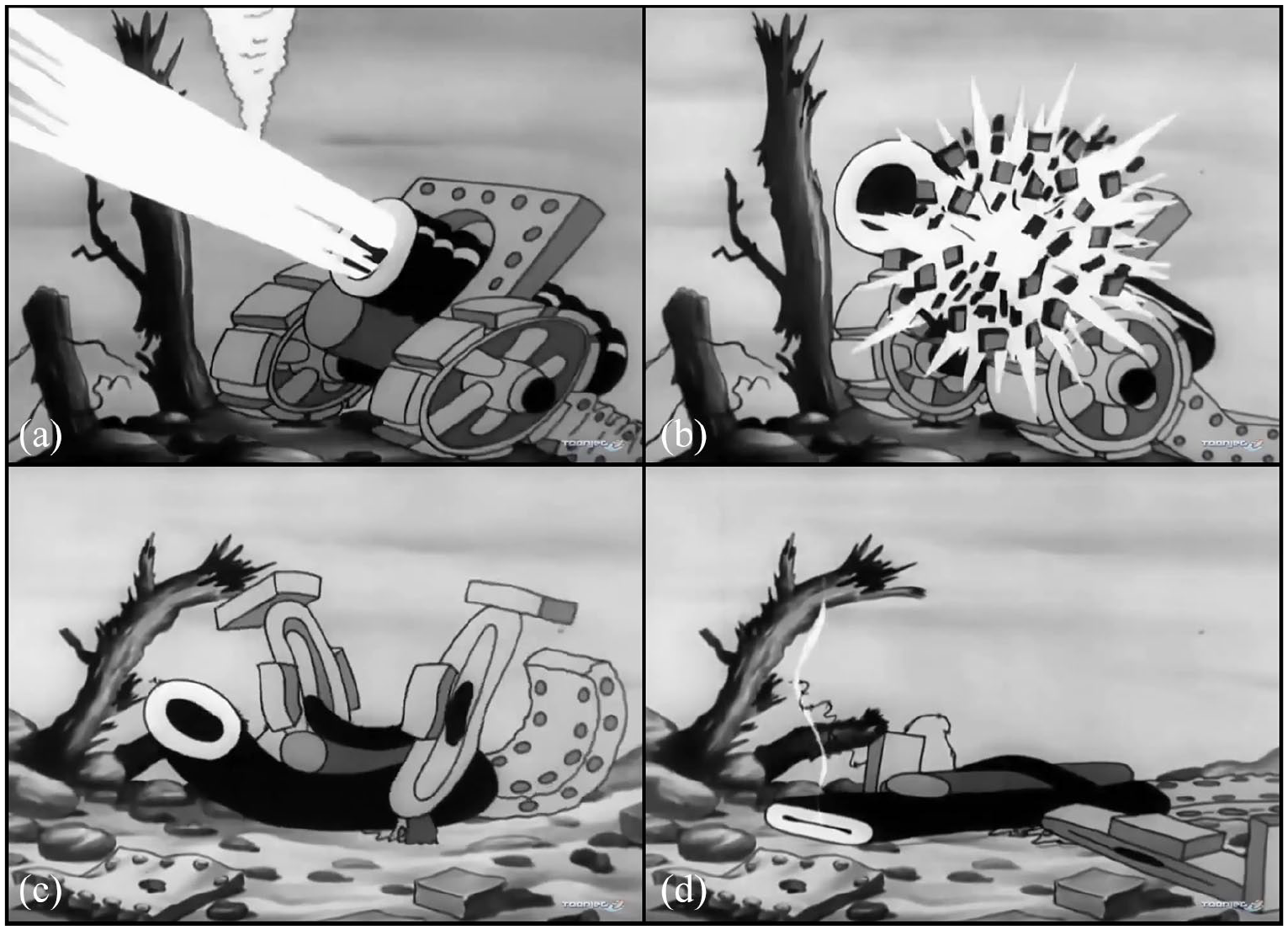
Bosko the Doughboy (Hugh Harman, 1931).
A third possibility appears when representational movement is imputed on to a different representational form. This process is often used in contemporary motion capture technologies, which may or may not generate conflicting identities, as long as structures are somewhat comparable, e.g. human movements are mapped to movements of dinosaurs in Jurassic Park (1993).
When possibility liberated from potential is extended from individual entities to the animation stage, the substance framework is rendered malleable. For example, warping buildings and landscapes in Felix Woos Whoopee (1928), depending on the chosen grounding concept, destabilizes the material constituents of buildings (modern conception of movement as the ground), spacetime (substance as ground), or the character’s (Felix) perception (narrative logic as ground) (Figure 5). This is because the perceived ‘whole’ moves anomalously from its speculated movement. Since space, time and movement are codependent with substance (structure + material potential), identity with non-representational movement creates at least two significant discursive contradictions. If identities are to remain stable with anomalous perceived wholes, then space and time are destabilized. Alternatively, if spacetime is universal and homogeneous, then substance and identity is destabilized. Substance as the triad of representational form, real matter and representational movement for external reality or live-action, becomes a conditional dyad of idea (any form) and its possibility with animated motion. Heterotopy and heterochrony become the order of such a formal universe.
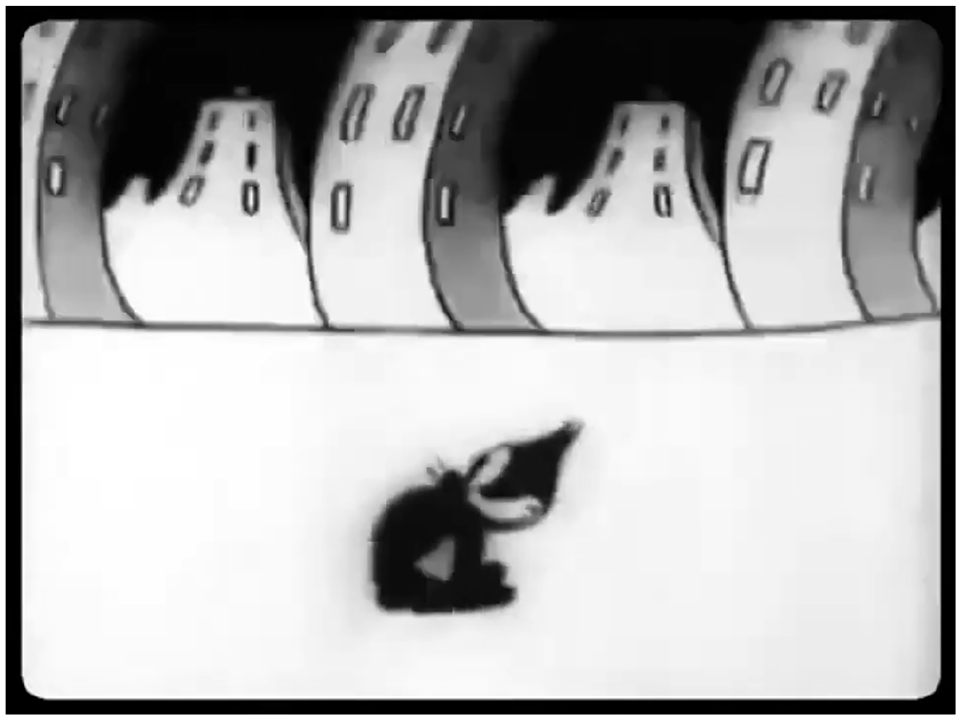
Felix Woos Whoopee (Otto Messmer, 1928).
Even in the case of stop-motion, non-representational movement or structural malleability can destabilize substance and identities. A definitive example would be Jan Švankmajer’s A Game with Stones (1965), 1 where stones are rendered fluid as they squeeze out from a tap, defying both their speculated and perceived potential (Figure 6a–d). It is just that representational thought predicated on material perception would still subject such destabilizing processes to the continuity of identity. Unpredictable materiality is also ‘unpredicable’ as possibility removes speculated potential and therefore creates inconsistent identities. Thus, subjective imagination of movement breaks structures of (re)cognition as much as it defies nature.
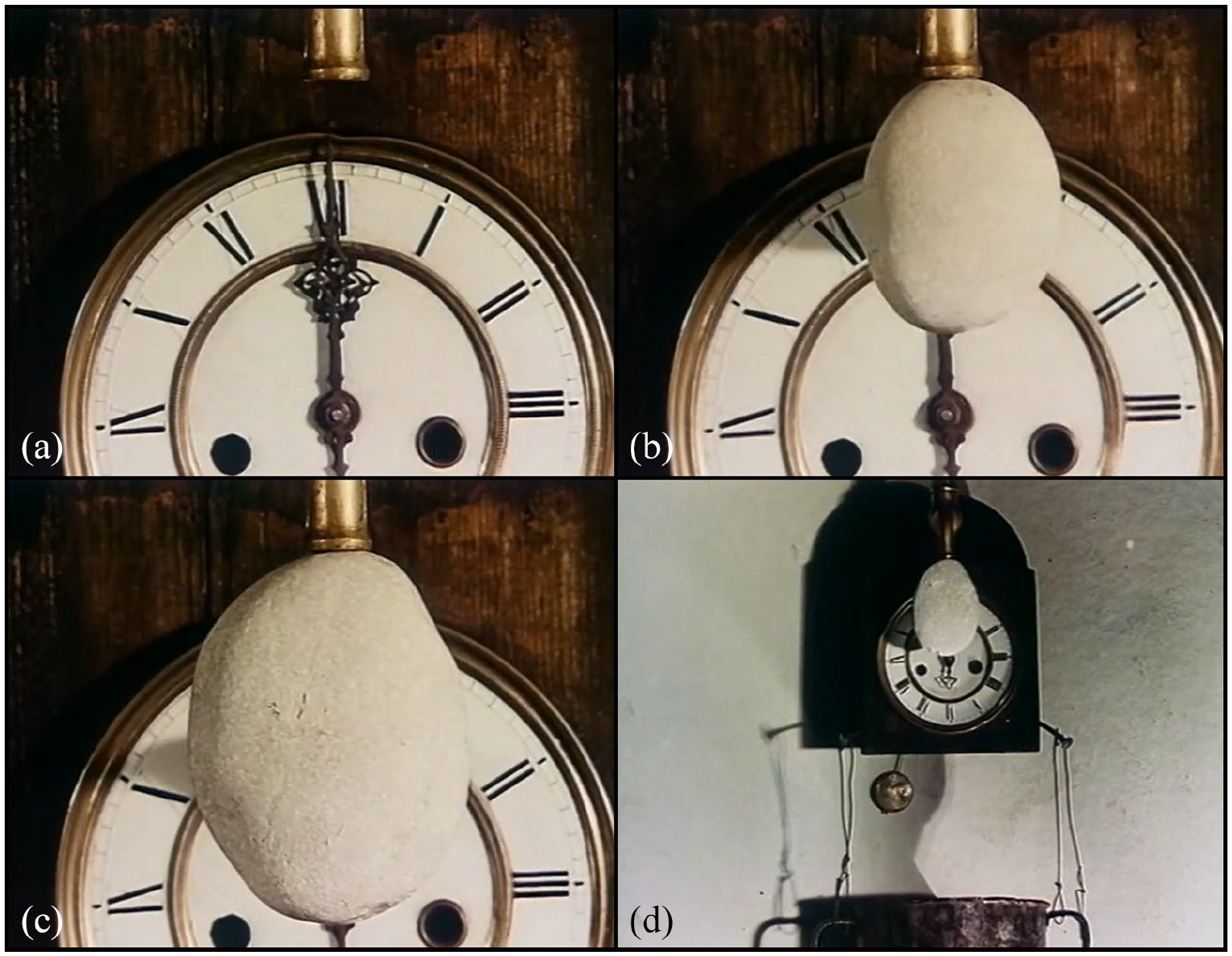
Still from film A Game with Stones, 1965, by Jan Švankmajer, ©Athanor Ltd. Reproduced with permission.
Between process and cognition
The substance framework regards materiality as the process of form’s territorialization and deterritorialization with an intermediate period of speculated endurance. Without speculated endurance, representational thought is replaced by totalized non-representation. But then, if pure becoming is salient to process, then there could be no duration between creation and disintegration of identity. As already argued, this results in non-recognition of identity or substance from a ‘swarm of differences’ (Deleuze, 1994[1968]: 51). Cognition is possible as process is speculative for external reality or its reproduction, and dependently originated with (the a priori causal structure of) substance. Cognition therefore presumes either an iconic form or representational movement, which leads to recognition.
PMM as connected singularities, or manifest process, exposes the limits of transcendental substance. With seamless linkages between forms, when both identity and substance are destabilized, where does cognition reside? Since identity itself is questionable with non-representation, cognition within process philosophy is untenable unless undergirded by potential, i.e. enduring structures. Again, if process philosophy was enough to comprehend the world sans substance, then there would not be any perceived difference between live action and PMM. If transgressing identity is fundamental to process, then this transgression is possible only with movement embracing possibility and not materiality, which means transgressing material potential (structure in representational movement), i.e. synthetic endurance. Significantly, PMM disjuncts and places both identity and structure into the realms of the ‘impossible,’ ungrounding potential, and hence, qualitative duration. For example, in Felix Woos Whoopee (1928), Felix splits into two parts, either/neither indicating the same entity (Figure 7). Again, in Felix Dines and Pines (1927), Felix splits into multiple clones with identities upon impact, generating confusion between original and copies, which seamlessly reassemble into a single entity (Figure 8a–d). In either case, impossible ‘life’ challenges conceptual limits of identity, substance, and also process.
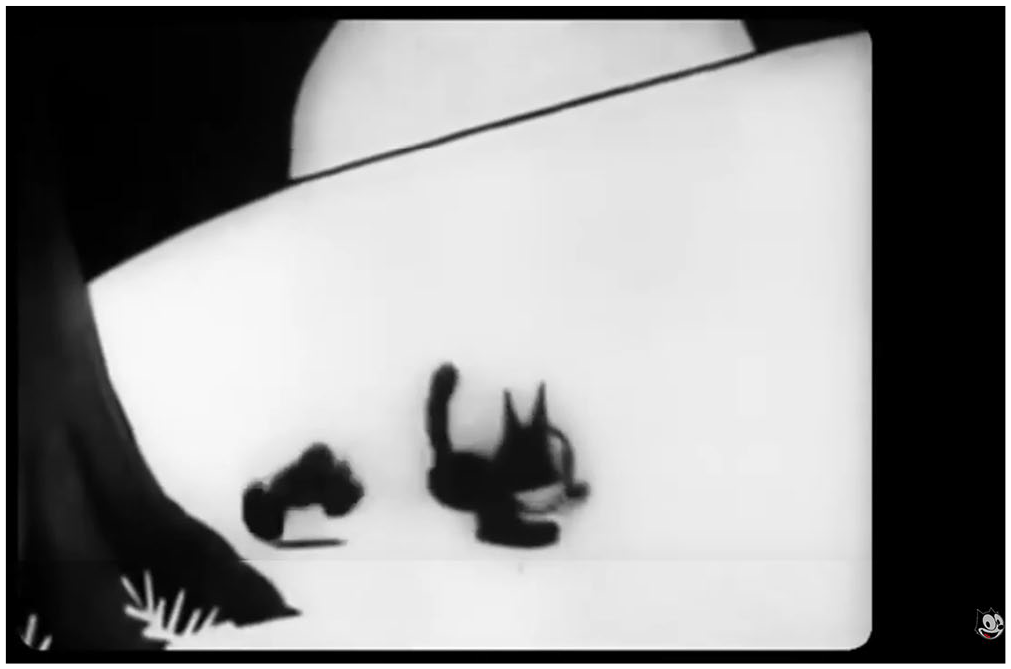
Felix Woos Whoopee (Otto Messmer, 1928).
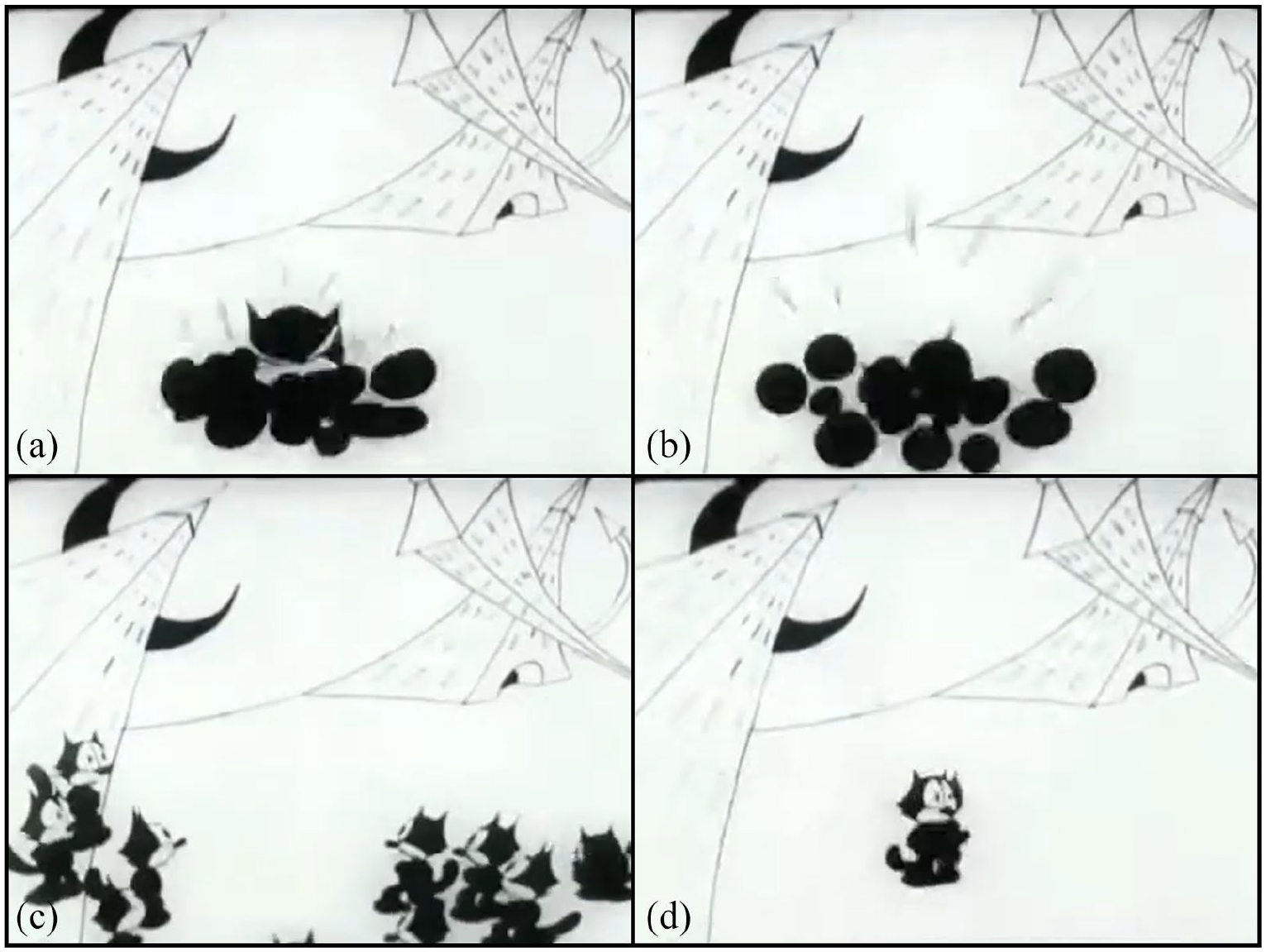
Felix Dines and Pines (Raoul Barré, 1927).
Manifest process involves the dilemmas in synthesizing concepts from unpredictable transformation of visible formal structures, by grounded knowledge structures. Hence, material perception (e.g. weight, speed, gravity, volume, interaction with foreign objects) from PMM defies scientific rational knowledge structures. Disney’s animation principles effectively imputed the logic of a cartoon substance to untamed possibility, such as causality, force relations, regulated movement, constancy of volume, or elasticity, effectively ‘creating’ material potential: ‘The volume of a character is an absolute quantity, like the volume within a container; no matter how much it is altered, the volume must remain constant’ (Klein, 1993: 50). Such principles were only the starting point towards ‘realism’. Contemporary digital morphs bound to narrative constraints and identity are indeed predicated on substance potential within the immanence of the modern conception of movement. Here, space and time are seemingly pure concepts, while metamorphic potential belongs to a specific substance, all apparently independent of each other. For example, in Terminator 2: Judgement Day (dir. James Cameron, 1991), metamorphosis of the T1000 (played by Robert Patrick) is delimited by the physics of a metal with predefined potential, its solid, liquid and liminal states adhering to constancy of volume, structure, or gravity, its identity undergirded by narrative logic. This becomes apparent in the screenplay, which is further corroborated by the visuals:
Like it [T1000] could disguise itself as anything . . . a pack of cigarettes?
No. Only an object of equal size . . .
Well, why doesn’t it become a bomb or something to get me?
It can’t form complex machines. Guns and explosives have moving parts. It doesn’t work that way. But it can form solid metal shapes. 2
Similarly, the ‘Transformers’ in Transformers: Age of Extinction (2014) are made of a ‘rare metal, molecularly unstable’, 3 their morphing potential delimited by two possible states, of a humanoid or a vehicle. In both cases, possibility is undergirded by potential within which metamorphosis operates, so that it can be grounded by the overarching causal structure of a scientific rational universe. In fact, the historical trajectory of animation could be observed as the triumph of representational thought through the increasingly ‘realistic’ emulation of substance, with material potential justifying narrative outcomes within the immanence of the modern conception of movement.
Cognition usually conflates structure with material potential into a singular identity. Once identity is disjunct from structure, matter and movement, several concerns may be raised with postulating a cognitive theory based on process-based reading of animation such as by Dan Torre (2014). A close reading of Torre’s approach could reveal the problems associated with process and cognition, five of which I discuss here.
Firstly, PMM is the result of artificial construction of movement from forms-in-sequence. Process philosophers that Torre refers to – Whitehead, Rescher or Deleuze – are really not concerned about PMM. Instead, they deal with speculative process against the overarching backdrop of substance. Although Torre cites Rescher’s point that ‘processes are basic and things derivative’, and Deleuze and Guattari in stating ‘a line of becoming has only a middle’, he contradicts himself, ‘if we know how something came about (its becoming), then we will have a greater understanding of it’ (Torre, 2014: 49). This contention not only asserts synthetic endurance of substance, but also points to speculative and not manifest process.
Secondly, while process philosophy cognizes substance as transient and as transitioning structure, neither can it assimilate fluid concatenations between random forms (‘unnatural’ metamorphosis), nor the possibility of shifting material perception from structureless movement, which destabilizes synthesized endurance with transforming potential and qualitative duration.
Thirdly, Torre (2014: 50) attempts to extract movement from form: ‘In order to consider pure motion, we need to disentangle it from form’. As already argued by Wertheimer, pure (objectless) movement cannot be grasped or analysed. Torre illustrates his contention through the example of a person dressed in black against a black background with only white lines as joint-marker points, so that it is ‘a simplified representation of human motion that effectively disentangled the human movement from the human form (p. 51, emphasis added). Torre suggests that current motion capture technologies do the same thing. However, he also accepts: A person dressed wholly in black, but having white lines painted on their costume, when standing in front of a black background will seem to disappear except for the white lines. These visible white lines will look nothing like a human – except when they move, then they become undeniably human. (p. 53, emphasis added)
Again, he refers to motion capture that ‘allows one to extract pure movement information from already existing film or video footage’ (p. 51). This process reproduces regulated movement of poses which effectively is representational movement of substance.
Fourth, although Torre suggests that animation is ‘immobile section + abstract movement’, and that ‘the animator must encode each new drawing with motion rather than overtly add to it . . . must at least have an awareness of the pure motion, distinct from the form that they are engaged with, in order to create a convincing movement of that form’ (p. 52, emphasis added), he is falling back upon techniques that simply copy ‘convincing’ representational movement of substance. As already argued, linking forms (sans matter) is different from connecting poses (form actualized in matter). Torre’s conception does not distinguish between the two. Moreover, is there any perception (or entity) where movement is always already not encoded?
Fifth, while Torre accepts that process does not necessarily mean a ‘disregard for the object’, the examples that he cites simply copy movement of substance. If process asserts a sense of ceaseless flux, by that logic, synthesizing endurance from pure movement disentangled from form should be futile. None of the process philosophers deals with movement sans matter or with dissoluble structures. Torre overlooks PMM as manifest process and continues the legacy of theorizing in terms of manifest substance. Hence, such speculation does not engage with possibilities that destabilize both substance and process frameworks.
Again, if process asserts ceaseless flux and substance corroborates continuing movement, is there any form where movement is always already not encoded? If cognition is also predication, its prerequisite is representational movement that motion capture already presumes. The white markers on the invisible human body in the aforementioned example would always conform to the human structure upon movement, despite the invisibility of the human form. Torre invokes multiple examples which are similar: of director Ang Lee delivering the motion capture performance for the 3D model of Hulk in The Hulk (dir. Ang Lee, 2003) (Torre, 2014: 52), or that of a snail moving like a tornado, a triangle like an old man (p. 52), or a leaf insect in stasis or movement appearing not as a leaf (p. 53). In another instance, Torre states that ‘we might . . . recognise someone from a distance based on their motion long before we distinguish their unique visual features. Each has his or her own signature motion; we can define a person by that motion’ (p. 54). Torre is indeed referring to recognition of representational structure with representational movement.
Torre suggests: The real strength of animation derives from its capacity to amalgamate motion and image in new ways. Thus the movement of a feather floating in the air is not that extraordinary; but when this movement is applied to a rock, something new and amazing is manifested. (p. 55)
As already discussed, the novelty lies in a rock moving like a feather, or in the perceived potential of a representative form to behave anomalously to its substance potential. The novel effect arises with conflictual identities arising from form (speculated potential) and from movement (perceived potential).
All of Torre’s cited examples and elucidated process, i.e. reproducing movement following ‘video-based motion capture’ (p. 51), adhere to representation following the modern dialectic of movement. PMM already subverts both the ancient and the modern conception of movement, not only in its process, but also with the resultant image, since it generates material perception as cognition (of matter) but not necessarily recognition (of substance).
As Torre himself states, ‘much of the metamorphosis of the real world occurs at a much slower pace than is humanly perceptible. Thus, we can see the effects of it, but not the occasion’ (p. 59). This is clearly the case of process speculated from substance, and not material perception from manifest process.
When Torre extends metamorphosis into cognitive processes, he presumes substance while highlighting fluid linkage of images. While Torre himself emphasizes that ‘we need to have a starting and a concluding object’, and since ‘one actively anticipates what one will see’, he also contradicts himself in stating ‘we are therefore able to comprehend the transformation phase from one thing to another’ (p. 59). This kind of cognition, albeit as recognition (recall) arrives with relational thought predicated on lived experience of substance. Therefore, in stating that the anticipated end of the metamorphic process is already known, and hence the transformation phase can be known, Torre is confined to natural metamorphosis and not unregulated transitions between unrelated forms. More significantly, to know is to be able to devise words for the intermediate transitional state within metamorphosis, such as caterpillar, pupa, or butterfly. Yet, what are the states between those cognizable states? By extension, what shall be the states in between those secondary states and, likewise, ad infinitum? In the absence of language and the possible control of each frame, metamorphic stages remain unnameable, and hence unknowable. PMM can only partially enter discourse, while primarily staying in the domain of the non-discursive and the pre-discursive. With metamorphosis, perceived matter de-contextualizes speculated identity and re-contextualizes as per the continuous synthesis of movement. Therefore, even if it enters discourse, PMM does not adhere to dominant metaphysics of substance, process, causal connections or scientific rational discourse. As PMM does not adhere to the predictable or the predicable, dematerializing and rematerializing movements and transitions leading to conflictual identities lead to cognitive dissonance. Torre, by adhering to emulation of representational movement, is able to posit a cognitive theory of substance, rather than process philosophy. Instead, PMM, by dematerializing substance (deterritorializing immutable structure) and materializing process (reterritorializing synthetic movement), ungrounds theory.
Nāgārjuna and dependent origination
Movement is impossible without identity formation. Again, identity formation with material perception is inevitable as movement arrives from a priori psychology connecting differences. By ungrounding substance, PMM, as manifest process, connects non-conceptual singularities. Therefore, process (synthetic boundary in formation) and substance (determinate boundary), as apparently opposing theories, conflate in structured movement translated into causal connections, failing which, meaning collapses. Scientific rational knowledge structures are therefore grounded on causal structures of substance and process, one corroborating the other. Their complementary natures and shortcomings are highlighted when synthesis is problematized. Perhaps a most apt summary of this dilemma is put forward by Nāgārjuna (1995: 35): If there is no entitihood, What changes? If there were entity, How could it be correct that something changes?
This clearly highlights the problem of positing identity or avoiding it. Instead, the Madhyamaka philosophy would suggest that all objects are ‘empty’. Nāgārjuna equates emptiness with ‘pratītyasamutpāda’ or dependent origination of concepts. Objects lack independent existence and are empty of inherent existence or self nature, which is essence. Things are not determinate entities; emptiness is to have no nature. But Nāgārjuna does not stop at stating that all phenomena are empty. In that case, it would suggest that emptiness is the essence of all things. Instead, Nāgārjuna furthers that: ‘all phenomena are empty and that their emptiness is also empty’ (p. 92). As Garfield (Nāgārjuna ’s translator/commentator) explains, emptiness ‘is not a self-existent void standing behind a veil of illusion comprising conventional reality, but merely a characteristic of conventional reality’ (p. 91). This is the doctrine of emptiness of emptiness. Ultimately, what counts as real is dependent on conventions. Any positive metaphysical concept is dependently originated and incoherent.
Whatever is dependently co-arisen That is explained to be emptiness. That, being a dependent designation, Is itself the middle way. Something that is not dependently arisen, Such a thing does not exist. Therefore a nonempty thing Does not exist. (Nāgārjuna, 1995[c. 150–250 CE]: 304)
These two excerpts summarize the contradictions inherent in both substance and process, while also highlighting their dependent origination. Garfield, translator of Nāgārjuna (c. 150–250 CE), explains, ‘The thing itself, apart from conventions of individuation, has no identity . . . To view emptiness in this way is to see it neither as an entity nor as unreal – it is to see it as conventionally real’ (p. 305). Moreover, emptiness itself being a dependent designation and nominal, is itself ultimately empty. The world viewed in this way is to see it ‘neither as nonempty nor as completely nonexistent’, instead as ‘conventionally existent, but empty’ (p. 306). By such a contention, all things are devoid of an essence. Initiating the cognizing process is to assert an identity to essence, which, being dependently originated (e.g. identity, substance, space, time, movement, difference, that corroborate each other), does not exist. Moreover, ‘if an essence is posited, one denies cessation’ (p. 70). If there is essence, then the entire phenomenal world would be immutable and static (p. 72).
By dematerializing substance and materializing process, PMM removes essence from entities by literally demonstrating Nāgārjuna ’s contention of the ‘contingency of all existents’ (King, 1989: 390). If we consider process, then Nāgārjuna (1995[c. 150–250 CE]: 171) has something to offer as well: A static existent does not endure. A nonstatic existent does not endure.
As Garfield elucidates, ‘the moment between the arising and ceasing of a momentary phenomenon – an event – has no temporal extent. So a thing that we might conventionally refer to as static literally does not endure with identity through time’ (p. 172). On the other hand, becoming, as conceptually reconciling identity with difference, has to be grounded on durée.
Dependent arising refutes the endurance of static representational thought as well as the continuing transience of non-representation. As Kalupahan, translator/commentator of Nāgārjuna (1995[c. 150–250 CE]: 16) states, ‘Dependent arising is the middle path presented by the Buddha between the extremes of eternalism and annihilationism, of strict determinism and chaotic indeterminism, of absolute reality and nihilistic unreality, of permanent identity and absolute difference.’ Therefore, dependent origination denies pure conceptions of substance and process. PMM, by manifestly materializing process, and yet dematerializing substance ultimately ungrounds the basis of theory, i.e. pure conceptions isolated by determinate boundaries, nonetheless illustrating that either philosophy is dependently originated. Although both philosophies overlap, they attempt and fail at creating determinate structural boundaries to isolate pure concepts.
Conclusion
As is evident, PMM resists meaning making or causal connections predicated on extremes of determinacy or indeterminacy informing knowledge structures where non-representational thought becomes equally untenable as representational thinking. PMM foregrounds the discursive conflicts associated with the contingency of relational concepts trying to theorize animation. Cognition dependently emerges alongside identity, substance, force, movement, space, time, continuity and difference, to name a few dependently originated concepts. The contingency of substance would destabilize all such relational concepts displacing them with alternative contingent conceptual speculations of difference-in-itself, process, becoming, concrete duration, or multiplicity, again with diffused structural limits. Neither can PMM or its perception be extricated from the material dimension, nor can the moving idea be asserted with ‘real’ substance, i.e. it is doubtful that there can be any ‘pure’ conception. Above all, the ideal and the material within the image are simultaneously connected and disjuncted with movement; sans movement, there is little distinction between the two. Movement itself may be illusory sans perception. Certain concluding observations emerge.
Firstly, it becomes clear that animated movement is delimited not only by practice, but also by theory. In the light of dependent origination, it can be noticed that animation praxis (theory+practice) proffers unlimited possibilities of form and movement that could extend to both its expression and interpretation. The only constraint being human imagination, animation praxis could reinstate earlier animation practices and possibilities intrinsic to the frame-by-frame process.
Secondly, since the rudiments of perceptual ‘meaningfulness’ appear with relationally dependent concepts like identity/material perception, discrete/continuous or space/time/difference, the unit of synthesis or analysis of animated motion (and moving images in general) could be rethought in terms of dependent origination.
Thirdly, since form/idea (perhaps equivalent to material/ideal) is bereft of independent existence, the interplay of apparent oppositions such as frame/shot, figure/ground, light/shadow, meaning/affect, substance/process, representation/non-representation, etc. could become more interesting. Since transgression cannot operate without structural constraints, PMM is really the play of possibilities on constraints, and vice versa. Accordingly, PMM could play with literal structural transformations to highlight perceptual contingencies.
Fourthly, the materiality of the moving idea problematizes the isolation of pure concepts and boundaries of separation between the ideal/material, simultaneity/succession or subject/object, which has wide implications, especially allowing for questioning naive referential realism, or linguistic, scientific and rational knowledge structures afflicting the moving image and thought in general.
Finally, this article tries to assert that animation should be theorized differently from live action images for its ontological and epistemological contingencies. This could usher in a new domain of theoretical speculation, the transgressive aspects of PMM subverting representational thought. An approach pitting imagination against conceptual limits, subverting normatives, or allowing for alternative realities, could provide a better understanding of the true possibility of animation as a medium that questions dominant knowledge frameworks.
Footnotes
Acknowledgements
The author thanks the anonymous reviewers for their insightful comments and Suzanne Buchan for her guidance and continuing support towards the realization of this article. The author also thanks Gautam Chakraborty for his critical insights and continuing dialogues on cinema.
Declaration of conflicting interests
The author declared no potential conflicts of interest with respect to the research, authorship and publication of this article.
Funding
The author received no financial support for the research, authorship and publication of this article.
Notes
Filmography

Goofy Goat Antics (1931): https://www.youtube.com/watch?v=OcOtkXwu8k4&feature=youtu.be