







Abstract
This article offers a geopolitical labor history of the rotoscope by analyzing the technology’s use by three animators—Max Fleischer and Walt Disney in the US, and Claudio Díaz-Valdés in Chile—to shape political subjects. In the first two cases, rotoscoping, an animation technique of tracing live-action footage into cartoon bodies, was used in composite-style shorts that dramatized life in the cartoon factory. Rotoscoped animations featured characters with explicit live-action referents that were infinitely plastic and hyperactive, downplaying exploitation in the Fordist workplace and its interconnection with US-imperial expansion. In the third case, the rotoscope’s unique capacity to image subjects dislocated from a geography or time helped expose the psychic cost of US intervention in Chile across nations and generations. In contrast to industrial North American animation, these independent films highlighted the painstaking labor of rotoscoping to suggest ethico-political links between animation workers across continents.
Keywords
“Do you remember the coup? What’s the first thing that you remember when you hear this word?” asks a calm, disembodied voice at the beginning of Golpe de Espejo (Mirror Coup) (2008), an animated documentary short film by Claudio Díaz-Valdés consisting of a series of interviews with Chileans born after the September 11, 1973 coup in Chile. “Concrete memories . . .” says one of the interviewees in a bewildered tone, “I don’t have them. I have imaginary memories, from the stories of my parents. Because they were exiled from Chile to France, and I was born in exile.” Her drawn image has been rotoscoped by hand over live-action footage. A painterly animation style and patches of blue and red dotting her hair add a fantastical quality to her account, as if to emphasize her status as doubly removed from the reality of the coup not only through exile, but in her reluctance to claim her “memories” about it as her own. As she speaks, her fill colors “boil” out of the lines—an effect that occurs in rotoscoping when the animated outline of the live-action figure is not perfectly standardized from frame to frame—making her seem to vibrate with emotion even as she speaks in a relatively flat and detached tone (Figure 1). At times, the animator paints streaks of blue into her eyes as the imaginary tears that might spring from these “imaginary” memories if she were to assimilate them into her experience.
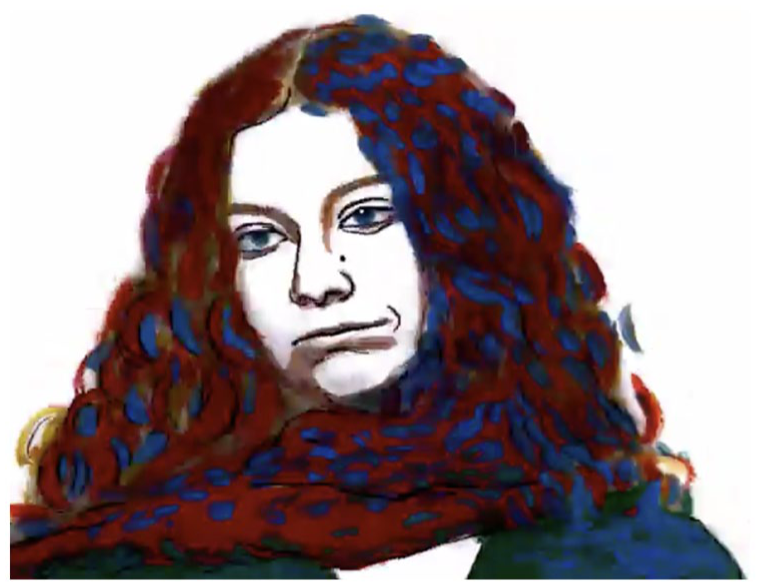
“Tengo más que nada recuerdos imaginarios.” Screen grab from Golpe de Espejo (Claudio Díaz-Valdés). © Díaz-Valdés, reproduced with permission.
By activating a speaking subject who always exists simultaneously as an animated “trace” and as a live-action moving image struggling fitfully beneath it, rotoscoping technique emphasizes the gap between the performance of normalcy or civility that the woman has had to adopt in order to move forward, and the part of her that is not “over” the past. In moments where the source footage has been more actively manipulated, it is almost as if the animator is giving her permission to cry. Rotoscoping stimulates concealed emotion by “unhoming” the speaker through the tension between the medium of animation and the qualities of live-action space that her movement suggests; between a part of her that exists in 1973 and the part of her making sense of her family history from the 2000s; between her self-originating account of how she feels, and the interpretation of the also Chilean animator who, from an even further point in time, extracts new meaning from her testimony and externalizes it in the act of tracing. Golpe de Espejo thus raises the questions: what can such conspicuously stretched, modified, and altered images of a second-generation narration of the 1973 coup reveal about the event’s emotional truth? What is it about the rotoscope—a North American technology with a complex military and labor history—that makes it an effective instrument for illustrating the subjectivity of US empire?
Stemming from work made in the early 2000s, these questions index a prior century of geopolitical violence and economic precarity imposed on Chile by the US. Collectively, Díaz-Valdés’ interview subjects constitute a generation of Chileans who were shaped by the coup and its aftermath, but struggle to articulate exactly how, either because they were not in the country at the time, or had not yet been born. The coup took place after the country’s democratically-elected Marxist president, Salvador Allende, began the process of nationalizing Chile’s copper companies, Anaconda and Kennicott, which had previously been owned by US corporations. The purpose of nationalizing copper, as well as other US-controlled Chilean farms and businesses, was to support healthcare and education reforms nationwide. Under Allende’s administration, wages rose steadily, which angered Chile’s elite. Before overthrowing Allende in 1973 and imposing Pinochet as Chile’s dictator, Nixon, in a CIA briefing, instructed his employees to “make the economy scream” at the same time as Milton Friedman suggested “shock therapy” as a punishment to Allende and the Chilean working class who had elected him (Office of the Historian, 1970). Under the measures outlined in “El Ladrillo,” an economic policy created by the “Chicago Boys,” a group of 50 Chilean economic students who had studied free-market economics with Friedman at the University of Chicago, inflation rose to a peak of 700% in 1973. Groups close to Pinochet’s regime also received wealth transfers from the state worth over 40% of the GDP. The dictatorship was sustained by broad state-sponsored torture of dissidents including electric shock, waterboarding, beatings, sexual abuse, and the disappearing of people who publicly opposed the regime. Today, Chile has officially recognized 40,018 victims of the dictatorship (Associated Press, 2011).
By using the rotoscope to illustrate and respond to young Chileans’ professions of disorientation, dissociation, or fragmentation in the face of uncountable losses, Díaz-Valdés’ critical engagement with the history of US intervention in Chile also illuminates the under-discussed military history of the technology. Invented by two brothers, Max and Dave Fleischer in the US in 1915, the rotoscope was originally designed to assist animators in tracing live-action footage frame by frame in order to imbue individual cartoon characters with more fluid, human-looking qualities of movement. While working as an animator at Red Seal Pictures, Max Fleischer was sent by his boss, John Randolph Bray, to create rotoscoped army training films at a base in Fort Sill, Oklahoma, while his brother worked as a film editor in the War Department in Washington DC (Cabarga, 1976: 10–11). 1 However, the rotoscope’s potential military or technical applications were never fully realized. Bray gave Max Fleischer the chance to create his first animated series showcasing the rotoscope technique, Out of the Inkwell (1918–1929), as a reward for having worked at Fort Sill. For the rest of their career, the Fleischer brothers would never speak in detail about their work for the military or make cartoons about war (Crafton, 1982: 160).
With the exception of Fleischer’s The Cartoon Factory (1924), which features a gag in which soldiers, better dressed for parts in a Nutcracker ballet than the battlefield, emerge from a malfunctioning cartoon machine, the first rotoscoped cartoons were staged within the relatively peaceful contexts of the modern workplace and domestic life in the US. Each Out of the Inkwell cartoon begins with live-action footage of Max Fleischer at his desk, then cuts back and forth between close-ups of his live-action hand and a blank page depicting their protagonist, Koko the Clown, being coaxed, coerced, or forced to emerge from the live-action inkwell as he engages in elaborate, often violent forms of rebellion against his maker and/as manager. Eventually, Out of the Inkwell shorts reflexively depicted the cartoon factory in parallel with the rise of Fordist factory work and the creation of increasing animation departments and “low-skilled” roles that emerged to do the time-consuming, “notoriously dull” work of tracing over copious amounts of live footage for shorts (Cartwright, 2012: 63).
As animation production became increasingly fragmented and produced new categories of workers, Out of the Inkwell cartoons maintained their signature structure. The material reality of animation production—many workers, many of them women, adolescents, and recent immigrants to New York, hunched over their desks in cubicles with few or no windows—was never depicted in the cartoons (Sammond, 2015: 97–98). In the years leading up to the passage of the 1935 National Labor Relations Act allowing unions, as worker consciousness grew, Fleischer shifted the way in which he represented himself as animator–manager within his animated cartoons to diminish and underplay his authoritative presence. In this sense, the largely unexplored wartime potential of the rotoscope to strategically displace the question of individual accountability in US military action was actualized in order to render the boss’s role in exploitation highly and opportunistically elastic, if not invisible.
By the late ’30s, Disney would depose the Fleischers as the new “King of Cartoonland” by using rotoscoping in more subtle forms; he hired unknown actors and dancers to be rotoscoped and contractually obligated them not to reveal their role in the film in order to maintain the audience’s emotional identification with characters (Canemaker, 2019; Keenan, 1951). But explicit rotoscoping and the composite live-action/cartoon style would return at two key moments in American labor history and geopolitics. First, during a 5-week strike at the Disney studios, Disney released The Reluctant Dragon (1941), which included scenes featuring its main animator, Robert Benchley, drawing frames and pitching his cartoon to Walt Disney. 2 As Goldman’s (2013: 25) work strongly suggests, the return of the “deliberately and self-consciously reflexive” rotoscoping style in this moment was part of an effort to downplay the role of vast teams of animators in making animated films. Second, the heat of the strike, as well as the studio’s $340,000 debt to the Bank of America, motivated Disney to travel to Latin America in 1941 as part of an OCIAA-funded goodwill tour. The tour was intended to foster pan-American solidarity through the production of media that would appeal to “Latin American sensibilities” while representing South Americans in a more positive light to North Americans (Bendazzi, 2017: 115; Thomas, 1976: 172). The resultant films, El Gaucho Goofy (1942), Saludos Amigos (1942) and The Three Caballeros (1944) featured a return of the early Fleischer tradition of obvious rotoscoping. Animated and live-action characters caroused, cavorted with, and antagonized each other, leaping into and out of screens within screens and dodging the animator’s paintbrush in ways that continually re-inscribed relationships between different layers of reality. No longer limited to depicting the vicissitudes of life within the North American Fordist workplace, the rotoscope found vibrant new life in pre- and peri-Cold War propaganda.
Animation scholars have written extensively about the inseparability of North American animation from its beginnings as a labor-intensive, rationalized, and exploitative form. Yuriko Furuhata (2011: 35) describes how the plasticity and cheer of animated bodies in the face of escalating brutality reflected the psychic demands placed on animators under the Fordist system in which they worked: to be endlessly moldable to discipline imposed from outside and able to endure monotonous, repetitive tasks. In his work, Nicholas Sammond establishes a politics of domination inherent to industrialized animation by showing how early images of animators skillfully creating and harshly disciplining rebellious animated characters developed in tandem with their “meta skill” of managing other animators. The way in which animator–managers related to their subjects onscreen and off was not only analogous, he argues, but constantly intertwined and enacted at the level of the animated line itself, through which the animator–manager now crafted cartoon spaces perfectly responsive to her fantasy with less resistance than in live-action filmmaking. While the aesthetic resemblance of early cartoon characters to minstrel figures is well-documented, Sammond’s work also highlights how, by activating a subject eager and endlessly able to circumscribe and discipline “unruly life,” early animation technologies interpolated those who used them into the structuring logics of chattel slavery (Sammond, 2015: 91). The rotoscope was thus imbricated in US histories of slavery and capitalist exploitation not only because of the content of the images that poured out of it at its dawn, but because it stimulated a dominating subject increasingly disconnected both from the vulnerability of the character that she was creating, and from her own.
This article adds to Furuhata and Sammond’s work on the animation industry as a reflection of the Fordist and racial capitalist conditions in which it was born by focusing on the under-explored US-imperial history and ideology of the rotoscope as a technology. Beginning with an analysis of the rotoscope in work by Fleischer and Disney, I return to Díaz-Valdés’ work to study the rotoscope’s eventual use in a Latin American context. I first show how, in North America, the rotoscope was an ideal tool for anti-worker and US-imperial propaganda because it stimulated a spectator who would be fortified against dramatic alterations of space, lapses in continuity, and losses of key elements that had once held the scene together. I then show how, while the rotoscope was used in North America primarily in ways that produced docile and flexible subjects of empire, by the end of the 20th century in Chile, the technology was surprisingly taken up to articulate anti-imperialist solidarity. I explore how, for Díaz-Valdés, the feelings of uncanniness, disorientation, or emotional numbness produced by creating and watching rotoscoped films could be channeled to effectively convey subjects’ sense of being both “there” and “not there” as they processed the impact of the intergenerational and national trauma of North American geopolitical expansion on their lives. No longer simply reifying the divide of early animated films between an animating subject with agency and an animated object constantly being flung out of control, the rotoscope was also used to enfold the animator and the animated subject into a common experience of emotional uncertainty and material precarity under US empire.
The rotoscope’s early history
At its inception, the rotoscope apparatus functioned by playing a live-action film clip from a projector placed on the ground, angled upward so that the image was visible on a pane of glass placed just below the animator’s line of vision, like a desk. Standing at the top of the device, the animator then placed a piece of paper over the projected image and traced each micro-movement of a filmed figure’s motion until a stack of drawings was collected, photographed, and then re-projected in sequence to create a cartoon that moved like the filmed figure. Given how time-consuming it was to trace the movements of just one character, rotoscoping rarely involved tracing aspects of the original footage other than the isolated outline of a single body within it.
From the beginning, the Fleischers imagined the rotoscope as a technology for recording subjective experience. The language of the patent advertises it as a tool to assist “the skillful artist” in “[exaggerating] or [modifying] particular elements or features of a grotesque character . . . while preserving the truthfulness of the photographic portrayal in its essentials” (Fleischer, 1917). Bouldin (2004: 22) emphasizes how the rotoscope granted exceptional authority to the animator’s impression or judgment of a particular person as grotesque, describing how, by extracting a certain aspect of a profilmic reality and embellishing it, the rotoscope “[drew] on a specific version of the real, which the process [posited] as a core, a base, an original”. Cartwright (2012: 63) has honed in on this aspect of the invention to compellingly call it “a device for rendering projections and fantasy”. Rotoscoping thus sought to render a subjective impression with a special kind of vividness, not only by adding or subtracting context from the actions of a live-action character, but also by manipulating the look of the figure itself, through tracing, to reflect the animator’s interpretation of reality.
Given the patent’s avowal of the aspects of the technology that could compromise its ability to render life with minimal distortion, it is surprising that it features an illustration of a rotoscope operator filming and tracing a semaphore signaler. The image references the rotoscope’s original use in the military when Max Fleischer was creating army training films at Fort Sill (Cabarga, 1976: 10–11; Fleischer, 1917; see Figure 2). Early press for the rotoscope frames the process as a “technical art” and de-emphasizes its use in cartoons, noting that Fleischer is “now devoting considerable time to applying his method to the technical field, where the possibilities are large” (“Fleischer advances”, 1919: 1) The patent and articles such as these do not specify exactly how the rotoscope was used outside of commercial animation or in the military, but one could speculate that in the Fort Sill training films, it might have been harnessed as a technique to virtualize violence for army trainees.
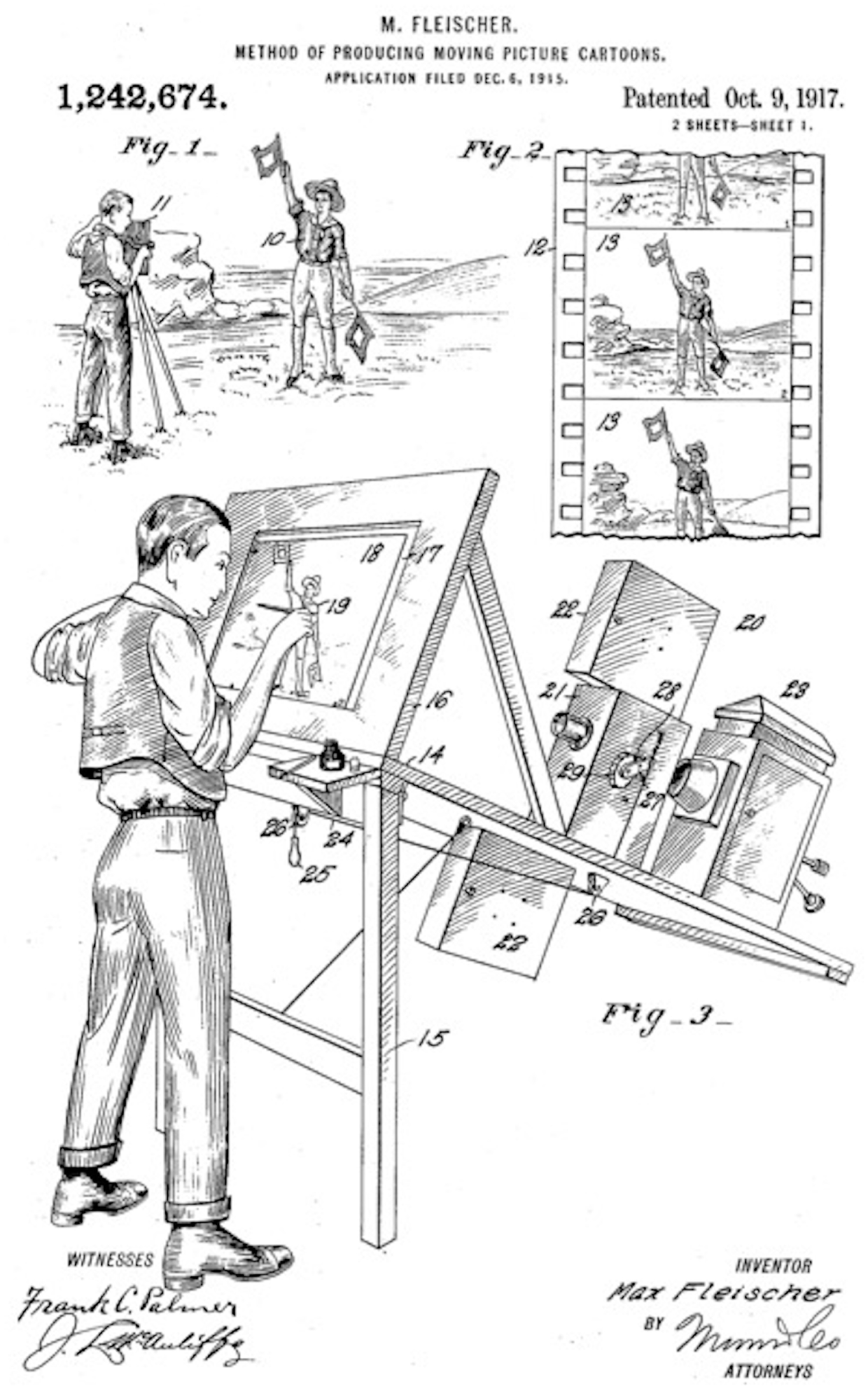
A semaphore signaler in the patent application for the rotoscope. Patent by Max Fleischer, Artist Unknown, 1915.
Although it was always a part of the US military apparatus, the rotoscope was invented before animation became an industry. In the brief period from 1914 to 1937 when US animation shifted from being a vaudeville trick to a commercial industry, the labor structure of animation underwent massive shifts. Before the rotoscope, animators usually made characters move by erasing and redrawing a single limb, and leaving the rest of the character’s body in a fixed position. All forms of animation were undeniably painstaking, but the rotoscope required the most labor of all the techniques that had preceded it, as the whole figure had to be meticulously traced and redrawn in its entirety each time. In a 1924 visit to Out of the Inkwell Studios, journalist Elizabeth Lonergan writes that “it takes from 2500 to 3000 little drawings for one cartoon” and notes that each 6–7-minute cartoon required between 6,700 and 10,000 drawings (Fleischer, 2005: 16; Lonergan, 1924: 40; “Fleischer tells”1934c: 3; “The Inkwell Man”, 1920). 3 While the Fleischer brothers did most of the painstaking work to create their rotoscoped cartoons at first, they eventually opened Out of the Inkwell Inc. in 1921 and later Fleischer Studios, which by 1937 had a staff of 167 people working 6-day weeks (Deneroff, 1987: 2).
The composite live-action and cartoon style of Out of the Inkwell predated the rotoscope and was a vestige of animation’s pre-industrial status as an “artisanal enterprise” in turn-of the century vaudeville, where magicians such as Émile Cohl and Winsor McCay made thousands of drawings, cut-outs and props on their own (Crafton, 1982: 137). The 1914 short, Gertie the Dinosaur, begins with live-action footage of Winsor McCay making a bet with another cartoonist, George McManus, that he can make a museum dinosaur “live again” through animation. The cartoon follows his arduous labors and culminates in his explanation to McManus and an audience of friends that it took 6 months and hours of toil at his desk making “ten thousand cartoons—each one a little different from the one preceding it” to create the upgraded lightning-sketch act that he performs for them. Offscreen, McCay refused to outsource the labor of animation. With his background as a magician, being able to credibly advertise himself as sole creator of his work was important to the appeal of his act and a source of pride (Sammond, 2015: 54).
Others saw the potential in producing animation on a larger scale and for greater profit. Donald Crafton calls John Randolph Bray the “Henry Ford of animation” because he broke the work of animating a cartoon into many small component parts. He also patented techniques that made the process more efficient, such as printing hundreds of identical sheets of tracing paper and leaving sections of the picture blank so that moving elements could be added to it through tracing (Crafton, 1982: 145). Bray’s original patent application was “all-inclusive,” meaning that he hoped to patent all known techniques of animation under his name. Other lightning-sketch artists and magicians such as Smith, Blackton, Cohl, and Gaumont who used the same techniques had also considered patenting animation, but Bray was the only one to see the process through (p.149). Bray’s fragmentation of animation tasks also led to the use of larger animation teams, which included women and adolescents “among whom low salaries and high turnover was the rule” (p.164).
In Out of the Inkwell Inc., Max Fleischer adopted and intensified Bray’s systematization of animation. In addition to discrete roles that Bray had invented such as inker, opaquer, and camera operator, Fleischer invented the position of the “inbetweener,” a uniquely flexible assembly line role. Inbetweeners did most of the work of animating scenes conceived of by the animator (the highest paid and most creative position), and also took on miscellaneous tasks from other departments. While being an inbetweener required doing a lot of work for little pay, many still wanted the job because it was the gateway to becoming an animator. However, while this assurance existed in the early days of the studio, by 1936, most of the animator positions had been filled and some animators were even demoted, so the potential rewards of the job significantly diminished (Deneroff, 1987: 2).
Like Bray, Fleischer carefully managed his managerial persona and strove to reconcile the contradictions between being a businessman and an artist in public relations. Even in his time (see Moen, 1915), Bray knew that no one would believe that he was the originator of animation (as the patents claimed) and justified his entitlement to higher profits than his artists on the grounds that he had invented ways to make animation more “commercially viable.” Fleischer had more experience as an artist and did most of the drawings at least for his early cartoons with help from his four brothers, which might account for why he did not feel the need to explain himself as much in interviews. As a manager, he also appears to have been more social than Bray. Where Bray was remembered by his workers as a “loner” with an “autocratic personality,” Fleischer cultivated a family atmosphere in his studio, attending employee weddings with a camera (Crafton, 1982: 154; “The time, the place”, 1935c: 3). Animator Shamus Culhane’s description of him as a “Victorian father” or “Victorian gentleman” encapsulates the identity of manager as benevolent patriarch that Fleischer appears to have assumed at work (Dial, 2000: 313).
Max’s live-action performance in the Out of the Inkwell shorts as himself also promoted his “gentlemanly” managerial affect to the masses. The comedy of the shorts as a whole derives from the sheer force of Koko’s fitful grasps for control over his own narrative, even though, as the artist, Max must always grant Koko the ability to initiate and intensify the degree of taunting or revenge. In most of the animated cartoons, Max asserts this power in an equanimous manner, clearly participating in the violence of the film but usually only responding to Koko in kind. For example, in the earliest available Out of the Inkwell short, The Clown’s Pup, Koko pokes fun at Max’s skills in drawing him and requests a pen of his own to draw himself a bulldog, leading Max to competitively draw his own more realistic, fiercer dog. When Koko throws his dog at Max’s, the two pups get so riled up that they start attacking Koko, who, now left with no better option, begs Max to open the inkwell so that he can jump back inside, which Max does with a smile and a gracious “be my guest” hand gesture (Figure 3).
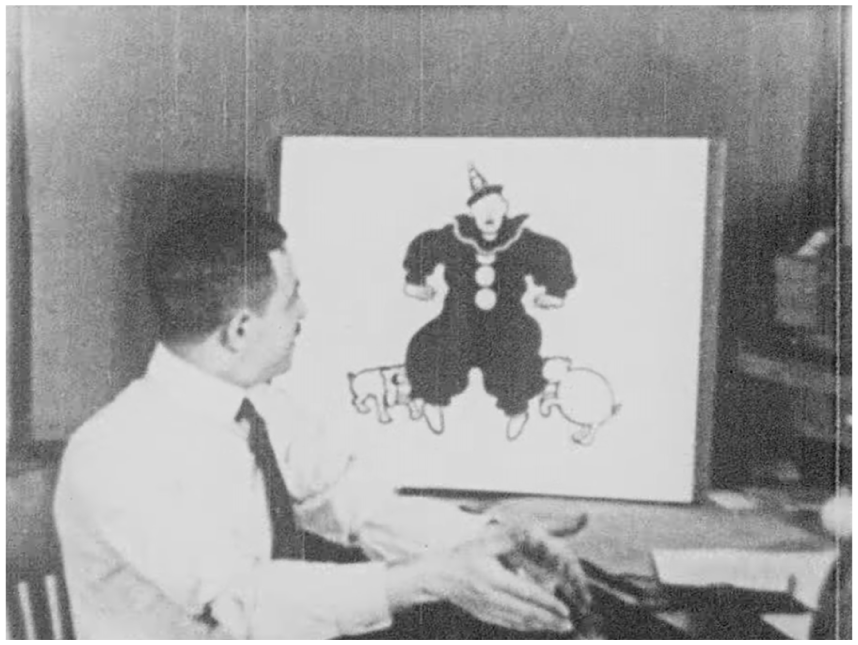
Max Fleischer manages Koko. Screen grab from The Clown’s Pup, Max Fleischer at Bray Film Studios, 1919.
But after Out of the Inkwell and in his next series, Betty Boop, Max becomes slightly less visible. He appears less often and when he does, seems to have had less of a hand in the escalation of tension within the narrative. His later reduced presence can be observed in the 1934 short, Ha! Ha! Ha!, in which Betty Boop plays dentist to Koko and accidentally gives him so much laughing gas that it not only engulfs them but emanates past the world of the cartoon and into the Out of the Inkwell office. 4 At the beginning, Max is not foregrounded as an agent in the chaos. He draws Betty and Koko, and they greet each other, but this time, Koko hoists himself out of the inkwell, and the candy bar that he bites into to cause his toothache was already sitting half-eaten on the desk, not drawn as part of the action of the short. The laughing gas eventually envelops Betty and Koko, Max’s cuckoo clock and typewriter, the mailbox, parking meter, random passerby, tombstones, and automobiles, who all dissolve into fits of laughter. As gas spreads through the office, we see that it is empty, and Max Fleischer has left; unlike everyone and everything else in the cartoon, he remains in control of himself through his absence. Where, as Sammond (2015: 91) argues, early commercial animation used the composite live-action and cartoon rotoscoping style to dramatize the animator–manager’s skillful creation, manipulation, and ultimate domination of “unruly life,” in these 1934 cartoons, Fleischer recedes as a managerial presence, and the action seems to unfold or unfurl with no real inciting agent or cause. Even within the cartoon, Betty is in some way responsible for the chaos, but could hardly be said to be presiding over it (Figure 4).
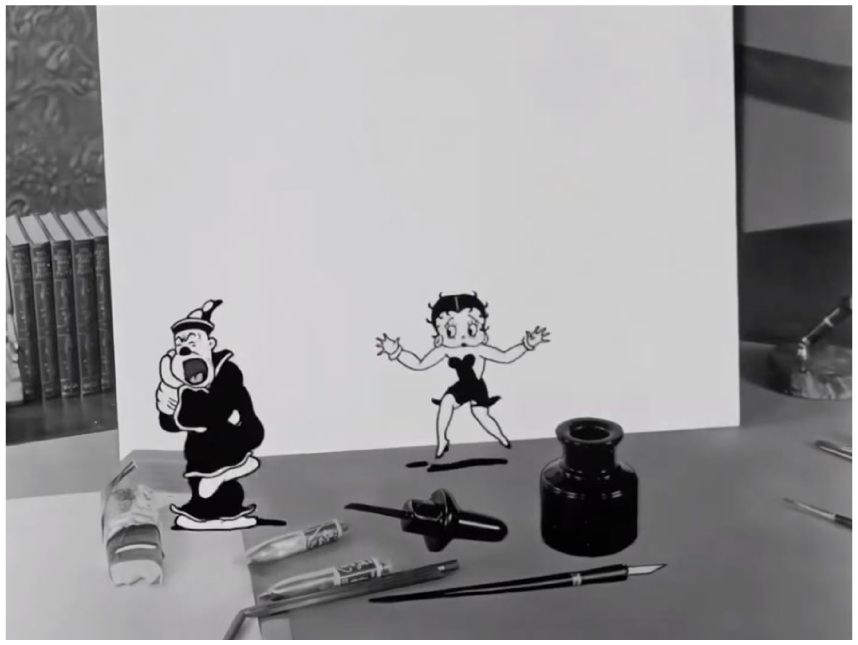
Betty and Koko unsupervised. Screen grab from Ha! Ha! Ha!, Max and Dave Fleischer at Fleischer Studios, U.M.&M. TV Corporation, 1934.
If Fleischer already represented himself as a relatively gentle manager–animator, both onscreen and off, why did he defang the composite style even further in the 1930s, to become almost invisible? By the 1930s, the animation process had been broken down into increasing divisions—most studios had an inbetweening department, along with animation, assistant animation, story, timing, background, inking, opaquing, camera, music, and sound, which also had its own manager and assistant manager (Deneroff, 1987: 2). At the height of the Depression, animation also became particularly profitable, as acknowledged by Fleischer (2005: 59) when he writes that the “fortunes of the Fleischer family [ran] counter to the times” because people turned to cartoons in order to escape their everyday struggles.
Of course, the windfall did not trickle down to workers who, by this period, had begun to voice their frustration with the industry of animation. In their staff publication, Fleischer’s Animated News, animators turned to drawing and poetry to language the psychic demands of their day-to-day work. While many of the articles in Fleischer’s Animated News were specific to the demands of the animation profession, others can be read as illustrative of a broader condition of 1930s workers balancing the effects of the Depression and the intensity of Taylorist managerial practices. A cartoon called “Checky Strike” depicts a check with a speech bubble coming out of it saying, “I’m your best friend! To anxiety—I bring relief. To distress—I bring courage, achievement. I bring content to loneliness. I bring comfort” (“I’m your checky strike!”, 1935a: 4). By 1930, Lucky Strike was the highest profiting brand and advertisements had begun to feature doctors saying they were “less irritating” than other cigarettes in response to a growing awareness that cigarettes were in fact unhealthy (see Stanford Research into the Impact of Tobacco Advertising, 2023). As a satire of the manipulative claims of advertisers, the cartoon emphasizes the paucity of the wage to address the toll of the job on workers’ emotions and time.
At the same time, workers drew on animation concepts and terminology for common language through which to describe feelings of depersonalization under stress. An article by Anderson Craig and Willard Bowsky featured definitions of studio terms and defined “animation board” as “a person tired of living” (“Fleischer’s Animated News 1 No. 6”, 1935b: 7). Another poem by Saul Kessler, “Cartoon Tragedy,” recounts the everyday ordeals of a man who “hated this cartoon life” even though “the poor chap . . . had a cartoon wife.” The poem continues:
And the cartoon kids, an even dozen
And the cartoon uncle, aunt, and cousin,
he smoked up packs of cartoon butts
’Til his awful fate had driven him nuts.
And that’s how they found him stark and dead
With a cartoon bullet in his cartoon head.
The concept of “cartoon everything” gives language to dissociation and existential dread as responses to the “cartoon life’s” precipitous demand for hard work and flexibility (“Definitions”, 1935b: 10). In an atmosphere in which cartoon characters could endlessly, exaggeratedly bounce back from pain without scars, Kessler’s poem also marks the impossibility of infinitely absorbing the impact of external stressors. Indeed, for at least two employees at Fleischer Studios, the work of animating was fatal. In 1935, Dan Glass, an inbetweener at Fleischer Studios who kept a turtle on his desk, died of tuberculosis. Another inbetweener, Lillian Oremland (one of three women inbetweeners) developed tuberculosis of the stomach in 1931 and was fired because of it. She later died of the disease in either late 1935 or 1936. Oremland’s friend, Lillian Friedman, attributes her death to the fact that the 10th floor where the inbetweeners worked was partitioned into cubicles without windows and there was no air conditioning, despite the fact that animators were inhaling ink fumes (Deneroff, 1987: 7).
Fleischer’s Animated News itself appears to have been started as a response to Glass’s sickness. Not unlike early Out of the Inkwell cartoons, in which Fleischer (1934a: 1) carefully designs and draws the tools for Koko to use to “fight” him, the content of the first issue is carefully framed by him, as, in an opening letter, he attributes the idea of starting the News to an inbetweener, Ben Solomon, and professes his wish that the magazine will create “good spirit and fellowship” among workers. In the same letter, Fleischer indirectly acknowledges Glass’s illness, explaining that the News will be sold for 10 cents an issue in order to create a collection for a then-unnamed employee who is ill and in need of assistance, adding that management will match the donation. Oremland, who would also have been sick by then, is not mentioned. In this and other issues, Max and Dave Fleischer continually express a desire for open lines of communication between management and workers. Max writes that the “cooperation of every person in our organization in furnishing interesting, helpful and desirable news will only mean the success of this publication, but will also help us all in the interchange of ideas and help us to understand each other.” (“Letter from Max Fleischer”, 1934a: 1)
A vague apology—“the company is trying to create the best working conditions for its members, but please have patience if you are not as comfortable as you should be, for there are many problems, some of which involve the throwing down of entire walls”—suggests that management knew by this point that they were at least partially at fault for Dan Glass’s illness and why (“Fleischer Studios News”, 1934b: 4).
The oft-professed wish throughout issues of Fleischer’s Animated News for everyone to work things out as a family also suggests that management anticipated and feared unionization. In 1934 New York, this fear would have been justified. Senator Wagner was in the process of revising his labor disputes bill, and the 1935 passage of the Wagner Act created the NLRB and allowed employees to join and form unions. In 1937, largely in response to Dan Glass’s death, the animators finally went on strike. The strike lasted for 6 months and adjourned when the workers received everything that they had asked for, except for a closed shop. 60% were unionized and 40% nonunion, and they gained a 40-hour workweek, extra pay for overtime, 1 week of paid time off for sick days and vacation, wage increases of 20%, and guarantees of production quotas. By 1943, the Screen Cartoonists Guild had organized all the major animation studios (Deneroff, 1987: 7).
If Fleischer’s Animated News was an attempt on the part of management to manufacture consent for ongoing exploitation, the implementation and overall success of the 1937 strike shows that the strategy was ultimately unsuccessful. On the other hand, it is difficult to tell if Fleischer’s directive to workers to express their feelings about the job had the opposite, galvanizing effect of unifying them in defense of themselves and their friends. The poems and drawings that workers provided about the difficulties of the job are neither so contaminated by the intervention of management as to be unintelligible on their own terms nor revolutionary calls to arms. They exist as partial views of the collective suffering that gave rise to the strike, and in this capacity offer more robust support for Furuhata’s notion of early animated cartoons in the US as testaments to the troubling plasticity expected of workers under a Fordist system. The issues of the News also show cartoonists, in their articulations of isolation or loneliness, assuming the subject-position of the “comic [clown]” of slapstick cinema that Hennefeld (2018: 4) describes as “both painfully vulnerable to injury and cartoonishly invincible to permanent damage.” This tension may have been amplified by the Taylorist style of “invisible management” which Fleischer used, both onscreen and off, to strategically modulate his authority, which offered an illusion of less control in the workplace while also rendering workers increasingly individually responsible for their own ability or failure to succeed.
The strike also marked a period of gradual decline in the popularity and output of Fleischer Studios. Part of this was due to the internal effects of the strike, as Max Fleischer never recognized the union. 5 But labor unrest was not the only factor affecting the Studios’ output. The 1937 release of Snow White and the Seven Dwarfs marked a shift in the style of animation that was most widely celebrated (Keenan, 1951: 10–11). Disney animators usually shot the entire feature film that they planned to animate in live-action first, then broke it down into still photographs that they carefully studied, made into flip-books, and traced over to create animated images that moved like the actors. Like the Fleischers, Disney thus relied heavily on rotoscope technology. However, rather than using the rotoscope to emphasize and exaggerate the different layers of an animated world, he sought new levels of realism through it. 6
Rotoscoping in the “Good Neighbor” era
In his first films, Disney did not speak about or advertise his use of the rotoscope because he thought it would impede his audience’s emotional identification with the characters. For example, the dancer and actress Marge Champion was paid $10 a day to act as Snow White for the feature film and contractually obligated to maintain secrecy about her role in the film’s making, despite the fact that her body was Snow White’s living source: “When I finally saw the finished product,” she said decades later, “I realized that every single movement was mine” (Canemaker, 2019). But Disney eventually loosened his commitment to concealing rotoscoping in his pre-Cold War films about Latin America, Saludos Amigos (1942) and Three Caballeros (1944), in which the technology was exposed in order to carefully manage North American viewers’ encounters with difference.
In 1941, Disney and his team traveled to Latin America on a “goodwill” tour meant to foster pan-American solidarity in the age of the Good Neighbor Policy. Many factors undermine the sincerity of the mission as one of pure inter-cultural appreciation. In addition to the timing of the trip in 1941 at the same time as the strike at Disney studios, the US government financed the trip as well as offering a $50,000 dollar subsidy, to be reimbursed if they turned a profit (Thomas, 1976: 172). The tour was still a significant event in the history of animation because it led to meetings between Disney and his team, and members of the then-burgeoning South American animation industry. In Argentina, Quirino Cristiani had already made several animated shorts, El Apostól (1917), Sin Déjar Rastros (1918) and El Mono Relojero (1938). In Brazil, Seth (née Alvaro) Marins had made an animated film called O Kaiser (Bendazzi, 2017: 46). Most of these films existed within a Latin American tradition of animated cartoons as an extension of the magazine and political cartooning world, which emphasized political commentary over the technical virtuosity of the artist.
When Disney came to Argentina, he met Cristiani and also hired the cartoonist Molina Campos to assist on El Gaucho Goofy. Campos quit after the short was released, refusing to work on any further Hollywood animated production because of the team’s disrespect for gaucho culture (Bendazzi, 2017: 115; Fanchin, 2023; Lénárt, 2024). An internal memo sent by John Rose, Disney’s liaison to the Coordinator for the Inter-American Affairs in New York after he quit, affirms Campos’ sense of being undervalued: “the frank truth of the matter is that we don’t need the guy at all,” Rose writes, “and that blunt fact applies to all the other South American talent we had lined up” (Goldman, 2013: 32). In moments such as these, we can appreciate how animation technology could give rise to a specific combination of cultural and artistic arrogance in its users. Rotoscoping allowed for the exploitation of animation workers, as well as for animators to receive credit often over and against the human models who provided the bodily movement and experience that made it possible. Here, Rose also fantasized about animation eliminating the need to interact with other people altogether.
But Disney in fact relied heavily on South American talent for the success of his Good Neighbor films, which featured live-action footage of performers Aurora Miranda, Dora Luz, and Carmen Molina. In the first rotoscoped sequence in The Three Caballeros, the film’s Brazilian stars, including Aurora Miranda as Yaya, emerge from a pop-up book. They appear ostensibly in order to give Donald Duck and his friend and guide—a green parrot from Rio named José Carioca, whose status as a city parrot is indexed by his flaneur style (an oversized white suit, a monocle, and a cane)—a tour of Bahía. Though Donald and José are supposedly in an unfamiliar place and outnumbered by the live-action figures in the scene, they still appear to be “at home” to the degree that the whole city has been rendered as a drawn cartoon, like them. Eventually, Yaya and her partner begin to dance, and Donald and José join them. Their movement has been rotoscoped over the dance of the live-action dancers and, as they dance, both the live-action figures and cartoon characters are depicted side-by-side so that the viewer can appreciate their movement in parallel.
In this scene, rotoscoping helps the film to do its “good neighborly” duty by suggesting that, beneath what Ruddell (2012: 15) calls the “surface play” of the animated line that rotoscoping emphasizes, these characters, though collectively from North and South America, and from larger and smaller cities within Brazil, are essentially interconnected, and moved by the same essential impulses. Ruddell argues that the play of the line over live-action footage caused by rotoscoping generates a generalized “mistrust” of reality in the spectator, but can also activate pleasurable curiosity about what lies “under” the animated image. Used in the context of US–Latin American diplomacy and pan-Americanism, rotoscoping might have had the potential to transform this curiosity inherent to the form into empathy. In this scene, it partially succeeds by nudging the viewer to look for unexpected or subtle similarities between dancing subjects from diverse geographical locations.
But Disney’s use of rotoscoping by through-line, which uses the force of live-action characters’ movements as a guide rather than outlining the whole character, maintains an overall clearer distinction between cartoon and live-action movement than Fleischer did in his rotoscoped cartoons, which fully outlined the live-action figure. 7 While the viewer can tell that Donald and José have been rotoscoped over Yaya and her dance partner, their movement is still not too similar to hers in a way that would risk relating them overly closely. Disney’s use of “through-line” technique holds the potential uncanniness of rotoscoping at bay, as animated and live-action figures still interact from cleanly separate movement-worlds. In the absence of the uncanny effect that is produced in rotoscoping by trace—which ultimately taints both the live-action source footage and the animated footage to leave both looking unshakably odd—Disney’s “through-line” style is more consumptive. It is consumptive in a colonial sense because it allows the animators to extract a small, attractive piece (Yaya’s dance) from the footage of Bahía as a whole, and help Donald fully “digest” it by tracing the movement into him so that he can easily dance like her, but in a more cartoonish way. This causes the original footage of her dancing to now appear Other and discontinuous with the comparatively “normal” cartoon world in which Donald’s rotoscoped dancing now looks natural.
The fact that the whole sequence takes place inside a pop-book entitled Latin America that has been sent to Donald Duck by his avian friends in Brazil adds an additional layer of mediation to Donald’s cross-cultural encounter. As José Piedra (1994) notes, this structuring conceit of Three Caballeros, which begins with Donald receiving the book as a surprise, posits Latin American lands and peoples as a “gift” being offered to North America for the taking. Along with rotoscoping, the book also allows Donald to modulate the intensity of his relationship to Latin America at will. Its covers are practically characters in the film in how they assiduously mirror and respond to his desire to be more “open” or “closed” to the Latin American people inside who are always available and offering themselves to him. Donald also can and does jump out of the book at the slightest moment of discomfort, such as when he is chased by a group of Mexican “bathing beauties” who he has been spying on at the beach. Over the course of the sequence, it becomes clear that the women are not chasing Donald, as one might assume, because they are angry at him for violating their privacy, but because they are obsessed with him and want even more of his attention. Piedra argues that the notion of the book as a gift supports the rhetoric of the Monroe Doctrine, which frames South America as the US’s backyard. We might understand the presence of so many Donald-crazy, sexually aggressive South American women within it as positioning the continent as actively pursuing a closer relationship with a comparatively passive or indifferent US when, in reality, the opposite was true. At this point in the 20th century, it was the US that was making bad-faith overtures toward hemispheric solidarity, only to violently intervene in Latin American politics by its end.
Anti-imperialism and the rotoscope
While Disney encountered a thriving animation industry in Latin America in the 1940s, rotoscoping would take much longer to become used among animators there because of the financial investment necessary to make rotoscoped feature films. In 2008, Claudio Díaz-Valdés released Golpe de Espejo as one of the first major rotoscoped animated films to come out of Latin America. In 2012, he also made Chile Imaginario, another rotoscoped documentary featuring interviews with Chileans born between 1973 and Chile’s bicentennial in 2010. In these animations about state terror, Díaz-Valdés’ use of the rotoscope to revisit live-action images of the 1973 coup invokes its early-1900s origins as a military technology. However, Díaz-Valdés deploys the technology to focus on the enduring and indelible effects of national trauma and collective grief as it extends across generations, as well as to highlight the material labor behind rotoscoping.
In Golpe de Espejo (see Figure 5), the rotoscoping appears to have been conspicuously done by hand because of the “boiling” effect visible throughout. In contrast to both Fleischer and Disney, Golpe de Espejo does not have a distinctly recognizable aesthetic. Each speaker is drawn in a completely different style, with some drawn in black and white, others in color, some outlined in computerized, bold lines, and others barely outlined at all. This choice suggests the hands of many different animators working on the film. Spilled paint on certain frames and the use of materials such as coffee, tea, and wine highlight the fact that the shorts were made in the studio, during late nights behind-the-scenes (Gordillo, 2021: 9). The encounter between the animator and the live-action image is made explicit, as the combined effect of the spills, stains, flickers, and “boiling” lend an edge of desperation and urgency to the images. It is as if the grieving of the over 40,000 killed and disappeared is always occurring on and offscreen, and, like the unfinished-looking images, will never be fully completed. 8
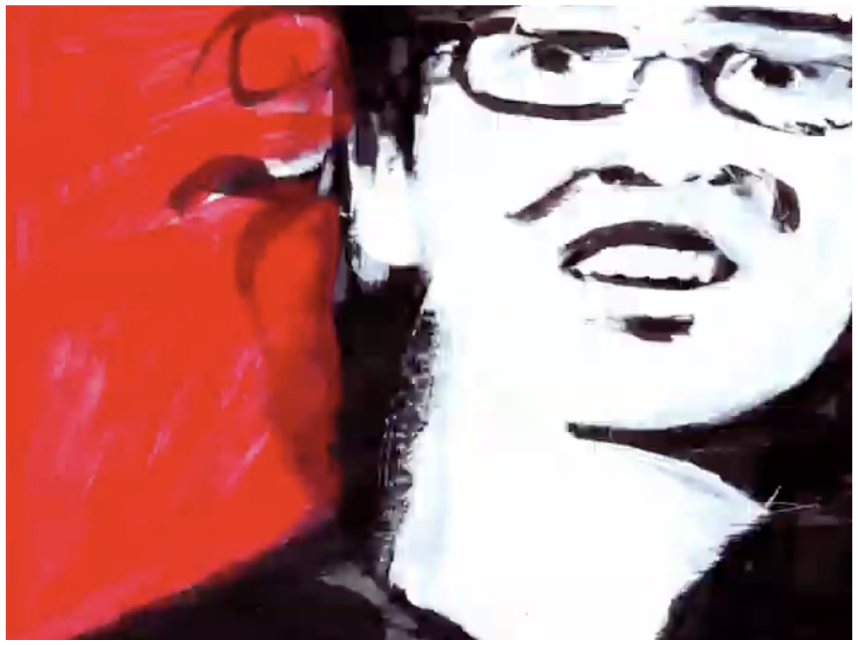
Another character drawn in a different style in Golpe de Espejo. Screen grab from Golpe de Espejo (2008). © Claudio Díaz-Valdés, reproduced with permission.
Where Disney’s films neutralize the US’s status as a threat to other countries by using popular characters such as Donald Duck as “ambassadors” for the US in Latin America, in Díaz-Valdés’ work, the US is never personified and, instead, alluded to obliquely and unsentimentally through a recurring animation of a graph showing the 700% rise in inflation after the coup in 1973. By not depicting the US as a humanoid figure, Golpe de Espejo wrests protagonism from it in order to make ordinary Chileans into main characters with their own distinguishing gestures and mannerisms. In addition to the woman I describe at the start of this article who looks away and seems embarrassed as she speaks of her “imaginary memories,” other subjects come to represent different archetypes of repression and disavowal. “Every Saturday, I was playing the violin,” says another Chilean when asked what she remembers about the coup. As she speaks, she smiles and gestures grandly, avoiding mention of the dictatorship and politics altogether. Another interviewee curtly emphasizes the relative peace of the present in a way that gently but firmly bars further questioning: “It’s difficult to talk about my childhood,” he says. “Although I don’t support today’s government, it’s not the same as the time of our parents, when you couldn’t even think differently.” The fact that an animated aesthetic has not been standardized across their appearances amplifies each character’s sense of isolation within their own opaque interior worlds. As long as they remain confused about what happened or hesitant to talk about it, they also remain unmoored from a shared reality, and from each other.
While connected to Golpe de Espejo in its use of interviews and rotoscoping to tell a story about the coup’s reverberations across generations, Chile Imaginario de-emphasizes individual testimonies to image the coup as a collective national trauma. In the film, Díaz-Valdés compiles multiple interviews into one script that is read by two narrators who speak over rotoscoped scenes of key moments in the history of resistance to the dictatorship: first, the use of police dogs to kill protesters in 1973, and second, the self-immolation of Sebastián Acevedo Becerra. In 1983, Acevedo Becerra burned himself at the Plaza de Armas in Concepción after his children were arrested and disappeared by Pinochet’s secret police. His last words were, “I want the CNI [Chile’s National Information Center] to return my children.” Chile Imaginario features rotoscoping over footage of the self-immolation alongside animations of the 700% inflation graph. If Golpe de Espejo posits links between the animator and the animated subject on the basis of a shared understanding of their nation’s past, Chile Imaginario more forcefully articulates the geopolitical and economic conditions for that understanding. Juxtaposing the graph, the dogs, and Becerra frames “shock therapy” as an effect of the rise of fascism and state terror. In this capacity, the “surface play” of the tenuous and fragile rotoscoped line over indeterminate, “boiling” masses of color also serves to illustrate the boundlessness of grief, and the way in which traumas that seem specific to individuals or their families exceed them and can offer points of anti-imperial solidarity.
Disney used the rotoscope and the composite style in the interest of controlling and managing a North American spectator’s potential experience of a given live-action space as if it were dangerous. Díaz-Valdés similarly draws on the comfort that the technology can provide by virtualizing violence. However, he does this in the interest of helping Chilean subjects face and integrate, rather than escape, the horrors of the past. Where Golpe de Espejo heavily manipulates live-action footage to “draw out” the repressed emotions of subjects who seem emotionally blocked, the quick pace, collectivized voiceover, and heavy distortion of footage from the coup in Chile Imaginario act as a kind of shield that directs traumatized subjects to engage with what they are seeing on a less personal or eventful basis, as if these histories have been everywhere and are already a part of them. Together, the films can be considered complementary parts of a broader project of building collectivity through an avowal of shared grief: Golpe de Espejo rotoscopes speakers to validate individual memories that they have dismissed as “imaginary.” Chile Imaginario rotoscopes news footage to image a Chilean psyche-in-common and offers it to the viewer as a mirror, and grounds for radicalization against empire.
The efforts in Díaz-Valdés’ shorts to make the hidden labor of rotoscoping visible also meaningfully recall the history of animation workers in the US who resisted the new forms of exploitation that the introduction of rotoscoping produced. Where animation workers at Fleischer Studios struggled to find creative ways (through the News) to articulate their inefficient emotions of grief, anger, and anxiety from within a highly-regulated work environment, Chile Imaginario and Golpe de Espejo avow experiences of worker inefficiency and imperfection through spills, stains, and tears that constantly emphasize the fact that these figures have been drawn and redrawn by hand. Where early animated cartoons spectacularized the animator–manager’s harsh, often violent circumscription and domination of “unruly life,” by the 21st century, we see the same instruments turned toward the subtler purpose of locating a genuine subjective feeling shared by the animator and the rotoscoped person. In Díaz-Valdés’ work, this feeling is rooted in a shared national trauma, but also creates an opening for articulations of solidarity between a broader class of people exploited in and by the US under global capitalism. This more patient use of the technology ultimately enacts a commitment to animating disenchantment; to peeling back layers of mystification in ways that allow viewers to imagine ethico-political links between the struggles of workers in a burgeoning US empire and their insurgent neighbors.
Footnotes
Acknowledgements
Thank you to Margaret Homans and Laura Wexler for their encouragement and invaluable comments on an early draft of this paper. I also wish to thank Camila Ortiz, Elias Kleinbock, Alfredo Pérez, Maria Baker, and Alana Fulton for reading later drafts and generously offering their feedback and support.
Ethical approval
No ethical approval was required for this study because it did not involve humans.
Consent to participate
No informed consent was required for this study because it did not involve humans.
Funding
The author received no financial support for the research, authorship, and publication of this article.
Declaration of conflicting interests
The author declared no potential conflicts of interest with respect to the research, authorship, and publication of this article.
Data availability statement
The author has no ethical, legal, or commercial concerns about publishing/sharing her research findings.