






Abstract
Cross-cultural fieldwork often requires researchers to navigate two ethical demands: institutional procedures designed to make ethical conduct auditable, and recruitment realities in which legitimacy and trust are negotiated through relationships, intermediaries, and organisational hierarchies. Drawing on collaborative autoethnography of two successive doctoral projects conducted at a university in Aotearoa/New Zealand, with recruitment in Hong Kong kindergartens and Mainland Chinese universities, this paper examines how recruitment proceeds when standardised consent and voluntariness procedures encounter relationship-mediated access. Voluntariness here means participants’ practical capacity to refuse or withdraw without social, institutional, or material penalty—a capacity that signed consent forms can document but cannot, on their own, guarantee. Combining contemporaneous recruitment journals with critical analysis of institutional ethics guidance, we show that recruitment breakdowns reflect misalignments between two co-existing ethical logics rather than cultural incompatibility: compliance visibility, where ethical conduct must be procedurally demonstrable, and relational legitimacy, where trust is established through intermediated endorsement and role-appropriate engagement. We identify three safeguards through which novice researchers protected voluntariness while maintaining legitimate access: in-person legitimacy-building, safety-valve recruitment (decoupling invitation from decision), and boundary work in messaging-platform ecosystems such as WeChat. We conceptualise the core capacity required to perform this alignment work as ethical hybridity: the reflexive capacity to recognise, negotiate, and document moments when governance templates and field relations diverge. The paper contributes to research ethics by rendering tacit recruitment judgement analytically visible, with implications for ethics review, decolonial research practice, and cross-cultural qualitative fieldwork.
Keywords
Introduction
Participant recruitment is a critical, often unpredictable phase of qualitative inquiry: a negotiated process of access, power, and trust (Abrams, 2010; Clark, 2008; Karnieli-Miller et al., 2009; Kristensen and Ravn, 2015). For doctoral researchers transitioning from classroom training to independent fieldwork, tensions surface between the procedural ethics required by university ethics committees and the relational realities of legitimate field access (Guillemin and Gillam, 2004; Stark, 2012). The unresolved problem this paper takes up is not that doctoral researchers require generic additional training before entering the field. Instead, the problem lies in the foregrounding of divergent ethical conducts by institutional procedures and field realities. The former privilege auditable documentation of voluntariness, consent, and researcher distance; while the latter requires trust built through intermediaries, role relations, and situated legitimacy. The substantive question for research ethics is therefore the alignment work required when these ethical logics do not readily coincide.
To make this alignment work analytically tractable, we use a small set of working terms throughout the paper. By voluntariness we mean participants’ practical capacity to refuse or withdraw from research without social, institutional, or material penalty—a capacity that signed consent forms can document but cannot, on their own, guarantee (Corrigan, 2003; Schaefer and Wertheimer, 2010). By audit-oriented governance we mean institutional ethics arrangements, operationalised in Aotearoa/New Zealand through Human Participants Ethics Committees, in which ethical conduct is rendered accountable through standardised documents (Stark, 2012; Strathern, 2000). We use compliance visibility to refer to the demand that ethical conduct be evidenced through auditable documents, such as consent forms and recruitment scripts (Guillemin and Gillam, 2004), and relational legitimacy for the parallel demand that recruitment legitimacy is established through intermediated endorsement and role-appropriate engagement (McAreavey and Das, 2013; Yen et al., 2017).
This tension is particularly visible in cross-cultural fieldwork, but we do not frame it as a civilisational clash between a “procedural West” and a “relational East.” Existing scholarship has documented both the challenges of cross-cultural research ethics (Honan et al., 2013; Liamputtong, 2010; Marshall, 2008) and the practical operation of relationship-mediated access in contexts such as China, including the role of guanxi (personal networks) and renqing (affective obligations) (Gold et al., 2002; Kipnis, 1997; Yen et al., 2017). Ethics regimes themselves are not internally monolithic. Aotearoa/New Zealand, for example, integrates relational and decolonising commitments, such as Te Ara Tika (Hudson et al., 2010) grounded in Māori epistemology, alongside procedural templates inherited from biomedical traditions (Tolich, 2002). Following Tsing (2005), we treat friction not as a clash between bounded systems but as the productive and unstable encounter through which apparently universal procedures become workable only through situated translation. The analytic question is therefore not whether one ethical logic is right and the other wrong, but how the two are aligned in practice when they pull in different directions, and what is required—procedurally and interactionally—to keep voluntariness intact while doing so.
We term the practical capacity required to navigate such misalignments ethical hybridity. Rather than referring to a mixture of “Western” and “Chinese” ethics, this concept denotes an alignment competence: the reflexive capacity to recognise when procedural ethics templates and field-based recruitment relations pull in different directions (Guillemin and Gillam, 2004); to design, enact, and document safeguards that protect voluntariness under those conditions (Schaefer and Wertheimer, 2010); and to do so while maintaining the auditable record on which institutional ethics governance legitimately depends (Stark, 2012). Although qualitative methodologists have long argued that ethics is enacted and negotiated in practice, not merely pre-approved (Ellis, 2007; Guillemin and Gillam, 2004), the specific work of aligning audit-oriented procedures with relationship-mediated recruitment is rarely operationalised in ways that ethics committees, supervisors, and novice researchers can collectively recognise. The contribution of this paper is therefore to research ethics first, with implications for doctoral supervision and ethics review.
Guided by this framing, we ask: How do doctoral researchers align audit-oriented ethics requirements with relationship-mediated recruitment conditions in ways that protect voluntariness while maintaining legitimate access? We address this question through a collaborative autoethnographic analysis (Chang et al., 2013) of recruitment journals and critical incidents from two successive doctoral projects, both conducted under the same university ethics regime but in distinct settings: kindergartens in Hong Kong (Author A) and universities in Mainland China (Author B). To trace how recruitment safeguards were developed in practice, we apply a tripartite analytic framework—bureaucratic (auditability demands), field-relational (recruitment access conditions), and relational (negotiation work)—that examines how alignment is achieved in situ rather than treating it as a cultural opposition to be resolved in advance.
Literature review
Institutional ethics governance in Aotearoa/New Zealand and beyond
Audit-oriented research ethics governance reflects a global institutionalisation of ethics review systems, in which ethical conduct is rendered organisationally visible through prior committee approval, standardised consent procedures, and documented withdrawal rights (Hedgecoe, 2008; Schrag, 2010; van Den Hoonaard, 2018). Strathern (2000) has termed this an audit culture: a mode of governance in which ethical behaviour is defined by procedural compliance rather than situated judgement. Within this broader landscape, university Human Participants Ethics Committees, including the university ethics regime and governance under which both authors of this paper operated, translate ethics into a working vocabulary of consent forms, anonymity guarantees, recruitment scripts, and conflict-of-interest declarations.
These mechanisms inherit, in important respects, the genealogy of biomedical research ethics. The post-Belmont consolidation of informed consent, prior review, and documented withdrawal rights diffused from biomedical into social-science contexts, often without thorough adaptation to qualitative and relational research designs (Schrag, 2010; Stark, 2012; van Den Hoonaard, 2018). The template frames the participant as an autonomous individual in a voluntary contract (Corrigan, 2003; O’Neill, 2003), and this biomedical logic translates unevenly to socially mediated recruitment. More recent integrity-oriented frameworks (UK Research Integrity Office (UKRIO), 2023; Universities UK, 2019) broaden the policy vocabulary towards trust and research culture, yet the operational tools encountered by doctoral researchers remain heavily consent-centred.
In Aotearoa/New Zealand, the procedural inheritance co-exists with indigenous frameworks like Te Ara Tika (Hudson et al., 2010), which prioritise relational and decolonising ethical commitments. Unlike templates prioritising individual autonomy, Te Ara Tika emphasises Māori concepts including whakapapa (relationships), manaakitanga (cultural responsibility and care), and mana (justice and integrity). Under this framework, researchers are embedded in webs of relationship; ethical recruitment involves maintaining relational integrity, not only signing forms. National standards (National Ethics Advisory Committee (NEAC), 2019) similarly champion relational and culturally responsive ethics. Yet the procedural tools provided to doctoral students—prescriptive guidelines and standardised templates—retain strong alignments with the biomedical genealogy described above (Smith, 2005; Tolich, 2002). Doctoral researchers therefore operate within a single ethics regime that contains both procedural-compliance and relational-decolonising commitments. This internal heterogeneity matters for our argument: the friction we examine lies not between Aotearoa/New Zealand and Chinese ethics regimes, but between co-existing logics within institutional ethics governance itself.
Decolonising research ethics and relational legitimacy
A growing body of scholarship has argued that institutional research ethics regimes are not culturally neutral, and that their procedural defaults reflect epistemological histories that sit uneasily with researched communities (Smith, 2021; Tikly and Bond, 2013; Tuck and Yang, 2014). This decolonising literature argues that procedural and relational ethics are both required, and that recruitment legitimacy depends on relational accountability that documentation alone cannot evidence. Te Ara Tika belongs to this broader move, alongside Indigenous and postcolonial scholarship across multiple contexts (Cram, 2001; Held, 2019; Smith, 2021). We engage this literature not to import Māori concepts into a Chinese fieldwork analysis, but to make a specific analytic point: even within Aotearoa/New Zealand’s own ethics arrangements, the assumption that auditable procedures suffice for ethical recruitment has been substantively contested—a contestation that shapes how we read the recruitment frictions documented later.
Where university audit cultures often assume a volunteer model—an autonomous stranger responding to a public advertisement (Corrigan, 2003; Wiles et al., 2005)—that model proves methodologically thin in settings where recruitment legitimacy is mediated through gatekeepers and organisational arrangements (Robinson-Pant and Singal, 2013; Tikly and Bond, 2013; Zhang, 2017). Ethical codes are interpreted and enacted in geographically specific ways, requiring context-responsive judgement (Zhang, 2017); where participation is socially situated and role-mediated, recruitment becomes a matter of negotiated relational ethics (Cannella and Lincoln, 2007; Ellis, 2007), not stranger transaction. Literature on Indigenous and relationship-mediated field settings similarly emphasises that trust is established through accountable relationships rather than legalistic consent forms alone (Cram, 2001; Smith, 2021).
In many Chinese organisational settings, relational obligations are articulated through guanxi and renqing. Chan (2013) argues that philosophical traditions in Hong Kong and other Chinese societies foreground relational harmony, which can sit uneasily with assumptions in institutional review board (IRB)-style systems. Following Hwang (1987) and Chen and Chen (2004), guanxi denotes particularistic personal connections grounded in reciprocity and sustained by renqing—the affective obligations governing these interactions. Unlike a volunteer-stranger model relying on system trust (Luhmann, 1979), trust in many Chinese organisational settings is mediated through networked endorsement, shaping whether institutional credentials are read as credible (Yen et al., 2017). Accountability for recruitment shifts accordingly: voluntariness in audit-oriented templates is evidenced through documented choice (O’Neill, 2003); in relationship-mediated arrangements, the felt safety of refusal additionally depends on intermediated endorsement.
Consent itself is reframed by this literature. Comparative work shows that the signed consent form is one element within a broader social interpretation of agreement (Boddy, 2014; Marshall, 2008; Molyneux et al., 2005); in hierarchical or relationship-mediated arrangements, formal consent can co-exist with perceived obligation, and what looks like volunteer recruitment on paper may be experienced as compliance with a request that is socially difficult to refuse (Mauthner and Doucet, 2003). We therefore assess voluntariness through the interactional viability of refusal and withdrawal; whether participants can plausibly say no, or stop, without social, institutional, or material penalty. This conceptual move from documented consent to refusal viability is central to how we analyse our data.
For doctoral researchers, this creates a recurrent tension. Audit-oriented guidance commonly frames intermediated recruitment as a risk to voluntariness, for example, as undue influence to be mitigated (NEAC, 2019; University of Auckland Human Participants Ethics Committee (UAHPEC), 2017, 2020). Field-based recruitment, however, may treat the intermediary as the only socially legible pathway to legitimate access. The collision is between compliance visibility and relational legitimacy as ethical demands that co-exist and must be aligned in practice.
Ethical hybridity as a framework for alignment work
Scholars have identified a tension between audit governance and relational recruitment. Guillemin and Gillam (2004) describe “ethically important moments” that pre-approved protocols cannot fully anticipate; Ellis (2007) and Cannella and Lincoln (2007) treat ethics as enacted in interaction; Zhang (2017) documents how procedural ethics is reinterpreted in geographically specific ways. This body of work identifies a capacity closer to Aristotelian phronesis—practical judgement derived from situated experience—than to rule-following alone (Flyvbjerg, 2001). Our argument extends it in one specific direction: the capacity to navigate the tension between compliance visibility and relational legitimacy is rarely operationalised in terms that institutional governance, supervisors, and novice researchers can collectively recognise, leaving alignment work tacit (Polanyi, 1966) and its costs absorbed individually.
This study uses ethical hybridity to name this alignment competence. Rather than referring to a mixture of Western and Chinese ethics or implying that researchers blend incommensurable traditions, this concept represents the practical capacity to recognise when procedural ethics templates and field-based recruitment relations pull in different directions; to design, enact, and document safeguards that protect voluntariness under those conditions; and to do so while preserving the auditable record on which institutional ethics governance legitimately depends.
Following Tsing (2005), we treat the moments where these tensions emerge as productive friction rather than cultural clash. This framing directs attention away from East/West dichotomies towards the specific points at which audit templates and field arrangements become misaligned, and the situated work through which alignment is achieved. It also reframes “deviation”: where a documented, defensible safeguard has been substituted for a template that did not work in context, what supervisors and ethics committees confront is not non-compliance but alignment work that needs to be made visible.
The implication for doctoral supervision is a shift towards cultivating a core capacity rather than a generic curriculum: the ability to recognise audit-relational misalignment, design safeguards that protect voluntariness without abandoning auditability, and document the reasoning behind these adaptations.
Methodology
Research design: Collaborative autoethnography
This study adopts a collaborative autoethnography (CAE) approach (Chang et al., 2013). We use CAE here as a method in which researchers systematically analyse their own fieldwork experiences together—not as private reflection alone, but as a comparative and dialogic source of data about a shared methodological problem. In this study, that shared problem is the alignment work required when audit-oriented ethics procedures encountered relationship-mediated recruitment. We selected CAE for its multivocality (Chang et al., 2013), which enabled the identification of structural patterns across two distinct sites, and align our approach with analytic autoethnography (Anderson, 2006), connecting personal experience to wider theoretical concerns: audit culture, decolonising and relational ethics, and the alignment work that connects them.
CAE has been critiqued for solipsism and limited generalisability (Anderson, 2006). We mitigate these limitations through cross-site collaborative validation, which allows us to identify structural patterns in audit-relational misalignment that exceed individual experience while acknowledging the situated nature of autoethnographic knowledge.
Positionality and reflexive standpoint
A reflexive account of our positionality is integral to the credibility of the analysis we offer. Both authors were Chinese doctoral researchers affiliated with a university in Aotearoa/New Zealand and conducting recruitment in Chinese educational settings; Author A in Hong Kong kindergartens, and Author B in Mainland Chinese universities. This positioned us neither as fully external international researchers nor as fully embedded institutional insiders. We were familiar with linguistic and interactional norms in our recruitment sites, but operated under an institutional ethics and governance regime grounded in Aotearoa/New Zealand and shaped by both audit-oriented and decolonising commitments (see Section “Institutional ethics governance in Aotearoa/New Zealand and beyond”). This insider–outsider hybrid position facilitated some forms of relational access—we could read intermediated introductions, register hierarchies, and face-work cues—while making other ethical tensions more acute, particularly where institutional approval, local trust, and role-based expectations did not align. The journals from which our data are drawn are therefore positional accounts rather than neutral records: contemporaneous interpretations produced by researchers whose location—doctoral status, ethnicity, gender, prior relationships, and institutional affiliation—shaped what was salient, what felt ethically uncertain, and what was eventually written down. The collaborative analytic phase was designed in part to surface these positional traces.
Research contexts and recruitment sites
The data are drawn from two successive doctoral projects conducted under a shared institutional ethics regime. Author A’s fieldwork in Hong Kong kindergartens involved IRB-style procedural requirements within relationship-mediated organisational access arrangements. Subsequently, Author B conducted recruitment in Mainland Chinese universities, where access was mediated through administrative gatekeepers and networked introductions (including guanxi in some instances), with variable ethics review practices across institutions.
The two sites also differed in analytically consequential configurations of gatekeeping. The Hong Kong kindergarten case involved layered gatekeeping among principals, teachers, parents, and children, where voluntariness had to be negotiated across adult authority, parental stewardship, and children’s assent. The Mainland university case involved more linear gatekeeping (administrators and teachers mediating access to adult or near-adult students), in which the principal voluntariness risk lay in role-based deference and the interactional cost of refusing a teacher-endorsed invitation. This shared institutional regime (university ethics) paired with distinct gatekeeping configurations enables us to surface transferable mechanisms of misalignment and alignment, rather than characterising either site as representative of Chinese fieldwork as such. The studies and their subsequent amendments were approved by the University of Auckland’s Human Participants Ethics Committee (Approval Nos. UAHPEC2790 and 021583).
Data collection: Triangulating policy and practice
Data collection followed a triangulation strategy across institutional documents and recruitment practice (Patton, 1999). Data collection for this study occurred across two time periods: Author A’s recruitment took place from June to October 2018, and Author B’s recruitment from December 2020 to May 2021. To establish procedural expectations, we analysed the University of Auckland Human Participants Ethics Committee (UAHPEC, 2011, 2017, 2020) Applicants’ Reference Manual, National Ethical Standards (NEAC, 2019), and Te Ara Tika guidelines (Hudson et al., 2010), alongside host-country regulatory documents (see Table 1). These institutional texts were treated as cultural artefacts (Strathern, 2000) and examined through document analysis (Bowen, 2009) for how voluntariness, consent, and gatekeeper roles were framed.
Policy and governance documents consulted across jurisdictions.
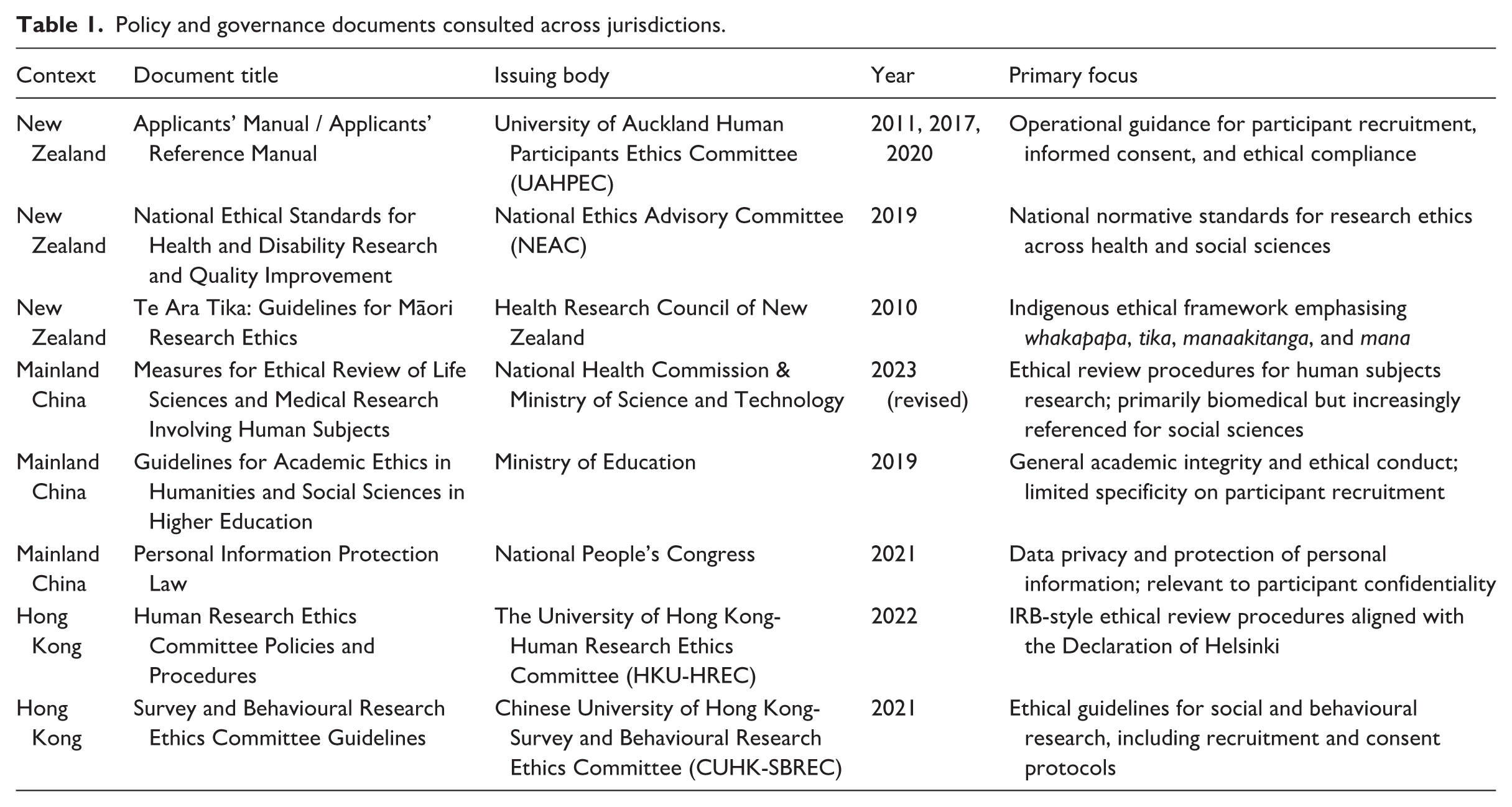
The institutional analysis was juxtaposed with the researchers’ reflexive journals. The journals documented critical incidents (Flanagan, 1954) or moments where the planned recruitment protocol faltered, where voluntariness safeguards became difficult to enact, or where recruitment required ethically defensible design changes. Entries were produced within 24–72 hours of each recruitment episode to minimise retrospective reconstruction.
Data analysis: A tripartite framework
Analysis proceeded in two phases. First, over approximately 8 months (beginning during active recruitment and continuing through the initial drafting phase), we engaged in concurrent collaborative sense-making (Chang et al., 2013): independently nominating critical incidents from our journals, then cross-reading and challenging one another’s interpretations against raw entries and contextual details. Incidents were retained if they (a) documented concrete misalignment between procedural requirements and field-based recruitment relations and (b) resonated across both sites, suggesting structural rather than idiosyncratic patterns. Versioned coding files and shared memos supported credibility.
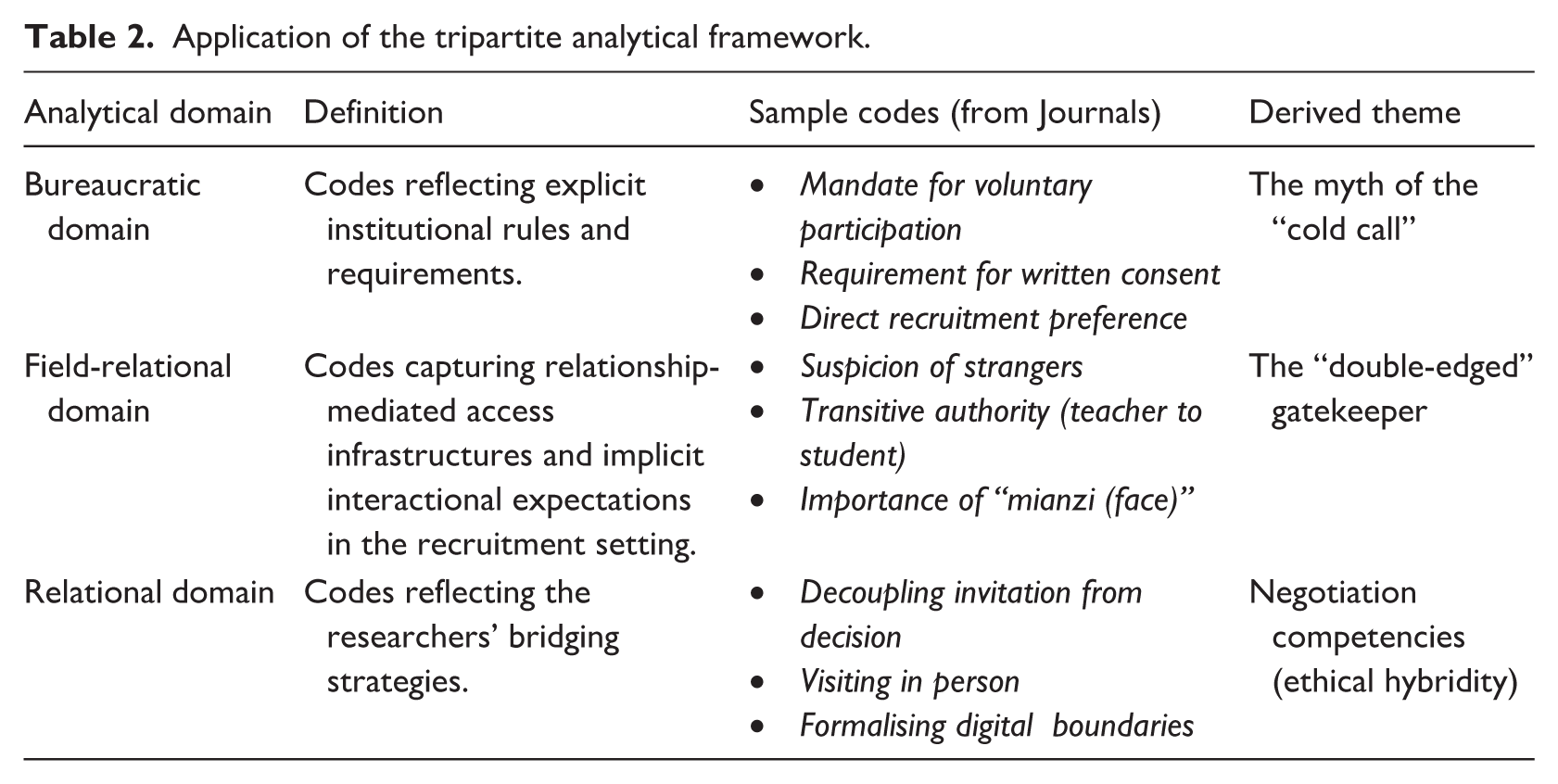
In the second phase, we applied a tripartite analytical framework across both data sources, categorising each incident into three domains (Table 2): (i) bureaucratic (auditability and compliance visibility; Strathern, 2000), which included institutional requirements such as consent scripts, formal distance, and conflict-of-interest provisions; (ii) field-relational, involving relationship-mediated recruitment arrangements (intermediated endorsement, role hierarchy, face-work); and (iii) relational (“ethics in practice”; Guillemin and Gillam, 2004), referring to the negotiation work through which audit-relational tensions were resolved.
Application of the tripartite analytical framework.
Findings
The myth of the cold call: Re-negotiating access
The first major friction was the inadequacy of the stranger model—the bureaucratic preference for impersonal, direct recruitment. The University of Auckland Human Participants Ethics Committee (UAHPEC) Applicants’ Reference Manual (2020) frames ethical recruitment through public accessibility, stating that researchers may use “public records of names and addresses (such as telephone directories)” (p. 36). Implicit is a reliance on system trust—the assumption that university affiliation and ethics approval number suffice to legitimise the request. This model assumes a public sphere of data that did not function as assumed in our settings, where contactability and legitimacy were mediated through semi-private institutional networks and gatekeepers.
In the field-relational domain of the organisational settings we entered, reliance on abstract institutional authority frequently collapsed at first contact. For Author B (Mainland China), the initial attempt to follow the direct recruitment protocol via mass email invitations resulted in a near-zero response rate. Similarly, Author A (Hong Kong) identified 48 potential kindergartens via the Education Bureau website and sent formal email invitations; this yielded only two rejections and 46 non-responses: I sent a perfectly ‘ethical’ email—logo, approval number, scripted wording—yet it landed with zero traction. It felt official on paper, but socially weightless: no one could place me, so the message read as ignorable at best, suspicious at worst. (Journal A, Entry A05)
The failure of system trust
We argue that this failure was not merely logistical but infrastructural, rooted in a misfit between institutionally assumed “system trust” and recruitment environments where credibility is established through networked endorsement (Yen et al., 2017). In our data, this misfit surfaced at two levels.
First, ethics review landscapes differ across our two host jurisdictions: social-science review is unevenly formalised across Mainland Chinese universities (National Health and Family Planning Commission, 2016), while Hong Kong universities operate IRB-style systems within organisational fields where relationship-mediated access remains influential (Chan, 2013; The Chinese University of Hong Kong (CUHK), 2025; The University of Hong Kong, 2022). Second, at the level of recruitment practice, institutional symbols (e.g. a university crest) conveyed origin but not credibility. In environments shaped by fraud awareness, unsolicited digital contact was often treated as suspicious by default. Procedural distance—intended as a safeguard—did not automatically generate legitimacy; in some moments, the absence of relational legibility functioned as a barrier to participation rather than a protection (see Author B’s reflection below).
The irony is that the more I tried to sound compliant and formal, the more it resembled institutional spam. Without an introduction, the ethics number didn’t signal trust—it looked like another credential someone could fake. (Journal B, Entry B09)
From procedural efficiency to in-person legitimacy-building
To overcome this obstacle, we shifted from a bureaucratic logic of efficiency to a relational logic of propriety, which is an example of ethical hybridity in action. Journal entries framed in-person presence as ethically consequential—the means by which the researcher became socially legible to gatekeepers. Author A undertook in-person legitimacy-building, physically visiting kindergartens to introduce the study: I realised I wasn’t just ‘following up’—I was repairing legibility. Showing up at the gate signalled that I recognised the school’s authority and wasn’t hiding behind a template. The visit was slower, but it felt like the first contact that could be read as sincere. (Journal A, Entry A11)
In these encounters, in-person presence functioned as an ethical performance of cheng (sincerity), conveyed through respectful presence and role-appropriate engagement. Relying solely on digital communication for initial contact was sometimes interpreted as impersonal in these organisational settings, while in-person presence enacted mianzi (face) by validating the school’s authority and demonstrating the researcher’s humility. This pivot reframes ethical recruitment from an administrative task of information transmission to an embodied performance of respect—one that protects voluntariness by ensuring recruitment becomes socially legible enough for refusal itself to be intelligible.
Guanxi, visibility, and voluntariness
Ultimately, successful access for both researchers depended not on the bureaucratic merit of the project as described in the Participant Information Sheet, but on relational endorsement of the researcher. Author A’s breakthrough occurred when a principal known to her personally forwarded the research information to a private WhatsApp group of kindergarten heads. Author B was similarly required to abandon mass mailing in favour of leveraging guanxi—personal networks that could vouch for the researcher’s credibility.
This finding sits in productive tension with audit-oriented procedural ideals that treat impersonal, direct recruitment as the default safeguard of voluntariness. In the procedural guidance under which we worked, recruitment through persons in authority and networks of acquaintance was treated as ethically sensitive because it could affect participants’ practical capacity to refuse (see, e.g. UAHPEC, 2017: 45–46, 52, on conflict of interest and persons in authority; NEAC, 2019, on free participation). This concern is well founded: intermediaries can render research more trustworthy, but they can also raise the interactional cost of refusal. Our point, therefore, is not that personal networks are ethically neutral, nor that institutional concern about undue influence is misplaced. It is that in some organisational settings personal networks are simultaneously a condition of recruitment legitimacy and a source of voluntariness risk. Procedural neutrality alone may not make the researcher socially legible in such settings—rendering the cold-call protocol an unworkable safeguard—while the relational pathway that does secure legibility introduces precisely the obligations that audit-oriented templates seek to neutralise.
Guanxi in our data functioned neither as a contaminant to eliminate nor as an unproblematic resource: it was the social condition under which recruitment became legible at all, and a relational pressure that recruitment design had to actively manage. Access was granted to the person and to the xinyong (trustworthiness) they embodied, rather than to the abstract project description. The ethical task therefore shifts from avoiding personal networks to designing safeguards that travel with them—safeguards that protect refusal viability without abandoning the relational pathway.
The double-edged gatekeeper: Trust and coercion
The second major friction emerged at the intersection of hierarchy and voluntariness. In the bureaucratic domain, the University of Auckland Human Participants Ethics Committee (UAHPEC) Applicants’ Reference Manual (2017) frames the involvement of persons in authority as a potential conflict of interest (p. 52) and a key constraint on free decision-making (pp. 45–46). Its framework is designed to mitigate such “imbalances of power” by rigorously separating institutional permission from individual consent, requiring explicit assurances that participation will not affect a subordinate’s status (p. 26). This logic positions the researcher’s direct recruitment as the ideal safeguard for voluntary consent. However, in many educational organisations we entered, authority relations were effectively transitive: a request forwarded by a superior (the essential gatekeeper) is often interpreted not as an invitation, but as a directive. Whether gatekeeper involvement was experienced as facilitative legitimacy or coercive obligation was also shaped by positionality (e.g. age, gender, institutional role, and perceived seniority), which modulated how authority and “voluntariness” were interpreted in situ.
Our reliance on gatekeepers to establish xinyong resonates with the Te Ara Tika principle that meaningful research requires kanohi ki te kanohi (face-to-face) engagement to build whakapapa (relationships) and ensure manaakitanga (cultural and social responsibility) (Hudson et al., 2010). This alignment underscores a deeper tension. The university framework, while containing provisions for culturally grounded research (Sec. 13.13, UAHPEC, 2017), defaults to a universalist model that interprets proximity bureaucratically as conflict of interest, while in our fieldwork the same proximity functioned as relational necessity. The friction lay not between culture and rules, but between the manual’s default auditable safeguards (documented voluntariness, formal distance, conflict-of-interest avoidance) and recruitment environments in which legitimacy is mediated through intermediaries and organisational roles.
The risk of socially compelled consent
Author A (Hong Kong) experienced the dangers of this dynamic firsthand. After a kindergarten principal agreed to distribute the consent forms to teachers, all forms were returned signed within a single day. In the bureaucratic domain, this might be viewed as a recruitment success—procedural consent had been obtained. However, Author A identified warning signs of socially compelled consent. Informal conversations revealed that teachers used passive constructions like “the principal told us to participate” rather than active framing (such as “I decided to participate”): Every form came back—too fast, too uniform. My first thought was success, then it flipped: if refusal is real, where are the hesitations, the questions, the ‘I’ll think about it’? The speed felt like compliance, not deliberation. (Journal A, Entry A19)
Hierarchical deference appeared to overwhelm individual autonomy: teachers perceived the principal’s distribution of the forms not as an invitation but as an implicit work assignment. This suggests that the procedural distance intended by the separate consent form was collapsed by the institutional proximity of the gatekeeper. While legal frameworks emphasise voluntary and explicit consent (including “separate consent” requirements under China’s Personal Information Protection Law, Standing Committee of the National People’s Congress, 2021, Art. 29), our data indicate that these legal safeguards are easily bypassed by interactional norms in hierarchical recruitment environments. The incident illustrates a recurrent alignment problem: procedural consent can be documented while voluntariness remains socially costly, highlighting the need to assess refusal and withdrawal viability rather than inferring autonomy from signed forms alone.
Strategy: Decoupling invitation from decision
Author B (Mainland China) encountered a similar tension when recruiting students. Given the high mistrust of strangers, Author B required teachers to introduce the study. However, relying on teachers risked undue influence, as students may experience educators’ requests as carrying role-based expectations, which can raise the interactional cost of refusal.
To resolve this, Author B developed process decoupling: structuring recruitment so that invitation flowed down the hierarchy (from teacher to student) to establish legitimacy, while response flowed horizontally and anonymously (from student to researcher). The anonymous digital response channel created a safe harbour where students could exercise autonomy—performing cultural deference to the teacher by receiving the message while exercising ethical agency by privately declining. This act of ethical hybridity satisfied the cultural need for a trusted introduction while preserving voluntary participation.
I needed the teacher’s introduction for legitimacy, but I couldn’t let the teacher ‘own’ the decision. So I designed two channels: authority for invitation, anonymity for response. I wrote in my memo, ‘Let deference carry the message; let autonomy carry the answer’. (Journal B, Entry B16)
Parental gatekeeping and the translation of children’s assent
A related tension between individual and relationally embedded agency manifested in Author A’s recruitment of children. Children’s assent is not an unusual ethical principle; it is a standard expectation in many research ethics systems, including in the United Kingdom, Aotearoa/New Zealand, Australia, and elsewhere, and is widely discussed in the qualitative ethics literature on research with children (Alderson and Morrow, 2020; Boddy, 2014; ESRC, 2023). The friction Author A encountered was therefore not that assent itself was unfamiliar as an ethical principle, but that its interactional translation in a Hong Kong kindergarten setting required careful work.
In some encounters, asking a young child separately could be heard by parents and principals as questioning parental stewardship rather than as age-appropriate respect. The researcher’s task was to render assent locally intelligible: not as a legal checkbox experienced as a challenge to adult responsibility, but as a developmentally calibrated invitation for the child to understand and agree. This is translation work in Tsing’s (2005) sense: a procedural expectation that travels widely across ethics regimes had to be made workable in a specific configuration of layered gatekeeping among principal, teacher, parent, and child.
When I raised assent, the parent heard ‘challenge’, not ‘respect’. I had to change the frame in real time: not a legal checkbox, but a small learning moment— ‘we’ll ask the child in an age-appropriate way, so they understand what is happening’. Only then did it feel acceptable. (Journal A, Entry A27)
The reframing strengthened rather than weakened the assent requirement: it ensured that the child’s agreement was sought through a register adults around her could recognise as care rather than confrontation, creating interactional room for hesitation. As with guanxi, the analytic point is not that audit-oriented expectations are abandoned in the face of relational realities, but that protecting the underlying ethical interest—here, the child’s developing voice—requires alignment work between procedural template and field arrangement.
Platform-mediated recruitment: WeChat and boundaries
The final friction was spatial. The two recruitment periods spanned different pandemic contexts: Author A’s recruitment occurred pre-pandemic (June–October 2018), while Author B’s took place entirely during the COVID-19 pandemic (December 2020–May 2021), when lockdowns and social distancing measures made in-person recruitment impossible. Consequently, Author B’s recruitment was conducted entirely through digital platforms, primarily WeChat. The analysis focuses primarily on WeChat (Author B), because its role as a convergent platform ecosystem—through which professional, private, and social ties simultaneously circulate—presented the most acute ethical–spatial challenges. Recent work on digital research ethics cautions against treating messaging platforms as neutral channels: their affordances shape availability, intimacy, responsiveness, and data traces (Eynon et al., 2017; Markham et al., 2021; Sugiura et al., 2017). While the university ethics manuals (UAHPEC, 2011, 2017, 2020) provide internet-research guidelines, they treat digital platforms predominantly as neutral tools, giving limited account of platform-based recruitment as a convergent ecosystem in which boundary management becomes an ethical task.
The collapse of ethical distance
For Author B, digital recruitment meant entering participants’ private digital sphere. In the bureaucratic domain, professional distance—clear separation between researcher and participant—is a core safeguard against coercion or exploitation. WeChat, however, is architecturally designed for social proximity and constant availability; recruiting via this always-on platform risked folding research into informal interaction and intruding into participants’ private time. A specific tension emerged around temporal boundaries: because WeChat circulates payments, social networking, and work simultaneously, participants treated the research relationship as continuous, sending messages at all hours—an intimacy that threatened the professional boundary assumed by standard ethical protocols.
WeChat collapses ‘field’ into my pocket. A message at 11:40 pm wasn’t malicious, but it changed the ethical situation: replying felt like endorsing constant access; not replying felt like violating the friendliness the platform expects. (Journal B, Entry B04)
Boundary management as relational labour
To navigate this, Author B engaged in conscious boundary management—relational labour designed to re-establish ethical distance within an intimate medium. The researcher deliberately standardised timing and register: messages received late at night were answered during the next working day, signalling that despite platform informality, the engagement was governed by professional research ethics. Author B also used shumianyu (formal written register) to counterbalance the platform’s casual norms.
I started treating response-time as an ethical signal. Delaying until work hours wasn’t avoidance; it was boundary-making. Over time, participants adjusted: fewer messages arrived at night, and the relationship felt more ‘research’ than ‘friend chat’. (Journal B, Entry B23)
This finding suggests that in the digital era, spatial ethics is not just about where research happens but how the researcher actively constructs a professional space within a social platform—a nuanced skill not currently codified in the university ethics manuals (2011, 2017, 2020).
Discussion and conclusion
This study has examined how doctoral researchers negotiate the alignment problem that arises when audit-oriented ethics procedures encounter relationship-mediated recruitment conditions. We have argued that recruitment in cross-cultural contexts depends on ethical hybridity: a core reflexive capacity to align compliance visibility with relational legitimacy in ways that protect participants’ practical capacity to refuse and withdraw.
Theoretical synthesis: Aligning compliance visibility and relational legitimacy
Our analysis confirms that social networks matter for access (Clark, 2011; McAreavey and Das, 2013) and specifies the mechanisms through which recruitment legitimacy is interactionally constructed. In the organisational settings we entered, legitimacy was not conferred by institutional approval but accomplished interactionally through intermediated endorsement and role-appropriate engagement. As documented in our findings (Section “The myth of the cold call: Re-negotiating access”), the cold call (Kristensen and Ravn, 2015) proved interactionally risky in settings where unsolicited contact lacked the social legibility required for credibility (Yen et al., 2017). This dynamic was navigated through reflexivity shaped by our “insider-outsider” positionality as Chinese doctoral researchers based in Aotearoa/New Zealand, a standpoint required to bridge institutional expectations with field realities (Zhao, 2017).
Rather than a single cultural pattern, our findings reveal a family of situated authority relations requiring context-specific safeguards. The Hong Kong kindergarten case involved layered gatekeeping where voluntariness was negotiated across adult authority, parental stewardship, and children’s assent. In the Mainland university case, linear gatekeeping via administrators and teachers created voluntariness risks rooted in role-based deference and the social cost of declining a teacher-endorsed invitation. Alignment work differed by site: ensuring a child’s hesitation was heard without unsettling adult carers in kindergartens, and designing university invitations that utilised teacher authority without compelling student compliance. Relationship-mediated recruitment is thus a structural property of socially mediated access in organisational settings, not a trait synonymous only with Chinese fieldwork.
The alignment work described in this study also shifts the form of the regulatory question. Reframing recruitment as ethical hybridity enables a practical decolonisation of research ethics by centring the relational safety and social intelligibility of the local context, rather than treating universal procedural templates as final authorities. This resists “ethical imperialism” (Schrag, 2010), which is the imposition of individualised biomedical models onto relationally embedded sites (Mackenzie and Stoljar, 2000). As our findings show, relational obligations remained a salient moral expectation despite distinct governance arrangements in Hong Kong and Mainland China (Chan, 2013). Regulatory convergence does not automatically remove the need for relationship-mediated legitimacy work; rather, it changes the form of alignment work required.
Our findings further complicate the discourse on voluntariness. While Schaefer and Wertheimer (2010) link voluntariness to withdrawal rights, our participants experienced withdrawal as a potential relational rupture rather than a neutral act. That no participant withdrew may reflect genuine satisfaction; equally, it may reflect the binding force of renqing. This supports Mackenzie and Stoljar’s (2000) concept of relational autonomy, in which agency is exercised within rather than outside social relations. Voluntariness must therefore be assessed in terms of refusal viability—the practical capacity to decline or stop without social, institutional, or material penalty—rather than inferred from documented consent alone (see Section “Introduction” for the full definition). This recasts the recruitment-level ethical task: not only “have I obtained consent?” but “have I designed conditions under which a ‘no’ would be intelligible, audible, and not socially expensive?”
Systemic implications: Reframing institutional responsibility
The primary challenge identified in our study is structural misalignment between institutional audit requirements and field realities, rather than a lack of information for novice researchers. Consequently, the implications of this work are addressed more to the relational systems, such as committees and supervisors, where ethical alignment work is often invisible.
First, institutional ethics review would benefit from a greater recognition of situated accountability alongside compliance visibility. Dominant biomedical legacies, which are standardised rules based on clinical trial models, can, if applied inflexibly, result in ethical imperialism (Schrag, 2010) where procedural templates are imposed on contexts where agency is relationally embedded. Ethics committees can resist this by recognising that principled adaptation in the field is not a failure of compliance, but the practical content of relational responsibility. Many committees already appreciate this in principle; our aim is not to imply otherwise, but to give that recognition a more consistent operational footing in routine review. This suggests a shift from checklist reviews to models that invite researchers to document their navigation of ethical hybridity, prioritising local social safety over signed forms.
Second, digital recruitment through platforms such as WeChat requires active boundary management to preserve the integrity of the research relationship. Instead of allowing always-on platforms to blur professional and social boundaries, researchers should perform deliberate relational labour. This involves constructing ethical distance through choices in timing and linguistic register, treating response times themselves as a signal of professional respect. Supervisors could help doctoral researchers recognise that in digital environments, ethical distance is a relational achievement rather than a property of the platform (Markham et al., 2021). By framing digital boundaries as a way to protect both researcher and participant agency, this practice aligns with the broader shift towards responsible research cultures that prioritise human dignity over constant digital accessibility.
Finally, these institutional shifts could be supported by broader policy developments towards trust-based research integrity. Developments such as the Code of Practice for Research (UKRIO, 2023) and national research concordats (Universities UK, 2019) signal a move towards responsible research cultures rather than auditable paperwork. In Aotearoa/New Zealand, Hong Kong, and Mainland China, this means valuing the hidden labour of building trust and ensuring that refusal viability is protected through culturally appropriate channels (see Section “Introduction” for the definition). This aligns with the broader decolonising commitment to centring the participant’s social ecosystem over the institution’s bureaucratic needs (Smith, 2021; Tuck and Yang, 2014).
Limitations and future directions
Several limitations warrant acknowledgement. First, although we offer a positional account, researcher identities are intersectional; factors including gender, age, and institutional seniority also shape access (Karnieli-Miller et al., 2009; Liamputtong, 2010); future research should examine how different positional configurations shape patterns of audit-relational misalignment. Second, our cross-sectional lens cannot resolve the longitudinal trajectory of relational consent: whether obligation to an intermediary attenuates over time or relational debt persists over time. Third, as platform-mediated research environments proliferate, further work is needed on the threshold at which professional enquiry becomes felt intrusion, and on safeguards proportionate to platform affordances rather than borrowed from face-to-face conventions.
Conclusion
This paper has argued that the gap between ethics manuals and recruitment realities is an alignment problem to be navigated rather than a defect to be eliminated. Across two successive doctoral recruitment trajectories, we have shown that frictions arise where audit-oriented templates encounter relationship-mediated recruitment. Conceptualising the core capacity required to hold these together as ethical hybridity, we recast voluntariness as a documentable practical judgement under situated conditions, rather than an attribute confirmed by prior approval alone. Ethical integrity lies less in rigid adherence to forms than in reflexive, documentable responsiveness—ensuring voluntariness is protected in the conditions under which a participant’s “no” can be heard, not just on the page.
Footnotes
Acknowledgements
We would like to acknowledge the support provided by the supervisors of the two authors from the University of Auckland.

Ethical considerations
Ethical approval for this study was obtained from the University of Auckland Human Participants Ethics Committee (UAHPEC), adhering to the Human Ethics Applicants Reference Manuals.
Author contributions
The two authors contributed equally to this article and share co-first authorship.
Funding
The authors received no financial support for the research, authorship, and/or publication of this article.
Declaration of conflicting interests
The authors declared no potential conflicts of interest with respect to the research, authorship, and/or publication of this article.
Data availability statement
No substantial or complex datasets were used in this study.