







Abstract
There is a debate about whether and why we overestimate addition and underestimate subtraction results (Operational Momentum or OM effect). Spatial-attentional accounts of OM compete with a model which postulates that OM reflects a weighted combination of multiple arithmetic heuristics and biases (AHAB). This study addressed this debate with the theoretically diagnostic distinction between zero problems (e.g., 3 + 0, 3 − 0) and non-zero problems (e.g., 2 + 1, 4 − 1) because AHAB, in contrast to all other accounts, uniquely predicts reverse OM for the latter problem type. In two tests (line-length production and time production), participants indeed produced shorter lines and under-estimated time intervals in non-zero additions compared with subtractions. This predicted interaction between operation and problem type extends OM to non-spatial magnitudes and highlights the strength of AHAB regarding different problem types and modalities during the mental manipulation of magnitudes. They also suggest that OM reflects methodological details, whereas reverse OM is the more representative behavioural signature of mental arithmetic.
One of the most mundane activities of human cognition is the mental manipulation of magnitudes to predict or optimise action outcomes. Oftentimes these magnitudes are perceptually imprecise, be it the extra time available to finish a presentation or the amount of petrol missing to fill a tank. Number symbols were invented to remove any such imprecisions and to enable us to do mental arithmetic without uncertainty, thus laying the foundation for endless cultural achievements. Nevertheless, systematic biases occur even when using such magnitude symbols, as long as uncertainty is involved in providing the estimated outcomes. This study is aimed at clarifying the source(s) of these surprising biases.
In formal arithmetic, the commutative property of operands holds in multiplication and addition operations: operands can be reordered without affecting the result (3 × 5 = 5 × 3; 3 + 5 = 5 + 3). Surprisingly, educated adult participants systematically violate this fundamental law by giving larger estimations for decreasing compared with increasing order of the same multiplicands (9 × 8 × 7 × 6 × 5 × 4 × 3 × 2 seems to be more than 2 × 3 × 4 × 5 × 6 × 7 × 8 × 9; this is known as “anchoring bias”; Tversky & Kahneman, 1974). A reverse violation of the commutative property of operands is found in addition problems: when educated adult participants express the magnitude of sums by adjusting the length of a line to be equivalent to the precise result, they produce longer lines for increasing compared with decreasing order of the same operands (1 + 2 is more than 2 + 1; this is known as “operand order effect”; Shaki et al., 2015).
Another source of bias in the mental manipulation of magnitudes is the type of mathematical operation performed: educated adult participants systematically misrepresent the outcomes of simple additions and subtractions. When indicating the outcomes of arithmetic problems by pointing to locations on a visually presented number line they point more to the right (overestimated the outcome) for addition compared with subtraction problems with mathematically identical outcomes (Pinhas et al., 2014; Pinhas & Fischer, 2008). Similar overestimations and underestimations for addition and subtraction, respectively, occur in approximate calculation (where dot patterns serve as operands; see Knops, Viarouge & Dehaene, 2009; McCrink et al., 2007; Pinheiro-Chagas et al., 2018). Surprisingly, this effect, known as “operational momentum” (OM) effect, holds not only with so-called non-zero problems where the addend is larger than zero (e.g., 8 − 2 vs. 4 + 2), but is even stronger with so-called zero problems (e.g., 6 + 0 or 6 − 0), where no “real” calculation is required. In sharp contrast, when result estimation changes from spatial movements on a number line to bi-directional production of line lengths (Shaki et al., 2018), a dissociation is found between zero and non-zero problems: with zero problems, participants produce longer lines for addition than subtraction, in accordance with the OM effect. Non-zero problems, however, yield an opposite pattern of results: longer lines are produced for subtraction than addition problems, establishing a reverse OM effect (for similar reverse OM with another procedure, see Blini et al., 2018).
Such surprising mistakes in the mental manipulation of magnitudes were extensively studied in the past decade (see review in Shaki et al., 2018). Yet, current theorising is underdeveloped: Each of the three specific behavioural effects mentioned above was “explained” post hoc by invoking a specific bias that was introduced to address that specific cognitive limitation: The anchoring bias, long established in psychophysics as an effect of starting conditions on subsequent perception (e.g., Goldstein et al., 2010), was transferred from the perceptual domain to explain the effect of the first number on the processing of subsequent numbers in cognitive estimation tasks. Spatial compatibility of the problem layout (the visually presented arithmetic problem) with an internal mental number line was used to explain the operand order effect in line-length production tasks. Finally, various single-mechanism accounts were suggested to explain the OM effect: (a) a “more or less heuristic account” (McCrink & Wynn, 2009; for review, see Fischer & Shaki, 2014, 2014, 2017); (b) a “compression account,” in which calculation occurs with logarithmically compressed number representations (Chen & Verguts, 2012; Knops et al., 2014; McCrink et al., 2007); and (c) the “attention-shift account,” arguing that movements of attention along the mental number line cause “overshoots” in the direction associated with the arithmetic operation, namely towards smaller numbers for subtraction and towards larger numbers for addition (Katz et al., 2017; Knops et al., 2013, 2014). This last account relies at its core on a spatial–numerical association that applies both to symbolic and non-symbolic magnitudes (smaller = left, larger = right), established through the pervasive SNARC (spatial–numerical association of response codes) effect (for extensive reviews, see Fischer & Shaki, 2014; Toomarian & Hubbard, 2018; Winter et al., 2015).
Note, none of the above single-mechanism accounts suggested to explain the classical OM effect (overestimation in addition and underestimation in subtraction problems) can predict the surprising stronger OM effect found in zero problems, not to mention the reverse OM we reported above. Moreover, these single-mechanism theories ignore the well-established anchoring bias which is relevant whenever we compare performance between problems with different first operands. Finally, these single-mechanism accounts ignore also a possible contribution to OM from the operation signs themselves (i.e., plus and minus signs), which were found to be associated with space: the plus sign with right space and the minus sign with left space (Mathieu et al., 2016, 2017; Pinhas et al., 2014).
To explain anchoring, operand order, and OM effects more comprehensively, the arithmetic heuristics and biases (AHAB) model was recently proposed, according to which certain mental arithmetic operations involve competition between the following three already established mechanisms: the anchoring bias, the more-or-less heuristic, and the sign–space association (Blini et al., 2018; Shaki & Fischer, 2017; Shaki et al., 2018). These three mechanisms are different from the above-mentioned single-mechanism accounts in that their activation depends on specific conditions, as is explained next.
The anchoring bias is invoked whenever the first operand of arithmetic problems is larger in subtraction operations than in addition operations; this occurs when result sizes are matched across operations. Anchoring obtains regardless of whether magnitudes are presented in a symbolic or non-symbolic format and requires no recurrence to the spatial layout of the calculation task. The more-or-less heuristic captures daily-life experiences where additions lead to larger outcomes and subtractions to smaller outcomes (Lakoff & Núñez, 2000; McCrink & Wynn, 2009). Thus, it reflects ecological associations of additions and subtractions, again regardless of spatial constraints. Finally, the sign–space association reflects learned associations of addition signs with right space and subtraction signs with left space, as taught in elementary school (e.g., Anghieri, 2000; Harries & Spooner, 2000), and is therefore culturally driven (Hartmann et al., 2015; Pinhas et al., 2014). Together, these three sources of error in real-life calculations can explain a wide range of findings in the recent literature pertaining to the mental manipulation of magnitudes, as we will explain next. It is this potential of AHAB that motivated this study.
Competition between multiple sources of bias emerges with different operands, so-called non-zero problems (e.g., 8 − 2 vs. 4 + 2). In these cases, anchoring bias predicts overestimation of subtraction outcomes (i.e., a reversal of OM, due to the large first operand), whereas more-or-less heuristic and sign–space association both predict overestimation of addition outcomes and thus a typical OM effect. The empirically found weaker OM (Pinhas & Fischer, 2008) and reverse OM (Blini et al., 2018; Shaki et al., 2018) can be explained by AHAB as resulting from the relative weights of all three-component mechanisms in the different studies (see Table 1 for an overview of results in the literature and their possible explanation through AHAB). Specifically, while the contrasting anchoring bias and more-or-less heuristic are always present in non-zero problems as explained above, the relevance of sign–space associations depends on the spatial characteristics of the required responses: When the responses are spatially distributed, such as in the pointing-to-location task (Pinhas et al., 2014; Pinhas & Fischer, 2008), the sign–space association further enhances OM (overestimation for addition and underestimation for subtraction), and an overall diluted effect (compared with zero problems, due to the competing anchoring bias) will be demonstrated. However, when the sign–space association is largely irrelevant to the task, such as in bi-directional length production (Shaki et al., 2018), the anchoring bias outweighs the more-or-less heuristic, and a reverse OM bias will appear.
Taxonomy of previous OM studies in addition and subtraction, according to their task requirements and stimuli used.
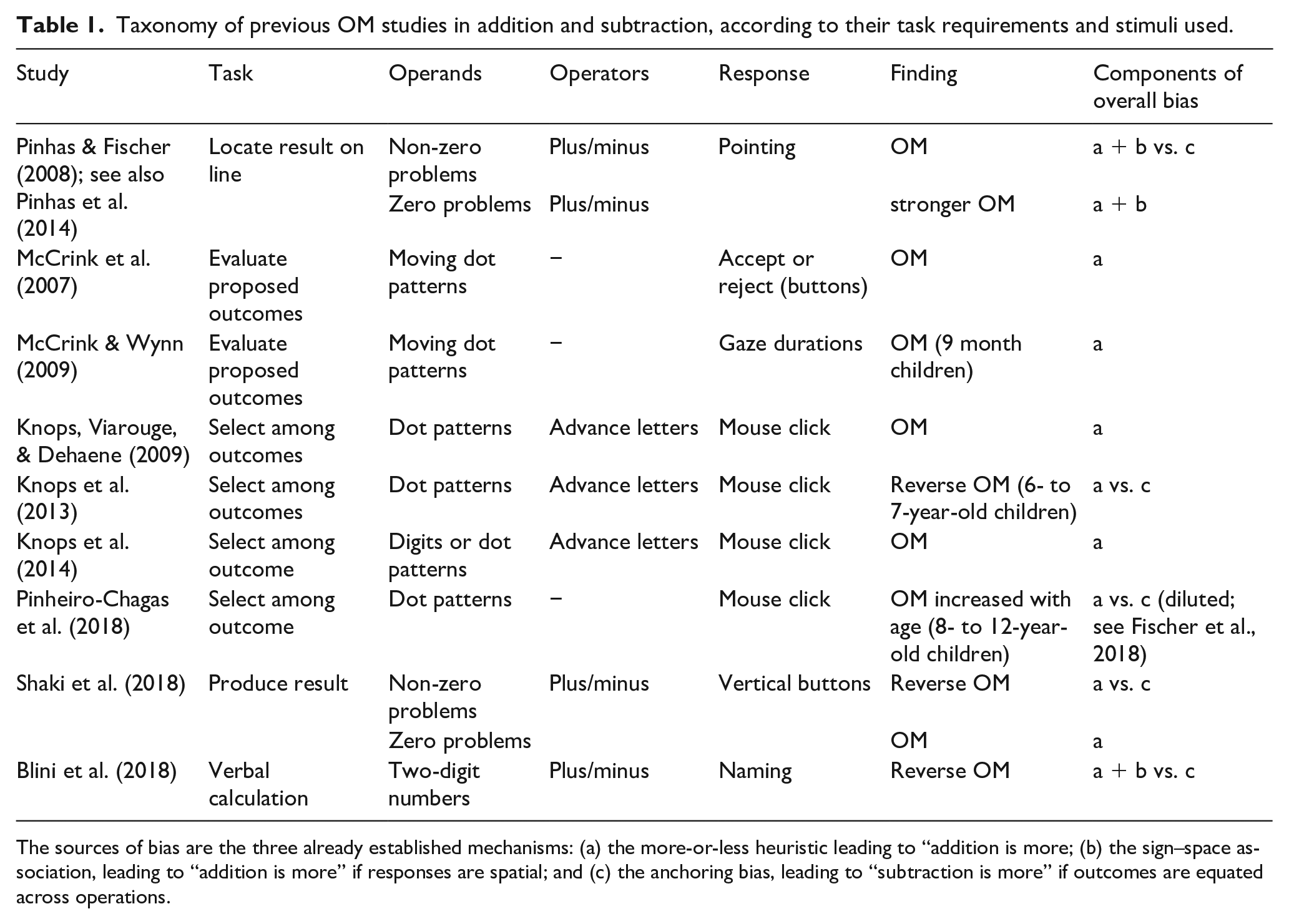
The sources of bias are the three already established mechanisms: (a) the more-or-less heuristic leading to “addition is more; (b) the sign–space association, leading to “addition is more” if responses are spatial; and (c) the anchoring bias, leading to “subtraction is more” if outcomes are equated across operations.
Finally, it is worth mentioning that the AHAB model supersedes an earlier proposal by Pinhas and Fischer (2008), according to which all elements of an arithmetic expression induce spatially associated activations. In that proposal, it was assumed that stronger OM for zero problems reflects the absence of noise from the second (null) operand, thereby enhancing the relative activation from the first (non-zero) operand when the result was computed. The original idea of multiple sources of bias was, however, further developed into AHAB.
Here, we investigate the applicability of AHAB to the mental manipulation of magnitudes in the non-visual domain of time. This is theoretically important for several reasons: First, given that our evidence is currently limited to visual length productions, we wanted to extend AHAB to a non-visual modality, namely duration production. The cognitive representation of time is well known to be spatial (for review, see Bonato et al., 2012 see also Frassinetti et al., 2009; Riemer et al., 2016). Such cross-modal generalisation would constitute an important demonstration of the generality of the proposed principles of AHAB. Second, it is unclear whether any of the proposed heuristics and biases generalises from spatial to non-spatial responses. Therefore, we recorded responses from a single button instead of two buttons or lateral mouse movements. Importantly, AHAB predicts an absence of contributions from the sign–space association to performance with such non-spatial responses (Shaki et al., 2018, p. 141). Assuming this to be the case, this would leave only two mechanisms to explain all observed results and therefore constitutes a strong and tractable test of AHAB. Specifically, AHAB predicts reverse OM in non-zero problems from a combination of anchoring and the more-or-less heuristic.
Third, using non-spatial stimuli and responses enables an unbiased assessment of OM, thus clarifying whether reverse OM is an exception or the rule for standard arithmetic problem formats (with two symbolic operands and an operation sign between them). Several previous OM studies used non-standard presentation formats, such as spatial movements of the operands (McCrink et al., 2007; Pinheiro-Chagas et al., 2018) or sequential central presentation of operands with the operation sign preceding the operands and subsequent spatial presentation of the estimated outcome in a multiple-choice paradigm (Knops, Viarouge & Dehaene, 2009 see also Katz & Knops, 2014). Thus, finding reverse OM in a task where spatial biases are minimised can help clarify the artificial nature of some previous OM results. Moreover, to test the AHAB model, we focus on symbolic arithmetic (see also Pinhas & Fischer, 2008; Shaki et al., 2018) with Arabic digits as operands and mathematical symbols (+, −) as operation sign. Previous studies did not use operation signs at all (McCrink et al., 2007), or used the letters A and S as the operation signs, thus minimising or completely concealing the possible influence of sign–space associations (Knops et al., 2009). Finally, the use of dot clouds as operands (Katz & Knops, 2014; Knops et al., 2009; McCrink et al., 2007; Pinheiro-Chagas et al., 2018) may induce further non-arithmetic biases, such as mis-estimation of the first and second operands themselves.
Last but not least, our previous work on AHAB relied largely on observations in Hebrew readers who habitually process text right-to-left. Reading direction has been shown to influence spatial biases in number processing (Göbel et al., 2018; Shaki et al., 2009). Although this population processes numbers and arithmetic problems left-to-right, it is important to document the reverse OM effect also in left-to-right readers.
Experiment 1
We used a line-length production task (see Shaki et al., 2018 for a similar procedure) and a time production task to evaluate OM both in symbolic arithmetic and in temporal estimation. Thus, while operands are encoded precisely, results must be mapped onto a spatial continuum with some uncertainty in the line-length production task, allowing us to discover error patterns of interest. The time production task removes the spatial dimension from the response and so allows us to assess the dependence of errors on this spatial feature.
Method
Participants
Forty University students (20 participants in the “dot” and 20 participants in the “line” starting condition; mean age = 24.43 years, SD = 2.50) were tested at the Department of General Psychology, University of Padova (Italy). All were habitual left-to-right-readers. The study was conducted in accordance with the Department of General Psychology guidelines and conducted according to the Declaration of Helsinki (59th WMA General Assembly, Seoul, 2008).
Stimuli, apparatus, and procedure
All tasks were presented on a 19-in. display and participants were randomly assigned to one of the two conditions. In the line-length production task (baseline condition), single digits 3, 4, 5, 6, and 7 were randomly presented and participants were instructed to read each number aloud and to then produce a line corresponding in length to the number’s magnitude. Responses were made with up and down arrow keys on a standard QWERTY keyboard and participants could adjust their responses. Each trial started with a horizontal line of “one unit” (100 pixels long and 3 pixels or 0.75 mm tall [100 pixels correspond to 2.6 cm]) presented at the display centre; participants were instructed to consider this as reference unit. Following the baseline condition and after a short break, the arithmetic condition started. It consisted of 20 arithmetic problems (addition and subtraction) with outcomes 3, 4, 5, 6, and 7: 10 zero problems (i.e., second operand 0; e.g., 3 + 0, or 3 − 0), and 10 non-zero problems (i.e., second operand 1; e.g., 2 + 1, 4 − 1). Half the arithmetic problems of each type were additions, the other half subtractions. Participants gave responses to the arithmetic problems aloud and then produced the corresponding line lengths, the line produced increased (dot starting) or shrank (line starting) simultaneously and bi-directionally (2 pixels every key press). A practice phase was introduced before the experimental session to help participants to familiarise with the task.
In the time production task, each trial started with a cross, lasting 1 s, that participants used as a standard time unit. Importantly, participants were unaware of the duration of this reference time unit. Then a single digit or an arithmetic problem appeared similar to the line-length production task. (We maintained the dot versus line starting condition to be consistent with the line-length production task.) Their task was to produce a temporal interval corresponding to the magnitude of a result (arithmetic condition) or a single digit (baseline condition) as in the line-length production task. None of the participants were aware of the duration of the standard time unit, they were only instructed to use that duration as a standard time unit. After the arithmetic problem or digit, participants were instructed to press and hold the spacebar to produce the temporal interval. Participants were explicitly told not to count during the time production task (Rattat & Droit-Volet, 2012).
Design
Both length and time production tasks included a baseline and an arithmetic task. The order of line-length production and time production tasks was counterbalanced between participants and a break was introduced between tasks. Participants were randomly assigned to line length starting first or time production first condition. Each baseline and each arithmetic stimulus appeared 6 times (5 Magnitude × 2 Operations × 2 Problem types × 6 repetitions = 120 trials; 5 Single digits × 6 repetitions = 30 baseline trials), yielding 150 trials. Two Starting conditions were manipulated between participants: a “dot” (2 pixels) and a “line” (100 pixels) starting condition.
Results
Line length
Baseline data were analysed with repeated-measures analysis of variance (ANOVA) with Starting conditions (dot, line) as a between-subjects factor and Magnitude (3, 4, 5, 6, and 7) as a within-subjects factor. Results showed a main effect of Magnitude, F(4, 152) = 373.98, p < .001,
Descriptive statistics for line-length task (pixels) for Experiment 1.
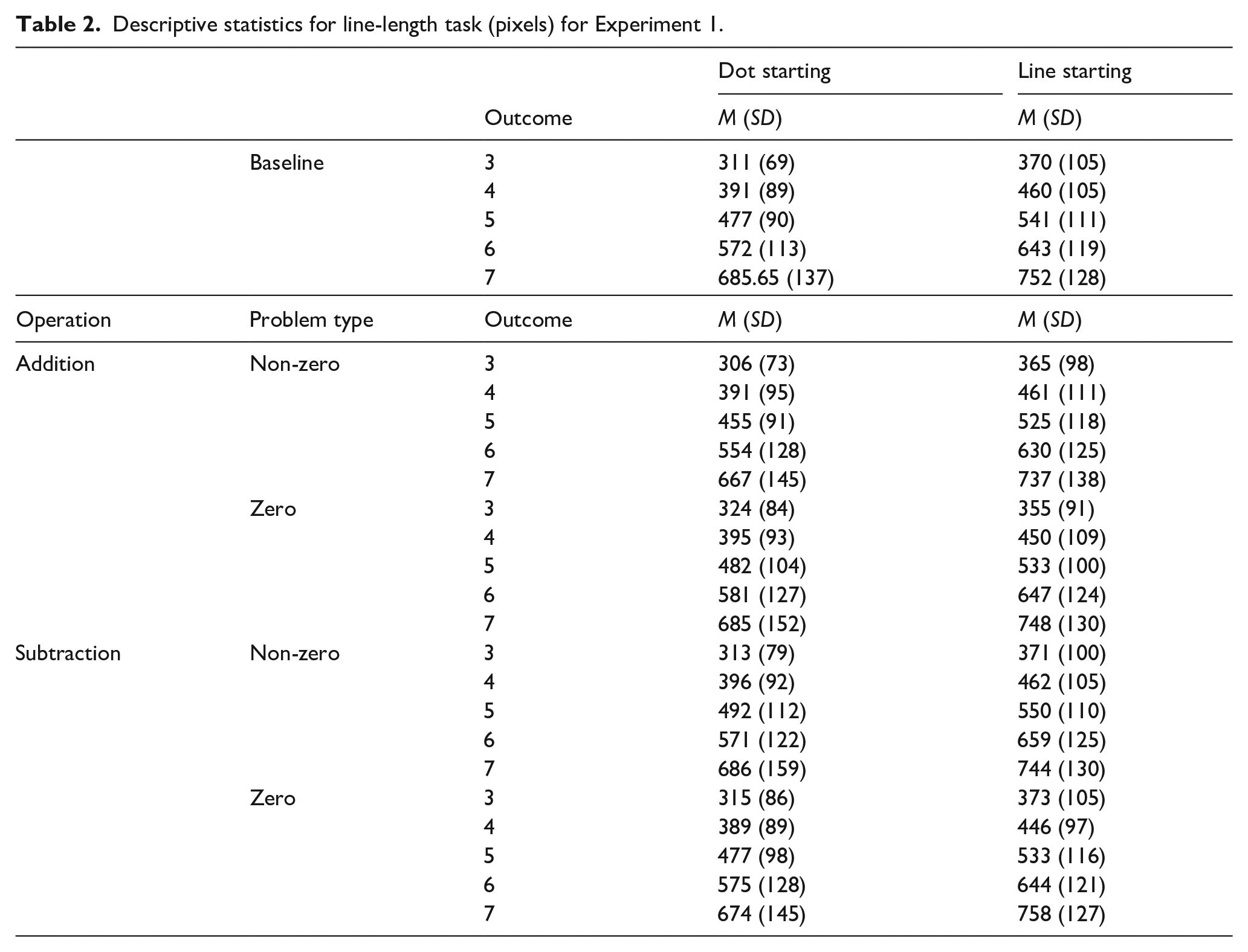
Arithmetic data were analysed with repeated-measures ANOVA on line-length production with Starting conditions (dot, line) as a between-subjects factor and Magnitude (3, 4, 5, 6, and 7), Problem type (non-zero problem, zero problem) and Operations (addition, subtraction) as a within-subjects factors.
Results showed a main effect of Operations, F(1, 38) = 20.47, p < .001,
The statistically significant interaction Operations × Problem type, F(1, 38) = 35.33, p < .001,
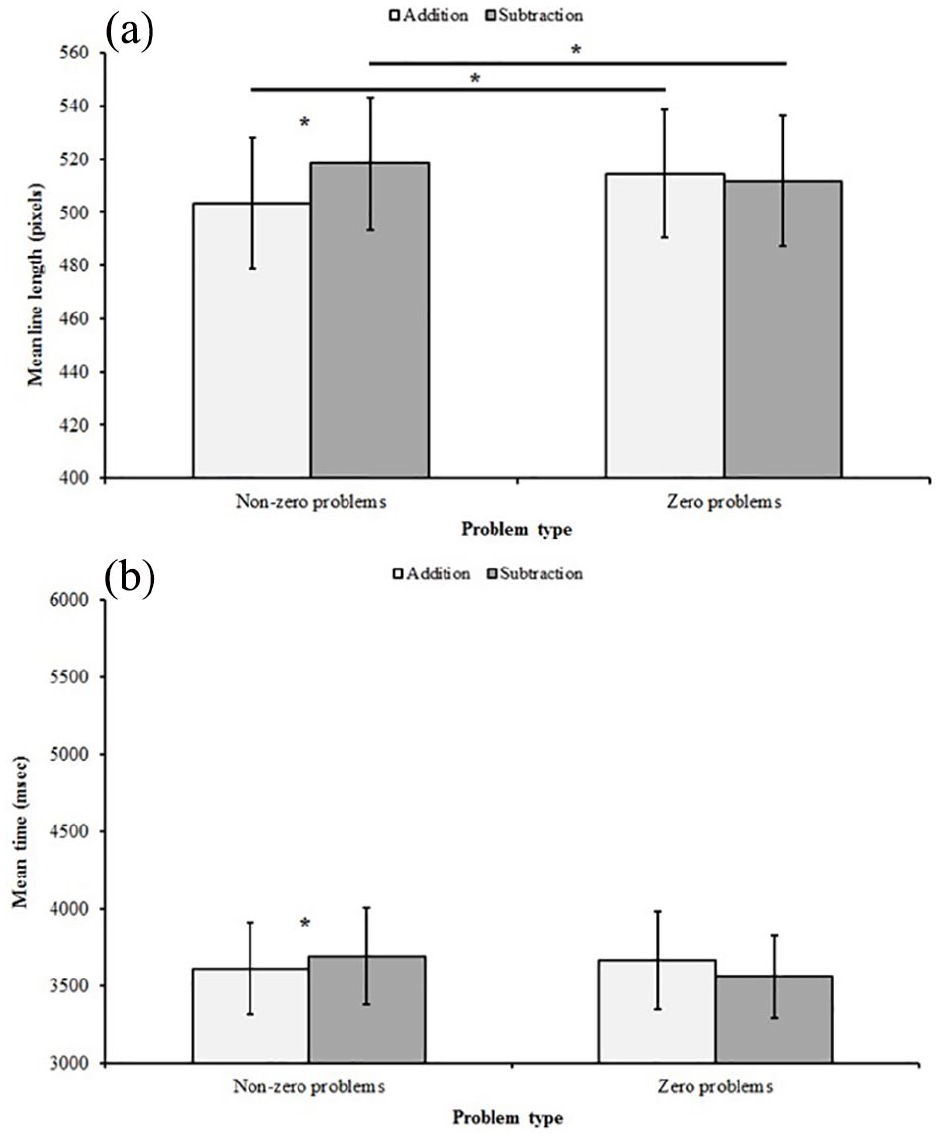
Experiment 1: (a) Mean line lengths (pixels) in calculation trials as a function of problem type and operation. (b) Mean time produced (ms) in baseline trials as a function of problem type and operation. The error bars indicate SE.
Time
Baseline data were analysed with repeated-measures ANOVA with Starting condition (dot, line
2
) as a between-subjects factor and Magnitude (3, 4, 5, 6, and 7) as a within-subjects factor. Results showed a main effect of Magnitude, F(4, 152) = 164.80, p < .001,
Arithmetic data were analysed with repeated-measures ANOVA with Starting condition (dot, line) as a between-subject factor and Magnitude (3, 4, 5, 6, 7), Problem type (non-zero problem, zero problem), and Operation (addition, subtraction) as within-subjects factors.
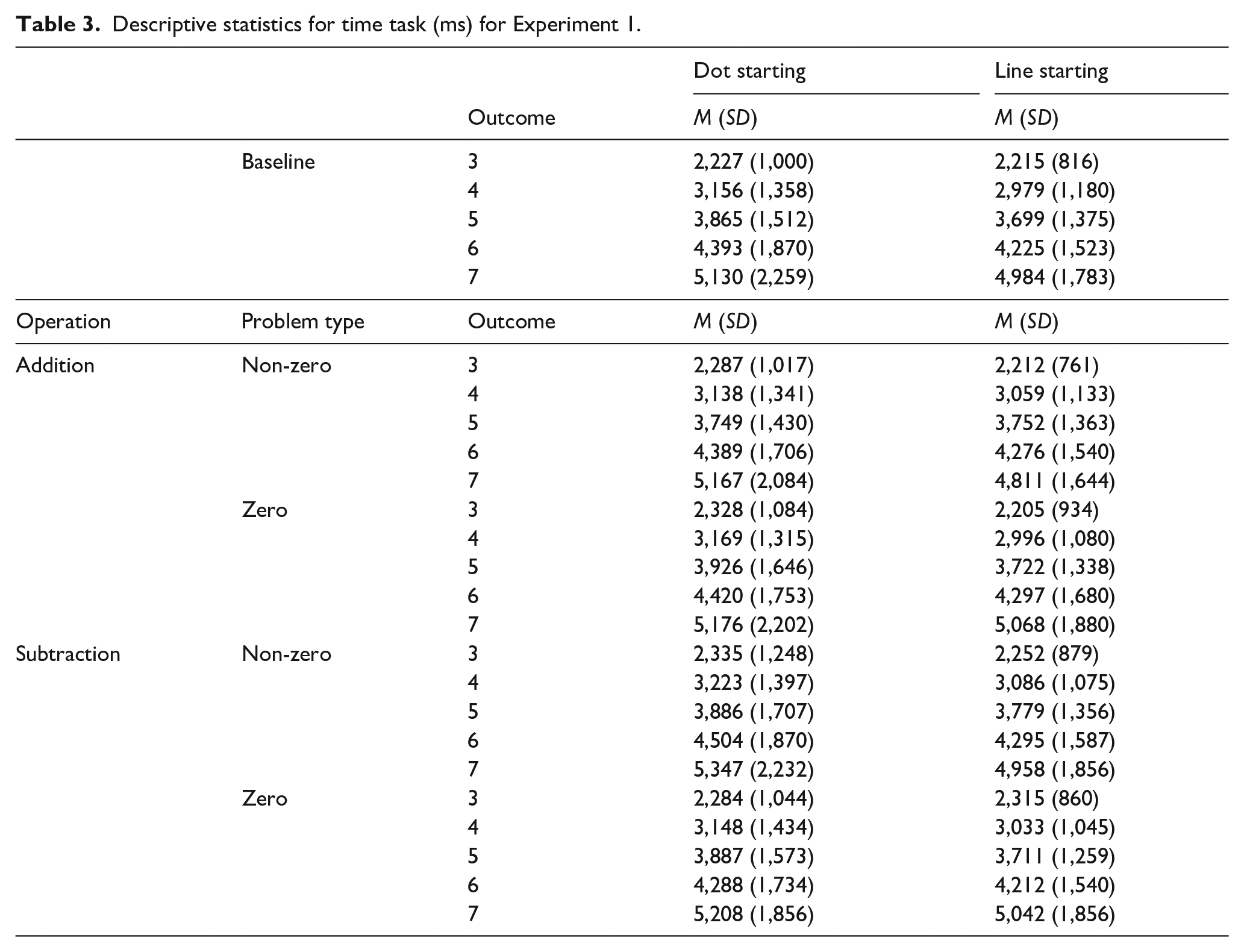
Results showed a main effect of Magnitude, F(4, 152) = 218.62, p < .001,
Descriptive statistics for time task (ms) for Experiment 1.
Discussion
The first experiment replicated the dissociation pattern previously found for zero versus non-zero problems by Shaki et al. (2018), but now in a group of left-to-right readers. Specifically, we found reliably reversed OM for non-zero problems but no difference between addition and subtraction for zero problems. Importantly, this result also held for time interval production, thus extending the observation to the temporal modality.
We note that for the line-length production task we used up and down arrow keys (as in Shaki et al., 2018), whereas for time productions we used the single space bar. Moreover, in the line-length production task, participants could adjust their responses, whereas this was not possible in the time production task. To enhance comparability of results and to replicate our theoretically important finding, we conducted a second study in which only the space bar was used throughout. Moreover, we randomised line and time production trials to reduce possible strategic differences in processing across modalities.
Experiment 2
Method
Participants
Twenty-two University students (10 male mean age 23.50 years, SD = 1.87) were recruited and tested at the Department of General Psychology, University of Padova (Italy). All were habitual left-to-right readers. The study was conducted in accordance with the Department of General Psychology guidelines and conducted according to the Declaration of Helsinki (59th WMA General Assembly, Seoul, 2008). All participants gave their informed written consent before participating in the study.
Stimuli and apparatus
The experimental setting was similar to the one used in Experiment 1 with the following changes (Figure 2): (a) Spatial and temporal tasks were randomised within the same experimental block. Each trial started with the reference stimulus (duration: 1 s), either a line of “one unit” (100 pixels long and 3 pixels or 0.75 mm tall) or a symbol of a clock (alarm clock) presented at the top centre of the computer screen to indicate the subsequent line-length or time interval production task. (b) Response modality was changed to have comparable tasks; in both line-length and time production tasks, participants used the spacebar to produce either the line or the temporal interval and importantly; no adjustment was allowed in either the line-length production task or the time production task. (c) We excluded the baseline condition to reduce the demands of the experiment. In both the line-length production and the time production tasks, stimuli consisted of 20 arithmetic problems with Magnitude 3, 4, 5, 6, and 7: 10 zero problems (i.e., second operand 0; e.g., 3 + 0, 3 − 0) and 10 non-zero problems (i.e., second operand 1; e.g., 2 + 1, 4 − 1). Half the problems of each type were additions, the other half subtractions. (d) We removed the factor starting condition and considered only dot-starting condition.
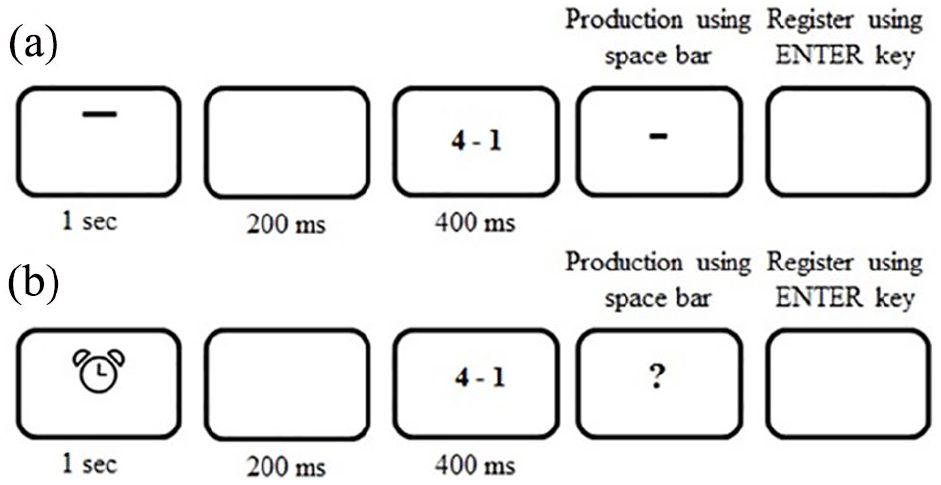
Experiment 2: Illustration of a trial sequence in (a) the line production task and (b) the time production task.
Results
Data were analysed with two separate repeated-measures ANOVAs, one for line productions and one for time productions, with Magnitude (3, 4, 5, 6, and 7), Problem type (non-zero problem, zero problems), and Operation (addition, subtraction) as within-subjects factors.
Line length
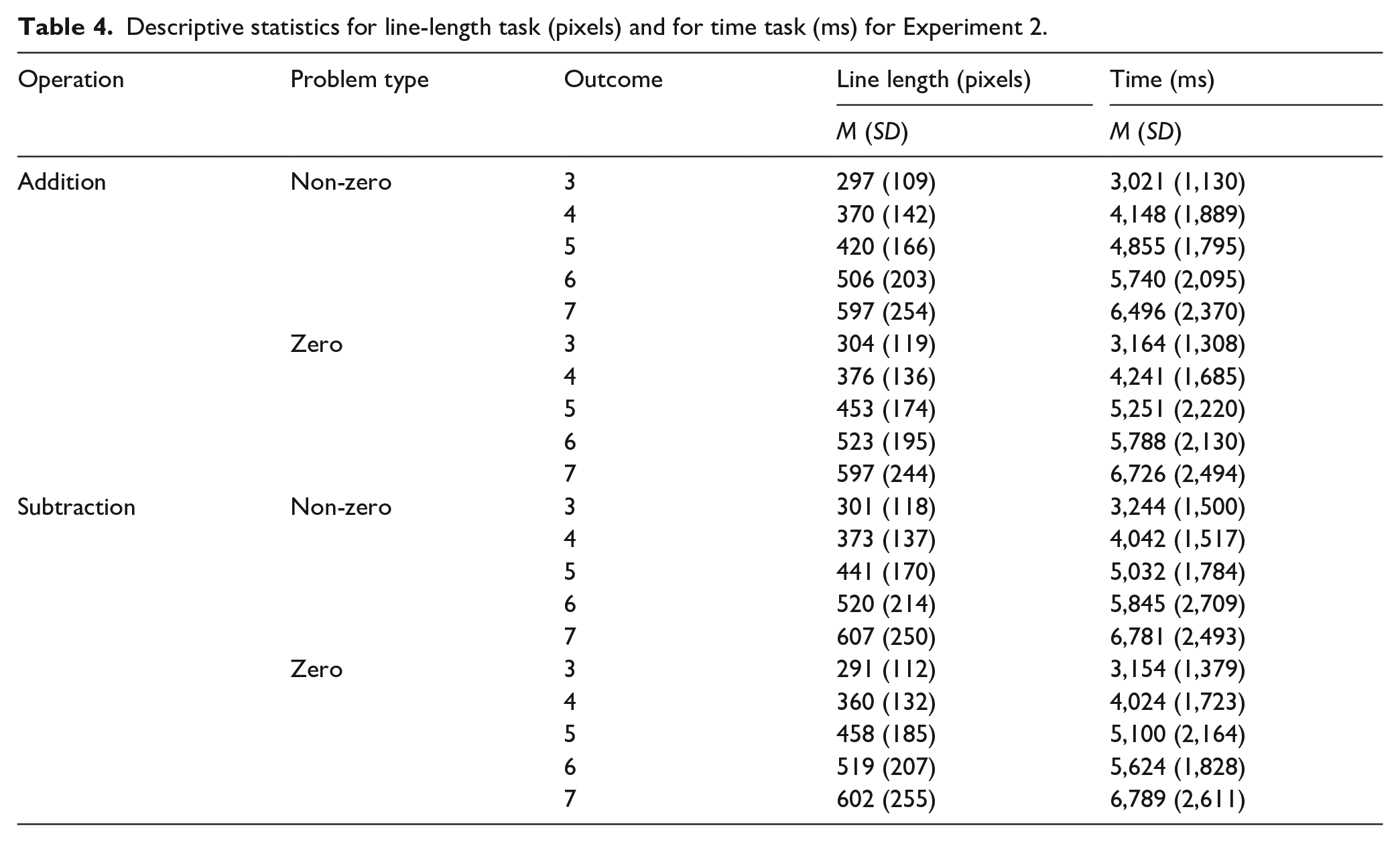
Results showed a main effect of Magnitude, F(4, 84) = 64.06, p < .001,
Descriptive statistics for line-length task (pixels) and for time task (ms) for Experiment 2.
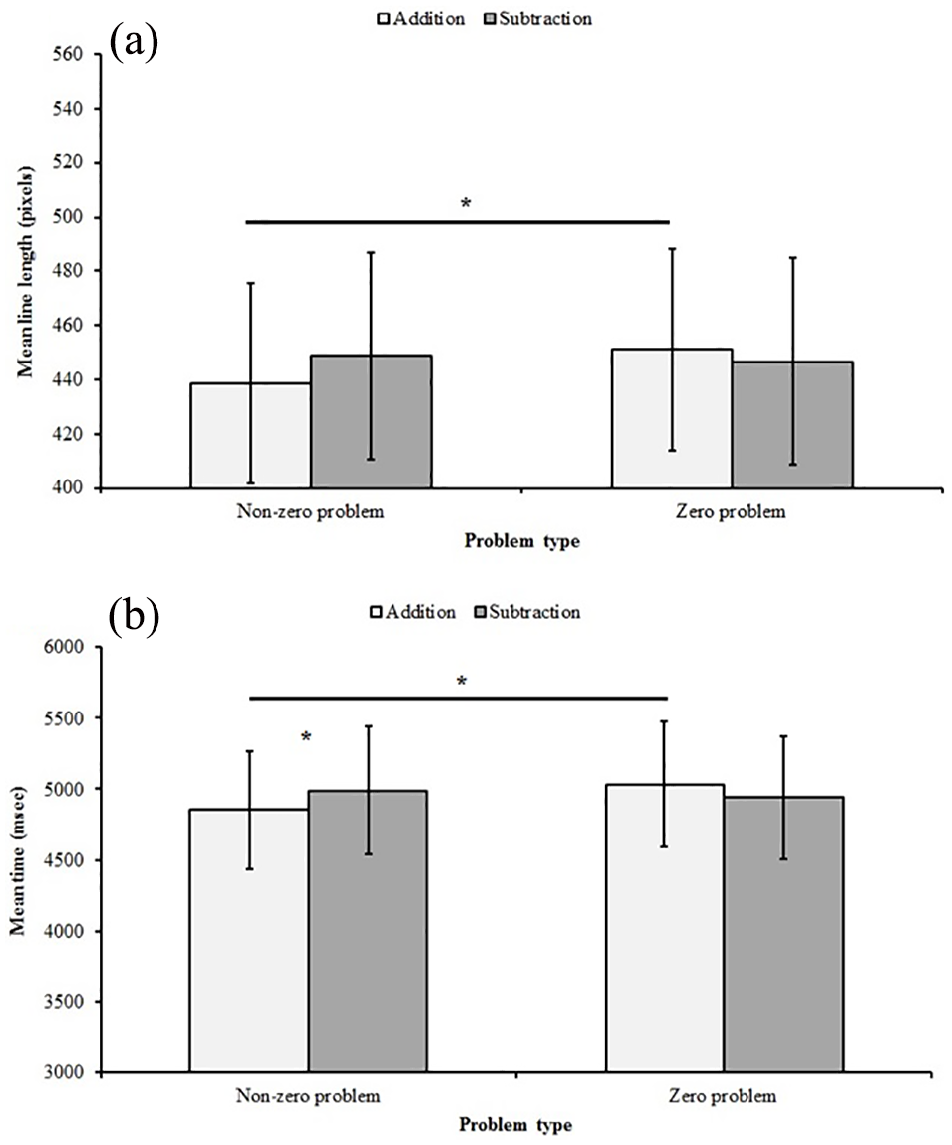
Experiment 3: (a) Mean line lengths (pixels) in calculation trials as a function of problem type and operation. (b) Mean time produced (ms) in calculation trials as a function of problem type and operation. The error bars indicate ± 1 SE.
Time
Results showed a main effect of Magnitude, F(4, 84) = 140.32, p < .001,
Discussion
Experiment 2 obtained numerically the same pattern of results as the first experiment and again replicates the findings of Shaki et al. (2018) in left-to-right readers. Specifically, there was again a lack of OM in zero problems across both spatial and temporal modalities. The OM effect for non-zero problems was also numerically present in both tasks, although it was only reliable in the temporal domain. A possible reason for this could be the removal of a directional component from the line-length production compared with Experiment 1, where two separate (although vertical) buttons had been used to respond. From the perspective of the AHAB model, this modification could have indirectly reduced the impact of the sign–space association further. Moreover, the mixing of modalities, imposed to eliminate strategy confounds, likely induced a task-switching cost (e.g., Wylie & Allport, 2000) that further diluted the expression of heuristics and biases in each task. Contrary to our expectation, the OM effect was less robust in length production compared with time production. The smaller sample size demands further caution in interpreting these findings. Nevertheless, given this numerical replication, we can now turn to a broader discussion of the results and their implications for our understanding of mental arithmetic.
General discussion
This study was motivated by the current debate about whether and why we overestimate addition and underestimate subtraction results when we mentally manipulate even small magnitudes (OM effect). In the light of recent theoretical developments, we applied the AHAB model (Shaki et al., 2018) which, in contrast to other accounts, uniquely predicts normal OM for arithmetic problems with zero as second operand (so-called zero problems; e.g., 3 + 0, 3 − 0) and reverse OM for non-zero problems (e.g., 2 + 1, 4 − 1; see Table 1). In two tests (line-length production and time production), participants indeed produced shorter lines and under-estimated time intervals in non-zero additions compared with subtractions. Observing this theoretically diagnostic interaction between operation and problem type extends OM to non-spatial magnitudes and highlights the predictive strength of AHAB
We examined left-to-right readers to address possible concerns about the generality of previous findings and replicated a dissociation between zero and non-zero problems that cannot be explained by any of the other single-mechanism accounts of OM: Underestimation of outcomes in addition compared with subtraction with non-zero problems (reverse OM), whereas the opposite pattern was demonstrated in zero problems. These results were found in both visual-spatial line-length production and in non-visual and non-spatial time production.
Importantly, our results speak against the compression, more-or-less, and attentional accounts of OM mentioned in the Introduction. First, the direction of the empirically observed dissociation falsifies most of these single-mechanism accounts: stronger OM with zero problems cannot be accounted for by the compression account in principle because the log of zero is not defined; it also challenges the attention shift account because zero magnitude movements should yield zero OM. Moreover, none of the single-mechanism accounts can explain the reverse OM which we consistently observed for a predictable type of problems, both here and previously (see Table 1; see also Shaki et al., 2018; Shaki & Fischer, 2017).
Second, all those accounts are limited to the representation and manipulation of numerical quantities, be they symbolic or non-symbolic. However, we showed here, for the first time, an operation-dependent estimation bias in the temporal domain where the operands are non-visual. Our findings extend OM to a non-spatial magnitude and highlight the predictive strength of AHAB regarding different problem types, sensory modalities and performance measurements in mental arithmetic. By assuming an anchoring bias in non-zero problems and a general presence of the more-or-less heuristic, while excluding any influence from the sign–space association due to the use of non-spatial responses, the model can correctly predict the pattern of results obtained, as we explain next.
This result also speaks to the issue of whether mental arithmetic operations on a non-visual dimension can generate OM. Specifically, there is considerable evidence for a mapping of the past to the left or back space and the future to the front or right space (see Bonato et al., 2012, for review). Our results show that the OM signature does not require input from the visual modality (see also the recent report by Bonato et al. (2020)).
To illustrate the competitive relationship of the above heuristics and biases during mental manipulation of magnitudes, consider the typical observation of OM in so-called zero problems, such as 6 + 0 or 6 − 0. Remember that, when the task format introduces some uncertainty regarding the precise quantities to be manipulated (by asking participants to produce line lengths or time intervals), the typical result is overestimated in addition compared with subtraction. AHAB explains this outcome as reflecting the absence of anchoring bias, due to the same first operand in addition and subtraction problems, combined with the operation-specific impact of the more-or-less heuristic. Moreover, if the responses are spatially distributed, such as in the pointing-to-location task, AHAB predicts a further enhancement of OM through the learned sign–space association (e.g., Pinhas et al., 2014; Pinhas & Fischer, 2008). Alternatively, if the responses are non-directional (such as in bi-directional modification in our line-length production) or even non-visual and thus arguably completely non-spatial (such as in our time production), it is possible that the only source of bias in zero problems is the use of a heuristic.
Consider now diluted OM (Pinhas & Fischer, 2008) and reverse OM (Shaki et al., 2018; also the findings of both experiments in this study) obtained with so-called non-zero problems, such as 8 − 2 vs. 4 + 2 (where results are controlled across operations). AHAB explains this outcome as reflecting the strong influence of anchoring bias (Tversky & Kahneman, 1974), due to larger first operands in subtraction problems than in addition problems. If responses are spatially distributed (such as in the pointing-to-location task), both the operation-specific impact of the more-or-less heuristic and the learned sign–space association will compete with anchoring bias and a diluted overall OM appears (e.g., Pinhas et al., 2014, 2015). Alternatively, if the responses are non-directional (such as in the bi-directional modification of our line-length production task), or even non-visual and thus arguably completely non-spatial (such as in our time production task), only the more-or-less heuristic will compete with the anchoring bias and an overall reverse OM will appear (such as in Shaki et al., 2018, and in both experiments of this study; see also Blini et al., 2018).
To conclude, most of the previous studies comparing addition versus subtraction performance have used non-symbolic operands (such as moving dot clouds) and absent or uncommon operation signs, or directionally biased methods to assess OM (moving dot clouds: McCrink et al., 2007; lateralised pointing responses: Pinhas & Fischer, 2008; Pinhas et al., 2014, 2015), or provided multiple candidate solutions simultaneously to participants (e.g., Knops et al., 2009; Pinheiro-Chagas et al., 2018). These methods either diluted the sign–space association or reduced the anchoring bias, thus preventing the discovery of reverse OM as a default error in the mental manipulation of symbolic magnitudes. In all cases, the result was that addition is more than subtraction. In contrast to these methodologically biased approaches, we show here using the standard format to display arithmetic problems that removing directional biases from stimulus presentation and requiring participants to generate solutions reveals the workings of anchoring bias and thus identifies reverse OM as a typical feature of arithmetic problem-solving.
Footnotes
Acknowledgements
The information in this manuscript and the manuscript itself has never been published either electronically or in print. There are no financial or other relationships that could be interpreted as a conflict of interest affecting this manuscript. This work was carried out within the scope of the project “use-inspired basic research,” for which the Department of General Psychology of the University of Padova has been recognised as “Dipartimento di Eccellenza” by the Ministry of University and Research. This work was also partially funded by Deutsche Forschungsgemeinschaft under FI_1915/8-1 “Competing heuristics and biases in mental arithmetic.”
Declaration of conflicting interests
The author(s) declared no potential conflicts of interest with respect to the research, authorship, and/or publication of this article.
Funding
The author(s) received no financial support for the research, authorship, and/or publication of this article.
