







Abstract
In a modern world saturated with cellphone-related stimuli, surprisingly little is known about their psychological effects. A small number of previous studies have found global distracting effects of cellphone rings on cognitive performance in undergraduate students. However, moment-to-moment reactions to cellphone sounds have not been investigated, nor have physiological changes that might accompany the cognitive effects. Developmental variations also remain unexamined. Thus, two experiments were conducted to examine the effects of cellphone notification sounds on cognitive performance (i.e., reaction time and accuracy on math problems) and heart rate variability in three age groups: adolescents (mean age: 15 years); young adults (mean age: 20 years); and mid-life adults (mean age: 48 years). Effects were most pronounced in the adolescent group, whose math problem accuracy and reaction time was compromised in response to notification sounds. These compromises were accompanied by increases in heart rate variability.
Public significance statement
This study suggests that when compared to young adults and mid-life adults, adolescents demonstrated greater compromises in math problem accuracy and reaction time (RT) and increases in heart rate variability (HRV) in response to cellphone notification sounds.
Cellphone use is ubiquitous in the United States. According to the Pew Research Center (2019), 99% of 18–49-year-olds own cellphones. In 2018, 95% of 13–17-year-olds endorsed owning or having access to a smartphone—up from 77% in 2015, and 45% of adolescents endorsed being online “almost constantly” (Anderson & Jiang, 2018). Our auditory and visual fields have become saturated with cellphone-related stimuli, and the cognitive, physiological, and developmental implications of this phenomenon have only begun to be examined.
Cellphone use and cognitive functioning
There is evidence that high levels of cellphone use may compromise learning and/or productivity in cognitive tasks. Overall cellphone use has been inversely correlated with college students’ grade point average (GPA; Jacobsen & Forste, 2011; Lepp et al., 2015) and class rank (Felisoni & Godoi, 2018), while higher levels of adults’ smartphone addiction have been associated with lost productivity at work (Duke & Montag, 2017). Marty-Dugas et al. (2018) found that in samples of college students as well as adults, overall cellphone use, and particularly absent-minded smartphone use, was positively associated with everyday episodes of inattention.
Studies have begun to investigate mechanisms through which endogenous and exogenous cellphone-related stimuli may affect cognitive processing. Alarmingly, the mere presence of a cellphone has been associated with compromises in undergraduate students’ cognitive functioning. Thornton et al. (2014) found that performance on high-demand neuropsychological tasks was worse when a cellphone (belonging to the experimenter or the participant) was placed on the participant’s desk, even when the cellphone was completely inactive. Similarly, Ward et al. (2017) found that performance on cognitive measures decreased relative to the proximity of the participant’s cellphone (on the desk, in a bag, or outside the room). This effect was moderated by cellphone dependence, such that cognitive costs were greatest among individuals who reported they would have trouble getting by without their cellphone.
The omnipresence of cellphones in school and work settings means that even if personally abstaining from cellphone use, one is likely to be exposed to auditory and/or visual stimuli associated with others’ phones. Four studies have examined the impact of cellphone-related auditory stimuli on undergraduates’ cognitive performance. Shelton et al. (2009) proposed that, consistent with the orienting reflex theory proposed by Sokolov (1963), cellphone-related sounds may cause an involuntary orienting response, recruiting attentional resources and causing delayed responses in ongoing cognitive activities. As expected, their laboratory experiment revealed that a cellphone ring was associated with increased reaction times in a lexical decision task, and it took participants longer to return to baseline after the presentation of the ring compared with presentation of neutral tones. In a classroom-based experiment, these researchers found that a cellphone ring during class was associated with significantly poorer recall of course content that had been presented at the time of the ring. These findings were replicated in a similar classroom-based experiment by End and colleagues (2010).
Röer et al. (2014) hypothesised that one’s own cellphone ringtone would create greater attentional capture than other ringtones presented during a short-term memory test. However, they found no evidence for the self-relevance of the ringtone; the presentation of any ringtone led to significantly poorer performance on a serial recall task when compared with a silent control condition. Furthermore, participants habituated to the ringtones, as evidenced by a linearly decreasing gap in performance between ringtone and silent trials. The authors interpreted these results as additional evidence to support an attentional orienting effect. Finally, Stothart et al. (2015) examined the effects of experimentally manipulated cellphone notifications (calls or texts) delivered to participants’ own cellphones during a sustained attention task. As expected, they found that the probability of errors was higher in groups that received notifications compared with a no-notification control group.
These existing studies of cellphone-related auditory distractors have utilised primarily between-subjects designs to examine global effects on cognitive performance in samples of undergraduate students. Important questions remain to be answered regarding the generalisability of these findings to other developmental periods, how auditory distractors may affect not only overall, but also moment-to-moment fluctuations in attention, and correlating processes that may account for the effects of cellphone-related distractors on cognitive performance.
Cognitive load and HRV
Although physiological responses to cellphone-related auditory stimuli have not yet been investigated, there is good reason to do so. As noted above, cellphone-related stimuli may increase cognitive load (e.g., Shelton et al., 2009), and demanding cognitive workloads have been associated with physiological changes similar to those associated with mental stress (van der Wel & van Steenbergen, 2018). Previous research has found that attentional shifts, such as those that may be associated with hearing a cellphone notification, result in immediate as well as residual cognitive costs, even when the switch is expected (e.g., Rogers & Monsell, 1995), and physiological markers have been identified for task-switching (e.g., Rondeel et al., 2015). If predictable physiological responses to cellphone-related stimuli can be identified, they may help to explain why or how cognitive performance is disrupted.
HRV increasingly has been utilised as a sensitive and reliable biomarker for mental stress (for a meta-analysis see Kim et al., 2018). HRV refers to fluctuations in the length of beat-to-beat intervals of the heart. A healthy cardiovascular system is able to adjust rapidly and flexibly to internal and external conditions to maintain homeostasis. Effective autonomic regulation involves dynamic, non-linear interactions between the sympathetic and parasympathetic nervous systems, and this is reflected in higher HRV. In contrast, lower HRV, reflecting a more monotonous heartbeat, can indicate that the cardiovascular system is responding in less complex and less efficient ways to changing psychological and environmental demands (Shaffer & Ginsberg, 2017). Low HRV indices are interpreted as evidence of decreased parasympathetic activation and/or increased sympathetic activation (Thayer & Lane, 2009).
HRV has been measured with long-term (e.g., 24 hr) or short-term recordings (e.g., 5 min), from which well-validated metrics and norms exist for monitoring broad aspects of health and well-being (Shaffer & Ginsberg, 2017). Low resting HRV has been associated with advancing age, diabetes and cardiovascular disease, and psychopathology (Chalmers et al., 2014; Jandackova et al., 2016; Thayer et al., 2010; Umetani et al., 1998). Also, short-term indices of low HRV have been linked with impaired cardiovascular, endocrine, and immune recovery to stress (Weber et al., 2010), higher levels of state anxiety (Friedman, 2007), and higher startle sensitivity (Ruiz-Padial et al., 2003). HRV also appears to be sensitive to cognitive task load manipulations (see Hughes et al., 2019 for a meta-analysis).
Among the many metrics of HRV, time-domain indices such as the root mean square of successive differences (RMSSD) quantify the variation in interbeat intervals (IBIs) across successive heartbeats. RMSSD is considered to be the primary time-domain measure for assessing changes in parasympathetic regulation that are reflected in HRV (Shaffer et al., 2014), and the most direct HRV indicator of stressed state (Mayya et al., 2015). Several studies utilising long-term and short-term measures of RMSSD have found that it decreases in conditions of emotional stress (Punita et al., 2016; Sin et al., 2016), cognitive workload (Endukuru et al., 2016), and in response to time-on-task (Luque-Casado et al., 2016; Melo et al., 2017).
In recent years, validity studies have been conducted to investigate whether ultra short-term (<5 min) measures of HRV are valid substitutes for these longer-term measures (for a review see Pecchia et al., 2018). Some evidence has been provided for the reliability of resting-state RMSSD measures as brief as 10 s (McNames & Aboy, 2006; Munoz et al., 2015), and a few studies have found that ultra short-term measures of RMSSD can distinguish between high cognitive demand and rest conditions. For instance, Salahuddin and colleagues (2007) tested mobile recordings of HRV that were 10–150 s in duration, and found that RMSSD recordings as low as 30 s could discriminate between baseline and mental stress (i.e., Stroop test) conditions. Arza and colleagues (2015) found similar reductions in RMSSD, reflecting diminished parasympathetic activity, from a resting baseline to an arithmetic task performance with 180 s measures.
One study has utilised an ultra short-term measure of RMSSD to examine parasympathetic-mediated responses to auditory stimuli. Chen et al. (2014) investigated children’s startle habituation to a series of 90 db white noise stimuli. These researchers calculated a ΔRMSSD7 index reflecting the change from pre-stimulus RMSSD (i.e., seven IBIs before stimulus presentation) to post-stimulus RMSSD (i.e., seven IBIs after stimulus presentation). They found that RMSSD significantly increased following the initial auditory stimulus but the magnitude of change gradually decreased in response to subsequent startle probes, suggesting rapid habituation. This study provides a useful model for investigating localised, moment-to-moment changes in HRV in response to cellphone notification sounds.
The current study
This study examined the effects of cellphone-related auditory stimuli on two behavioural indicators of attentional performance (reaction time and accuracy) and HRV while participants completed challenging math problems. We tested these effects in two experiments targeting participants at three broad developmental levels: young adult undergraduate students (Experiment 1), and adolescents and mid-life adults (Experiment 2).
Our goal was to test individuals’ ability to ignore task-irrelevant distractions while performing cognitive work analogous to homework, studying, and job-related tasks. Such everyday tasks can be demanding, require the deployment of sustained attention, and are often undertaken with one’s own cellphone and/or others’ cellphones nearby. Math problems were presented in blocks of several trials each (see Table 1). An iPhone 5 text alert vibration sound was utilised as a proxy for naturally occurring cellphone-related auditory distractors that often occur while such tasks are being completed.
Experimental protocol.
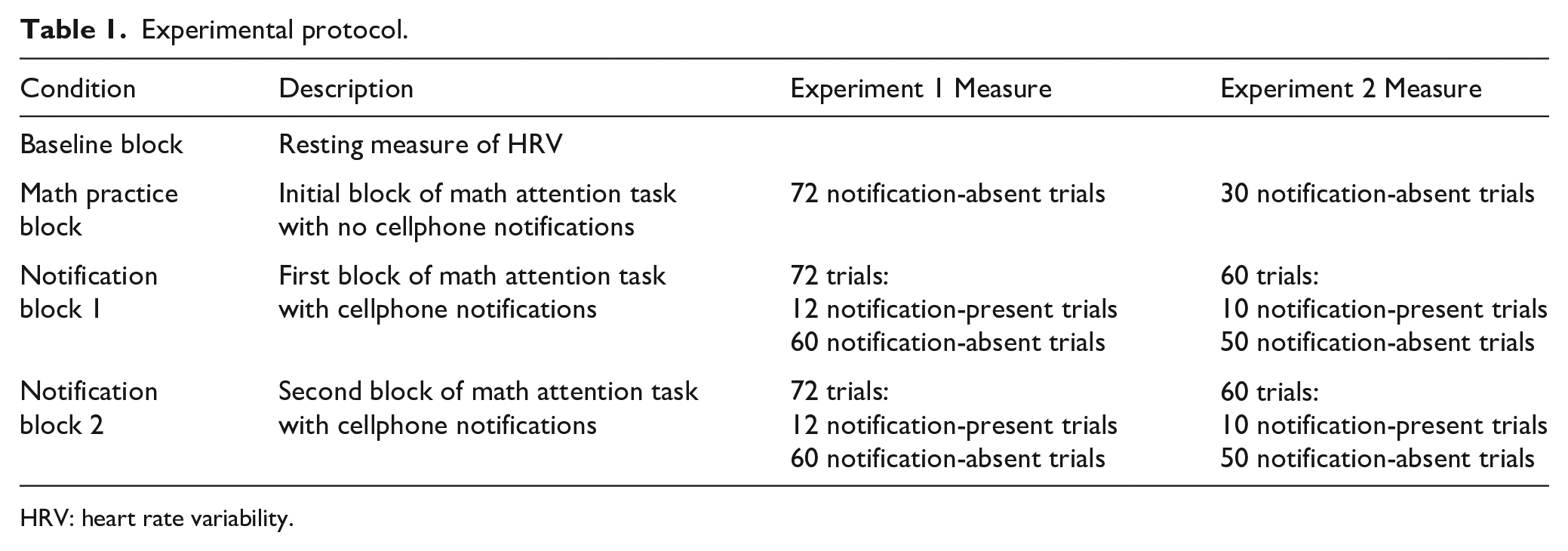
HRV: heart rate variability.
Unlike most existing studies of cellphone-related auditory distractors, which have investigated undergraduate students using between-subjects designs, we utilised a within-subjects design to investigate localised effects (i.e., moment-to-moment fluctuations) on cognitive performance and HRV. Localised effects on attentional performance were tested by comparing notification-present trials versus notification-absent trials within notification blocks, and localised effects on HRV were tested by sampling the 6 s (approximately 7 IBIs) immediately preceding and following auditory notifications. This heart rate sampling method is very similar to that of Chen et al. (2014). However, their design was a fixed-paced passive viewing of pictures interspersed with an acoustic startle stimulus (white noise), whereas our study required the completion of math problems using a self-paced presentation format with auditory phone vibration alerts presented intermittently.
Finally, given previous research indicating that effects of cellphone-related stimuli are moderated by individual difference variables such as cellphone dependence (Ward et al., 2017), we examined correlations of compulsive cellphone use and response inhibition with indicators of attentional performance and HRV.
Three hypotheses were tested in Experiment 1 (young adults) and Experiment 2 (adolescents and mid-life adults). Given the relative lack of previous studies examining these phenomena across developmental periods, we did not have a priori directional hypotheses regarding age-related effects, and the following hypotheses were explored separately by age group.
In Hypothesis 1, we predicted that participants would have slower (i.e., higher) RT and lower accuracy on notification-present trials, compared to notification-absent trials. In Hypothesis 2, based on the results of Chen and colleagues (2014), we expected that participants would show higher post-notification HRV compared to pre-notification HRV. In Hypothesis 3, we explored correlations of individual difference variables with attentional performance and HRV. We expected that greater difficulties with response inhibition would be associated with higher RT cost of cellphone notifications (notification-present trial RTs minus notification-absent trial RTs) and HRV change (post-notification HRV minus pre-notification HRV). Based on Ward and colleagues’ (2017) finding that higher levels of cellphone dependence were associated with greater attentional cost in the presence of a cellphone, we expected that higher levels of compulsive cellphone use would be associated with greater RT cost. Associations of compulsive cellphone use and HRV were tested on an exploratory basis. Supplemental analyses were performed to address global effects of cellphone notifications on attentional performance and HRV.
General method
Heart rate monitoring protocol
At the start of each session involving completion of the math problems, participants were fitted with three heart rate sensor leads (from a BioPac MP36 unit), two placed approximately 2.5 cm below the midpoint of each clavicle, and one on the left ribs just under the breast. These skin areas were prepped with 5,000 grit sandpaper and an alcohol swab to ensure proper sensor adhesion and signal. Participants were instructed on the proper placement of the sensors and were themselves responsible for placing the sensors. A human diagram in the testing room with sensors applied in the proper places was used to help participants accurately place the sensors. A razor was also provided if significant hair was present at these locations. Before the math problems began, experimenters visually confirmed that reliable heart rate signal was present, and participants were instructed to keep both hands on the computer table and to avoid excessive arm movement that could result in abberant heart rate signal.
Cognitive task protocol
Details of the experimental protocol are presented in Table 1. Participants’ heart rate was monitored continuously during the math task session. When designing our experimental blocks, our primary concern was creating a baseline block of math problems that would not be contaminated by residual heart rate reactivity to stressful notification alerts experienced in previous blocks. Thus, all participants first passively viewed a 5-min video of fish swimming in an aquarium, which served as a resting measure of HRV. This was then followed by a block of practice math problem trials without notifications, followed by two math blocks with notifications. In our attentional math task, simple math problems were presented in black text (RGB = 0, 0, 0) against a light grey background (RGB = 192, 192, 192). The math problems subtended 1.0° and 10.9 of visual angle, respectively. The experimental task was programmed in E-Prime v2.0 software (Psychology Software Tools, Pittsburgh, PA) and presented on an Asus 21 in high-definition monitor controlled by a Dell computer. The math problems took the format of verifying the correctness of one 2-digit number added to another 2-digit number (see Figure 1). To control for difficulty, the two digits could not sum to a number greater than 100, and one of the numbers was always between 13 and 19. Finally, the second digit in the other 2-digit number was at least a 3 through 9, requiring participants to mentally “carry over” a 1 when adding the last digit in each number. Participants pressed the “M” key if the equation was correct, or the “Z” key if it was incorrect. Participants were allowed up to 12 s to respond before the next trial was initiated. The task was also self-paced in that responses made before the time limit triggered the next trial. The ratio of correct to incorrect trials was 50/50. Before each trial a fixation cross was presented for 500 ms to ready the participant for the start of the trial.
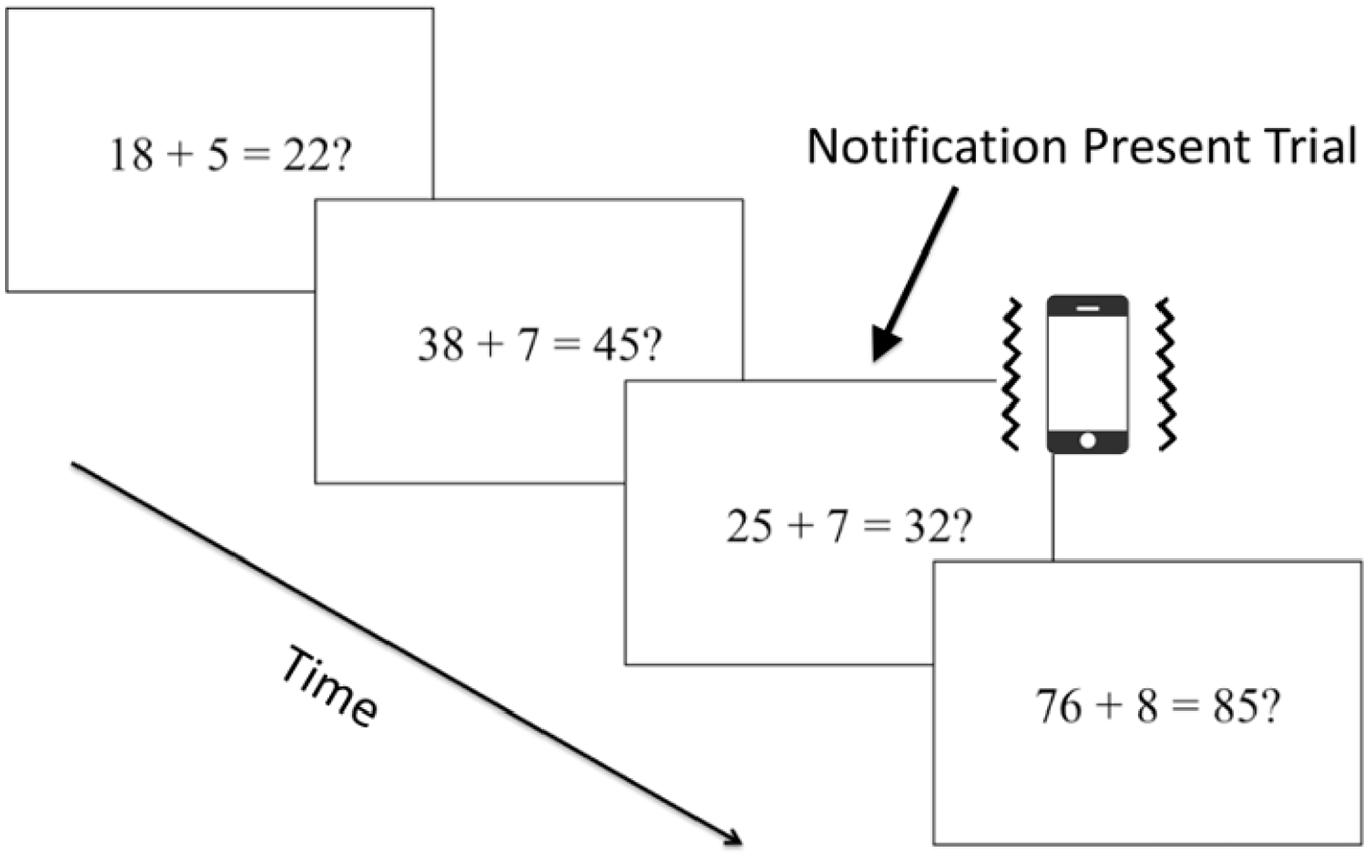
Sample trial sequence from a notification block in Experiment 2.
Due to the different developmental and other characteristics of the samples investigated in this study, math problems were more difficult in Experiment 1 (undergraduate students recruited from an academically rigorous university) than in Experiment 2 (adolescents and mid-life adults recruited from the community). Undergraduate students also completed more math problems than their younger and older counterparts (three blocks of 72 trials in Experiment 1, vs. three blocks of 60 trials in Experiment 2).
The first block (math practice) was performed without auditory notifications, while the two subsequent blocks (notification blocks 1 and 2) presented high fidelity audio recordings of iPhone 5 text alert vibrations that are the default vibration pulse when the phone is set to only vibrate. These alert vibration sounds were presented through a Sonos digital-audio converter and output through one of two Emotiva bookshelf, self-powered speakers positioned at a 45 angle 52 cm to the side and back of the computer monitor. The face of each speaker was angled so that it pointed directly at the participant. Finally, a black-clothed screen (40 × 60 cm) was placed in front of each speaker to visually obscure the source of the vibration alert.
The audio recordings of the vibration alert were a single pulse with a duration of 1.2 s and an intensity of approximately 62 db (A-weighted). These alerts were presented on 24 of the 144 trials (Experiment 1) or 20 of the 120 trials (Experiment 2) across the two notification blocks. To minimise the predictability of these notifications, half of the notifications in each block were presented through the left or right speaker. To ensure that the alerts were presented while participants were evaluating the math equations, the alerts were time-locked with the presentation of the math problems so that they were presented either 500, 750, or 1,000 ms (in equal proportions) after the onset of the math problems.
Procedures for all of tasks described were approved by the host institution’s IRB.
HRV measurement
We computed HRV locally in response to notifications during notification blocks 1 and 2. RMSSDs (see Malik et al., 1996) were computed by extracting standard R-R (beat-to-beat) intervals from the QRS complex using BioPac’s BSL 4.1.1 (2015) software. R-R intervals greater than 2,000 ms or less than 300 ms were excluded as artefacts within each block (Bulut et al., 2018). The timing of auditory notifications was time-locked with heart rate data using a parallel port connection between the E-prime computer and the BioPac MP36 unit. To examine the local, event-related effects of notifications on HRV, additional inclusion criteria were required. Because math problems were performed relatively quickly, RMSSDs were calculated for the 6 s preceding (pre-stimulus baseline) and the 6 s following (post-stimulus reactivity) each auditory notification. Although notification trials were separated by at least three and an average of five equations, some exceptionally fast participants completed equations so quickly that the 6 s post-stimulus period of a previous notification trial intruded on the pre-stimulus period of the next notification trial, thus limiting the number of heartbeats sampled for that interval. To reliably compute RMSSDs for each notification, we thus required at least five heartbeats in each 6 s pre and post-notification period to calculate RMSSDs for that notification trial. Notification trials not meeting this criterion were excluded.
Response inhibition
Participants completed a computerised version of the Stroop task (Stroop, 1935), which consisted of the words “red,” “yellow,” and “blue” presented in red (RGB = 255, 0, 0), yellow (RGB = 255, 255, 0), or blue (RGB = 0, 0, 255) colour. Participants were given up to 8 s to respond to the font colour by pressing either the left, down, or right arrow keys corresponding to red, blue, and yellow responses, respectively. After a set of 12 practice trials, participants completed 72 test trials. For 50% of the trials the word and the font colour matched (congruent), while the other half of the words conflicted with their font colour (incongruent).
Compulsive cellphone use
The 12-item Compulsive Cellphone Use Questionnaire (CCQ; Murdock et al., 2019) was utilised to assess compulsive qualities of cellphone use, including affective, cognitive, and behavioural aspects of excessive and repetitive cellphone use that is at least partially motivated by anxiety reduction, as well as activity and relationship interference that results from this tendency. Participants responded to items on a 5-point scale ranging from 1 (not at all) to 5 (very) or from 1 (never) to 5 (almost always). Responses were summed to form a total score, with higher scores indicating higher levels of compulsive cellphone use. The CCQ had excellent internal consistency in previous samples of undergraduate students (αs = .91 and .90; Murdock et al., 2019). In the current sample, internal consistency was good in Experiment 1 (young adult α = .84) and Experiment 2 (adolescent group α = .86; mid-life adult group α = .84).
Power analyses
Previous cell phone distraction studies have measured the effect size of cell phone notifications/rings on cognitive performance by comparing performance during notification conditions to conditions in which notifications are absent. Although the precise methodology varies across studies, typically these are blocked designs with effect sizes ranging from partial η2 of .07 to .24 in Shelton et al. (2009) to partial η2 of .16 in Röer et al. (2014). Because the Röer et al. study was more comparable to the current design, we used its effect size to estimate the number of participants needed using G*power 3 software (Faul et al., 2007). With a conservative power level of .95 and an alpha of .05, an estimated total of 130 participants would be needed to detect an interaction between age group and notification-present and absent effects. Because our design incorporated both a more sensitive event-related design (compared to block designs) and a more sensitive dependent measure (RT), as opposed to digit recall in Röer et al., we reasoned that fewer participants would be needed in the current study. F tests reported below are accompanied by eta-square (non-partialled) effect size estimates.
Experiment 1
Method
Participants
Participants were 37 undergraduate students recruited from a selective liberal arts university. The sample was 72% self-identified female and had an average age of 20.11 years (SD = 1.30, range = 18–22), with 17% first years, 11% sophomores, 30% juniors, and 42% seniors. All participants were iPhone users. Data from three participants (not included in the demographics above) were excluded from analyses. One of these participant’s QRS complex was not discernible due to excessive signal noise, presumably the result of excessive arm movement or sensor contact that weakened during the session. Two other participants were excluded because they completed math problems too quickly for the minimum pre- and post-stimulus period to be established, which precluded the calculation of notification effects.
Design and procedure
After IRB consent, participants performed the experimental protocol (see Table 1) followed by a computerised version of the Stroop task and the Compulsive Cellphone Use Questionnaire. Participants earned US$20.
Results
Localised effects of cellphone notifications on attentional performance
The localised effects of phone notifications on RT were computed by comparing correct trial, median RTs 1 for notification-present versus notification-absent trials within notification blocks 1 and 2. We performed a block (notification block 1 vs. 2) × notification trial (notification-present vs. notification-absent) repeated measures ANOVA on correct trial RT. The presence of notifications slowed RTs reliably relative to notification-absent trials, F (1, 36) = 10.93, p = .002, η2 = .14 (see Figure 2). Furthermore, a block × notification trial interaction, F (1, 36) = 6.33, p = .017, η2 = .02, suggested some habituation to notifications, which were somewhat larger in notification block 1, t(36) = 3.30, p = .002, d = .54, CI = [0.19, 0.88], than in notification block 2, t(36) = 2.60, p = .013, d = .43, CI = [0.09, 0.76].
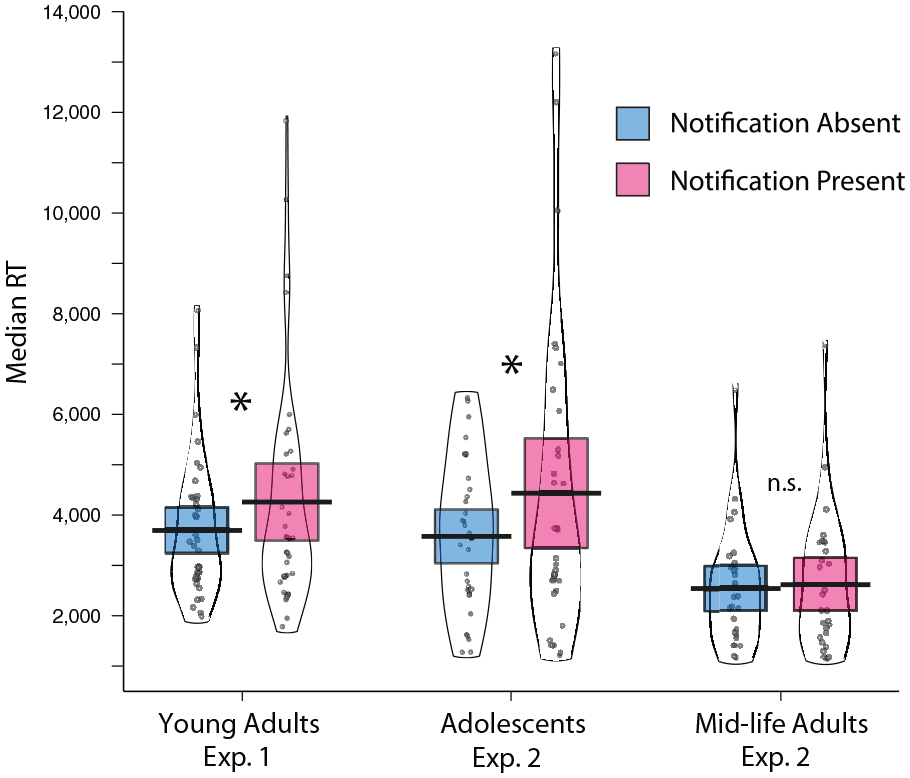
Localised effects of notifications on median RTs. Boxes represent the 95% confidence intervals around the mean (horizontal bars). Circles indicate participant-level median RTs. *Notification effect significant at p < .05. n.s. = not significant.
Localised effects of notifications on accuracy were computed as well. Accuracy did not differ in notification-present trials (M = 91.4%, SD = 10.8) versus notification-absent trials (M = 91.3%, SD = 7.60), F (1, 36) = 0.01, p = .922, η2 < .01, nor was there an interaction, F (1, 36) = 1.23, p = .275, η2 = .01.
Localised effects of cellphone notifications on HRV
RMSSDs for pre- and post-notification periods were averaged across the 12 notification trials in each block for each participant and submitted to a block (notification block 1 vs. notification block 2) × notification (pre- vs. post-notification) repeated measures ANOVA. Neither the effect of notifications nor the interaction with block were significant for RMSSDs, both Fs (1, 36) < 2.1, ps > .15, η2s < .02 (see Figure 3).
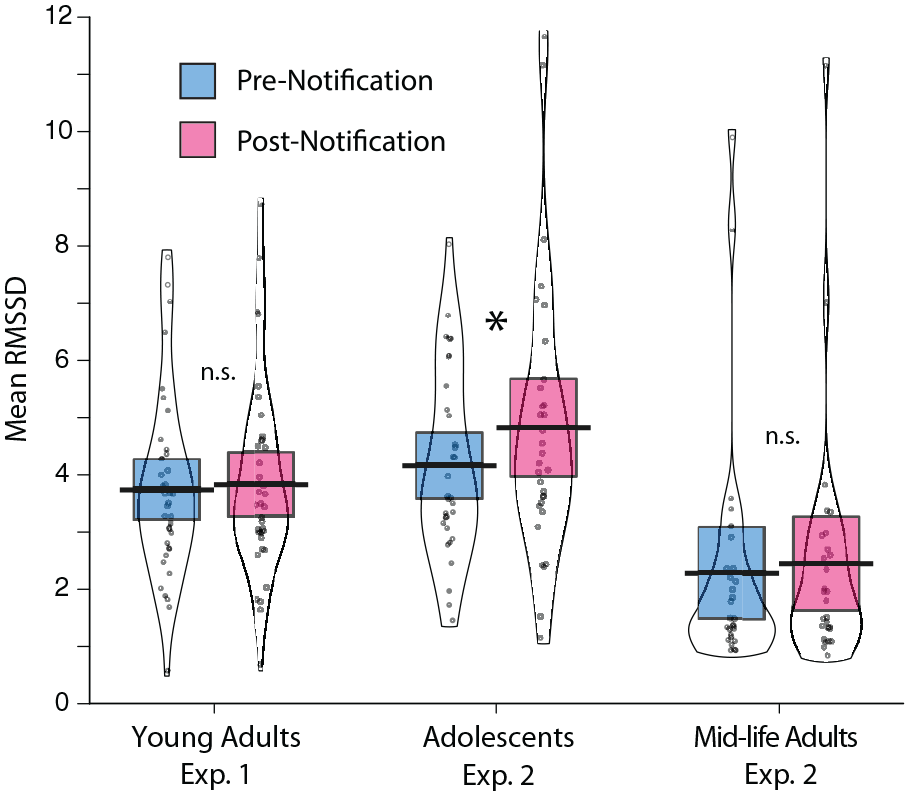
Localised effects of RMSSDs pre- and post-notification. Boxes represent the 95% confidence intervals around the mean (horizontal bars). Circles indicate participant-level means. *Notification effect significant at p < .05. n.s. = not significant.
Correlations of individual difference variables with attentional performance and HRV
To examine possible mechanisms underlying susceptibility to notifications, we correlated the local changes in both RT (RT cost: notification-present minus notification-absent RTs) and RMSSD (post-notification 6 s interval minus pre-notification 6 s interval) with response inhibition (Stroop incongruent minus congruent RT) and compulsive cellphone use. RT costs from notifications were neither correlated with response inhibition, r = −.01, n = 36, nor RMSSD changes, r = −.09, n = 36. Compulsive cellphone use was neither correlated with RT costs, r = .00, n = 36, nor RMSSD changes, r = −.01, n = 36. Note that one participant did not understand the Stroop task instructions, and another did not fill out the CCQ, so their data are not reflected in correlations involving these variables.
Supplemental analyses of global effects
We tested global effects of cellphone notifications by comparing attentional performance and HRV during blocks of math problems that contained periodic cellphone notification vibrations (notification-present) versus blocks that contained no notifications (notification-absent).
We first examined global math practice effects of all trials across the practice and notification blocks 1 and 2 using correct trial median RTs. There was an overall effect of block on RT, F (2, 72) = 30.64, p < .001, η2 = .46, with RTs becoming faster from the practice to notification block 1, t(36) = 4.31, p < .001, d = .71, CI = [0.35, 1.07], and becoming faster still between notification blocks 1 and 2, t(36) = 4.64, p < .001, d = .76, CI = [0.39, 1.12]. Accuracy, however, did not vary across the three blocks, F (2, 72) = 1.74, p = .184, η2 = .05.
We assessed HRV by comparing the baseline block, math practice block, notification block 1, and notification block 2. All heartbeats were included in this analysis so long as they met the artefact inclusion criteria. RMSSDs were submitted to a one-way block (resting, math practice, notification block 1, and notification block 2) repeated measures ANOVA. There was no significant block effect for RMSSD, F (3, 108) = 0.98, p < .404, η2 = .03.
Discussion
In Experiment 1, a reliable disruption in math performance (in terms of slower RTs) was found on trials in which an audible text notification was present, even though notifications were neither visible nor were participants required to respond to the notifications. These results are consistent with previous behavioural findings of the distracting effects of cellphone-related auditory and visual stimuli (Marty-Dugas et al., 2018; Röer et al., 2014; Shelton et al., 2009; Stothart et al., 2015; Thornton et al., 2014). In contrast to the attentional data, HRV reactivity to the notifications was not detected within notification blocks.
Experiment 2
Although the distracting effects of text notifications are well-documented in college populations, their effects on adolescents are less well known and potentially more disruptive. In Experiment 2, we tested these same effects on a group of adolescents and their parent/caregivers. We used the same methodological procedures and statistical analyses as in Experiment 1 with the following exceptions. First, the math problems were simplified to 2-digit plus 1-digit equations (e.g., 43 + 8 = 51?) to better match the abilities of the younger sample. Second, we reduced the number of math equations in the notification-free practice block to 30 trials and reduced the notification blocks from 72 to 60 trials to minimise any fatigue effects that might occur in the community-recruited cohorts of adolescents and mid-life adults. Furthermore, the number of notification trials in each block dropped to 10 to maintain the same ratio of notification-present to notification-absent trials as in Experiment 1.
Method
Participants
Participants included adolescents and one of their respective parents or guardians (i.e., mid-life adults), recruited through flyers placed throughout the community. The adolescent sample (n = 32) was 50% self-identified female and had an average age of 15 years (range = 12–18). The racial composition of the adolescent sample was 88% White, 6% Asian, 3% Black/African American, and 3% Native Hawaiian/Pacific Islander. The mid-life adult sample (n = 28) comprised 61% self-identified females and participants’ average age was 48 years (range = 37–68). Not reported here are the data of two adolescents and four parents whose heart rate data had to be excluded because the QRS complex was not discernible due to excessive signal noise during the math task. We assume that this noise was either the result of excessive arm movement or sensor contact that weakened during the session. All participants were cellphone users, and iPhones were used by 79% of adolescents and 62% of mid-life adults.
Design and procedure
The data reported here are a subset of a larger study that additionally assessed these participants’ sleep, activity, and smartphone usage. The study protocol involved two lab sessions separated by 3 days. On the first visit adolescents completed an online survey, were fitted with an activity watch, and installed a phone use monitoring app on their smartphone. Three days later adolescents returned to the lab to complete the experimental protocol in which cognitive performance and HRV were measured. Participating parents/adults performed these two sessions in the opposite order. Participants earned US$25 each.
The design of Experiment 2 was the same as Experiment 1, with the exception of modifications to the math task described above (i.e., simplified problems and fewer, shorter, blocks; see Table 1). Also, because the total number of notification trials was decreased from 12 to 10 per block, we did not test block × notification interactions in local analyses. All other math block parameters were identical to the previous experiment.
Results
Independent t-tests were conducted to examine differences in median RTs, accuracy, and HRV by smartphone type (iPhone vs. other). No significant differences were found for adolescents or mid-life adults.
Localised effects of cellphone notifications on attentional performance
The localised distracting effects of phone notifications on attentional performance were computed by comparing correct trial, median RTs for notification-present versus notification-absent trials across notification blocks 1 and 2. These RTs were submitted to an age (adolescent vs. mid-life adult) × notification trial (notification-present vs. notification-absent) ANOVA with age serving as a between-subjects variable and notification within-subjects. Again, auditory notifications reliably slowed RTs for math problems across both groups, F (1, 58) = 7.33, p = .009, η2 = .10, (see Figure 2). Mid-life adults generally completed the math problems faster than the adolescents, F (1, 58) = 9.27 p = .004, η2 = .14, and an age × notification interaction, F (1, 58) = 4.57, p = .037, η2 = .07, revealed that the effects of notifications were disrupting for adolescents, t (31) = 2.55, p = .016, d = .45, CI = [0.08, 0.81] but not parents, t (27) = 1.13, p = .266, d = .22, CI = [−0.16, 0.59].
Mean accuracy for math problems was likewise analysed. Although accuracy was lower for notification-present (M = 94.8%, SD = 7.70) versus notification-absent trials (M = 96.5%, SD = 4.50), F (1, 58) = 4.75, p = .033, η2 = .08, there were no main or interacting effects of age, both Fs < 1.0.
Localised effects of cellphone notifications on HRV
Following the analysis protocol of Experiment 1, mean RMSSDs were again averaged across the 6 s pre- and post-notification trials for each participant and submitted to an age (adolescent vs. mid-life adult × notification pre vs. post-notification) ANOVA with age and notification being manipulated between and within-subjects, respectively. Adolescents exhibited greater HRV than parents, F (1, 58) = 17.30, p < .001, η2 = .23. Furthermore, the onset of notifications increased HRV relative to pre-stimulus levels for all participants, F (1, 58) = 9.91, p = .003, η2 = .14, and this effect appeared to vary with age group, F (1, 58) = 3.29, p = .075, η2 = .05, (see Figure 3). Follow-up comparisons revealed that the increase in HRV in response to the notifications was pronounced in adolescents, t (31) = 2.93, p = .006, d = .52, CI = [0.15, 0.89] but absent in mid-life adults, t (27) = 1.47, p = .153, d = .28, CI = [−0.10, 0.66]. This age interaction cannot be attributed to general increases in post-notification heart rates, as beats per minute did not increase from the pre- (M = 86.5, SD = 11.8) to post-notification (M = 86.4, SD = 11.7) intervals for adolescents, t (31) = 0.25, p = .807, d = .04, CI = [−0.31, 0.39].
Correlations of individual difference variables with attentional performance and HRV
We again examined possible mechanisms underlying susceptibility to notifications by correlating local notification changes in both RT and RMSSD with response inhibition and compulsive cellphone use. Similar to Experiment 1, one mid-life adult participant did not understand the Stroop task, and one adolescent did not complete the CCQ, and the correlations below reflect this excluded data. Greater difficulty with the Stroop task was associated with higher RT notification costs for both adolescents, r = .42, n = 31, p = .018, and mid-life adults, r = .55, n = 27, p = .002. Increased HRV change in response to notifications was also correlated with poorer Stroop performance for adolescents, r = .36, n = 32, p = .044, but not for parents, r = .02, n = 27. Finally, higher cellphone compulsivity was associated with lower HRV notification reactivity for parents, r = −.42, n = 28, p = .026, but not reliable for adolescents, r = −.24, n = 31, p = .19. Cellphone compulsivity was not associated with RT notification costs for either age group, both rs < .19. To test whether the size of these correlations was reliably different between adolescents and mid-life adults, we used Fisher’s r to z-score transformation. Using this method, each of the above correlations was not reliably different at the .05 alpha level, all zs < 1.35, all ps > .09.
Supplemental analyses of global effects
The global costs of performing math problems under conditions of notification distraction were again assessed by comparing the math practice block to the notification blocks 1 and 2 against age group. Mid-life adults were generally faster (M = 2,907 ms, SD = 1,439) with their responses than adolescents (M = 4,053 ms, SD = 1,593), F (1, 58) = 8.67, p = .005, η2 = .13. A block effect also emerged, F (2, 116) = 26.49, p < .001, η2 = .31, with RTs becoming faster from the initial math practice block (M = 3629 ms, SD = 1,591) to notification block 1 (M = 3,407 ms, SD = 1,657), t (59) = 2.28, p = .026, d = .29, CI = [0.03, 0.55], and faster still from notification block 1 to block 2 (M = 2,933 ms, SD = 1,478), t (59) = 6.11, p < .001, d = .79, CI = [0.50, 1.08]. These block effects did not interact with age, F (2, 116) = 1.93 p = .149, η2 = .02.
It is possible that the block practice effects on RT were due to a speed—accuracy trade-off, as accuracy did decrease across blocks, F (2, 116) = 7.24, p < .001, η2 = .11. Specifically, accuracy declined from the initial math practice block (M = 97.4%, SD = 3.49%), to the subsequent notification block 1 (M = 96.2%, SD = 4.45%), t (59) = 2.82, p = .007, d = .36, CI = [0.10, 0.62]. There was no reliable decrease in accuracy from notification block 1 to 2 (M = 94.9%, SD = 6.64%), t (59) = 1.84, p = .071, d = .24, CI = [−0.02, 0.50]. These block effects, however, did not vary or interact with age, both Fs < 1.4, ps > .24, η2 < .03.
As with RT, we assessed age-related differences in global changes in HRV across the baseline, math practice, and notification blocks 1 and 2. RMSSDs, however, did not shift reliably across blocks in general or differently among age groups, both Fs < 2.6, ps > .06.
Discussion
Confirming the results of the previous experiment, the presence of notifications resulted in the reliable slowing of RTs for both adolescents and mid-life adults. More importantly, adolescents were found to be more sensitive to the auditory text notifications, showing both greater slowing of RTs and greater increases in HRV in response to notifications compared with mid-life adults. Correlational analyses also indicated that the distracting effects of notifications were strongly tied to response inhibition performance for both age groups, suggesting that the ability to ignore irrelevant cell phone notifications may be linked with more general inhibitory executive functions. Moreover, for adolescents, greater difficulty on the Stroop task was associated with greater HRV reactivity to notifications, indicating that the costs of distractions for this group were accompanied by physiological responses not seen in the mid-life sample.
General discussion
The current study is the first to examine cognitive and physiological effects of cellphone-related auditory distractions across three developmental periods. Results suggest developmental variation in these effects (see Table 2 for a summary of results), with particularly notable findings in the adolescent group. In analysis of moment-to-moment change, adolescents’ RT was significantly slower in notification-present math problems than in notification-absent trials, and this slowing was likely not the result of a speed-accuracy trade-off, as accuracy also declined in notification-present versus absent trials. Adolescents’ slowed responses were also accompanied by HRV increases in the moments immediately following notification sounds. Finally, adolescents’ response inhibition difficulties on the Stroop task were positively correlated with notification-related RT costs and HRV change. Taken together, these findings suggest a robust pattern of reactivity to notification alerts for young, developing minds.
Summary of primary comparisons and results.

RT: response time; HRV: heart rate variability; NS: not significant.
Indicates age-group difference in Experiment 2.
Localised cognitive costs of cellphone notifications
In the current study, partial support was found for localised (Hypothesis 1) effects of cellphone notifications on cognitive performance. RT effects were evidenced in adolescent and young adult groups by higher (slower) RTs in notification-present trials when compared with notification-absent trials.
The current study provided a conservative test of distracting effects of cellphone-related auditory stimuli, as notifications were not associated with participants’ own cellphones. Participants were asked to leave their cellphone in a room adjacent to the experimental lab, and thus there was no question of whether the notification sounds were emitting from a participant’s own phone. These findings echo those of Röer and colleagues (2014), who hypothesised that one’s own cellphone ringtone would create greater attentional capture than other ringtones presented during a short-term memory test, but found no evidence for the self-relevance of the ringtone. In that study, any ringtone negatively affected cognitive performance when compared with no ringtone. RT data from both current experiments show that cellphone notifications imposed a sizable cost on attentional focus even when there was no explicit requirement, or self-relevant motivation, to attend to them.
Localised HRV reactions to cellphone notifications
Only adolescents demonstrated HRV changes in response to cellphone notification sounds, though it should be noted that the age × notification interaction itself did not reach our significance level of .05, and thus may be related to a lack of statistical power to detect interacting effects with the RMSSD variable. Adolescents demonstrated a significant increase in HRV from pre-notification to post-notification, suggesting that notifications exert both cognitive and physiological effects. This was consistent with the effect predicted in Hypothesis 2, which was based on previous findings in which children’s RMSSD significantly increased in the moments following a startling auditory stimulus (Chen et al., 2014).
Thus, in the current study cellphone notifications acted on adolescents’ bodies in a manner more similar to startling sensory stimuli (Chen et al., 2014) than to demanding cognitive load (e.g., Shelton et al., 2009). However, several factors should be considered in interpreting this finding. Most importantly, previous studies have investigated young adults and adults only, with the exception of Chen et al. (2014), who studied 8-year-olds. In addition, the HRV time intervals of previous studies have ranged from several seconds (Arza et al., 2015; Chen et al., 2014) to a number of minutes (Endukuru et al., 2016; Melo et al., 2017). Regardless, measures of HRV have been shown to decrease with time on task, which supports the sensitivity of such measures to sustained attention (Chang & Huang, 2012; Luque-Casado et al., 2013). It is possible that adolescents’ higher resting baseline HRV than adults (Umetani et al., 1998) may create different patterns of HRV reactivity in response to notifications over short periods compared with adults. Another possibility is that cellphone notifications are more socially meaningful to adolescents than they are to adults. Because adolescents find social interactions more rewarding than do adults (e.g., Chein et al., 2011), adolescents may place greater importance on each text, further contributing to HRV changes and cognitive distractibility.
It should be noted that in the current study, analyses of localised effects have demonstrated the feasibility of using a within-subject, event-related design to assess the immediate and direct effects of notifications on both cognition and physiology. Specifically, we found measurable effects of notifications on HRV, even though the measurement period was limited to 6 s, affirming the viability of assessing HRV in brief (around 10 s) time intervals (Chen et al., 2014; McNames & Aboy, 2006; Munoz et al., 2015; Salahuddin et al., 2007). This is a promising methodology for future research investigating physiological mediators of cellphone-related stimuli on psychological functioning.
Individual difference correlates of notification responses
In support of Hypothesis 3, response inhibition difficulties were positively correlated with RT notification costs for adolescents and mid-life adults, and positively correlated with HRV change for adolescents. Response inhibition, as measured by the Stroop task, has reliably been associated with the ability to inhibit prepotent responding in favour of more task-relevant responses (e.g., Kane & Engle, 2003; Sugg & McDonald, 1994). The ability to control behaviour and withhold reactions to immediately rewarding stimuli is often a challenge for adolescents (see Luna et al., 2010, for a review), and the present findings suggest that the underdevelopment of executive functioning may leave adolescents especially sensitive to distraction by cellphone notifications. It is curious that these same correlations were not observed in our sample of college students. It may be that college students are simply more practised at receiving/ignoring texts than adolescents or mid-life adults.
Counter to expectations, compulsive cellphone use was not significantly correlated with RT notification costs in any age group. Exploratory analyses revealed an inverse correlation between compulsive cellphone use and HRV change for mid-life adults. That is, adults with higher levels of self-reported compulsive orientation towards cellphone use exhibited less HRV reactivity to notification sounds when they were engaged in challenging cognitive work. Future research should investigate the roles of multiple behavioural and affective dispositions towards cellphone use in moderating individuals’ responses to cellphone-related stimuli.
Limitations and future directions
As the first study to utilise a within-groups design to examine the effects of cellphone-related auditory stimuli, some design elements must be considered in interpreting the current findings. One limitation of this study is that the cognitive task differed in difficulty and length from Experiment 1 (undergraduate students) to Experiment 2 (adolescents and mid-life adults). This was necessary to avoid ceiling effects for young adult participants. However, it may have altered the degree of cognitive load, emotional stress, and/or demand on sustained attention for participants across age groups. Future research may begin to address this by measuring the degree to which task difficulty affects notification costs and whether these effects interact with age. Controlling for participants’ self-reports of subjective aspects of the cognitive task may also help explain how the effects of notifications shift with age.
As a cross-sectional study, it is necessary to consider that age effects may be confounded with cohort effects. That is, age-related between-group differences may arise because of the different smartphone-related histories of adolescents, for whom cellphones have been perpetually salient in their lifetimes, versus adults, for whom cellphones may play a less sustained or important role in social life. It is possible that the current cohort of adolescents will remain particularly sensitive to cellphone-related auditory stimuli throughout their lifetimes.
In conducting one of the first studies to examine localised effects on HRV using sub 10 s measurements, we did not control for factors that can be correlated with HRV, such as respiration, recent caffeine intake or exercise, previous health conditions, or phase of the menstrual cycle. Conditions that would alter respiration were minimised, as participants were seated in the same position and had no verbal interactions throughout the experiment. Furthermore, like Chen and colleagues (2014), we found that adolescents’ HRV increases in response to notifications were not confounded by heart rate increases from pre- to post-notification intervals.
It should be acknowledged that this study utilised iPhone-based auditory stimuli. All participants of Experiment 1 were iPhone users, but some participants of Experiment 2 owned other types of smartphones. To test the generalisability of the current findings, future research should investigate whether brand-specific notification sounds would differentially affect cognitive performance or physiological responses.
Although it was beyond the scope of this study to examine variations in the effects of cellphone-related stimuli based on gender and/or race, these must be investigated in future studies as there is evidence that cellphone-related cognitions and behaviours vary on these characteristics (Oviedo- et al., 2019; Sillice et al., 2018). Furthermore, given previous findings that HRV tends to decrease with age (Umetani et al., 1998), and that sensitivity to startling stimuli differed as a function of resting HRV (Ruiz-Padial et al., 2003), future research should examine both age and resting HRV as potential moderators of physiological reactivity to cellphone-related stimuli.
Conclusion
Our modern world is saturated with cellphone-related stimuli, and the cognitive and physiological costs of this environment are unclear. As individuals, families, schools, and workplaces shape practices and policies regarding cellphone use, it is critical to understand whether the costs of these distractions are significant, lasting, domain-specific, context-specific, and/or developmentally sensitive. The current study has found that adolescents show greater and more consistent cognitive and physiological reactivity to cellphone notification sounds, when compared with young adults and mid-life adults. This impairment was accompanied by an increase in HRV mimicking previously reported physiological responses to a loud, startling auditory stimulus (Chen et al., 2014). These findings suggest the importance of expanding the investigation of cellphone-related distractors to additional contexts and younger children.
Context
This project represents a natural intersection and extension of our research programmes examining associations between cellphone use and sleep quality (e.g., Murdock et al., 2017, 2019) and effects of naturally occurring sleep deprivation on attentional orienting (Whiting & Murdock, 2016). Having established general links between cellphone use, sleep quality, and compromises in cognitive functioning, we decided to explore possible mechanisms through which cellphone-related stimuli may affect cognition. Physiological reactivity is an excellent candidate pathway, and the lack of existing, developmentally informed research on this topic makes it a compelling area of investigation.
Footnotes
Declaration of conflicting interests
The author(s) declared no potential conflicts of interest with respect to the research, authorship, and/or publication of this article.
Funding
The author(s) received no financial support for the research, authorship, and/or publication of this article.
