







Abstract
Production research has yielded mixed findings regarding whether grammatical encoding specifies grammatical functions and linear word order simultaneously or separately, supporting either one-stage or two-stage models. Here, we focused on the double object (DO) and shifted double object (SDO) constructions in Zhuang, an ethnic minority language in China because they differ only in linear ordering of the two nouns whose grammatical functions are direct object and indirect object, assuming the roles of Theme and Recipient, respectively. Using two structural priming experiments, we found that both DO and SDO constructions induced within-structure priming effects, but they did not prime each other. Such structural priming effects persisted, regardless of whether semantic features (i.e., animacy of the Theme) were repeated across primes and targets. Taken together, these priming patterns support the one-stage model of grammatical encoding, where a conceptual representation is converted into a structure specifying both grammatical functions and linear word order.
Introduction
It is generally accepted that language production mainly consists of three processes: conceptualisation, formulation, and articulation (Bock & Levelt, 1994; Levelt, 1989). At the initial processes of conceptualisation, a speaker encodes a pre-verbal message that captures essential features of her intended meaning (Bock & Levelt, 1994, p. 946). At the ultimate processes of articulation, she generates a stream of speech. In between stands the intermediate processes of formulation, responsible for grammatical and phonological encoding. In grammatical encoding, the speaker has to retrieve individual words from her mental lexicon and then put them together to form a sentence. The current work focuses on the grammatical encoding process, as it remains a subject of much debate regarding exactly how words are turned into a well-formed sentence.
In the production literature, there exist two camps of theories on the grammatical encoding process: the two-stage model and the one-stage model. The two-stage model (e.g., Bock & Levelt, 1994; Garrett, 1980) assumes that grammatical encoding involves two stages, namely 1) a functional stage where the abstract “lemmas” retrieved from the mental lexicon are assigned grammatical functions (e.g., a noun as a semantically and syntactically specified category is assigned as SUBJECT-NOMINATIVE, DIRECT OBJECT-ACCUSATIVE, or OBLIQUE OBJECT-DATIVE) and 2) a positional stage where the phonologically specified “lexemes” are inserted into slots of a planning frame where unordered hierarchical relations (in terms of dominance, e.g., a verb phrase [VP] node dominates a verb node and a noun phrase [NP] node) are established, and then linear word order (in terms of precedence, e.g., a noun phrase precedes a verb phrase) is determined, such that the constituent structure (i.e., how phrases are organised, e.g., VP→V NP NP) is constructed. Thus, in this model, conceptual representations (e.g., thematic roles, animacy features, and information emphasis) are mapped onto the constituent structure indirectly, via the mediation of grammatical function (Bock, 1987; Bock & Levelt, 1994).
In contrast, the one-stage model maintains that grammatical functions, phrasal constituents, and linear ordering—all as different subcomponents of a single representation—are computed in a single stage (Branigan & Pickering, 2017; Cai et al., 2012; also see Köhne et al., 2014). In this model, conceptual representations, such as thematic roles, are directly mapped onto the constituent structure in which hierarchical relations and linear order are determined at the same time, without the mediation of grammatical functions. In other words, message-level representations are mapped to a single syntactic representation incorporating both grammatical functions and constituent structures (Cai et al., 2012, pp. 845–846), and this syntactic representation—in terms of the phrase-structure tree—is assumed to be simple and flat (i.e., without moved elements, deep structures, or strict requirement of binary branching of Chomskyan grammar) (Branigan & Pickering, 2017). To do this, speakers track in parallel a series of mappings, including mappings from concept to grammatical function (e.g., the Thematic-Function mapping), mappings from concept to constituent structure (e.g., the Thematic-Constituent Structure mapping), and mappings from concept to linear order (e.g., the Thematic-Order mapping). These mappings, differing in relative weighting, simultaneously affect speakers until the ultimate choice of syntactic structure is made.
Both the two-stage and one-stage models have supporting evidence for their key claims about grammatical encoding from speech errors and structural priming. The structural priming paradigm—where speakers tend to reproduce the structure that was recently processed when uttering a new sentence—is particularly suitable to evaluate the two models because regardless of whether or not languages have morphological inflections—which is ideal for eliciting speech errors, representations at different stages of grammatical encoding can be captured by priming effects (Branigan & Pickering, 2017). Below, we review evidence for each model, with a focus on structural priming.
One issue that distinguishes between the two models relates to whether the representation of hierarchical relations is separated from that of linear ordering. Data from subject-verb agreement errors (e.g., The key to the cabinets was/*were rusty, Bock & Miller, 1991) have mainly been used to argue for two stages of grammatical encoding since an influential work by Vigliocco and Nicol (1998). In that study, participants were asked to produce, using adjectives and prepositional NPs as prompts, either declarative sentences (e.g., The flight of the helicopters was safe.) or questions (e.g., Was the helicopter of the flights safe?). A comparable rate of agreement errors was found in both types of sentences, regardless of whether the verb was linearly close or distant to the local noun, suggesting that linear proximity does not affect agreement computation. Assuming questions share the same underlying structure as declarative, Vigliocco and Nicol (1998) argued that agreement is computed once the hierarchical tree structure is established—with number features passing up through the subject node to the verb node, before the linear order of lexical words is determined. Subsequent work on three NPs such as the threat(s) to the president(s) of the company(ies) has also yielded similar findings (Franck et al., 2002), lending further support to the existence of the functional and positional levels as claimed by the two-stage model (Eberhard et al., 2005; Vigliocco & Hartsuiker, 2002).
However, recent evidence from agreement errors and structural priming supports a single stage of constituent structure in grammatical encoding. Using picture identification and description tasks, Haskell and MacDonald (2005) had participants produce questions about a certain property of one picture from two pictures (e.g., Can you tell me whether the horses or the clock is/are red?). They found that participants tended to inflect verbs to agree with the closer of the two disjunctive NPs (NP1 or NP2), suggesting that linear proximity affects agreement computation. Likewise, using the complex “NP PP1 PP2” structure (e.g., The backpack with the plastic buckles on the leather strap), Gillespie and Pearlmutter (2011) found that agreement error rates are determined solely by a local noun’s linear distance to the head noun. Furthermore, using both written and spoken fragment-sentence completion tasks, Pickering et al. (2002) found a significant production of prepositional object (PO) target sentences (e.g., The racing driver showed the torn overall to the helpful mechanic.) only with PO-inducing primes (e.g., The racing driver showed the torn overall . . .), but not with shifted-PO (SPO)-inducing primes (e.g., The racing driver showed to the helpful mechanic . . .). Pickering et al. (2002) used these results to argue that PO and SPO must each have its own fully specified representations; Otherwise, a common, dominance-only hierarchical representation would have primed SPO and PO targets. 1 Taken together, data from agreement errors and structural priming have suggested that hierarchical relations and linear order are determined simultaneously.
We now turn to evidence from structural priming for the two-stage vs. one-stage models, as they make contrastive predictions on priming effects. Recall that in the two-stage model, the functional level is indispensable, such that conceptual representations of thematic roles (e.g., Agent, Theme, or Recipient) are mapped onto grammatical functions (i.e., subject, direct object, or indirect object) first, and then these roles are mapped to the surface word order. Termed as the Thematic–Function account (see a summary in Köhne et al., 2014, pp. 305–306), it predicts that two competing constructions with different word orders (e.g., dative alternations, active–passive alternations) but an identical mapping from thematic roles to grammatical function should be able to prime each other because the shared, unordered representation of hierarchical relations can be realised as different linear orders of words at the positional stage. In contrast, according to the one-stage model, priming effects may (or may not) take place, depending on the strengths of mappings between different subcomponents of a single syntactic representation. Although this potentially renders a variety of priming effects supporting the two-stage model also accountable by the one-stage model, it is not clear yet which mappings are a prior psychologically real.
In terms of the conceptual-to-function mapping(s), structural priming evidence for the two-stage model is relatively rare, only occasionally found in Cantonese (e.g., Song & Lai, 2021) or cross-linguistic/bilingual data (e.g., B. Chen et al., 2013; Shin & Christianson, 2009), with some findings (e.g., B. Chen et al., 2013; Song & Lai, 2021) also compatible with the one-stage model. In Song and Lai (2021), Cantonese participants were presented with object-topicalisation object-subject-verb (OSV) prime sentences, as in (lit.) CL-thief TOP CL-policeman catch-PERF SFP 2 “The thief, the policeman has caught,” where the Theme (“the thief”) was assigned the grammatical function of Direct Object but was topicalised to the sentence-initial position. Relative to the control baseline (“The thief and the policeman”), participants in the OSV prime condition produced significantly more canonical subject-verb-object (SVO) target sentences (e.g., [lit.] CL-policeman catch-PERF CL-thief SFP “The policeman has caught the thief”). Given that both prime and target sentences have the Theme in the Direct Object position, Song and Lai (2021) attributed this priming effect to a mapping from conceptual representations (i.e., thematic roles) to grammatical functions (i.e., Direct Object) first, and then to word order, hence supporting the two-stage model. 3
However, Song and Lai (2021) failed to find any priming effects for the other set of prime–target pair, that is, between the Topicalised Passive and the Standard Passive; yet, these two constructions are fundamentally identical in all aspects, except for the presence or absence of a topic-marking particle ne, as in (lit.) CL-thief (TOP) PASS CL-policeman catch-PERF SFP “The thief (,) 4 has been caught by the police.” If the Thematic-Function mapping was a major source of structural priming, priming would have taken place from Topicalised Passive construction to Standard Passive constructions. Song and Lai (2021) had no clear explanations for this, only hinting at the formal laboratory setting and the lack of discourse context (but cf. Cai et al.’s [2012] Experiments 1 and 2) that potentially prevented participants from producing topic structures in general.
Recently, there has been increasing evidence for the two-stage model from cross-linguistic structural priming. The cross-linguistic data, however, might be interpreted with caution because bilinguals’ syntactic representations are likely to be shallow and semantically driven, and care is needed to control variables, such as structural comparability between source and target languages (e.g., balanced or marked), target language proficiency, task difficulty, cognitive capacities, and individual differences. Here, we review two representative works of cross-linguistic priming supporting the two-stage model. Using sentence recall paradigm, Shin and Christianson (2009) examined Korean–English bilingual production of English Double object (DO)/PO structures (e.g., Mary gave John a book/a book to John), using three types of Korean dative primes: 1) canonical PO (Mary-NOM John-to book-ACC gave-PAST-DECL), 2) scrambled PO (Mary-NOM book-ACC John-to gave-PAST-DECL), and 3) DO (Mary-NOM JOHN-ACC book-ACC gave-PAST-DECL). English PO and two Korean PO constructions share the same Thematic-Function mapping (i.e., Recipient to Oblique Object, Theme to Direct Object) and the same dominance structure (i.e., a dative VP dominates a verb, a NP, and a PP), but differ in word order (i.e., verb-final in Korean, but verb-medial in English), and so do English DO and Korean DO constructions. Shin and Christianson (2009) found that participants recalled significantly more English target-PO sentences in Korean canonical PO primes (68%) than in Korean DO primes (62%), suggesting cross-linguistic structural priming effects (6%) despite word order differences. Note, however, Korean scrambled PO primes did not differ from Korean DO primes in recall rates of English target-PO sentences (65% vs 62%), even though structure-wise, Korean scrambled PO appears to parallel to English PO more closely than Korean canonical PO.
In picture-description and confederate-scripting experiments, B. Chen et al. (2013) investigated whether L1-Chinese, L2-English learners showed cross-linguistic structural priming, using passive constructions in Chinese and English. Both constructions have the same Thematic-Function mapping (i.e., Agent–Object, and Patient–Subject), but differ in the linear word order: The Agent follows the verb in English (e.g., The cup was broken by the cat) but precedes the verb in Chinese (e.g., Beizi bei xiaomao dapole “The cup BEIpassive the cat break-perfective”). Indeed, Chen and colleagues found cross-linguistic structural priming between Chinese and English passive sentences, and such priming occurred in either language direction (i.e., L1-Chinese passives can prime L2-English passives, and vice versa), thus supporting the Thematic–Function account of the two-stage model of grammatical encoding. 5 Note, however, the findings of B. Chen et al. (2013) might have alternative explanations from the priming of thematic roles (i.e., Patient–Agent ordering in English and Chinese passives) or that of animacy configurations (i.e., the Patient was always inanimate and the Agent animate).
In contrast to relatively few works supporting the two-stage model, increasing evidence for the one-stage model has been found from structural priming studies on English (e.g., Chang et al., 2003; Pickering et al., 2002), German (e.g., Köhne et al., 2014; Pappert & Pechmann, 2014), and Mandarin (e.g., Cai et al., 2012). Chang et al. (2003) is the first study demonstrating structural priming arising from a direct mapping from thematic roles to linear order, using the location–theme locative alternation with two inanimate NPs. Participants were asked to read a sentence, compare numbers, and recall the sentence. Results showed more Theme–Location sentences were produced after Theme–Location primes (e.g., The maid rubbed polish onto the table.) than after Location–Theme primes (e.g., The main rubbed the table with polish.), and conversely, more Location–Theme sentences after Location–Theme primes than after Theme–Location primes. Clearly, the lack of priming between seemingly equivalent constructions falsifies the two-stage model, 6 but supports the one-stage model. Note, however, other subcomponents’ mappings in the one-stage model, for instance, the Theme-to-Direct Object order vs the Theme-to-Oblique order, or the Theme-to-Constituent Structure order, may also yield the observed priming patterns.
Clear evidence for the Theme-Order account of the one-stage model comes from Cai et al. (2012, Experiment 2), where Chinese participants were presented with Topic-DO prime sentences where the Direct Object assuming the Theme role is topicalised to the initial Topic position, as in Nage qiu gongzhu reng-gei le xiaochou “That ball(Theme) the princess(Agent) threw-to the clown(Recipient).” Relative to the intransitive baseline, participants produced significantly more target PO (rather than DO) sentences, as in Jiaoshou reng-le yige pingguo gei yisheng “The professor(Agent) threw an apple(Theme) to the doctor(Recipient),” where the Theme is in the Direct Object position. Notice that both the prime and target sentences maintain the relative order of “Theme-Recipient” (regardless of whether the Theme precedes or follows the Agent), suggesting a direct mapping of thematic roles onto word order is the source of the observed priming patterns, hence supporting the Thematic-Order account of the one-stage model. Furthermore, Cai et al. (2012, Experiment 3) presented participants with both the Topic-DO and Topic-PO primes (e.g., Naben shu niuzai song-le gei shuishou “That book[Dobj] the cowboy gave to the sailor(Oobj)”), and found a larger priming effects from Topic-DO primes to DO targets than from Topic-PO primes to PO targets. Given that Topic-DO and Topic-PO share the same Theme-Recipient order but differ in Thematic-Function mappings (i.e., Recipient and Theme onto Direct Object in Topic-DO vs Theme onto Direct Object and Recipient onto Indirect Object in Topic-PO), and importantly target DO shares the same Thematic-Function mapping with Topic-DO primes but not with Topic-PO primes, Cai et al. (2012) attributed the stronger priming with Topic-DO to DO to the Thematic-Function mapping, along with the Thematic-Order mapping.
It is worth noting, however, that at the conceptual level, thematic roles in Cai et al. (2012) were not separated from animacy, as animate referents are known to be inherently associated with Recipients, and inanimate entities with Themes (Köhne et al., 2014). Furthermore, animacy features arguably influence the Thematic-Function mapping, as shown by Bock et al.’s (1992) finding that more inanimate Subjects in English actives were produced following primes with inanimate Subjects than following primes with animate Subject. Animacy is also a prominent cue in a morphologically bare language such as Chinese (P. Li et al., 1993). Thus, further studies are needed to distinguish thematic roles from animacy.
Beyond the evidence from English and Mandarin, the one-stage model is also supported by the priming data in dative alternations in English and German. Recall that in Pickering et al. (2002), target PO completions were only primed by PO-inducing fragment primes, but not by SPO-inducing fragment primes. This lack of structural priming with SPO is reinterpreted as two sources of mappings (i.e., priming the PO via the conceptual-to-function mapping vs priming the DO via the conceptual-to-linear mappings) cancelling each other out (Cai et al., 2012; Köhne et al., 2014), hence supporting the one-stage model. Note, however, the absence of the priming effect might be in part due to the usage of the SPO being highly restricted in English, occurring only when the direct object is longer than the prepositional phrase and encodes new information (Arnold et al., 2000; Pickering et al., 2002, pp. 589, 601). However, given that it is precisely the final (long/heavy) NP that participants were asked to provide as a continuation, fragment completion tasks might not be sensitive enough to detect priming effects of rare structures.
German has case marking, and its shifted-DO (SDO) structure, though also not very common, occurs more frequently and less restricted than English SPO. Interestingly, due to case marking, the preferred DO (NPDAT-NPACC, e.g., Der Rentner schickt dem Minister den Beschwerdebrief “The retiree-NOM sends [the minister]-DAT [the complaint letter]-ACC”) and PO (NPACC-PPACC, Der Rentner schickt einen Beschwerdebrief an den Minister “The retiree-NOM sends [a complaint letter]-ACC to [the minister]-ACC) have a shifted variant: SDO (NPACC-NPDAT) and SPO (PPACC-NPACC). Note that while DO/SDO and PO/SPO alternations each have identical phrase structures (i.e., NP–NP or NP–PP), the thematic role ordering is shared between SDO and PO (i.e., Theme-before-Recipient), and between DO and SPO (i.e., Recipient-before-Theme). To find out the locus of structural priming of SDO target structure, Pappertet and Pechmann (2014) used these four prime structures and found that the SDO target responses were significantly primed by SDO and PO primes, with a similar size of priming effects (3.72%–4.39%), but not by DO and SPO primes. They concluded that what matters in structural priming is clearly not the order of constituents, but the order of thematic roles, hence supporting the Thematic-Order account. Note, however, as the authors admitted (Pappertet & Pechmann, 2014, p. 2273), animacy might have covaried with thematic roles at the conceptual level. Given that animate Objects tend to precede inanimate Objects in German, and that grammatical case strongly correlates with animacy, with datives being preferentially assigned to animate recipients and accusatives to inanimate themes (Pappert et al., 2007, p. 311), case is also confounded with animacy/thematic roles.
This concern about the animacy confound is addressed by Köhne et al. (2014), who focused on German DO/SDO alternation. In Experiment 1, they found significantly more DO responses after DO primes than after (1) SDO primes and (2) the intransitive baseline, with no priming effects being found (1) from DO to SDO, or (2) from SDO to DO. To avoid potential influence from animacy, they created stimuli with two animate NPs (Experiment 2), as in “The man promises the wife (to get) the cleaning woman.” Similar results were found, with DO priming DO but not SDO, SDO priming SDO but not DO. Given that the Theme and Recipient roles are mapped onto the same grammatical functions in DO and SDO, yet DO did not prime SDO, nor did SDO prime DO, Köhne et al. (2014) concluded that thematic roles must have been directly mapped onto the surface word order. Note, however, in Köhne et al.’s (2014) study, phrase structures and the order of thematic roles were confounded with the case markers (i.e., NP-ACC; NP-DAT), such that the priming effect could have been attributed to the order of case marker (Muylle et al., 2020).
One noteworthy issue, however, is that the production rates of German SDO are low in both Pappert and Pechmann (2014) and Köhne et al. (2014), reportedly ranging from 5.5% to 15.2%, which on average is even lower than the results of a study on spoken German corpus showing 22% of SDO structures vs. 88% of DO (Kempen & Harbusch, 2004). Although priming effects were nevertheless detected with SDO primes in German, relative to an absence of effect with SPO in English, it is ideal to verify their findings using dative structures of comparable frequencies.
To summarise, existing work supporting either the two-stage model or the one-stage model of grammatical encoding has yielded inconclusive results, partly because most studies fail to tease apart priming effects from other confounding factors, such as animacy (e.g., Cai et al., 2012; B. Chen et al., 2013), linear order of thematic roles (e.g., B. Chen et al., 2013), and case marking (e.g., Köhne et al., 2014; Pappert & Pechmann, 2014). Furthermore, existing work has mostly focused on Indo-European languages that are morpho-syntactically rich, with few isolating languages with little morphology (cf. Cai et al., 2012; Song & Lai, 2021). Thus, it is not clear whether their conclusions also fit for other types of languages.
In this study, we turn to Zhuang, an isolating language from the Sino-Tibetan language family because its free word-order variation makes it possible for us to hold thematic roles constant while manipulating its word order. In the next sections, we will first provide some background information about Zhuang, focusing on its DO and SDO constructions. Then, we motivate our sentence production experiments.
The present study
As a member of the Tai–Kadai language group of Sino-Tibetan language family, Zhuang is an ethnic minority language mainly spoken by Zhuang minority people in Guangxi Zhuang Autonomous Region in Southwest China. The basic word order of Zhuang is SVO. Directly relevant to our research concern, a dative event in Zhuang can be realised into three syntactic structures, namely DO (1a), SDO (1b), and PO (1c). Although all three constructions use the same dative verb (soengh “send”), only in the PO construction does the preposition haej “to” appear in between the direct object (“a banana”) and the oblique object (“student”), and the former two constructions have the two NP arguments vary in their positions. In the current study, we focus on DO and SDO (i.e., the double-object alternation).
(1) Syntactic structures of a dative event in Zhuang a. DO construction Lvauxsae soengh-haej hvagseng aen makgoij ndiz
7
. teacher send-to student CL banana a “The teacher sends the student a banana.” b. SDO construction Lvauxsae soengh-haej aen makgoij ndiz hvagseng. teacher send-to CL banana a student “The teacher sends the student a banana.” c. PO construction Lvauxsae soengh aen makgoij ndiz haej hvagseng. teacher send CL banana a to student “The teacher sends a banana to the student.”
Note that in the double-object alternation (1a–b), the ditransitive verb can either take a bare form (soengh “send”) or incorporate the preposition haej to form a verb compound (soengh-haej “send-to”) (for a syntactic analysis of “preposition incorporation,” see Baker, 1988; Feng, 2003; X. Li & Wu, 2015). Although both forms are acceptable in Zhang, in certain cases the bare verb alone might fail to unambiguously express the direction of entity transfer, which by default can go in two ways. For instance, the compound verb in “Lvauxsae
Existing functional typology work has suggested that it is rather unusual for a language to have both DO and SDO constructions (Heine & König, 2010; Kempen & Harbusch, 2004; Zhang, 2011). However, as documented by Chinese dialectologists, coexistence of both DO and SDO constructions has a fairly wide geographical coverage in southern and southwestern China, constituting a hallmark of “areal typology” (Hashimoto, 1976; Zhang, 2011), with Zhuang as a case in point (He, 2016; G. Li, 2016; Y. Xu, 2014). This long-standing observation about DO/SDO alternation in Zhuang is further verified by a picture-description study reported in Xiang and Wu (2020), where native speakers of Zhuang produced a high rate of DO (range: 27.7%–33.3%) and SDO (range: 66.5%–53.8% 8 ) sentences overall. Thus, both DO and SDO are naturally occurring structures in Zhuang.
More importantly, DO and SDO constructions possess the same Thematic-Function mapping, specifically, the Theme (“a banana”) maps onto the Direct Object, and the Recipient (“the student”) onto the Indirect Object. However, they differ in the Thematic-Order mapping: In DO, the Recipient is mapped onto the first post-verbal position, and the Theme onto the second post-verbal position. Conversely in SDO, the Recipient is mapped onto the second post-verbal position, and the Theme onto the first post-verbal position. Because the DO and SDO differ only in terms of the mapping between thematic roles and constituent order, we can hold constant the mapping between thematic roles and grammatical functions when examining the priming patterns of DO and SDO. Thus, the common DO/SDO alternation in Zhuang provides a good test case to evaluate the two competing sentence production models regarding grammatical encoding.
In the current study, we designed two sentence production experiments using structural priming. In Experiment 1, we aimed to evaluate the predictions of one-stage and two-stage models by testing the priming effect of DO and SDO. If the Thematic–Function account of the two-stage model is correct, we expect that, relative to the baseline, DO sentences should prime DO and SDO responses, and likewise, SDO sentences should prime SDO and DO responses. In contrast, if the Thematic-Order account of the one-stage model is correct, DO and SDO will not prime each other. To address potential influences of animacy ordering, we further manipulated the animacy of the Theme in Experiment 2. If animacy is independent from thematic role, then priming effects should be boosted regardless of whether priming occurs between structures or within structures. To foreshadow our results, we only found within-structure priming effects for DO and SDO but no cross-structure priming effects, and such within-structure priming persisted irrespective of whether the animacy feature between primes and targets was repeated or not. Thus, our findings support the one-stage model.
Experiment 1
In Experiment 1, we aimed to test priming effects within and between DO and SDO constructions in Zhuang, using the structural priming paradigm.
Method
Participants
Overall, 30 native speakers of Zhuang 9 (8 female, Mage = 25.3 years, SD = 6.76) voluntarily participated in the experiment in exchange of 50 yuan. They were residents of two villages in Guangxi, China, and were visited and tested individually in their respective homes. None of them participated in other experiments or the norming test in this study. This study, and the other experiments reported in this article, was conducted in accordance with the Declaration of Helsinki and was approved by the Ethics Committee of the School of Foreign Languages, Shanghai Jiao Tong University.
Materials
In Experiment 1, we manipulated the prime type (DO vs. SDO) and created 24 sets of experimental prime sentences, as in (1a–b). The critical verbs, totaling 12 (see the Supplementary Material A), were used twice, but were paired with different NPs. These verbs were three-place predicates involving three entities, namely, an animate Agent, an animate Recipient, and an inanimate Theme. We always used the compound form of dative verbs because they 1) unambiguously express the direction of transferring, 2) sound natural and were well accepted by Zhuang people, as shown by our grammaticality judgement test to be reported in this section, and 3) can prevent participants from producing PO, a construction that is beyond our research focus. Compound verbs were also frequently used in existing work on Mandarin DO/PO alternations (e.g., Cai, 2010; Cai et al., 2011, 2012, 2015; Huang et al., 2016). In this experiment, the verbs were repeated across prime and target to boost potential priming effects.
Each prime sentence was paired with a target picture, all depicting a dative event (e.g., “The teacher gives the student a pencil”) that consisted of an Agent (“the teacher”), a Recipient (“the student”), and a Theme (“a pencil”). Each set of pictures had two versions, where the Agent and the Recipient switched their locations, with the Theme always in the middle (see Figure 1 for a sample picture with the Agent on the left and the Recipient on the right).

Sample target picture in Experiments 1 and 2.
We also created 24 intransitive sentences as a baseline prime condition, as in (2). With only one entity (i.e., an animate Agent), this condition has its structural representation completely different than that of dative primes involving three entities. Hence, it would prime neither DO nor SDO. In addition, we also constructed 36 filler transitive sentences (e.g., “The father praises the son”). The corresponding pictures for baseline primes and filler trials were also constructed.
(2) Sample baseline prime sentence Lvaux sae liuz. teacher laugh “The teacher laughs.”
All sentences, including experimental primes, intransitive baseline primes, and transitive fillers, were pre-recorded with Praat (Boersma & Weenink, 2015) in a soundproof booth by the first author who is a native speaker of Zhuang. Each sentence was read twice, and the one enunciated at a steady tempo was selected for segmentation. All auditory stimuli were clear and distinguishable, with natural pauses between words. In addition, the verbs serving as prompts for participants to use when they described the target sentences were recorded individually. We used auditory prompts rather than the visual written forms because 1) only highly educated Zhuang speakers majoring in Zhuang language in the universities master the written forms and 2) our participants were from villages and no one learned written Zhuang.
All visual stimuli—both experimental targets and fillers—were black-and-white line drawings created by a college student majoring in fine arts. They were then scanned and saved as JPEG files.
Norming pretest
To verify the naturalness of the 12 dative verbs to be used in the priming experiment, we conducted a grammaticality judgement test. In total, 12 sets of experimental dative prime sentences, each with a different dative verb, were counterbalanced into two lists using Latin Square, such that for each item set, only one of the two versions was assigned to each list. For each list, 12 experimental trials were intermixed with 13 filler trials that were transitive sentences, and then were pseudo-randomised. To keep participants attentive to the task, 7 of the 13 filler trials were ungrammatical. In addition, 12 native speakers of Zhuang (5 females, Mage = 25 years, SD = 7) took the test on an online platform “Tencent Questionnaire” (https://wj.qq.com) for an exchange of 15 yuan. None of them participated in other experiments. Once logged in, they were asked to listen to each pre-recorded sentence and then rate its acceptability on a 5-point Likert-type scale (1 = completely unacceptable, 5 = completely acceptable). Each sentence was shown on a single page, and participants could only proceed to the next, without being able to go backward.
We fitted the rating data with cumulative link mixed models using the clmm function from the ordinal package (Christensen, 2019) in R (Version 3.2.2), with participants and items as random intercepts. The result showed no significant difference between DO (M = 4.69, SD = 0.76) and SDO (M = 4.63, SD = 0.86) structures (β = −.15, SE = 0.42, z = −0.35, p = .73), suggesting that the dative verbs occurring in DO and SDO sentences as in our stimuli sounded natural, and thus were highly accessible to native speakers of Zhuang. All the data and analyses reported in this study can be accessed at https://osf.io/ye4mz/.
Procedure
In the structural priming experiment, we adopted Cai’s (2010) sentence-repetition paradigm. In the priming phase, participants heard a pre-recorded sentence and then repeated it. In the target phase, they described a target picture with a new set of Agent, Recipient, and Theme, all being different from those in the priming phrase.
The stimuli were presented on a ThinkPad laptop using E-prime 1.0. Participants sat in front of the laptop in a quiet room and were recorded during the task. Each trial began with a fixation cross at the centre of screen for 500 ms. Then after hearing a pre-recorded sentence in Zhuang, participants repeated it within 5,000 ms. Then a target picture appeared on the screen, and 1,000 ms after the onset of the picture, a pre-recorded target verb was aurally presented. The verb was played only once. Prompted by the verb, participants would describe the pictures using the given verb. In 6,000 ms, the picture disappeared, with a blank screen shown for 200 ms. Then the next trial started. Figure 2 illustrates the whole experimental procedure.
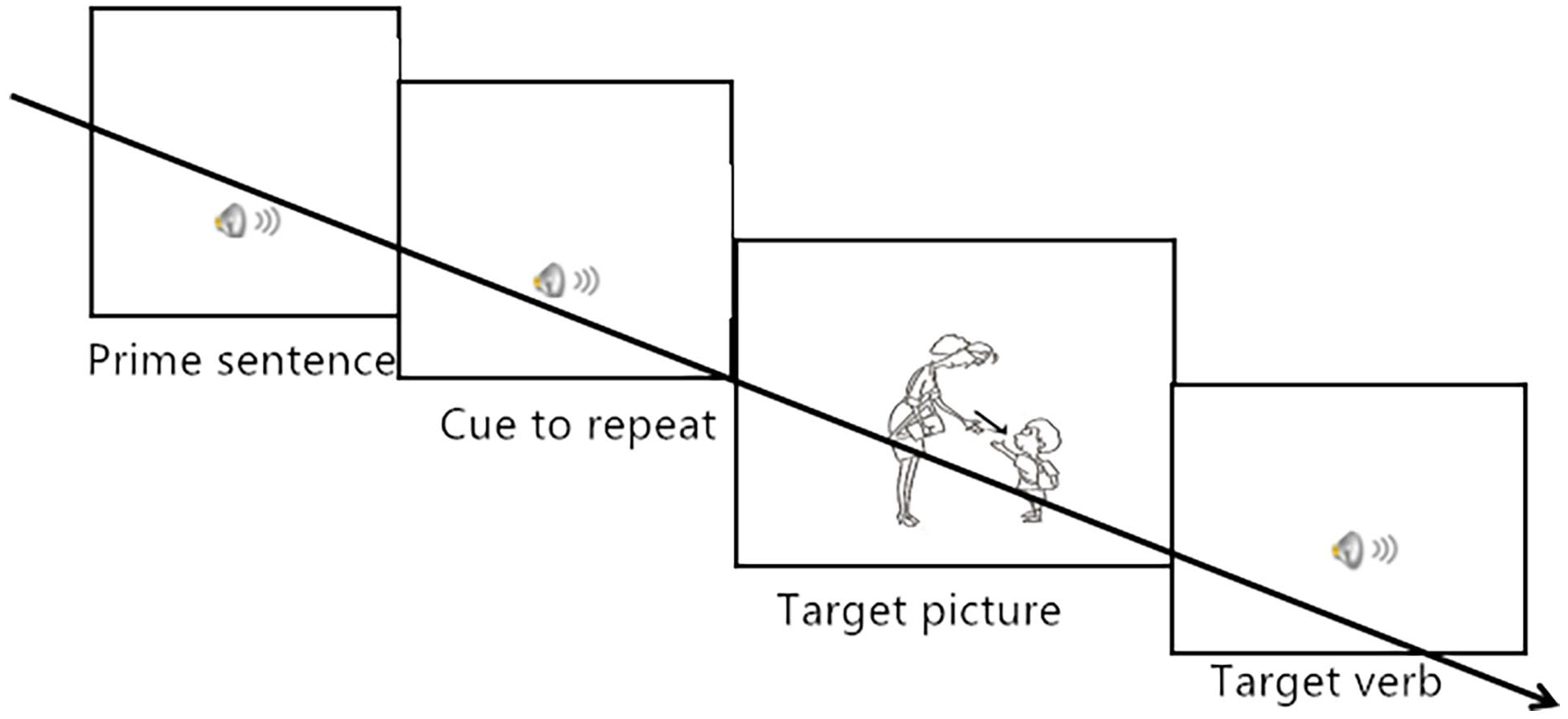
An illustration of the experiment paradigm and procedure in Experiments 1 and 2.
Prior to the experiment, participants underwent a training session on the names of the figures to be presented in the pictures. They were shown each figure in isolation on the laptop, while hearing its name that was pre-recorded. They were told to familiarise themselves with those pictures along with the corresponding names. Before the formal experiment started, they had five practice trials. The whole experiment lasted approximately 30 min.
Scoring
All utterances were coded into three types by the first author as the native speaker of Zhuang:
DO, in which the structure is Agent NP + Verb + Recipient NP + Theme NP, as in (1a);
SDO, in which the structure is Agent NP + Verb + Theme NP + Recipient NP, as in (1b);
Other, in which structures were not DO or SDO, including grammatical but unexpected PO (as the compound verb phrase was broken down into two segments, e.g., Lvauxsae soengh aen makgoij ndiz haej hvagseng. “The teacher sends a book to the student.”), complete but ungrammatical PO (e.g., *Lvauxsae soengh-haej aen makgoij ndiz haej hvagseng. “The teacher sends-to a book to the student.”), incomplete sentence (e.g., Gengj cat soengh haej aen mak leiz ndiz. “The policeman sends a pear.”), and no response.
Results
Out of 1,080 target responses, 567 were DO responses (52.5%), 415 were SDO responses (38.4%), and 98 were other responses (9.1%).
Table 1 shows the distribution of DO, SDO, and other responses as a function of prime type and the proportion of DO responses out of DO and SDO responses. As shown in the last row of Table 1, the production rate of DO construction increased by 6% (i.e., 0.65–0.59) in the DO prime condition compared with the baseline intransitive condition. This means the production rate of SDO construction (which is complementary to that of DO, i.e., 1–0.48) increased by 11% (i.e., 0.52–0.41) in the SDO prime condition compared with the baseline intransitive condition. This seemingly stronger magnitude of the priming effect with SDOs relative to DOs might be due to a high production of DO responses overall across all prime conditions.
Response counts and proportion of DOs out of DOs and SDOs by prime condition in Experiment 1.
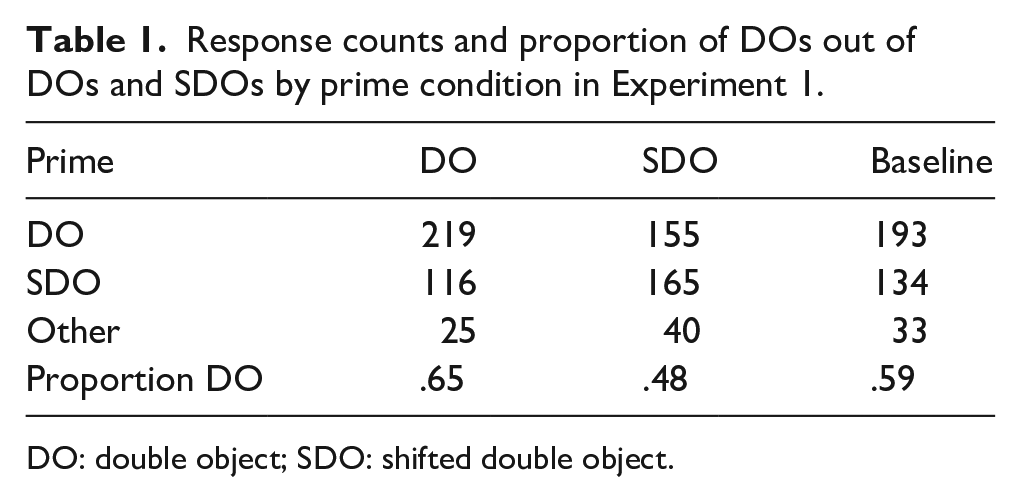
DO: double object; SDO: shifted double object.
We fitted generalised logistic mixed-effects models, using the glmer function of the lme4 package (Bates & Maechler, 2009) in R. The dependent variable was dichotomous (DO = 1, SDO = 0). The fixed factor was the prime type, which contained three levels: DO, SDO, and baseline. We used treatment coding, setting the baseline condition as the reference level. As the random slopes did not significantly improve the model fit, the best fit model only included random intercepts. We estimated the p-values for the effects using the summary function of the lmerTest package (Kuznetsova et al., 2017).
Table 2 shows the coefficient estimates (β) for each level of the fixed factor and its significance level. Since DO responses were coded as 1, these estimates demonstrate the probability of observing a DO response in a prime condition. The estimates of two levels of the fixed factor (i.e., DO and SDO) represent that compared with the baseline condition, how much the probability of observing a DO response increased (a positive sign) or decreased (a negative sign) in the corresponding DO primes or SDO primes.
Summary of the final mixed-effects model on the target responses (DO = 1, SDO = 0) with the reference level set as “Prime Type: Baseline” in Experiment 1.
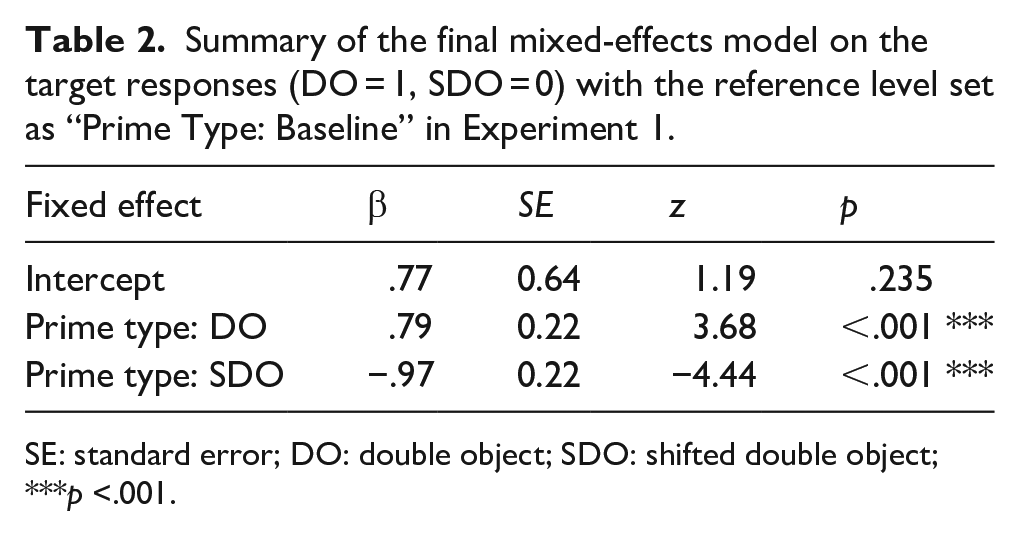
SE: standard error; DO: double object; SDO: shifted double object; ***p <.001.
As shown in Table 2, the estimate of the intercept was positive and insignificant, indicating that the probability of observing DO responses (59%) was numerically increased than that of observing SDO responses (41%) in the baseline condition, without reaching significance. This means our Zhuang-speaking participants were no more likely to use the DO construction than the SDO construction when describing a target picture in the baseline condition because both structures occur frequently and sound natural. Importantly, the estimate of DO was positive and significant (β = .79, SE = 0.22, p < .001), indicating that the probability of observing DO responses significantly increased under the DO prime condition (65%) compared with the baseline condition (59%). In contrast, the estimate of SDO was negative and significant (β = −.97, SE = 0.22, p < .001), suggesting that the probability of observing DO responses significantly decreased under the SDO prime condition (48%) compared with the baseline condition (59.02%).
To address potential concerns about our sample size, we conducted post hoc estimations of the size of priming effect detected in Experiment 1. Following the procedure and formulas detailed in Mahowald et al. (2016, pp. 4–5) and X. Chen et al. (2022, p. 5), the odds ratio is 0.699 (95% CI = [0.539, 0.859]). Converting this odds ratio into an estimate of a Cohen’s d standardised effect size returns an effect size of d = 0.385, indicative of a small-to-medium-sized effect per Cohen’s original rubric (Cohen, 1977).
Discussion
Experiment 1 showed that participants’ responses were affected by the prime sentence that they had just encountered. Specifically, there were significantly more DO responses following DO primes than following SDO and baseline primes. Similarly, there were significantly more SDO responses following SDO primes than following DO and baseline primes.
The results of Experiment 1 replicated the main results from German (Köhne et al., 2014; Pappert & Pechmann, 2014). Recall that in their Experiment 1, Köhne et al. (2014, Table 1) did not find priming effects of SDO compared with the baseline, and the proportion of SDOs (13.6%) appeared much lower than that of DOs (68.5%) even in the baseline condition. However, we found significant priming effects of SDO relative to the baseline, with a comparable production rate of SDO (41%) and DO (59%) in the baseline condition. Clearly, the priming effect of SDO in Zhuang is more robust than what was reported in existing work on shifted-structures in German (Köhne et al., 2014; Pappert & Pechmann, 2014) and English (Pickering et al., 2002).
Crucially, the responses of DO by SDO primes and SDO by DO primes in Experiment 1 were significantly less than by the baseline, respectively. These results indicated that DO and SDO sentences did not prime one another, even though both types of sentence involved the same mappings of thematic roles to grammatical functions. Recall that if an independent stage of functional processing did exist, DO and SDO would have primed each other. Hence, these results are inconsistent with the Thematic–Function account. Rather, the results of Experiment 1 seemed to follow the Thematic-Order account. According to the thematic-order account, thematic roles can be directly mapped onto the surface word order. Since DO and SDO possess different mapping patterns of thematic roles to word order, it is not surprising that they did not prime each other.
Experiment 1 showed that DO and SDO primes had different patterns of priming, indicating that they should have different syntactic representations. However, just as in previous research on other languages, the DO/SDO alternation in Zhuang is potentially confounded by thematic roles and animacy because the Recipient was always animate and the Theme was always inanimate in DO and SDO. Cross-linguistically, this kind of animacy configuration is canonical, enabling the animacy features operative at the conceptual level to align with thematic roles. As mentioned in the “Introduction,” the classic work on English active/passive alternation by Bock et al. (1992) has shown the order of animate vs. inanimate referents can be primed, and this finding is recently replicated by X. Chen et al. (2022) with a larger sample of 496 than the original (N = 192). However, other research on dative constructions has failed to find an independent effect of animacy ordering on priming effect (e.g., Buckle et al., 2017; Huang et al., 2016). Given that existing findings are mixed, it is worth further examining whether the priming effect found in Experiment 1 was partly due to the intrinsic animacy of DO and SDO. Thus, we further conducted Experiment 2, aiming to separate the impact of animacy from that of thematic roles.
Experiment 2
Our goal of Experiment 2 was to investigate whether the animacy features of the Theme in prime sentences would affect priming effects. Thus, in addition to the prime type (DO vs SDO), we also manipulated the animacy features of the Theme (animate vs inanimate). If priming occurs regardless of whether the animacy features are identical or not between the primes and the targets, it would suggest that the structural priming effects detected in Experiment 1 arose solely from the thematic-role mapping but not from the animacy mapping. However, if priming does not occur when the animacy features are not repeated, the structural priming effects detected in Experiment 1 would be in part accounted for by the animacy mapping, in addition to the thematic-role mapping.
Method
Participants
Overall, 36 native speakers of Zhuang (12 female, Mage = 27.5 years, SD = 7.6) participated in the experiment in exchange of 50 yuan. None of them took other experiments.
Materials
We manipulated the animacy of the Theme in primes (animate vs. inanimate) and the prime type (DO vs. SDO), yielding four priming conditions (DO-Ani, SDO-Ani, DO-Inani, and SDO-Inani), as in (3a–d). In the targets, the animacy of the Theme was always inanimate. Thus, out of the four prime conditions, the animacy of the Theme matched with that of the target in the DO-Inani and SDO-Inani conditions, but mismatched with that of the target in DO-Ani and SDO-Ani conditions. In addition, we also created a baseline, just as (2) in Experiment 1.
(3) Sample stimuli in Experiment 2 a. DO-Ani Lvaux banj cek-haej genglij puj gongz nyenz ndiz. boss lend(-to) manager CL worker a “The boss lends the manager a worker.” b. SDO-Ani Lvaux banj cek-haej puj gongz nyenz ndiz genglij. boss lend-to CL worker a manager “The boss lends the manager a worker.” c. DO-Inani Lvaux banj cek-haej genglij aen ce ndiz. boss lend-to manager CL car a “The boss lends the manager a car.” d. SDO-Inani Lvaux banj cek-haej aen ce ndiz genglij. boss lend-to CL car a manager “The boss lends the manager a car.”
We created 30 sets of experimental stimuli. Due to the difficulty in finding appropriate verbs with argument structures of different animacy features, 10 ditransitive verbs (see the Supplementary Material B) were used three times. As in Experiment 1, the verb used in the prime sentence and the target picture in this experiment was the same. Experimental stimuli were counterbalanced into five lists using Latin Square. Each list contained 30 experimental trials, with 6 each from the four priming and baseline conditions, along with 90 filler transitive sentences. All the experimental trials and filler trials in each list were pseudo-randomised such that no three experimental trials occurred in a row.
Procedure and scoring
The same procedure and scoring were used as in Experiment 1.
Results
Out of 1,080 responses, 475 (43.98%) were DO responses, 547 (50.65%) were SDO responses, and 58 (5.37%) were other responses.
Table 3 shows the distribution of these responses and the proportion of DO responses out of DO and SDO responses as a function of priming conditions. Participants produced most DO responses following DO primes (DO-Ani: 58%; DO-Inani: 57%), intermediate following Baseline (47%), and fewest following SDO primes (SDO-Ani: 32%; SDO-Inani: 38%). These patterns indicate that regardless of animacy, the production rate of DO construction increased by 10.5%, i.e., ([0.58–0.47] + [0.57–0.47,]/2) on average in the two DO prime conditions compared with the baseline condition. This means the production rate of SDO construction which was complementary to that of DOs, i.e., ([1–0.32] + [1–0.38])/2, increased by 12%, i.e., ([0.68–0.53] + [0.62–0.53,]/2), on average in the two SDO prime conditions compared with the baseline condition.
Response counts and proportion of DO responses out of DOs and SDOs by prime condition in Experiment 2.
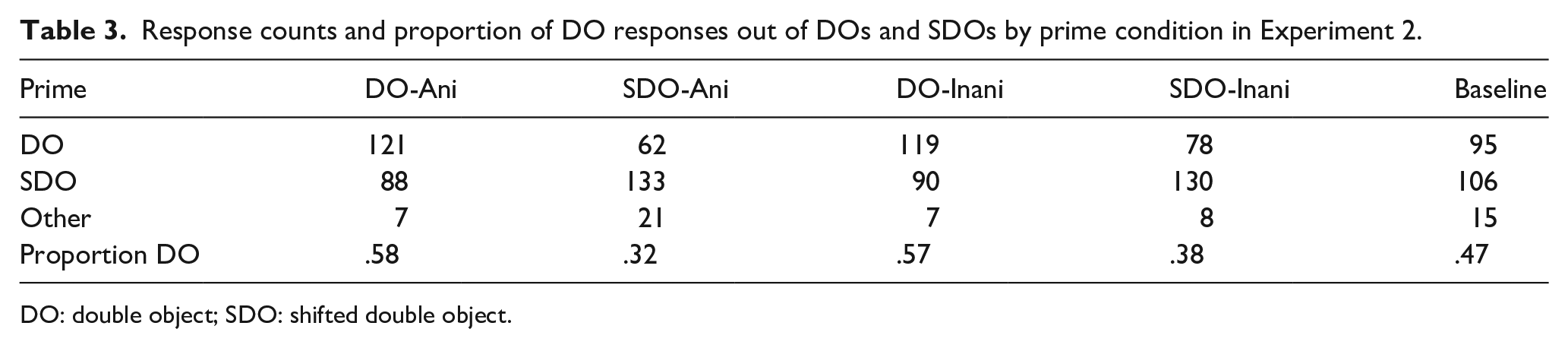
DO: double object; SDO: shifted double object.
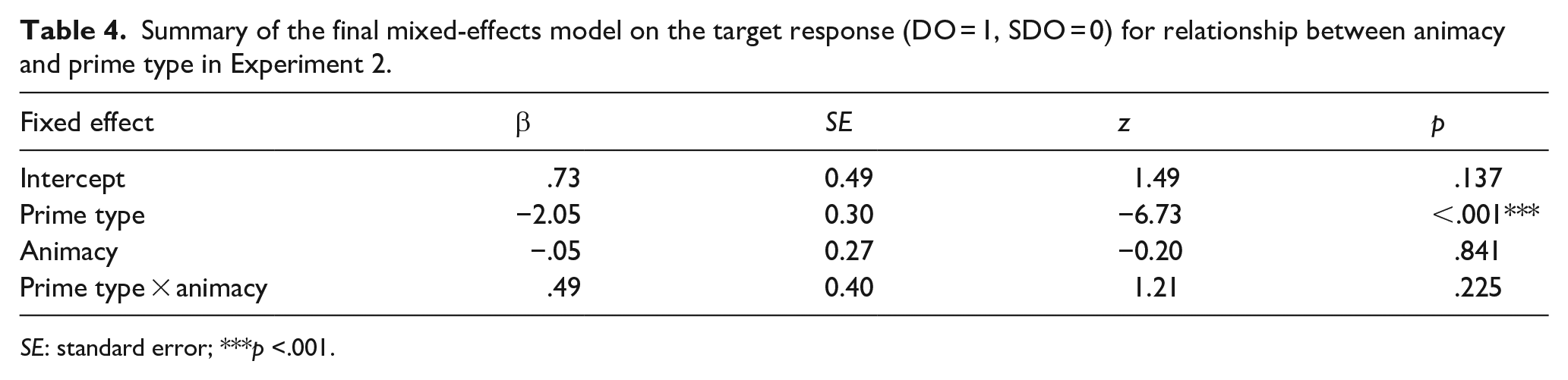
To find out whether animacy affects priming effects, we fit a generalised logistic mixed-effects model on the binomial target response (DO = 1, SDO = 0), with prime type (DO vs SDO), animacy of the Theme (animate vs inanimate), and their interaction as fixed factors. The random factors included random slopes and intercepts for participant and item. When the model failed to converge, we gradually reduce the random-effect structure by removing random slopes on items first. However, the models kept failing to converge even with random intercepts only. Following Huang and Li (2020), we set the iteration number as 20,000 and the model with intercepts only succeeded to converge. The results are reported in Table 4, showing a main effect of prime type only, with no main effect of animacy, and no interaction between prime type and animacy.
Summary of the final mixed-effects model on the target response (DO = 1, SDO = 0) for relationship between animacy and prime type in Experiment 2.
SE: standard error; ***p <.001.
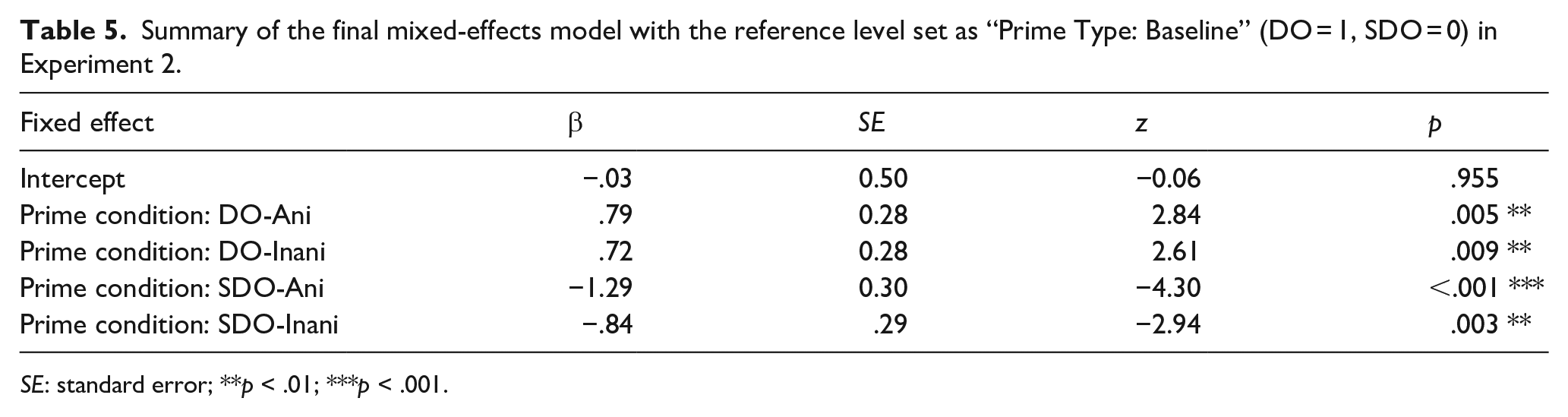
We then further evaluated, as in Experiment 1, whether the likelihood of producing DO was increased by only DO primes (including two conditions: DO-Ani and DO-Inani), compared with the baseline. When fitting generalised logistic mixed-effects models, the dependent variable was the number of DO responses (DO = 1, SDO = 0), and the fixed factor was the prime type, which contained five levels: DO-Ani, DO-Inani, SDO-Ani, SDO-Inani, and Baseline. As the random slopes did not significantly improve the model fit, the best fit model only included random intercepts.
Table 5 shows that the estimate of DO-Ani was positive and significant, indicating that the probability of observing DO responses significantly increased under DO-Ani prime condition (58%) compared with the baseline condition (47%). Likewise, the estimate of DO-Inani was positive and significant, indicating that the probability of observing DO responses significantly increased under DO-Inani prime condition (57%) compared with the baseline condition (47%). Thus, compared with the baseline condition, both DO-Ani and DO-Inani primed DOs (but not SDOs).
Summary of the final mixed-effects model with the reference level set as “Prime Type: Baseline” (DO = 1, SDO = 0) in Experiment 2.
SE: standard error; **p < .01; ***p < .001.
In contrast, the estimate of SDO-Ani was negative and significant, suggesting that the probability of observing DO responses significantly decreased under SDO-Ani prime condition (32%) compared with the baseline condition (47%). Similarly, the estimate of SDO-Inani was negative and significant, suggesting that the probability of observing DO responses significantly decreased under SDO-Inani prime condition (38%) compared with the baseline condition (47%). Thus, both SDO-Ani and SDO-Inani primed SDOs (but not DO), compared with the baseline condition.
As in Experiment 1, we also conducted post hoc estimations of the size of priming effect for Experiment 2. The log odds ratio is 0.934 (95% CI = [0.79, 1.078]). Converting it into an estimate of the standardised Cohen’s d yields an effect size of d = 0.513, suggesting a medium-to-large-sized effect of structural priming for Experiment 2.
Discussion
In our Experiment 2, with an additional manipulation of the animacy of the Theme across primes and targets, we found no additive priming effects attributable to animacy. This result is consistent with previous findings from Mandarin (e.g., X. Chen et al., 2020; Huang et al., 2016; Xiang et al., 2022) and German (e.g., Köhne et al., 2014), suggesting that the structural priming effects observed in our experiments on Zhuang had little to do with the mapping of animacy.
If animacy features between primes and targets did play a role in the priming effects, we should have observed the priming effects in the DO-Inani and SDO-Inani conditions only because the prime and target sentences in these two conditions were fully matched in syntactic structures and in animacy configurations (that is, the direct object was always inanimate and the indirect object, animate). However as a matter of fact, we did find the priming effects in the DO-Ani and SDO-Ani conditions as well. Given that the prime sentences in these two conditions had the double-animate configuration (i.e., both the direct object and the indirect object were animate), which was different from the animacy configuration of the target sentences, the fact that priming effects nevertheless arose suggests that what counts is the identical thematic roles shared between the prime and the target, not the identical animacy configuration. Such monotonous priming effects across animacy configurations thus indicate that animacy was not involved in the current study.
Crucially, the responses of DO by SDO-Ani or SDO-Inani primes and SDO by DO-Ani or DO-Inani primes in Experiment 2 were significantly less than by the baseline, respectively. These results go a step further, confirming the findings in Experiment 1 that DO and SDO sentences did not prime one another with the animacy being controlled. Hence, just as Experiment 1, results in Experiment 2 were inconsistent with the Thematic–Function account. Rather, they were consistent with the Thematic-Order account.
In sum, the results of Experiment 2 showed that both DO and SDO manifested within-structure priming effects, regardless of whether the animacy of the Theme in priming sentences (with other animacy features being equal) matched with that of targets. It indicates that the additional manipulation of animacy in Experiment 2 brought no changes in the priming pattern of DO and SDO. This substantiates the validity of the findings from Experiment 1, confirming that structural priming effects observed from DO and SDO prime sentences came purely from the mapping of thematic roles.
General discussion
In this study, we set out to investigate a long-standing issue in sentence production, namely whether grammatical encoding involves two stages or just one stage, using the double-object alternation construction in Zhuang. In two structural priming experiments, we found within-structure priming effects but no between-structure priming effects (Experiments 1 and 2), and such priming effects were independent of animacy mapping (Experiment 2). Taken together, our results lend support to the Thematic-Order account of the one-stage model, but are difficult to reconcile with the Thematic–Function account of the two-stage model.
The Thematic–Function account claims that there exists an independent functional level where thematic roles map to grammatical functions, yielding an unordered dominance-only hierarchical structure, and then via linearisation, the surface word order is established at the positional level. The DO and SDO constructions in Zhuang share the same mapping of thematic roles to grammatical functions, with the Recipient being mapped to the Indirect Object, and the Theme to the Direct Object, resulting in an unordered structure (i.e., S NPSUB [VP V NPDO NPIO]), which can be realised in two kinds of linear ordering. Thus, Thematic–Function account predicts that DO and SDO with the same representation (at the functional level) should prime each other (at the positional level). However, results from our experiments showed that DO and SDO only manifested within-structure priming effects but no between-structure priming effects. Furthermore, as confirmed by Experiment 2, such within-structure priming effects were not influenced by the animacy features at the conceptual level. Hence, these consistent results provide strong evidence against the two-stage model.
Instead, our results are compatible with the Thematic-Order account, which claims that thematic roles are mapped to the surface word order directly, without necessarily passing through the intermediate stage of grammatical functions. Because the DO and SDO constructions in Zhuang differ in the word order, such that the Recipient maps onto the first post-verbal position and the Theme onto the second post-verbal position in the DO construction, but the Thematic-Order mapping is reversed in the SDO construction, no priming effects should be expected between structures, such as DO and SDO. Indeed, we failed to detect any priming effect between DO and SDO in both experiments 1 and 2. Therefore, our findings demonstrate that the order of thematic roles at the conceptual level can trigger priming, providing additional evidence for the Thematic-Order mapping in support of the one-stage model (Cai et al., 2012; Chang et al., 2003; Köhne et al., 2014; Pappert & Pechmann, 2014). Our study also provides novel evidence showing that Zhuang speakers represent DO and SDO as two distinct structures.
While our overall results provide evidence for the one-stage model, we recognise that there could be a few sources from which arises the consistent within-structure priming in Zhuang DO/SDO alternations. In a thorough review of existing priming studies on passives and other constructions, Ziegler et al. (2019, pp. 7–8, Tables 3 and 4) suggest that priming can be attributed to a number of factors, including lexical content, semantic event structure, information structure, syntax-animacy mappings, and content-less syntactic phrase structure. In terms of lexical content and the presence or absence of morphemes, Zhuang has no morpho-syntactic markers for gender, number, or case, and the lexical items involved in the DO/SDO constructions are exactly the same. Thus, the structural priming effects consistently found in our study could not have arisen from the inflectional information of surface structure, a factor identified in German DO/SDO alternation (Köhne et al., 2014; Pappert & Pechmann, 2014). Repeating verbs in prime and target sentences might potentially boost our priming effects, but existing work has shown that structural priming persists despite lexical boost (Branigan et al., 2000; Pickering & Branigan, 1998) and that priming effects persists with or without lexical overlap (Hartsuiker et al., 2008). Thus, it is unlikely that lexical content would affect our critical findings of within-construction priming but no across-construction priming.
In terms of syntax-animacy mappings, our Experiment 2 clearly shows that within-structure priming persists even when the animacy configuration of the prime sentences differed from that of the target sentences, thus ruling out animacy mapping as the underlying factor.
In terms of information structure, existing work has shown syntactic structure (e.g., it-cleft) emphasising the patient or the agent influences structural priming (e.g., Bernolet et al., 2009; Vernice et al., 2012). However, no overt cues are available in Zhuang DO/SDO alternation for “thematic emphasis,” rendering two post-verbal arguments equally prominent. If we follow the standard given-before-new principle for information structure assignment (Chafe, 1987; Gundel, 1988), then focus (or emphasis) is put on the Theme role in DO but on the Recipient in SDO. In this sense, the structural priming effects attested in our experiments could be attributed to potentially varying thematic emphasis in DO and SDO.
Event structures may also arguably differ in DO/SDO alternations in Zhuang. When discussing argument realisations of English dative alternations, Levin and Rappaport Hovav (2005, p. 207) posit that the DO construction can be decomposed into a HAVE predicate embedded within a CAUSE predicate (Agent CAUSE [Recipient HAVE Theme]), whereas the PO construction contains an embedded BE AT predicate (Agent CAUSE [Theme BE AT Recipient]). Following this line of reasoning, we speculate that the event structure of SDO in Zhuang might resemble that of PO in English. As argued by Chinese dialectologists, prepositions in PO tend to be dropped by speakers, leading to emergence of SDO (Tang, 1993; Xiang, 1997; L. Xu & Peyraube, 1997; Zhang, 2011). In Cantonese—a representative language of southern dialects in China—verbs in PO and SDO are subject to identical semantic constraints, indicating that SDO is derived from PO over time (L. Xu & Peyraube, 1997). In functional typology work, Cantonese SDO was borrowed from the Tai–Kadai language group, to which Zhuang belongs (Hashimoto, 1976; Peyraube, 1981). Assuming that SDO in Zhuang underwent similar diachronic and derivational processes from PO as in Cantonese or southern dialects in general, then Zhuang speakers might have distinct event-structure representations for DO and SDO. We leave it as an open question regarding whether event-structure changes have impact on structural priming, as the current evidence is still mixed (e.g., Bock & Loebell, 1990, cf. Bunger et al., 2013; Ziegler et al., 2018).
Conclusion and future directions
The current study uses Zhuang, an isolating minority language, to investigate the source of grammatical encoding structural priming effect. Our results from two experiments on Zhuang DO/SDO alternations revealed that the DO only primed DO target responses, and SDO only primed SDO target responses, suggesting Zhang speakers had a direct conceptual-to-linear mapping when formulating utterances. Importantly, such within-structure priming patterns were independent of animacy. The consistent within-structure priming effects are supportive of the one-stage model of grammatical encoding. To our knowledge, this is the first psycholinguistic study on structural priming of dative alternations in Zhuang. Our study proves it is fruitful to evaluate competing theories by examining languages that are rarely investigated.
A limitation, however, is that our sample size was rather small given the current standard (Brysbaert, 2019; Mahowald et al., 2016). This can be addressed in the future through properly powered studies testing whether our findings can be replicated.
Supplemental Material
sj-docx-1-qjp-10.1177_17470218221137063 – Supplemental material for Grammatical encoding of double-object alternations in Zhuang: Evidence for the one-stage model
Supplemental material, sj-docx-1-qjp-10.1177_17470218221137063 for Grammatical encoding of double-object alternations in Zhuang: Evidence for the one-stage model by Keshu Xiang and Fuyun Wu in Quarterly Journal of Experimental Psychology
Footnotes
Declaration of conflicting interests
The author(s) declared no potential conflicts of interest with respect to the research, authorship, and/or publication of this article.
Funding
The author(s) disclosed receipt of the following financial support for the research, authorship, and/or publication of this article: This research was supported by Shanghai Social Science Foundation (2019BYY005).

Data accessibility statement
Supplementary material
The supplementary material is available at qjep.sagepub.com.
Notes
References
Supplementary Material
Please find the following supplemental material available below.
For Open Access articles published under a Creative Commons License, all supplemental material carries the same license as the article it is associated with.
For non-Open Access articles published, all supplemental material carries a non-exclusive license, and permission requests for re-use of supplemental material or any part of supplemental material shall be sent directly to the copyright owner as specified in the copyright notice associated with the article.
