







Abstract
It is well established that negative emotions influence a range of cognitive processes. How these emotions influence the metacognitive judgement individuals make about their own performance and whether this influence is similar depending on the conditions under which metacognition is assessed, however, is far less understood. The primary aim of this study was to determine whether exposure to emotional stimuli could influence metacognitive judgements made under short or long time constraints. A total sample of 144 young adults (aged 18–35 years) was recruited and asked to complete an arithmetic strategy selection task under emotional or neutral condition. Following each strategy selection trial, participants also provided a retrospective confidence judgement (RCJ). Both strategy selection and RCJ were collected under short or long time constraints (1,500 vs. 2,500 ms for strategy selection and 800 vs. 1,500 ms for RCJ). In addition to replicating previous findings showing lower rates of better strategy selection under negative emotions compared with neutral condition, an effect of negative stimuli on the accuracy of participants’ confidence judgements was found, but only if participants had a short time limit to make their second-level evaluation. Such findings are consistent with the hypothesis that exposure to emotional stimuli disturbs early, but not late metacognitive processes and have important implications to further our understanding of the role of emotions on metacognition.
Introduction
The influence of emotions on cognition has received a lot of attention over the past decades. This influence has been examined in as varied domains as memory, attention, arithmetic, or decision-making (De Houwer & Hermans, 2010; Lemaire, 2022; Robinson et al., 2013, for overviews). Emotions can either improve (e.g., memory advantage for emotional as compared with neutral events; Yonelinas & Ritchey, 2015) or disrupt (e.g., poorer recognition performance when stimuli are encoded under stress condition; Davis et al., 2019) performance, depending on whether emotions are relevant to the task and/or to participants’ past emotional experience. Specifically, task-relevant emotions have been shown to improve performance while irrelevant emotions are associated with a decrease in performance (e.g., Blanchette & Campbell, 2012; Talamini et al., 2022).
As emotionally valenced information is generally assumed to more readily capture people’s attention than emotionally neutral information, authors usually assume that exposure to emotional conditions results in deleterious effects on cognitive performance when emotional stimuli detract participants’ attention away from the target task (e.g.,Öhman et al., 2001; Verbruggen & De Houwer, 2007; Yiend et al., 2013) and in better performance when the redirection of attentional resources enables deeper information processing (e.g., Blanchette et al., 2014). While the role of emotions has been well documented in a wide variety of cognitive domains, little is currently known about their impact on people’s ability to self-monitor cognitive performance (i.e., metacognition) and the conditions under which such an influence occurs.
Until now, no studies have examined the effects of positive emotions on metacognition. The few available results concern negative emotions and suggest either beneficial or deleterious influence of these emotions on metacognition, depending upon contexts (e.g., Culot et al., 2021; Massoni, 2014). For instance, after inducing an anxious state using threat of monetary losses, Massoni (2014) found better metacognitive performance under negative than neutral emotion condition. By contrast, Culot et al. (2021) have recently found that emotional threat (i.e., induced by randomly administering electric shocks following the metacognitive response) perceived as unrelated to metacognitive performance could decrease the accuracy of metacognitive judgements. Similarly, Desender and Sasanguie (2022) have reported a disruption of metacognition due to internally triggered emotions, showing less accurate metacognitive judgements on an arithmetic task in participants with high levels of math anxiety (for similar results with participants under stress while making judgements on a perceptual decision task, see Reyes et al., 2015).
In contrast to this set of data showing an influence of both internally and externally induced negative emotions on metacognition, several studies found no changes in metacognitive judgements under emotional conditions (e.g., Davis et al., 2019; Geurten & Lemaire, 2022; Ifcher & Zarghamee, 2014; Tauber & Dunlosky, 2012). Recently, for instance, Geurten and Lemaire (2022) asked participants to accomplish a better strategy selection task while solving arithmetic problems followed by direct (i.e., in retrospective confidence judgements—RCJs; Expt 1) or indirect (i.e., using an opt-out option to skip items; Expt 2) metacognitive evaluations. Decrease in metacognitive accuracy under emotional condition was found when metacognition was assessed indirectly, but no variations in metacognitive performance as a function of emotions were observed when classical RCJs were collected. Such findings suggest that some metacognitive processes may be more sensitive than others to negative emotions. Specifically, in this study, the authors proposed that the indirect metacognitive assessments relied more heavily on automatic processes than the classical explicit metacognitive evaluation (which could call upon either automatic or deliberate processes depending on the task conditions; e.g., Koriat et al., 2004) and that fast, automatic processes could be more sensitive to emotional manipulations than slower, analytical metacognitive decisions.
Interestingly, such a dual path is frequently proposed by models of metacognition (Koriat, 2007; Koriat et al., 2008; Koriat & Levy-Sadot, 1999). According to these models, metacognitive judgements can be made, on one hand, through automatic, intuitive inferences based on a variety of cues that reside in immediate feedback from task performance. Such inferences give rise to a fast metacognitive feeling that is used by individuals to make quick and effortless experience-driven judgements. On the other hand, metacognitive judgements could be made via analytic inferences in which various pieces of evidence are processed and weighed before reaching an information-driven decision. The idea is that deliberate, but slower, analytical systems can override intuitive responses when costs/benefits of extra-efforts outweigh fast and easy (but less accurate) judgements or when context (e.g., a short time to make judgements) do not force participants to fast and frugal evaluations (Alter et al., 2007). Both behavioural and neuroimaging evidence supports dissociation between these two types of processes (e.g., Fleming et al., 2016; Gilovich et al., 2002; Koriat et al., 2004; Kornell et al., 2011; Undorf & Zimdahl, 2019). For instance, electroencephalogram (EEG) data revealed both late (1,300–1,900 ms) and early (350–950 ms) electrophysiological responses associated with metacognitive performance when participants make judgements (e.g., Müller et al., 2016; Skavhaug et al., 2010; Tsalas et al., 2018; Wokke et al., 2017). Evidence for two different types of mechanisms underlying metacognitive judgements suggests that each type may be affected by different factors or by the same factor to different levels. One such potential factor of interest here concerns emotions.
To date, evidence suggests that emotions can influence metacognition and reveals the presence of both early (intuitive) and late (analytical) metacognitive mechanisms. Whether, and if yes, how emotions influence each or both of these mechanisms, however, is unknown. In this context, the primary aim of this study was to determine whether emotions influence early, late, or both metacognitive processes. To do so, participants were recruited and instructed to complete an arithmetic strategy selection task under emotional or neutral condition. We tested arithmetic as previous works showed that this domain is appropriate to investigate the role of negative emotions on metacognitive judgements (Geurten & Lemaire, 2022) and on participants’ performance (e.g., Desender & Sasanguie, 2022; Fabre & Lemaire, 2019; Lallement & Lemaire, 2021), as well as the benefits of accurate metacognition on performance (Geurten & Lemaire, 2017, 2019, 2022).
In line with a number of previous studies, we investigated the role of emotions using a within-induction emotion procedure where participants see an emotionally negative (or neutral) picture unrelated to the task before the target arithmetic task (e.g., Fabre & Lemaire, 2019; Geurten & Lemaire, 2022; Kleinsorge, 2009; Lallement & Lemaire, 2021; Schimmack, 2005, for examples in arithmetic). Following strategy selection on each problem, participants had to provide an RCJ on their strategy choice (i.e., they had to state whether they are confident or not in having selected the better strategy). Here, we compared the effects of negative stimuli on accuracy of early metacognitive, experience-based judgements and on late metacognitive, information-based judgements by implementing a time constraint to both the strategy selection and confidence judgement tasks. Specifically, a short (1,500 ms) or long (2,500 ms) time limit was set for the strategy selection phase with the aim of examining whether time constraints could modulate the effect of negative stimuli on the cognitive response. Regarding the judgement phase, a short (800 ms) or a long (1,500 ms) time limits were also determined on the basis of prior studies showing early metacognitive response around 350–950 ms and a late metacognitive response around 1,300–1,900 ms after the processing of the cognitive information (e.g., Tsalas et al., 2018; Wokke et al., 2017).
The following hypotheses and predictions were tested. Generally, exposure to task-irrelevant negative emotional stimuli is shown to impair performance. If exposure to such stimuli disturb more earlier than later strategy selection and metacognitive judgements, we expect a stronger impact of negative emotions on both strategy selection and metacognitive performance under short as compared with the long time constraint. By contrast, if negative emotional context impacts more later than earlier cognitive and metacognitive processes, a stronger effect of emotional stimuli should be observed when responses are provided after a longer delay. Our design enabled us to also test the possibility that emotions influence both early and late strategy selection and metacognitive judgements, to the same or different extents. This possibility predicts either significant and comparable effects of emotions under short and long time limits or significant effects (but with different magnitudes) of emotions under short and long time limits.
Method
Participants
A final sample of 144 young adults (77 females) recruited online on Prolific (http://www.prolific.co) was included in this experiment. They were paid 7.5 £/hr for their participation. Any registered person on Prolific who mentioned being a native English speaker was allowed to participate independently of their country of origin. Native English speakers from the United Kingdom (N = 132), the United States (N = 10), and unspecified country (N = 2) composed this sample. Additional data for seven participants were collected but not included in the analyses, because their error rates for strategy selection were ⩾50%, and the total duration time of their testing was very short (<1,000 ms/problem), suggesting that they only responded by chance. Age in the final sample ranged from 18 to 35 years (M = 28.01 years; SD = 4.73). This study was approved by the National Ethics Committee in France (Ref #: SI CNRIPH 20.04.02.47414), and participants’ informed consents were obtained before the study started. The sample size was determined a priori. Specifically, power analyses for classical analyses of variance were computed to reach a predicted power of .80 (α = .05, β = .20) for a triple Selection Time × Judgement Time × Emotion Condition interaction (small effect size, f = .15; Cohen, 1988), with Emotion Condition as the only within-participant factor. The minimum sample size required was 128 participants.
Stimuli
Arithmetic problems
Forty-eight multiplication problems presented in a standard form (i.e., a x b) with the operands a and b being two-digit numbers were used as stimuli in the study. In all problems, the unit digit of one operand was <5 while that of the other operand was >5 (e.g., 32 × 69). Half the problems were best estimated (i.e., closest products from the correct products) with the rounding-down (RD) strategy (e.g., 86 × 21). The other problems were best estimated with the rounding-up (RU) strategy (e.g., 84 × 47). Based on absolute differences in mean percent deviations between estimates and correct products (calculated with the following formula: ([1 – correct product]/correct product] × 100) yielded by the RD and RU strategies, two types of problems were selected. The better strategy was easier to find on the so-called easier problems than on the so-called harder problems. The side of the larger operand (i.e., half the problems of each category had their largest operand on the left position and half on the right position) and the side of the operand with the smallest unit digit (i.e., the operand with the smallest unit digit was in the left position in half the problems and in the right position in the other problems) were counterbalanced. Based on previous findings in arithmetic (see Kadosh & Dowker, 2015; Knops, 2020, for overviews), we also ensured that (a) no operand had a 0 or a 5 as unit digit, (b) digits were not repeated within operands (e.g., 22 × 56), (c) digits were not repeated in the same unit or decade positions across operands (e.g., 52 × 57), and (d) no reverse order of operands was used (e.g., 46 × 23 vs. 23 × 46). Finally, we controlled that the size of the correct products and the mean percentage deviations between correct products and estimates were similar for both RU and RD problems.
Emotional stimuli
To manipulate the emotional context, 96 pictures were selected from the International Affective Photo System (IAPS; Lang & Bradley, 2007). Forty-eight pictures were emotionally negative (M arousal = 5.94; SD = 0.55; M valence = 2.64; SD = 0.5), and 48 pictures were emotionally neutral (M arousal = 2.62; SD = 0.32; M valence = 4.96; SD = 0.21). Emotional valence (i.e., whether the stimulus is judged negative or neutral) and arousal (i.e., whether the stimulus is judged strong or weak) were balanced across problem types (see Table 1).
M valence and arousal for each category of problems (SDs in parentheses).
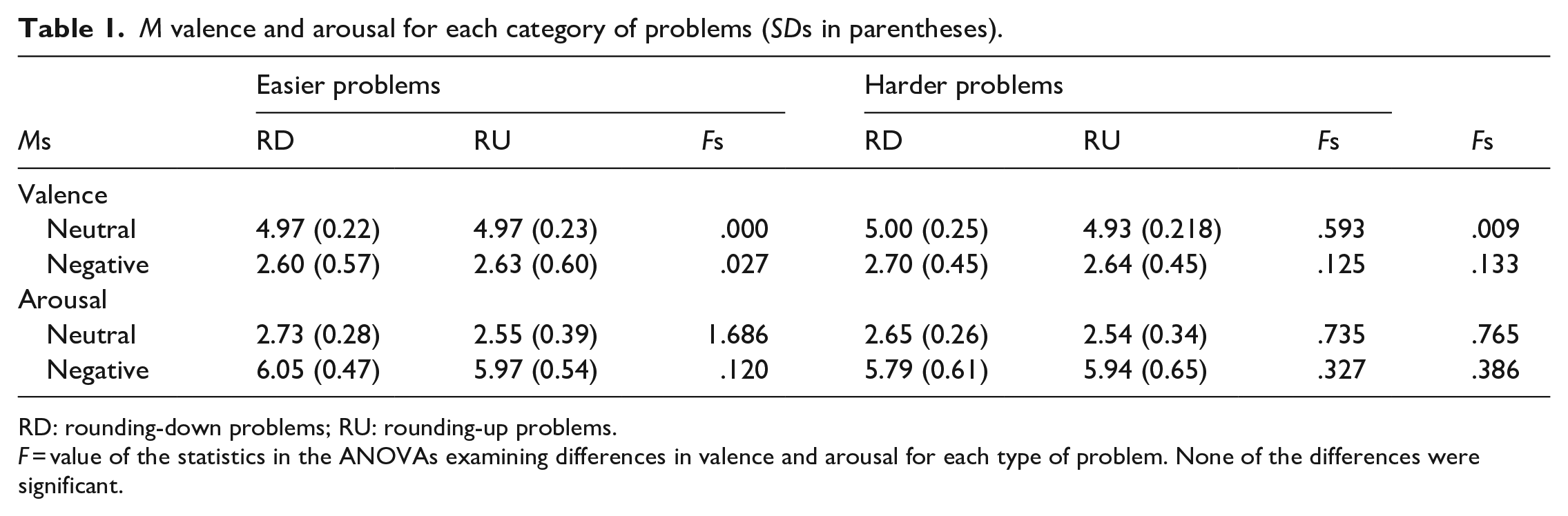
RD: rounding-down problems; RU: rounding-up problems.
F = value of the statistics in the ANOVAs examining differences in valence and arousal for each type of problem. None of the differences were significant.
Procedure
Participants underwent an approximately 20–30 min session during which they completed a strategy selection task and provided a retrospective confidence judgement on each trial. Both the strategy selection task and RCJ could be made either under strong or weak time constraint, depending on the experimental condition. For the strategy selection task, following previous studies on arithmetic strategies (e.g., Ardiale & Lemaire, 2012; Lemaire & Brun, 2016), the shorter allocated response time was set to 1,500 ms and the longer allocated time was set to 2,500 ms. On the basis of prior results in the metacognitive field (e.g., Tsalas et al., 2018; Wokke et al., 2017), the shorter time limit for the RCJ was set to 800 ms and the longer time limit was set to 1,500 ms. Participants were randomly assigned to one of these four experimental conditions (i.e., N = 36 in “Long selection—Long judgement”; N = 34 in “Long selection—Short judgement”; N = 37 in “Short selection Long judgement”; and N = 37 in “Short selection—short Judgement”). No differences were found between these four experimental groups in terms of age, F(3, 140) = .23, p = .87, or gender, χ²(144) = 3.86, p = .28. All participants started with an initial practice phase, including 12 arithmetic problems so as to get familiarised with the general procedure (no feedback was provided). The stimuli were presented in random order in a 40-point Arial font in the centre of the computer screen (see Figure 1). During the test phase, when participants failed to provide a response (for strategy selection or metacognitive judgement) within the allocated time, it was considered as a missing value. Missing values represented 5% of all the collected data here.
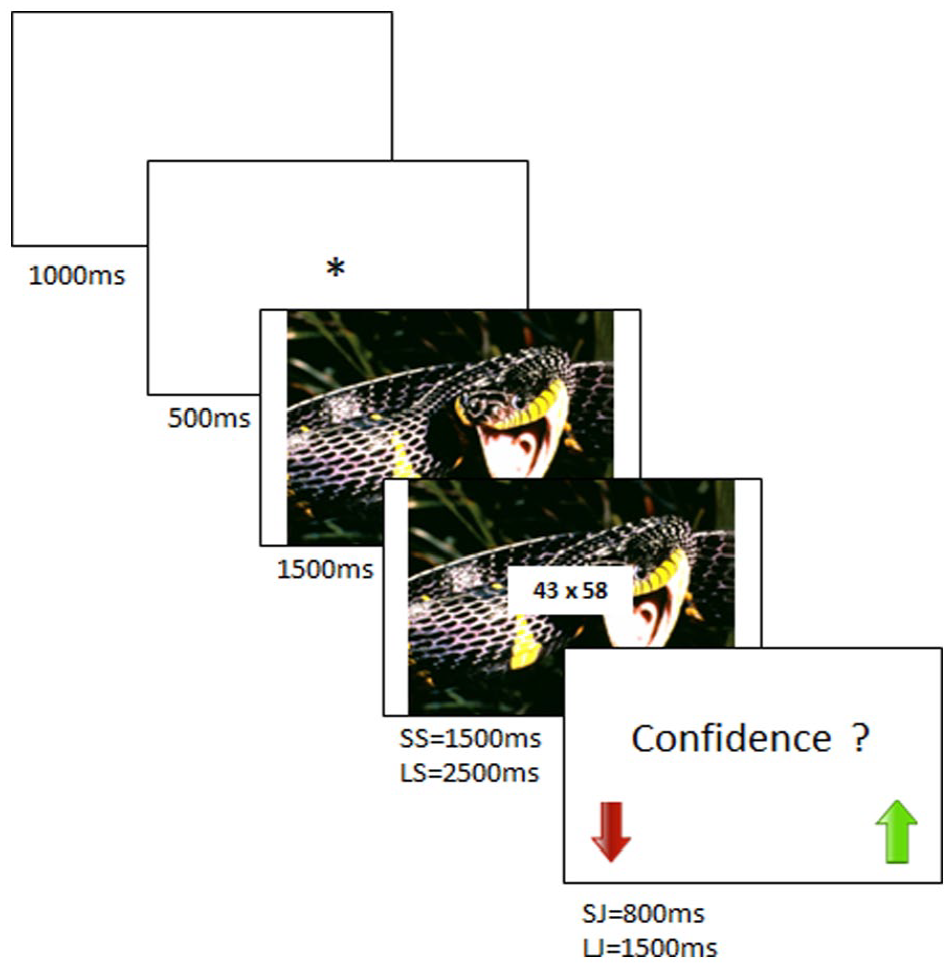
Description of the experimental procedure.
Strategy selection task
Several tasks in different domains could have been used to pursue our goals, as long as previous works found that emotions influence metacognitive judgements in the target cognitive tasks. In this project, we used a strategy selection task following up previous studies showing that negative emotions influence metacognitive judgements (Geurten & Lemaire, 2022). Also, following previous works where this computational estimation task has proved useful to investigate arithmetic processes (e.g., Lallement & Lemaire, 2021; Nicolas et al., 2020), such as encoding arithmetic problems, processing problem features, selection of best strategies, execution of component processes of each strategy, and outputting an approximate product. In this arithmetic strategy selection task, participants had to select the better strategy between two available strategies, rounding both operands down (RD strategy) or rounding both operands up (RU strategy) to their closest decades on each problem. Before starting, participants were described the two strategies and told that the better strategy for a given problem was the strategy that yielded the answer that was closest to the correct product for this problem. Participants were also informed that they will see pleasant and unpleasant pictures before each problem.
Each trial started with a 1,000 ms white screen followed by a fixation cross at the centre of the screen for 500 ms. Then, an emotionally negative (e.g., a car accident) or neutral (e.g., a flower) picture was displayed on the screen for 1,500 ms. Following this picture, the multiplication problem appeared superimposed on the picture until participants’ response or until the time limit is reached. The maximum time to select the better strategy on each trial was either 1,500 or 2,500 ms, depending on the selection-time condition (short vs. long). The shorter duration was selected on the basis of previous studies as the minimum delay necessary for young adults to provide a strategy selection rate higher than chance level (Lemaire & Brun, 2016). The problem was placed on a random location on the picture, so it was unpredictable from trial to trial. Below the multiplication problem, the two available strategies (RD or RU) were proposed, one on the right side of the screen and one on the left side. Participants had to press the right or the left response key to select their response. Participants completed 96 trials, divided into two blocks of 48 trials each. A short break was allowed between the two blocks.
RCJ
Each strategy selection was immediately followed by an RCJ during, which participants were instructed to indicate whether they were “sure” or “unsure” that they selected the better strategy on the previous problem. Specifically, in addition to the verbal label (“sure” vs. “unsure”), the “sure” response was represented by a green arrow pointing up, while the “unsure” response was represented by a red arrow pointing down. The two-point scale appeared until participants’ response or until the time limit is reached. The maximum judgement time was either 800 or 1,500 ms, depending on the judgement time condition (short vs. long) the participants were assigned in. A two-point scale was used instead of a broader scale to allow participants to make fast metacognitive decisions even under short time limit (i.e., decision time is usually slower when one has to choose between more alternatives). Furthermore, such a procedure allowed us to stay as close as possible to the metacognitive judgement procedure used by Geurten and Lemaire (2022).
Data analyses
Strategy selection
To test the effects of negative emotional stimuli and time constraints on both the accuracy and the reaction time (RT) of participants’ strategy selection, two generalised linear mixed-effects models were performed on an item-by-item basis. Participant was modelled as a random effect. The model included random intercepts and by-participant random slopes. For the accuracy scores, a binary-dependent variable coded whether participants successfully selected (coded 1) the better strategy on each trial or not (coded 0). For response latencies, only the latencies for correct strategy selection trials were included. The emotional valence (negative vs. neutral) on each trial was added as first-level predictor and the selection-time constraint (short vs. long) as second-level predictor. Cross-level interactions between these variables were also added to the model. The two main effect estimates were conditional upon set default values. Thus, the estimate of one level of the predictor represented its effect when the other was at its default value. The default value was “neutral” for the emotion type and “short” for the selection time, allowing us to determine whether changes in the experimental conditions significantly increase or decrease participants’ performance as compared with the conditions defined by default.
RCJs
The Meta-d′/d′ ratio (Mratio; see Fleming & Lau, 2014; Masson & Rotello, 2009) was used to estimate the accuracy of participants’ RCJ (i.e., giving a “sure” response after a correct selection and an “unsure” response after an incorrect selection). Mratio is a measure of the degree to which a participant can discriminate correct from incorrect decisions while controlling for the influence of participants’ performance at the cognitive level (metacognitive effectiveness). An Mratio >0 indicated above chance performance. An Mratio of 1 indicated that participants were as accurate at the metacognitive level than at the cognitive level. An Mratio >1 indicated that participants were able to draw additional information than was available at the cognitive level when making their metacognitive judgements (Fleming, 2017). As the Mratio could not be included in mixed-effect analyses here given that it could not be computed on an item-by-item basis, the effect of emotional stimuli and time constraints at both the selection and judgement levels were tested using a mixed-design analysis of variance (ANOVA), with selection time (short vs. long) and judgement time (short vs. long) as between-participant factors, and the emotional condition (neutral vs. emotion) as the only within-participant variable.
Results
Strategy selection
Accuracy of better strategy selection
Binomial mixed-effect modelling on the accuracy of better strategy selection only indicated an effect of emotion, β = −.23, SE = .03, z = 6.16, p < .001. Specifically, as can be seen in Table 2, participants were more likely to make better strategy selection in the neutral condition than in the emotional condition (.67 vs. .62). No other main or interaction effects involving selection time (short vs. long) came out significant, all βs < .01, z < .19, ps > .85.
Means proportions, standard errors (in parentheses), and ranges (in brackets) of better strategy selection and latencies for selecting the better strategy as a function of (neutral, negative) emotion and (short, long) selection-time conditions.
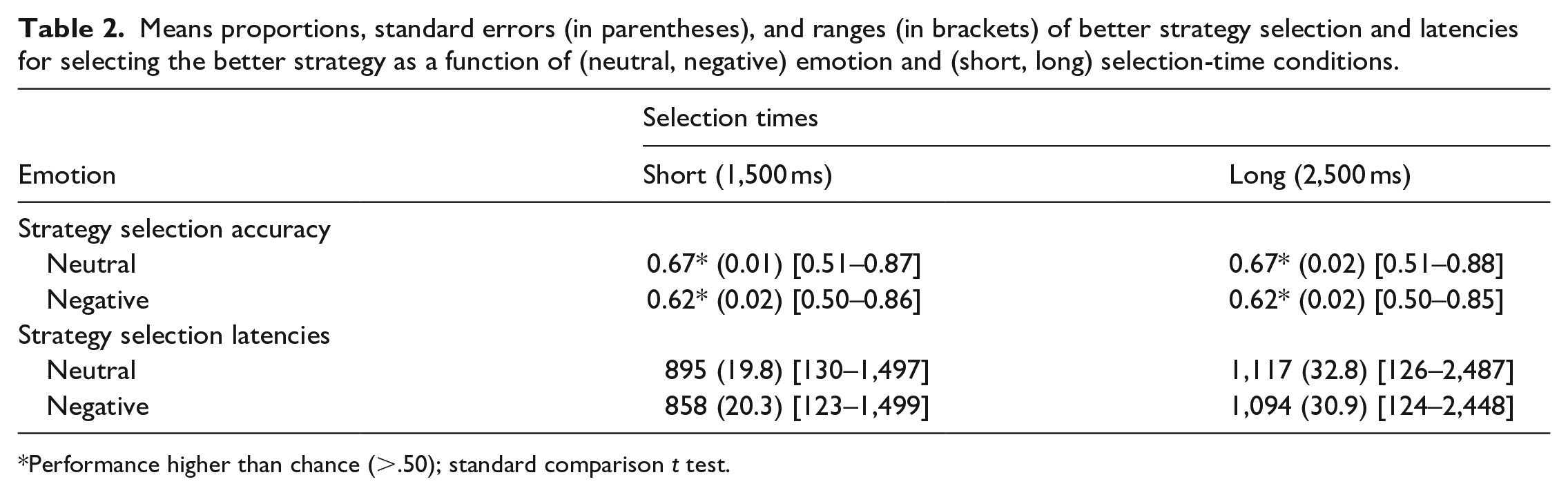
Performance higher than chance (>.50); standard comparison t test.
Latencies for better strategy selection
The results of the Gaussian mixed-effect modelling on selection latencies for correct better strategy selection revealed a significant effect of emotion, β = −.30, SE = 6.32, t = 4.78, p < .001, with faster strategy selection under emotional than neutral condition (976 vs. 1,006 ms). A main effect of selection time was also found, β = 228.9, SE = 35.16, t = 6.51, p < .001, indicating that participants were faster to make correct strategy selection when the time limit was shorter (M = 877 ms) than when the time limit was longer (M = 1,105). The Emotion × Selection Time interaction was not significant, β = 13.3, SE = 12.64, t = 1.05, p = .29 (see Table 2 for Ms).
RCJ
Judgement bias
Before determining whether participants’ metacognitive accuracy is affected by our experimental manipulations, we first examined whether there were condition-related changes in the raw frequency of the two confidence choices. The results of the 2 (Selection Time) × 2 (Judgement Time) × 2 (Emotion condition) mixed ANOVA conducted on the mean frequency of the high confidence choice (“I’m sure”) only revealed a significant main effect of emotion, F(1, 140) = 5.82, MSE = 2.63, p = .005, η² = .03, with participants reporting less confidence responses after being presented with emotional stimuli. As this effect could simply be due to participants’ being objectively less accurate for selecting the better strategy under emotional conditions, however, we had to test whether this adjustment in their judgement choice was indeed accurate in all our experimental conditions.
Judgement accuracy
The results of the 2 (Selection Time) × 2 (Judgement Time) × 2 (Emotion condition) mixed ANOVA conducted on the Mratio as a measure of metacognitive accuracy revealed a significant main effect of selection time, F(1, 140) = 23.33, MSE = 54.36, p < .001, η² = .05. Metacognitive judgements were less accurate under shorter strategy-selection time limit relative to longer strategy-selection time limit (0.43 vs. 1.29). A significant interaction between emotion and judgement time was also found, F(1, 140) = 4.70, MSE = 1.60, p = .032, η² = .001. Follow-up analyses for each judgement time (short vs. long) showed that participants were less accurate when making judgements in the emotional than in the neutral condition under short time constraints (.67 vs. .93), t = 2.62, SE = .09, p = .04. No differences between the negative and neutral conditions were found when the judgement time constraint was long (.90 vs. 94), t = .42, SE = .09, p = .97. No other main or interaction effects reached significance, all Fs < 3.0, ps > .86 (see Figure 2).
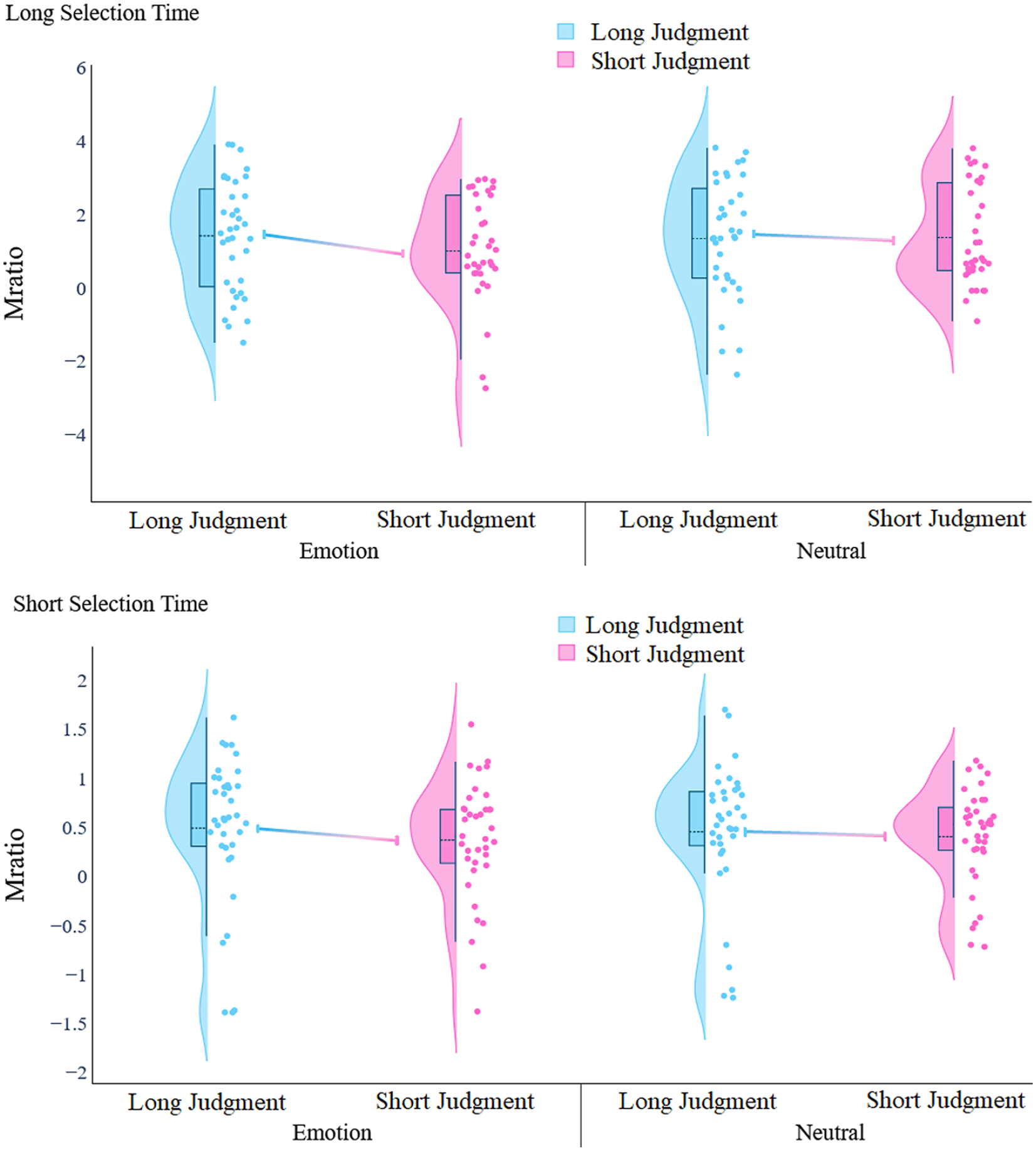
The top panel represents metacognitive accuracy estimated using the Mratio for the two emotion conditions and judgement time limits under long selection time limit. The bottom panel represents metacognitive accuracy estimated using the Mratio for the two emotion conditions and judgement time limits under short selection time limit.
Finally, to further explore whether the deleterious effect of the emotional condition under short judgement time constraint was due to participants’ reporting more confidence in poorer strategy choice, less confidence in better strategy choice, or both, a binomial mixed-effect modelling on raw confidence judgement (sure vs. unsure) was conducted as a follow-up analysis. The emotional valence (negative vs. neutral) on each trial was added as the first-level predictor and the accuracy of the selection strategy (better vs. poorer) as the second-level predictor. The results revealed a significant Emotion × Strategy selection accuracy interaction, β = −.33, SE = .14, z = 2.3, p = .02. Specifically, participants were less likely to express high confidence after selecting the better strategy in the emotional condition (M = .56) than in the neutral condition (M = .69). In contrast, the frequency with which participants reported to be confident in their response after selecting the poorer strategy did not differ between the emotional (M = .69) and the neutral condition (M = .64).
Judgement times
Gaussian mixed-effect modelling conducted on participants’ response times for RCJs indicated faster judgements under shorter judgement time constraints (M = 387 ms) than under longer judgement time constraints (M = 663 ms), β = 87.84, SE = 11.40, t = 7.07, p < .001). No main effects of emotion, β = 2.80, SE = 1.79, t = 1.56, p = .12, or selection time, β = 1.13, SE = 13.06, t = 0.09, p = .91, were found. Similarly, none of the interaction effects reached significance, all βs < 2.35, ts < 1.31, ps > .19 (see Table 3 for Ms). Note that here, all judgements were included in the analyses as we wanted to determine whether emotions affected judgement response latencies independently of whether these judgements were correct. However, we found exactly the same pattern when our analyses were conducted using only response latency for “correct” judgements.
Means, standard errors (in parentheses), and ranges (in brackets) of metacognitive accuracy (Mratio) and latencies for making RCJ as a function of (neutral, negative) emotions, (short, long) selection time conditions, and (short, long) judgement times.
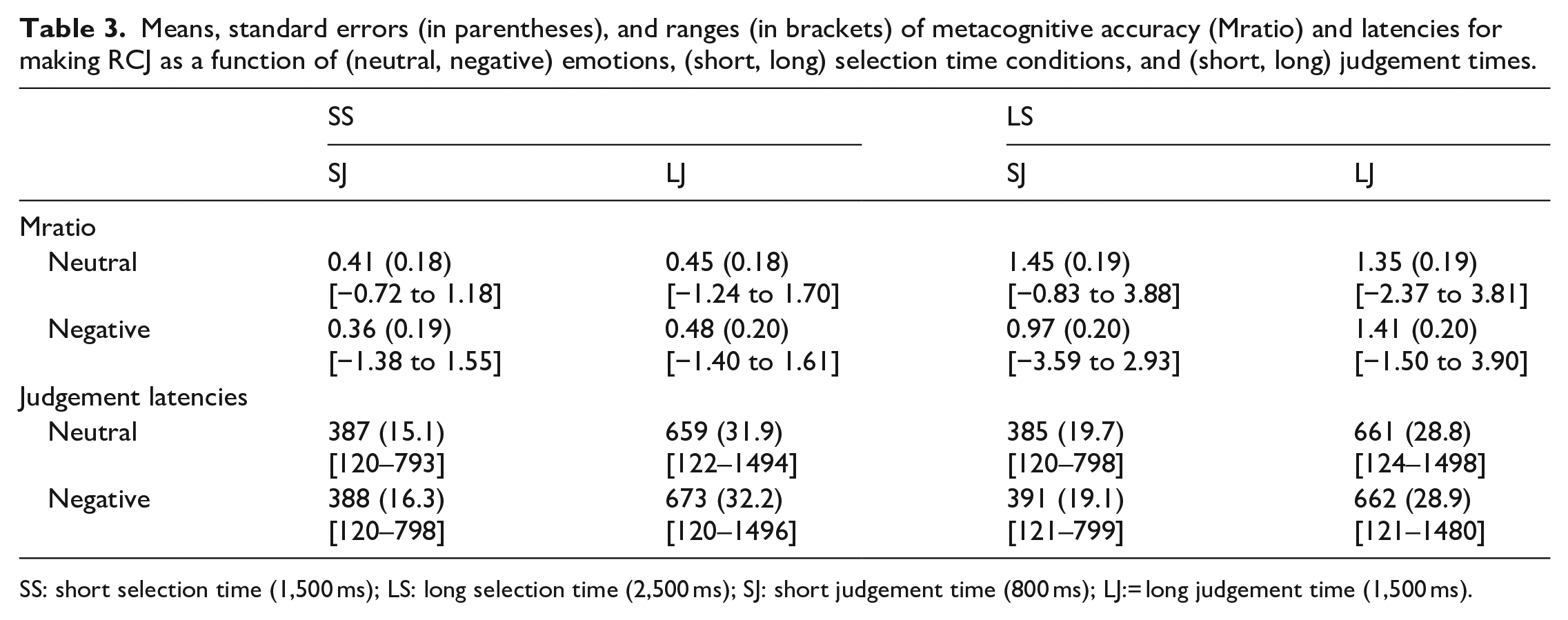
SS: short selection time (1,500 ms); LS: long selection time (2,500 ms); SJ: short judgement time (800 ms); LJ:= long judgement time (1,500 ms).
Discussion
The main goal of the present experiment was to test whether negative emotional conditions differently influence the accuracy of early and late metacognitive evaluations on an arithmetic strategy selection task. At the cognitive level, our results replicated previous findings showing a decrease in strategy selection accuracy under the negative emotional condition compared with the neutral condition (Geurten & Lemaire, 2022; Lallement & Lemaire, 2021), an effect that was not modulated by time pressure. At the metacognitive level, however, the effect of negative stimuli on the accuracy of participants’ confidence judgements was found to differ with time constraints. Indeed, poorer metacognitive judgements were found only if participants had a short time limit to conduct their first-level (strategy selection) and second-level (RCJ) evaluations. These findings have important implications for furthering our understanding of how emotions affect metacognitive processes.
From previous works investigating the relations between cognition and emotion, we know that, when emotions are irrelevant for the task at hand, the impact of emotional stimuli on performance results from biased allocation of attentional resources to emotional stimuli, leading to depleted resources available for the target cognitive task (e.g., Öhman et al., 2001; Verbruggen & De Houwer, 2007; Yiend et al., 2013). The decrease in strategy selection accuracy observed here is consistent with this hypothesis. Interestingly, the absence of effect of the selection-time condition on this pattern seems to indicate that more time to select the better strategy did not (a) change how often participants selected the better strategy on each problem in the neutral condition, and (b) attenuate the negative effect of the emotional condition. One explanation could be that, in the present experiment, even the longer time limit was too short to allow participants to reallocate attentional resources towards the task at hand. Indeed, the longer time limit used here (2,500 ms) was still quite short compared with the range of response time that is typically observed in self-paced strategy selection task (Lemaire & Brun, 2016). Note, however, that the lack of differences in rates of better strategy selection between short and long time does not mean that time constraints have no effects on strategy selection. For example, Lemaire and Brun (2016) found that better strategy selection increased (from 66% to 71%) when participants had to select the better computational estimation strategy in longer presentation duration (i.e., 4,300 ms on average) compared with shorter presentation duration (i.e., 2,200 ms). Had we tested longer time constraints in the present study, we may have found improved strategy selection and modulated effects of emotional stimuli on better strategy selection.
Comparable rates of better strategy selection and effects of the emotional condition on better strategy selection under shorter and longer time constraints make interesting differences in effects of time constraints on both metacognitive judgements and on effects of emotions on those judgements. We found a significant drop in RCJ accuracy if participants had to make their strategy selection under short as compared with the long time constraint. From a theoretical point of view, such findings are consistent with the cue utilisation approaches of metacognition (Geurten & Lemaire, 2017; Geurten & Willems, 2016; Koriat, 2007; Koriat et al., 2008). According to these approaches, metacognitive judgements are based on a variety of cues that are collected online as cognitive activities are performed. One cue that has regularly been reported as a determinant of retrospective judgements is the speed with which a cognitive response is given (Koriat et al., 2009; Vickers & Packer, 1982). Under time constraints, however, differences in response latencies between (usually faster) correct and (usually slower) incorrect decisions (Leckey et al., 2020) are probably less diagnostic than it usually is, leading participants to make more erroneous RCJ. This assumption is also coherent with Baranski and Petrusic’s (1998) findings showing that when the first-level response is made under time pressure, confidence at the second-level judgement is determined post-decisionally and involves memory-based evaluations that are supposed to be less accurate than online evaluations. By contrast, under longer strategy selection duration, participants have enough time to perform online evaluations before the deadline is passed and, thus, are more likely to be able to rely on diagnostic cues, like speed for selecting the better strategy to reach accurate metacognitive judgements.
In addition to poorer metacognitive judgements under restricted strategy selection time limit, our most original findings here concern the interaction between the emotional condition and the judgement time limit on metacognition. Specifically, our data revealed a negative effect of emotional stimuli on metacognitive accuracy only under short judgement time constraints, an outcome consistent with the hypothesis of Geurten and Lemaire (2022). According to this hypothesis, automatic experience-based judgements could be more sensitive to emotional manipulations than deliberate information-based evaluations. Once again, such a pattern could easily be understood within the cue utilisation approaches (e.g., Koriat, 2007). Indeed, if participants’ attention is focused on the emotional pictures rather than on the cognitive task, they are allegedly less likely to detect cues residing in immediate feedback from task performance, leading to a disruption of their early experience-based evaluation. In addition to a reorientation of the attentional focus, it is also possible that the few detected cues were misleading for participants. Indeed, according to McGillivray (2021), emotional information is one of the strongest cues that individuals rely on when forming their judgements. As in the present experiment, the emotional cue was not relevant for conducting the metacognitive assessment, it could have reduced the accuracy of experience-based judgements.
While the dual-process approach offers a nice explanation of our findings, our data do not allow to totally rule out the possibility that a single process that would be differently impacted by the response time manipulation was, in fact, involved. For instance, accumulation frameworks—according to which metacognitive judgements involved the gathering of evidence starting from the stimuli presentation until a metacognitive decision is reached (e.g., Desender et al., 2022)—would predict that shortening the time limits would prevent participants to accumulate as much evidence as needed, reducing the accuracy of their judgements under short time constraints.
By contrast, metacognitive evaluations conducted under long judgement time limit was not affected by emotional stimuli. If late metacognitive processes are supposed to stem from analytic rather than intuitive inferences, such findings are not so surprising as, for these judgements, participants are assumed to rely on their previous knowledge of cognitive functioning to guide their decisions. Here, this could have helped them to disqualify emotions as a relevant cue for judgement and enable them to make better sense of the online feedback received from the task. Regarding attentional resources, the longer delay could also have provided participants with more time to recover from the attentional resources depletion induced by emotional stimuli at the cognitive level and, then, enabled them to use these newly available resources to perform a more deliberate metacognitive evaluation or, in a single-process view, to continue accumulating evidence in favour of one or the other decision. Overall, such findings replicate previous works examining judgements without time constraints, showing no differences in the accuracy of judgements of learning (JOLs) for emotional and neutral stimuli (Tauber & Dunlosky, 2012) and no miscalibration of confidence in RCJs after an emotional induction (Geurten & Lemaire, 2022; Ifcher & Zarghamee, 2014). Late metacognitive judgements, however, do not always appear to be immune to emotions. Several studies have actually revealed an influence of emotions on explicit metacognition (e.g., Culot et al., 2021; Massoni, 2014). The emotional induction procedures used in these studies, however, were far more extreme than the one used here (i.e., pictures varying in valence and arousal vs. threat of monetary losses or electric shocks). It is thus possible that strong emotional manipulations were able to disturb even late metacognitive processes, possibly by preventing participants to allocate sufficient resources to a comprehensive evaluation of their cognitive performance. To test this, future studies should examine whether manipulating the level of arousal associated with the emotional stimuli could modulate the effect of these emotional stimuli on metacognitive judgements.
While the present study indicates that negative emotional stimuli could decrease the accuracy of early metacognitive judgements without impacting later metacognitive evaluations, several limitations should lead us to consider these results with caution. First, while our time limit manipulation appears to yield differences in emotional effects between early and late metacognitive judgements, it does not allow us to conclude that there is an actual qualitative difference between judgements made under short or long time limit. Additional studies collecting more fine-grained measures of time course of metacognitive judgements (e.g., EEG data) may reveal either differences in EEG during RCJ between emotion and neutral conditions (e.g., a reduction in prefrontal theta oscillations associated with the metacognitive performance from 350 to 550 ms post-stimulus; Wokke et al., 2017) or similar EEG morphology and time courses between the two emotional conditions. This is all the more important because, while the latencies of judgements made under long time constraints were longer than those made under short time constraints, they were still shorter than latencies typically observed under no-time pressure conditions (e.g., mean judgement latencies was around 800 ms in Geurten & Lemaire, 2022, vs. 675–678 ms here). This suggests that even in the long judgement time condition, participants somewhat increased their RCJ speed to make sure to fit speed constraint. Such speedup possibly impacted the processes involved in their metacognitive assessments (e.g., by reducing participants’ ability to disregard irrelevant or inaccurate information).
More generally, another limitation concerns the fact that, to allow for fast judgements, our data were collected using a scale with a very limited range. As prior studies suggest that participants are more accurate when a broader scale is available (Lingel et al., 2019), future studies should be conducted to determine whether using less limited scales to collect metacognitive judgements could have helped participants to counteract the negative effect of the emotional condition. Furthermore, while the use of the Mratio enabled us to control for the influence of the cognitive performance on the accuracy of the metacognitive judgements, it could be interesting to replicate our findings with a procedure leading to comparable performance at the cognitive level in emotional and neutral conditions. Such a procedure would ensure that the effects observed at the metacognitive level did not result from any lingering effects of the emotional manipulation on the arithmetic performance. In the same vein, while our participants were randomly assigned to one of the four conditions and we did not have any reasons to suspect that this randomisation was not successful, we did not ensure that these groups did not differ on our variables of interest (e.g., metacognition, strategy selection) before any experimental manipulation. Such a preliminary check should certainly be performed in future studies. Finally, it is important to note that the present findings were obtained with externally induced emotions (i.e., exposure to negative stimuli). As such, it would be useful to determine whether our results remain the same when other types of paradigms are used to manipulate participants’ emotional state (e.g., stress induction).
Despite these limitations, our results remain critical because they shed important light on how emotional stimuli can influence metacognitive judgements. Theoretically, our data could be consistent with the hypothesis proposed Geurten and Lemaire (2022) that exposure to emotional stimuli disturbs early metacognitive processes possibly by preventing participants from detecting, processing, or using the most appropriate cues. Such a finding, if confirmed, could strengthen the hypothesis of dissociation between automatic and deliberate metacognitive judgements. Indeed, the differences in effects of distracting emotional stimuli on early and late metacognitive judgements could be interpreted, in line with previous evidence, in favour of the dual-process models of metacognitive functioning (e.g., Fleming et al., 2016; Gilovich et al., 2002; Kornell et al., 2011; Undorf & Zimdahl, 2019). While other explanations still have to be ruled out (i.e., accumulation hypothesis), emotional manipulations could prove an interesting way to document the nature of these potential dual processes and help better understand the factors influencing each of them. From a practical perspective, the latter result is quite encouraging as it could represent a promising way to counteract the effects of negative emotions on arithmetic performance. To do so, however, future research should be conducted to determine whether, even under more naturalistic conditions (e.g., mathematical anxiety), participants are still able to adjust their subsequent strategy selection on the basis of their judgements as long as they are given sufficient time to make an informed metacognitive judgement.
Footnotes
Declaration of conflicting interests
The author(s) declared no potential conflicts of interest with respect to the research, authorship, and/or publication of this article.
Funding
The author(s) disclosed receipt of the following financial support for the research, authorship, and/or publication of this article: This research was supported by the National Fund for Scientific Research (F.R.S.-FNRS) to M.G. and the Agence Nationale de la Recherche under Grant # ANR # 20-ASTC-0031 to P.L. The F.R.S.-FNRS and the CNRS have no role in the study design, collection, analysis, and interpretation of data; in the writing of the report; and in the decision to submit the article for publication.
Research data
Data and Material will be made available on the public university repository of the first author upon acceptance.
