







Abstract
Task-irrelevant speech is known to cause disruption of short-term memory, either through specific interference with encoding processes (e.g., seriation, semantic processing) or by diverting attention from the focal task. Previous studies found that semantically related background speech can induce memory intrusions of words that were not part of the to-be-remembered list. While these findings suggest false memories due to semantic interference, the present study aims to test whether the presence of task-irrelevant speech affects the susceptibility to memory intrusions also in the absence of semantic interference. Therefore, incomprehensible to-be-ignored speech was presented during encoding of semantically related words. It was found across three experiments that incomprehensible changing-state speech increased the rate of false memories of non-presented but semantically related words in a subsequent recognition (Experiments 1 and 2) or recall test (Experiment 3), compared with white noise or steady-state speech. The findings indicate that speech interfered with serial-order processing of the to-be-remembered items, thus urging participants to rely on semantic information to encode and retrieve the presented words. While a focus on semantic information enabled participants to correctly recollect the majority of presented words, it most likely also increased the proportion of false memories of words with semantic associations to the presented words both in recall and recognition tests. In all three experiments, the presence of an auditory deviant in background speech did not increase the rate of false memories, suggesting that attentional capture alone does not necessarily induce source monitoring errors. However, Experiment 3 revealed that an increase in visual task-encoding load attenuated the changing-state effect on the production of false memories. This indicates that the semantic organisation processes initiated as a result of the loss of order information in case of changing-state speech may be sensitive to attentional control.
Keywords
Performing a cognitive task typically requires some mental effort to focus attention on the information that is relevant to the task, while ignoring task-irrelevant information such as the background noise. While it is important for the attentional system to remain open to the environment (e.g., in order to detect potential threats), task-irrelevant sound often also leads to disruption of cognitive performance with regard to the focal task. For example, the mere presence of to-be-ignored background speech (e.g., Colle & Welsh, 1976; Salamé & Baddeley, 1982) or temporally changing non-speech sounds (e.g., tone sequences; Jones and Macken, 1993) is known to disrupt the serial memorisation of visually presented information (e.g., written words).
According to the interference-by-process account (e.g., the “object-oriented episodic record model”; Jones et al., 1996; Jones and Tremblay, 2000; see also J. E. Marsh et al., 2009), disruption of cognitive performance occurs when the processes to register the irrelevant information interfere with the processes that are required to perform the focal task. When the task requires serial-order information to be retained (e.g., through subvocal rehearsal or grouping in a serial recall task), then any task-irrelevant seriation processes are expected to interfere. The interference-by-process account has been quite successful in explaining the changing-state effect, that is, the observation that task-irrelevant changing-state sequences of sound (i.e., temporally varying sounds, “A-C-D-B-E”) are more disruptive than steady-state sequences (“A-A-A-A-A”) in a serial recall task, regardless of whether it is speech or not (e.g., Jones & Macken, 1993). Specifically, it is assumed that, in the case of changing-state sound, pre-attentive/automatic auditory streaming processes lead to the formation and encoding of an ordered sequence of auditory objects (as part of auditory scene analysis; Bregman 1990), and the order cues contained in this task-irrelevant sequence of objects interfere with the deliberate processing of the serial order of the to-be-remembered items (i.e., interference by seriation processes). In line with this account, it has also been observed that changing-state sound produces less interference in non-serial memorisation tasks or when participants did not engage in serial rehearsal (e.g., Beaman & Jones, 1997, 1998; Hughes et al., 2007; Hughes & Marsh, 2020; Jones & Macken, 1993; Kattner & Ellermeier, 2018).
On the contrary, when the task encourages processing of the semantic information then semantic processing of task-irrelevant information is expected to produce interference. For instance, in a free recall task individuals will typically attempt to organise the to-be-remembered information (e.g., word lists) based on semantic associations (though about one-third of participants may still engage in serial rehearsal during free recall, see Mandler, 1969). It has been found that, in contrast to serial recall, auditory distraction in free recall depends much more on the semantic similarity of the information contained in irrelevant speech and to-be-remembered items (i.e., a “between-sequence semantic similarity effect”), in particular when serial rehearsal is discouraged through rapid presentation of target items (Beaman, 2004; J. E. Marsh et al., 2008; Neely & LeCompte, 1999) or when a categorisation strategy is encouraged (J. E. Marsh et al., 2009). Specifically, in this case the disruptive effect of irrelevant spoken words on the free recall of a list of semantically related words (e.g., words from a single category such as “vehicles”) was shown to be larger when the distractor words were drawn from the same semantic category compared with when “unrelated” words from a different semantic category were presented (J. E. Marsh et al., 2008, 2009). Moreover, semantic information was found to produce interference also when the distractors are presented in the same modality (visual or auditory) or even embedded within the to-be-remembered sequence (Beaman et al., 2013). In line with an interference-by-process account, these findings suggest that semantic information in task-irrelevant speech interferes with semantic organisation processes regarding the to-be-memorised words (interference by semantic processes). However, it is important to note that the between-sequence semantic similarity effect may strongly depend on the participants’ use of a semantic categorisation strategy, and changing-state sound may produce equal interference with the retention of order information in serial and free recall tasks (Beaman & Jones, 1998).
In contrast to free recall, it has been assumed that serial recall should not be affected by the semantic similarity between irrelevant speech and to-be-remembered information (e.g., Buchner et al., 1996; J. E. Marsh et al., 2008). However, there is some evidence suggesting that the processing of semantic content of irrelevant speech determines the degree of auditory distraction in a serial recall task as well. For example, it was found that emotional words are more disruptive than neutral words (Buchner et al., 2004, 2006; J. E. Marsh et al., 2018; though this effect may be partially due to the acoustic profile of emotional words, Kattner & Ellermeier, 2018), and that meaningful sentences often produce more disruption than sequences of unrelated words (i.e., additional disruption beyond the changing-state effect, Hughes & Marsh, 2020). In addition, providing semantic foreknowledge about the specific sentences that are to be spoken during a serial recall task was found to attenuate distraction (Bell et al., 2017; Röer et al., 2015), but only if the content of foreknowledge is fully intelligible (Kattner et al., 2022), suggesting that to some extent both irrelevant speech and the to-be-remembered information are processed semantically.
An alternative unitary attentional account explains both types of auditory distraction (changing-state and semantic similarity effects) with attentional capture (e.g., Bell et al., 2008, 2012; Cowan, 1995). Here it is assumed that irrelevant sound diverts attentional or cognitive resources from the focal task, regardless of the specific processes required to perform the task, either because the sound does not match with the predictive model based on previous stimulation (e.g., an auditory oddball “A-A-A-A-B,” eliciting predictability-based attentional capture, Eimer et al., 1996) or due to specific semantic properties of the sound indicating relevance to the individual’s current goals (e.g., one's own name or a taboo word, 115 Röer et al., 2013; Röer et al., 2017; that is the stimulus-specific self-relevance hypothesis, 116 Hughes & Marsh, 2020). Attentional capture may thus account for semantic similarity effects, as the goal-relevance of task-irrelevant information is expected to be higher when there is a semantic relationship with the goal-relevant to-be-remembered items, thus diverting more attentional resources from the focal task due to stimulus-specific attentional capture (for a discussion of additional accounts of the semantic similarity effect see Hanczakowski et al., 2017; J. E. Marsh et al., 2009). Moreover, it has been argued that also the changing-state effect may be explained with (predictability-based) attentional capture, assuming that the sounds in a changing-state sequence are less predictable compared with sounds in a steady-state sequence (though distraction occurs also with highly predictive changing-state sequences such as “V-J-X-V-J-X-V-J-X. . .,” e.g., Jones & Macken, 1995). Hence, while a predictive model of a steady-state sequence can be generated with little effort, more attentional resources should be required to continuously update the predictive model in case of a changing-state sequence of perhaps randomly varying sounds, thus leaving less attentional resources for the focal task.
However, it has been shown more recently that sentential speech (containing semantic, syntactic, and statistical information that can be incorporated into a predictive model) causes more disruption than an unpredictable sequence of words (Hughes & Marsh, 2020), thus strongly challenging an attentional-capture account of the changing-state effect. In addition, there is evidence suggesting that the disruption caused by predictability-based attentional capture (i.e., disruption by an auditory deviant) is independent of the changing-state effect (Hughes et al., 2007; Marois et al., 2019). Indeed, several functional dissociations have been reported between the deviation effect and the changing-state effect, with only the deviation effect being eliminated by increased task-encoding load, forewarning cues, or high working memory capacity (e.g., Hughes et al., 2013), indicating that attentional capture is more sensitive to cognitive control than interference-by-process. In line with these findings, the duplex-mechanism account has been proposed, suggesting that attentional capture and interference-by-process are two functionally distinct mechanisms of auditory distraction (see Hughes, 2014; Hughes et al., 2005).
In addition to the detrimental effects of semantic similarity on the recall or recognition of presented words, task-irrelevant speech may also affect the occurrence of memory intrusions, in particular when semantic processing is involved. It has been found that semantic similarity between to-be-ignored words and the to-be-remembered words not only disrupts recall of presented words (between-sequence semantic similarity effects), but also increases the probability to falsely recall words which were not presented in the to-be-remembered sequence (and even when the specific word was not presented in the irrelevant sequence on the same trial; see Beaman et al., 2013; J. E. Marsh et al., 2008, 2015; Neely & LeCompte, 1999). These findings suggest that semantically related irrelevant speech can induce false memories, probably reflecting a failure of source monitoring (Johnson et al., 1993; Roediger et al., 2004). Specifically, “external–external” source monitoring errors may arise when irrelevant background speech contains information (e.g., a word) that is semantically associated with the to-be-remembered items. In this case, the occurrence of a word in irrelevant speech (whether presented on the same or a previous trial) is supposed to activate the respective semantic information, and a false recollection of the irrelevant word may result from a confusion of the word’s actual source of activation in the irrelevant auditory stream with a source of activation in the visually presented list of to-be-remembered words (and in contrast to semantically unrelated irrelevant words, the category label can no longer be used as an unambiguous retrieval cue to retrieve only the presented items, see J. E. Marsh et al., 2008, p. 687). However, in addition to these “external–external” source monitoring errors, the presentation of words from a particular semantic category may also activate additional non-presented items from the same semantic category, and this can lead to “internal–external” source monitoring errors (i.e., false recall of words that were not presented in irrelevant speech). In this case, the internal source of activation of semantically related, non-presented words (due to activation of the entire semantic category) can be mistaken for an external source of activation based on presentation in the list of to-be-remembered words. It has been found indeed that semantically related irrelevant speech also increases the probability of internal–external source monitoring errors (J. E. Marsh et al., 2008). Here, the presentation of semantically related items in irrelevant speech may encourage an incorrect attribution of sources of activation based on semantic similarity (through activation of the semantic category), thus leading to the false recollection of non-presented, internally generated items. Both types of memory intrusions could thus be explained with semantic interference-by-process (rather than interference-by-content, J. E. Marsh et al., 2008), assuming that interference is caused or facilitated by semantics in irrelevant speech.
The aim of the present study is to investigate whether irrelevant speech facilitates the production of memory intrusions when there is no semantic interference originating from the semantic content in irrelevant speech. In contrast to previous studies (Beaman et al., 2013; J. E. Marsh et al., 2008), the focus lies on memory intrusions of words that were neither presented in the to-be-remembered list nor in the irrelevant sound (i.e., true memory intrusions as the “recollection of something that did not happen,” Gallo, 2010). Therefore, false memories of non-presented words were induced experimentally using the Deese–Roediger–McDermott (DRM) paradigm (Deese, 1959; Roediger & McDermott, 1995). In this paradigm, participants are presented with lists of words that are all associated semantically with a particular non-presented target word. With this paradigm, the non-presented target word (critical lure) is typically reported with a probability of about 50% in a subsequent free recall or recognition test, and these false memories are often accompanied by high levels of confidence and even a feeling of “remembering” the particular word (e.g., Roediger & McDermott, 1995; Westerberg & Marsolek, 2003). There is also evidence suggesting that these memory intrusions depend on the depth of processing of the semantic content (e.g., Thapar & McDermott, 2001) as well as on the attentional resources available with more false memories occurring typically with divided attention during encoding (Dewhurst et al., 2007; Peters et al., 2008) or retrieval (Knott & Dewhurst, 2007, note that in this study, divided attention during encoding reduced false memories).
The experiments of the present study were designed to test whether irrelevant speech without semantic content presented during the encoding and retention of DRM lists increases the rate of false memories of the critical lure (i.e., independent of between-sequence semantic interference). Therefore, either speech in a foreign language (not understood by the participants) or computer-generated pseudo-speech was presented to participants while memorising lists of semantically associated words. In this case, it could be argued that the production of false memories may be susceptible to attentional capture, assuming that irrelevant sound diverts attention not only from the memorisation but also from source monitoring processes. Specifically, with regard to the false recollection of non-presented semantically associated words (“internal–external” source monitoring errors), it could be expected that an internal source of activation (due to a spread of activation of the semantic information of presented words) is more likely to be confused with an external source of activation if less attentional resources are available for source monitoring. In this case, irrelevant speech should enhance the rate of false memories even in the absence of semantic information in irrelevant speech (i.e., due to attentional capture by incomprehensible speech or pseudo-speech). However, it may be difficult to disentangle an attentional-capture explanation from an interference-by-process account even in the absence of semantic interference, because interference may still occur with regard to the processing of order information (assuming that some participants will use a seriation strategy to memorise the word lists, Mandler, 1969). For instance, if participants engaged in serial rehearsal of the to-be-remembered words, then irrelevant (changing-state) speech would be expected to interfere with the order information of some words (in particular in the middle of the list). As a consequence, during recall participants may use semantic similarity as a cue to retrieve the lost items (i.e., the order of items may have been rearranged by semantic associative strength with the semantic theme), and a non-presented word that is strongly associated with the same semantic retrieval cue (e.g., the theme of the list) may be particularly likely to be falsely recalled or recognised.
Hence, in the absence of semantic interference, an increased rate of false memories of non-presented words could indicate either attentional capture or interference with serial-order processing encouraging the use of semantic retrieval cues. Specifically, irrelevant speech may either have a direct effect by diverting attentional resources from source monitoring or an indirect effect through interference with serial-order processing and thus a stronger reliance on semantic processing. In both cases, an increase in the rate of semantic memory intrusions would be the result. To assess the contribution of direct attentional capture, the effects of an auditory deviant were contrasted with changing-state speech in all three experiments. In Experiment 1, predictability-based attentional capture was elicited with an acoustical oddball violating the predictive model based on previous stimulation (a frequency-modulated tone embedded in irrelevant speech). In Experiment 2, stimulus-specific attentional capture was tested by presenting a meaningful word of emotional salience (a taboo word) or word of relevance to the participants’ current goal (the critical lure associated with the to-be-remembered list) within a stream of pseudo-speech. In Experiment 3, a deviant letter was presented in a steady-state sequence of spoken letters. Moreover, Experiment 3 also tested whether the increase in memory intrusions due to a deviant or due to changing-state speech (in a recall task) depends on visual task-encoding load, which would suggest sensitivity to attentional control.
Experiment 1
The aim of Experiment 1 was to test whether the presentation of incomprehensible to-be-ignored speech (Swedish) during encoding and retention increases the rate of memory intrusions with to-be-remembered DRM lists using a recognition test. To test whether the production of false memories is sensitive to attentional capture, an unexpected auditory event was presented within the stream of speech on some trials.
Method
Participants
The appropriate sample size was determined on the basis of previously observed effects of irrelevant speech (quiet, unrelated speech, related speech) on memory intrusions in serial and free recall tasks (
N = 50 participants were recruited from the students’ population at Health and Medical University ín Potsdam (14 men and 36 women). Ages ranged between 18 and 56 years (M = 25.32, SD = 11.02). Participants were sent an URL to run the experiment online with their own computers, and they were compensated with course credits immediately after completion. The duration of the experiment ranged between 30 and 47 min (M = 34.88, SD = 3.46). All participants provided explicit informed consent by ticking a check box on the welcome screen prior to starting the experiment.
Apparatus and materials
The experimental routines were programmed in PsyToolkit 3.4.0 (Stoet, 2010, 2017) and the web-based experiment was run on the European server (https://www.psytoolkit.org/c/3.4.0/). Participants were instructed to use headphones to run the experiment, and n = 30 reported to use in-ear headphones, whereas n = 18 reported to use on-ear/over-ear headphones. Two additional participants nevertheless reported to use “loudspeakers,” but since they passed the headphone screening test (see below), it is possible that they may just have mistaken their headphones for “loudspeakers.”
The experiment started with a headphone screening test (Woods et al., 2017) to make sure that participants were wearing headphones and not loudspeakers. Prior to the headphone-screening test, participants were presented with continuous pink noise and instructed to adjust the volume of their computer and headphones to a comfortable level. During the test, three 200-Hz stereo pure tones were presented successively for 1 s each and together with a blue box on the screen (200-ms inter-stimulus intervals between the tones). The sound pressure level of one tone was 6 dB lower compared with the other two tones, and one of the two high-level tones had the phase reversed between the left and right channels, which reduces the sound pressure level in air due to acoustical interference (in case of loudspeakers, but not with headphones). The participants’ task was to indicate which tone was “softer” than the other two by clicking on the respective box on the screen. They passed the test if at least five of six responses in a row were correct. The task ended once the test was passed or after 36 trials. If participants did not pass the test, a message was shown on the screen, indicating that the audio system was not sufficient to run the experiment. Participants were allowed to restart the experiment using headphones.
Twenty-four lists of words were created by translating and slightly adapting the original lists (Roediger & McDermott, 1995). Some words from the original list were replaced by words that were considered more suitable for the German sample (e.g., “Spree” instead of “Mississippi”). The full word lists are provided in the Supplemental Appendix. Each list consisted of 12 words (e.g., “dough,” “butter,” “sandwich,” “rye” . . .) which were all associated with a critical lure (e.g., “bread”). Each list consisted of unique words that were not contained in any other list.
Task-irrelevant sound was either a 30-s stream of white noise, a 30-s recording of Swedish speech, or the same recording of Swedish speech containing an acoustical deviant after 21.5 s (a frequency modulated sinusoidal “chirp” tone of 800 ms duration rising from 440 to 1,320 Hz, created with Audacity) .
Design and procedure
The main task consisted of 24 trials, in which the 24 unique to-be-remembered words lists were presented. A total of 10 lists were presented with white noise, 10 were presented with irrelevant speech, and 4 lists were presented with irrelevant speech containing the deviant.
Participants started each trial by clicking on a yellow rectangular box in the centre of the black screen. Then a list of 12 words was presented successively in white font on a black screen. Each word was presented for 1,500 ms, followed by a 500-ms inter-stimulus interval. After an additional retention interval of 6,000 ms, participants were presented a probe recognition test with 25 words including the 12 presented words, 12 non-presented words drawn randomly from other lists, and the critical lure. The order of these 25 probe words was randomised. Participants were asked to press the “J” key if the word was presented in the list (old), and the “N” key if it was not contained in the list (new). No immediate feedback was provided after each response, but the number of correctly recalled words from the presented list was shown on the screen after the last recognition response for 2,000 ms before the next trial started.
At the end of the experiment, participants were presented with an open question to describe the strategies they used to memorise the word lists.
Results
The mean number of recognitions and rejections of presented and non-presented words during different types of irrelevant sound is illustrated in Figure 1. As can be seen in Figure 1a and b, the number of correct word recognitions (hits) and rejections of unrelated non-presented words is high (93% correct responses on average) and did not depend much on the sound condition. However, there was a considerable number of false recognitions of critical lures, as illustrated in Figure 1c (73% memory intrusions on average). Importantly, there were more false memories of critical lures when irrelevant background speech was presented, compared with irrelevant white noise.
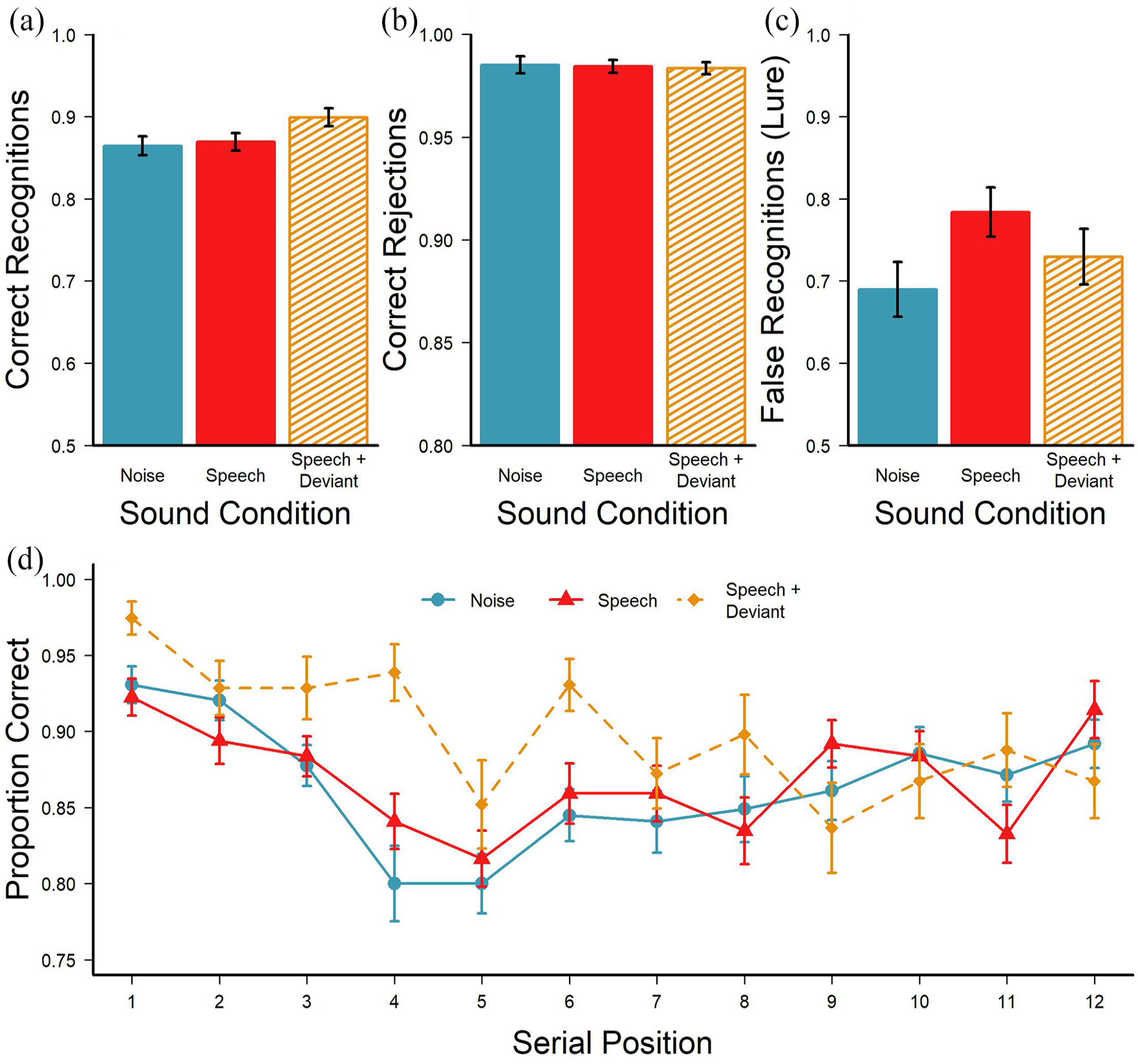
Mean proportions of (a) correct recognitions of presented words, (b) correct rejections of non-presented words (unrelated to the presented words), and (c) false recognitions of critical lures (non-presented but semantically related to the presented words) as a function of the sound condition (noise, speech, speech with deviant) in Experiment 1. Panel (d) shows the correct recognition rate of the 12 presented words in the three sound conditions as a function of their serial position in the presented list. Error bars indicate ± standard error of the mean.
A 3 (sound: noise, speech, deviant) × 3 (word type: presented, non-presented, lure) repeated-measures ANOVA on the proportion of “J” (old) responses revealed a significant main effect of sound
A planned-contrasts analysis (Holm corrected for four comparisons, Holm, 1979) revealed that there was no significant irrelevant speech effect (noise–speech) on the recognition of presented words,
An additional signal-detection analysis revealed a small, but non-significant−d′=z(False alarm rate)) between noise (M = 2.71, SD = 0.51), speech (M = 2.65, SD = 0.48), and deviant sound conditions (M = 2.75, SD = 0.44),
To assess the extent to which participants relied on seriation to memorise the word lists, the participants’ reported memorisation strategies (typed text responses) were categorised into serial rehearsal (e.g., “repetition of words,” “inner speech”), semantic processing (e.g., “remember the theme,” “create stories”), imagery (e.g., “visualise”), or other/no strategies (for a similar approach see Morrison et al., 2016). It was found that the majority of participants reported to have used a semantic processing strategy (n = 31), while some also reported serial rehearsal (n = 8) or imagery (n = 6). A further indication for the use of serial rehearsal is provided by serial position curves of the recognitions of presented words showing the typical primacy (and recency) effects with lower recognition rates for words presented in the middle of the list, indicating that the first items in the list were serially rehearsed more often (see Figure 1d). A 3 (sound) × 12 (serial position) repeated-measures ANOVA confirmed a significant main effect of serial position,
In contrast to the original study on the effect of semantically related word lists on memory intrusions at recall (Roediger & McDermott, 1995), a recognition test was used in the present experiment. Some studies have shown that the presentation of presented or semantically related words prior to the critical lure can increase the rate of false recognitions due to test-induced priming (i.e., activation of semantic information at test rather than encoding, Coane & McBribe, 2006; Dewhurst et al., 2011; E. J. Marsh & Dolan, 2007; but see Dodd et al., 2006). To test whether the distractor effects on false memories were affected by test-induced priming, the effect of the number of presented words presented prior to the critical lure was analysed also for the data of Experiment 1. There was indeed a small but significant correlation between the number of target words presented prior to the critical lure (0–12 words) and the rate of false recognitions,
Discussion
The results of Experiment 1 suggest that incomprehensible task-irrelevant speech affected the susceptibility to memory intrusions. Specifically, the presence of Swedish speech increased false recognitions of non-presented words that were semantically related to the to-be-remembered list (critical lures), compared with noise in the background. However, speech did not affect the proportion of correct recognitions of the presented words, nor did it affect the proportion of correct rejections of unrelated non-presented words. Interestingly, the additional presence of an auditory deviant (a frequency-modulated tone) in irrelevant speech eliminated the speech-related increase in false memories.
In principle, an effect of auditory distraction on the rate of false memories could be either due to a diversion of attentional resources from source monitoring processes or due to process-specific interference with the rehearsed order of the presented words leading to a stronger reliance on semantic information during recognition (thus more false recognitions of semantically related, non-presented words). The fact that an auditory deviant—which should capture attention due to a violation of the predictive model (Eimer et al., 1996)—did not lead to an additional increase in false memories (if anything it had the opposite effect) suggests that the results cannot be explained with attentional capture. Instead, the increase in false recognitions may be the result of interference between irrelevant speech and the processing of the order of to-be-remembered words. Both the participants’ self-reports of memorisation strategies as well as the primacy effects observed in serial position curves (higher recognition rates for words from the beginning of the list may reflect serial rehearsal) indicate that serial rehearsal was used to some extent. However, the fact that irrelevant speech did not affect the recognition of presented words suggests that seriation was not the only or the predominant memorisation strategy. Instead, participants may have used multiple memorisation strategies (e.g., serial rehearsal and semantic processing), or they may have switched memorisation strategies depending on the task demands and the efficacy of specific processing modes. If participants initially used serial rehearsal to memorise the words, then irrelevant speech (but not noise) would have caused a breakdown of the order information forcing participants to focus more on the semantic information of the list. That is, due to interference with serial-order processing, participants may have relied more on semantic associations between the words of the list rather than on order cues during the recognition test. While a semantic retrieval strategy obviously produced a high proportion of correct recognitions (regardless of the sound condition), it is also more likely that the critical lure from the same semantic theme will be falsely recognised in the absence of order information. The loss of order information of the presented words would thus be compensated by using semantic cues during recognition, but at the cost of producing higher rates of false recognitions of other words with semantic associations to the theme of the list. Interestingly, it was also found that participants developed a laxer response bias when distracted by irrelevant speech, whereas the sensitivity to discriminate presented words from unrelated non-presented words was generally high and unaffected by irrelevant sound. This also suggests that the interference with order information may have increased the tendency to recall by semantic cues rather than by serial order.
While the presence of incomprehensible, free-running speech clearly increased the rate of memory intrusions compared with white noise (most likely due to interference with order processing), an auditory deviant embedded in irrelevant speech (a brief frequency-modulated tone) had no reliable effect on both correct recognitions of presented words and memory intrusions of semantically related words. This might indicate that the deviant did not divert sufficient attentional resources to disrupt memorisation or to induce additional false memories through a lack of source monitoring (by inducing more “internal–external” source monitoring errors). Alternatively, it is possible that attentional capture disrupted semantic encoding of the words, thus leading to fewer memory intrusions of the semantically related critical lure. That is, while participants were able to use semantic information to compensate for the loss of order information in the case of irrelevant speech (producing more false recognitions), the additional presentation of a deviant may have disrupted semantic processing as well, thus reducing the number of false recognitions. However, it is also possible that the attentional capture effect could not be detected due to the lower reliability of the memory estimates with only four trials containing a deviant (compared with 10 trials with speech or noise). Therefore, the possibility of attentional capture influencing the production of false memories and/or the recognition of presented words was investigated also in Experiment 2, using different types of deviants that are assumed to cause stimulus-specific attentional capture due to their relevance to the participant (i.e., comprehensible taboo words and words semantically related to the list of to-be-remembered items).
Experiment 2
The aim of Experiment 2 was to replicate and extend the finding that irrelevant speech increases the rate of memory intrusions (i.e., false recognitions of words that were never presented). The results of Experiment 1 suggest that speech interfered with the retention of order information of to-be-remembered words leading to recognition by semantic similarity (i.e., strength of the association with the semantic theme of the list), which may have enhanced the rate of false recognitions of the semantically associated critical lure. However, it is still unclear why the presence of an auditory deviant (a frequency-modulated tone within a stream of speech) did not affect the recognition of presented words, nor the rate of false memories (it even tended to reduce the effect of speech on false memories). Therefore, a different type of attentional capture (stimulus-specific) was elicited in Experiment 2 by presenting a single comprehensible and meaningful item in a stream of otherwise uncomprehensible pseudo-speech. Stimulus-specific attentional capture is expected due to the potential relevance of that single item to the participants’ current goal (either a taboo word or word that was semantically related to the to-be-remembered list). Moreover, to test the assumption that the effect of irrelevant speech on false memories is due to interference with serial-order processing, changing-state speech (pseudo-speech consisting of random syllables) was contrasted with steady-state speech (repeated utterances of a single syllable) in Experiment 2: If the increase in false memories was a result of interference with serial-order processing rather than attentional capture, then a changing-state sequence of irrelevant speech should produce more false memories than a steady-state sequence.
Method
Participants
Given that some effects may not have reached statistical significance due to a lack of power in Experiment 1 (e.g., no reliable deviation effect with only four deviant trials), the sample size was increased to provide sufficient power for the demonstration of smaller effects. A sensitivity analysis revealed that a sample of 72 participants (corresponding to J. E. Marsh et al., 2008 Exp. 1 and 2) allows to demonstrate effect sizes of
A sample of N = 72 participants was recruited at the Potsdam campus of Health and Medical University (22 men and 50 women). The participants’ ages ranged between 18 and 49 years (M = 22.32, SD = 5.01). Student participants were compensated with course credit, and all participants provided written informed consent prior to participation in the study.
Apparatus and materials
The experiment was conducted in the psychological laboratory of the Health and Medical University. The experimental routines were programmed in PsychoPy (Peirce, 2007; Peirce et al., 2019). The same 24 German word lists as in Experiment 1 were used in Experiment 2.
Four different sequences of pseudo-speech were generated with a web-based text-to-speech generator using a female voice (“German/Marlene” from https://ttsmp3.com/). These recordings were cut to 30 s and served as task-irrelevant changing-state speech in Experiment 2. For the steady-state speech condition, four syllables were extracted from the pseudo-speech recordings (“sim,” “tun,” “rei,” “nag”) and concatenated repeatedly to create steady-state sequences of 30 s duration (about 4 syllables/s). Eight additional recordings with a unique deviant sound were created. For the taboo-word condition, a recording of a unique German taboo word (“Analplug,” “Hurensohn,” “Ficken,” “Klitoris”) was inserted at the 20th second of changing-state speech. For the related word condition, a recording of one of the critical lures (“Brot,” “Mädchen,” “Schlaf,” “Spinne”; about 500 ms) was inserted at the 20th second of the recording of changing-state pseudo speech. Three of these critical words have produced a moderate proportion of memory intrusions in Exp. 1 (45%, 46%, and 45% false recognitions of “Mädchen,” “Schlaf,” and “Spinne,” respectively), whereas one critical word produced a large number of memory intrusions (84% false recognitions of “Brot”)
Design and procedure
As in Experiment 1, there were 24 trials with a unique to-be-remembered word list on each trial. Either steady-state or changing-state pseudo-speech was presented on eight trials each. On the remaining eight trials, changing-state speech containing either the critical lure (corresponding to the visually presented word list) or a taboo word as a deviant sound was presented (four trials each).
Each trial started with a text message to prompt the start of the respective trial (“Ready for trial X?”), which disappeared after 2,000 ms. After a 1,000-ms delay, the first word of the list was presented and a new word was presented every 2,500 ms. Each word was presented in white font on a grey screen for 2,000 ms. After the 12th word, there was a delay of 5,500 ms before the first probe word was presented. The participant’s task was to indicate whether the word was contained in the list of that trial or not by pressing the “J” or “N” key on the keyboard, respectively. The background sound started 500 ms prior to the first word, and it was presented both during presentation of the word list (24 s) and during the retention interval (5.5 s). As in Experiment 1, the recognition test consisted of 25 trials, containing the 12 presented words, 12 non-presented words from other lists, and the (non-presented) critical lure. The words were presented in random order. A brief feedback was presented for 1,000 ms after each response indicating whether the response was correct or incorrect.
Results
The proportion of correct recognition/rejection responses for presented and non-presented words during different types of irrelevant speech is illustrated in Figure 2a and b. As in Experiment 1, the hit rate and the proportion of correct rejections of unrelated words was high (90% correct responses). However, there were again many false recognitions of the critical lure (66%) and the proportion of memory intrusions also depended on the type of background sound.
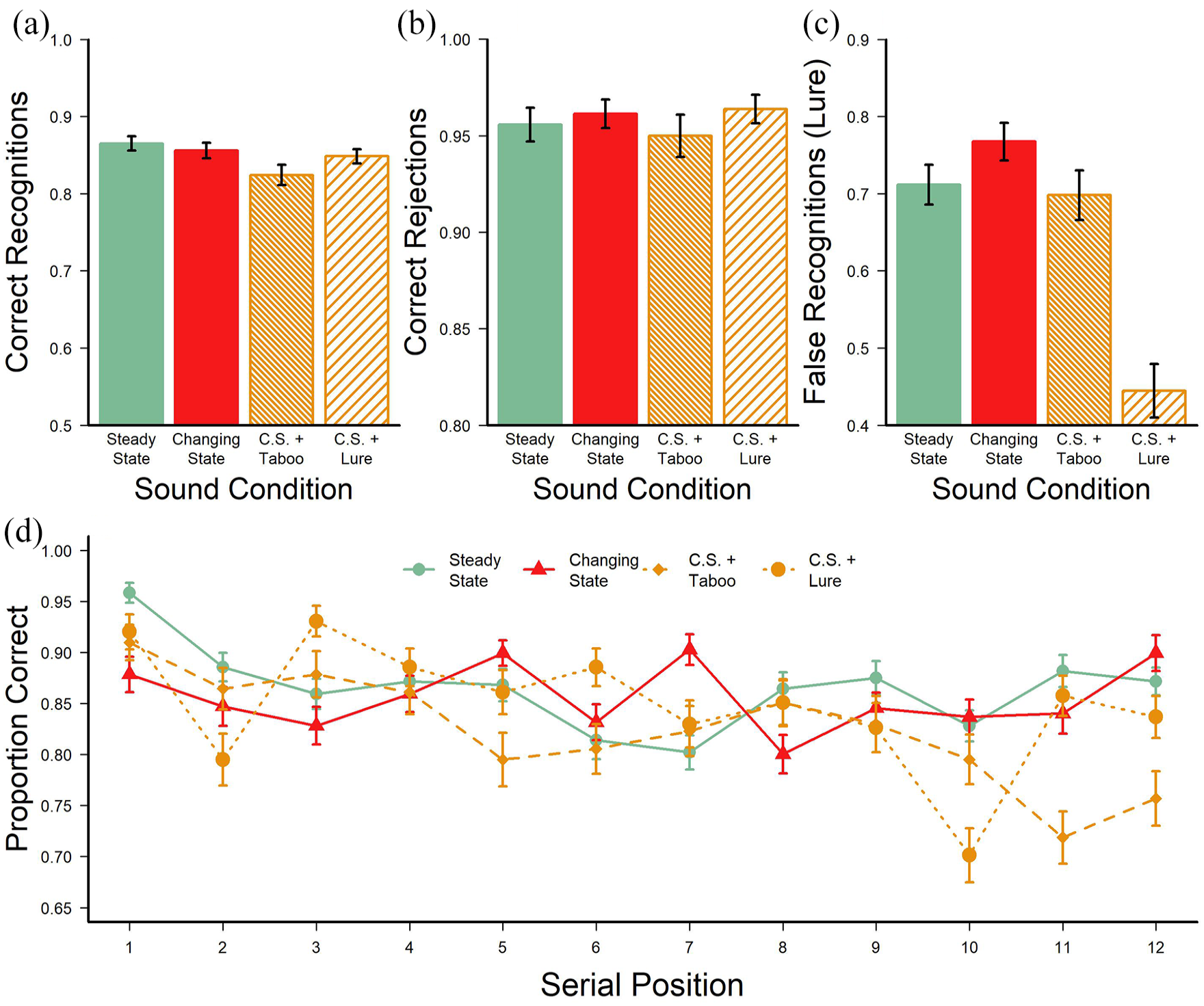
Mean proportions of (a) correct recognitions of presented words, (b) correct rejections of non-presented words (unrelated to the presented words), and (c) false recognitions of critical lures (non-presented but semantically related to the presented words) as a function of the different sound conditions (steady-state, changing-state, changing-state + deviant) in Experiment 2. Panel (d) shows the correct recognition rate of the 12 presented words as a function their serial position in the list of presented words in the four sound conditions. Error bars indicate ± standard error of the mean.
A 4 (speech: steady-state, changing-state, critical lure, taboo word) × 3 (word type: presented, non-presented, lure) repeated-measures ANOVA on the proportion of “J” responses (old) revealed a significant main effect of speech
A planned-contrasts analysis (Holm corrected for six comparisons) revealed that there was no significant changing-state effect (changing-state—steady-state) on the recall of presented words,
Interestingly, there was a significant changing-state effect on the proportion of false recognitions of critical lures,
A signal-detection analysis revealed a significant difference in the sensitivity parameter d′
There was again a significant difference with regard to the response criterion c,
Finally, the use of a seriation strategy to memorise the word lists was assessed through effects of the serial position of the word in the presented list. As can be seen in Figure 2d, the proportion of correct recognitions was slightly lower for words presented in the middle of the list compared with words from the beginning of the list suggesting that serial rehearsal was used to refresh the words in memory (with words in the beginning of the list receiving more rehearsal). A 4 (sound) × 12 (serial position) confirmed a significant serial position effect,
The influence of test-induced priming was tested also for the false recognitions observed in Experiment 2. In contrast to Experiment 1, there was no significant correlation between the number of presented words presented prior to the critical lure (0–12) and the rate of false recognitions,
Discussion
Experiment 2 successfully replicated the effect of task-irrelevant speech on memory intrusions. Specifically, the rate of false recognitions of the critical lure was higher when changing-state speech was presented (randomly varying syllables), compared with steady-state speech (a repeated syllable). This finding suggests that changing-state speech produced interference with the retention of the serial order of the to-be-remembered words, which in turn made participants rely more on semantic information during the recognition of words. As the critical lures were semantically associated with the presented words, they were more likely to be falsely recognised when order cues were not available due to interference-by-process (with changing-state speech during encoding). Also consistent with Experiment 1, the rate of correct recognitions of presented words was not affected by irrelevant changing-state speech. While this appears at odds with the idea that changing-state speech interfered with serial-order processing (in this case it should have affected the recognition of presented words as well), it is possible and likely that many participants have relied on both serial rehearsal and semantic encoding of the to-be-remembered words. Thus, the detrimental effect of changing-state speech on the order of presented words could have been compensated by the additional encoding of semantic information. At the same time, the use of a semantic retrieval strategy made participants more likely to produce false memories based on semantic associations (i.e., more false recognitions of critical lures).
Interestingly, in contrast to Experiment 1, the presence of an auditory deviant was found to affect the rate of correct recognitions in Experiment 2, indicating that stimulus-specific attentional capture occurred. Specifically, a taboo word embedded in incomprehensible pseudo-speech was found to disrupt the recognition of presented words, but it did not increase the rate of false recognitions. This indicates that attentional capture disrupted the memorisation processes (i.e., by diverting cognitive resources from serial rehearsal and/or semantic processing), but it does not seem to have affected source monitoring processes which would have led also to a higher rate of false memories. Hence, in line with the duplex-mechanism account (Hughes, 2014), the results of Experiment 2 suggest that interference-by-process and attentional capture may be two functionally distinct mechanisms which have produced diverging effects on the memorisation of presented words and the production of memory intrusions.
Interestingly, similar to Experiment 1, the presence of an auditory deviant (a taboo word) in changing-state speech eliminated the increase of memory intrusions due to changing-state speech—even though about the same degree of interference with serial order processing should have occurred. This might indicate that the taboo word diverted attentional resources from semantic processing. Thus, with a taboo word presented in changing-state speech, participants may have lost not only the order information due to interference-by-process, but also the semantic information due to attentional capture. As a result, both the correct and false recognition of words from the semantic theme of the presented words would have been affected. Experiment 3 was designed to further test this assumption.
Moreover, Experiment 2 showed that the proportion of memory intrusions was reduced considerably by presenting the goal-relevant critical lure in the stream of irrelevant speech. Hence, rather than causing attentional capture and potentially increasing the susceptibility to false memory, the auditory presentation of the lure may have enabled participants to disambiguate the different sources of activation. Related to this observation, previous studies have reported that, under certain conditions, a semantic similarity between distractors and to-be-remembered items can be beneficial to recall. Specifically, when the to-be-remembered lists of words comprise multiple semantic categories then irrelevant speech consisting of words from the same categories was found to improve recall of the presented words in a later category-cued recall test, compared with unrelated distractor words (Hanczakowski et al., 2017). Such a “reversed between-sequence semantic similarity effect” may suggest that the semantic information contained in irrelevant speech can be used to disambiguate categorical information and the respective sources of activation at recall. In the present experiment, the perception of a semantically associated word in a different sensory modality may have helped to disambiguate the source of activation and thus avoid false recognitions of critical lures (i.e., the auditory presentation of the lure word induced an additional external activation which can be separated from its internal source of activation due to semantic associations with the theme of the to-be-remembered words).
Experiment 3
The production of false memories in the old/new recognition tasks of the previous two experiments (in particular in Experiment 1) may have been influenced by test-induced priming, with the proportion of false recognitions of the critical lure increasing with the number of (presented) words from the same semantic theme tested prior to the critical lure. As the influence of test-induced priming may be weaker in a recall task (E. J. Marsh & Dolan, 2007), a third experiment was conducted in which the recognition measure was replaced by a free recall task (which is also more typical for studies of auditory distraction). The finding of increased false memories due to irrelevant changing-state speech in a recall task will further support the assumption that the semantic memory intrusions can be the result of interference with order information during encoding rather than the additional activation of semantic information during retrieval, thus providing important evidence for the generalisation of the findings observed in the previous two experiments. Therefore, participants of Experiment 3 were asked to type all words they remembered from the presented list (regardless of their order), thus avoiding possible influences of the number the prior presentations and retrievals of target words on the (false) recognition of semantically related words.
A second aim of Experiment 2 was to determine whether an effect of irrelevant speech on false memories (or correct recall) is driven by attentional capture. Therefore, visual task-encoding load was manipulated in Experiment 3 by presenting the to-be-remembered words either clearly visible (low load) or embedded in visual noise (high load). Any increase in false memories that was due to a diversion of attentional resources from the memorisation task (or from source monitoring) should be attenuated when task-encoding load is increased (e.g., attentional resources should be required to process a deviant sound, see Hughes et al., 2013; Hughes et al., 2007). In contrast, if the increase in false memories was due to interference-by-process (presumably the changing-state effect on false recognitions as observed in Exps 1 and 2), then the effect should not depend on visual task-encoding load.
In Experiments 1 and 2, direct effects of attentional capture were investigated with the deviation effect. In both experiments, the occurrence of a deviant (whether an acoustical oddball or a taboo word) in changing-state speech tended to reduce the number of false recognitions, although about the same degree of interference with serial-order processing (and thus more semantic processing) should have been induced due to the changing-state nature of the speech. One possibility is that the auditory deviant diverted attentional resources from the encoding and retention of semantic information, thus decreasing both the number of correct and false recognitions of words with semantic associations to the presented words (note that the effect on correct recognitions was observed only in Experiment 2). To disentangle the effects of auditory deviants and changing-state sound, the deviant sound in Experiment 3 was embedded in a sequence of steady-state speech (100 repetitions of a single syllable, with one differing syllable), thus eliminating potential simultaneous effects of interference with serial-order processing due to changing-state sound.
Method
Participants
For Experiment 3, N = 62 student participants (16 men and 46 women) were recruited at Health and Medical University (n = 37) and Medical School Berlin (n = 25). This sample size allows to demonstrate effect sizes of
Apparatus and materials
The to-be-remembered items consisted of the same word lists that were used in Experiments 1 and 2. To manipulate task-encoding load, the words were presented either clearly visible in white font colour on a black background or masked with some visual noise (see Figure 3).

Example of to-be-remembered words presented with low (left) or high (right) task-encoding load in Experiment 3.
The to-be-ignored sound sequences consisted of 100 spoken letters (200 ms each) that were concatenated with 100 ms inter-stimulus intervals, thus producing a total duration of 30 s. The letters were drawn randomly (from C, F, J, K, L, M, P, Q, T, V, X, and Z) to created unique 12 steady-state sequences and unique 12 changing-state sequences. In the steady-state sequences, the same letter was repeated 100 times, and in the changing-state sequences, 100 letters were drawn with replacement from the set of 12 letters. Four of the steady-state sequences contained a single deviant letter that replaced the 82th letter in the sequence (e.g., a single “L” in a sequence of “C”s).
Procedure
The experiment was programmed in PsyToolkit 3.4.4 (Stoet, 2010, 2017), and the online study started with a headphone screening test identical to Experiment 1 (Woods et al., 2017). The procedure of the main task was similar to the previous two experiments with some exceptions. Each of the 12 to-be-remembered words was presented on the screen for 1,500 ms, followed by a 500 ms inter-stimulus interval. A 6,000 ms retention interval followed after the last word, and the sequence of irrelevant speech was presented both during the presentation of the to-be-remembered words (24 s) and the retention interval (6 s). In contrast to the previous two experiments, steady-state and changing-state sound sequences were presented in two separate blocks (each consisting of 12 trials), and the order of blocks was counterbalanced across participants. In the steady-state block, the deviant sounds were presented on the 4th, 6th, 9th, and 12th trials (note that the deviant was presented shortly after the presentation of the last word, 24.6 s after presentation onset). Most importantly, the recognition measure from Experiments 1 and 2 was replaced by a free recall task. Therefore, after the retention interval (and the offset of the sound), participants were asked to enter the 12 presented words using their keyboard. A text message was presented on the screen prompting the participant to enter one word at a time. Each word was to be typed and confirmed by pressing the ENTER key. Participants were informed that they did not have to recall the words in the presented order. No feedback was provided, and participants could start the next trial by clicking on a box on the screen immediately after the last word was entered. Participants were also informed that they did not have to remember the words from previous lists after the words had been entered.
Results
The participants’ typed words in the recall task were coded manually as (a) correct recall of a presented word, (b) false recall of the critcial lure, and (c) false recall of a non-presented word that was not the critical lure. Words with minor spelling errors were coded as the most likely intended word (e.g., “pijama” was counted as “pyjama”).
The proportions of correctly recalled words in Experiment 3 are illustrated in Figure 4a, separately for the different conditions of irrelevant sound and task-encoding load. A 3 (sound: steady-state, steady-state + deviant, changing-state) × 2 (load: low, high) repeated-measures ANOVA revealed no main effect of sound,
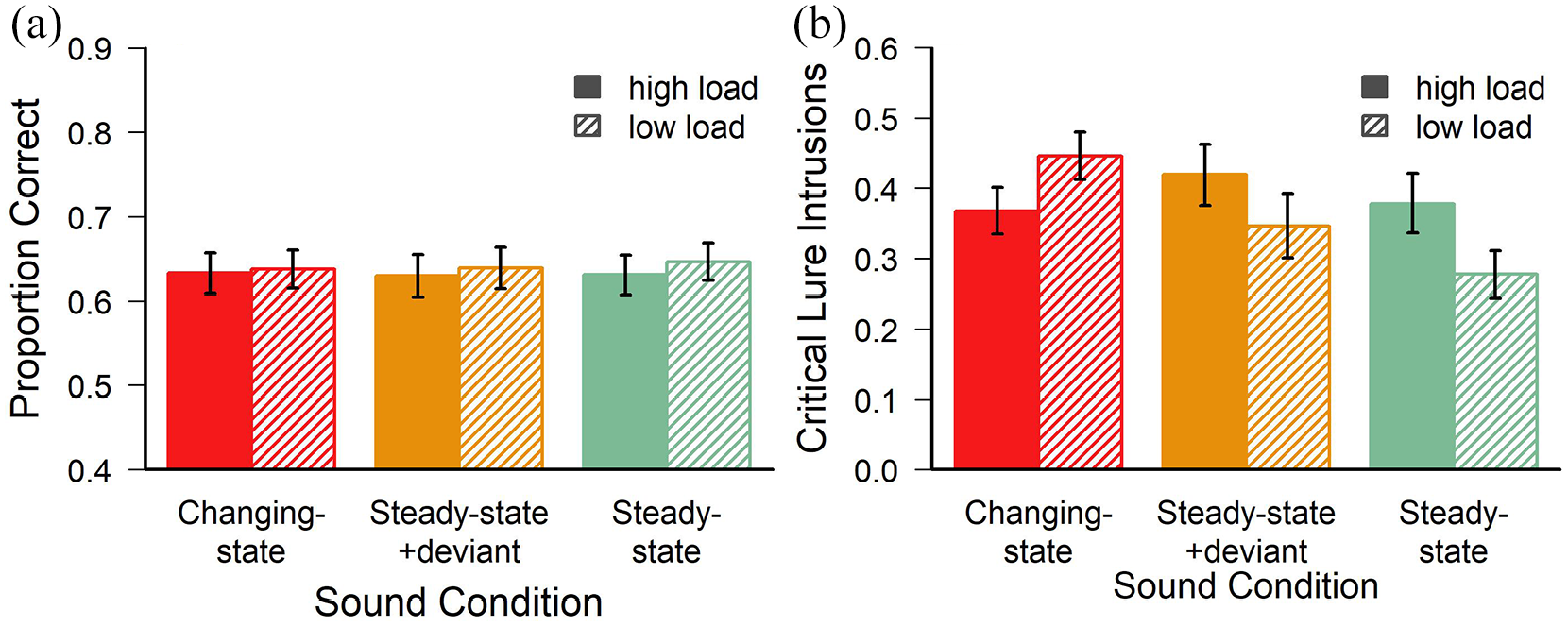
Mean proportions of (a) presented words that were recalled correclty and (b) semantically related critical lures that were falsely recalled in Experiment 3 as a function of visual task-encoding load and irrelevant sound (steady-state, steady-state + deviant, changing-state). Error bars indicate ± standard error of the mean.
Figure 4b shows the proportions of memory intrusions of the critical lures in the free recall task of Experiment 3. As can be seen, the rate of falsely recalled critical lures was higher with changing-state than with steady-state speech, in particular when the task load was low. A 3 (sound: steady-state, steady-state + deviant, changing-state) × 2 (load: low, high) repeated-measures ANOVA on the proportions of critical-lure intrusions confirmed this observation with a significant interaction between sound and load,
Discussion
Experiment 3 demonstrated that irrelevant speech also facilitates the production of false memories in a free recall task. Specifically, the presence of changing-state speech during the encoding and retention of semantically related words increased the proportion of semantic recall errors, that is, false recollections of the non-presented critical lure. Consistent with the previous two experiments using a recognition task, this indicates that changing-state speech may have interfered specifically with the processing of the order of the presented words during encoding, thus encouraging participants to rely more on semantic encoding, which in turn made participants more susceptible to the production of false memories of words with semantic associations to the theme of the presented words.
In contrast, and also in line with the previous two experiments, the mere presentation of an auditory deviant in a stream of irrelevant speech did not increase memory intrusions of the critical lure. This suggests that attentional capture alone did not increase the susceptibility to the production of false memories (e.g., through a lack of attentional resources required for source monitoring). Importantly, in contrast to Experiments 1 and 2, the auditory deviant was not presented in free-running changing-state speech, but in a stream of steady-state utterances (repeated letters) avoiding simultaneous interference with serial-order processing. The observation that the auditory deviant had no effect on false memories in Experiment 3 suggests that attentional capture (and the diversion of attention from semantic processing) may not have been the primary cause of the reduction of memory intrusions in the previous experiments. However, the deviant letter in Experiment 3 was presented shortly after the presentation of the to-be-remembered words (possibly when the last word of the list is being added to the rehearsal list). Previous studies found that the deviation effect on serial recall is eliminated when irrelevant sound containing a single deviant (e.g., a temporal irregularity) is presented during the retention interval only, compared with when it is presented during the encoding phase (Hughes et al., 2005, Exp. 2). Thus, it could be argued that the presentation of the deviant letter at the beginning of the retention interval in Experiment 3 may have eliminated the deviation effect. However, Hughes et al. (2005) observed an eliminated deviation effect only when irrelevant sound did not start prior to the retention interval, and they argued that the process of generating a predictive model of the auditory stimulation and its violation due to the deviant occurred at a time when the full “rehearsal cohort” of to-be-remembered items has already been established. In contrast, the irrelevant sound in the present experiment was presented throughout both the encoding and retention phase. Therefore, participants must have generated a predictive model of the sound during encoding. Given that the violation of this model by the deviant occurred immediately after presentation of the last to-be-remembered word, it is likely that attentional capture may still have disrupted encoding of the to-be-remembered list (whether through the addition of the last word to the rehearsal cohort or the formation of semantic associations with the theme of the list). Nevertheless, further research is certainly required to test whether an earlier presentation of the deviant (during presentation of the words) would have exerted an influence on false memories.
Experiment 3 further revealed that the changing-state effect on critical-lure intrusions depended on visual task-encoding load, with changing-state speech increasing the rate of false memories only when the task load was low (as it was the case in Experiments 1 and 2). This indicated that an increase in task load may have impaired semantic processing and thus reduced the production of semantic memory intrusions. More specifically, the retention of semantic information of the to-be-remembered words appears to require attentional resources, and an increase in attentional task demands may have produced a loss of semantic information, which would have reduced both the proportion of correct recalls (see next paragraph) and the number of semantic recall errors.
As in the previous experiments using a recognition task, the recall accuracy for presented words was not influenced by the type of irrelevant sound. Hence, in line with Experiments 1 and 2, the recall performance suggests that participants may not have relied on serial-order processing as the predominant memorisation strategy. Rather, it is likely that the words were encoded and recalled based on semantic cues. The results indicate that participants were able to use semantic processing as a successful memorisation strategy to compensate for the possible loss of order information due to irrelevant changing-state sound—but at the cost of producing more false memories. Interestingly, the correct recall of presented words was affected by an increase in visual task-encoding load, with lower recall accuracy when to to-be-remembered words were presented with visual noise. This indicates that the manipulation of task-encoding load has been successful. Due to the additional attentional demands required to process the to-be-remembered words, less attentional resources may have been available for semantic processing and this may have reduced both recall accuracy and semantic memory intrusions.
General discussion
Three experiments were conducted to test whether task-irrelevant speech affects the susceptibility to semantic memory intrusions both in recognition and recall tasks using DRM lists of semantically associated words (Deese, 1959; Roediger & McDermott, 1995). In Experiment 1, it was found that background speech in an incomprehensible language (to the participants) increased the rate of false recognitions of a non-presented but semantically related lure word by about 14% compared with a white noise background. Replicating this general finding, Experiment 2 demonstrated that the presence of changing-state pseudo-speech similarly increased the rate of semantic memory intrusions by about 8% compared with a steady-state speech control condition, indicating that the effects may indeed be due to interference with serial-order processing (Jones & Tremblay, 2000; J. E. Marsh et al., 2009) rather than attentional capture affecting source monitoring. In particular, it is possible that the loss of order information in memory due to a changing-state effect urged participants to engage in semantic processing during encoding and retrieval. Experiment 3 replicated this effect of task-irrelevant changing-state speech also in a recall task avoiding the possibility of test-induced priming during a recognition test. Possible additional effects of attentional capture on the production of false memories were investigated in all three experiments by presenting an auditory deviant (either acoustical oddballs or meaningful sounds) on a few trials. Specifically, more memory intrusions could be expected if attention was diverted from source monitoring processes. However, across all experiments, the presence of a deviant sound did not increase the proportion of false memories (if anything, it tended to have the opposite effect, see below).
Importantly, in contrast to previously observed between-sequence semantic similarity effects on the production of memory intrusions (J. E. Marsh et al., 2008; Neely & LeCompte, 1999), the present findings cannot be explained with semantic interference-by-process, because essentially no semantic information has been activated by the speech samples in the present experiments (except for individual words contained in the deviant sound conditions in Experiment 2). Hence, this may be the first demonstration of interference-by-process causing semantic intrusions that goes beyond a between-sequence semantic similarity effect of irrelevant speech. The overall pattern of results suggests that the increase in memory intrusions may be an indirect consequence of interference with order processing (due to changing-state sound) resulting in a shift from serial rehearsal to semantic processing during encoding and retention of the word lists. Both the shape of the serial position curves and the participants’ self-reports of recall strategies in Experiment 1 indicate that at least some participants used seriation to memorise the word lists (note, however, that the serial position curves alone do not necessarily reflect the use of a seriation strategy during encoding). It is thus possible that changing-state speech interfered with the initial rehearsal of the order of to-be-remembered words and encouraged participants to either simultaneously process semantic information or to switch entirely to a semantic encoding strategy during encoding and retention. During the subsequent recognition or recall tests, the strong semantic associations between the memorised words could have been used as successful retrieval cues to achieve a high rate of correct recognitions and recalls regardless of the sound condition (i.e., no irrelevant speech effect on free recall, cf. Salamé & Baddeley, 1990; but see Beaman & Jones, 1998; LeCompte, 1994). At the same time, the semantic retrieval strategy may have increased the likelihood of memory intrusions of the semantically related critical lure. Further research will be required to determine whether participants consciously experienced the loss of order information and deliberately decided to switch to a different memorisation strategy focusing on semantic information (note that previous studies found that participants may be well aware of the disruptive effects of different types of background sound, see Bell et al., 2022; Kattner & Bryce, 2022), or whether the shift in encoding processes is an automatic consequence of the inefficacy of seriation as an encoding strategy due to the loss of order information.
Across all three experiments, an auditory deviant that was embedded in the background speech did not increase the rate of false memories. This suggests that the deviant may not have caused a diversion of attentional resources from source monitoring, which would have produced more false memories due to a confusion of internal and external sources of activation (see Johnson et al., 1993; Roediger et al., 2004). If anything, the auditory deviants seem to have reduced the number of memory intrusions in a recognition test compared with changing-state speech without a deviant (Experiments 1 and 2). At first sight, this seems to be difficult to explain because—given that the deviant was embedded in changing-state speech inducing interference with serial-order processing—participants most likely focused on semantic encoding, which should still have increased the susceptibility to false recognitions of semantically related words. However, it could be argued that the deviant may have diverted attentional resources from semantic processing (which may even demand more attentional control than serial rehearsal). Due to attentional capture by the deviant sound, participants could thus have lost some semantic information as well, which may reduce not only the number of correct recognitions, but also the number of semantic memory intrusions. Admittedly, a disruptive effect of the deviant on memory for presented words was observed only in Experiment 2 (with a taboo word presented as a deviant in pseudo-speech), but not in Experiments 1 and 3 (with an auditory oddball that violates the predictive model). More research is thus required to determine the direct effect of attentional capture on semantic encoding in a free recall task (most studies of auditory deviation effects in memory seem to use serial recall). Nevertheless, the consistently observed dissociation between the effects of changing-state sound and auditory deviants on false memories clearly suggests that the increase in false memories with task-irrelevant changing-state speech—both in recognition and recall paradigms—is not due to direct attentional capture, but rather due to an indirect effect of interference with serial-order processing and a consequential shift to an alternative encoding mode focusing on semantic information.
Overall, this interpretation of the present findings is more consistent with an interference-by-process or a duplex-mechansism account of auditory distraction (Hughes, 2014; Jones et al., 1996; Jones & Tremblay, 2000; J. E. Marsh et al., 2009) than with a unitary attentional account (Bell et al., 2008, 2012; Cowan, 1995). Specifically, the results suggest that the increase in memory intrusions was not due to a diversion of attention from memorisation and/or source monitoring processes during encoding, because the addition of an auditory deviant in the stream of irrelevant sound (predictability-based or stimulus-specific attentional capture) did not increase the rate of false memories beyond that of changing-state sound. In contrast, the occurrence of a deviant in changing-state speech may even reduce the proportion of memory intrusions. While this suggests that the deviant elicited attentional capture, its influence on false memories seems to be distinct from (opposite to) the interference effects produced by free-running changing-state speech (i.e., in line with a duplex-mechanism account, Hughes, 2014). Specifically, it seems that the increased rate of false memories may have been an indirect consequence of interference with serial-order processing (e.g., Jones & Tremblay, 2000; J. E. Marsh et al., 2009), which led to a greater focus on semantic encoding and thus more false memories of semantically related words. The additional diversion of attention (e.g., by the taboo word in Experiment 2) might then have caused disruption of semantic processing and thus reduced the production of semantic memory intrusions.
Interestingly, it was further found in Experiment 3 that the changing-state effect on memory intrusions depends on visual task-encoding load. This also suggests that the increase in false memories due to semantic associations in the presence of changing-state speech may be sensitive to the availability of attentional control, indicating a combination of automatic interference with order processing and attention-demanding semantic processing. Specifically, if changing-state sound interfered with the retention of order information and as a consequence participants were more likely to switch to semantic processing, then additional attentional resources may be required to process the semantic information. With low task-encoding load, more attentional resources can be used to encode the semantic theme of the presented words, thus also producing more semantically related false memories. However, with high task-encoding load, the additional demands imposed by the task may in turn draw attentional resources from semantic encoding, thus reducing the proportion of semantic memory intrusions (for a reduction of false memories with divided attention at encoding, see also Knott & Dewhurst, 2007). This observation may be related also to perceptual interference, which was shown to have beneficial effects on memory by encouraging the encoding of item-specific information rather than relational and order information (Mulligan, 1999, 2000). As semantic memory intrusions may be a result of relational processing (i.e., encoding the semantic relations between presented words), it could be argued that the enhanced task-encoding load in Experiment 3 may have reduced false memories via increased perceptual interference.
In all three experiments, the rate of presented words that were recognised or recalled correctly was not affected by the presence of irrelevant changing-state speech. This observation is compatible with the idea that serial rehearsal may not have been the predominant strategy to memorise the words. Instead, it is likely that participants encoded semantic information of the presented words and used semantic information as cues to recognise and recall the words. Specifically, noticing the high semantic relatedness of the words of a given list, participants may have used semantic associations with the theme of the presented words as a retrieval cue. Although the participants’ self-reported memorisation strategies (Experiment 1) and the strong primacy effect in serial position curves indicate the use of serial rehearsal to memorise at least the initial items, participants may have lost the order information due to interference-by-process on trials with changing-state speech and switched to a more attention-demanding, but still highly efficient semantic processing strategy. In line with a general interference-by-process account (e.g., Jones & Tremblay, 2000; J. E. Marsh et al., 2009), the focus on semantic processing to memorise the word lists could explain the absence of an irrelevant speech effect on correct recollections of presented words (whether in recall or recognition tasks), because (a) interference in a free recall task was less likely with semantic processing (Beaman & Jones, 1998; Salamé & Baddeley, 1990) and (b) no semantic content was conveyed through irrelevant speech thus avoiding between-sequence semantic interference (J. E. Marsh et al., 2008; Neely & LeCompte, 1999). On the contrary, the same semantic processing mode explains the increase in the false recollections of non-presented words when the availability of serial-order information was diminished due to the presence of irrelevant changing-state speech during encoding. An additional attentional capture mechanism, however, may be required to explain the decrease in memory intrusions when a deviant is presented within a stream of changing-state speech—presumably due to a diversion of attention from semantic processing.
In addition to the observed effects of irrelevant changing-state speech on the production of false memories (and the effects of an auditory deviant on correct recognitions in Experiment 2), it was further found in Experiment 2 that the presentation of the critical lure within the otherwise incomprehensible background speech dramatically reduced the rate of memory intrusions by about 42%, compared with changing-state speech without a deviant. Somewhat consistent with previous reports of a “reversed between-sequence semantic similarity effect” with multiple to-be-separated semantic categories (Hanczakowski et al., 2017), the presentation of a semantically related item in a different modality seems to help participants disambiguate external (due to stimulus presentation) and internal (due to semantic associations) sources of activation and thus have help to almost eliminate false recognitions of the critical lure.
Taken together, the three experiments reported here provided evidence for an effect of auditory distraction on the production of false memories in both recognition and recall tasks. Specifically, incomprehensible changing-state speech was found to increase the number of false recognitions of non-presented words that are semantically related to the to-be-remembered list. Importantly, this was observed without presenting the falsely recognised words visually or auditorily, thus indicating that the memory intrusions were not due to between-sequence semantic similarity or external–external source monitoring errors. Instead, the results suggest that irrelevant changing-state speech most likely interfered with the retention of the order of the to-be-remembered words (note that self-reported memorisation strategies and the serial position curves may be indicative of serial rehearsal in some participants), thus encouraging participants to either simultaneously encode semantic information or switch entirely to a semantic encoding strategy, which can be used at retrieval in the absence of order cues. As a consequence, participants were able to easily recollect the majority of presented words during a later recognition or recall test (due to the strong semantic associations) without being affected by the presence of irrelevant speech. Due to the high semantic associative strength of the critical lures with the theme of the to-be-remembered words, the interference with order processing and the consequential reliance on semantic retrieval cues most likely increased also the rate of false memories of semantically related words (i.e., the critical lures) across all three experiments using recognition and recall tasks. Importantly, Experiment 3 revealed that this increase of semantic false memories due to task-irrelevant changing-state speech occurs only when visual task-encoding load was low, but not when task load was increased by presenting the to-be-encoded items in visual noise. This indicates that semantic processing of the to-be-remembered words—which induces memory intrusions—may be sensitive to attentional control. Consistent with the assumption that semantic processing is susceptible to attentional capture, the highly salient taboo words presented in pseudo-speech (Experiment 2) were also found to impair the recognitions of presented words. Overall, these findings indicate that acoustical interference with order processing can induce a change in memorisation processes towards semantic encoding, which in case of a DRM paradigm can increase the likelihood of semantic memory intrusions—unless attentional resources are diverted from the encoding processes.
Supplemental Material
sj-docx-1-qjp-10.1177_17470218241235654 – Supplemental material for False memories through auditory distraction: When irrelevant speech produces memory intrusions in the absence of semantic interference
Supplemental material, sj-docx-1-qjp-10.1177_17470218241235654 for False memories through auditory distraction: When irrelevant speech produces memory intrusions in the absence of semantic interference by Florian Kattner in Quarterly Journal of Experimental Psychology
Footnotes
Acknowledgements
The author is very thankful to his student assistants Elisa Boden, Mona Steiner, Lena Flaake, Theresa Liebold, Paul Hofmann, and Jacomo Steiner for their help with the recruitment of participants and data collection. This manuscript has been written with the R package {papaja} (Aust & Barth, 2022).
Declaration of conflicting interests
The author(s) declared no potential conflicts of interest with respect to the research, authorship, and/or publication of this article.
Funding
The author(s) received no financial support for the research, authorship, and/or publication of this article.

References
Supplementary Material
Please find the following supplemental material available below.
For Open Access articles published under a Creative Commons License, all supplemental material carries the same license as the article it is associated with.
For non-Open Access articles published, all supplemental material carries a non-exclusive license, and permission requests for re-use of supplemental material or any part of supplemental material shall be sent directly to the copyright owner as specified in the copyright notice associated with the article.
