







Abstract
Using new developments in the mental comparison task paradigm, this study addresses the question of the influence of prior visual experience in the natural use of mental perspective to achieve mental spatial tasks without any protocol-imposed perspective. During the experiment, 39 participants (11 early blind, 13 late blind, and 15 blindfolded-sighted) explored two corridor maps to memorise the spatial arrangement of 10 objects disposed along corridors. After the learning phase, several tasks addressing spatial memory and reasoning used in the mental spatial representation were performed. Blindfolded-sighted participants preferred an egocentric perspective, while the two visually impaired groups showed no overriding preference between egocentric and allocentric perspectives. Results showed a performance advantage for egocentric over allocentric perspectives, regardless of visual experience. Our results shed light on previous assumptions regarding cognitive mental map construction, suggesting the need to reflect on previous results and their dependence on imposed mental perspectives.
Introduction
This study concerns the properties of mental representations of space developed by visually impaired people. The primary question this work attempts to address concerns the spatial mental perspective representations naturally elaborated by blind people.
A large number of studies have been interested in the nature of the mental representations of individuals in general (not specifically involving blind individuals) and have concluded that the knowledge of environments of the allocentric type appeared only after the discovery of the environments step by step (discovery of landmarks, identification of the different paths globally linking these landmarks, then by integrating the metric relations between these different landmarks), allowing to pass from the elaboration of an egocentric mental representation to an allocentric one (Denis, 2017; Siegel and White, 1975). Thus, the spatial model constructed is progressively elaborated, becoming more complete each time by combining the information resulting from the motor exploration of this environment but also from all the other senses brought into play—initially the visual sense, which plays a major role, offering the possibility of accessing all the information at once. This progressive and hierarchical conception is, however, questioned by works showing early acquisition of knowledge that is assumed to be at a higher level (Huttenlocher et al., 2008; Nys et al., 2015). However, in the case of blind people, whether or not they have benefited from prior visual experience, the appropriation of space cannot take place in this manner. Information is principally acquired sequentially, allowing the discovery of spatial references one after the other, possibly extending to bi-manual exploration with two concurrent streams of tactile information.
Most studies, even if they do not all go in the same direction, agree in suggesting that blind people are capable of representing their environment spatially, whatever the modalities of acquisition of this environment (see Thinus-Blanc and Gaunet, 1997; Dulin et al., 2008, for reviews). On the other hand, some results suggest that, depending on the elaboration, an allocentric mental representation would be particularly difficult (Denis, 2017; Pasqualotto et al., 2013), or even impossible, in the case of people who are blind from birth in mental distance exploration tasks 1 —for example, see Annex (Afonso, 2006).
We note that in the vast majority of studies on spatial representation by the blind, participants have been asked to create a mental representation of a map, placing the participant in a “flyover” mode to solve the experimental task (Afonso, 2006; Afonso et al., 2010; Chabanne et al., 2004; Picinali et al., 2014), compared to the limited studies employing egocentric exploration (Afonso et al., 2010; Afonso-Jaco and Katz, 2022; Picinali et al., 2014).
Looking in more detail at the set of studies by Afonso et al. (2005, 2010), Afonso-Jaco and Katz (2022) compared distance comparison task results between verbally described, small (haptic table-top vertically mounted map) and large (room-scale locomotive/spatial-auditory) environments. Results showed different performances depending on prior visual experience and learning conditions, with late-blind participants performing best with locomotive egocentric learning. Specifically, early-blind participants made significantly more errors in the case of small differences in distances than late-blind and blindfolded-sighted participants. Furthermore, after learning of a small size configuration, early-blind participants took significantly longer than blindfolded-sighted participants to compare distances, which was no longer the case after learning the spatial configuration in the immersive environment.
Using similarly scaled, though simpler environments (horizontally mounted table-top and room-scale locomotive/haptic environment), Iachini et al. (2014) approached allocentric/egocentric perspectives differently, considering allocentric (distance between objects) versus egocentric (distance to myself/reference position) distance comparisons. Results showed that congenitally blind people had more difficulty with allocentric tasks with respect to late-blind and sighted participants, being more pronounced in the large-scale than small-scale environment. Egocentric task performance was better than allocentric for all groups, more so for the small-scale environment. While they concluded that in the absence of prior visual experience, egocentric spatial representations were “favoured,” this judgment would appear to be based on task performance, not on preference.
In contrast, Pasqualotto et al. (2013), using a large (room-scale locomotive/haptic) environment, investigated whether the ability to use an allocentric reference frame is subject to visual experience. After exploring the environment, participants were prompted to an allocentric spatial representation through a tactile map. Tasks examined the reported angular position of learned objects relative to other objects (allocentric) or positions along the learned route (egocentric). Congenitally blind participants performed better in egocentric tasks, while late-blind and blindfolded-sighted were better in allocentric tasks. In addition, for egocentric tasks, congenitally blind participants performed better than late-blind and blindfolded-sighted; while in allocentric tasks, late-blind and blindfolded-sighted performed better than congenitally blind participants.
It should be noted that the first two studies did not actually compare participants’ perspectives; they only inferred perspectives from the presentation method. The third study imposed different perspectives and evaluated associated performance. In contrast, the current study was designed to allow participants to freely employ an allocentric or egocentric perspective, realising the same task, enabling an evaluation of this preference via analysis of the results rather than being procedurally imposed.
Imposed mental map perspective
Several authors have put forward that one of the problems of so-called laboratory experiments is imposed by instruction of a specific type of resolution of the experimental task, thereby imposing the strategy to be used by participants, which can be biased to those who are more familiar with alternative strategies (Cattaneo and Vecchi, 2011; Thinus-Blanc and Gaunet, 1997). This can result in a conflation between ability, competence, and performance, as highlighted by Millar (1994). We can ask ourselves then, what would be the results obtained in tasks of mental scanning or mental comparison of distances if the participants were allowed to “navigate” mentally without constraints imposed by the instruction protocol (contrary to, e.g., “Imagine yourself walking from A to B . . .”). In other words, if the instructions when comparing two distances did not oblige participants to take an allocentric perspective, would they tend to compare two distances corresponding to path lengths, or would they naturally take the allocentric perspective, as it has been imposed so far in the literature? This is the object of the current study.
Open perspective design
Unlike previous studies, without obstacles on the maps, adding obstacles can offer different correct responses depending on the mental representation perspective employed for judging the distances between objects. For example, the direct linear distance
We subjected participants to learning spatial environments, representing a convoluted corridor path. Along this path, several landmarks were placed. The task consisted of creating a mental representation of this environment as precisely as possible by memorising the path’s structure and the different landmark positions. Participants then solved several tasks. The first is an immediate recall task, verifying that all the notable landmarks have been memorised. The second is a mental comparison of distances task, with the particularity of specifically not prescribing the use of an allocentric type of representation, as is often the case in the literature, but rather allowing participants to intuitively rely on the type of mental perspective that would naturally allow them to solve the experimental tasks. Finally, participants reconstruct the layout of the landmarks within a model of the environment based on their developed mental representations, providing a global metric of a mental map’s geometric quality.
The remainder of the manuscript is organised as follows. Section 2 presents the experimental hypotheses, methods, and design. Section 3 analyses the various task response results. This is followed by section 4, situating the obtained results in the context of previous studies.
Experiment
This study examines the representations of spatial configurations constructed by late-blind, early-blind, and blindfolded-sighted individuals following haptic exploration. The aim is to reveal the type of mental perspective (allocentric or egocentric) that would come naturally to participants to achieve spatial mental tasks. The instructions purposely do not give any explicit directive on the type of perspective to be used during the resolution of the experimental tasks, contrary to what is classically used in mental distance comparison tasks (Afonso, 2006; Denis and Cocude, 1992; Noordzij et al., 2006; Picinali et al., 2014). Participants are, therefore, entirely free to resolve the task using an allocentric (Euclidian) or egocentric (navigational) mental map.
After having interviewed specialists in visual impairment (i.e., locomotion instructors, Braille trainers, researchers in visual impairment, and associations of visually impaired people) and blind and visually impaired people, it appeared to us that the supports, whether 3D printed or thermoformed, were used interchangeably. Recent research has shown that the increase in tactile contrast made possible by 3D printing could make exploration easier, especially for EBs and BSs (Bleau et al., 2023). In that study, low-resolution maps used 2D abstract symbols (e.g., lines to model staircases), while high-resolution maps used 3D direct symbols (e.g., miniature staircases). The study by Wabiski et al. (2020) has examined terrain-type maps and the potential advantages of 3D-printed maps of traditional tactile maps used currently in classrooms for the visually impaired. However, to our knowledge, no particular attention had been paid to evaluating the potential impact of one of these supports on the characteristics of the mental representations elaborated, considering the different resolution or level-of-detail capabilities between the two support types without modifying the information format. We were interested, therefore, in examining if the mental representations produced from haptic exploration of an interior spatial environment could be influenced by the tactile support used to characterise this environment.
The following hypotheses are proposed and evaluated by the current study:
H1 The approach to solving spatial mental tasks, when not explicitly specified in the instruction, is individually specific and influenced by early visual experiences. We hypothesize that a preponderant preference for an egocentric perspective in the mental exploration of spatial maps, in the absence of specific constraints, will be observed in individuals with early blindness. In contrast, individuals with prior visual experiences are more likely to employ an allocentric mental mapping strategy.
H2 Providing participants with the freedom to select their preferred perspective, whether allocentric or egocentric, does not result in a performance advantage for either perspective.
Taking the position that more precise tactile maps are expected to enhance participants’ comprehension of the environment and increase the precision of their mental representations, we propose a final hypothesis concerning the experimental physical interface:
H3 The metric properties of mental representations are affected by the level of environmental support during learning, impacting response time, the percentage of correct answers, and the precision of object positioning within learned spatial configurations. This difference will be more significant with inexperienced users.
Design
The experimental design invites participants to haptically explore virtual indoor environments (scenarios) using tactile maps (support). In each map scenario, object markers were positioned at given landmark positions, or points of interest (POIs). Following this exploration learning phase, three tasks assessing simple memory processes or more complex processes related to constructing their mental representation were performed. Participants had to resolve a free recall of POIs, carry out a series of mental comparisons of distance tasks, and finally, reposition the POIs within their initial map, as detailed in the Methods section below.
Methods
Task overview
After the learning phase, tasks assessing simple memory processes or more complex processes related to constructing a spatial model (inferences) were performed. These tasks, involving more or less the egocentric or allocentric perspective, are classically used in literature (see Gyselinck et al., 2006; Péruch et al., 2006; Picucci et al., 2013, for some examples). Thus, a free recall of objects (simple memory task), a distance comparison (allocentric or egocentric perspective according to the participant’s implicit choice), and a task in which participants had to indicate where objects were on the initial plan (allocentric) as a final check were performed (Afonso et al., 2010; Grison and Afonso Jaco, 2020).
Free recall tasks
The free recall of objects is a simple memory task used to evaluate if elements are encoded in memory. This is used in the literature for sighted participants as they learn the object’s spatial arrangement by visual exploration or under a verbal format (Meilinger and Knauff, 2008; Nys et al., 2015; Picucci et al., 2013) or for blindfolded participants after a sensory-motor exploration (Grison and Afonso Jaco, 2020). This allows for verification that all elements have been correctly memorised and that if they do not appear in the reconstructions, it will be a problem of placement, not knowing where it is, rather than not remembering that such and such object was in the list.
In the current study, participants are evaluated before performing the experimental tasks on their success in recalling the learned environment. To ensure that participants have incorporated the environment under study into their working memory, a free recall task of the points of interest, irrespective of spatial configuration, is employed. If recall rates are insufficient, additional learning can be performed, or the subject can be excluded if they appear unable to accomplish the memory task.
Mental comparison of distance tasks
A paradigm widely used to interrogate the analogical character of mental representations is that of the mental comparison of distances. Denis and Zimmere (1992) took the material proposed in the mental scanning task, a circular island (Denis and Cocude, 1989), and asked participants, as in the task described previously, to learn the configuration of the island and the position of different landmarks. After learning the configuration, participants were asked to mentally compare the distances between pairs of landmarks (e.g., “Is the distance between the harbour and the creek greater than the distance between the harbour and the lighthouse?”). Responses and associated response times were recorded. This experiment was particularly interesting because it allowed for a right or wrong response, a benefit compared to the alternative mental scanning paradigm, briefly described in the Annex for reference. Results from the mental comparison of distance tasks have shown that individuals process large distance differences more quickly than small ones and that they make fewer errors in judgment for large differences in distance than for small ones (Denis and Cocude, 1992, 1997)—for example, the larger the difference between two distances, the shorter the response time and the higher the percentage of correct responses.
This corresponds to what has been observed in psycho-physics, confirming the symbolic distance effect phenomenon according to which judgements of difference (e.g., the difference in size) between objects evoked from memory requires less time as the magnitude of the judged difference increases (Moyer, 1973; Paivio, 1975). This task was first proposed to people who were blind from birth, late-blind, and blindfolded-sighted by Afonso et al. (2003). Results showed that, after verbal description, tactile exploration, and locomotor exploration in a real or virtual environment, all participants, regardless of their prior visual experience, showed results similar to those obtained in the literature for sighted people—that is, the greater the difference between two distances, the shorter the response time and the higher the percentage of correct (Afonso, 2006; Afonso et al., 2003; Noordzij et al., 2006; Picinali et al., 2014). This work agrees with the idea that the mental map developed by blind individuals, whether born blind or becoming blind later in life, preserves the metric relations between the different objects present in the learned spatial environment well.
A question has been raised regarding the impact of varying the learning perspective (egocentric or allocentric) on the preservation of metrics in mental representations of spatial configurations. Building on the work of Denis and Cocude (1989), Chabanne et al. (2004) used a paradigm to investigate the influence of learning modality (visual or verbal) and representation type (egocentric or allocentric) on mental representations of a spatial environment. They designed four learning conditions: “flyover-visual,” “visual route,” “fly-by-verbal,” and “path-verbal.” Participants explored the distances between landmarks in a circular garden with varying distances. Results revealed that participants’ response times increased linearly with the distance to be mentally explored, regardless of the experimental condition.
Noordzij et al. (2006) performed a similar mental distance comparison task with blind participants and showed that blind participants achieved the same pattern of results as sighted participants but that, unlike sighted participants, they performed better after listening to an egocentric description than after listening to an allocentric description.
Reconstruction task
Previous research in the spatial understanding of architectural spaces used physical reconstructions (Picinali et al., 2014), comparing key points in the architectural reconstructions for analysis using bidimensional regression 2 (Friedman and Kohler, 2003).
The reconstruction task ensures that after the manipulation, the mental model used by the participants is still of a nature to have allowed them to respond to the tests. If the person has incomprehensible results on the tests and, in this task, the reconstruction quality is very poor, then they are among the people to be eliminated from the panel. On the other hand, if their results in the reconstruction task are good, one must reexamine the test results to identify the issue.
Interpreting such analysis can be difficult if the number of reference points for the same map varies between participants. To ensure that all reconstructed maps had the same number of reference points, they were asked to reconstruct the positions of the 10 POI elements on the map. Photographs of the maps with constructed POI positions were taken, with the coordinates of POIs extracted and then used for bidimensional regression, thereby providing an overall metric comparing the spatial arrangement of the ensemble of POIs to the original reference map positions.
Materials
Scenarios
Four imaginary indoor corridor environments were created, representing a path with various landmarks along the way. Each scenario is defined by a map represented by a corridor (60 m length, 2 m width) comprising four turns (60°, 90°, 90°, and 120°) and passing through a “room” (
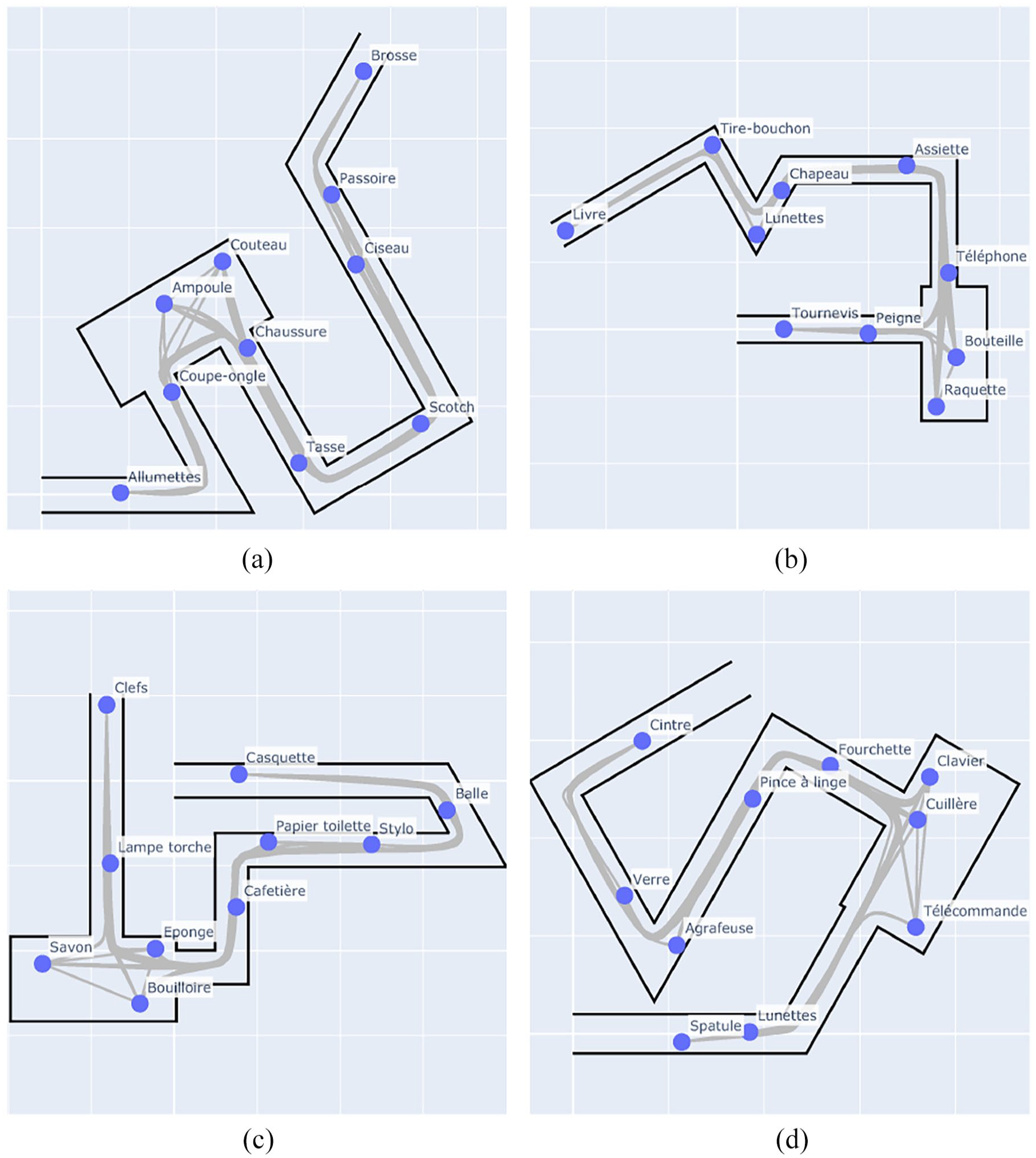
The four proposed scenarios include POI placements and all possible dnav paths. (a) Scenario 1. (b) Scenario 2. (c) Scenario 3. (d) Scenario 4.
Objects
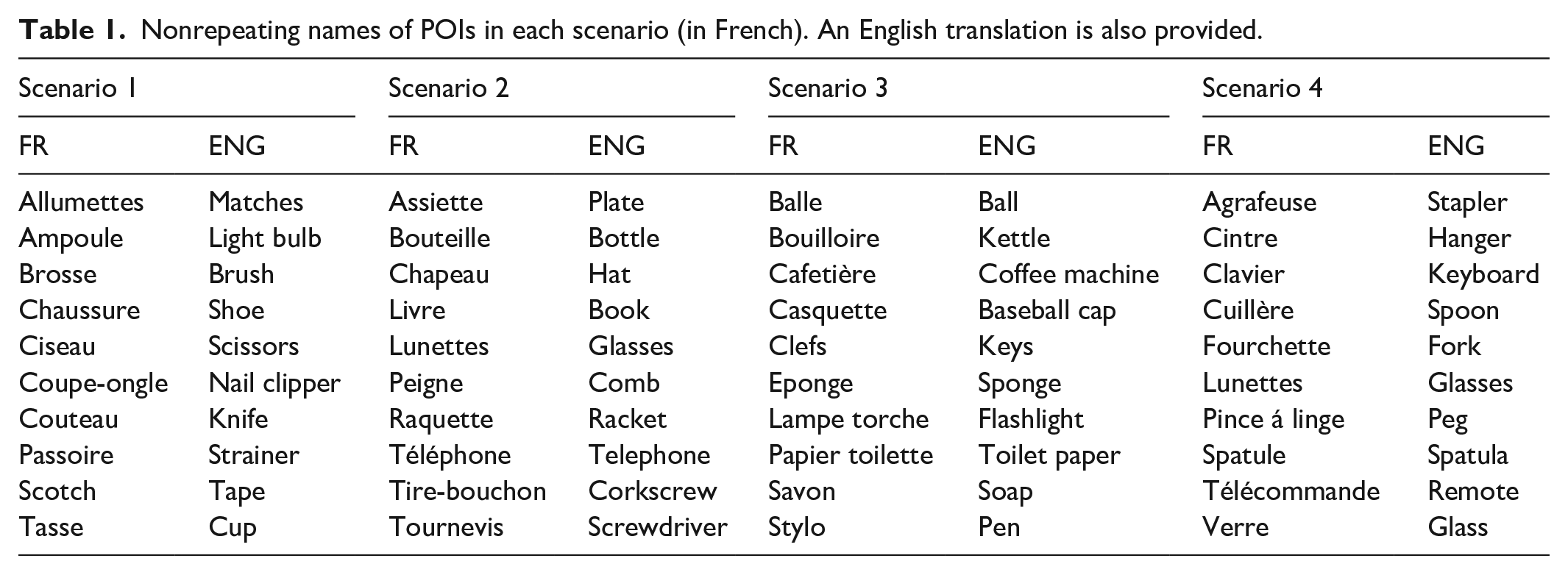
Forty landmark terms were selected for POIs in the experiment. They were common objects, small and manipulable (e.g., ball, pen, shoe, or key), so there would be no conflict of plausibility with their existence at random positions. All objects were rated highly as being “really graspable” according to Guérard et al. (2014) database (as noted on a 7-point scale,
Nonrepeating names of POIs in each scenario (in French). An English translation is also provided.
POI reconstruction
For each map, an arrangement of POIs was developed, resulting in four map scenarios. For each specific scenario, 10 object names (see Table 1) were assigned a defined spatial position on a map (i.e., a POI). Each POI pair can be characterised by a Euclidean distance
Tactile maps: To test hypothesis
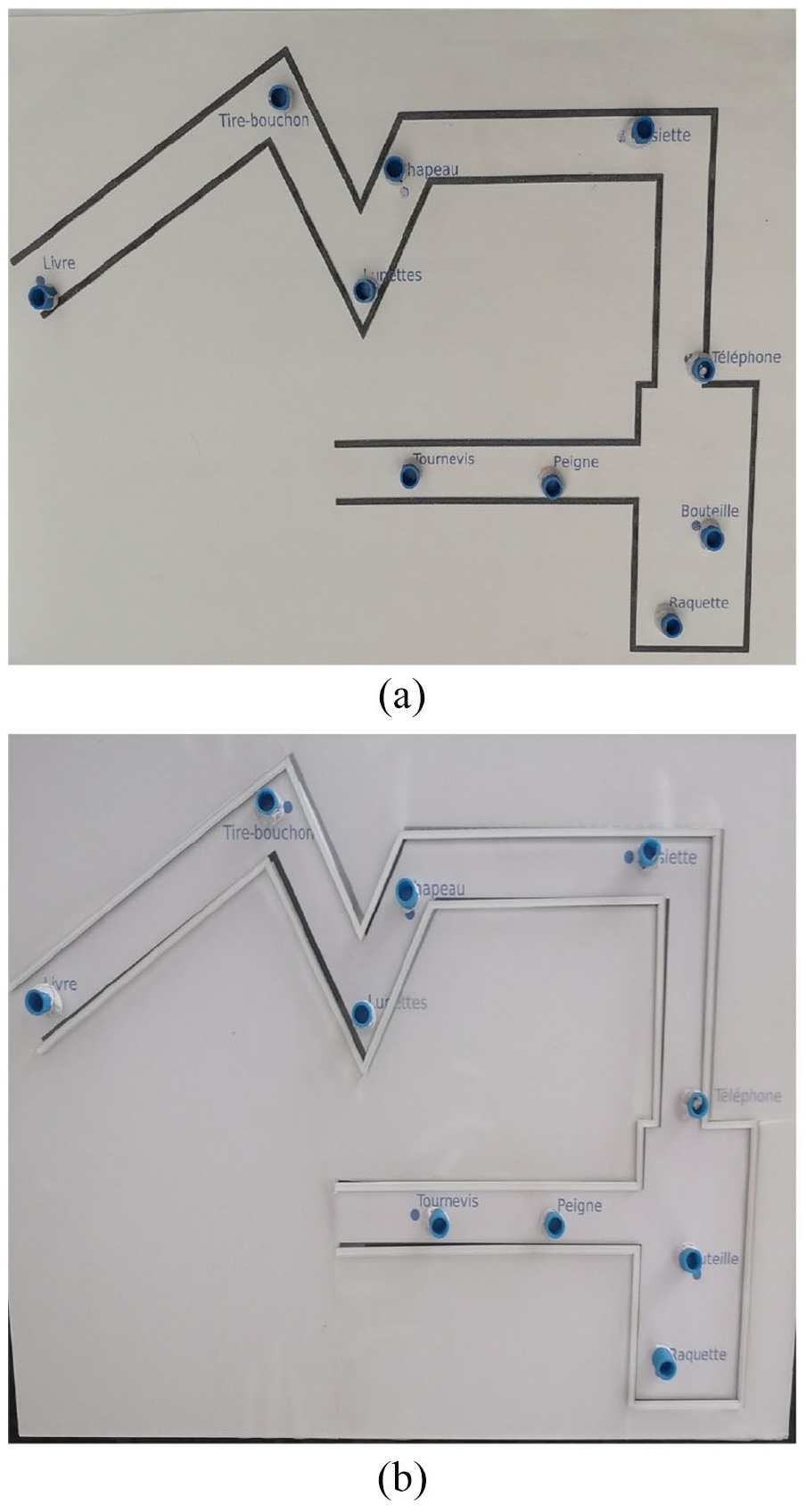
Two examples of tactile map scenario reconstructions showing POI markers and associated labels, scenario 2, ID#018, group EB.
POI-pair distance comparison task details
For each scenario and each subject, the object for the distance comparison task consisted of a selection of 20 pairs from all possible combinations of POIs for each scenario, evaluated twice using two repetition blocks. Pairs were formed based on a common first detail (e.g., Lunette–scotch / Lunette–clavier) and a relation question for the participant to answer: “is shorter?” (
The same distance does not appear in three successive comparisons.
An equal number of
Assuming a given perspective, allocentric or egocentric, there should be an equal number of “true” and “false” correct responses within a repetition block.
Assuming a given perspective, a maximum of 3 successive identical responses (a series of 3 “true” or 3 “false”) is permitted.
The ordering of the
The presentation order of the two pairs remains the same over the two repetition blocks, while the comparison sign
Procedure
Participants were tested individually. The total duration of the experiment was
Procedural familiarisation phase
To familiarise participants with understanding the task (procedural learning), there was first a short phase of mental comparison of distances between six cities located on the periphery of the map of France (Strasbourg, Marseille, Perpignan, Bordeaux, Cherbourg, Dunkerque). Participants first had to remember their spatial locations, chosen so as to be easy, and then haptically explored a relief map with six markers representing the different cities. Then, the participant had to answer TRUE or FALSE to statements concerning the mental comparison of distances—for example, “Strasbourg–Marseille bigger than Strasbourg–Dunkerque.” Participants had to mentally imagine the distance between the first two cities mentioned and then between the other two cities. Due to the lack of obstacles, responses to this preliminary task are expected to be equal, regardless of the perspective taken.
Participants responded to decide whether the statement was true, indicating this by pressing a key on the computer keyboard. To answer TRUE, they pressed the “L” key on the keyboard (AZERTY) with their right hand; to answer FALSE, they pressed the “S” with their left hand. The two keys were covered with felt fabric to facilitate key recognition and finger placement. Following this evaluation, two participants were eliminated due to their inability to pass the procedural screening test.
Exploration learning phase
Participants first haptically explored the scenario maps on the attributed support without any landmark objects, and then, 10 markers (verbally assigned names) were positioned at given POIs. After a familiarisation exploration, in which participants were free to take all the time needed to understand the map without the objects (Afonso, 2006; Boumenir, 2011), participants explored the first scenario (the map with the markers) without time constraints. The markers were then removed, and participants were asked to reconstruct the scenario for the first time. The experimenter corrected placement errors by taking the participant’s hand (holding the incorrectly positioned counter) and directing it to its correct position, as in previous studies with blind participants (Afonso, 2006; Afonso et al., 2010). This procedure was repeated until the participant felt they had memorised all the objects and their correct locations, finalising the second reconstruction task. The exploration time and the number of explorations required by the participant to memorise each scenario were recorded.
Free recall task
After learning the spatial configuration of a scenario, participants were asked to count down in steps of three from a random three-digit number for 2 minutes (interference task) and then perform the free recall of the objects present (simple memory task). They could then proceed to the mental comparison of distance tasks.
The number of objects correctly recalled by participants was recorded as a score out of a possible 10.
Mental comparison of distance task
The administration of this task was automated (coded in Psychopy3, version 2020.2.4 [Peirce et al., 2019]). All instructions were given verbally by the computer program, either in the form of recorded or computer-generated speech. All participants accomplished the experiment on the same laptop (Acer, swift 5).
Participants were told that each trial would first consist of hearing the names of two objects on the map. They were invited to picture the entire map and then to focus on the distances separating a pair of named objects (e.g., Lunette–scotch). After a pause of 2 s, the “relation statement” was presented—that is, “plus petit que" (“smaller than”) or “plus grand que” (“greater than”). After a pause of 2 s, the second pair of named objects were presented (e.g., Lunette–clavier). From the presentation of the second pair, participants were invited to focus on the newly specified distance and compare it with the first one. Participants had then to respond if the relation statement was TRUE or FALSE, using the attributed button (indicating if the statement between the distances of the two proposed pairs was true or false). Responses and response times were recorded. Participants were allowed to take a short break between the two repetition blocks if desired.
The interpretation of the term “distance” was left to the participants. Nothing in the experimental instructions was included to influence this choice for the participants. They were entirely free to resolve the task using an allocentric or egocentric mental map for distance evaluations. Two principal metrics were calculated based on the mental distance comparison responses. After completing the mental comparison of distance task, participants were asked to make a final POI reconstruction of the scenario.
Distance type agreement score: The total score of correct answers according to each of the two perspectives was calculated. As the allocentric and egocentric interpretations were always in opposition, the distance type agreement score for allocentric representations (based on Euclidean distances) is the complement of the distance type agreement score for egocentric representations (based on navigation distances). The predominant perspective (allocentric versus egocentric) used by each participant was computed by analysing which perspective produced the highest number of correct answers. From there, participants were categorised as belonging to the egocentric or allocentric perspective for each map studied.
Distance comparison grouping: We systematically tabulated the number of correct answers (according to the Euclidean versus navigational distances) to obtain a score out of a possible total of 40.
Distance comparisons were put into three categories (small = D1, medium = D2, large = D3), depending on the magnitude of the difference between the two POI pairs (henceforth referred to as an item). Thresholds were determined to generate subsets of approximately equal distributions, given the actual distance distances employed in the POI-pair distance comparison task for each item. In the Euclidean condition, combining the four scenarios, D1 comprised 58 items (
POI reconstruction tasks
Participants placed the 10 physical markers on the original tactile map, initially devoid of markers, identifying each corresponding POI name. Reconstructions were photographed in the following three steps: first reconstruction attempt, final reconstruction at the end of the exploration learning phase, and finally, the reconstruction after the distance comparison task. An example of the map reconstruction photos taken at each stage is shown in Figure 3.
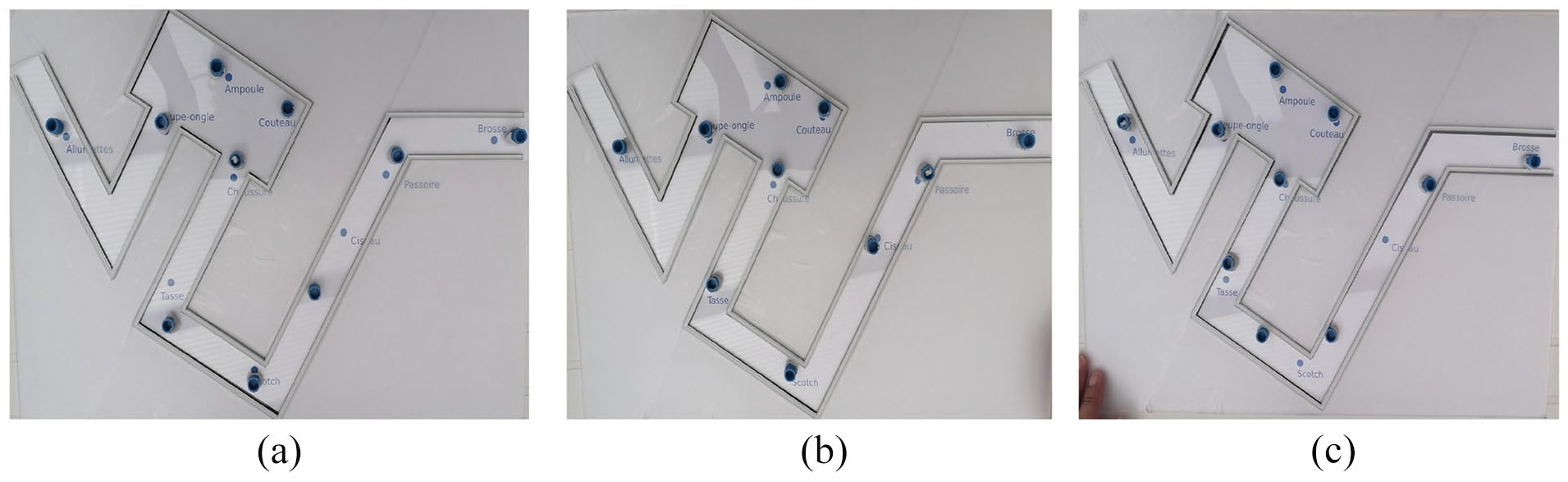
Example overhead photo series of map reconstructions, scenario 1, ID#018, group EB.(a) Placement phase 1, first exploration. (b) Placement phase 2, end of learning. (c) Placement phase 3, after distance comparison task.
The POI reconstruction photographs were analysed (Webplotdigitizer 4 ) to extract the coordinates of the POIs placed by the participants. These 10 geometrically arranged reference points define a 2D landmark map. The two-dimensional regression, specified above in the section Methods: Reconstruction Task, first optimises scale and rotational alignment before comparing the geometrical structure similarity of each reconstructed landmark map to the scenario reference.
Participants
The experiment involved 39 participants aged 19 to 60 yr
One group of participants was composed of 11 early blind individuals who had totally lost their sight before the age of 2.5 yr (3 males and 8 females; aged 30 to 55 yr,
To avoid any potential bias between groups EB and LB compared to BS, several data were collected about the participants, such as age, educational and sociocultural backgrounds, and information about autonomy in their everyday lives. At the outset of the study, the BS group was constructed to match the demographics of the EB and LB participant pool equally. Due to the COVID pandemic, however, several subjects recused themselves from participating due to the pandemic restrictions and health concerns. The demographics remained comparable but not as ideally matched as at the outset.
Three EB and three LB were later excluded from the experiment, as they reported being unable to achieve the tasks and decided not to pursue the experiment after the first task. One BS was excluded due to the random nature of their answers.
Results
Analysis of variance (ANOVA) was carried out with independent variables: Group (EB, LB, BS) and support (thermo swell touch paper = T, 3D printed = 3D); design variables scenario
Map learning
Exploration times (map without or with POIs) and the number of explorations were measured during the learning phase. No significant differences were found between groups or between supports. Participants took significantly more time on average
Free recall task
In the free recall task, participants recalled 9–10 correct names. No significant differences were observed regarding support. Group factor analysis shows a significant difference
Mental exploration method
In analysing results, while no explicit instruction was given, it was assumed that participants employed either an egocentric (Navigation distances) or allocentric (Euclidean distances) frame of reference consistently. The distance type agreement score was tabulated for each participant (EB, LB, or BS) and each support (T or 3D), being the number of correct responses obtained from an allocentric perspective (Euclidean type map) or egocentric one (navigation type map). We discarded from this analysis those participants whose scores were 45–55% as inconclusive/inconsistent, eliminating participants whose responses were close to random between the two perspectives. This could be due to a poor capability with the distance comparison task or the presence of dynamic switching between perspectives during the study, both of which render results unusable in the current analysis. This selection analysis resulted in retaining 89% of the initial participants: 8 EB, 13 LB, and 15 BS. Moreover, this first analysis allowed us to add the variable “perspective” (P = egocentric or allocentric) to the analyses.
The first global analysis was to observe which perspective participants used to resolve the experimental task, with a summary shown in Figure 4. These data, and subsequent plots, employing 95% confidence interval reporting, as promoted in various statistical literature (Baguley, 2009; Cumming, 2014), allow for a rapid visual comparison of significance as well as an indication of the effect size. Those who benefited from early visual experience (BS and LB) used mostly an egocentric perspective to solve the task of mental comparison of distance (correct answers respectively mean 87% of the cases for the BS, and 69% of the cases for the LB), independent of the support. In the case of participants without early visual experience, results differed according to support. EB in condition T responses were correct for an allocentric perspective in 62.5% of the cases (or 5 out of 8 participants), while the opposite was observed in condition 3D, with 62.5% of participants’ responses being in accordance with an egocentric perspective.
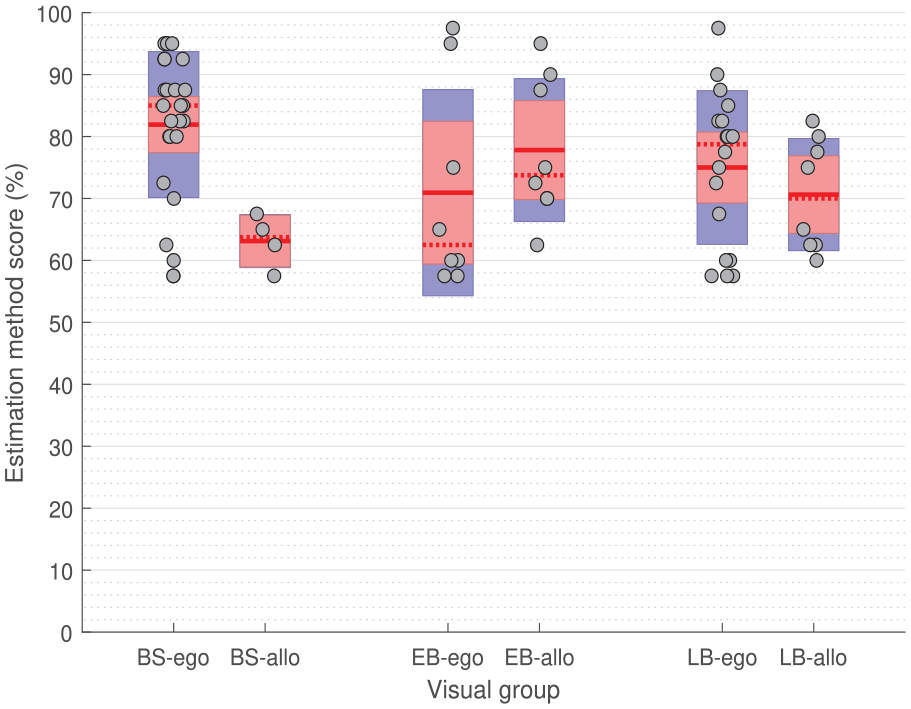
Frequency of use of distance estimation methods according to visual condition and perspective grouping. Plot shows median (red line), mean (dashed red line), 95% confidence interval (orange area), and 1 standard deviation (blue area), as well as the full data scatter plot.
Examining the consistency of responses at the group level, we evaluated the percentage of times they actually used this perspective compared to chance. Thus, the higher the percentage of coherence of a group, the more the use of one or the other perspectives was preferred. Conversely, if the result is close to 50%, it indicates a chance response. The statistical analysis shows a significant interaction between group and perspective
Mental comparison of distances task
Percentage of correct responses
Results showed no observable effect of group or support on the percentage of correct responses (to the assigned perspective of a given participant following individual distance-type agreement scores). In contrast, analysis of the perspective factor shows (see Fig. 5a) that participants using the egocentric perspective obtain significantly more correct responses than participants using the allocentric perspective (
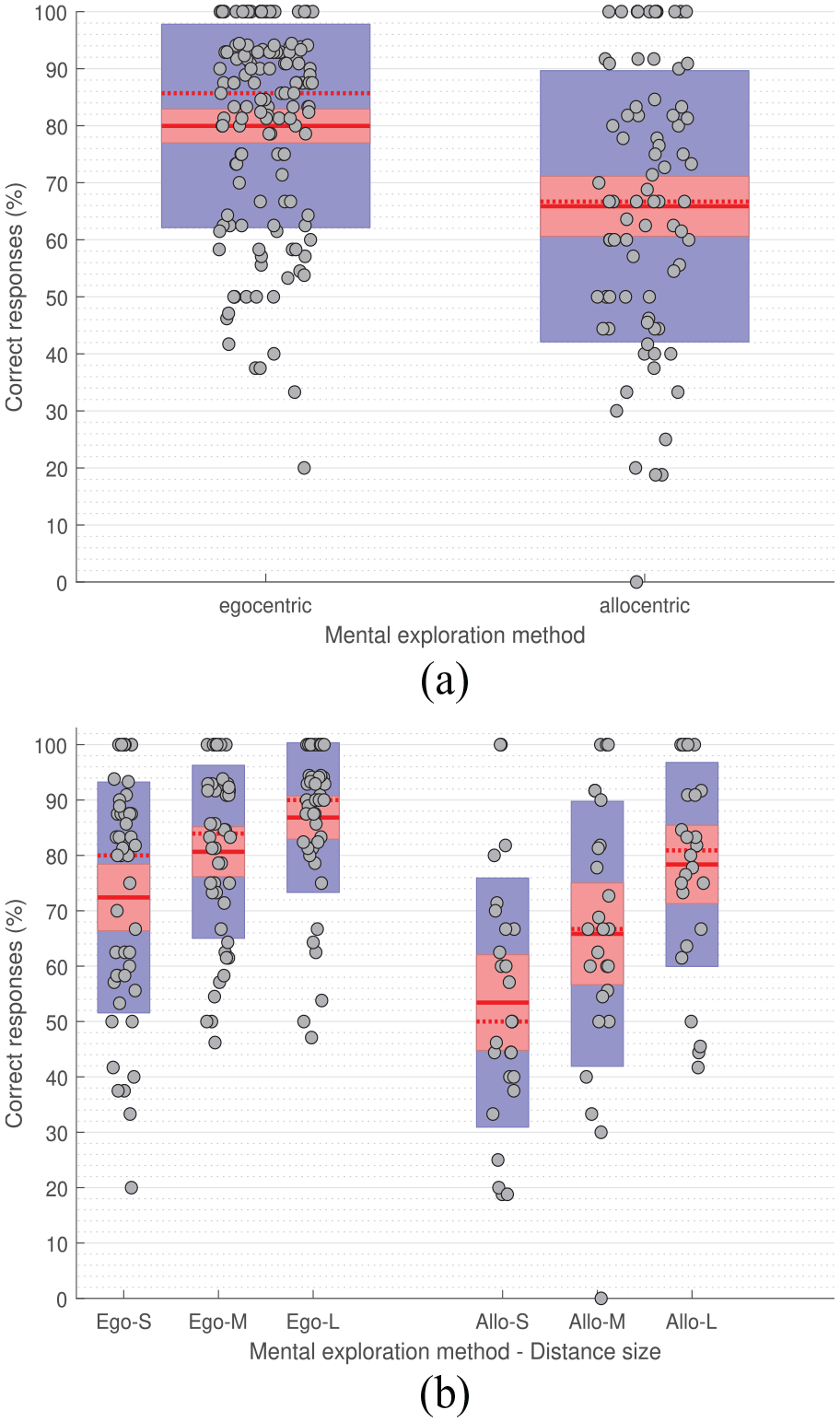
Percentage of correct answers. (See Figure 4 for plot style legend.). (a) Percentage of correct answers according to the perspective group attribution (showing results for all distance differences [small, medium, and large]). (b) Percentage of correct answers according to distance difference (small, medium, and large) and perspective group attribution.
Regardless of the perspective used during the task, the results also show a distance effect, showing that small, medium, and large differences in distance were treated significantly differently
Results also indicate a significant interaction between the perspective and distance variables (F (2,210) = 4.48, p = 0.013), as seen in Fig. 5b. The percentage of correct responses is higher when participants take an egocentric rather than an allocentric perspective to solve the task, regardless of the type of distance differences (small, medium, or large). The post-hoc analysis shows that in the case of an egocentric perspective, only the difference between the Small and the Large distances appears significant
Response time
Analysis of response times of correct responses shows a significant effect of the perspective variable
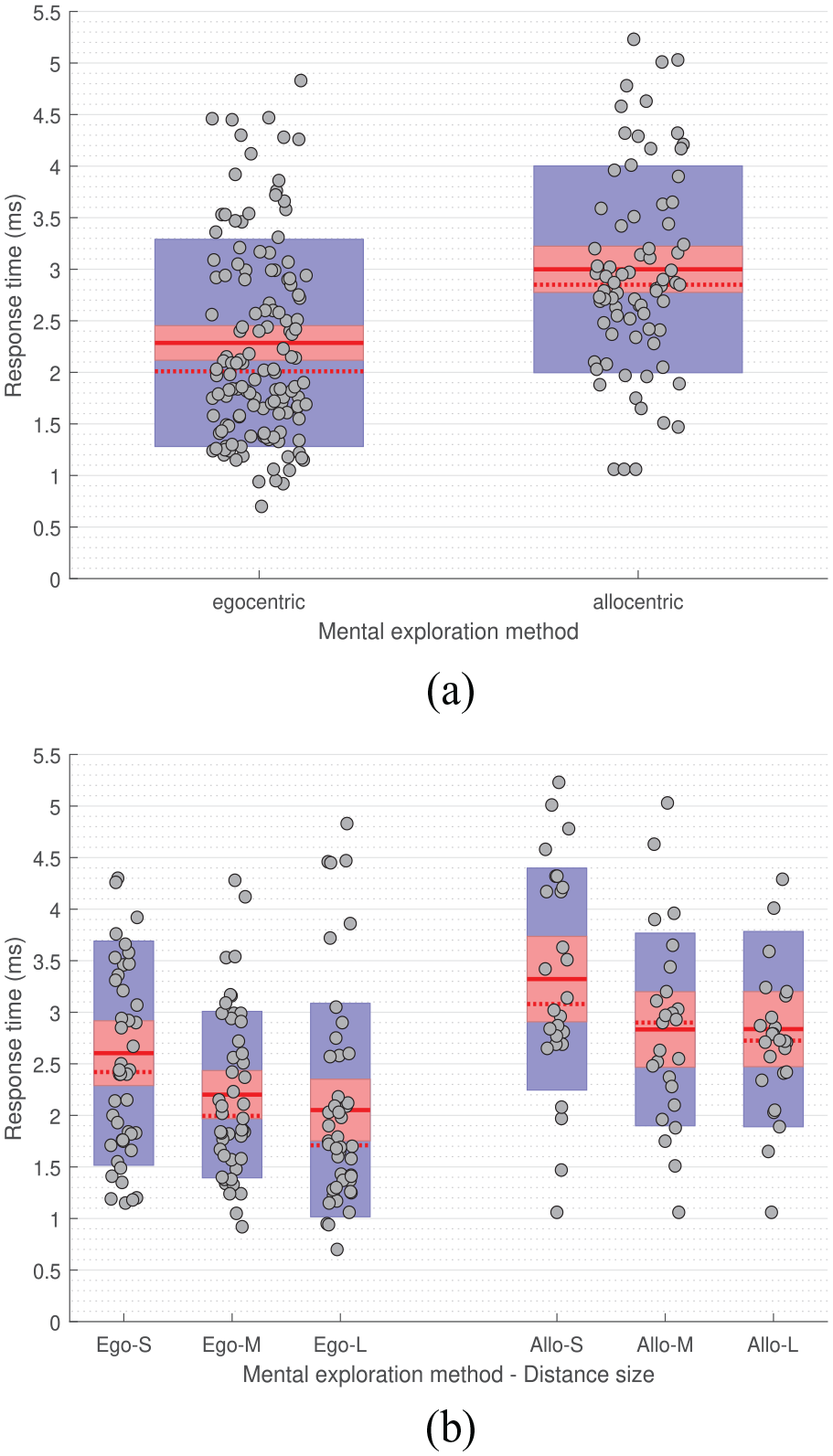
Response times. (See Figure 4 for plot style legend.) (a) Correct response times according to the perspective group attribution. (b) Correct response times as a function of distance difference (small, medium, and large) and perspective group attribution.
POI reconstruction
Results showed no observable scenario, group, or support effect on the reconstruction coherence relative to the prescribed POI placements. As shown in Figure 7, overall values for bidimensional regression analysis are quite high, indicating good map reconstructions in all conditions. Differential analysis of the three POI placement tasks
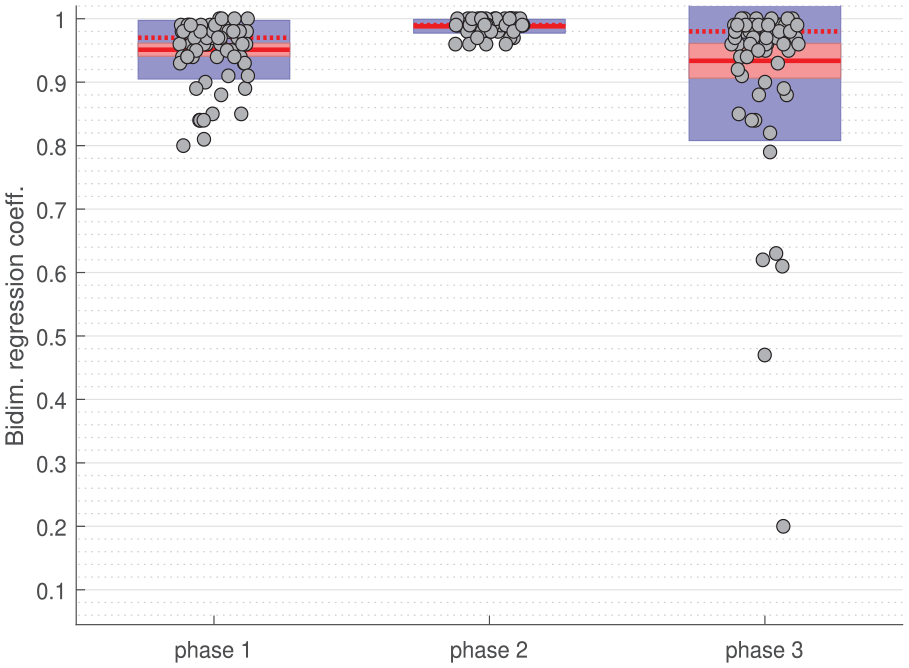
Bidimensional regression analysis (across scenario, group, support) for the placement phases. (See Figure 4 for plot style legend.).
Discussion
This study investigated the type of spatial mental representations constructed from two different haptic modalities, depending on participants’ visual conditions. We designed a protocol that allowed participants to choose their method of mental exploration without any explicit instructions on how to explore the spatial representation they encoded during the learning phase. We used the distance comparison task designed by Denis and Zimmere (1992) to assess the ability to construct spatial mental representations and measure their properties.
Our hypothesis suggested that the preference for an egocentric versus allocentric perspective when exploring mental maps is influenced by prior visual experience (early blind = EB, late blind = LB, no visual deficit [blindfolded-sighted] = BS). Previous studies have shown performance advantages in the mental comparison of distance tasks between perspectives regarding visual experience (allocentric for BS, egocentric for LB and EB [Noordzij et al., 2006; Péruch et al., 2006]). Using the same task in an experiment that allowed each participant to choose their perspective freely, we expected participants’ choices to be consistent with those findings. We did not anticipate any performance advantage between perspectives (allocentric versus egocentric) when participants were allowed to choose their perspectives freely.
Limitations
Several assumptions were made when designing the protocol and analysing the results. Results are, therefore, to be considered in light of these limitations.
Firstly, we have controlled the information provided and the size of the environment, both of which are typical of indoor navigation by visually impaired subjects (typical tactile map, typical corridor size). We examined what strategies were employed and to what degree they were common according to visual experience when removing the instructional bias observed in previous studies. Such analysis excludes consideration of prior training by each individual participant and other elements beyond our control. Consequently, we include in H1 the supposition that these group definitions have experienced common learning strategies, thereby controlling for this factor by group.
Secondly, selected participants were autonomous in their daily lives (not institutionalised, etc.), had a profession, or were involved in associations. They were considered similar enough in demographic conditions to construct groups according to their degree of visual deprivation. As individual differences could not be controlled, participants were screened to ensure that at least they understood the basic task through a procedural familiarisation phase, which only eliminated 2 potential participants.
Finally, the procedural screening in the familiarisation phase involved simple distance comparisons of points situated on the perimeter of a map of France. While answers to this task are expected to be the same for both allocentric and egocentric perspectives, due to the absence of obstacles, some potential bias in the choice of perspective could be considered from this prior task. Classification results for the taken perspective based on responses to the largest distance difference comparison allowed for a clear classification of 89% of participants, with the remaining participants potentially either performing more errors or being inconsistent with the perspective employed. From those clearly classified, accuracy rates were 80% on average for all distance comparisons. These results provide a strong indication of the consistency of the employed strategy in general, and the evidence of the two perspective classifications suggests that the effect of prior task exposure was limited or absent.
H1: Preference for egocentric perspective in individuals with early blindness
Regarding the subjectively chosen method, blindfolded-sighted subjects significantly preferred the egocentric method. Unexpectedly, we observed no marked preference for one method over the other between the two blind groups. Therefore, the experimental results do not align with hypothesis H1; rather, they reveal no marked preference for one method over the other in blind groups. These results question the findings of the literature, which indicate that the absence of early visual experience overwhelmingly favours the use of an egocentric representation (Millar, 1994; Noordzij et al., 2006). Without specific instructions on the type of perspective to use, early blind individuals did not systematically employ an egocentric navigation perspective. This strongly suggests that experimental instructions may have influenced previous studies.
H2: No performance advantage for either perspective
Concerning the two types of mental exploration methods, our experiment highlighted significant differences irrespective of the visual experience group. The outcome of this study does not corroborate hypothesis H2. Instead, it indicates that using an egocentric perspective led to better performance (faster and more correct answers).
H3: Support material affects performance
Hypothesis H3 was not confirmed, with the results of this study indicating that regardless of the type of support explored (3D printed or thermoformed), participants could memorise many items based on information derived from tactile exploration of the environment. We note, however, that both maps contained the same geometrical information and symbols (POI markers). For more complex maps, multiple abstract symbols could be more complicated in initial explorations for untrained people and even regular users. Therefore, we can assume the effect of the type of POI symbols could explain our divergent results with prior research (Bleau et al., 2023). Adapting our study to more complex maps with 3D contexts/requirements may bring out significantly different results in mental representation abilities between the two types of maps.
Conclusion
In all groups, participants demonstrated the ability to elaborate reliable mental representations, and the results reproduced the symbolic distance effect described in the literature, where larger differences between two distances resulted in shorter response times and a higher percentage of correct responses (Afonso, 2006; Noordzij et al., 2006; Picinali et al., 2014).
Given the difficulty of the task and the haptic modality (processing information item by item), we can suggest that using an egocentric perspective was easier and more efficient regardless of visual experience. Participants achieved better results using the mental exploration method that did not require transposing information into verbal or visuospatial format, which questions the Baddeley and Hitch (1974) model that considers the working memory system based on those two modalities. Participants could directly encode information from tactile exploration to construct a reliable representation and use it in our distance comparison task by exploring in a navigational way, item by item, without transposing it into verbal or visuospatial information. Our results highlight the limitations of that model, as raised previously in Grison and Afonso Jaco (2020), suggesting that participants relied directly on sensory-motor information to construct their spatial models. These findings support the existence of different working memory systems, as proposed by Cowan (1988), which define a format based on multiple sensory systems (modality-specific components of memory in the first phase and interactions between modalities in the second phase).
Interestingly, it was observed that most blindfolded-sighted participants did not necessarily transpose tactile information into a visuospatial format to construct their representations, even though using tactile maps was unusual. Despite previous studies identifying good abilities for blindfolded-sighted participants to use allocentric representations, they spontaneously relied on egocentric representation, probably induced by the tactile exploration imposed in our study. However, these findings did not appear significant for the blind participant groups. Many blind participants indicated in the pre-test questionnaire that they had learned how to explore tactile maps in school or during their locomotion training. This learning effect could explain why they randomly used one representation or the other, as they were accustomed to switching from one model to another.
Annexe: Mental exploration and the symbolic distance effect
One widely employed paradigm that has been developed to evaluate spatial mental maps has been the mental scanning task, originally proposed by Kosslyn et al. (1978) and later adapted to studies examining various learning protocols with both sighted and blind individuals.
In the mental scanning task, the participant is first asked to learn the spatial configuration of an obstruction-less environment, with different objects located around its perimeter, whether it is a “classic” island (Kosslyn et al.,1978) or a simplified island in the shape of a circle (Denis and Cocude, 1992). Participants are then asked to imagine an object moving in a straight line, at a constant speed, between different objects (in pairs) that were part of the initial configuration they had learned.
The most notable result obtained from mental scanning tasks consisted in the observation of a linear relationship between the mental travel time between two points and the physical distance between them; thus, the longer the distance to be covered between two points, the longer the time required for its mental travel, given the aforementioned instructions (Beech, 1979a,b, 1980; Borst and Kosslyn, 2008; Borst et al., 2006; Dror et al., 1993; Iachini and Giusberti, 2004; Kosslyn et al., 1978; Pinker et al., 1984). This time/distance correlation was analysed as evidence that the metric properties of the initial environments were preserved in the mental representation elaborated by the individuals.
The next question was whether this feature of mental representations, found in psycho-physics and commonly referred to as the “symbolic distance” effect in the case of mental representations (Moyer, 1973; Paivio, 1975), arose solely from the fact that the studies were conducted using visually perceived images (Kosslyn, 1973; Kosslyn et al., 1978) from which individuals had to create a mental representation. Alternatively, would it be observed whatever the initial support? Thus, distance mental exploration paradigms have been employed after learning by verbal description (Denis and Cocude, 1989, 1992, 1997), haptic exploration (Kerr, 1983; Röder and Rösler, 1998), and locomotor exploration in real and/or virtual environments (Afonso et al., 2003; Afonso, 2006; Iachini and Giusberti, 2004; Picinali et al., 2014). These studies have highlighted the preservation of the symbolic distance effect.
Investigating the influence of vision on the characteristics of mental representations, Afonso et al. (Afonso, 2006; Afonso et al., 2010) proposed a task, adapting that of Denis and Cocude (1992), to participants who were blind from birth, late-blind, and blindfolded-sighted, to evaluate the influence of early visual experience in the results obtained previously. Participants were asked to solve a mental scanning task after learning the spatial configuration of an environment by either verbal description or haptic exploration. While the time-distance correlation was clearly observed for participants with visual experience, it was completely absent for participants who were blind from birth. On the other hand, as soon as the participants who were blind from birth were immersed in a full-scale virtual reality representation of the environment (and no longer exploring in a manipulative space, i.e., map), the results obtained in the mental scanning task, whether after a verbal description or a motor exploration of the environment, showed a strong positive correlation between the mental navigation time and the distance to be covered.
Footnotes
Acknowledgements
The authors are grateful to Emma Coudray (master’s degree student) for her contribution to the experimental sessions of the experiment. They also thank the anonymous research participants for their time and effort. The authors acknowledge Frank Zagala’s contributions to in developing the experimental platform.
Declaration of conflicting interests
The author(s) declared no potential conflicts of interest with respect to the research, authorship, and/or publication of this article.
Funding
The author(s) disclosed receipt of the following financial support for the research, authorship, and/or publication of this article: This work was funded by the RASPUTIN project (Grant No. ANR-18-CE38-0004,  ), with B.F.G. Katz project leader and Pascale Piolino principal investigator for Université Paris Cité.
Ethical Approval
Ethical approval for the study was granted by the Paris University committee, CER U-Paris (Nř IRB: 00012021-02).