







Abstract
As trained educational and developmental psychologists who study the role of working memory in educational outcomes, we know the various assumptions made about definitions and measurements of this cognitive ability. Considering the popularity of the Baddeley and Hitch working memory model in these fields, we raise challenges related to measurement, overlap with executive function, and adopting working memory measurement approaches from adult models. We propose that researchers consider how working memory tasks might tap multiple other abilities. This is problematic in the context of child cognitive development and in understanding which factors explain educational outcomes in children. We recommend giving greater attention to the central executive, acknowledging the overlap between the central executive and executive function in study design, and investigating a developmental model in the context of the broader abilities evoked in measurement. These recommendations may provide a fuller understanding of working memory’s mechanistic role in children’s learning and development and assist in developing reasonable adjustments for specific aspects of working memory for children who struggle.
Introduction
Working memory is a cognitive resource with limited capacity that preserves information while simultaneously processing the same or other information (Baddeley, 2000). It has been linked to numerous higher-order cognitive skills in everyday life (Greiff et al., 2015; Unsworth & Engle, 2007; Unsworth et al., 2009). Therefore, it is no surprise that working memory is a popular topic, spawning many research articles and books. At the time of this writing, the search term “working memory” yields over one million results in the first author’s library database. Much of the research concerning working memory demonstrates its correlations with numerous outcomes, including academic achievement in children (Gordon et al., 2020; Miller-Cotto & Byrnes, 2020; Peng, Barnes et al., 2018), native and foreign language acquisition (e.g., Linck et al., 2014), learning-related disabilities (e.g., Fuchs et al., 2014; Peng et al., 2018), neurodevelopmental conditions such as attention-deficit/hyperactivity disorder (e.g., Willoughby et al., 2019), and cognitive decline in old age (e.g., Nguyen et al., 2019). Indeed, literature on working memory with children in education and development is abundant, demonstrating moderate to strong correlations between working memory and various educational outcomes (see Peng et al., 2016; Peng, Wang, Namkung, 2018, for meta-analyses). However, while a plethora of research indicates the importance of working memory, little work has provided an understanding of why it is essential to education and development, and several factors compound this. These include (1) the overlap of abilities attributed to the central executive and to executive function, resulting in a risk of double measurement; (2) that working memory task performance is influenced by other cognitive abilities such as processing speed, prior knowledge, numeracy, and language; and (3) the adoption of assessment methods were born out of adult models, thus lacking consideration of cognitive development in child populations.
The above factors can provide challenges to the disciplines investigating this cognitive construct. To expand the third issue, working memory research with younger children often adapts measures from cognitive science using adult populations, meaning measurements and interpretation differ from that which cognitive science research first intended (Oberauer & Lewandowsky, 2019). In addition, the rapid growth of executive function research and its potential to explain developmental and educational outcomes has resulted in a level of interest from researchers in these fields (see Souissi et al., 2022, for a review) comparable to working memory. However, executive function descriptions (e.g., Miyake et al., 2000) considerably overlap with those of the central executive in the Baddeley and Hitch model of working memory, and many studies are not designed to acknowledge this overlap (this is discussed in detail later in this review). This article will discuss considerations for potential duplication with executive function processes (e.g., Miyake et al., 2000), measuring working memory in child samples, its influence from other constructs, and how to approach studying working memory in children without drawing conclusions based on the adult cognition literature. We also provide potential suggestions for paths forward in the field and how we might use this knowledge to support children who struggle in the classroom.
Working memory in education and development
Although working memory research originates from cognitive psychology, the past few decades have demonstrated the growth of focus on this concept in developmental and educational research. Specifically, researchers have conducted studies to identify developmental and individual differences in working memory and to explain how these differences might account for developmental and educational outcomes (e.g., Hall et al., 2022; Miller-Cotto & Byrnes, 2020; H. Zhang et al., 2023). As such, researchers have examined performance on working memory tasks, such as the aforementioned complex span task, as predictors of mathematical abilities (see Y. Zhang et al., 2022, for a meta-analysis), reading (see Peng et al., 2018, for a meta-analysis), and educational attainment more generally (Peng & Kievit, 2020). However, despite its popularity, challenges limit our understanding of working memory in developmental and educational contexts. We discuss these challenges here, but first, we provide a brief history.
A brief history
Working memory researchers can trace the concept to short-term memory literature (e.g., Atkinson & Shiffrin’s classic 1968 model). Baddeley and Hitch (1974) suggested that short-term memory was the precursor to working memory. As a result, “short-term memory” and “working memory” are used interchangeably in the research literature, and it is therefore helpful at this point to clarify terminology. A review by Jarrold and Towse (2006) made a clear distinction, stating that short-term memory refers to an individual’s “ability to store or maintain information over a limited period, while working memory refers to the ability to hold information in mind while manipulating, and integrating other information in the service of some cognitive goal” (p. 39). It is this latter definition that is used consistently throughout this review. We define an important clarification point as it clarifies the issues we raise regarding measurement later.
In support of this, in his review titled “The Many Faces of Working Memory and Short-Term Storage,” Cowan (2017) acknowledged that a considerable degree of confusion has arisen due to the various definitions of the concepts that have been born out of the many and varied approaches to its measurement. In addition, he notes that social scientists have an unfortunate pattern of using various terms for the same phenomenon (Cowan et al., 2020). We argue that this has most likely contributed to varied approaches to studying working memory in educational and developmental research fields.
Regarding models of working memory, although we acknowledge other commonly used theories today (e.g., the Time-based Resource-sharing Model, Barrouillet & Camos, 2021; Barrouillet et al., 2004; Embedded Process Model, Cowan et al., 2005), this article focuses on the multicomponent model of working memory (Baddeley & Hitch, 1974). Given the readership of this Special Issue, a full explanation of this enduring model is not required here; however, we provide a brief description relevant to the key points raised in this review.
The components of the Baddeley and Hitch (1974) model are the phonological loop, visuospatial sketchpad, central executive, and episodic buffer (Baddeley, 1986, 2000). It is the central executive that is the focus of this review. According to this model, the central executive facilitates working memory performance by directing attention to relevant information, suppressing irrelevant information, inhibiting reactions to irrelevant information, and switching attention between different processes (Baddeley, 2000; Baddeley et al., 2001). With this multicomponent model information in mind, we now turn to a discussion on measuring working memory.
Working memory measurement
As noted in the previous section, numerous approaches to measuring working memory have been developed. One commonly used measure is the complex span task, designed to mirror the need to simultaneously process, maintain, and recall verbal or visuospatial information over short periods. Visuospatial complex span tasks involve holding visual or spatial information in mind, manipulating (e.g., reversing), and recalling the presentation of locations or sets of objects. For example, in the Corsi Block backward task, the participant observes the experimenter tapping a sequence of cubes and then repeats the sequence in reverse order. Verbal tasks include maintenance, manipulation (e.g., reversal), and retrieval of numbers, words, or letters. For example, in the Digit Span task, the participant listens to the presentation of a series of numbers and then repeats the sequence in reverse order.
It is important to note that many working memory tasks are designed to recruit visuospatial or verbal processing and maintenance and all the abilities mentioned above within the central executive. That is, it is assumed these abilities are required for successful task completion. Yet, while the description above of the central executive includes several processes (i.e., directing attention, inhibitory control, switching between processes), they do not appear as standalone abilities in the original model. This, supposedly, has led to the development of tasks that do not explicitly tap these components separately or even by distinct trials within one task. Indeed, Baddeley has noted that measurement of the central executive has been challenging (Baddeley, 2002) and the least understood as a result (Baddeley, 2006).
We acknowledge that working memory measures, other than complex span tasks, are used in research with adults and children. For example, the change detection task (e.g., Rouder et al., 2011) presents participants with an array of visual items, followed by a short delay, and then a request to identify whether the variety has changed (usually evident in only one item). We argue that this task also demands inhibition of distracting stimuli (i.e., the non-relevant items in the array) and switching between different rules when processing the initial information (“retain the information”), and then after the delay (“spot the difference”). These abilities are akin to the central executive in the multicomponent model, yet the task does not measure these components in isolation.
To avoid a lack of clarity, it is also relevant to note that some studies have used simple span tasks to ostensibly assess abilities representing working memory. Such measures are like the complex span tasks described previously but do not include the requirement to manipulate the presented information. We argue that these are short-term memory measures, not working memory, as per the definition mentioned earlier by Jarrold and Towse (2006). In such tasks, the abilities attributed to the central executive are not drawn to the agreed assumption in working memory models.
Acknowledgement of the absence of specific measures of central executive abilities is essential because if we agree that working memory helps explain educational and developmental outcomes, we may also accept that critical aspects of this ability are not explicitly measured and, therefore, cannot be fully understood. For example, if we cannot measure inhibitory control within a working memory task, how can we determine its influence on outcomes of interest? Furthermore, suppose working memory is either measured as flawed or cannot be disentangled from other abilities. In that case, it is difficult to interpret one’s working memory ability and how to intervene in this skill for educational or developmental purposes. We include this point in greater detail in the next section.
Working memory and executive function
Alongside the continued growth of working memory research since the Baddeley and Hitch (1974) model,. Miyake and colleagues (2000; Friedman & Miyake, 2017; Miyake & Friedman, 2012; Miyake & Shah, 1999) have described a set of related but discrete abilities that enable goal-directed behaviour. These are referred to by the umbrella term executive function and are required when automated or routine behaviour is insufficient to achieve a known goal or goals. The specific set of abilities is defined as inhibitory control (the ability to suppress irrelevant information and inhibit inappropriate behaviour), set-shifting or task-switching (the ability to switch attention between one task, rule, or dimension and another), and updating (monitoring and revising relevant information for a specific task; Friedman & Miyake, 2017; Miyake et al., 2000; Miyake & Friedman, 2012).
As with working memory, educational and developmental psychologists have similarly adopted executive function to explain differences in specific higher-order abilities such as reading (e.g., Follmer, 2018), mathematical ability (e.g., Cragg & Gilmore, 2014), and educational outcomes more generally (e.g., Gerst et al., 2017). Here, we discuss the challenges that can arise when developmental and educational psychology researchers adopt both models as predictors of study design.
The functional descriptions of executive function (i.e., set-shifting, inhibitory control) are analogous to the functions of the central executive in the multicompetent working memory model. Yet, many of us can and do assume inhibitory control, set-shifting, and working memory can be measured using discrete tasks when designing studies. For example, complex span tasks assess a child’s working memory regarding their ability to monitor incoming information, switch between processing and storage tasks (which might also require switching between domains), inhibit responses to distracting or irrelevant information, and maintain and update information for short periods. If researchers view executive function as a construct, or set of constructs, separate from working memory, they might also add measures of inhibitory control and set-shifting (or task-switching). In that case, these two abilities are measured twice: once in the working memory task and then again in standalone measures of inhibitory control and set-shifting. The duplicated measurement has resulted in a varied body of evidence, which we discuss next.
Working memory, alongside inhibition and/or task switching, has been investigated as a predictor and correlate of several skills, such as mathematical achievement (e.g., Bull et al., 2008; see Friso-van den Bos et al., 2013, for a meta-analysis) and reading (e.g., Borella & de Ribaupierre, 2014; Chiappe et al., 2000; Passolunghi et al., 2022; see Follmer, 2018, for a meta-analysis), and in neurodevelopmental conditions such as those with autism (e.g., Sinzig et al., 2008). In these studies, it is often the case that academic outcomes are either correlated with executive function and not working memory (Bull & Scerif, 2001) or working memory and not executive function measures (e.g., Bull et al., 2008), or a combination of working memory and inhibition (Borella & de Ribaupierre, 2014), or working memory mediated by inhibition (Chiappe et al., 2000), and so on.
Findings from such studies could be explained by the task impurity problem (Burgess, 1997), where other cognitive abilities are recruited when attempting to evoke working memory or executive function performance. This is a known issue in such research, and we discuss it in the section: Considerations and Potential Paths Forward. However, it is also worth considering findings from latent variable analysis studies that have attempted to separate working memory, inhibition, and set-shifting into factors to identify different relationships with academic outcomes. We discuss this point in the following section. Still, it is essential to examine the updating and working memory for disambiguation as they are conflated in the literature and often measured using the same tasks.
As stated, Miyake et al. (2000) identified three executive function constructs, including “updating.” They described this as the ability to store and update relevant information in a readily available state (Miyake et al., 2000; Van der Ven et al., 2012), akin to working memory descriptions (e.g., Baddeley, 1992). Considering this, St Clair-Thompson and Gathercole (2006) assessed children on four complex span tasks and two measures to evaluate the updating construct. All the tasks were loaded together on the same factor, leading them to conclude that working memory and updating measures assess the same underlying construct. Miyake and colleagues (2000) also note that updating is closely linked to working memory. Furthermore, Van der Ven et al. (2012) describe updating as “ . . . the ability to store and update relevant information in working memory” (p. 71), and many authors have since used the idea of updating as the cognitive ability to store, monitor, and modify information in an accessible state (Bull & Lee, 2014; Iuculano et al., 2011; Lee et al., 2011; Lehto et al., 2003; Miyake et al., 2000; Toll et al., 2011). Therefore, we accept that working memory and updating are the same concept, with nomenclature arising from two (or more) fields. As such, in studies employing latent variable analysis, the tasks used to measure updating can be considered measures of working memory, as is acknowledged by all the authors in the published research discussed next.
Working memory and latent variable models
Latent variable studies use various measures of inhibition, set-shifting/task-switching, and updating/working memory to establish whether these observed variables load onto latent variables as discrete abilities. These studies aim to understand which factors predict specific educational outcomes. As shown in Table 1, in these exemplar studies, working memory is the only consistently distinguishable factor and the only consistent predictor of educational outcomes, with subsequent factors varying regarding which abilities they do or do not represent. According to the Baddeley and Hitch model, this makes intuitive sense if one considers that working memory is a factor encompassing inhibition and set-shifting within the central executive and, therefore, engulfing any variance explained by those abilities.
Summary of studies investigating factor structures of children’s working memory and executive function.
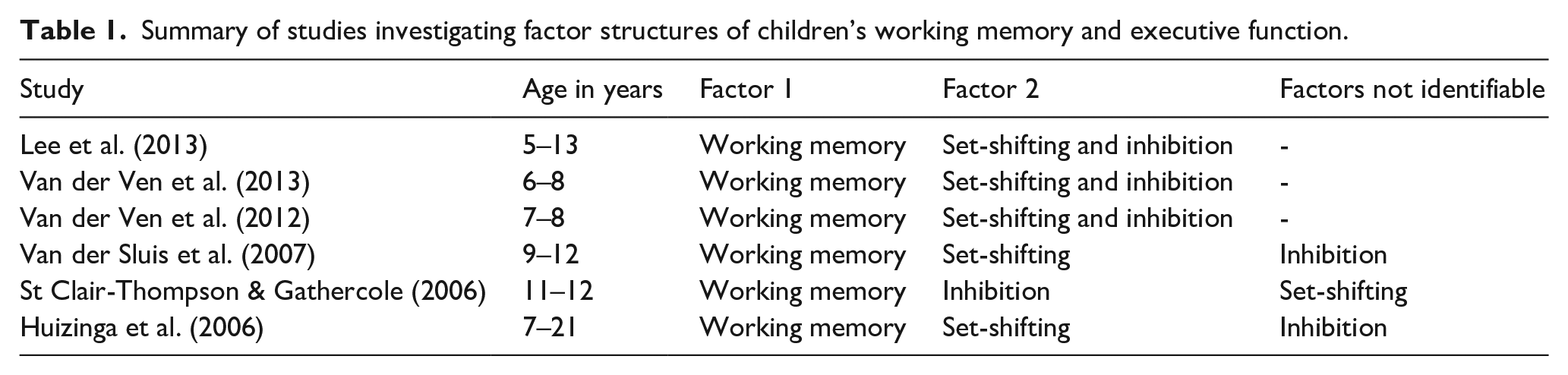
Regardless of these varied and inconsistent findings, many influential studies focus on inhibition, set-shifting, and working memory/updating, thus measuring some combination of the constructs twice. This is understandable given the wealth of related literature researchers have produced examining these abilities as predictors of academic outcomes and developmental cognitive milestones. However, we argue that this has a downstream problematic effect on assessing which abilities are essential, how each supports children’s learning and explains developmental and individual differences in academic outcomes. It is worth considering how we might more precisely measure “working memory.” We include these considerations in the following section.
Unpacking working memory: beyond the overlap with executive function
Like the concerns we have proposed in this review, McCabe et al. (2010) argued that psychologists and neuropsychologists examining executive function and working memory in adults have been measuring the same cognitive ability but using different terminology. A study with 200 participants assessed performance on four measures of working memory, four measures of executive function, and processing speed, vocabulary, and episodic memory, demonstrating a correlation between working memory and executive function was robust (r = .97) and not evident with other cognitive abilities suggesting this was not based on similarities across broad cognitive abilities in the sample. They concluded, and we agree, that working memory and executive function tests tap a common executive attention construct. Executive attention is highly predictive of higher-order cognitive abilities.
Although McCabe’s solution is appealing, it may also be necessary to consider that tasks designed to measure working memory do not require a single ability but a set of abilities. Alongside attentional control to stay on task-relevant components, there is a reliance on other non-executive abilities such as information processing of stimuli, language comprehension to understand rules, numeracy in, for example, a counting span task, or existing knowledge in a sentence span task. There is likely to be developmental and individual variability in these non-executive processes that influence the relationship between performance on complex span tasks and academic performance. This point is discussed in more detail under the heading “Working memory and Related Cognitive Abilities.” However, it is important to note that McCabe and colleagues provided evidence that working memory and executive function measures load onto a single factor and that non-executive abilities such as processing speed, vocabulary, and episodic memory do not. It, therefore, remains that the single attentional construct they identified likely represents an ability essential for optimal educational outcomes and other higher-order skills. We do not mean that other abilities are unimportant, but that they interact with this attentional resource to affect performance differently. Related to this, we articulate two points to consider related to the multiple-component working memory model and the suitability of the McCabe model in developmental and educational research: (1) working memory tasks tap more than a single construct and (2) measures such as the complex span tasks do not fully consider that children are at different points of development in terms of the cognitive abilities required for such tasks; and that, even within the same age group, children develop these abilities at different rates.
Working memory and related cognitive abilities
There is considerable evidence for the influence of broader abilities on working memory (and executive function) task performance. For example, faster processing speed can reduce time-based demands on limited attentional resources, thus improving working memory performance in adults and children (e.g., Towse & Hitch, 1995) and subsequent links with high-level cognition (Bayliss et al., 2003; 2005; Gordon et al., 2020; Lépine et al., 2005; St Clair-Thompson & Gathercole, 2006; Unsworth et al., 2009). Studies have also found strong links between processing speed and inhibition and task-switching functions (Cepeda et al., 2013), with slower processing speeds accounting for poor performance on tasks that tap these abilities (Rose et al., 2011). A negative processing time to storage ratio has been interpreted as an attentional switching ability in participants with faster processing speeds, enabling the refreshing of working memory items (Barrouillet & Camos, 2021; Camos & Barrouillet, 2011).
There is also evidence that some cognitive abilities can interfere with performance. For example, some of the studies above reduced opportunities for strategy use in working memory tasks by restricting processing times and found that it increased the strength of the relationships with higher-order skills (e.g., Gordon et al., 2020; Lépine et al., 2005). Some interpreted this as demonstrating that maintenance strategy interferes with the relationship between working memory and abilities such as mathematics and reading. Conversely, the strategy-linking model claims substantial individual differences in strategy use during working memory tasks (Morrison et al., 2016; Peng & Fuchs, 2017), with strategy use as a primary driver of working memory’s predictive utility (e.g., McNamara & Scott, 2001; Turley-Ames & Whitfield, 2003). Efficient strategy use during working memory tasks reflects working memory capacity, linking it to other cognitive tasks such as reading (e.g., Olesen et al., 2004; Robison & Unsworth, 2017; Unsworth & Spillers, 2010). This strategy-linking model has two variants. The mediation model claims the relationship between working memory and other cognitive tasks (e.g., reading) is fully mediated by effective strategies shared across tasks (Gonthier & Roulin, 2020; Gonthier & Thomassin, 2015). The affordance model claims the relationship between working memory and other tasks (e.g., reading) is affected by the similarity of strategies used across tasks (e.g., Bailey et al., 2008). Thus, strategy use may confound working memory rather than explain why it predicts academic skills. Conversely, strategy use during working memory training may be the critical component of efficiently using working memory in tasks that share the same strategy. The evidence is mixed and requires further investigation.
It is also relevant to acknowledge studies that have used simple (e.g., counting dots), compared with complex (e.g., arithmetic operations), processing stimuli in complex span tasks have found stronger links with academic outcomes (e.g., Lépine et al., 2005) arguing that the use of simple processing stimuli taps a purer attentional capacity uncontaminated by individual variation in cognitive abilities required by more complex stimuli such as reading sentences or computing sums (Barrouillet et al., 2009; Cowan et al., 2003).
The knowledge base is another factor that can influence working memory performance. Research has shown that children with specialised knowledge of, or familiarity with, the stimuli used in working memory tasks can outperform adults without that knowledge. This is the case for verbal (e.g., Schneider et al., 1998) and visuospatial (e.g., Chi & Ceci, 1987) information.
Although all abilities might not be relevant for all working memory tasks (e.g., a non-word span or change detection task is unlikely to rely on prior knowledge), we argue that the influence of such broader abilities is not inconsequential. It may, therefore, be worth considering how we might identify the degree to which children rely on processing speed, strategy use, existing knowledge, and other abilities during task performance. Thus, if we assume that a single attentional construct explains the link between working memory and educational and developmental outcomes and that other skills interact with this construct in important ways, we can measure it while considering the effects of these related cognitive abilities. We discuss this in greater detail in the Considerations section.
Working memory and child development
A challenge arising from working memory and its adoption in educational and developmental psychology is that working memory assessments originated in adult samples. In cognitive science, working memory is often assessed using a reverse digit or letter-word span (for a review, see Byrnes & Miller-Cotto, 2023). Researchers adapted these assessments for young children from the adult literature. For example, in the United States, a secondary dataset, the Early Childhood Longitudinal Study (ECLS), provided by the U.S. Department of Education, uses the numbers reverse span, a similar measure adapted for children and has assessed working memory for over 18,000 children. Researchers have published thousands of papers from this dataset, and while the first author has also published many studies from this dataset, we acknowledge the potential ramifications of using measures that may not easily translate to child populations, or worse, make assumptions about working memory development based on adult cognition. The ECLS dataset is a widely used dataset from the US government, and many studies have been published from it, informing much of what we know about educational and developmental outcomes. The issues related to this are discussed next.
Given what we know about how working memory develops over the lifespan (i.e., that developmental differences might be explained by differential age-related performance in processing speed and time taken to reactivate items in memory; Gaillard et al., 2011), it is unlikely approaches developed in cognitive science with adult populations would automatically translate to younger children and adolescents—especially given cognitive developmental trajectories and exposure to the education system. Children are at various points of development of a range of cognitive abilities at different ages, and even within the same age group, children develop at different rates. Whereas in an adult population, an a priori analysis is likely to find a reasonable degree of homogeneity in abilities such as processing speed, language comprehension, and basic numeracy, in child populations, a comparison of samples is expected to find heterogeneity in at least some of these.
At this point, we have identified many challenges to understanding working memory in child populations. We now turn to considerations and recommendations for the future of the field.
Considerations and potential paths forward
Despite abundant evidence for the role of working memory in educational and developmental outcomes, some critical issues still need to be addressed. Briefly, these are (1) the overlap of abilities attributed to the central executive and to executive function, resulting in a risk of double measurement; (2) that working memory task performance is influenced by other cognitive abilities such as processing speed, prior knowledge, numeracy, and language; and (3) the adoption of assessment methods born out of adult models, thus lacking consideration of cognitive development in child populations. The result is a limitation in our understanding of which cognitive abilities are important in education and at particular stages of development and how we can capture students’ capabilities to support challenges. In short, these issues challenge our ability to understand why and how working memory explains specific developmental and educational outcomes. Based on these issues outlined, we provide the following considerations:
1. Greater attention to the central executive. The field may consider shifting its focus to clarifying the role of the central executive in the Baddeley and Hitch model. In particular, the field can work to gather a set of testable assumptions about the central executive, specify how it differs from other aspects of the model, and develop some terminology/protocols on how one can best measure it. Previous approaches to this issue are acknowledged and include measuring inhibition and task-switching to control for these abilities. However, this does not address the problem unless we can assess working memory without the central executive (i.e., to avoid double measurement), essentially using short-term memory tasks. Researchers have attempted to unpack working memory in this way (see Gordon et al., 2022) but still ignore working memory’s description as involving processing, storing, and manipulating information (cf. Jarrold & Towse, 2006). We support existing work that has begun to examine the central executive’s role closely (see Logie, 2016) and support continued investigation into its measurement in children. In particular, Logie (2016) suggested that we may attempt to understand the function of the central executive, either as a single unitary construct (e.g., central attention) or responsible for coordinating the various processes within working memory, which are all testable hypotheses. We argue in favour of better defining the central executive towards these testable endeavours.
2. Overlap with executive function: Consider that executive function, as presented by Miyake and colleagues (2000; Friedman & Miyake, 2017; Miyake & Friedman, 2012), was not intended to be a tripartite model. They have argued, “The three EFs . . . were chosen because they . . . represented an intermediate level of complexity to examine the question of unity and diversity . . . the model should not be considered comprehensive . . . nor . . . a hypothesis about elementary processes” (Friedman & Miyake, 2017, p. 4). We argue for an understanding by educational and developmental researchers that inhibition, task-switching/set-shifting, and updating/working memory are not discrete abilities and, therefore, should not be measured as such. That is, the ability to inhibit the processing of irrelevant information and to switch between tasks reside, according to the model, within the central executive and, therefore, within working memory. A push for this understanding will require empirical cognitive approaches in child and adult populations. The proposed approach in the previous consideration may be one way to achieve this. That is, by more fully understanding the role of the central executive, we might then understand, accept, and go some way to measure the abilities attributed to it.
3. Working memory, other cognitive abilities, and the developing brain: Measures of working memory tap a set of abilities, not all of which researchers acknowledge in the study design. What we describe here is known as the task impurity problem (Burgess, 1997; Stuss & Levine, 2002), where other cognitive events likely to influence task performance are unavoidably evoked. We recommend that researchers measure broader abilities to understand how they affect task performance. The reason for this is to, once again, increase the likelihood that we are identifying the specific ability or set of abilities that explain the link between working memory and developmental and educational outcomes—some approaches we discuss here.
To return to the previously executive attention concept (McCabe et al., 2010), it may be informative to isolate this construct within existing working memory measures (e.g., complex span tasks) by separately measuring the related effects of, for example, processing speed, strategy use, comprehension, and numeracy and accounting for their contribution to task performance. By isolating executive attention abilities, it is possible to understand the roles (both positive and negative) played by these other cognitive factors in higher-order skills, such as those learned in school. Some researchers have attempted to deconstruct complex span task performance, using recall time to predict reading ability (e.g., Cowan et al., 2003; Gordon et al., 2020; Towse, Cowan, Hitch, & Horton, 2008; Towse, Cowan, Horton, & Whytock, 2008), processing speed and accuracy to predict reading and mathematics (Gordon et al., 2020), and attentional focus to predict various academic outcomes (Bayliss et al., 2003; Engel de Abreu et al., 2010; Lépine et al., 2005) with some success. Such studies suggest that we might define working memory as an attentional resource that brings into play these other abilities in important ways.
More extensive research is required to provide a robust body of evidence regarding which factors (e.g., attention control, processing speed, recall time), in which modality (e.g., verbal, visuospatial), explains what educational skills (e.g., reading, comprehension, geometry, arithmetic), and at what point of child development. If we can do this, we can provide more streamlined support for struggling children.
In addition, when considering assessment for education purposes, we might reduce the possibility of “noise” in measurement if we only measure what we know to be developed and relevant at that stage. For example, suppose there is evidence that short-term storage of visuospatial information does not explain differences in mathematics ability as children move through to early adolescence (Gordon et al., 2022). In that case, measuring it specifically might have very little value, but it still demonstrates some links to the outcome due to the aforementioned broader abilities. Conversely, there could be a great deal of value in assessing information processing speed (regardless of modality) and attentional control (i.e., the central executive). Such approaches would need to rely upon a robust body of evidence built up over time; however, the point remains that current models of working memory do not allow for this separation.
We do not propose an immediate move to a further deconstructed version of the Baddeley and Hitch model but argue that there may be value in investigating the feasibility of a model that considers other cognitive abilities, the role of the central executive, and executive function for the developing brain. Thus, we provide the following suggestions for examining working memory and its development: First, the field might consider measurement invariance using standard scores to ascertain whether scores between children and adults are invariant. Of course, we acknowledge that this may require intensive longitudinal designs that are not always feasible, and few longitudinal datasets use the same measures for child and adult samples. Second, related to our earlier point about working memory potentially being explained by other constructs (e.g., processing speed, reading, prior knowledge), we might also consider whether these explanatory variables change over development and based on the measures used. This may give us a clearer picture in terms of what other skills are recruited in these tasks and the extent to which working memory is used relative to other skills. It may be the case that working memory tasks require other skills at different ages. Finally, and likely the most straightforward, is creating working memory measures for children not previously borrowed from the adult literature.
Applications for supporting children who struggle
Considering the above points, it is possible to identify what reasonable adjustments could support children who struggle in education at various points of their development. Currently, a working memory task might identify children with a low span score, which correlates with their arithmetic performance. However, from that single-span score, it would not be possible to understand which cognitive ability the task relies on to explain the mathematical difficulties. For example, one reasonable adjustment for children with low working memory capacity is providing external short-term storage aids, such as a whiteboard slate (Gathercole et al., 2006). This is often effective, but how do we identify why this support does not work for a child? If the above-recommended measurement approach is adopted, it might be possible to locate a different process, such as attentional control or processing speed, that negatively impacts performance on a working memory task and its link to a specific academic ability. Doing so would enable the development of reasonable adjustments that support the child specific to their deficit. For example, should processing speed be an issue, allowing more time for task comprehension might support learning more effectively than an external memory aid. Answering these questions may bring us closer to truly understanding working memory’s mechanistic role in children’s learning and development.
Summary and conclusion
In this review, we presented three challenges related to studying working memory in educational and developmental research: measuring working memory, the overlap with executive function, and the retrofitting of adult measures onto child samples in research. These were measurements adopted from adult models and co-measurements with executive function. From this, we proposed that researchers consider that working memory tasks tap multiple abilities and that measures do not consider children’s cognitive abilities’ developmental trajectory. It was recommended that going forward, greater attention be paid to the abilities attributed to the central executive, and the conflation of the central executive and executive function should be acknowledged in study design. The feasibility of a developmental model of working memory should be investigated empirically. It is proposed that these recommendations might enable the development of reasonable adjustments that support the child specific to their deficit and bring us closer to a fuller understanding of working memory’s mechanistic role in children’s learning and development.
Footnotes
Declaration of conflicting interests
The author(s) declared no potential conflicts of interest with respect to the research, authorship, and/or publication of this article.
Funding
The author(s) received no financial support for the research, authorship, and/or publication of this article.
