







Abstract
For decades, researchers have explored the relationship between aesthetic features such as symmetry and complexity and preference. Likewise, philosophers and psychologists alike have pondered the differences between preference and behavior. Nevertheless, little is known about the relationship between aesthetic preference and motivation. Using an online approach–avoidance motivation task, we compare the reaction times between congruent (aesthetic preference + approach) and incongruent (aesthetic preference + avoidance) conditions. In Experiment 1, we explore the relationship between symmetry and complexity and approach–avoidance motivated behavior. In Experiment 2, we distinguish the mechanisms in play in the relationship by manipulating presentation and decision-making time. In Experiment 3, we assess the generalizability of the results beyond abstract graphical patterns. Overall, our research advances knowledge of the relationship between aesthetic preferences for features like symmetry and complexity and approach–avoidance motivation, and it has implications for fields such as marketing.
Introduction
The link between aesthetics and motivation is exhibited in tasks as ubiquitous as buying a garment that looks pretty or agreeing to go on a date with someone attractive. Humans appear to be motivated by things they like. However, despite considerable empirical work on aesthetics and the rise of the field of neuroaesthetics, the question of how aesthetics relates to approach–avoidance motivated behavior remains unresolved (Chatterjee & Vartanian, 2014; Skov & Nadal, 2020).
What the focus of neuroaesthetics should be remains one of the largest controversies in the field (Brielmann, 2021). On one hand, some researchers define neuroaesthetics as the study of the biological bases of aesthetic experiences (Chatterjee & Vartanian, 2014). Based on this definition, there are certain objects, or object properties, that elicit a particular aesthetic response. On the other hand, a more broad account of neuroaesthetics defines it as the study of how sensory information acquires hedonic value (Skov & Nadal, 2020; Wassiliwizky & Menninghaus, 2021).
Both accounts describe the relationship between preference and motivation differently. Researchers arguing for a more narrow approach hypothesize that disinterested interest, a mental state characterized by a deep engagement with an object without a desire to acquire or control it, may resemble neural activity for “liking” but not “wanting,” and may be accompanied by the experience of pleasurable aesthetic emotions (Hayn-Leichsenring & Chatterjee, 2018). If true, this could explain how aesthetic experiences can be byproducts of rewarding experiences. At the same time, aesthetic experiences would then differ from the desire for objects that drives behaviors such as consumer behavior. Conversely, researchers arguing for a broader account hypothesize that humans compute the hedonic value of sensory information with the functional goal of motivating behavioral interactions with them (Chatterjee & Vartanian, 2014). It is worth noting that, based on this broader account, there are a plethora of studies in fields like food hedonics and neuroeconomics that explore the relationship between hedonic valuation and approach or avoidance motivated behavior (e.g., Havermans, 2011; Kahneman et al., 1993; Piqueras-Fiszman et al., 2014).
Arguing for or against what the focus of neuroaesthetics should be extends beyond this paper. Nevertheless, there are contexts for which knowing how certain features, deemed as aesthetic features by the narrow approach (Palmer et al., 2013), relate to approach or avoidance motivated behavior is highly relevant (Chatterjee & Vartanian, 2014). These include visual art, product design, and marketing. For example, marketers may wonder how visual features (e.g., spatial structure of objects, colors) in their brand elements (e.g., packaging, ads, websites) will lead to specific motivational behaviors. We thus rely on the narrower definition of aesthetics to explore the tie between specific visual aesthetic features and motivation, in particular approach–avoidance motivation.
Preference and motivation
Previously, researchers have studied the connection between preference and behavior, determining that even though liking and wanting may be separate systems (Berridge et al., 2009), their corresponding neural circuitry partially overlaps (Anselme & Robinson, 2016; Castro & Berridge, 2014; Rangel et al., 2008).
Taking this further, there has been some research focusing on understanding the relationship between aesthetics and motivation. For example, Berlyne’s theory of aesthetics has been discussed in the field for several decades (Cupchik, 1986; Marin et al., 2016; Menninghaus et al., 2019; Nadal et al., 2010, p. 201; Skov, 2019). Berlyne’s research studied the relationship between both interest and attention and motivational processes. He explored how curiosity, the need for satiation, and the intrinsic elements of objects, such as their complexity, evoke interest (Berlyne, 1949, 1960, 1971, 1974). Overall, he viewed aesthetic activity as a form of exploration rooted in intrinsic motivation (Cupchik, 1986). Though some have found experimental support for his theories (Friedenberg & Liby, 2016; Imamoglu, 2000), others have not (Güçlütürk et al., 2016; Martindale et al., 1990). Furthermore, his theory concerning the connection between arousal and aesthetic appeal has been widely criticized, with claims that it is an oversimplification and not concrete enough to explain how arousal and motivation relate to affective responses (Silvia, 2005; Skov, 2019).
Additional research has established that when the motivation to engage with artwork has been induced in participants, whether by asking them to generate a title or by telling them that engaging with artwork has benefits, they reported feeling significantly more pleasure than when they simply rated the paintings based on their gut feeling (Steciuch et al., 2019). Other studies have shown ties between learning motivation and visual aesthetic ratings (H.-F. Wang, 2019) and that acquiring motivation modulates whether aesthetics impact consumer decisions (L. Wang et al., 2019).
Our focus herein is on approach and avoidance-motivated behavior. Approach motivation involves appetition, reward, and incentive, whereas avoidance motivation involves aversion, punishment, and threat (Elliot et al., 2013). Approach and avoidance motivation are thought to be regulated by two primary systems, the behavioral activation system (BAS) and the behavioral inhibition system (BIS) (Carver & White, 1994; Elliot et al., 2013; Gray, 1982), with the BAS responsible for approach-motivated behavior and the BIS responsible for avoidance-motivated behavior.
Some existing work has examined the relationship between aesthetics and approach and avoidance motivated behavior. Vessel et al. (2018) looked at shared preferences across aesthetic domains. Their study included a keypress task, in which participants could increase or decrease the viewing time of an image by pressing a key. They argued that keypress viewing time is a measure of approach motivation, and their results suggest that keypress patterns, for the most part, resemble those of preference ratings. Vartanian et al. (2013) used a categorization task to study how differences in architecture contours influence aesthetic evaluations (“beautiful” or “not beautiful”) and approach–avoidance decisions (“enter” or “exit”). Their results suggest that even though contour influenced aesthetic evaluations (participants judged curvilinear spaces as more beautiful), contour did not affect approach–avoidance decisions (Vartanian et al., 2019). Velasco et al. (2020) found that symmetrical (as opposed to asymmetrical) shapes are associated with approach words. Furthermore, in a separate study, Velasco et al. (2020) manipulated the symmetry of packaging and the hedonic value of different products and measured their association to approach and avoidance words using a two-alternative forced-choice task. Their results suggest that regardless of the hedonic value of the product, symmetrical packaging designs are more likely to be associated with approach words than asymmetrical packaging designs.
While these studies provide some insight into how people associate aesthetic features and approach and avoidance categories, they are mostly based on categorization tasks and may contain “liking” as a possible confound. In other words, it is not possible to know whether their participants related different aesthetic features with approach and avoidance categories because of their motivational meaning and not, say, their valence. Thus, two important questions remain: What is the relationship between visual aesthetic stimulus features and approach–avoidance motivated behavior? What explains such a relationship (if, indeed, it exists)? In the present research, we aim to address these questions.
To study the relationship between aesthetics and approach and avoidance motivated behavior, we focus on two aesthetic features: symmetry and complexity. These features have been studied extensively, not only in the context of motivation (Berlyne, 1960, 1971; Velasco et al., 2016, 2020) but also in empirical aesthetics research. The existing literature on symmetry and complexity in the context of aesthetics provides us with a strong foundation for the present research. In addition, exploring two different aesthetic features allows us to extend (i.e., generalize) our results.
Symmetry
Although many different types of symmetry exist (e.g., translational, rotational), reflectional or bilateral symmetry is the most studied and the most relevant to humans (Treder, 2010; Turoman et al., 2018). In this case, we define a shape as symmetrical if it is composed of a reflection along a vertical or horizontal midline. Symmetry is a commonly preferred aesthetic feature (Bertamini & Rampone, 2020; Palmer et al., 2013), and preference for symmetry is present across cultures, testing contexts, and stimulus types (Tinio & Leder, 2009). However, preference may be modulated by art expertise (Leder et al., 2019; Weichselbaum et al., 2018). Several theories have tried to explain why symmetry is a preferred aesthetic feature, such as the processing fluency theory (Reber et al., 2004), which posits that the brain processes symmetry fluently, or the mere-exposure effect (Zajonc, 1968), which posits that symmetry is a preferred feature given its ubiquity in nature (Treder, 2010). Alternatively, other researchers have proposed that symmetry is preferred due to its characteristic as an adaptive phenotype (Møller & Thornhill, 1998) or its ability to facilitate image segmentation (Treder, 2010). While the relationship between symmetry and preference is strong, the relationship between symmetry and motivation is not clear. Symmetry’s association to quality (Little, 2014; Møller & Thornhill, 1998; Pombo & Velasco, 2021) and the idea that individuals have a tendency to approach elements with high quality (Velasco et al., 2020) would suggest why symmetry (vs. asymmetry) results in approach behavior. This is consistent with the proposition that visual features that regulate approach and avoidance behaviors may also evoke specific aesthetic judgments (Vartanian et al., 2013).
Complexity
The relationship between complexity and preference is not as clear as that between symmetry and preference. Though defining complexity is difficult and definitions may differ across fields, in aesthetics, complexity generally refers to the amount of information an element conveys. It can refer to quantity, but it can also be defined in comparative terms (e.g., X is more complex than Y) (Jacobsen & Höfel, 2001). Berlyne (1971) suggested that preference for complexity resembles an inverted U-shape, where too little or too much complexity is not preferred. Some research suggests that too much complexity may violate the natural order, and an intermediate amount of complexity may be preferred because it balances maximizing information and maintaining comprehensibility (Aleem et al., 2017). Alternatively, other researchers have observed a linear relationship between pleasure and complexity. Stamps (2002) suggested that the relationship between pleasure and entropy is either linear or asymptotic, and Nadal et al. (2010) suggested that there are different types of complexity and each relates to beauty ratings differently. For example, they proposed that there is a positive linear relationship between the variety of elements and preference, but an inverted U-shape relationship between asymmetry and preference.
Overall, both symmetry and complexity are generally preferred in a variety of contexts and constitute two of the objectively defined characteristics of beauty (Aleem et al., 2019). Given that these two aesthetic features have been clearly tied to preference and, more tentatively, to motivation (whether theoretically or in categorization tasks), we use them herein as means to assess the relationship between aesthetics and approach and avoidance behavior. In other words, we are assuming the preference for both symmetry and complexity (as extensively supported by previous work), to assess whether these aesthetic features are tied to approach or avoidance motivated behavior.
We hypothesize that more preferred aesthetic features will be tied to approach-motivated behavior (as opposed to avoidance-motivated behavior). This would be consistent with previous work showing this relationship categorically (Velasco et al., 2016). If our hypothesized relationship were to be true, it would challenge the assumption that visual aesthetic features are characterized by a disinterested interest mental state.
Possible mechanisms underlying the tie between aesthetics and motivation
In addition to measuring approach–avoidance behavior in relation to two aesthetic features, the present research aims to begin to understand the possible mechanisms that may explain such relationships. Previous research has established that both presentation time and time pressure when making a decision influence people’s evaluation of aesthetic stimuli. Based on the idea that the human brain processes information received at different moments in time differently (Caplette et al., 2020), the effects of presentation time and time pressure may help explain the circumstances under which aesthetic features influence motivated behavior.
Presentation time
On one hand, following Bar and Neta’s results (2006, 2007), Corradi et al. (2019) showed that presentation time modulates preference for curvature: curved real-life objects are preferred more at shorter presentation times, and curved meaningless patterns are preferred more at unlimited presentation times. They suggest that in the absence of semantic associations, contour is more relevant to the decision, which could explain the preference for curvature only in real object pictures shown at short presentation times. Additionally, they showed that when contour is the only key factor in a decision, as in the abstract patterns without time restriction, contour weighs more on the decision. Their tentative conclusion is that contour elicits a more bottom-up automatic positive response, which may be occluded by top-down semantic associations. This aligns with previous research suggesting not only that low-level visual elements require less information and less time to process compared to semantic information, but also that visual preferences depend on the semantic content of stimuli (Vessel et al., 2018; Vessel & Rubin, 2010). Overall, presentation time serves to operationalize potentially different mechanisms for evaluating aesthetic elements. Therefore, it could be the case that shortened presentation times of valenced stimuli may, in a bottom-up fashion, lead to different motivational reactions, whereas longer presentation times allow further access to semantic memory, and thus result in top-down control of the motivated behavior.
Time pressure
On the other hand, time pressure influences the mechanisms through which aesthetic features are processed. Several theories, both within and outside of aesthetics, suggest an interplay between automatic and voluntary processes in decision-making (Dhar & Gorlin, 2013; Graf & Landwehr, 2015; Kahneman, 2011; Leder et al., 2004; Leder & Nadal, 2014). In other words, preference ratings may vary depending on whether they were made through deliberate or intuitive processing. Thus, these theories would predict that aesthetic-based decisions would differ under induced time pressure.
In the context of consumer behavior, the role of time pressure on decision-making has interested researchers for decades (Bettman, 1979; Iyer, 1989). More specifically, some have investigated how this time pressure relates to how aesthetic features are attended to and perceived at the time of making a decision. One study found that under time pressure, consumers filter textual information more (e.g., ingredient information on a shampoo bottle) and pictorial information less (e.g., a logo or picture on a shampoo bottle) (Pieters & Warlop, 1999). Similarly, contours and shapes, as opposed to design features such as size, brand letters, brand pictures, and color, attract consumer’s initial visual attention (Clement et al., 2013). Visual elements (compared to informational elements) play a larger role in the decision-making process under time pressure (Reutskaja et al., 2011). Generally, these results suggest that under time pressure, different aesthetic elements affect attention and perception differently. Overall, the dual-processing theory of decision-making, in conjunction with the idea that aesthetic features may be perceived and processed differently under time pressure, highlights the importance of considering time pressure as a modulator of how aesthetic features relate to approach–avoidance motivated behavior.
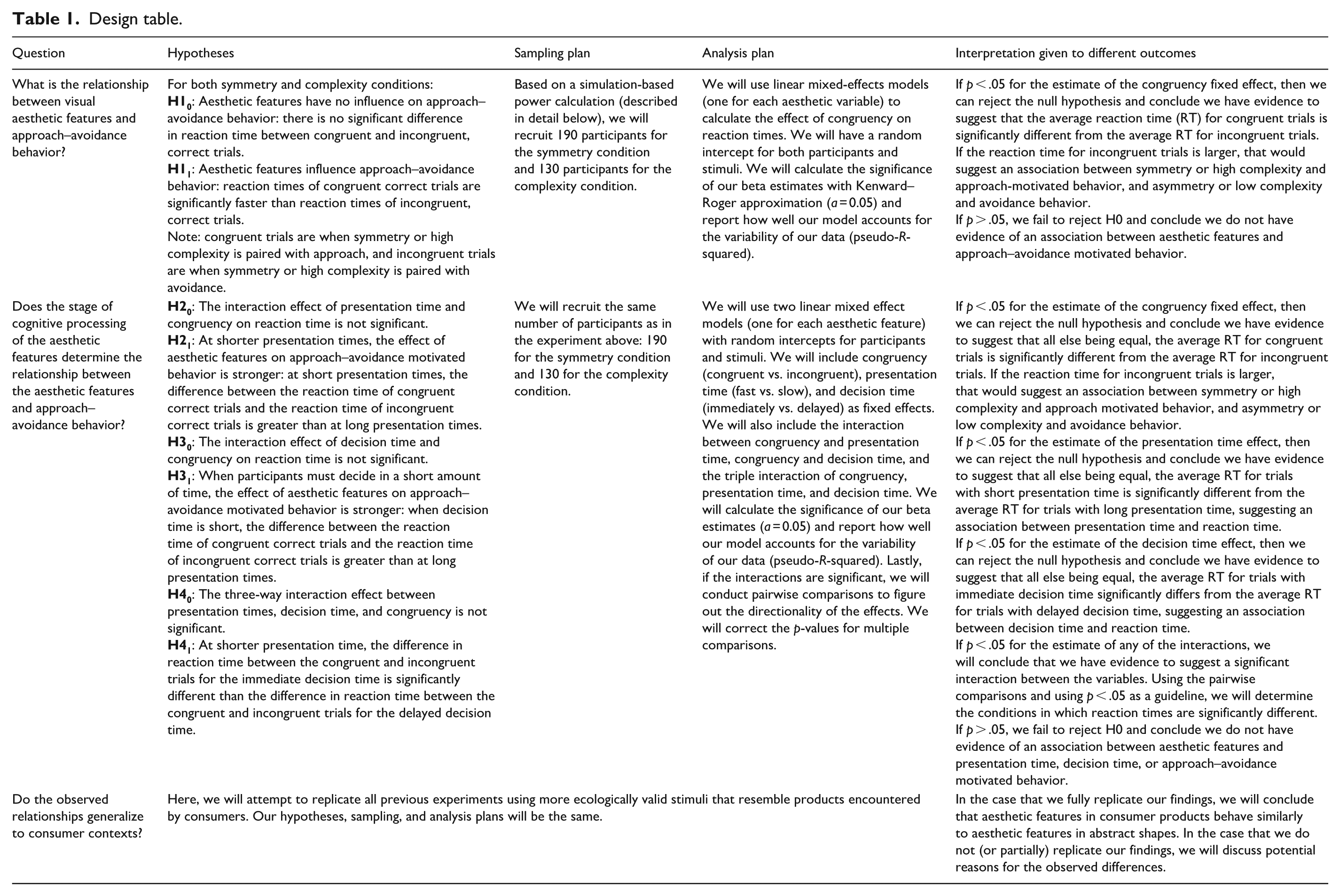
The ways in which presentation time and decision-making time result in motivational change could provide insight into the processing stage at which aesthetic features affect approach or avoidance motivated behavior. Through three experiments involving an online approach–avoidance task, we examine the relationship between visual aesthetic features and approach–avoidance motivated behavior and determine whether presentation time and decision-making time may explain this relationship. With such empirical work, we aim to begin to elucidate the relationship between aesthetics and motivated behavior, as well as the mechanisms that may explain this relationship. We predict not only that aesthetic features are related to approach–avoidance motivated behavior in both abstract and consumer contexts, but also that presentation time and time pressure modulate this relationship. Table 1 provides the details of our research questions, hypotheses, and data collection and analysis plans.
Design table.
Methods
Ethics information
This study was approved by the ethics committee at the Universidad Camilo José Cela (CEI-UCJC, with code 14_CEI_2020) and was carried out in accordance with the World Medical Association’s Declaration of Helsinki. We obtained informed consent from all participants, and participants were compensated in accordance with Prolific Academic’s (https://prolific.com) participant payment guidelines.
Experiment 1
Participants
190 participants took part in the symmetry experiment (110 female, 80 male; ages 19–72, M = 42.2, SD = 14.3). One hundred twenty-eight took part in the complexity experiment (65 female, 62 male, 1 other; ages 19–74, M = 40.2, SD = 13.9). It took participants, on average, approximately 8 min to complete the study.
Sampling plan
There is no satisfactory analytical solution to calculate the power of relatively complex linear mixed-effects models, so we relied on a simulation-based power estimation (Kumle et al., 2021). The simulations were conducted in R using the “simr” package (Green & MacLeod, 2016). We estimated how many times we would get a statistically significant result if we were to run our experiment 1,000 times as a function of number of participants. We used the parameter estimates from our pilot study. Figure 1 shows the results of our simulations. Based on these simulations, we selected the sample size based on 95% power (shown as a bold horizontal line in the plots) using the lower limit of the confidence intervals. For the symmetry condition, we recruited 190 participants and for the complexity condition, we recruited 130 participants. We recruited participants who indicated that they are based in the United Kingdom, speak English as a first language, and have normal or corrected-to-normal vision.
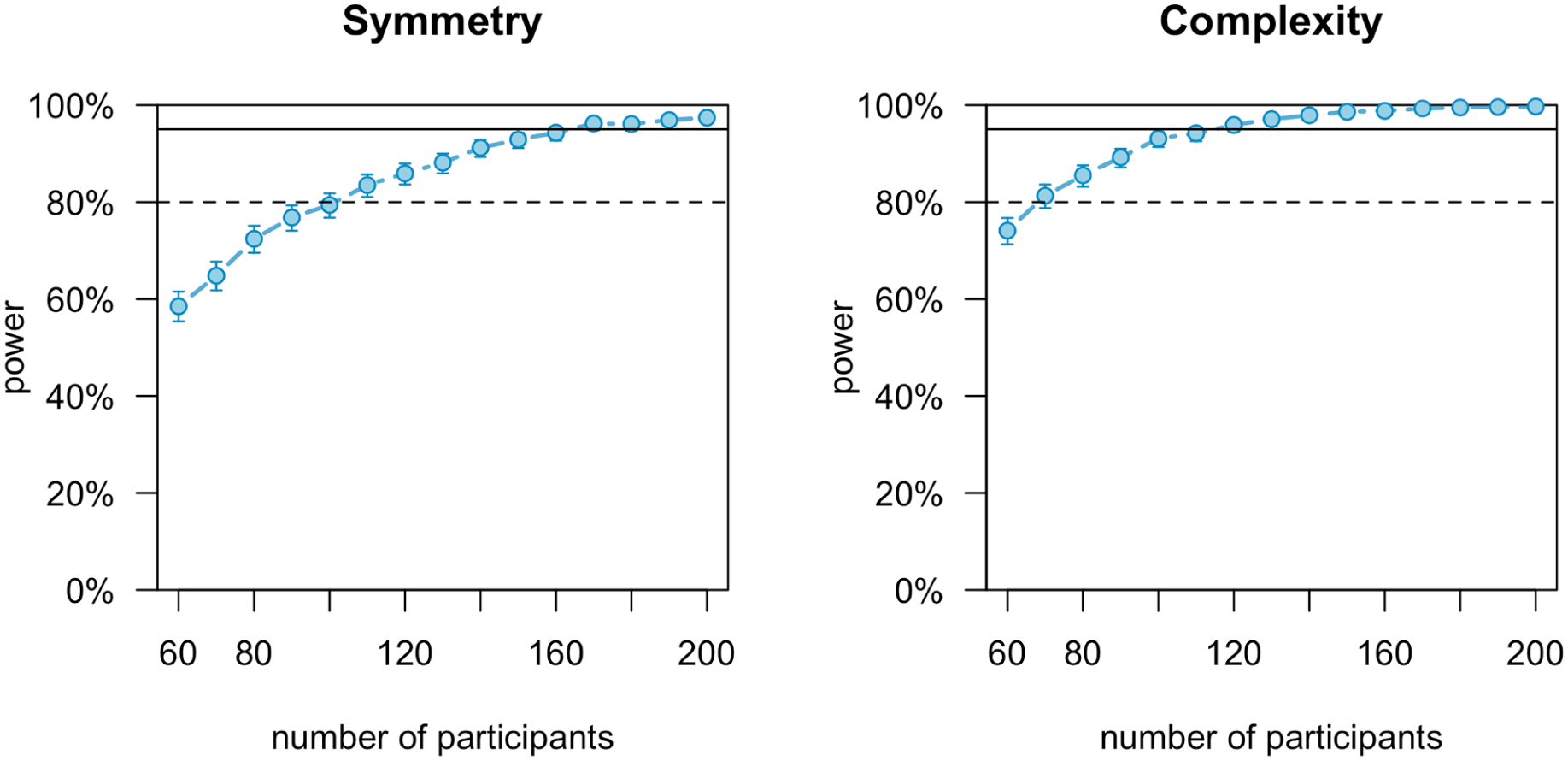
Simulation-based power calculation for both symmetry and complexity. Error bars correspond to 95% confidence intervals, and the bold horizontal line corresponds to 95% power.
Stimuli
We obtained permission to use the graphic pattern stimuli from Jacobsen and Höfel (2002) in our study. We decided to use these stimuli because they have been widely used in aesthetic experiments (Augustin et al., 2012; Jacobsen, 2010; Jacobsen et al., 2006; Leder et al., 2019). These stimuli (252 total) vary in terms of symmetry (number of symmetry axes) and complexity (number of elements). The symmetry condition contains both symmetrical and asymmetrical stimuli. For the symmetrical stimuli, we selected all of the stimuli that were exclusively symmetrical along both the vertical and horizontal axes (60 total). For the asymmetrical stimuli, we randomly selected 60 of the stimuli that contained no axes of symmetry. The mean number of elements in both the symmetrical and asymmetrical pool of stimuli is very similar (14.8 vs. 14.7, respectively). The complexity condition contained both low complexity and high complexity stimuli. To obtain these, we selected the stimuli with the highest number of elements and with the lowest number of elements in each of the symmetry levels. For example, if 20 of the 252 (8%) stimuli are symmetrical along one axis, then 4% of the stimuli in the high-complexity pool are symmetrical along one axis, and 4% of the stimuli in the low-complexity pool are symmetrical along one axis. Each pool of complexity stimuli (high-complexity vs. low-complexity) contains 60 stimuli. See Figure 2 for an example of the stimuli used.
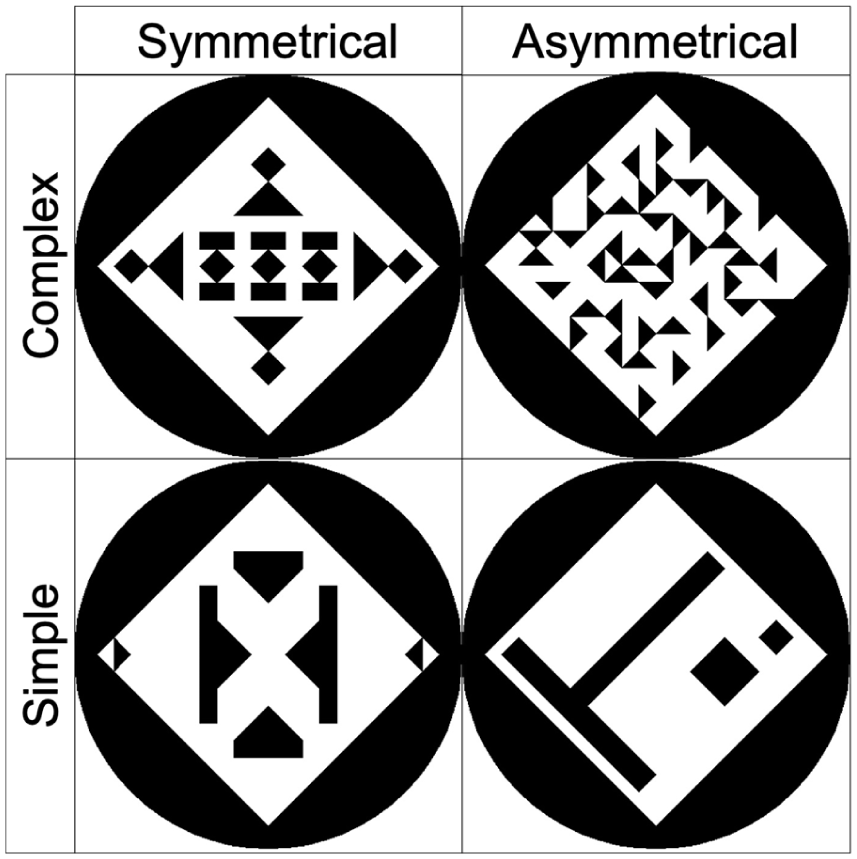
Example of shape stimuli for each symmetry and complexity condition. We obtained permission to use the stimuli from Jacobsen and Höfel (2002).
Apparatus and materials
All experiments were programmed using the builder view of PsychoPy3 (Peirce et al., 2019) and delivered through Pavlovia (https://pavlovia.org). The experiment only ran if participants were using a computer, as opposed to a tablet or smartphone. It is worth noting that online experiments, even ones relying on reaction times and presentation times, can provide reliable results (Bridges et al., 2020; Woods et al., 2015).
Design and procedure
A variety of approach–avoidance tasks (AAT) exist to measure approach–avoidance motivated behavior. The original AAT (Solarz, 1960), as well as AATs requiring specialized equipment, such as the Joystick AAT (Rinck & Becker, 2007) or mouse tracking and mouse pushing and pulling tasks (Weil et al., 2017; Wittekind et al., 2015), are appropriate for laboratory settings. However, AATs have been adapted for online studies resulting in other options: the Manikin AAT (Markman & Brendl, 2005), the Mobile AAT (Zech et al., 2020), the Tilt task (Kakoschke et al., 2018), and the Swiping task (Meule et al., 2019). One particular task, the online Visual Approach/Avoidance by the Self Task (VAAST) (Aubé et al., 2019), appears to be promising to measure approach–avoidance behavior in online settings. Many of the alternative online tasks use arm movements, which can be ambiguous given that arm extension and flexion can signal both approach and avoidance. The VAAST simulates whole body movement without requiring actual body movement, and results suggest large and replicable compatibility effects (Rougier et al., 2018). Likewise, the online VAAST replicates the results of the VAAST when conducted in laboratory settings, and results are consistent across cultures (Aubé et al., 2019). Overall, the online VAAST provides an easy and ecologically valid way to measure approach–avoidance behavior in an online study and thus was our chosen task.
Our online VAAST had a mixed design with aesthetic feature (symmetry vs. complexity) as a between-participant condition and congruency of trial (congruent vs. incongruent) as a within-participant condition. Each participant took part in either the symmetry or the complexity online VAAST. Participants gave informed consent and then were told that they should use the upwards and downwards arrow on their computer to move forward and backwards in a given environment, in this case, a white room. Participants then completed two tasks. In one task, which we refer to as the congruent condition, they were told that they had to approach, by pressing the upwards arrow on their keyboard, symmetrical (complex) shapes and avoid, by pressing the downwards arrow on their keyboard, asymmetrical (simple) shapes. The instructions gave participants a definition of symmetry (complexity). Participants were asked to respond as fast and as correctly as possible and were asked to only use the index finger of their dominant hand. The task contained 6 practice trials and 40 experimental trials. There were 20 trials for each aesthetic condition (e.g., 20 symmetrical shapes and 20 asymmetrical shapes), and for each participant, these were randomly selected out of the total pool of 60 stimuli. During practice trials, which we excluded from the analysis, participants received feedback on whether they were correct (e.g., pressed the upwards arrow upon the appearance of a symmetrical stimulus). They received no feedback on the remaining trials. Participants had to press the spacebar to start each trial. A fixation cross appeared for half a second and then the shape appeared. Each time the participant pressed the upwards arrow, the stimulus got bigger, and every time they pressed the downwards arrow, the stimulus got smaller, simulating approach behavior and avoidance behavior, respectively. We measured participants’ reaction time to press an arrow upon presentation of the stimulus, as well as whether they got it correct. The second task was the same, except we asked participants to do the opposite (e.g., approach asymmetrical shapes and avoid symmetrical shapes). The second task, which we refer to as the incongruent condition, used the same stimuli as the first task, and the order in which participants completed the tasks was counterbalanced. Note that the second task also included six practice trials that were excluded from the analysis. Figure 3 shows an example of what a single trial looked like. Lastly, we asked participants whether they noticed the changes in the instructions and to rate, on a Likert-type scale ranging from 1 (strongly disagree) to 5 (strongly agree), how much they agree with the following statement: “During the entire experiment, I was paying attention and responded to the best of my abilities.”
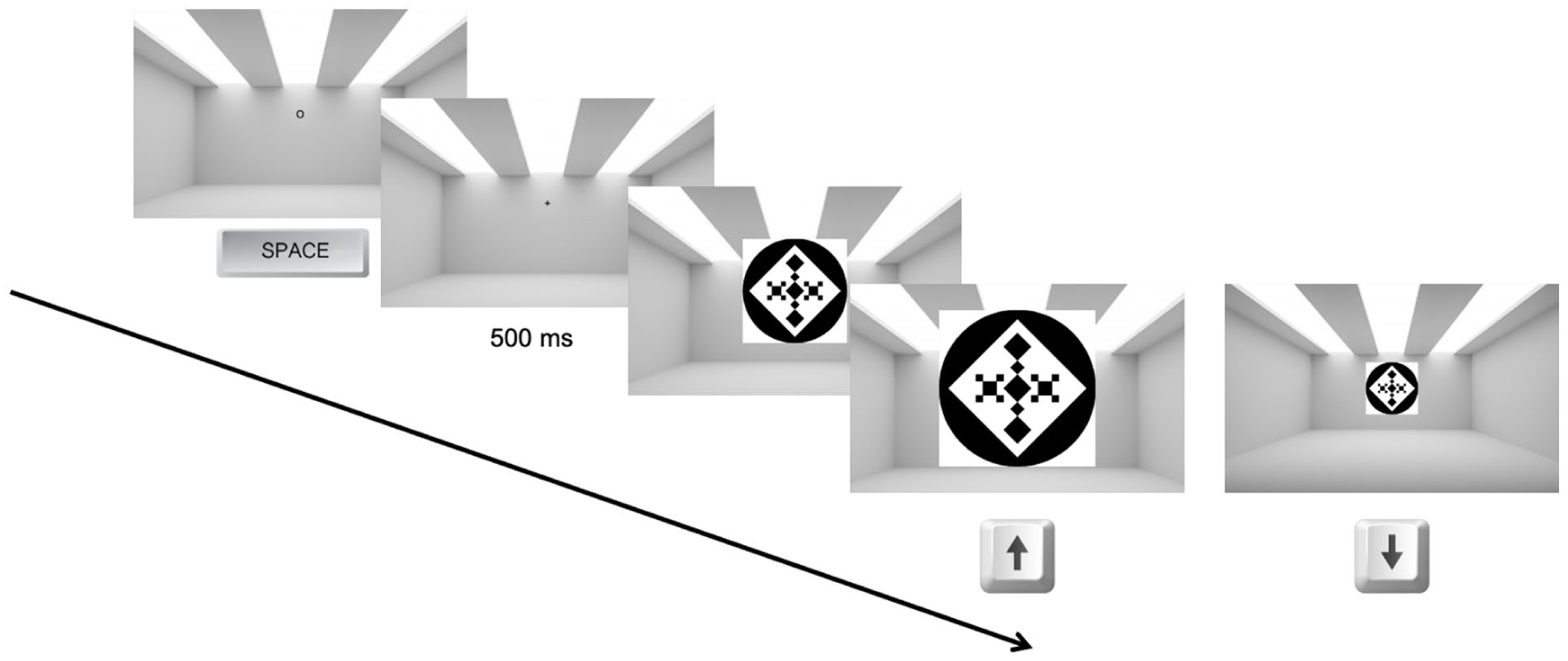
Graphical representation of a single experimental trial in the symmetry condition in Experiment 1.
Analysis plan
We excluded participants who did not notice the change in instructions, who rated their attention on the task a 3 (neither agree nor disagree) or below, and who replied incorrectly to more than 20% of the trials in both congruency conditions. First, we considered the trials in which participants answered correctly and for which the reaction time fell within the mean reaction time ± 2 standard deviations.
For each type of aesthetic feature (symmetry vs. complexity), we ran a linear mixed model in R using the “lmer” function in the “lme4” package (Bates et al., 2015). Unlike traditional ANOVAs, mixed-effects models allow accounting for both between and within-participant factors (DeBruine & Barr, 2021; Judd et al., 2017). In particular, mixed-effects models allow us to account for effects of both participants and stimuli in addition to the effect of congruency on reaction times. In our model, we included random intercept values for both participants and stimuli. We also included congruency level (congruent vs. incongruent trials) as a fixed effect. Since reaction times tend to follow a non-normal distribution, we took their logarithm to adjust the residuals. We had separate models for participants in the symmetry and complexity conditions. We used the Kenward–Roger approximation of the “lmerTest” package to obtain p-values, and we assessed the effectiveness of our model with the conditional pseudo R-squared value provided by the “model_performance()” function in R (Lüdecke et al., 2020; Luke, 2017).
To complement our reaction time analysis, we also considered whether there is a difference in the number of incorrect responses between congruent and incongruent trials using a generalized linear mixed model.
Pilot data
To test the feasibility of Experiment 1, and since the following experiments assume that there is a relationship between aesthetic features and approach and avoidance motivated behavior, we conducted a pilot experiment (N = 200) following the design of Experiment 1. We found that participants were, on average, faster at approaching symmetrical stimuli and avoiding asymmetrical stimuli, and slower at avoiding symmetrical stimuli and approaching asymmetrical stimuli, t(6424) = 2.65, b = 0.02, p < .008, 95% CI = [0.01, 0.04]. We also found that participants were, on average, faster at approaching complex stimuli and avoiding simple stimuli, and slower at avoiding complex stimuli and approaching simple stimuli, t(5824) = 3.58, b = 0.02, p < .001, [0.01, 0.02]. For a full description of the pilot analyses, see the Supplemental Material. All data and analyses are available at: https://osf.io/pa9df.
Experiment 2
Participants
One hundred eighty-four participants took part in the symmetry experiment (79 female, 104 male, 1 other; ages 19–77, M = 41.1, SD = 12.7). One hundred twenty-seven took part in the complexity experiment (54 female, 71 male, 2 other; ages 19–77, M = 39.2, SD = 13.0). It took participants, on average, approximately 27 min to complete the study.
Stimuli, apparatus, and materials
For Experiment 2, we used the same pools of symmetry and complexity stimuli as in Experiment 1. We used the same method to develop and distribute Experiment 2 as used in Experiment 1.
Design and procedure
Experiment 2 consisted of an online VAAST. This experiment followed a mixed design with aesthetic features (symmetry vs. complexity) as a between-participant variable, and congruency of trial (congruent vs. incongruent), presentation time (fast vs. slow), and time to make a decision (immediately vs. delayed) as within-participant variables. We considered stimuli presented for 84 ms as “fast.” We chose 84 ms in accordance with findings that suggest that participants more strongly prefer curvature when the stimulus is presented for that duration (Bar & Neta, 2006; Corradi et al., 2019). Additionally, we considered stimuli presented for 1,000 ms as “slow”. Even though 1,000 ms seems fast when comparing the ecological validity of aesthetic judgments (e.g., one may stare at a painting for several minutes), previous research has shown that there are no differences in aesthetic judgments between presentation times of 1 and 30 s (Brielmann et al., 2017), and individuals only need 750 ms to make an aesthetic judgment of a musical piece (Belfi et al., 2018). Participants were asked to either make a decision (i.e., press a key in response to the VAAST) immediately after stimulus offset or after 1,000 ms. It was predicted that the mean choice reaction time for young adults for a visual stimulus is around 350 ms (Solanki et al., 2012). Thus, if participants were asked to respond after 1,000 ms, they would have enough time to avoid an impulse reaction and change their mind.
The design of Experiment 2 differed slightly from Experiment 1. Since the images had a strict presentation time, they were covered by a mask after the appropriate amount of time. To indicate that participants were allowed to respond, a green circle appeared around the mask. Figure 4 shows the experimental procedure. To facilitate the task for participants, the decision and presentation time conditions were separated by blocks. Participants completed eight blocks, one for each combination of congruency, presentation time, and decision-making time. Like Experiment 1, each participant only completed the experiment for one aesthetic feature. The order in which participants completed each block was randomized.
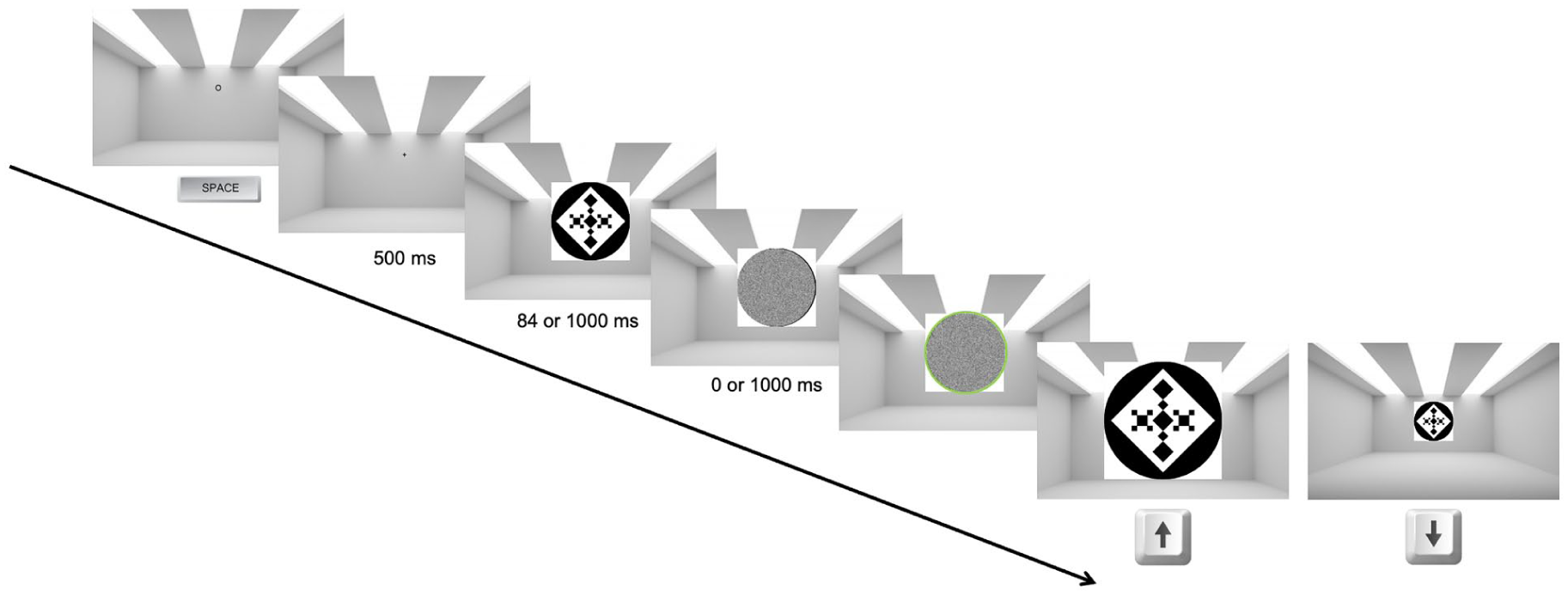
Graphical representation of Experiment 2.
Sampling plan
We recruited participants in the same way and following the same criteria as in Experiment 1.
Analysis plan
We used two linear mixed effect models, one for each aesthetic feature, with random intercepts for participants and stimuli. We included congruency (congruent vs. incongruent), presentation time (fast vs. slow), and decision time (immediately vs. delayed) as fixed effects. We also included the interaction between congruency and presentation time, congruency and decision time, and the triple interaction of congruency, presentation time, and decision time. We calculated the significance of our beta estimates (α = 0.05) and reported how well our model accounts for the variability of our data (pseudo R-squared). Lastly, if the interactions were significant, we conducted pairwise comparisons to determine the directionality of the effects, and we corrected the p-values for multiple comparisons.
Experiment 3
Participants
One hundred eighty-five participants took part in the symmetry experiment (95 female, 89 male, 1 other; ages 18–77, M = 35.9, SD = 13.3). One hundred twenty-three took part in the complexity experiment (58 female, 64 male, 1 other; ages 18–73, M = 34.5, SD = 12.5). It took participants, on average, approximately 27 min to complete the study.
Stimuli
For the third experiment, we created our stimuli by overlaying the symmetry and complexity stimuli from Experiments 1 and 2 onto commonplace consumer goods. We considered three types of product categories: fashion, food packaging, and technology. We used the categorization of each of the overlaid graphical patterns from Experiments 1 and 2 to determine each stimulus’ characterization as symmetrical (high complexity) or asymmetrical (low complexity) in accordance with Experiments 1 and 2. To prevent the symmetry or complexity of the consumer goods from interacting with the overlaid pattern, we ran a short pilot study in which we asked participants to rate how symmetrical (complex) the consumer good designs (without the overlaid pattern) were. We tried three exemplars of each category: fashion (t-shirt, hat, bag), food packaging (coffee bag, pasta bag, olive oil bottle), and technology (phone case, headphones, VR headset). Based on the participant ratings, we selected the stimuli with the most uniform distributions of symmetry and complexity ratings. Figure 5 shows the exemplars and the distribution of their symmetry and complexity ratings. Raw data are available in the Supplemental Material.
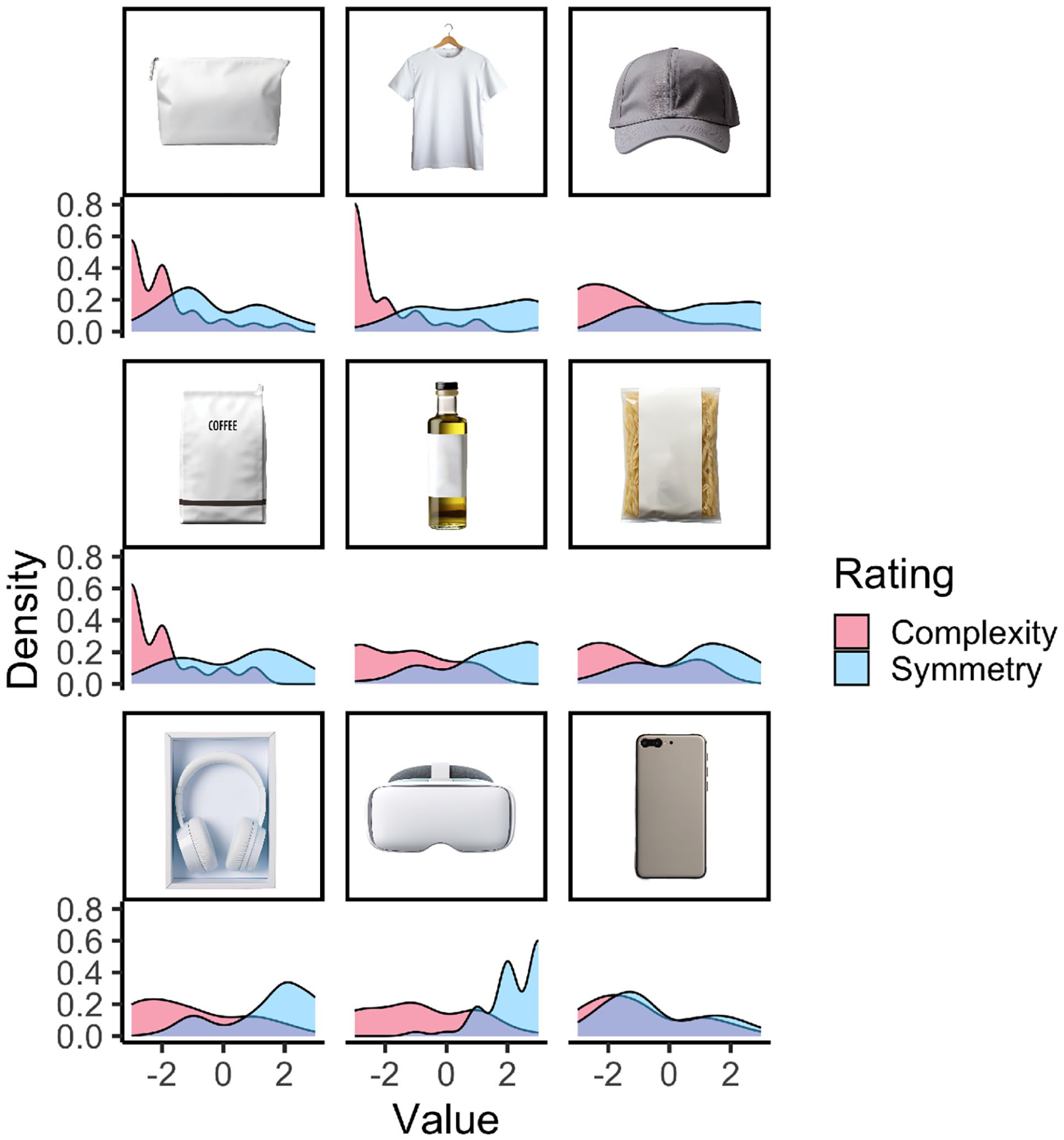
Distribution of ratings for symmetry and complexity for all potential product categories. Each row contains the examples of each category, fashion, food, and technology, respectively. The rightmost stimuli in each row constitute our final selection.
For exploratory purposes, we included the average symmetry or complexity value given to each stimulus as part of our linear mixed-effects models to test whether these modulate any of our results.
Design, sampling, and analysis plan
Experiment 3 aimed to replicate Experiment 2 with a different, more ecologically valid, set of stimuli. The design, procedure, sampling plan, and analysis plan were similar to Experiment 2.
We feared that triplicating Experiment 2 to include all three consumer products made the experiment too long (approx. 27 vs. 81 min), resulting in participant fatigue effects. Therefore, we decided to maintain the same length as Experiment 2, keeping the 40 trials per condition, but randomizing the products across trials. As such, participants saw on average 13 trials of each product in each condition. To maintain ecological validity, we presented the three products at different sizes, in accordance with the product’s size in real life. Figure 6 shows examples of the three products with an overlaid stimulus.
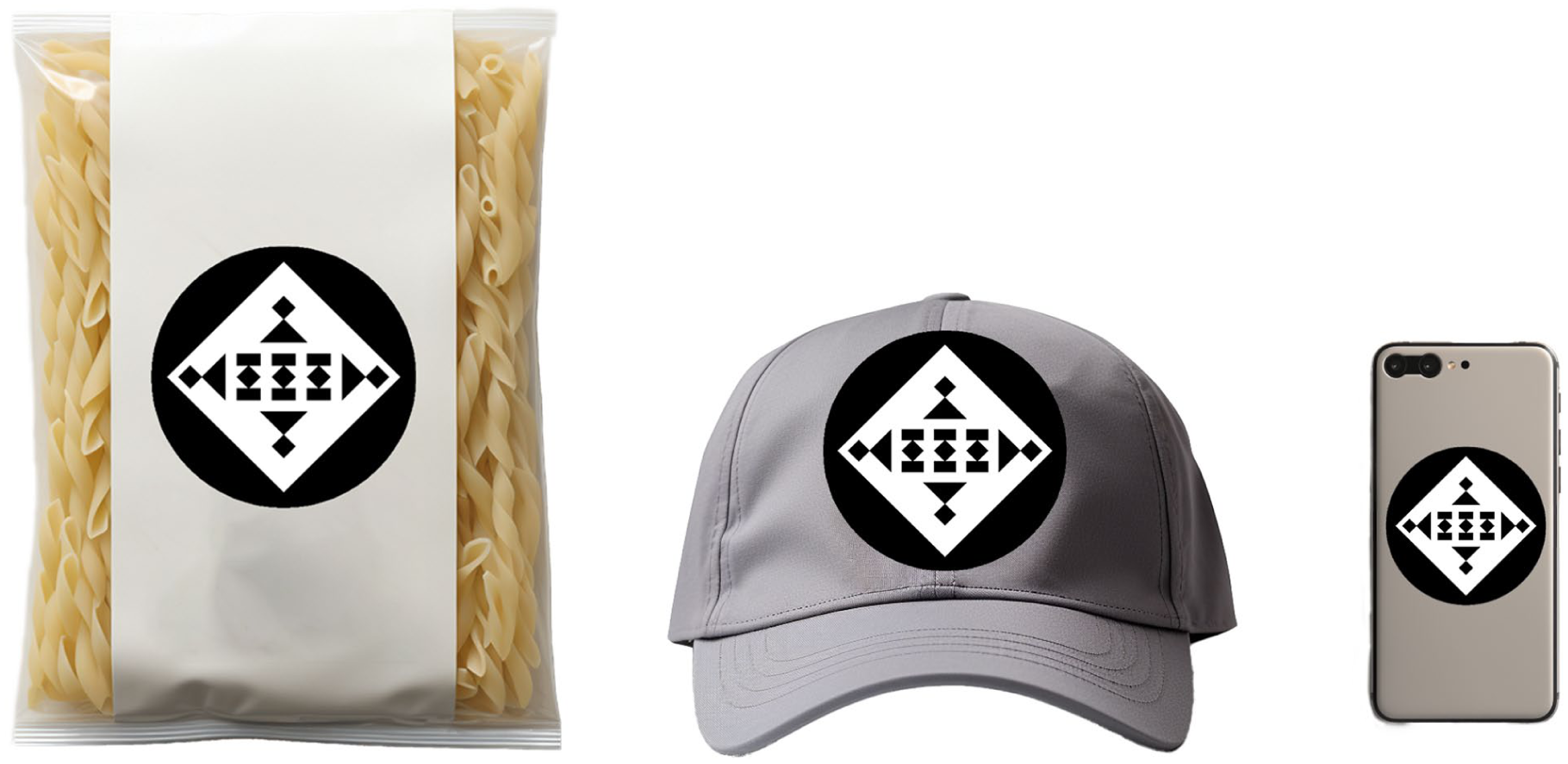
Example of a symmetrical abstract pattern overlaid on each selected product.
Data availability
Our raw data and materials are available here: https://osf.io/pa9df.
Code availability
All code used for our analyses is available here: https://osf.io/pa9df.
Results
Experiment 1
Based on our exclusion criteria outlined above, we excluded participants with self-reported attention below a 3 out of 5 and who reported not having noticed the change in instructions between the congruent and incongruent blocks (24 for the symmetry experiment and 15 for the complexity one). We also excluded participants who got more than 20% of the trials incorrect (12 for symmetry, 15 for complexity). Lastly, we also excluded incorrect trials and trials with response times outside two standard deviations (we allowed 0 < RT < 4.89 s for symmetry and 0.46 < RT < 2.24 s for complexity). Below, we report the results of 153 participants (12,059 trials) for the symmetry condition and 98 (7,536 trials) for the complexity condition. Though the resulting sample sizes are below the target size calculated to achieve 95% power, based on our original simulations (Figure 1), our power remains over 90%.
The results of our linear models suggest a significant effect of congruency on reaction times for both symmetry (Table 2) and complexity (Table 3). We took the congruent condition as the reference level. For the symmetry condition, the mean reaction time in the congruent condition was 1.62 s (SD = 0.61), while the mean reaction time in the incongruent condition was 1.75 s (SD = 0.66). In other words, participants were, on average, faster at approaching symmetrical stimuli and avoiding asymmetrical stimuli, and slower at avoiding symmetrical stimuli and approaching asymmetrical stimuli. For the complexity condition, the mean reaction time in the congruent condition was 1.26 s (SD = 0.25) while the mean reaction time in the incongruent condition was 1.28 s (SD = 0.26). In other words, participants were, on average, faster at approaching complex stimuli and avoiding simple stimuli, and slower at avoiding complex stimuli and approaching simple stimuli. Thus, we found evidence to support H11. Figure 7 provides a graphical representation of the data.
Mixed-effects model for the symmetry condition in Experiment 1.
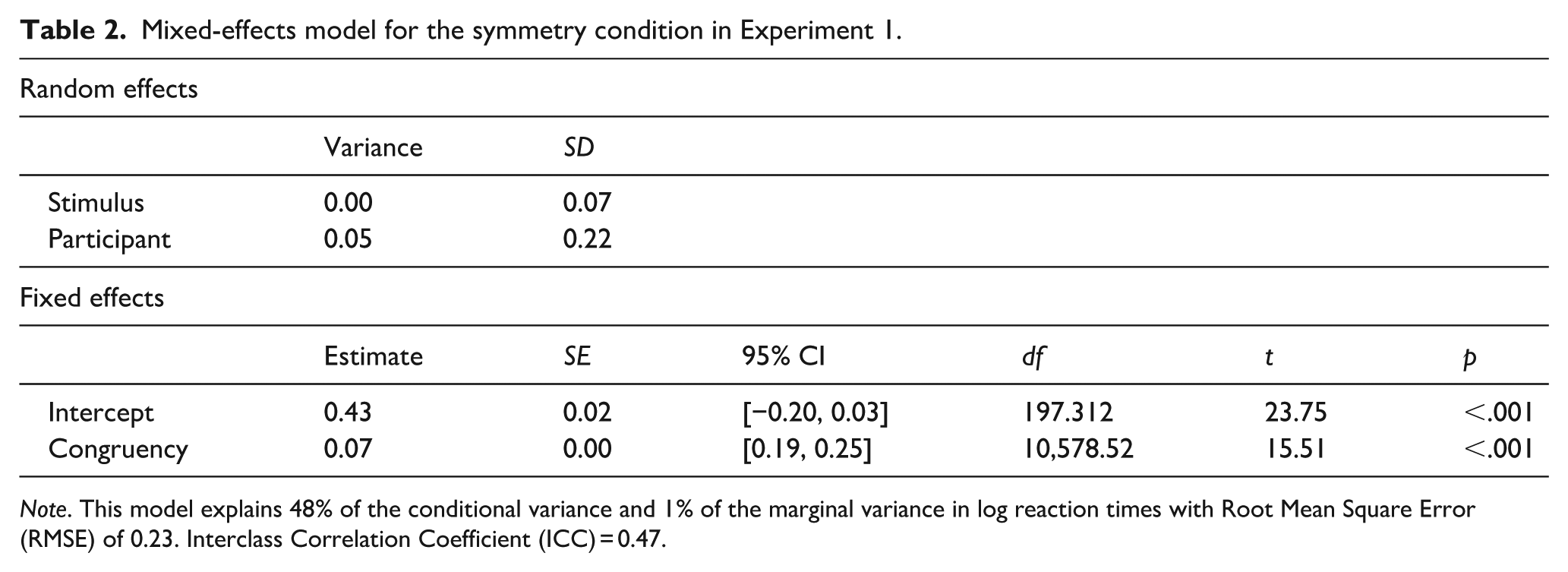
Note. This model explains 48% of the conditional variance and 1% of the marginal variance in log reaction times with Root Mean Square Error (RMSE) of 0.23. Interclass Correlation Coefficient (ICC) = 0.47.
Mixed-effects model for the complexity condition in Experiment 1.
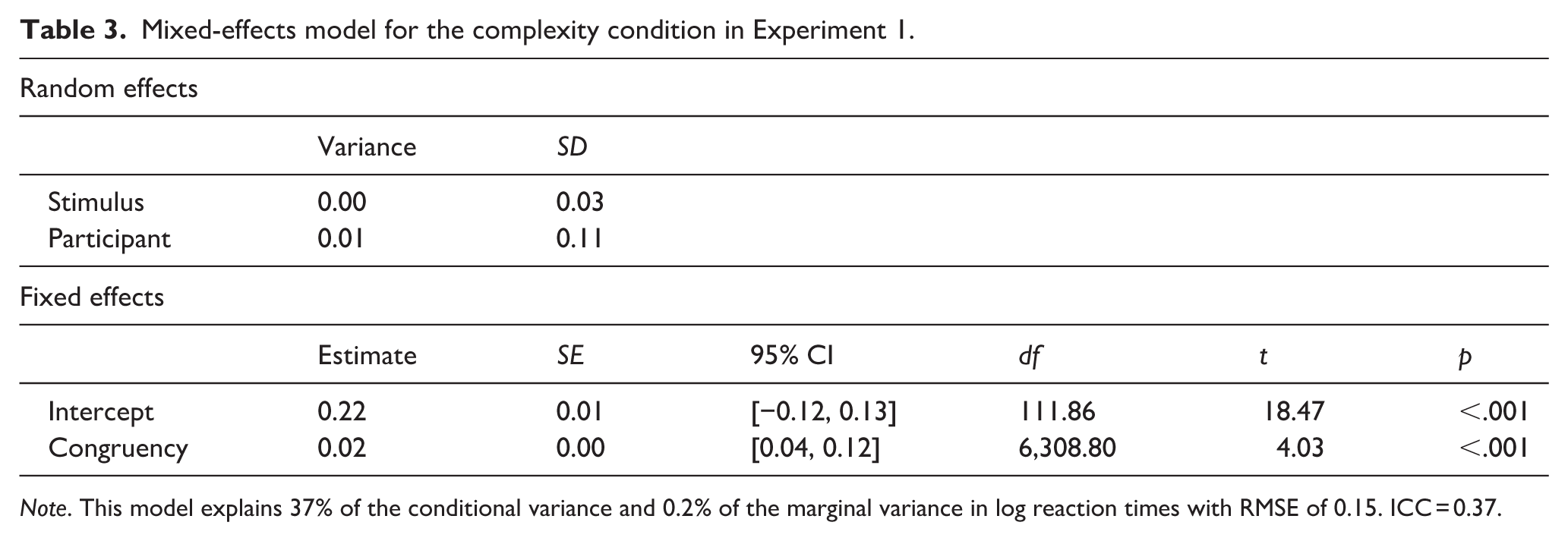
Note. This model explains 37% of the conditional variance and 0.2% of the marginal variance in log reaction times with RMSE of 0.15. ICC = 0.37.
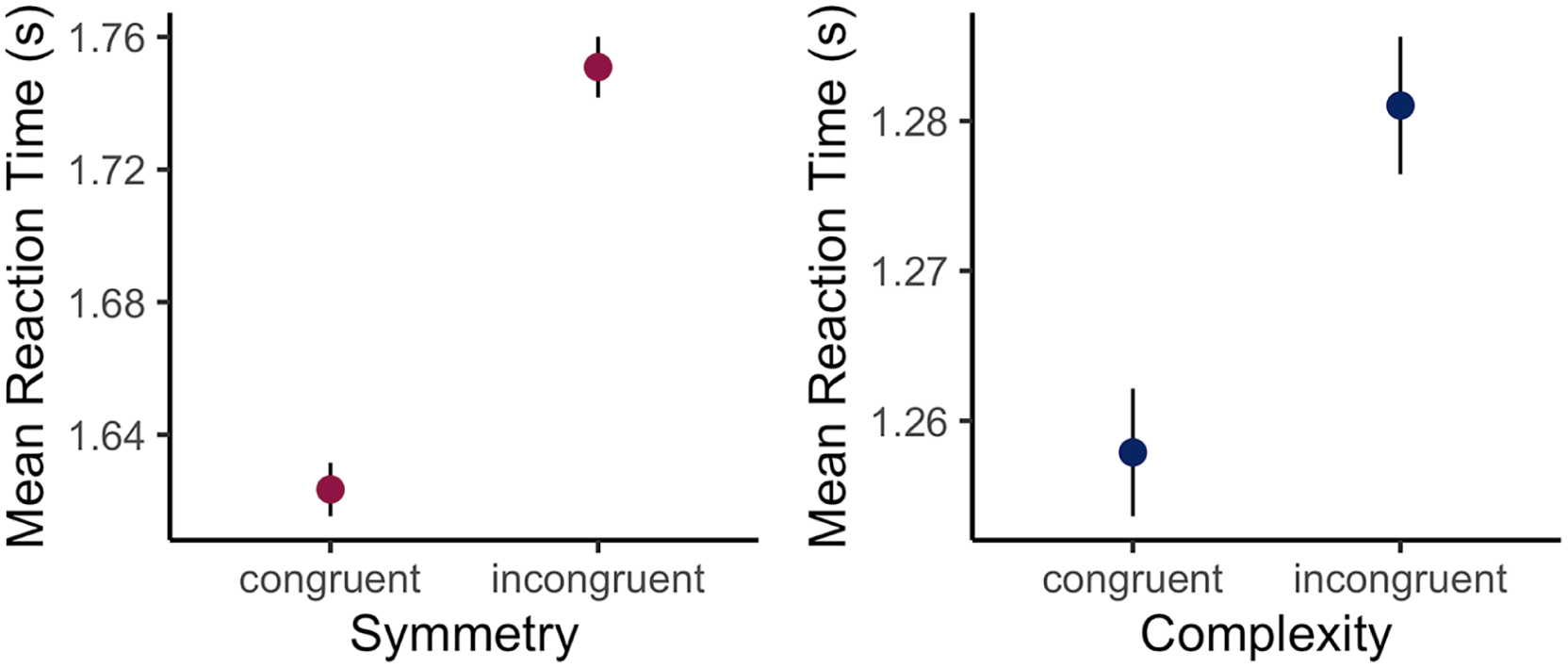
Results of Experiment 1. Error bars correspond to standard errors of the mean.
Experiment 2
For the results of Experiment 2, we excluded participants with self-reported attention below a 3 out of 5 and who reported not having noticed the change in instructions between the congruent and incongruent blocks (32 for the symmetry experiment and 19 for the complexity one). We also excluded participants who got more than 20% of the trials incorrect in both conditions (13 for symmetry, 20 for complexity). Lastly, we also excluded incorrect trials and trials with reaction times outside two standard deviations (we allowed 0 < RT < 3.82 s for symmetry and 0 < RT < 4.4 s for complexity). Below, we report the results of 139 participants (44,267 trials) for the symmetry condition and 88 (28,027 trials) for the complexity condition. Though the resulting sample sizes are below the target size calculated to achieve 95% power, based on our original simulations (Figure 1), our power remains over 90%.
In our linear models, we took the congruent condition as the reference level for congruency. The reference levels for presentation time and response delay were short presentation (0.084 s) and no delay (0 s), respectively. For symmetry, the proposed linear model did not converge, so instead we display the results of a simpler model, with only participants as a random intercept (Table 4). This model shows a significant interaction between congruency and presentation time, but not one between congruency and response delay. We also found a significant three-way interaction. Figure 8A shows these results. More specifically, we find that there is a larger difference in reaction time for congruent trials (M = 0.49 s, SD = 0.42) and incongruent trials (M = 0.52 s, SD = 0.42) during 0.084 s presentation times, than there is during 1 s presentation times (Mcongruent = 0.49 s, SD = 0.38; Mincongruent = 0.50 s, SD = 0.41). Thus, we rejected H20 and found evidence in support of H21. It is worth noting that even though the interaction between congruency and response delay was not significant, the results do show a tendency towards a larger difference in reaction time without a response delay compared to a 1 s response delay. However, since we did not find a significant interaction between congruency and response delay, we failed to reject H30. We found that at short presentation times, the mean difference in reaction time is greater without a response delay (Mcongruent = 0.48 s, SD = 0.39; Mincongruent = 0.52 s, SD = 0.42), than with one (Mcongruent = 0.51 s, SD = 0.46; Mincongruent = 0.53 s, SD = 0.43). Thus, we rejected H40 and found evidence in support of H41.
Mixed-effects model for the symmetry condition in Experiment 2.
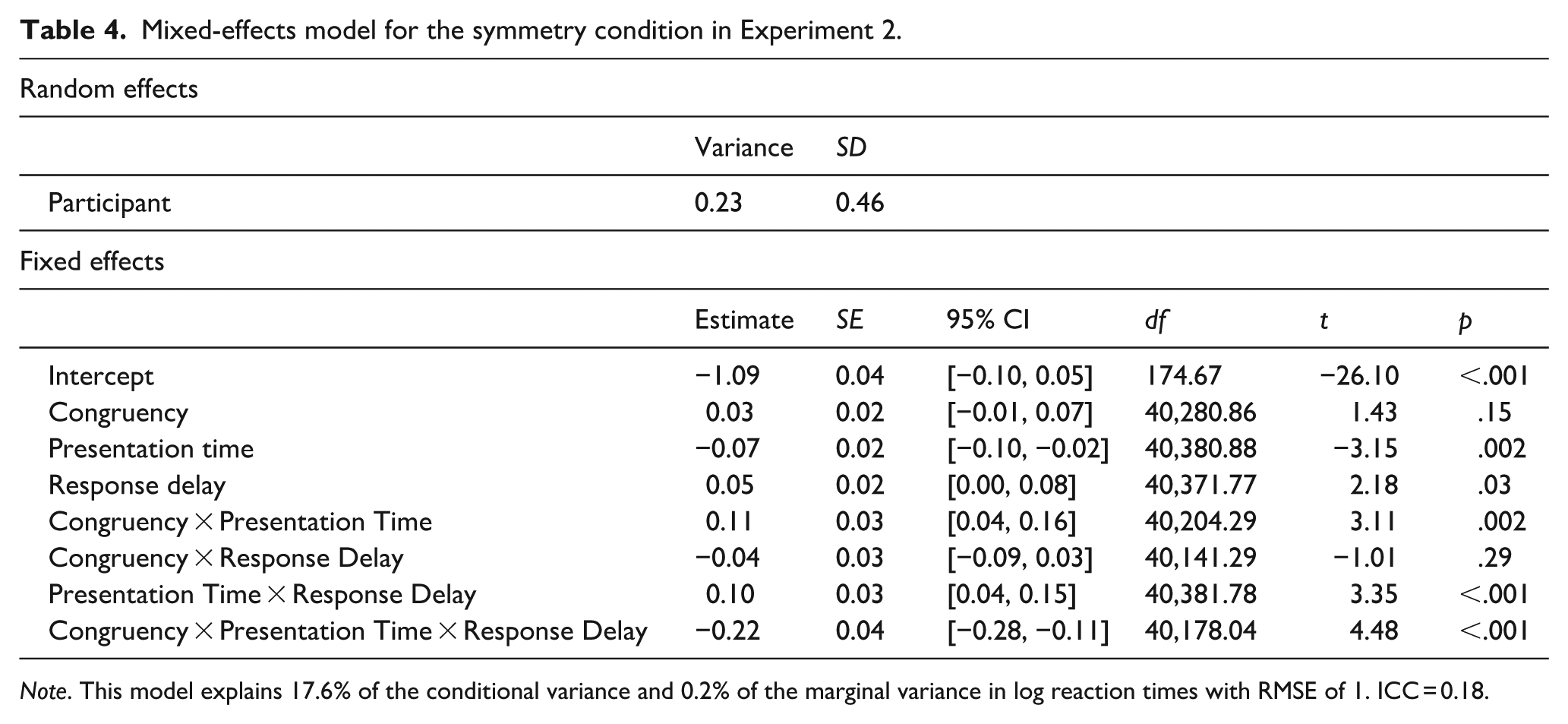
Note. This model explains 17.6% of the conditional variance and 0.2% of the marginal variance in log reaction times with RMSE of 1. ICC = 0.18.
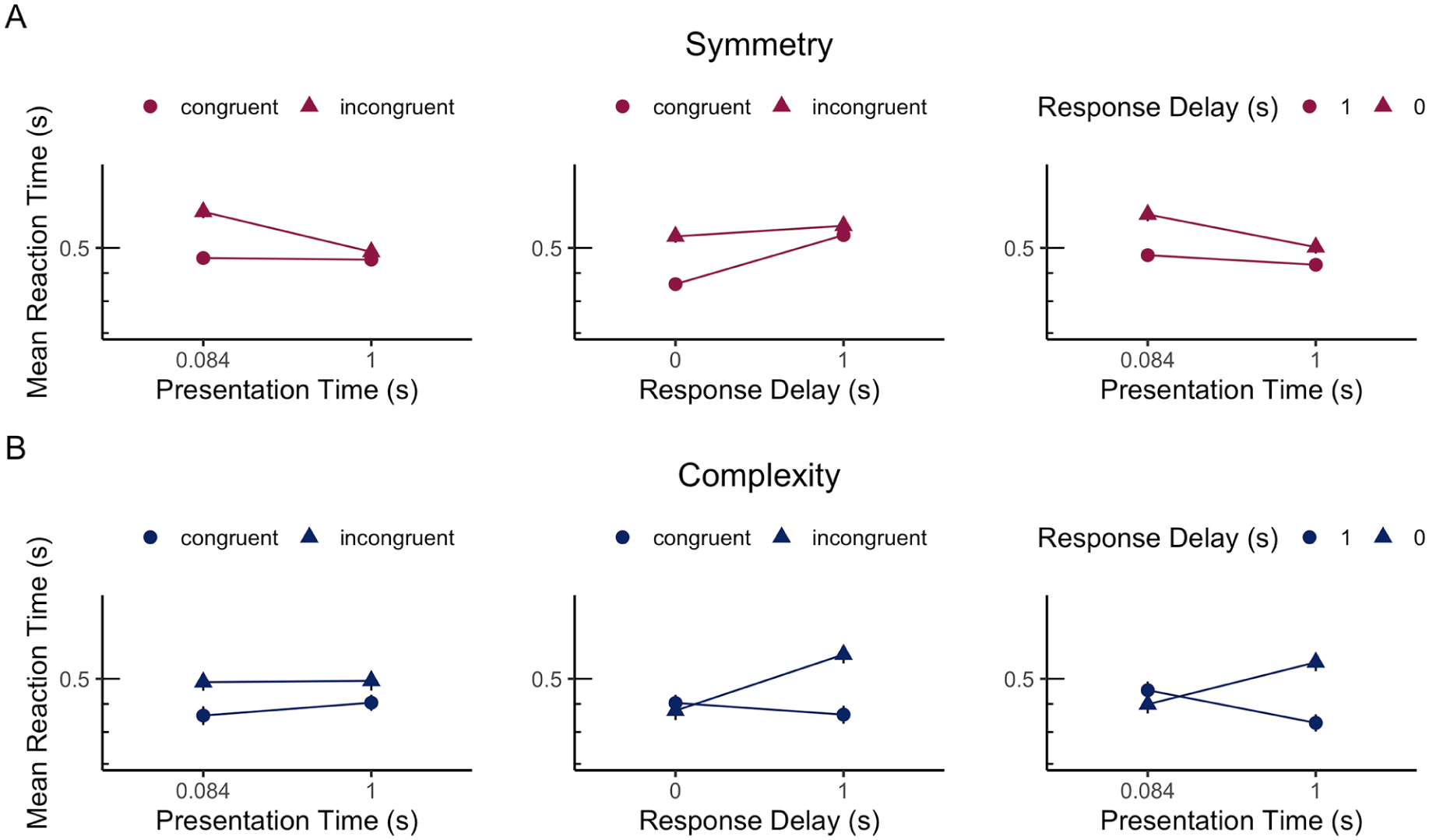
Results of Experiment 2. Error bars correspond to standard errors of the mean. (A) Shows the results for symmetry and (B) shows the results for complexity.
For complexity, we found significant interactions between congruency and presentation time and congruency and response delay (Table 5). Here, we did not observe a three-way interaction. The difference in reaction times between congruent and incongruent trials was larger for a 0.084 s presentation time (Mcongruent = 0.48 s, SD = 0.41; Mincongruent = 0.50 s, SD = 0.43) than for a 1 s presentation time (Mcongruent = 0.49 s, SD = 0.40; Mincongruent = 0.50 s, SD = 0.45). Thus, we rejected H20 and found evidence in support of H21. The difference in reaction times between congruent and incongruent trials was also larger with a response delay (Mcongruent = 0.48 s, SD = 0.41; Mincongruent = 0.51 s, SD = 0.45) than without a delay (Mcongruent = 0.49 s, SD = 0.40; Mincongruent = 0.48 s, SD = 0.43). Thus, we rejected H30 and found evidence to support the opposite of H31. Rather than observing a larger difference without a response delay, we observe that the effect of congruency is stronger with a 1 s response delay. Since we did not observe a three-way interaction, we failed to reject H40.
Mixed-effects model for the complexity condition in Experiment 2.
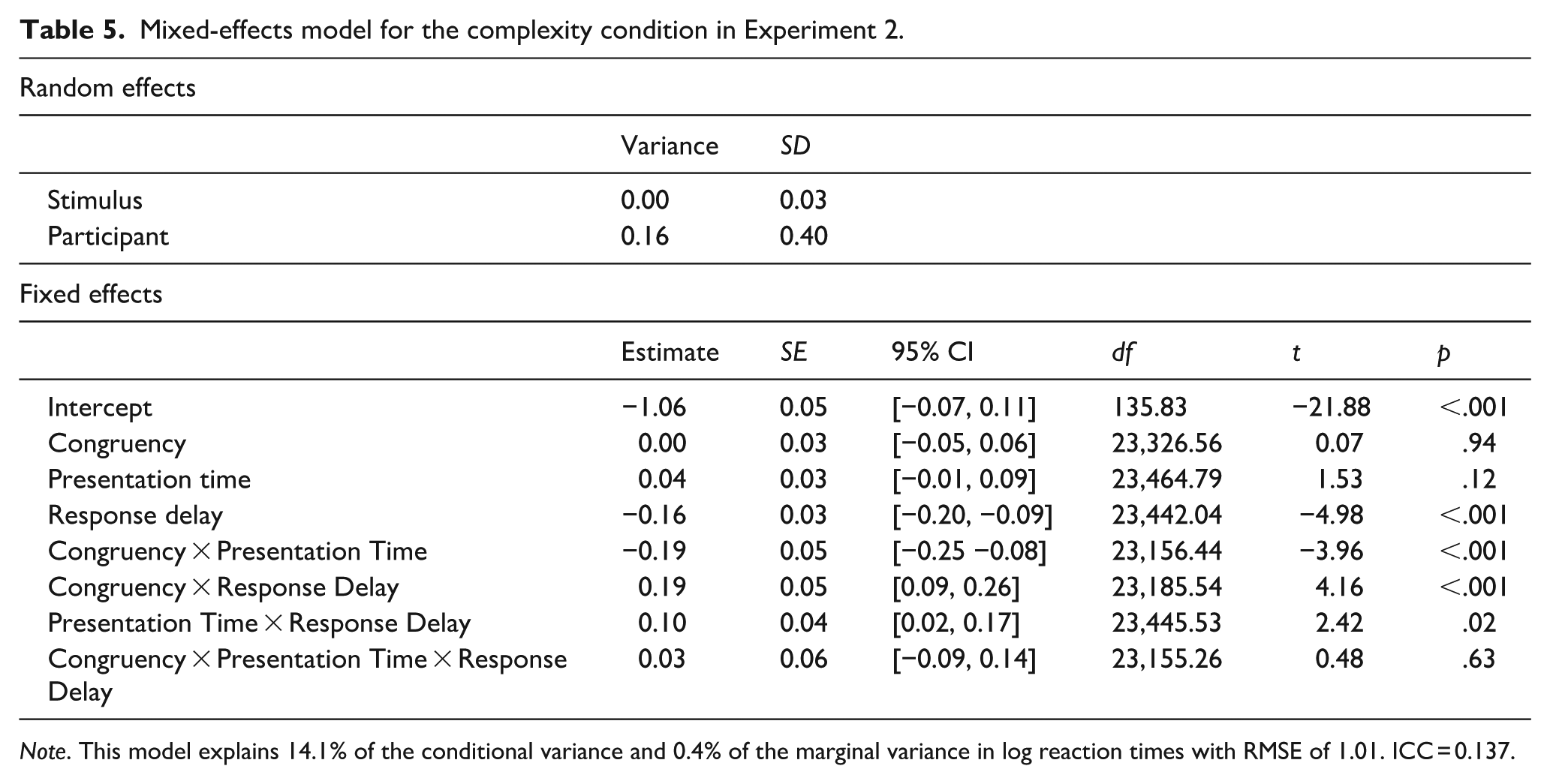
Note. This model explains 14.1% of the conditional variance and 0.4% of the marginal variance in log reaction times with RMSE of 1.01. ICC = 0.137.
Experiment 3
For the results of Experiment 3, we excluded participants with self-reported attention below a 3 out of 5 and who reported not having noticed the change in instructions between the congruent and incongruent blocks (32 for the symmetry experiment and 26 for the complexity one). We also excluded participants who got more than 20% of the trials incorrect in both conditions (33 for symmetry, 39 for complexity). We also excluded incorrect trials and trials with reaction times outside two standard deviations (we allowed 0 < RT < 4.87 s for symmetry and 0 < RT < 4.4 s for complexity). Below, we report the results of 120 participants (33,617 trials) for the symmetry condition and 58 (15,314 trials) for the complexity condition. Though the resulting sample sizes are below the target size calculated to achieve 95% power, based on our original simulations (Figure 1), our power remains over 85% for symmetry and 75% for complexity.
Our proposed mixed-effects linear models did not converge. Thus, we display the results for a simpler, alternative model that only includes participants as a random intercept. We took the congruent condition as the reference level for congruency. The reference levels for presentation time and response delay were short presentation (0.084 s) and no delay (0 s), respectively.
For symmetry, our results indicate significant interactions between congruency and presentation time and congruency and response delay (Table 6). We also observed a significant three-way interaction. More specifically, there was a larger difference in reaction time between congruent and incongruent trials during 1 s presentation times (Mcongruent = 0.49 s, SD = 0.40; Mincongruent = 0.56 s, SD = 0.48) than during 0.084 s presentation times (Mcongruent = 0.53 s, SD = 0.45; Mincongruent = 0.54 s, SD = 0.47). Thus, we rejected
Mixed-effects model for the symmetry condition in Experiment 3.
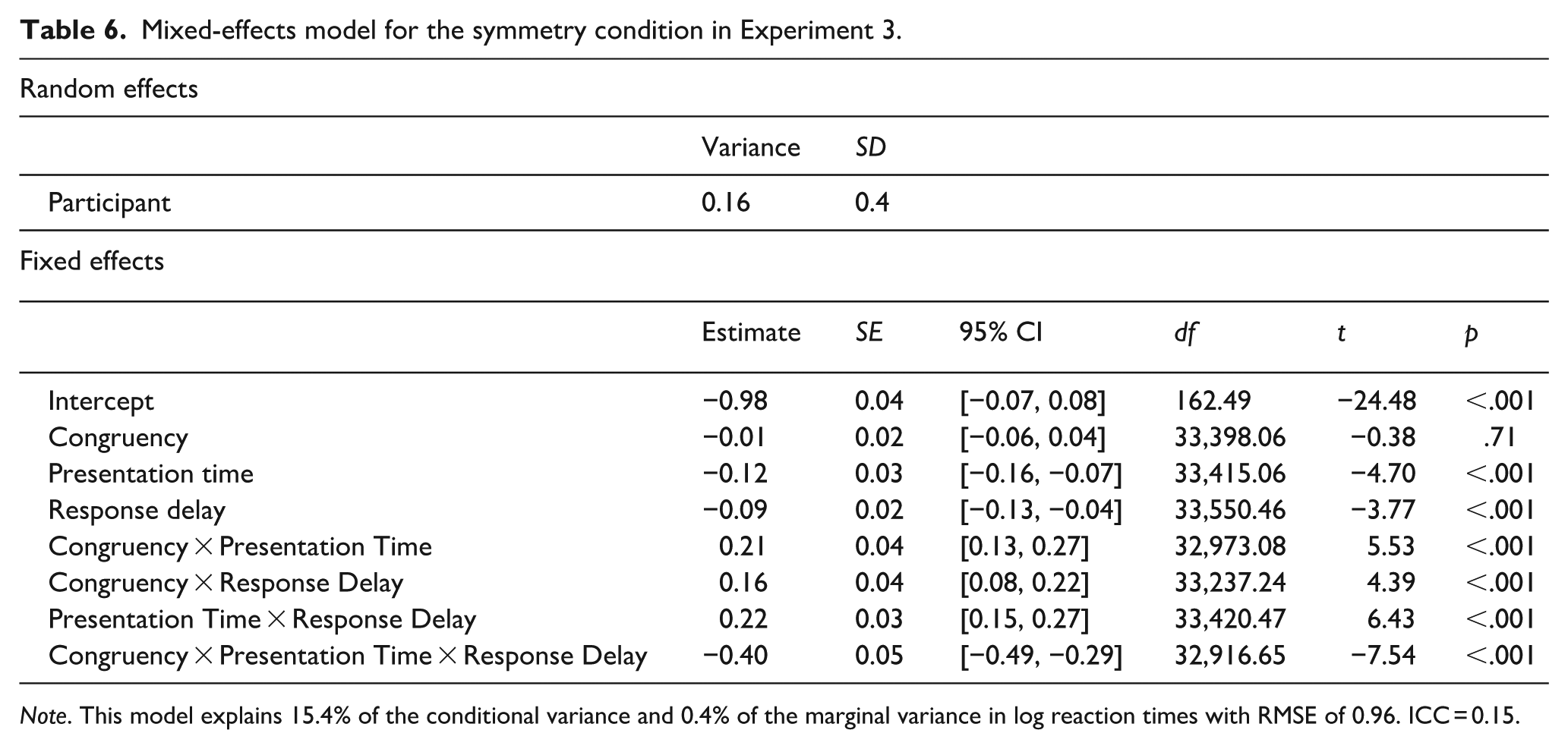
Note. This model explains 15.4% of the conditional variance and 0.4% of the marginal variance in log reaction times with RMSE of 0.96. ICC = 0.15.
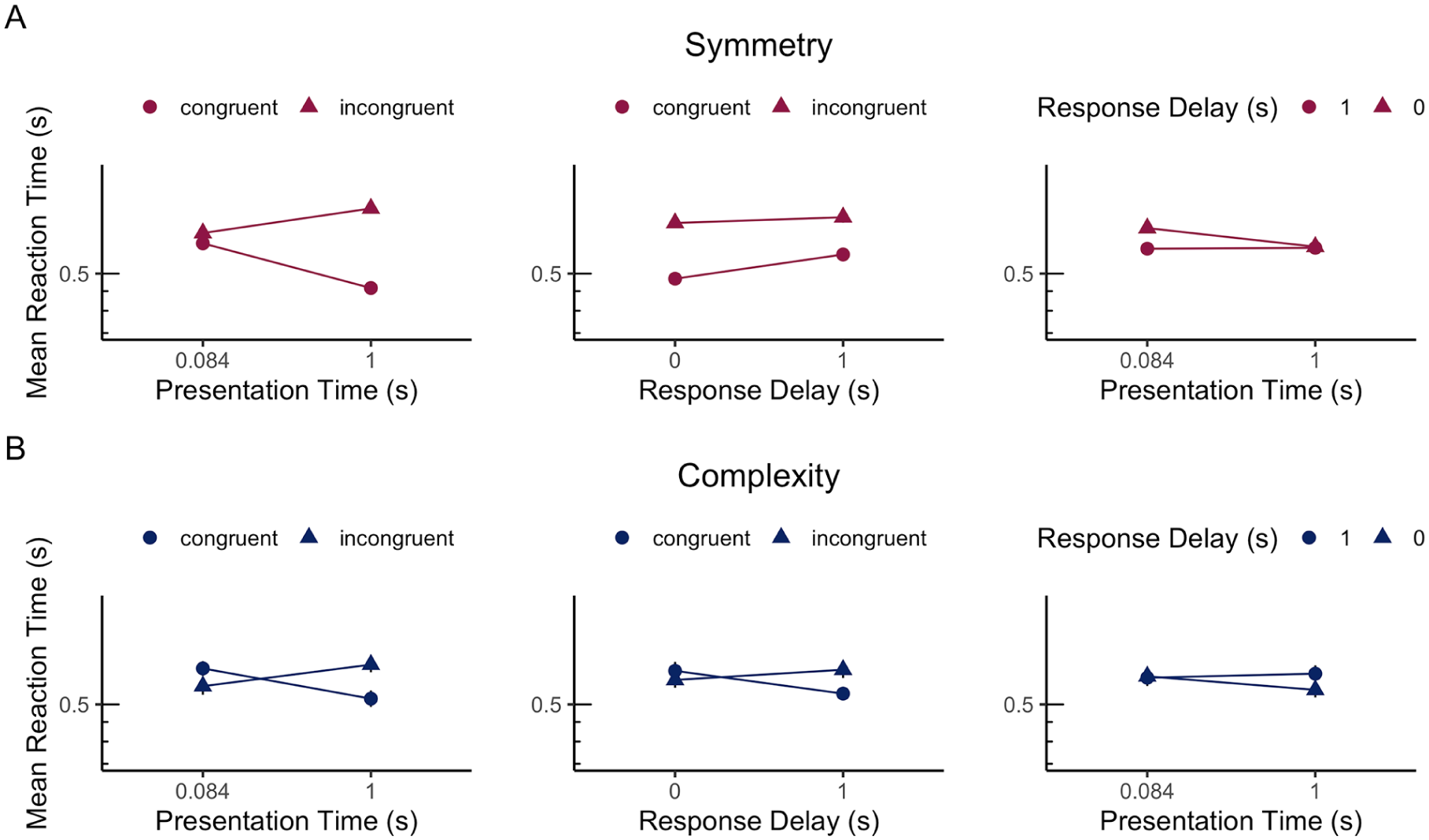
Results of Experiment 3. Error bars correspond to standard errors of the mean. (A) Shows the results for symmetry, and (B) shows the results for complexity.
For complexity, our model indicates significant interactions between congruency and presentation time and congruency and delay (Table 7). We also observed a significant three-way interaction. More specifically, there is a larger difference in reaction time between congruent and incongruent trials at 1 s presentation times (Mcongruent = 0.51 s, SD = 0.48; Mincongruent = 0.54 s, SD = 0.45) than at shorter presentation times (Mcongruent = 0.53 s, SD = 0.45; Mincongruent = 0.52 s, SD = 0.48). Likewise, there is a larger difference in reaction time with a 1 s delay (Mcongruent = 0.51 s, SD = 0.42; Mincongruent = 0.53 s, SD = 0.46) than without a delay (Mcongruent = 0.53 s, SD = 0.51; Mincongruent = 0.52 s, SD = 0.47). Thus, we rejected H20 and H30, but we find evidence to support the opposite of H21 and H31: the effect of congruency on reaction time was greater at longer presentation times and without a response delay. Contrary to our expectations, we found that at short presentation times, the mean difference in reaction time was greater with a 1 s response delay (Mcongruent = 0.56 s, SD = 0.44; Mincongruent = 0.50 s, SD = 0.44), than without (Mcongruent = 0.51 s, SD = 0.45; Mincongruent = 0.54 s, SD = 0.52). Thus, we rejected H40, but found evidence to support the opposite of H41. Figure 9B shows the results.
Mixed-effects model for the complexity condition in Experiment 3.
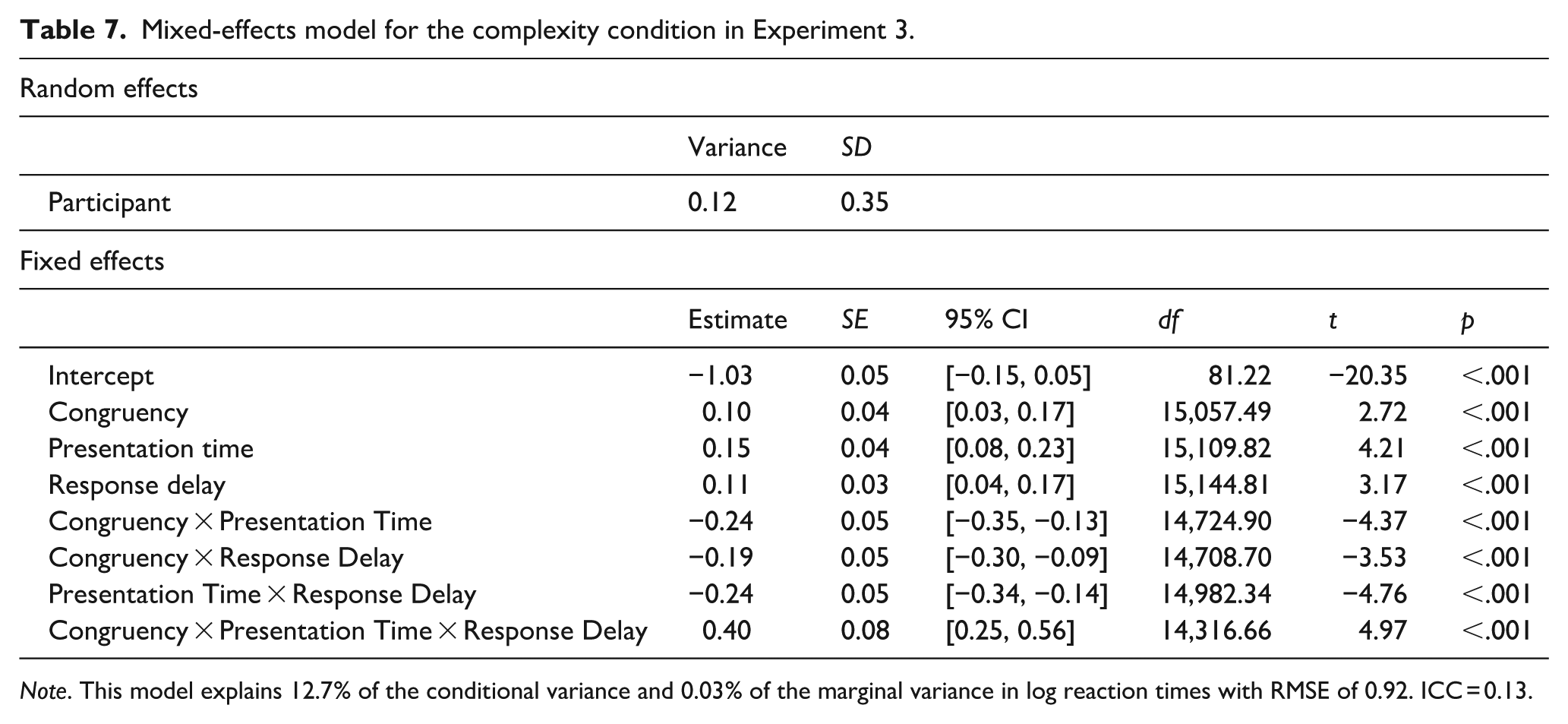
Note. This model explains 12.7% of the conditional variance and 0.03% of the marginal variance in log reaction times with RMSE of 0.92. ICC = 0.13.
To test whether there were differences in reaction time across products, we ran a one-way ANOVA with log reaction time as the dependent variable and product (three levels: hat, pasta, and phone) as the independent variable. We did not observe differences in reaction time across product conditions for either symmetry, F(2, 357) = 0.14, p = .87, or complexity, F(2, 171) = 0.19, p = .83 (see Figure 10).
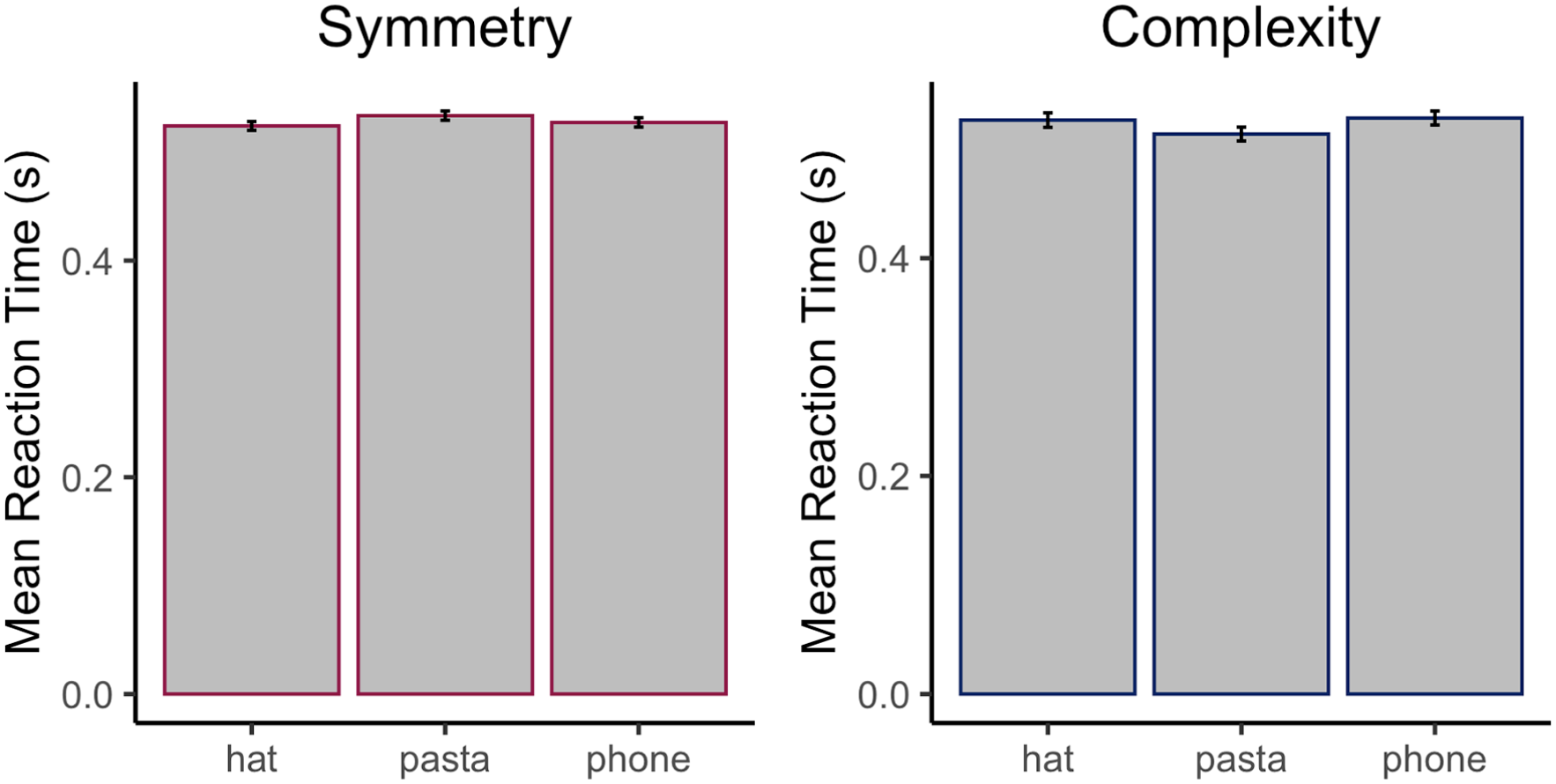
Results of one-way ANOVAs of reaction time and product. Error bars correspond to standard errors of the mean.
For exploratory purposes, we repeated the same mixed-effects model analysis to test whether the mean symmetry and complexity ratings (Experiment 3 Pilot) modulated any of our effects. We included symmetry or complexity product mean rating as a main effect. The reported main effects and interactions between congruency, presentation time, and response delay time remained, but we did not find any significant effects of either variable on log reaction times.
Discussion
To explore the relationship between visual aesthetic features, specifically symmetry and complexity, we conducted three online experiments using an online approach–avoidance motivation task. We hypothesized that more preferred aesthetic features (symmetry vs. asymmetry and high complexity vs. low complexity) would elicit approach behaviors rather than avoidance, in both abstract and consumer contexts. By manipulating presentation time and time pressure to make a decision (response delay), we examined the automatic and deliberate processing of aesthetic features, thereby revealing the conditions under which these features strongly affect approach or avoidance motivated behavior.
Experiment 1 showed that participants were generally faster at approaching symmetrical and complex stimuli and slower at approaching asymmetrical and simple stimuli, indicating a main effect of congruency on reaction time. In accordance with our hypotheses, Experiment 2 showed that, for symmetry and complexity, the effect of congruency on reaction time was more pronounced at shorter presentation times. We also observed that for symmetry the effect of congruency is more pronounced without a response delay during short presentation times. However, contrary to our expectations, we only observed an effect of response delay for complexity stimuli, and the effect of congruency was greater with a response delay. Experiment 3, which targets a more ecologically valid context, showed that for symmetry and complexity, the effect of congruency is greater at long presentation times. While the effect of congruency on reaction time was greater without a response delay for symmetry, the opposite was true for complexity. Lastly, we found a significant three-way interaction between congruency, presentation time, and response delay. Table 8 summarizes the results in relation to our hypotheses.
Results summary.
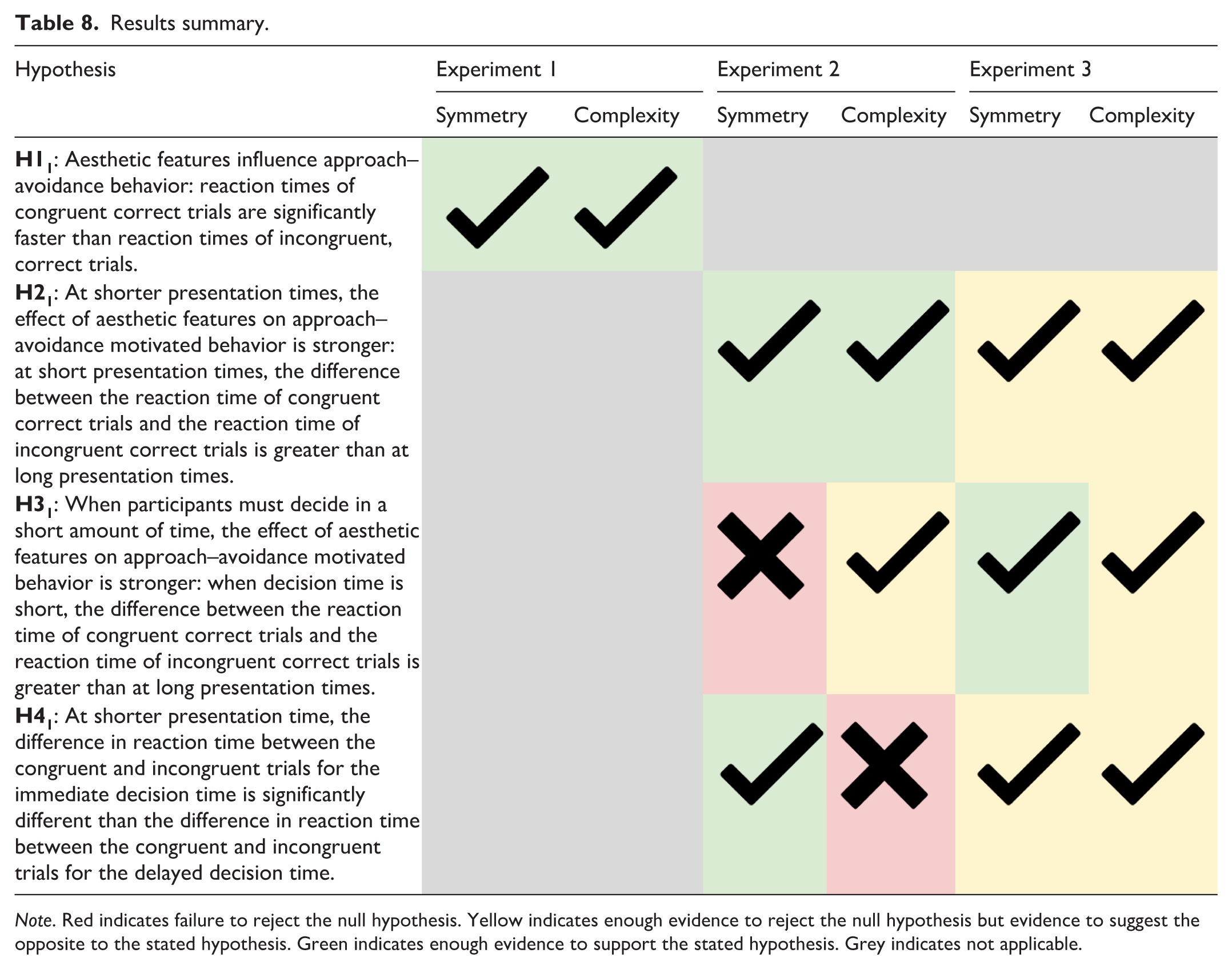
Note. Red indicates failure to reject the null hypothesis. Yellow indicates enough evidence to reject the null hypothesis but evidence to suggest the opposite to the stated hypothesis. Green indicates enough evidence to support the stated hypothesis. Grey indicates not applicable.
The results of Experiment 1 align with our hypothesis and previous research (Velasco et al., 2016, 2020) suggesting that preferred aesthetic features are linked to approach-motivated behavior. Specifically, aesthetic features like symmetry and complexity, which are generally preferred and have been tied to positive hedonic value (Bertamini & Rampone, 2020; Palmer et al., 2013; Stamps, 2002), directly facilitate approach behaviors. The overlap in neural circuitry between “liking” and “wanting” systems (Anselme & Robinson, 2016; Berridge et al., 2009; Castro & Berridge, 2014; Rangel et al., 2008) may explain this effect, supporting the broader account of neuroaesthetics that posits sensory information acquires hedonic value to motivate interaction (Skov & Nadal, 2020; Wassiliwizky & Menninghaus, 2021). Within the confines of our stimuli and experimental design, these findings may challenge the notion of aesthetic experience as a state of disinterested interest characterized by engagement without desire (Hayn-Leichsenring & Chatterjee, 2018), highlighting instead that aesthetic preferences can actively drive motivational behavior.
The effects found in Experiment 1 are more nuanced when considered in the context of different processing and decision times. Indeed, the findings from Experiments 2 and 3 offer conceptual insights into how presentation time and response delay modulate the relationship between aesthetic features and approach–avoidance motivated behavior. Regarding presentation time, the results of Experiment 2 suggest that symmetrical and complex stimuli elicit immediate, bottom-up responses that rapidly influence approach behaviors (Corradi et al., 2019; Stamps, 2002). This is in accordance with our original hypothesis and suggests that for abstract patterns, aesthetic features more strongly motivate approach behavior in the absence of top-down semantic associations (Tawil et al., 2024).
Experiment 3 suggests the opposite. Overlaying the same patterns on consumer goods resulted in a stronger effect of congruency for longer presentation times. These results imply that in real-world settings, additional time may be required to process aesthetic features, as well as the semantic information about objects and the categories they belong to, and translate them into motivated action (Nadal et al., 2010; Pombo & Velasco, 2021). This aligns with the perspective that objects with rich affordances demand more cognitive processing (Djebbara & Kalantari, 2023), emphasizing the crucial role of affordances in our interaction with complex stimuli (Gibson, 2014). Importantly, these findings underscore the limitations of assuming that results generalize—claims about aesthetic features in abstract patterns may not consistently extend to more ecologically valid environments. This highlights the importance of conducting studies in more naturalistic settings and capitalizing on modern technologies to develop stimuli with greater ecological validity.
When it comes to response delay, the results are less conclusive. In terms of complexity, for both abstract shapes (Experiment 2) and consumer goods (Experiment 3), the effect of congruency on reaction time was stronger after a 1 s response delay. For symmetry, the effect of congruency on reaction time was stronger without a response delay for consumer goods (Experiment 3). The same tendency was present for abstract patterns, but the interaction between congruency and response delay was not significant. Overall, the interaction between congruency and response time seems to be more driven by aesthetic features themselves, rather than by context (abstract vs. consumer products). A possible reason why symmetry and complexity are differently affected by response delay may be ease of categorization. Even though both symmetry and complexity are operationalized in a plethora of ways (Bertamini & Rampone, 2020; Nadal et al., 2010; Pombo et al., 2023; Treder, 2010), reflection along the vertical and horizontal axes may be a more prototypical representation of symmetry than the number of elements is of complexity. Thus, it could be that, in our experiment, making a decision about symmetry was easier than making one about complexity. This idea is supported by the larger number of incorrect trials in the complexity experiments compared to the symmetry ones.
Researchers have also shown competition between symmetry and complexity: symmetrical stimuli tend to be less complex (Aleem et al., 2017, 2019; Mather et al., 2023). Individuals thus tend to weigh each of these differently when making an aesthetic judgment. It is plausible that at a population level, one feature is generally weighted more highly than the other, suggesting different interactions between preference and the time required to make a decision. Lastly, the inconclusive nature of the response delay results may also be due to a limitation of our experimental design. Even though we asked participants to wait 1 s to give a response, we could not control the time it took them to make a decision about the stimulus. They could make a decision soon after stimulus offset, independent of how long they had to wait to input their decision.
The results of our experiments may be elegantly explained by the affective gradient hypothesis, which suggests that individuals continuously evaluate potential future states based solely on their affective responses (Shenhav, 2024). This theory posits that individuals contemplate all potential future states and the affective response associated with each potential action. These form a gradient that directs behavior towards more desirable and away from less desirable outcomes. Following this hypothesis, symmetrical and complex visual features likely generate stronger positive affective responses, creating a steeper affective gradient that naturally drives individuals to approach these stimuli more readily. Conversely, asymmetrical and simple features may evoke weaker or even negative affect, resulting in lower approach behaviors as individuals are less motivated to engage with them. These gradients may be influenced both by the time-related processing, as well as semantic information, further modulating said behavior.
In cognitive psychology, reaction time differences as small as 20 ms are often considered meaningful, particularly in tasks that measure implicit biases or automatic cognitive processes. For example, in the study by Rougier et al. (2020), a reaction time difference of 28 ms between compatible and incompatible conditions was found to be significant and relevant in the context of approach–avoidance task, highlighting the sensitivity of such tasks to small temporal differences. This aligns with findings from meta-analyses on evaluative conditioning and implicit association tasks, where differences of 20 to 30 ms have been shown to reliably indicate underlying cognitive and affective processes (Greenwald et al., 2009; Hofmann et al., 2010). Such small differences are robust indicators of automatic evaluations and behavioral tendencies, even though they may seem trivial in magnitude.
Independent of the mechanisms driving our results, understanding the relationship between aesthetic features and approach/avoidance motivated behavior across contexts has practical implications for domains such as marketing and design, where leveraging aesthetic features can strategically influence consumer evaluations and decision-making (Althuizen, 2021; Bettels & Wiedmann, 2019). Indeed, from a practical standpoint, our findings emphasize the value of integrating preferred aesthetic features like symmetry and complexity into product design, packaging, and other marketing materials to actively facilitate approach behaviors from consumers. In a marketplace where the majority of product launches appear to fail, capitalizing on aesthetic features in design can create a point of differentiation, helping products stand out in a crowded and competitive environment while capturing consumer interest and motivation (Schneider & Hall, 2011). By leveraging these aesthetic elements, marketers can enhance the attractiveness of their offerings (as long as the promise of the product holds), thereby increasing consumer engagement and the likelihood of purchase decisions (Velasco et al., 2020; H.-F. Wang, 2019). Understanding how aesthetic features interact with presentation time and response delay also provides insights that marketing strategies may capitalize on. Products and their corresponding marketing elements are presented in different formats (e.g., at the shop, e-commerce, in ads, or YouTube videos) that vary in terms of exposure and decision times. The interplay between aesthetic features and said times may be strategically used to maximize impact.
It is important to note that, in the present research, we do not claim that symmetry and complexity are synonymous with aesthetic appeal; rather, our approach builds upon a substantial body of literature indicating that, on average, these visual properties tend to influence aesthetic preferences positively (e.g., Bertamini & Rampone, 2020; Nadal et al., 2010; Palmer et al., 2013; Stamps, 2002; Tinio & Leder, 2009; Treder, 2010; Turoman et al., 2018). However, we acknowledge important exceptions noted in the literature, highlighting evidence that simpler rather than complex patterns may often be perceived as more aesthetically appealing (e.g., McDougall & Reppa, 2008; Reppa & McDougall, 2022), and that symmetry is not always the strongest predictor of perceived beauty (Jones & Jaeger, 2019). In our study, the use of mixed models was intended to account for individual variability in responses to these visual attributes. Nevertheless, future research should explicitly investigate how individual differences in preferences for symmetry and complexity moderate the influence of these attributes on approach or avoidance behaviors. Such studies might benefit from preliminary rating experiments to empirically validate the aesthetic appeal of stimuli before their use, ensuring that the chosen visual features effectively reflect the relevant aesthetic dimensions.
Here, we offer a paradigm for future researchers to expand beyond symmetry and complexity and consider how other features, like curvature, texture, or color, influence approach/avoidance motivated behavior. It is worth considering that while our research moves beyond previous studies assessing approach and avoidance motivation in a way that may be confounded with liking, our design may still involve liking as a potential contributor to our results. Future research may still utilize other approach–avoidance experimental paradigms and give consideration to individual differences in preference to replicate and extend our results.
Conclusion
In conclusion, our findings affirm that visual aesthetic features like symmetry and complexity are linked to approach–avoidance motivated behavior. Preferred aesthetic elements not only elicit approach behaviors but do so through mechanisms influenced by both automatic and deliberate cognitive processing, as modulated by presentation time and response delay. These results underscore the importance of understanding how specific aesthetic features drive approach–avoidance motivation, with practical implications for fields like marketing and product design, where these elements can significantly influence consumer behavior.
Supplemental Material
sj-docx-1-qjp-10.1177_17470218251371660 – Supplemental material for When and how visual aesthetic features influence approach–avoidance motivated behavior
Supplemental material, sj-docx-1-qjp-10.1177_17470218251371660 for When and how visual aesthetic features influence approach–avoidance motivated behavior by Maria Pombo, Guido Corradi, Andrew J Elliot and Carlos Velasco in Quarterly Journal of Experimental Psychology
Footnotes
Data accessibility statement

Declaration of conflicting interests
The author(s) declared no potential conflicts of interest with respect to the research, authorship, and/or publication of this article.
Funding
The authors disclosed receipt of the following financial support for the research, authorship, and publication of this article: The authors thank Asahi Breweries and the Research Fund of the Department of Marketing at BI Norwegian Business School for providing funding for this research.
References
Supplementary Material
Please find the following supplemental material available below.
For Open Access articles published under a Creative Commons License, all supplemental material carries the same license as the article it is associated with.
For non-Open Access articles published, all supplemental material carries a non-exclusive license, and permission requests for re-use of supplemental material or any part of supplemental material shall be sent directly to the copyright owner as specified in the copyright notice associated with the article.
