







Abstract
The reading of external negated disjunctions (a disjunction as a clause is externally negated) is an interdisciplinary issue addressed by logic, linguistics, and psychology. For external negated disjunctions, we investigated how their possibility judgments varied with their two expression forms: NTSs (not-true sentences) with the form It is not true that p or q or both versus DSs (deny-sentences) with the form Someone denied that p or q or both). We propose the semantic negation scope account for the question with the hypothesis of the effect of expression form of negation that a NTS will more often elicit the weak local negation strategy that people consider cases negating at least one of the disjuncts as possible, and judge p¬q, ¬pq, and ¬p¬q as possible; while a DS will more often elicit the strong global negation strategy that people consider only cases negating all disjuncts as possible, and judge only ¬p¬q as possible. Experiments 1 and 2 tested the hypothesis in verbal and pictural scenarios, respectively. Both experiments exhibited the effect of expression form of negation that DSs more often elicited the strong global negation strategy, while in conversational and non-conversational contexts, NTSs more often elicited the weak local negation strategy, as favoring the semantic negation scope account over the alternative accounts. The effect of expression form of negation suggests that there seems no unified mental mechanism of the reading of external negated disjunctions with different expression forms.
Introduction
Disjunctions are compound sentences formed by connecting two simple sentences with the logical connective or, usually represented as the formula p or q (for example, the ball is blue or plastic). They can be interpreted as being inclusive (the two disjuncts can be true simultaneously) or exclusive (the two disjuncts cannot be true simultaneously). Classical logic generally treats basic disjunctions p or q (without meaningful connections between disjuncts) as inclusive (Aloni, 2021). However, in natural language, the form p or q may be ambiguous in whether it is inclusive or exclusive (Aloni, 2021). In order to avoid the ambiguity of the form p or q, this study focuses on basic inclusive disjunctions and uses the explicit inclusive form p or q or both, which is also the typical form used in mental model theories (Khemlani et al., 2018). Using the explicit inclusive form, we can compare and differentiate the different predictions of mental model theories and the present research. Combining a disjunction with a negation operator yields a negated disjunction. The reading of negated disjunctions is an interdisciplinary issue addressed by logic, linguistics, and psychology.
In natural languages, the negation of a disjunction (e.g., the card is round or red) can be distinguished into the internal/sentential negation (the card is not round or red) and the external/propositional negation (it is not the case that the card is round or red) (De Clercq, 2020; Horn, 1989). Research on negated disjunctions focuses on internal negations in linguistics (Goro, 2024; Pagliarini et al., 2022), and external negations in the psychology of propositional reasoning (Khemlani et al., 2014; Macbeth et al., 2013, 2014; Yin et al., 2021), respectively.
Linguistic research concerns how various linguistic factors influence the reading of negated disjunctions. In linguistics, there is the cross-linguistic relativity of reading internal negated disjunctions based on the disjunction scope parameter account that whether the reading of an internal negated disjunction Not p or q (e.g., the card is not round or red) is the wide-scope not-both reading Not p or not q or the narrow-scope neither reading Neither p nor q depends on the disjunction scope parameter whether disjunctions take scope over negations or not. Specifically, the internal negated disjunction is interpreted as Not p or Not q in some languages such as Chinese and Japanese where disjunctions that are positive polarity items tend to avoid appearing in the scope of negation and so disjunctors take wider scope over negations, but as Neither p nor q in some languages such as English and German where disjunctions are not positive polarity items and so negations take wider scope over disjunctors (Goro, 2024; Pagliarini et al., 2018; Szabolcsi, 2004). Huang et al. (2020) proposed the polarity sensitivity cancellation account (PSCA) that in Chinese the polarity sensitivity of the disjunction word huozhe “or” can be canceled by external negation, and so both Mandarin-speaking children and adults would be expected to assign the “neither” interpretation (neither p nor q) of an external negated disjunction: Not (p or q), where negation takes scope over disjunction. In their Experiment 3, they used Truth Value Judgment Tasks where participants were asked to judge whether a disjunction with the focus adverb “Only” as the target sentence (e.g., Only the big pirate planted corals near the red mermaid or the green mermaid) is right (i.e., true) or wrong, given some facts (e.g., The big pirate planted corals near the red mermaid and the green mermaid, and the small pirate planted corals near the green mermaid). In their tasks, most children and adults rejected the disjunction. They argued that since the fact is q “the small pirate planted corals near the green mermaid,” such responses implied that the external negation/rejection of the disjunction was based on the neither interpretation (neither near the red mermaid nor near the green mermaid) of the assertion that it’s not true/right that anyone other than the big pirate planted corals near the red mermaid or the green mermaid (the assertion was implied by the target sentence). However, an alternative account for the rejection was that for the participants, the focus of negation might be the subject “anyone other than the big pirate,” and they might have understood the external negation of the disjunctive sentence as merely negating the subject (the big pirate) rather than the disjunction as the predicate, and so they rejected the disjunctive sentence due to the subject negation. The fact that the big pirate planted corals near the red mermaid and the green mermaid did not semantically negate the predicated disjunction (planted corals near the red mermaid or the green mermaid). In short, the rejection of the disjunctive sentence might be due to the subject negation, rather than the predicate negation. Overall, their results were ambiguous, and their explanation was not convincing. Moreover, their tasks asked participants to judge whether a disjunction was right, rather than whether a negated disjunction was right. Their tasks examined covert negations of disjunctions, but not the direct reading of explicit negations of disjunctions, and so were indirect implicit tasks. In summary, their experiment failed to demonstrate the PSCA. The present research examines the direct reading of explicit negated disjunctions, and so we can directly test PSCA along the way in psychological research.
Psychological research concerns mental operations of external negations of disjunctions. Currently, in the psychology of propositional reasoning a controversial issue is how people read an external negated disjunction (Khemlani et al., 2014; Macbeth et al., 2013, 2014; Yin et al., 2021). This research aims to investigate this question in Chinese where the Chinese word “或者(huòzhě)” corresponds to the English word “or.” In this paper, negated disjunctions generally refer to external negated disjunctions.
In propositional logic, negation can be interpreted as a unary function converting the True into the False (Horn & Wansing, 2025). Logically, the typical expression of an external negated disjunction is the not-true sentence, such as It is not true (the Chinese word 不是真的 bushi zhen de) that p or q or both (abbreviated as NTS). Another typical expression of negation is deny (the Chinese word 否认 fouren) used in natural conversation/communication. Some researchers argue that negating a disjunction is the same as denying it (Khemlani et al., 2014). They argue that the negated disjunction can also be expressed as the denial sentence Someone denies that p or q or both (abbreviated as DS). However, some researchers argue that negation is not equivalent to denial that is a speech act, and epistemically denying A is not equivalent to asserting ¬A (Ripley, 2020). Overall, in both English and Chinese, external negated disjunctions have the two typical expression forms of not-true sentences (NTSs) and deny-sentences (DSs).
Logically, these two expressions both have the external negation constraint that external negations take scope over disjunctions. According to De Morgan’s law, Not (p or q) = Not-p and Not-q, the external negation of a disjunction means the conjunction of the negations of its disjuncts. Therefore, NTSs and DSs both mean neither reading Not p and Not q. For example, for a card, Someone denied that the card was round or red, and It was not true that the card was round or red both mean that the card is neither round nor red.
However, previous separate psychological studies have revealed differences in reading DSs and NTSs. In the possibility judgment task (typical in the psychology of propositional reasoning) used by Khemlani et al. (2014), participants were asked to judge whether each of cases pq, p¬q, ¬pq, and ¬p¬q (“¬” represents negation) is possible or impossible for a DS (e.g., Bob denied that he wore a yellow shirt or he wore blue pants on Monday.). The results showed that 86% of participants judged only ¬p¬q as possible, corresponding to the neither interpretation. However, other experiments using NTSs revealed that for most participants, the negated disjunction does not imply only ¬p¬q is possible. Macbeth et al. (2013, 2014) used an equivalence judgment task, presenting a NTS (e.g., It is not true that London is a city or Africa is a continent.) as the premise and asking participants to select one of the four candidate sentences that is equivalent to the premise. In their two experiments, 56% and 44% of participants respectively considered the equivalent sentence as London is not a city or Africa is not a continent (with the formula Not-p or Not-q), showing the not-both interpretation; while only 26% and 32% of participants considered the equivalent sentence as the neither interpretation London is not a city and Africa is not a continent (with the formula Not-p and Not-q). In Experiment 2 in Yin et al. (2021), which used a possibility generation task, participants were asked to list all possible cases based on a given NTS (e.g., it is not true that a card is red or it is round). It was found that the size order of the generation rates for the four cases was ¬p¬q (81.3%) > ¬pq (56.3%) ≈ p¬q (52.5%) > pq (31.3%). These experimental results all indicate that a NTS mentally implies that cases p¬q, ¬pq, and ¬p¬q all are possible. This is different from the finding about DSs by Khemlani et al. (2014). In summary, the separate studies on DSs and NTSs demonstrate the different readings of DSs and NTSs. This suggests that the two different expressions of a negated disjunction have different semantics.
In the psychology of propositional reasoning, DSs and NTSs receive research concerns because they are typical in natural languages such English and Chinese. These two English expressions have the corresponding Chinese expressions. For example, the NTS “it is not true that a card is red or it is round” corresponds to the Chinese expression: “一张卡片是红色的或者圆形的”不是真的. This sentence has the Chinese transliteration: “Yī zhāng kǎpiàn shì hóngsè de huòzhě yuánxíng de” bù shì zhēn de. It has the glossed English translation: “A card is red or round” is not true. Here, the most common Chinese lexical realization form of “is not true” is that “a statement” 不是真的(bù shì zhēn de). The DS “He denies that a card is red or it is round” corresponds to the Chinese expression: 他否认“一张卡片是红色的或者圆形的”. This sentence has the Chinese transliteration: Tā fǒurèn “yī zhāng kǎpiàn shì hóngsè de huòzhě yuánxíng de.” It has the glossed English translation: He denies “a card is red or round”. Here, the most common Chinese lexical realization form of deny is that someone 否认(fǒurèn) “a statement.” Overall, the two typical forms of Chinese external negation are 不是真的 (is not true) and 否认 (deny). The current research examines these two typical expressions of external negation in Chinese, and so we can compare Chinese and English typical external negations.
For the different readings of external negated disjunctions DSs and NTSs with the explicit constraint that external negations take scope over disjunctions, we propose a semantic negation scope account that is based on the basic semantic difference between DSs and NTSs in terms of the negation scope parameter. In linguistics, semantically, DSs and NTSs have different negation scopes. The negation scope parameter applies to external negated disjunctions and concerns whether the external negation focuses on all disjuncts or some disjuncts in a disjunction. We specified the semantic negation scope account (SNSA) as follows.
A DS (Someone denied that p or q or both) generally represents a speech act—denial that semantically indicates a wide-scope global negation with negating all the disjuncts in the disjunction, and results in the neither reading “Not-p and not-q.” This usage typically appears in conversational contexts. Consider the following dialogue:
(1) Jack said that the card Mary was holding was round or red.
(2) Mary denied that the card she was holding was round or red.
(2) as Mary’s denial of Jack’s previous statement meant to remove or negate all the disjuncts involved in the disjunction in (1). Such denial semantically functions to completely remove the relevant information from the previous utterance, and so it is semantically a strong global negation (Oversteegen & Schilperoord, 2014; Spenader & Maier, 2009; van der Sandt & Rob, 2003). Here, the essence of the strong global negation lies in negating all the disjuncts (components) in the disjunction, but not the disjunctor “or.” Thus, the strong global negation coincides with the external negation constraint that the external negation takes scope over the disjunction.
A NTS (It is not true that p or q or both) can be used with the same semantics in non-conversational and conversational contexts. For example, in a non-conversational context, it is not true that the card is round or red. In a conversational context, Jack said that the card was round or red, but Mary considered what Jack said (the card was round or red) was not true. For a compound sentence such as “p or q or both” or “p and q,” to assert it is not true does not mean to negate all the components in it, according to the semantic principle of negations being alternatives that the negation of a statement means some alternatives to the statement (Capuano et al., 2023; Gotzner & Romoli, 2022; Repp & Spalek, 2021). The negation “not true” of the conjunction “p and q” may means some alternatives such as “not-p and q” or “p and not-q” with some local alternatives (negations) to the conjunction, and so is a weak local negation. Similarly, the negation “not true” of the disjunction “p or q or both” can mean “not-p or q or both” or “p or not-q or both” with some local alternatives (local negations of some disjuncts) to the disjunction whole, and so can be a weak local negation without negating the disjunctor “or.” Thus, semantically, a disjunction being not true can mean some local negations of the disjunction whole, rather than the neither reading Not p and not q based on the external negation constraint that external negations take scope over disjunctions. Here, the semantic principle of negations being alternatives trumps the external negation constraint. Thus, external negations may fail to cancel the polarity sensitivity of the disjunction.
Overall, the semantic difference between DSs and NTSs lies in semantic negation scope. A DS tends to mean the wide-scope global negation with negating all disjuncts in the disjunction, aligning with the external negation constraint; whereas a NTS tends to mean the narrow-scope local negation with negating some disjuncts in the disjunction due to the principle of negations being alternatives that trumps the external negation constraint. Denying a disjunction tends to mean wider scope negation and so stronger negation than asserting the disjunction being not true does. For external negated disjunctions DSs and NTSs where external negations explicitly take scope over disjunctions, whether negation scope is wide or narrow is a semantical matter, without considering the external negation constraint. Thus, the external negation constraint does not determine the reading of external negated disjunctions. This is the semantic mechanism of external negated disjunctions DSs and NTSs. We call it the SNSA.
The negation scope parameter of external negated disjunctions concerns whether the external negation focuses on all disjuncts (the wide-scope global negation) or some disjuncts (the narrow-scope local negation) in a disjunction. It differs from the disjunction scope parameter of internal negated disjunctions that concerns whether disjunctors take scope over negations (the wide-scope not-both reading) or the opposite (the narrow-scope neither reading). The wide-scope global negation in external negated disjunctions is similar to the narrow-scope neither reading in internal negated disjunctions. The narrow-scope local negation in external negated disjunctions is similar (but not identical) to the wide-scope not-both reading in internal negated disjunctions.
The previous psychological studies on DSs and NTSs provide some empirical evidence for SNSA. The preference for the strong global negation strategy for DSs is favored by the finding in Khemlani et al. (2014) that for most participants, a DS meant that only ¬p¬q was possible, and the other three cases were impossible. We specify the strong global negation strategy as follows. Specifically, people will understand the negated disjunction as the negation of all the disjuncts in the disjunction, and then based on this global negation (indicating the neither interpretation), examine whether each case negates all the disjuncts. Only when a case negates all the disjuncts will people judge it as possible; otherwise, it is impossible. Among the four cases, only ¬p¬q negated all three disjuncts of the disjunction: p, q, and both, and so ¬p¬q is possible, while the other three cases are impossible. Compared to the three possibilities (pq, p¬q, ¬pq) contained in the positive disjunction, the global negation strategy for the DS negates all of them. The number of possibilities in the negated disjunction is reduced, and the possibilities contained before and after negation are completely different.
The preference for the weak local negation strategy for NTSs is favored by the findings in Macbeth et al. (2013, 2014) and Yin et al. (2021). These studies found that most participants did not negate all the disjuncts in a NTS, but rather only negated some parts of the NTS. Yin et al. (2021) proposed a clause negation strategy (CNS) based on syntactic operations for the possibility generation task of NTSs (as shown in Figure 1). This strategy is based on local negations in syntax. It involves first negating the clauses in a NTS to form a new disjunction (a syntactic operation), and then constructing the possibility model allowed by the new disjunction. The clause negation is a step-by-step process: negating p or q starts with negating both clauses, then negating only the first clause p, and finally negating only the second clause q. The order of the negation steps affects the generation rate of each case. Some reasoners may stop at the first step and ignore possibilities generated by the latter two steps. According to CNS, “the negation of a disjunction yields all the 4 possible cases” and “¬p¬q will be the most frequently endorsed case” (Yin et al., 2021, p. 228). In summary, the CNS for the possibility generation task about NTSs involves multiple steps, each with two stages: first forming a new disjunction, and then constructing possibility models under the new disjunction. The possibility generation is an indirect process based on syntactic operations. Therefore, the CNS is an indirect possibility generation strategy.
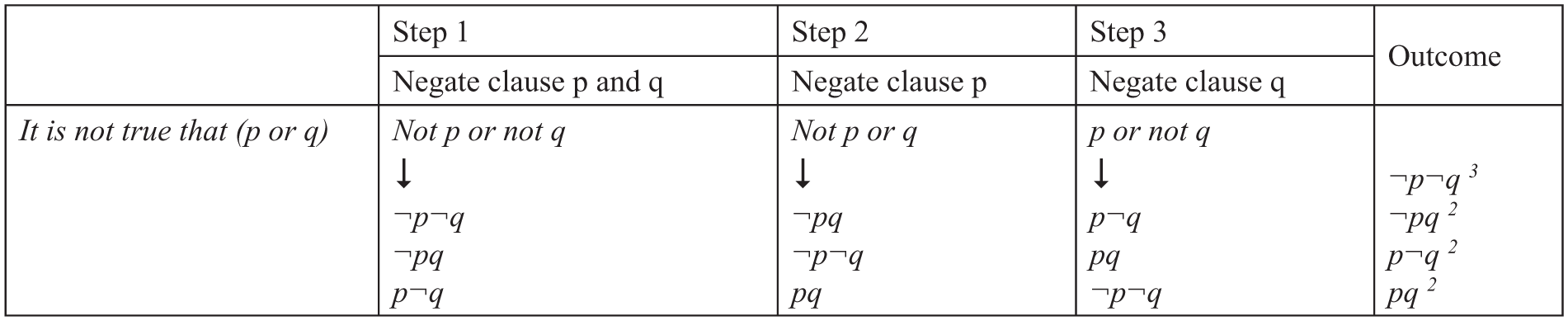
The procedure of the clause negation strategy in possibility generation under negated disjunctions.
However, the syntax-based CNS is not suitable for explaining thinking process in the possibility judgment task of a NTS (It is not true that p or q or both). In this task, the four cases are all present, and people can directly compare each case with the disjuncts in the disjunction and judge whether it is possible or impossible based on whether it at least negates one of the disjuncts in the disjunction. This is the local negation strategy, as is suggested by the finding (Macbeth et al., 2013, 2014) that about half participants read a NTS (e.g., It is not true that London is a city or Africa is a continent.) as London is not a city or Africa is not a continent, showing the not-both interpretation. People may first intuitively understand the negation of the disjunction as at least negating one of the disjuncts (indicating the not-both interpretation), and then examine whether each case at least negates one of the disjuncts in the disjunction. If a case at least negates one of the disjuncts, people judge it as possible; otherwise, they judge it as impossible. For a NTS (It is not true that p or q or both), p¬q negates the disjunct q, and so it is possible; ¬pq negates the disjunct p, and so it is possible; ¬p¬q negates three disjuncts p, q, and both, and so it is possible; while pq does not negate any disjunct, and so it is impossible. This direct local negation strategy does not require forming a new disjunction at the syntactic level, so it is a direct strategy. It is simpler and more economical than the CNS. Thus, for the possibility judgment task of NTSs, people will prefer the local negation strategy over the CNS.
A variant of the local negation strategy for the possibility judgment task of NTSs is that people may first expand the p or q or both into the complete disjunction p¬q or ¬pq or pq (each disjunct is a complete case), and then judge each case as possible or impossible depending on whether it negates at least one disjunct of the expanded disjunction. In this way, pq negates p¬q and ¬pq, p¬q negates pq and ¬pq, ¬pq negates pq and p¬q, and ¬p¬q negates pq, p¬q, and ¬pq. Each case of the four cases at least negates two of the expanded disjuncts, and so it should be judged as possible. This four-possibilities interpretation does not indicate the not-both interpretation and the neither interpretation. Thus, this variant does not imply the not-both reading Not p or not q.
The local negation strategy predicts that whether people judge pq as possible depends on whether they expand the affirmative disjunction into a complete one. And people will judge each of cases ¬p¬q, p¬q, and ¬pq as possible regardless of whether the disjunction is expanded. Therefore, compared to these three cases, cases pq will elicit more “impossible” judgments. Thus, we hypothesize that in the possibility judgment task, people tend to use the local negation strategy for NTSs, considering that a NTS implies three possibilities (p¬q, ¬pq, ¬p¬q) indicating the not-both interpretation or four possibilities (pq, p¬q, ¬pq, ¬p¬q) indicating neither the not-both interpretation nor the neither interpretation. Compared to the affirmative disjunction p or q or both, which contains three possibilities pq, p¬q, and ¬pq (Johnson-Laird & Ragni, 2019; Johnson-Laird et al., 1992, 2015; Khemlani et al., 2018), the three-possibilities interpretation of the NTS only negates the possibility of pq in the affirmative disjunction, without negating the possibilities of p¬q and ¬pq; and the four-possibilities interpretation of the NTS not only does not negate the three possibilities contained in the affirmative disjunction, but even adds the possibility of ¬p¬q. For the NTS, the number of possibilities in the negated disjunction is the same as or even more than the number of possibilities in the affirmative disjunction, and possibilities p¬q and ¬pq are retained. This is weak negation without reduction in the number of possibilities.
In summary, according to SNSA, we hypothesize that the difference in the possibility reading of the two expression forms (“not true” and “deny”) of external negated disjunctions may be due to the different negation strategies for NTSs and DSs. People tend to use the strong global negation strategy for DSs that indicates neither interpretation, but the weak local negation strategy for NTSs. For NTSs, the local negation strategy leads to the three possibilities interpretation indicating the not-both reading or the four-possibilities interpretation indicating neither the not-both reading nor the neither reading. The local negation strategy does not definitely imply the not-both reading Not p or not q. It should be emphasized that these two negation strategies apply to external negations of disjunctions, but not internal negations of disjunctions.
Previous theories have attempted to explain the meaning of negated disjunctions, but they do not distinguish between the two expression forms of negation. The mental model theory (MMT) defines mental models as iconic presentations of the possibilities elicited by a given piece of information (Johnson-Laird, 1983). It assumes that the core meaning of a compound proposition refers to the sets of possibilities being semantically compatible to the compound (Johnson-Laird, 2001; Johnson-Laird & Byrne, 2002, p. 650). This principle of semantic compatibility is the fundamental principle of MMT. According to MMT, p or q or both refers to the following three possibilities:
The negation of a disjunction refers to the complement of the set of possibilities allowed by the disjunction: case ¬p¬q is possible, while cases pq, p¬q, and ¬pq are impossible (Khemlani et al., 2012). For example, “it is not true that this card is round or red or both” means that “this card can only be non-round and non-red.” We call this account the complement account that is consistent with neither interpretation of PSCA. In MMT, the negation of a disjunction can be expressed by both the NTS and the DS, and both are interchangeable. Therefore, MMT predicts no difference in the reading of the NTS and the DS, both of which should conform to the complement account.
In summary, for the possibility judgment task of an external negated disjunction, MMT predicts the complement interpretation that both forms mean that only ¬p¬q is possible. PSCA predicts that both forms of external negations share the neither interpretation consistent with the complement interpretation of MMT. SNSA predicts that the expression form of negation may influence negation strategies, and consequently affect the possibility reading of negated disjunctions. For NTSs in non-conversational and conversational contexts, people tend to use the weak local negation strategy, judging at least cases p¬q, ¬pq, and ¬p¬q as possible. For DSs, people tend to use the strong global negation strategy, judging only ¬p¬q as possible. The key difference between these two strategies lies in whether p¬q and ¬pq are judged as possible or impossible.
Overview of the Present Experiments
Two experiments were conducted to distinguish between the above predictions. Both experiments used abstract materials to avoid interference from background knowledge associated with concrete materials. Experiments 1and 2 investigated the influence of expression form of negation on possibility judgments under external negated disjunctions in verbal and pictural scenarios, respectively. In each experiment, there were three between-group conditions that examined possibility judgments under DSs in conversational contexts (DSs), NTSs in conversational contexts (C-NTSs), and NTSs in non-conversational contexts (NC-NTSs), respectively. Because DSs are pragmatically used in conversational contexts, the present experiments examined the reading of DSs only in conversational contexts. The comparison of the former two conditions examined whether in conversational contexts the two expression forms DSs and NTSs would make a difference to the reading of external negated disjunctions. The comparison of the latter two conditions examined whether the reading of NTSs was reliable across conversational and non-conversational contexts.
Experiment 1
Method
Participants
We conducted a pilot study to investigate between-group differences in possibility judgments about C-NTSs and DSs, with responses to cases p¬q and ¬pq as the key items that can distinguish between the two strategies. The results showed that in the C-NTS task, the proportions of judging cases p¬q as impossible, possible, and necessary were 29%, 69%, and 2%, respectively, while in the DS task, the corresponding proportions were 53%, 43%, and 4%, respectively. In the C-NTS task, the proportions of judging cases ¬pq impossible, possible, and necessary were 30%, 65%, and 5%, respectively, while in the DS task, the corresponding proportions were 53%, 40%, and 7%.
We used the Non-proportional Odds calculation method in SampleSizes Software (Machin et al., 2018) to determine the required sample size for two groups when the dependent variable was ordinal. According to the statistical requirement (α = .05, power = 1 − β = 0.80) and the proportions corresponding to cases p¬q, each group needed at least 81 participants. For cases ¬pq, each group needed at least 61 participants. We adopted the sample size of each group based on the minimum sample size (81) calculated from cases p¬q.
The formal experiment also examined the reading of NC-NTSs, and so contained the three participant groups that respectively read DSs, C-NTSs, and NC-NTSs. Therefore, the total minimum sample size of the three groups was 243. We recruited 300 college students with age 18 to 20 years (116 males, 184 females) from an ordinary college in China, who were randomly arranged to the three groups, each with 100 participants. They had not studied any logic courses.
The present two experiments received ethical approval from the Shaanxi Normal University Human Research Ethics Committee. All the participants provided written informed consent.
Design and materials
The experiment was a paper-and-pencil test that used the possibility judgment task, and employed a mixed design with the three between-group conditions (NC-NTSs, C-NTSs, and DSs) that formed two between-group independent variables. The first was an expression form of negation (C-NTSs vs. DSs). The comparison of C-NTSs and DSs aimed to examine the effect of expression form of negation in conversational contexts. Pragmatic contexts of NTSs as the second independent variable were varied with two levels: C-NTSs versus NC-NTSs. The comparison of C-NTSs and NC-NTSs aimed to examine whether the reading of NTSs would be reliable across these two pragmatic contexts. Since NC-NTSs and DSs differed in both expression forms and pragmatic contexts, these two conditions were not comparable.
We used the between-group design to avoid the possible interferences between the different expression forms in using within-group design. Participants were randomly assigned to the three groups.
The possibility judgment task required participants to judge whether the four cases were impossible, possible, or necessary under a negated disjunction. To avoid potential influences from concrete material contents, we used abstract materials. In each condition, there were two between-group topics: one about balls (the ball is blue or plastic or both) and the other about cards (the card is round or red or both). Thus, there were six questionnaires that were formed by combining the three conditions and the two topics. The ball questionnaires are presented below. The card questionnaires had the same format as in the ball questionnaires, except using the card materials. The following questionnaires are translated from the original Chinese version.
The NC-NTS questionnaire with the ball topic
Instruction
Please read the following problem and answer the questions in it independently and carefully in order. Check the option you agree with. Thank you for your sincere cooperation.
Here is a box of balls, and now a ball is randomly drawn from it. It is not true that the ball is blue or plastic or both. Please answer the following questions based on the information above:
Is this ball (necessarily, possibly, impossibly) a blue plastic ball?
Is this ball (necessarily, possibly, impossibly) a blue non-plastic ball?
Is this ball (necessarily, possibly, impossibly) a non-blue plastic ball?
Is this ball (necessarily, possibly, impossibly) a non-blue non-plastic ball?
The C-NTS questionnaire had the same instruction and the same four questions as the NC-NTS questionnaire, and the following conversational context:
Here is a box of balls. Bob randomly picked a ball from it, and asked Jerry to guess the color and material of the ball. Jerry said “This ball is blue or plastic or both.” Based on the fact, Bob considered that Jerry’s statement was not true. Please answer the following questions based on the information above.
The DS questionnaire had the same instruction and the same four questions as the NC-NTS questionnaire, and the following conversational context:
Here is a box of balls. Jack randomly picked a ball from it, and asked Tom to guess the color and material of the ball. Tom said “This ball is blue or plastic or both.” Based on the fact, Jack denied “this ball is blue or plastic or both.” Please answer the following questions based on the information above.
In each question, there were three response options: necessarily, possibly, and impossibly. For the same case, modal beliefs of these three responses decreased from strong to weak in order. Therefore, the response variable was ordinal. The possibility judgment task can examine both modal beliefs about individual cases and the overall response patterns of the four cases. For the present tasks, SNSA predicted that the both NTS groups would be more likely to use the local negation strategy, while the DS group would be more likely to use the global negation strategy. This would be reflected in the following two aspects:
For individual cases, cases p¬q and ¬pq would yield stronger modal beliefs in both NTS groups than in the DS group, and cases ¬p¬q would yield stronger modal beliefs in the DS group than in both NTS groups. And modal beliefs in each case would not differ between the two NTS groups.
For response patterns, both NTS groups would more often judge ¬pq, p¬q, and ¬p¬q as possible, and there would be individual differences in possibility judgments about case pq, where some participants would judge it as possible but others would judge it as impossible. The DS group would more often judge only ¬p¬q possible, and the other three cases impossible. The two NTS groups would not differ in response patterns.
MMT and PSCA both predicted that the expression form of external negation would neither affect modal beliefs in individual cases nor response patterns.
Procedure
Participants completed the questionnaires in a quiet classroom. The six questionnaires were randomly distributed to participants. Each participant received a questionnaire and a pen to fill it out. There was no time limit for the tasks. Participants took about 5 min to complete the tasks.
Results
There were no significant differences between the results of the two topical materials, and so the results were collapsed. The overall results of the four cases are shown in Figure 2. The response patterns are shown in Table 1. Participants showed individual differences in both possibility judgments and response patterns. Overall, participants showed poor performances in terms of using the global negation strategy indicating neither interpretation of negated disjunctions.
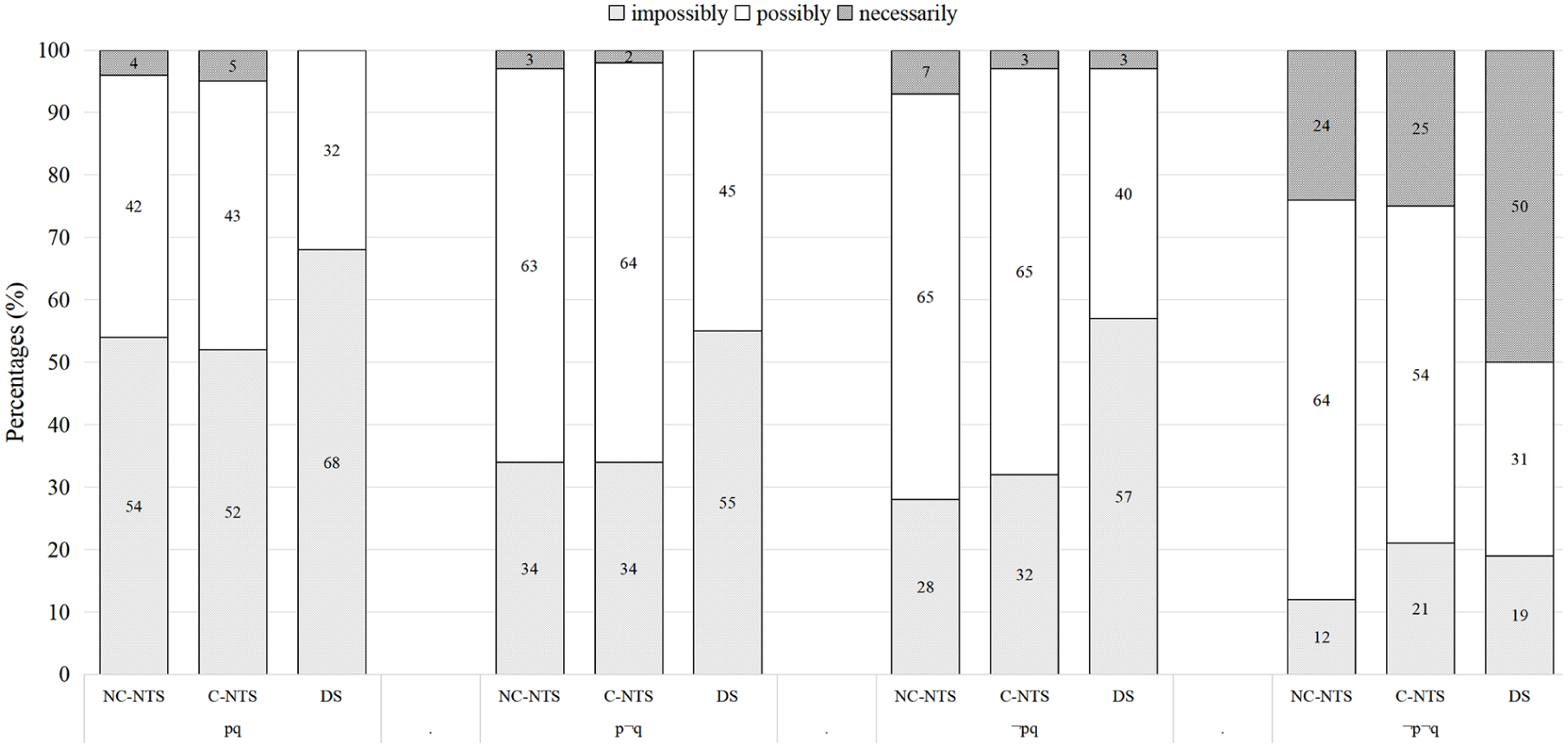
Possibility judgments (percentages) for individual cases in Experiment 1.
Response patterns (percentages) of possible judgments in Experiment 1.
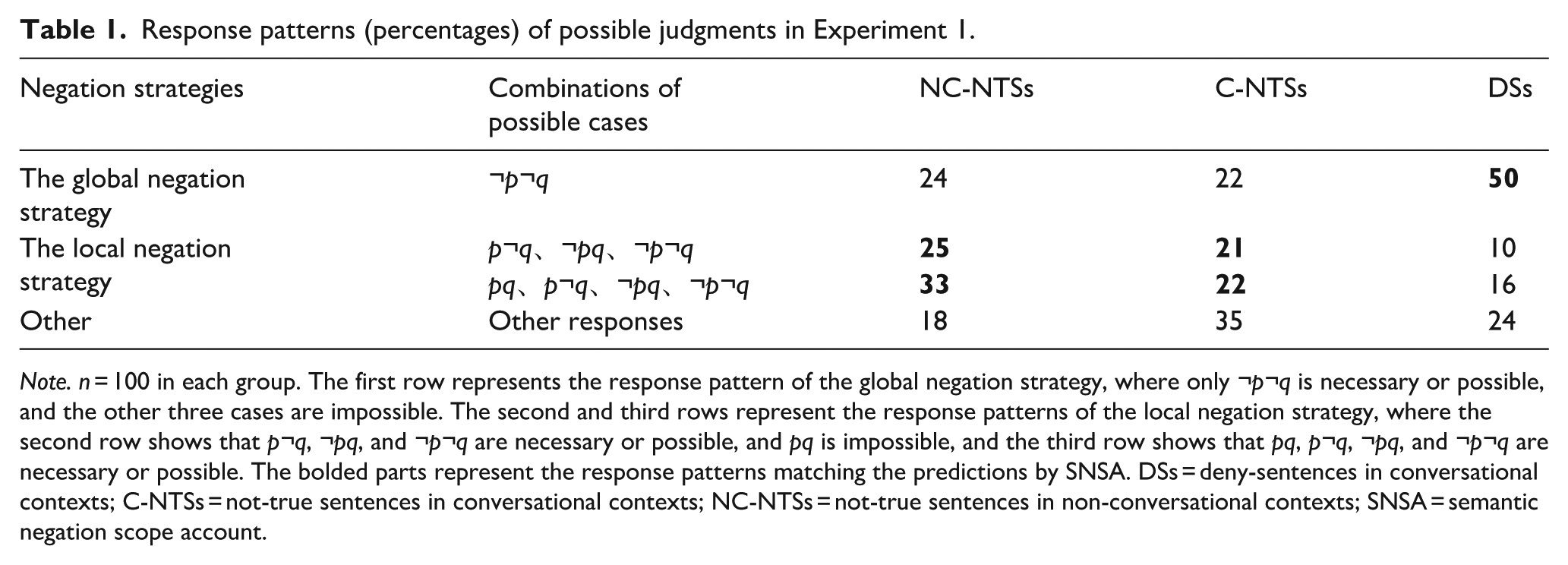
Note. n = 100 in each group. The first row represents the response pattern of the global negation strategy, where only ¬p¬q is necessary or possible, and the other three cases are impossible. The second and third rows represent the response patterns of the local negation strategy, where the second row shows that p¬q, ¬pq, and ¬p¬q are necessary or possible, and pq is impossible, and the third row shows that pq, p¬q, ¬pq, and ¬p¬q are necessary or possible. The bolded parts represent the response patterns matching the predictions by SNSA. DSs = deny-sentences in conversational contexts; C-NTSs = not-true sentences in conversational contexts; NC-NTSs = not-true sentences in non-conversational contexts; SNSA = semantic negation scope account.
We treated the response variable as an ordinal variable, and coded the three responses “impossibly,” “possibly,” and “necessarily” as 0, 1, and 2, respectively. We examined the effect of expression form of negation in conversational contexts and the effect of pragmatic contexts of NTSs, respectively.
Expression form of negation
We first conducted a Mann–Whitney test on the between-group differences for each case. Modal beliefs in cases pq were significantly stronger in the C-NTS group than in the DS group (Mann–Whitney U = 4,120, p = .012 < .05, r = .25). Modal beliefs in each of cases p¬q and ¬pq were significantly stronger in the C-NTS group than in the DS group (for p¬q, Mann–Whitney U = 3,905, p = .002 < .05, r = .31; for ¬pq, Mann–Whitney U = 3,787.5, p = .001 < .05, r = .34). Cases p¬q and ¬pq were more often judged as impossible in the DS group, but as possible in the C-NTS group. Finally, modal beliefs in cases ¬p¬q were significantly weaker in the C-NTS group than in the DS group (Mann–Whitney U = 3,937, p = .005 < .05, r = .28). 50% of the DS group judged ¬p¬q as necessary, while most of the C-NTS group judged ¬p¬q as only possible. In summary, for each of the cases pq, p¬q, and ¬pq, modal beliefs were stronger in the C-NTS group than in the DS group, indicating that the C-NTS group more often used the local negation strategy. For cases ¬p¬q, modal beliefs were stronger in the DS group than in the C-NTS group, indicating that the DS group more often used the global negation strategy. Overall, for each case, the effect of expression form of negation on modal beliefs was significant, which was consistent with only the prediction of SNSA.
We conducted a chi-square test of independence on the differences in response patterns. The results showed that response patterns reflecting the local negation strategy were significantly more frequent in C-NTSs (43%) than in DSs (26%) (χ2(1) = 6.395, p = .011 < .05, ϕ = .179), while response patterns reflecting the global negation strategy were significantly more frequent in DSs than in C-NTSs (χ2(1) = 17.014, p < .001, ϕ = .292). Thus, participants more often used the local negation strategy for C-NTSs, but more often used the global negation strategy for DSs. Furthermore, within the C-NTS group, the proportions of the two response patterns corresponding to the local negation strategy did not differ (binomial test, p > .05). Thus, the two proportions of possible and impossible judgments for cases pq were roughly equal, and so there were substantial individual differences in judgments for cases pq. Overall, expression form of negation significantly affected primary response patterns, with the C-NTS group showing more response patterns based on the local negation strategy and the DS group showing more response patterns based on the global negation strategy. The effect of the expression form of negation was consistent with only the prediction of SNSA.
In the C-NTS group, most participants judged cases p¬q and ¬pq as possible or necessary, and primary response patterns based on the local negation strategy included these two judgments. These individual judgments of cases p¬q and ¬pq quantitatively aligned with the local negation strategy. This suggests that C-NTS group tended to use the local negation strategy. In the DS group, most participants judged ¬p¬q as necessary or possible, while judging p¬q and ¬pq as impossible. This response pattern is in line with the global negation strategy in the DS group, which did not include the possibilities of p¬q and ¬pq. This suggested that DS group tended to use the global negation strategy. Overall, in each group, individual judgments of p¬q and ¬pq were consistent with the primary response pattern: the C-NTS group tended to use the local negation strategy, while the DS group tended to use the global negation strategy. Thus, the expression form of negation significantly affected participants’ negation strategies, as predicted by only SNSA.
Pragmatic contexts of NTSs
For each of the four cases, modal beliefs showed no significant differences between the two NTS groups (for pq, Mann–Whitney U = 5,119, p > .05, r = .03; for p¬q, Mann–Whitney U = 4,967, p > .05, r = .01; for p¬q, Mann–Whitney U = 4,670, p > .05, r = .09; for ¬p¬q, Mann–Whitney U = 3,787.5, p > .05, r = .08). The effect of pragmatic contexts of NTSs was not significant.
Response patterns reflecting the global negation strategy did not differ between the two NTS groups (χ2(1) = .113, p > .05, ϕ = .024). Although response patterns reflecting the local negation strategy were significantly more frequent in NC-NTSs (58%) than in C-NTSs (43%) (χ2(1) = 4.50, p = .034 < .05, ϕ = .150), the primary strategy was the local negation strategy for both NTS groups. Overall, pragmatic contexts of NTSs did not affect response patterns. Thus, NTSs showed the same semantics across conversational and non-conversational contexts. Both NTS groups primarily used the local negation strategy.
In both NTS groups, among participants who used the local negation strategy, some showed the three-possibilities (p¬q, ¬pq, and ¬p¬q) reading indicating the not-both interpretation, while others showed the four-possibilities (pq, p¬q, ¬pq, and ¬p¬q) indicating neither the not-both interpretation nor the neither interpretation. This suggested that participants using the local negation strategy varied in possibility judgments of pq: some judged it as impossible, while others judged it as possible. This difference resulted from variation in the local negation of the affirmative disjunction. Specifically, those who judged pq as impossible directly compared pq to the disjuncts and found that it did not negate any of the disjuncts in “p or q or both.” In contrast, those who judged pq as possible compared it to the complete disjunction (p¬q or ¬pq or pq) and found that pq negated the p¬q and ¬pq, and so judged it as possible.
In summary, the reading of external negated disjunctions varied with expression form of negation, as favoring SNSA over the other accounts. For NTSs, pragmatic contexts did not affect the reading of NTSs, and so NTSs showed the same semantics across conversational and non-conversational contexts.
Experiment 2
It could be argued that in Experiment 1 participants’ poor performances in terms of using the global negation strategy (with judging only ¬p¬q possible) of negated disjunctions may be due to that the problems were entirely abstract verbal scenarios, which may be difficult to understand. In order to test whether the findings of Experiment 1 would be generalizable to real pictural scenarios, in Experiment 2, the problems used pictural scenarios containing both pictures and texts to help participants understand the problems in a more intuitive way. Experiment 2 had the same design as Experiment 1, except that the problems used pictural scenarios to replace verbal scenarios in Experiment 1.
Method
Participants
We conducted a pilot study on the possibility judgment task with pictural scenarios in the present experiment to investigate between-group differences in possibility judgments about C-NTSs and DSs, with responses to cases p¬q and ¬pq as the key items that can distinguish between the two strategies. The results showed that in the C-NTS task, the proportions of judging p¬q as impossible, possible, and necessary were 19%, 69%, and 12%, respectively, while in the DS task, the corresponding proportions were 43%, 47%, and 10%. In the C-NTS task, the proportions of judging ¬pq as impossible, possible, and necessary were 23%, 70%, and 7%, respectively, while in the DS task, the corresponding proportions were 50%, 47%, and 3%.
We used the SampleSizes Software to determine the required sample size for two groups. The method was the same as in Experiment 1. According to the statistical requirement (α = .05, power = 1 − β = .80) and the proportions corresponding to cases p¬q, each group needed at least 79 participants. For cases ¬pq, each group needed at least 50 participants.
To ensure the reliability of the study, we estimated the sample size based on the minimum sample size (79) calculated from cases p¬q. The formal experiment contained the three participant groups that respectively read DSs, C-NTSs, and NC-NTSs. Therefore, the total minimum sample size of the three groups was 237. We recruited 270 college students with age 18 to 20 years (111 males, 159 females) from an ordinary college in China, who were randomly arranged to the three groups, each with 90 participants. They had not studied any logic courses.
Design and materials
The experiment was a paper-and-pencil test. It investigated whether expression form of negation and pragmatic contexts of NTSs would affect possibility judgments in pictural scenarios. The experimental design and the question format were identical to those in Experiment 1, but with the addition of pictures in the problems. The NC-NTS questionnaire had the same instruction as in Experiment 1, with the problem as follows, which is translated from the original Chinese version.
The NC-NTS questionnaire
Here are eight cards, as shown in the following pictures:
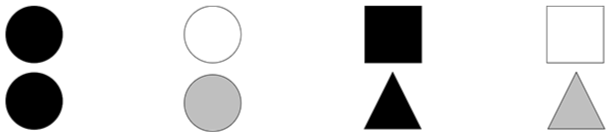
And now a card is randomly drawn from these cards. It is not true that “the card is round or black or both”. Please answer the following questions based on the information above:
Is this card (necessarily, possibly, impossibly) round and black?
Is this card (necessarily, possibly, impossibly) round and non-black?
Is this card (necessarily, possibly, impossibly) non-round and black?
Is this card (necessarily, possibly, impossibly) non-round and non-black?
The C-NTS questionnaire had the same pictures and the same four questions as the NC-NTS questionnaire, and the following conversational context: Bob randomly picked a card from these cards, and asked Jerry to guess the color and shape of the card. Jerry said, “The card is round or black or both.”
Based on the fact, Bob considered that Jerry’s statement was not true.
Please answer the following questions based on the information above.
The DS questionnaire had the same pictures and the same four questions as C-NTS questionnaire, and the following conversational context: Jack randomly picked a card from these cards, and asked Tom to guess the color and shape of the card. Tom said, “The card is round or black or both.”
Based on the fact, Jack denied “this ball is blue or plastic or both.”
Please answer the following questions based on the information above.
The theoretical predictions for Experiment 2 were similar to those in Experiment 1.
Procedure
The procedure was identical to that in Experiment 1.
Results
The results of the four cases are shown in Figure 3. The results of response patterns are shown in Table 2. Participants showed individual differences in both possibility judgments and response patterns. In Table 2, participants still showed poor performances in terms of using the global negation strategy. The comparison of Tables 2 and 1 showed that pictorial scenarios did not improve participants’ performances, compared to verbal scenarios.
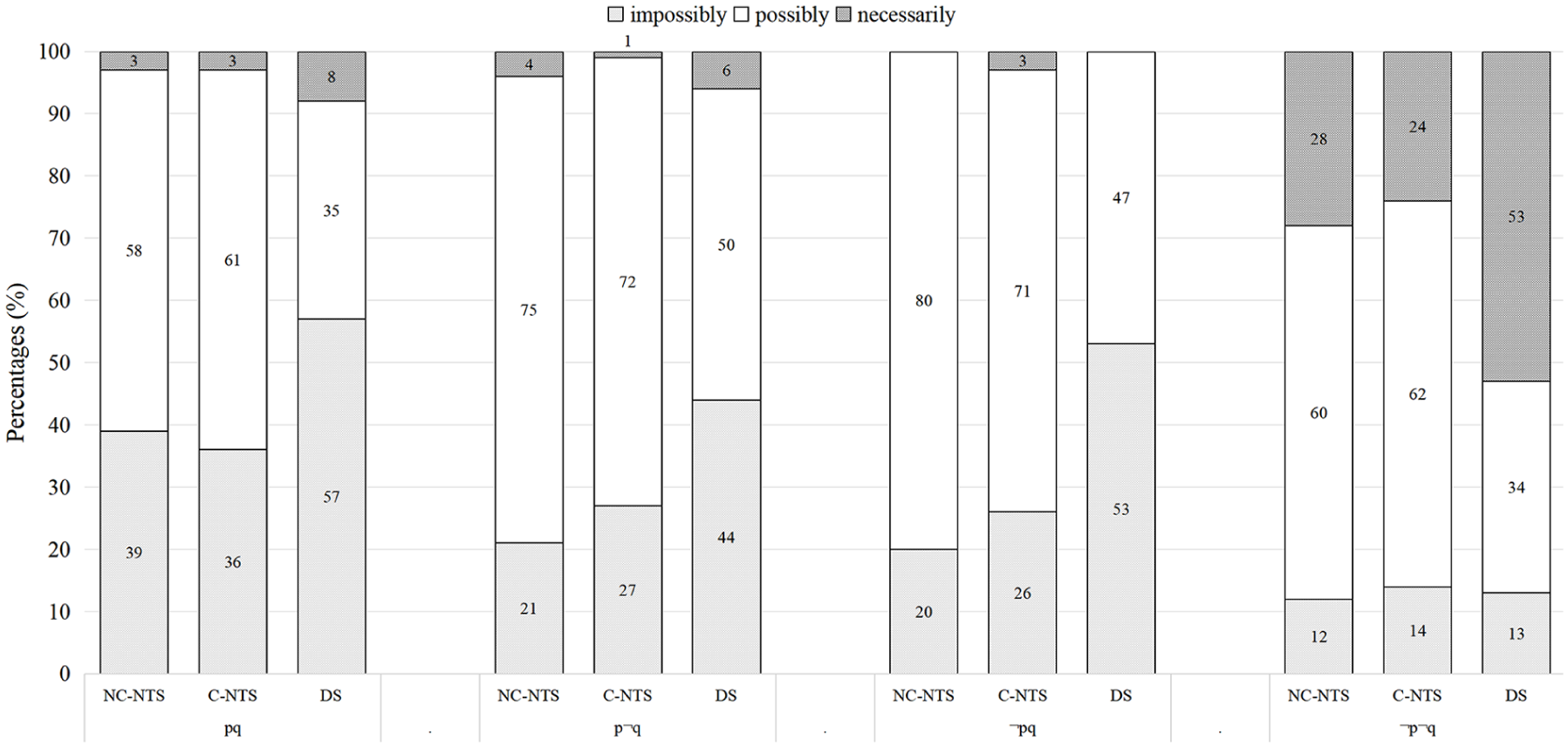
Possibility judgments (percentages) for individual cases in Experiment 2.
Response patterns (percentages) of possible judgments in Experiment 2.
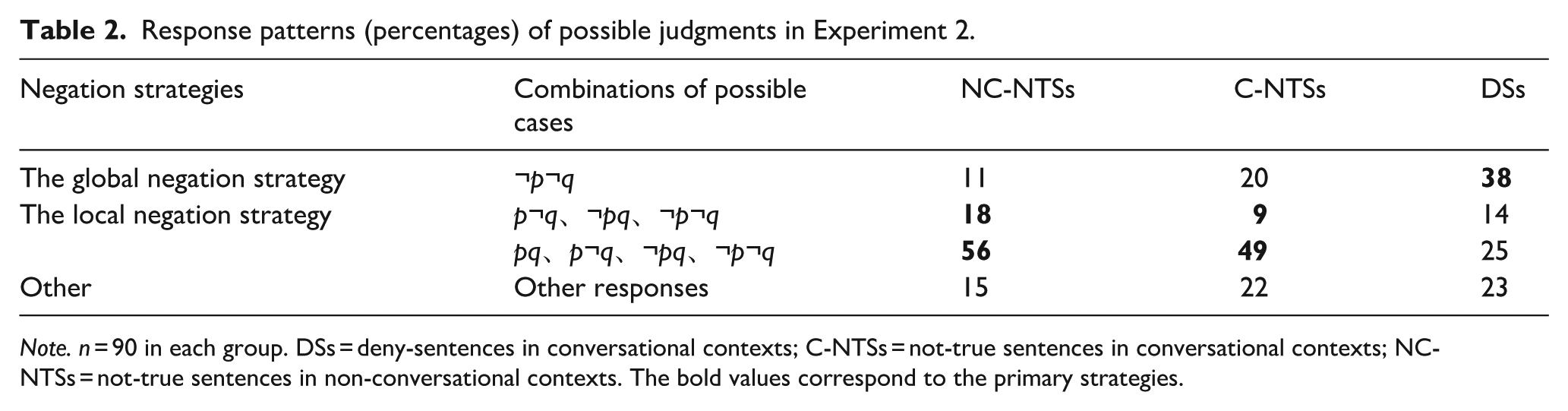
Note. n = 90 in each group. DSs = deny-sentences in conversational contexts; C-NTSs = not-true sentences in conversational contexts; NC-NTSs = not-true sentences in non-conversational contexts. The bold values correspond to the primary strategies.
We used the same statistical analyses as in Experiment 1.
Expression form of negation
We first conducted a Mann–Whitney test on the between-group difference in each case. Modal beliefs in cases pq were significantly stronger in the C-NTS group than in the DS group (Mann–Whitney U = 3,339.5, p = .022 < .05, r = .24). The majority of the DS group judged pq as impossible, while the majority of the C-NTS group judged it as possible. Compared to the DS group, the C-NTS group showed marginally significantly stronger modal beliefs for cases p¬q (Mann–Whitney U = 3,470, p = .052, r = .20) and significantly stronger modal beliefs for cases ¬pq (Mann–Whitney U = 2,862, p < .001, r = .42). Finally, modal beliefs in cases ¬p¬q were significantly weaker in the C-NTS group than in the DS group (Mann–Whitney U = 5,085, p = .001 < .05, r = .34). Cases ¬p¬q were more often judged as necessary in the DS group, but as possible in the C-NTS group. Modal beliefs in each of the cases pq, p¬q, and ¬pq were stronger in the C-NTS group than in the DS group, indicating that the C-NTS group more often used the local negation strategy. Modal beliefs in cases ¬p¬q were stronger in the DS group than in the C-NTS group, indicating that the DS group more often used the global negation strategy. Overall, the effect of expression form of negation on modal beliefs in each case was significant, as predicted by only SNSA.
We conducted a chi-square test of independence on the differences in primary response patterns. The results showed that response patterns reflecting the local negation strategy were significantly more frequent in C-NTSs (58%) than in DSs (39%) (χ2(1) = 6.429, p = .011 < .05, ϕ = .189), while response patterns reflecting the global negation strategy were significantly higher in DSs than in C-NTSs (χ2(1) = 6.923, p = .009 < .05, ϕ = .196). Thus, participants more often used the local negation strategy for C-NTSs, but more often used the global negation strategy for DSs. Expression form of negation significantly affected the participants’ response patterns, as predicted by only SNSA.
Overall, expression form of negation significantly influenced participants’ negation strategies: C-NTSs more often elicited the local negation strategy, while DSs more often elicited the global negation strategy. Experiment 2 using pictural scenarios replicated the effect of Expression form of negation in Experiment 1 using verbal scenarios.
Pragmatic contexts of NTSs
For each of the four cases, modal beliefs showed no significant differences between the two NTS groups (for pq, Mann–Whitney U = 4,180.5, p > .05, r = .04; for p¬q, Mann–Whitney U = 3,728.5, p > .05, r = .12; for p¬q, Mann–Whitney U = 3,933, p > .05, r = .05; for ¬p¬q, Mann–Whitney U = 3,866.5, p > .05, r = .06). The effect of pragmatic contexts of NTSs was not significant. Both NTS groups primarily used the local negation strategy.
Response patterns reflecting the global negation strategy did not differ between the two NTS groups (χ2(1) = 2.707, p > .05, ϕ = .123). Although response patterns reflecting the local negation strategy were significantly more frequent in NC-NTSs (74%) than in C-NTSs (58%) (χ2(1) = 4.500, p = .034 < .05, ϕ = .150), the primary strategy was the local negation strategy for both groups. Overall, pragmatic contexts of NTSs did not affect primary response patterns, with both NTS groups showing the primary response patterns indicating the local negation strategy.
In summary, in pictural scenarios, the reading of external negated disjunctions also varied with expression form of negation, as favoring SNSA over the other accounts. For NTSs, the reading of NTSs showed the same semantics across conversational and non-conversational contexts. Experiment 2 using pictural scenarios replicated the findings in Experiment 1 using abstract verbal scenarios.
General discussion
Experiments 1 and 2 investigated the influences of expression form of negation and pragmatic contexts of NTSs on possibility judgments under external negated disjunctions in verbal and pictural scenarios, respectively. Pictural scenarios did not improve participants’ performances in terms of using the global negation strategy, compared to verbal scenarios. Thus, the possibility reading of external negated disjunctions was stable across verbal and pictorial scenarios.
Both experiments revealed the effect of expression form of negation that DSs more often elicited the global negation strategy indicating the neither interpretation, while NTSs more often elicited the local negation strategy regardless of pragmatic contexts. In both experiments, pragmatic contexts of NTSs did not affect possibility judgments and negation strategies. Thus, the semantic reading of NTSs is stable across conversational and non-conversational contexts. Overall, the reading difference between conversational DSs and NTSs shows that both have different inherent semantics. DSs are more likely to mean global negations, while NTSs are more likely to mean local negations.
These results confirm only the predictions of SNSA: expression form of negation influences negation strategies, thereby affecting possibility judgments. For DSs, people tend to use the strong global negation strategy, and so judge only ¬p¬q possible. For NTSs, regardless of pragmatic contexts, people tend to use the weak local negation strategy, and so judge p¬q, ¬pq, and ¬p¬q as possible. In summary, expression form of negating disjunctions affects the semantic reading of negated disjunctions. This is beyond MMT and PSCA, both of which predict that expression form makes no difference to the reading of external negated disjunctions.
In both experiments, participants showed individual differences in both possibility judgments and response patterns, and poor performances in terms of using the global negation strategy indicating the neither interpretation of external negated disjunctions. These findings show that even for external negated disjunctions, external negations fail to completely take scope over disjunctions, and scope of negation is still ambiguous. This aligns with the general view that scope of negation is ambiguous in many natural languages, including English (Horn & Wansing, 2021).
In the present two experiments, for most participants, a NTS implies the three possibilities of p¬q, ¬pq, and ¬p¬q. Similarly, previous studies have found that the set of possibilities generated by most participants for a NTS also included these three possibilities (Yin et al., 2021). The similarity suggests that people generally interpret a NTS as containing these three possibilities. This interpretation is consistent with the finding that most participants read It is not true that p or q as Not p or Not q (Macbeth et al., 2013, 2014), because the latter reading also implies the three possibilities. Overall, these studies on NTSs provide the converging evidence that a NTS more frequently implies the three possibilities, indicating the local negation strategy. This interpretation disfavors the complement account of MMT that a NTS implies only the possibility of ¬p¬q.
In the present two experiments in Chinese, a DS more often implies that only ¬p¬q is possible, while the other three cases are impossible. This is similar to the finding in Experiment 1 by Khemlani et al. (2014). These studies show a similar primary response pattern indicating the reading that a DS more often implies only the possibility of ¬p¬q. This reading was reliable across both Chinese and English studies. The two experiments provide the convergent evidence that a DS more often implies only the possibility of ¬p¬q, indicating the global negation strategy.
The difference between the above readings of NTS and DSs demonstrates that the effect of expression form of negation is reliable. Overall, NTSs and DSs tend to elicit the different readings and the different negation strategies, and so there is no unified mechanism of negating disjunctions with different expressions. This refutes MMT’s unified explanation of negation: the complement account.
The complement account of MMT seems to be applicable to DSs, but not NTS. However, in the present experiments, even for DSs, there were obvious individual differences: some judged only ¬p¬q as possible, as predicted by both the complement account and the global negation strategy; while others judged p¬q, ¬pq, and ¬p¬q all as possible, as predicted by the local negation strategy. In DSs, no more than half of the participants showed the response pattern predicted by the complement account, and so the complement interpretation of DSs failed to dominate the reading of DSs.
Moreover, the global negation strategy is more feasible than the complement account for the reading of DSs. According to the complement account (Khemlani et al., 2012, p. 551), people need to first construct the set of the three possibilities allowed by the unnegated disjunction, and then construct the complement of the set. This process requires individuals to first hold the three possibility models in working memory and then calculate the possibilities in the complement. This process increases working memory load. In contrast, according to the global negation strategy, people judge whether a case is possible or impossible by examining whether the case negates all the explicit disjuncts in the disjunction. If so, then they judge it possible. This direct process does not require storing any mental models in working memory, and so is more economical. According to García-Madruga et al. (2011), the use of strategies in cognition and reasoning is based on the cognitive-economy principle: Strategies are aimed at satisfying a goal in the simplest, quickest, and most economical way possible (p. 577). Therefore, in the possibility judgment, task people should prefer the simpler and more economic global negation strategy over the complex complement calculation that demands heavy working memory load.
The small scope interpretation of negation (Khemlani et al., 2012; Macbeth et al., 2013, 2014) of MMT fails to explain the predominant possibility judgments of NC-NTSs in the current experiments either. The small scope negation principle aims to reduce the number of mental models. For the negated disjunction, reducing the number of mental models has two alternative interpretations. One is that compared to the complementary set predicted by MMT (only one possibility), the number of actual models should be reduced to zero after negating the disjunction, meaning all the four cases are impossible. The other is that compared to the models before negating the disjunction (three possible models), the number of actual models after the negation should be reduced to less than or equal to two, meaning not more than two out of the four cases are possible. However, for NC-NTSs in the present experiment, none of the participants in Experiment 1 and only 7% of participants in Experiment 2 judged all four cases as impossible, disfavoring the first interpretation. And 66% of participants in Experiment 1 and 77% of participants in Experiment 2 gave more than two possibilities, disfavoring the second interpretation. Thus, regardless of which interpretation is adopted, most possibility judgments of NC-NTSs do not support the small scope negation. Similarly, the small scope interpretation of negation also fails to explain the predominant possibility judgments of C-NTSs.
In Experiments 1 and 2, for both NC-NTSs and N-NTSs where negation explicitly takes scope over disjunction, the minorities of participants used the global negation strategy with the neither reading neither p nor q, while the majorities of participants didn’t show the neither reading predicted by PSCA. This finding shows that external negation did not yield good performances. These results imply that scope relations between disjunctions and negations alone fail to determine the reading of negated disjunctions. The predominant response patterns (indicating the local negation strategy) of NTSs favor the linguistic view that the negation of a statement means some alternatives to the statement (Capuano et al., 2023; Gotzner & Romoli, 2022; Repp & Spalek, 2021), but not the PSCA hypothesis that the external negation of a Chinese disjunction (p or q) can cancel the polarity sensitivity of the disjunction, such that Mandarin-speaking children and adults both read the negated disjunction as the neither interpretation Not-p and Not-q (Huang et al., 2020).
In Experiments 1 and 2, even in DSs being favorable for the global negation strategy with the neither interpretation, the proportions of judging only ¬p¬q as possible were 50% and 38% respectively. These responses were the primary responses favoring the neither interpretation predicted by PSCA. These proportions are less than the proportion (more than 70%) of choosing an instance being “neither A nor B” (e.g., A card with an elephant picture printed on it) as matching the English internal negated disjunction (not A or B) (e.g., which card doesn’t have a cat or a dog?) in Jasbi et al. (2023) and the proportion (more than 90%) of judging a Spanish internal negated disjunction (not A or B) (e.g., The triangle is not yellow or blue) as matching an instance being “neither A nor B” (e.g.,  ) in Lobina et al. (2023). This performance difference may be due to the task difference between the present possibility judgment tasks and the factual match tasks in their study. The factual match tasks asked participants to judge whether an instance match an internal negated disjunction or whether an internal negated disjunction match an instance. These tasks didn’t examine modal inferences from internal negated disjunctions, and so there is no contradiction between the present finding and their findings. For modal inferences, a negated disjunction may allow some possibilities other than the possibility of ¬p¬q, because even ¬p¬q is the case, this is unable to rule out the other alternative possibilities. Thus, it is plausible that for negated disjunctions, modal inferences allow less global negations (neither p nor q) than factual matches. Moreover, the above performance difference may also be due to the difference between external and internal negations of disjunctions. This direction is worthy of future investigation.
For external negated disjunctions, the effect of expression form of negation occurs within the same language. This shows that in the same language, the reading of negated disjunctions is relative, varying with expression forms. The effect of expression form of negation parallels the effect of prosodic focus on the reading of internal negated disjunctions in French: When prosodic stress is placed on the disjunction “A or B” (“ou” in French), it induces more children to read “not A or B” as “not A or not B” compared to the neutral intonation condition (Larralde et al., 2021). The latter is the effect of prosodic forms, while the former is the effect of wording forms. This similarity suggests that linguistic forms modulate the reading of negated disjunctions.
Moreover, the reading of negated disjunctions in the same language also varies with the natures of tasks, as is suggested by the performance difference between the equivalence judgment tasks and the factual match tasks about Spanish negated disjunctions (Lobina et al., 2023; Macbeth et al., 2013, 2014). In the equivalence judgment tasks used by Macbeth et al., about one half of participants considered a Spanish external negated disjunction Not (p or q) as being equivalent to Not-p or Not-q, and less than one third of participants considered it as being equivalent to the normal answer Not-p and Not-q (that is, neither p nor q). In contrast, in the factual match tasks used by Lobina et al., more than 70% of participants affirmed the match between a Spanish internal negated disjunction not A or B and an instance fitting the description Not A and Not B. For Spanish negated disjunctions, the factual match tasks with internal negations yielded more normal responses than the equivalence judgment tasks with external negations. Thus, the reading of negated disjunctions in the same language may vary with the natures of tasks and type of negation (internal versus external negation), and so is relative.
Overall, within the same language, the reading of negated disjunctions is relative, varying with both linguistic forms of negation and natures of tasks. This relativity is an extension to the cross-linguistic relativity of reading internal negated disjunctions by the Disjunction Parameter account (Goro, 2024; Pagliarini et al., 2018; Szabolcsi, 2004). Our research demonstrates the within-linguistic relativity of reading external negated disjunctions different from the cross-linguistic relativity of reading internal negated disjunctions. Moreover, according to Nieuwland & Kuperberg (2008) and Lobina et al. (2023), pragmatic and semantic factors, tasks (comprehension versus reasoning tasks) can affect the reading of negated disjunctions. Finally, we can conclude that the reading of negated disjunctions is relative, varying with various factors including cross-linguistic factors such as the disjunction parameter, and within-linguistic factors such as linguistic forms, natures of tasks, internal versus external negations, pragmatic and semantic factors. The complex interplay of so many factors implies that there is no unified mechanism for reading negated disjunctions. How these factors jointly affect the reading of negated disjunctions needs further investigation in the future.
Conclusion
This study, for the first time, investigated the influence of the expression difference between Chinese NTSs and DSs on possibility judgments of external negated disjunctions. The present experiments revealed that Chinese NTSs and DSs showed different semantic readings, and the semantics of NTSs is stable across conversational and non-conversational contexts. DSs in conversational contexts are more likely to mean global negations. In conversational and non-conversational contexts, NTSs are more likely to mean local negations. The effect of expression form of negation favors SNSA over the other alternative accounts, and its conjunction with individual differences in negation strategies suggests that in linguistics and psychology, there seems to be no unified mental mechanism of the reading of external negated disjunctions with different expression forms.
Footnotes
Declaration of conflicting interests
The authors declared no potential conflicts of interest with respect to the research, authorship, and/or publication of this article.
Funding
The authors received no financial support for the research, authorship, and/or publication of this article.
Ethical approval
The present two experiments received ethical approval from the Shaanxi Normal University Human Research Ethics Committee.
Informed consent
All the participants provided written informed consent. There is no material from other sources.
