







Abstract
The role of attention in three distinct forms of numerical processing (i.e., subitizing, estimation, and counting) has been extensively studied. However, the similarities and differences in the impacts of top-down and bottom-up attention on these three processes remain poorly understood. This gap raises key theoretical questions: Do individuals adopt a uniform cognitive strategy (i.e., a static strategy) across forms of numerical processing and types of attentional modulation? Do they dynamically adjust accuracy and/or precision for varying forms of numerical processing and/or different types of attentional modulation (i.e., a dynamic strategy)? Or do they exhibit greater flexibility by combining these two strategies, depending on specific effects of attentional modulation on numerical processing? Using a novel paradigm that incorporates counting with continuous attentional consumption, we identified a combination of static and dynamic strategies: A greater reliance on attention for processing precision of small numerosities is ubiquitous across numerical processing forms and attentional modulation types. However, an attention-driven transition effect occurs exclusively across forms of numerical processing, not types of attentional modulation. Additionally, attention modulation on central tendency effect differs across numerical processing forms and attentional modulation types. These results highlight the dynamic nature and flexibility of attentional modulation on numerical processing.
Introduction
Numerical processing is of great significance to human survival and adaptation (Dehaene, 1997; Feigenson et al., 2004). When target stimuli are presented simultaneously and the number of objects in the stimulus set is small (typically less than 4), we can rapidly and accurately determine the numerosity of the set, a phenomenon known as subitizing (Kaufman et al., 1949). However, as the number of objects increases (equal to or greater than 4), two distinct forms of numerical processing may occur. In situations where the presentation time is very brief and serial counting 1 is not feasible, participants tend to make a holistic evaluation of the set’s cardinality, referred to as estimation 2 (Whalen et al., 1999). Estimation is believed to rely on an approximate numerical system (ANS) that represents numbers analogically and approximately (Dehaene, 1997; Tobias, 1967). Conversely, when the presentation time of the stimuli is sufficiently long, numerical stimuli trigger serial counting (or counting as a shorthand in this study), which depends on vocal or subvocal verbal processing and symbolic operations (Choo et al., 2014; Cutini et al., 2014; Logie & Baddeley, 1987). A considerable amount of research has examined the role of attention in subitizing (J. Chen et al., 2022; Eayrs & Lavie, 2021; Olivers & Watson, 2008), estimation (Vetter et al., 2008), and counting (Logie & Baddeley, 1987). However, there is currently a dearth of research investigating and comparing the attention modulation of these three processes simultaneously.
The human cognitive system is continually challenged by information overload from both external and internal sources. Consequently, selective and filtering processes—mediated through top-down and bottom-up attentional mechanisms (see details below)—are critical for optimizing cognitive task efficiency, including numerical processing across different ranges (e.g., subitizing, estimation, and counting). The lack of research directly comparing the impacts of both top-down and bottom-up attention on these three processes simultaneously raises key theoretical questions: Do individuals adopt a uniform cognitive strategy (i.e., a static strategy) across forms of numerical processing and types of attentional modulation? Do they dynamically adjust the accuracy and/or precision of numerical processing in response to varying forms of numerical processing and/or different types of attentional modulation (i.e., a dynamic strategy)? Or do they exhibit greater flexibility by combining these two strategies, depending on specific effects of attentional modulation on numerical processing?
The present study addresses these questions by investigating whether attentional modulation effects observed in one form of numerical processing or one type of attentional modulation can be generalized to another. To this end, we developed a novel paradigm incorporating continuous attentional consumption into counting (see details below). Our exploration to these theoretical questions is particularly pertinent in light of previous findings demonstrating that numerical processing is not strictly rigid and can exert a transition from one form to another (e.g., from subitizing to estimation, Hyde & Wood, 2011) under specific attention modulations. Therefore, a comprehensive investigation of these theoretical questions is both logical and necessary.
Two Types of Attention Modulations
The mechanisms of subitizing (Olivers & Watson, 2008), estimation (Vetter et al., 2008), and counting (Logie & Baddeley, 1987) are strongly connected to attention modulation. However, an important question arises as to what type of attention modulation is important. According to the biased competition theory of selective attention (Desimone & Duncan, 1995), there are two types of attention modulations: bottom-up one, also known as attentional load (Lavie, 2005; Lavie et al., 2004), and top-down one, also known as attentional allocation (Coull et al., 2004). Bottom-up attention is primarily determined by the characteristics of the stimulus (Lavie, 2005, such as category, orientation, color, and position). It focuses on how the stimulus influences an individual’s choice of information and is also referred to as stimulus-driven attention. The extent of stimulus-driven attentional modulation varies with perceptual load. In single-task scenarios, attention to a relevant task can be automatically disrupted or not, depending on the presence (yes load) or absence (no load) of a task-irrelevant, abrupt stimulus (Eayrs & Lavie, 2021). Similarly, in dual-task paradigms, attention to a primary task can be involuntarily diverted by a secondary detection task, with the degree of interference varying based on whether the target is defined by a single feature (low load) or a conjunction of features (high load; Anobile, Cicchini, & Burr, 2012; Vetter et al., 2008; present study, see below). On the other hand, top-down attention is mainly determined by task goals and individual expectations (Coull et al., 2004), including current goals, expectations of stimulus locations and presentation time, individual prior knowledge, and experience. It emphasizes what information individuals choose to process, known as the target set in the mind, and is also called goal-oriented attention.
The Attention-Reliance for Processing Precision of Small and Large Numerosities
There is little debate regarding whether serial counting necessitates spatial attention (Choo et al., 2014; Cutini et al., 2014; Logie & Baddeley, 1987). Throughout the counting process, participants must continuously shift their focus of attention, grouping and marking the targets one by one. Moreover, as a sequential task, counting may suffer from the cost of serially chaining two cognitive operations (Fan et al., 2012; Fan et al., 2011). Consequently, attention modulation appears to be a crucial factor for the successful execution of serial counting. In contrast, a long-standing debate revolves around whether subitizing or estimation requires attentional resources. In a seminal paper, Trick and Pylyshyn (1994) proposed that subitizing represents a mechanism for individuating multiple objects simultaneously, operating at a pre-attentional stage. In this sense, subitizing occurs prior to the engagement of attention and remains independent of attention modulation (Trick & Pylyshyn, 1993, 1994).
However, some research has challenged this traditional view. Vetter et al. (2008) investigated the roles of attention in subitizing and estimation and discovered that manipulating attentional load could impact the processing precision of both subitizing and estimation (Vetter et al., 2008). Consequently, the authors put forth a perspective suggesting the existence of a single, attention-demanding enumeration mechanism, that is, attention-reliance for both small and large numerosities.
In addition, several studies have demonstrated that subitizing may require more attention than estimation. For instance, Olivers and Watson (2008) employed rapid serial visual presentation for an enumeration task and indicated that subitizing also necessitates attentional resources. Similarly, Burr et al. (2010) manipulated attentional load and assessed the accuracy and precision of an enumeration task. Their results revealed that the precision differences between small and large numerosities were only evident under low attentional load but disappeared under high attentional load. These findings suggest that subitizing and estimation may involve distinct mechanisms, with subitizing requiring more attentional resources.
Though previous research has shown that the processing precision of subitizing is more reliant on attention than estimation, this conclusion is constrained by the exclusive focus on bottom-up attention. It remains uncertain whether comparable effects can be observed with top-down attention modulation. Similarly, there is currently no research directly comparing how bottom-up and top-down attentional modulations may differ in a distinct form of numerical processing beyond subitizing and estimation, specifically counting, which relies on sequential processing and focal attention.
The Attention-Driven Transition from Subitizing to Estimation
The role of attention in numerical processing is further complicated by a study (Hyde & Wood, 2011) that demonstrated the significance of spatial resolution of attention in determining whether numerical processing takes the form of subitizing or estimation. According to this study, subitizing occurs when attentional resources are abundant and individual objects can be selected, while estimation occurs when attention is occupied by another task and individual objects cannot be selected, even for the same small numerosities. The findings of this study, particularly the attention-driven transition from subitizing to estimation, are consistent with two other studies (Anobile, Cicchini, & Burr, 2012; Burr et al., 2010) that indicated the precision of small numerosities becomes similar to that of large numerosities under high attentional load. However, it remains unclear and requires further investigation whether the attention-driven transition effect is specific to the form of subitizing to estimation only or if it can occur across forms of numerical processing, such as from counting to estimation.
Attentional Load and Central Tendency Effect
Some studies (Anobile, Turi, Cicchini, & Burr, 2012) have also highlighted the attention modulation of numerical processing from the perspective of context-induced response bias, specifically the central tendency effect. Here, central tendency (or regression to the mean) refers to a bias in which stimuli are prone to being misperceived, leaning toward the mean of the distribution. Central tendency has been extensively studied for over a century (Hollingworth, 1910) and is widely observed across various sensory systems and perceptual attributes, such as numerosity, size, duration, and speed (Anobile et al., 2019). The typical signature of this bias is an overestimation of small stimuli and an underestimation of large ones (Vetter et al., 2008). In tasks of number-line mapping, central tendency effect led to a non-linear, logarithmic-like number line (Anobile, Cicchini, & Burr, 2012).
Anobile, Cicchini, and Burr (2012) modelled the central tendency effect within the Bayesian framework, where the mean across all experienced numbers is considered a prior. What they found is that the central tendency effect, that is, the reliance on the prior, is systematically modulated by the extent of how attention is deprived. Specifically, increased attentional load decreased the relative reliability (reciprocal variance) of the current sensory data, thus boosting the processing weight given to the prior. This led to a higher central tendency effect under attentional load. Their framework reinforced the connection between the representation of numerical information and the requirement of attentional resources.
Similarly, in a typical enumeration task, Vetter et al. (2008) demonstrated an overestimation of low numerosities and an underestimation of high numerosities. This central tendency effect was found to be more pronounced with an increase in bottom-up attentional load (Vetter et al., 2008). However, these studies exclusively focused on bottom-up attention and solely examined the central tendency effect in subitizing and estimation, while leaving the investigation of top-down attention and counting untouched. Therefore, it would be intriguing to further investigate how both bottom-up and top-down attention modulate the central tendency effect in various forms of numerical processing, including subitizing, estimation, and counting.
Goals of the Present Study
To the best of our knowledge, no study has yet compared the effects of top-down and bottom-up attention modulations on subitizing, estimation, and counting simultaneously. While some studies have mentioned these three enumeration processes (Choo et al., 2014; Cutini et al., 2014), their discussions have been limited to theoretical aspects or pairwised comparisons only. Surprisingly, despite the significance of subitizing, estimation, and counting in numerical cognition, there is currently a lack of appropriate paradigms to simultaneously investigate attention modulations of these three processes. Additionally, while some researchers have utilized a target detection paradigm (Anobile, Cicchini, & Burr, 2012; Vetter et al., 2008) or an attentional blink paradigm (Burr et al., 2010; Olivers & Watson, 2008; Xu & Liu, 2008) to manipulate bottom-up attention on subitizing and estimation, there is a dearth of research investigating the attention modulation in enumeration from a top-down, goal-directly perspective. In this study, we have developed a novel paradigm called “counting with continuous target detection” and combined it with manipulations of “probability clue-based attentional allocation” (Coull et al., 2004) and “task difficulty-based attentional load” (Vetter et al., 2008) to explore top-down and bottom-up attention modulation of subitizing, estimation, and counting simultaneously.
The present study aims to investigate whether several attentional modulation effects, such as the greater reliance on attention for processing precision of small numerosities, the attention-driven transition effect and the central tendency effect, observed in one form of numerical processing (specifically in subitizing and estimation) or in one type of attention modulation (specifically in bottom-up attention), can be extrapolated into another form of numerical processing (such as counting) or another type of attention modulation (such as top-down attention).
Experiment 1
Experiment 1 employed a dual-task paradigm comprising an enumeration task and a target detection task. The enumeration task necessitated participants to report the quantity of a dot set, ranging from 1 to 8. The target detection task required participants to determine whether a target was presented in each trial, with the attentional load manipulated by the difficulty of target detection. To investigate the impact of bottom-up attentional load on non-symbolic numerical enumeration, the performance of the enumeration task was compared across different attentional load levels. Experiment 1a assessed subitizing and estimation, while Experiment 1b focused on counting.
Experiment 1a
Method
Participants
To obtain appropriate sample sizes, we conducted an a priori sample size calculation using GPower 3.1 (Faul et al., 2007). Assuming an alpha level of .05 and a power of .9, a minimum sample size of 20 was required to detect a medium effect size (f = .2) with sufficient power for both Experiments 1a and 1b (Analysis of variance (ANOVA), repeated-measures, within factors and sixteen measurements [2 attention levels * 8 numerosity levels]). Twenty-one students from Central China Normal University (CCNU) participated in Experiment 1a. The participants’ average age was 20.6 years (9 males), with a range of 18 to 24 years. All participants in this and subsequent experiments were right-handed and had normal or corrected-to-normal vision. Each participant provided signed consent in accordance with the requirements of the Institutional Review Board of CCNU.
Stimuli and Procedure
Stimuli in this and subsequent experiments were presented on a 19-inch cathode-ray tube (CRT) monitor (IIYAMA HM903DT, iiyama Co., Ltd. Tokyo, Japan) with a resolution of 1,024 × 768 pixels at a refresh rate of 100 Hz. The stimuli were generated using the Psychophysics Toolbox (Brainard, 1997; Pelli, 1997) implemented on MATLAB (MathWorks Inc., Natick, MA, USA.). The participants were seated in a quiet room, with their eyes positioned approximately 57 cm away from the computer screen.
Participants pressed any key to start a trial (see Figure 1). After the black fixation (500–1,000 ms), the stimuli (including the target detection stimulus and the enumeration stimulus, presented within a 12° * 12° square region against a gray background) were presented for 200 ms, followed by a binary pixel noise mask covering the entire area of the stimuli (150 ms) to prevent visual persistence (Coltheart, 1980).
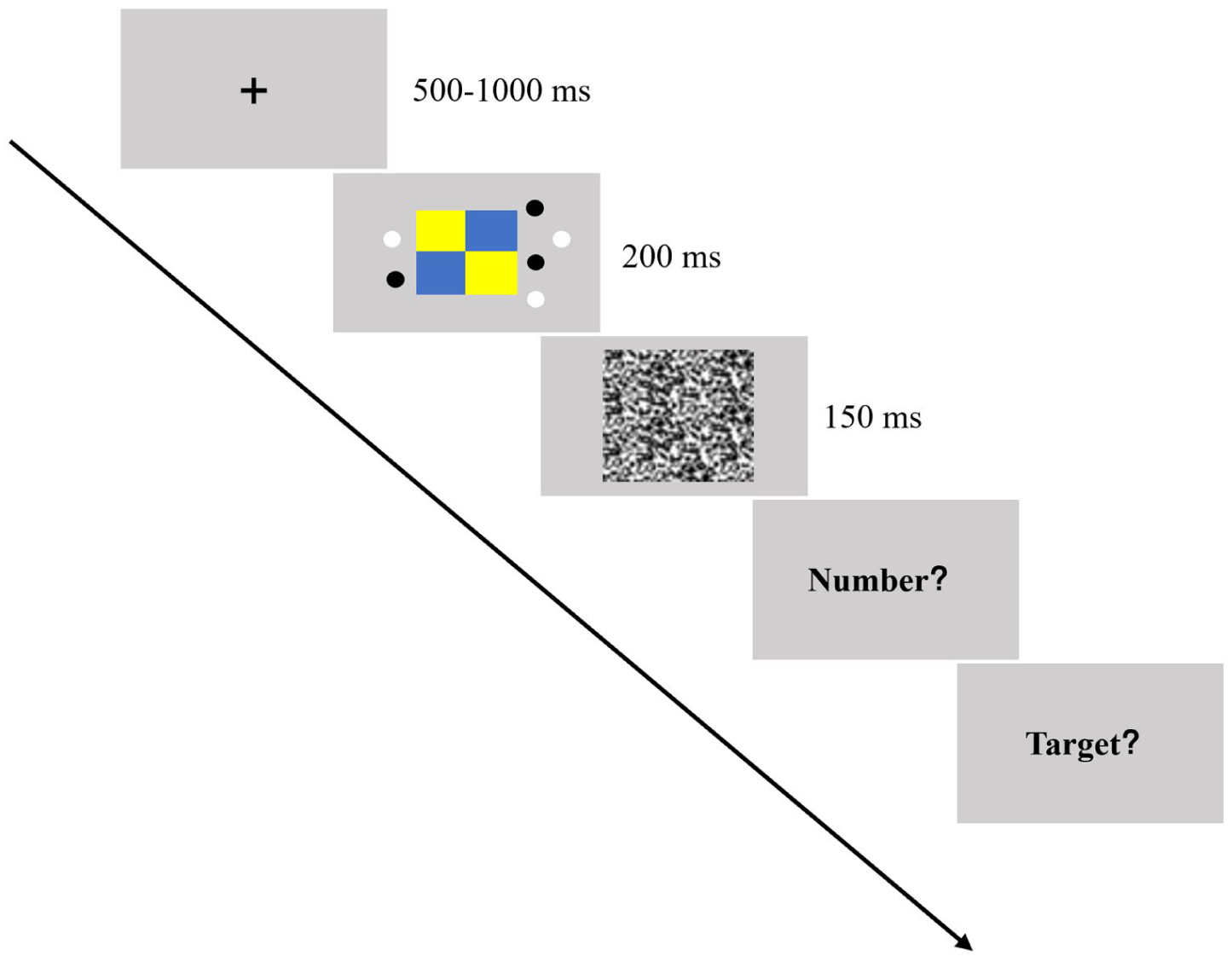
The trial sequence and exemplary stimuli used in Experiment 1a. A manipulation of “task difficulty-based attentional load” was employed as shown in the figure.
The target detection task was adapted from Vetter et al.’s (2008). The stimuli for target detection consisted of four centrally positioned colored squares (see Figure 2), with each square subtending 1.5° of visual angle. The color squares were centrally presented on the display, surrounded by enumeration stimuli, specifically, a set of dots. There were eight color combinations for the four squares, which determined whether the stimulus was a target or not. In the low attentional load conditions, the presence of red squares defined a target, regardless of the spatial arrangement of colors. In the high attentional load conditions, a specific conjunction of color and spatial arrangement defined a target: the target stimulus should contain two green squares along the right diagonal or two yellow squares along the left diagonal. The high attentional load conditions required participants to pay attention to both the color and spatial arrangement of the stimuli. This manipulation of “task difficulty-based attentional load” was employed in this experiment and subsequent Experiment 1b.
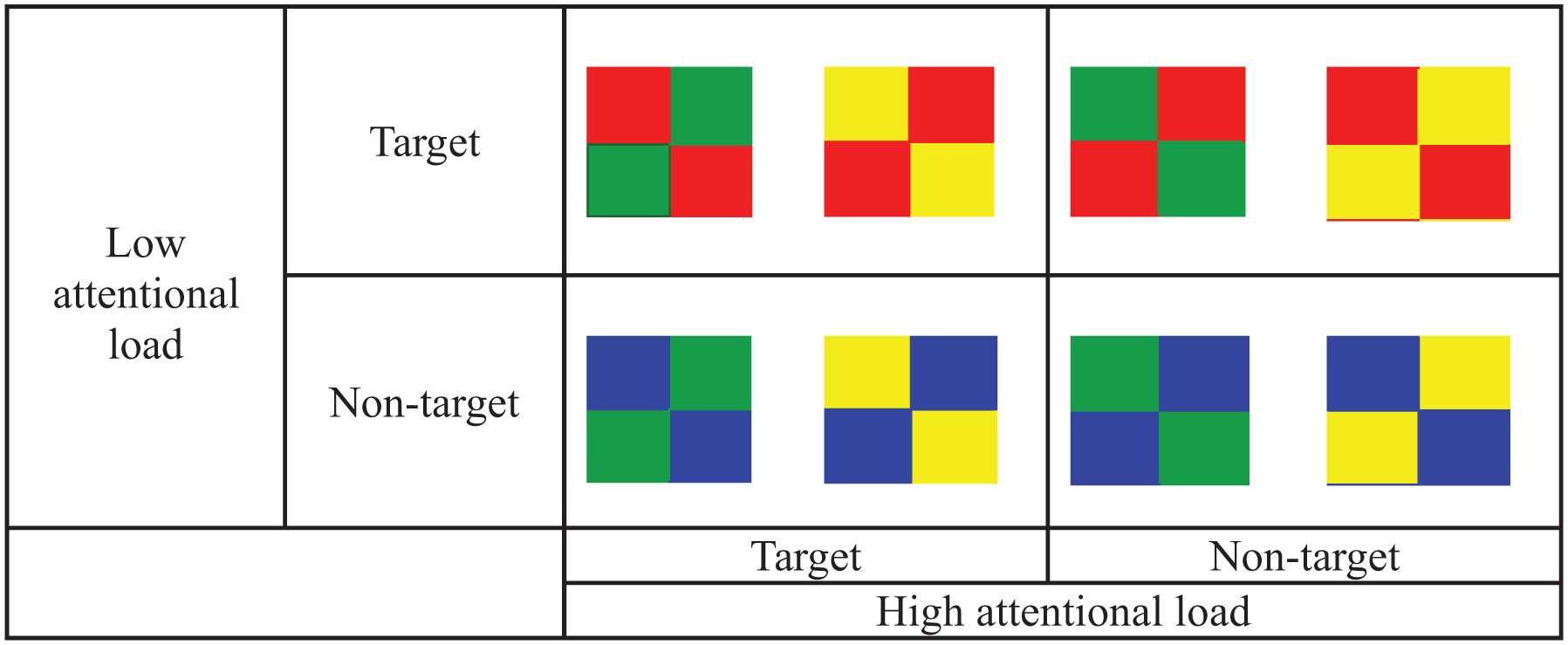
The stimuli used in the target detection task in Experiments 1a and 1b. Note that the target detection task in Experiments 2a and 2b exclusively utilized stimuli with a high attentional load.
The enumeration task closely resembled the paradigm extensively utilized in prior research (Burr et al., 2010; Shimomura & Kumada, 2011). The enumeration stimuli consisted of one to eight dots, each with a diameter of .42° of visual angle. The position of each dot was chosen randomly. The minimum distance between two dots was .84° of visual angle. Dots were half-white and half-black, so luminance was not a clue to the enumeration task. We used this approach in the current study by varying attentional load to numerical rather than non-numerical processing in a dual-task paradigm.
The participants were required to respond to the enumeration task first, then to the target detection task. In the enumeration task, participants were instructed to press the space key while verbally reporting the numerosity of the dots as quickly and accurately as possible. The target detection task involved pressing either the “F” or “J” keys to indicate the presence or absence of a target with no time limit. The assignment of keys was balanced, with half of the participants using “F” for target and “J” for non-target, and the other half the opposite configuration. Prior to the formal test, participants practiced each task separately and were only allowed to proceed to the formal test once they achieved 80% correctness. The formal test consisted of 4 blocks, totaling 512 trials (2 attention loads * 8 dot numbers * 32 repetitions). To confirm the reliability of the results of study, Bayes factor (BF10), calculated using JASP (Jeffreys’ s Amazing Statistics Program, University of Amsterdam, Netherlands, version 0.18), was also reported for t-tests and planned comparisons. BF10 quantifies the relative evidence for the alternative hypothesis (H1) relative to the null hypothesis (H0; Jeffreys, 1961; Wagenmakers et al., 2018; Wetzels et al., 2011). A BF10 > 3 indicates moderate support for H1, whereas a BF10 < .33 supports H0. Notably, in a few cases, discrepancies between frequentist (p-values) and Bayesian (BF10) results were observed, reflecting inconsistent evidence and highlighting the need for further investigation.
Results and Discussion
Manipulation of the Attentional Load
To verify effective manipulation of the attentional load, we conducted a 2 (task type) × 2 (attention load) repeated-measures ANOVA on the accuracy of the target detection task and the enumeration task. 3 The results showed that the main effect of attention load was significant (F[1, 20] = 50.227, p < .001, η2 p = .715): accuracy for both tasks were lower under the high-load condition compared to the low-load condition (see Figure 3A). Furthermore, the interaction between task type and attention load was not significant. This indicates that the manipulation of the attentional load was effective. The decline in target detection performance under high attentional load, relative to the low-load condition, was not attributable to a trade-off in which participants prioritized enumeration at the expense of target detection (Figure 3).
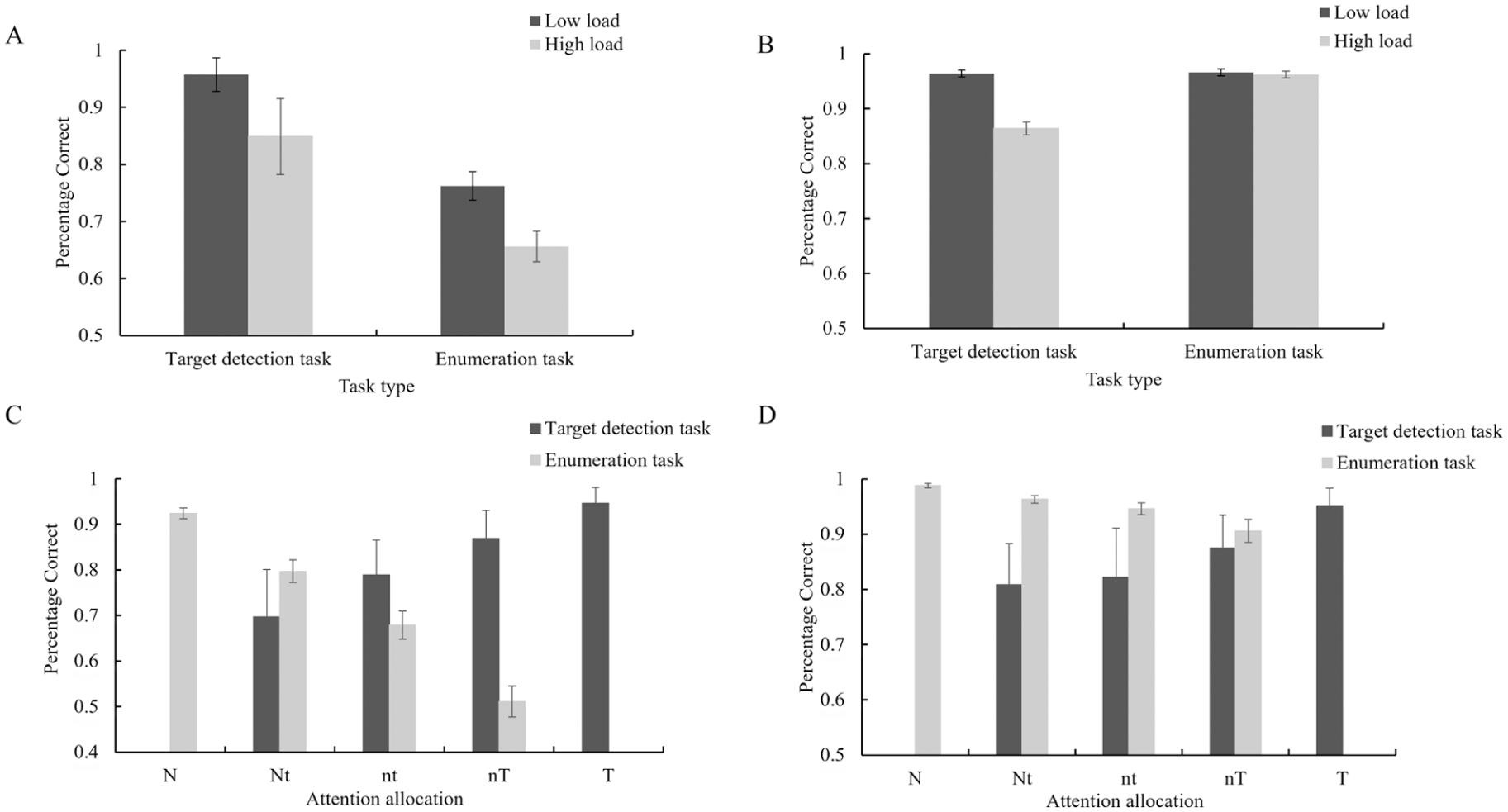
The percentage of correct responses for the target detection and enumeration tasks in Experiment 1a (A), Experiment 1b (B), Experiment 2a (C), and Experiment 2b (D). Error bars represent the standard errors of the means.
Enumeration Task
To ensure the efficacy of attentional load, only the trials with correct target detections were included in the analyses of enumeration performance in this and subsequent experiments. Four dependent variables, including percent error rate, average reaction time (RT), accuracy coefficient (AC), and variation coefficient (VC), were used to measure different aspects of enumeration performance. The AC was calculated as the mean difference between numerical responses and the objective magnitude, divided by the mean response. The VC was calculated as the standard deviation of numerical responses, divided by the mean response. The formulas for calculating AC and VC are provided below:
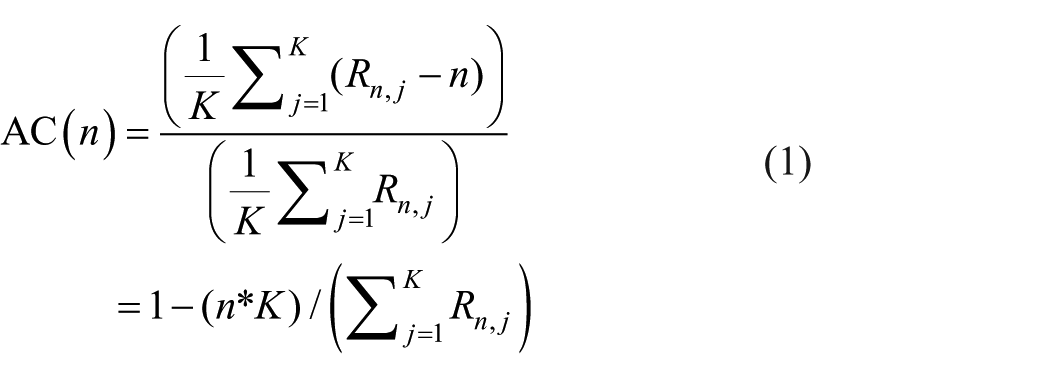
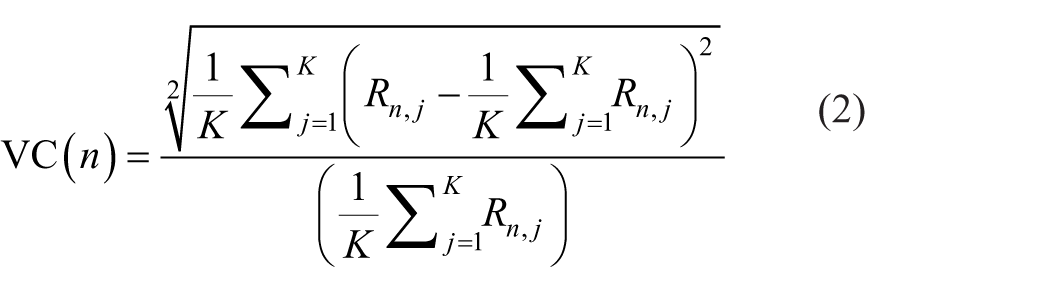
Here, n represents a numerosity level that requires both the AC (n) and the VC (n). K denotes the total number of trials conducted at a specific numerosity level, n.
ACs indicate the overall and relative bias/accuracy of underlying numerical processing, while VCs indicate the overall and relative precision of underlying numerical processing (Cheng et al., 2021; Izard & Dehaene, 2008; Revkin et al., 2008). A zero or near-zero AC indicates a bias-free response, whereas a zero or near-zero VC indicates the highest stability or repeatability of a response. The contributing factors to the percent error rate may include accuracy, precision, or combinations of them with different weights. Thus, the AC (representing accuracy) and VC (representing precision) provide different aspects about the numerical processing compared to the percent error rate and RT.
Error Rate
We conducted a repeated-measures ANOVA 4 with within-subject factors of attentional load (low vs. high) and dot number (1–8; see Figure 4A). The results revealed a significant main effect of attentional load (F[1, 20] = 16.812, p = .001, η2 p = .457) and dot number (F[3.491, 69.820] = 93.765, p < .001, η2 p = .824). Participants performed significantly better in the low attentional load conditions compared to the high attentional load conditions. As anticipated, the enumeration error rate increased with the dot number (all p < .05, BF10 > 10, except for 1 vs. 2 and 7 vs. 8). Additionally, there was a significant interaction between attentional load and dot number (F[4.064, 81.290] = 3.901, p = .006, η2 p = .163). Further analysis revealed that when the dot number was 2 (p = .196, BF10 = .496), 3 (p = .167, BF10 = .555), or 4 (p = .069, BF10 = 1.058), there was no significant difference in the enumeration error rate under varying attentional loads. However, in the remaining conditions, dot numbers 1 (p um.013, BF10 014.059), 5 (p .0.002, BF10 0016.729), 6 (p 6.014, BF10 013.857), 7 (p .8.002, BF10 0023.359), and 8 (p < .001, BF10 0094.646), the differences were all found to be statistically significant. These findings indicate that the impact of attentional load on the error rate primarily manifests in extremely small (dot number 1) and relatively large (dot numbers 5, 6, 7, and 8) numerosities.
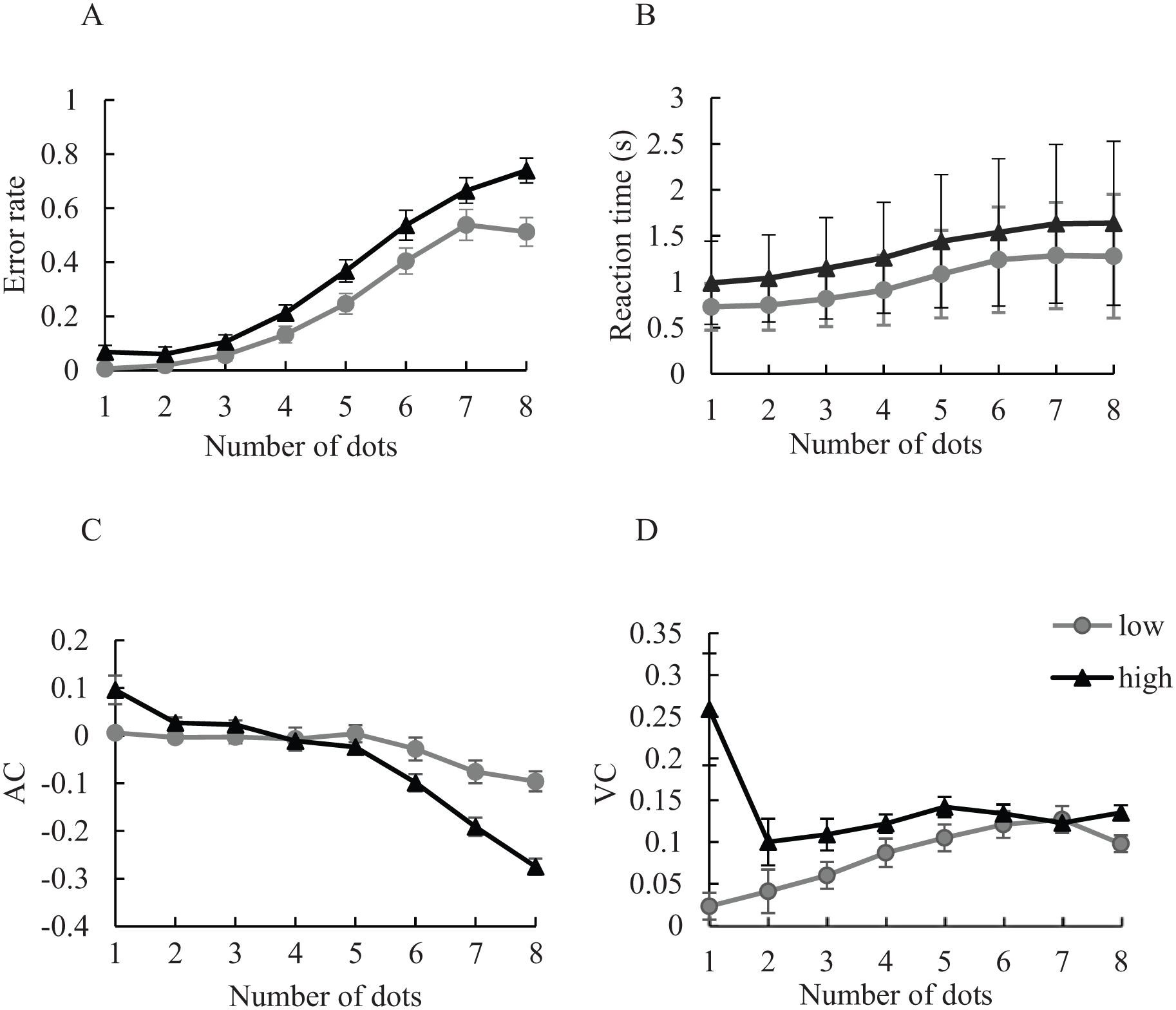
The error rate (A), the reaction time (B), the accuracy coefficient (C), and the variation coefficient (D) of the enumeration task in Experiment 1a. The low attentional load (gray) and high attentional load (black) conditions are presented separately. Error bars represent the standard errors of the means.
Reaction Time
As expected, the repeated-measures ANOVA revealed a significant main effect of attentional load (F[1, 20] = 24.595, p < .001, η2 p = .552). The RT was quicker under the low attentional load compared to the high attentional load (see Figure 4B). Additionally, the main effect of dot number was significant (F[1.378, 27.564] = 33.721, p < .001, η2 p = .628). The RT increased with the dot number (all p < .05, BF10 > 3, except for 1 vs. 2, 6 vs. 8, and 7 vs. 8). However, the two-way interaction was not significant (F[3.211, 64.230] = 2.349, p = .077). These results suggest that attentional load influences the RTs of both subitizing and estimation.
Accuracy Coefficient
A repeated-measures ANOVA revealed a significant main effect of dot number (F[1.546, 30.916] = 31.933, p < .001, η2p = .615). Post hoc analysis showed significant differences between dot 6 and all dot number levels, as well as between both 7 and 8 and all dot number levels (all p < .05, BF10 > 10). Additionally, the interaction effect between attentional load and dot number was also significant (F[1.710, 34.206] = 9.652, p = .001, η2 p = .326). Further analysis indicated that when the dot number was 4 (p = 0.894, BF10 = 0.229), 5 (p = .113, BF10 = .733), 6 (p = .099, BF10 = .808) or 7 (p = .064, BF10 = 1.125), there were no significant differences in AC between the high and low attentional loads. However, for dot numbers 1 (p = .008, BF10 = 6.316), 2 (p = .036, BF10 = 1.778), and 3 (p = .038, BF10 = 1.683), a high attentional load resulted in numerical overestimation compared to a low attentional load. Conversely, for dot numbers 8, a high attentional load led to numerical underestimation (p = .005, BF10 = 9.541) compared to a low attentional load. These findings suggest that the accuracy of the enumeration task is significantly influenced by attentional load, with contrasting response biases observed for small and large numerosities (see Figure 4C).
Variation Coefficient
A repeated-measures ANOVA revealed a significant main effect of attentional load (F[1, 20] = 13.221, p = .002, η2 p = .398). Additionally, there was a significant interaction between attentional load and dot number (F[2.045, 40.909] = 7.224, p = .002, η2 p = .265). Further analysis demonstrated that the VC in the high attentional load condition was higher for dot numbers 1 (p = .002, BF10 = 24.965) and 5 (p = .046, BF10 = 1.467), but lower for dot number 8 (p = .002, BF10 = 21.161), when compared to the low load condition. These findings echo the AC results, suggesting that attentional load has contrasting effects on the response precision of small and large numerosities (see Figure 4D).
To inspect the magnitude of attention load effect on different numerosity levels, we defined the attention load effect as VChigh_load − VClow_load. Then, we conducted a repeated measures ANOVA on the results of the attention load effect, revealing a significant main effect of dot number (F[7, 140] = 3.901, p = .001, η2 p = .163). Post hoc tests indicated significant differences between dot number level 1 and the other number levels (all p < .05, all BF10 > 3). Specifically, the VC of number 1 was significantly higher than the other number levels. At the same time, the VC for 6 was significantly lower than that for 8 (p = .048, BF10 = 1.416), while the VC for 7 was significantly lower than those for 4 (p = .016, BF10 = 3.415), 5 (p = .015, BF10 = 3.660) and 8 (p = .006, BF10 = 7.498). Furthermore, we combined 1 to 4 and 5 to 8 to calculate the attention load effect within small and large number ranges. A paired t-test showed that attention load had a greater impact on the precision of subitizing compared to estimation (t[20] = 2.823, p = .011, Cohen’s d = .738, BF10 = 4.846).
The results of Experiment 1a demonstrated two effects of attentional load on subitizing and estimation. First, the high attentional load inhibited the edge effect of enumeration, which was only present in the low attentional load condition. Here, the edge effect (Jazayeri & Shadlen, 2010; Poulton, 1973) refers to a response bias where participants tend to provide more accurate and precise reports for numerosities located at the lower and upper edges of a numerical range (e.g., dot numbers 1 and 8 in the present experiment) compared to neighboring numerosities within the numerical range. The origin of the edge effect stems from participants progressively acquiring knowledge of the actual numerical range after several trials, thereby enabling them to utilize this information as a reference for reporting extremely small and extremely large numerosities. The numerical performance of dot number 8 in Experiment 1a, as indicated by the error rate, AC, and VC, exhibited a distinct trend compared to neighboring numerosities, such as dot numbers 6 and 7, revealing a signature of the edge effect. However, the edge effect at dot number 8 was eliminated under conditions of high attentional load. In addition, the results of the VC analysis indicated that the numerical precision at dot number 1 was exceptionally high (with a VC close to 0) under low attentional load. However, this precision was significantly reduced under high attentional load, suggesting that the edge effect at dot number 1 was also suppressed by the increased attentional load.
Additionally, the attentional modulation effects were particularly pronounced at numerosity 1 compared with adjacent conditions, such as numerosity 2. We suspect that the greater overestimation of numerosity (e.g., Figure 4C) and increased variability in numerical processing (e.g., Figure 4D) at numerosity 1 under high attentional load are driven by stimulus salience and its influence on visual capture and attentional control. Specifically, the abrupt onset of a single to-be-enumerated dot constitutes a more salient event against a uniformly distributed gray background and relatively consistent target detection stimuli, compared with conditions involving multiple dots. This transient event may impair the detection and feature discrimination of the suddenly-appeared object (Whitney & Cavanagh, 2000), for example, the single dot in our study, particularly under high attentional load, due to increased demands on exogenous attention (Posner, 1980; Rensink et al., 1997). Consequently, this results in greater numerical bias and reduced precision at numerosity 1. These findings align with prior research indicating that enumeration tasks within the subitizing range demand greater bottom-up attentional resources (Olivers & Watson, 2008).
Second, the high attentional load amplifies the response bias of central tendency during enumeration. The results of Experiment 1a clearly demonstrate that a high attentional load induces a pronounced central tendency effect (over- and under-estimation for small and large numerosities) compared to a low attentional load.
Excluding the lower and upper edges of the numerical range (dot numbers 1 and 8), VC variation from numerosities 2 to 7 was significantly smaller under high attention load compared to low attention load, suggesting homogenized numerical processing across numerical ranges. This contrasts with the pronounced VC changes observed under low attention load, indicating distinct processing mechanisms for subitizing and estimation. Similarly, under low attention load, only the estimation range exhibited numerical underestimation, while the subitizing range maintained near-perfect accuracy, avoiding the typical overestimation of small numerosities associated with the central tendency effect. These findings underscore the distinct processing mechanisms between subitizing and estimation under low attention load. In contrast, high attention load induced a pronounced central tendency effect in both subitizing and estimation, indicating a homogenization of numerical processing across numerical ranges. In summary, these results suggest that when bottom-up attentional resources are severely limited, subitizing may partially transition into estimation-like processing, consistent with the findings of Hyde and Wood (2011).
Experiment 1b
Method
Participants
Sample size calculation was conducted in accordance with Experiment 1a. Twenty-one students from CCNU participated in Experiment 1b. The participants’ average age was 20.3 years (8 males), with a range of 18 to 25 years.
Stimuli and Procedure
Stimuli and procedures were consistent with Experiment 1a, with the following exceptions (see Figure 5). First, the stimulus duration of 200 ms in Experiment 1a was modified. In Experiment 1b, stimuli remained on the display until participants provided their speeded responses or the presentation time exceeded 5 s. This adjustment ensured that participants had sufficient time to perform numerical counting while maintaining both speed and efficiency. Consequently, the backward mask in Experiment 1a was removed in this experiment, similar to previous studies (Logie & Baddeley, 1987). Second, to maintain a continuous attentional load during the numerical counting task, an innovative paradigm was developed in which a target detection stimulus, randomly and independently designated as a target, was interspersed with the numerical dot stimuli. Specifically, the numerical dots were continuously presented on the display, whereas the target detection stimuli were not. The timeline of the color square presentation consisted of a periodic repetition of a 200-ms probability-based presence period, during which the target detection stimulus appeared with a 50% probability, and an 800-ms absence period, during which no target detection stimuli were presented. In the first 200-ms window, stimuli for both tasks were presented simultaneously. Additionally, each target detection stimulus had a 50% probability of being designated as a target, independently of other target detection stimuli. Participants were instructed to determine and report whether the currently observed target detection stimulus, rather than any previously presented target detection stimuli stored in working memory, was a target before pressing the space bar and verbally reporting the numerosity of the dots. Notably, this paradigm leverages the sustained attentional resource conflict caused by each sequential target detection stimulus in relation to the numerical processing task itself, without focusing on whether the representations of previously processed target detection stimuli, potentially stored in working memory, can be accessed or updated following each attentional resource conflict. The 50% probability provided no predictive information about the appearance of target detection stimuli following an 800-ms absence period and therefore could not support the formation of reliable temporal expectations or the adoption of a waiting strategy for subsequent target detection stimuli, particularly given the requirement for speeded responses in the enumeration task. Consequently, participants could not ignore any target detection stimulus and were subject to the attentional load caused by the sudden, uninformative appearance of these stimuli while performing the numerical counting task. This manipulation, referred to as “counting with continuous target detection,” was employed in the present experiment and the subsequent Experiment 2b. It ensured that participants did not adopt a strategy of completing one task before attending to the other. Thus, the target detection task and the counting task were interleaved, providing a good example of concurrent counting with continuous attentional consumption. The response collection for the two tasks remained identical to that of Experiment 1a.
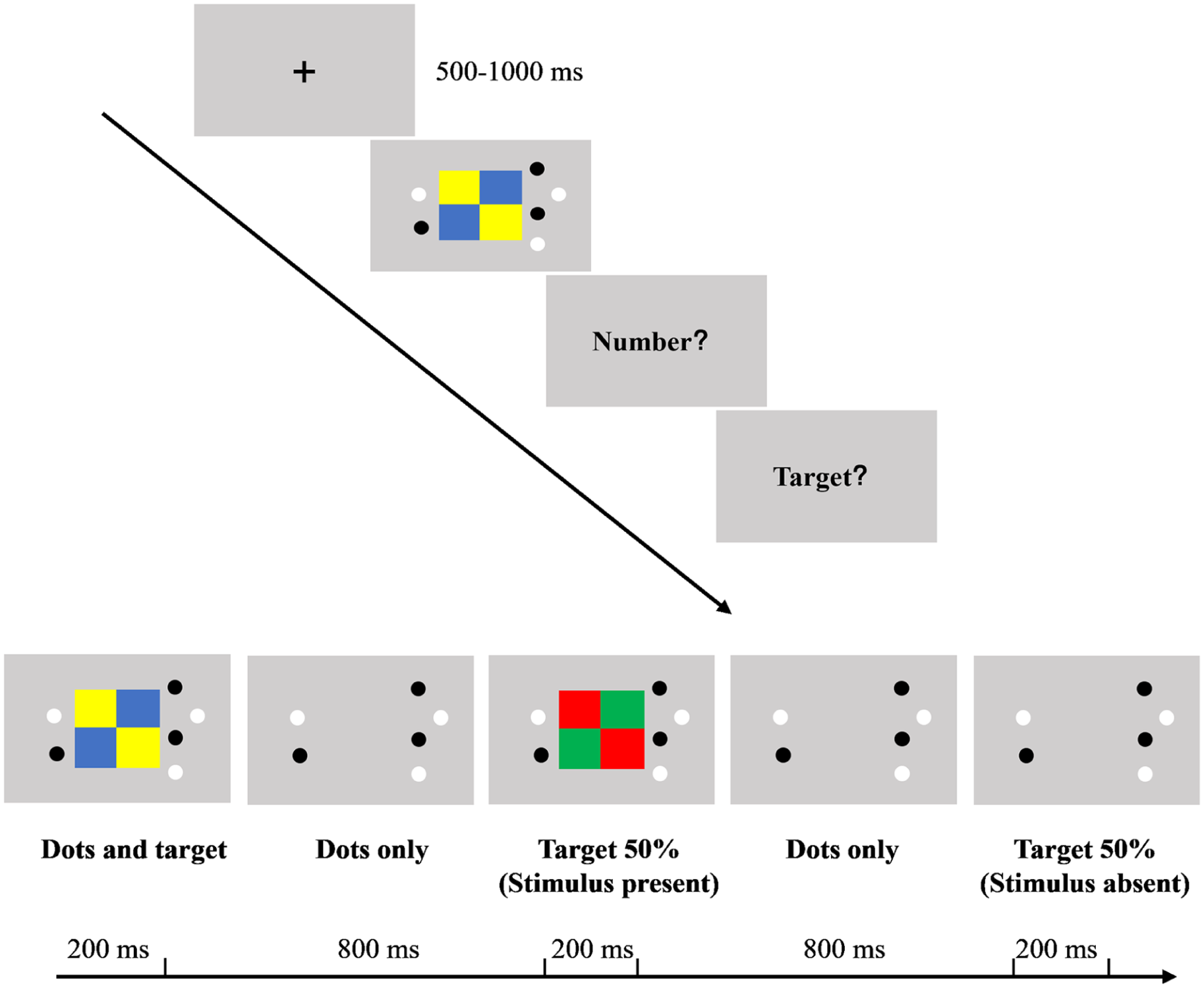
The trial sequence and exemplary stimuli used in Experiment 1b. A manipulation of “task difficulty-based attentional load” and a manipulation of “counting with continuous target detection” were employed as shown in the figure. Each target detection stimulus, presented within a 200-ms time window, had a 50% probability of being designated as a target and was independent of all other target detection stimuli. These target detection stimuli were randomly interspersed with a 50% probability among numerical dot stimuli, which were continuously displayed. For further elaboration, please refer to the main text.
Results and Discussion
The data analysis for Experiment 1b closely resembled that of Experiment 1a.
Manipulation of the Attentional Load
As expected, a 2 (task type) × 2 (attention load) repeated-measures ANOVA revealed a significant main effect of attention load (F[1, 20] = 91.489, p < .001, η2 p = .821): compared to the low load condition, participants’ accuracy was lower under the high load condition (see Figure 3B). Furthermore, the interaction between task type and attention load was significant (F[1, 20] = 74.913, p < .001, η2 p = .789). Simple effects analysis showed that for the target detection task, accuracy was significantly higher under the low-load condition than under the high-load condition (F[1, 20] = 61.83, p < .001, BF10 > 100). However, for the enumeration task, no significant difference was found between the high and low load conditions, which was due to a ceiling effect in accuracy during the counting task. These results confirm that attentional load was effectively manipulated without inducing a trade-off between enumeration and target detection performance.
Enumeration Task
Error Rate
According to the reaction of the participants, it was clear that the participants performed counting rather than estimation since the average error rate was under 10% (see Figure 6A). The repeated-measures ANOVA revealed a significant main effect of dot number (F[1.816, 36.314] = 12.315, p < .001, η2 p = .381). However, the main effect of attentional load and the interaction between attentional load and dot number were not significant.
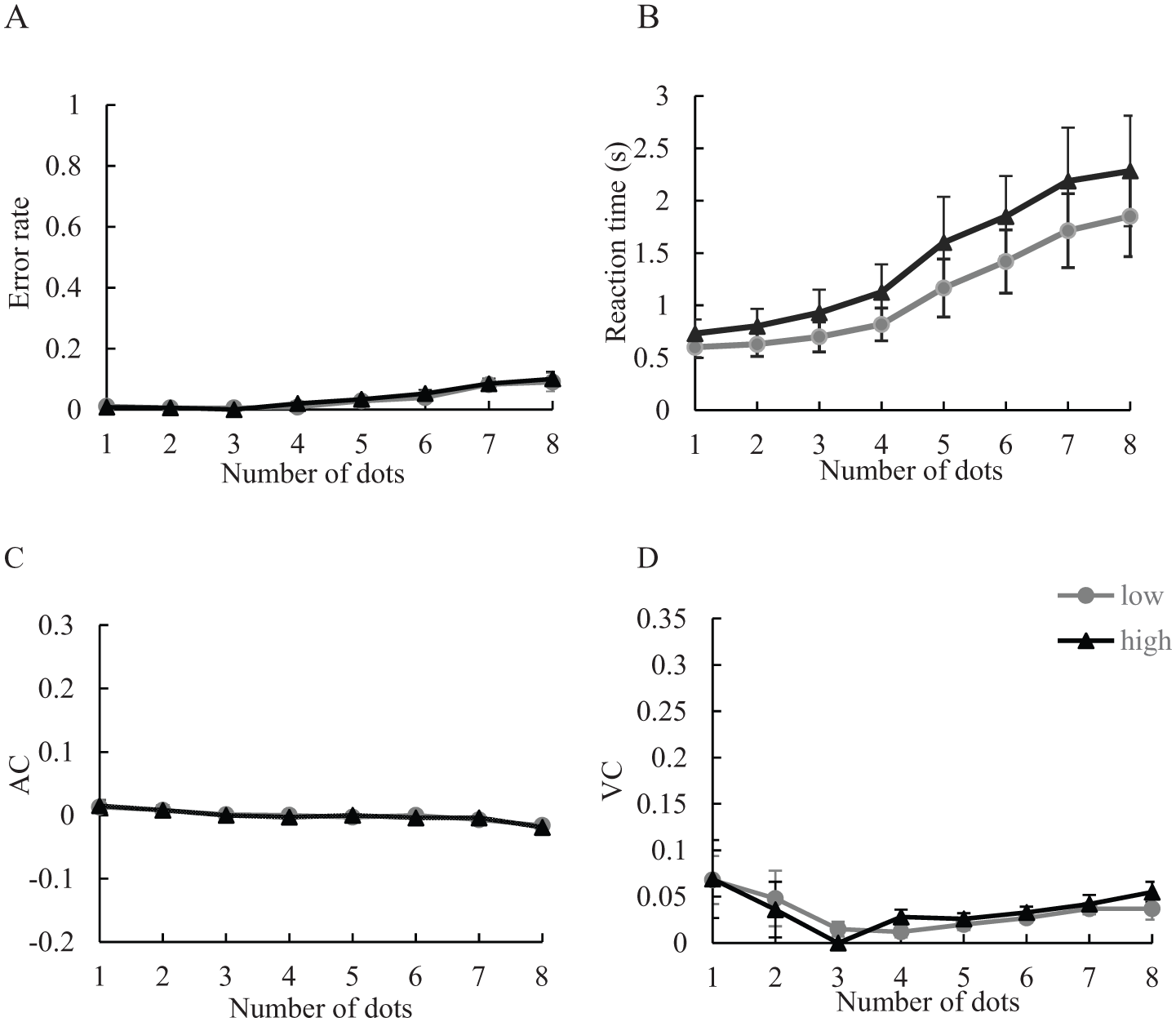
The error rate (A), the reaction time (B), the accuracy coefficient (C), and the variation coefficient (D) of the enumeration task in Experiment 1b. The low attentional load (gray) and high attentional load (black) conditions are presented separately. Error bars represent the standard errors of the means.
Reaction Time
A repeated-measures ANOVA revealed a significant main effect of attentional load (F[1, 20] = 98.205, p < .001, η2 p = .831). Participants took longer to complete the numerical counting under the high attentional load conditions compared to the low attentional load conditions. Additionally, there was a significant main effect of dot number (F[1.658, 33.157] = 185.107, p < .001, η2 p = .902). The interaction between attentional load and dot number was also significant (F[3.286, 65.710] = 12.546, p < .001, η2 p = .385). Further analysis revealed that across all dot numbers, high attentional load significantly increased RTs (all p < .05, all BF10 > 100) compared to low attentional load (see Figure 6B). This effect was more pronounced for larger numerosities than for smaller ones.
Accuracy Coefficient
A repeated-measures ANOVA revealed a significant main effect of dot number (F[3.007, 60.139] = 6.507, p = .001, η2 p = .245). Post hoc analysis revealed a significant underestimation at dot number level 8 compared to 1 (p = .032, BF10 > 100), 3 (p = .038, BF10 > 100), and 4 (p = .043, BF10 > 100). However, the main effect of attentional load and the interaction between dot number and attentional load were not significant. These findings indicate that attentional load did not affect the accuracy of counting (see Figure 6C).
Variation Coefficient
The results of a repeated-measures ANOVA indicate no significant main effects or interactions, suggesting that attentional load had no impact on the precision of numerical counting (see Figure 6D). Similarly, we also conducted a repeated measures ANOVA on the results of the attention load effect, which revealed that the main effect of dot number was not significant (F[1.988, 39.769] = .348, p = .707). There were no significant differences in the effect of attention load on the counting precision within the small and large number range.
In Experiment 1b, the error rates remained consistently low, accompanied by increased RTs as the number of dots increased. These findings provide two compelling pieces of evidence that participants indeed employed a counting strategy rather than relying on subitizing and/or estimation. It appears that attentional load does not have a significant impact on the error rate, accuracy, and precision of counting. However, it does exert influence on RT. The greater the attentional load, the longer it takes to complete the counting process. Importantly, the impact of attentional load on RT becomes more pronounced as the number of dots increases. This pattern was specifically observed during counting in Experiment 1b but not during subitizing and estimation in Experiment 1a. These results suggest that the influence of attentional load on numerical processing can gradually accumulate in a typical serial processing task, such as counting. Thus, it provides additional evidence of the successful manipulation of counting.
Further evidence indicates that participants in Experiment 1b predominantly employed a counting strategy, even for smaller set sizes, to achieve exact enumeration. Under high attentional load in Experiment 1b, performance for small set sizes (1–4) showed remarkably low error rates (mean = 0), minimal bias (absolute constant, AC, mean = 0), and high precision (variable constant, VC, mean = 0–.07). In contrast, Experiment 1a exhibited higher error rates (mean = .08–.2), greater bias (AC mean = 0–.1), and lower precision (VC mean = .1–.25) for the same set sizes. These disparities indicate that the processing strategy for small set sizes (1–4) in Experiment 1b was distinct from the subitizing observed in Experiment 1a and more consistent with counting, which aims for exact enumeration. Moreover, when collapsing across all set sizes, the mean RT in Experiment 1b was significantly longer than in Experiment 1a. This difference reflects the sequential processing inherent to counting, in contrast to the parallel processing typical of subitizing and estimation. Although a counting strategy predominates, we cannot entirely rule out the possibility of a residual usage of subitizing for small numerosities in Experiment 1b. Future studies could explore this by developing paradigms to quantify the different weights and contributions of counting and subitizing during enumerating small numerosities.
In addition, the edge effect observed during subitizing and estimation in Experiment 1a was not observed during counting in Experiment 1b. This finding aligns with the definition of counting as a deliberate, precise, and meticulous form of enumeration, thus providing additional validation for the effective manipulation of counting in the present study. A significant central tendency was observed during counting, similar to subitizing and estimation under a high attentional load. In contrast to Experiment 1a, the central tendency was comparable between low and high attentional load during counting. These findings suggest that counting, as a serial and slow enumeration strategy, tends to induce a response bias of central tendency that is unaffected by attentional load.
Experiment 2
Experiment 1 manipulated the attentional load to explore its effect on subitizing, estimation, and counting. This is a bottom-up, task difficulty-driven manipulation of attentional resources. Experiment 2 aims to manipulate attentional resources in a top-down, expectation-driven manner. The top-down manipulation was adapted from the paradigm employed by Coull et al. (2004) to investigate attention modulation of time estimation. In this paradigm, participants were instructed to respond to only one task within a dual-task framework. At the beginning of each trial, a clue was provided to indicate the probabilities of making a response for the two tasks. By providing these probabilities in advance, participants were able to effectively allocate their attentional resources (Coull et al., 2004). Specifically, the task with a higher response probability received a greater allocation of attentional resources. In Experiment 2, similar clues will be employed to indicate five levels of attentional allocation (0%, 25%, 50%, 75%, 100%) to an enumeration task. The effects of attentional allocation on various dot number levels (2–6) will be assessed separately for subitizing, estimation, and counting. We used this approach in the current study by parametrically varying attentional allocation to numerical versus non-numerical processing in a dual-task paradigm.
Experiment 2a
Method
Participants
To obtain appropriate sample sizes, we conducted an a priori sample size calculation using GPower 3.1 (Faul et al., 2007). Assuming an alpha level of .05 and a power of .9, a minimum sample size of 17 was required to detect a medium effect size (f = .2) with sufficient power for both Experiments 2a and 2b (ANOVA, repeated-measures, within factors and 20 measurements [4 attention levels * 5 numerosity levels]). Twenty-two students from CCNU participated in Experiment 2a. The participants’ average age was 21.4 years (6 males), with a range of 18 to 24 years.
Stimuli and Procedure
All experimental apparatuses were the same as those in Experiment 1. A manipulation of “probability clue-based attentional allocation” was employed in Experiments 2a and 2b. At the beginning of each trial, a clue indicating the probabilities of making a response for the enumeration task (N task) and the target detection task (T task) was presented to direct attentional allocation. There are five types of attentional allocation clues that signal varying degrees of focused or divided attention (see Figure 7). Each clue has been labeled with distinct letters and corresponding vertical gray bars. For example, the “N” clue denoted a 100% (0%) probability of responding to the N (T) task, while the “T” clue represented a 100% (0%) probability of responding to the T (N) task. Similarly, the Nt, nt, and nT clues indicated probabilities of 75% (25%), 50% (50%), and 25% (75%) for responding to the T (N) task, respectively. The sum of the N task probability and the T task probability always equaled one, indicating complementary attentional allocation between these two tasks. Thus, the instructed attentional allocation was as follows: attending entirely to N task and ignoring T task (“N”); attending more to N task than T task (“Nt”); attending to both tasks equally (“nt”); attending to T task more than N task (“nT”); attending entirely to T task and ignore N task (“T”). The height of the gray bar for each task was scaled according to the probability of responding to that specific task. The clue was presented for 1,000 ms, followed by a black fixation (500–1,000 ms).
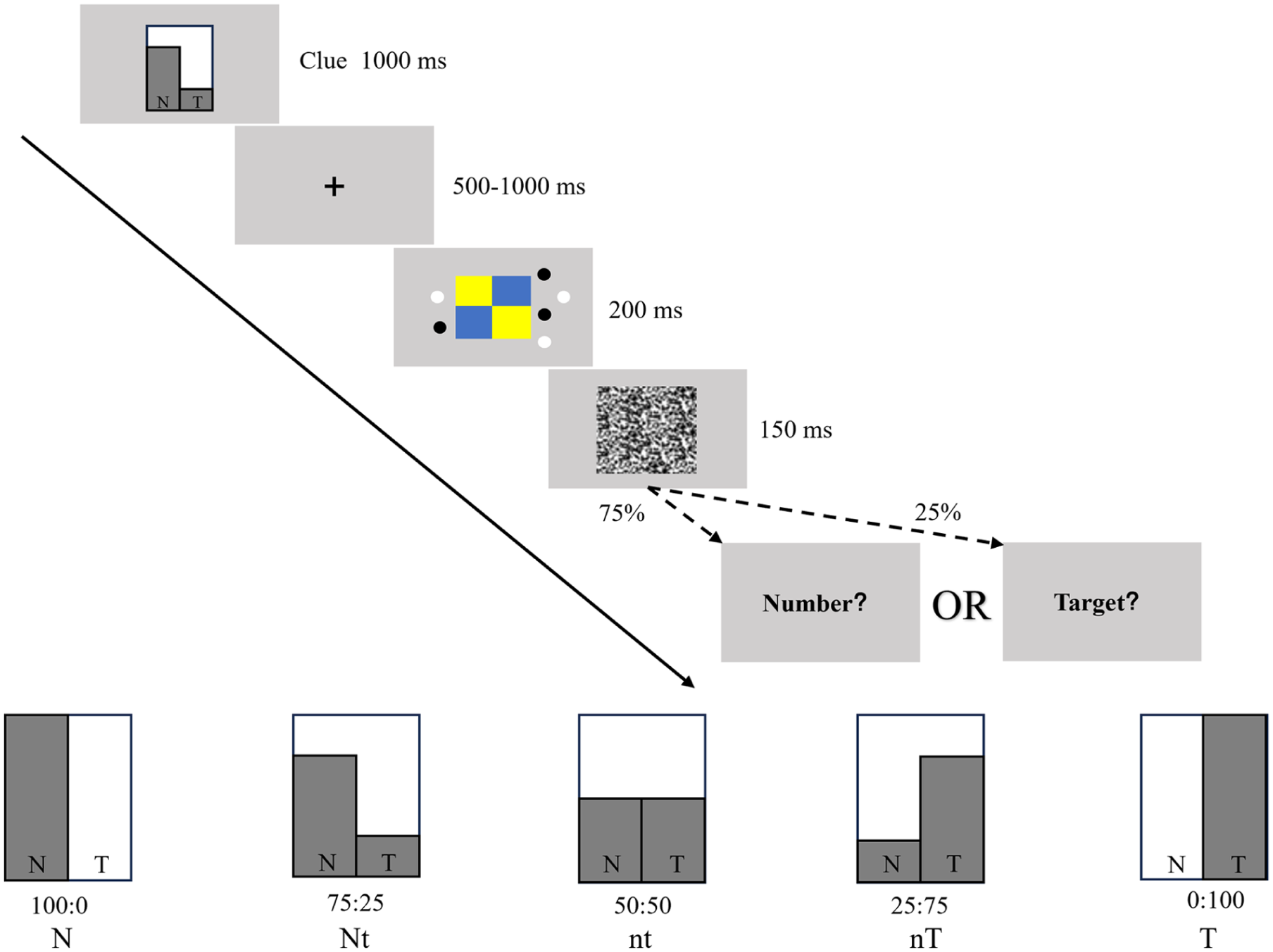
The trial sequence and exemplary stimuli used in Experiment 2a. A manipulation of “probability clue-based attentional allocation” was employed. There were five types of clues, which represented the probabilities of making a response for the enumeration task (N task) and the target detection task (T task). For further elaboration, please refer to the main text.
Subsequently, stimuli, including target detection stimuli and enumeration stimuli, were presented for 200 ms, followed by a 150 ms mask, as in Experiment 1a. A response screen with the response probe NUMBER (denoted as N response) or TARGET (denoted as T response) then appeared, prompting participants which task they should respond to. Therefore, for each trial, participants made a single response, in terms of either to N task or T task, even though they may have been required to process both tasks. The probability of the response probe being NUMBER or TARGET corresponded directly to the type of attentional clue presented at the start of that trial. All trials in the “N” clue condition, but none in the “T” clue condition, required a NUMBER response, and no trials in the “N” clue condition, but all in the “T” clue condition, required a TARGET response. In addition, the parametric variation of the probability of responding to the N(T) task in the “Nt,” “nt,” and “nT” clue conditions was designed specifically to encourage appropriate attentional allocation in a parametric way. For instance, the probability of the N task progressively decreased by 25% increments, while the probability of the T task correspondingly increased by 25% across the three clue conditions. Consequently, attentional allocation was expected to decrease for the N task and simultaneously increase for the T task.
The response collection for the N or T task mirrored that of Experiment 1a. To ensure that participants actively allocated attention resources according to the clues, only stimuli from the high attentional load condition in Experiment 1 were utilized in Experiment 2, maintaining consistent difficulty levels for the target detection task. Experiment 2a consisted of a total of 1,080 trials, which included five levels of attentional allocation (N, Nt, nt, nT, T) and five dot number conditions (2–6). The distribution of trial numbers for the combinations of N, Nt, nt, nT, and T clue levels and N(T) responses followed a ratio of 1(N1/T0): 4(N3/T1): 2(N1/T1): 4(N1/T3): 1(N0/T1), respectively. This distribution aimed to equalize the total number of trials between N and T responses across the five clue conditions, ensuring at least 18 repetitions for each combination of attentional allocation and N(T) response, and, crucially, to prevent co-variation between trial number and the probability of N(T) response. The experiment were divided into two sessions, with each session consisting of five blocks, each corresponding to one of the five clue types. The order of the clue types was counterbalanced among participants.
Results and Discussion
Data for N task were collected during N, Nt, nt, and nT conditions, while data for T task were collected during Nt, nt, nT, and T conditions. The data analysis for Experiment 2a closely resembled that of Experiment 1a.
Manipulation of the Attentional Allocation
A repeated-measures ANOVA was conducted to analyze the percentage correct of the target detection task, considering attentional allocation (the probability of responding to the target detection task was 25%, 50%, 75%, and 100%) as a factor. As expected, the main effect of attentional allocation was significant (F[3, 63] = 71.425, p < .001, η2 p = .773). Notably, as the T task probability increased, the percentage of correct responses of target detection improved (see Figure 3C, T task). Post hoc comparisons revealed that the differences between any two clues were all significant (all p < .05, all BF10 > 100). Similarly, as the N task probability increased (and consequently, the T task probability decreased), the percentage of correct responses of enumeration also improved (see Figure 3C, N task). Full statistical results for the percentage correct (equivalent to 1 minus Error rate) of the enumeration task are provided below. These findings suggest that the participants indeed allocated attentional resources actively according to the clues, providing evidence for the effectiveness of the paradigm.
Enumeration Task
Error Rate
A repeated-measures ANOVA revealed significant main effects of attentional allocation (four probabilities of responding to the enumeration task, i.e., 100%, 75%, 50%, and 25%), (F[2.209, 46.399] = 131.397, p < .001, η2 p = .862), and dot number (2–6), (F[2.297, 48.243] = 18.849, p < .001, η2 p = .473). As the N task probability decreased and the dot number increased, the error rate increased. Post hoc analysis indicated significant differences between all dot number pairs (all p < .05, BF10 > 10), except for 2 versus 5 (p > .05, BF10 = .127) and 3 versus 4 (p > .05, BF10 = .223). Similarly, all paired differences across attentional allocation levels were significant (all p < .001, BF10 > 100). Additionally, there was a significant interaction between attentional allocation and dot number (F[5.674, 118.581] = 4.862, p < .001, η2 p = .188). Simple analysis showed that there were significant differences between the different attentional allocation conditions at all dot levels (all p < .001). Further analysis revealed a significant linear trend for the 100% N task probability condition (F[1, 21] = 28.063, p < .001, η2 p = .572). As the N task probability decreased, a pronounced nonlinear quadratic trend emerged (nt: F[1, 21] = 49.291, p < .001, η2 p = .701; nT: F[1, 21] = 33.909, p < .001, η2 p = .618; see Figure 8A). This indicates that inadequate attentional allocation hampers numerical processing, with larger effects observed for both small and large numerosities compared to intermediate numerosities.
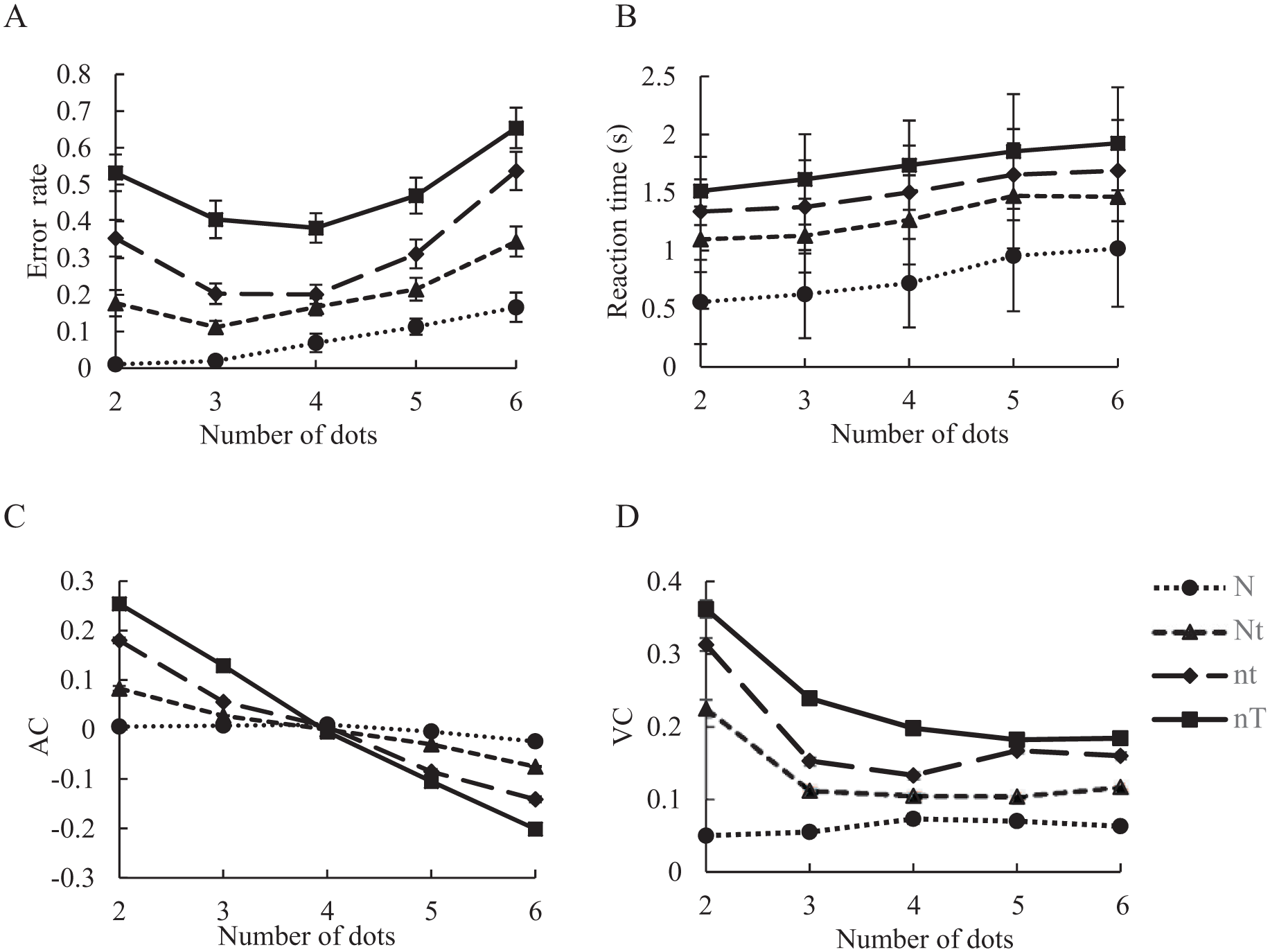
The error rate (A), the reaction time (B), the accuracy coefficient (C), and the variation coefficient (D) of the enumeration task in Experiment 2a. Performance under the four probabilities of responding to the enumeration (N) task (100%, 75%, 50%, 25%, corresponding to N, Nt, nt, nT) is presented separately. Error bars represent the standard errors of the means.
Reaction Time
A repeated-measures ANOVA revealed significant main effects of dot number (F[1.613, 33.869] = 48.067, p < .001, η2 p = .696) and attentional allocation (F[1.875, 39.376] = 114.417, p < .001, η2 p = .845). Post hoc analysis indicated significant differences between all dot number pairs (all p < .05), except for 2 versus 3 (p = .171, BF10 = 33.641) and 5 versus 6 (p = .368, BF10 = 3.702). Similarly, all paired differences across attentional allocation levels were significant (all p < .001, BF10 > 100). Overall, RT increased with a higher dot number or a lower N-task probability. The interaction between attentional allocation and dot number was not significant (F[6.456, 135.571] = 1.511, p = .120). These findings clearly demonstrate that attentional allocation has a significant impact on the processing time of both subitizing and estimation (see Figure 8B).
Accuracy Coefficient
A repeated-measures ANOVA revealed significant main effects of dot number (F[1.523, 31.990] = 2246.358, p < .001, η2 p = .991), with all paired differences between dot number levels being significant (all p < .001, BF10 > 100). The main effect of attentional allocation was also significant (F[1.338, 28.100] = 12.568, p = .001, η2 p = .374). Post hoc analysis indicated that the response bias in the nT condition was significantly higher than in the other conditions (all p < .01, all BF10 < 1). More critically, the interaction between dot number and attentional allocation was significant (F[2.001, 42.011] = 881.263, p < .001, η2 p = .977). In the small numerosity range, a decrease in N task probability led to numerical overestimation, while numerical underestimation occurred in the large numerosity range. These findings suggest that attentional allocation significantly influences enumeration accuracy, with contrasting response biases for subitizing and estimation (see Figure 8C).
Variation Coefficient
A repeated-measures ANOVA revealed significant main effects of dot number (F[1.298, 27.267] = 232.213, p < .001, η2 p = .917). Post hoc analysis showed that, significant differences were found between dot 2 and the other levels (3–6; all p < .001, BF10 > 100), as well as between 3 and 4 (p < .001, BF10 = 74.689), and between 3 and 5 (p = .019, BF10 = 1.070). All remaining pairwise comparisons showed no significant differences. The main effect of attentional allocation was also significant (F[1.458, 30.627] = 890.691, p < .001, η2 p = .977), with all paired differences between attentional allocation levels being significant (all p < .001, BF10 > 100).
Importantly, their interaction was also significant (F[2.453, 51.506] = 97.221, p < .001, η2 p = .822). Simple effects analysis indicated significant differences between attentional allocation pairs at all number levels (all p < .001; see Figure 8D). To examine the magnitude of the attentional allocation effect on different numerosity levels, we defined the attentional allocation effect as the difference in VC between the 100% and 25% N task probability conditions. This analysis revealed that the main effect of dot number on the attentional allocation effect was significant (F[1.934, 40.610] = 190.875, p < .001, η2 p = .901). Post hoc analysis indicated that the attentional allocation effect was greater for small numerosities than for large numerosities. Specifically, the effect on 2 was significantly larger than for other number conditions (all p < .001), and 3 was larger than 4, 5, and 6 (all p < .001). These findings suggest that attentional allocation has a greater impact on the precision of subitizing than on estimation.
To control attentional allocation, participants were pre-informed about the probabilities associated with responding to the two tasks. The findings indicated that a lower probability of the T task resulted in decreased attentional allocation to the T task and inferior performance in the target detection. This suggests the effectiveness of manipulating attentional allocation. As attentional resources allocated to the enumeration task decreased, there was a parametric increase in the error rate, RT, and VC. All measurements, including error rate, RT, AC, and VC, indicated that attentional allocation impacts both subitizing and estimation. However, the VC revealed that attentional allocation had a greater impact on the processing precision of subitizing than that of estimation, which aligns with Vetter et al.’s (2008) findings using bottom-up attentional modulation. Therefore, we have extended the findings of Vetter et al. (2008) and suggest that subitizing relies more heavily on attention, regardless of whether attentional resources are controlled in a bottom-up or top-down manner.
The magnitude of the central tendency effect, characterized by overestimation of small numerosities and underestimation of large numerosities, was modulated in a parametric manner by a progressive reduction in attentional allocation to the N task. This finding in AC results was corroborated by the observed patterns in error rates, which exhibited non-linear, U-shaped patterns (i.e., higher error rates for small and large numerosities compared to intermediate ones) that became more prominent with a progressive reduction in attentional allocation. The nonlinearity of error rates can be partially attributed to the contribution of central tendency to the increase in error rates for small and large numerosities through overestimation and underestimation, respectively. When integrating the results of Experiments 1a and 2a, it appears that the occurrence of the central tendency effect necessitates insufficient attentional resources, whether governed by bottom-up or top-down mechanisms. However, since the nonlinearity of error rates was not observed in Experiment 1a, this suggests that central tendency exerts a greater influence on error rates when top-down, rather than bottom-up, attentional control dominates.
Experiment 2b
Method
Participants
Sample size calculation was conducted in accordance with Experiment 2a. Eighteen students from CCNU participated in Experiment 1b. The participants’ average age was 20.6 years (5 males), with a range of 18 to 23 years.
Stimuli and Procedure
Experiment 2b combined the manipulation of “probability clue-based attentional allocation” employed in Experiment 2a with the manipulation of “counting with continuous target detection” employed in Experiment 1b. The remaining aspects of stimuli and procedures were consistent with Experiment 2a (see Figure 9).
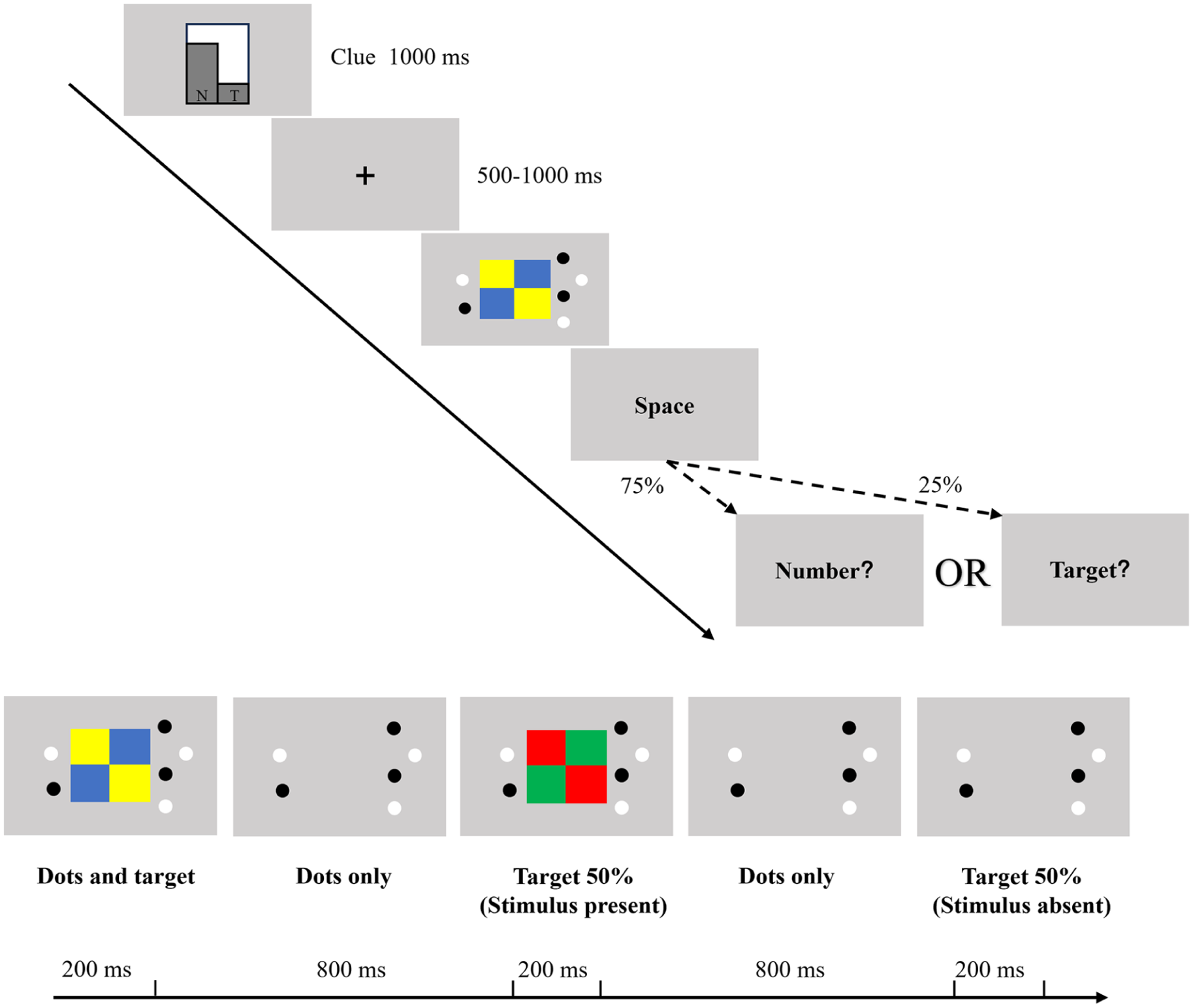
The trial sequence and exemplary stimuli used in Experiment 2b. A manipulation of “probability clue-based attentional allocation” and a manipulation of “counting with continuous target detection” were employed as shown in the figure.
Results and Discussion
The data analysis for Experiment 2b mirrored that of Experiment 2a.
Manipulation of the Attentional Allocation
A repeated-measures ANOVA revealed a significant main effect of attentional allocation (F[1, 23] = 67.114, p < .001, η2 p = .745). As the T task probability increased, the percentage correct of target detection also improved. Post hoc comparisons indicated that all differences between clues, except for Nt and nt, were statistically significant (all p < .05, BF10 > 100). As the T task probability increased, participants allocated more attention to the target detection task, resulting in improved percentage of correct responses of target detection (see Figure 3D, T task). Similarly, as the N task probability increased (and consequently, the T task probability decreased), the percentage of correct responses of enumeration also improved (see Figure 3D, N task). Full statistical results for the percentage correct (equivalent to 1 minus Error rate) of the enumeration task are provided below. These findings suggest that participants actively allocated attentional resources according to the clues, providing evidence for the effectiveness of the paradigm.
Enumeration Task
Error Rate
The error rate was generally low (under 15%, see Figure 10A). A repeated-measures ANOVA revealed a significant main effect of dot number (F[4, 68] = 2.988, p = .025, η2 p = .150); however, post hoc analysis showed that none of the pairwise comparisons between dot number levels reached significance (all p > .05, BF10 < 1). The main effect of attentional allocation was also significant (F[1.517, 25.789] = 13.686, p < .001, η2 p = .446). Post hoc comparisons revealed significant differences between most clue conditions (all p < .05, BF10 > 3), except for nT and nt. As the probability of the N task increased, the error rate of the counting task decreased. However, the interaction between dot number and attentional allocation was no significant (F[4.613, 78.424] = 1.769, p = .134). These findings indicate that attentional allocation influences the error rate of counting, no matter whether numerosities are small or large.
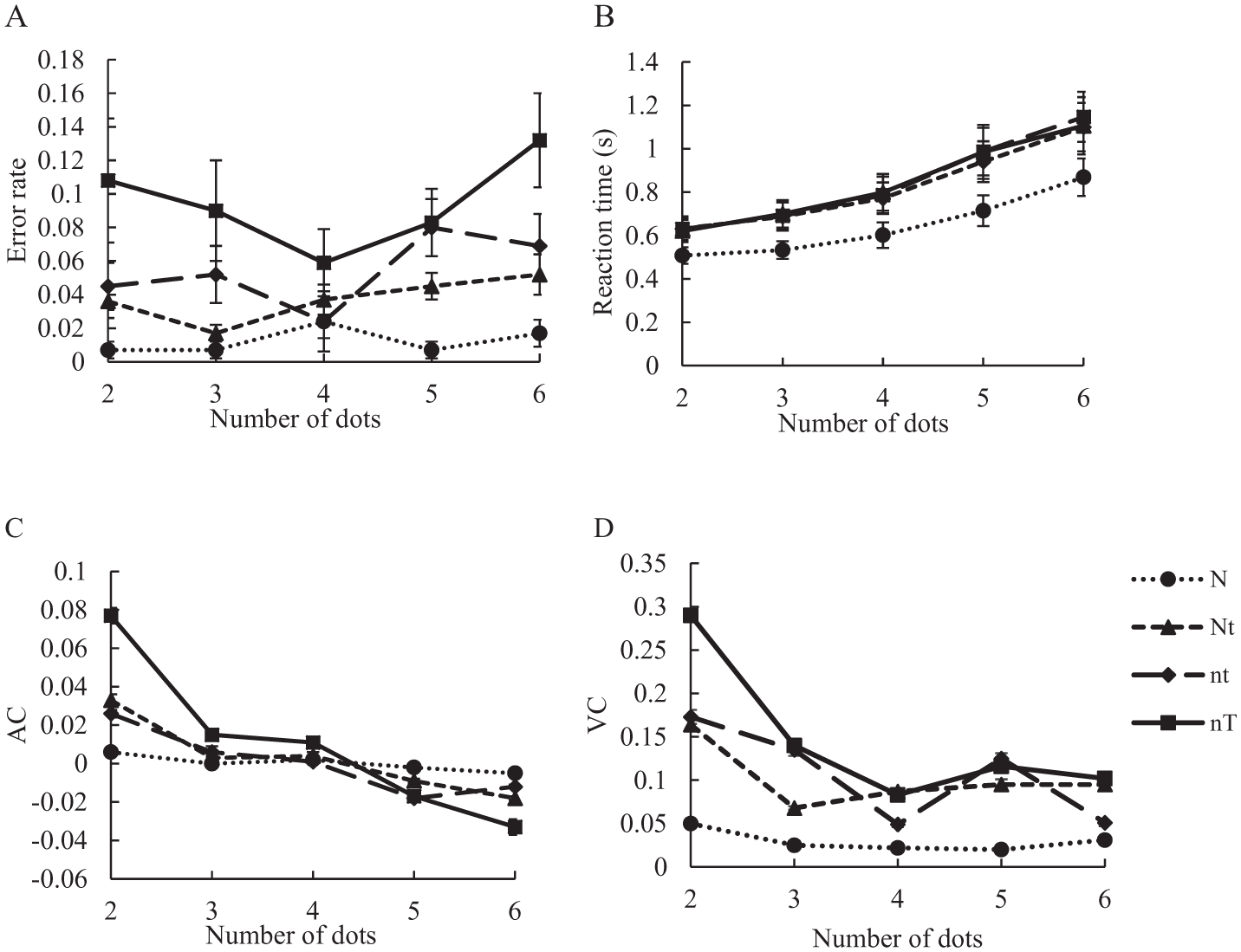
The error rate (A), the reaction time (B), the accuracy coefficient (C), and the variation coefficient (D) of the enumeration task in Experiment 2b. Performance under the four probabilities of responding to the enumeration (N) task (100%, 75%, 50%, 25%, corresponding to N, Nt, nt, nT) is presented separately. Error bars represent the standard errors of the means.
Reaction Time
A repeated-measures ANOVA revealed significant main effects for attentional allocation (F[1.525, 25.924] = 15.672, p < .001, η2 p = .480) and dot number (F[1.257, 21.371] = 31.393, p < .001, η2 p = .649; see Figure 10B). As the probability of the N task increased or the dot number decreased, the RT of counting decreased.
Post hoc analysis indicated that the RT in the N condition was significantly lower than in the other conditions (all p < .01, all BF10 > 100). And all paired differences between dot number levels were significant (all p < .05, BF10 > 100). Additionally, the 2-way interaction was also significant (F[3.589, 61.007] = 2.644, p = .048, η2 p = .135). Further post hoc comparisons revealed that across all dot number conditions, the differences between the N clue and the other three clues were significant (all p < .05). However, no significant differences were found among Nt, nt, and nT. These findings suggest that as attentional resources decrease, participants require more time to complete the counting. However, when the degree of attention distribution dropped below 50%, the processing time did not change significantly.
Accuracy Coefficient
A repeated-measures ANOVA revealed significant main effects for attentional allocation (F[3, 51] = 42.655, p < .001, η2 p = .715) and dot number (F[1.310, 22.275] = 182.030, p < .001, η2 p = .951). Post hoc analysis indicated that the response bias in the nT condition was significantly higher than in the other conditions (all p < .001, all BF10 > 3). And all paired differences between dot number levels were significant (all p < .001, BF10 > 100), except for 3 versus 4. Most importantly, the interaction between dot number and attentional allocation was also significant (F[2.208, 37.539] = 70.131, p < .001, η2 p = .805). For the smallest numerosity (2), the reduced N task probability (Nt) condition led to an overestimation of the counting relative to the N condition (p < .05), whereas for the largest numerosity (6), an underestimation was observed (p < .05). These findings suggest that counting accuracy is significantly influenced by attentional allocation, with contrasting response biases observed for small and large numerosities (see Figure 10C).
Variation Coefficient
A repeated-measures ANOVA revealed significant main effects for attentional allocation (F[1.471, 25.004] = 201.347, p < .001, η2 p = .922) and dot number (F[2.129, 36.187] = 323.126, p < .001, η2 p = .950). And all paired differences between attentional allocation levels and between dot number levels were significant (all p < .001, BF10 > 10), except for Nt versus nt or 3 versus 5. Importantly, their interaction was also significant (F[3.475, 59.074] = 64.306, p < .001, η2 p = .791). Further analysis revealed that the range of VC change (defined as the difference in VC between the 100% and 25% N task probability conditions, that is, the N and nT conditions) was significantly larger (p < .05) for smaller numerosities (2 and 3) than for larger numerosities (5 and 6; see Figure 10D). These findings suggest that attentional allocation significantly impacts the precision of counting, with a greater effect observed in small numerosities compared to large numerosities.
Experiment 2b investigated the impact of attentional allocation on numerical counting. The findings revealed that a decrease in attentional allocation significantly impaired counting performance for both small and large numerosities, as evidenced by measures of error rate, RT, accuracy, and precision. This implies that successful numerical counting necessitates an adequate pre-allocation of attentional resources, irrespective of the range of numbers. Therefore, by combining the results of Experiment 2a, these findings expand the contribution of top-down attention into counting, going beyond subitizing and estimation. In addition, since Experiment 1b did not observe any effect of attentional load on error rate, accuracy, and precision of counting, it appears that top-down attentional allocation plays a more important role in counting compared to bottom-up attentional load.
Furthermore, it has been observed that when the degree of attention allocation is below 50%, the RT exhibits less sensitivity to the decrease of attention allocation compared to other measurements, such as error rate, accuracy, and precision. One possible explanation is that the numerical representation strategy may shift from counting to estimation due to insufficient attentional allocation. In other words, participants may struggle to accurately count the individual dots and instead rely on ensemble processing-based estimation. Consequently, changes in performance would be reflected in error rate, accuracy, and precision, but not in RT.
This proposal was further supported by the results of other three measurements in the condition with the lowest attentional allocation to the N task (“nT”). Specifically, in this condition, a non-linear, U-shaped pattern of error rate (i.e., higher error rates for small and large numerosities compared to intermediate ones, all p < .05) was observed, accompanied by a largest central tendency effect (over- and under-estimation for small and large numerosities), and a greater attentional dependency of small numerosities compared to large ones (which expands Vetter et al. (2008)’s similar finding on subitizing into counting). The observed patterns mirrored the results from the “nT” condition in Experiment 2a, where participants were instructed to perform non-counting numerical processing under conditions of minimal attentional allocation. These findings suggest that when attentional allocation is substantially reduced, counting partially shifts toward estimation. Further studies are needed to provide converging evidence to support our findings. Finally, the largest central tendency was observed in the condition with minimal attentional allocation (“nT”). Together with the results of Experiment 1b, this finding suggests that central tendency in counting is sensitive to the modulation of pre-allocated attentional resources but not to bottom-up attentional interference.
General Discussion
Our study reveals a profound influence of both bottom-up and top-down attention on subitizing, estimation, and counting. Humans adopt a combination of static and dynamic strategies depending on specific effects of attentional modulation on numerical processing. In some cases, such as the greater reliance on attention for processing precision of small numerosities, individuals tend to adopt a uniform cognitive strategy (i.e., a static strategy) across diverse numerical processing scenarios or/and under varying types of attentional modulation. Conversely, in other cases, such as the attention-driven transition effect and the attention modulation on central tendency effect, humans exhibit flexibility and adaptability by dynamically adjusting the accuracy and/or precision of numerical processing in response to varying forms of numerical processing and/or different types of attentional modulation (i.e., a dynamic strategy).
Experiments 1 and 2 respectively manipulated bottom-up attentional load and top-down attentional allocation in numerical tasks involving subitizing, estimation and counting. Experiment 1a revealed that high attentional load amplifies the response bias of central tendency during subitizing and estimation. Additionally, it inhibits the edge effect, which was only observed in the low attentional load condition. Experiment 1b further used a novel “counting with continuous target detection” paradigm and demonstrated a robust central tendency effect that is unaffected by bottom-up attentional load. The effect of attentional load on RT gradually accumulates with an increase in the number of dots during counting in Experiment 1b, but not during subitizing and estimation in Experiment 1a, reflecting the intricate nature of serial processing in counting.
Experiment 2a revealed a strong modulation of attentional allocation on subitizing and estimation, as evidenced by the four measurements. This experiment extends previous research in two aspects. First, it demonstrates that the reliance on attention is greater for processing precision of subitizing, even with top-down attentional allocation. Second, it shows that central tendency effect during subitizing and estimation relies on both bottom-up and top-down attention, with a greater contribution to the error rate during top-down attentional modulation. Finally, Experiment 2b combined the manipulation of attentional allocation with a counting task. The results suggest that the numerical processing may shift from counting to estimation due to insufficient attentional allocation, as supported by various measurements. Moreover, this experiment extended previous research on the greater attention-reliance for processing precision of small numerosities from subitizing into counting. Lastly, Experiment 2b demonstrated that top-down attentional allocation, rather than bottom-up attentional load, modulates the central tendency effect in counting.
Greater Attention-Reliance for Processing Precision of Small Numerosities
The first core finding of the present study is the ubiquitous presence of greater attention-reliance for processing precision of small numerosities. This phenomenon occurs across various types of attention modulations, including both top-down attentional allocation and bottom-up attentional load for subitizing. Additionally, it is observed across different forms of numerical processing, encompassing both subitizing and counting for top-down attentional allocation.
These findings corroborate earlier research demonstrating that attentional resources are essential for processing precision of subitizing, but are either unnecessary or less crucial for processing precision of estimation (Burr et al., 2010; Xu & Liu, 2008). Furthermore, the present study expands the understanding of the impact of attention from bottom-up to top-down processes and from subitizing to counting. Our results are also consistent with an earlier study (Gliksman et al., 2016), which demonstrated that subitizing could be facilitated by increasing attentional engagement through an alertness paradigm. The attentional improvement also occurred for estimation, albeit to a lesser extent and only when the to-be-enumerated elements were presented in a canonical arrangement (Gliksman et al., 2016).
The attention modulation in estimation was also observed in the present study. Particularly, the influence of attentional load and attentional allocation on estimation is evident in terms of accuracy, precision, and RT, emphasizing the significance of both bottom-up and top-down attention in the estimation process. These findings validate previous studies that have reported the influence of attentional load on estimation (Olivers & Watson, 2008; Vetter et al., 2008) and further extend this effect from bottom-up attention to top-down attention.
Transition of Numerical Processing Across Different Forms
Is there any interconnection between attention modulations in counting and subitizing, given that counting relies on focal attention and attention is also a prerequisite for subitizing? This question is partially addressed by the second key finding of the present study, which reveals that the attention-driven transition effect occurs across various forms of numerical processing. Specifically, excessive attentional load can cause a shift from subitizing to estimation, while inadequate attentional allocation can lead to a transition from counting to estimation. Consequently, both subitizing and counting may deteriorate into the same form of numerical processing, namely estimation, due to insufficient bottom-up and top-down attention, respectively. This is a novel finding, as the two processes fundamentally engage distinct systems. Subitizing operates through parallel processing, relying on early object-processing systems (Trick & Pylyshyn, 1993, 1994; Xu, 2009; Xu & Chun, 2009), whereas counting involves sequential processing, depending on verbal processing and symbolic operations (Choo et al., 2014; Cutini et al., 2014; Logie & Baddeley, 1987).
Hyde and Wood (2011) identified a neural signature marking the transition from subitizing to estimation under conditions of limited attentional load. Specifically, when bottom-up attention is sufficient, an early event-related potential (ERP) component (N1) scales with the cardinal numerosity of the set size, signaling a parallel individuation process. Conversely, when bottom-up attention is insufficient, a later ERP component (P2p, P2 posterior) scales with the ratios of numerosities, reflecting the signature of the ANS. Studies using paradigms sensitive to lateralized electrophysiological components demonstrate that early components, such as N2pc (N2 posterior contralateral; Ester et al., 2012; Mazza & Caramazza, 2015; Pagano & Mazza, 2013), and late components, such as Contralateral Delay Activity (CDA)/Sustained Posterior Contralateral Negativity (Pagano & Mazza, 2013), are linked to subitizing. As CDA reflects visual working memory (VWM) capacity (Vogel & Machizawa, 2004) and N2pc indicates visual-spatial attentional selection (Luck & Hillyard, 1994), N2pc rather than CDA likely indexes early object individuation in subitizing and correlates with individual differences in subitizing capacity (Pagano et al., 2014).
It would be intriguing for future studies to uncover the neural signature of the transition from counting to estimation under conditions of insufficient attentional allocation, utilizing technologies such as ERP. The P3 component, a late positive ERP, is widely regarded as an effective indicator of high-level cognitive function. Its amplitude indicates the extent of attentional resources allocated to a specific task (Kida et al., 2003). Therefore, we anticipate observing a P3 component with its amplitude scaling in accordance with the cardinal numerosity of the set size during counting with sufficient attentional allocation. In contrast, when top-down attention is inadequate, a P2p component may scale with the ratios of numerosities, reflecting a signature of estimation. Future studies are imperative to test this hypothesis.
Central Tendency and Top-Down/Bottom-Up Attention Modulations
The third core finding of the present study is that the attention modulation on central tendency differs across numerical processing forms and attentional modulation types, with top-down attention playing a more critical role than bottom-up attention, particularly in counting. In subitizing and estimation, both the bottom-up attentional load and top-down attentional allocation modulate the central tendency effect. However, in counting, it is top-down attentional allocation, rather than bottom-up attentional load, that modulates the central tendency effect.
These findings add new evidence supporting the intrinsic connection between the representation of numerical information and the requirement of attentional resources (Anobile, Turi, Cicchini, & Burr, 2012; Anobile, Cicchini, & Burr, 2012; Vetter et al., 2008). The attention modulation on central tendency in subitizing and estimation suggests that both bottom-up and top-down attention play certain roles in subitizing and estimation. However, the attention modulation on central tendency in counting provide evidence that top-down attention plays a more significant role in counting compared to bottom-up attention.
Regarding the role of attention in the central tendency effect, our findings corroborate previous research conducted using an enumeration task similar to the current study (Vetter et al., 2008). This prior study demonstrated an increase in central tendency effects when bottom-up attentional load was deprived for subitizing and estimation. More recently, Pomè et al. (2021) demonstrated that presenting a visual clue to increase attentional engagement can facilitate the representation of numbers. This results in a less compressed representation of numbers in space, that is, reduced central tendency effects, compared to when attention is diverted elsewhere, regardless of whether attention is directed towards location or objects. In the present study, we demonstrate that increasing both bottom-up and top-down attention (thus decreasing uncertainty of sensory events, Jazayeri & Shadlen, 2010) reduces central tendency effects for subitizing and estimation. However, only the increase in bottom-up attention, not top-down attention, reduces central tendency effects for counting. Therefore, our findings expand upon the research conducted by Pomè et al. (2021) and Vetter et al. (2008) and reveal how central tendency effects of subitizing, estimation, and counting can be flexibly modulated by stimulus- and goal-driven attention.
Flexibility of Attentional Modulation on Numerical Processing
Taken together, these results indicate that top-down and bottom-up attention play significant yet distinct roles in subitizing, estimation, and counting. This is likely due to the different mechanisms and functional origins underlying these three numerical processes. Subitizing is rooted in the object tracking system (OTS; Melcher & Piazza, 2011). The OTS is a domain-general system that relies on object individuation (Trick & Pylyshyn, 1993), which involves separating items in the scene into distinct entities with specific identities and spatial locations during the early stages of object recognition (Xu, 2009; Xu & Chun, 2009). Accurately and precisely binding target objects with spatial locations and singling them out from other distractors requires consumption of significant attentional resources (Gliksman et al., 2016), regardless of whether attention is driven by stimuli or goals. In contrast, estimation is based on the ANS (Feinstein & Bynner, 2004; Piazza, 2010). The ANS system is limited to numerical processing and originates from ensemble numerosity extraction. This involves representing numbers analogically and approximately to achieve a rapid and accurate appraisal of the numerosity of stimulus sets (Dehaene, 1997; Tobias, 1967). Thus, excessive consumption of attentional resources is not necessary in estimation (Hyde & Wood, 2011). Furthermore, counting entails a sequential repetition of various component processes (Choo et al., 2014; Cutini et al., 2014; Logie & Baddeley, 1987), such as object individuation and the transfer of its representation into working memory (Vogel et al, 2001). As the working memory system approaches its capacity limit, participants rely on top-down control to maintain its operation (Shimomura & Kumada, 2011). Consequently, counting inherently demands top-down attention. Therefore, top-down and bottom-up attention flexibly, yet differentially, enhance numerical processing that serves different adaptive functionalities.
Our findings highlight the dynamic and flexible nature of attentional modulation on numerical processing. Specifically, the human cognitive system can flexibly employ static and dynamic strategies across different numerical processing forms and varying sources of information overload. A recent study by Kutter et al. (2022), utilizing single-neuron recordings, demonstrated that neurons in the human medial temporal lobe (MTL) adopt distinct coding strategies for arithmetic rules, such as addition and subtraction. Neurons in the hippocampus utilize static coding to process arithmetic rules, supporting the maintenance and manipulation of rule-related information over extended periods. In contrast, neurons in the parahippocampal cortex use dynamic coding to handle rapidly changing arithmetic rule information. This study elucidates the neural basis of strategy selection in arithmetic rule processing. Arithmetic rules are based on abstract relationships between operands, consistent with prior findings that the MTL, particularly the hippocampus, plays a pivotal role in representing abstract relational spaces (D. Chen et al., 2024; Vaidya & Badre, 2022). However, our paradigm did not involve abstract relational representations. Thus, the neural basis of selecting static and dynamic strategies for attentional modulation on numerical processing is more likely associated with brain regions involved in attention and numerosity processing, such as the parietal and frontal cortices, rather than the MTL. Future research employing high-temporal-resolution techniques, such as electroencephalography and magnetoencephalography, could further elucidate this neural basis.
RT Measurement and Potential Applications in Developmental Dyscalculia
It is worth noting that, following previous literature on attentional modulation during numerical processing (Pomè et al., 2021), we also measured RTs and calculated the time participants took to provide their speeded responses. Consistent with previous findings, RTs were faster when participants had sufficient attentional resources, regardless of whether attention was driven by bottom-up stimulus features or top-down task goals. Our study provides evidence that RTs can be a valid tool, along with precision and accuracy, for exploring attentional modulation in subitizing, estimation, and particularly counting, where other measurements may become less sensitive in situations involving bottom-up attention.
Finally, developmental dyscalculia (DD), a disorder characterized by poor abilities to acquire and use arithmetic, is closely related with attentional dysfunctions such as attention deficit/hyperactivity (Shalev & Gross-Tsur, 2001). Some research has demonstrated that the subitizing process (Koontz, 1996) and number comparison (Rousselle & Noël, 2007) are impaired in children and adults with DD, providing evidence for the growing consensus that the neuropsychological basis of DD is a disorder of the “number sense” (Dehaene, 1997). This refers to the ability to represent and manipulate numerical quantities non-verbally, including subitizing and estimation. However, the core deficit of DD is not limited to the representation of non-verbal quantity (the “number sense”) but also includes the ability to link quantity to symbolic representations of numbers (the “meaning of number”; Wilson & Dehaene, 2007). This is evident in numerous individuals with developmental delay, as they exhibit a slower progression in acquiring verbal processing-based counting skills and counting procedures (Geary, 1993; Wilson et al., 2006). Therefore, the paradigm employed in the current study, specifically the proposed “counting with continuous target detection,” has the potential to aid in the evaluation and differentiation of attention modulation dysfunctions related to the “number sense” and those related to the “meaning of number” in individuals with DD when compared to typically developing children and adults.
Miscellaneous Aspects and Limitations of the Present Study
Numerous studies have demonstrated that human participants employ groupitizing strategies in numerical processing, including subitizing (Wege et al., 2022) and estimation (Friedenberg & Limratana, 2005). Groupitizing refers to the phenomenon whereby visually grouped arrays are enumerated more rapidly and accurately than unstructured arrays (Starkey & McCandliss, 2014). In the present study, stimuli with distinct black or white luminance may prompt participants to visually group objects (e.g., into clusters) based on luminance differences, potentially enhancing the speed and accuracy of subitizing or estimation. However, the current study design precludes direct measurement of groupitizing strategies or evaluation of how bottom-up and top-down attentional processes modulate their use. Future studies could adopt methods from Friedenberg and Limratana (2005) and Wege et al. (2022), independently manipulating the number of groups and the number of dots per group to elicit a Stroop-like pattern of congruency and interference effects. Such an approach would facilitate a deeper understanding of how groupitizing strategies influence distinct forms of numerical processing under varying types of attentional modulation.
In both Experiments 1 and 2, participants were consistently required to maintain a feature/conjunction target set, possibly in VWM, as well as a response mapping set (i.e., one response mapping for the target detection task and another for the enumeration task), possibly in cognitive control-related working memory (WM). Importantly, these additional WM loads were comparable across Experiment 1 (bottom-up attentional manipulation) and Experiment 2 (top-down attentional manipulation), and thus are unlikely to confound the interpretation of the results. In addition, prior work demonstrates a dissociation between the roles of WM storage and WM cognitive control in selective attention: VWM maintenance load resembles perceptual load in facilitating distractor rejection, while WM cognitive control load impairs it (Konstantinou et al., 2014). Despite the potential for these opposing influences, the attentional effects observed in the present study aligns with predictions based on perceptual load of the target detection (Anobile, Cicchini, & Burr, et al., 2012; Vetter et al., 2008). This consistency suggests that the net effect of the potential opposing contributions of VWM maintenance load and WM cognitive control load may be minimal and likely negligible relative to the perceptual load imposed by the target detection.
The present study has several limitations. First, although it seeks to identify enumeration strategies across diverse forms of numerical processing under varying attentional conditions, it relies on indirect performance metrics (e.g., error rates and RTs) rather than explicit strategy reports. Future studies could strengthen conclusions about cognitive strategies employed under different attentional conditions by incorporating explicit measures, such as post-trial self-reports or retrospective questionnaires.
Second, numerous studies have established associations between visual spatial working memory (VSWM) capacity and enumeration performance (e.g., subitizing capacity; Piazza et al., 2011), dual-task costs (e.g., in visual search combined with spatial working memory tasks; Oh & Kim, 2004), and attentional strategy shifts (e.g., resistance to attentional capture; Fukuda & Vogel, 2009). Thus, individual differences in VSWM capacity may explain variability in numerical processing for distinct forms of numerical processing under varying types of attentional modulation. A key limitation of this study is the absence of VSWM capacity measurements. Future research should evaluate VSWM capacity and its interaction with attentional conditions to determine whether VSWM modulates attentional effects. Such measurements could further clarify mechanisms underlying transitions in numerical processing across different forms. Specifically, in low attentional allocation conditions (e.g., Experiment 2b), individuals with lower VSWM capacity may shift from counting to estimation earlier, potentially due to challenges in sustaining precise item representations during counting.
Footnotes

Funding
The authors disclosed receipt of the following financial support for the research, authorship, and/or publication of this article: This work was supported by grants from the National Natural Science Foundation of China (32200864) and the Fundamental Research Funds for the Central Universities, China (CCNU24JCPT038 and CCNU25JC028).
Declaration of Conflicting Interests
The authors declared no potential conflicts of interest with respect to the research, authorship, and/or publication of this article.