







Abstract
Previous research has confirmed the effect of monetary reward on selective attention, but the influence of social reward has yet to be fully investigated. To address this issue, we employed a modified two-rectangle paradigm paired with the monetary incentive delay task or social incentive delay task. In this paradigm, reward cues were implemented symbolically and were not linked to performance-based rewards. In Experiment 1, the relative value of monetary reward diminished object-based attention without affecting space-based attention (SBA). In Experiment 2, the stability of the SBA effect was confirmed, but the elimination of the object-based attention effect due to the relative value of non-verbal social reward was only observed in women. In Experiment 3, we found that verbal social reward resulted in similar effects as monetary reward in Experiment 1 when non-verbal information bias was controlled. The results contribute further evidence to the extended common currency schema and are consistent with the view from prospect theory that relative, context-dependent value can influence early attentional processing across different reward types.
Introduction
Rewards are crucial motivators that guide individuals through a complex landscape of choices and actions, significantly shaping how they prioritize and respond to various stimuli. Traditionally, extensive research has centered on monetary reward due to its tangible and quantifiable nature (Bowyer et al., 2021; Hübner & Schlösser, 2010; H. Kim & Anderson, 2021; Liao & Anderson, 2020; Libera & Chelazzi, 2006; Neuser et al., 2020; Zeng et al., 2022). However, recent findings have expanded this perspective to include social reward, which provides intangible benefits such as recognition, approval, and belonging (Foulkes & Blakemore, 2016; Hayward et al., 2018; Hu et al., 2021; L. Li et al., 2023; Martins et al., 2021; Nardou et al., 2023). This comprehensive understanding illuminates the complex dynamics between social and monetary rewards, offering deeper insights into how they collectively influence the cognitive processes that drive interactions and shape behavioral outcomes.
It is still an open question whether social and monetary rewards activate similar processes. The effects of rewards on voluntary behaviors are well-documented, and a growing number of studies have explored their influence on involuntary, automatic processes such as attentional allocation. However, research on social rewards in this context remains relatively limited, especially in comparison to monetary rewards. The extended common currency schema, proposed to explain how we process social and non-social stimuli, argues that identical neural mechanisms attribute motivational relevance to both forms of stimuli (Ferry et al., 2024; Martins et al., 2021; Ruff & Fehr, 2014; Saxe & Haushofer, 2008; Wake & Izuma, 2017). For example, overlapping neural networks process both social and monetary rewards, with the caudate nucleus and left putamen becoming more active in response to higher financial gains and favorable self-assessments (Izuma et al., 2008). Moreover, Anderson (2016) discovered that the attentional prioritization of visual stimuli can be modified by social rewards through associative learning. By pairing arbitrary stimuli with positive social feedback, the attentional system prioritized those stimuli in a manner similar to the effects seen with monetary reward. The results provided evidence that value-driven attention, which was often associated with monetary rewards, also extended to social incentives, revealing the broader applicability of this attentional principle.
Nevertheless, other studies have identified distinctions in the mechanisms involved in processing monetary and social rewards (Nelson & Jarcho, 2021; Wang et al., 2017; Zhang et al., 2022). These differences may be influenced by gender, highlighting the need to take this variable into account when examining reward-related behaviors (Lawrence et al., 2020; Spreckelmeyer et al., 2009). For instance, Spreckelmeyer et al. (2009) employed the monetary incentive delay task (MIDT; Knutson et al., 2000) along with an adapted version termed the social incentive delay task (SIDT). Results from 16 male and 16 female participants revealed that men exhibited faster reactions to cues promising monetary reward compared to those suggesting social reward, while the reaction times of women did not differ based on incentive types. Greimel et al. (2018) found consistent results by adopting a similar paradigm. The behavioral data aligned with gender-specific brain activation patterns. In men, a wide range of mesolimbic regions was activated when anticipating monetary reward, whereas social reward elicited only limited activation. Conversely, women showed consistent activation of the same brain regions in anticipation of either incentive type (Spreckelmeyer et al., 2009). Therefore, further investigation is essential to assess how monetary and social rewards respectively impact cognitive processing, and whether the effects of these rewards are regulated by gender.
Additionally, the MIDT and the SIDT did not distinguish between object-based attention (OBA) and space-based attention (SBA). Traditionally considered spatial-based, similar to a searchlight or zoom lens (Posner et al., 1980), the concept of selective attention has been expanded by recent studies to include OBA, where focus is on locations within an attended object (Egly et al., 1994). OBA was first distinguished from SBA by the two-rectangle paradigm, in which participants were shown two parallel rectangles and a central fixation point, after which a cue was displayed at one end of a rectangle. The target subsequently appeared in one of three possible locations: the cued location (valid condition), the opposite end of the cued rectangle (invalid same-object condition, ISO), or an equidistant spot on the other rectangle (invalid different-object condition, IDO). Results consistently showed the fastest response times (RTs) for the valid condition, indicating the SBA effect, and faster RTs for ISO condition than for IDO condition, suggesting the presence of the OBA effect. This demonstrated that both SBA and OBA are essential for effective visual selective attention. Numerous studies have argued that unlike SBA, OBA is not inherently robust, as it can be affected by a range of factors (Cavanagh et al., 2023; X. Li & Logan, 2008; Malcolm & Shomstein, 2015; Nah & Shomstein, 2020; Schoenfeld et al., 2014; Shomstein & Yantis, 2004; Yin et al., 2018), including rewards (Diao et al., 2024; Shomstein & Johnson, 2013; Zhao et al., 2020). Shomstein and Johnson (2013) investigated how attentional allocation was influenced by monetary rewards through a modified two-rectangle paradigm combined with a performance-dependent reward system. The study revealed that participants exhibited quicker responses to IDO compared to ISO when different-object locations were linked to higher rewards. However, response times for ISO and IDO were comparable when the reward levels for both locations were equivalent. This finding affirmed the researchers’ assertion regarding the ability of monetary incentives to override object-based attentional guidance, directing attention exclusively based on reward strategy. Since SBA tends to remain stable across reward conditions while OBA can be flexibly adjusted by motivational context, the mixed results reported in earlier studies may partly reflect a lack of clear separation between these two types of attention. Studies that did not explicitly dissociate spatial- and object-based components often found that reward influenced attentional allocation, but without clarifying whether this effect arose from SBA, OBA, or both (Greimel et al., 2018; S. Kim & Beck, 2020; Spreckelmeyer et al., 2009). By contrast, paradigms that separated the two components have consistently shown that reward modulates OBA but has little or no effect on SBA (Shomstein & Johnson, 2013; Zhao et al., 2020). Thus, in tasks that fail to make this distinction, the observed effects may represent a conflation of both influences, which could account for variability and apparent inconsistencies in the literature regarding the role of reward in attentional guidance.
Aside from the potential blended effects of OBA and SBA, there are still some unresolved issues in prior studies that need to be addressed. Firstly, the aforementioned studies, as well as most studies involving the SIDT, employed positive facial expressions as social reward stimuli, which are considered non-verbal information. Studies have indicated that men tend to be less responsive to social non-verbal communication than women (Briton & Hall, 1995; McClure, 2000; Schmid et al., 2011; Toivainen et al., 2017). Therefore, the results of studies showing gender moderation in different incentive delay tasks might stem from gender differences in sensitivity to non-verbal social signals rather than differences in monetary and social rewards. Moreover, the distinction between relative and absolute values is another important aspect of reward. The relative value is contingent on the values present in a given context (e.g., more or less), in contrast to the absolute value, which remains unaffected by the values of other items (e.g., 20 dollars). For instance, S. Kim and Beck (2020) have found that color distractors characterized by high relative value were more effective at capturing attention, while attention was deployed equally to color distractors with different absolute values, indicating that relative, as opposed to absolute value, influenced attentional selection. They extended the prospect theory, which claims that behaviors in later cognitive processes (including judgment and decision-making) are influenced by relative value instead of absolute value, to earlier stages, especially selective attention. However, the influence of relative and absolute values for social reward remains unexplored.
To address the issues mentioned previously, we carried out three experiments that integrated the two-rectangle paradigm with the MIDT or SIDT. In Experiments 1a and 1b, the influence of relative and absolute values of monetary reward on OBA and SBA was explored by setting the low reward condition in Experiment 1b to match the absolute value of the reward condition in Experiment 1a, but with different relative values. We predicted that relative value, instead of absolute value, would influence OBA but not SBA, and this effect would be independent of gender. Experiments 2 and 3 were conducted following the same procedures as Experiment 1, examining the effects of non-verbal social reward and verbal social reward, respectively. Given the gender differences in sensitivity to non-verbal social signals (Briton & Hall, 1995; McClure, 2000; Schmid et al., 2011; Toivainen et al., 2017), we predicted that the results of Experiment 2 would be regulated by gender: the results of women would be similar to those of Experiment 1, while for men, non-verbal social reward would not influence OBA or SBA. Furthermore, by controlling for non-verbal social signals in Experiment 3, we were able to test the hypothesis derived from the extended common currency schema that the results would resemble those of Experiment 1.
Experiment 1
Method
Participants
We used MorePower 6.0.4 software (Campbell & Thompson, 2012) to estimate the required sample size for a 2 × 2 × 2 mixed-model analysis of variance (ANOVA) with one between-subject factor and two within-subject factors. Although our experiment employed a 2 × 2 × 3 design, the analysis concentrated specifically on the 2 × 2 × 2 interactions in SBA and OBA separately. A power analysis indicated that a sample size of 44 participants was required to achieve 80% power with a significance level of 0.05 and the effect size (η p 2 = .16) reported by Greimel et al. (2018) to detect a potential interaction effect among gender and conditions. The sample size was also informed by relevant studies, where sample sizes varied between 32 and 49 (Cornwall et al., 2018; Greimel et al., 2018; Spreckelmeyer et al., 2009).
Based on these analyses, 48 undergraduate students (24 men: Mage = 19.17, SDage = 1.40; 24 women: Mage = 19.29, SDage = 1.46) were recruited for Experiment 1a. Another group of 48 undergraduate students (24 men: Mage = 19.38, SDage = 1.37; 24 women: Mage = 19.21, SDage = 1.14) were recruited for Experiment 1b following the same protocols as those in Experiment 1a. In both experiments, participants exhibited normal or corrected-to-normal vision while remaining unaware of the experimental intent. It is noteworthy that in this experiment, as well as in the subsequent ones, participants received a fixed monetary payment for their participation in accordance with institutional policies. However, the rewards presented during the task were symbolic in nature and were not tied to participants’ actual performance-based compensation. This symbolic reward manipulation—using visual feedback to indicate varying levels of reward—has been widely adopted in prior research and demonstrated to effectively modulate attentional processes under experimental conditions (Spreckelmeyer et al., 2009; Wake & Izuma, 2017).
Apparatus and Stimuli
The stimuli were presented by using E-prime on a 19-inch color monitor (1,280 × 1,024 pixels; 60 Hz refresh rate). The stimuli for the two-rectangle paradigm were two white rectangles (1.3° × 4.5°) presented on a black background, separated by a distance of 1.9°, with a fixation cross measuring 0.3° × 0.3°. The rectangles were either arranged horizontally (above and below the fixation point) or vertically (left and right). A yellow line served as the cue, emphasizing the outer boundary of one end of the rectangles, while a red dot (0.48° diameter) served as the target. In Experiment 1a, we selected a picture of three CNY symbols for the reward condition and a picture of three hourglass symbols for the no reward condition as the cues. The feedback for the reward condition was a picture of five golden coins falling into an open money bag, whereas the feedback for the no reward condition was a picture of the same bag without any coin falling (see Figure 1). In Experiment 1b, the cue and feedback for the low reward condition were identical to those in the reward condition of Experiment 1a. Also, the cue and feedback for the high reward condition were a picture of six CNY symbols and a picture of ten golden coins falling into an open money bag (see Figure 1). To confirm that these pictures induced varying levels of reward (high, moderate, none), we had an independent sample of 30 participants complete an online 9-point Likert scale questionnaire (1 = no reward, 9 = high reward) to rate the sense of reward. A one-way ANOVA was then carried out with picture type as a within-subject factor to analyze the ratings. A significant main effect was found on the sense of reward (F[1, 29] = 131.41, p < .001, η p 2 = .87). Post-hoc tests showed that the ratings of high reward picture (M = 6.80, SD = 1.69) were significantly higher than those of low reward picture (M = 4.30, SD = 0.84), t(29) = 8.56, p < .001, and the ratings of low reward picture were in turn significantly higher than those of no reward picture (M = 2.07, SD = 0.87), t(29) = 7.64, p < .001. The results indicated that the stimuli performed as expected and were appropriate for the formal experiment.
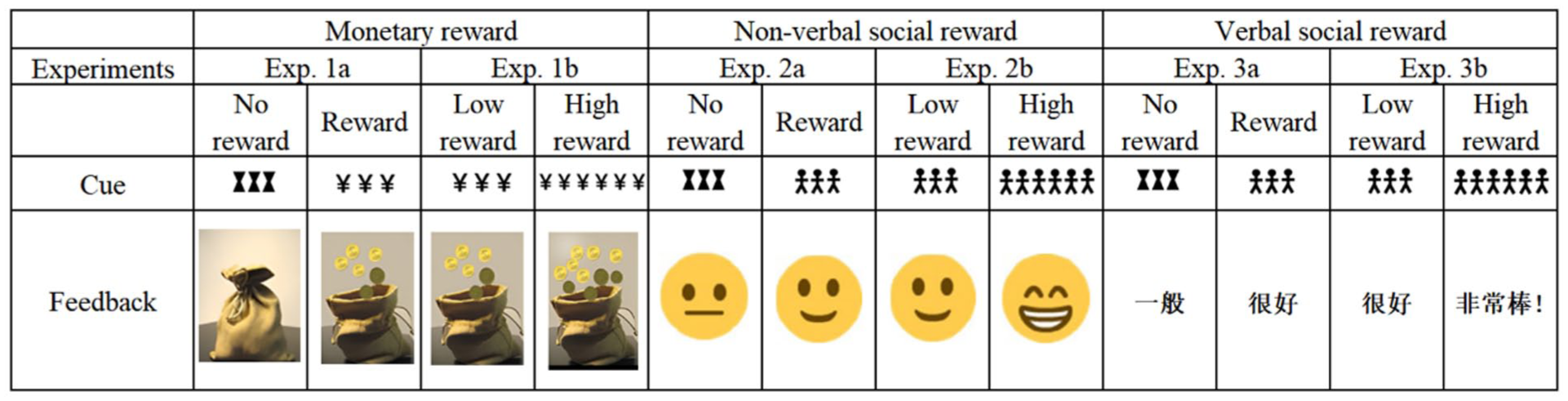
Stimuli used in all the experiments.
Thus, the no reward condition in Experiment 1a and the low reward condition in Experiment 1b can both be referred to as relatively low reward conditions, while the reward condition in Experiment 1a and the high reward condition in Experiment 1b can both be referred to as relatively high reward conditions.
Design and Procedure
A 2 (gender: female, male) × 2 (reward: relatively high reward, relatively low reward) × 3 (cue validity: valid, ISO, IDO) mixed design was used in Experiments 1a and 1b, with gender as a between-subject factor, reward and cue validity as within-subject factors.
Each trial began with a cue presented for 1,000 ms, signaling whether the trial was the relatively low or high reward condition. Next, after a 1,000 ms preview featuring two rectangles with a fixation cross, a cue appeared for 100 ms at any of the four ends of the rectangles. After presenting the two rectangles and fixation cross for another 200 ms, the target (or no target in catch trials) appeared, remaining visible until participants pressed the “M” key or for 1,300 ms if no response occurred. After the participant responded correctly, the corresponding feedback was presented for 500 ms. The next trial commenced after a 300 ms blank interval between trials (Figure 2). Participants were instructed to respond as quickly and accurately as possible by pressing the “M” key upon detecting the target and to refrain from pressing it during catch trials, in which no target appeared. They were also required to maintain their gaze on the fixation throughout the trial. Experiments 1a and 1b involved a practice block of 20 trials, after which participants proceeded through five experimental blocks, totaling 400 target-present trials and 128 catch trials. Each experiment lasted about 50 min, including brief breaks between the blocks.
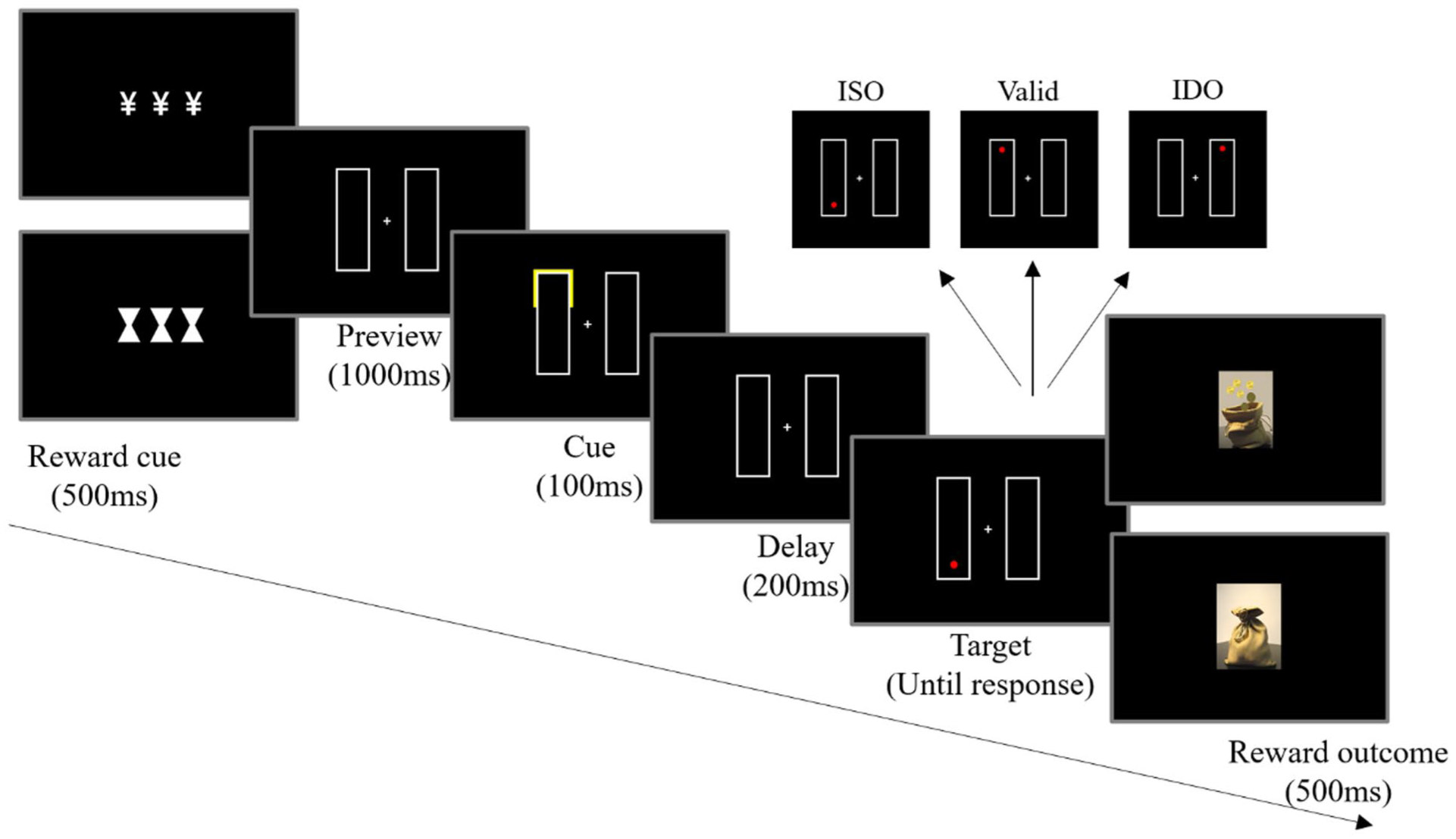
The time course of a trial in each experiment. “Valid” trial: the target was in the cued location. “ISO” trial: the target was at the uncued end of the cued rectangle. “IDO” trial: the target was on the uncued rectangle.
Results
The analyses were conducted only on RTs from correct trials. RTs exceeding three standard deviations were discarded, resulting in approximately 2.09% of the trials being excluded in Experiment 1a and 1.78% in Experiment 1b. Participants who responded on more than 10% of catch trials (i.e., with catch trial accuracy below 90%) were to be excluded from analysis. However, no participants met this exclusion criterion in any of the experiments.
SBA Effect
Repeated-measures ANOVAs structured as 2 (gender: female, male) × 2 (cue validity: valid, invalid) × 2 (reward: relatively high reward, relatively low reward) were performed to analyze the mean RTs for both Experiments 1a and 1b. The average response times of ISO and IDO conditions were used to define the invalid condition.
Analyses of RTs (see Figure 3) revealed a significant SBA effect in both Experiment 1a (F[1, 47] = 104.65, p < .001, η p 2 = .70) and Experiment 1b (F[1, 47] = 39.54, p < .001, η p 2 = .46), with faster RTs for the valid condition (Experiment 1a: M = 329.80 ms, SE = 5.44; Experiment 1b: M = 325.36 ms, SE = 5.35) than those for the invalid condition (Experiment 1a: M = 342.72 ms, SE = 5.86; Experiment 1b: M = 336.51 ms, SE = 5.29). The main effect of reward was not significant in Experiment 1a (F[1, 47] = 2.72, p = .106, η p 2 = .06), but significant in Experiment 1b (F[1, 47] = 4.97, p = .031, η p 2 = .10). Post-hoc tests in Experiment 1b found faster RTs in the high reward condition (M = 328.55 ms, SE = 5.51) than those in the low reward condition (M = 333.33 ms, SE = 5.19). No additional main effects or interactions achieved statistical significance according to the analyses (Experiment 1a: all Fs < 2.96, all ps > .092; Experiment 1b: all Fs < 2.38, all ps > .129). These findings indicate that monetary reward does not modulate the SBA effect.
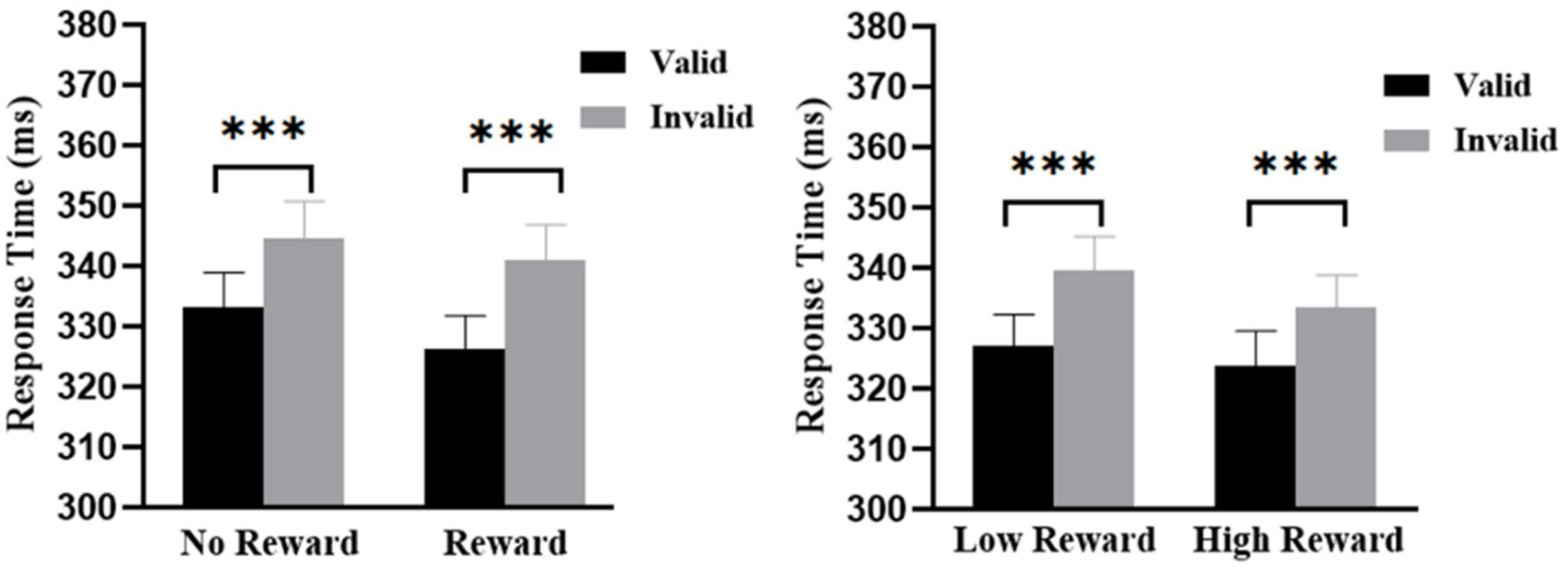
Results of space-based attention effect from Experiment 1a (a) and Experiment 1b (b). Mean reaction times as a function of cue validity and reward (*** indicates p < .001). Error bars represent the standard error.
Analyses of accuracy (ACC) found no significant effects (Experiment 1a: all Fs < 2.82, all ps > .100; Experiment 1b: all Fs < 3.05, all ps > .088). Hence, the RT patterns cannot be regarded as a speed-accuracy trade-off.
OBA Effect
Repeated-measures ANOVAs structured as 2 (gender: female, male) × 2 (cue validity: ISO, IDO) × 2 (reward: relatively high reward, relatively low reward) were performed to analyze the mean RTs.
Analyses of RTs (see Figure 4) revealed a significant main effect of cue validity (Experiment 1a: F[1, 47] = 18.25, p < .001, η p 2 = .28; Experiment 1b: F[1, 47] = 16.99, p < .001, η p 2 = .27), with faster RTs for ISO condition (Experiment 1a: M = 338.86 ms, SE = 6.00; Experiment 1b: M = 331.66 ms, SE = 5.52) than those for IDO condition (Experiment 1a: M = 346.58 ms, SE = 5.86; Experiment 1b: M = 341.37 ms, SE = 5.32). The main effect of reward was not significant in Experiment 1a (F[1, 47] = 0.98, p = .327, η p 2 = .02), but significant in Experiment 1b (F[1, 47] = 7.21, p = .010, η p 2 = .14), with faster RTs in the high reward condition (M = 333.39 ms, SE = 5.37) than those in the low reward condition (M = 339.64 ms, SE = 5.46). The main effect of gender was not significant (Experiment 1a: F[1, 47] < 0.01, p = .995, η p 2 < .001; Experiment 1b: F[1, 47] = 2.24, p = .142, η p 2 = .05). In addition, the two-way interaction between reward and gender was not significant (Experiment 1a: F[1, 47] = 0.99, p = .325, η p 2 = .02; Experiment 1b: F[1, 47] = 0.11, p = .743, η p 2 = .002), nor was the interaction between cue validity and gender (Experiment 1a: F[1, 47] = 0.29, p = .591, η p 2 = .01; Experiment 1b: F[1, 47] = 1.30, p = .743, η p 2 = .002). Importantly, the two-way interaction between reward and cue validity was significant (Experiment 1a: F[1, 47] = 5.90, p = .019, η p 2 = .11; Experiment 1b: F[1, 47] = 7.22, p = .010, η p 2 = .14). Results from the simple effect analyses indicated faster RTs for ISO trials than those for IDO trials in the relatively low reward condition (Experiment 1a: t[47] = 4.87, p < .001, Cohen’s d = 0.26, 95% confidence interval (CI) [6.48, 15.59]; Experiment 1b: t[47] = 4.91, p < .001, Cohen’s d = 0.37, [7.85, 20.84]), suggesting a significant OBA effect. However, in the relatively high reward condition, no significant difference in RTs between ISO trials and IDO trials was found (Experiment 1a: t[47] = 1.94, p = .059, Cohen’s d = 0.10, [−0.17, 8.97]; Experiment 1b: t[47] = 1.74, p = .055, Cohen’s d = 0.13, [−0.11, 10.26]), indicating the absence of OBA effect. The three-way interaction among gender, reward, and cue validity was not significant (Experiment 1a: F[1, 47] = 0.20, p = .660, η p 2 = .004; Experiment 1b: F[1, 47] = 0.60, p = .441, η p 2 = .01). Bayesian repeated measures ANOVA indicated weak evidence against including this three-way interaction in Experiment 1a (BFincl = 0.493) and moderate evidence in Experiment 1b (BFincl = 0.330). These results suggest that monetary reward modulates the OBA effect, and that no gender differences were observed in this experiment. Additional statistical details are provided in the Supplemental Material.
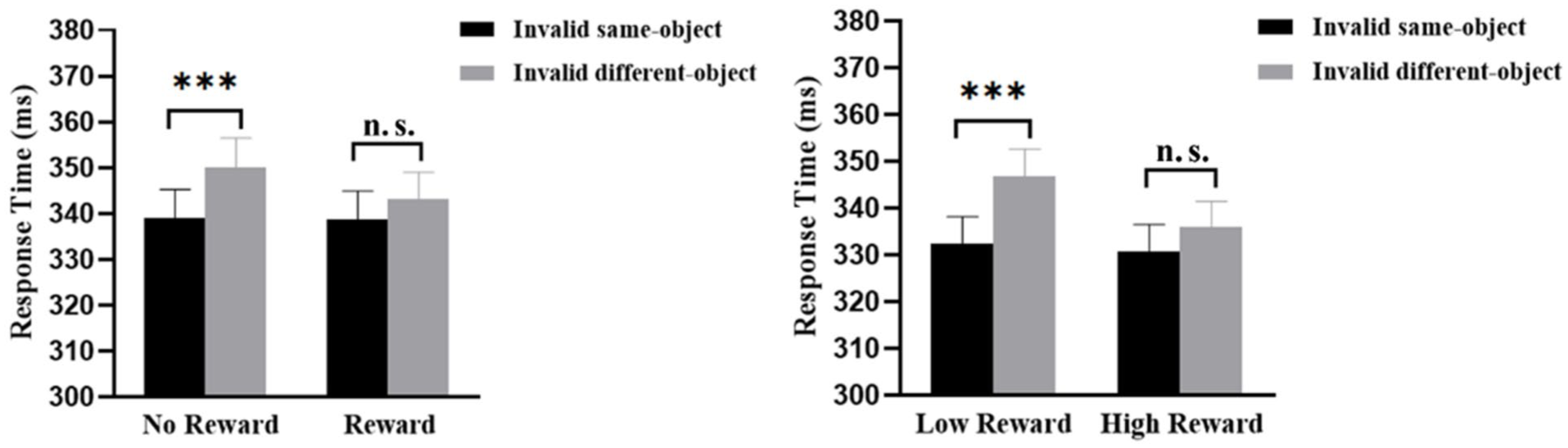
Results of object-based attention effect from Experiment 1a (a) and Experiment 1b (b). Mean reaction times as a function of cue validity and reward (n.s. indicates p > .05, *** indicates p < .001). Error bars represent the standard error.
Analyses of ACC found no significant effects (Experiment 1a: all Fs < 2.31, all ps > .135; Experiment 1b: all Fs < 2.43, all ps > .126). Hence, a speed-accuracy trade-off cannot be inferred from the observed RT patterns.
Discussion
In Experiment 1, no significant difference in the SBA effect was found across varying reward conditions. However, the OBA effect observed in relatively low reward condition disappeared in relatively high reward condition. These findings support the hypothesis that monetary reward specifically modulates the OBA effect without affecting the SBA effect. Comparing Experiments 1a and 1b, where the low reward condition in Experiment 1b matched the reward condition in Experiment 1a in absolute value but differed in relative value, it was concluded that the relative, instead of the absolute value, impacted the OBA effect. Additionally, we found no compelling evidence that the influence of monetary reward depended on gender.
It has been confirmed that the relative value of monetary reward indeed modulated OBA in Experiment 1. However, the relative and absolute values of social reward remained unexplored in previous studies. Therefore, happy facial expressions with increasing intensity levels served as non-verbal social reward feedback in Experiment 2. Consistent with Experiment 1, we set the reward condition in Experiment 2a as the low reward condition in Experiment 2b. Assuming the relative and absolute values of non-verbal social reward resemble those of monetary reward, no OBA effect would be found in the low reward condition, even though it was observed in the reward condition.
Experiment 2
Method
Participants
The sample size and criteria for participant selection were aligned with those used in Experiment 1a. Forty-eight undergraduate students (24 men: Mage = 19.04, SDage = 1.16; 24 women: Mage = 18.79, SDage = 1.25) were recruited for Experiment 2a, and another 48 (24 men: Mage = 19.29, SDage = 1.08; 24 women: Mage = 19.21, SDage = 1.28) for Experiment 2b.
Apparatus and Stimuli
For the two-rectangle paradigm in Experiment 2, the apparatus and stimuli were identical to those in Experiment 1. In Experiment 2a, we selected a picture of three identical humanoid silhouettes for reward condition and a picture of three hourglass silhouettes for no reward condition as the cues. The feedback for reward condition was a slightly smiling face, whereas the feedback for no reward condition was a neutral face (see Figure 1). In Experiment 2b, the cue and feedback for low reward condition were the same as those in the reward condition of Experiment 2a. As for high reward condition, the cue and feedback were a picture of six identical humanoid silhouettes and a beaming face with smiling eyes (see Figure 1). To verify the effectiveness of the stimuli, they were rated using the same protocols as those in Experiment 1. A significant main effect of the sense of reward was observed (F[1, 29] = 116.68, p < .001, η p 2 = .80). Post-hoc tests showed that the ratings of high reward picture (M = 6.87, SD = 1.11) were significantly higher than those of low reward picture (M = 4.93, SD = 1.28), t[29] = 6.75, p < .001, and the ratings of low reward picture were in turn significantly higher than those of no reward picture (M = 2.50, SD = 0.94), t[29] = 8.49, p < .001. The results indicated that the stimuli performed as expected and were appropriate for the formal experiment.
Accordingly, the relatively low reward and the relatively high reward conditions in Experiment 2 were defined in terms consistent with those in Experiment 1.
Design and Procedure
A similar framework encompassing the design and procedure was employed in Experiment 2, following the methodology of Experiment 1.
Results
The analyses were conducted only on RTs from correct trials. RTs exceeding three standard deviations were discarded, leading to the exclusion of approximately 1.46% of the trials in Experiment 2a and 1.75% in Experiment 2b.
SBA Effect
Repeated-measures ANOVAs structured as 2 (gender: female, male) × 2 (cue validity: valid, invalid) × 2 (reward: relatively high reward, relatively low reward) were performed to analyze the mean RTs.
Analyses of RTs (see Figure 5) found a significant SBA effect (Experiment 2a: F[1, 47] = 65.82, p < .001, η p 2 = .59; Experiment 2b: F[1, 47] = 55.38, p < .001, η p 2 = .55), with faster RTs for the valid condition (Experiment 2a: M = 331.61 ms, SE = 5.23; Experiment 2b: M = 330.64 ms, SE = 5.48) than those for the invalid condition (Experiment 2a: M = 344.19 ms, SE = 5.99; Experiment 2b: M = 344.05 ms, SE = 5.77). A significant main effect of reward was also observed (Experiment 2a: F[1, 47] = 8.61, p = .005, η p 2 = .16; Experiment 2b: F[1, 47] = 14.68, p < .001, η p 2 = .24), with faster RTs in the relatively high reward condition (Experiment 2a: M = 335.76 ms, SE = 5.68; Experiment 2b: M = 333.88 ms, SE = 5.76) than those in the relatively low reward condition (Experiment 2a: M = 340.04 ms, SE = 5.55; Experiment 2b: M = 340.81 ms, SE = 5.48). No additional main effects or interactions achieved statistical significance according to the analyses (Experiment 2a: all Fs < 3.46, all ps > .069; Experiment 2b: all Fs < 1.98, all ps > .166). These results suggest that non-verbal social reward does not modulate the SBA effect.
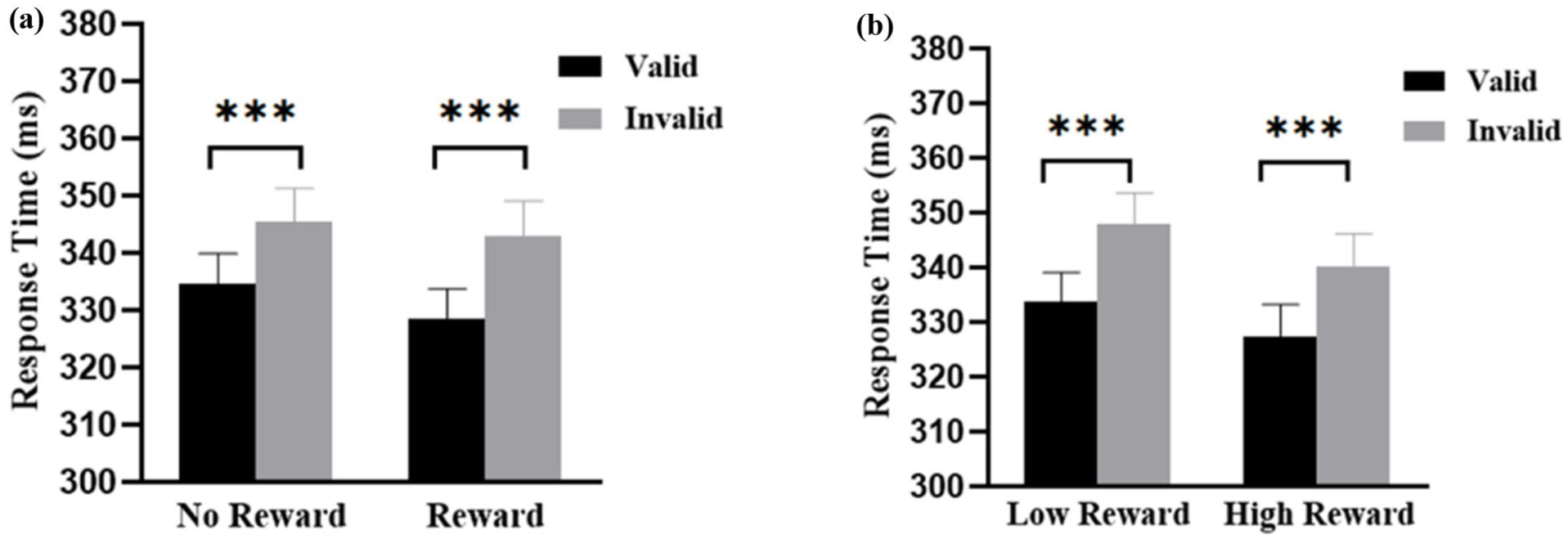
Results of space-based attention effect from Experiment 2a (a) and Experiment 2b (b). Mean reaction times as a function of cue validity and reward (*** indicates p < .001). Error bars represent the standard error.
Analyses of ACC found no significant effects (Experiment 2a: all Fs < 2.79, all ps > .102; Experiment 2b: all Fs < 1.59, all ps > .213). Hence, the RT patterns cannot be regarded as a speed-accuracy trade-off.
OBA Effect
Repeated-measures ANOVAs structured as 2 (gender: female, male) × 2 (cue validity: ISO, IDO) × 2 (reward: relatively high reward, relatively low reward) were performed to analyze the mean RTs.
Analyses of RTs (see Figure 6) showed that the main effect of cue validity was significant (Experiment 2a: F[1, 47] = 48.77, p < .001, η p 2 = .52; Experiment 2b: F[1, 47] = 36.51, p < .001, η p 2 = .44), with faster RTs for ISO condition (Experiment 2a: M = 338.71 ms, SE = 5.91; Experiment 2b: M = 337.84 ms, SE = 5.84) than those for IDO condition (Experiment 2a: M = 349.67 ms, SE = 6.17; Experiment 2b: M = 350.27 ms, SE = 5.88). The main effect of reward was found to be nonsignificant in Experiment 2a (F[1, 47] = 1.75, p = .193, η p 2 = .04), but significant in Experiment 2b (F[1, 47] = 9.99, p = .003, η p 2 = .18), with faster RTs in the high reward condition (M = 340.30 ms, SE = 5.90) than those in the low reward condition (M = 347.81 ms, SE = 5.88). The main effect of gender was not significant (Experiment 2a: F[1, 47] = 0.08, p = .784, η p 2 = .002; Experiment 2b: F[1, 47] = 0.46, p = .503, η p 2 = .01). In addition, the two-way interaction between reward and gender was not significant (Experiment 2a: F[1, 47] = 0.09, p = .760, η p 2 = .002; Experiment 2b: F[1, 47] = 1.44, p = .236, η p 2 = .03), nor was the interaction between cue validity and gender (Experiment 2a: F[1, 47] = 0.25, p = .617, η p 2 = .01; Experiment 2b: F[1, 47] = 0.23, p = .636, η p 2 = .01). The two-way interaction between reward and cue validity was not significant (Experiment 2a: F[1, 47] = 1.81, p = .186, η p 2 = .04; Experiment 2b: F[1, 47] = 0.05, p = .828, η p 2 = .001). Importantly, the three-way interaction among gender, reward, and cue validity was significant (Experiment 2a: F[1, 47] = 15.47, p < .001, η p 2 = .25; Experiment 2b: F[1, 47] = 17.50, p < .001, η p 2 = .28).
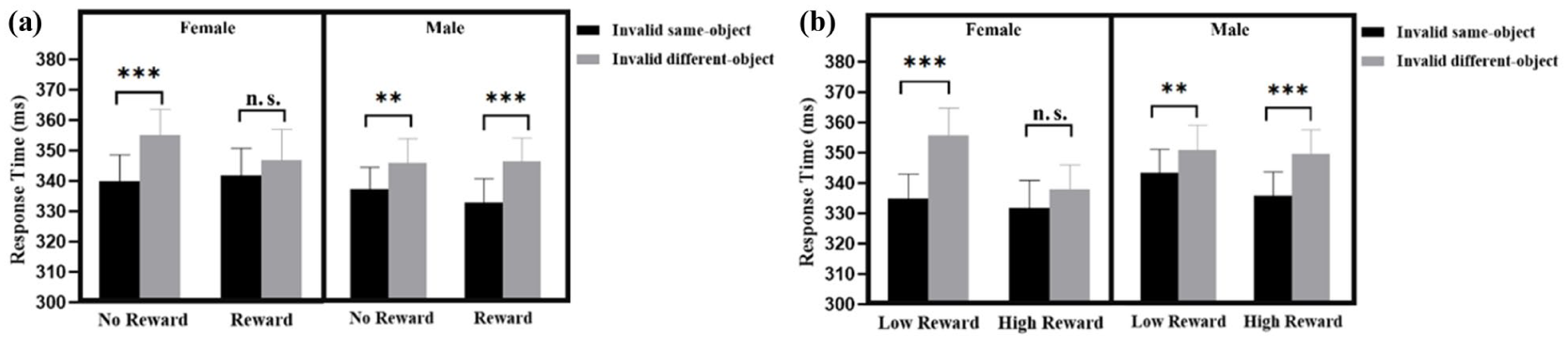
Results of object-based attention effect from Experiment 2a (a) and Experiment 2b (b). Mean reaction times as a function of cue validity and reward (n.s. indicates p > .05, ** indicates .001 < p < .010, *** indicates p < .001). Error bars represent the standard error.
To investigate how non-verbal social reward influences OBA differently in men and women, we split this interaction by gender. For female participants, a significant interaction was observed between reward and cue validity (Experiment 2a: F[1, 23] = 12.51, p = .002, η p 2 = .35; Experiment 2b: F[1, 23] = 14.37, p = .001, η p 2 = .39). Further analyses indicated that, in the relatively low reward condition, women had faster RTs in ISO trials compared to IDO trials (Experiment 2a: t[23] = 5.87, p < .001, Cohen’s d = 0.34, 95% CI [9.71, 20.99]; Experiment 2b: t[23] = 5.05, p < .001, Cohen’s d = 0.50, [10.91, 30.46]), suggesting a significant OBA effect. However, in relatively high reward condition, there was no significant difference in RTs between ISO trials and IDO trials (Experiment 2a: t[23] = 1.91, p = .058, Cohen’s d = 0.11, [−0.17, 10.16]; Experiment 2b: t[23] = 1.50, p = .080, Cohen’s d = 0.19, [−0.80, 13.09]), suggesting the absence of OBA effect. For male participants, no significant interaction between reward and cue validity was observed (Experiment 2a: F[1, 23] = 3.78, p = .064, η p 2 = .14; Experiment 2b: F[1, 23] = 4.00, p = .057, η p 2 = .15). These results indicate that non-verbal social reward modulates the OBA effect in women, but not in men.
Analyses of ACC found no significant effects (Experiment 2a: all Fs < 2.44, all ps > .125; Experiment 2b: all Fs < 0.81, all ps > .374). Hence, a speed-accuracy trade-off cannot be inferred from the observed RT patterns.
Discussion
The findings from Experiment 2 indicated no significant difference in the SBA effect across varying reward conditions. However, for women, the OBA effect that persisted in the relatively low reward condition disappeared in relatively high reward condition; whereas for men, the OBA effect remained unaffected by reward. This indicates that non-verbal social reward modulates the OBA effect solely in women. When comparing Experiments 2a and 2b, it was evident that the relative value of the non-verbal social reward, rather than its absolute value, influenced the OBA effect in women.
In Experiment 2, we found that non-verbal social reward effectively modulated OBA, and this modulation was influenced by gender. However, the role of verbal social reward in influencing OBA is still relatively unknown. Therefore, we developed Experiment 3 to investigate if verbal social reward and non-verbal social reward produce comparable effects on OBA. Additionally, Experiments 1 and 2 both indicated that the OBA effect was influenced by relative value rather than absolute value. To explore the relative and absolute values of verbal social reward, we set the reward condition in Experiment 3a as the low reward condition in Experiment 3b, consistent with that in Experiments 1 and 2.
Experiment 3
Method
Participants
The sample size and criteria for participant selection were aligned with those used in Experiment 1a. Forty-eight undergraduate students (24 men: Mage = 19.88, SDage = 1.23; 24 women: Mage = 19.63, SDage = 1.06) were recruited for Experiment 3a, and another 48 (24 men: Mage = 19.71, SDage = 1.27; 24 women: Mage = 19.75, SDage = 1.19) for Experiment 3b.
Apparatus and Stimuli
For the two-rectangle paradigm in Experiment 3, the apparatus and stimuli were identical to those in Experiment 1. Cues for the SIDT were exactly the same as those in Experiment 2. In Experiment 3a, the feedback for reward condition was a moderately positive Chinese word “很好,” interpreted as “very good,” whereas the feedback for no reward condition was a neutral Chinese word “一般,” interpreted as “okay” (see Figure 1). In Experiment 3b, the feedback for low reward condition were the same as those in the reward condition of Experiment 3a. Additionally, the feedback for high reward condition was an exceedingly positive Chinese word “非常棒!,” interpreted as “excellent!” (see Figure 1). To verify the effectiveness of the stimuli, they were rated using the same protocols as those in Experiment 1. A significant main effect on the sense of reward was observed (F[1, 29] = 125.10, p < .001, η p 2 = .81). Post-hoc tests showed that the ratings of high reward word (M = 7.20, SD = 1.32) were significantly higher than those of low reward word (M = 4.30, SD = 1.25), t(29) = 8.38, p < .001, and the ratings of low reward word were in turn significantly higher than those of no reward word (M = 2.17, SD = 0.75), t(29) = 7.43, p < .001. The results indicated that the stimuli performed as expected and were appropriate for the formal experiment.
Accordingly, the relatively low reward and the relatively high reward conditions in Experiment 3 were defined in terms consistent with those in Experiment 1.
Design and Procedure
A similar framework encompassing the design and procedure was employed in Experiment 3 following the methodology of Experiment 1.
Results
The analyses were conducted only on RTs from correct trials. RTs exceeding 3 standard deviations were discarded, leading to the exclusion of approximately 2.05% of the trials in Experiment 3a and 2.22% in Experiment 3b.
SBA Effect
Repeated-measures ANOVAs structured as 2 (gender: female, male) × 2 (cue validity: valid, invalid) × 2 (reward: relatively high reward, relatively low reward) were performed to analyze the mean RTs.
Analyses of RTs (see Figure 7) found a significant SBA effect (Experiment 3a: F[1, 47] = 91.65, p < .001, η p 2 = .67; Experiment 3b: F[1, 47] = 78.30, p < .001, η p 2 = .63), with faster RTs for the valid condition (Experiment 3a: M = 338.24 ms, SE = 6.07; Experiment 3b: M = 345.69 ms, SE = 7.23) than those for the invalid condition (Experiment 3a: M = 352.35 ms, SE = 6.38; Experiment 3b: M = 360.17 ms, SE = 7.71). The main effect of reward was not significant in Experiment 3a (F[1, 47] = 0.002, p = .968, η p 2 < .001), but significant in Experiment 3b (F[1, 47] = 4.14, p = .048, η p 2 = .08), with faster RTs in the high reward condition (M = 347.07 ms, SE = 7.29) than those in the low reward condition (M = 358.78 ms, SE = 8.59). No additional main effects or interactions achieved statistical significance according to the analyses (Experiment 3a: all Fs < 1.07, all ps > .308; Experiment 3b: all Fs < 1.36, all ps > .250). These results suggest that verbal social reward does not modulate the SBA effect.
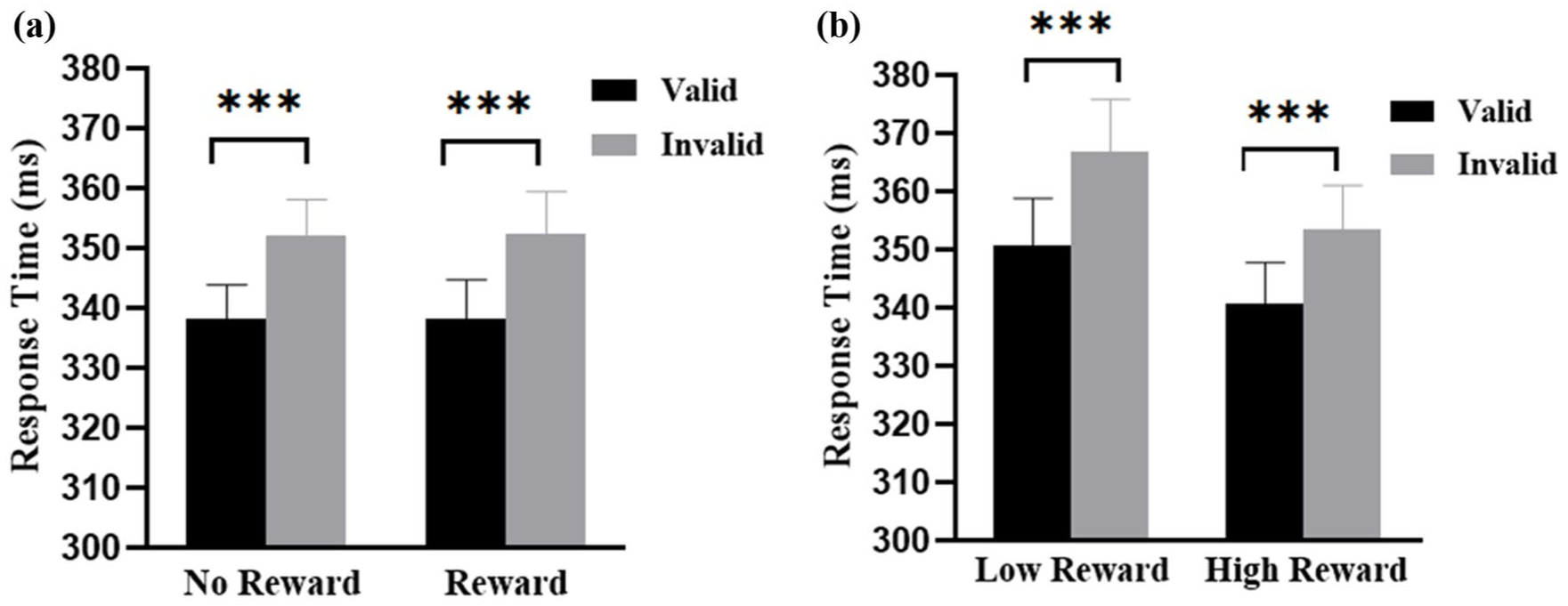
Results of space-based attention effect from Experiment 3a (a) and Experiment 3b (b). Mean reaction times as a function of cue validity and reward (*** indicates p < .001). Error bars represent the standard error.
Analyses of ACC found no significant effects (Experiment 3a: all Fs < 2.79, all ps > .102; Experiment 3b: all Fs < 2.41, all ps > .128). Hence, the RT patterns cannot be regarded as a speed-accuracy trade-off.
OBA Effect
Repeated-measures ANOVAs structured as 2 (gender: female, male) × 2 (cue validity: ISO, IDO) × 2 (reward: relatively high reward, relatively low reward) were performed to analyze the mean RTs.
Analyses of RTs (see Figure 8) found a significant the main effect of cue validity (Experiment 3a: F[1, 47] = 24.64, p < .001, η p 2 = .35; Experiment 3b: F[1, 47] = 20.98, p < .001, η p 2 = .31), with faster RTs for ISO condition (Experiment 3a: M = 347.37 ms, SE = 6.67; Experiment 3b: M = 355.48 ms, SE = 7.70) than those for IDO condition (Experiment 3a: M = 357.33 ms, SE = 6.23; Experiment 3b: M = 364.86 ms, SE = 7.86). The main effect of reward was not significant in Experiment 3a (F[1, 47] = 0.02, p = .899, η p 2 < .001), but significant in Experiment 3b (F[1, 47] = 4.12, p = .048, η p 2 = .08), with faster RTs in the high reward condition (M = 353.53 ms, SE = 7.58) than those in the low reward condition (M = 366.81 ms, SE = 9.11). The main effect of gender was not significant (Experiment 3a: F[1, 47] = 0.31, p = .583, η p 2 = .01; Experiment 3b: F[1, 47] = 0.11, p = .738, η p 2 = .002). In addition, the two-way interaction between reward and gender was not significant (Experiment 3a: F[1, 47] = 0.06, p = .805, η p 2 = .001; Experiment 3b: F[1, 47] = 0.15, p = .696, η p 2 = .003), nor was the interaction between cue validity and gender (Experiment 3a: F[1, 47] = 0.02, p = .900, η p 2 < .001; Experiment 3b: F[1, 47] = 0.02, p = .888, η p 2 < .001). Importantly, the two-way interaction between reward and cue validity was significant (Experiment 3a: F[1, 47] = 9.07, p = .004, η p 2 = .17; Experiment 3b: F[1, 47] = 10.62, p = .002, η p 2 = .19). Further analyses revealed that, in the relatively low reward condition, RTs for ISO trials were faster than those for IDO trials (Experiment 3a: t[47] = 5.75, p < .001, Cohen’s d = 0.32, 95% CI [10.30, 19.41]; Experiment 3b: t[47] = 5.61, p < .001, Cohen’s d = 0.25, [9.30, 20.38]), suggesting a significant OBA effect. However, in relatively high reward condition, RTs for ISO trials were not significantly faster than those for IDO trials (Experiment 3a: t[47] = 1.96, p = .084, Cohen’s d = 0.11, [−0.70, 10.83]; Experiment 3b: t[47] = 1.48, p = .129, Cohen’s d = 0.07, [−1.18, 9.02]), suggesting the absence of OBA effect. The three-way interaction among gender, reward, and cue validity was not significant (Experiment 3a: F[1, 47] = 1.93, p = .172, η p 2 = .04; Experiment 3b: F[1, 47] = 0.02, p = .896, η p 2 = .001). Bayesian repeated measures ANOVA indicated weak evidence against including this three-way interaction in Experiment 3a (BFincl = 0.541) and Experiment 3b (BFincl = 0.491). These results indicate that verbal social reward modulates the OBA effect, and that no gender differences were observed in this experiment.
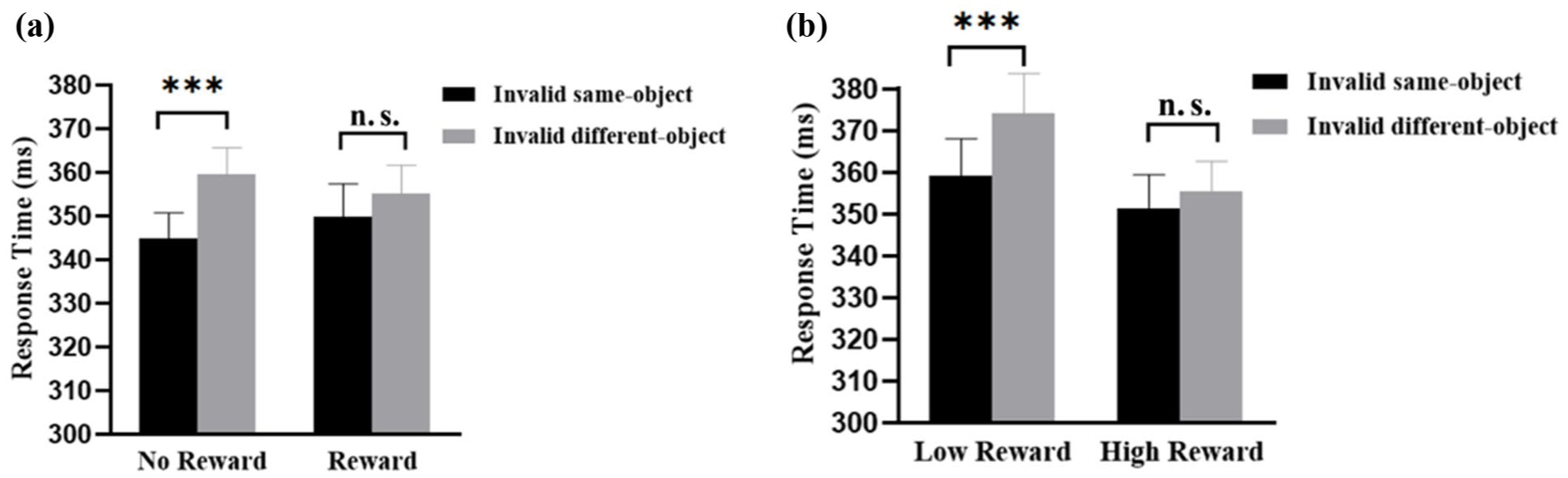
Results of object-based attention effect from Experiment 3a (a) and Experiment 3b (b). Mean reaction times as a function of cue validity and reward (n.s. indicates p > .05, *** indicates p < .001). Error bars represent the standard error.
Analyses of ACC found no significant effects (Experiment 3a: all Fs < 3.02, all ps > .089; Experiment 3b: all Fs < 1.61, all ps > .211). Hence, a speed-accuracy trade-off cannot be inferred from the observed RT patterns.
Discussion
The findings from Experiment 3 indicated no significant difference in the SBA effect across varying reward conditions. However, the OBA effect that was evident in relatively low reward condition disappeared in relatively high reward condition. These results support the hypothesis that verbal social reward modulates only the OBA effect, with no compelling evidence for gender-specific differences. Comparing Experiments 3a and 3b, where the values of the low reward condition in Experiment 3b and the reward condition in Experiment 3a were identical but relatively different, it was determined that relative value of verbal social reward, instead of absolute value, influenced the OBA effect. Additionally, the influence of verbal social reward appeared unrelated to gender.
General Discussion
The present investigation sought to distinguish between SBA and OBA to examine whether monetary, non-verbal social, or verbal social rewards modulate SBA, OBA, or both. The results revealed that SBA remained robust across different types and magnitudes of rewards. However, for monetary and verbal social rewards, the OBA effect was absent in relatively high value conditions. Notably, for non-verbal social reward, the OBA effect was found to vanish exclusively in women, while this effect consistently persisted in men. Therefore, after excluding the bias of non-verbal information in social rewards, we found that the relative values of both monetary and social rewards, rather than their absolute values, eliminated the OBA effect but did not affect the SBA effect.
In the three experiments conducted here, the distinct effects on SBA and OBA attributed to rewards were observed, highlighting the differential properties of these attentional processes. Consistent with the findings of prior research (Shomstein & Johnson, 2013), our study demonstrated that SBA was not influenced by rewards, regardless of reward types. Extensive research spanning decades on SBA has illustrated its robustness and inflexibility, showing that attention is automatically deployed to a location whenever a sensory cue is present (Jans et al., 2010; Macaluso, 2010; Posner et al., 1980; Robertson, 2003). Interestingly, OBA was completely abandoned in the presence of both monetary and social rewards. This finding aligns with prior studies (Diao et al., 2024; Shomstein & Johnson, 2013; Zhao et al., 2020), which suggested that OBA was entirely overridden in the context of the reward-based strategy (Shomstein & Johnson, 2013). However, more recent evidence indicates that OBA can remain robust even when reward-driven strategies are present (Grignolio et al., 2024), suggesting that the extent to which rewards override OBA may vary across contexts. Such findings highlight the need to consider task-specific conditions. In the present study, introducing simple reward anticipation revealed distinct differences between SBA and OBA effects, although they initially seem similarly involuntary and compulsory.
The absence of OBA effects in the high reward conditions may also reflect a shift in attentional dynamics under heightened motivational states. High-value rewards may increase participants’ task engagement or promote goal-directed attention, thereby reducing reliance on stimulus-driven mechanisms such as object-based facilitation. This interpretation aligns with prior research suggesting that reward motivation can enhance sustained attention and diminish the influence of automatic attentional biases (Anderson, 2016; Esterman et al., 2014). Accordingly, high reward conditions may have promoted a more focused attentional mode, leading to reduced expression of OBA effects.
Additionally, the intriguing finding is the gender-specific influence of non-verbal social reward on OBA. In Experiment 2, the neutralization of the OBA effect by non-verbal social reward was observed only in women, but not in men. This result, consistent with several previous studies on social reward (Spreckelmeyer et al., 2009), aligns with our predictions. Social rewards were employed in both Experiments 2 and 3, with the only difference being that non-verbal social stimuli were used in Experiment 2, whereas verbal social stimuli were used in Experiment 3. The gender regulation observed in Experiment 2 disappeared in Experiment 3 following the substitution of non-verbal stimuli (facial expressions) with verbal stimuli (words). Moreover, gender differences in sensitivity to non-verbal information have been well-documented, with numerous studies demonstrating that men are generally less proficient than women in interpreting non-verbal signals (Briton & Hall, 1995; McClure, 2000; Schmid et al., 2011; Toivainen et al., 2017). Thus, the gender differences observed in Experiment 2 and in previous studies are likely the result of sensitivity to non-verbal information, rather than differences between monetary and social rewards. These findings indicate that social and monetary rewards potentially operate on similar fundamental principles, supporting the extended common currency schema.
Furthermore, our study is the first to explore the relative and absolute values of social reward. Evidence from Experiments 2 and 3 indicates that it is the relative value, instead of the absolute value, of social reward that influences OBA, consistent with findings for monetary reward. This is in line with recent research suggesting that attentional allocation can be shaped by contextual value differences. For instance, S. Kim and Beck (2020) demonstrated that the relative value of visual distractors influenced attentional allocation, even when their absolute values were identical. Although prospect theory was originally developed to explain value-based decision-making, their study proposed that the principle of comparing value in relative terms may also be informative for understanding early-stage attentional processes. Building on this perspective, our findings extend the investigation of relative value effects to both monetary and social rewards, providing additional support for the notion that these reward types may share common attentional mechanisms, consistent with the extended common currency schema.
Our results indicate that the relative values of rewards, whether monetary or social, effectively influence attentional selection. Moreover, as established in previous research, monetary rewards may not always enhance intrinsic motivation; in some cases, they can actually lead to its reduction (Albrecht et al., 2014; Deci et al., 1999). For instance, it has been demonstrated that individuals who were given a financial reward showed a decrease in effort on a task once the reward was removed. In contrast, participants who had not received any performance-related incentives maintained their effort levels. Interestingly, participants who were given verbal social reward exhibited an opposite trend: following the withdrawal of encouraging verbal feedback that acknowledged their abilities, their effort levels actually increased. Therefore, verbal social reward has both positive and prolonged effects and is broadly applicable due to the absence of gender differences. This carries important implications for educational settings, where teachers can use verbal social rewards to improve students’ performance by promoting sustained concentration and increasing persistence on academic tasks. Additionally, further clinical research could explore its potential therapeutic effects in addiction recovery (Venniro et al., 2022), as such reward can enhance attentional control and sustain motivation even after reward withdrawal, offering a stable and effective intervention strategy.
Nevertheless, certain methodological limitations should be noted. First, although we equated subjective reward values across conditions using participant ratings, this approach may not fully account for differences in attentional salience or actual motivational impact across reward types. Subjective ratings may reflect conscious preferences but not necessarily the implicit attentional weight or behavioral potency associated with different stimuli. This limitation should be considered when interpreting the observed effects, and future work may benefit from combining subjective measures with more direct indices of reward salience or value representation. In addition, our study focused on objective values and examined the relative–absolute distinction in line with prospect theory, but it did not incorporate the distinction between subjective and objective value representations emphasized by recent work (Soltani et al., 2021). Future research should consider how these two dimensions—subjective versus objective and relative versus absolute—may jointly shape attentional mechanisms. Furthermore, the use of a between-subjects design prevented within-subject comparisons. This choice helped avoid carryover or strategic effects, especially since presenting both reward types to the same participants could have altered their perceived value. It also avoided excessively long sessions that might induce fatigue. Future studies could adopt within-subject designs to enable more direct comparisons across reward types, provided that sequence and fatigue-related confounds are carefully controlled. Finally, because reward feedback was symbolic rather than tied to actual payment or real social outcomes, the generalizability of our findings to fully consequential reward contexts remains to be tested in future work using performance-contingent monetary and real social rewards.
To conclude, the current research evaluated the impact of monetary and social rewards on selective attention through three experiments utilizing a modified two-rectangle paradigm, combined separately with the MIDT and SIDT. After accounting for the bias of non-verbal information, we concluded that the relative values of both monetary and social rewards eliminated OBA without influencing SBA. This finding provides further evidence for the extended common currency schema, suggesting that the prospect theory can be extended to earlier cognitive stages and various reward types.
Supplemental Material
sj-docx-1-qjp-10.1177_17470218261417302 – Supplemental material for For Praise or Money: The Impact of Different Types of Symbolic Rewards on Selective Attention
Supplemental material, sj-docx-1-qjp-10.1177_17470218261417302 for For Praise or Money: The Impact of Different Types of Symbolic Rewards on Selective Attention by Jing Zhou, Feiyu Diao, Yunfei Gao, Jingjing Zhao and Yonghui Wang in Quarterly Journal of Experimental Psychology
Footnotes
Acknowledgements
The authors appreciate the Humanity and Social Science Youth Foundation of the Ministry of Education of China and the Natural Science Foundation of Shaanxi Province for financial support.

Ethical Considerations
The study was conducted in accordance with the Declaration of Helsinki, and approved by the Ethics Committee of School of Psychology at the Shaanxi Normal University with reference numbers HR2023-10-009, approval on 18 October 2023.
Consent to Participate
Informed consent was obtained from all subjects involved in the study. The privacy rights of human subjects have been observed.
Funding
The authors disclosed receipt of the following financial support for the research, authorship, and/or publication of this article: This research was supported by the Humanity and Social Science Youth Foundation of the Ministry of Education of China (22YJC190030) and the Natural Science Foundation of Shaanxi Province (2025JC-YBQN-254).
Declaration of Conflicting Interests
The authors declared no potential conflicts of interest with respect to the research, authorship, and/or publication of this article.
References
Supplementary Material
Please find the following supplemental material available below.
For Open Access articles published under a Creative Commons License, all supplemental material carries the same license as the article it is associated with.
For non-Open Access articles published, all supplemental material carries a non-exclusive license, and permission requests for re-use of supplemental material or any part of supplemental material shall be sent directly to the copyright owner as specified in the copyright notice associated with the article.
