







Abstract
Implicit (unconscious) learning ostensibly affects cognitive and social skills in both typical and atypical populations, such as those on the autism spectrum. Research into implicit learning in autism has yielded conflicting results, underscoring the need to explore factors that might influence their implicit learning. One such factor is processing style, specifically processing biases for either global (holistic) or local (detail-oriented) processing. In our experiment, we investigated the potential role of processing differences in implicit (and explicit) learning performance in individuals with autism (n = 20) and typically developing (TD) individuals (n = 22), by using a global-local version of the artificial grammar learning (AGL) task. Overall AGL performance and explicit knowledge yielded only a trend toward an interaction suggesting a greater global processing advantage in TD participants compared with that in participants with autism but no conclusive evidence. The above interaction was further observed in terms of implicit knowledge, with TD participants demonstrating higher levels of implicit structural knowledge than individuals with autism during global processing. Implicit knowledge between group differences during local processing remains weak/inconclusive. Overall, our findings suggest interesting potential processing differences in the implicit learning between individuals with and without autism.
Keywords
Introduction
Implicit learning refers to knowledge acquisition through passive exposure to complex patterns or regularities and without people’s effort or even conscious awareness (e.g., Reber, 1967, 1993). Individuals engage in implicit learning without explicit instruction and without being able to state what they have learned. Importantly, this definition does not imply that conscious awareness is entirely absent at all stages of learning in tasks that aim to elicit implicit learning; rather, implicit and explicit learning processes commonly coexist and both support task performance (e.g., Dienes & Perner, 1999; Dienes & Scott, 2005). Prior to a phase of learning, in experimental tasks that study implicit learning, individuals receive no information about the existence of any structured regularities embedded in the task. For instance, in the training phase of the artificial grammar learning (AGL) task (Reber, 1967, 1993), one of the most extensively used implicit learning paradigms and the one also used in the present study, participants observe strings of symbols without knowing that these strings are constructed by some complex artificial grammar rules. Under such an unintentional mode of processing during training, learning may involve limited or no conscious access to the underlying structure, although learners may as well develop some conscious knowledge too. Following learning, in the test phase of the AGL task, people are asked to judge the grammaticality of new symbol strings. The conscious or unconscious status of the knowledge demonstrated in this phase is often assessed by subjective measures like Dienes and Scott’s (2005) method, in which people are asked to report the strategy on which they based each of their responses, with results often providing evidence of some unconscious knowledge (e.g., Guo et al., 2013; Mealor & Dienes, 2013; Ziori et al., 2014). The consciousness of knowledge acquired in implicit learning tasks is also often judged by post-experimental direct tasks like recognition tests, which have been shown to be primarily sensitive to explicit item-specific (e.g., whole-item or chunk-based) knowledge (e.g., Batterink et al., 2015; Knowlton & Squire, 1996; Knowlton et al., 1992; Liu et al., 2023).
According to Reber (1967, 1992, 1993), who provided the first experimental claim of implicit learning via the AGL task, implicit processes are rather robust and are thus expected to show reduced variability with respect to individual characteristics including various neurological disorders. However, later studies have challenged Reber’s views, suggesting that implicit learning may be subject to variation in people’s traits and characteristics, including intelligence (e.g., Danner et al., 2011), executive functioning (e.g., Pedraza et al., 2024), age (e.g., Lukács & Kemény, 2015), and personality traits (e.g., Kaufman et al., 2010). The notion that implicit processes may be affected by individual and developmental factors has directed researchers’ interest toward whether this type of learning can also be affected by various clinical or neurological disorders.
One such condition is autism spectrum disorder (ASD), namely, a syndrome that encompasses repetitive behaviors and frequent deficits in cognitive functioning, social communication, language development, and sensorimotor skills, which begin early in life and vary widely in intensity. Numerous studies have extensively explored various aspects of this complex disorder, which is now recognized as a highly heterogeneous condition of varying severity and causes. In this paper, we use a mix of person-first (e.g., individuals/people with autism) and identity-first (e.g., autistic people/individuals) terminology when referring to ASD or to people with this condition, in alignment with the guidelines of recent research, in order to cover the different preferences of both professionals and individuals with this condition (see, e.g., Buijsman et al., 2023; Kenny et al., 2016; Martinez et al., 2025).
Implicit learning has been studied for several decades; however, the research field that explores the implicit learning capacity in people with neurodevelopmental disorders, including autism, has increased considerably in recent years. The way implicit learning functions in individuals with autism may improve our understanding of this particular condition. For example, the possibility of implicit learning deficits could help explain why people with autism face difficulties in social interactions, communication, and motor abilities, all of which are thought to depend on implicit learning processes (e.g., Conway & Pisoni, 2008; Jurchiș & Dienes, 2023; Reber et al., 2019; Reed et al., 2010).
Despite the increasing research interest on whether and how autism affects implicit learning skills, the evidence is still far from conclusive. A substantial number of studies have examined visuomotor implicit learning in autism, mainly by using serial reaction time–type paradigms. Their findings range from preserved implicit learning (e.g., Nagy et al., 2025; Németh et al., 2010; Pesthy et al., 2023; Travers et al., 2010; Treves et al., 2024) to reduced or delayed learning relative to typically developing (TD) groups (e.g., Gidley Larson & Mostofsky, 2008; Gordon & Stark, 2007; Mostofsky et al., 2000; Travers et al., 2015). These discrepancies have been interpreted in terms of task demands, learning rate differences, or developmental factors. Other studies have focused on contextual cueing paradigms, which assess the implicit learning of spatial regularities. Intact contextual cueing effects in autism have been reported by Brown et al. (2010) and Kourkoulou et al. (2012), whereas later work suggests reduced or altered learning effects in autism under certain conditions (Travers et al., 2013; Xie et al., 2024). Notably, enhanced implicit learning performance in autism has been reported in a visuospatial implicit learning task by Roser et al. (2015), suggesting that under certain task conditions implicit learning may not only be preserved but even superior in individuals with autism. By contrast, studies with prototype learning tasks, which rely on abstraction across exemplars, have yielded evidence for impaired implicit learning in autism (Gastgeb et al., 2012; Schipul & Just, 2016), pointing to possible limitations on category learning mechanisms. Studies employing AGL paradigms have also produced mixed results, with evidence for intact (Brown et al., 2010), impaired (Klinger et al., 2007) or preserved but less developed (Ziva & Ziori, 2025) implicit learning abilities in autism.
Taken together, this diverse pattern of findings suggests that implicit learning in autism is not consistently impaired. Indeed, meta-analytic reviews show that, on average, implicit learning ability is preserved in people with autism (Foti et al., 2015; Obeid et al., 2016), while also emphasizing that the notable variability across studies may stem from task characteristics and/or individual factors that may affect implicit learning performance of individuals with autism. Nevertheless, it should be noted that most of the above studies (with the exception of Ziva & Ziori, 2025) have inferred the presence of implicit knowledge relying solely on participants’ performance in implicit learning tasks or have applied insensitive measures of awareness. For example, some studies (e.g., Brown et al., 2010; Németh et al., 2010; Pesthy et al., 2023; Roser et al., 2015) have drawn conclusions regarding participants’ acquired knowledge based on their verbal reports, an approach that has been strongly criticized for not being sensitive enough to accurately capture conscious knowledge (see, e.g., Dienes & Berry, 1997; Shanks & John, 1994). Other studies have used only prediction or recognition tests (Travers et al., 2010, 2013; Treves et al., 2024; Xie et al., 2024), which assess primarily explicit knowledge without providing information about the contribution of implicit processes in performance. Given that performance in implicit learning tasks typically reflects a combination of conscious and unconscious effects, the lack of sensitive measures is a significant limitation that may partly account for the mixed results observed in previous work.
Researchers aiming to explain the contradictory results of implicit learning studies in autism have examined whether implicit learning performance is varied due to specific characteristics/symptoms of the condition, which might vary between autistic groups across studies (noting that there are inconsistencies in autism characterization in different studies). Current data suggest that the reported differences in the pattern of implicit learning performance detected in the autistic and TD groups can neither be directly attributed to the main symptomatology of autism, regardless of its severity, nor to autistic individuals’ intellectual abilities (e.g., Brown et al., 2010; Travers et al., 2010, 2013; Xie et al., 2024; Ziva & Ziori, 2025; but see Schipul & Just, 2016 and Travers et al., 2015 for exceptions regarding autism symptomatology, and Gastgeb et al., 2012 for an exception regarding the influence of IQ differences).
Considering the above conflicting results, further research would be useful as a means to disambiguate these discrepancies. In a very recent study, Ziva and Ziori (2025) suggested that exploring the role of a broader range of individual characteristics in implicit learning could possibly shed more light on the different patterns of implicit learning observed in neurotypical individuals and individuals with autism. They proposed that one such characteristic is individual processing style, namely, the way individuals prefer to process information, by focusing their attention either on the whole picture (i.e., more global information) or on more detailed, local information. Given the various suggestions regarding attentional differentiation between individuals with autism and TD individuals, this approach offers promise to progress this debate, not in terms of whether implicit learning is generally intact in people with autism, but rather in terms of highlighting particular aspects of deficit versus competence. Presumably, implicit learning may vary across different kinds of perceptual processing; a pertinent distinction concerns global processing (i.e., attending to the big picture of a stimulus) versus local processing (i.e., attending to the details of a stimulus).
Whether differences between local and global processing affect implicit cognition has been attracting some attention. For example, Kiyokawa et al. (2012) reported that a group of Japanese students demonstrated a clear bias for global processing, displaying chance performance when it came to local processing, in a global-local version of an AGL task, like the one used in our study. By contrast, U.K. students exhibited comparable learning for both processing types. Pertinently, this effect persisted even when the structural knowledge they had gained was implicit in nature. Two more recent studies examined the impact of processing biases on implicit skills, specifically on implicit memory. Hine and Tsushima (2018) found that the implicit (and not the explicit) memory of their TD subjects was affected by individual perception style such that participants who displayed a local processing bias relied more on implicit memory than those with a global processing style. In another study, Lebreton et al. (2021) examined how the local processing tendency of individuals with autism affects implicit and explicit memory under global and local processing conditions. They found that, in the implicit memory condition, the local processing bias of the autistic group reduced their ability for globally directed processing, while in the explicit condition it impaired their ability to distinguish between stimuli with common characteristics.
Taken together, the above findings suggest that different processing tendencies may have an impact on competences related to implicit versus explicit processing.
Processing Biases in Autism and Their Role on Implicit Learning
As already mentioned, processing tendencies (biases toward global or local processing) may vary between individuals and reflect how people tend to perceive and analyze information, through either a holistic (global) or a detailed-oriented (local) perspective. A putative tendency of individuals with autism for local information processing is an idea supported by certain theories aiming to explain cognitive processing in autism, namely, by the weak central coherence (WCC) theory, introduced by Frith (1989); see also Happé and Frith (2006) and Morgan et al. (2003) and the enhanced perceptual functioning (EPF) theory postulated by Mottron and Burack (2001) and Mottron et al. (2006). Although both theoretical frameworks propose that people with autism are expected to demonstrate a bias for local processing, the WCC theory predicts reduced global processing abilities in autistic groups as a result of deficits in central coherence, while the EPF model postulates that global functioning in autism is unimpaired, although a person with autism is likely to use global processing mechanisms less frequently.
Visuospatial perception in autism has been extensively explored, but with varying and inconsistent results. For example, a study by Chen et al. (2012) found that adolescents with autism showed enhanced local visual processing and slightly reduced global processing abilities compared with healthy controls, while Nilsson Jobs et al. (2018) found that young children that had received an autism diagnosis had superior performance on a local visual task but did not differ from other groups with no such diagnosis on global tasks. By contrast, a meta-analysis on the visuospatial skills in populations with autism indicates that the differences observed in the processing of holistic (global) and more detailed (local) information between subjects with autism and neurotypical subjects are minor (Muth et al., 2014). Individuals with autism appear to show a tendency for local information, albeit of a small-to-medium magnitude. Similarly, another meta-analysis of studies of autistic groups aged 6 to 35 years suggests that information processing in autism is not that atypical: The results showed neither a widespread impairment in the processing of global information nor a superior performance in local processing for individuals with autism (Van der Hallen et al., 2015).
Other authors propose that the processing of global information remains unimpaired in autism, but local processing biases may be observed more frequently in tasks allowing participants to choose the preferred processing style. More specifically, in visuospatial tasks where there are no specific instructions asking participants to focus on a particular type of information (either global or local), individuals with autism appear to show a bias for local levels of processing and reduced global processing (Koldewyn et al., 2013; Plaisted et al., 1999). Relatedly, Van Eylen et al. (2018) showed that, when it comes to controlled experimental conditions, the processing abilities of participants with autism were almost comparable with those of a TD group, although there may be some variation due to the nature of the task (see also D’Souza et al., 2016) and demographic factors like age and gender. Their results suggest a weak global processing deficit in autism and a consistent but not remarkable bias toward local features. In another study, Neufeld et al. (2020) found decreased global processing in subjects with autism but not enhanced local processing (for similar results, see also Booth & Happé, 2018; Nayar et al., 2017). By contrast, Bouvet et al. (2014) found a local bias and intact global processing in autism using auditory stimuli with a hierarchical structure. In all, it seems that the differences in information processing between individuals with autism and neurotypical individuals are not consistent. However, most evidence seems to point to a relatively lower global advantage of autistic people than that of TD groups, most likely because of their local processing bias. Evidence for a crossover interaction is also supported, albeit by a limited number of studies and is highly dependent on specific task demands (e.g., Koldewyn et al., 2013; Plaisted et al., 1999).
A gap in the implicit learning literature concerns the fact that very little is known about the role of processing biases on how individuals with autism process information implicitly. Kourkoulou et al. (2012) showed that individuals in the spectrum were overall slower than a TD group in their responses in an implicit visual search task (see also Travers et al., 2013; Xie et al., 2024), but they were able to acquire some knowledge of the task, independently of whether it demanded learning from global or local spatial configurations. Notably, the only known study that specifically explores global versus local information processing in implicit learning of individuals with autism versus TD individuals is Ziva and Zori (2025) – this study contradicted the expectations of both the WCC and the EPF theories. In this study, both groups showed a global processing advantage; however, the TD group demonstrated a weaker global processing bias and only in terms of reaction time and not accuracy. Furthermore, the TD group outperformed the autistic group in general and especially when local processing was required. Ziva and Ziori’s (2025) findings indicate a possible connection between the decreased implicit learning performance of the autistic group and difficulties in information processing, mainly at the local level.
In Ziva and Ziori’s (2025) study, participants first performed one of the most widely used implicit learning tasks, namely, the AGL task (e.g., Pothos, 2007; Reber, 1967; Reber et al., 1991). After the AGL task, participants were instructed to perform a Navon task, which measures peoples’ processing biases toward global versus local features (or the whole picture vs. the details) of a visual stimulus (Navon, 1977).
The autistic group had above chance AGL performance, but lower than that of the TD group. Results from the Navon task showed that the TD group demonstrated an advantage in both global and local processing compared with participants with autism, who struggled mainly with processing local elements. Most importantly, the authors reported a correlation between AGL performance and individual perception style for the TD group, with higher grammaticality performance being associated with a reduced preference for global processing. A possible interpretation of this finding may be that a processing orientation emphasizing local elements, rather than the global picture, could be linked to enhanced AGL performance, as AGL may (among other parts) involve the learning of detailed information like the learning of adjacent dependencies, which may be considered a more local type of processing. Hence, the observed bias of the autistic group toward global processing could potentially have impeded their capacity to do well in the AGL task.
To sum up, the limited existing knowledge of how individual differences in processing biases might influence implicit learning processes in populations with autism versus TD populations highlights a notable research gap in this specific area. This paper aims to provide new perspectives on implicit learning mechanisms and the way they might be differentiated between individuals with autism versus TD individuals, as a function of processing biases.
The Present Study
Ziva and Ziori’s (2025) approach involved correlating results from two separate tasks, namely, one assessing implicit learning and one assessing individual processing biases toward global or local information. This presents an interpretative challenge, since global versus local tendency in one task does not necessarily translate to global versus local tendency in implicit learning and AGL specifically. Therefore, in the present study both global and local processing modes were included within the same task, by using a global versus local version in the same AGL paradigm. This experimental design allows us to examine whether individual processing biases may have a moderating role in AGL outcomes, thereby filling a gap in the existing AGL research on the implicit learning of people with autism. If this is the case, then the discrepancies observed in earlier work on implicit learning in autism may, at least in part, reflect differences in task characteristics related to local versus global processing biases, rather than general implicit learning challenges for populations with autism.
We created a global-local version of the AGL paradigm using the GLOCAL letter sequences generated from two different artificial grammars from Tanaka et al. (2008). GLOCAL sequences were originally developed by Tanaka et al. (2008) as a method of examining the effect of attention biases within the AGL paradigm (see also Kiyokawa et al., 2012; Li & Shi, 2016). These sequences are composed of compound letters, following the concept introduced by Navon (1977). Each compound letter is comprised of a larger, global letter constructed from a collection of smaller local letters. Consequently, as can be seen in Figure 1, a GLOCAL sequence may be perceived as one coherent sequence when seen as a global stimulus (e.g., ΝΝΣΤΣ) and simultaneously as a different sequence if one focuses on the details or the local level of each large letter (e.g., ΓΜΓΖΖ). Note, for a neurotypical individual it may appear that processing on the global level is easier; however, there is evidence that participants with autism are more interested in (or just focus more on) the detailed structure.

Example of a GLOCAL string used in the present experiment.
Finally, in contrast to most previous studies that investigated implicit learning in autism relying only on participants’ performance on implicit learning tasks or on insensitive measures of consciousness, we applied both a subjective measure used in many implicit learning studies and a post-experimental recognition task. Doing an AGL task can lead to both (ostensibly) implicit and explicit knowledge. In the context of AGL in particular, learners may demonstrate knowledge of whether a sequence is grammatical or ungrammatical, which is referred to as judgment knowledge, and knowledge of the specific features or regularities underlying grammaticality judgments, which is referred to as structural knowledge. Judgment knowledge has traditionally been assessed mainly using confidence-based measures that capture participants’ awareness of the correctness of their responses (e.g., Dienes et al., 1995; Scott & Dienes, 2008; Ziva & Ziori, 2025). However, the presence of conscious judgment knowledge does not inform us at all on the consciousness of structural knowledge that led to a decision. More specifically, unconscious judgment knowledge suggests unconscious structural knowledge, but conscious judgment knowledge may be accompanied by either conscious or unconscious structural knowledge. In the present work we examine only the (un)consciousness of structural knowledge, as is done in many relevant implicit learning studies (e.g., Kiyokawa et al, 2012; Norman et al., 2016; Ziori et al., 2014), as our focus is on what participants know, namely, on the knowledge the two groups acquired about the structure of global and local training sequences. To this end, we used a method widely used in AGL experiments, whereby participants are asked to report the rationale behind their classification judgments (Dienes & Scott, 2005). Moreover, given that knowledge of the artificial grammar structure may encompass awareness of specific items or fragments of items (Dienes & Scott, 2005), we tested whether participants had acquired any fragment knowledge (bigrams) of the training sequences, by also using a post-task recognition test of bigrams (see, e.g., Johnstone & Shanks, 2001; Perruchet & Pacteau, 1990). Recognition tests mainly assess explicit knowledge, therefore, above chance performance on such tests means that participants may have gained at least some conscious knowledge of particular parts of the grammar.
Method
Participants
An a priori power analysis was used to determine the appropriate sample size. To estimate the appropriate effect size for the two-way interaction between group (ASD vs. TD) and level of processing (global vs. local), we relied on various previous studies. As this is the first known study that investigates local versus global processing in populations with autism versus TD populations with an AGL task, we relied both on previous studies with similar design and populations, but different experimental task (Bouvet et al., 2014; Ziva & Ziori, 2025) and on the one known study that used exactly the same design, dependent variables, and experimental task. but different populations, that is, TD adults (Kiyokawa et al., 2012). The effect sizes of the first two studies range from η p 2 = .11 (the lowest of the two relevant η p 2 values in Ziva & Ziori, 2025) to η p 2 = .33 (the highest of the three η p 2 values in Bouvet et al., 2014). In Kiyokawa et al. (2012), the effect size was η p 2 = .19 (as converted from the reported Cohen’s d = 0.97) in the overall AGL performance and in implicit structural knowledge, and η p 2 = 0.32 (as converted from the reported Cohen’s d = 1.38) in explicit structural knowledge. We opted for the conservative approach of using the lowest of the above effect sizes (i.e., η p 2 = .11, which corresponds to f = 0.35), to ensure that our study is adequately powered, and more specifically to account for potential overestimation of previous effect sizes, sample variability and methodological differences as well as to increase the generalizability of our findings. The a priori power analysis with an effect size of f = 0.35 for the interaction of interest, a power level of 0.90, and an alpha set at .05 indicated a sample size of 24. However, we decided to use a substantially larger sample size (N = 42) to handle potential variability due to individual differences, as well as adjusting for a potential participant dropout.
Twenty Greek-speaking individuals with autism were recruited from public schools of western Greece. Every participant in the autistic group had received an official diagnosis from public Diagnostic Assessment Centers. Other psychiatric or neurological conditions were used as exclusion criteria. The control group consisted of 22 individuals who had never received any psychiatric or neurodevelopmental disorder diagnosis and was matched with the autistic group in terms of age, t(40) = 1.26, p = .214, d = 0.390; gender, χ2 = .038, p = .845; full-scale IQ, t(29.09) = −1.71, p = .098, g = −0.532; verbal IQ, t(40) = −1.44, p = .157, d = −0.446; and performance IQ, t(40) = −1.68, p = .094, d = −0.530. Both groups underwent an assessment of symptoms indicative of autism, via the Childhood Autism Rating Scale (CARS; Schopler et al., 1986). The above scale is a well-established 15-item screening tool for the identification of autism and the evaluation of the symptoms’ severity. The range of scores lies between 15 and 60, with individuals scoring below 30 indicating a nonautistic diagnosis. Participants’ verbal, nonverbal, and general intelligence were estimated with the Greek-Cypriot edition (Spanoudis & Tourva, 2012) of the Wechsler Abbreviated Scale of Intelligence (WASI; Wechsler, 1999), which is intended for administration to people over 6 years old. Due to the AGL task’s complexity, especially during the test phase, prospective participants with a full-scale IQ below 70 were excluded from this study. This decision aimed at ensuring that all participants from both groups would understand well the instructions and experimental task requirements. The mean age, WASI scores, and CARS scores of our sample are shown in Table 1.
Mean Age, WASI, and CARS Scores for the TD and ASD Groups.
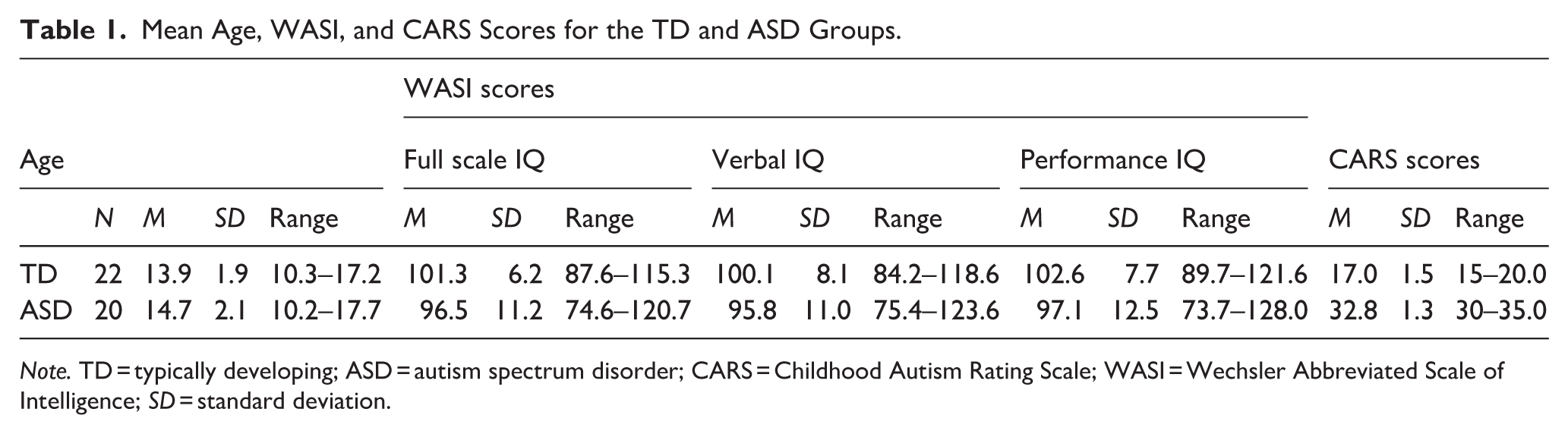
Note. TD = typically developing; ASD = autism spectrum disorder; CARS = Childhood Autism Rating Scale; WASI = Wechsler Abbreviated Scale of Intelligence; SD = standard deviation.
Ethical permission to conduct the experiments was granted from the Greek Ministry of Education, as well as from the Ethical Committee of the University of Ioannina. As part of the ethics protocol of the study, participants’ parents gave their informed agreement for their children’s participation, by signing a written, informed consent, while all participants (including underage ones) themselves also gave their informed assent before the onset of the study.
Stimuli
For the learning phase, we created grammatical sequences from the two artificial grammars used in Tanaka et al. (2008), with the difference that Roman letters were replaced with Greek ones (Figure 2). The letter sequences were three to six letters long. For half the participants, Grammar 1 was the basis of strings with a global structure, while Grammar 2 produced strings with a local structure; for the other half of participants, the correspondence between grammars and global versus local level was reversed. For the presentation of the GLOCAL sequences, we used blue capital letters on a white background. A large letter displayed on the screen had a height of about 4 cm and a width from 2.5 to 3.5 cm. Participants were presented with a total of 108 training items in a testing screen of 1,024 × 768 resolution.
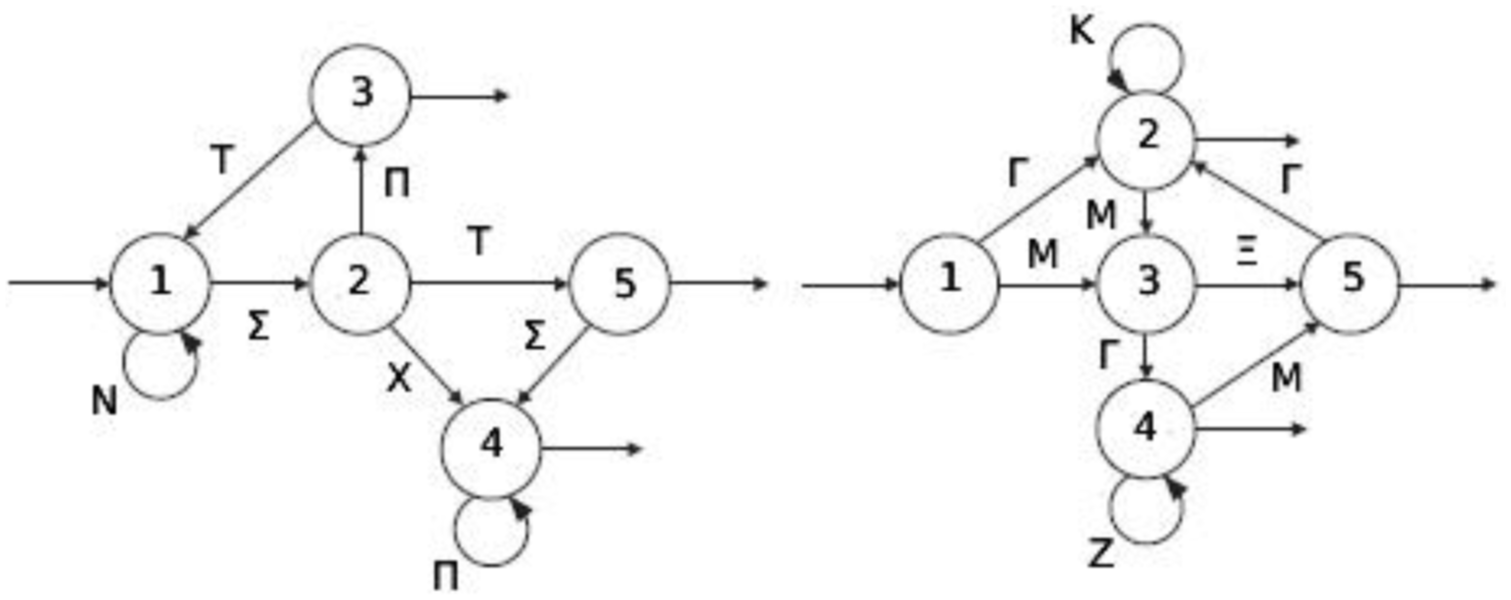
Two grammars used in the present study (adapted from Tanaka et al., 2008). The one on the left corresponds to Grammar 1, and the other on the right to Grammar 2.
For the test phase, 20 grammatical letter sequences consisting of 5 to 6 letters were created from each grammar. Unlike the GLOCAL sequences of the learning phase, these were created using simple letter sequences (i.e., not combinations of larger and smaller letters). Half of the test sequences had been presented during training, while the other half had not. The nongrammatical sequences were constructed by violating the rules in the grammatical sequences, and in particular by replacing one or two characters (see the appendix in Tanaka et al., 2008). The test phase had 40 pairs of items such that 20 pairs corresponded to the local items and the other 20 to the global items. For each pair, there was a grammatical item and a matched ungrammatical one, with the same length as the grammatical one.
Procedure
All stimuli were presented on a 14-inch laptop screen, with participants sitting at an approximate distance of 50 cm away from the screen. The experimenter maintained a discreet presence only to give the instructions that were necessary to the procedure. This approach ensured that face-to-face contact remained limited and consistent across all participants (cf. Farkas et al., 2023, 2024).
PsychoPy3 Experiment Builder, v2020.2.8 (Peirce et al., 2019) was used to administer the task. All participants were provided with both oral and written instructions. Examples of the learning and test sequences were presented before proceeding to each of the two phases, and comprehension was tested through follow-up questions asked by the experimenter and feedback during these preexperimental examples. Special attention was given to individuals with autism by using simple language. Testing took place in quiet rooms, with the whole session lasting around 40 min. All responses were recorded individually for each participant.
During the learning phase, a total of 18 GLOCAL sequences were displayed on the screen. Half of the participants saw 18-letter strings following Grammar 1 at one level (e.g., the global) and Grammar 2 at the other (i.e., the local), and the remaining participants saw 18 strings following the reverse correspondence of grammar to levels. Each participant was asked to pay special attention to the strings, without receiving any specific guidance as to which of the two levels to focus on. Each GLOCAL string appeared six times, which produced 108 strings, with each string staying on the screen for 6 s. Within each block of 18 strings, a message appeared 3 times in a random order, instructing participants to write down the last sequence of large letters (i.e., the global string) or the last sequence of small letters (i.e., the local string) they had seen. This was done to prevent prolonged distraction. GLOCAL strings were separated from each other by a mask stimulus (a series of “+” signs) that appeared at the location of a string for a 1 s.
At the end of the training phase, participants heard for the first time that the training strings of each of the two levels had been constructed by some complex rules. Next, they entered the test phase, which comprised two blocks of stimuli, each of which was presented twice. One block contained 20 pairs of sequences generated from the grammar presented at the global level (with each pair consisting of 1 grammatical and 1 nongrammatical sequence), and the other block contained 20 pairs of sequences generated from the grammar presented at the local level (with each pair also consisting of 1 grammatical and 1 nongrammatical sequence). One sequence in each pair appeared in the upper part of the screen, and the other in the lower part of the screen. Thus, during the test phase, participants observed 40 global and 40 local pairs, and for each pair, they had to decide which of the 2 strings was grammatically correct. The matching of grammatical and nongrammatical strings in each pair was randomized for each participant, with each pair always consisting of strings of the same length. The stimulus presentation during testing was counterbalanced among participants such that half of the participants started with global strings and the other half with local ones. Responding during test was self-paced.
For each response, participants were also instructed to indicate whether their classification stemmed from guessing, intuition, familiarity, recollection, or rules (Dienes & Scott, 2005; Scott & Dienes, 2008; see also Ziori & Dienes, 2015; Ziori et al., 2014). More specifically, they were asked to indicate which of the following options best described the basis of their response:
Guess: My judgment is entirely random.
Intuition: I feel that my judgment is correct, but I have no idea why.
Familiarity: The string seems either familiar or unfamiliar, but I am not able to specify the reasons.
Recollection: I remember or fail to remember seeing the exact string or a part of it during training.
Rules: My judgment is based on one or more rules that I can report if someone asked me to.
“Guess,” “intuition,” and “familiarity” options implied an unconscious basis for structural knowledge. By contrast, “recollection” and “rules” responses suggested that structural knowledge might have been consciously accessed, at least in part.
A post-task recognition test was used to evaluate explicit and/or implicit fragment knowledge. Participants were presented with 20 bigrams (i.e., 2-letter fragments) corresponding to Grammar 1 and 20 bigrams corresponding to Grammar 2. Half of them had been shown during the learning phase, whereas the other half had not. Participants were asked to discriminate between bigrams that had been presented in the learning phase and those that had not been seen before.
Statistical Analysis
A significance level of .05 was used in all analyses. For the global-local AGL task, two-way mixed ANOVAs were conducted to analyze (a) overall classification accuracy, (b) classification accuracy when participants were using implicit structural knowledge, and (c) classification accuracy when they relied on explicit structural knowledge. Group (TD, ASD) was a between-subjects factor, and level of processing (global, local) was a repeated-measures factor. One-sample t-tests examined whether general classification accuracy as well as classification accuracy for implicit and explicit attributions was significantly above the level of chance (50%) for each group and each level of processing. Independent-sample t-tests were used to compare the mean proportion of implicit and explicit structural knowledge attributions between the two groups.
Regarding the Recognition test, a mixed two-way ANOVA was used to analyze recognition accuracy, with groups (TD, ASD) as a between-subjects factor and level of processing (global, local) as a repeated-measures factor. One-sample t-tests assessed whether recognition exceeded the level of chance (50%) for each group and each level of processing.
Correlations were conducted to test whether age, IQ, and autistic symptoms related to participants’ classification accuracy.
When we had a large number of comparisons with no prespecified (a priori) hypotheses, we used multiple comparisons corrections (Benjamini & Hochberg, 1995) to control for the risk of type I error. By contrast, when hypotheses were set in advance, we did not apply such corrections, as they can inflate the risk of type II error and potentially obscure important results (see, e.g., Glickman et al., 2014; Perneger, 1998; Streiner, 2015).
Although we used null hypothesis significance testing as our primary method of analyzing our data, we also estimated Bayes factors (B) for the nonsignificant findings regarding our hypotheses to distinguish between lack of evidence for the alternative hypothesis versus evidence for the null relying on informed priors (e.g., Dienes, 2014). For the interpretation of Bs, we relied on the following standard convention (Dienes, 2014; Lee & Wagenmakers, 2014): When we test the strength of evidence for the alternative hypothesis (H1) and we report BF10, Bs ⩾3 indicate at least moderate evidence for H1, whereas Bs ⩽1/3 indicate at least moderate evidence for the null hypothesis (H0). When we test the strength of evidence for H0 and we report BF01, Bs ⩾3 indicates at least moderate evidence for H0 and Bs ⩽1/3 indicates at least moderate evidence for H0. In both cases, Bs lying between 1/3 and 3 indicates insensitivity to distinguish between H1 and H0. When BH(0,6) is reported, it denotes that the Bayesian analyses were performed with half-normal distribution, whereas when BN(0,6) is reported it refers to a normal distribution. In both cases, the SD was 6 based on previous relevant research (Ziori & Dienes, 2015; Ziva & Ziori, 2025). The half-normal distribution was used only for (a) the directional hypothesis regarding our key interaction, which predicts that, when the task instructions do not direct attention to a specific type of processing, individuals with autism are expected to show a lower global advantage compared to TD individuals and (b) testing for learning above chance (which is also directional). For the main effects, we used normal distribution, as no direction can be justified based on the prior literature for the effect of group and presumably on the opposing responses for the two groups in terms of the level of processing, which are expected to cancel out the main of effect of the latter factor.
Results
General Performance in the Global-Local AGL Task
The two-way ANOVA on participants’ overall classification accuracy (Figure 3) produced no significant main effect of group, F(1, 40) = 1.131, p = .294, η p 2 = .028, BN(0,6) = 0.47. BF10 indicated inconclusive evidence for either H1 or H0 regarding the group effect. The effect of level of processing was not significant either, F(1, 40) = 0.583, p = .450, η p 2 = .014, BN(0,6) = 3.05, indicating no difference between global and local classification accuracy across the whole sample (note the BF01 > 3 here provides evidence for H0). As predicted, the opposing responses expected in the two groups in terms of the level of processing canceled out the main effect of this factor. Moreover, the analysis revealed no evidence of an interaction between group and level of processing, F(1, 40) = 3.003, p = .091, η p 2 = .070, BH(0,6) = 2.80. The BF10 for the interaction indicated insensitive data and provided only weak evidence for H1 (i.e., for a greater global over local advantage in the TD group than in the ASD group), as its value (2.80) suggests that the data are nearly three times more likely under H1 than under H0.
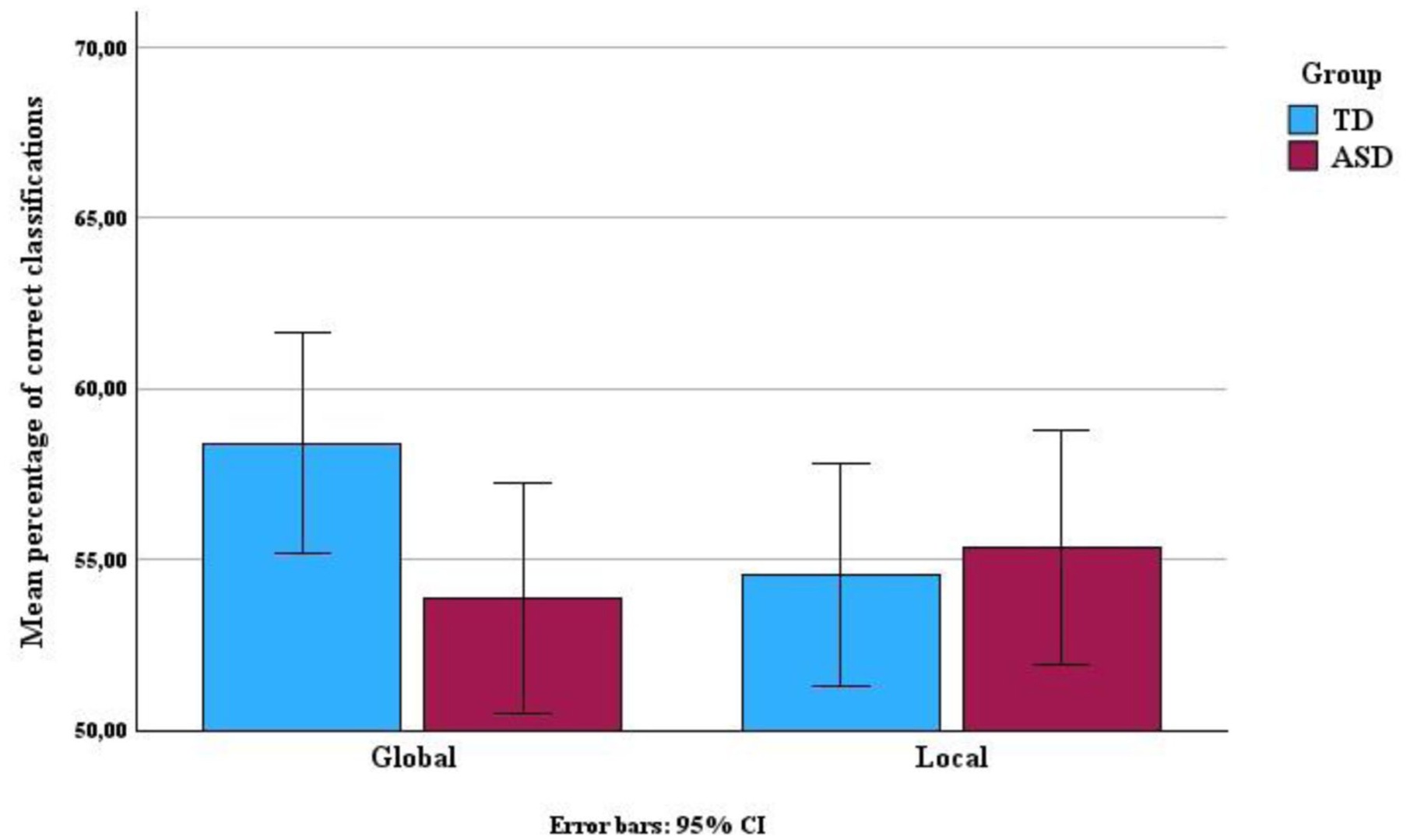
Overall classification accuracy in the global-local task.
Οne-sample t-tests were applied for each group (TD and ASD) and each processing level (global and local) to determine whether their overall classification accuracy was significantly above the 50% chance level. For the ASD group, accuracy exceeded chance at both the global level, M = 53.88%, SD = 7.41, and the local level, M = 55.38%, SD = 8.48. Similarly, for the TD group, at the global processing level, M = 58.41%, SD = 7.54, and the local processing level, M = 54.55, SD = 6.71. Results showed that performance for both groups exceeded a baseline of 50% in both global and local processing (all ps <.030), indicating some learning from all training stimuli.
Frequency of Knowledge Attributions
Figure 4 shows how often participants from the two groups used each attribution. No statistically significant differences between the ASD and TD groups were found in terms of the proportions of implicit and explicit attributions they selected for either the global or local processing level condition or when data from both conditions were combined (all ps >.198). We did not apply a multiple comparisons correction in this case, as none of the values were statistically significant in the initial analyses. However, we conducted a 2 × 2 Bayesian ANOVA on the percentage of implicit knowledge attributions. Given that we had no informed priors, we used the default settings of JASP (version 0.18; JASP Team, 2023). The analyses revealed no significant main effects or interaction, all ps >.67, BFs >3.5 (for BF01), providing evidence of no differences in how frequently implicit (and consequently explicit) attributions were used by the participants.
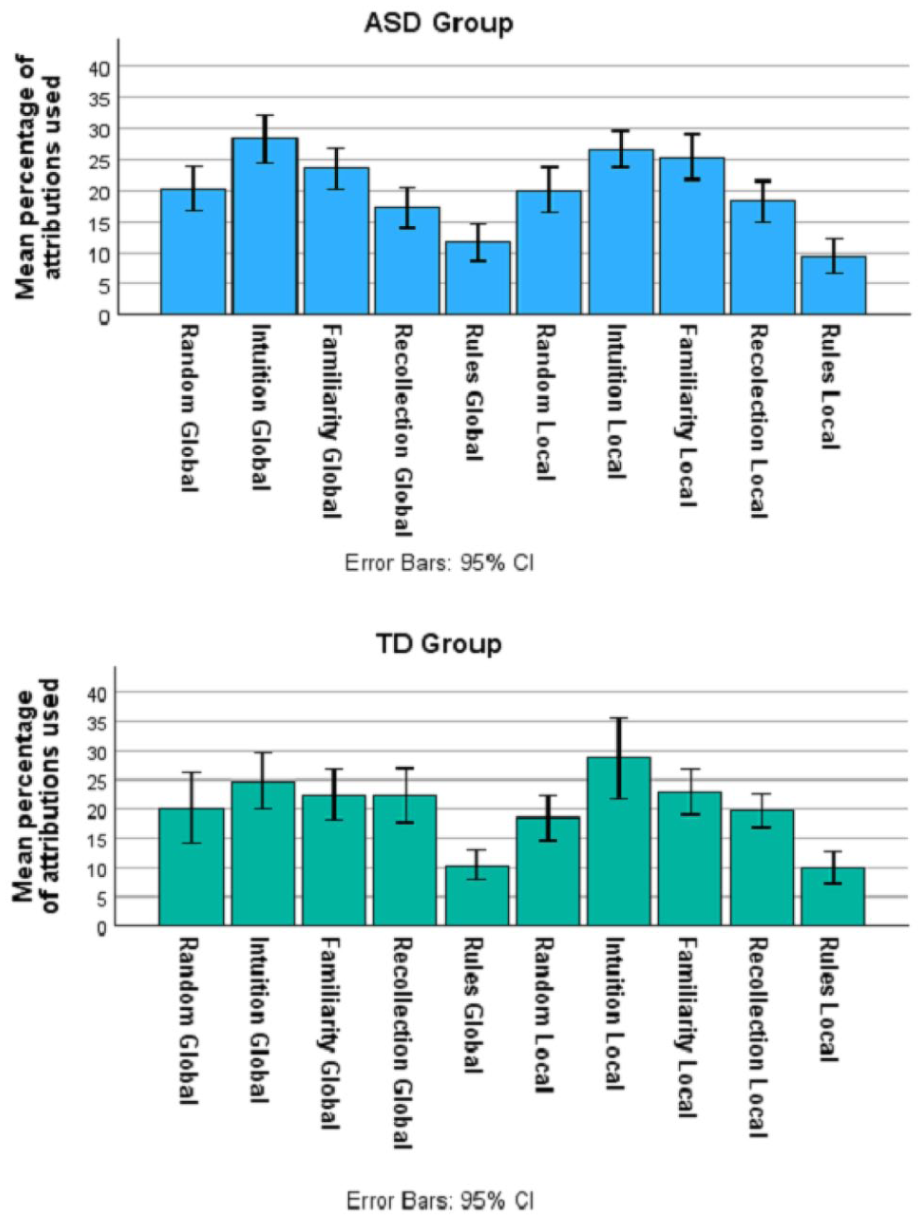
Mean percentage of the different attributions used by the two groups (ASD vs. TD) in each processing level (global vs. local).
Accuracy of the Different Classification Attributions
Participants’ accuracy for the different types of attributions when classifying the global grammar and the local grammar were used to assess the implicit and explicit structural knowledge and investigate potential differences in the two types of knowledge depending on group and level of processing.
When calculating the mean percentage of correct classifications for implicit and explicit knowledge, there may be cases where participants use certain attributions less often than others. For example, some participants might give only a few answers that reflect conscious or unconscious knowledge. In such cases, the result is based on limited observations and could be unrepresentative of their actual knowledge. To address this, we followed Kiyokawa et al. (2012; see also Guo et al., 2013) and applied a Bayesian adjustment to all participants that had chosen an attribution at least once, by using the following formula:

Following previous studies (e.g., Dienes & Scott, 2005; Kiyokawa et al., 2012), all implicit attributions (random, intuition, and familiarity) were grouped together, and the same was done for explicit attributions (recollection and rules). Grouping the attributions into two broader categories (implicit vs. explicit) addresses possible complications arising from the unequal use or low number of certain attributions.
Implicit Structural Knowledge
The two-way ANOVA on classification accuracy when participants were using implicit structural knowledge yielded no significant main effect of group, F(1, 40) = 0.608, p = .440, η p 2 = .015, BN(0,6) = 0.38 (Figure 5). BF10 indicated inconclusive evidence for either hypothesis. The effect of level of processing was not significant either, F(1, 40) = 0.441, p = .510, η p 2 = .011, BN(0,6) = 3.53 (BF01 > 3 here provides evidence for H0). However, the analysis showed a significant two-way interaction, F(1, 40) = 4.28, p = .045, η p 2 = .097. More specifically, when using implicit knowledge, the TD group outperformed the ASD group at the global level, as predicted, t(40) = −2.08, p = .044, d = −0.642 (M = 57.60%, SD = 7.11 vs. M = 53.29%, SD = 6.23), while regarding differences in performance at the local level between the two groups, there was data insensitivity, t(40) = −0.64, p = .529, d = 0.196, BH(0,6) = 0.65 (M = 53.73%, SD = 6.70 for the TD group and M = 55.28%, SD = 9.05 for the ASD group). Paired t-tests were conducted to compare global and local classification accuracy for implicit knowledge within each group. Results indicated data insensitivity as to the existence of a difference in global versus local processing for the ASD group, t(19) = −1.04, p = .313, d = −0.232, BH(0,6) = 0.85. For the TD group, there was evidence for an advantage of global over local processing, t(21) = 1.88, p = .074, d = 0.401, BH(0,6) = 3.03.
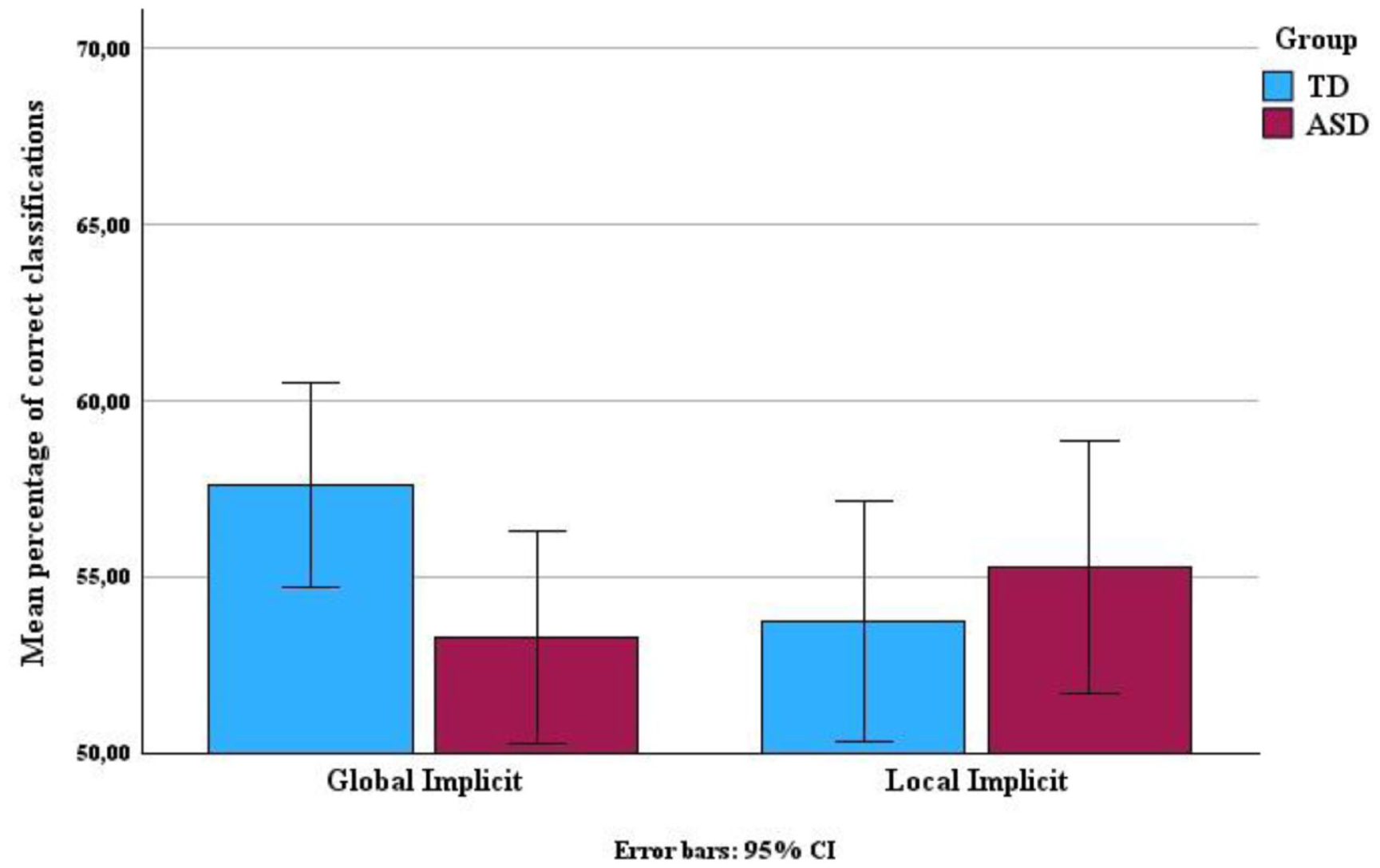
Participants’ mean percentage of correct classifications when using implicit structural knowledge.
One-sample t-tests showed that when using implicit knowledge, both groups performed significantly above the 50% chance level at both the global and local levels of processing (all ps <.029). For the ASD group, the means were M = 53.29%, SD = 6.23 at the global level and M = 55.29%, SD = 9.05 at the local level, while for the TD group the corresponding means were M = 57.60%, SD = 7.11 at the global level and M = 53.73, SD = 6.70 at the local level.
Explicit Structural Knowledge
Α two-way ANOVA on participants’ classification accuracy when they were using explicit structural knowledge (see Figure 6) showed no significant main effect of group, F(1, 40) = 3.14, p = .084, η p 2 = .073, BN(0,6) = 1.39. BF10 indicated inconclusive evidence for distinguishing between H1 and H0. The effect of level of processing was not significant, F(1, 40) = <0.001, p = .992, η p 2 = <.001, BN(0,6) = 3.16 (note the BF01 > 3 here provides evidence for H0). The two-way interaction, F(1, 40) = 1.87, p = .179, η p 2 = .045, BH(0,6) = 1.9 was not significant either, and BF10 provided insensitive evidence for distinguishing between the two hypotheses.
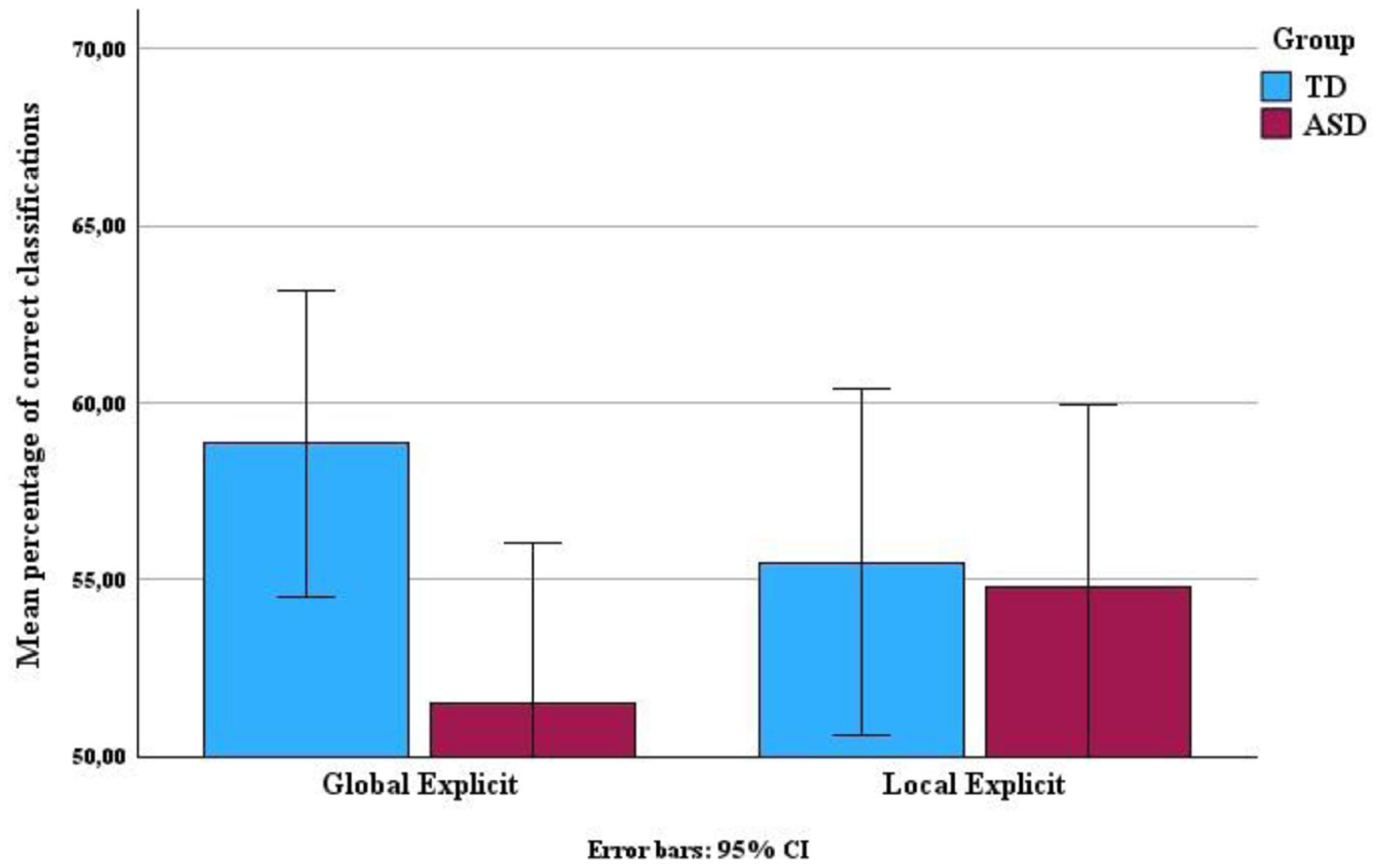
Mean percentage of correct classifications when using explicit structural knowledge.
The one-sample t-test that was conducted to examine whether the two groups acquired explicit knowledge (above a chance level of 50%) showed that the ASD group performed significantly above chance at the local level, t(19) = 2.324, p = .031, d = 0.520 (M = 54.81%, SD = 9.25), but data were insensitive as to whether their performance at the Global level was close to random, t(19) = 0.612, p = .548, d = 0.137, BH(0,6) = 0.65 (M = 51.51%, SD = 11.05). By contrast, the TD group performed significantly above chance at the global level, t(21) = 4.565, p = <.001, d = 0.973 (M = 58.84%, SD = 9.08) and (nearly) the local level, t(21) = 1.985, p = .060, d = 0.423, BH(0,6) = 4.08 (M = 55.50%, SD = 12.98), with BF10 providing evidence for HI (i.e., above chance performance).
Evaluation of Fragment Knowledge
To investigate whether participants had learned specific parts of the training sequences, both groups completed a bigram recognition test after the main task. Data from 19 participants with autism were included in the analyses, as 1 participant in this group failed to complete the test due to fatigue. To assess participants’ fragmentary knowledge, we used the mean percentages of correct classifications separately for each group and level of processing. The two-way ANOVA on recognition accuracy yielded no significant main effect of group, F(1, 39) = 0.019, p = .890, η p 2 < .001, BN(0,6) = 0.76, with BF10, indicating inconclusive evidence for distinguishing between H1 and H0. The level of processing was not significant either, F(1, 39) = 0.147, p = .703, η p 2 = .004, BN(0,6) = 5.88 (the BF01 > 3 here provides evidence for H0). Moreover, we found no significant two-way interaction, F(1, 39) = 2.990, p = .092, η p 2 = .071, BH(0,6) = 2.89. The BF10 for the interaction indicated insensitive data, providing only weak evidence for H1 (i.e., for a greater global over local advantage in the TD group than in the ASD group and an at least equal performance of the ASD group in local processing), as its value (2.89) suggests that the data are nearly three times more likely under H1 than under H0.
One-sample t-tests were applied to examine whether recognition accuracy was significantly above baseline (50%) for each group and each level of processing. Results showed that, for the TD group, overall performance was significantly above chance (50%) for both the global, t(21) = 4.091, p = <.001, d = 0.872 (M = 59.10%, SD = 10.42) and the local level of processing, t(21) = 2.085, p = .049, d = 0.445 (M = 55.45%, SD = 10.22). The ASD group scored above chance at the local level of processing, t(18) = 2.882, p = .005, d = 0.582 (M = 57.89%, SD = 11.94), but their performance at the global level only marginally exceeded chance, t(18) = 1.949, p = .067, d = 0.447, BH(0,6) = 3.75 (M = 55.00%, SD = 11.18). However, the value of BF10 provided evidence of above chance performance at the global level as well. Overall, this pattern of findings from the direct recognition test suggests that all participants managed to acquire some fragmentary knowledge of both grammar types.
Correlations
We also searched for possible correlations between participants’ overall performance, implicit and explicit learning in both global and local conditions, and individual characteristics of participants, and in particular, age, IQ (as measured by WASI), and autistic symptoms severity (as measured by CARS). None of the correlations was statistically significant (all ps >.084) after applying the Benjamini–Hochberg method for multiple comparisons correction (Benjamini & Hochberg, 1995), which provides no evidence that the above factors affected the learning outcomes in our sample. Moreover, all BFs provided either evidence for H0 or inconclusive evidence with respect to H0 or H1. The only BF that provided supportive evidence for the existence of a correlation was the BF for the correlation between IQ and explicit performance for only global stimuli and only for the ASD group (BF01 = 0.22).
Discussion
The aim of our study was to investigate how the processing tendencies of children and adolescents with and without autism affects implicit learning. For this purpose, we used an AGL paradigm with two different artificial grammars that incorporated both global and local processing levels. More specifically, the letter strings presented in the learning phase were created by using Navon-type letters, with no specific instructions as to the direction of attention toward the global or local level of stimuli, which allowed us to make inferences about participants’ processing tendencies. Given that processing biases may influence the focus of attention and that perceptual attention affects implicit learning, it was hypothesized that potential differences in processing biases between TD and autistic groups might lead to variations in implicit (and explicit) learning performance, depending on whether individuals focused on the global or local structure. More specifically, in alignment with previous theories and research, we predicted that when the task instructions do not direct attention to a particular processing level, people with autism are expected to show a reduced global advantage compared with TD individuals, most probably because of their greater tendency toward local details.
The results from participants’ general performance in the AGL task indicate that although the data lean toward the above hypothesis, the evidence supporting the predicted interaction remains inconclusive. The discussion below will unfold possible reasons for the data insensitivity and weak evidence in favor of the hypothesized interaction. The analyses of participants’ implicit and explicit structural knowledge revealed an overall similar pattern with some differences, highlighting the importance of using additional measures of consciousness in AGL for revealing more fine-grained details and information about the type of learning and the knowledge acquired.
Implicit Learning in Autism
This study aimed to contribute to a research field with inconsistent findings, that of implicit learning in autism. Our findings align with those of previous work that have provided evidence of preserved implicit learning in young people with autism (e.g., Gidley Larson & Mostofsky, 2008; Gordon & Stark, 2007; Schipul & Just, 2016; Travers et al., 2015) and contrast with others that have reported impairments in implicit learning among individuals with autism (e.g., Gastgeb et al., 2012; Klinger et al., 2007; Mostofsky et al., 2000). They are also consistent with the recent findings of Ziva and Ziori (2025), who found preserved implicit learning in autism, albeit reduced in comparison with that of a neurotypical group. However, it is not sufficient to ask whether a specific type of learning is preserved in autism or not without attempting to have a deeper understanding of this type of learning.
First, an important step toward a more refined understanding of the type of knowledge acquired in the implicit learning concerns the additional measures that should be utilized to allow for useful distinctions. As stated in the introduction, most of the previous implicit learning studies in autism relied only on participants’ performance in the main task or on insensitive measures. This study used sensitive measures of consciousness that have been widely used in implicit learning research, namely, a subjective measure of structural knowledge and a recognition test.
It should be noted here that the focus of the present study was on whether participants knew what they knew rather than whether they knew if they knew when they classified the global and local stimuli; thus, we used participants’ attributions to assess the conscious or unconscious structural knowledge that guided their learning when relying on global versus local structural aspects of the stimuli. The recognition test we used also taps into structural knowledge (i.e., knowledge of fragments of the training items). Of course, one may use confidence ratings or even knowledge attributions to draw conclusions about the consciousness of judgment knowledge as well, since correct judgments accompanied by rules, memory, intuition, and familiarity attributions suggest conscious judgment knowledge, whereas correct judgments accompanied by guess attributions suggest unconscious judgment knowledge. However, the distinction between judgment and structural knowledge was beyond the scope of the present work. Future work that is interested in distinguishing between different aspects of consciousness (e.g., access to structural vs. judgment knowledge or strategic control) in the implicit and explicit learning of people with autism could combine and compare different methods and/or measures for the assessment of conscious access.
A second step toward a more nuanced understanding of implicit learning is attempting to elucidate different types of processing that might affect the overall implicit learning performance. This was the main aim of the present study by comparing global versus local processing in young people with and without autism.
The Role of Individual Processing Biases on Implicit and Explicit Learning
Although prior research reveals inconsistencies with respect to global versus local processing in ASD versus TD individuals, most studies seem to support a greater global processing advantage in TD individuals than in autistic individuals, which may lead to either a smaller global over local advantage (or perhaps a greater local over global advantage) in people with autism. Importantly, while the vast majority of prior research examined processing biases in autism with tasks such as the Navon task, this study uses the AGL task to fill a gap in the literature on implicit learning in autism.
Based on the present findings, the hypothesis predicting a greater global over local processing advantage for the TD group than for the autistic group (and even a potential local vs. global processing advantage for individuals with autism) received inconclusive evidence in terms of our participants’ overall AGL performance, as well as in terms of their explicit structural knowledge, as indicated by Bayes factors. In terms of implicit structural knowledge, the predicted interaction was confirmed in that the TD group demonstrated a global over local processing precedence. In addition, the TD group outperformed the autistic group in global processing, whereas with respect to the local over global processing bias in the autistic group as well as with respect to the comparison of the two groups in local processing, the data were insensitive. Importantly, both groups showed implicit knowledge at an above chance level, suggesting that all participants, independent of group, were able to extract implicit structural information from both artificial grammars. Thus, participants with autism could engage in implicit learning regardless of the level of processing. This is in agreement with Kourkoulou et al. (2012), who found that participants with autism could implicitly extract patterns from local and nonlocal contexts, while performing a contextual cueing task.
In general, our findings regarding information processing in autism align with previous research, particularly with the work of Van der Hallen et al. (2015) and Van Eylen et al. (2018), who reported that individuals with autism do not exhibit severe difficulties in holistic processing (see also Muth et al., 2014). The current global advantage of the TD group compared with that of the autistic group in the acquired implicit structural knowledge does not imply a deficit in the global processing of participants with autism. Presumably, a local processing bias in participants with autism might have weakened the degree and/or the quality of global processing but not to a detrimental degree, as it remained above a chance level in terms of the overall accuracy and the implicit knowledge acquired. The above interpretation is in line with Mottron et al. (2006) who argue against a global processing deficit in autism; instead, individuals with autism may engage in holistic processing less frequently than TD individuals, giving priority to a local processing mode. If individuals with autism treat global processing as an unfavored type of processing, this could mean that in a task that allows processing at both local and global levels, such as in the present AGL task, they may have relied primarily on local processing, using global processing only as a secondary processing mode. Meanwhile, the TD group’s greater implicit knowledge at the global level, together with a comparable performance at the local level, indicates more flexible processing that allows them to switch between local and global processing as required.
This possible flexibility for the TD group coincides also with their above chance explicit knowledge at both processing levels. For the autistic group, the overall pattern of explicit knowledge results suggests less robust knowledge at the global level of processing, but evidence regarding this level of processing remains inconclusive, so no firm conclusions may be drawn about that.
A trend toward an interaction pointing to a greater global processing advantage in the TD group than in the autistic group was also found in the recognition test, which evaluated participants’ fragment knowledge, namely, knowledge of the structural details (i.e., pairs of letters that make up the artificial grammars) that were learned during the learning phase. The results showed that such fragmentary knowledge, which is to a large extent considered explicit, exceeded a chance level for both groups in both types of grammar (i.e., global and local). Presumably, the quality of fragmentary knowledge for smaller fragments was higher than that of larger ones, which allowed the development of sufficient conscious knowledge, independent of level of processing (see Cleeremans and Jiménez’s, 2002 theory of consciousness, according to which high quality knowledge gives rise to conscious knowledge).
The insensitivity of our data with respect to a reduced global over local advantage in the autistic group versus the TD group in the overall AGL performance (as well as in their implicit and explicit knowledge separately) leaves the question of the existence of different processing types in the two groups open. Several reasons might explain this inconclusive evidence regarding our predicted interaction between group and level of processing in the present study, despite the use of a robust design with a sample size that is much larger than the one indicated by the a priori power analysis. The observed variance in our sample, most probably due to the complexity of the task and the individual differences in the strategies possibly applied by both groups (especially for the group with autism and especially for the putative most challenging for them global processing condition) to manage the increased task demands, is likely to have weakened the strength of the interaction. Indeed, the current AGL task with two grammars is a demanding task that might have caused occasional fatigue or loss of focus or might have resulted in performance instability (e.g., frequent change in strategies or modes of processing) for the present sample, all of which may be possible reasons of noise in the data.
Another possibility of why the data showed a trend toward an interaction but remained insensitive is because the true effect size of the interaction might be smaller than the one hypothesized in the a priori analysis.
All the above do not indicate the absence of an effect but possible reasons for the attenuation of an effect with potential theoretical significance that is worth exploring further. It is also worth noting here that the null main effect of level of processing we found in all analyses is consistent with an interaction, as the reversed pattern of responses from the two groups in the two different grammars explains the way the above main effect cancels out overall.
A methodological detail that might have also affected the strength of the processing tendency of the two groups toward global versus local aspects is the occasional reproduction of the global and local letter sequences that our instructions demanded. One might argue that this instruction might have introduced some sort of bias toward both grammars (even if indirectly). However, this possibility seems unlikely as participants had to reproduce only a minimal number of sequences (18 out of the 108 training strings). The above instruction was given to bring the two grammars to participants’ attention and thus render both of them task-relevant, as task relevance has been shown to enhance implicit learning in AGL (see Eitam et al., 2009). This procedure allows us to test whether the two different groups learn only one or both sequence types, when these are of equal task relevance or whether their processing tendencies are strong enough to impede or favor the learning of a certain sequence type. Moreover, the reproduction of grammar sequences served as a means of decreasing the possibility that the particular sample (young people, especially young individuals with autism) would demonstrate insufficient visual attention to the on-screen stimuli, which would be detrimental for performance in an AGL task.
This study builds upon and extends the work of Ziva and Ziori (2025), by providing a more in-depth exploration of the role of processing style on implicit learning. While Ziva and Ziori (2025) found evidence of implicit knowledge in participants with autism, such participants in their study exhibited a global processing advantage and reduced local processing efficiency, leading the authors to presume that local processing difficulties may have contributed to the reduced implicit knowledge of their autistic group compared with that of TD participants. However, such a relationship is not supported by the findings of the current study.
As already mentioned, Ziva and Ziori (2025) examined implicit learning and perception style in individuals with autism using two separate tasks, an AGL task that assessed implicit learning and a Navon task that measured participants’ global-local processing style. First, in the Navon task used by Ziva and Ziori (2025), participants were given explicit instructions to direct their attention to either global or local stimuli. It is possible that this approach has influenced participants’ performance, leading to outcomes that reflect the imposed task demands rather than natural processing tendencies. This interpretation aligns with research showing that in selective attention tasks, where participants are directed to focus on a specific level, individuals with autism may adopt different processing strategies that restrict their typical processing biases, whereas divided attention tasks, such as the one used in our study, tend to favor the individual’s dominant processing style (see, e.g., Koldewyn et al., 2013; Plaisted et al., 1999). Furthermore, the use of two distinct tasks in Ziva and Ziori’s (2025) study does not clearly uncover the actual relationship between implicit learning and processing style.
Moreover, the ASD group in Ziva and Ziori’s (2025) study included subjects with mild-to-severe ASD symptoms and a mean full-scale IQ of 67.5. Since the local processing difficulties reported by Ziva and Ziori (2025) are not a typical phenomenon in autism, it is possible that lower cognitive abilities of their sample contribute to challenges in task performance in general, irrespective of characteristics specific to autism. This interpretation agrees with Van Eylen et al. (2018), who observed that individuals with autism with higher IQs tend to exhibit stronger information processing skills (for a similar finding in a TD group, see Dore et al., 2018). The present study adopted an ASD sample better matched to TD controls, in an effort to minimize the possibility that differences in intellectual ability confuse our results.
The Role of Age, IQ, and ASD Symptoms Severity on Learning Outcomes
In this study, we also explored whether other individual characteristics, such as age, intellectual ability, and ASD symptoms severity were associated with overall, implicit, and explicit learning performance in the two processing conditions. Overall, we found no evidence that the above factors correlated significantly with performance on the AGL task or with implicit and explicit learning, suggesting that the observed differences in implicit learning performance between participants with autism and TD participants cannot be attributed to these particular characteristics. Similarly, previous studies with autistic groups (e.g., Brown et al., 2010; Gordon & Stark, 2007; Travers et al., 2010, 2013; Xie et al., 2024; Ziva & Ziori, 2025; but see Gastgeb et al., 2012; Schipul & Just, 2016; Travers et al., 2015) found no relationship between implicit learning and such factors. The only evidence for a correlation we found was between IQ and explicit global processing and only for participants with autism, a finding that coincides with the fact that conscious processing of global information was the most cognitively demanding processing type for this group. Of course, in our study the two groups were age- and IQ-matched. Moreover, our autistic group included individuals who exhibited mild or mild-to-moderate symptoms of the disorder. Therefore, further research with more diverse samples may help determine whether these findings generalize to individuals with autism who have more intense symptoms and a wider range of cognitive abilities.
In conclusion, our study offers new insights into the effect of individual characteristics in implicit learning in general and in autism in particular, by showing how different processing biases may influence performance. Most previous work in the field has overlooked individual processing biases, focusing instead on the role of more pronounced autistic characteristics or on simple group comparisons on performance. Our findings highlight the possibility that the processing level at which regularities are presented in an implicit learning task may have a moderating effect in implicit learning performance in both typical populations and populations with autism, particularly in tasks where global or local processing is important for task success. In this sense, we suggest that a simple intact versus impaired description for implicit learning in autism is inadequate and that implicit learning performance in autism could be better understood as context-dependent, since it is possible that specific individual characteristics, such as processing biases, may be contributing factors that shape implicit learning outcomes in such groups. Clearly, the findings of the present study cannot account for all inconsistencies in this research field, given that implicit learning outcomes may be affected by many confounding variables, such as sample characteristics, participants’ strategies, and/or specific task features. Nevertheless, our results add to the ongoing research by emphasizing the need to further explore the role of processing tendencies in implicit learning in autism, and particularly the task conditions under which implicit learning is more likely to pose challenges for such individuals. More specifically, our findings provide suggestive evidence of an interesting trend that is worth exploring further: If an implicit learning task combines both global processing and local processing and does not direct attention to either of the two, then people with autism will most likely achieve an adequate local performance (if not better than TD people) and might be less effective in global processing, without implying a global processing deficit. This perspective provides a potential basis for understanding the contrasting findings across implicit learning studies and may guide future research particularly interested in the relationship between implicit learning and individual characteristics in general and in the degree to which any potential differences in the learning of populations with autism and TD populations might stem from different processing biases (i.e., a tendency toward holistic versus more detailed processing) in the two populations.
Footnotes

Ethical Considerations
The research received approval from the Greek Ministry of Education and the Ethical Committee of the University of Ioannina, aligning with the Declaration of Helsinki’s standards. Participants had the right to withdraw from the study at any point.
Consent to Participate
Parents provided written informed agreement for their children’s participation, while participants gave an informed assent in advance of all the study procedures.
Funding
The authors received no financial support for the research, authorship, and/or publication of this article.
Declaration of Conflicting Interests
The authors declared no potential conflicts of interest with respect to the research, authorship, and/or publication of this article.
Data Availability Statement
The data of our study are available from the corresponding author [AZ] upon reasonable request and in compliance with ethical restrictions and guidelines.