






Abstract
Emojis influence perceptions of both messages and senders. One area where their effects are less understood is in the context of forgiveness. In the current study, participants (N = 443) read scenarios containing a fictional message exchange between two characters; one of whom had transgressed and subsequently apologised. Their apology would be either text-only (“I’m sorry”), emoji-only (“ ”), or text plus emoji (“I’m sorry ”). For each scenario, participants were asked to indicate their own likelihood of forgiving the transgressor. Results revealed that text plus emoji apologies were most likely to be forgiven, whereas emoji-only apologies were least likely to be forgiven. The findings highlight the role of emojis in relationship maintenance in online communication, suggesting that senders may wish to combine text messages with emojis when communicating an apology online. In addition, while emojis alone can convey emotions and serve as non-verbal cues, they may be less effective than verbal apologies in fostering forgiveness.
Keywords
Background
Forgiveness generally occurs after one party apologises for a hurtful offence (Lawler-Row et al., 2007) and plays a crucial role in relationship maintenance. Apologies can occur in both face-to-face (F2F) and text-based communication. One key difference across these two media is the availability of non-verbal cues to emotion, which may be crucial in promoting forgiveness. In text-based messages, a promising substitute for the non-verbal cues which may accompany an F2F apology are emojis or emoticons, which have been shown to be beneficial during online communication (Kahar & Habil, 2020), for example, by helping to establish emotional tone (Kaye et al., 2016). The current study examined the influence of the use of emojis during an apology on the perceiver’s willingness to forgive.
What Is Forgiveness?
Forgiveness is central to healthy human development and is an important process in the restoration of interpersonal relationships after social conflicts (Hill, 2001). Essentially, it is a prosocial motivational change in a victim, which occurs after a person has incurred a transgression (McCullough, 2001). Forgiveness refers to giving up resentment against, and to stop being angry with, a transgressor (McCullough et al., 2009). Scobie and Scobie (1998) claimed that the term “prosocial” is needed during forgiveness. They suggested that when people forgive, they tend to be less motivated to harm their transgressor and, simultaneously, become more motivated to act in ways that will benefit the transgressor. For example, they will no longer have motivations for revenge and avoidance, and harmonious interpersonal relations with their transgressor will increase (McCullough et al., 2001).
Emoji Interpretation
Computer-mediated communication (CMC) has increased in recent years (Meier et al., 2020), and one common form of CMC is that of texting through smartphones (Emanuel, 2013). It has been reported that the increased frequency of texting is associated with a positive perception of romantic relationships, relationship satisfaction, intimacy, and support (Morey et al., 2013). Although texting has been found to maintain and improve interpersonal relationships without F2F contact (e.g., Morey et al., 2013), one limitation of CMC is the lack of non-verbal cues such as head nods, smiles, and vocal inflection (Kiesler et al., 1984). These are very important during communication as they are used to judge the speaker’s emotion and attitudes (Kraut et al., 1982).
To solve this, individuals started using emoticons as a proxy for non-verbal cues. Emoticons are character-based representations of facial expressions traditionally constructed using ASCII (American Standard Code for Information Interchange) symbols, such as punctuation marks and letters (e.g., :-)). These devices have been shown to attenuate rudeness while texting, particularly when expressing rejection and complaints, as well as to enhance the intensity when expressing gratitude and praise (Skovholt et al., 2014). For example, when examining the perception of a positive statement with and without a smiling emoticon, Derks et al. (2008) reported that individuals tended to rate the statement with an emoticon as more positive than the statement without an emoticon. To aim for a more complex and nuanced method of expression, emojis have been developed. In contrast to emoticons, emojis are standardised pictographs encoded via Unicode, which are rendered as distinct graphical icons. Emojis contain more facial features and a better representation of human emotional expressions, and are now commonly used (Ganster et al., 2012, see also a systematic review in Bai et al., 2019). Emojis can be used for many purposes, including providing information, engaging the recipient, modifying tone, maintaining relationships (Kelly & Watts, 2015), and providing an easy way to add personality to a text-based communication (Desta, 2014). Emojis can also be used as decorations, to make text messages more entertaining and appealing, or to trigger a more intense response (Cramer et al., 2016), as they provide social intimacy by intensifying one’s emotions through mimicking real facial expressions (Ayres, 2014).
Boutet et al. (2021) examined how individuals interpreted text messages with and without emojis. They reported that when positive statements were accompanied by a smiling emoji (e.g.,  ), participants tended to rate the statement as being more positive than when only a positive statement was shown. This was also seen in negative statements where individuals rated negative statements with a sad emoji (e.g., ) as being more negative than statements without emojis. Moreover, Rodrigues et al. (2017) examined the role of emojis in interactions between romantic partners by comparing text varying in emotional cues (i.e., text without emotional cue vs. text plus emotional cue vs. text plus emoji – e.g., “I didn’t like what happened with us yesterday.” vs. “I didn’t like what happened with us yesterday. I’m sad.” vs. “I didn’t like what happened with us yesterday.
  ”). In Experiment 1, Rodrigues et al. (2017) also manipulated the valence of the message (positive/negative), and in Experiment 2, they only included negative exchanges and manipulated the seriousness of the context. Results showed that when the issues discussed in the message interaction were very serious (Experiment 2), negative messages with emojis (text plus emoji) were viewed as more negative than the same message without emotional cues (text alone). However, for mild (Experiment 1) or less serious situations (Experiment 2), Rodrigues et al. (2017) reported that negative message perceptions appeared to benefit from including emojis, in that negative messages with emojis were rated as being more positive than the same message without additional information.
Rodrigues et al. (2017) demonstrated an increased positivity (or reduced negativity) when negative messages were accompanied by emojis in mild or less serious situations; this positivity improvement has also been found in other studies when the message was accompanied by non-face emojis. For instance, Riordan (2017) examined the role of non-face emojis in communicating affect, and their results showed that a message (either positive or negative) with an object emoji (e.g.,  ) can enhance positive sentiment compared to a message without an emoji. Importantly, Riordan’s (2017) and Rodrigues et al.’s (2017) results suggest that the presence of an emoji (either facial or non-facial) can have a positive impact in the context of a negative exchange (in not very serious situations), which may be of particular relevance to the current study, in which we examine participants’ willingness to forgive following a transgression.
More recently, the findings reported in both Boutet et al. (2021) and Hand et al. (2022) show that when text valence and emoji expressions are congruent, this strengthens perceptions of emotionality in the “same direction”; that is, negative text paired with negative facial expression emojis resulted in the greatest perceptions of emotional negativity. Hand et al. (2022) showed that negative text-only messages were perceived equally as negatively as negative sentences paired with either neutral face emojis (e.g.,  ) or non-face (but contextually relevant) object emojis (e.g.,
  ). In the current study, since we examined participants’ willingness to forgive in a negative context when the sender of the text message had offended the receiver, we selected only context-relevant emojis, specifically, negative face emojis (e.g., and
  ).
).
Emojis and Forgiveness
Humans maintain and augment relationships through emotional communication. Many emotional cues are non-verbal, but carry rich social information (van Kleef, 2016) and are therefore critical to successful interpersonal communication. When F2F, communicators typically have a variety of multi-modal cues available to aid the interpretation of emotionality – for example, loudness, pitch, gesture, and facial expression. These non-verbal cues, however, are absent from many forms of CMC, resulting in a greater potential for misunderstandings and misinterpretations (e.g., Byron, 2008).
The efficacy of CMC versus traditional modes of communication is considered within frameworks such as the Social Information Processing theory and the Social Identity Model of Deindividuation Effects (e.g., Walther, 2011; Walther & Parks, 2002). Such frameworks recognise that CMC does not necessarily convey the same non-verbal information as F2F communication, but also argue for the importance of the cues which are transmitted during CMC (Kalman & Gergle, 2014).
There has been little research investigating the role of emojis in influencing people’s willingness to forgive in interpersonal relationships. However, some researchers have investigated this issue in the context of marketing communication through using image-based emoticons (e.g.,  ; Ma et al., 2021) or emojis (e.g.,
  and
and  , in Ma & Wang, 2021; a pleading face in Wang et al., 2023). Image-based emoticons are platform-specific graphical replacements (e.g., “stickers”) which are not part of a standardised character set. Specifically, Ma et al. (2021) examined the willingness to forgive customer service in online shopping and showed that the online service provider was more likely to be forgiven when their apology messages were accompanied by a negative image-based emoticon (i.e., ) compared to the text-only apology condition. Moreover, Wang et al. (2023) examined the impact of emojis (i.e., a pleading face) on customers’ forgiveness and showed that the use of emojis increased the perceived sincerity of the apology, which resulted in greater willingness to forgive. Additionally, Ma and Wang (2021) further examined the influence of negative (i.e., ) versus positive (i.e., ) emojis on willingness to forgive in the context of service failure during online shopping. Perceivers demonstrated a higher level of willingness to forgive when the apology messages were accompanied by a negative emoji than a positive emoji.
However, previous research examining the relationship between emoji interpretation and willingness to forgive was restricted to a specific customer service setting. Currently, little is known regarding how emojis would influence people’s willingness to forgive in more general CMC situations involving “social” interactions. Moreover, previous research only included text-based apology messages with and without emojis, and it remains unclear how emojis presented in isolation may function in this context (reflecting real-world emoji-only messaging).
Emojis as a Speech Act
Recently, emojis have also attracted the attention of researchers interested in speech acts. According to the Speech Act Theory (Austin, 1962; Searle, 1969, 1979), language not only can provide information, but can also perform actions. An example is that by saying, “I have an appointment tonight,” the speaker indirectly carries out an action of refusal to another’s invitation. Previous research investigating the effect of emojis on facilitating language comprehension suggests an important role for emojis in performing actions. For instance, Holtgraves and Robinson (2020) investigated the role of emojis (e.g.,  ) in the comprehension of face-threatening indirect language. An example of face-threatening indirect language is: “It’s hard to give a good presentation.” When Nick asked a question, “What did you think of my presentation?.” The reply message violated the relation maxim by not providing the requested opinion and typically was perceived as negative. Their results revealed that emojis facilitated the comprehension process. Specifically, when accompanied by an emoji (e.g., “It’s hard to give a good presentation.”), the intended meaning (i.e., “I didn’t like your presentation.”) of indirect language was more likely to be recognised and took less time to perceive. Interestingly, Holtgraves and Robinson (2020) also included a condition where there was only an emoji (and no text, e.g., ) in the message, and it showed that compared to the text-only message, participants were more likely to recognise the sender’s intended meaning from the emoji-only message.
Holtgraves (2024) then proposed that emojis can perform specific “speech acts,” as language does, and conducted a series of experiments by including only an emoji in text messages to test this assertion. For example, responding to a friend by sending the emoji  , the sender indicates that they agree with their friend. Results reported in Holtgraves (2024) showed that although senders and receivers of emoji messages were overconfident about the communicative success, both believed that emojis alone could communicate specific speech acts.
Moreover, the Theory of Affective Pragmatics (Scarantino, 2017) suggests that non-verbal emotional expressions can also communicate speech acts that people would typically use language for; that is, “expressing what’s inside, directing other people’s behaviour, representing what the world is like, and committing to future courses of action.” (p. 165). For example, in certain contexts, “crying expresses sadness and conveys a demand that the recipient provides aid and support” (p. 181). Emojis could be considered as a graphic form of emotional expression and may be able to communicate speech acts as well (Ge & Gretzel, 2018; Ge & Herring, 2018). This is particularly relevant to the current study, in which we also aimed to investigate participants’ willingness to forgive their conversational partner for a transgression when their apology message featured an isolated emoji in the absence of text.
Current Study
Numerous studies have reported the importance of forgiveness in maintaining harmony in social relationships (e.g., Bono, 2005; Tsang et al., 2006). Thus, it is important to examine factors that might facilitate forgiveness in online text-based communication. The purpose of the current study was to examine the role played by emojis in the process of willingness to forgive. During the study, participants read 24 experimental scenarios containing text-based conversations between two characters. Each scenario outlined a transgression from one character against the other, and the subsequent text conversations involved the transgressor apologising to the victim in one of three ways. The apology was either text-only (e.g., “I’m sorry”), text plus an emoji (e.g., “I’m sorry ”), or emoji-only (e.g., ). To add variety and support generalisability, we included characters with various relationships (e.g., parent-child, siblings, lovers, friends, and classmates) and a range of transgressions in our experimental scenarios. The participants’ task was to rate how likely they would be to forgive the transgressor if they were the victim.
The key aim of the study was to examine whether the use of emojis would facilitate forgiveness. Since both language and emojis can communicate speech acts (e.g., Holtgraves, 2024; Scarantino, 2017), we assumed that by sending either a text-only (i.e., the words, “I’m sorry”), an emoji-only (e.g., ) or text plus emoji (e.g., “I’m sorry ”) message, the sender expressed apology and requested that the receiver forgive their transgression. Participants’ willingness to forgive could be considered as the effect of the apology act (Scarantino, 2017), that is, the action performed by sending an apology (Austin, 1962; Searle, 1969). Although some previous research (e.g., Boutet et al., 2021; Hand et al., 2022) reported that individuals tend to provide more positive perceptions when viewing positive text messages with emojis, and more negative perceptions when viewing negative text messages with negative emojis, previous research investigating the relationship between forgiveness and emoji interpretation in marketing communication (i.e., customer service) showed that adding an emoji to the apology messages increased customers’ willingness to forgive (e.g., Ma et al., 2021; Wang et al., 2023). Moreover, as noted previously, there is some evidence to suggest that the presence of an emoji can have a positive social impact even in a negative situation (e.g., Rodrigues et al., 2017). Therefore, we consider that while the emotions embedded in an apology message may be considered negative, the attitude of asking for forgiveness and the consequential social impact should be considered positive. Thus, we predicted that the addition of an emoji to a text-based apology would facilitate forgiveness.
In relation to how emojis alone would affect the willingness to forgive compared to the text-only message, it is more difficult to make predictions. According to Holtgraves and Robinson (2020), the intended meaning of indirect language was more likely to be recognised in the emoji-only condition than the text-only condition. However, it may not apply to the recognition of an apology, as the text version of an apology (i.e., “I’m sorry”) is direct and obvious, whereas an emoji-only message is more indirect. It is also worth mentioning that the Theory of Affective Pragmatics (Scarantino, 2017) suggests that although emotional expressions can communicate acts, they are less powerful than language in performing speech acts. Specifically, there are no restrictions on the propositional contents that speech acts can take, whereas for emotional expressions, the scope is limited. For instance, you can demand that someone stop talking by looking at them and placing your index finger vertically on your lips, but you “cannot demand a person to come back tomorrow at 3 pm sharp without additional linguistic information” (p. 182). Therefore, emojis alone might be less effective than text in conveying an apology, resulting in participants being less likely to forgive in the emoji-only condition than the text-only condition.
Method
Participants
There were 443 participants (353 females, 90 males). The age range was 18 to 59 years old with a mean of 22.35 (SD = 8.03). Out of the 443 participants, 375 were native English speakers, while 68 reported that English was not their first language. However, these 68 participants generally reported that they started learning English at a young age (median starting age of learning English = 5 years old, range = 2–21). Participants either completed the study through the SONA system to obtain course credit (n = 221), were recruited via social media (n = 150), or via Prolific (n = 72). The study was conducted following the ethical guidelines of the School of Psychology, University of Nottingham (Ethics Committee Reference: 875).
Materials and Design
Participants were asked to read 36 scenarios (24 experimental items and 12 “filler” items), which included text conversations between 2 characters. Each conversation was followed by a question related to the participants’ emotional perception of the situation, which they could answer by selecting an option on a response scale. The experimental scenarios and text conversations described one of the characters (transgressor) asking for forgiveness from the other character (victim). There were three within-subjects experimental conditions: emoji-only, text-only, and emoji plus text (see Table 1 for an example, and https://osf.io/sdhgm/ for the full set of experimental and filler items).
Example Experimental Item in All Conditions and An Example Filler Item.
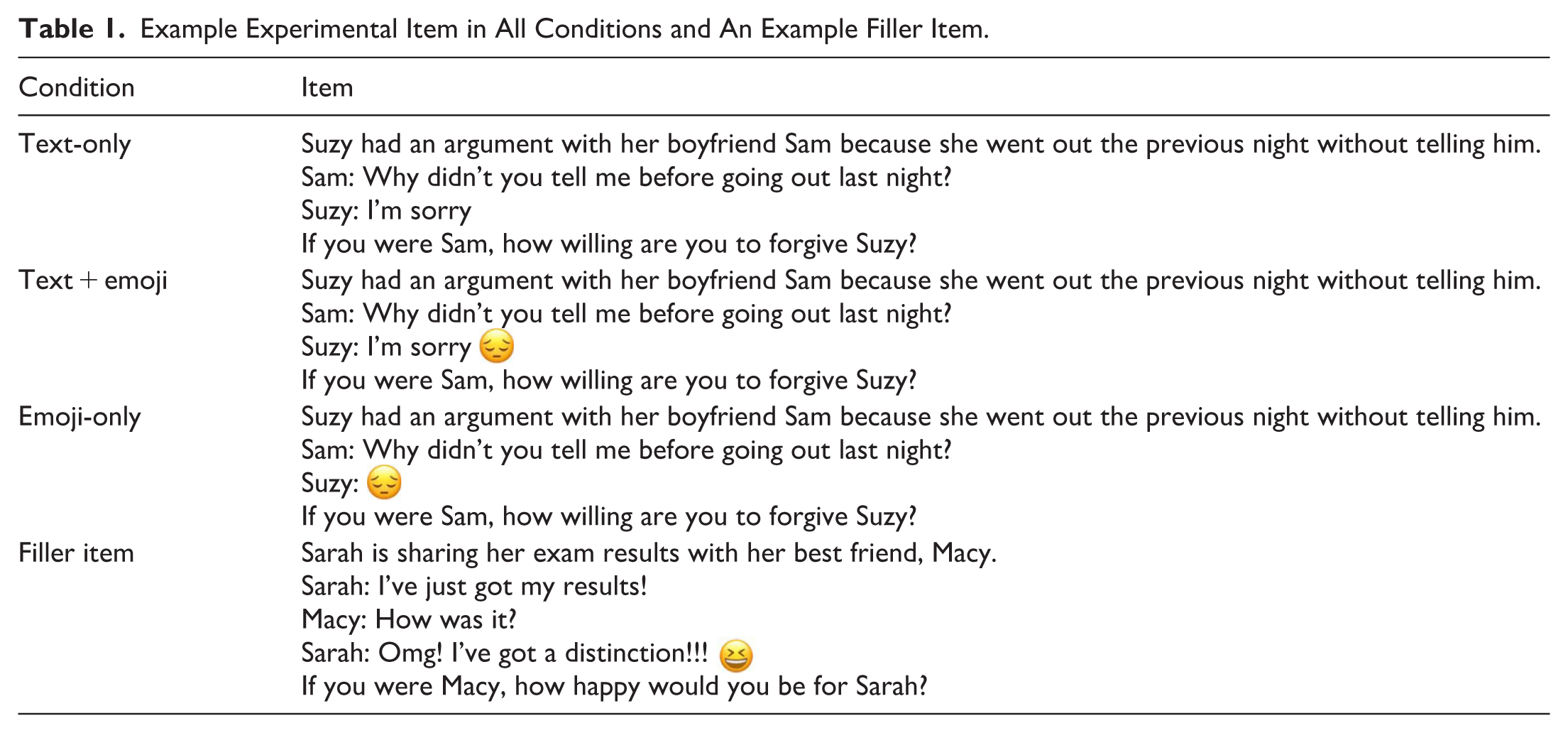
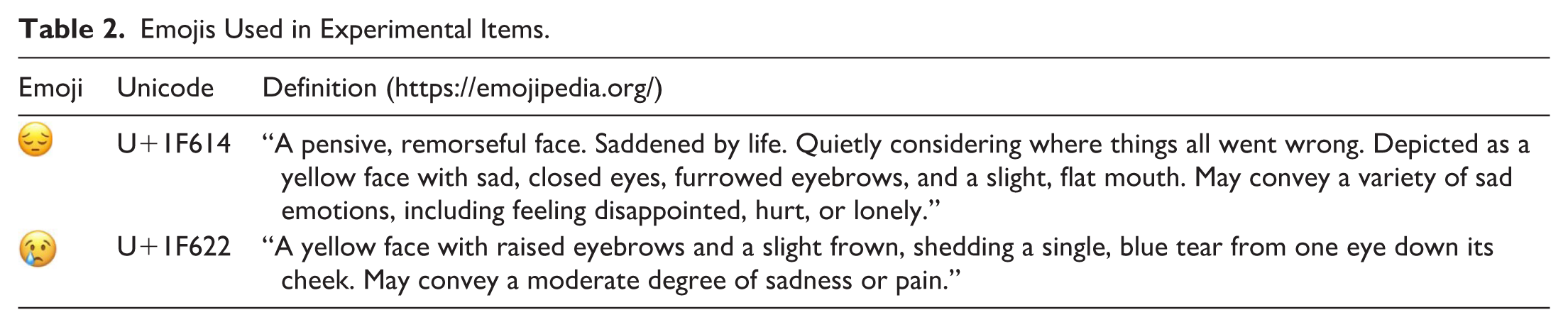
For the experimental items, after reading each scenario and subsequent text conversation, participants were asked to imagine themselves as the victim, and rate how willing they are to forgive the transgressor on a five-item scale, by selecting either “not at all,” “slightly,” “moderately,” “very,” or “extremely” willing. Participants were asked to complete 24 experimental trials, which were counterbalanced across 3 versions of the survey such that each participant saw each item in only 1 of the 3 possible conditions, specifically, 8 text-only trials, 8 text + emoji trials, and 8 emoji-only trials. The aim of counterbalancing was to control for the potential influence of individual scenarios (e.g., order effects, potentially different perceptions of severity) as far as possible. Across the 24 experimental items, the and emojis (see Table 2) were each used 12 times. The two emojis were selected as we focused on only negative face emojis, and the selected two emojis are considered more representative and appropriate based on the definitions provided by Emojipedia (http://emojipedia.org/). All participants, regardless of the device/platform used, saw emojis that were rendered in the same way (i.e., the iOS design). We also had 12 filler items, which included a range of different emojis, such as  or
or  , and the question following the scenarios was unrelated to forgiveness. Filler items were included in order to distract participants from “forgiveness,” add more variety of emojis, and balance the negative impression of experimental scenarios, thus preventing participants from adopting strategies in their responses and encouraging them to read scenarios attentively. Participants were randomly assigned to one of the three versions of the survey, and items were presented in a different random order for each participant.
Emojis Used in Experimental Items.
Procedure
The survey was distributed via an anonymous link generated by Qualtrics (Provo, UT). Participants completed the survey in their choice of environment and had as much time as they needed. Participants were first asked to read the information sheet and General Data Protection Regulation details. They were then asked to provide consent. Prior to rating the experimental and filler items, they were asked to provide demographic information (i.e., gender, age, and whether their first language is English or not). After completing the rating task, participants were given a short debrief about the true aim of the study.
Data Analysis
The data were analysed in a similar manner to the approaches taken in Hand et al. (2022) and Neel et al. (2023). Raw data were exported from the data collection host platform. Extraneous data (i.e., filler items) and possible identifiers were removed. A .csv file was built, where response data per item were transposed from horizontal to vertical, and variables coded for participant number (1–443), stimulus item number (1–24), and display condition (1–3; text-only, emoji-only, emoji + text). Cumulative link mixed modelling (CLMM) was used to estimate fixed effects (Apology condition: text-only, emoji-only, text + emoji) accounting for the random effects of individual participants (e.g., Jaeger et al., 2018) and stimulus items (e.g., Taylor et al., 2022). The “ordinal” package (Christensen, 2019) in R (R Core Team, 2016) was used to generate CLMMs. Optimal random effect structures were identified using forward model selection (see Barr et al., 2013; Matuschek et al., 2017). The dependent variable (i.e., participants’ choices regarding their willingness to forgive) was coded as follows: “not at all” = 1, “slightly” = 2, “moderately” = 3, “very” = 4, or “extremely” = 5.
Model fit was improved by adding a random slope for the Apology condition across participants. Post hoc tests were conducted using the “emmeans” package (v1.4.8; Lenth et al., 2020); significance thresholds were adjusted using the Bonferroni method. Effect size (Cliff’s delta) was calculated using the “effsize” package (Torchiano, 2020). Per Cohen (1988), Cliff’s delta ⩽0.15 is considered “small” (analogous to Cohen’s d effect size of 0.20), Cliff’s delta ⩽0.33 is considered “medium” (analogous to Cohen’s d effect size of 0.50), and Cliff’s delta ⩽0.47 is considered “large” (analogous to Cohen’s d effect size of 0.80).
Furthermore, we conducted Pearson’s chi-square tests of association to consider the relationship between individual forgiveness choices (i.e., “not at all,” “slightly,” “moderately,” “very,” or “extremely” willing) across conditions (text-only, emoji-only, text + emoji). Cramer’s V was taken as an indicator of effect size.
Results
Descriptive statistics are presented in Table 3.
Descriptive Statistics Across Apology Conditions.

Note. SE = standard error; CI = confidence interval.
CLMMs modelling revealed that the main effect of Apology condition on willingness to forgive was significant but small (χ2[2] = 98.83, p < .001; Cliff’s Δ = .10, 95% CI [0.07, 0.12]). Planned follow-up comparisons (Bonferroni corrected) revealed that participants were less likely to endorse an emoji-only apology than either a text-only apology (z = 8.16, p < .001) or a text + emoji apology (z = 10.23, p < .001). In addition, they were more likely to forgive after receiving a text + emoji apology than a text-only apology (z = 2.98, p = .009).
Furthermore, we considered the breakdown of “forgiveness decisions” across conditions. A contingency table is presented in Table 4.
Apology Acceptance Outcomes across Conditions.
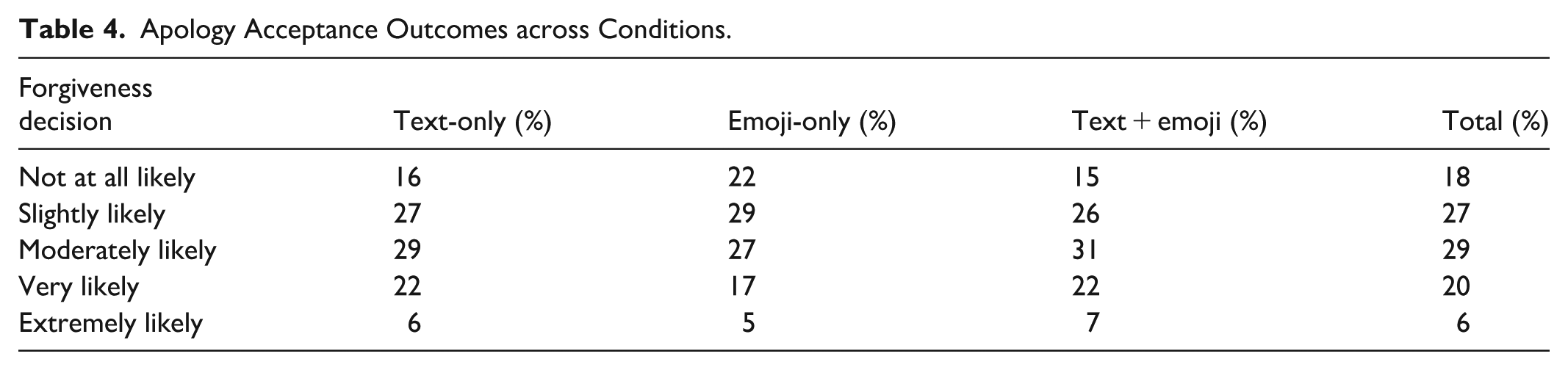
A Pearson’s chi-square revealed a significant association between forgiveness choice and Apology presentation condition (χ2[8] = 111.42, p < .001; Cramer’s V = 0.07, 95% CI [0.05, 0.08]). Comparisons of observed and expected frequencies revealed that for text-only apologies, fewer than expected received “Not at all likely” decisions (584 vs. 627), and more than expected received “Very likely” decisions (781 vs. 716). For emoji-only apologies, more than expected received “Not at all likely” decisions (791 vs. 627) or “Slightly likely” decisions (1,007 vs. 958), whereas there were fewer than expected “Moderately likely” (954 vs. 1,025), “Very likely” (608 vs. 723), or “Extremely likely” decisions (169 vs. 201). For apologies consisting of text + emoji, fewer than expected received “Not at all likely” (527 vs. 627) or “Slightly likely” (921 vs. 958), whereas more than expected received “Moderately likely” (1,078 vs. 1,025), “Very likely” (781 vs. 723), or “Extremely likely” (235 vs. 201).
The distribution of responses is illustrated in Figures 1 and 2.
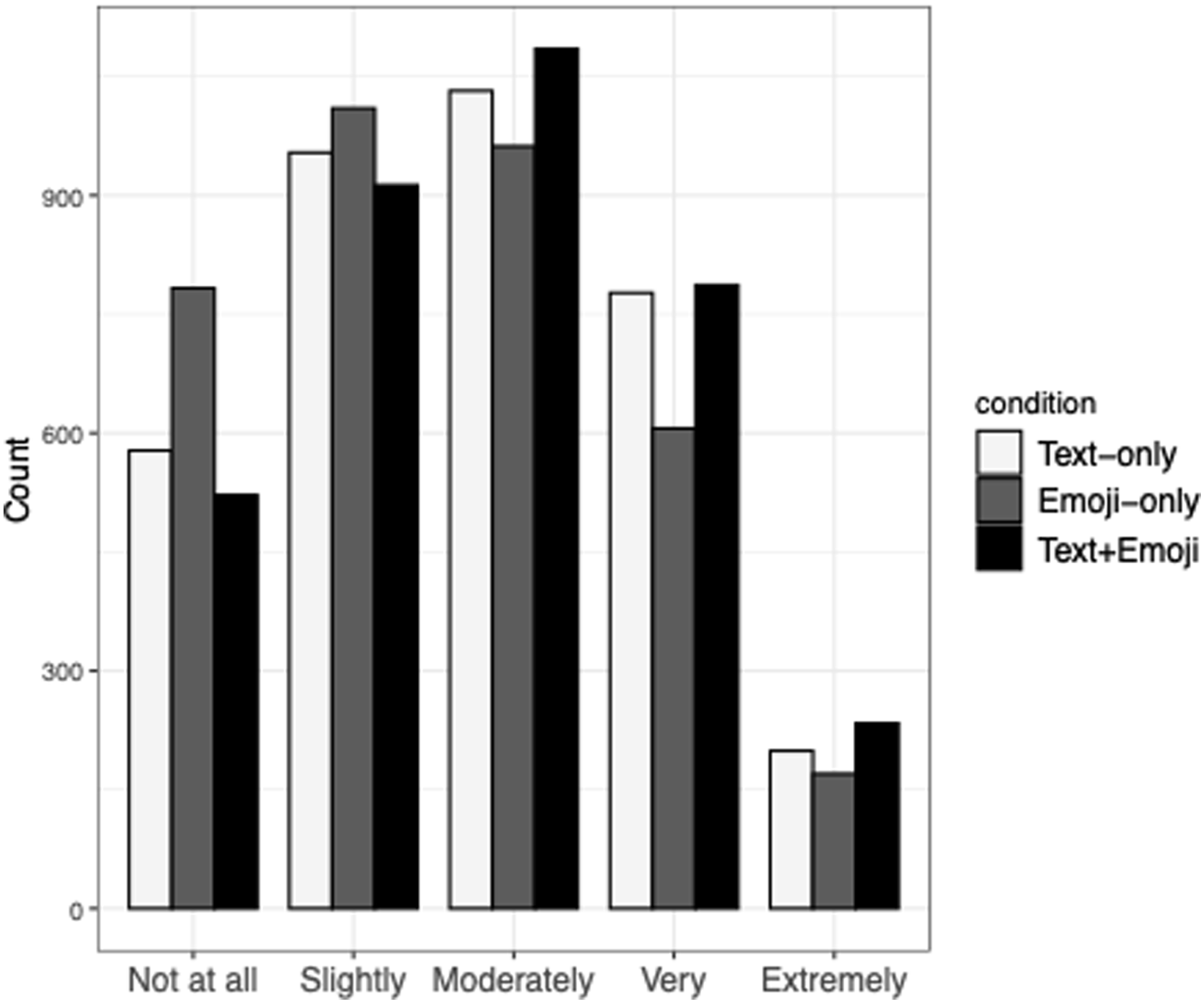
Distribution of forgiveness likelihoods across “Text-only,” ‘Emoji-only,” and “Text + Emoji” conditions.
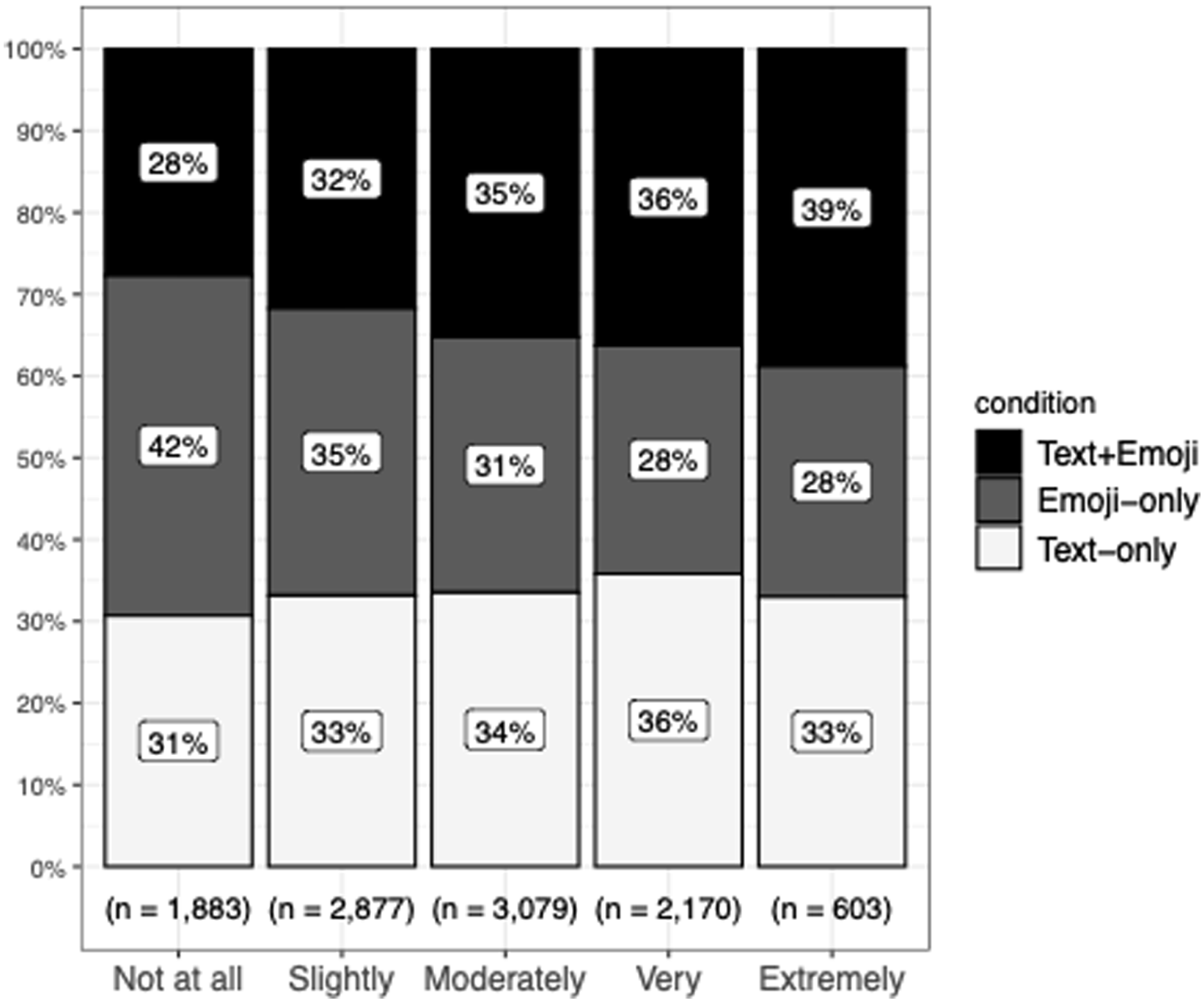
Forgiveness likelihoods in “Text-only,” “Emoji-only,” and “Text + Emoji” conditions across rating items of “Not at all,” “Slightly,” “Moderately,” “Very,” and “Extremely.”
Discussion
The aim of the current study was to gain a deeper understanding of the influence of emojis on people’s willingness to forgive. Results showed that the “text + emoji” condition produced significantly higher forgiveness ratings than the “text-only” or “emoji-only” conditions. Specifically, participants were more likely to forgive the sender (i.e., transgressor) when a text-based message was accompanied by an emoji than without an emoji. Although participants demonstrated willingness to forgive in the emoji-only condition, they showed less likelihood compared to text-based messages, either with or without an emoji.
The Role of Emojis in Willingness to Forgive
The findings of this study suggest that adding an emoji to a text message enhances the intended meaning or expressed emotions, which is in line with previous research. For instance, a negative or neutral message with a negative emoticon/emoji was perceived as having more negative emotion than one without a negative emoticon/emoji (Boutet et al., 2021; Derks et al., 2008; Hand et al., 2022; Luor et al., 2010; Neel et al., 2023; Skovholt et al., 2014). In the current study, the transgressor expressed emotions of guilt or regret for their offences and sought forgiveness by sending an apology message. The scenario describing the transgression is inherently negative, yet the appearance of an apology is arguably a positive development. Specifically, although guilt or regret might be considered as negative emotions, the recognition of the transgressor’s acknowledgement of remorse may be able to console the receiver and reduce the negative impressions, thus resulting in a likelihood of forgiveness. Previous research showed that the degree to which a transgressor offers an apology and actively seeks forgiveness affects the likelihood of being forgiven (e.g., McCullough et al., 1997, 1998). Lev-Ari (2025) also showed that apologies with longer words were perceived as more apologetic. Text apologies plus emojis might be considered as more effortful on the sender’s part than text-only or emoji-only apologies. Therefore, a verbal apology message accompanied by an emoji might be considered as apologising with more sincerity than the text-only or emoji-only apology messages, which reduced the negative impression towards the transgressor (Ohbuchi et al., 1989). This suggestion is supported by previous research on willingness to forgive in the contexts of service failure in marketing communication (customer service; e.g., Ma et al., 2021; Wang et al., 2023), which showed that adding an emoji to an apology message increased the perceived sincerity and facilitated customers’ willingness to forgive. Hand et al. (2022) also showed that negative text accompanying a negative emoji drives perceptions of negativity regarding both messages and senders’ state. The receiver, when seeing the apology message with text and a facial emoji (e.g., a sad face) may be more likely to consider that the sender took responsibility for the offence and expressed a sincere demand for forgiveness. Thus, the presence of an emoji following a verbal apology (i.e., “I’m sorry”) enhanced the perceived emotions of apologising, which comforted the receiver and then resulted in more willingness to forgive.
Furthermore, although emojis alone may be able to perform speech acts (e.g., Holtgraves, 2024; Scarantino, 2017), the findings of the current study suggest that they might be less effective than written verbal language in communicating an apology. Participants demonstrated the least willingness to forgive when the apology message included only an emoji compared to both the text-only and text plus emoji conditions. It might be that emoji-only messages in this study were more ambiguous compared to the text-only and text plus emoji messages, thus participants may be less confident in perceiving the apology-relevant emotions signalled by a facial emoji (e.g., ). Specifically, previous research showed that when interpreting negative emojis, the receiver perceived the sender’s emotions as being 26% less negative than the sender reported (Berengueres & Castro, 2017). Thus, in the current study, it might be more difficult for participants to successfully recognise the sender’s emotions of guilt or regret conveyed by only an emoji compared to the more direct text messages (i.e., text-only and text plus emoji). Moreover, the emoji-only apology might be considered as conveying apology-relevant emotions with less sincerity compared to the more direct text messages, which may be viewed as a signal of less likelihood of taking responsibility for the offence (McCullough et al., 1997, 1998), thus resulting in less willingness to forgive. Therefore, the possible misinterpretation of the emoji-only apology may lead to less willingness to forgive compared to more explicit apology messages. In addition, emoji-only messages (e.g., ) might be considered more effortless compared to text-only messages (i.e., “I am sorry”), thus less apologetic (Lev-Ari, 2025), thereby yielding less willingness to forgive.
The finding that emoji-only messages were less effective than text-only messages was inconsistent with the results reported in Holtgraves and Robinson (2020). Holtgraves and Robinson (2020) showed that participants were more likely to perceive the intended meaning of the sender in emoji-only messages, compared to text-only messages. It is worth noting that while the current study examined apology messages, Holtgraves and Robinson (2020) investigated indirect language. The above inconsistency might be driven by the distinct communicative goals of these two types of language. In the context of an apology, emojis serve as a plea for forgiveness – a social “repair” that relies heavily on the receiver’s perception of the sender’s sincerity and willingness to take responsibility. Indeed, a recent study (Lev-Ari, 2025) suggests that the more effort a sender invests in an apology message, the more apologetic it is perceived to be, thereby increasing the likelihood of forgiveness. Therefore, the effectiveness of emojis in apology messages may depend on how well they signal these attributes.
Our findings suggest that emoji-only apology messages were less effective compared to text-only and text plus emoji messages. This may be because, without explicit apologetic language, emojis alone are more implicit and ambiguous; furthermore, sending a single emoji may be perceived as relatively effortless. This can create an impression of lower sincerity, leading to a reduced willingness to forgive. However, for indirect speech acts, any non-direct response may be sufficient for the perceiver to interpret the sender’s intended meaning, and emojis can be more indicative than text-only messages in certain circumstances. For instance, as in Holtgraves and Robinson (2020), compared to the text-only condition, emojis can facilitate comprehension of indirect replies to requests for information (i.e., opinions and disclosures), rather than indirect replies to requests for action (e.g., refusals). Emojis may function as a contextual cue to facilitate the comprehension of only nonconventional indirect replies (e.g., opinions and disclosures). Therefore, the communicative effect of emojis in apology messages and indirect reply messages is very different, depending on the communication goals and contexts.
Implications
The findings of the current study have important implications for both theory and practice. Firstly, we investigated emoji interpretation from a speech act perspective. We provide initial empirical evidence for the communicative effect of emojis as an apology strategy in social interaction. Little research has examined emojis as a non-verbal speech act, and although Holtgraves (2024) conducted a series of experiments to investigate whether emojis can perform speech acts, they only examined participants’ perception of the sender’s intent conveyed by emoji-only messages. That is, they demonstrated that the receiver can successfully perceive the sender’s intent (e.g., to remind) when a text message included only an emoji. However, according to the Speech Act Theory (Austin, 1962; Searle, 1969), speech can also affect the receiver. That is, the perceiver (including the receiver) is likely to carry out actions under the influence of the sender’s speech. The current study examined the perceiver’s response (i.e., willingness to forgive) to both verbal (text) and non-verbal (emoji) speech acts, providing new insights that adding an emoji to a text-based apology increases the communicative effect on the perceiver (indicated by willingness to forgive), and emojis alone can communicate an effect on the perceiver as well. Furthermore, the finding that emojis alone were less effective compared to text messages (with or without emoji cues) contributes to the development of the Theory of Affective Pragmatics (Scarantino, 2017) that emotional expression, such as non-verbal emoji-based apology, is less effective than verbal speech acts.
In addition, the findings have practical implications for everyday social interactions. Specifically, similar to previous research in a customer service context (Ma et al., 2021; Wang et al., 2023), the findings of the current study suggest using emojis alongside text in apology messages can enhance their effectiveness in more social settings as well. Therefore, a sender may wish to combine text with emojis when apologising in CMC, as this approach may increase the likelihood of forgiveness. However, senders should be cautious in employing emoji-only messages when apologising, as the perceiver may misinterpret the intended emotions, potentially reducing their willingness to forgive.
Limitations and Future Directions
There are some limitations to this study. Firstly, we included two specific emojis, that is, the and emoji, however, other emojis may also effectively communicate a sense of apology. For instance, research by Wang et al. (2023) highlighted the positive impact of a pleading face emoji on willingness to forgive. Moreover, according to the Theory of Affective Pragmatics (Scarantino, 2017), different emotional expressions can produce various effects in communication. While both the and emoji could be considered as conveying an apology effectively, there might be subtle differences in their impact. Therefore, it would be interesting for future studies to examine the effect of various types of emojis on willingness to forgive, providing a more nuanced understanding of how different emojis influence interpersonal interactions. Furthermore, the conclusions which can be made may be limited by the sample, primarily consisting of young female participants from the UK who spoke English as their first language. Since previous research showed that individual differences, such as age (Cui et al., 2024), gender, and culture (e.g., Chen et al., 2024), and levels of autistic traits and alexithymia (Taylor et al., 2024), influenced recognition of the emotions conveyed by emojis, future studies could benefit from exploring those individual differences in perceiving emojis as a speech act with a more diverse and balanced sample. Finally, although the observed difference between the text-only and text + emoji conditions is small in magnitude, it was estimated across a fully counterbalanced set of items and randomised trial orders. Because trial order varied across participants and each item appeared in only one condition per participant, the effect is unlikely to be attributed to systematic repetition or order effects. However, future studies could examine how emoji-related effects evolve with repeated exposure to the same stimuli.
The current study also suggests some future directions. Specifically, this study is an important first step, in which we aimed to examine whether emojis could perform the basic function of influencing willingness to forgive. However, the downstream consequences of willingness to forgive might be interesting for future follow-up studies. For instance, relationships between prosocial motivations, willingness to forgive, and the presence of emojis might be interesting research questions. Moreover, we focused on only text-based apologies; however, examining the format of apologies (i.e., text-based or in-person) might also be an interesting future direction, given the additional cues that are available (e.g., tone of voice) in in-person interactions. Compared to in-person apologies, text-based apologies may be perceived as less sincere, as people are less likely to view text-based messages as a genuine reflection of the sender’s feelings when text-based messages require less physical effort or spontaneous emotional expression (Walther et al., 2009).
Furthermore, it might be insightful to conduct qualitative studies to examine how participants actually interpret apologies across different conditions, as these interpretations might be a factor influencing forgiving behaviour. In addition, transgressions can range from minor slights to very serious, thus, the manipulation of seriousness might be an interesting avenue for future studies. Finally, although participants in the current study saw emojis that were rendered in the same way (i.e., the iOS design), it would be interesting for future studies to consider the effects of vendors (e.g., iOS/Android/Windows) or prior platform use in examining emojis in communication. Similarly, although we assumed that our sample, a majority of which were young adults and shared the same gender and culture, interpreted the two emojis in similar ways in an apology context, individuals may demonstrate different familiarity with specific emojis and this may influence their interpretations of emojis (e.g., Chen et al., 2024). Future studies could also take familiarity with specific emojis into account when investigating the effects of emojis on communication.
Conclusion
This study investigated how the inclusion of emojis in apology messages affects willingness to forgive. Results indicated that adding an emoji to text messages enhanced the effectiveness of the apology. While emojis alone can serve as either a non-verbal speech act or an emotional expression to convey apologies, in isolation, they were nevertheless found to be less effective than a verbal (text-based) apology. The findings highlight the importance of combining text messages with emojis when apologising online. In addition, while emojis can convey emotions and serve as non-verbal cues, they may not fully replace the impact of verbal apologies in fostering forgiveness.
Footnotes

Ethical Considerations
The study was conducted following the ethical guidelines of the School of Psychology, University of Nottingham (Ethics Committee Reference: 875).
Funding
The authors received no financial support for the research, authorship, and/or publication of this article.
Declaration of Conflicting Interests
The authors declared no potential conflicts of interest with respect to the research, authorship, and/or publication of this article.