






Abstract
Research has shown that recalling autobiographical memories primes semantic memory retrieval on conceptual implicit memory tasks (e.g., category exemplar generation). It has been argued that such autobiographical-to-semantic memory priming reflects the functional/interactive nature of autobiographical and semantic memory. In this study, we examined how the activation of self-knowledge, an abstract form of autobiographical memory, facilitated semantic memory retrieval on a category exemplar generation task. In Experiment 1, participants in a self-reference condition judged how words might relate to themselves (e.g., jazz), and in a semantic processing condition, they made word-familiarity judgments (e.g., broccoli). They were then given a category exemplar generation task (e.g., name types of music, vegetables). The results of this experiment showed that self-knowledge processing led to significant priming on the generation task, and that this priming did not differ from that of semantic processing. Experiment 2 replicated these findings along with an added event recall condition, which did not differ from the other processing conditions. Experiment 3 replicated the findings of Experiment 2 using a depth of processing manipulation. It is argued that the results support the notion that the activation of abstract autobiographical knowledge can facilitate semantic processing.
Keywords
Introduction
The interdependent nature of episodic/autobiographical memory and semantic memory has been represented with a number of paradigms and findings (Greenberg & Verfaellie, 2010; Irish & Vatansever, 2020; Klein et al., 2002; Rubin, 2022; Tulving, 1972, 1983, 2002; Westmacott & Moscovitch, 2003; Westmacott et al., 2003). In our lab, we have argued that bidirectional activations between autobiographical memory and semantic memory are the norm (Mace, 2010; Mace & Aaron, 2026), and that such activations are typically functional (e.g., they facilitate semantic processing, e.g., Mace & Aaron, 2026; Mace et al., 2019), or they produce common phenomena (e.g., everyday involuntary memories, e.g., Conway, 2005; Mace, 2024; Mace et al., 2019). These views have been represented by two priming paradigms, semantic-to-autobiographical memory priming (Mace et al., 2019), and autobiographical-to-semantic memory priming (Mace & Aaron, 2026).
Semantic-to-autobiographical memory priming is the case where semantic processing causes the unconscious activation of autobiographical memories, and such activations cause the subsequent facilitation or production of autobiographical memories on involuntary or voluntary memory tasks (Conway, 1990; Mace et al., 2019). A number of studies have presented evidence for this form of priming (see a complete review in Mace, 2024). For example, Conway (1990) showed that prior semantic processing had reduced retrieval time on a cue-word autobiographical memory task (see also Sheldon et al., 2020), whereas Mace et al. (2019) showed that prior semantic processing influenced content production on a cue-word autobiographical memory task (i.e., participants were more likely to retrieve memories which were the autobiographical exemplars of semantic primes, Experiments 1 and 3). Several studies have shown that prior semantic processing can cause involuntary autobiographical memory production (Mace & Unlu, 2020; Mace et al., 2019, see Mace, 2024 for a review), while these studies have also shown that semantic-to-autobiographical memory priming can occur with a multitude of different stimuli and modalities (Mace & Unlu, 2020; Mace & Aaron, 2025; Mace et al., 2023), that semantic-to-autobiographical memory priming can occur unconsciously (Mace & Keller, 2024a), and that it can be long-lasting (i.e., for at least 1 week, Mace & Hidalgo, 2022).
These studies show that semantic processing can facilitate voluntary memory and cause involuntary memories. They suggest that semantic processing results in the continuous unconscious activation of autobiographical memories (Conway, 2005). We have argued that these activations are functional for semantic processing, in that they provide autobiographical exemplars that aid in the comprehension and maintenance of concepts (e.g., Mace, 2024). While there is currently no direct evidence for this functional view of autobiographical memories, there is evidence that autobiographical memories can have a delayed facilitatory effect on semantic processing, as shown in studies on autobiographical-to-semantic memory priming (Mace & Aaron, 2026).
Autobiographical-to-semantic memory priming is the case where autobiographical memory retrieval primes performance on subsequent semantic memory tasks (e.g., category exemplar generation, word association). To date, there are only two studies in this area (Mace & Aaron, 2026; Mace et al., 2026), and thus, it was the goal of this study to further investigate this priming phenomenon. Before we outline the details of the current study, we review these two studies in some detail.
In the first study, Mace and Aaron (2026) tested the autobiographical-to-semantic memory priming hypothesis with two semantic tasks, category exemplar generation (where participants are primed with members of a taxonomic category, e.g., sneakers for types of footwear), and word association (where participants are primed with one word from a pair of associates, e.g., family from the pair kin-family, see examples in Mulligan, 1998; Weldon & Coyote, 1996). In Experiment 1, one group (i.e., the autobiographical group) retrieved autobiographical memories in response to word cues (e.g., sneakers, grandparents, watermelon), while another group (i.e., the semantic group) rated the words for the familiarity of their meanings. Both groups then received a category exemplar generation task, along with an unprimed control group that judged the alphabetical status of letter strings (e.g., EFG, XAT) in place of the priming phase. Priming on the category exemplar generation task was found for both the autobiographical and semantic groups, relative to the unprimed control group. Mace and Aaron (2026) followed that experiment with an experiment that used a within-subjects design, where participants also used words to recall autobiographical memories, but they also rated words for the familiarity of their meanings. These priming sessions were followed by a word association task. As in their first experiment, the results revealed significant priming for the autobiographical and semantic conditions. Thus, this study was the first to show that autobiographical memories can prime the retrieval of semantic memories, and in both experiments, priming from autobiographical processing was as strong as priming from semantic processing.
Mace et al. (2026) followed up on these findings with another semantic task, the general knowledge task (Blaxton, 1989; Hamann, 1990). The general knowledge task provides participants with trivia-like questions (e.g., What did Socrates drink at his execution?), whose answers typically correspond with previously presented primes (e.g., Hemlock, see Roediger & McDermott, 1993, for a review of all conceptual implicit tasks). In the first experiment of Mace et al. (2026), participants were given primes (e.g., dog) that corresponded to answers to general questions (e.g., What animal is related to wolves?), and, as in Mace and Aaron (2026), they either recalled autobiographical memories in response to these words, or they rated their meaningfulness. As in Mace and Aaron (2026), both the autobiographical group and the semantic group showed significant and equivalent priming on the general knowledge task that followed priming. In a second experiment, Mace et al. (2026) used the associates of the primes that they had used in their first experiment (e.g., pet and bone in place of dog). The results of this experiment showed significant priming on the general knowledge task for both the autobiographical and semantic groups, as in the first experiment. Mace et al. (2026) argued that the results showed that the facilitatory nature of autobiographical memory primes extends to their associates, broadening their functional range, and that autobiographical and semantic memories exist in an elaborate activational network (cf. Burianova et al., 2010).
Mace and Aaron (2026) and Mace et al. (2026) argued that their results show that autobiographical memories cause the activation of various generic knowledge structures (e.g., categorical knowledge, general knowledge), and that autobiographical memory can be functional to semantic processing when these knowledge structures are needed for specific tasks. They also argued that the results, along with those from the semantic-to-autobiographical memory priming paradigm, support the view that there are bidirectional activations between autobiographical memory and semantic memory, such that autobiographical memory activation causes the activation of related semantic knowledge, and semantic memory activation causes the activation of related autobiographical knowledge (Conway, 2001, 2005). 1
These two studies showed that the retrieval of specific autobiographical memories (e.g., I remember getting my dog from the animal shelter) can aid the retrieval of semantic memories. Mace and Aaron (2026) suggested that more general forms of autobiographical memory (e.g., repeated events, such as I used to play in the orchestra at university) should prime the retrieval of semantic memories. Along these lines, we believe that other abstract forms of autobiographical memory, such as self-knowledge (e.g., I like dogs), will aid in the retrieval of semantic memories. In the current study, we report on the results of three experiments, where we tested the idea that the retrieval of self-knowledge (also known as personal semantics) would aid semantic memory retrieval by having participants process words (e.g., jazz) in relation to themselves, followed by a category exemplar generation task (e.g., name types of music).
Self-knowledge has been used and conceptualized in different ways. Traditionally, self-referential processing of words has been compared to semantic processing, and it has been shown to result in superior word recall relative to semantic processing (Bower & Gilligan, 1979; Rogers et al., 1977, but see Klein & Kihlstrom, 1986). Self-knowledge has at times been called personal semantics (Kopelman et al., 1989; Renoult et al., 2012), and it has also been classified in a number of ways with respect to memory systems. Some researchers have deemed it to be semantic memory, a bridge between semantic memory and autobiographical memory, part of the conceptual self, or more plainly, a part of autobiographical memory (Conway, 2005; Conway et al., 2019; Ernst & Rathbone, 2019; Klein et al., 2002; Renoult et al., 2012; Rubin, 2019, 2022). Researchers have also argued that two types of representations underlie self-knowledge (i.e., episodic and summary semantic knowledge, e.g., Klein & Loftus, 1993; Klein et al., 1992, see Klein et al., 2002). More recent focus on self-knowledge, and other forms of abstract autobiographical memories, or personal semantics, has been to place it along a continuum between autobiographical memory and semantic memory (Sheldon et al., 2020; Renoult et al., 2012, 2016).
Personal semantics, as a more global entity, has been divided into four subtypes (i.e., autobiographical facts, self-knowledge, repeated events, and autobiographically significant concepts, see Renoult et al., 2012). Our interest in the current report was limited to the self-knowledge construct. We take the position that self-knowledge is an abstract form of autobiographical memory that is distinct from specific autobiographical memories (i.e., episodic memories), extended event memories and repeated event memories (often called general event memories, collectively, e.g., Conway, 2005). 2 These different forms of autobiographical memory are distinct from semantic memory not only in their unique personal content but also with their relation to the self (e.g., see discussion in Rubin, 2019). While there are different views on where abstract autobiographical memories (or personal semantics) may be placed (Renoult et al., 2012), we believe that it is useful to consider how self-knowledge may be used in comparison to more concrete, sensory/perceptual forms of autobiographical memory (i.e., episodic memories), and general semantics. It seems that episodic memories and self-knowledge are more likely to be used in personally relevant ways (e.g., answering questions about the self or a past activity experienced by the self) than are general semantic memories (e.g., knowing the capital of France). Thus, from a functional perceptive, episodic memory, including extended event and summary memories, and self-knowledge can be seen as having similar purposes distinct from semantic memory. In this regard, one can see self-knowledge under the larger umbrella of autobiographical memory, though it may be neurocognitively distinct. Nevertheless, regardless of one’s position on where self-knowledge stands, we reasoned that positive results obtained here would show that self-knowledge, like the event-specific knowledge, can facilitate semantic memory retrieval, and therefore may be functional to it. Furthermore, such results would be further evidence of the interactive and functional nature of various forms of declarative memory.
Experiment 1
Experiment 1 utilized a fully within-subjects design. Participants were given words (e.g., jazz, volleyball, selfish), with the instructions to relate them to themselves in one condition (self-reference), and rate them on the familiarity of their meaning in another condition (semantic). These priming conditions were followed by a category exemplar generation task, where participants named exemplars of multiple semantic categories (e.g., types of music, sports, personality characteristics in others, Barsalou, 1985; Battig & Montague, 1969). Priming on category exemplar generation task was then compared to an unprimed control condition. Based on the hypothesis outlined above, that abstract autobiographical knowledge about the self will activate general semantic knowledge, in this instance categorical knowledge, we predicted that the self-reference priming condition would lead to significant priming on the category exemplar generation task, which would not differ from the semantic priming condition, while both priming conditions would be significantly greater than the unprimed condition.
Method
Participants
The participants were 40 undergraduate students from Eastern Illinois University, who participated in exchange for course credit. Twenty-four of the participants were females, and 16 were males, with an age range of 18 to 25 years (M = 20.48 years, SD = 2.47). All participants gave written informed consent, and the study was approved by the University’s ethics review board. Concerning sample size estimates, large effect sizes have been reported for the category exemplar generation task (Hamann, 1990), and we have also obtained a large effect size with this task (Mace & Aaron, 2026). Thus, to estimate sample size for this experiment, we used the large effect size setting (f = 0.40) in G*Power (3.1). For a one-way, dependent-samples F-test, with power set at .95, and with an alpha level of .05, G*Power indicated that a minimum of 23 participants were needed. Nevertheless, we opted for a sample size of 40, to maximize power.
Stimuli and Design
The stimuli for the priming phases were 80 exemplar words (e.g., encyclopedia, recliner) drawn from 24 categories (e.g., types of reading materials, types of furniture) listed in Battig and Montague (1969) and Barsalou (1985) (see the online Supplemental Material for the category labels and the exemplars used). To avoid ceiling effects, the exemplars selected were medium to low-frequency items. To determine average response rates for items drawn from Battig and Montague’s (1969) categories, we used Van Overschelde et al.’s (2004) updated category norms. The average response rate reported in Van Overschelde et al. (2004) for the 80 exemplars was 0.25 (SD = 0.15, ranging from 0.08 to 0.62).
From the 80 exemplar words, two priming lists were constructed, each with 40 exemplars from 12 categories, with one-half of the participants receiving one list, one-half receiving the other list. In this configuration, one list serves as the priming list while the other list serves as the unprimed control list. In each priming list, six categories were assigned to a processing condition (self-reference or semantic), with each containing 20 exemplar words, arranged randomly, with each participant receiving the same randomly ordered list. In each priming list, the six categories were counterbalanced across processing conditions (self-reference and semantic), and processing conditions were counterbalanced for order, with each serving in first or second position. Finally, the category exemplar generation task contained all 24 category labels, arranged randomly, with each participant receiving the same randomly ordered list.
The experimental design was a within-subjects manipulation with three conditions (self-reference, semantic, and unprimed). As noted, the unprimed condition was the unprimed list, as participants received one list in the priming phase while both lists (primed and unprimed) were presented in the category exemplar generation task.
Procedure
Participants were either tested individually or in small groups of 2–4. In the self-reference priming condition, participants were given the word primes, and they were instructed to read each word and rate how much they thought the word personally related to them or their life in any way. They were told that a word might refer to something they do or did, something they like or don’t like, something they use or used, or it may or may not describe them personally. They were told to use a 0–5 scale to rate words, where 0 = not related to me or my life, 1 = a little related to me or my life, and 5 = very related to me or my life. In the semantic priming condition, participants were given the word primes, and they were instructed to consider the definitional meanings of words, and then rate them using a 0–5 scale, where 0 indicated word definitions were unknown, 1 indicated word definitions were very unfamiliar, and 5 indicated high familiarity with word meanings. Participants either started with the self-reference priming condition followed by the semantic priming condition, or they received the reverse order. For both conditions, the words were printed on a sheet of paper, one for each condition, arranged randomly, with places next to each word for ratings. Participants worked through each condition at their own pace. On the conclusion of this phase of the experiment, participants were given a 5-min rest period before starting the category exemplar generation task.
For the category exemplar generation phase of the experiment, participants were told that various category names would be read to them, and they were to name as many examples of the category as they could in the time allotted. They were then given an example of a category (a type of science), and the experimenter named a few examples. The experimenter further explained that a category would be read, and they were to write down examples until time was called, and they would then move on to the next category and so forth. Once it was clear that they understood, the task commenced. Participants were given a booklet where the category labels were printed at the top of the page, and there were blank spaces underneath them. Each page contained a single category label from 1 of the 24 categories. For each category, the experimenter instructed them to turn to the page, and the experimenter read the label out loud, with the instructions to think of examples and write them until time is called. When time was called, they were instructed to turn to the next page, and the process was repeated for each of the 24 categories. The time given for each category was 25 s (Mace, 2003; Mace & Aaron, 2026). No connections were made between the category exemplar generation task and the priming phase. At debriefing, none of the participants indicated that they were aware of the connection between the priming tasks and the category exemplar generation task.
Results and Discussion
The data for this experiment were the target exemplars for each category that corresponded to the primed or unprimed list. A one-way dependent-samples analysis of variance (ANOVA) was conducted (self-reference vs. semantic vs. unprimed), and Holm’s test was used as the follow-up test. Alpha levels for all statistical tests were set at .05, and assumption checks were performed following all analyses (whose outcomes are not reported if assumptions were verified).
Table 1 shows the mean number of target exemplars generated on the category exemplar generation task in the self-reference, semantic, and unprimed conditions. As shown in the table, more target exemplars were produced in the self-reference and semantic conditions on the category exemplar generation task than in the unprimed condition. An ANOVA conducted on the data in Table 1 indicated a significant difference among the means, F(2, 78) = 12.03, MSE = 5.50, p < .001, η p 2 = .24. Follow-up with Holm’s test showed that the self-reference and the semantic conditions did not differ (p = .17, d = 0.28), while both differed from unprimed (self-reference vs. unprimed, p < .01, d = 0.69; semantic vs. unprimed, p < .001, d = 0.97), thus confirming statistically significant and equivalent priming for both the self-reference and semantic conditions.
Mean Number of Target Exemplars Produced on the Category Exemplar Generation Task in the Priming and Unprimed Conditions in Experiment 1.
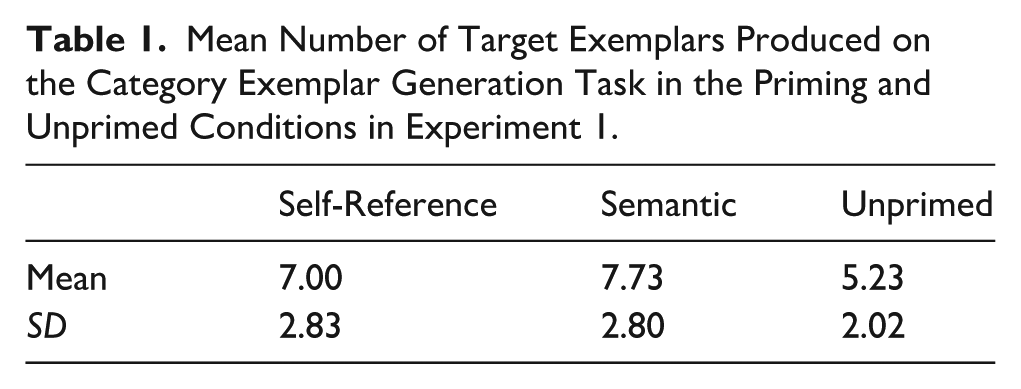
The findings of this experiment are consistent with the implicit memory literature in that semantic processing has typically resulted in robust priming on the category exemplar generation task (Roediger & McDermott, 1993). However, the novel finding reported here is that self-reference processing also led to significant priming on the category exemplar generation task. What is more, self-reference processing caused priming that was indistinguishable from semantic processing, suggesting that its strength as a priming mechanism is equal to that of semantic processing. These findings are consistent with those reported in Mace and Aaron (2026) and Mace et al. (2026), where autobiographical processing (i.e., the recall of specific past episodes) produced priming on the category exemplar generation task and other semantic tasks, which was also indistinguishable from semantic processing. Together, these results and the results reported here suggest that both specific and abstract autobiographical memories can facilitate the retrieval of semantic memories. This observation adds further support, and a new layer, to the idea that autobiographical memory can be functional to semantic processing and semantic memory. We will further discuss this idea after reporting the outcome of Experiment 2.
Experiment 2
The goal of Experiment 2 was to replicate the findings of Experiment 1 and to compare priming from self-reference processing to priming from autobiographical memory recall. We used a within-subjects design, where participants processed words in a self-reference condition and a semantic condition, as in Experiment 1, but they also used words to recall past personal experiences. Following these priming sessions, participants were given the category exemplar generation task, in which their performance was compared among the priming conditions and to the unprimed condition. We predicted that self-reference and semantic processing would lead to significant priming on this task, as in Experiment 1, and that autobiographical recall would also lead to significant priming, as in Mace and Aaron (2026).
Method
Participants
The participants were 42 undergraduate students from Eastern Illinois University, who participated in exchange for course credit. Twenty-two of the participants were females, and 20 were males, with an age range of 18 to 28 years (M = 20.43 years, SD = 3.88). All participants gave written informed consent, and the study was approved by the University’s ethics review board. We based our sample size estimate on the results of Experiment 1, which showed a fairly large effect size with 40 participants.
Stimuli and Design
The stimuli for the priming phases were 96 exemplar words (e.g., encyclopedia, recliner) drawn from 30 categories (e.g., types of reading materials, types of furniture) listed in Battig and Montague (1969) and Barsalou (1985). The exemplars were the same as in Experiment 1, but with 16 more medium to low frequency items drawn from six additional categories in Battig and Montague (1969) (see the online Supplemental Material for the category labels and the exemplars used). Again, we used Van Overschelde et al. (2004) to determine average response rates for items drawn from Battig and Montague (1969), which was 0.26 (SD = 0.15, ranging from 0.08 to 0.71) according to their data.
From the 96 exemplar words, 2 priming lists were constructed, each with 48 exemplars from 15 categories, with one-half of the participants receiving one list, one-half receiving the other list. As in Experiment 1, this configuration allowed one list to serve as the priming list while the other list served as the unprimed control list. In each priming list, five categories were assigned to a processing condition (self-reference, semantic, or autobiographical recall), with each containing 16 exemplar words, arranged randomly with the same random order for each participant. In each priming list, the five categories were counterbalanced across processing conditions (self-reference, semantic, and autobiographical recall), and the processing conditions were counterbalanced for order, with each serving in the first, second, and third positions. Finally, the category exemplar generation task contained all 30 category labels, arranged randomly, with each participant receiving the same randomly ordered list. Thus, as in Experiment 1, participants were exposed to both primed and unprimed categories.
The experimental design was manipulated within-subjects with four conditions (self-reference, semantic, autobiographical recall, and unprimed). As in Experiment 1, the unprimed condition was the unprimed list, as participants received one list in the priming phase while both lists were presented in the category exemplar generation task.
Procedure
Participants were either tested individually or in small groups of 2–4. The procedure for the self-reference and semantic priming conditions was the same as in Experiment 1. For the autobiographical recall condition, participants were given the word primes, and they were instructed to use them to recall a memory from their past and then rate their confidence in the details of the event on a 0–5 scale, where 0 indicated no memory, 1 indicated not very confident, and 5 indicated very confident (Mace & Aaron, 2026). As in Experiment 1, the words for all conditions were printed on sheets of paper, arranged randomly, with places next to each word for the ratings. Participants worked through each condition at their own pace, and at the conclusion of this phase of the experiment, participants were given a 5-min rest period before starting the category exemplar generation task, where the procedure was identical to Experiment 1 but with six additional categories. As in Experiment 1, no connections were made between the category exemplar generation task and the priming phase, and at debriefing, none of the participants indicated that they were aware of the connection between the priming tasks and the category exemplar generation task.
Results and Discussion
As in the first experiment, the data for this experiment were the target exemplars for each category that corresponded to the primed or unprimed list. A one-way dependent-samples ANOVA was conducted (self-reference vs. semantic vs. autobiographical recall vs. unprimed), and Holm’s test was used as the follow-up test. Alpha levels for all statistical tests were set at .05, and assumption checks were performed following all analyses (whose outcomes are not reported if assumptions were verified).
Table 2 shows the mean number of target exemplars generated on the category exemplar generation task in the self-reference, semantic, autobiographical recall, and unprimed conditions. As shown in the table, more target exemplars were produced in the self-reference, semantic, and autobiographical recall conditions on the category exemplar generation task than in the unprimed condition. Also, the priming conditions do not appear to differ from one another. An ANOVA conducted on the data in Table 2 indicated a significant difference among the means, F(3, 123) = 5.83, MSE = 4.62, p < .001, η p 2 = .13. Follow-up with Holm’s test showed that the self-reference, semantic, and autobiographical recall conditions did not differ (ps = 1.00, ds = 0.02–0.16), while all of them differed from unprimed (self-reference vs. unprimed, p < .01, d = 0.75; semantic vs. unprimed, p < .01, d = 0.77; autobiographical recall vs. unprimed, p = .02, d = 0.61), thus confirming statistically significant and equivalent priming for all priming conditions.
Mean Number of Target Exemplars Produced on the Category Exemplar Generation Task in the Priming and Unprimed Conditions in Experiment 2.

In summary, the findings of Experiment 2 replicated those of Experiment 1. Self-reference processing led to significant priming on the category exemplar generation task, and priming following self-reference processing was no different from priming following semantic processing, as in Experiment 1. For the additional autobiographical recall condition, the results also replicated previous findings, where the recall of autobiographical memories had led to significant priming on the category exemplar generation task (Mace & Aaron, 2026). The comparison between the autobiographical recall condition and the self-reference condition revealed that each of these processing conditions led to the same level of priming on the category exemplar generation task. This finding suggests that both abstract and specific autobiographical memory processing can have the same priming influence on subsequent semantic processing. While we realize that participants sometimes recall general autobiographical memories when asked to recall episodic memories, we believe that both of these memories will affect semantic memory performance, as stated in Mace and Aaron (2026), and that they are distinctly different from the more abstract self-related memories (i.e., one class refers to events, whereas the other class refers to knowledge of personal characteristics). Thus, the activation of each type of autobiographical knowledge can facilitate the retrieval of semantic knowledge in equal proportions, and because both autobiographical processing conditions did not differ from the semantic processing condition, it suggests that the activation of autobiographical knowledge, generally, can be as facilitatory as the prior activation of semantic knowledge.
Experiment 3
Experiment 1 showed that self-reference processing led to significant priming on the category exemplar generation task, and Experiment 2 replicated these findings while also showing that autobiographical memory recall led to significant priming on the same task, replicating Mace and Aaron (2026). However, it could be argued that these findings are alternatively explained by basic lexical processing, and not autobiographical processing. That is, priming in the autobiographical conditions in Experiments 1 and 2 may have been the sole function of basic lexical processing of the verbal stimuli, and thus autobiographical processing neither caused the priming nor added to it, according to such an account. However, if this account were true, the autobiographical conditions should have shown significantly less priming than the semantic condition. The literature on conceptual implicit memory is replete with depth of processing effects where semantic processing tasks similar to the one used here showed significantly greater priming than various basic lexical processing conditions (Bergerbest & Goshen-Gottstein, 2002; Hamann, 1990; Mulligan et al., 1999; Srinivas & Roediger, 1990; Vaidya et al., 1997; Weldon & Cayote, 1996). If priming from the autobiographical processing conditions used here was merely a function of lexical processing, then one should have seen such a depth of processing effect, with the semantic processing condition outstripping the autobiographical conditions. Nevertheless, while we believe that the lack of this observation belies a lexical processing explanation, Experiment 3 was designed to rule it.
Accordingly, in Experiment 3, we employed a depth of processing manipulation, where the autobiographical processing conditions used in Experiment 2 were compared to a condition that was based on basic lexical processing, e-counting. As in Experiments 1 and 2, we employed the category exemplar generation task as our measure of priming. We used a within-subjects design, where participants counted “e”s in words in a shallow condition, and they also processed words in a self-reference condition and an autobiographical recall condition, as in Experiment 2. We selected e-counting because it has been used often in depth of processing experiments (Hourihan & MacLeod, 2007; Hyde & Jenkins, 1969; Tekin & Roediger, 2020, see Brown & Mitchell, 1994), and we used it in another priming study and found that it produced significant semantic-to-autobiographical memory priming on the vigilance task (Mace & Keller, 2024b). We did not include the semantic condition from Experiments 1 and 2 to reduce the number of conditions, and because such a processing condition has a long history of producing superior memory performance compared to shallow conditions on explicit memory tests and conceptual implicit memory tests (Brown & Mitchell, 1994; Craik, 2002). Mace and Keller (2024b) also found a depth of processing effect when e-counting was compared with familiarity ratings.
Regarding predictions and implications, we predicted that when compared to the unprimed control condition, all priming conditions would show significant priming; however, the self-reference and the autobiographical recall conditions would also show greater priming than the e-counting condition. We reasoned that this finding would rule out the possibility that priming from the autobiographical conditions was merely a function of lexical processing, because the increased priming in these conditions would suggest that autobiographical processing enhanced semantic memory retrieval on the priming task over and above basic lexical processing.
Method
Participants
The participants were 42 undergraduate students from Eastern Illinois University, who participated in exchange for course credit. Twenty-five of the participants were females, and 17 were males, with an age range of 18 to 25 years (M = 20.38 years, SD = 1.62). All participants gave written informed consent, and the study was approved by the University’s ethics review board. We based our sample size estimate on the results of Experiment 2, which showed a fairly good effect size with 42 participants.
Stimuli and Design
The stimuli for the priming phase were identical to those in Experiment 2, and the design of the category exemplar generation task was also identical. As in Experiments 1 and 2, the two priming lists were distributed evenly among participants, allowing one list to serve as the priming list while the other list served as the unprimed control list. As in Experiment 2, in each priming list, five categories were assigned to a processing condition (self-reference, autobiographical recall, or e-counting), with each containing 16 exemplar words, arranged randomly, with each participant receiving the same randomly ordered list. In each list, the five categories were counterbalanced across processing conditions (self-reference, autobiographical recall, or e-counting), and processing conditions were counterbalanced for order, with each serving in first, second, and third position.
The experimental design was manipulated within-subjects with four conditions (self-reference, autobiographical recall, e-counting, and unprimed). As in Experiments 1 and 2, the unprimed condition was the unprimed list, as participants received one list in the priming phase while both lists were presented in the category exemplar generation task.
Procedure
Participants were either tested individually or in small groups of 2–3. The procedure for the self-reference and autobiographical recall conditions was the same as in Experiment 2. For the e-counting condition, participants were told to read the word and count the number of “e”s in it, noting that number, including zero, in a space next to the word. As in Experiments 1 and 2, the words for all conditions were printed on sheets of paper, arranged randomly, with places next to each word for responses. Participants worked through each condition at their own pace, and at the conclusion of this phase of the experiment, participants were given a 5-min rest period before starting the category exemplar generation task. As in Experiments 1 and 2, no connections were made between the category exemplar generation task and the priming phase, and at debriefing, none of the participants indicated that they were aware of any connection between the priming tasks and the category exemplar generation task.
Results and Discussion
As in the first two experiments, the data for this experiment were the target exemplars for each category that corresponded to the primed or unprimed list. A one-way dependent-samples ANOVA was conducted (self-reference vs. e-counting vs. autobiographical recall vs. unprimed), and Holm’s test was used as the follow-up test. Alpha levels for all statistical tests were set at .05, and assumption checks were performed following all analyses.
Table 3 shows the mean number of target exemplars generated on the category exemplar generation task in the self-reference, e-counting, autobiographical recall, and unprimed conditions. As evident in Table 3, more target exemplars were produced in the self-reference, e-counting, and autobiographical recall conditions on the category exemplar generation task than in the unprimed condition. In addition, consistent with predictions, the autobiographical priming conditions do not appear to differ from one another, but they do appear to differ from the e-counting priming condition. An ANOVA conducted on the data in Table 3 indicated a significant difference among the means, F(3, 123) = 12.08, MSE = 4.54, p < .001, η p 2 = .23.
Mean Number of Target Exemplars Produced on the Category Exemplar Generation Task in the Priming and Unprimed Conditions in Experiment 3.

Assumption checks revealed a departure from sphericity (Mauchly, χ2[5] = 13.56, p = .02), which when corrected, resulted in small changes (Greenhouse-Geisser estimate, ε = .86; corrected ANOVA, F(2.57, 105.27) = 12.08, MSE = 5.31, p < .001, η2 p = .23). Follow-up with Holm’s test showed that all priming conditions differed from the unprimed (self-reference vs. unprimed, p < .001, d = 1.08; e-counting vs. unprimed, p = .04, d = 0.49; autobiographical recall vs. unprimed, p < .001, d = 1.06), thus confirming statistically significant priming for all priming conditions. Holm’s test further showed that the self-reference and autobiographical recall conditions did not differ (p = .92, d = 0.02). Holm’s test also confirmed that both autobiographical priming conditions were significantly greater than the e-counting priming condition (self-reference vs. e-counting, p = .02, d = 0.59; autobiographical recall vs. e-counting, p = .02, d = 0.57), consistent with predictions.
In summary, the findings of Experiment 3 replicated the findings of Experiments 1 and 2 for the self-reference processing condition. Priming following autobiographical recall replicated the findings in Experiment 2 and Mace and Aaron (2026). However, Experiment 3 differs in that e-counting was compared to the two autobiographical processing conditions. Here, e-counting produced significant priming, as in other studies (Brown & Mitchell, 1994), and it also led to significantly reduced priming compared to the autobiographical processing conditions. The observation of greater priming in the autobiographical processing conditions in this study is consistent with depth of processing manipulations on tests like category exemplar generation (Hamann, 1990; Mulligan et al., 1999), where deep processing conditions produced superior priming relative to shallow processing conditions, like e-counting. Such findings have been traditionally attributed to the enhanced/elaborate processing in deep processing conditions, which is seen as having an enhanced priming function on conceptual implicit memory tasks like category exemplar generation (Brown & Mitchell, 1994; Mulligan et al., 1999; Roediger & McDermott, 1993). Similarly, we argue that such greater priming from the autobiographical processing conditions relative to the e-counting condition suggests that autobiographical processing enhances semantic memory production on the category exemplar generation task over and above basic-level processing. Thus, we believe that the findings reported for the current experiment rule out the possibility that lexical processing alone was the basis for priming in the autobiographical processing conditions.
General Discussion
Several studies have shown that semantic memories prime autobiographical memories (i.e., semantic-to-autobiographical memory priming, e.g., Mace et al., 2019; see Mace, 2024), whereas a couple have shown that autobiographical memories can prime semantic memories (i.e., autobiographical-to-semantic memory priming, Mace & Aaron, 2026; Mace et al., 2025). In the latter form of priming, the recall of specific autobiographical memories facilitated performance on several semantic tasks (i.e., category exemplar generation, general knowledge, word association). Mace and Aaron (2026) argued that such results showed how the retrieval of autobiographical memories can aid in the retrieval of semantic memories, thus facilitating semantic processing. They argued that the results also suggest that semantic knowledge structures are commonly activated when autobiographical memories are activated (e.g., see also Irish & Piguet, 2013), and that abstract forms of autobiographical memory are also likely to activate semantic knowledge, where they, too, may aid in the subsequent recall of semantic memories.
Here, we tested the idea that self-knowledge can facilitate semantic processing by comparing priming from self-reference processing with priming from semantic processing (Experiments 1 and 2) and the recall of specific autobiographical memories on the category exemplar generation task (Experiments 2 and 3). Experiment 1 found significant priming on the category exemplar task following self-reference processing, and priming from this processing condition did not differ from priming from the semantic processing condition. Experiment 2 replicated these results, and it also showed that priming from the autobiographical memory recall condition was significant, and it did not differ in magnitude from the self-reference processing and semantic processing conditions. Experiment 3 replicated the priming effects of self-reference processing and autobiographical memory recall and showed that these two conditions produced significantly more priming than a shallow condition, e-counting. As noted, the results of Experiment 3 appear to rule out the alternative idea that priming from the autobiographical processing conditions is merely a function of lexical processing. Beyond this observation, the findings have several implications.
The findings show that, like the retrieval of specific autobiographical memories, access to self-knowledge can aid in subsequent semantic processing, specifically when such processing requires the retrieval of categorical knowledge. Thus, there may be a functional benefit of self-knowledge activation beyond the immediate function of such knowledge (e.g., answering a question about the self), which may confer benefits to general and specific forms of semantic processing. Mace and Aaron (2026) argued that, beyond aiding in the retrieval of categorical knowledge, autobiographical memory processing may aid in the retrieval of other forms of semantic knowledge (e.g., general knowledge and associative knowledge). Similarly, we believe that self-knowledge activation will also aid in the retrieval of other forms of semantic knowledge (e.g., general knowledge and associative knowledge). Future studies should look to investigate these possibilities.
As argued in Mace and Aaron (2026), the findings reported here suggest that semantic memory structures, like categorical knowledge, are commonly activated when autobiographical memories are activated (see a similar view in Irish & Piguet, 2013). The data suggest that the activation of semantic memories is not limited to the prior activation of specific autobiographical memories but also includes abstract autobiographical memories, such as self-knowledge. Future studies should investigate the role of other forms of autobiographical memory in the facilitation of semantic processing. It is reasonable to imagine that such facilitation would occur with the prior activation of other forms of personal semantics (Renoult et al., 2012).
It may also be informative to investigate how closely related self-knowledge and episodic memories are to semantic memories. Sheldon et al. (2020) found that accessing self-knowledge and repeated-event knowledge resulted in shorter retrieval latencies than general semantic memory access on a subsequent autobiographical memory task that required the retrieval of specific past experiences. Sheldon et al. (2020) argued that their results supported the idea that different forms of personal semantics represent intermediary forms of memories between episodic autobiographical memory and semantic memory. It would be interesting to see if similar results were obtained with the reverse experimental paradigm. That is, how priming from self-knowledge and episodic memory access might compare on a reaction-time-based semantic task (e.g., category verification, and timed word association, e.g., Hourihan & MacLeod, 2007; Vaidya et al., 1997).
As argued elsewhere (Mace, 2010; Mace & Aaron, 2026; Mace et al., 2019), we believe that the data can be explained by an elaborate activational network, where autobiographical memory and semantic memory activate each other (see also Burianova et al., 2010, as well as other similar views, e.g., Greenberg & Verfaellie, 2010; Irish & Piguet, 2013; Westmacott et al., 2003). In the semantic-to-autobiographical pathway, when semantic memories are activated, related and relevant semantic memories are activated, as well as related and relevant autobiographical memories, all of which can have an immediate function (e.g., aid in comprehension) or a delayed function (e.g., facilitate autobiographical memory retrieval). Similarly, in the autobiographical-to-semantic pathway, when autobiographical memories are activated, related and relevant autobiographical memories are activated, as well as related and relevant semantic memories, all of which can have an immediate function (e.g., aid in comprehension) or a delayed function (e.g., facilitate semantic memory retrieval). This type of architecture would allow autobiographical memory and semantic memory to functionally interact, producing the effects seen here and elsewhere (Mace & Aaron, 2026; Mace et al., 2019). While we have used this type of model to explain autobiographical-to-semantic priming and semantic-to-autobiographical priming, we also realize that other theoretical models are possible.
Nevertheless, a model like this, or one similar, may explain why there were no apparent differences in priming magnitude between the autobiographical conditions and the semantic condition. In each of the activation scenarios above, both autobiographical knowledge and semantic knowledge are presumed to be activated with equal strength, resulting in similar priming outcomes. However, there may be circumstances in which autobiographical processing might produce greater priming than semantic processing. For example, autobiographical memory retrieval can be more likely to result in consistent mental imagery (Brewer, 1996; Greenberg & Knowlton, 2014; Rubin & Kozin, 1984) than semantic processing. This imagery enhancement might give autobiographical processing an advantage over semantic processing in subsequent object or picture recognition (Lupker, 1988). In addition, priming on the category exemplar generation task has been shown to decline over several hours (e.g., Hamann, 1990, see Roediger & McDermott, 1993). Because autobiographical priming has shown no decay in strength after 7 days (Mace & Hidalgo, 2022), it is possible that priming from autobiographical processing may show no decay on the category exemplar generation task, whereas priming from semantic processing may show considerable decay. Questions like these can be investigated in future studies.
Regarding the autobiographical recall conditions employed in Experiments 2 and 3, we noted that even though participants are instructed to recall episodic memories, they sometimes recall extended event memories (e.g., my trip to London last summer) or summary/repeated event memories (e.g., Sunday walks in the park). As discussed, we believe that these types of general autobiographical memories will prime semantic memories in the way that episodic memories do, as the central content of these memories will also activate corresponding conceptual content in semantic memory. Consistent with this idea, there is indirect evidence that shows that autobiographical memories are conceptually organized (e.g., Conway & Bekerian, 1987; Mace et al., 2013; see also Conway, 2005; Mace & Clevinger, 2019), suggesting the type of organization for autobiographical and semantic memory as outlined above. However, future studies should compare these types of general autobiographical memories with episodic memories on a task like category exemplar generation.
Apart from these considerations, the data presented here represent another instance of where autobiographical memory and semantic memory have interacted (Greenberg & Verfaellie, 2010). To our knowledge, this is the first study where self-knowledge has been shown to facilitate semantic processing. Previous work has shown interactions between semantic memories, episodic memories, episodic future thoughts (imagining future selves), and autobiographical significance, for example (Irish & Piguet, 2013; Mace et al., 2019; Westmacott & Moscovitch, 2003). Adding self-knowledge to this list suggests another way in which autobiographical memory and semantic memory can interact, making such interactions even more nuanced and multifarious. Such observations appear to speak more to an interdependent autobiographical memory and semantic memory than to an independent autobiographical memory and semantic memory (see discussion in Greenberg & Verfaellie, 2010, for example).
Depending on one’s perspective, this study could be perceived as having an inherent theoretical limitation. As stated at the outset, we believe that self-knowledge is a part of autobiographical memory (Conway, 2005; Conway et al., 2019), whereas others have taken the position that it is a form of semantic memory, or a form of memory in between autobiographical and semantic memory (e.g., see discussions in Renoult et al., 2012, 2016; Sheldon et al., 2020). If self-knowledge (and other forms of so-called personal semantics) are indeed a part of semantic memory, or a distinct, intermediary form of memory, then our paradigmatic nomenclature, autobiographical-to-semantic memory priming, as applied to the results presented here, may be a misnomer. Such a reality might also result in different interpretations of our findings. While we acknowledge this alternative view, we also acknowledge that the status of self-knowledge has not been definitively settled. Thus, we continue to argue for the view that self-knowledge and other forms of abstract autobiographical memories are a part of the autobiographical knowledge base. Nevertheless, in the interim and possibly beyond, it may be useful to view abstract autobiographical memories instead along a functional continuum. Abstract autobiographical memories, as well as specific autobiographical memories, are more likely to be useful personally than semantic memories. As noted, all forms of autobiographical memory differ from semantic memories in content, function, and their relation to the self, where the self is a central theme in autobiographical memories but not semantic memories (Rubin, 2019). Taking this approach does not obviate their neurocognitive status but allows them to be grouped along a functional dimension.
In conclusion, this study has shown that prior self-knowledge processing primed semantic memory production on the category exemplar generation task across three experiments. These findings add to previous findings where specific autobiographical memories caused similar results on semantic tasks (Mace & Aaron, 2026). Experiments 2 and 3 showed that the activation of specific autobiographical memories caused as much priming as self-knowledge activation on the generation task, and these findings, along with others (Mace & Aaron, 2026), suggest that both specific and abstract forms of autobiographical memories can facilitate semantic retrieval and processing. Thus, the findings extend the range and facilitation of autobiographical memory processes to semantic memory processes, and we have argued that they also support an interconnected, network view of autobiographical memory and semantic memory. We have argued here and elsewhere (Mace, 2024; Mace & Aaron, 2026; Mace et al., 2019) that such observations support a broader view which asserts that autobiographical memory activations are functional to semantic processes, and that such functional contributions occur in both an immediate manner (as seen in semantic-to-autobiographical priming, e.g., Mace et al., 2023) and a delayed manner (as seen here and in Mace & Aaron, 2026). Future work should focus on how self-knowledge might facilitate semantic processes in other semantic contexts, as well as how other forms of abstract autobiographical memory might be involved.
Supplemental Material
sj-docx-1-qjp-10.1177_17470218261457398 – Supplemental material for Autobiographical Processing Primes Semantic Memory Production on the Category Exemplar Generation Task: The Role of Self-Referential Processing
Supplemental material, sj-docx-1-qjp-10.1177_17470218261457398 for Autobiographical Processing Primes Semantic Memory Production on the Category Exemplar Generation Task: The Role of Self-Referential Processing by John H. Mace, Jaden D. Woerner and Kaitlyn R. Parker in Quarterly Journal of Experimental Psychology
Footnotes

Ethical Considerations
This study was approved by the institution’s ethics review board.
Consent to Participate
All participants gave their written, informed consent to participate in this study.
Funding
The authors received no financial support for the research, authorship, and/or publication of this article.
Declaration of Conflicting Interests
The authors declared no potential conflicts of interest with respect to the research, authorship, and/or publication of this article.
Data Availability Statements
The University’s ethics review board did not approve of the publication of individual data files, and therefore, the data are not available online. However, requests for the data can be made to the first author.
Notes
References
Supplementary Material
Please find the following supplemental material available below.
For Open Access articles published under a Creative Commons License, all supplemental material carries the same license as the article it is associated with.
For non-Open Access articles published, all supplemental material carries a non-exclusive license, and permission requests for re-use of supplemental material or any part of supplemental material shall be sent directly to the copyright owner as specified in the copyright notice associated with the article.
