







Abstract
Target prevalence influences decision-making in visual search tasks, making it a crucial area of research. The low prevalence effect (LPE) occurs when lower target prevalence leads to higher miss rates, often due to premature target-absent decisions. This study investigated whether removing the need for an explicit “target-absent” response, using a go/no-go (GNG) response task, can mitigate the LPE by reducing premature decisions. Participants completed either a target-present/absent (PA) response task or a GNG task, with target prevalence set at high (50%) and low (5%) levels. In Experiment 1, the GNG task used an identical trial termination time across participants. In Experiment 2, the trial termination time was customized based on each participant’s performance threshold established prior to the main task. Results showed that the miss rate difference between prevalence conditions was smaller in the GNG task than in the PA task in both experiments. Moreover, customizing trial termination times also reduced the overall miss rate without increasing false alarms. Combining the GNG response type and customized trial termination offers a simple but effective method for improving target detection performance and mitigating the LPE in visual search.
Introduction
Humans routinely use visual selection in daily life, a cognitive process that involves identifying relevant information while ignoring irrelevant stimuli in their environment. This fundamental process is a central theme in psychology (Wolfe, 1994). To investigate visual selection, researchers commonly employ visual search tasks (e.g., Treisman & Gelade, 1980). In a typical visual search task, participants are instructed to find a target stimulus among distractors and respond explicitly regarding the target’s presence or absence.
In typical visual search tasks, the probability of presenting a target—target prevalence—is 50%. However, target prevalence is sometimes much lower in real-world visual search scenarios such as airport security inspections and medical diagnostics. Low target prevalence is associated with increased miss rates (i.e., the rate of target-absent responses in target-present trials) and faster reaction times (RTs) in target-absent trials—a phenomenon known as the low prevalence effect (LPE). Various studies have documented the LPE in simulations of real-world scenarios, including airport security inspections (Buser et al., 2020; Wolfe et al., 2005, 2007, 2013), hazard detections in driving (Kosovicheva et al., 2023) and medical diagnostics (Evans et al., 2013; Nakashima et al., 2015; Wolfe, 2022; Zhang et al., 2023; but see Gur et al., 2003).
The LPE may be considered analogous to the vigilance decrement (e.g., Broadbent & Gregory, 1965; See et al., 1995), as both reflect a reduced probability of signal detection when the background event, that is, noise, rate increases. However, these two phenomena differ from the perspectives of the task types and underlying cognitive processes (see Wolfe et al., 2007). Vigilance tasks typically require participants to detect a rare and faint signal at an uncertain time. In contrast, visual search tasks generally require participants to determine whether a target stimulus is present or absent in the display that remains visible until a response is made. Moreover, vigilance is defined as the ability to sustain attention over time, and the vigilance decrement could be related to a transient lapse in attention and appear as the task continues over time. Considering the task settings of visual search, the LPE is not directly related to such attentional lapses, and it could occur even though the fatigue from a long-time task is minimized. Therefore, the LPE has been discussed as a phenomenon distinct from the vigilance decrement.
Several factors contribute to the occurrence of the LPE, such as response execution errors (e.g., Fleck & Mitroff, 2007), failures of perception (Hout et al., 2015), prevalence-induced shifts in target-present/absent decision criterion (Wolfe et al., 2007), and premature decision of search termination (Wolfe & Van Wert, 2010). While response execution errors and perceptual failures were relatively minor issues (cf. Kunar et al., 2010, 2017; Van Wert et al., 2009), criterion shifts and premature termination are considered as main reasons for the LPE. The present study focuses on the role of search termination processes.
Wolfe and Van Wert (2010) offered a multiple-decision model to explain the LPE, suggesting that a lowered quitting threshold may lead to premature target-absent decision, thereby contributing to its emergence. According to this model, during a visual search, observers select an item and determine whether it is the target. When the item is identified as the target, observers terminate the search with a target-present response. Otherwise, they decide whether to terminate the search with a target-absent response or continue examining additional items. If the search continues, the process of selecting and judging an item repeats. The model posits that information for quitting the search is accumulated as the search progresses. The search concludes either when an item is identified as a target (a target-present response) or when accumulated information reaches a quitting threshold (a target-absent response). Frequent target-absent trials are thought to lower this threshold, causing observers to quit the search prematurely and thus increasing miss errors.
Researchers have investigated how to mitigate the LPE by considering the decision-related criteria. Most studies have focused on maintaining the target-present/absent decision criterion during low prevalence situations. For example, Wolfe et al. (2007) found that inserting a brief high prevalence training session with feedback reduces miss errors in subsequent low prevalence trials without feedback by inhibiting the decision criterion shift. Similarly, Schwark et al. (2012) proposed using false feedback to adjust participants’ perceived prevalence. In this approach, participants were sometimes falsely informed of a “miss error” despite correctly judging a trial as target-absent. The approach could shift the decision criterion toward “liberal,” that is, frequent target-present decisions, and indeed led to improved target detection and mitigation of the LPE. However, these manipulations may inadvertently increase false-alarm errors, incorrectly identifying a target as present in target-absent trials (see also Wolfe et al., 2013), raising concerns about their practical applicability. Taylor et al. (2022) suggested that the LPE could be reduced by a similarity search task, in which participants were instructed to find the most visually similar item to a given target regardless of whether the target was present or absent. This may be due to either sustaining a high quitting threshold and/or diminishing the accumulation of evidence toward this threshold, because this search task eliminates the requirement for participants to decide on “target-absent.” Although this approach showed promise, the authors acknowledged challenges for real-world application, such as the increased variability of items in settings like airport screening (e.g., knives, explosives) compared to the more homogeneous conditions typically found in laboratory settings.
Some studies have attempted to mitigate the LPE by manipulating response types to inhibit the bias toward the “target-absent” responses. Rich et al. (2008) conducted a four-alternative forced choice visual search task, manipulating the relative prevalence of four target types, and suggested that providing multiple-response alternatives can eliminate the LPE. Nakashima et al. (2013) also reported that the LPE was absent when participants searched for multiple targets and identified the target type, that is, their responses were not simply target-present/absent. While the multiple-response method effectively reduces the LPE, it introduces a more complex task environment, deviating from the typical two-response format.
Building on previous research suggesting that the key factor of the LPE is the premature search termination, we tried to propose a method to prevent it by reducing the number of responses. To this end, the present study introduces a simplified approach to eliminate explicit target-absent responses using a go/no-go (GNG) response task. In the GNG task, observers make an explicit response only when detecting a target and do not respond when determining the target is absent.
Although one might assume that removing the target-absent response eliminates the quitting threshold in the multiple-decision model, the cognitive mechanism of the GNG response task appears to be more complex. Indeed, Gomez et al. (2007) compared two-alternative choice tasks with GNG tasks by using diffusion modeling. They suggested that an implicit decision criterion could remain in no-go trials, implying that the absence of an explicit response does not preclude the decision-making. Since the simple diffusion model is inadequate for capturing the underlying complex processes of visual search tasks, a multiple-decision model was proposed (Wolfe & Van Wert, 2010). Despite their differences, both models share the premise that decision-making involves accumulating information to reach a threshold. Thus, the multiple-decision model can be discussed in a way that parallels the diffusion model. Especially in the GNG response visual search task, where no-go responses correspond to target-absent decisions, its quitting threshold in the multiple-decision model could be implicit. If this is the case, it might be less influenced by external factors, such as target prevalence. Considering that frequent target-absent responses in typical visual search tasks may lower the quitting threshold in low prevalence situations (and increase miss errors), we speculate that eliminating target-absent responses, as in the GNG task, may help sustain a higher quitting threshold, even in low prevalence scenarios.
Given this reasoning, the GNG response may provide an effective way to mitigate the LPE. To our knowledge, this is the first study to investigate whether eliminating target-absent responses could mitigate LPE in visual search tasks compared to the typical two-choice response types. We hypothesize that the GNG response task can effectively mitigate the LPE. If successful, the degree of the LPE—measured as the difference in miss rates between low and high prevalence conditions—should be smaller in the GNG response task than in the typical target-present/absent (PA) task.
Experiment 1
The purpose of Experiment 1 was to examine the effect of response type on the LPE. Participants were required to search for a “T” shape among “L” shapes—a task previously shown to elicit the LPE (Rich et al., 2008). The critical manipulation in this experiment was the response type: participants either responded by indicating target presence or absence, that is, a PA response, or responded by indicating only target presence, that is, a GNG response.
Given the nature of the GNG task, there may be instances where no response is made for an extended period, which could lead to a decline in vigilance potentially impairing performance (e.g., Broadbent & Gregory, 1965; See et al., 1995). To minimize this risk, the experiment employed self-paced trials. Once the current trial was completed, regardless of GNG responses, participants were free to initiate the next trial at their own discretion rather than having the next trial begin automatically. This procedure applied not only to the GNG task but also to the PA task to make the procedures similar. This setting enables us to discuss our experimental results from the perspective of visual search rather than vigilance.
In this experiment, participants were informed that the target prevalence was high/low at the beginning of the experimental block, but they were not given trial-by-trial accuracy feedback. Although previous studies usually provided accuracy feedback (e.g., Rich et al., 2008; Taylor et al., 2022) and indicated the potential effect of feedback on the LPE (Wolfe, 2022), some studies reported that the LPE can occur even without the feedback (Nakashima et al., 2015; Wolfe et al., 2013). Thus, we assumed that the LPE could occur in our experimental setting.
Method
Participants
Forty-two graduate and undergraduate students from Kyoto University, all native Japanese speakers with normal or corrected-to-normal vision, participated in the experiment. We excluded two participants from the analysis due to non-compliance with instructions. Therefore, we analyzed the data from 40 participants (age: M = 21.2 years, SD = 2.5; 21 women). Participants were randomly assigned to the PA or GNG task groups, with 20 in each group. We determined the sample size based on the methodology outlined by Taylor et al. (2022), which focused on mitigating the LPE. The chosen sample size exceeded that used in previous studies investigating the LPE (e.g., Fleck & Mitroff, 2007; Wolfe et al., 2005, 2007). It is noted that our analysis centered on detecting the interaction effect between task and prevalence. We also conducted a priori power analysis with G*Power (Faul et al., 2007), assuming conservatively a medium effect size (f) of 0.25, a statistical power of 0.80, and an alpha level of .05. This analysis indicated a minimum required sample size of 34 participants. Based on these considerations, we set the target sample size at 40 to ensure sufficient statistical power. This research complied with the principles of the Declaration of Helsinki. The Ethics Committee at Kyoto University approved the experimental procedure (KUIS-EAR-2019-004). We obtained informed consent from all participants. They were paid 1,500 yen (approximately 10 USD) for their participation.
Apparatus
The experiment was programmed using PsychoPy software (Peirce, 2007). Stimuli were presented on a 27-inch EV2785 monitor (EIZO; Ishikawa, Japan) with a 60 Hz refresh rate and a 3,840 × 2,160 pixel resolution. The experiment was run on a Windows computer with an Intel I7-6850K CPU at 3.60 GHz. A 10-key pad was used, with the “2” key designated to initiate the search display and the “4” and “6” keys for responses within the visual search task.
Stimuli and Procedure
Participants’ heads were not fixed, and the viewing distance was approximately 75 cm from the monitor. The stimuli consisted of rotated “T” (target) and “L” (distractor) shapes, each approximately 0.76° × 0.76° in size, displayed in white on a gray background. The distractor stimuli were L shapes that had a spatial offset (approximately 0.076°) in the line junction. This manipulation increased target–distractor similarity and task difficulty, and was intended to prevent ceiling effects in the visual search task. These stimuli were randomly placed in 12 of 24 invisible grid cells (6 horizontal × 4 vertical, each cell approximately 2° × 2°) on the display. Each stimulus was centered within its cell and then randomly jittered by up to ±0.4°. In target-present trials, one target “T” shape appeared in one of four orientations (upright, 90° to the left or right, or inverted). The remaining 11 items were distractor “L” shapes, each presented in one of four orientations. In target-absent trials, 12 distractors were displayed.
Figure 1 shows examples of trial sequences for the PA and GNG tasks. Each trial began with a central fixation cross. Participants were instructed to press the keys with their index finger. Upon pressing the “2” key, a blank display was shown for 0.5 s, followed by the search display. In the PA task, participants should perform a target-present response when they found a target or a target-absent response when they judged no target by pressing the “4” and “6” keys as accurately and quickly as possible. The key assignment for target-present and target-absent responses was counterbalanced among participants. In the GNG task, participants responded to finding a target (using either the “4” or “6” key, counterbalanced among participants) as accurately and quickly as possible, with no response required for a target-absent decision.
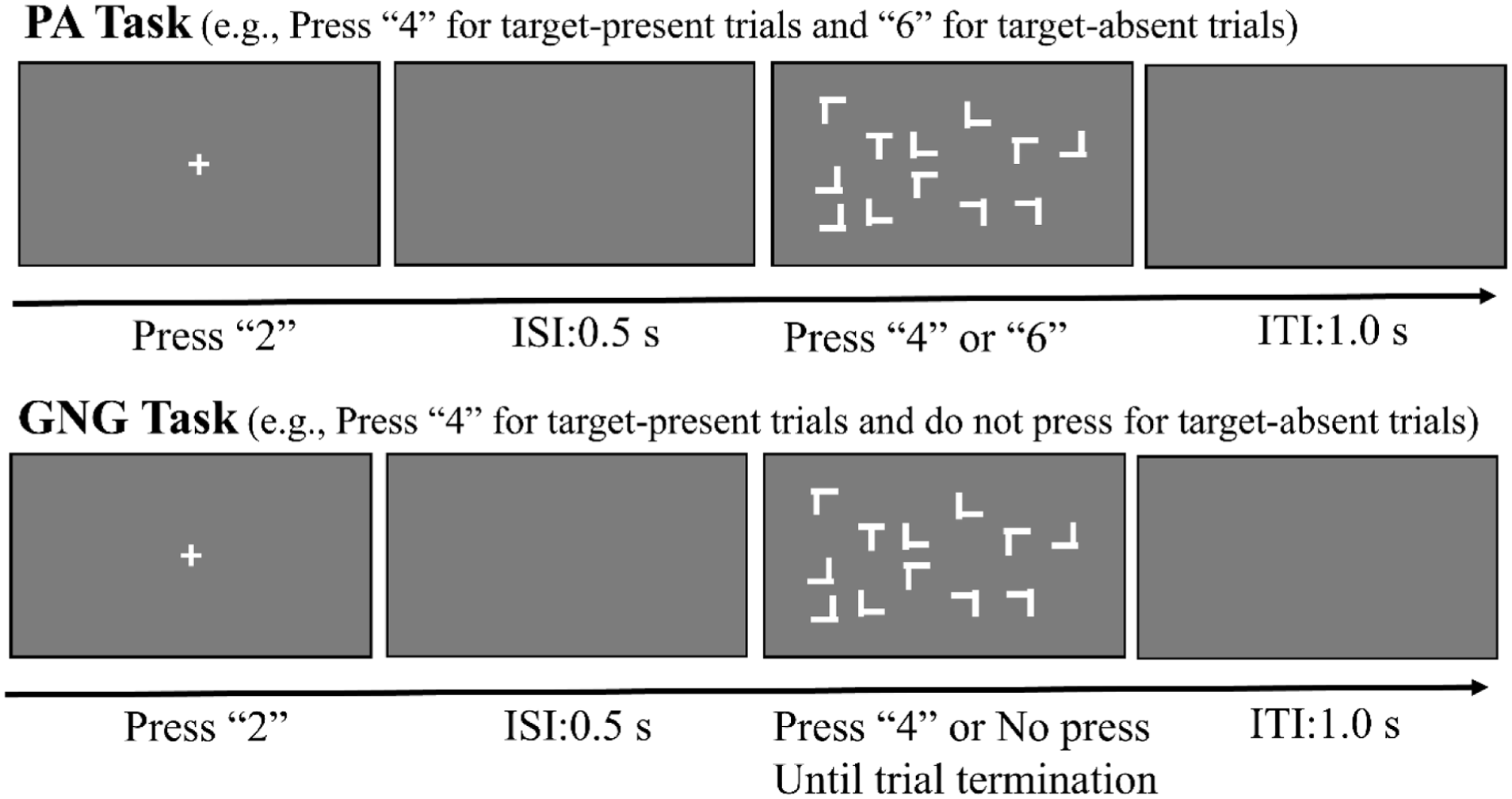
Sample trial sequence for a target-present trial in the PA and GNG tasks.
In the GNG task, we randomly varied the trial termination time between 2.0 and 2.9 s in 0.1-s increments, with an equal number of trials at each termination time. The minimum criterion of 2.0 s for trial termination was adopted based on Kristjánsson (2015), which utilized GNG response types in feature search and multiple conjunctive search experiments. The central fixation was presented for the subsequent trial after 1.0 s intertrial interval following the participants’ response or trial termination.
Participants completed two blocks of trials (named test session). One was the low prevalence block, consisting of 600 trials with optional breaks every 60 trials. The other was the high prevalence block, composed of 60 trials. Both blocks contained 30 target-present trials, resulting in target prevalences of 5% in the low prevalence block and 50% in the high prevalence block.
At the beginning of the test session, participants were given instructions about responding to the visual search task and completed 10 practice trials with a 50% target prevalence to familiarize themselves with the task. No feedback was provided for correct or incorrect responses during the experiment. Participants were informed of the target prevalence (high or low) before each block. The order of the blocks was counterbalanced among participants, and the trial order was randomized in each block. Additionally, a 3-min break was provided between blocks.
Data Analysis
The data were analyzed using a mixed-design analysis of variance (ANOVA), primarily focusing on miss rates. Prevalence (high vs. low) was treated as a within-participant factor, and task (GNG vs. PA) as a between-participants factor. Trials with RTs faster than 200 ms or slower than the mean RT plus 2.5 times the standard deviation (SD) for each condition from each participant were excluded as outliers. Post hoc comparisons were performed using the Bonferroni correction. Additionally, as supplementary analyses, we examined the false-alarm rates, RTs for correct target-present trials, and RTs for correct target-absent trials (PA task only). All statistical tests were conducted with a significance level of p < .05. This experiment was not preregistered.
Results
Figure 2a presents the miss rates observed in Experiment 1. A mixed-design ANOVA revealed a significant main effect of prevalence, F(1, 38) = 71.99, p < .001, partial η2 = .655, and a non-significant main effect of task, F(1, 38) = 0.01, p = .938, partial η2 < .001. Importantly, the interaction between task and prevalence was significant, F(1, 38) = 11.46, p = .002, partial η2 = .232. Post hoc analysis of the simple effects of prevalence showed that in both tasks, the miss rate in the low prevalence condition (mean miss rate: 0.315 and 0.248 in the PA and GNG tasks, respectively) was significantly higher than in the high prevalence condition (0.090 and 0.152, respectively), ps <.001. The simple effect of the task showed that the miss rate was significantly higher in the GNG task than in the PA task under the high prevalence condition, p = .036. In contrast, no significant difference was found between tasks under the low prevalence condition, p = .142. As a result, the degree of the LPE in the GNG task (0.097) was smaller than in the PA task (0.225), t(35.45) = 3.39, p = .002, Cohen’s d = 1.07 (Welch’s t-test with adjusted degrees of freedom to account for variance heterogeneity).
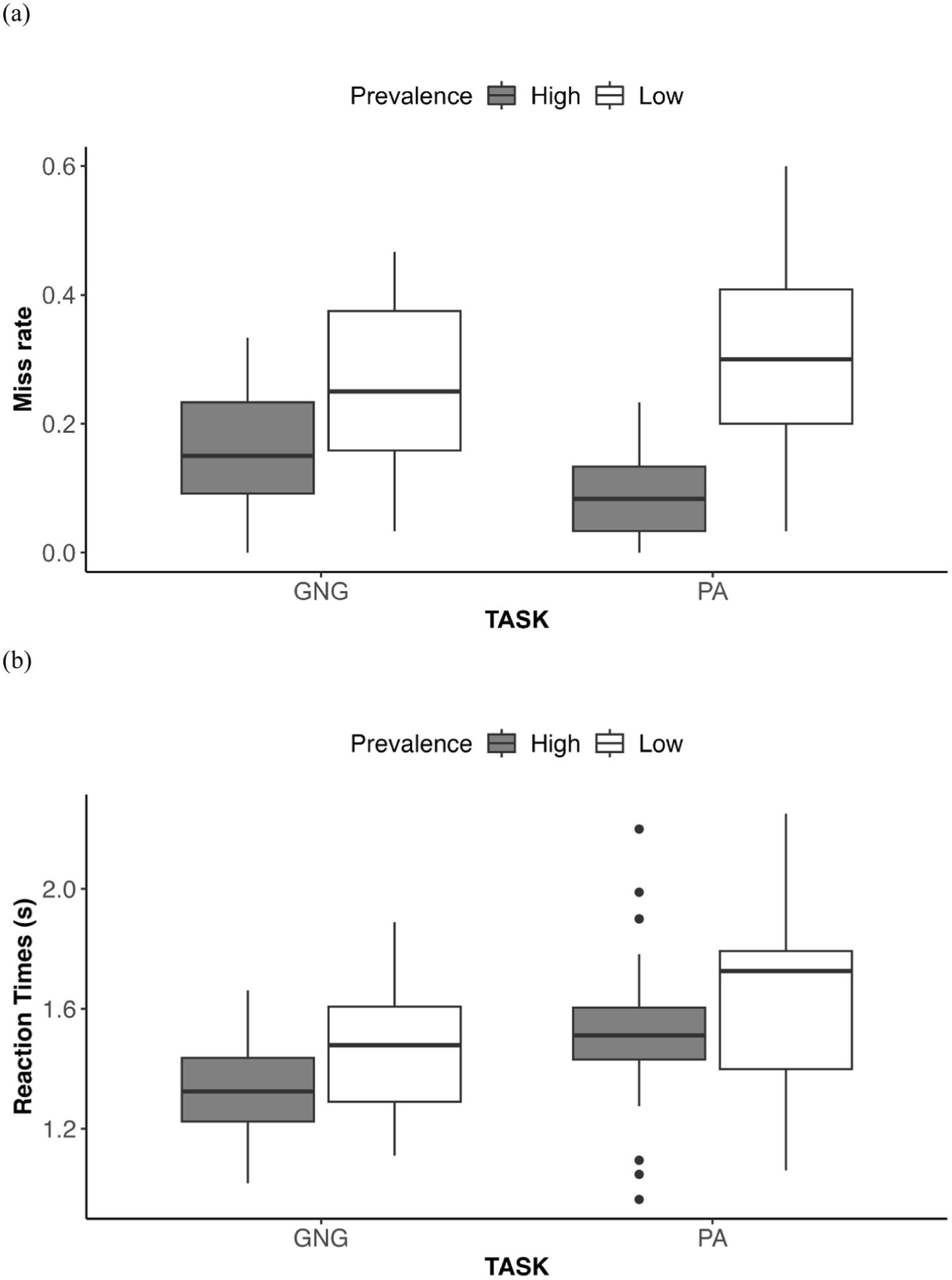
Results of (a) miss rates and (b) reaction times for correct target-present trials across task and prevalence conditions in Experiment 1.
An ANOVA on false-alarm rates revealed a significant interaction between task and prevalence, F(1, 38) = 6.37, p = .016, partial η2 = .144. The simple main effect of the task showed that the GNG task’s false-alarm rate (0.020) was significantly higher than in the PA task (0.005) under the high prevalence condition, p = .013, whereas there was no significant difference under the low prevalence condition, 0.001 in GNG, 0.001 in PA, p = .512.
We also conducted a mixed ANOVA on RTs in correct target-present trials (Figure 2b). RTs in the GNG task (1.391 s) were faster than in the PA task (1.585 s), F(1, 38) = 8.17, p = .007, partial η2 = .177, and RTs were faster in the high prevalence condition (1.424 s) than in the low prevalence condition (1.553 s), F(1, 38) = 8.99, p = .005, partial η2 = .191. No significant interaction was found between task and prevalence, F(1, 38) = 0.02, p = .903, partial η2 < .001. It is noted that overall RTs appear relatively long (approximately 1.5 s) in the T-among-L search task, possibly due to the offset in the L stimulus, which increased task difficulty.
Additionally, we compared the RTs in correct target-absent trials between the prevalence conditions in the PA task. RTs in the low prevalence condition (2.083 s) were significantly faster than in the high prevalence condition (2.693 s), t(19) = 4.80, p < .001, Cohen’s d = 1.01.
Discussion
Results showed that miss rates increased in the low prevalence condition not only in the PA task but also in the GNG task, confirming that the LPE emerged in both tasks. Our results also demonstrated that participants respond more slowly to target presence when targets are less frequent regardless of response type. Although RTs in correct target-present trials are generally less sensitive to target prevalence than those in target-absent trials (Wolfe, 2021), target-present RTs can sometimes vary based on target prevalence (e.g., Ishibashi et al., 2012; Nakashima et al., 2015). Thus, our results about RTs are not surprising.
Importantly, the degree of the LPE was numerically smaller with the GNG response type than with the PA response type. In addition, the faster responses observed in the GNG task compared to the PA task align with findings from previous studies (Kristjánsson, 2015; Wang et al., 2005), indicating that the GNG task does not require discrimination between the presence and absence of a target in the decision-making process. Taken together, our results imply that modifying the response structure may decrease the degree of the LPE due to the decision process modulation.
However, the mitigation of the LPE should be interpreted cautiously given the overall performance pattern observed in the GNG task. Miss rates in the low prevalence condition were not significantly different between the two tasks. Instead, the miss rate in the high prevalence condition was higher in the GNG than in the PA task, despite its less effort requirement (Van der Heijden & La Heij, 1982; Wang et al., 2005). This pattern indicates that the apparent LPE reduction was not driven by a clear improvement in rare-target detection. In addition, although false-alarm errors were infrequent compared to miss errors, the GNG response type in this experiment demonstrated a disadvantage in terms of false alarms compared to the PA response type. Unexpected factors may influence performance in the GNG task observed in this experiment.
Given that the mean correct target-absent RTs in the PA task ranged from approximately 2.1 to 2.7 s, the trial termination time between 2.0 and 2.9 s in the GNG task might not be long enough to view a search display sufficiently. Participants may have rushed, sometimes mistakenly responding as target-present. More importantly, this may have caused some trials to terminate too early, preventing participants from searching for the target thoroughly. In this case, a target-absent decision was recorded, contributing to the relatively high miss rate in the GNG task.
We conducted an additional analysis to investigate the possibility that early trial termination in the GNG task contributed to the elevated miss rate. We divided each participant’s target-present trials in the GNG task into two groups based on the trial termination time: an early termination group (2.0–2.4 s) and a late termination group (2.5–2.9 s). Overall, 15 out of 20 participants exhibited higher miss rates in the early termination than in the late termination group. A 2 (Prevalence: high vs. Low) × 2 (Trial Termination: Early vs. Late) ANOVA on miss rates, focusing on the main effect of trial termination and its interaction with prevalence, revealed a significantly higher miss rate in the early termination group (0.241) than in the late termination group (0.165), F(1, 19) = 10.15, p = .005, partial η2 = .348. There was no significant interaction, F(1, 19) = 1.75, p = .201, partial η2 = .084. Thus, the relatively high miss rate in the GNG task can be due to early trial termination, independent of target prevalence.
The results in Experiment 1 provide suggestive evidence that the GNG response method may influence the LPE, but it also indicates that its effectiveness depends critically on appropriate trial termination time. Too early trial termination in the GNG task contributes to higher miss rates, implying that giving participants more time could reduce such errors. However, simply extending the duration for all participants may not be an ideal solution. Some participants might feel that even a longer termination time is too short. In contrast, a prolonged termination time could lead to boredom in other participants; indeed, some participants exhibited higher miss rates in the late termination trials. These considerations led to Experiment 2, where trial termination time was customized based on each participant’s performance threshold to minimize early trial termination. In Experiment 2, we aimed to examine again the effectiveness of the GNG method for mitigating the LPE.
Experiment 2
The purpose of Experiment 2 was to examine the LPE mitigation by the GNG response method with customized trial termination times. In Experiment 1, the potential benefit of the GNG response structure may have been constrained by insufficient trial durations. If too early trial termination contributed to elevated miss rates, then adjusting trial termination time based on individual performance thresholds should reduce such miss errors. Under this refinement, we expected the GNG task to show lower overall miss rates and a more reliable reduction of the LPE relative to the PA task.
Experiment 2 introduced a pre-test session consisting of a PA task with a 50% target prevalence before the test session. We determined each participant’s trial termination time for the GNG task based on their mean correct target-absent RT in the pre-test session. In visual search tasks, target-present responses are generally faster than target-absent responses. Therefore, we assumed that a trial termination time based on the target-absent RT would be sufficiently long for each participant’s target-present responses.
Method
Participants
In the analysis of miss rates in Experiment 1, we observed a large effect size (f = 0.5) for the interaction. Based on this effect size, a priori power analysis using G*Power indicated a minimum required sample size of 12 participants. However, to ensure sufficient statistical power and consistency with Experiment 1, we set the target sample size for Experiment 2 at 40 participants. We recruited 41 new graduate and undergraduate students from Kyoto University, all native Japanese speakers. The participants provided their informed consent for participation. Participants were paid 1,500 yen for their participation. All participants had normal or corrected-to-normal vision except one participant whose data we excluded from the analysis. We analyzed the data of 40 participants (age: M = 21.6 years, SD = 3.1; 14 women). As in Experiment 1, we randomly assigned the participants to 1 of the 2 task groups, with 20 participants in each group.
Apparatus, Stimuli, and Procedure
The apparatus, stimuli, and procedure in Experiment 2 were identical to those in Experiment 1, except for introducing a pre-test session and customizing trial termination times for each participant in the GNG task group. Participants first completed the pre-test session, which included training (10 trials) and a 50% prevalence condition (60 trials). Each participant’s mean correct target-absent RT was calculated and rounded to the nearest 10th of a second (e.g., 2.8 s), which was determined as the criterion RT. Each trial in the test session of the GNG task group was randomly terminated between the participant’s criterion RT and the criterion plus 0.9 s, in 0.1-s increments, with an equal number of trials at each termination time. The pre-test session was also conducted for the PA task group to maintain consistency in the experimental procedure, although we did not use the data from this session. Participants were given a 5-min break between the pre-test and test sessions. This experiment was not preregistered.
Results and Discussion
We set the trial termination criterion for the GNG task based on each participant’s RT in the pre-test session. The mean criterion in the GNG task group was 3.4 s in Experiment 2, substantially longer than the 2.0 s in Experiment 1. It is noted that the correct target-absent RTs in the pre-test session were not different between the PA and GNG groups (3.126 s vs. 3.344 s), t(37.28) = 0.701, p = .488, Cohen’s d = 0.22.
A mixed ANOVA on miss rates (Figure 3a) revealed significant main effects of task, F(1, 38) = 10.78, p = .002, partial η2 = .221, and prevalence, F(1, 38) = 54.14, p < .001, partial η2 = .588. Notably, a significant interaction was observed between task and prevalence, F(1, 38) = 4.87, p = .033, partial η2 = .114. Simple effects analysis showed that, in both tasks, the miss rate was higher under the low prevalence condition (0.307 in PA; 0.115 in GNG) than under the high prevalence condition (0.155 in PA; 0.033 in GNG), ps <.001. Furthermore, the miss rate in the GNG task was lower than in the PA task under both the high prevalence condition, p = .005, and the low prevalence condition, p = .002. Again, the degree of the LPE in the GNG task (0.082) was smaller than in the PA task (0.152), t(33.75) = 2.21, p = .034, Cohen’s d = 0.70. The mean false-alarm rates in the GNG task were 0.007 in the high prevalence condition and 0.001 in the low prevalence condition, whereas the corresponding values in the PA task were 0.003 and 0.002. There were no main effects of task, F(1, 38) = 0.35, p = .557, partial η2 = 009, and prevalence, F(1, 38) = 2.50, p = .122, partial η2 = .062, and no interaction, F(1, 38) = 0.70, p = .408, partial η2 = .018.
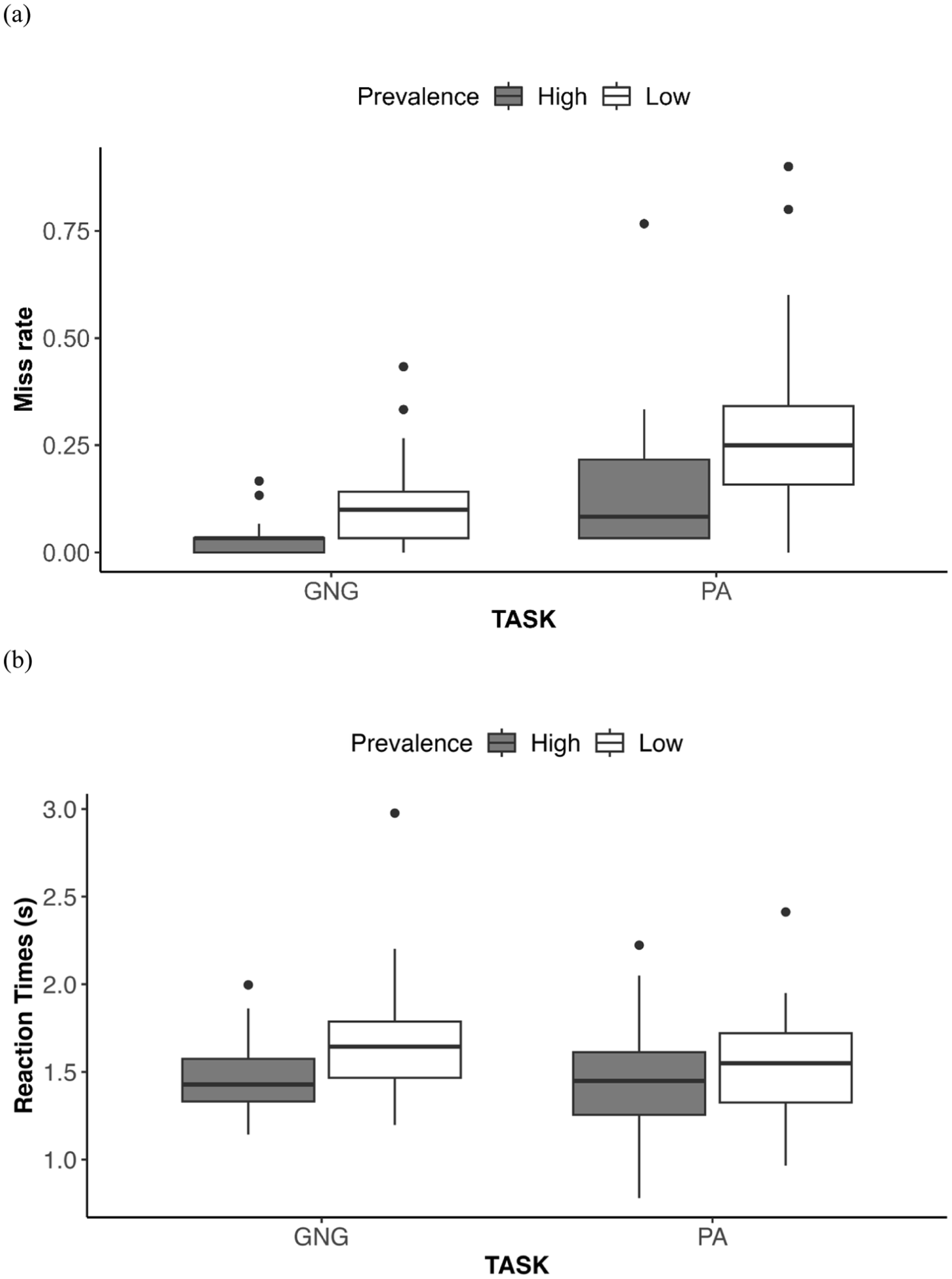
Results of (a) miss rates and (b) reaction times for correct target-present trials across task and prevalence conditions in Experiment 2.
Overall miss rates, unlike Experiment 1, were lower in the GNG task than in the PA task when the trial termination time in the GNG task was customized based on each participant’s RT in the pre-test session. This indicates the facilitation of visual search by the GNG response method. More importantly, the GNG response method effectively mitigated the LPE compared to the target PA response method typically used in visual search experiments. In sum, the benefit of the GNG response method for mitigating the LPE should be enhanced when it is combined with the customized trial termination times.
Overall false-alarm rates were very low. This was not very surprising, because it was comparable to the false-alarm result in Rich et al. (2008) which conducted a task requiring participants to search for a “T” shape among “L” shapes. In this experiment, participants may have adopted a cautious response strategy and responded only when they were confident that the target was present. Importantly, the GNG task showed no disadvantage in false-alarm rates, which contrasts with the findings from Experiment 1. Providing each participant with adequate time for a thorough search could reduce not only miss errors but also false-alarm errors.
A mixed ANOVA on correct target-present RTs (Figure 3b) revealed a significant main effect of prevalence, F(1, 38) = 15.21, p < .001, partial η2 = .286, indicating that RTs were faster in the high prevalence condition (1.460 s) compared to the low prevalence condition (1.622 s). There were no significant main effect of task, F(1, 38) = 0.78, p = .381, partial η2 = .020, and the interaction, F(1, 38) = 3.68, p = .063, partial η2 = .088. In the PA task, the correct target-absent RTs in the low prevalence condition (1.868 s) were significantly faster than in the high prevalence condition (2.584 s), t(19) = 4.97, p < .001, Cohen’s d = 0.80.
The results of RTs were generally consistent with Experiment 1. However, unlike Experiment 1, no differences between the GNG and PA tasks were observed. Additionally, correct target-present responses in the GNG task averaged across prevalence conditions were slower in Experiment 2 (1.583 s) than in Experiment 1 (1.391 s), t(31.29) = 2.74, p = .010, Cohen’s d = 0.87. Considering the longer trial termination time and lower miss rates in Experiment 2 compared to Experiment 1, these results suggest that early trial termination can impose time pressure on participants, leading to increased miss errors and faster responses in visual search tasks (Rieger et al., 2021). In other words, weakened time pressure due to the customized trial termination time in Experiment 2 allowed participants to search more carefully, resulting in slower responses and fewer miss errors. Consequently, correct target-present RTs did not differ significantly between the PA and GNG tasks in Experiment 2. Thus, overall miss errors in the GNG task caused by early trial termination can be reduced effectively by setting trial durations based on the individuals’ performance thresholds.
Furthermore, we explored whether frequently repeated explicit “target-absent” responses actually increased the miss rates in the low prevalence conditions, and conversely, whether the absence of explicit “target-absent” responses could prevent an increase in miss rates. This analysis is theoretically important because it tests whether the LPE may partly arise from cumulative effects of repeated target-absent decisions on miss errors. An analysis was conducted by dividing the data (600 trials in each participant) from the low prevalence condition into two segments (i.e., first half: 1st–300th trials; second half: 301st–600th trials). We predicted that, in the PA task, correct target-absent RTs would be faster and miss rates would increase in the second half. We also predicted that the increase in miss rate in the second half of the GNG task would be inhibited compared to the PA task.
An ANOVA on correct target-absent RTs in the PA task, with the segment (First half vs. Second half; within-participant), revealed a significant main effect of the segment, showing that correct target-absent responses were faster in the second half (1.643 s) than in the first half (2.102 s), F(1, 19) = 30.34, p < .001, partial η2 = .615. A mixed ANOVA on miss rates (Figure 4), with the segment and task as factors, revealed a significant interaction, F(1, 38) = 7.81, p = .008, partial η2 = .171. Post hoc analysis showed that in the PA task, the miss rate was higher in the second half (0.370) than in the first half (0.243), p < .001, whereas there was no significant difference between the second (0.110) and first (0.120) halves in the GNG task, p = .774. Therefore, frequent and repetitive “target-absent” responses could make higher miss rates, and conversely, the absence of them could prevent this increase.
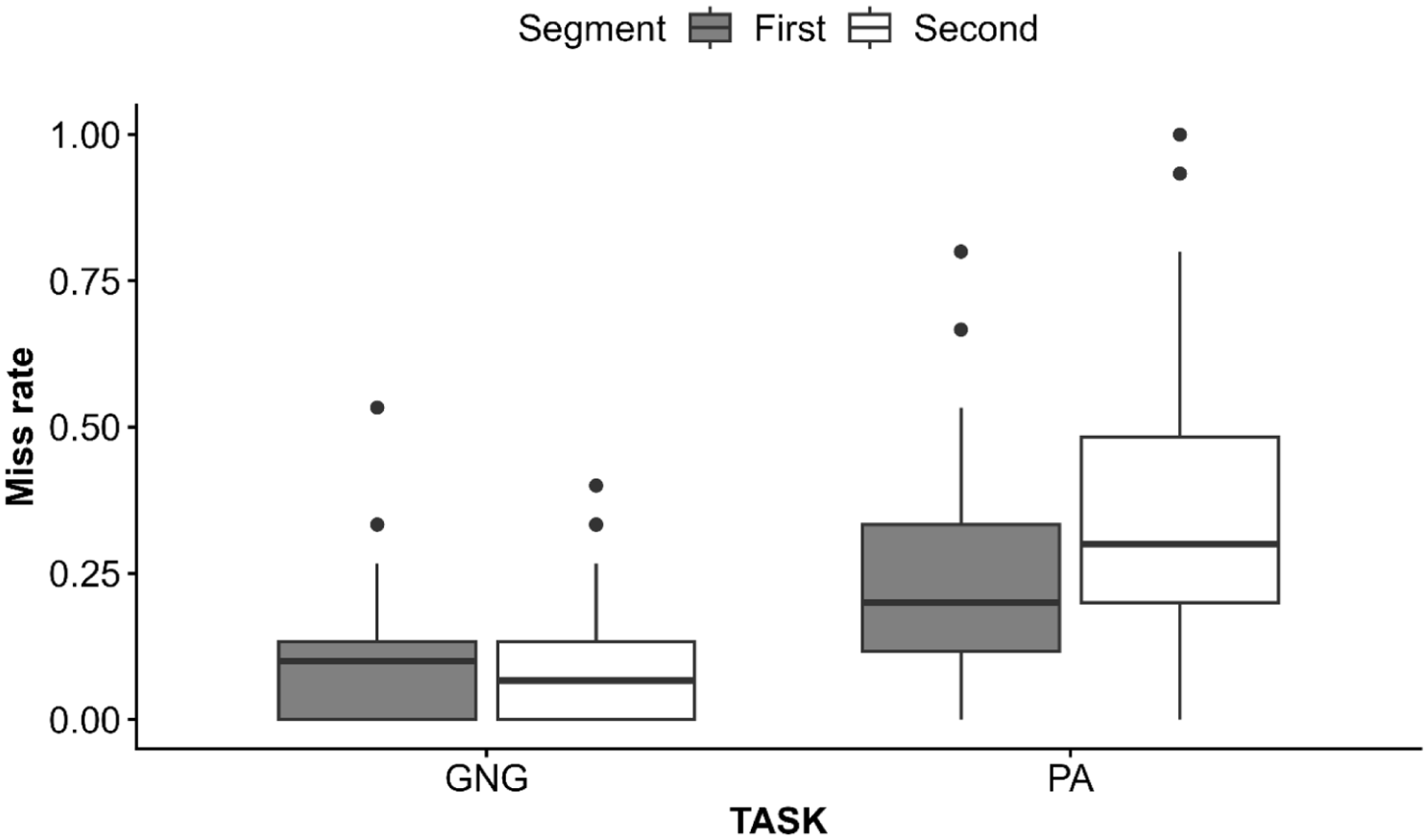
Miss rates across task and segment conditions in the low prevalence condition in Experiment 2.
It is noted that the block order did not influence miss rates. An additional analysis including Block order (high–low prevalence vs. low–high prevalence) as a factor in a Task × Prevalence × Order ANOVA on miss rates revealed no significant effects involving Block order, Fs <2.48, ps >.124, partial η2s >.005. That is, miss rates in the high prevalence condition did not differ depending on whether the block was performed before or after the low prevalence condition. This suggests that even after the low prevalence block where frequent and repetitive “target-absent” responses were required in the PA task, the break time and the task instruction enabled the participants to change their search strategy and/or decision criterion in the high prevalence block. Therefore, the overall difference in visual search performance between the GNG task and the PA task is not due to the incidentally increased miss rates in the high prevalence condition after the low prevalence condition in the PA task.
General Discussion
This study investigated whether the LPE in visual search tasks could be mitigated using a GNG response type in which an explicit target-absent response is not required. The results demonstrated that the LPE could be clearly reduced in the GNG response task compared to the PA response task when combined with customized trial termination times based on each individual’s performance. Thus, eliminating the need to respond “target-absent” could effectively mitigate the LPE.
Our proposed method using the GNG task is straightforwardly grounded in the multiple-decision model (Wolfe & Van Wert, 2010). We assumed that frequent explicit target-absent responses lower the quitting threshold in the multiple-decision model. The absence of explicit target-absent responses can inhibit conscious target-absent decisions, thereby preventing the lowered quitting threshold when targets are rare. Supporting this assumption, additional analyses in Experiment 2 showed that miss rates increased following frequent target-absent trials in the PA task, but not in the GNG task. That is, our results fit within the multiple-decision model framework explaining the LPE.
As noted earlier, prior studies have highlighted that the GNG task does not require participants to discriminate between target presence and absence during decision-making (e.g., Kristjánsson, 2015). This design may allow participants to focus more effectively on detecting targets, potentially improving search efficiency. It is plausible that enhanced search efficiency could explain the LPE mitigation. However, our findings do not support this interpretation. In Experiment 1, responses were faster in the GNG task than in the PA task, but the GNG task also resulted in more miss and false-alarm errors. This result indicates that quicker responses stemming from reduced response selection demands are insufficient to eliminate the LPE. Therefore, the GNG response method may not directly mitigate the LPE through enhanced visual search efficiency, but rather through its role in subtly modulating the quitting threshold that governs search termination.
Potential Advantages of the GNG Method
In addition to mitigating the LPE, the GNG method may offer further advantages. Notably, in Experiment 2, the GNG response method did not significantly increase false-alarm rates. One might expect that false-alarm rates would rise in a two-alternative choice situation, where inhibiting target-absent responses could conversely facilitate target-present responses (cf. Schwark et al., 2012; Wolfe et al., 2013). This can be interpreted as the shift of the target-present/absent decision criterion. In contrast, our method eliminates the target-absent response, which may help to prevent false-alarm errors, especially when observers feel they have sufficient time to search for the target. Thus, the GNG response with performance-based termination time effectively mitigates the LPE without increasing false-alarm rates.
Another advantage of the GNG method lies in its simplicity compared to previously proposed methods for mitigating the LPE, such as increasing response options (Nakashima et al., 2013; Rich et al., 2008). Such an approach makes the task setting more complex, sometimes leading to errors beyond the LPE due to increased cognitive demands for the response selection. In contrast, our method could alleviate potential fatigue and cognitive load.
Furthermore, since this method only requires a change in response types, it can be easily integrated with other approaches. For example, the combination of our method and perceptual learning should be effective. Perceptual training on target stimuli (e.g., training for targets through a perceptual discrimination task) improves target detection sensitivity and response speed in visual search tasks (Schuster et al., 2013), which could improve visual search performance and help mitigate the LPE due to perceptual failures. Investigating this issue in greater detail would be both necessary and intriguing.
Limitations and Future Research
Our results demonstrate the effectiveness of the GNG method in mitigating the LPE. However, due to the relatively simple experimental design in our study, there are some limitations to be considered.
First, while customized trial termination times effectively reduce miss errors caused by early trial termination, they substantially extend the total task time, especially in low prevalence situations. In Experiment 1, the mean total task time (excluding the break time) for participants in the low prevalence condition was approximately 45 min for the GNG task and 40 min for the PA task. In Experiment 2, it was approximately 57 min for the GNG task and 37 min for the PA task. Such extension may distress observers if mandatory breaks are not provided. Buser et al. (2020) investigated the impact of breaks on task performance during 60-min X-ray image inspections under high and low prevalence conditions. They reported that breaks did not affect performance; however, screeners without breaks reported high levels of distress. In our study, participants were allowed to take breaks freely after every 60 trials and start trials at their own pace. Nevertheless, participants possibly underestimated their need for breaks, potentially leading to insufficient rest. Therefore, it is crucial to design adequate mandatory breaks when implementing a GNG response type with customized trial termination in environments with infrequent target presentations.
Second, related to the above, the longer trial time, or task time, required in the GNG condition may limit its practical applicability in real-world settings, where target prevalence is typically much lower and time efficiency is critical. The additional time required for each trial may impose substantial time costs, particularly in large-scale screening contexts. Thus, although the GNG method provides a useful tool for investigating search termination mechanisms under controlled laboratory conditions, its practical implementation should be carefully balanced against considerations of time efficiency. In addition, we used the target-absent RTs as the criterion of the trial termination time, but this is one possible criterion. It is important to examine how to determine the trial termination time for each participant.
Third, to generalize our findings, investigating the effects of the GNG response method in more perceptually complex stimuli such as X-ray baggage scans and medical images is crucial. It is also important to consider multiple-target search environments, in which observers must simultaneously search for two or more targets and make PA (i.e., target-present/absent) decisions (e.g., Menneer et al., 2007, 2010). Further empirical research is needed to determine whether our method can effectively mitigate the LPE under such conditions. Through the investigation, we can evaluate the feasibility and applicability of our proposed method in real-world situations.
Fourth, it is unclear whether the prolonged trial termination time alone decreases the LPE. In Experiment 2, the mean trial termination time in the GNG task was longer than the mean target-absent RT in the PA task. This may make participants respond more slowly in the GNG task. Indeed, the target-present RTs were not different between the tasks, although the GNG response method does not require the target presence/absence discrimination in the decision-making process compared to the PA response method (Kristjánsson, 2015; Wang et al., 2005). This may reflect a speed–accuracy tradeoff, in which slower responding can improve detection accuracy (i.e., reduce miss errors). Although it is reasonable to argue that the speed–accuracy tradeoff can reduce overall miss errors, it remains unclear whether this reduction is particularly pronounced under the low prevalence situation. Further, this discussion leads to the following question: If the trial were to continue until the same termination point used in the GNG task, rather than ending immediately upon response, would the LPE also be mitigated even in the PA task? This is akin to the correctable search situation, where participants are given an opportunity to modify their initial response (Fleck & Mitroff, 2007). Such methods do not effectively reduce the LPE in relatively complex search tasks (Van Wert et al., 2009). Once participants have made a target-absent judgment in rare-target search tasks, unless they clearly recognize their own error, they may find it difficult to change their decision even when additional time is provided. Nevertheless, our experimental design could not consider these factors separately, future studies should manipulate these variables independently to disentangle their respective contributions to the LPE.
Fifth, it is important to generalize our findings to situations in which trial-by-trial feedback is provided. This study suggests that the GNG response method could effectively mitigate the LPE under no feedback situation. Our findings are important because the low prevalence visual search tasks, such as baggage screening or medical screening, generally include little or no feedback. In contrast, previous studies about the LPE usually conducted visual search tasks with trial-by-trial accuracy feedback (e.g., Rich et al., 2008; Taylor et al., 2022; Wolfe et al., 2007). Feedback could influence observers’ decision criteria or search termination strategies by encouraging performance monitoring and strategic adjustments (Wolfe, 2022). Moreover, Lyu et al. (2021) identified that feedback could modulate the LPE in perceptual decision. Thus, it is necessary to investigate the interactive effects of response type and feedback to clarify the robustness of the GNG effect and the underlying mechanisms of the decision process related to target prevalence.
Finally, it is important to note that the GNG task does not require participants to make an explicit target-absent response. As a result, reaction time data for target-absent trials are unavailable, which limits the interpretation of how participants internally determine target absence. To better understand this process, incorporating additional measures such as eye-tracking could be informative. For instance, gaze patterns can indicate whether participants continue inspecting remaining items or terminate the search early, thereby offering indirect evidence about the timing and strategy of search termination. Such information would provide a more detailed understanding of the decision processes underlying target-absent judgments.
Conclusion
To our knowledge, this study is the first to demonstrate that removing the explicit target-absent response effectively mitigates the LPE in visual search tasks. By focusing solely on target-present responses and reducing the pressure to rush, observers are less likely to miss rare targets, because premature search termination is effectively prevented in the low prevalence situation. This idea is simple and straightforward within the framework of the multiple-decision model, which accounts for the cognitive mechanisms of visual search (Wolfe & Van Wert, 2010).
Footnotes

Ethical Considerations
This study was conducted in accordance with the ethical principles of the Declaration of Helsinki and was approved by the Institutional Review Board of Kyoto University (KUIS-EAR-2019-004).
Consent to Participate
Written informed consent was obtained from all individual participants included in the study.
Author Contributions
BK served as lead for conceptualization, data curation, formal analysis, investigation, methodology, project administration, resources, software, validation, visualization, writing – original draft, and writing – review and editing. TK served in a supporting role for conceptualization, funding acquisition, methodology, project administration, resources, supervision, and writing – review and editing. RN served as lead for conceptualization, fund acquisition, methodology, project administration, resources, supervision, and writing – review and editing.
Funding
The authors disclosed receipt of the following financial support for the research, authorship, and/or publication of this article: This work was supported by KAKENHI grants from the Japan Society for the Promotion of Science (23K11787 to RN).
Declaration of Conflicting Interests
The authors declared the following potential conflicts of interest with respect to the research, authorship, and/or publication of this article: This article is based on research conducted as part of Byungju Kim’s doctoral dissertation.